
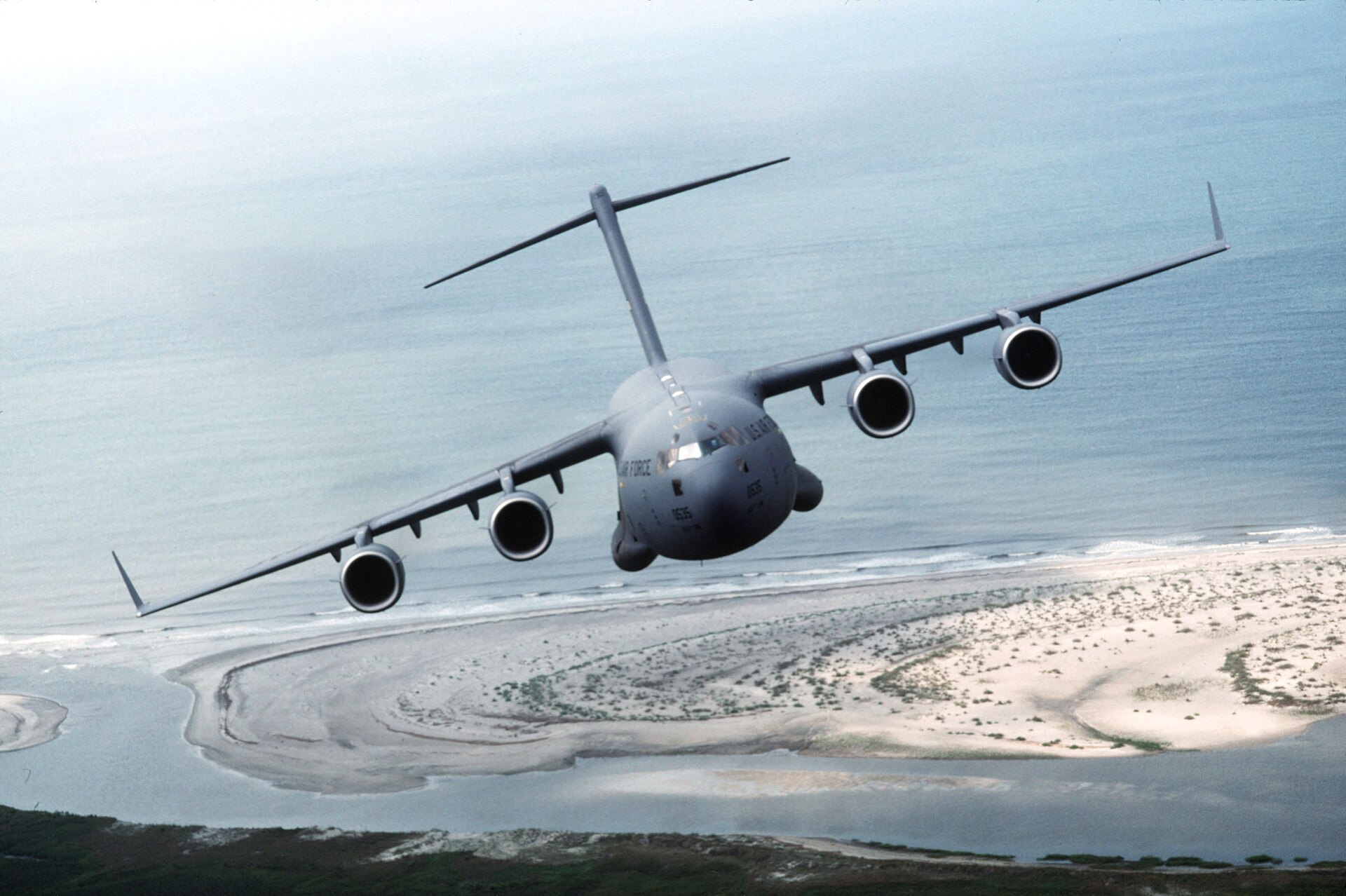
Boeing C-17 Globemaster III
Strategic Airlifter
A jet that can carry a main battle tank across an ocean and land it on a short, rough strip at the other end: the C-17 merged strategic and tactical airlift and became the West’s indispensable heavy lifter.
The C-17: how one airlifter learned to do two jobs
Until the 1990s the US Air Force divided airlift into two worlds. Jets such as the C-141 Starlifter and C-5 Galaxy flew across oceans to big, paved bases; turboprop C-130 Hercules carried the load forward to the short strips near the fighting. Every transfer cost time. The C-X requirement of the late 1970s asked for one aircraft that could do both: carry outsize Army equipment intercontinental distances and then deliver it directly to a small, austere airfield. In 1981 McDonnell Douglas won with a design that drew on its YC-15 short take-off demonstrator, and the name it eventually took honoured two earlier Douglas transports, the C-74 and C-124 Globemasters.
The road to service was rough. Development stretched through the 1980s, and by the early 1990s the programme was beset by cost growth, technical problems and doubts in Congress. The first aircraft flew from Long Beach to Edwards Air Force Base on 15 September 1991, but in 1993 the Pentagon put the contractor on notice and capped the buy unless performance improved. It did. The C-17 entered service at Charleston, South Carolina, in January 1995, and later that year the Air Force committed to a full fleet. After McDonnell Douglas merged into Boeing in 1997, the Long Beach line went on to build 279 aircraft before closing in November 2015.
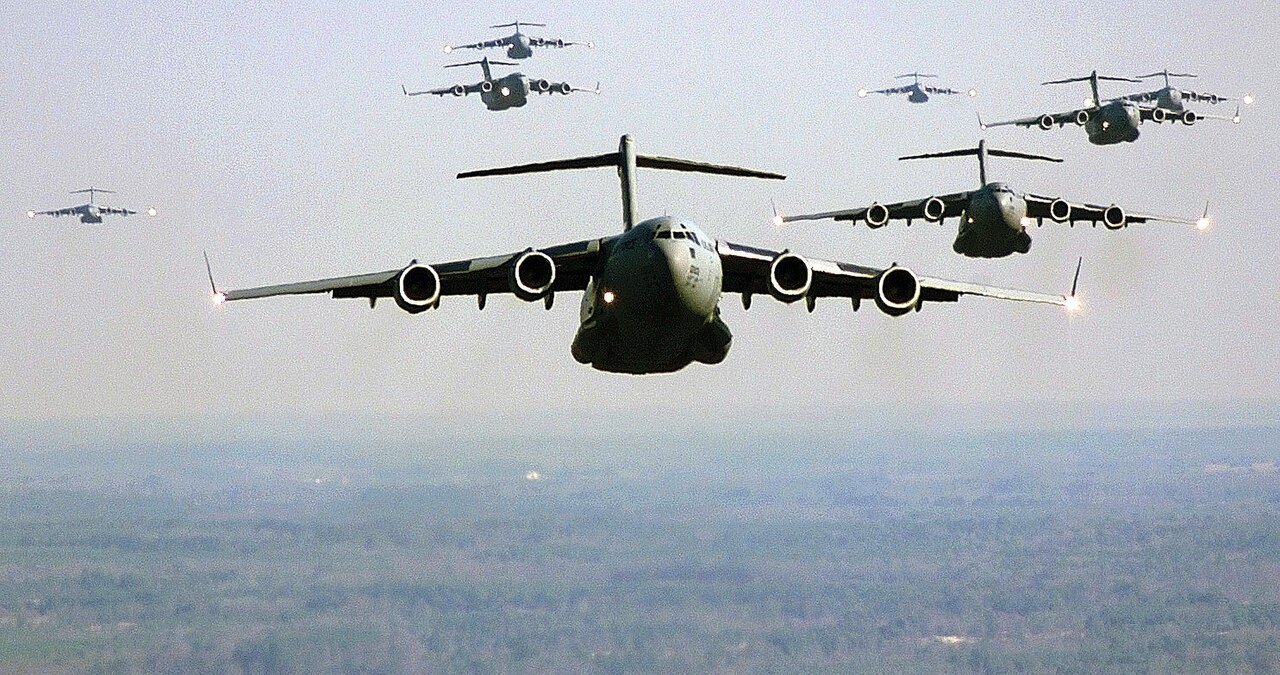
By then the C-17 had become the aircraft every Western military crisis seemed to depend on. It flew into Bosnia and Kosovo, dropped paratroopers into northern Iraq, kept forces in Afghanistan supplied for twenty years, carried relief to Haiti, Japan and Nepal, and supported scientists in Antarctica. Britain, Australia, Canada, India, Qatar, the UAE and Kuwait bought it, and a dozen NATO and partner nations share three through the Strategic Airlift Capability in Hungary. In August 2021 a single C-17 lifted 823 people out of Kabul, the most ever carried by the type. Boeing gives the global fleet as 275, with the US Air Force flying 223 of them.
01The C-17’s difficult birth: from C-X to near-cancellation
The C-17 was conceived in an era when Vietnam and the 1973 Yom Kippur airlift had exposed the limits of American air mobility. The C-X competition sought a jet that could carry the Army’s outsize equipment, including tanks, and deliver it straight to forward airfields. McDonnell Douglas’s winning design used externally blown flaps, in which engine exhaust is directed over large slotted flaps to create extra lift at low speed, a technique proven on the YC-15 prototypes of the 1970s.
Budget pressures slowed full-scale development, which did not begin in earnest until the mid-1980s. Problems with the wing, software and weight, combined with cost growth, made the programme a target in Washington in the early 1990s. After the 1993 intervention by the Defense Department, the company reorganised its management and production, and a demanding reliability evaluation in 1995 helped persuade the Air Force to buy a full fleet. What had been one of the most criticised procurement programmes of its day ended as one of the most valued aircraft in the inventory.
02The C-17 abroad: Britain, Australia and the NATO wing in Hungary
The Royal Air Force was the first export customer, initially leasing four aircraft from 2001 for No. 99 Squadron at RAF Brize Norton and later buying them and adding more, for a total of eight. Australia’s No. 36 Squadron at Amberley received its first in 2006 and also built up a fleet of eight, used for missions from Afghanistan to Antarctica and for disaster relief across the Pacific. Canada bought five as the CC-177, and India’s fleet of eleven made it the largest operator outside the United States.
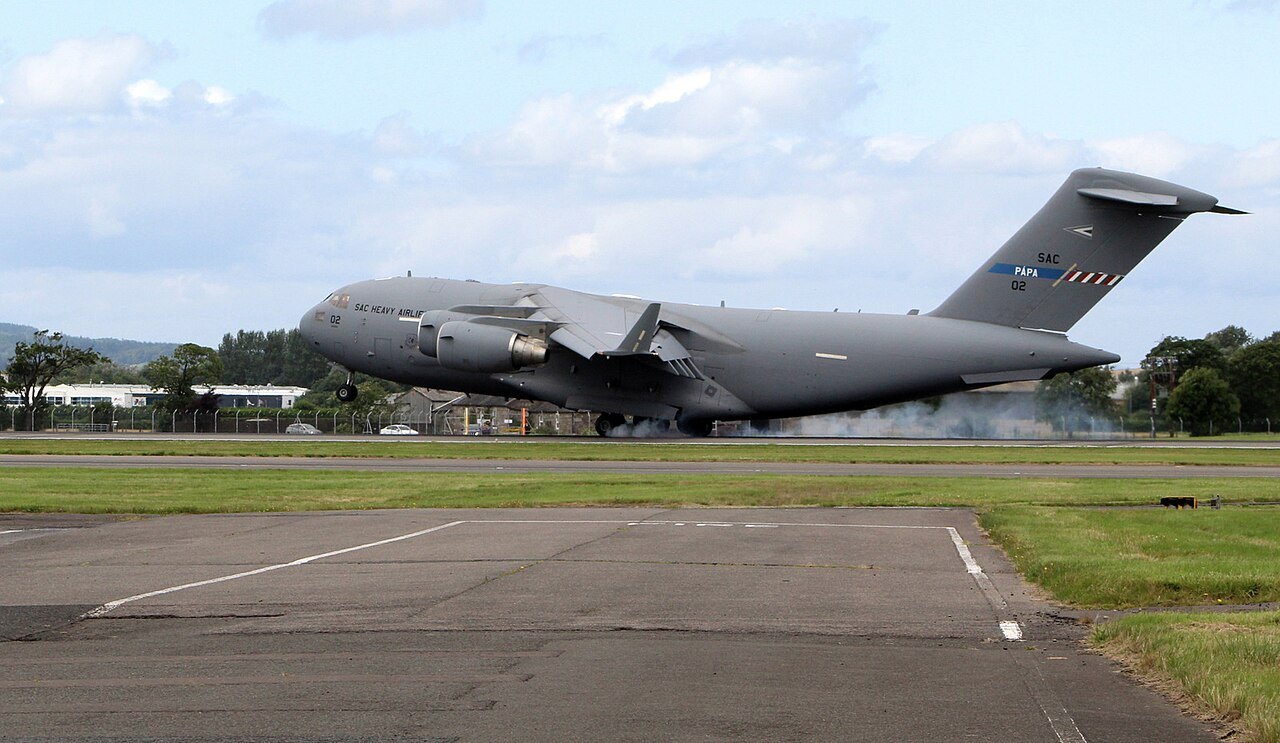
The most unusual operator is the Strategic Airlift Capability, a consortium of NATO and partner nations, including non-aligned Sweden and Finland at the time, that jointly owns three C-17s based at Pápa in Hungary. Flown by the multinational Heavy Airlift Wing since 2009, the aircraft carry national markings of Hungary but fly missions for each member according to its share of flight hours, giving smaller nations access to strategic airlift they could not afford alone.
What makes the C-17 special
Short-field heavy lifter
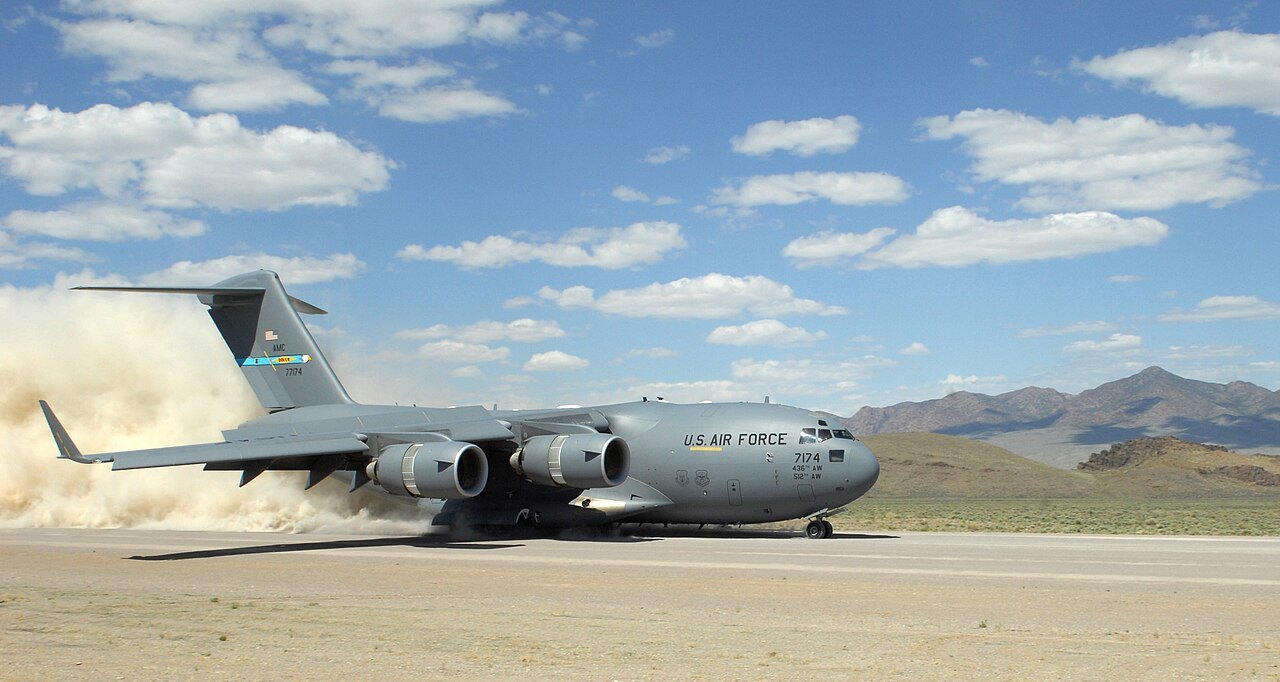
Externally blown flaps, a supercritical wing and powerful thrust reversers let the C-17 make steep, slow approaches and stop in a short distance at heavy weights. It is designed to use runways of around 3,500 ft (1,070 m) and can operate from unpaved strips. The thrust reversers are strong enough to let a loaded aircraft reverse up a slope on the ground, so it can turn and park on cramped forward airfields without a tug.
A hold sized for the Army
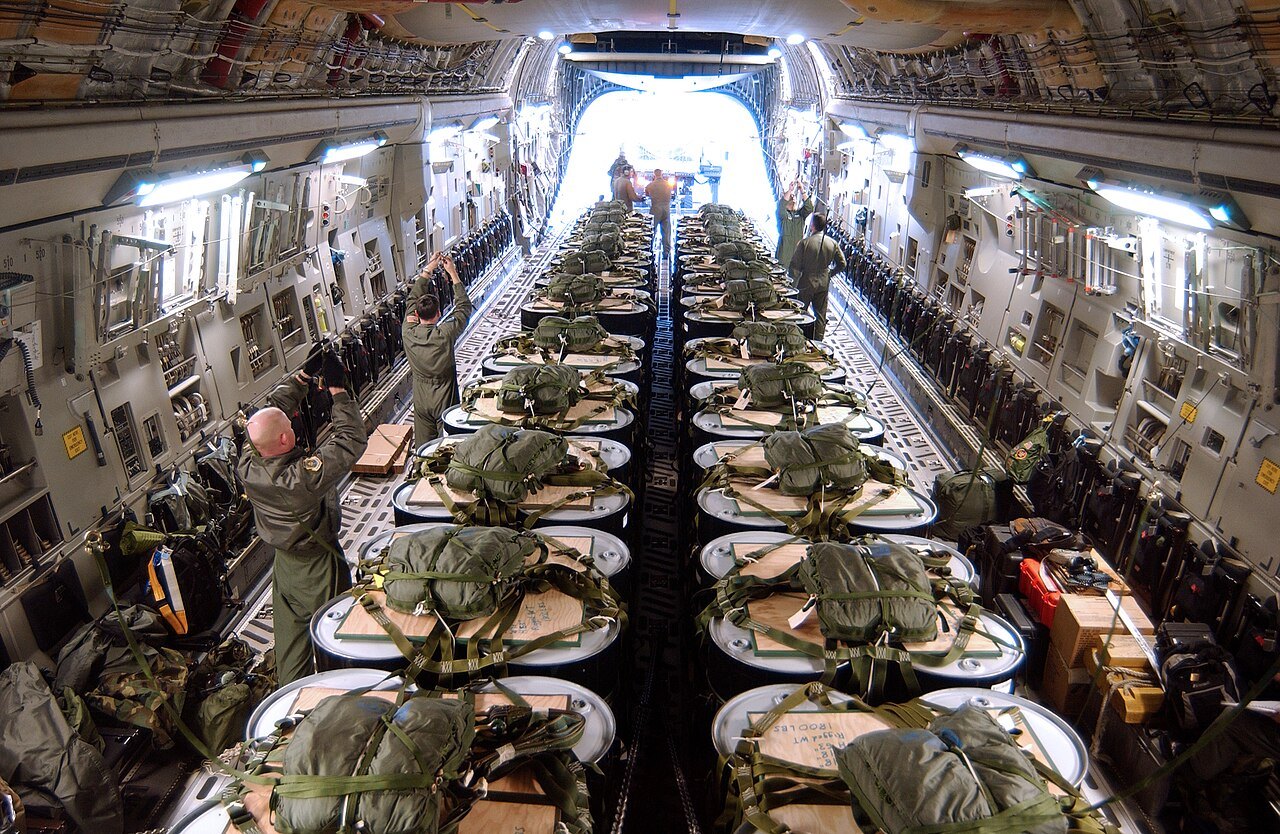
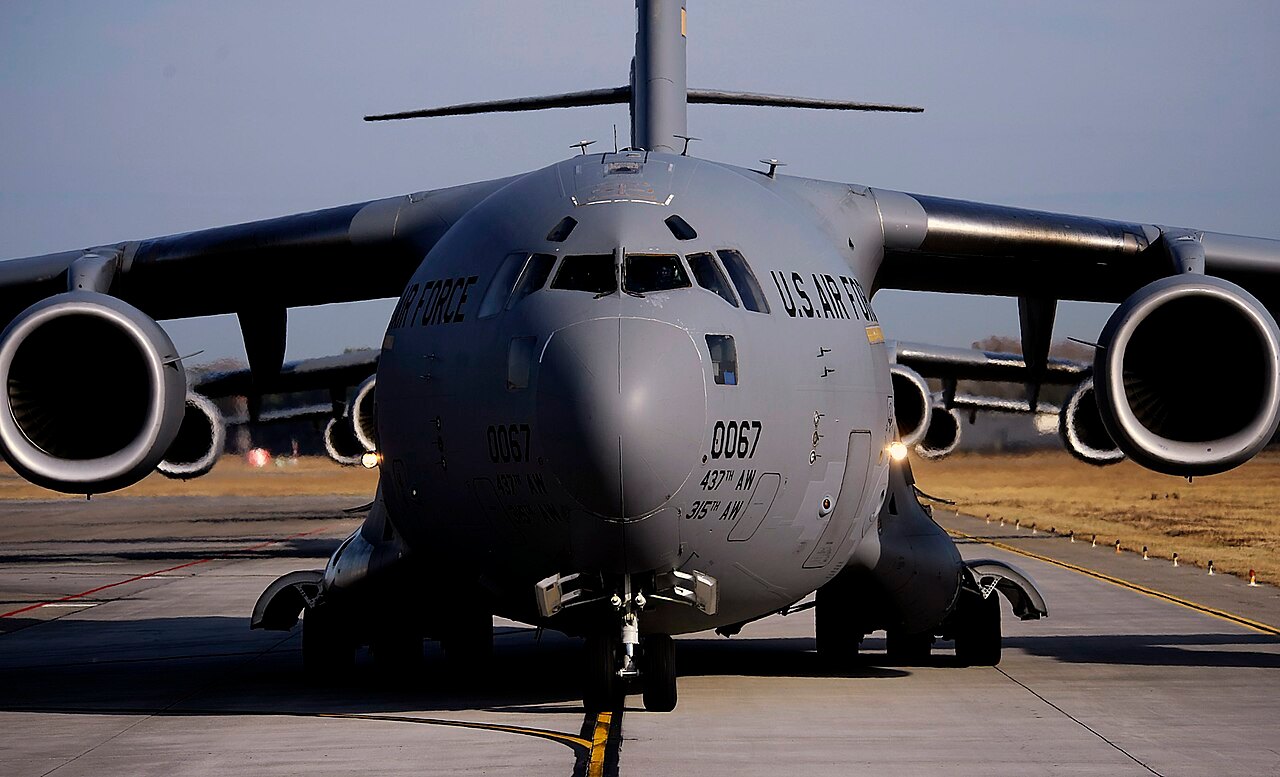
The cargo floor was dimensioned around Army equipment rather than pallets. Boeing gives a maximum payload of 164,900 lb in its current figures; the hold can take an M1 Abrams tank, several Stryker or Bradley vehicles, or a CH-47 Chinook helicopter. Fifty-four sidewall seats are permanently installed and 48 more can be fitted down the centre, giving 102 paratroopers, while single airdrop loads of up to 60,000 lb can be pushed out of the rear.
Three crew, one loadmaster
Earlier strategic airlifters needed navigators and flight engineers. The C-17’s digital flight deck, with head-up displays and a fly-by-wire control stick in place of a yoke, lets two pilots fly it, while a single loadmaster handles the cargo using an integrated roller and restraint system that can be reconfigured from vehicles to pallets to seats without special tools. Aerial refuelling extends range almost indefinitely, limited mainly by crew endurance.
03The C-17’s versions and upgrades
- C-17A: the only production version, built in blocks with progressive improvements to avionics, defensive systems and structure.
- Extended-range aircraft: later production added a centre-wing fuel tank, retrofitted to earlier aircraft.
- CC-177: Royal Canadian Air Force designation.
- Globemaster III (RAF, RAAF): export aircraft built to the same standard as USAF C-17A.
- BC-17X / MD-17: proposed commercial versions; none entered service.
- C-17B: proposed tactical version with improved short-field capability; not built.
Boeing C-17 Globemaster III specifications
Specifications
- Crew
- 3 (two pilots, one loadmaster)
- Length
- 53.0 m (174 ft)
- Wingspan
- 51.75 m (169 ft 10 in)
- Height
- 16.8 m (55 ft 1 in)
- Max take-off weight
- 265,350 kg (585,000 lb)
- Max payload
- 77,519 kg (170,900 lb); Boeing’s current figure 164,900 lb (74,800 kg)
- Powerplant
- 4 × Pratt & Whitney F117-PW-100 (PW2040) turbofans, 40,440 lbf (180 kN) each
- Cruise speed
- Mach 0.74–0.77 (about 450 kn, 830 km/h)
- Range
- 2,400 nmi (4,450 km) with full payload; 6,200+ nmi (11,500 km) with no payload; air refuellable
- Service ceiling
- 45,000 ft (13,700 m)
- Capacity
- 102 paratroopers; 134 passengers; or one CH-47 Chinook or M1 Abrams tank
- Airdrop
- single loads to 60,000 lb (27,200 kg); sequential to 110,000 lb (49,900 kg)
Costs & production
- Unit cost
- about US$218 million in fiscal 1998 constant dollars, as given in the US Air Force fact sheet
- Cost per flight hour
- Hedged estimate: roughly US$20,000–25,000, based on published US Air Force reimbursable flying-hour rates of recent years; fully burdened figures are higher
- Production
- 279 built at Long Beach, California, 1991–2015
- Programme
- C-X selection 1981; first flight 1991; service entry 1995; US$23.8 billion ten-year sustainment contract awarded 2021
04The C-17’s operating costs: expensive to fly, cheaper than two aircraft
The C-17 is a costly aircraft by any measure. The US Air Force fact sheet gives a unit cost of about US$218 million in fiscal 1998 dollars, and in 2021 Boeing received a ten-year sustainment contract worth US$23.8 billion for the global fleet. Hourly costs, as reflected in the Air Force’s published reimbursement rates, run to tens of thousands of dollars; we give a hedged range of roughly US$20,000 to 25,000 per hour, with fully burdened figures that include depreciation and personnel considerably higher.
The case for the aircraft has always rested on what it replaces. By delivering cargo straight to the point of need, a C-17 can avoid a trans-shipment onto smaller aircraft and the ground handling that goes with it, and its three-person crew is smaller than those of the C-141 and C-5. For smaller air forces, the Strategic Airlift Capability’s shared fleet shows another way to spread the cost.
The C-17 from C-X competition to Kabul
McDonnell Douglas wins C-X
The company’s design, drawing on the YC-15, is chosen for the new airlifter.
First flight
The first C-17 flies from Long Beach to Edwards Air Force Base on 15 September.
Programme on notice
The Pentagon caps the buy unless cost and technical problems are fixed.
Into service
The C-17 becomes operational at Charleston in January; the full fleet is approved later in the year.
RAF arrives
Britain leases its first C-17s for No. 99 Squadron at Brize Norton.
Northern Iraq jump
C-17s drop about 1,000 paratroopers of the 173rd Airborne Brigade into northern Iraq.
NATO’s shared wing
The Heavy Airlift Wing begins flying the Strategic Airlift Capability’s C-17s from Pápa, Hungary.
Alaska crash
A C-17 crashes at Elmendorf during air show practice, killing its four crew.
Production ends
The last C-17 leaves Long Beach in November after 279 aircraft.
Kabul evacuation
A single C-17 carries 823 people out of Kabul on 15 August.
Stories & eyewitnesses: the C-17 in action
Bashur, 2003: the night jump into Iraq
A brigade arrives by parachute from Italy.
Read the full story
Reach 871: 823 people out of Kabul
The most people ever carried by a C-17.
Read the full story
Kabul, 16 August 2021
The tragedy on the runway.
Read the full story
Elmendorf, 2010
The only C-17 lost in a crash.
Read the full story
The Heavy Airlift Wing
A dozen nations, three aircraft, one squadron.
Read the full story
Into Haiti and Japan
Relief flights after two great disasters.
Read the full story
Down to the ice
Airlift to McMurdo and the South Pole.
Read the full story
Australia’s first
No. 36 Squadron changes its reach.
Read the full story
Backing up a hill
The parking trick crews practise.
Read the full story
The C-17 in pictures
Where the C-17 flies and flew
The C-17’s record
The C-17 is unarmed, but it has flown into every major Western operation since the mid-1990s, from the Balkans to Iraq and Afghanistan, often onto airfields under threat. Its record also includes some of the largest humanitarian and evacuation airlifts of recent decades. Only one has been lost in an accident.
See how training and combat types compare in the military aircraft statistics database. Figures are approximate.
Everything people ask about the C-17
Can I fly in a Boeing C-17 Globemaster III?
How much can a C-17 carry?
How many C-17s were built?
Who operates the C-17?
Can the C-17 land on short runways?
Why is it called Globemaster III?
Is the C-17 still in production?
You can’t fly the C-17.
These, you can.
Most of this museum you can only look at. These genuine military jets you can fly yourself with MiGFlug — with aerobatics and time on the controls.
 Fly the L-39 AlbatrosThe world’s most-flown jet trainer — aerobatics included
 Fly the F-104 Starfighter“The missile with a man in it”
 Fly the MiG-21The Cold War’s most-produced jet
 Fly the T-33 Shooting StarAmerica’s first jet trainer
 Fly the DH VampireA piece of early jet history
 Fly the S.211Agile Italian jet trainer
 Fly the MB-326The classic Aermacchi jet
 Fly the MiG-15The Soviet legend of the Korean War
Continue the tour
Every fact, checked
- C-17 Globemaster IIIBoeing: fleet size, operators, engines, dimensions, payload and airdrop limits
- C-17 Globemaster III fact sheetUS Air Force fact sheet: specifications, unit cost and service history (not opened, blocked)
- C-17 Globemaster III Heavy-Lift Military Transport AircraftAirforce Technology: service entry, production end, operators, specifications and sustainment contract
- C-17 Globemaster IIIGlobalSecurity: Globemaster lineage and early basing at Charleston
- Strategic Airlift CapabilitySAC programme: the multinational Heavy Airlift Wing at Pápa (not opened)
- C-141 StarLifterLockheed Martin history of the predecessor the C-17 replaced