
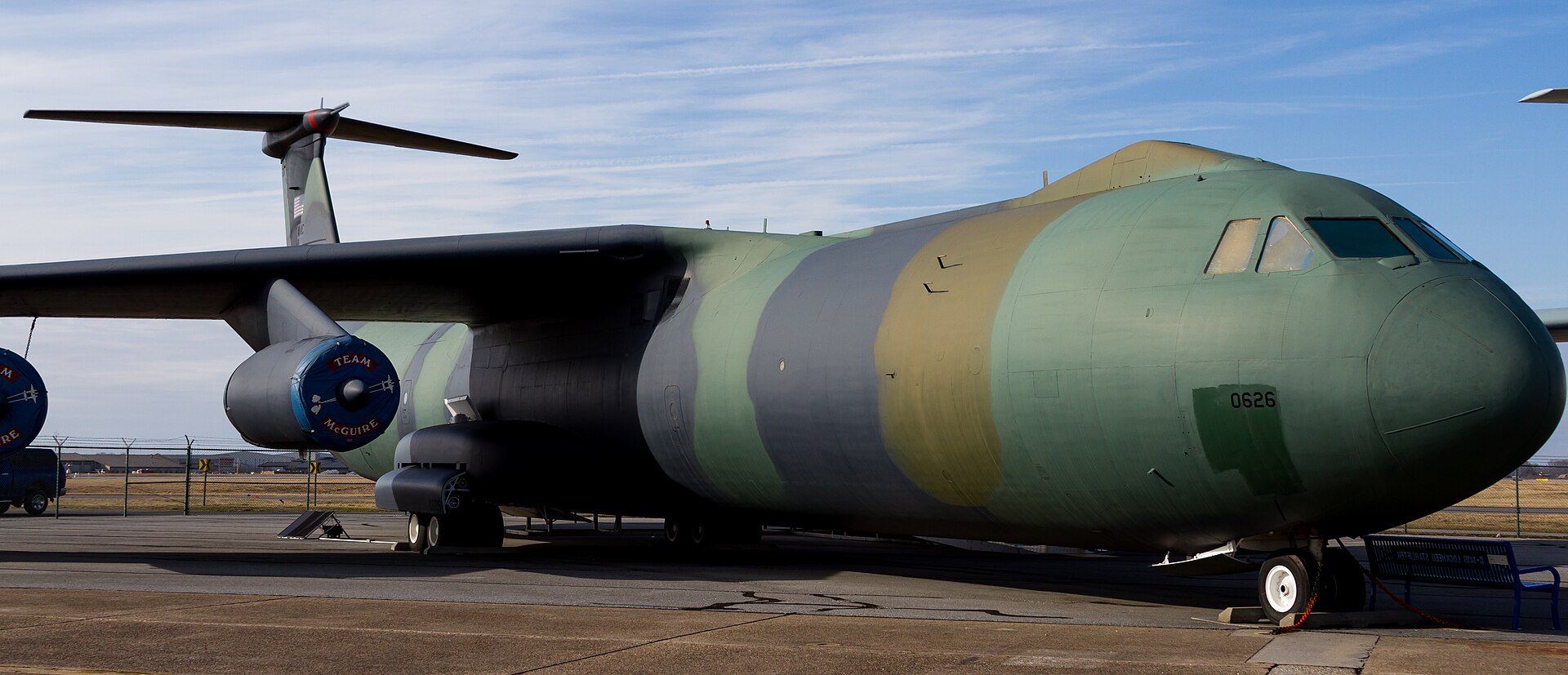
Lockheed C-141 Starlifter
The First Jet Airlifter
The first jet designed from the outset as a military transport, the C-141 turned American airlift into a jet-age global network, flew the wounded home from Vietnam and brought the prisoners of war out of Hanoi.
The C-141 Starlifter: how America’s airlift went jet
At the start of the 1960s, American military airlift still meant piston-engined C-124 Globemasters and C-133 Cargomasters, slow, noisy and unable to keep pace with the jet fighters and bombers they supported. President John F. Kennedy made an all-jet military transport one of the early directives of his administration, and Lockheed’s Marietta, Georgia, plant won the contract with a design that set the pattern for every heavy airlifter since: a high, swept wing, four podded turbofans, a T-tail and a fuselage at truck-bed height with a rear ramp. On 22 August 1963 Kennedy unveiled the first aircraft by remote control from the White House, and it flew on 17 December 1963, the 60th anniversary of the Wright brothers’ first flight.
Lockheed delivered on schedule and under budget, and the Starlifter entered squadron service in 1965, just as the war in Vietnam was escalating. It cut the round trip from California to Saigon from 95 hours by piston transport to about 34, according to Lockheed Martin. Outbound, the C-141s carried troops, ammunition and equipment; on the way home they became flying hospitals, bringing wounded servicemen back to the United States for treatment. In February 1973 a C-141 landed in Hanoi to collect the first American prisoners of war released under the Paris peace accords, and Starlifters went on to bring nearly 600 home in Operation Homecoming.
Its only real weakness was that its cargo floor filled up before the aircraft reached its weight limit. From 1977 to 1982 the fleet was stretched by about 23 ft and given air-to-air refuelling, becoming the C-141B, with roughly a third more capacity. Starlifters flew into Grenada, Panama and the Gulf, where during Desert Shield one landed in Saudi Arabia about every seven minutes. A modernised C-141C served with the Reserve and Air National Guard after active-duty units moved to the C-17. The last Starlifter, the famous “Hanoi Taxi”, made its final flight in May 2006 after 43 years of service by the type.
01The C-141 in Vietnam: out with cargo, home with the wounded
The Starlifter arrived just as the American commitment in Vietnam multiplied, and it quickly became the backbone of the Pacific air bridge. Military Airlift Command scheduled C-141s through Hawaii, Guam, Okinawa and the Philippines to bases such as Tan Son Nhut, Cam Ranh Bay and Da Nang, carrying troops, spare parts, ammunition and anything else that needed to arrive fast. Its jet speed shrank the Pacific: Lockheed Martin records that the round trip from California to Saigon fell from 95 hours to 34.
The return flights mattered just as much. C-141s were fitted with litter stanchions and carried flight nurses and medical technicians, turning the cargo hold into an aeromedical evacuation ward. Wounded servicemen who had been stabilised in Vietnam or Japan could be in a hospital in the United States within days. The aircraft also carried the war dead home. For a generation of Americans, the Starlifter was the aircraft that took them to Vietnam and, for many, the one that brought them back.
02The C-141 and Operation Homecoming: the Hanoi Taxi
Under the Paris Peace Accords of January 1973, North Vietnam agreed to release American prisoners of war. On 12 February 1973, the first C-141s landed at Gia Lam airport in Hanoi to collect them, with aircraft 66-0177 among the first to make the flight. Prisoners, some held for more than seven years, walked across the tarmac to the waiting transports, some on crutches or stretchers, to begin the journey home. Over the following weeks Starlifters brought nearly 600 men out of Hanoi and from other release points, via Clark Air Base in the Philippines to the United States.
Aircraft 66-0177 became known as the Hanoi Taxi. It served on into the 2000s, upgraded to C-141C standard, and was kept as a flying memorial with signatures from former POWs inside. On 6 May 2006 it made the last flight of any C-141, to Wright-Patterson Air Force Base, Ohio, where it joined the National Museum of the United States Air Force.
What makes the C-141 Starlifter special
The template for heavy airlift
The C-141 defined the modern military jet transport. Its high wing kept the engines clear of debris and let the fuselage sit low, so the cargo floor was at the height of a truck bed and vehicles could drive up a short ramp. The T-tail kept the rear clear for loading and airdrops. The Il-76, C-5 and C-17 all follow the same layout, and the C-141 was the first jet aircraft designed from the start to meet military standards as a troop and cargo carrier.
Stretched to fit
The C-141A could often fill its hold before reaching its maximum take-off weight. Lockheed’s answer was to insert fuselage plugs ahead of and behind the wing, lengthening it by about 23 ft, and to add an aerial refuelling receptacle above the cockpit. The C-141B’s capacity rose by about a third, and with in-flight refuelling it could fly non-stop around the world. Nearly the whole fleet was converted between 1977 and 1982.
A flying observatory
One early C-141A was converted by NASA into the Kuiper Airborne Observatory, carrying a large infrared telescope that looked out through an opening in the fuselage. Flying above most of the water vapour in the atmosphere, it allowed astronomers to observe at wavelengths blocked from the ground. Lockheed Martin credits it with contributing to the discovery of the rings of Uranus, and it served science for about two decades.
03The C-141’s variants: from A to C
- C-141A: original production version, 284 built for the US Air Force.
- NC-141A: test and research aircraft, including the Kuiper Airborne Observatory and 61-2775, used to tow a QF-106 in NASA’s Eclipse project in 1997–98.
- C-141A (SOLL): aircraft modified for special operations low-level missions.
- C-141B: stretched by about 23 ft with aerial refuelling; nearly the whole fleet converted from 1977 to 1982.
- C-141C: C-141Bs upgraded in the late 1990s with digital flight systems, GPS and improved defensive systems, flown mainly by Reserve and Guard units.
- L-300: civil demonstrator; no airline orders followed.
Lockheed C-141B Starlifter specifications
Specifications
- Crew
- 5 to 6 (two pilots, two flight engineers, loadmaster, navigator on many missions); medical crew on medevac flights
- Length
- 51.29 m (168 ft 4 in)
- Wingspan
- 48.74 m (159 ft 11 in)
- Height
- 11.96 m (39 ft 3 in)
- Max take-off weight
- 155,600 kg (343,000 lb)
- Powerplant
- 4 × Pratt & Whitney TF33-P-7 turbofans, 21,000 lbf (93 kN) each
- Maximum speed
- about 909 km/h (565 mph)
- Range
- about 5,800 km (3,600 mi) with a 50,000 lb load, per the AMC Museum; air refuellable (C-141B)
- Service ceiling
- about 12,500 m (41,000 ft)
- Capacity
- C-141B: about 200 troops, 155 paratroops or 103 litter patients
- Cargo hold
- 93 ft (28.3 m) long on the C-141B
Costs & production
- Cost per flight hour
- Retired; hedged historical estimate of roughly US$5,000–8,000 an hour in 1990s money, based on fuel burn for four TF33 engines of very roughly 6–7 tonnes an hour plus crew and maintenance; treat as an order of magnitude
- Production
- 284 built at Marietta, Georgia
- Programme
- Contract 1961; first flight 1963; service 1965–2006; C-141B stretch 1977–1982
04The C-141’s operating costs: a cheap jet for its day
Lockheed delivered the C-141 programme on schedule and under budget, a rarity among major aircraft programmes of the era and a sharp contrast with the C-5 that followed. The Starlifter’s TF33 engines, of the same family as the B-52H’s engines, were well understood, and the aircraft was simple to maintain by later standards.
As the fleet aged, costs rose. By the 1990s the airframes had accumulated very high flying hours, and fatigue cracking in the wings forced restrictions and expensive repairs; this was a key reason for retiring the fleet in favour of the C-17. With the type now retired, any hourly figure is historical. We give a hedged order-of-magnitude estimate of US$5,000 to 8,000 per hour in 1990s money, based on fuel burn plus crew and maintenance; actual Air Force accounting figures varied with year and method.
The C-141 Starlifter from Kennedy’s order to the Hanoi Taxi
All-jet airlifter ordered
Kennedy directs the procurement of a jet military transport; Lockheed wins.
Unveiling and first flight
Kennedy unveils the C-141 on 22 August; it flies on 17 December.
Into service
The Starlifter begins operations, quickly flying to Vietnam.
Operation Homecoming
C-141s bring nearly 600 American POWs out of Hanoi and other release points.
Fall of Saigon
C-141s evacuate Americans and Vietnamese refugees.
Stretch begins
Conversion to the longer, air-refuellable C-141B begins, completed in 1982.
Beirut
A C-141 carries 78 wounded from the bombing of the Marine barracks in Beirut.
Desert Shield
C-141s land in Saudi Arabia about every seven minutes at the height of the build-up.
Namibia collision
A C-141B collides with a German Tu-154 off the Namibian coast.
Active duty ends
The last active-duty C-141 retires at McGuire Air Force Base in September.
Last flight
The Hanoi Taxi flies to the National Museum of the USAF on 6 May.
Stories & eyewitnesses: the C-141 Starlifter
Kennedy presses the button
A president unveils a transport by remote control.
Read the full story
Hanoi, 12 February 1973
The first POWs walk to freedom.
Read the full story
The Hanoi Taxi at Dayton
The last flight of any C-141.
Read the full story
The first Starlifter, the glider tug
61-2775 at the AMC Museum.
Read the full story
Rings around Uranus
A Starlifter in the history of astronomy.
Read the full story
Beirut, 1983
The wounded from the Marine barracks.
Read the full story
Off Namibia, 1997
A mid-air collision over the South Atlantic.
Read the full story
Every seven minutes
The Starlifter in the Gulf build-up.
Read the full story
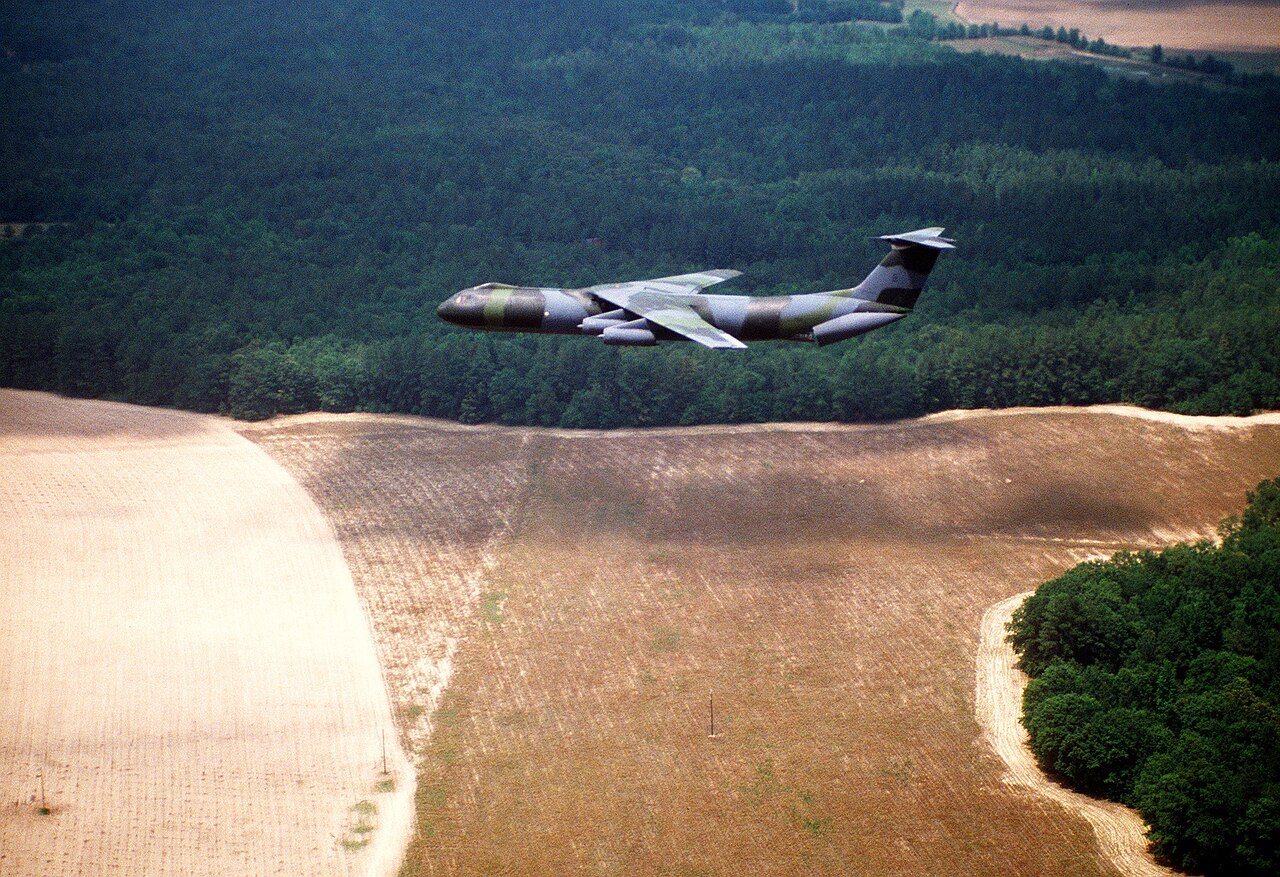
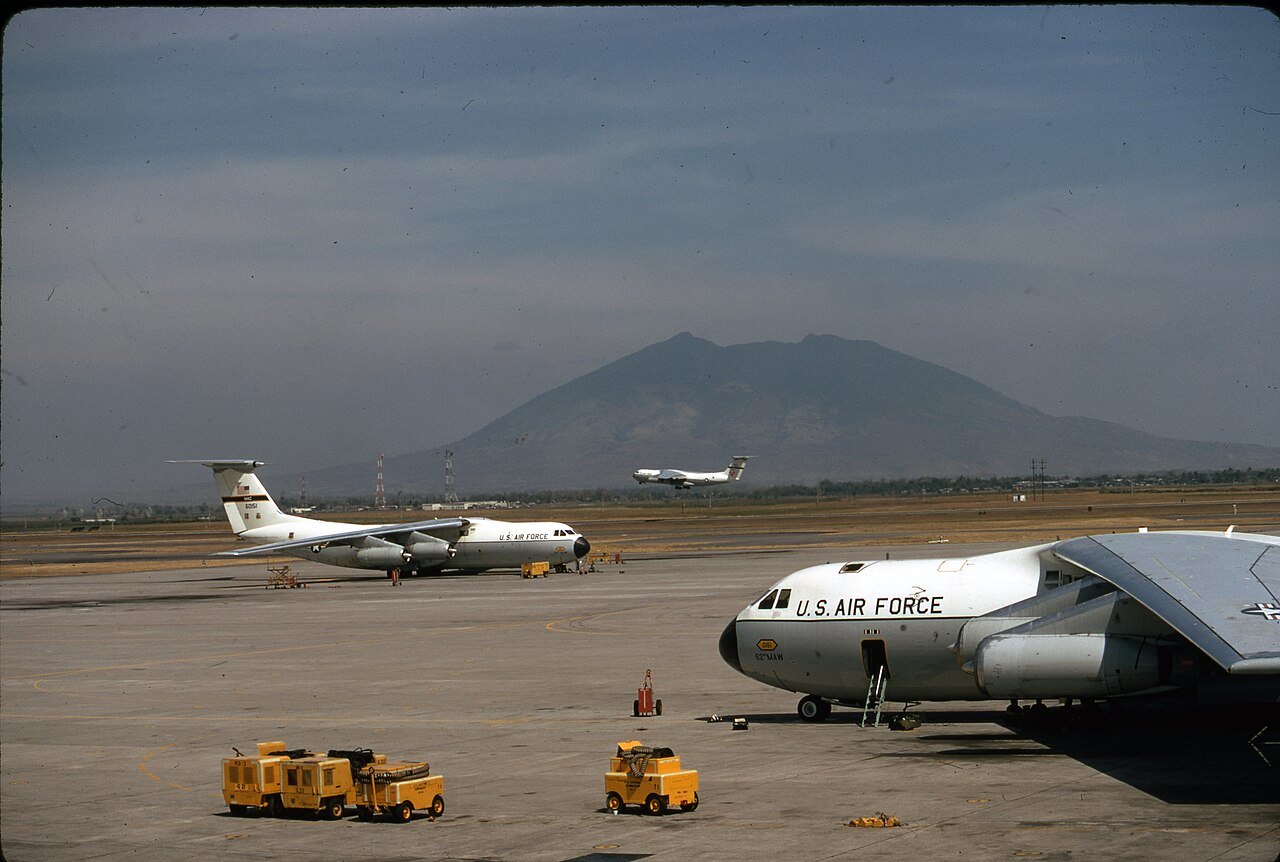
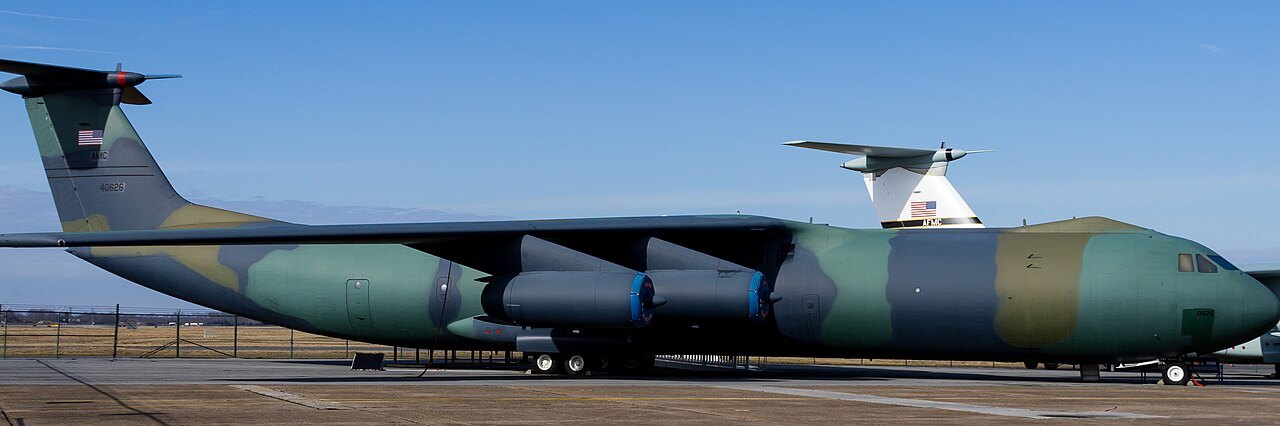
The C-141 in pictures
Where the C-141 flies and flew
The C-141 Starlifter’s record
The C-141 was an unarmed transport, but its 43-year career ran from Vietnam through Grenada, Panama and the Gulf War to Kosovo and Iraq. It is remembered above all for aeromedical evacuation and for bringing the prisoners of war home in 1973. Its service record is measured in people and cargo carried rather than combat.
See how training and combat types compare in the military aircraft statistics database. Figures are approximate.
Everything people ask about the C-141
Can I fly in a Lockheed C-141 Starlifter?
What was the C-141 used for?
How many C-141s were built?
What is the Hanoi Taxi?
Why was the C-141 stretched?
What replaced the C-141?
Where can I see a C-141?
You can’t fly the C-141.
These, you can.
Most of this museum you can only look at. These genuine military jets you can fly yourself with MiGFlug — with aerobatics and time on the controls.
 Fly the L-39 AlbatrosThe world’s most-flown jet trainer — aerobatics included
 Fly the F-104 Starfighter“The missile with a man in it”
 Fly the MiG-21The Cold War’s most-produced jet
 Fly the T-33 Shooting StarAmerica’s first jet trainer
 Fly the DH VampireA piece of early jet history
 Fly the S.211Agile Italian jet trainer
 Fly the MB-326The classic Aermacchi jet
 Fly the MiG-15The Soviet legend of the Korean War
Continue the tour
Every fact, checked
- C-141 StarLifterLockheed Martin history: unveiling, service, Vietnam, Homecoming, Beirut, Desert Shield, Kuiper observatory
- C-141A StarlifterAir Mobility Command Museum: 61-2775, production total, Eclipse tow and specifications
- C-141 StarlifterGlobalSecurity: C-141B stretch, fleet numbers and retirement dates
- Lockheed C-141C Starlifter “Hanoi Taxi”National Museum of the USAF fact sheet (URL not verified, fetch blocked)
- C-5 GalaxyLockheed Martin history of the C-141’s larger stablemate
- C-17 Globemaster IIIBoeing: the C-141’s successor