
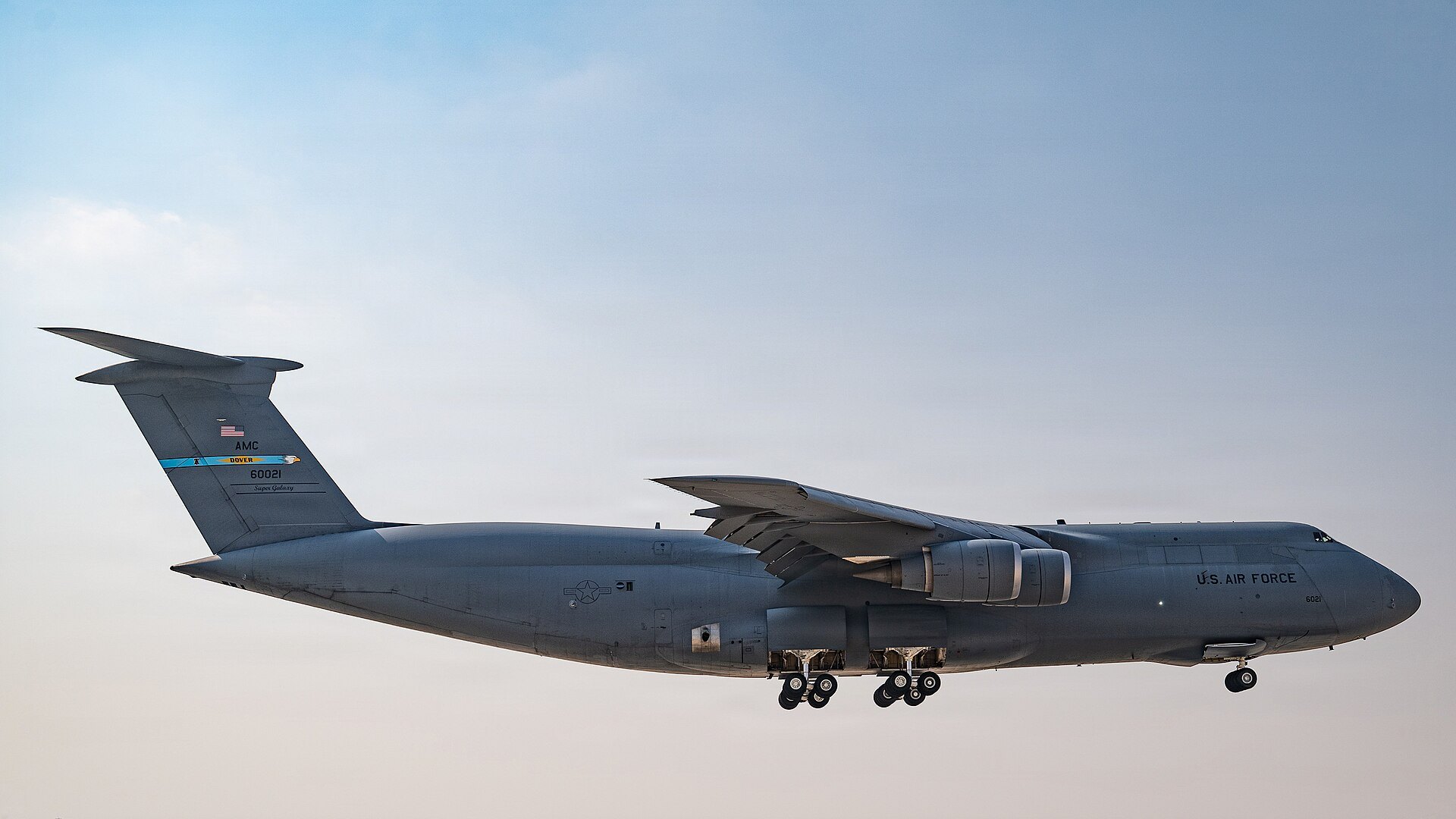
Lockheed C-5 Galaxy
and C-5M Super Galaxy
For two decades the largest aircraft in the Western world, the C-5 was built to fly an army’s heaviest equipment across oceans, and after half a century and new engines it still carries more than any other US aircraft.
The C-5 Galaxy: how Lockheed built a hangar that flies
The C-5 was the Pentagon’s answer to a question posed by Vietnam: how to move an army’s heaviest equipment, not just its men and pallets, across the world quickly. The CX-HLS competition of the early 1960s asked for a transport with more than twice the maximum take-off weight of the C-141. Lockheed won the contract in 1965 against Boeing and Douglas, and its Marietta, Georgia, plant produced a giant with a high wing, a T-tail, a nose that swings up like a visor and a rear ramp, so vehicles can drive straight through. It first flew on 30 June 1968, and the first aircraft reached the US Air Force in 1970.
Size brought trouble. Cost overruns on the programme became a national scandal when Pentagon analyst A. Ernest Fitzgerald told Congress in 1968 that it was running about US$2 billion over estimates, and early aircraft suffered wing cracking that forced load restrictions and, in the 1980s, new wings. Yet the aircraft itself was transformative. Its cargo compartment was five times larger than the C-141’s; it could carry four Sheridan light tanks or a Chinook helicopter, and Lockheed calculated that it could transport nearly 98 percent of the US Army’s equipment. Its TF39 engines were the first high-bypass turbofans in service, ancestors of the engines on today’s wide-body airliners.
Galaxies flew into Vietnam almost immediately, and in 1973 they were central to Operation Nickel Grass, the airlift that resupplied Israel during the Yom Kippur War. They carried the build-up for Desert Storm, relief to Rwanda and the long campaigns in Iraq and Afghanistan. After 81 C-5As, a further 50 improved C-5Bs were built in the 1980s. From the 2000s the fleet was modernised with glass cockpits, and 52 aircraft were rebuilt with new General Electric engines as the C-5M Super Galaxy, which set 41 world records and is expected to serve into the 2040s. No other American transport has matched its outsize capacity, and no direct successor has yet been ordered.
01The C-5 and the price of size: overruns, cracks and a whistleblower
The C-5 was procured under the “total package procurement” concept, in which a single contract covered development and production. It was meant to control costs; instead, as weight grew and technical problems mounted, it exposed Lockheed to huge losses and the Air Force to political embarrassment. In 1968 Air Force cost analyst A. Ernest Fitzgerald testified to Congress that the programme was running roughly US$2 billion over estimates. He was later removed from his post, and his case became a landmark in the history of US government whistleblowing.
The engineering problem was the wing. Weight-saving measures left it vulnerable to fatigue, and cracks appeared early in service. The Air Force imposed payload limits and, from the 1980s, re-winged the C-5A fleet. At the same time it ordered 50 new C-5Bs with the stronger wing and other improvements, the last delivered in 1989. The financial strain of the C-5 and other programmes contributed to Lockheed’s crisis of the early 1970s, when it needed a US government loan guarantee to survive.
02The C-5M Super Galaxy: a second life
By the 1990s the C-5’s reliability was poor and its original engines and analogue cockpit were dated. The Air Force chose to modernise rather than retire. The Avionics Modernization Program gave the fleet a glass cockpit with digital avionics, and the Reliability Enhancement and Re-engining Program replaced the TF39s with General Electric F138 engines, a military version of the CF6-80C2 airliner engine, and upgraded more than 70 other systems.
Fifty-two aircraft, a mix of C-5Bs and selected C-5As, were rebuilt as C-5M Super Galaxies, with the remaining older aircraft retired to storage. The new engines gave much better take-off performance, climb and fuel efficiency. In September 2009, in its test campaign, a C-5M set 41 records in a single flight, including carrying 176,610 lb to over 41,100 ft in under 24 minutes, according to Lockheed Martin. In 2012 Lockheed projected that the modernised aircraft would serve for at least another 40 years.
What makes the C-5 Galaxy special
Drive in, drive out
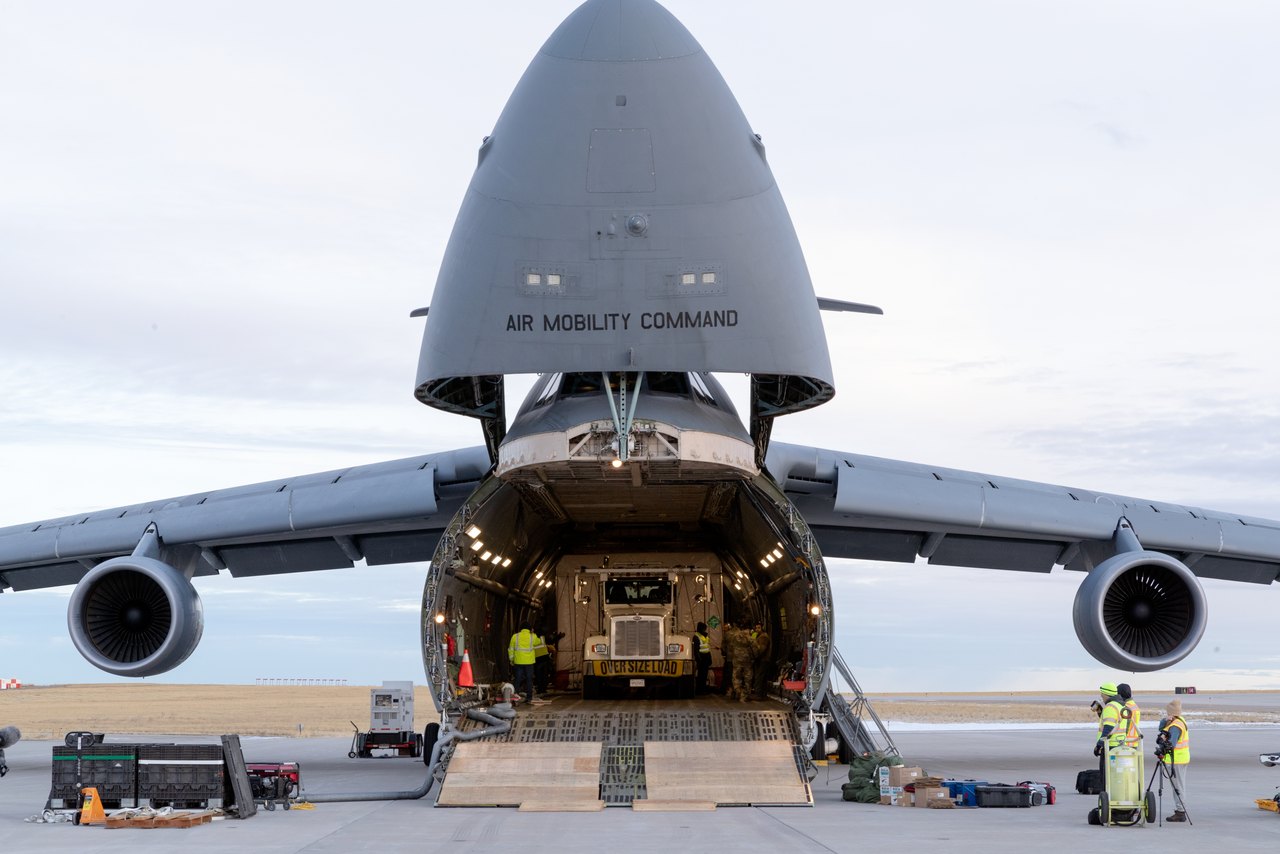
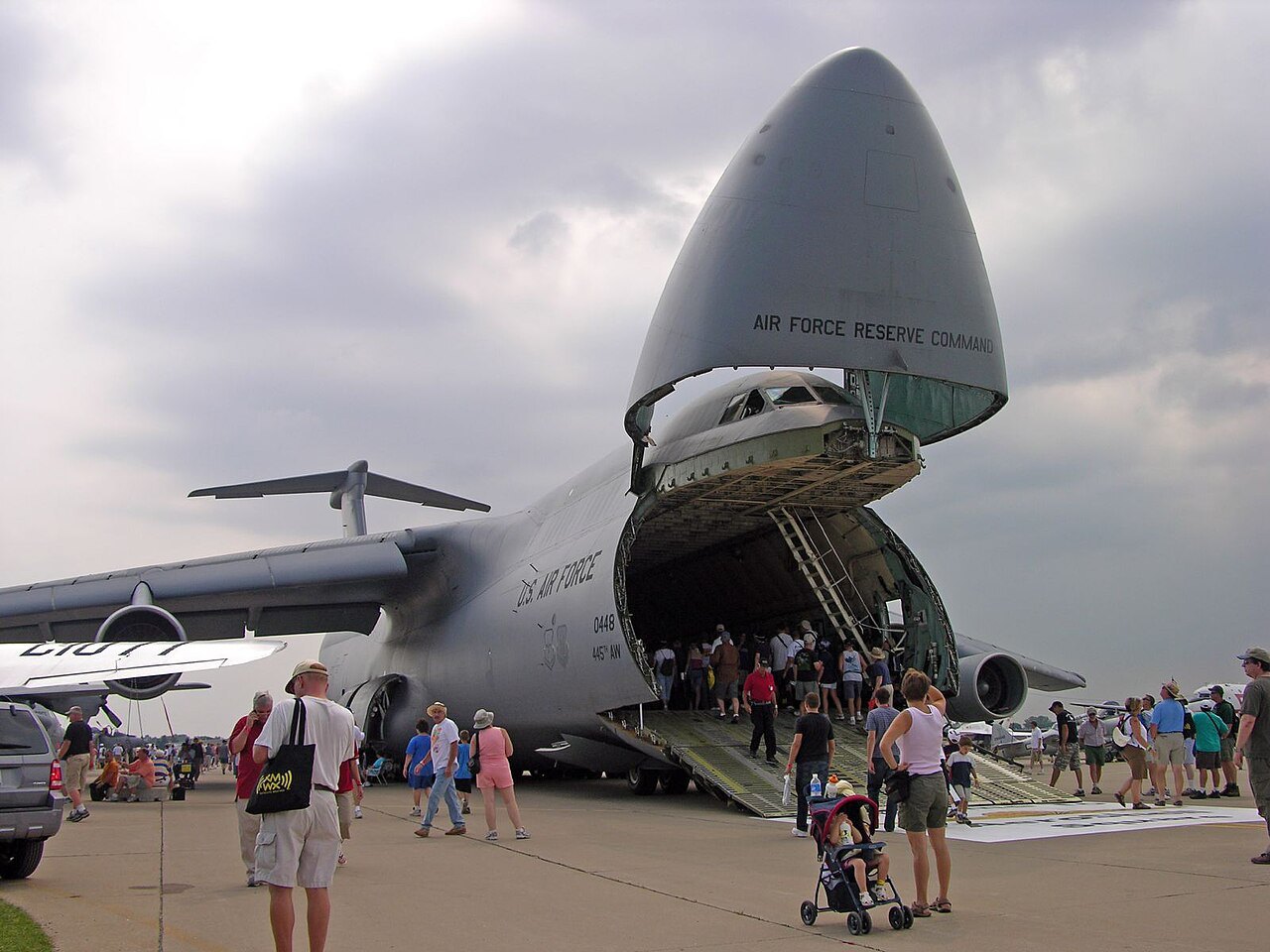
The C-5’s nose swings upward as a visor to expose a forward ramp, and a second ramp and doors open at the rear. Vehicles can drive in at one end and out at the other, and both ends can be loaded at once. The cargo floor is about 121 ft long and 19 ft wide, a space the Air Force compares with an eight-lane bowling alley, with a separate upper deck seating troops behind the flight deck.
The kneeling giant
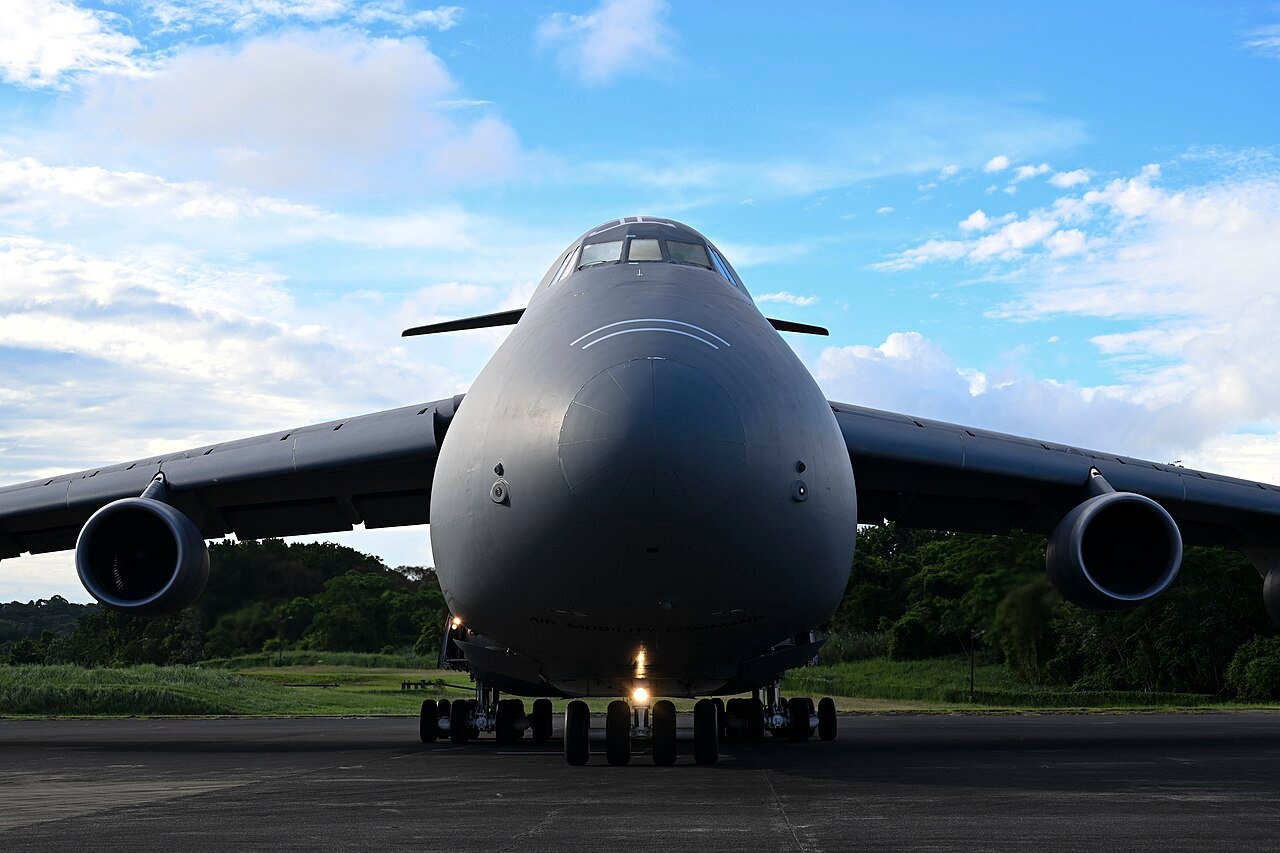
The C-5 rests on 28 wheels: a four-wheel nose leg and four six-wheel main bogies. The undercarriage can lower, or kneel, the fuselage so the cargo floor sits closer to the ground, reducing the slope of the ramps for heavy vehicles. The gear also spreads the aircraft’s enormous weight, letting it use runways that could not otherwise take an aircraft of its size.
Heavier than anything else
The C-5 can carry the Army’s heaviest equipment, including the 74-ton mobile scissors bridge, tanks and helicopters, according to GlobalSecurity. The AMC Museum notes that it can carry six MRAP armoured vehicles or up to five helicopters. Maximum take-off weight is 769,000 lb in peacetime, rising to 840,000 lb under wartime rules. Only Russia’s An-124 and the one-off An-225 have carried more among military-capable transports.
03The C-5’s variants: C-5A to C-5M
- C-5A: original production version, 81 built 1968–1973; TF39-GE-1C engines; later re-winged.
- C-5C: two C-5As modified with an enlarged cargo compartment to carry large satellites and space hardware for NASA.
- C-5B: improved production version with stronger wing and upgraded systems, 50 built 1985–1989.
- C-5 AMP: Avionics Modernization Program glass cockpit fitted across the fleet.
- C-5M Super Galaxy: 52 aircraft rebuilt with GE F138 engines and some 70 system improvements; last delivered in 2018.
- L-500: proposed commercial freighter; never built.
Lockheed C-5M Super Galaxy specifications
Specifications
- Crew
- minimum 4 (pilot, co-pilot, flight engineer, loadmaster); typically more on long missions
- Length
- 75.31 m (247 ft 1 in)
- Wingspan
- 67.89 m (222 ft 9 in)
- Height
- 19.84 m (65 ft 1 in)
- Max take-off weight
- 348,800 kg (769,000 lb) peacetime; 381,000 kg (840,000 lb) wartime
- Max payload
- about 120,000 kg (264,440 lb) per the AMC Museum; later USAF figures for the C-5M are higher
- Powerplant
- 4 × General Electric F138-GE-100 (CF6-80C2) turbofans, about 50,000 lbf (222 kN) each
- Range
- about 5,950 km (3,700 mi) with maximum payload; air refuellable
- Service ceiling
- about 10,400 m (34,000 ft) at heavy weights
- Cargo floor
- about 36.9 m × 5.8 m (121 ft × 19 ft), height 4.1 m (13 ft 6 in)
- Landing gear
- 28 wheels; kneeling capability
Costs & production
- Cost per flight hour
- Hedged estimate: roughly US$30,000–40,000, based on published US Air Force reimbursable rates for the C-5 in recent years; among the most expensive aircraft in the inventory per hour
- Production
- 131 built at Marietta, Georgia: 81 C-5A (1968–1973) and 50 C-5B (1985–1989)
- Programme
- Contract 1965; first flight 1968; delivered from 1970; 52 rebuilt as C-5M, last delivered 2018
04The C-5’s operating costs: the price of a giant
The C-5 has always been expensive to own. Its development overrun became a political cause in the late 1960s, the wing modification of the 1980s added to the bill, and through the 1990s and 2000s the C-5 fleet’s mission-capable rates were notoriously low, with older aircraft spending long periods awaiting parts. Each flying hour consumes large quantities of fuel and requires a big crew and extensive maintenance.
We give a hedged estimate of roughly US$30,000 to 40,000 per flying hour, based on published US Air Force reimbursement rates for the type; fully burdened costs are higher. The C-5M modernisation was justified on the argument that new engines and systems would cut fuel burn, improve reliability and extend the fleet’s life by decades at less cost than buying a new outsize airlifter, of which none was available off the shelf.
The C-5 Galaxy from CX-HLS to Super Galaxy
Lockheed wins
Lockheed is selected for the CX-HLS heavy logistics transport.
First flight
The first C-5A flies at Marietta on 30 June; congressional testimony exposes cost overruns.
Into service
The first C-5 is delivered to the US Air Force.
Nickel Grass
C-5s help resupply Israel during the Yom Kippur War.
Missile drop
A C-5A air-drops a Minuteman ICBM over the Pacific on 24 October.
Operation Babylift crash
A C-5A carrying orphans crashes near Saigon on 4 April.
Last C-5B
Production of the 50 C-5Bs ends.
Ramstein crash
A C-5A supporting Desert Shield crashes on take-off from Ramstein, Germany.
Dover crash
A C-5B crashes short of the runway at Dover; all aboard survive.
41 records
A C-5M sets 41 world records in one flight.
Last C-5M
The 52nd and final Super Galaxy conversion is delivered.
Stories & eyewitnesses: the C-5 Galaxy
Nickel Grass, 1973
Resupplying Israel in the middle of a war.
Read the full story
Operation Babylift
The first flight of the orphan evacuation ended in tragedy.
Read the full story
Dropping a Minuteman
The day a transport launched an ICBM.
Read the full story
Ramstein, 1990
A thrust reverser in the climb.
Read the full story
Dover, 2006: everyone walked away
A crash with no fatalities.
Read the full story
Rwanda, 1994
Relief to a country in catastrophe.
Read the full story
Forty-one records in one flight
The Super Galaxy shows off its new engines.
Read the full story
The first C-5 in a museum
69-0014 retired to Dover.
Read the full story
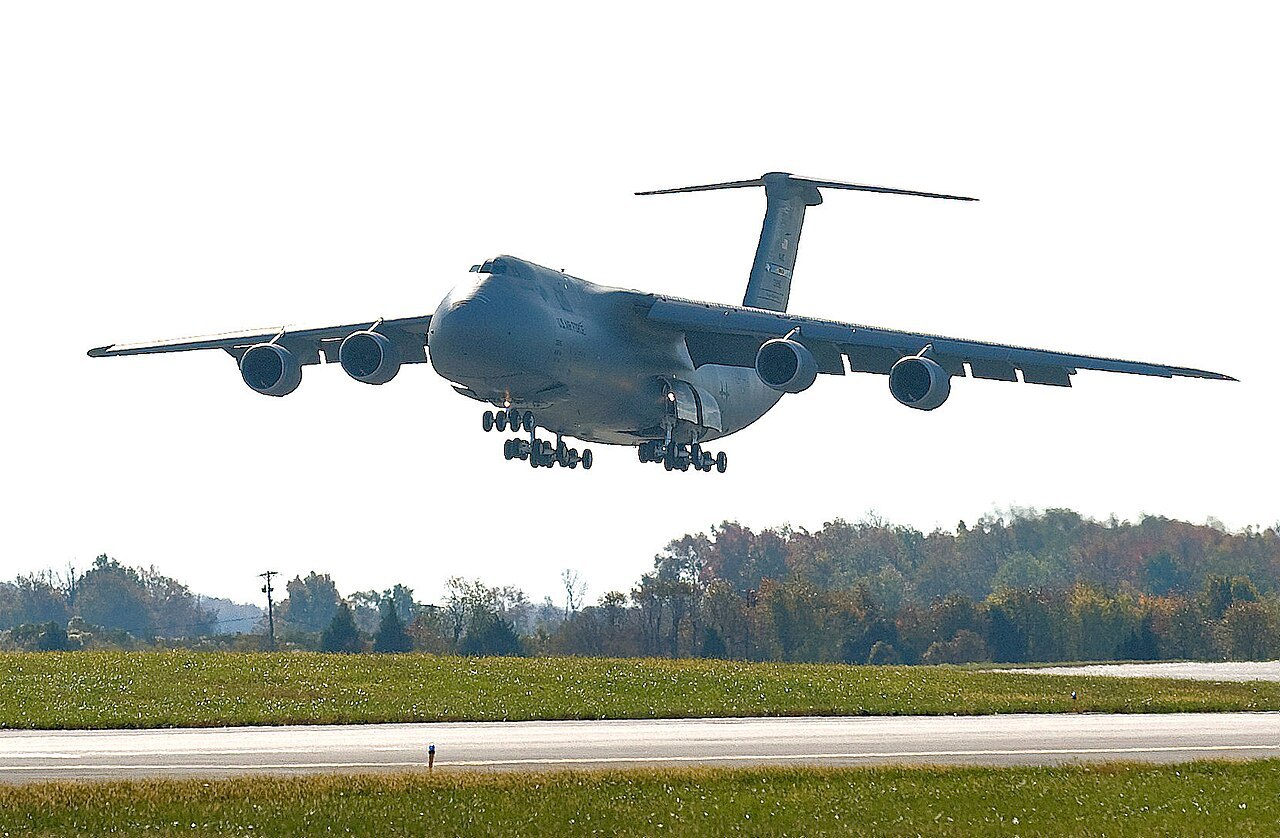
The C-5 in pictures
Where the C-5 flies and flew
The C-5 Galaxy’s record
The C-5 has supported every major US operation since 1970, from Vietnam and the Yom Kippur War airlift through Desert Storm, the Balkans, Iraq and Afghanistan, as well as relief operations around the world. It is unarmed and has not been lost to enemy action, but accidents in 1975, 1990 and 2006 were significant events in its history.
See how training and combat types compare in the military aircraft statistics database. Figures are approximate.
Everything people ask about the C-5
Can I fly in a Lockheed C-5 Galaxy?
How big is the C-5 Galaxy?
How many C-5s were built?
What is the difference between the C-5 and C-5M?
Is the C-5 bigger than the C-17?
Who flies the C-5?
Where can I see a C-5?
You can’t fly the C-5.
These, you can.
Most of this museum you can only look at. These genuine military jets you can fly yourself with MiGFlug — with aerobatics and time on the controls.
 Fly the L-39 AlbatrosThe world’s most-flown jet trainer — aerobatics included
 Fly the F-104 Starfighter“The missile with a man in it”
 Fly the MiG-21The Cold War’s most-produced jet
 Fly the T-33 Shooting StarAmerica’s first jet trainer
 Fly the DH VampireA piece of early jet history
 Fly the S.211Agile Italian jet trainer
 Fly the MB-326The classic Aermacchi jet
 Fly the MiG-15The Soviet legend of the Korean War
Continue the tour
Every fact, checked
- C-5 GalaxyLockheed Martin history: contract, delivery, capacity, operations and C-5M records
- C-5A GalaxyAir Mobility Command Museum: 69-0014, the Minuteman drop and specifications
- C-5 GalaxyGlobalSecurity: capability, weights and modernisation programmes
- C-5 A/B/C Galaxy and C-5M Super Galaxy fact sheetUS Air Force fact sheet (not opened, blocked)
- C-141 StarLifterLockheed Martin history of the C-5’s smaller predecessor
- C-141A StarlifterAir Mobility Command Museum: context on the strategic airlift fleet