
Boeing E-3 Sentry
AWACS
The Boeing 707 with a radar saucer on its back that watched over the Cold War, Desert Storm, 9/11 and Ukraine, and turned the battle manager into an aircraft of its own.
The E-3 Sentry: how a 707 became the eye in the sky
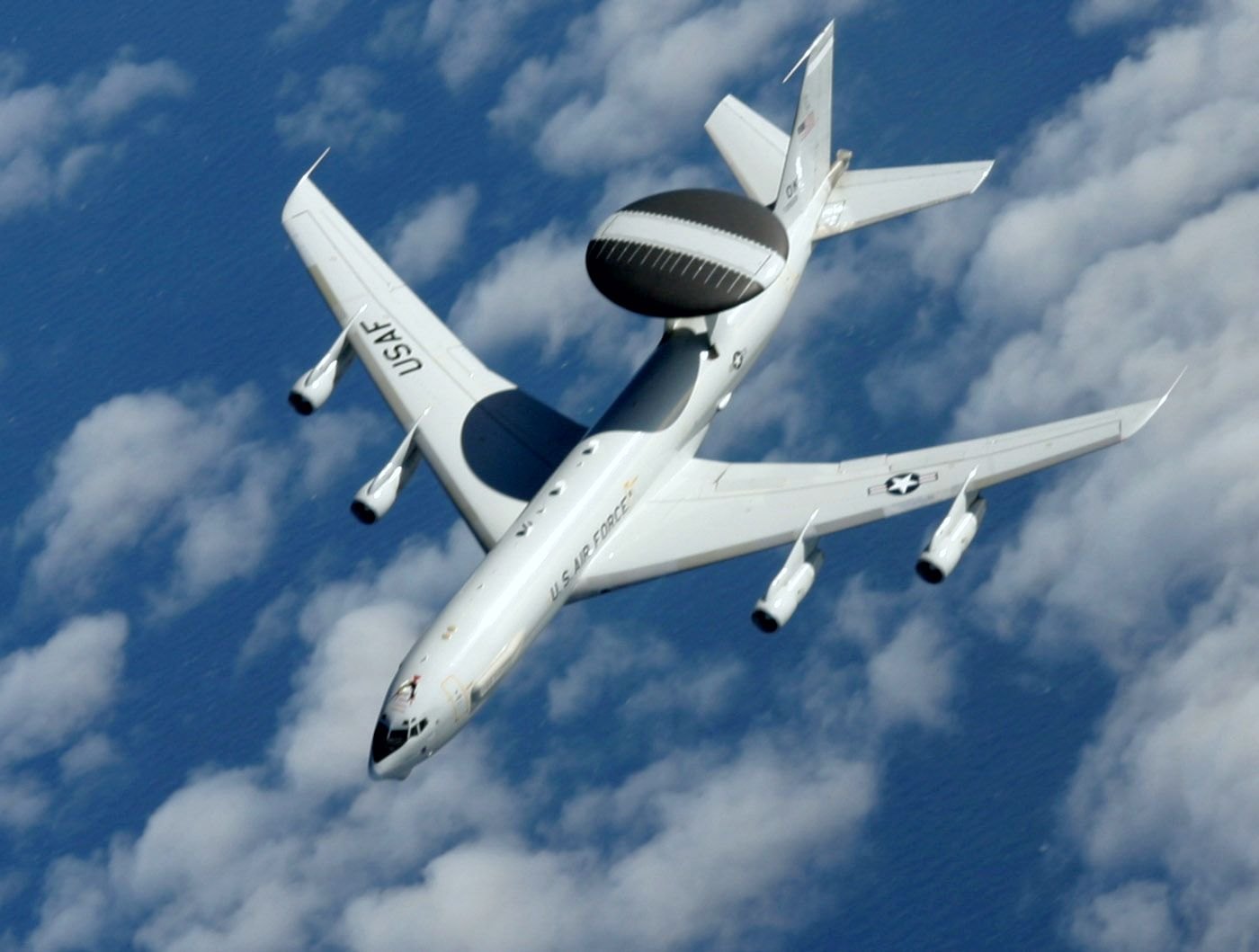
Picture the inside of an E-3 at 29,000 feet over the Saudi desert in January 1991: rows of grey consoles in a darkened cabin, a dozen or more operators in headsets, and on their screens every Iraqi aircraft that leaves the ground. Above them, nine metres of rotating radome turns six times a minute. The Boeing E-3 Sentry, better known simply as AWACS (Airborne Warning and Control System), was designed to see low-flying bombers coming at Western Europe long before ground radars could. In the Gulf War it did something larger: it ran the air war in real time, handing fighters their targets and keeping tankers, bombers and jammers out of each other’s way.
The idea was old; the execution was new. Navies had flown radar pickets since the Second World War, but the US Air Force wanted a radar that could pick out a small aircraft against the clutter of the ground below. Boeing was chosen as prime contractor in 1970, the radar contest went to Westinghouse, and the result was the pulse-Doppler AN/APY-1, mounted back to back with an identification antenna inside a 9.1 m rotodome on two struts above a militarised 707-320B. The EC-137D test aircraft flew on 9 February 1972, the first E-3 reached the 552nd wing at Tinker Air Force Base, Oklahoma, in March 1977, and initial operating capability followed in April 1978.
Only 68 were built, the last delivered in 1992, but they spread across the Western alliance: 34 for the US Air Force, 18 for NATO’s multinational force at Geilenkirchen, seven for the Royal Air Force, four for France and five for Saudi Arabia. They flew in every major Western air campaign from Desert Storm to Libya and against Islamic State, and after 9/11 NATO crews patrolled American skies. Half a century after the first flight the fleet is shrinking: the RAF retired its Sentries in 2021, the US Air Force began retiring aircraft in 2023, and successors from Boeing and Saab are taking over the job. Few aircraft have mattered so much while being seen so rarely by the public.
01The E-3 Sentry’s origins: radar that could look down
The US Air Force opened its AWACS programme in December 1965, at a time when the main fear was Soviet bombers coming in low over Europe and North America, below the cover of ground-based radar. The Navy’s carrier-based Hawkeye and the older EC-121 Warning Star had proved the value of airborne radar, but neither could reliably track a low target over land, where ground returns swamped the screen. The answer was pulse-Doppler processing, which separates moving targets from stationary clutter.
Boeing was selected as prime contractor in July 1970 with an airframe based on the 707-320B. Two radar makers, Westinghouse and Hughes, flew competing systems in the EC-137D test aircraft, and Westinghouse won in 1972. The original plan to use eight TF34 engines was dropped in favour of four TF33s, the military version of the 707’s JT3D turbofan. Production E-3As followed, later upgraded to E-3B and E-3C standard, and the US fleet was eventually modernised as the E-3G with new mission computers and consoles under the Block 40/45 programme.
02The E-3 Sentry in NATO: a squadron with no single nation
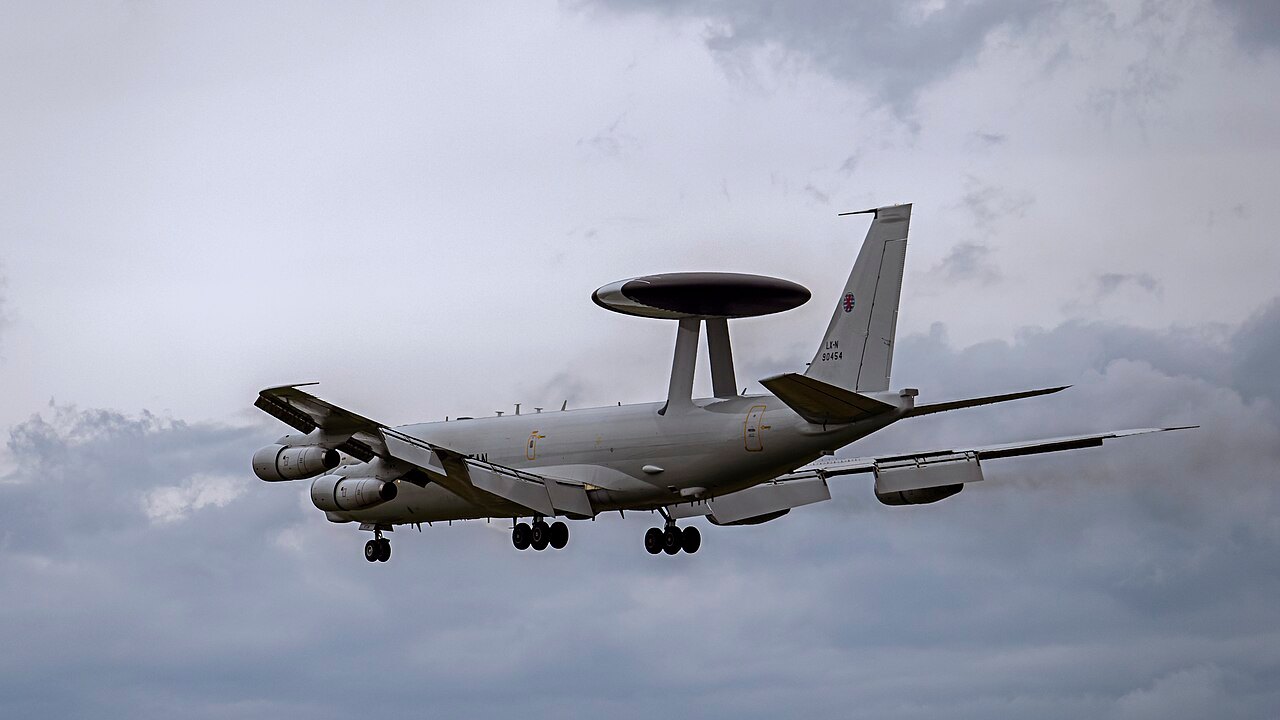
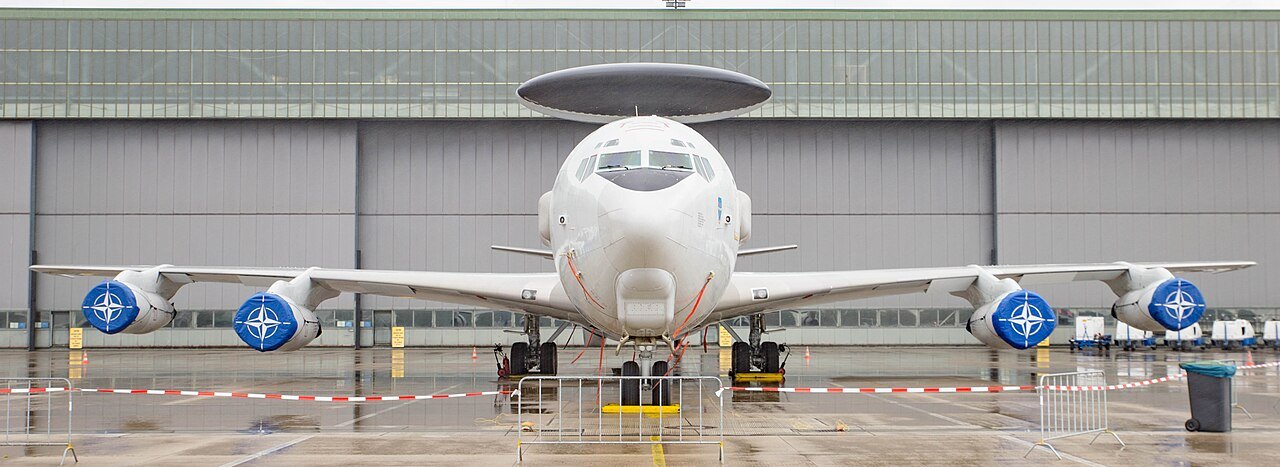
The NATO Airborne Early Warning and Control Force is one of the most unusual units in military aviation. Its E-3A aircraft are owned by the alliance itself, registered in Luxembourg because NATO has no civil register of its own, and flown by mixed crews drawn from member nations. The first aircraft arrived in January 1982 and the main operating base has been Geilenkirchen in western Germany ever since.
The force has flown over the Balkans in the 1990s, over Turkey during both Gulf Wars, and over the Mediterranean, Libya and Afghanistan. Its most symbolic deployment came after 11 September 2001, when NATO invoked its mutual-defence clause for the first time and E-3As flew patrols over the United States in Operation Eagle Assist. Since February 2022 NATO AWACS have flown along the alliance’s eastern border, watching the air war over Ukraine from Polish and Romanian airspace. In 2025 NATO reportedly settled on the Saab GlobalEye as the successor to its ageing E-3A fleet.
What makes the E-3 Sentry special
The rotodome
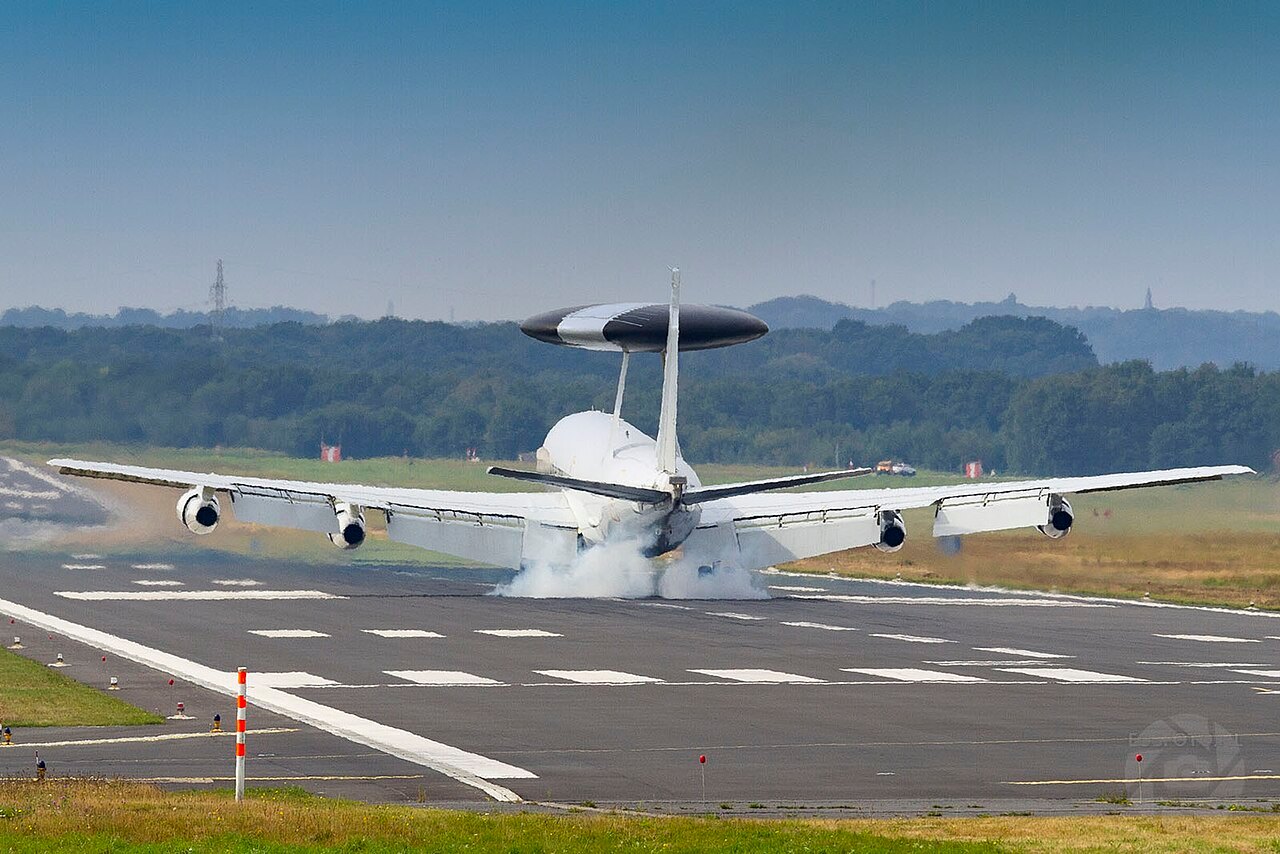
The E-3’s signature is a 9.1 m (30 ft) disc, 1.8 m thick, carried 3.3 m above the fuselage on two struts. Inside, the main surveillance antenna and the IFF interrogator sit back to back. In operation the dome turns about six times a minute; in transit it turns slowly to keep the bearings lubricated. The placement gives the radar a clear 360-degree view and keeps it away from the wings and tail, at the cost of considerable drag and some tricky handling in crosswinds.
Look-down radar
The Westinghouse AN/APY-1 and its maritime-capable successor AN/APY-2 use pulse-Doppler processing to pick out aircraft flying low over land or water, the task that defeated earlier airborne radars. The US Air Force gives the radar a range of more than 250 miles (400 km) for low-flying targets, and further for aircraft at medium and high altitude. A passive detection system adds the ability to locate hostile emitters without transmitting at all. The radar can also be run in modes optimised for long range or for tracking ships at sea.
A command post with wings
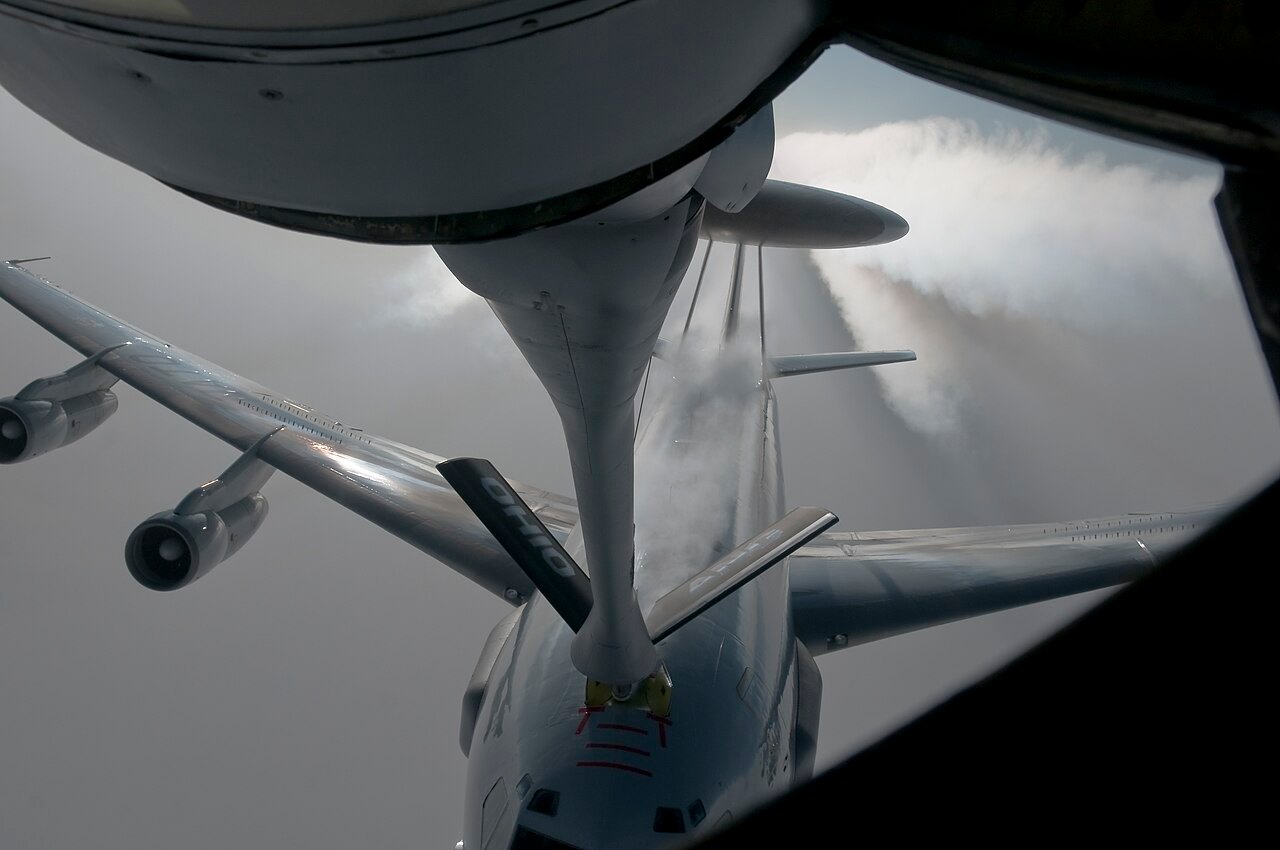
Behind the four-person flight deck sits a mission crew of 13 to 19 specialists, according to the US Air Force: surveillance operators who build the air picture, weapons controllers who direct fighters, and a mission commander. On station the aircraft relays the picture by data link to fighters, ships and ground commanders. With air-to-air refuelling, missions can last far longer than the eight hours the E-3 can stay on station unrefuelled, limited mainly by crew fatigue. Crew rest bunks and a galley sit at the rear of the cabin.
03The E-3 Sentry’s upgrades: from analogue to E-3G
The E-3 has been rebuilt in place several times. Early US E-3As were upgraded to E-3B and E-3C standard with better computers, more consoles and the maritime-capable APY-2 radar. The Radar System Improvement Program of the 1990s added sensitivity against small targets. The biggest change was Block 40/45, which replaced the legacy mission computing with open-architecture commercial hardware and new operator workstations; the upgraded aircraft became the E-3G, with initial operating capability in 2014. It was not painless: the Pentagon’s test office reported in 2016 that the system struggled to fuse sensor tracks and was vulnerable to cyber threats, delaying full testing.
A parallel cockpit programme replaced the analogue flight deck with glass displays and removed the navigator’s station. The British, French and Saudi aircraft, delivered later, were built with CFM56 engines instead of the old TF33s, giving them better fuel economy and range.
Boeing E-3 Sentry specifications
Specifications
- Crew
- 4 flight crew plus 13–19 mission specialists
- Length
- 46.6 m (152 ft 11 in)
- Wingspan
- 44.4 m (145 ft 9 in)
- Height
- 12.7 m (41 ft 9 in)
- Rotodome
- 9.1 m (30 ft) diameter, 1.8 m (6 ft) thick
- Empty weight
- 92,986 kg (205,000 lb)
- Max take-off weight
- 147,418 kg (325,000 lb)
- Fuel capacity
- 79,494 litres (21,000 US gal)
- Powerplant
- 4 × Pratt & Whitney TF33-PW-100A turbofans, 91 kN (20,500 lbf) each (US and NATO aircraft)
- Maximum speed
- about 855 km/h (461 kt)
- Cruise speed
- about 580 km/h (360 mph, Mach 0.48)
- Range
- more than 9,250 km (5,000 nmi)
- Service ceiling
- above 8,800 m (29,000 ft)
- Endurance
- about 8 hours on station unrefuelled; longer with air-to-air refuelling
- Radar
- Westinghouse (Northrop Grumman) AN/APY-1/APY-2 pulse-Doppler
Costs & production
- Unit cost
- US$270 million in fiscal 1998 constant dollars (US Air Force fact sheet)
- Cost per flight hour
- Hedged estimate: in the tens of thousands of US dollars per hour, plausibly US$40,000–60,000 or more, based on four old TF33 engines, a crew of up to 23 and heavy depot maintenance on 1970s airframes; no single official figure is used here
- Production
- 68 built, 1977–1992: USAF 34, NATO 18, UK 7, France 4, Saudi Arabia 5
- Programme
- AWACS programme opened 1965; Boeing prime contractor 1970; first delivery 1977; E-3G upgrade operational 2014
04The E-3 Sentry’s variants: from E-3A to E-3G
- EC-137D: two 707 test aircraft used for the radar fly-off, first flown 1972.
- E-3A: initial production standard for the US Air Force; also the NATO version, later extensively upgraded.
- E-3B / E-3C: US upgrades with improved computers, extra consoles and the APY-2 radar.
- E-3D (Sentry AEW1): Royal Air Force version with CFM56 engines and a refuelling probe, in service 1991–2021.
- E-3F: French Air and Space Force version with CFM56 engines, based at Avord.
- Saudi E-3A: five CFM56-powered aircraft for the Royal Saudi Air Force.
- E-3G: US Block 40/45 upgrade with open-architecture mission systems, operational from 2014, the version that remains in US service.
05The E-3 Sentry’s operating costs: why old 707s are expensive
The E-3’s running costs are driven by age. The US and NATO aircraft still use the TF33, a 1960s turbofan that burns far more fuel than modern engines, and the 707 airframe went out of airline production decades ago, so parts must often be specially made or recovered from retired aircraft. Availability has suffered accordingly, one reason the US Air Force began retiring E-3s in 2023 to free money for a successor.
The mission crew is the other big cost: a typical sortie may carry around twenty people, each a trained specialist. No single official cost-per-hour figure is quoted here; the estimate above is a hedged order of magnitude based on these factors.
The E-3 Sentry from Cold War radar picket to Ukraine watch
AWACS programme opens
The US Air Force begins work on an airborne radar that can track low-flying bombers over land.
Boeing selected
Boeing wins the prime contract with an aircraft based on the 707-320B airliner.
EC-137D flies
The test aircraft makes its first flight on 9 February, ahead of a radar fly-off won by Westinghouse.
First delivery
The 552nd Airborne Warning and Control Wing at Tinker AFB receives its first E-3s in March; initial operating capability follows in April 1978.
Saudi sale
After a bitter political fight, the US Senate allows the sale of five AWACS to Saudi Arabia.
NATO force forms
NATO receives its first E-3A in January and builds its multinational force at Geilenkirchen.
Desert Storm
E-3s control the coalition air war over Iraq and Kuwait; the RAF’s E-3D enters service the same year.
Yukla 27
A US E-3 crashes after bird strikes on take-off from Elmendorf AFB, Alaska, killing all 24 aboard.
Eagle Assist
After 9/11, NATO E-3As patrol the skies of the United States.
E-3G operational
The Block 40/45 upgrade reaches initial operating capability.
RAF retirement
The last RAF Sentry mission is flown over Iraq on 30 July; the type leaves British service in August.
Loss in Saudi Arabia
An E-3G is reported destroyed on the ground at Prince Sultan Air Base in an Iranian drone and missile strike.
Stories & eyewitnesses: the E-3 Sentry at war and in peace
Desert Storm: running the air war
In 1991 the E-3 became the nerve centre of the largest air campaign since 1945.
Read the full story
Yukla 27: geese at Elmendorf
The worst loss in the type’s history was caused by birds.
Read the full story
Preveza, 1996: into the sea wall
NATO’s aircraft came off the runway on a Greek airfield.
Read the full story
The Saudi AWACS fight of 1981
Selling five radar planes became one of the hardest foreign-policy votes of the Reagan years.
Read the full story
Eagle Assist: NATO over America
For the first time, alliance aircraft defended the skies of the United States.
Read the full story
Allied Force: watching Serbia
Over the Balkans, AWACS crews managed a crowded sky.
Read the full story
The RAF’s last Sentry mission
Thirty years of British service ended over Iraq.
Read the full story
Watching the war in Ukraine
From allied airspace, AWACS crews have followed the air war next door.
Read the full story
Prince Sultan, 2026: a loss on the ground
In the war with Iran an AWACS was destroyed without leaving the ground.
Read the full story
A second life in Chile
Retired British Sentries found a new air force.
Read the full story
The E-3 Sentry in pictures
Where the E-3 Sentry flies and flew
The E-3 Sentry’s record
The E-3 carries no weapons, but it has been at the centre of every major Western air campaign since 1991, controlling the fighters that scored most coalition air-to-air kills in the Gulf War. Its losses have come from accidents and, in 2026, from a strike on the ground.
See how training and combat types compare in the military aircraft statistics database. Figures are approximate.
Everything people ask about the E-3 Sentry
Can I fly in a Boeing E-3 Sentry?
What does AWACS stand for?
What is the disc on top of the E-3?
How many E-3 Sentries were built?
Who still flies the E-3?
What will replace the E-3?
Has an E-3 ever been lost?
You can’t fly the E-3 Sentry.
These, you can.
Most of this museum you can only look at. These genuine military jets you can fly yourself with MiGFlug — with aerobatics and time on the controls.
 Fly the L-39 AlbatrosThe world’s most-flown jet trainer — aerobatics included
 Fly the F-104 Starfighter“The missile with a man in it”
 Fly the MiG-21The Cold War’s most-produced jet
 Fly the T-33 Shooting StarAmerica’s first jet trainer
 Fly the DH VampireA piece of early jet history
 Fly the S.211Agile Italian jet trainer
 Fly the MB-326The classic Aermacchi jet
 Fly the MiG-15The Soviet legend of the Korean War
Continue the tour
Every fact, checked
- E-3 Sentry (AWACS) fact sheetUS Air Force: dimensions, weights, crew, unit cost, delivery dates and operations
- RAF E-3D Sentry aircraft returns to the UK from last operational missionRoyal Air Force on the final Operation Shader detachment and 30 years of service
- Program Dossier: E-3 SentryAviation Week: fleet status, Block 40/45, cockpit upgrade and replacement plans
- E-3 Sentry (AWACS)Programme history and Desert Storm statistics
- E-3 AWACS Block 40/45 (FY2016 annual report)Pentagon Director of Operational Test and Evaluation assessment of the E-3G upgrade
- NATO unveils new special livery E-3A AWACS for 35th anniversaryThe Aviationist on the NATO force at Geilenkirchen
- Air Force cancels E-7 Wedgetail, citing survivability and cost concernsBreaking Defense, 2025, on the planned E-3 replacement
- Wedgetail to be RAF’s new early warning radar aircraftRAF, 2019: E-7 contract and reduction of the E-3D fleet