
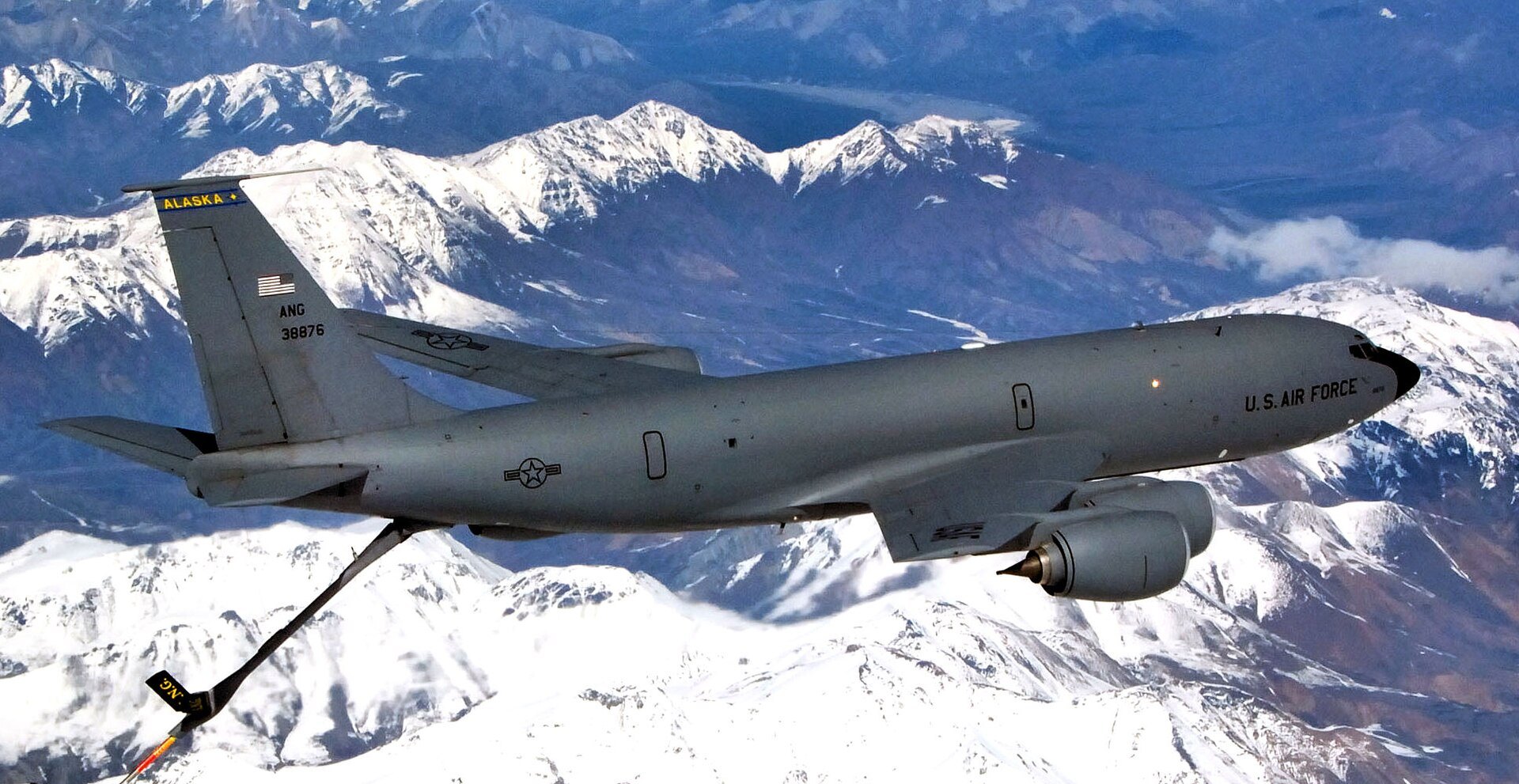
Boeing KC-135 Stratotanker
The Tanker That Never Retired
Built for Strategic Air Command in the 1950s, the KC-135 turned American air power into a global reach, refuelled every American air war since Vietnam, and its oldest airframes are now pushing seventy.
The KC-135: how a Cold War bomber escort became the backbone of American air power
In the early 1950s Strategic Air Command had a problem it could not fly around. Its new B-47 Stratojets and the coming B-52 cruised at jet speeds, but the piston-engined KC-97 tankers that were meant to refuel them had to dive to keep up while the bombers slowed almost to the stall. Boeing had gambled its own money on a jet transport demonstrator, the 367-80 or “Dash 80”, which first flew in July 1954. The Air Force ordered a tanker derived from it that same year, and on 31 August 1956 the first KC-135A flew at Renton. Deliveries to the 93rd Air Refueling Squadron at Castle Air Force Base, California, began in June 1957. For the first time the tanker and the bomber flew at the same height and speed.
Production ran until 1965 and produced 803 KC-135s, alongside a wider C-135 family of transports, airborne command posts, reconnaissance and test aircraft. The design was simple: a narrower fuselage than the later Boeing 707 airliner, fuel in the wings and in tanks under the floor, and a single flying boom in the tail steered by a boom operator lying prone and looking aft through a window. The boom could pass about 6,500 lb of fuel a minute. Above the floor the cabin stayed free for cargo or up to 80 passengers. The early J57 turbojets needed water injection for take-off and earned the type a reputation for noise, smoke and long runways.
The KC-135 has outlasted every plan to replace it. A new wing skin programme in the 1970s and 1980s and, above all, the re-engining with CFM56 turbofans that produced the KC-135R in the 1980s gave it a second life: about 50 percent more fuel to offload, much less noise and lower operating costs. It refuelled the air war over Vietnam, the Gulf in 1991, the Balkans, Afghanistan and Iraq, and it is still flying combat support today. In September 2024 the US Air Force still had about 376 on strength, and the KC-46 Pegasus is only gradually taking over. Air Force planners expect a large share of the R-model fleet to keep flying well into the 2030s, which would give some airframes a career of around eighty years.
01The KC-135’s family: the C-135 airframes that did everything but refuel
The basic C-135 airframe proved so adaptable that Boeing and the Air Force turned it into dozens of specialised aircraft. The C-135 Stratolifter was a pure transport, used by Military Air Transport Service until the C-141 arrived. The EC-135 airborne command posts of Operation Looking Glass kept a general officer and a battle staff aloft around the clock from 1961 to 1990, ready to command SAC’s nuclear forces if ground headquarters were destroyed. The RC-135 family, still in service as the Rivet Joint, Combat Sent and Cobra Ball, gathers electronic and missile intelligence. The WC-135 samples the air for traces of nuclear tests, and the OC-135 flew Open Skies treaty observation flights. Others carried airborne lasers, tracked missiles and spacecraft, or tested new engines.
The best known to the public was NASA’s reduced-gravity aircraft. Flying long parabolas, it gave astronauts, scientists and film crews around 25 seconds of weightlessness at a time, and its effect on the stomach gave it the nickname “Vomit Comet”. One such airframe, 59-1481, is now preserved at Ellington Field in Houston. The KC-135Q was a quieter specialist: 56 tankers were modified to carry the special JP-7 fuel of the SR-71 Blackbird, with separated fuel systems and secure communications. When re-engined they became KC-135Ts, which remain in service.
02The KC-135 abroad: France, Turkey, Chile, Singapore and contractors
Few KC-135s went to foreign air forces, because almost every one was needed at home. The exception was France, which bought 12 C-135F tankers in the early 1960s to give its Mirage IV nuclear bombers the reach to strike the Soviet Union. Re-engined as C-135FRs, they served the French strategic air forces for about six decades and were finally retired in 2023, replaced by the A330 MRTT Phénix.
Later, as the US fleet shrank, refurbished ex-USAF aircraft went abroad. Turkey operates seven KC-135Rs, Chile three KC-135Es, and Singapore flew four KC-135Rs until 2019. Several of the retired French and Singaporean aircraft have since passed to Metrea, a private company that sells air refuelling as a service, and one of them has been wet-leased to India to train Indian Air Force crews. The result is that the 1950s Boeing tanker is now a commercial product as well as a front-line military aircraft.
What makes the KC-135 special
The flying boom
The KC-135’s refuelling boom is a rigid telescoping tube with small control surfaces, called ruddevators, near its tip. The receiver pilot holds position below and behind the tanker, following director lights under the fuselage, while the boom operator, lying on a couch in the tail and looking through a rear window, flies the boom into the receptacle. It transfers fuel far faster than a hose and drogue, which is why US Air Force bombers and fighters adopted receptacles. For Navy and allied probe-equipped aircraft a short hose and basket, the boom drogue adapter, can be fitted on the ground.
The R-model re-engining
The original Pratt & Whitney J57 turbojets made about 13,000 lb of thrust each with water injection and were notoriously loud. From the early 1980s most of the fleet received CFM International F108 turbofans, the military CFM56, rated at about 21,600 lb each. The resulting KC-135R can take off heavier from shorter runways, offload around half as much fuel again as the A model, and is far quieter and cheaper to run. Reserve and Guard aircraft first received ex-airliner TF33 engines and became KC-135Es, later retired.
Old airframes, constant upgrades
A KC-135 built in 1957 is still on the Air Force’s books, and the type has survived because it has been rebuilt again and again. New lower wing skins, new engines, glass-cockpit upgrades under the Pacer CRAG and later Block 45 programmes, which removed the navigator’s position, and modern communications have all been added. Corrosion and parts obsolescence are the enemies. The trade-off is clear: maintaining a tanker this old costs more every year, but buying several hundred replacements at once has never been affordable, so the fleet is being thinned slowly rather than retired.
03The KC-135’s variants: from A to R and T
- KC-135A: original production tanker with J57 turbojets; 732 built.
- KC-135Q: 56 aircraft modified to carry JP-7 for the SR-71, with separated fuel systems.
- KC-135E: Guard and Reserve aircraft re-engined with ex-airliner TF33 turbofans; about 157 converted, all retired by 2009.
- KC-135R: the main modern version with CFM56 (F108) turbofans; more than 400 converted.
- KC-135T: KC-135Qs re-engined with CFM56s; 54 aircraft.
- C-135F / C-135FR: 12 tankers built for France; later re-engined.
- C-135 family: C-135 transports, EC-135 command posts, RC-135 reconnaissance, WC-135 atmospheric sampling, OC-135 Open Skies and NKC-135 test aircraft.
Boeing KC-135R Stratotanker specifications
Specifications
- Crew
- 3 (pilot, co-pilot, boom operator); navigator on older versions
- Length
- 41.53 m (136 ft 3 in)
- Wingspan
- 39.88 m (130 ft 10 in)
- Height
- 12.70 m (41 ft 8 in)
- Empty weight
- 44,630 kg (98,392 lb)
- Max take-off weight
- 146,284 kg (322,500 lb)
- Fuel capacity
- 90,718 kg (200,000 lb)
- Cargo
- up to 37,600 kg (83,000 lb) or 80 passengers
- Powerplant
- 4 × CFM International F108-CF-100 turbofans, about 96 kN (21,600 lbf) each
- Maximum speed
- about 933 km/h (580 mph)
- Cruise speed
- about 850 km/h (530 mph) at 30,000 ft
- Range
- about 2,400 km (1,300 nmi) with 150,000 lb of transferable fuel
- Service ceiling
- 15,240 m (50,000 ft)
- Boom offload rate
- about 2,950 kg (6,500 lb) per minute
Costs & production
- Unit cost
- About US$39.6 million (KC-135R, fiscal 1998 constant dollars, US Air Force fact sheet basis)
- Cost per flight hour
- Hedged estimate: roughly US$10,000–20,000 per hour depending on what is counted (fuel only or full maintenance and depot costs); US Air Force studies have shown support costs rising steeply as the fleet ages
- Production
- 803 KC-135s built 1955–1965, plus other C-135 family airframes
- Programme
- Ordered 1954; first flight 1956; in service since 1957; replacement by the KC-46 under way
04The KC-135’s operating costs: why old tankers are expensive
The KC-135 was cheap to buy in the 1950s and has been paid off many times over, but an airframe this old is not cheap to keep. US Air Force studies around the turn of the century found that maintenance and depot costs for the fleet had roughly tripled in a decade, driven by corrosion, fatigue and parts that no longer exist in industry. Each aircraft spends long periods in programmed depot maintenance at Tinker Air Force Base.
The CFM56 re-engining cut fuel burn and maintenance and is often credited with about a quarter less operating cost than the A model, which is one reason the R-model fleet has lasted so long. Published hourly figures vary widely because they include different things: fuel alone for four turbofans is a large share, and full costs including depot work push the total far higher. Any single number should be read as an estimate.
The KC-135 from the Dash 80 to the 2020s
Dash 80 flies, tanker ordered
Boeing’s privately funded 367-80 jet demonstrator flies in July; the Air Force orders the first KC-135s.
First flight
The first KC-135A flies on 31 August at Renton, Washington.
Into SAC service
Deliveries begin to the 93rd Air Refueling Squadron at Castle AFB, California, in June.
Looking Glass begins
EC-135 airborne command posts start continuous alert flying for Strategic Air Command, which lasts until 1990.
Young Tiger
KC-135s begin refuelling fighters and bombers over Southeast Asia, a commitment that lasts the whole Vietnam War.
Production ends
The last KC-135A is delivered after 803 tankers.
Palomares collision
A KC-135 and a B-52G collide during refuelling over Spain; the tanker crew are killed and four hydrogen bombs fall.
KC-135R enters service
The first CFM56-powered R models join the fleet, transforming performance and noise.
Desert Storm
KC-135s form the largest part of the tanker force that sustains the Gulf War air campaign.
Shell 77
KC-135R Shell 77 breaks up in flight over Kyrgyzstan after a Dutch roll; three crew die.
Replacement arrives
The first KC-46A Pegasus is delivered, beginning the slow replacement of the KC-135.
France retires its C-135FRs
France stands down the last of the type that served its nuclear forces for six decades.
Stories & eyewitnesses: the KC-135 from SAC alert to the Middle East
LeMay’s nonstop to Buenos Aires
A brand-new tanker showed what jet range meant.
Read the full story
Young Tiger over Vietnam
The tanker that kept strike packages alive.
Read the full story
Casteel’s crew and the Mackay Trophy
One tanker, many thirsty aircraft, one afternoon in 1967.
Read the full story
Palomares, 1966
A refuelling accident that dropped four hydrogen bombs on Spain.
Read the full story
Looking Glass: thirty years in the air
A command post that never landed for three decades.
Read the full story
The KC-135Q and the Blackbird
A tanker that carried a fuel no other aircraft used.
Read the full story
The Vomit Comet
The tanker that taught astronauts to float.
Read the full story
Desert Storm: the tanker bridge
The air war over Iraq ran on tanker fuel.
Read the full story
Shell 77, Kyrgyzstan
An old design flaw resurfaced in 2013.
Read the full story
The first KC-135, at its home base
Where to see a KC-135 today.
Read the full story
The KC-135 in pictures
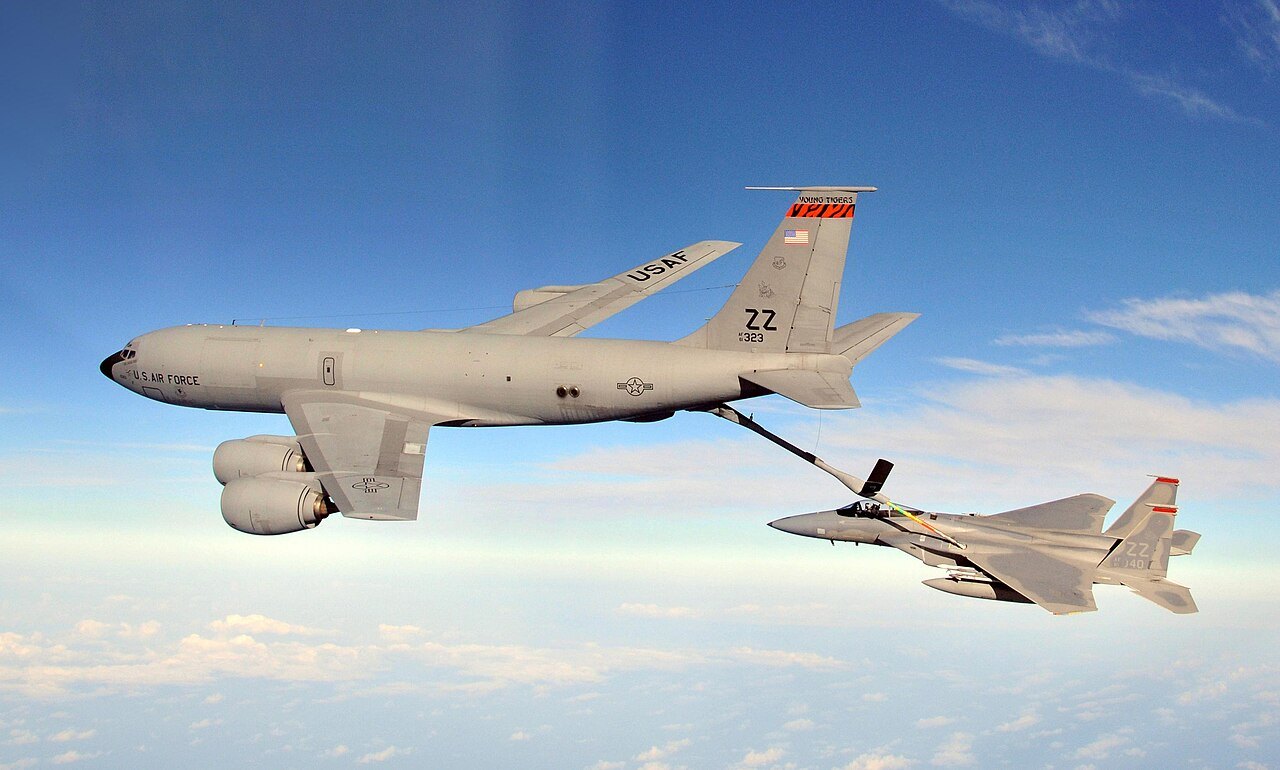
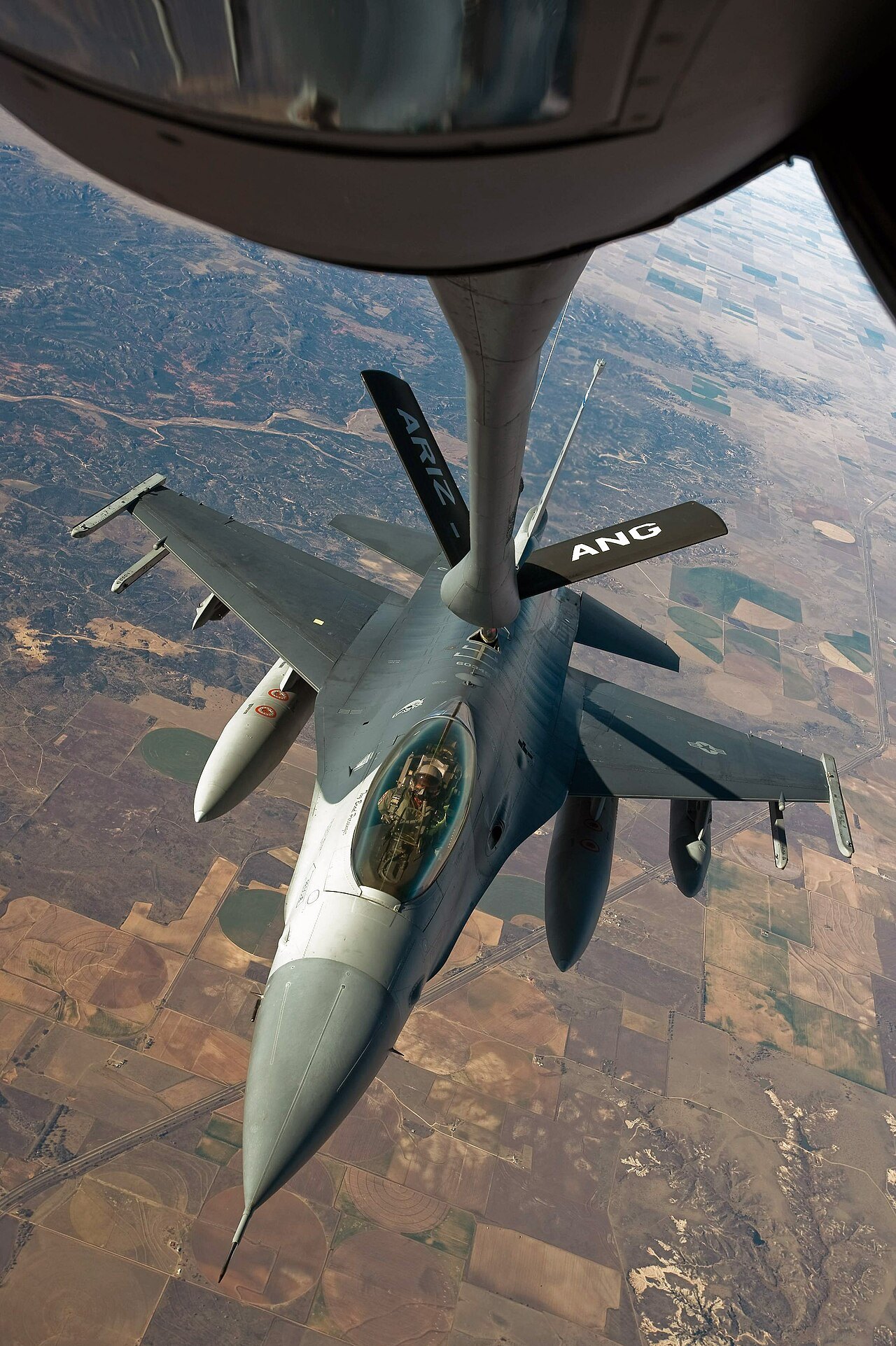
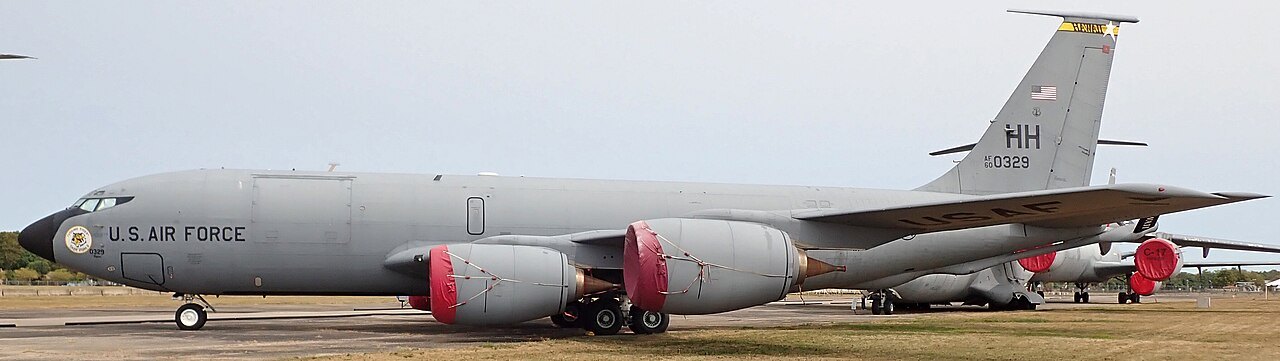
Where the KC-135 flies and flew
The KC-135’s record
The KC-135 is a support aircraft, but it has flown in every American air war since Vietnam and in many smaller operations, usually close enough to combat to be at risk. Its record is measured in decades and in fuel rather than in kills.
See how training and combat types compare in the military aircraft statistics database. Figures are approximate.
Everything people ask about the KC-135
Can I fly in a Boeing KC-135 Stratotanker?
Is the KC-135 the same as a Boeing 707?
How old are the KC-135s still flying?
How much fuel can a KC-135 carry?
Can the KC-135 refuel Navy aircraft?
What is replacing the KC-135?
Who else flies the KC-135?
You can’t fly the KC-135.
These, you can.
Most of this museum you can only look at. These genuine military jets you can fly yourself with MiGFlug — with aerobatics and time on the controls.
 Fly the L-39 AlbatrosThe world’s most-flown jet trainer — aerobatics included
 Fly the F-104 Starfighter“The missile with a man in it”
 Fly the MiG-21The Cold War’s most-produced jet
 Fly the T-33 Shooting StarAmerica’s first jet trainer
 Fly the DH VampireA piece of early jet history
 Fly the S.211Agile Italian jet trainer
 Fly the MB-326The classic Aermacchi jet
 Fly the MiG-15The Soviet legend of the Korean War
Continue the tour
Every fact, checked
- KC-135 Stratotanker fact sheetUS Air Force official data: specifications, unit cost, capacities
- KC-135 StratotankerProgramme dates, fleet numbers, re-engining and offload figures
- National Museum of the United States Air Force: KC-135 and EC-135 exhibitsPreserved aircraft and history of the type
- Boeing KC-135 Stratotanker: More Than Just a Tanker (Robert S. Hopkins III, Midland, 1997)Standard history of the C-135 family, variants and operations
- Mackay Trophy winnersNational Aeronautic Association award record, 1967 Casteel crew
- Air Force Historical Support Division: Palomares and Looking Glass historiesOfficial histories of SAC operations and accidents