
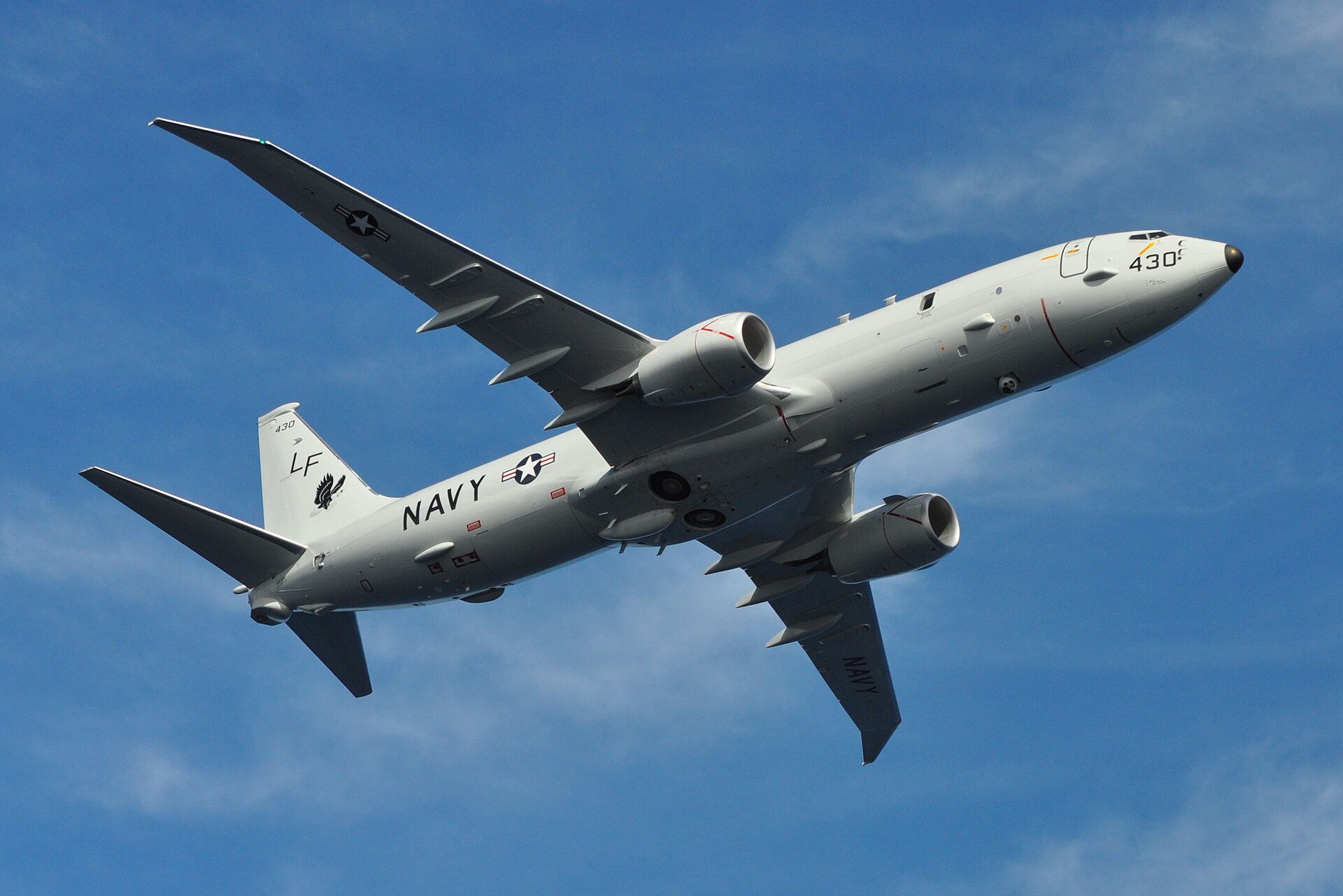
Boeing P-8 Poseidon
The Sub Hunter Airliner
A Boeing 737 turned submarine hunter, the P-8 replaced the P-3 Orion and Nimrod, searched for MH370, shadowed Chinese and Russian fleets, and now patrols the oceans for ten nations.
The P-8 Poseidon: how a 737 learned to hunt submarines
From the outside it looks like the airliner you took on holiday, painted grey. Then the bomb-bay doors open behind the wing, a launcher in the rear fuselage fires sonobuoys into the sea, and the crew at the consoles start listening for the faint machinery noise of a submarine far below. The Boeing P-8 Poseidon is a 737-800 rebuilt for war at sea: torpedoes and anti-ship missiles, an in-flight refuelling receptacle, a strengthened airframe and wings borrowed from the larger 737-900 with raked tips. It was designed to do the job of the Lockheed P-3 Orion faster, higher and with a smaller crew, and it has replaced the Orion and the Nimrod in air forces and navies from Norway to New Zealand.
The US Navy chose Boeing’s design in its Multimission Maritime Aircraft competition on 14 May 2004. The first P-8A flew on 25 April 2009, the first fleet aircraft was delivered on 4 March 2012, and initial operating capability came in November 2013. Unlike the turboprop Orion, which hunted at low level for hours, the jet-powered Poseidon was planned to do much of its work from higher altitude, relying on long-range sensors, high-altitude torpedo kits and data links. The US version does not carry a magnetic anomaly detector, the tail sting that defined earlier sub hunters; India, which ordered the P-8I in 2009 as the first export customer, insisted on one.
Boeing says more than 170 had been delivered by the mid-2020s and that the fleet has flown well over 700,000 hours. Operators include the US Navy, India, Australia, the United Kingdom, Norway, New Zealand, South Korea and Germany, with Canada and Singapore to follow. The P-8 has searched for the missing Malaysia Airlines Flight 370 and the Argentine submarine ARA San Juan, shadowed Russian submarines in the North Atlantic, and become a regular target of aggressive Chinese intercepts over the South China Sea. It is now, by some distance, the Western world’s standard maritime patrol aircraft, and the benchmark against which rivals such as Japan’s Kawasaki P-1 and Airbus-based proposals are judged.
01The P-8 Poseidon’s origins: replacing the Orion
By the late 1990s the US Navy’s P-3 Orions, designed in the 1950s, were wearing out. A first attempt to replace the Orion with a new-build version of the same aircraft was abandoned, and the Navy opened the Multimission Maritime Aircraft competition. Lockheed Martin offered a modernised Orion; Boeing offered a militarised 737. On 14 May 2004 Boeing won, and in June the Navy awarded a development contract worth more than US$3.8 billion.
The P-8 is built in an unusual way: Boeing’s commercial plant in Renton assembles a strengthened 737 airframe on the same line as airliners, and the military systems are installed afterwards. The basic design is a 737-800ERX with the wings of the 737-900, raked wingtips instead of the airliner’s blended winglets, a bomb bay behind the wing, six underwing and fuselage hardpoints and an air-to-air refuelling receptacle above the cockpit. The engines are CFM56-7s fitted with larger generators to power the mission systems.
02The P-8 Poseidon worldwide: from Arakkonam to Lossiemouth
India became the first export customer in January 2009, ordering eight P-8I Neptune aircraft with a magnetic anomaly detector and Indian-designed data links; four more followed in 2016 and further aircraft were approved later. The first arrived on 15 May 2013 and they serve with INAS 312 at INS Rajali, Arakkonam. Australia’s first P-8 arrived in 2016; the RAAF flies them from Edinburgh, South Australia, with Nos 11, 12 and 292 Squadrons under No. 92 Wing.
The United Kingdom, which had scrapped its Nimrod MRA4 in 2010, bought nine P-8s as the Poseidon MRA1. The first, named Pride of Moray, reached RAF Lossiemouth in October 2020, restoring British long-range maritime patrol after a gap of a decade. Norway flies five from Evenes in the Arctic north, New Zealand received four from December 2022 to replace its P-3K2 Orions, and South Korea and Germany have followed. Canada announced its choice of the P-8 in November 2023.
What makes the P-8 Poseidon special
Listening to the sea
The P-8’s main anti-submarine sensor is not on the aircraft at all: it is the field of sonobuoys it drops, up to 129 on board according to the RAAF, which listen passively or ping actively and radio what they hear back to the aircraft. The acoustic system can process many buoys at once. Above the water, a multi-role radar with inverse synthetic aperture mode identifies ships at long range, and an electro-optical and infrared turret gives a close look.
Weapons from height
A weapons bay behind the wing carries Mk 54 torpedoes, mines or depth charges, and underwing hardpoints carry Harpoon anti-ship missiles. Because a jet airliner is less suited to long low-level search than a turboprop, the US Navy developed the High-Altitude Anti-Submarine Warfare Weapon Capability, a wing kit that lets a torpedo glide down from altitude before entering the water, so the P-8 does not have to descend to attack.
Range and speed
Boeing gives the P-8 a maximum speed of 490 knots and a radius of more than 1,200 nautical miles with over four hours on station; the RAAF says it can conduct low-level anti-submarine warfare more than 2,000 km from base. With air-to-air refuelling it can stay out far longer. Its speed means it can reach a distant search area much sooner than the Orion it replaced, which matters when a submarine contact is only hours old.
03The P-8 Poseidon’s cabin: a crew of nine at work
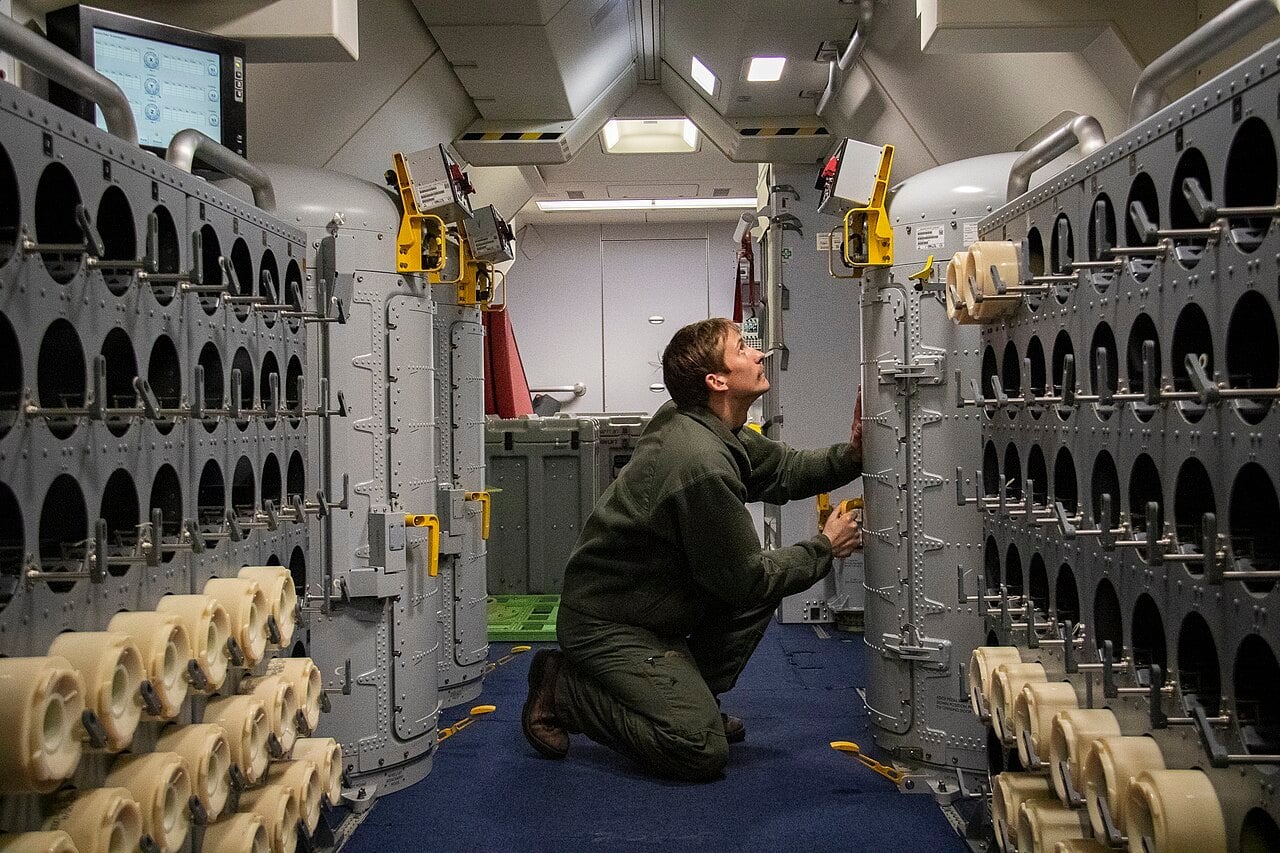
The US Navy gives the P-8A a crew of nine: two pilots and seven mission crew, including tactical coordinators and acoustic and electronic warfare operators; the RAAF lists eight. Unlike the Orion, whose crew needed an observer at the window, the P-8 crew works at a row of identical multifunction consoles along the left side of the cabin, any of which can be set to any task. Rotary sonobuoy launchers in the rear fuselage can be reloaded in flight.
The aircraft was designed for 25 years and 25,000 flight hours, according to Boeing, and receives regular capability increments: better acoustic processing, upgraded radar modes, wideband satellite communications and integration of new weapons and sensors. The P-8I adds the magnetic anomaly detector in a tail boom and a second radar at the rear, and some US aircraft carry an underbelly surveillance radar pod for overland and littoral work.
Boeing P-8A Poseidon specifications
Specifications
- Crew
- 9 (2 pilots, 7 mission crew); RAAF lists 8
- Length
- 39.47 m (129 ft 6 in)
- Wingspan
- 37.64 m (123 ft 6 in)
- Height
- 12.83 m (42 ft 1 in)
- Empty weight
- about 62,730 kg (138,300 lb)
- Max take-off weight
- 85,820 kg (189,200 lb)
- Internal fuel
- almost 34 tonnes (RAAF)
- Powerplant
- 2 × CFM International CFM56-7B turbofans, 121 kN (27,300 lbf) each
- Maximum speed
- 907 km/h (490 kt)
- Cruise speed
- about 815 km/h (440 kt)
- Range
- 7,500 km (4,050 nmi) (RAAF); radius 2,222 km (1,200 nmi) with 4 hours on station
- Service ceiling
- 12,500 m (41,000 ft)
- Sonobuoys
- 129
- Armament
- Weapons bay and 11 hardpoints in total; Mk 54 torpedoes, AGM-84 Harpoon missiles, mines and depth charges
Costs & production
- Unit cost
- commonly reported at about US$125–150 million per aircraft in the 2010s, depending on lot and what is included
- Cost per flight hour
- Hedged estimate: in the order of US$20,000–35,000, based on its airliner-derived engines and fuel burn, a crew of nine and mission-system support; no official figure is used here
- Production
- More than 185 built by early 2026; the US Navy alone has taken around 130
- Programme
- Contract 2004; first flight 2009; IOC November 2013; GlobalSecurity cites a US Navy estimate of about US$44 billion over 25 years (FY2004 dollars)
04The P-8 Poseidon’s variants and operators
- P-8A Poseidon: US Navy baseline, also bought by Australia, Norway, New Zealand, South Korea, Germany and Canada.
- Poseidon MRA1: RAF designation for its nine P-8As at Lossiemouth.
- P-8I Neptune: Indian Navy version with magnetic anomaly detector, aft radar and Indian data links.
- Increment upgrades: successive US software and hardware packages adding sensors, communications and weapons such as the high-altitude torpedo kit.
05The P-8 Poseidon’s operating costs: airliner economics, military workload
One of the selling points of a 737-based patrol aircraft is commonality with the world’s largest airliner fleet: engines, spare parts, training and maintenance practices are widely available. That should make the P-8 cheaper to run per hour than an ageing four-engine turboprop or a bespoke design. GlobalSecurity, citing older Navy data, put the total life-cycle cost of the US programme at about US$44 billion in 2004 dollars.
Against that, the mission systems and sonobuoys are expensive, and maritime patrol is low-level work over salt water. No single authoritative public cost per flight hour was found; the estimate given is an order of magnitude only.
The P-8 Poseidon from competition to global patrol
Boeing wins
On 14 May the US Navy selects Boeing’s 737-based design for its Multimission Maritime Aircraft.
India orders; first flight
India signs for eight P-8Is in January; the first P-8A flies on 25 April.
First delivery
The US Navy receives its first P-8A on 4 March.
Operational
The first P-8I reaches India in May; the US Navy declares initial operating capability in November.
MH370 and a barrel roll
P-8s search the Indian Ocean for MH370; in August a Chinese J-11 performs a barrel roll near a US P-8.
Australia
The RAAF’s first P-8A arrives.
Searches and standoffs
US P-8s search for the submarine ARA San Juan; Indian P-8Is deploy during the Doklam standoff with China.
Britain returns
The RAF declares initial operating capability in April and Pride of Moray reaches Lossiemouth in October.
Chaff and New Zealand
A Chinese J-16 releases chaff ahead of an Australian P-8 in May; New Zealand takes its first P-8 in December.
Into Kaneohe Bay
A US Navy P-8A overruns the runway at Marine Corps Base Hawaii in November and ends up in the water.
Canada and Germany
Deliveries to new European and North American operators continue.
Stories & eyewitnesses: the P-8 Poseidon on patrol
Searching for MH370
Two US Navy P-8s joined the biggest search in aviation history.
Read the full story
The barrel roll, 2014
A Chinese fighter pilot made a very public point.
Read the full story
With a camera crew over the Spratlys
In 2015 the US Navy let journalists hear China’s warnings.
Read the full story
ARA San Juan, 2017
P-8s joined the search for a missing Argentine submarine.
Read the full story
Doklam and Ladakh
India’s P-8Is looked inland as well as out to sea.
Read the full story
Pride of Moray
Britain’s return to maritime patrol after a decade’s gap.
Read the full story
Into Kaneohe Bay, 2023
A rainy landing ended in the sea, without injuries.
Read the full story
Chaff in the engine
An Australian P-8 had a dangerous encounter in 2022.
Read the full story
In the Arctic north
Norway’s P-8s watch the Russian Northern Fleet’s doorstep.
Read the full story
The P-8 Poseidon in pictures
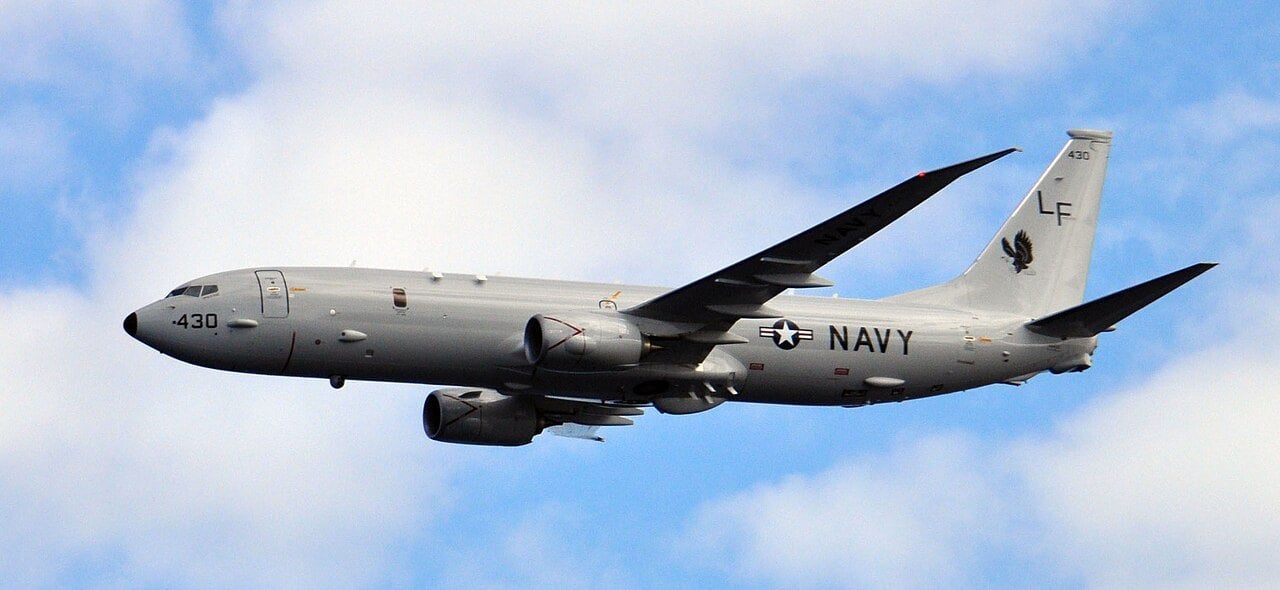
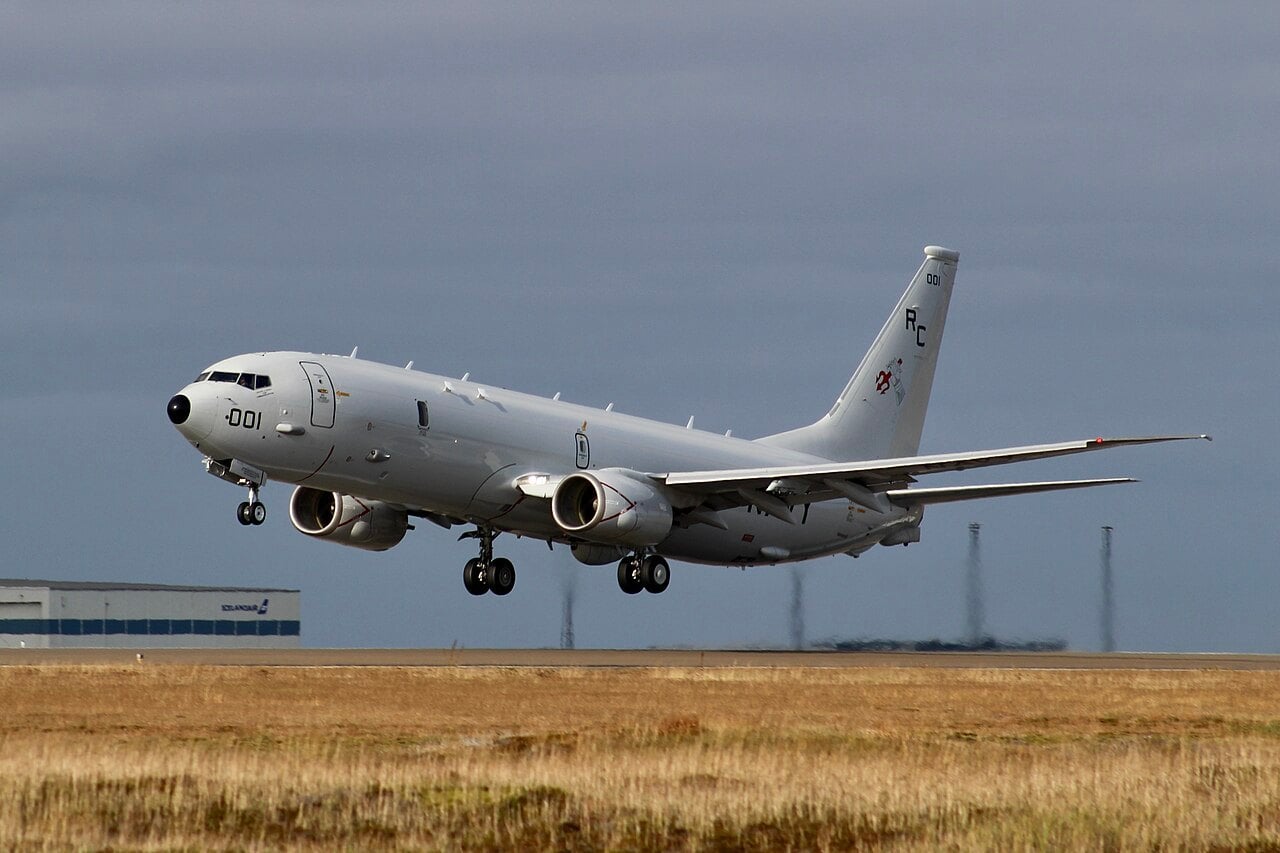
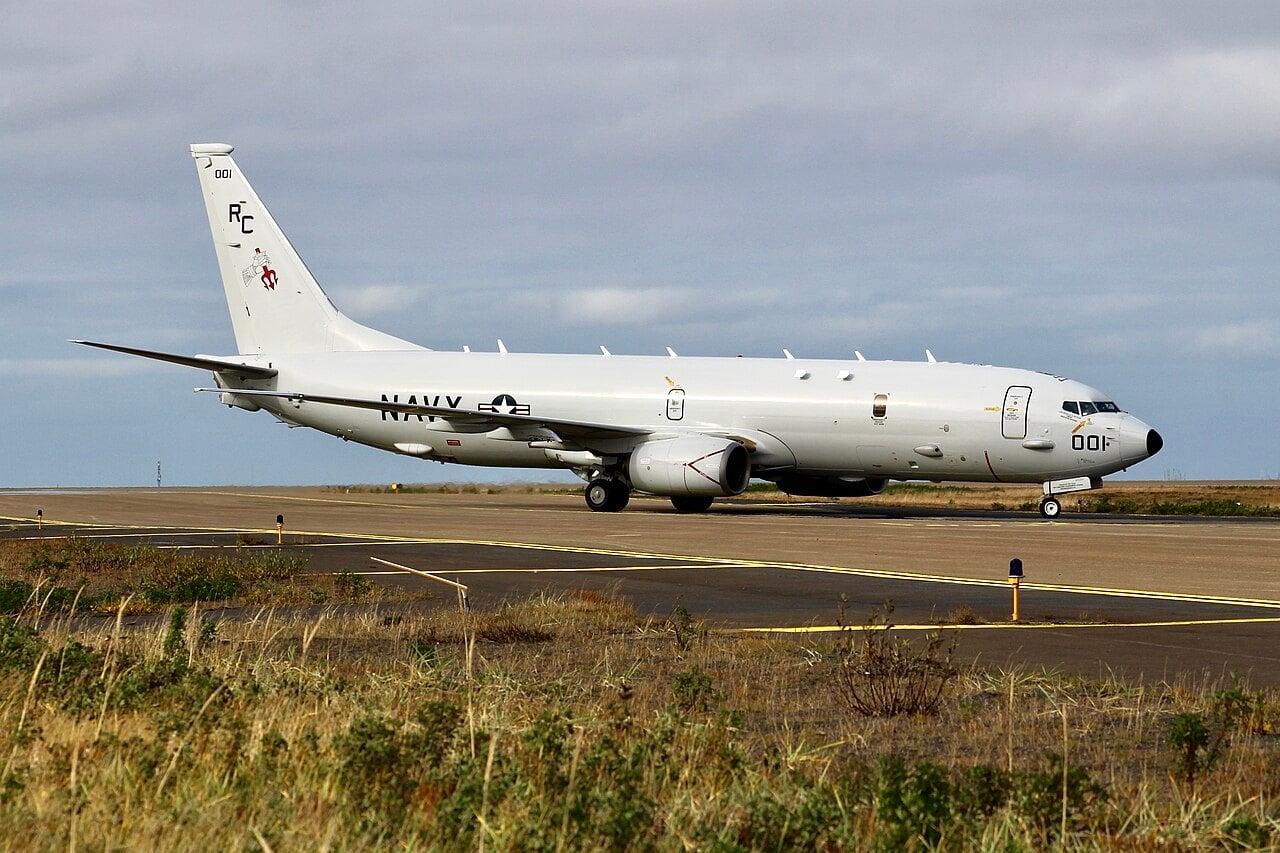
Where the P-8 Poseidon flies and flew
The P-8 Poseidon’s record
The P-8 has not been in a shooting war at sea, but it flies a constant front-line surveillance mission around China, Russia and the Middle East, and it has taken part in some of the largest searches of recent years. Its service is measured in hours and patrols rather than kills.
See how training and combat types compare in the military aircraft statistics database. Figures are approximate.
Everything people ask about the P-8 Poseidon
Can I fly in a Boeing P-8 Poseidon?
Is the P-8 Poseidon a Boeing 737?
What does the P-8 Poseidon do?
Which countries fly the P-8?
What did the P-8 replace?
Does the P-8 have a magnetic anomaly detector?
How long can a P-8 stay airborne?
You can’t fly the P-8 Poseidon.
These, you can.
Most of this museum you can only look at. These genuine military jets you can fly yourself with MiGFlug — with aerobatics and time on the controls.
 Fly the L-39 AlbatrosThe world’s most-flown jet trainer — aerobatics included
 Fly the F-104 Starfighter“The missile with a man in it”
 Fly the MiG-21The Cold War’s most-produced jet
 Fly the T-33 Shooting StarAmerica’s first jet trainer
 Fly the DH VampireA piece of early jet history
 Fly the S.211Agile Italian jet trainer
 Fly the MB-326The classic Aermacchi jet
 Fly the MiG-15The Soviet legend of the Korean War
Continue the tour
Every fact, checked
- P-8A Poseidon multi-mission maritime aircraft fact fileUS Navy: dimensions, weights, engines, crew and armament
- P-8A PoseidonUS Navy NAVAIR: mission, sensors and programme status
- P-8 PoseidonManufacturer: operators, deliveries, fleet hours, performance and design life
- P-8A PoseidonRoyal Australian Air Force: squadrons, base, specifications and sonobuoy load
- P-8 Poseidon MMAProgramme history, contract values and life-cycle cost
- P-8I NeptuneIndian orders, base, squadron and magnetic anomaly detector
- Pentagon: China tried to block U.S. military jet in dangerous mid-air interceptThe Washington Post (Craig Whitlock, August 2014) on the J-11 barrel roll
- Chinese fighter jet ‘chaffs’ Australian plane near South China Sea, Canberra allegesCNN, June 2022, on the J-16 chaff incident
- Navy’s P-8 sub hunter bets on high altitudeBreaking Defense, 2012, on the P-8’s high-altitude ASW concept
- India inducts first squadron of anti-submarine warfare planeThe Diplomat (Franz-Stefan Gady, 2015) on the P-8I
- Germany: P-8A aircraft and associated supportUS Defense Security Cooperation Agency notification, March 2021