
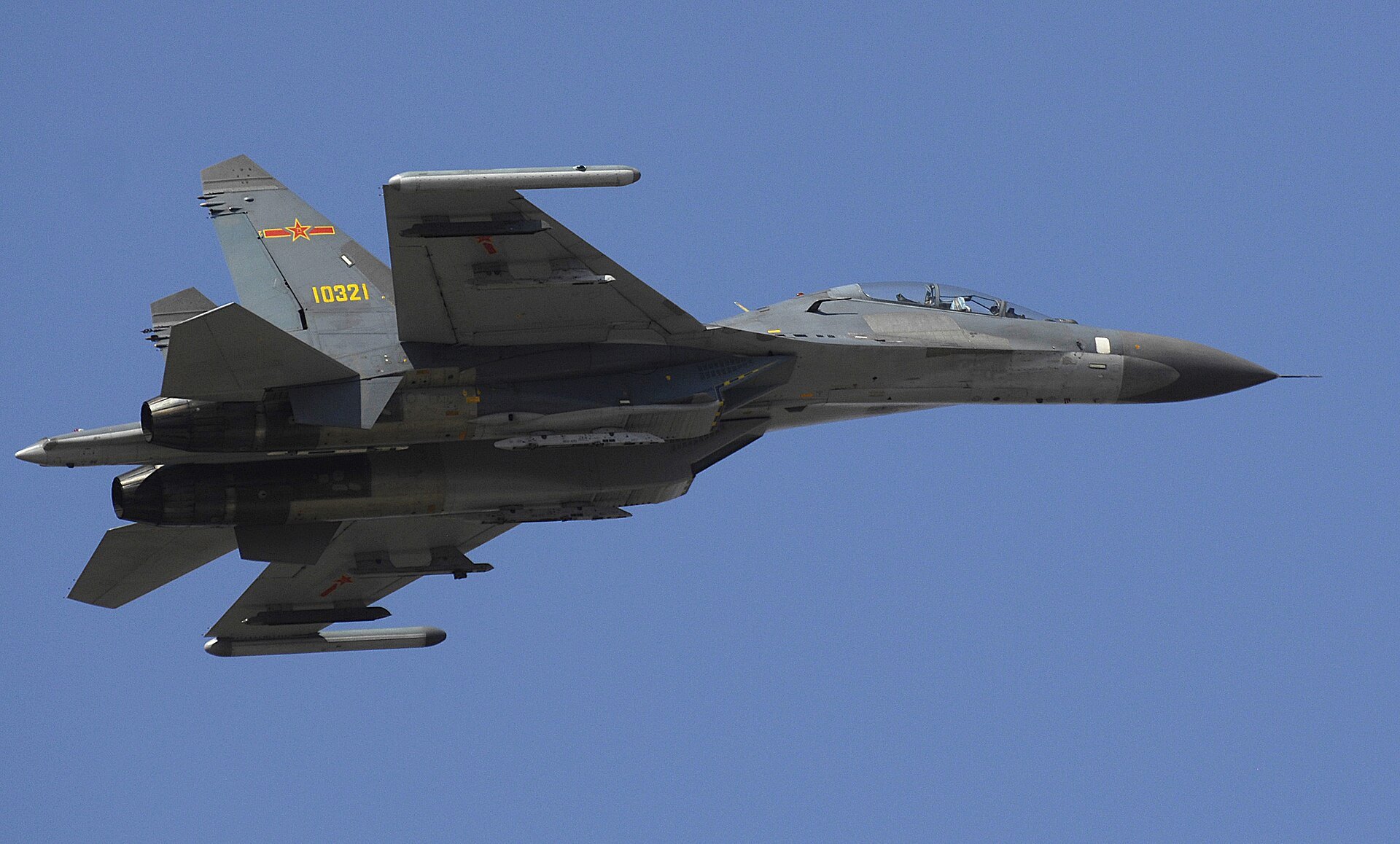
Shenyang J-11
China’s Flanker, from J-11B to J-16
China’s licence-built Su-27 became the foundation of a home-grown Flanker family: the J-11B with Chinese engines and radar, and the J-16 strike fighter that now leads the PLA’s probing flights around Taiwan.
The J-11: how China turned a licensed Su-27 into its own Flanker family
In 1992 the first Sukhoi Su-27s arrived in China. For a People’s Liberation Army Air Force still built around copies of 1950s MiGs, the big twin-engined Flanker was a leap of a whole generation, and Beijing wanted to build it at home. In the mid-1990s Russia agreed to a licence for 200 aircraft to be assembled by Shenyang Aircraft Corporation from kits made at Komsomolsk-on-Amur, under the designation J-11; the deal’s reported value varies widely between sources. The first two Shenyang-assembled J-11s were completed in December 1998, with Russian help.
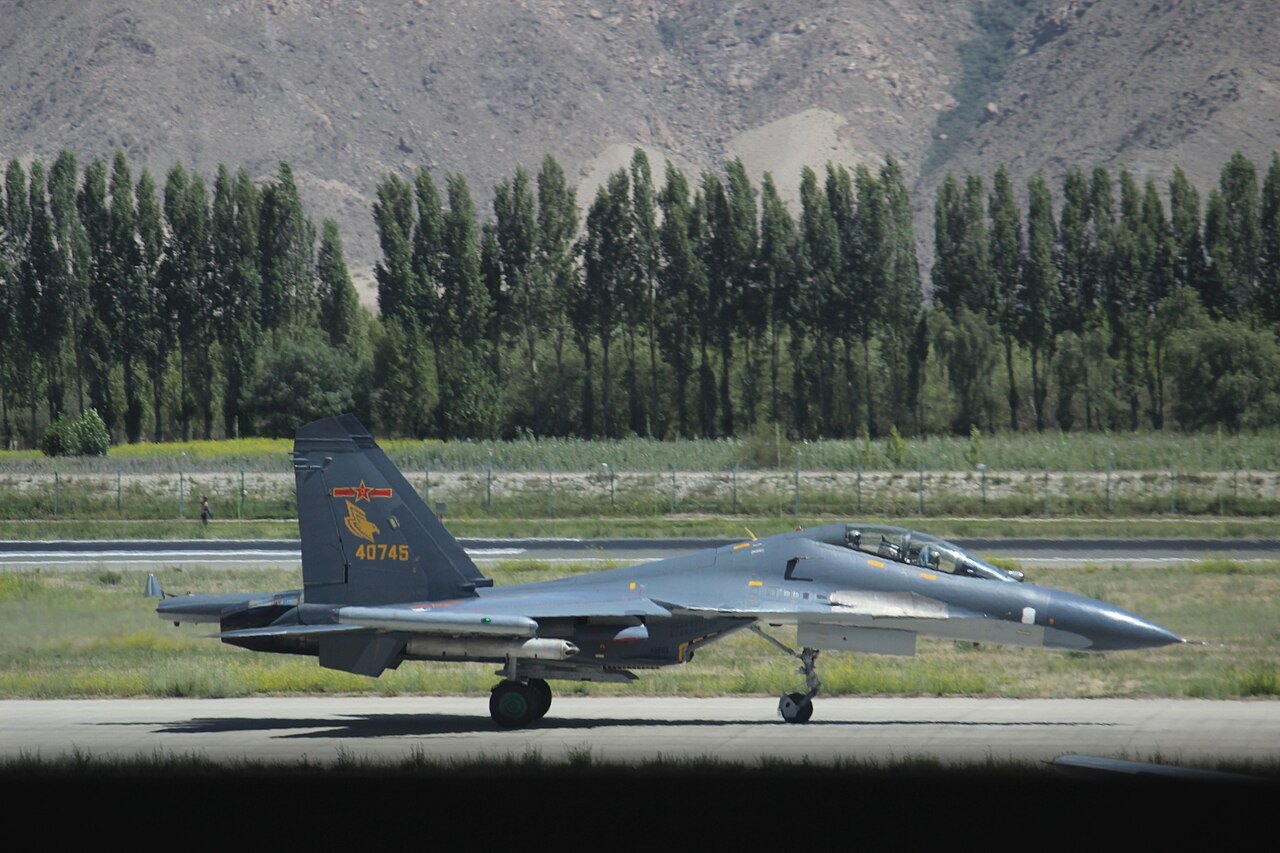
China stopped well short of 200. After roughly a hundred kit-built J-11s and upgraded J-11As, Shenyang turned to the J-11B, an airframe that looked like a Su-27 but was filled with Chinese systems: a Chinese radar and weapons, increased use of composites that saved more than 700 kg, and, after a difficult development, the domestic WS-10 Taihang turbofan. The J-11B first flew around 2003 and was publicly acknowledged in 2007. Moscow was widely reported to regard it as an unlicensed copy.
From the two-seat J-11BS Shenyang developed the J-16, a heavy multirole strike fighter comparable to the Su-30MKK China had bought from Russia, with an AESA radar and twelve weapons stations. It entered service around 2015 and was shown publicly at the PLA’s 90th-anniversary parade in July 2017. Today the J-16 is the aircraft China most often sends to test Taiwan’s air defences, while naval J-11BHs guard the coast and the family’s carrier cousin, the J-15, flies from China’s carriers.
01The J-11B: China’s break with Moscow
The licence agreement assumed China would keep buying Russian kits, engines and avionics. Instead, Shenyang used what it learned on the J-11 production line to build a Chinese version. The J-11B replaced the Russian radar with a Chinese Type 1493 set and carried Chinese missiles such as the PL-12. Composite parts reduced weight by more than 700 kg, and Chinese reports claim a much smaller radar signature than the Su-27SK.
The hardest part was the engine. The WS-10 Taihang suffered performance and vibration problems in 2008 and 2009, and early J-11Bs flew with Russian AL-31Fs. By around 2011 Chinese sources said about nine-tenths of the aircraft was domestically made. Russia was widely reported to regard the J-11B as a breach of the licence, and the dispute is often seen as a reason Russia became more cautious about selling advanced fighters to China for a decade. By 2011, GlobalSecurity estimated, China was flying some 300 Flanker-family aircraft of all types.
02The J-16 at work: the PLA’s go-to fighter around Taiwan
When large formations of PLA aircraft fly into Taiwan’s south-western air defence identification zone, the J-16 is usually among them. FlightGlobal described it in 2021 as China’s top choice for testing Taiwan’s air defences. Its long range, two-person crew and heavy weapon load suit long patrols over the Taiwan Strait and the South China Sea.
The family has also been at the centre of dangerous encounters with Western patrol aircraft. In August 2014 a J-11B intercepted a US Navy P-8 Poseidon about 135 miles east of Hainan, passing as close as about 20 ft in what the Pentagon called an unsafe and unprofessional intercept. In May 2022 a J-16 intercepted a Royal Australian Air Force P-8 over the South China Sea, releasing flares and then chaff in its flight path, and in May 2023 a J-16 made an aggressive fly-by of a US RC-135.
What makes the J-11 special
A Flanker with Chinese insides
Outwardly the J-11B is a Su-27: a large blended-body fighter with twin tails, widely spaced engines and huge internal fuel. Inside it is Chinese: the Type 1493 radar, domestic mission computers, Chinese weapons and, in most aircraft, WS-10 engines. That independence let China upgrade at its own pace, and the later J-11BG is reported to carry an AESA radar and the long-range PL-15 and agile PL-10 missiles.
J-16: the heavy striker
The J-16 combines the J-11BS two-seat airframe with an AESA radar, a modern glass cockpit, greater use of composites and twelve hardpoints for air-to-air missiles, precision-guided bombs and anti-ship missiles. Its back-seater manages sensors and weapons on long missions. RUSI’s Justin Bronk has argued that China’s J-11 and J-16 derivatives, with AESA radars, new datalinks and better electronic warfare, now outclass Russia’s own Su-35S in overall combat capability.
J-16D: the electronic attacker
The J-16D is an electronic warfare version, comparable in concept to the US Navy’s Growler. A possible J-16 electronic warfare variant was reported to have made its first flight in late 2015. Its job is to jam and locate enemy radars and protect strike packages, and it has since been seen in PLA combat training.
03The J-11 family’s engines and missiles: the indigenisation story
The J-11 programme tracks China’s path to aerospace independence. The first aircraft used Russian AL-31F engines, N001 radars and R-27 and R-73 missiles. The J-11B swapped in Chinese radar and PL-series missiles; the WS-10 engine became standard after its early problems were solved; and the J-11BG and J-16 moved to AESA radars and the PL-15, a missile RUSI says outranges the US AIM-120C/D. In 2021 satellite imagery even showed a Flanker variant parked among unmanned aircraft at the Malan test base in Xinjiang, prompting speculation about optionally crewed or drone-surrogate Flankers.
Shenyang J-11B specifications
Specifications
- Crew
- 1 (J-11B); 2 (J-11BS, J-16)
- Length
- 21.9 m (71 ft 10 in)
- Wingspan
- 14.7 m (48 ft 3 in)
- Height
- 5.92 m (19 ft 5 in)
- Max take-off weight
- 33,000 kg (72,750 lb); J-16 about 35,000 kg (77,160 lb)
- Powerplant
- 2 × Shenyang WS-10A afterburning turbofans, about 132 kN (29,700 lbf) each
- Maximum speed
- Mach 2.35
- Range
- about 3,530 km (2,190 mi)
- Service ceiling
- 18,500 m (60,700 ft)
- Armament
- 1 × 30 mm GSh-30-1 cannon; 10 hardpoints (12 on the J-16) for PL-8, PL-10, PL-12 and PL-15 air-to-air missiles and air-to-ground weapons
Costs & production
- Cost per flight hour
- No published figure; for heavy twin-engined Flanker-class fighters, outside estimates generally run to the low tens of thousands of US dollars per hour, so treat any number as an order of magnitude only
- Production
- About 100 kit-built J-11 and J-11A; several hundred J-11B, J-11BS, naval J-11BH/BSH and J-16 since, with exact totals not officially published
- Programme
- Mid-1990s licence for 200 Su-27SK assembled by Shenyang; reported deal value varies between sources
04The J-11 family’s variants: from kit-built Su-27 to J-16D
- J-11: Su-27SK assembled by Shenyang from Russian kits, first two completed December 1998.
- J-11A: upgraded J-11 with Chinese avionics and missile approach warning.
- J-11B: indigenised single-seater with Type 1493 radar, composites and WS-10 engines; first flight about 2003.
- J-11BS: two-seat trainer and combat version.
- J-11BH / J-11BSH: naval air arm versions for land-based coastal defence.
- J-11BG: upgraded J-11B with lighter radome and reported AESA radar.
- J-11D: improved prototypes of 2015 to 2016, not put into production.
- J-16: two-seat multirole strike fighter with AESA radar, in service from about 2015.
- J-16D: electronic attack version.
05The J-11’s operating costs: an educated guess
China does not publish unit or operating costs for its combat aircraft. What can be said is that the J-11 family belongs to the heaviest class of fighters, with two large afterburning engines, a big fuel load and complex radar and electronic systems. Western estimates for comparable aircraft put flight-hour costs far above those of light single-engined fighters; the figure above is a hedged order-of-magnitude range, not an official number.
The J-11 from licensed Su-27 to J-16
Flankers arrive
China receives its first Su-27s from Russia.
Licence deal
Russia and China agree licence assembly of 200 Su-27SKs at Shenyang (the agreement is dated 1995 or 1996 in different sources).
First J-11s
The first two Shenyang-assembled J-11s are completed in December.
J-11B flies
The indigenised J-11B makes its first flight.
J-11B acknowledged
Chinese state television acknowledges the J-11B; WS-10 engine problems delay full service until about 2010.
P-8 intercept
In August a J-11B makes a close intercept of a US Navy P-8 east of Hainan.
J-16 in service
The J-16 enters PLA Air Force service; a J-16D electronic warfare prototype is reported flying.
Public debut
The J-16 appears at the PLA’s 90th-anniversary parade at Zhurihe on 30 July.
Taiwan and Zhuhai
J-16s lead large ADIZ incursions around Taiwan, and the J-16D electronic attack version is seen in service.
Chaff in front of a P-8
In May a J-16 releases flares and chaff in front of an Australian P-8 over the South China Sea.
Stories & eyewitnesses: the J-11 and J-16
Kits from Komsomolsk
The first J-11s were Russian aircraft finished in China.
Read the full story
Why China stopped at about a hundred
The licence was for 200 aircraft; China ended it halfway.
Read the full story
The Taihang’s troubled youth
China’s first big military turbofan nearly sank the J-11B.
Read the full story
Twenty feet from a Poseidon
In August 2014 a J-11B flew a dangerously close intercept.
Read the full story
Chaff in the engines’ path
In May 2022 a J-16 put an Australian crew at risk.
Read the full story
An aggressive fly-by
In May 2023 a J-16 confronted a US reconnaissance jet.
Read the full story
The go-to fighter around Taiwan
The J-16 leads the PLA’s pressure on Taiwan’s air defences.
Read the full story
A Flanker among the drones
In 2021 satellites caught a Flanker at China’s secret UAV base.
Read the full story
Guo Dianman and the J-11B
The engineer who led China’s own Flanker.
Read the full story
The J-11 in pictures
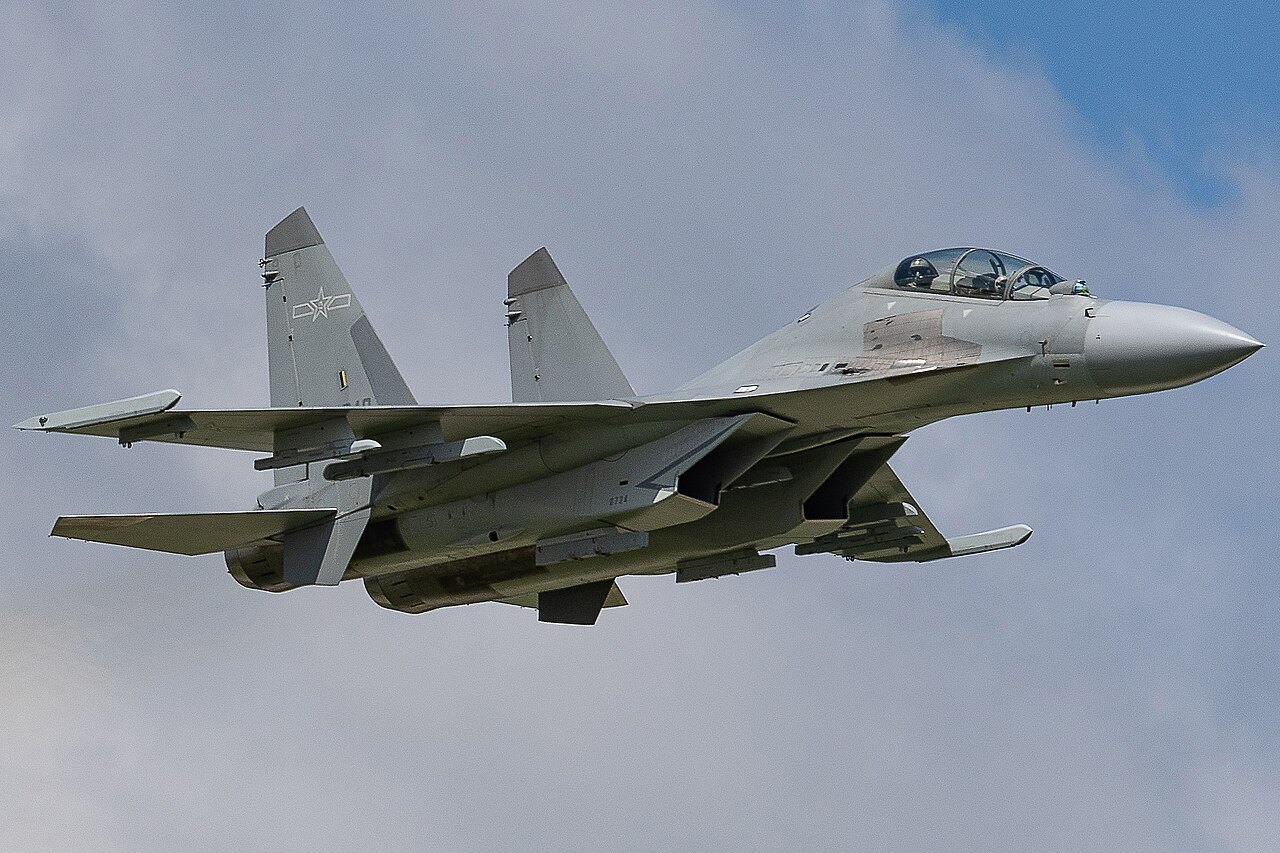
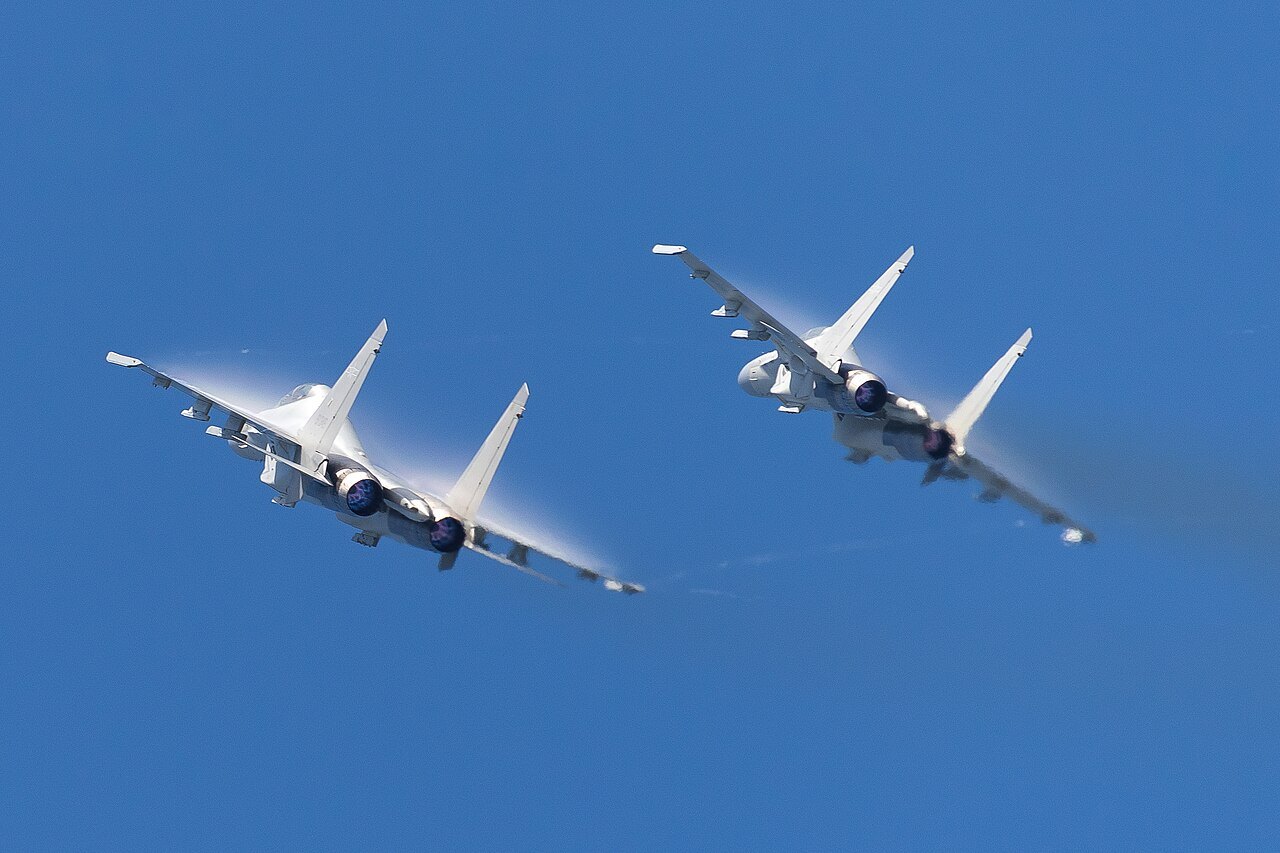
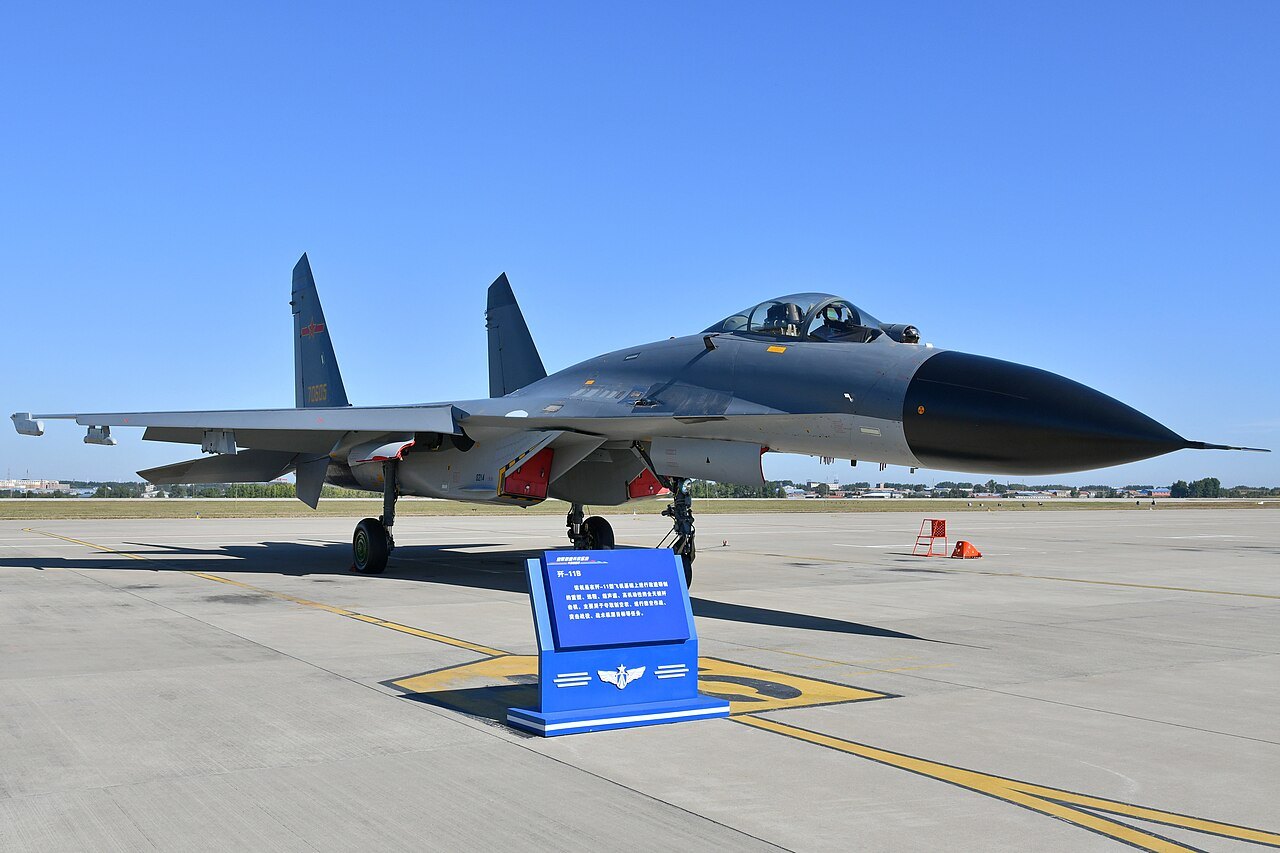
Where the J-11 flies and flew
The J-11’s record
The J-11 family has never fought a war. Its record is one of deterrence, patrols and intercepts: long flights over the South China Sea and around Taiwan, and a series of dangerous encounters with US and Australian surveillance aircraft since 2014.
See how training and combat types compare in the military aircraft statistics database. Figures are approximate.
Everything people ask about the J-11
Can I fly in a Shenyang J-11?
Is the J-11 a copy of the Su-27?
What is the difference between the J-11B and the J-16?
What engines does the J-11 use?
Has the J-11 seen combat?
What is the J-16D?
You can’t fly the J-11.
These, you can.
Most of this museum you can only look at. These genuine military jets you can fly yourself with MiGFlug — with aerobatics and time on the controls.
 Fly the L-39 AlbatrosThe world’s most-flown jet trainer — aerobatics included
 Fly the F-104 Starfighter“The missile with a man in it”
 Fly the MiG-21The Cold War’s most-produced jet
 Fly the T-33 Shooting StarAmerica’s first jet trainer
 Fly the DH VampireA piece of early jet history
 Fly the S.211Agile Italian jet trainer
 Fly the MB-326The classic Aermacchi jet
 Fly the MiG-15The Soviet legend of the Korean War
Continue the tour
Every fact, checked
- J-11 fighterGlobalSecurity: Su-27 deliveries, fleet estimates, domestic production
- J-11BGlobalSecurity: J-11B first flight, WS-10 problems, composites, chief engineer
- J-16GlobalSecurity: J-16 development and 2017 parade debut
- J-16 is China’s go-to fighter in Taiwan aerial incursionsFlightGlobal, Greg Waldron, 4 October 2021
- Why China’s latest jets are surpassing Russia’s top fightersForbes, Sebastien Roblin, November 2020
- Russian and Chinese combat air trendsRUSI Whitehall Report, Justin Bronk, October 2020
- Flanker fighter appears among unmanned aircraft at China’s secretive drone test baseThe War Zone, Tyler Rogoway, July 2021