
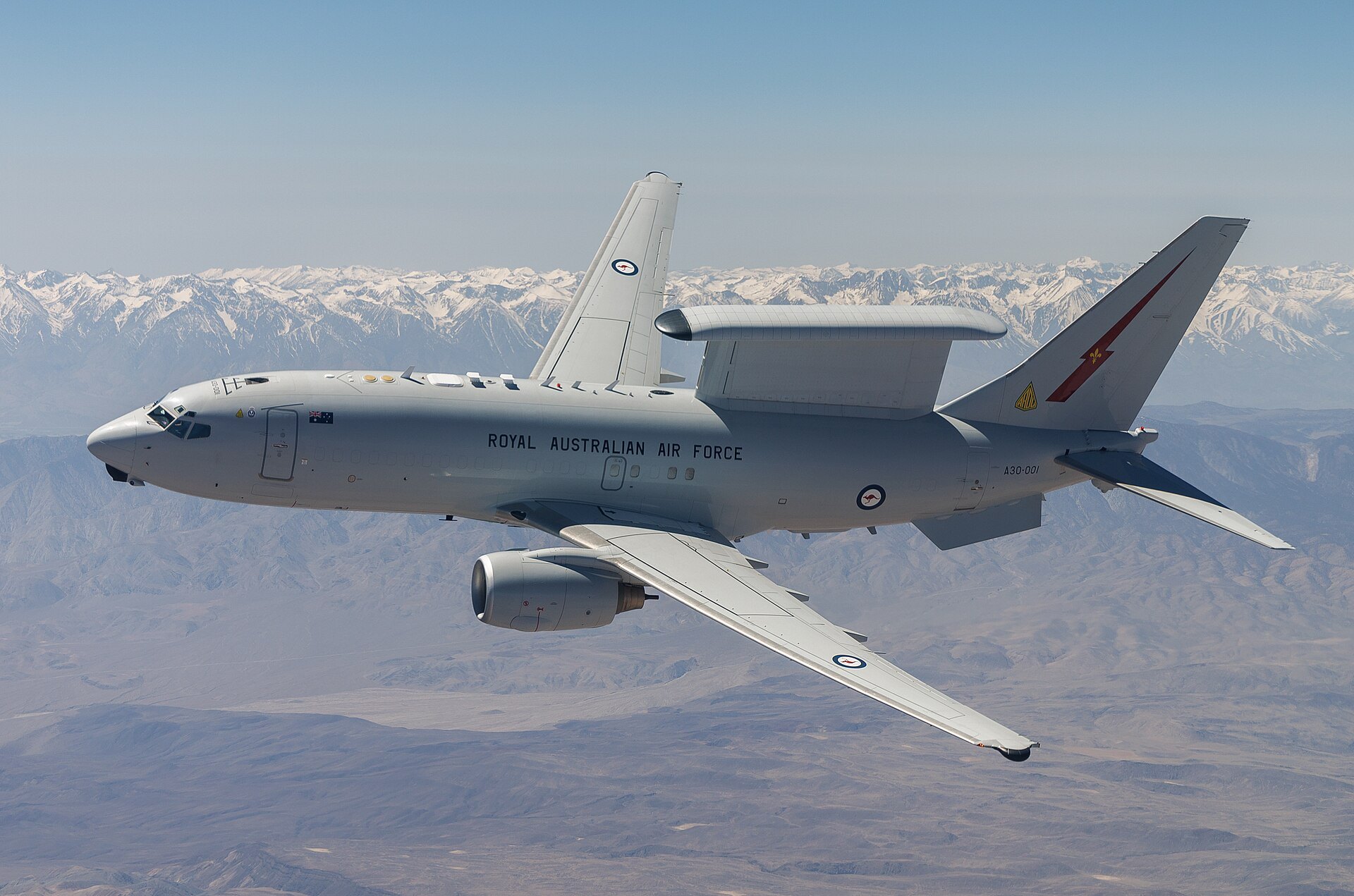
Boeing E-7 Wedgetail
Airborne Early Warning and Control
Australia’s troubled radar project became the most sought-after airborne early warning jet: a Boeing 737 with a fixed radar on its back, flown over Iraq, Europe and the Gulf and chosen to succeed the E-3.
The E-7 Wedgetail: how Australia’s radar jet came good
On 1 October 2014 a grey Boeing 737 with a long flat blade on its back flew north from the Middle East to watch over coalition aircraft striking Islamic State in Iraq. It was the first Australian sortie of the campaign, and for the crew of the E-7A Wedgetail it was vindication. A decade earlier the aircraft had been a byword for delay and cost overruns; now it was controlling coalition fighters, tankers and surveillance aircraft, on patrols that, with air refuelling, could last around 17 hours. Within a few years the same aircraft would be guarding the supply routes to Ukraine, and air forces that had flown the much older E-3 Sentry for decades were lining up to buy it.
The Wedgetail was born in Australia’s Project Wedgetail, named after the country’s largest bird of prey, the wedge-tailed eagle. Boeing won the contract in December 2000 with a 737-700 airframe carrying a Northrop Grumman Multi-role Electronically Scanned Array (MESA) radar in a fixed dorsal structure nicknamed the top hat. Instead of a rotating dish, MESA uses electronically steered arrays on its sides and an end-fire array on top to look all round. The aircraft first flew in 2004, but integrating the radar and mission systems proved far harder than planned. Australia listed it as a Project of Concern in 2008; the first two aircraft were delivered in November 2009, and initial operating capability came only in November 2012.
Once working, it proved very good. Australia’s six aircraft, flown by No. 2 Squadron from RAAF Base Williamtown, have flown over Iraq and Syria, deployed to Europe to protect the Ukraine aid corridor, and in 2026 to the Gulf. Turkey bought four as the Peace Eagle and South Korea four as the Peace Eye. The Royal Air Force ordered five, cut to three, to replace its E-3Ds. The US Air Force chose the E-7 in 2022 to replace the E-3, then proposed cancelling it in 2025, only for Congress to keep two prototypes alive. NATO also picked the E-7 and later chose another aircraft. Few military aircraft have been so wanted and so argued over.
01The E-7 Wedgetail’s difficult birth: Project Wedgetail
Australia began looking for an airborne early warning aircraft in the 1990s, issuing a request for proposals in 1996. Boeing’s 737 design, with Northrop Grumman’s MESA radar, beat rival bids and won the system acquisition contract in December 2000, for four aircraft with options for more; Australia eventually took six. The first two were modified in Seattle and the rest by Boeing Australia, with BAE Systems Australia supplying electronic warfare self-protection.
The schedule then collapsed. Boeing announced a two-year slip in 2007 and a further delay in 2008, a total of 38 months against the contract baseline according to GlobalSecurity, as the radar and mission computing failed to meet requirements. Australia put the project on its Projects of Concern list in January 2008. Boeing, working to a fixed-price contract, is reported to have absorbed well over a billion US dollars of its own money to fix the problems. The first aircraft were accepted in May 2010, initial operating capability came in November 2012 and full operating capability in May 2015. The project was removed from the Projects of Concern list in 2012.
02The E-7 Wedgetail and the E-3’s succession
The E-7’s second career began as the E-3 Sentry fleets aged. The UK signed for five E-7s in March 2019 at £1.51 billion, later reducing the order to three, which are converted from existing 737 airframes by STS Aviation Group in Birmingham. The first RAF aircraft was received with No. 8 Squadron markings in October 2024, but service entry slipped into 2026; the aircraft appeared in public at the Royal International Air Tattoo in 2025 alongside the Red Arrows.
The US Air Force declared in April 2022 that the E-7 was the only platform able to meet its needs in time, awarded Boeing a US$1.2 billion contract for two prototypes in February 2023 and planned a fleet of 26. In June 2025 the Pentagon proposed cancelling it, citing cost growth and survivability, and favouring space-based sensors. Congress funded continued development, and in 2026 the Air Force awarded further contracts to complete two prototypes. NATO, which had announced in November 2023 that it would buy six E-7s, cancelled that plan in November 2025 and opted for the Saab GlobalEye.
What makes the E-7 Wedgetail special
The MESA top hat
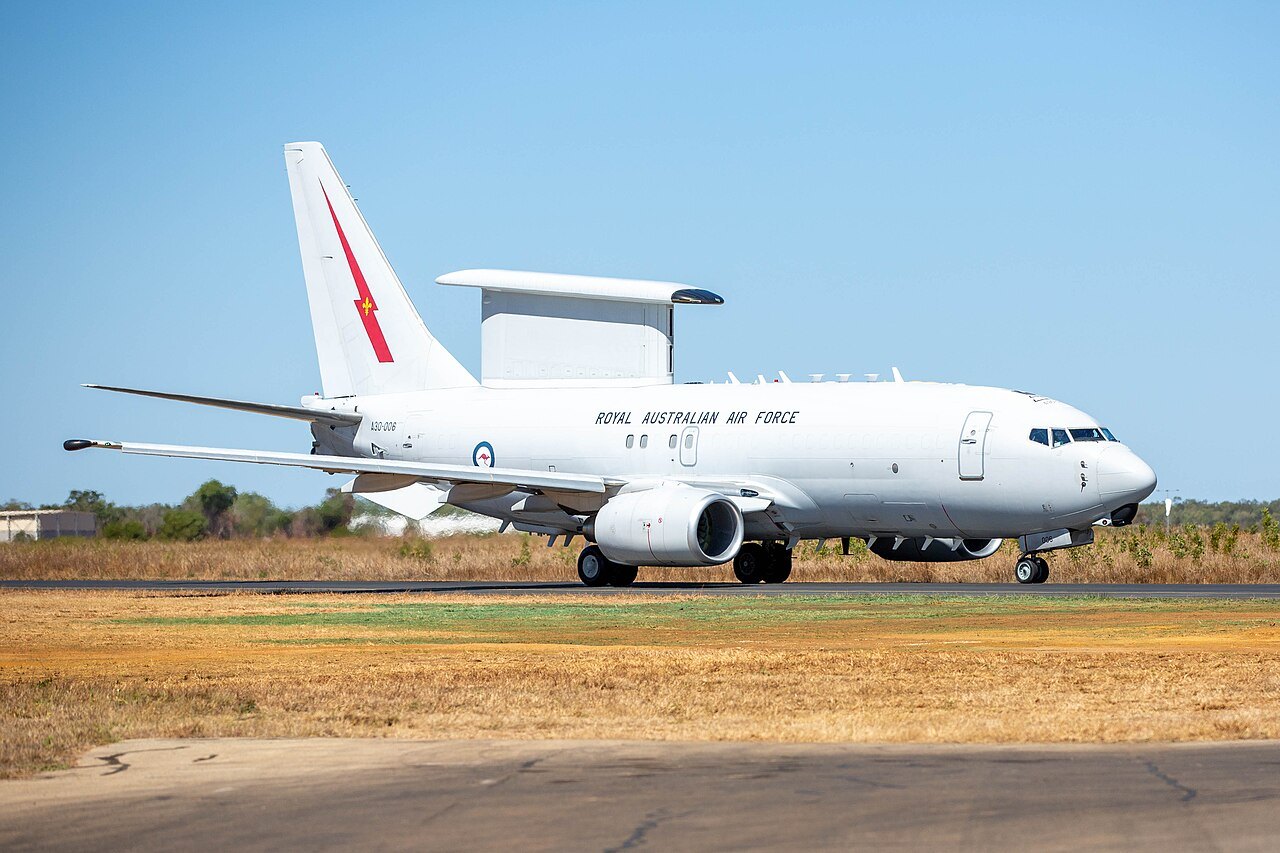
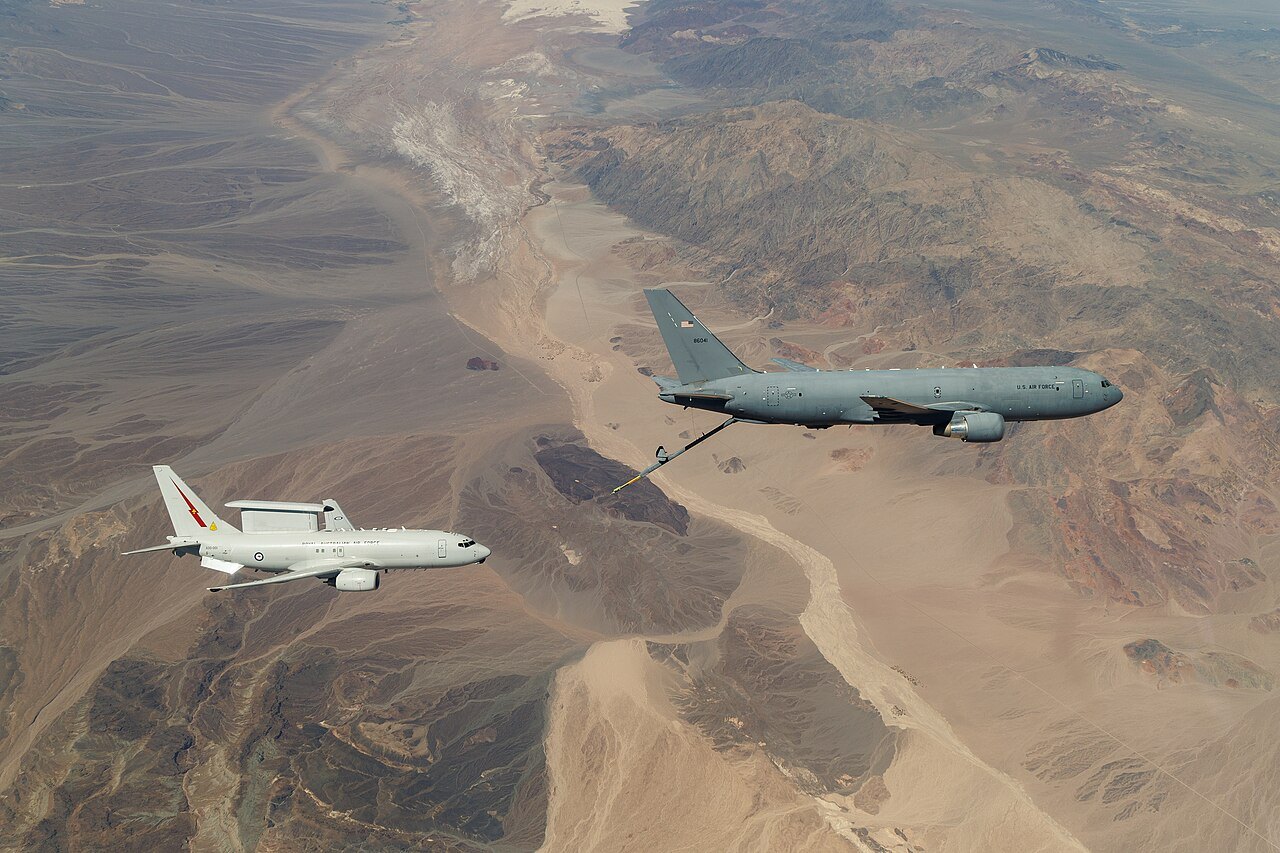
The E-7’s radar sits in a long dorsal fin-like structure, the top hat, on top of the fuselage. Two large side-looking arrays cover the flanks and a top-hat array looks fore and aft, giving 360-degree coverage without moving parts. Because the beam is steered electronically, operators can dwell on a particular sector, track fast targets more often or search a different area, all at the same time. The RAAF gives the radar a range of more than 400 km.
Air and sea at once
The MESA radar can track airborne and maritime targets simultaneously, according to the RAAF. The UK Defence Journal cites the ability to track 180 targets and run 24 intercepts at once, with look-up detection beyond 600 km and frigate-sized ships beyond 240 km. Its arrays also act as an electronic intelligence receiver. In one mission the aircraft can survey about four million square kilometres, an area the size of Western Australia, according to the RAAF.
A 737 for a battle manager
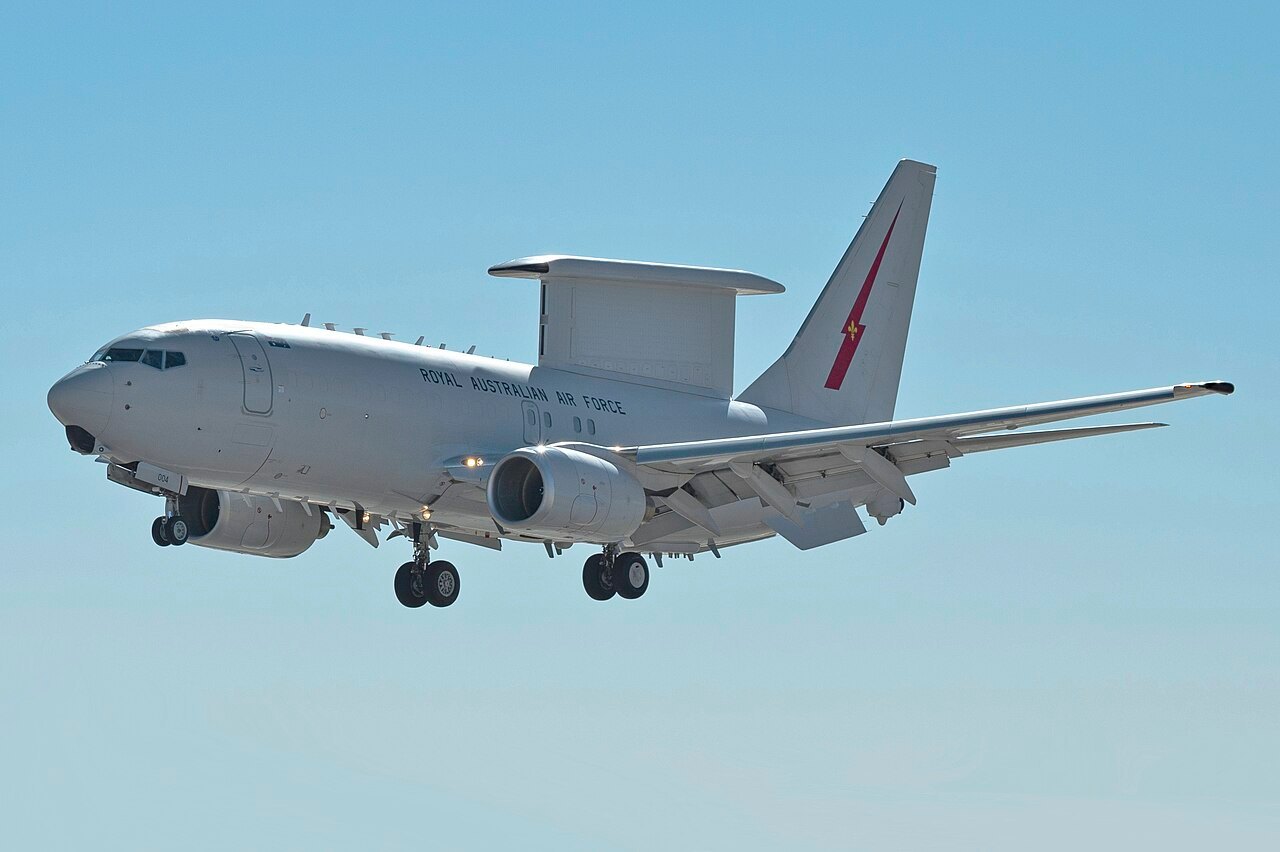
The 737-700 airframe is far younger and more economical than the 707 under the E-3, and its CFM56 engines and spares are used by airlines worldwide. The E-7 has an air-to-air refuelling receptacle, a cruise speed of about 760 km/h and a ceiling of 41,000 ft. Inside, a mission crew of air battle managers and electronics analysts works at multifunction consoles, building the picture and controlling fighters, while the flight deck carries two pilots.
03The E-7 Wedgetail’s variants: Australia, Turkey, Korea, Britain and the US
All E-7s share the 737-700-based airframe and MESA radar, but each customer has its own mission equipment. Turkey’s four Peace Eagle (E-7T) aircraft were largely converted by Turkish Aerospace Industries, with HAVELSAN providing ground support and software, and are being modernised with Aselsan mission computers. South Korea’s four Peace Eye aircraft, ordered in 2006 for US$1.6 billion, were delivered between 2011 and 2012.
The British Wedgetail AEW1 uses converted second-hand airliners. The US E-7A prototypes were intended to add US-specific communications, data links and security standards. Throughout, the radar is refreshed through software and hardware updates; MESA’s electronic scanning makes it well suited to adding new modes without changing the antenna.
Boeing E-7A Wedgetail specifications
Specifications
- Crew
- 2 flight crew plus mission crew of air battle managers and electronics analysts
- Length
- 33.6 m (110 ft 3 in)
- Wingspan
- 34.3 m (112 ft 7 in)
- Height
- 12.6 m (41 ft 4 in)
- Empty weight
- about 46,606 kg (102,750 lb)
- Max take-off weight
- about 77,600 kg (171,000 lb)
- Powerplant
- 2 × CFM International CFM56-7B27A turbofans, 121 kN (27,300 lbf) each
- Maximum speed
- 955 km/h (515 kt) (RAAF)
- Cruise speed
- 760 km/h (410 kt) (RAAF)
- Range
- 7,040 km (3,800 nmi); extended by air-to-air refuelling
- Service ceiling
- 12,500 m (41,000 ft)
- Radar
- Northrop Grumman MESA (Multi-role Electronically Scanned Array), range 400+ km (RAAF)
Costs & production
- Unit cost
- US Air Force per-aircraft estimates were reported rising from about US$588 million to about US$724 million by 2025 (Breaking Defense); the UK paid £1.51 billion for an original order of five in 2019
- Cost per flight hour
- Hedged estimate: probably in the order of US$20,000–40,000, based on a twin-engine 737 airframe with airliner-common engines and spares but a large mission crew and complex radar; no official figure is used here
- Production
- 6 for Australia, 4 for Turkey, 4 for South Korea, 3 for the UK, plus 2 US prototypes in development
- Programme
- Australian contract 2000; first flight 2004; RAAF initial operating capability 2012; full capability 2015
04The E-7 Wedgetail’s customers at a glance
- Australia (E-7A): 6 aircraft, No. 2 Squadron, RAAF Base Williamtown.
- Turkey (Peace Eagle): 4 aircraft; first, named Kuzey, accepted February 2014, last delivered December 2015.
- South Korea (Peace Eye): 4 aircraft delivered 2011–2012; a follow-on order went to a rival design in 2025.
- United Kingdom (Wedgetail AEW1): 3 aircraft for No. 8 Squadron at RAF Lossiemouth.
- United States (E-7A): 2 prototypes; plans for 26 production aircraft proposed for cancellation in 2025.
- NATO: six planned in 2023, cancelled in 2025 in favour of GlobalEye.
05The E-7 Wedgetail’s operating costs: young airframe, demanding radar
The E-7’s case against the E-3 rested partly on running costs: two modern turbofans instead of four 1960s engines, and an airframe family still in widespread airline service. Even so, early ownership was not cheap. A 2019 report in the South Korean press said the four Peace Eye aircraft had suffered frequent breakdowns and incurred maintenance costs approaching their purchase price, with availability of 63 to 73 per cent against a 75 per cent target.
No authoritative public cost per flight hour was found, so the table gives an order-of-magnitude estimate. Acquisition costs vary widely between customers depending on conversions, support and development.
The E-7 Wedgetail from Project Wedgetail to the E-3’s successor
Boeing wins
Australia awards Boeing the Project Wedgetail contract in December.
First flight
The first 737 AEW&C flies in the United States.
Korea orders
South Korea signs for four Peace Eye aircraft.
Project of Concern
Australia lists Wedgetail as a Project of Concern after repeated delays.
Operational
The RAAF takes its sixth aircraft in June and declares initial operating capability in November.
MH370 and Iraq
The first operational sortie supports the MH370 search in April; the first sortie over Iraq follows on 1 October.
Full capability
The RAAF fleet reaches full operating capability in May; Turkey receives its last Peace Eagle in December.
Britain buys
The UK signs for five E-7s to replace the E-3D, later cut to three.
US choice
The US Air Force selects the E-7 to replace the E-3.
Guarding Ukraine’s lifeline
An RAAF Wedgetail deploys to Germany in October for six months to watch over the aid corridor to Ukraine.
Cancelled and revived
The Pentagon proposes cancelling the US E-7; Congress funds the prototypes; NATO switches to GlobalEye.
To the Gulf
Australia deploys a Wedgetail to the United Arab Emirates during the war with Iran; the RAF aircraft are due to enter service.
Stories & eyewitnesses: the E-7 Wedgetail on operations
MH370: the first operational sortie
The Wedgetail’s first real mission was a search, not a war.
Read the full story
Operation Okra: over Iraq and Syria
Six months after MH370, the Wedgetail went to war.
Read the full story
A Project of Concern
For years the Wedgetail was a warning, not a success story.
Read the full story
Ramstein, 2023: watching the aid corridor
An Australian jet flew a NATO mission in Europe.
Read the full story
To the Gulf, 2026
Australia sent a Wedgetail to the war with Iran.
Read the full story
Kuzey: Turkey’s Peace Eagle
Turkey took years longer than planned to receive its aircraft.
Read the full story
Peace Eye: the Korean experience
South Korea’s aircraft showed the costs of a small fleet.
Read the full story
With the Red Arrows at RIAT
Britain’s new radar jet made its public debut in formation.
Read the full story
Cancelled, then not
The US Air Force’s E-7 became a political battle.
Read the full story
Named after an eagle
The aircraft carries the name of Australia’s largest bird of prey.
Read the full story
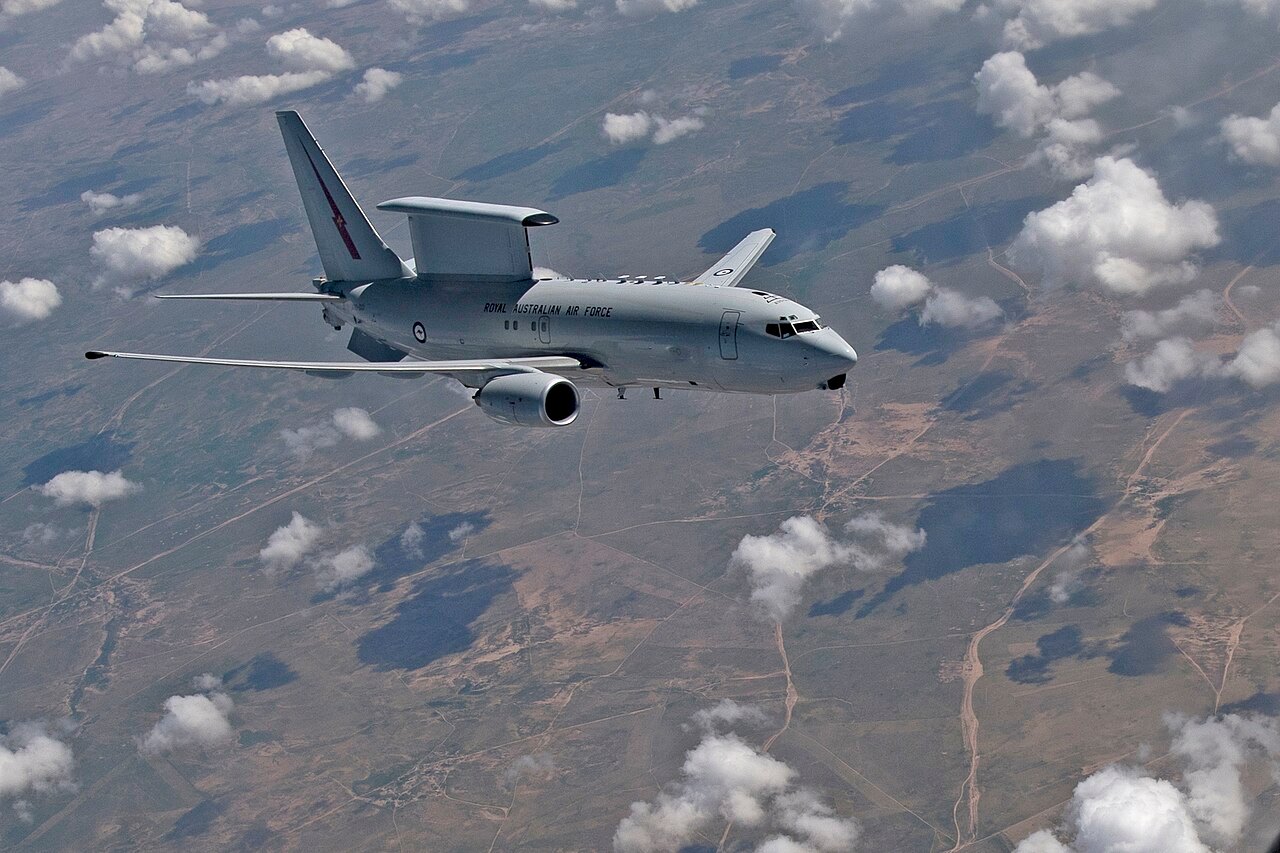
The E-7 Wedgetail in pictures
Where the E-7 Wedgetail flies and flew
The E-7 Wedgetail’s record
The Wedgetail is unarmed, but RAAF aircraft have flown combat support over Iraq and Syria, guarded the Ukraine aid corridor from Germany and deployed to the Gulf in 2026. No E-7 has been lost.
See how training and combat types compare in the military aircraft statistics database. Figures are approximate.
Everything people ask about the E-7 Wedgetail
Can I fly in a Boeing E-7 Wedgetail?
What is the E-7 Wedgetail based on?
Why does the Wedgetail’s radar not rotate?
Who flies the E-7?
Is the E-7 replacing the E-3 Sentry?
Where does the name Wedgetail come from?
Has the E-7 seen combat?
You can’t fly the E-7 Wedgetail.
These, you can.
Most of this museum you can only look at. These genuine military jets you can fly yourself with MiGFlug — with aerobatics and time on the controls.
 Fly the L-39 AlbatrosThe world’s most-flown jet trainer — aerobatics included
 Fly the F-104 Starfighter“The missile with a man in it”
 Fly the MiG-21The Cold War’s most-produced jet
 Fly the T-33 Shooting StarAmerica’s first jet trainer
 Fly the DH VampireA piece of early jet history
 Fly the S.211Agile Italian jet trainer
 Fly the MB-326The classic Aermacchi jet
 Fly the MiG-15The Soviet legend of the Korean War
Continue the tour
Every fact, checked
- E-7A WedgetailRoyal Australian Air Force: specifications, squadron, base, radar and coverage
- Wedgetail to be RAF’s new early warning radar aircraftRAF, March 2019: £1.51 billion contract and coverage figures
- Boeing receives U.S. Air Force E-7 Airborne Early Warning and Control aircraft contractBoeing, February 2023: US$1.2 billion prototype contract
- Air Force cancels E-7 Wedgetail, citing survivability and cost concernsBreaking Defense, June 2025: cancellation and cost growth
- UK pushes delayed Wedgetail service entry target into 2026FlightGlobal, 2025, on RAF schedule
- RAAF Wedgetail arrives in EuropeAustralian Defence Magazine, October 2023, Ramstein deployment
- A guide to the E-7 WedgetailUK Defence Journal: radar performance and Okra patrol lengths
- WedgetailProject Wedgetail contract, delays and Projects of Concern history
- NATO strengthens situational awareness with next generation of command and control aircraftNATO, November 2023: plan to procure six E-7s