
AIDC F-CK-1 Ching-Kuo
Taiwan’s Indigenous Defence Fighter — the home-grown multirole jet the island built when it could not buy modern fighters abroad, and still a pillar of its air defence today alongside the F-16 and Mirage 2000.
The Story
The AIDC F-CK-1 Ching-Kuo: the fighter Taiwan had to build itself
The AIDC F-CK-1 Ching-Kuo is a fighter born of necessity. In the 1980s Taiwan found itself unable to buy the modern combat aircraft it needed from abroad, its usual supplier constrained by diplomacy. Rather than go without, the island set out to design and build its own advanced fighter — and, with substantial quiet help from American industry, it succeeded. The result, the Indigenous Defence Fighter, or IDF, gave Taiwan a home-grown fourth-generation multirole jet and remains, decades later, one of the three pillars of its air defence.
The political backdrop is inseparable from the aircraft. In 1979 the United States switched its formal diplomatic recognition from the Republic of China on Taiwan to the People’s Republic of China on the mainland, and a subsequent joint communiqué in 1982 committed Washington to gradually reducing its arms sales to Taiwan. With advanced Western fighters such as the F-16 effectively off the table at the time, Taiwan’s government concluded that it would have to develop a modern fighter of its own. The programme that followed was a matter of national self-reliance as much as of engineering.
The urgency was real. Taiwan’s fighter fleet in the early 1980s leaned heavily on ageing types such as the F-104 Starfighter and the F-5, aircraft increasingly outmatched by the modernising forces across the strait. Without a way to buy their replacements, the island faced a widening capability gap in the one domain — the airspace over and around the Taiwan Strait — where it could least afford to fall behind. The Indigenous Defence Fighter was conceived as the answer to that gap.
“The fighter Taiwan built when it could not buy one — an indigenous jet with a great deal of quiet American help.”— the Ching-Kuo’s place in history, in a sentence
The work was led by AIDC, the Aerospace Industrial Development Corporation, Taiwan’s state aerospace company. But the IDF was never a purely solo effort. Although a full sale of complete fighters was politically impossible, American companies were permitted to provide extensive technical assistance, and they did. General Dynamics — makers of the F-16 — advised on the airframe and aerodynamics; the engine grew from a collaboration with the American firm Garrett; and the radar drew on Westinghouse technology. The Ching-Kuo is best understood as an indigenous design shaped and enabled by deep American input, which is exactly why it looks, to many eyes, like a cousin of the F-16 and the Northrop F-20.
To manage such an ambitious undertaking, the programme was divided into four coordinated sub-projects, each with its own codename: one for the airframe, one for the engine, one for the avionics and radar, and one for the weapons. This structure let Taiwan and its American partners develop the aircraft’s major systems in parallel, and it produced not just a fighter but an entire supporting ecosystem of engines, sensors and missiles — a remarkable achievement for a first indigenous combat aircraft.
For AIDC and Taiwan’s wider industry, the programme was a crash course in advanced aerospace. Building a modern fighter demanded mastery of composite structures, digital flight controls, radar integration and much else the island had never before attempted. The IDF effort forced the creation of an entire domestic aerospace capability more or less from scratch — skills, tools and facilities that would outlast the aircraft itself and underpin Taiwan’s later aviation projects.
The aircraft that emerged was a compact, twin-engined multirole fighter. Power came from two ITEC TFE1042 turbofans — also known by the military designation F125 — a small but capable engine developed jointly by AIDC and Garrett. Its nose housed the GD-53 “Golden Dragon” pulse-Doppler radar, derived from American technology, giving the fighter a genuine beyond-visual-range capability. And crucially, Taiwan developed its own weapons to go with it: the Tien Chien, or “Sky Sword”, family of air-to-air missiles — the short-range, infrared-guided Sky Sword I and the radar-guided, longer-ranged Sky Sword II — alongside a built-in cannon.
In the air the Ching-Kuo is a modern, fly-by-wire fighter — agile and responsive, if not as powerful as the heavyweight twin-engined fighters of larger air forces. Its relatively small size and light weight make it quick to get airborne and nimble in close combat, qualities well suited to the rapid-scramble interception role at the heart of Taiwan’s defensive posture, where reaction time can matter as much as raw range or payload.
The fighter was named Ching-Kuo in honour of Chiang Ching-kuo, the President of the Republic of China who had launched the programme and who died in 1988, the year before the aircraft first flew. The prototype took to the air in 1989, and after a development effort that included the loss of a prototype, the Ching-Kuo entered service with the Republic of China Air Force in the mid-1990s. Around 130 were built, equipping front-line fighter wings tasked with defending Taiwanese airspace.
The first flight, in 1989, was a moment of considerable national pride — visible proof that Taiwan could design and build a modern fighter, and a public statement of resolve at a tense point in its history. That symbolism mattered almost as much as the hardware itself. An indigenous fighter said something about the island’s determination and technical capability that no imported aircraft, however capable, ever quite could.
Its arrival changed Taiwan’s strategic calculus. Ironically, the very success of the IDF programme — demonstrating that Taiwan could and would build its own fighters — is often credited with helping to loosen the constraints on foreign sales. In the early 1990s the United States approved the sale of F-16s to Taiwan, and France sold it Mirage 2000s. The island suddenly had three modern fighter types instead of none, and the planned production run of the home-grown Ching-Kuo was cut back accordingly. The IDF had, in a sense, succeeded twice over: as an aircraft, and as a lever.
Rather than being sidelined by its foreign fleetmates, the Ching-Kuo settled in alongside them as part of a layered defence. Taiwan operated the F-16, the Mirage 2000 and the IDF together, each with its strengths, giving the air force flexibility and resilience — no single supplier or type could be a single point of failure. The indigenous fighter, fully under Taiwan’s own control for maintenance, upgrades and weapons integration, offered a security of supply that imported aircraft never could.
None of this is to overstate the aircraft. The Ching-Kuo is a light fighter with modestly powered engines and limited range and payload compared with heavier types, reflecting both the constraints under which it was built and its primary role as a short-notice interceptor defending nearby airspace rather than a long-range strike platform. Taiwan understood these trade-offs. The IDF was designed to do a specific job over a specific patch of sky, under wholly national control — not to out-match the largest fighters in every measure.
That control paid off in the aircraft’s later life. From the late 2000s Taiwan carried out a mid-life upgrade, producing the improved F-CK-1C and F-CK-1D variants. The upgrade brought better avionics, more capable mission systems, additional weapons capacity and other refinements, keeping the design relevant well into the twenty-first century. Being able to modernise its own fighter on its own timetable, without needing anyone else’s permission, was precisely the kind of independence the whole programme had been created to secure.
The expertise built up around the Ching-Kuo did not stop with the fighter. The design, engine and systems knowledge accumulated through the IDF programme fed directly into Taiwan’s later indigenous aircraft, most notably an advanced jet trainer that draws heavily on Ching-Kuo heritage. In that sense the fighter’s greatest legacy may be not the roughly 130 airframes themselves but the enduring national capability to design, build and sustain combat aircraft — exactly the strategic independence the programme was created to secure.
Today the Ching-Kuo remains in front-line service, a core part of the Republic of China Air Force’s fighter force in an era of heightened tension across the Taiwan Strait. It flies regular air-defence and interception missions, and it continues to serve alongside Taiwan’s F-16s and Mirage 2000s. For an aircraft conceived because a small, diplomatically isolated island could not buy the fighters it needed, the Ching-Kuo has more than justified itself — a testament to what determined self-reliance, and a great deal of quiet international cooperation, can achieve.
01Political origins: the arms constraints and self-reliance+
The Ching-Kuo exists because of diplomacy. After the United States switched formal recognition from Taipei to Beijing in 1979, and a 1982 joint communiqué committed Washington to gradually reducing arms sales to Taiwan, the island found it could no longer readily buy the advanced Western fighters it wanted — the F-16, at that point, was not available to it.
Faced with an ageing fighter fleet and no easy way to replace it, Taiwan’s leadership decided to build a modern fighter domestically. The IDF programme was therefore as much a political and strategic project as a technical one: an assertion that Taiwan could provide for its own defence even when cut off from its usual sources of advanced weaponry.
02American technical assistance behind an “indigenous” fighter+
Although complete fighters could not be sold, American firms were allowed to provide extensive technical help, and this assistance was central to the IDF’s success. General Dynamics, the maker of the F-16, advised on the airframe and aerodynamics; the American company Garrett partnered on the engine; and the radar drew on Westinghouse technology and know-how.
This is the key to understanding the aircraft. “Indigenous” is accurate in that Taiwan designed, integrated and built the fighter and owns it outright — but it did so with deep American input that let it leapfrog the long, expensive learning curve of first-generation fighter development. The Ching-Kuo is a genuine product of Taiwanese industry, enabled by a discreet transatlantic partnership.
03Why it looks like an F-16 or F-20+
Many observers notice that the Ching-Kuo bears a family resemblance to the General Dynamics F-16 and the Northrop F-20 Tigershark. This is no coincidence: General Dynamics’ involvement in the airframe design, and the wider American assistance, naturally drew on contemporary US fighter thinking.
The result is an aircraft that blends familiar elements — a blended wing-body, leading-edge root extensions and a bubble canopy reminiscent of the F-16 — with its own distinctive features, notably its two engines rather than the F-16’s one, and its own nose and intake arrangement. It is its own aircraft, but its lineage in 1980s American fighter design is plain to see, and entirely by design.
04The four sub-programmes: airframe, engine, avionics, weapons+
Developing a fighter and all its systems from a standing start is enormously complex, so the IDF effort was organised into four coordinated sub-projects, each with its own codename — one for the airframe, one for the engine, one for the avionics and radar, and one for the weapons. Each could progress in parallel, drawing on the relevant American partners.
This structure was a large part of why the programme worked. Rather than a single monolithic project, it was a set of linked efforts that together delivered not just an airframe but a complete weapon system: engine, radar and indigenous missiles all developed alongside the aircraft. Few first attempts at a national fighter have produced so complete an ecosystem.
05The ITEC TFE1042 (F125) twin turbofans+
The Ching-Kuo is powered by two ITEC TFE1042-70 afterburning turbofans, carrying the military designation F125. The engine was developed by ITEC, a joint venture between AIDC and the American firm Garrett, growing out of an existing small turbofan design uprated and fitted with an afterburner for fighter use.
Two engines was a deliberate choice for an island air force whose fighters would often fly over water: the redundancy of a twin-engined layout offers a margin of safety if one engine fails. The F125 is modest in thrust compared with the engines of larger fighters, which makes the Ching-Kuo a relatively light, compact aircraft — but it is well matched to the interceptor and air-defence role for which the fighter was primarily designed.
06The GD-53 “Golden Dragon” radar+
At the heart of the Ching-Kuo’s combat capability is the GD-53 “Golden Dragon” radar, a multimode pulse-Doppler set derived from American radar technology of the era. It gave the fighter the ability to detect and engage targets at beyond-visual range, look down against low-flying targets, and support both air-to-air and air-to-ground modes.
A capable radar was essential to the whole point of the aircraft: intercepting incoming threats before they reached Taiwanese airspace. Paired with the indigenous Sky Sword II radar-guided missile, the Golden Dragon radar gave the Ching-Kuo a genuine beyond-visual-range punch — a modern combat capability that Taiwan now controlled entirely for itself.
07Tien Chien (Sky Sword) I and II missiles+
One of the IDF programme’s most important achievements was that Taiwan developed its own air-to-air missiles to arm the fighter. The Tien Chien, or “Sky Sword”, family came in two main types: the Sky Sword I, a short-range, infrared-homing dogfight missile broadly comparable in concept to the Sidewinder, and the Sky Sword II, a longer-ranged, radar-guided missile for beyond-visual-range engagements.
This mattered enormously for self-reliance. A fighter is only as good as the weapons it can carry, and by fielding its own missiles Taiwan ensured that its indigenous fighter would not be left toothless if supplies of foreign weapons were cut off. Together with a built-in cannon, the Sky Sword missiles gave the Ching-Kuo a complete, home-controlled air-combat armament.
08Named for President Chiang Ching-kuo+
The fighter’s name honours Chiang Ching-kuo, President of the Republic of China, who had championed the indigenous fighter programme as part of his drive to strengthen Taiwan’s self-defence. He died in January 1988, the year before the aircraft first flew, and the fighter was named in his memory — hence “Ching-Kuo”.
The name underlines how closely the aircraft was tied to Taiwan’s national identity and its determination to stand on its own. This was not merely a piece of military hardware but a symbol of the island’s resolve to provide for its own security, carrying the name of the leader who had set that course.
09First flight in 1989 and service entry+
The first Ching-Kuo prototype flew in 1989. The flight-test programme was demanding and not without cost — a prototype was lost during development — but the aircraft was steadily proven and refined. It entered service with the Republic of China Air Force in the mid-1990s, with the type reaching operational units and forming dedicated fighter wings.
For Taiwan, getting the aircraft from a blank sheet to an operational fighter in roughly a decade, while simultaneously developing its engine, radar and missiles, was a formidable industrial accomplishment. The Ching-Kuo gave the island a modern fighter under its own control at exactly the moment it most needed one.
10ROCAF service, numbers and the F-16 effect+
Around 130 Ching-Kuos were built. That the number was not higher is itself part of the story: the IDF programme is widely credited with helping to change the diplomatic weather, and in the early 1990s the United States approved the sale of F-16s to Taiwan while France supplied Mirage 2000s. With modern imported fighters suddenly available, the planned IDF production run was trimmed.
Far from making the Ching-Kuo redundant, this gave Taiwan a diverse, three-type fighter force. The IDF took its place as the fully home-controlled element of that force, equipping front-line wings and sharing the air-defence burden with its foreign-built fleetmates. Its numbers were modest, but its strategic value — as a fighter no foreign government could switch off — was considerable.
11The F-CK-1C/D mid-life upgrade+
From the late 2000s, Taiwan carried out a mid-life upgrade of its Ching-Kuo fleet, producing the improved F-CK-1C (single-seat) and F-CK-1D (two-seat) variants. The upgrade brought more capable avionics and mission computers, enhanced weapons capacity, additional fuel and other refinements, substantially improving the aircraft’s effectiveness.
The upgrade demonstrated the enduring value of owning the design. Taiwan could plan, fund and execute the modernisation on its own schedule and to its own requirements, integrating new weapons and systems without needing another country’s approval. For a nation whose whole reason for building the fighter was independence of supply, the ability to upgrade it freely was the programme’s promise fulfilled.
12Role in Taiwan’s layered air defence+
The Ching-Kuo is one of three fighter types that form the backbone of the Republic of China Air Force, flying alongside the F-16 and the Mirage 2000. Each type has its own strengths, and operating all three gives Taiwan flexibility and resilience — a diversity that means no single supplier, spare-parts pipeline or technical problem can ground the whole fighter force at once.
Within this mix, the IDF handles a core share of air-defence and interception duties, scrambling to meet incursions and standing ready to defend the island’s airspace. As the fully indigenous element, it also serves as the foundation on which Taiwan continues to build its own aerospace expertise, informing later domestic projects such as advanced trainers.
13The cross-strait context, factually+
The Ching-Kuo cannot be understood apart from the long-running political dispute across the Taiwan Strait. The People’s Republic of China regards Taiwan as part of its territory, while Taiwan has governed itself since 1949; the resulting tension has shaped the island’s defence policy for decades. It was this environment — and the diplomatic isolation that came with it — that made an indigenous fighter necessary in the first place.
We describe this context factually and take no position on the underlying dispute. What is relevant to the aircraft is straightforward: heightened tension across the strait keeps Taiwan’s air-defence needs acute, and the Ching-Kuo, as a home-built fighter beyond the reach of any foreign supplier’s veto, occupies a particular place in the island’s calculations. It remains an active front-line type in a sensitive strategic setting.
Design & Engineering
How the Ching-Kuo was built: an indigenous fighter with international roots
Taiwan designed, integrated and built the IDF itself, but did so with deep American technical help — producing a compact twin-engined multirole fighter with its own radar and its own missiles.
Compact twin-jet
A light, blended wing-body multirole fighter powered by two ITEC F125 turbofans — twin-engine redundancy suited to an island air force flying over water.
Home-controlled sensors & arms
The GD-53 Golden Dragon radar and the indigenous Tien Chien (Sky Sword) I and II missiles gave Taiwan a complete air-combat system it owned outright.
Indigenous, with US input
Designed and built by AIDC with technical help from General Dynamics, Garrett and Westinghouse — hence its family resemblance to the F-16 and F-20.
Specifications
AIDC F-CK-1 Ching-Kuo specifications: dimensions, performance and cost
Baseline: the AIDC F-CK-1A Ching-kuo as delivered to the Republic of China Air Force from 1994 — single seat, two ITEC/Honeywell F125-GA-100 turbofans, GD-53 radar, Tien Chien I and II missiles — because that is the standard to which every published specification table refers. Deltas for the two-seat F-CK-1B, for the F-CK-1C/D produced by the Hsiang Chan mid-life upgrade, and for the T-5 Brave Eagle trainer drawn from the same drawings are in grey. Six cautions before the figures. First, the word "indigenous". The Ching-kuo is a Taiwanese aeroplane in the sense that Taiwan paid for it, specified it, assembled it and owns it outright; it is not one in the sense of having been designed without help. General Dynamics shaped the configuration, Garrett built the engine in a joint venture, the radar is a General Electric AN/APG-67 derivative with Westinghouse technology in it, the fly-by-wire came from Lear Astronics, the head-up display from Bendix/King, the inertial platform from Honeywell and the ejection seat from Martin-Baker. None of this was concealed at the time and none of it diminishes the achievement; the point of the programme was to obtain an aeroplane the United States would not sell directly, and the route chosen was to buy the components of one and integrate them at home. Second, the production total. The most-cited figure is 131 serial airframes, and the English Wikipedia infobox gives 137 including six prototypes and pre-production machines, while the delivery contract is usually described as 130 aircraft. These are three ways of counting the same programme and the difference is entirely about whether the four full-scale development aircraft and the ten pre-production machines are inside or outside the number. This page uses 131 serials, notes 130 as the contracted delivery figure and flags 137 as the all-in build total. Third, the reduction. The requirement is variously given as 250 or 256 aircraft and the cut to 130 is commonly dated to 1991, but the two purchases that caused it — 150 F-16A/B Block 20 announced by the United States in September 1992 and 60 Mirage 2000-5 agreed with France in November 1992 — both fall in 1992. Treat 1991 as too early for a decision that could only have been taken once those aircraft were certain. Fourth, service entry. Some sources give 1992 and some give 1994; the first production aircraft were handed over in early 1994 and the first squadron stood up later that year, so 1994 is the date this page uses for operational service and 1992 is best read as the year deliveries of pre-production machines began. Fifth, the performance below is clean-airframe manufacturer data and one of its most-repeated lines is arithmetically impossible, which is dealt with in its own row. Sixth, the ROCAF publishes almost nothing about this aeroplane. Internal fuel capacity, ammunition load, climb rate, field length and serviceability are all absent from open sources; where a figure below is derived rather than quoted, it says so.
Dimensions & weights
- Crew
- 1 The F-CK-1B and the upgraded F-CK-1D are two-seat and fully combat-capable, which matters more here than it does in most air forces: 28 of the 130 aircraft contracted were two-seaters, a fifth of the buy, and in a force that expects to fight from the first hour a combat-capable trainer is a squadron aeroplane that happens to have a second cockpit rather than a training aeroplane that happens to be armed.
- Length
- 14.21 m (46 ft 7 in) Shorter than an F-16C by about a metre and a half, and shorter than an F/A-18A by three metres. The Ching-kuo is often described as a hybrid of the two and it looks like one, but it is markedly smaller than either.
- Wingspan
- 9.00 m (29 ft 6 in) over the wingtip missile rails Almost exactly the span of an F-16 at 9.45 m, on an aeroplane with two engines instead of one. The span is the first clue to the design problem: a twin-engine fighter squeezed into a single-engine planform because the only engines available were small ones.
- Height
- 4.42 m (14 ft 6 in) Twin canted vertical tails were considered and rejected; the Ching-kuo has a single large fin, which is one of the clearest points of divergence from the F/A-18 it is said to resemble.
- Wing area
- 24.2 m² (260 sq ft) Against 27.9 m² for the F-16. A smaller wing on a heavier-for-its-size aeroplane, and the arithmetic of that shows up in the wing loading row below.
- Aspect ratio
- 3.35 Derived from span and area. Low, as it should be for a supersonic interceptor with a cranked leading edge and substantial root extensions; the Ching-kuo was drawn to turn and to accelerate in the vertical, not to loiter.
- Wing configuration
- Cranked-arrow planform with leading-edge root extensions and blended wing-body The General Dynamics fingerprints are here. The forebody strakes, the blended body and the bifurcated intakes mounted low on the sides under the strakes are all F-16 and F-16XL thinking, adapted to two small engines instead of one large one. The result is an aeroplane whose lineage is legible from fifty metres away, which was politically awkward and aerodynamically sensible.
- Empty weight
- 6,486 kg (14,299 lb) Extraordinarily light for a twin-engine fighter with a pulse-Doppler radar and a full fly-by-wire system. It is light because it had to be: with only 18,900 lbf of reheated thrust available, every kilogram had to be argued for. Weight control on this programme was not good engineering practice, it was survival.
- Normal gross weight
- 9,072 kg (20,000 lb) A round 20,000 lb, which is a strong hint that the number is a design target rather than a measurement.
- Maximum take-off weight
- 12,247 kg (27,000 lb) Less than a fully loaded F-16C by some 40 per cent and less than an F/A-18C by nearly half. This is a small aeroplane by any standard, and the smallness is not a design preference but a consequence of the engine embargo that created the programme.
- Disposable load
- 5,761 kg (12,701 lb) between empty and maximum take-off weight Derived. That figure has to contain fuel, pilot, ammunition and every weapon carried, which is why an armed Ching-kuo with a useful radius is a Ching-kuo carrying very little else.
- Internal fuel
- ~1,900–2,000 kg (~4,200–4,400 lb), derived and not published Neither AIDC nor the ROCAF has released an internal fuel figure. What can be done is arithmetic: the gap between empty weight and normal gross weight is 2,586 kg, and once a pilot, a full magazine for the M61A1 and two wingtip missiles are subtracted, what is left is fuel. The answer lands just under two tonnes, which for a twin-engine fighter is very little indeed and is the single most important number on this page.
- Additional internal fuel, F-CK-1C/D
- 771 kg (1,700 lb) The mid-life upgrade found room for another 771 kg inside the airframe, which against a derived baseline of under two tonnes is an increase of something between a third and two-fifths. No other change made to the Ching-kuo has done more for its usefulness. Conformal tanks were also flown on upgrade prototypes; they have not appeared on the operational fleet.
- External fuel
- Three 1,040 L (275 US gal) drop tanks Two underwing and one on the centreline, about 2,500 kg of fuel in total — more than the aeroplane carries inside itself. A Ching-kuo configured for range is therefore an aeroplane whose entire useful load is fuel, with the centreline occupied and drag added, and this is precisely why the 771 kg of internal fuel bought by the upgrade mattered so much.
Performance
- Maximum speed
- Mach 1.8 at altitude, about 1,910 km/h (1,187 mph, 1,031 kn) Note the conversion, because the one in general circulation is wrong. Tables everywhere pair Mach 1.8 with 2,220 km/h, but 2,220 km/h is Mach 1.8 only at sea-level speed of sound, and no aeroplane of this class reaches Mach 1.8 at sea level. At tropopause height Mach 1.8 is about 1,910 km/h. Either the Mach number or the kilometres per hour is right; the pairing is arithmetic nobody checked.
- Maximum speed, realistically achievable
- Disputed; GlobalSecurity gives Mach 1.2 There is a wide and genuine disagreement here. AIDC-derived tables say Mach 1.8; GlobalSecurity states flatly that the aircraft reaches Mach 1.2. The two are reconcilable if the higher figure is a clean-airframe demonstration and the lower one describes an armed aeroplane with fixed-geometry intakes and 42 kN per side in reheat. Fixed intakes are the tell: they are optimised for one speed band, and an aeroplane with them does not hold a high supersonic number for long or at low altitude.
- Service ceiling
- 16,800 m (55,100 ft) Genuinely high, and unsurprising for a light aeroplane with two engines. Altitude was one of the design case’s real requirements: the Ching-kuo was drawn to meet incoming aircraft over the Taiwan Strait, and height is range for a radar and energy for a missile.
- Rate of climb
- Not published by AIDC or the ROCAF Secondary sources circulate figures as high as 254 m/s (50,000 ft/min) at sea level, which would be a clean, light, best-day number of the kind manufacturers publish and squadrons never see. What can be said with confidence is what the thrust-to-weight row says: at normal gross weight the Ching-kuo has very nearly one pound of thrust per pound of aeroplane, so its initial climb is excellent and its climb at combat weight with tanks and missiles is ordinary.
- Thrust-to-weight ratio
- 0.95 at normal gross weight, 0.70 at maximum take-off weight Derived from 18,930 lbf of reheated thrust. The first number is genuinely good and explains why Ching-kuo pilots have always liked the aeroplane in a clean fight. The second is the one that governs an operational sortie, and 0.70 is where a light fighter starts to feel heavy.
- Thrust-to-weight, dry
- 0.61 at normal gross weight Derived from 12,140 lbf without reheat. This is the number that matters for a long transit or a patrol, because reheat on this engine is not something you leave selected.
- Wing loading
- 375 kg/m² (76.8 lb/sq ft) at normal gross weight Comparable to an F-16 at similar loading and better than an F/A-18. Combined with a cranked wing, root extensions and a full-authority fly-by-wire system with no mechanical reversion, this is an aeroplane that turns properly. Nobody has ever seriously criticised the Ching-kuo’s handling.
- Wing loading, maximum
- 506 kg/m² (103.8 lb/sq ft) at maximum take-off weight Derived. A third more than at gross weight, on a small wing, which is another way of saying that a fully loaded Ching-kuo is a very different aeroplane from a clean one.
- Range
- 1,100 km (684 mi, 594 nmi) with three external tanks Read that carefully. Eleven hundred kilometres is not the range of a Ching-kuo, it is the range of a Ching-kuo whose every available fuel station is occupied by a tank. The clean-airframe figure is not published and would be considerably less.
- Combat radius
- ~350–400 km (~190–215 nmi) with tanks; GlobalSecurity gives 70–90 nmi armed on internal fuel This is the widest disagreement in the type’s published data and it is not resolvable from open sources. The lower figure, 130 to 165 km, describes an armed aeroplane on internal fuel with a combat allowance, and it is consistent with the derived internal fuel above. The higher one is a tanked ferry-style radius. Both can be true and the honest summary is the one every account agrees on: the Ching-kuo is short-legged, and that is the price paid for two small engines and a light airframe.
- Endurance in reheat
- About three minutes GlobalSecurity’s figure, and the single most quoted criticism of the type. Three minutes of afterburner is not unusual for a light fighter with modest internal fuel — the arithmetic is much the same on an early Gripen or an F-5E — but it defines the tactics: the Ching-kuo is a point-defence interceptor that gets to the merge with energy and cannot afford a long one.
- Take-off and landing distances
- Not published No open figure exists. What is known operationally is more useful: the ROCAF disperses Ching-kuos to Magong in the Penghu Islands and plans for highway strips, and the fleet is expected to operate from damaged and repaired runways. A short-field number would tell you less about this aeroplane than the fact that its parent air force assumes its airfields will be cratered.
- Agility and flight control
- Well regarded; no mechanical reversion The Ching-kuo was Taiwan’s first fly-by-wire aeroplane and its triple-redundant digital system has no mechanical backup at all, which in 1989 was a considerable act of confidence for a first-time designer. Two aircraft were lost during pre-production, in 1991 and 1993, to mechanical defects; the flight control system was not the culprit and the type’s handling reputation has been good throughout.
Propulsion & systems
- Engines
- Two ITEC/Honeywell F125-GA-100 afterburning turbofans, originally designated TFE1042-70 The whole programme in one entry. Taiwan wanted the General Electric F404 or the Pratt & Whitney F100 and could have neither; the export of a modern combat engine was precisely what the 1982 communiqué made impossible. What Garrett could sell was a derivative of the TFE731 business-jet engine, and the International Turbine Engine Corporation — a Garrett and AIDC joint venture formed in 1982 — was created to turn that into a fighter engine. It worked. It also permanently capped what the aeroplane could be.
- Rated thrust
- 27 kN (6,100 lbf) dry and 42.1 kN (9,500 lbf) with afterburner, each Against 78.7 kN for a single F404 in an early Hornet. Two F125s together produce 84.2 kN, barely more than one F404, on an aeroplane carrying two sets of accessories, two intakes and two engine bays. In 1985 the design was found to fall short of its performance requirement and the answer was a ten per cent thrust increase, which tells you how fine the margin was.
- Engine architecture
- Two-spool, three-stage fan, four axial plus one centrifugal high-pressure stage, bypass ratio 0.49:1, overall pressure ratio 19.4:1 The centrifugal final compressor stage is the giveaway: that is business-jet practice, carried straight across from the TFE731 family, and it is why the engine is compact, robust and modest in thrust. Honeywell quotes 2.59 m and 1,050 lb dry for the non-afterburning F124; the reheated F125 is longer and heavier and no figure has been published.
- Engine designation politics
- TFE1042-70, TFE1042-70A and TFE1088-12 all describe the same engine family The redesignations were not technical. Renaming the engine repeatedly made it harder for Beijing to point at a specific American military powerplant being supplied to Taiwan, and made it easier for Washington to say that no such thing was happening. It is one of the more candid examples on record of an aerospace designation being a diplomatic instrument.
- Engines produced
- 325 F125-GA-100 built for Taiwan For 131 serial airframes needing 262 installed engines, or 137 airframes needing 274. That leaves somewhere between fifty and sixty spares for a fleet expected to fly high-tempo alert sorties for thirty years, which is thin, and it is a standing constraint on how hard the ROCAF can work the type.
- Air intakes
- Fixed-geometry bifurcated side intakes beneath the leading-edge root extensions No variable ramps and no moving spike, which saves weight, cost and complexity and costs high-Mach performance. It is the correct choice for an interceptor that will fight within two hundred kilometres of its own runway, and it is one reason the Mach 1.8 claim deserves the scepticism the performance rows give it.
- Flight control system
- Triple-redundant digital full-authority fly-by-wire, Lear Astronics, with dual-redundant MIL-STD-1553B data buses A 32-bit flight control computer from BAE Systems replaced the original units from 2002. More significant politically, the F-CK-1C/D upgrade substituted indigenous flight control software for the American code, ending Taiwan’s dependence on a foreign source-code holder for the system that keeps the aeroplane in the air. For a country whose whole defence procurement problem is conditional access, that was worth more than any weapon added at the same time.
- Radar
- GD-53 Golden Dragon X-band pulse-Doppler Derived from the General Electric AN/APG-67(V) drawn up for the Northrop F-20 Tigershark — the fighter the United States would not sell Taiwan — with technology from the Westinghouse AN/APG-66 of the F-16 folded in. That the radar of Taiwan’s indigenous fighter is a derivative of the radar of the American fighter Taiwan was refused is the neatest summary of the whole affair that exists.
- Radar performance
- 57 km (35 mi) look-up, 39 km (24 mi) look-down; 10 targets tracked, 2 engaged simultaneously Fifteen modes, eight air-to-air and seven air-to-ground. These are respectable mid-1980s numbers and they are the ones the type entered service with; how far the GD-53 has been improved inside the C/D upgrade is not disclosed. Two simultaneous engagements against ten tracks is a genuine multi-target capability and was a considerable thing for Taiwan to possess in 1994.
- Navigation and displays
- Honeywell H423 inertial navigation system, Bendix/King head-up display, Smiths Industries cockpit systems The Tien Lei avionics project brought in Smiths Industries, Lear Astronics, Litton and Martin-Baker. The cockpit that resulted was conventional Western practice of the period and it is the reason ROCAF pilots move between the Ching-kuo, the F-16 and, with more effort, the Mirage 2000 without relearning their trade.
- Electronic warfare
- TWS-95 radar homing and warning system In April 1997 Litton’s Applied Technology division took a contract worth up to $116.2 million for improved radar warning receivers for the fleet, and further electronic warfare improvements were part of the C/D upgrade. Details are not public. Given the density of the surface-to-air and airborne radar environment the type would face, this is the area where the gap between what is published and what matters is widest.
- Escape system
- Martin-Baker zero-zero ejection seat Martin-Baker was one of the four named partners on the Tien Lei avionics and systems package. A British seat in a Taiwanese aeroplane built with American help is a fair emblem of how the programme was assembled: whatever could be bought was bought, from whoever would sell it.
- Stores stations
- Wingtip rails, underwing pylons, centreline station and semi-recessed fuselage stations Published station counts for the Ching-kuo disagree and no authoritative diagram is in open circulation. What is firmly attested is the arrangement: infrared missiles on the wingtips, medium-range missiles carried semi-conformally against the fuselage under the intake trunks, and wet pylons under the wings. The C/D upgrade doubled semi-recessed medium-range carriage from two rounds to four, which is the single most consequential change made to the aeroplane.
14The Ching-Kuo’s variants, from F-CK-1A to F-CK-1D+
The Ching-Kuo family is straightforward. The original production versions were the single-seat F-CK-1A and the two-seat F-CK-1B, the latter used for conversion training and some operational roles while retaining combat capability. The mid-life upgrade then produced the improved F-CK-1C (single-seat) and F-CK-1D (two-seat) variants.
There are no export sub-types, because the aircraft has never been exported, and no wildly divergent specialised versions — the family is a clean progression from the initial A/B fighters to the upgraded C/D standard. This tidy lineage reflects a type built by, and only for, a single air force with a very specific and consistent mission.
15The AIDC F-CK-1’s cost: what the records show+
Reliable, directly comparable cost figures for the Ching-Kuo are not readily available in public sources. It was developed and procured within Taiwan’s national defence programme, and the way such costs are reported does not translate cleanly into the kind of per-unit price often quoted for aircraft sold on the international market. The mid-life upgrade programme was a further, separately funded investment.
Rather than repeat a misleading figure, we list the cost fields here with caution. What can reasonably be said is that developing an entire fighter — airframe, engine, radar and missiles — from a low industrial base was a major national investment, and that the resulting security of supply and indigenous capability were as much the point as the cost per aircraft.
16The Ching-Kuo among indigenous fighters+
The Ching-Kuo belongs to a small club of fighters designed by nations seeking independence from foreign suppliers, and it is instructive to compare it with peers such as India’s HAL Tejas. Like the Tejas, the IDF was a first-generation national fighter developed under constraints, drawing on foreign technical help while aiming for domestic control of the finished product.
Where the Ching-Kuo stands out is in how quickly it reached service and how complete its supporting ecosystem was, with an indigenous engine collaboration, radar and missiles all fielded together. It was not the most powerful fighter of its generation, but as a demonstration that a diplomatically isolated island could build and sustain a modern combat aircraft, it succeeded emphatically.
17Seeing the Ching-Kuo today+
Because the Ching-Kuo remains an active front-line fighter, the place to see it is in Taiwan, where it serves with the Republic of China Air Force. It appears at Taiwanese air-force open days and displays, and preserved or display examples can be found at sites associated with the ROCAF and Taiwan’s aerospace industry.
As a still-serving type flown only by Taiwan, the Ching-Kuo is not scattered across museums worldwide the way retired Cold War types are. It is very much a living aircraft, and encountering one means encountering the working Taiwanese air force — a reminder that this is not a historical curiosity but a fighter still standing guard.
Armament & payload
The Ching-kuo carries the weapons Taiwan had to build because it could not buy them
Every significant weapon on this aeroplane exists because an American equivalent was unavailable. The Tien Chien I was built because the AIM-9L was rationed; the Tien Chien II was built because the AIM-120 AMRAAM was withheld until the F-16 fleet arrived, and in the Taiwan Strait crisis of 1995 and 1996 the forty pre-production TC-2 rounds were the only beyond-visual-range air-to-air missiles Taiwan possessed. The Wan Chien dispenser was built because no Western standoff weapon was on offer. The National Chung-Shan Institute of Science and Technology did not develop these things out of national pride; it developed them because the alternative was to have nothing. The result is an aeroplane whose armament is more genuinely indigenous than the aeroplane itself.
What the fit adds up to is a competent short-range air defence fighter that the mid-life upgrade turned into something more interesting. In F-CK-1A form the Ching-kuo carried two radar-guided missiles and a pair of heat-seekers and was, in practice, a point interceptor. In F-CK-1C/D form it carries four TC-2, an anti-radiation missile, and a pair of Wan Chien dispensers that reach four hundred kilometres, which puts airbases on the Chinese mainland inside its envelope from Taiwanese airspace. That is a different aeroplane doing a different job, and it happened without a single new airframe being built. Weapon fits differ between the A/B and C/D standards, several integrations are trial-only or unconfirmed, and the ROCAF publishes no authoritative stores clearance list; treat any single tabulated loadout as indicative rather than official.
Gun
- One 20 mm M61A1 Vulcan six-barrel rotary cannon, mounted internally in the forward fuselage.
- The standard American fighter gun of the era, and one of the few major items Taiwan could obtain without argument — the M61 was already in ROCAF service and was not the kind of technology the 1982 communiqué was written to restrict.
- Ammunition capacity has not been published. Installations of this size in aircraft of this class typically carry a few hundred rounds, which at the M61A1’s rate of fire is a handful of seconds.
- Retained unchanged through the F-CK-1C/D upgrade. Nothing about the gun installation has ever been controversial, which in this programme makes it unusual.
Air-to-air
- Tien Chien I (TC-1, Sky Sword I) — indigenous short-range infrared missile with a dual-spectral imaging seeker credited with 18.5 km detection, carried on the wingtip rails. Revealed May 1986, in production from 1991, in service from 1993.
- Tien Chien II (TC-2, Sky Sword II) — indigenous beyond-visual-range missile, 184 kg, 3.694 m long, 19 cm in diameter, inertial mid-course guidance with active radar terminal homing. Two carried semi-conformally on the F-CK-1A; four after the C/D upgrade.
- TC-2C, first tested in 2017, is quoted at 100 km and Mach 6 and represents a generational step over the original round; 250 to 300 extended-range missiles were ordered in 2021.
- AIM-9 Sidewinder, up to four, as an alternative to the TC-1. The Ching-kuo has never been cleared for the AIM-120 AMRAAM: Taiwan’s AMRAAM stocks were bought for the F-16 fleet, and the TC-2 exists precisely to fill that hole.
- The radar supports two simultaneous engagements against ten tracked targets, so four TC-2 aboard is a magazine for two passes rather than four.
Air-to-surface guided
- Wan Chien ("Ten Thousand Swords") — NCSIST standoff glide dispenser, two carried, developed under the codename Project God’s Axe and conceptually close to the AGM-154 JSOW and Storm Shadow. In service from 2011, full operational capability declared 2018, improved version credited with 400 km. The F-CK-1C/D is its only launch platform.
- AGM-65 Maverick, up to four. American, imported, and the type’s only conventional precision anti-armour and anti-ship-of-opportunity weapon.
- TC-2A anti-radiation missile — a passive-seeker derivative of the Sky Sword II, compared to the AGM-88 HARM and credited with detection at 92 km. Integration was one of the announced objectives of the C/D upgrade.
- Hsiung Feng II anti-ship missile — trialled but never adopted. Integration on the original F-CK-1A/B was abandoned over length incompatibilities between missile marks, and although the C/D was announced as capable of carrying it, whether the programme continued is not established. This card records a capability the aeroplane demonstrated and never received.
- Hsiung Chih — an air-launched, lightened derivative of the ramjet-powered supersonic Hsiung Feng III, disclosed in 2022 with the Ching-kuo as its intended carrier and observed in test during 2025. If it enters service it will be the heaviest and fastest weapon the type has ever carried.
Bombs
- Up to ten Mk 82 500 lb general-purpose bombs.
- Up to three Mk 84 2,000 lb general-purpose bombs.
- Up to ten Mk 20 Rockeye II cluster bombs — an anti-armour weapon whose presence in the inventory says exactly what the ROCAF expected to find on a Taiwanese beach.
- These are unguided iron bombs and that is the point worth making. No laser-guided bomb or GPS-guided weapon has been publicly shown on the Ching-kuo; Taiwan’s Paveway and later precision stocks went to the F-16 fleet, which also received the targeting pods to use them.
- Carrying ten Mk 82 on an aeroplane with a maximum take-off weight of 12,247 kg is arithmetically possible and operationally meaningless: it would leave the aircraft with almost no fuel. Treat the maxima as structural limits, not sorties.
Rockets
- No unguided rocket armament is documented on the F-CK-1 in ROCAF service, and no rocket pod has been publicly displayed on the type.
- The card is kept because the absence is informative. The Ching-kuo was conceived as an air defence fighter for a specific and narrow contingency, and close air support against troops in contact was never part of the requirement; that work belonged to the AT-3 Tzu Chung and, later, to attack helicopters.
- The ground-attack capability the type does have — Maverick, iron bombs, cluster weapons and above all Wan Chien — is aimed at ships, landing forces and airfields, all of which are point or area targets engaged from a distance rather than from a strafing pass.
- In a strait crossing measured in tens of hours, an aeroplane that must fly over a beach to fire rockets is an aeroplane that will not come back many times. The omission looks like judgement rather than oversight.
Pods & other stores
- Up to three 1,040 L drop tanks, two underwing and one centreline — the standard configuration for anything beyond a local intercept, and the reason a long-range Ching-kuo sortie is a lightly armed one.
- Conformal fuel tanks, flown on F-CK-1C/D upgrade prototypes and not adopted on the operational fleet. They would have been the cleaner answer to the range problem and their absence is one of the upgrade’s quiet disappointments.
- Internal chaff and flare dispensing, with the TWS-95 radar homing and warning system and improved receivers from the 1997 Litton contract.
- No electro-optical targeting pod has been publicly confirmed on the type. Taiwan’s targeting pods went with its precision bombs to the F-16 fleet, which is a large part of why the Ching-kuo’s air-to-ground repertoire is built around weapons that guide themselves.
- Nothing resembling a reconnaissance, jamming or buddy-refuelling pod has ever been shown. The Ching-kuo does one job and carries the equipment for that job and no other.
Three typical loadouts
- Air defence alert, Tainan or Magong, 2026
- F-CK-1C. Two TC-1 or AIM-9 on the wingtip rails, four TC-2 semi-recessed against the fuselage, one centreline tank, gun loaded. This is the sortie the aeroplane exists for and the one it now flies almost daily: a scramble against People’s Liberation Army aircraft crossing the median line or entering the south-western air defence identification zone. It is also the loadout in which the C/D upgrade is most obviously worth its money, because the A model would have flown the same sortie with half the radar-guided rounds.
- Counter-airfield standoff strike
- F-CK-1C. Two Wan Chien dispensers, two TC-2 for self-defence, two TC-1 on the tips, two underwing tanks. Launched from over Taiwan or the Strait against airfields, radars and missile sites on the mainland coast, with the aircraft never leaving friendly airspace. This is the mission the Ching-kuo was not designed for, cannot have been designed for in 1982, and acquired thirty years later through a weapon rather than an aeroplane.
- Operational conversion and weapons instruction
- F-CK-1D. Two-seat, wingtip acquisition rounds only or clean, one centreline tank, full radar and flight control system. The two-seaters are combat-capable and a fifth of the fleet, so this sortie is flown on aircraft that would go to war fully armed the following morning — which is the correct way to run a small air force and an expensive way to run a training syllabus.
Sourcing. The armament list above is assembled from the published Ching-kuo specification, NCSIST weapon data and reporting on the Hsiang Chan upgrade. The ROCAF issues no stores clearance document and several entries are contested: the Hsiung Feng II integration is explicitly recorded as test-only and never entered service, the Hsiung Chih air-launched anti-ship missile is a development programme rather than a fielded weapon, and ammunition capacity, electronic warfare fits and the exact number and location of stores stations are not in the public domain. Where a weapon is listed here as carried, it is carried by at least one attested account; where the evidence is thinner than that, the entry says so.
Variants
One airframe, one operator, and an upgrade that mattered more than the original
The Ching-kuo begins with a document. On 17 August 1982 the United States and the People’s Republic of China signed the third of their joint communiqués, in which Washington stated that its arms sales to Taiwan would not exceed, in quality or quantity, the levels of recent years, and that it intended gradually to reduce them. Seven months earlier the Reagan administration had already declined to sell Taipei an advanced fighter, turning down both the Northrop F-20 Tigershark and the F-16 and offering continued licence assembly of the ageing F-5E instead. Reagan privately issued the Six Assurances to Taiwan in July 1982 — no date for ending arms sales, no prior consultation with Beijing, no pressure to negotiate — and those assurances are the crack through which the Ching-kuo came into existence. Taiwan could not buy a fighter. It could, with careful handling, buy the pieces of one and the expertise to put them together.
AIDC began work in May 1982 under Hsi-Chun Mike Hua, later called the father of the Indigenous Defence Fighter, and in 1983 the effort was split into four projects: Ying Yang for the airframe, with General Dynamics; Yun Han for the engine, with Garrett; Tien Lei for avionics, with Smiths Industries, Lear Astronics, Litton and Martin-Baker; and Tien Chien for the missiles, at Taiwan’s own Chung-Shan Institute. The American assistance was substantial, openly contracted and tightly bounded. General Dynamics worked through four phases — analysing the ROCAF requirement, assessing configurations, hosting AIDC engineers through preliminary design, and completing its share of the work — and then stopped, because State Department export controls permitted design consultancy and not development, production or marketing. Several configurations were studied, three from AIDC and a parallel General Dynamics series; the G-4 was chosen with features of the C-2 folded in. AIDC then skipped the prototype stage altogether and went straight to full-scale development to save time and money, which is a decision that looks reckless and turned out to be right.
The aeroplane was rolled out in December 1988 and named for Chiang Ching-kuo, the president who had authorised the programme and who had died that January. It first flew on 28 May 1989. Then the ground moved. In September 1992 President George H. W. Bush announced the sale of 150 F-16A/B Block 20 to Taiwan, and in November France agreed to supply 60 Mirage 2000-5. The embargo that had justified the Ching-kuo had, for the moment, lifted. The requirement — given as 250 or 256 aircraft depending on the source — was cut to 130. Production ran from 1990 to 2000 and stopped there. The type entered squadron service in 1994 and by December of that year 32 aircraft were at Ching Chuan Kang. It was the most expensive thing Taiwan had ever built, it had been overtaken by policy before the first squadron was operational, and it is still flying.
The mid-life upgrade is where the story turns. Announced on 27 March 2007 by President Chen Shui-bian as the F-CK-1C/D Hsiung Ying, or Brave Hawk, and executed under Project Hsiang Chan from 2009, it doubled TC-2 carriage from two rounds to four, added the TC-2A anti-radiation missile and the Wan Chien dispenser, replaced the mission computers and electronic warfare suite, strengthened the undercarriage, found 771 kg of additional internal fuel, and replaced American flight control software with Taiwanese code. The first phase covered 71 aircraft over four years at a cost above US$500 million, and the last upgraded aircraft was delivered in 2018. The figure usually given for the whole programme is 127 aircraft, in two batches corresponding to the two wings that fly the type. Every one of the Ching-kuo’s genuinely modern capabilities dates from that work rather than from the original build.
There is one further consequence of the original programme that is easy to miss. Because AIDC had designed, tooled and built a supersonic fighter, it still knew how thirty years later, and the AIDC T-5 Brave Eagle — a lead-in fighter trainer that shares the Ching-kuo’s engines in non-afterburning form and about a fifth of its components — exists because that capability had not been allowed to die. Taiwan’s continuing ability to build combat aircraft is arguably the most valuable thing the Ching-kuo produced, and it is not an aeroplane.
- Full-scale development aircraft (1988–90; 4 built: A-1, A-2, A-3 and B-1)
- Three single-seat and one two-seat aircraft, built without a preceding prototype stage to compress the schedule. A-1 first flew on 28 May 1989 and B-1 on 10 July 1990. The decision to skip prototypes saved years and put the whole programme’s risk onto four airframes.
- Pre-production aircraft (built from October 1990; 10 aircraft, first four delivered March 1992, last in 1993)
- The batch on which the type was proved and on which it was very nearly lost. Two aircraft were destroyed in accidents traced to mechanical defects, one in 1991 and one in 1993, at a moment when the programme’s political enemies had F-16s and Mirages to point at instead.
- F-CK-1A (single-seat; the bulk of the 130-aircraft contract, roughly 102 aircraft)
- The production single-seater: GD-53 radar, two semi-conformal TC-2, wingtip TC-1, M61A1 gun, no precision air-to-ground capability worth the name. A competent short-range interceptor and, until the upgrade, not much more.
- F-CK-1B (two-seat; 28 aircraft)
- Combat-capable two-seat conversion and continuation trainer, a fifth of the buy. The second cockpit displaces fuel from an aeroplane that had none to spare, which makes the B the shortest-legged Ching-kuo of all.
- F-CK-1C Hsiung Ying ("Brave Hawk"; announced 27 March 2007, converted from F-CK-1A from 2009, deliveries to 2018)
- The upgraded single-seater and the version now in service: four TC-2 instead of two, TC-2A anti-radiation missile, Wan Chien standoff dispenser, new mission computers and electronic warfare fit, strengthened landing gear, 771 kg more internal fuel, indigenous flight control software. This is the aeroplane the ROCAF actually operates.
- F-CK-1D (converted from F-CK-1B, same programme)
- The two-seat equivalent of the C, upgraded to the same standard and retaining full combat capability. In an air force this size the two-seaters are war-fighting aircraft that also teach.
- Project Hsiang Chan phase one (71 aircraft; contracted 2009, four-year programme, over US$500 million)
- The first upgrade batch, covering the aircraft of the wing at Tainan. This is the phase for which cost and quantity are firmly documented; the second batch, covering the balance of the fleet at Ching Chuan Kang and completing in 2017 and 2018, is less well recorded and the commonly quoted whole-programme total of 127 aircraft rests on it.
- F-CK-1C/D conformal-tank configuration (prototypes only)
- Two conformal fuel tanks were flown on upgrade prototypes and were not adopted. Given that range is the type’s defining weakness, this is the most interesting road the programme did not take.
- AIDC T-5 Brave Eagle (derived design, not a variant; named 24 September 2019, first flight 10 June 2020; 66 planned, 56 delivered by 2026)
- Advanced jet trainer and lead-in fighter trainer sharing the Ching-kuo’s engines in non-afterburning F124-200TW form but with about 80 per cent new components, a composite structure, thicker wings and more fuel. The United States approved 132 engines in 2017. The fleet was grounded after a double engine failure and crash on 15 February 2025 and the investigation was still running when the flight data recorder was recovered that March.
- Export and licence-built versions (none)
- There are none and there never will be. The Ching-kuo has never been offered for export, never been licence-built and never served with any air force but one. General Dynamics’ contract with AIDC specifically excluded marketing, and no state that recognises Beijing could buy a Taiwanese fighter in any case. This entry exists to record an absence that is central to the type rather than incidental to it.
Production and accounting. The figures on this page are 131 serial airframes, 137 including the four full-scale development and ten pre-production aircraft, and 130 as the contracted delivery quantity after the requirement was cut from 250 or 256. All three numbers appear in reputable sources and they are not in conflict once it is clear what each is counting. Manufacture ran from 1990 to 2000, entirely at AIDC’s Taichung works, and no airframe of this type has ever been built anywhere else. Two aircraft were lost in pre-production accidents in 1991 and 1993; the ROCAF does not publish a consolidated attrition figure for the type and none is offered here. The Ching-kuo is not a museum aeroplane and survivor arithmetic does not apply to it: this is a front-line fleet that has been continuously upgraded for thirty years, and the fair way to state its condition is that of the airframes built, roughly 127 passed through the Hsiang Chan upgrade to C/D standard and remain in service. What the type is worth is contested and always has been. Its critics are right that it is short-ranged, modestly armed for its size and, on GlobalSecurity’s assessment, never world-class. Its defenders are right that it was delivered on time by a country that had never built a supersonic fighter, that it gave Taiwan a domestic air-to-air missile industry, an avionics industry and a flight control software capability it would otherwise not have, and that when Washington and Paris changed their minds in 1992 it was the existence of the Ching-kuo that had made changing their minds worth doing.
Operators today
The Ching-kuo has exactly one operator and cannot ever have another
A single row is not a mistake and it is not a chart drawn badly. The F-CK-1 has never been exported, never been licence-built and never been offered abroad: General Dynamics’ contract with AIDC expressly excluded marketing, and no state that recognises the People’s Republic of China could buy a Taiwanese fighter without a diplomatic rupture. Sole operatorship is not a footnote to this aeroplane’s history, it is the same fact that caused it to be built.
Within the ROCAF the fleet sits in two tactical fighter wings. The 1st Tactical Fighter Wing, historically numbered the 443rd, flies the type from Tainan Air Base with the 1st, 3rd and 9th Tactical Fighter Squadrons, and maintains the standing detachment at Magong in the Penghu Islands out in the Strait. The 3rd Tactical Fighter Wing, historically the 427th, flies it from Ching Chuan Kang near Taichung with the 7th and 28th Tactical Fighter Squadrons and a third squadron. Those two wings correspond to the two batches of the Hsiang Chan upgrade, 71 aircraft in the first phase and the balance in the second. The type is not based at Taitung: Chihhang Air Base on the east coast is home to the 7th Tactical Fighter Wing, historically the 737th, which flew F-5E/F Tiger IIs and has been the base associated with the Ching-kuo-derived T-5 Brave Eagle trainer rather than with the fighter itself.
This is an estimate and a deliberately conservative one. It is the number of airframes generally reported as having passed through the Hsiang Chan mid-life upgrade to F-CK-1C/D standard, against 131 serial aircraft built and two known pre-production losses; the ROCAF publishes neither an inventory figure nor a serviceability rate for the type, and the operational number on any given day will be lower than the number on charge, as it is for every air force. No second operator row exists because no second operator has ever existed. Sources: IISS The Military Balance and FlightGlobal World Air Forces for the fleet order of magnitude, with unit and basing detail from published ROCAF order-of-battle material; figures that could not be corroborated have been left out rather than filled in.
Timeline
The AIDC F-CK-1 Ching-Kuo through the years
The United States switches formal recognition from Taipei to Beijing, beginning the constraints on arms sales that would drive the IDF programme.
A US–PRC joint communiqué commits Washington to gradually reducing arms sales to Taiwan, pushing the island toward self-reliance.
Taiwan launches the Indigenous Defence Fighter programme under AIDC, split into four sub-projects with American technical assistance.
President Chiang Ching-kuo, who launched the programme, dies; the fighter is named in his memory.
The first Ching-Kuo prototype takes to the air, beginning the flight-test programme.
With the IDF proving Taiwan’s resolve, the US approves F-16 sales and France supplies Mirage 2000s; planned IDF numbers are trimmed.
The Ching-Kuo enters service with the Republic of China Air Force, equipping front-line fighter wings.
Around 130 aircraft are built, completing the initial production run of single- and two-seat fighters.
Taiwan upgrades the fleet to the improved F-CK-1C/D standard, with better avionics, systems and weapons capacity.
The Ching-Kuo remains in front-line ROCAF service alongside the F-16 and Mirage 2000 amid heightened cross-strait tension.
Stories & Eyewitnesses
The AIDC F-CK-1 Ching-Kuo in stories: the moments that defined it
The fighter Taiwan built when it could not buy one, with quiet American help, its own radar and missiles, and a lasting place in the island’s layered air defence — the Ching-Kuo’s history told through the moments that stuck.
NecessityBuilt, not bought
Taiwan couldn’t buy modern fighters abroad.
After the US shifted recognition to Beijing and agreed to curb arms sales, Taiwan could not readily buy fighters like the F-16 — so it built its own.
The IDF was a project of national self-reliance as much as engineering.
Quiet HelpAmerican input
Indigenous, but with deep US assistance.
Full fighter sales were blocked, but General Dynamics, Garrett and Westinghouse were allowed to provide extensive technical help.
Taiwan designed and owns the aircraft — enabled by a discreet transatlantic partnership.
ResemblanceAn F-16 cousin
Why it looks like an F-16 or F-20.
With General Dynamics advising on the airframe, the Ching-Kuo drew on contemporary US fighter thinking — hence its F-16/F-20 family look.
But it has two engines, and its own nose and intakes: its own aircraft.
Four ProjectsA complete system
Airframe, engine, avionics, weapons.
The programme was split into four sub-projects, developing the airframe, engine, radar and missiles in parallel.
It produced not just a fighter but a whole home-grown weapon system.
Twin TurbofansThe F125 engine
Two ITEC/Garrett turbofans.
Power comes from two ITEC TFE1042 (F125) turbofans, developed with the American firm Garrett.
Twin engines gave welcome redundancy for a fighter flying over water.
Golden DragonIts own radar
The GD-53 pulse-Doppler radar.
The GD-53 “Golden Dragon” radar, derived from US technology, gave the fighter a genuine beyond-visual-range capability.
Essential for intercepting threats before they reached Taiwanese airspace.
Sky SwordHome-built missiles
Tien Chien I and II.
Taiwan built its own missiles: the infrared Sky Sword I and the radar-guided Sky Sword II, plus a cannon.
A fighter with home-controlled weapons could not be left toothless by an embargo.
The NameFor a president
Named after Chiang Ching-kuo.
The fighter honours President Chiang Ching-kuo, who launched the programme and died in 1988, the year before it flew.
A symbol of Taiwan’s resolve to provide for its own defence.
1989First flight
From blank sheet to the air.
The prototype flew in 1989; despite the loss of one aircraft in testing, the type was proven and entered service in the mid-1990s.
A formidable industrial feat for a first indigenous fighter.
The LeverIt changed the weather
The IDF helped unlock the F-16 sale.
By proving Taiwan would build its own fighters, the IDF is credited with helping loosen the constraints — the US soon approved F-16s, France sold Mirage 2000s.
Planned IDF numbers were trimmed as a result — the programme succeeded twice over.
UpgradedThe C/D standard
A mid-life upgrade on Taiwan’s terms.
From the late 2000s the fleet was upgraded to F-CK-1C/D standard — better avionics, systems and weapons.
Modernising its own fighter, on its own schedule, was the whole point of owning it.
Three TypesLayered defence
Flying with the F-16 and Mirage 2000.
The Ching-Kuo serves alongside the F-16 and Mirage 2000, giving Taiwan a diverse, resilient fighter force.
As the home-built element, it is the fighter no foreign government can switch off.
On GuardStill serving
A front-line fighter today.
The Ching-Kuo remains in active ROCAF service, flying air-defence and interception missions amid heightened cross-strait tension.
Not a museum piece, but a fighter still standing guard.
Photo Gallery
The AIDC F-CK-1 Ching-Kuo in photographs
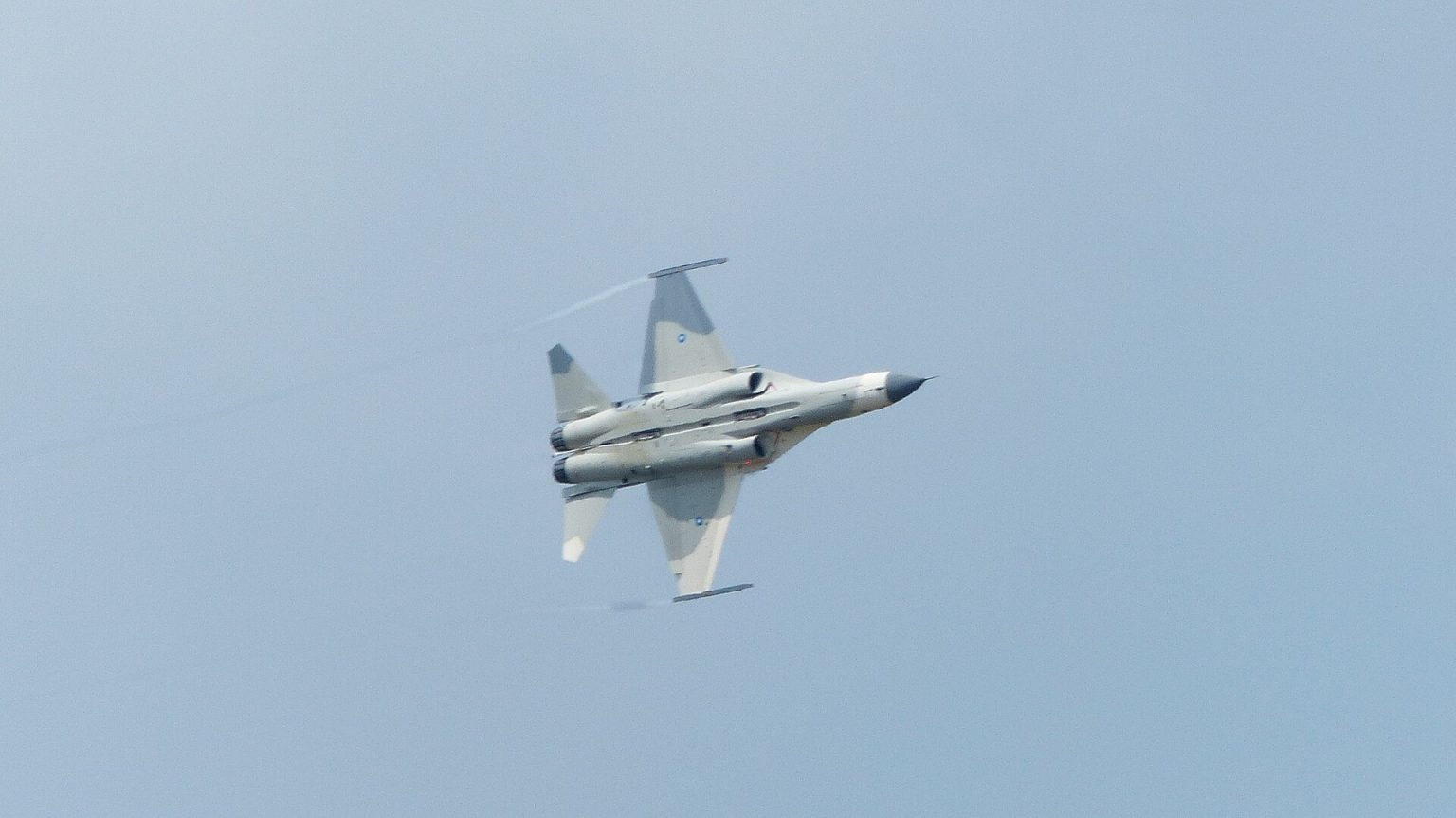
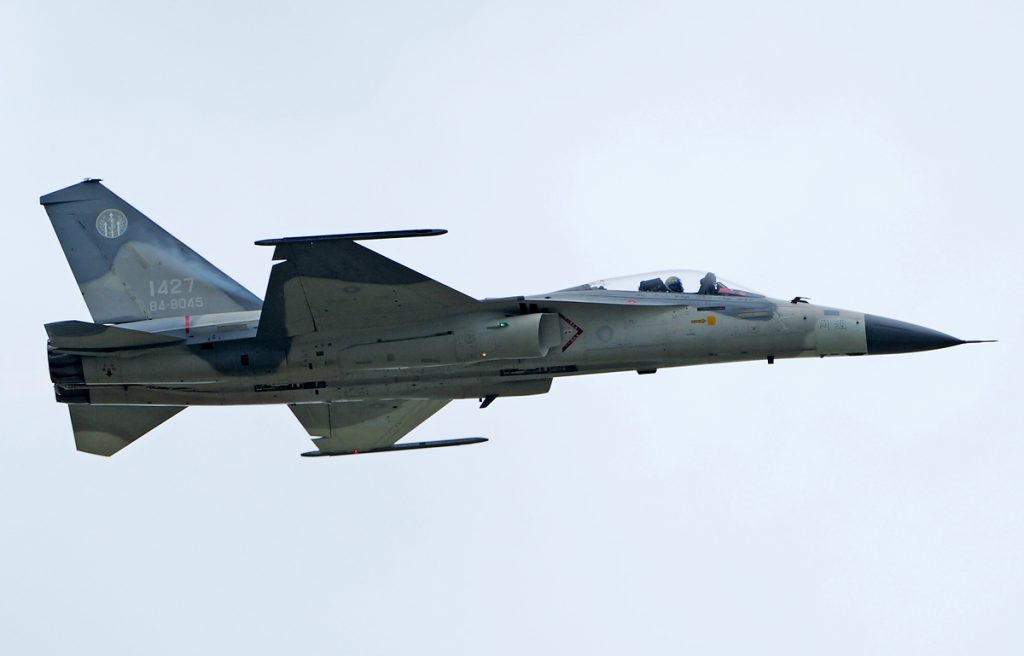
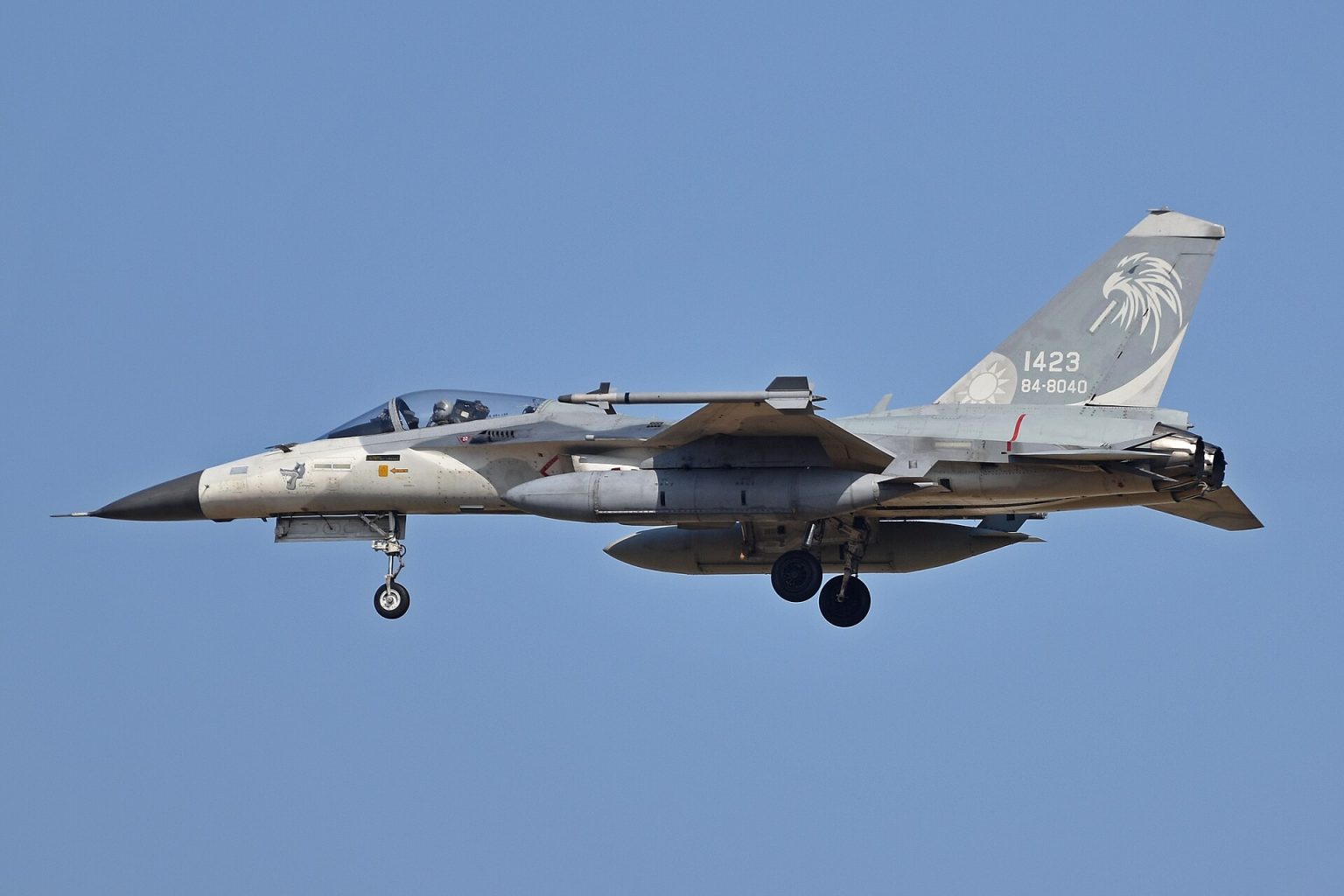
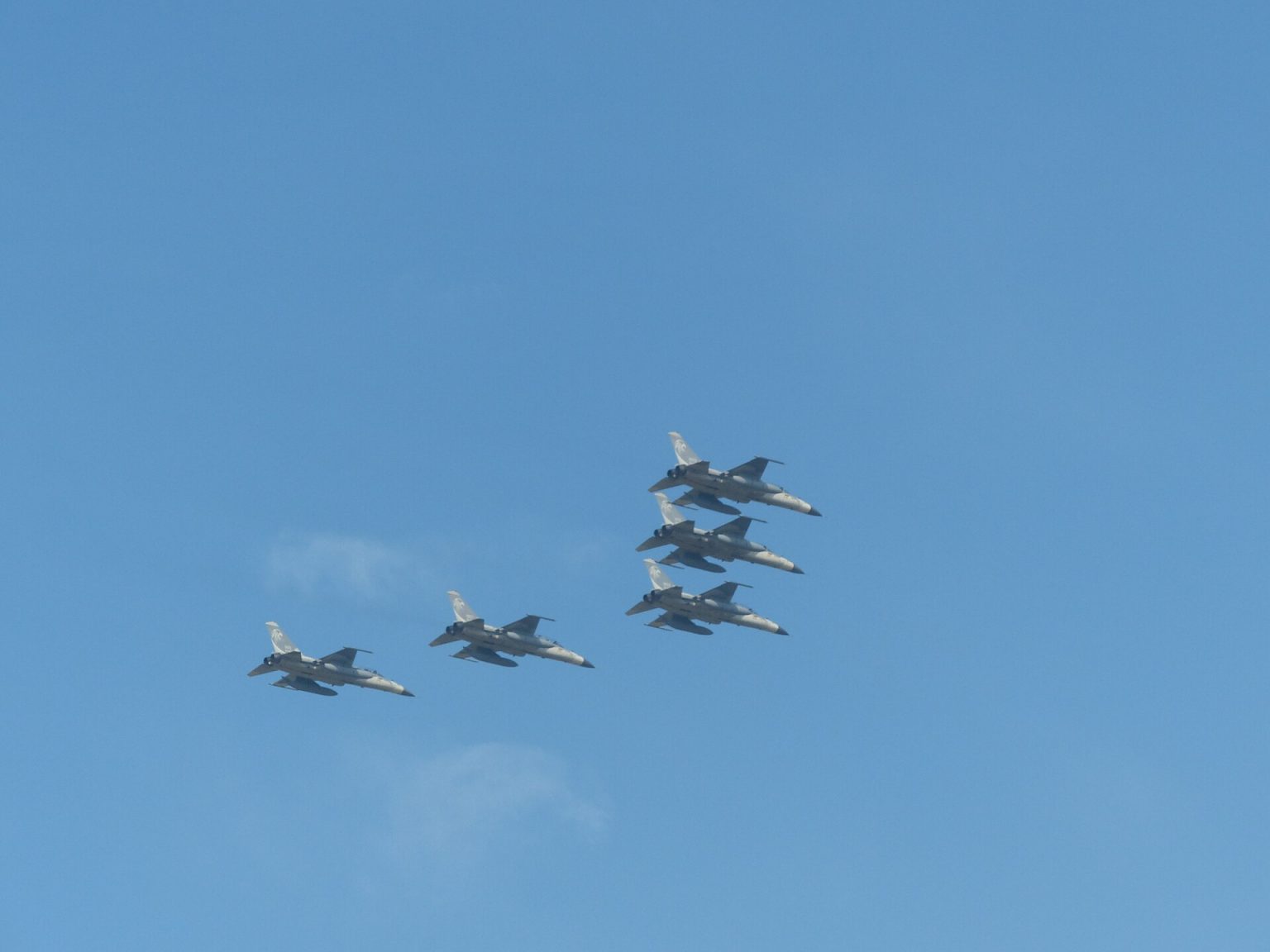
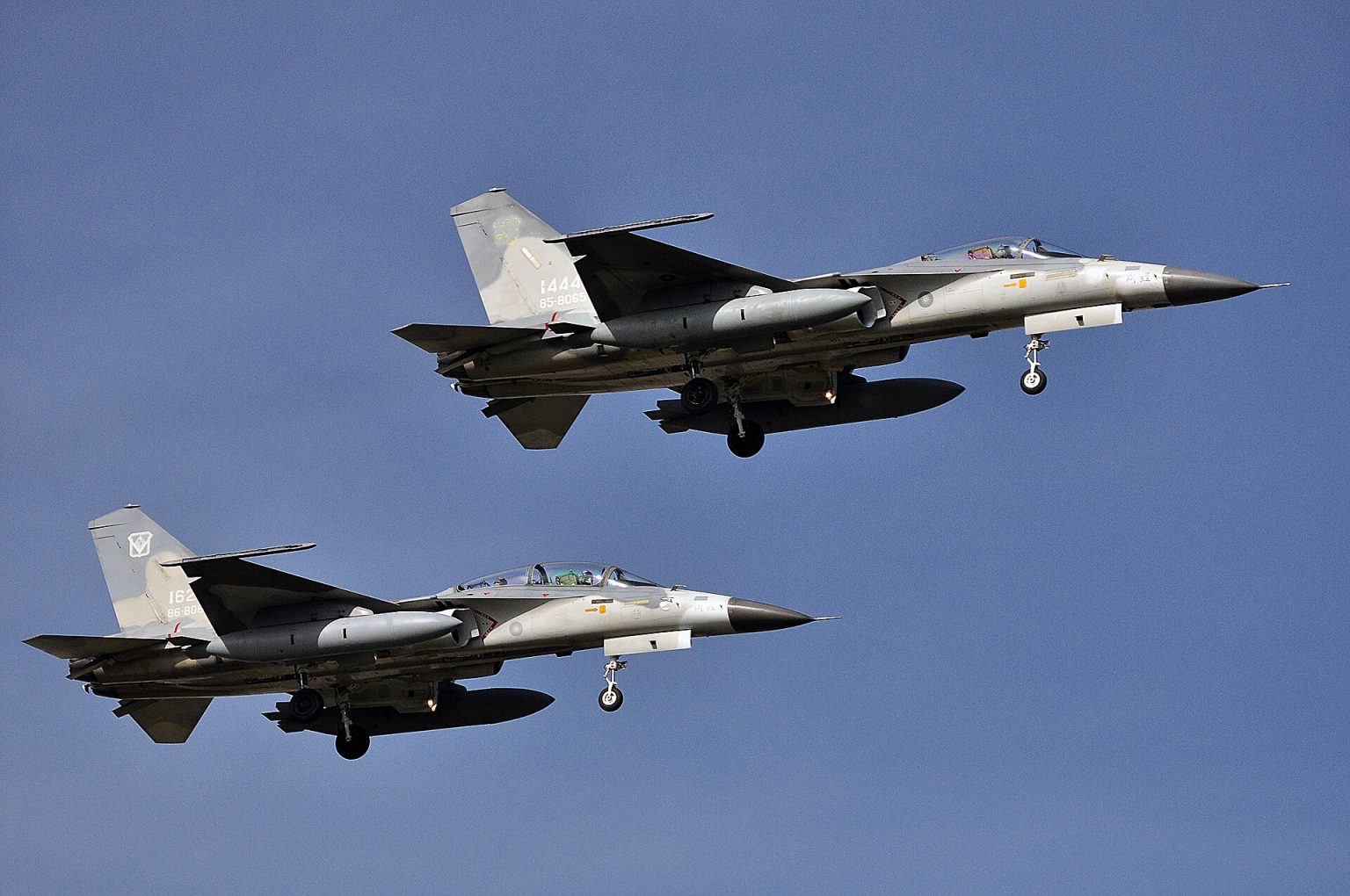
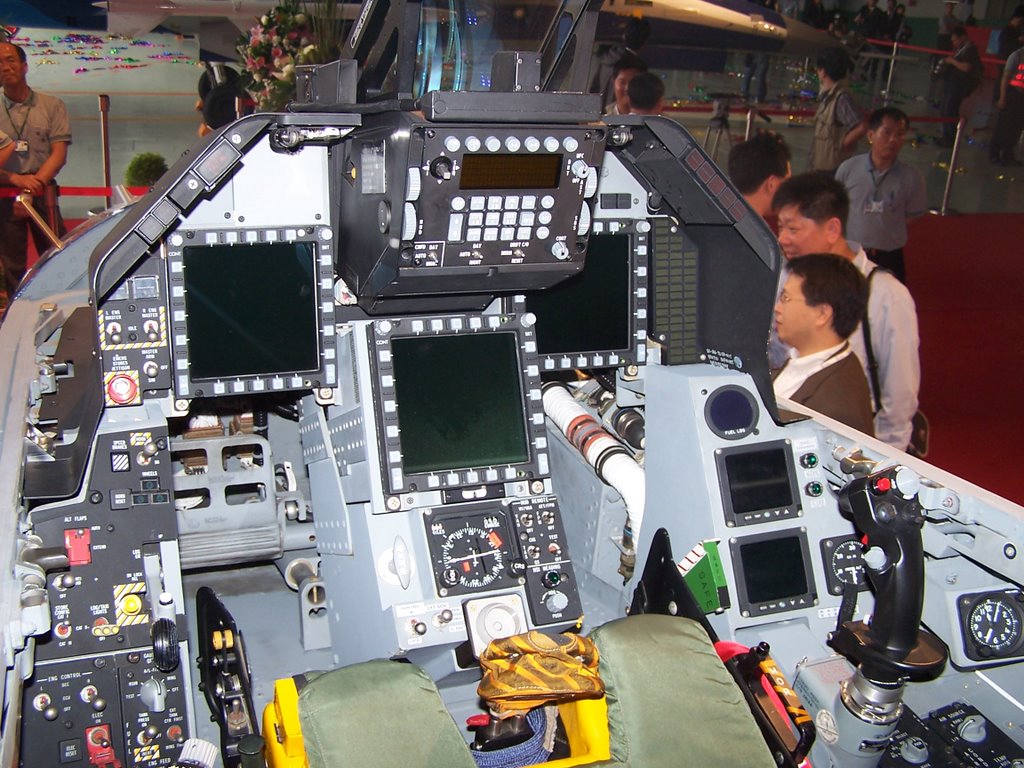
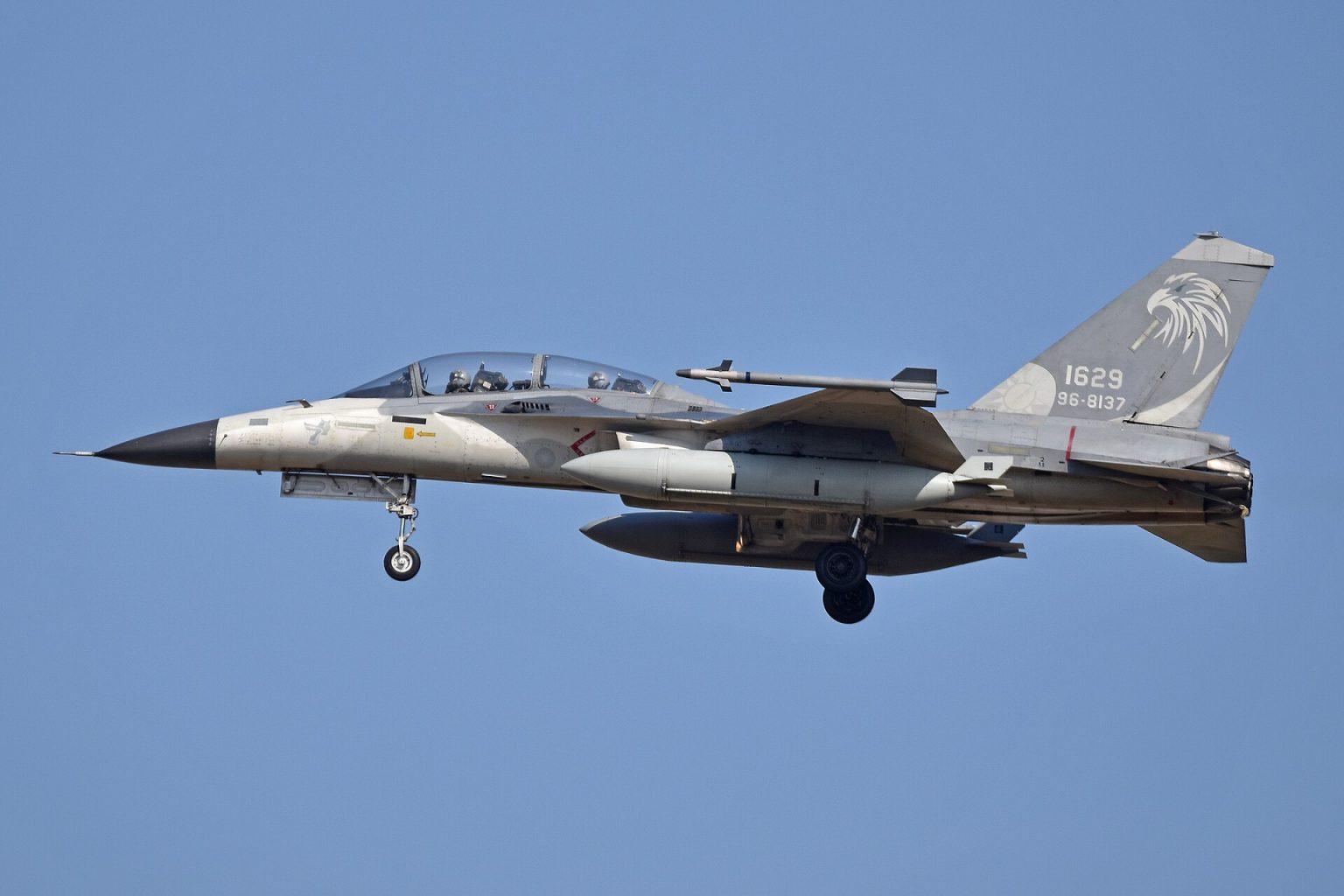
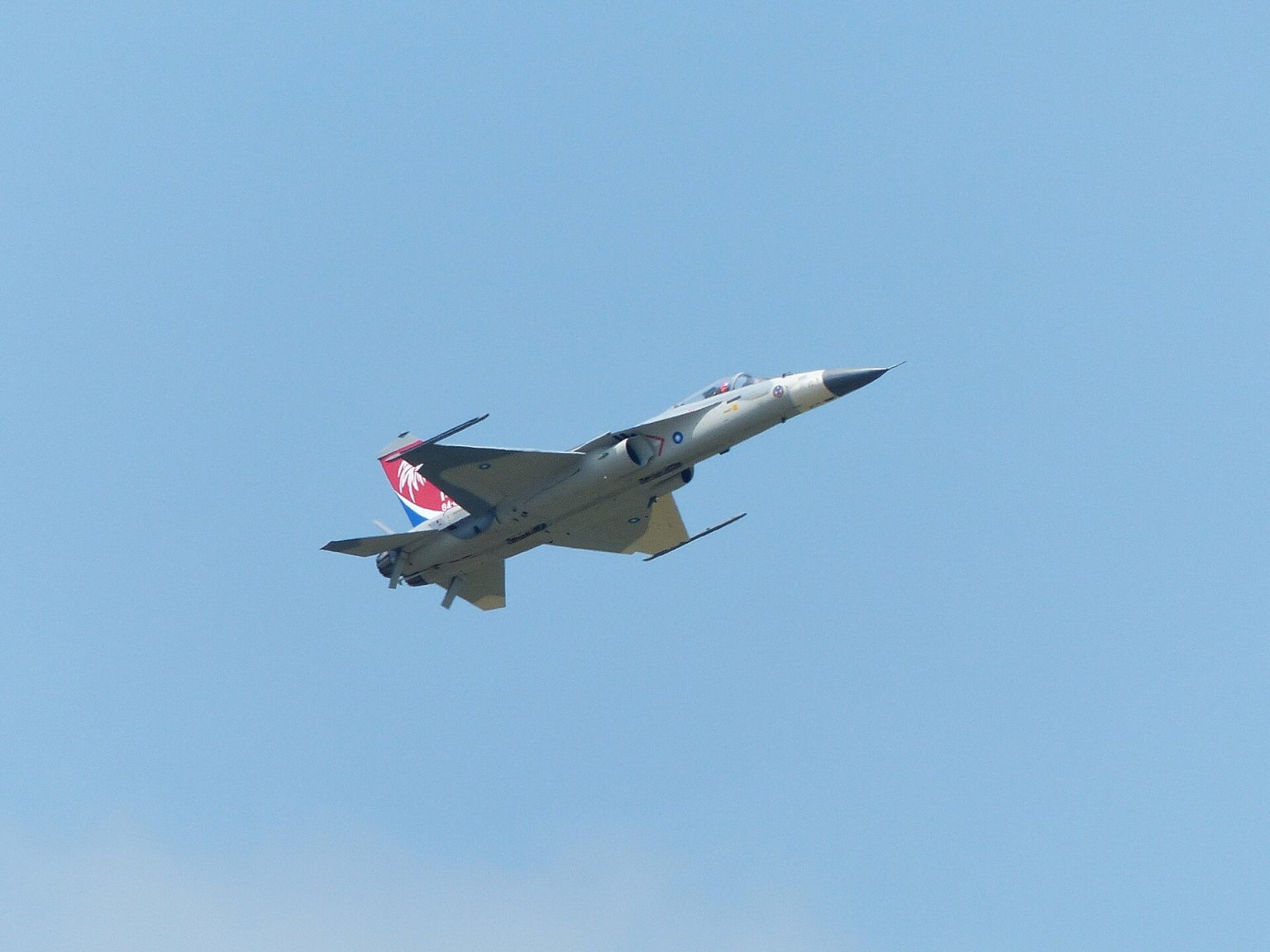
Photographs of the Ching-Kuo in Republic of China Air Force service, each credited to its source and licence. Click any photo to enlarge.
On Film
The AIDC F-CK-1 Ching-Kuo on video: Taiwan’s indigenous fighter
A look at the AIDC F-CK-1 Ching-Kuo — the story of Taiwan’s Indigenous Defence Fighter, its design and its role in the island’s air defence.
“AIDC F-CK-1 Ching-Kuo | Can the Indigenous Defense Fighter” by Weapon Detective (approx. 95,000 views at time of writing; running time ~15 minutes) — a documentary on Taiwan’s indigenous fighter, its origins and its capability.
Operations Overview
Where the AIDC F-CK-1 Ching-Kuo flies: an operator map
Designed, built and flown by Taiwan alone. The Ching-Kuo has never been exported — every aircraft serves the Republic of China Air Force — so this is a single-nation map. Hover or tap for detail.
Categories: Design, Manufacture & ROCAF Service (Taiwan) · In Service & Preserved (Taiwan). The Ching-Kuo is flown only by Taiwan’s Republic of China Air Force, so both categories fall on a single country.
Service Record
The Ching-Kuo’s record: self-reliance in the air
The Ching-Kuo’s significance lies in what it represents — a diplomatically isolated island building, fielding and upgrading its own modern fighter, complete with radar and missiles.
Questions & Answers
AIDC F-CK-1 Ching-Kuo: your questions answered
Can I fly in an AIDC F-CK-1 Ching-Kuo?
No — there is no bookable Ching-Kuo flight experience, and MiGFlug does not offer one. It is an active front-line fighter of the Republic of China Air Force, not an aircraft available for civilian rides. If what you actually want is the real thing — strapping into a genuine military jet and flying it — you very much can do that today in other types. MiGFlug arranges flights in real fighter jets and warbirds around the world. Start here: migflug.com/flights-prices.
Why is the AIDC F-CK-1 Ching-Kuo historically important?
The Ching-Kuo is significant as Taiwan’s Indigenous Defence Fighter — a modern fourth-generation fighter the island designed and built itself in the 1980s and 90s, when diplomatic constraints kept it from buying advanced fighters abroad. It demonstrated that a diplomatically isolated Taiwan could field, arm and upgrade its own combat aircraft, and it remains a core part of the island’s air defence today.
Why did Taiwan build its own fighter?
After the United States switched formal recognition to the People’s Republic of China in 1979 and a 1982 communiqué committed Washington to gradually reducing arms sales to Taiwan, the island could not readily buy advanced Western fighters such as the F-16. Rather than let its air force fall behind, Taiwan launched the Indigenous Defence Fighter programme to build a modern fighter domestically — a matter of national self-reliance.
Was the Ching-Kuo really “indigenous”?
Yes and no, and both parts matter. Taiwan designed, integrated, built and owns the aircraft, which is why it is called indigenous. But it did so with extensive American technical assistance: General Dynamics advised on the airframe, the engine grew from a partnership with Garrett, and the radar drew on Westinghouse technology. So the Ching-Kuo is a genuine Taiwanese aircraft, developed with deep — if discreet — American help.
Why does the Ching-Kuo look like an F-16?
Because of its origins. General Dynamics, which built the F-16, advised on the Ching-Kuo’s airframe, and the wider American assistance drew on contemporary US fighter design. The result has a family resemblance to the F-16 and the Northrop F-20 Tigershark — a blended wing-body and bubble canopy — though the Ching-Kuo has two engines rather than one and its own nose, intakes and systems.
What weapons does the Ching-Kuo carry?
Its signature armament is indigenous: the Tien Chien, or “Sky Sword”, family of air-to-air missiles — the short-range, infrared-guided Sky Sword I and the radar-guided, beyond-visual-range Sky Sword II — together with a built-in 20mm cannon. It can also carry bombs and other stores. Fielding its own missiles was central to the programme’s goal of self-reliance, ensuring the fighter could not be disarmed by a foreign embargo.
Is the Ching-Kuo still in service?
Yes. The Ching-Kuo remains a front-line fighter of the Republic of China Air Force, flying alongside Taiwan’s F-16s and Mirage 2000s. A mid-life upgrade in the late 2000s produced the improved F-CK-1C/D variants, keeping the type relevant, and it continues to fly air-defence and interception missions amid heightened tension across the Taiwan Strait.
Was the AIDC F-CK-1 Ching-Kuo a good aircraft?
Judged against the largest and most powerful fighters of its generation, the Ching-Kuo is a relatively light, modestly powered aircraft. But judged against what it was meant to do — give a diplomatically isolated island a modern, home-controlled air-defence fighter it could build, arm and upgrade itself — it has been a clear success. Decades of continuous front-line service, and an in-house mid-life upgrade, speak for themselves.
Fly For Real
You can’t fly the Ching-Kuo — but these, you can
No F-CK-1 is a bookable ride today. The urge behind it — to strap into a real military aircraft and actually fly — is very much still bookable. MiGFlug puts you in genuine fighters and warbirds around the world.
Fighter Jet Flights
Take the controls of a real ex-military jet with an experienced pilot.
Fighter jet experiences
From warbirds to supersonic jets — a range of real flights worldwide.
All flights are operated by MiGFlug’s vetted partners with professional pilots. Browse every option and current pricing at migflug.com/flights-prices. MiGFlug does not operate AIDC F-CK-1 Ching-Kuo flights — no bookable example exists.
Related Aircraft
If the AIDC F-CK-1 Ching-Kuo interests you, explore these
Sources & Further Reading
Where this AIDC F-CK-1 Ching-Kuo history comes from
Note on figures: dimensions, performance and production numbers for the Ching-Kuo vary between sources and by variant, and are hedged here as approximate. Cost fields are listed as not reliably comparable because transparent public figures are not consistently available. The cross-strait political context is described factually and neutrally, without taking any position on the underlying dispute; the aircraft is presented as an active defence asset of Taiwan. The Ching-Kuo remains in front-line service and has never been exported.