
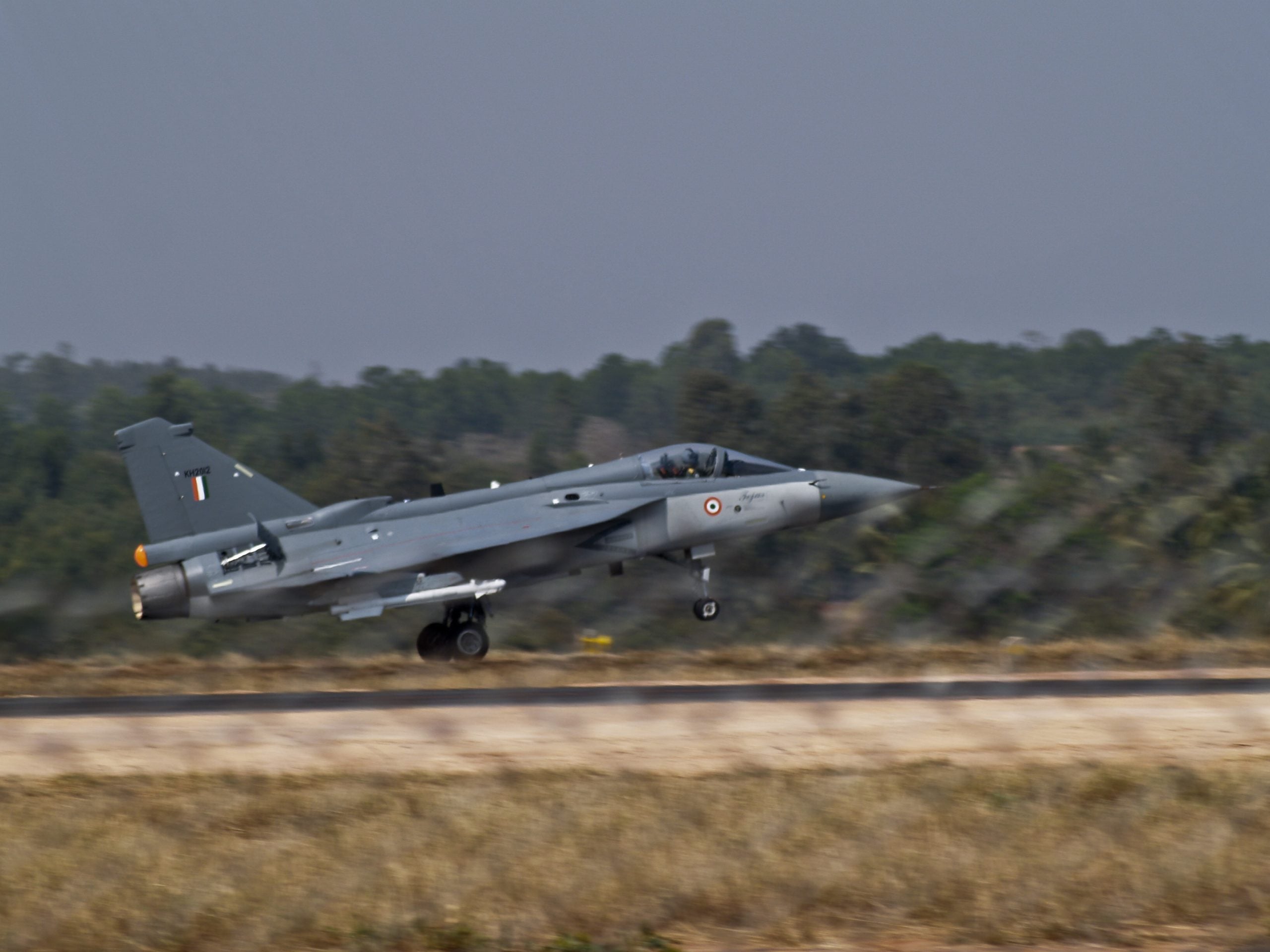
HAL Tejas
“Light Combat Aircraft”
India’s indigenous lightweight multirole fighter — a tailless compound-delta developed over four decades to replace the MiG-21 and prove the country could design and field a modern jet of its own.
Built to make India build fighters
The Tejas is less a single aircraft than the visible result of a national decision. In 1983 India sanctioned the Light Combat Aircraft (LCA) programme, and in 1984 set up the Aeronautical Development Agency (ADA) to run it, with Hindustan Aeronautics Limited (HAL) as the principal builder. The stated goal was twofold: replace the Indian Air Force’s huge, ageing fleet of Soviet MiG-21s, and — just as importantly — build an indigenous capability to design, integrate and certify a modern combat aircraft at home.
That ambition made for a long road. The programme had to develop its own quadruplex digital fly-by-wire flight-control system after outside support was curtailed, and US technology sanctions following India’s 1998 nuclear tests briefly disrupted access to engine and flight-control work. The first technology-demonstrator prototype did not fly until 4 January 2001, flown by Wing Commander Rajiv Kothiyal. Prime Minister Atal Bihari Vajpayee gave the aircraft its name — Tejas, a Sanskrit word for radiance — in 2003.
Operational milestones followed slowly: an Initial Operational Clearance in 2013, entry into IAF squadron service in 2016 with No. 45 Squadron (the “Flying Daggers”), and Final Operational Clearance in 2019. The improved Mk1A — with an AESA radar and updated electronic-warfare suite — has been ordered in large numbers since 2021, and a larger, more powerful Mk2 is in development. Timelines and delivery rates have repeatedly slipped, and critics call the effort overdue; supporters counter that it gave India a fighter industry it did not have before. Both readings are widely held.
01The HAL Tejas programme: why India’s Light Combat Aircraft took nearly forty years
Sanctioned in 1983 and first flown in 2001, the Tejas is often cited as one of the longest fighter-development timelines in modern aviation. Several factors are commonly blamed: an early decision to pursue difficult indigenous technologies — a relaxed-stability airframe, a home-grown digital fly-by-wire system and a high composite fraction — all at once; the loss of foreign assistance after the 1998 nuclear-test sanctions; and dependence on an imported engine, the General Electric F404, whose supply has continued to constrain deliveries into the 2020s.
Whether the programme is judged a success or a cautionary tale depends on what is measured. It has not produced a large fleet quickly, and orders have run well ahead of deliveries. But it did deliver a certified, in-service, largely Indian-built fighter and the design and testing base behind it — the explicit long-term aim from the start. These are contested framings, and this page presents both rather than adjudicating between them.
What makes it special
A tailless delta flown by wire
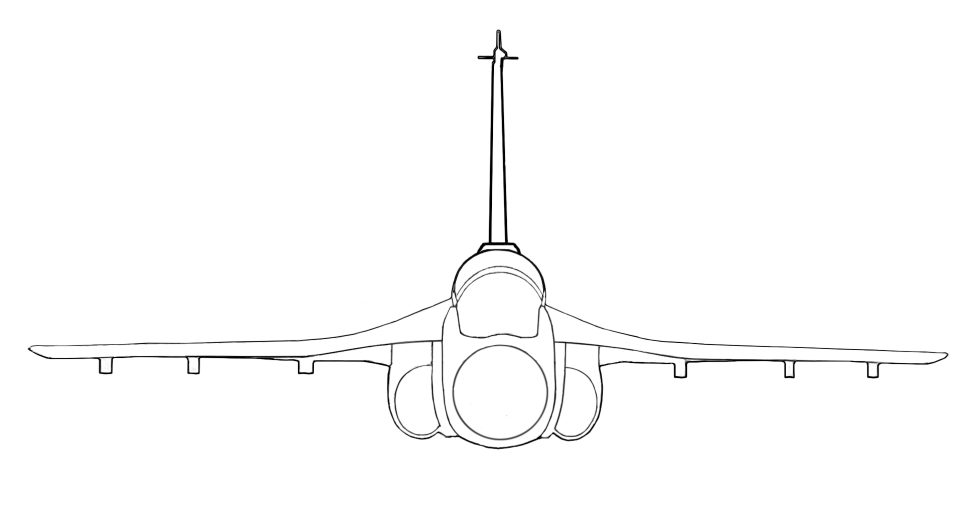
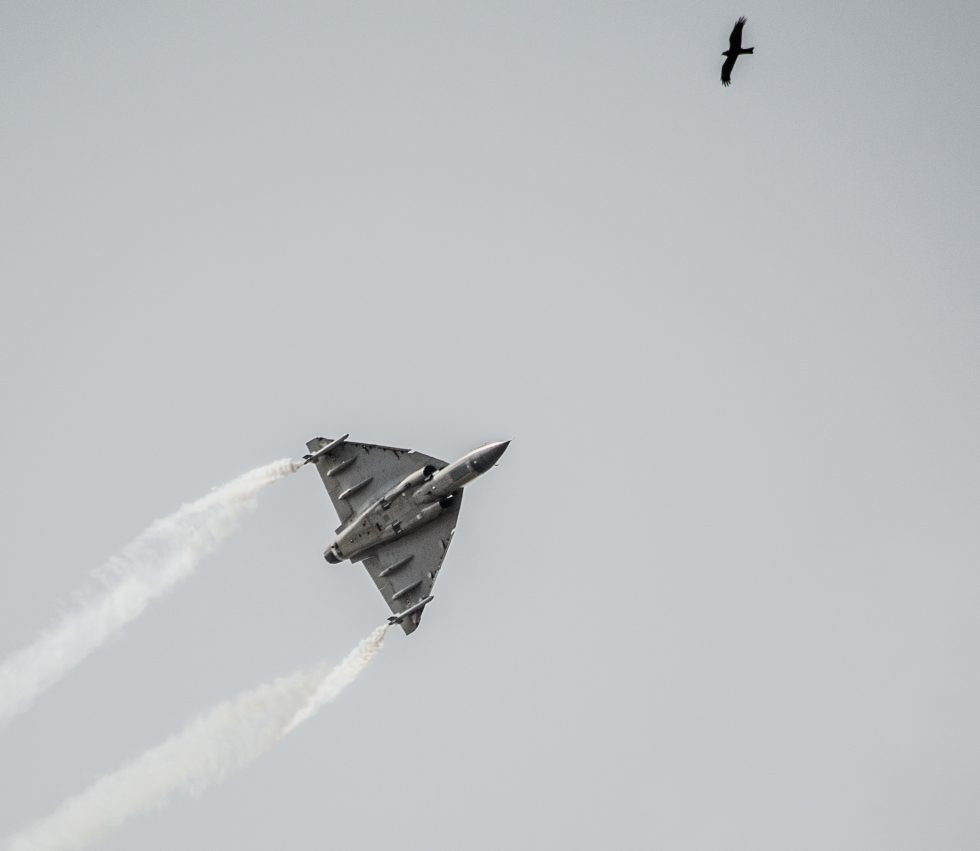
The Tejas has no tailplane — just a compound-delta wing and a single fin. Like many modern fighters it is deliberately aerodynamically relaxed-stability, which improves agility but makes it impossible to fly by hand; a quadruplex digital fly-by-wire system corrects the aircraft dozens of times a second. India developed that flight-control software largely in-house after external support was limited — one of the programme’s hardest and most-cited technical achievements.
Small, light and composite-heavy
The Tejas is one of the smallest and lightest supersonic fighters in service, with an empty weight commonly cited around 6.5 tonnes. A large share of the airframe — roughly 45% by weight and around 90% by surface area, figures widely quoted — is carbon-fibre composite. Composites cut weight and the number of joints and fasteners, and can reduce radar signature. The exact fractions vary between sources and variants, so treat them as approximate.
Indigenous avionics and the Mk1A radar
The Tejas carries a glass cockpit and a growing share of Indian-made avionics. The baseline Mk1 flew with an Israeli EL/M-2032 radar; the upgraded Mk1A is fitted with an AESA radar (the indigenous Uttam or Israeli EL/M-2052 is variously reported) plus a new electronic-warfare suite and beyond-visual-range missiles. Reported capability figures for the newest variants should be read as manufacturer or programme claims pending independent confirmation.
02The HAL Tejas fly-by-wire system: the software India had to write itself
A relaxed-stability aircraft cannot be flown without a flight-control computer constantly adjusting the surfaces. Early in the programme the flight-control law development had US involvement, but access narrowed and India completed and cleared much of the digital fly-by-wire work domestically. It is frequently highlighted as the single hardest element of the Tejas effort — and, once proven, as a foundational capability for later Indian aircraft. Specific development-cost and schedule claims around it vary by source.
03The HAL Tejas engine: why the F404 — and the F414 for the Mk2
The Tejas Mk1 and Mk1A are powered by a single General Electric F404-GE-IN20 afterburning turbofan of roughly 84 kN thrust. An indigenous engine (the GTRE Kaveri) was intended to power the aircraft but did not mature in time, leaving the type dependent on the imported F404 — and F404 supply delays have been repeatedly cited as a brake on Mk1A deliveries. The larger Mk2 is designed around the more powerful GE F414. Thrust and timeline figures here are programme figures and remain subject to change.
Full specifications
Baseline note: these figures describe the Tejas Mk 1A as contracted in 2021 and powered by the General Electric F404-GE-IN20. A caution belongs at the top of the page rather than buried in it: as of 3 September 2026 not one Mk 1A has been handed to the Indian Air Force. Seven F404-IN20 engines had reached HAL by 13 July 2026 against 99 ordered in 2021, roughly 30 airframes stood complete without engines, and the Mk 1A numbers below are therefore ADA and HAL published data, not measured squadron experience. Where the Mk 1A is unchanged from the Mk 1 FOC — which does fly operationally — the figure is the same aeroplane. Deltas for the Mk 1 IOC and FOC standard, the twin-seat trainer, the cancelled LCA Navy and the larger Mk 2 / Medium Weight Fighter are in grey.
Dimensions & weights
- Crew
- 1 (2 in the twin-seat trainer, which is combat-capable and doubles as a lead-in fighter trainer; the naval NP-1 and NP-5 prototypes were also two-seaters)
- Length
- 13.2 m (43 ft 4 in). Mk 2 grows to 14.65 m (48 ft 1 in), and the naval prototypes added a drooped nose for the deck approach.
- Wingspan
- 8.2 m (26 ft 11 in). Mk 2: 8.5 m (27 ft 11 in).
- Height
- 4.4 m (14 ft 5 in)
- Wing area
- 38.4 m² (413 sq ft), a cropped compound delta with no tailplane
- Empty weight
- 6,560 kg (14,460 lb). The Mk 1A is marginally heavier than the Mk 1 FOC despite composite substitution; HAL has never published a separate figure.
- Normal take-off weight
- 9,800 kg (21,600 lb)
- Maximum take-off weight
- 13,500 kg (29,800 lb). Mk 2: 17,500 kg (38,600 lb) projected, which is what moves it out of the light-fighter class altogether.
- Internal fuel
- ~2,458 kg (~5,420 lb; 3,060 litres). India’s Comptroller and Auditor General singled this out in 2015 as too little for useful combat endurance, and it cannot be fixed without a new fuselage — which is the Mk 2, planned at over 3,400 kg internal.
- External fuel
- Drop tanks of 1,200 litres (317 US gal) inboard, 800 litres (211 US gal) and 725 litres (192 US gal) on the centreline; three of the stations are wet
- Hardpoints
- 8 — three under each wing, one on the fuselage centreline, one under the port intake reserved for sensor pods (some tables print 9 by counting a twin rail; ADA’s own drawings show eight. Mk 2 is designed for 11 to 13.)
- Maximum external stores
- ~4,500 kg (~9,920 lb). The spread in print is unusually wide for so basic a number: 3,500 kg is the figure long quoted for the Mk 1, 5,300 kg appears in some specification tables, and no operational sortie has approached any of them.
- Composite content
- 45% of the airframe by weight and about 90% by surface area — wing skins, spars, ribs and fin, with an aluminium-lithium and titanium substructure (the highest proportion of any fighter of its generation, and the programme’s most genuine technical achievement)
Performance
- Maximum speed
- 2,220 km/h (1,200 kt, 1,380 mph) at altitude, Mach 1.8 (the ADA figure. Mach 1.6 is quoted at least as often, and squadron pilots describe the aeroplane as transonic in practice rather than a high-Mach interceptor.)
- Service ceiling
- 16,000 m (52,500 ft)
- Combat radius
- ~500 km (~270 nm, ~310 miles) on a hi-lo-hi profile with drop tanks (the IOC-II figure was given as 400 to 500 km; this is the number the CAG report was complaining about)
- Ferry range
- 3,000 km (1,620 nm, 1,860 miles) with external tanks
- In-flight refuelling
- Fixed probe on the starboard forward fuselage, cleared at FOC standard from the Il-78 and Su-30MKI buddy store; ground hot-refuelling also cleared (the IOC aircraft had neither, which is a large part of why the CAG called them of limited operational value)
- Load factor
- +9 / −3.5 g
- Angle-of-attack limit
- 24° at IOC, opened to 28° for Full Operational Clearance in 2019
- Wing loading
- 255 kg/m² (52 lb/sq ft) at normal take-off weight — low, which is where the aircraft’s well-attested turning performance comes from
- Thrust-to-weight ratio
- 0.88 at 9,800 kg, calculated from rated thrust (ADA publishes 1.07, which corresponds to a lighter combat weight than the quoted gross figure. Both numbers are defensible; they are not the same measurement.)
- Rate of climb
- Not published by ADA or HAL for any Tejas mark (figures circulating in reference works and on data sites are unsourced estimates and are omitted here)
- Landing
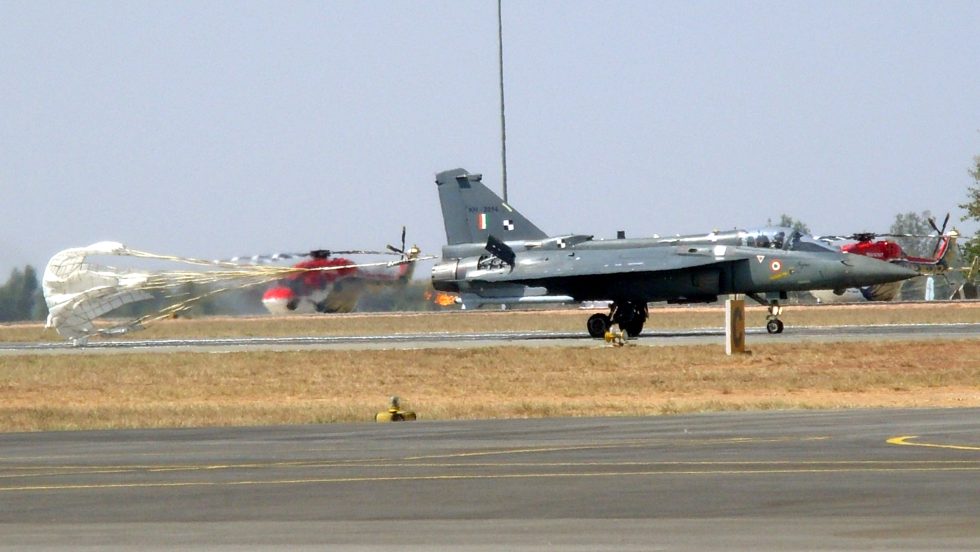
- Braking parachute; an indigenous hybrid chute weighing 10 kg (22 lb), spanning 5.75 m (18 ft 10 in) and deployable to 340 km/h (184 kt) entered service in December 2025
- Safety record
- Two aircraft lost in 25 years of flying — near Jaisalmer on 12 March 2024, the pilot ejecting, and at the Dubai Airshow on 21 November 2025, which killed the pilot. A runway excursion at Naliya on 7 February 2026 grounded the whole fleet until early April 2026, the cause traced to a software fault
Propulsion & systems
- Engine
- 1 × General Electric F404-GE-IN20 afterburning turbofan with FADEC — the highest-thrust member of the F404 family, developed specifically for the Tejas and selected in 2004 (TD and PV airframes flew on the earlier F404-GE-F2J3; Mk 2 uses the F414-INS6 at 98 kN / 22,000 lbf)
- Thrust
- 85 kN (19,000 lbf) with afterburner; 54 kN (12,140 lbf) dry
- Engine data
- 3.91 m (12 ft 10 in) long, 89 cm (35 in) diameter, 1,073 kg (2,365 lb); three-stage fan and seven-stage high-pressure compressor, overall pressure ratio 28:1
- Engine supply
- Seven F404-IN20 delivered to HAL by 13 July 2026 against 99 ordered in August 2021, with a further 113 ordered on 7 November 2025 for delivery from 2027 to 2032. GE had closed the IN20 line at Lynn, Massachusetts for want of orders and had to restart it; a South Korean sub-supplier in financial trouble added to the delay. The first engine of the 2021 order shipped on 25 March 2025, roughly two years late, and HAL is levying liquidated damages
- Indigenous engine
- The GTRE Kaveri, begun in 1986 to power production Tejas, reached about 46 kN dry and 70.5 kN wet against a requirement of 81 kN and was formally delinked from the LCA in September 2008 after failing high-altitude testing in Russia in 2004. A derivative dry engine of 49 to 51 kN now targets the Ghatak unmanned combat aircraft; a full-afterburner run reaching about 81 to 83 kN was demonstrated on 18 February 2026, and a clean-sheet Kaveri 2.0 of 90 to 100 kN was announced in August 2026 as a mid-life replacement for the F404. None of this has yet flown in a Tejas
- Radar
- Elta EL/M-2032 mechanically scanned multi-mode on the Mk 1 and trainer; Elta EL/M-2052 AESA on the first Mk 1A batch; the indigenous LRDE Uttam AESA — 912 gallium-arsenide transmit/receive modules, X-band, a claimed detection range above 150 km (81 nm) — on the 97-aircraft batch ordered in 2025. Uttam is still formally "in development": it cleared four stages of flight testing by April 2025, and HAL only ordered 122 active antenna array units from Astra Microwave on 31 July 2026, for delivery by 2031
- Flight control
- Relaxed static stability with a quadruplex digital fly-by-wire system, control laws written in India by the National Control Law team from 1992 after the United States froze support in 1998. The Mk 1A adds an indigenous PowerPC-based Digital Flight Control Computer certified to DO-178C Level A, first flown on LSP-7 on 19 February 2024; auto low-speed recovery and disorientation recovery are built into the laws
- Electronic warfare
- DARE-Elisra Mayawi suite on the Mk 1; the Mk 1A carries the Angad suite and, on the 2025 batch, Swayam Raksha Kavach — Dhruti DR118 radar warning receiver internally plus an Advanced Self Protection Jammer carried as a pod. Integrating the jammer and the AESA so that both work at once has been one of the specific obstacles delaying Mk 1A acceptance
- Cockpit
- Night-vision-compatible glass cockpit with an indigenous head-up display, three multi-function displays and two smart standby displays, HOTAS controls and the Elbit DASH IV helmet-mounted display; Martin-Baker Mk16 zero-zero ejection seat (the seat, the refuelling probe and the quartz radome are British-supplied, which is precisely why an Argentine sale was never realistic)
- Life support
- Liquid oxygen on the Mk 1; an indigenous on-board oxygen generating system for the Mk 1A, cleared in high-altitude trials to 15,240 m (50,000 ft) in March 2024
- Signature reduction
- Small planform, a Y-duct intake shielding the compressor face, radar-absorbent coatings and a composite skin. This lowers the radar cross-section relative to a metal fighter of the same size; it does not make the Tejas a stealth aircraft, and ADA has never claimed it does
- Production
- Three final assembly lines — two at Bengaluru and one at Nashik inaugurated on 17 October 2025 — for a nominal 24 aircraft a year, with a fourth line proposed to reach 32. Wings come from Larsen & Toubro, fuselage sections from Dynamatic, VEM Technologies and Alpha Tocol; HAL is now largely the integrator rather than the fabricator
04The HAL Tejas’s operating costs: why the figures are estimates
Indian defence contracts are usually reported as bulk-order totals in rupees rather than as a clean per-aircraft flyaway price, so a single unit cost for the Tejas is hard to pin down. Widely reported figures place a Mk1A in the very rough range of US$40–50 million depending on how development, infrastructure and spares are apportioned — treat any precise number as an estimate, not an audited price. No reliable public cost-per-flight-hour figure exists for the type. Any exact dollar figure attached to a Tejas should be read as an approximation.
Armament & payload
The Tejas fires a Russian gun, sees through an Israeli radar and shoots Indian missiles — and its air-to-ground clearance is thinner than the brochures imply
Two things are true at once about Tejas armament. The air-to-air side is real and tested: Python-5 and I-Derby ER were fired successfully in April 2021, the indigenous Astra Mk 1 was launched from a Tejas in August 2023 and scored a direct hit beyond 100 km in March 2025, and ASRAAM firings from Mk 1A airframes were completed by October 2025. The air-to-ground side is mostly a list of intentions. What an operational Mk 1 FOC can actually drop today is a laser-guided bomb with a Litening pod and iron bombs; BrahMos-NG, Rudram, SCALP and the anti-ship NASM-MR appear on every published weapons diagram and none of them has been cleared on the aircraft. The gun is worth noting for what it says about the programme: the IOC aircraft delivered from 2016 had no cannon at all, and the GSh-23 only arrived with the FOC standard in 2019. Everything below describes Indian Air Force configurations. The Mk 1A weapon fit is contracted rather than fielded, since no Mk 1A had been delivered as of September 2026, and several stores listed as Mk 1A items were still awaiting final certification when the aircraft was written about as though it were in service.
Gun
- One 23 mm Gryazev-Shipunov GSh-23 twin-barrel cannon in a fairing under the starboard intake, 220 rounds
- A Soviet-era weapon on a 21st-century airframe, chosen because the Indian Air Force already stocks the ammunition for its MiG-21 and MiG-27 fleets — sustainment logic, not performance logic
- Not fitted to the 16 Mk 1 IOC aircraft; gun firing trials at HAL Nashik came later and the cannon is part of the FOC standard from 2019 onwards
- Retained unchanged on the Mk 1A; the Mk 2 is designed around the single-barrel 30 mm GSh-30-1 instead
Air-to-air
- Rafael Python-5 close-combat missile with high off-boresight capability, cued by the DASH IV helmet display; direct hit demonstrated on 27 April 2021
- Rafael I-Derby ER active-radar beyond-visual-range missile, up to four carried; validated in the same April 2021 trial
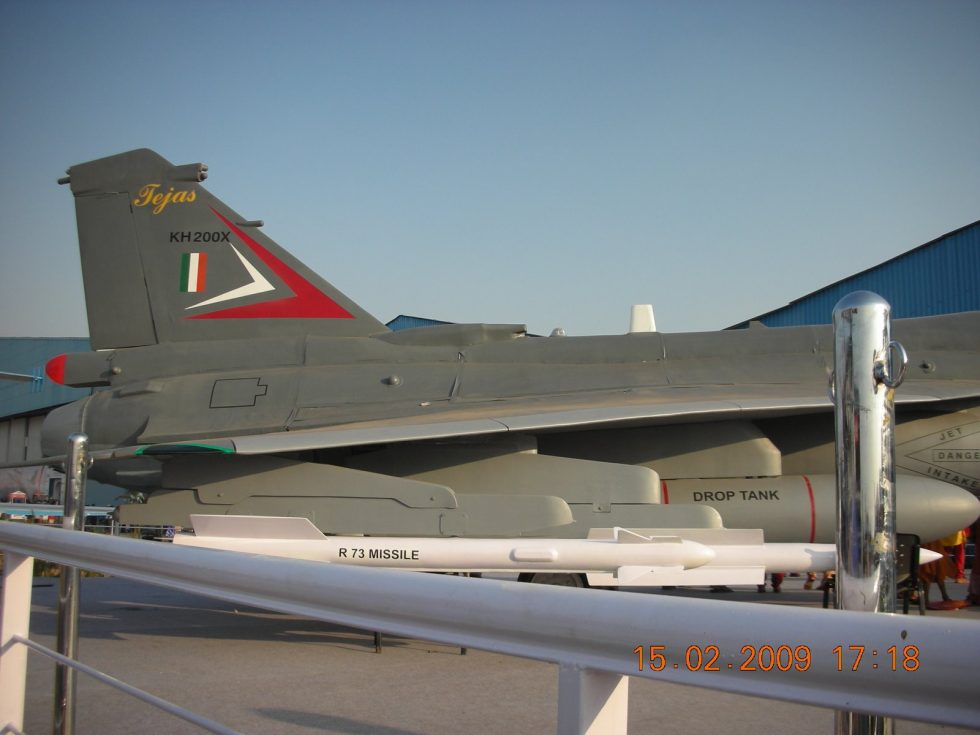
- Vympel R-73 short-range infrared missile, the legacy fit carried since the IOC aircraft
- DRDO Astra Mk 1 beyond-visual-range missile — first fired from a Tejas on 23 August 2023 off Goa, direct hit at over 100 km on 12 March 2025, though a further trial in late March 2025 failed and needed software rework before firings resumed
- MBDA ASRAAM on the Mk 1A, fired in trials during 2025; Astra Mk 2 and Meteor are proposals, not integrations
Air-to-surface guided
- This is the weak card and it should be read as such: no cleared stand-off guided air-to-surface weapon is in Tejas squadron service
- DRDO Rudram-1 anti-radiation missile — planned, integrated on the Su-30MKI, not on the Tejas
- BrahMos-NG, the lightened supersonic cruise missile sized for this aircraft, is the store most often shown under a Tejas in artwork; the missile itself was still in development in 2026 and has never been carried by one
- NASM-MR anti-ship missile and the French SCALP-EG are listed in specification tables as planned; neither has a service release
- Safran AASM-Hammer powered glide munitions have been proposed for the Mk 1A as a near-term way out of this gap
Bombs
- Rafael Griffin laser-guided bombs and the DRDO Sudarshan laser-guidance kit, both fired in trials and the mainstay of the aircraft’s real precision capability
- GBU-16 Paveway II 1,000 lb laser-guided bombs
- DRDO High Speed Low Drag bomb family of 100, 250, 450 and 500 kg, plus the Smart Anti-Airfield Weapon glide bomb and Spice electro-optical kits
- Unguided general-purpose and retarded bombs and cluster dispensers, carried on the four inboard and mid-wing stations
- A laser-guided bomb release formed part of the Mk 1A weapons trials completed in October 2025 — one of the four validations the Air Force set as a condition of acceptance
Rockets
- No unguided rocket pod has been publicly cleared, demonstrated or shown on an Indian Air Force Tejas
- The Air Force holds large stocks of 57 mm S-5 and 80 mm S-8 rockets from its Soviet-origin fleets; nothing prevents carriage in principle, but the Tejas was never scoped for the close-air-support role those weapons serve
- The card is kept rather than padded because its emptiness is informative: this aircraft was designed to replace the MiG-21 as a point-defence and battlefield air-superiority fighter, not to replace the MiG-27
Pods & other stores
- Rafael Litening III targeting and reconnaissance pod on the dedicated port-intake station or the centreline; the improved Litening 4I is planned
- Elta ELL-8222WB self-protection jamming pod on the Mk 1; the indigenous Advanced Self Protection Jammer pod on the Mk 1A
- Drop tanks of 1,200, 800 and 725 litres — a typical operational Tejas is carrying two of them, which is what the combat radius figure assumes
- Forward-looking infrared, infrared search and track and laser rangefinder pods are cleared for the intake station; there is no internal IRST until the Mk 2
- Chaff and flare dispensers from Bharat Dynamics are internal; no towed decoy is fitted, though the Mk 2 is to carry the Israeli X-Guard
Three typical loadouts
- Air defence, as No. 45 Squadron flies it
- Two R-73 or Python-5 on the outboard stations, two I-Derby ER inboard of them, a 1,200-litre tank under each wing and 220 rounds of 23 mm. This is the everyday Mk 1 FOC fit and the configuration flown at Exercise Tarang Shakti in 2024, where visiting French and German pilots flew the aircraft and rated its handling well.
- Precision strike with a pod
- Litening III on the port-intake station, two Griffin or Sudarshan laser-guided bombs on the inboard wing pylons, two close-combat missiles outboard for self-defence, one centreline tank. Short-legged without tanker support, which is why the FOC refuelling probe mattered more than its modest appearance suggests.
- Mk 1A as contracted, not as delivered
- AESA radar — EL/M-2052 on the first batch, Uttam on the second — with two Astra Mk 1, two ASRAAM, the Advanced Self Protection Jammer pod on a wing station and two drop tanks. Every element of this has been fired or flown separately; making the radar, the jammer and the mission computer work together in one aircraft is exactly the problem that kept deliveries stalled through 2026.
Sourcing caveat: Indian reporting on Tejas weapons routinely lists planned, proposed and cleared stores in a single sentence, and manufacturer diagrams show everything ADA hopes to integrate over the aircraft’s life. Where a weapon here is described as fired or cleared, a dated trial is on record; where it is described as planned, none is. Weapon counts assume the eight-station layout and are drawn from ADA and Indian Air Force material rather than from export brochures.
Variants
Forty-two years after it was authorised, the Tejas exists in two operational squadrons and a great many drawings
The Light Combat Aircraft programme was sanctioned in 1983 to replace the MiG-21. The Aeronautical Development Agency was created in 1984, project definition began in October 1986, the design was frozen in 1990 and the first technology demonstrator flew on 4 January 2001 — eighteen years in. American sanctions after the 1998 nuclear tests cost the fly-by-wire effort its foreign support and forced India to finish the control laws itself, which it did, and which is one of the programme’s real achievements. Initial Operational Clearance came in December 2013, Full Operational Clearance in February 2019, and the last of the 32 single-seat Mk 1 fighters was delivered in August 2023 — a full seventeen years after the first order was signed for delivery by December 2011.
The pattern repeats in the Mk 1A. Contracted in February 2021, first production aircraft flown on 28 March 2024, weapons trials finished in October 2025, and still not accepted by the Air Force in September 2026. The proximate cause is genuinely external — General Electric had shut the F404-IN20 line and could not restart it quickly — but the Air Force’s refusal to take aircraft that do not meet the agreed qualitative requirements is about radar, electronic-warfare and mission-computer integration, which is HAL’s and DRDO’s problem, not GE’s.
- Technology Demonstrators TD-1, TD-2 (2001–2002, 2 built)
- First flights 4 January 2001 and 6 June 2002, on the interim F404-GE-F2J3. The type was only named Tejas in 2003.
- Prototype Vehicles PV-1 to PV-6 (2003–2014, 5 built)
- PV-1 flew 25 November 2003; PV-5 and PV-6 were the two-seat trainer prototypes, PV-6 not flying until 8 November 2014.
- Limited Series Production LSP-1 to LSP-8 (2007–2013, 8 built)
- LSP-2 was the first with the F404-IN20; LSP-8 froze the production standard. LSP-2, LSP-3 and LSP-7 later became the flying testbeds for the Uttam radar, the electronic-warfare suite and the Mk 1A flight control computer.
- Tejas Mk 1 IOC (ordered 2006, 16 delivered)
- The 45 Squadron aircraft. No gun, no refuelling probe, restricted to 24° angle of attack; the CAG judged them of limited combat value in 2015, and it was right.
- Tejas Mk 1 FOC (ordered 2010, 16 delivered by August 2023)
- Adds the GSh-23 cannon, air-to-air refuelling, 28° angle of attack and updated flight-control software. This is the version that actually constitutes an operational fighter.
- Tejas Mk 1 Trainer (18 on order, 6 delivered)
- Tandem two-seater, first production example flown 5 April 2023 and first delivered 4 October 2023. Two of the original eight remain undelivered because they do not meet the Air Force’s qualitative requirements; ten more were bought under the 2021 Mk 1A contract to Mk 1 standard.
- Tejas Mk 1A (141 fighters and 29 trainers on order, none delivered)
- Around forty changes over the Mk 1: AESA radar, new electronic-warfare suite, indigenous flight control computer, on-board oxygen generation, aerodynamically cleaner pylons, reshaped cockpit floor. First flight of a Mk 1A-standard prototype 20 May 2022, of the first production aircraft LA-5033 on 28 March 2024, of the first Nashik-built aircraft on 17 October 2025.
- LCA Navy NP-1, NP-2, NP-5 (2012–2023, 3 built, cancelled as a production type)
- Strengthened undercarriage, arrester hook, drooped nose and LEVCON canard surfaces at the wing root for approach control. Ski-jump take-off from the shore-based facility at Goa in December 2014, arrested landings there in 2019, and landing and take-off aboard INS Vikrant in February 2023. The Navy withdrew in December 2016 on thrust-to-weight grounds; the airframes now feed the twin-engine TEDBF effort.
- Tejas Mk 2 / Medium Weight Fighter (in development, no prototype flown)
- A different aeroplane rather than an upgrade: longer fuselage, close-coupled canards, F414-INS6 of 98 kN, 17,500 kg maximum take-off weight, 6,500 kg of stores on 11 to 13 stations, internal IRST and a projected 1,200 km combat radius. Roll-out has slipped from 2022 through 2025 to a first flight expected in mid-2026, which had not happened by September 2026.
- Export and derivative proposals (no orders)
- The LIFT lead-in fighter trainer and the SPORT supersonic omni-role trainer, offered unsuccessfully to Australia and the US Navy, and CATS MAX, a two-seat Mk 1A conceived as controller for unmanned wingmen. None has been built.
Fleet and order book as at 3 September 2026, and why there is no operators chart on this page: India is the only operator, so a one-bar chart would be decoration rather than information. The Indian Air Force has taken 38 of the 40 Mk 1 ordered — 16 IOC, 16 FOC and 6 trainers — of which 36 remain after two losses; the last two trainers were refused for not meeting service qualitative requirements. They equip two squadrons: No. 45 "Flying Daggers" at Sulur, operational since July 2016, and No. 18 "Flying Bullets", formed 27 May 2020 and now at Naliya. On order beyond that are 141 Mk 1A fighters and 29 Mk 1A trainers — 83 aircraft contracted in February 2021 for about 45,700 crore rupees, and 97 more signed on 25 September 2025 for about 62,400 crore rupees, one day before the MiG-21 was retired from Indian service. Deliveries against those contracts stand at zero. Seven engines had arrived by mid-July 2026, about 30 airframes were complete without them, and the target of 18 to 24 aircraft by the end of 2026 depends on GE sustaining two engines a month and on the Air Force waiving part of its acceptance criteria. Export interest has been persistent and fruitless: Malaysia chose the FA-50 in 2023, Egypt the J-10C in 2024, Botswana ended talks in January 2025, Argentina was blocked by British-origin components, and the Nigerian discussions reported in December 2023 were suspended by July 2024. Brazil and the Democratic Republic of the Congo remain in conversation. Order figures are from Indian Ministry of Defence and HAL announcements; delivery figures from HAL statements and Indian Air Force briefings through August 2026, and they are the numbers most likely to have changed by the time you read this.
From national programme to frontline squadron
LCA programme sanctioned
India approves the Light Combat Aircraft programme to replace its MiG-21 fleet with an indigenous fighter.
ADA formed
The Aeronautical Development Agency is set up to manage the programme, with HAL as principal manufacturer.
First flight
Technology demonstrator TD-1 first flies on 4 January, flown by Wg Cdr Rajiv Kothiyal.
Named “Tejas”
Prime Minister Vajpayee names the aircraft Tejas — Sanskrit for radiance.
Initial Operational Clearance
The Tejas Mk1 receives IOC, clearing it for induction into service.
Enters IAF service
No. 45 Squadron “Flying Daggers” becomes the first Tejas unit.
Final Operational Clearance
The Mk1 reaches FOC standard; a second squadron, No. 18 “Flying Bullets,” follows.
Large Mk1A order
India orders 83 improved Tejas Mk1A; deliveries later slip, largely on engine supply.
Mk1A flies; MiG-21 retires
The Mk1A makes its first flight; the IAF retires its last MiG-21s in 2025 and orders a further 97 Mk1A.
From the programme: twelve Tejas stories
The jet meant to replace the MiG-21
India launched the LCA to build a home-grown successor to its vast MiG-21 fleet.
Read the full story
A new agency to run it
The Aeronautical Development Agency was created specifically to manage the LCA.
Read the full story
The software India had to write
After outside help narrowed, India completed its own digital flight-control system.
Read the full story
Eighteen years to the runway
The first Tejas prototype did not fly until January 2001.
Read the full story
“Radiance”
Prime Minister Vajpayee gave the aircraft its Sanskrit name in 2003.
Read the full story
The engine that came from abroad
An indigenous engine never matured, leaving the Tejas dependent on the GE F404.
Read the full story
The Flying Daggers
No. 45 Squadron became the first Indian Air Force Tejas unit.
Read the full story
A carrier landing that led elsewhere
A naval Tejas made an arrested landing on INS Vikramaditya in 2020.
Read the full story
More on paper than in the air
India has ordered far more Tejas than have so far been delivered.
Read the full story
Two steps up
The programme is evolving through an upgraded Mk1A and a larger Mk2.
Read the full story
Interest, but no confirmed sale
Several countries have been linked to the Tejas; none has yet bought one.
Read the full story
A clean record, then two losses
The Tejas flew without a crash for over 20 years before two recent accidents.
Read the full story
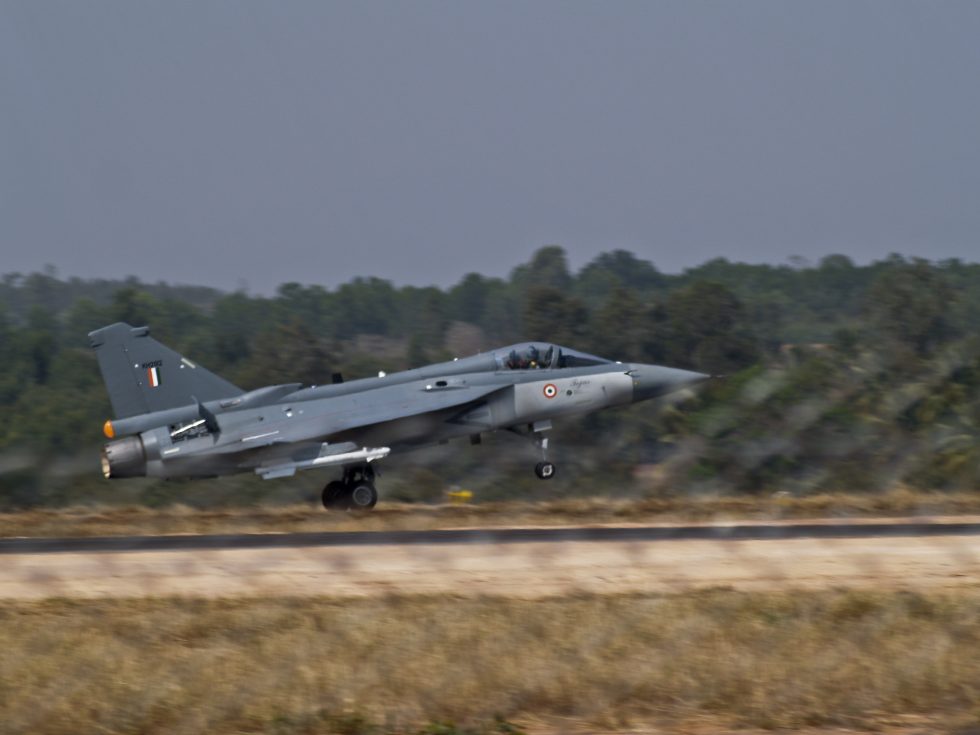
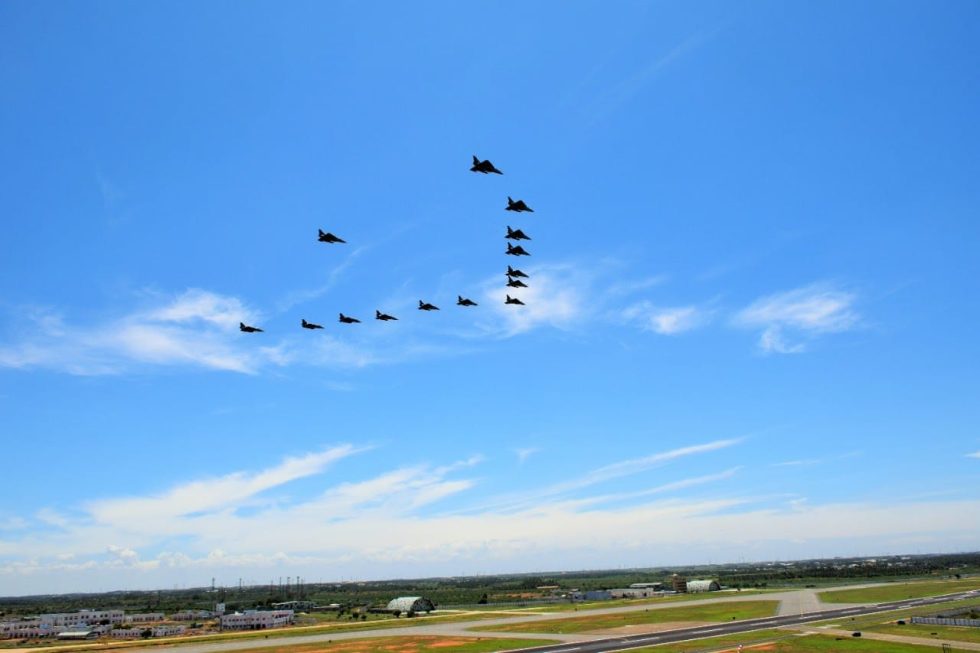
The Tejas in pictures
The Tejas in motion
A curated, high-authority video feature for the Tejas is coming soon. In the meantime, explore the photo gallery above and the stories from the programme.
Where the Tejas operates
The score that defines it
The Tejas has not been used in combat. Its significance is not a kill tally but a milestone: it is the first fighter designed and certified in India to reach frontline squadron service. Its record so far is written in first flights, clearances and orders rather than air-to-air engagements — and the figures below are programme milestones, not battle honours.
Compare the combat record of every military aircraft. Programme figures as of July 2026 and subject to change.
Everything people ask about the HAL Tejas
Can I fly in a Tejas?
Is the Tejas really made in India?
How fast is the Tejas?
Has the Tejas ever seen combat?
What is the difference between the Mk1A and the Mk2?
Does the Tejas replace the MiG-21?
Who operates the Tejas, and has anyone else ordered it?
You can’t fly the Tejas.
These, you can.
Some legends only live in museums — others are fuelled and waiting. MiGFlug has put civilians in real military jet cockpits since 2004.
 Fly the L-39 AlbatrosThe world’s most-flown jet trainer — aerobatics included
 Fly the F-104 Starfighter“The missile with a man in it”
 Fly the MiG-21The Cold War’s most-produced jet
 Fly the T-33 Shooting StarAmerica’s first jet trainer
 Fly the DH VampireA piece of early jet history
 Fly the S.211Agile Italian jet trainer
 Fly the MB-326The classic Aermacchi jet
 Fly the MiG-15The Soviet legend of the Korean War
Continue the tour
Every fact, checked
- ADA / tejas.gov.inThe programme’s official site — milestones, variants and development history.
- Airforce TechnologySpecifications, engine, armament and variant reference.
- Livefist DefenceFirst-flight recollections and Indian defence-programme reporting.
- ThePrintMk1A orders, delivery delays and export-prospect coverage.
- The National InterestAnalysis of the Tejas’s role, strengths and limitations.
- Naval TechnologyThe naval Tejas and its 2020 arrested carrier landing.
- The War Zone (TWZ)Reporting on the 2025 Dubai Airshow crash.
- Military FactoryCross-checked specification and timeline data.