
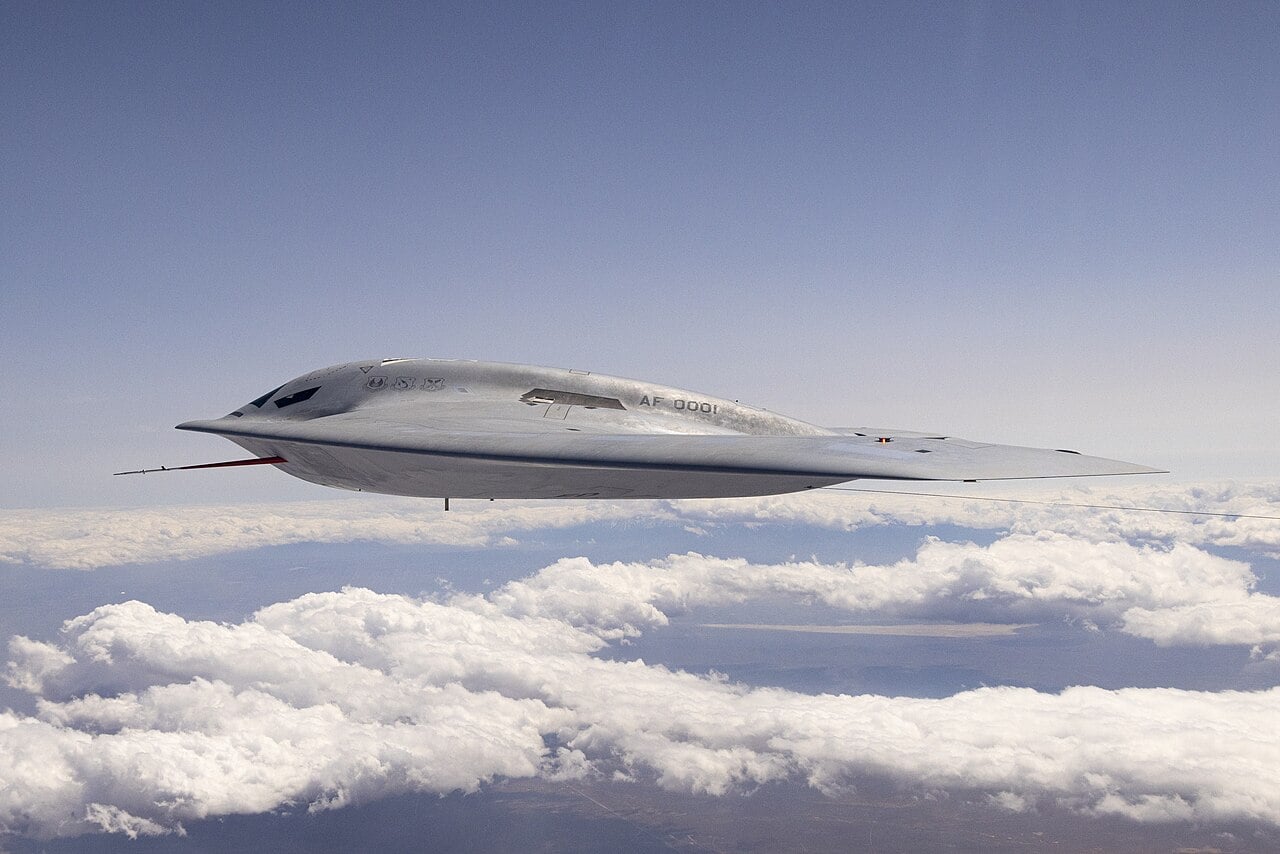
B-21 Raider
Northrop Grumman’s sixth-generation stealth bomber
The 21st century’s first bomber: a stealth flying wing built to strike anywhere on Earth, carry the nuclear deterrent — and one day fly with no one aboard.
The B-21 Raider: America’s first new bomber in a generation
For thirty years the B-2 Spirit was the only stealth bomber on Earth — twenty-one aircraft, each worth more than its weight in gold, so precious they rarely left American soil. The B-21 Raider is the answer to the obvious question: what comes next? Rolled out of a Palmdale hangar on 2 December 2022 and first flown on 10 November 2023, it is the first all-new American bomber in more than three decades, and Northrop Grumman calls it the world’s first sixth-generation combat aircraft.
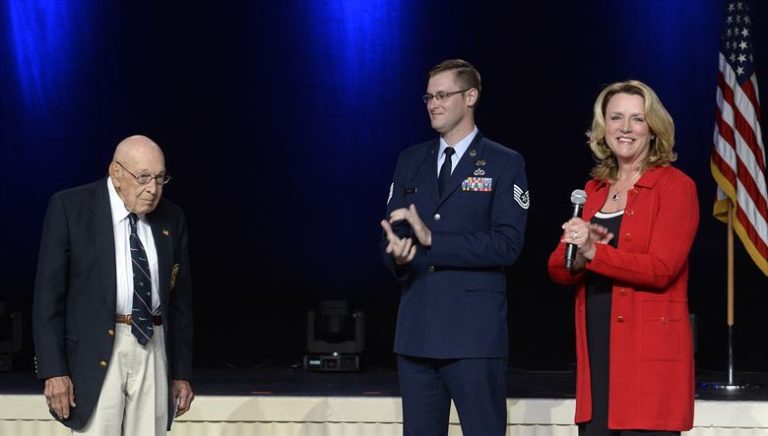
Its name reaches back to 18 April 1942, when sixteen B-25 Mitchells led by Lt. Col. Jimmy Doolittle launched from the carrier USS Hornet and struck Tokyo — a raid that changed little on the ground but everything in morale. When the Air Force named the new bomber in September 2016 it chose “Raider” in their honour, and Lt. Col. Richard Cole — then 101 and the last surviving Doolittle Raider — was there to help unveil it.
The B-21 is a flying wing, like the B-2 before it, but smaller, lighter and — crucially — cheaper. Where the B-2 was a Cold War exquisite built in tiny numbers against the Soviet Union, the B-21 is designed to be built in bulk: the Air Force wants at least 100, and has structured the whole programme around an average cost of roughly $692 million per aircraft (in 2010 dollars) rather than the Spirit’s stratospheric price. It is meant to be affordable enough to matter.
What makes it “sixth-generation” is less any single gadget than how it was built and how it will change. It was designed and tested as a complete digital twin before metal was cut — part of Northrop’s “e-Series” digital-engineering approach — and its open-systems architecture is meant to let new software, sensors and weapons be bolted on for decades without redesigning the jet. It is also optionally crewed: flown today by two pilots, but designed to one day fly missions with no one aboard.
And it carries the weight of the nuclear mission. The Raider is dual-capable — conventional weapons such as JASSM-ER and JDAM, plus the nuclear B61-12 gravity bomb and the new AGM-181 Long-Range Standoff missile — making it a future leg of the American nuclear triad. Unlike the B-2, it was shaped with the Pacific, and China’s dense air defences, in mind rather than a European war.
For now it lives at Edwards Air Force Base, where a second aircraft joined flight testing in September 2025 and spotters photograph it climbing over the California desert. The first operational Raiders are due “on the ramp” at Ellsworth Air Force Base, South Dakota, in 2027, with Whiteman and Dyess to follow. As they arrive, the B-1 Lancers and the last B-2 Spirits will retire — and for the first time in a generation, the bomber force will be built around something new.
01Why “Raider”: the Doolittle Raid of 1942, and what the name promises
On 18 April 1942, four months after Pearl Harbor, eighty airmen in sixteen B-25 Mitchell bombers under Lt. Col. James “Jimmy” Doolittle flew off the deck of the USS Hornet and bombed Tokyo and other Japanese cities — then pressed on toward China, where most crews crash-landed or bailed out. Militarily the damage was slight; psychologically it was enormous, proving Japan’s home islands were not beyond reach and lifting American morale at its lowest point.
The Air Force revived the name in September 2016. Retired Lt. Col. Richard “Dick” Cole — Doolittle’s own co-pilot on the lead aircraft and, at 101, the last surviving Raider — helped reveal it. Cole died in 2019, aged 103. The choice is deliberate: like the men it honours, the B-21 is built to reach targets others believe are safely out of range.
What makes the B-21 Raider a “sixth-generation” bomber
A flying wing, refined
A tailless all-wing planform gives all-aspect stealth, but the Raider is smaller and lighter than the B-2 it succeeds. Broadband low-observable shaping and coatings are tuned against modern radars, and the engines sit buried behind serpentine inlets so no fan face is ever exposed.
Built in software first
The B-21 was designed and flight-tested as a complete “digital twin” before a single part was machined — Northrop’s “e-Series” approach. An open mission-systems architecture is meant to let sensors, weapons and software be added for decades as updates, not new airframes.
Optionally crewed, nuclear-capable
Flown today by a crew of two, the Raider is designed to one day fly missions uncrewed. It is dual-capable — conventional JASSM-ER and JDAM, plus the nuclear B61-12 and the AGM-181 LRSO missile — making it a coming leg of the U.S. nuclear triad.
02The B-21 Raider’s stealth: what a sixth-generation flying wing changes
Every straight edge, every gap and every exposed engine face is a place a radar can find an aircraft. A tailless flying wing removes most of them: there is no vertical fin, no sharp fuselage, just a single continuous blended shape whose few edges are aligned to scatter radar energy away from the receiver. The B-2 proved the idea in the 1980s; the B-21 refines it with three more decades of low-observable materials and, reportedly, broadband shaping intended to defeat the lower-frequency radars that modern air defences increasingly use to hunt stealth aircraft.
Northrop has said little in specifics — signatures, coatings and inlet design are among the programme’s most closely held secrets. What officials will say is comparative: at the rollout, the Secretary of Defense claimed even the most advanced air-defence systems “will struggle to detect a B-21 in the sky.” The honest caveat is that no outside observer can verify that; the numbers that would prove or disprove it are classified.
03The B-21 Raider’s digital-twin development: how it was built in software first
The Raider is the flagship of what the Air Force calls digital engineering. Before metal was cut, Northrop built a complete virtual aircraft — a “digital twin” — and its hundreds of suppliers worked from a shared model rather than paper drawings, so that parts fit and systems behaved as predicted when the real airframe came together. The intent was to wring surprises out in software, where they are cheap, instead of on the flight line, where they are not.
The pay-off shows in an unusually undramatic flight-test campaign and in the aircraft’s open mission-systems architecture, designed so new weapons and sensors can be integrated as software loads over the type’s life. Whether digital engineering truly tames the cost and schedule risk that has haunted every past bomber is still being tested — but the B-21 is the biggest bet yet that it can.
B-21 Raider specifications
Baseline note: everything below describes the B-21A, the only variant that exists, and almost none of it is official. The US Air Force has published essentially three kinds of number about this aircraft — an average procurement unit cost, a minimum buy of 100 airframes, and the date of first flight. It has released no span, no length, no weight, no speed, no range and no thrust figure, and the programme remains a special access programme. Every dimension in circulation, including those printed in reference works, is a photogrammetric estimate worked back from the December 2022 rollout photographs and later flight-test imagery, and the estimates disagree with one another by more than ten per cent. Anything in grey below is an estimate, an inference or a comparison, never a released figure; where estimates conflict, both are given. A B-21 number quoted to three significant figures should be distrusted on sight.
Dimensions & weights
- Crew
- 2 (pilot and mission commander; the USAF fact sheet adds that the design can accommodate manned or unmanned operation)
- Wingspan
- Not released — Aviation Week estimated 40.2 m (132 ft) from rollout imagery; later analysis scaling against ground crew gave about 41.5 m (136 ft); several reference tables print 44–47 m (145–155 ft), which is almost certainly too large
- Wingspan, B-2A, for scale
- 52.43 m (172 ft) — a published figure, and the reason every B-21 estimate is expressed as a fraction of it
- Length
- Not released — about 16.5 m (54 ft) is the figure most often repeated; no one has published the working behind it
- Height
- Not released — roughly 6 m (20 ft) by comparison with people standing alongside; the B-2A is 5.18 m (17 ft), so the B-21 reads as taller as well as narrower
- Wing area
- Not released — no credible published estimate exists, because the planform apex is hard to fix from the released angles
- Empty weight
- Not released — Aviation Week put it at roughly half the B-2A’s, which would be near 32,000 kg (70,000 lb)
- Maximum take-off weight
- Not released — 81,600 kg (180,000 lb) circulates widely with no named source; the B-2A’s is 170,600 kg (376,000 lb)
- Internal fuel
- Not released — and unlike most figures here, not even guessed at responsibly
- Payload
- Not released — 9,070 kg (20,000 lb) is the number that recurs; the USAF has never confirmed it, and the B-2A’s 18,100 kg (40,000 lb) is the only anchor
- Configuration
- Flying wing with a lambda trailing edge; split rudders outboard, elevons inboard; no vertical surfaces of any kind
- Landing gear
- Retractable tricycle; twin-wheel nose unit, twin-wheel mains (counted from photographs, not from a document)
- Air refuelling
- Dorsal receptacle; photographed taking fuel from a KC-135 in imagery released April 2026
Performance
- Maximum speed
- Not released — high subsonic. "Mach 0.8 or better" is an estimate that has been repeated until it looks like a specification
- Cruising speed
- Not released
- Service ceiling
- Not released — about 15,200 m (50,000 ft) circulates
- Range
- Not released — at the 2022 rollout Northrop Grumman’s chief executive said only that the B-21 has greater range than the B-2A, which the USAF gives as roughly 11,100 km (6,900 mi) unrefuelled
- Combat radius
- Not released — an Australian think-tank paper used 4,000 km (2,500 mi) unrefuelled as a planning figure, which is an assumption, not a datum
- Endurance
- Not released; air-refuellable, so in practice bounded by crew fatigue and tanker availability rather than tankage
- Radar cross-section
- Not released — the insect-sized comparisons in circulation are rhetorical shorthand from officials, not measurements
- Rollout
- 2 December 2022, Air Force Plant 42, Palmdale, California
- First flight
- 10 November 2023, Palmdale to Edwards Air Force Base
- Second aircraft
- Arrived at Edwards 11 September 2025; two B-21s were flying there through 2026
- Test progress
- The 412th Test Wing’s B-21 Combined Test Force reported in May 2026 that a campaign scoped for 180 days had been completed in 73; an operational test pilot flew the aircraft on 11 June 2026
- Planned service entry
- First delivery to Ellsworth Air Force Base, South Dakota, in 2027
Propulsion & systems
- Engines
- 2 — inferred, not stated. The airframe has two dorsal inlets, so two engines is the reasonable reading; the Air Force has never confirmed even the count
- Manufacturer
- Pratt & Whitney (named as one of seven tier-one suppliers in March 2016; the engine’s military designation is classified and has never been released)
- What it is not
- Not the General Electric F118. Four F118-GE-100s of 77 kN (17,300 lbf) power the B-2A, and the claim that they also power the B-21 is one of the most common errors written about this aircraft. It is simply wrong.
- Reported engine type
- Non-afterburning medium-bypass turbofan reported to share a core with the F135 that powers the F-35 (the "PW9000" label often attached to it is a Pratt & Whitney concept name from the 2010s, not a confirmed designation)
- Thrust
- Not released — a 120 kN (27,000 lbf) class engine is the usual estimate, which would give roughly the same installed thrust as the B-2A’s four smaller engines
- Inlets
- Serpentine ducts buried in the upper surface and blended far more flush than the B-2A’s raised trapezoids — matching inlet airflow to engine demand was described publicly in 2021, by a member of the House Armed Services Committee, as one of the programme’s harder integration arguments
- Internal fuel
- Not released
- Radar
- Not released — two trapezoidal array apertures flank the nose gear bay, in the same position as the B-2A’s AN/APQ-181 arrays but visibly smaller
- Electronic warfare, self-protection
- Not released. No aperture on the aircraft has been publicly identified with a function
- Mission systems
- Government-owned open systems architecture, so that sensors, weapons and software can be replaced without returning to the prime contractor. Northrop states that software certification time has already been halved
- Development method
- The first major US military aircraft designed end to end on a digital thread, with the physical properties of each part carried in the digital model. It was meant to buy predictable cost, faster change and cheaper sustainment than the B-2A, whose low-observable coatings made it one of the most maintenance-hungry aircraft ever fielded
- Crew stations
- 2 ejection seats (type not released)
- Number built
- Two flying at Edwards, further airframes in ground test and in assembly at Palmdale; outside estimates of the classified production rate cluster near seven a year. Programme of record is a minimum of 100
- Unit cost
- $550 m average procurement unit cost in base-year 2010 dollars ($639 m in 2019 dollars, $692 m in 2022 dollars — all three are on the USAF fact sheet, and the base year is the whole story: quoting "$550 million" as a present-day price is wrong)
04The B-21 Raider’s operating costs: what a next-generation stealth bomber costs
The B-21’s defining promise is that stealth can be affordable. The Air Force built the programme around an average procurement unit cost of about $692 million per aircraft in 2010 dollars — a figure that rises in then-year money but is still a fraction of the B-2’s roughly $2 billion. The full programme is estimated at $203 billion or more across development, at least 100 aircraft and thirty years of operations.
Affordability has not been painless. Northrop Grumman took charge of roughly $1.6 billion against the first low-rate production lots in 2023–24, when fixed-price contracts collided with inflation. The Air Force has since reported the costs under control after renegotiation, and its fiscal-2027 request for the programme runs to about $6.1 billion as it accelerates production. A true cost-per-flight-hour will not exist until the fleet actually operates — which is why the specification above leaves that line open.
05The B-21 Raider’s numbers and bases: how many, and where they’ll fly
The stated floor is 100 aircraft, and senior officers and analysts have argued for more — studies have floated 145 to 200 to give the force real depth against a Pacific adversary. Production is being accelerated toward a target of roughly seven aircraft a year, with capacity recently expanded.
Flight testing runs at Edwards Air Force Base, California, where the 412th Test Wing’s B-21 Combined Test Force flies the aircraft; a second airframe joined the effort in September 2025. Ellsworth Air Force Base, South Dakota, will host the first operational and training units — Air Force leaders expect Raiders “on the ramp” there in 2027 — followed by Whiteman AFB, Missouri and Dyess AFB, Texas.
Armament & payload
The B-21’s weapons load has never been disclosed, so this section says what is known and, at greater length, what is not
The B-21 carries everything internally, in a single weapons bay whose dimensions, station count and rated capacity are all classified. What the Air Force has confirmed is the intent: the aircraft is a dual-capable penetrating bomber, meant to certify for nuclear release with the B61 Mod 12 and Mod 13 gravity bombs and the AGM-181 Long-Range Stand-Off missile, and to carry conventional stand-off and direct-attack weapons including the AGM-158B JASSM-ER and the JDAM family. That is a list of weapons the aircraft is assigned, not a loadout table, and the difference matters. No public source knows how many LRSOs a B-21 carries, whether it uses a rotary launcher, or whether the bay is long enough for the largest penetrators. Every weapon named below is an assignment or a credible report, not a demonstrated carriage; nuclear certification in particular is a multi-year process that follows first delivery, and none of it has happened yet.
Nuclear weapons
- B61 Mod 12 guided gravity bomb — the current US strategic and tactical gravity weapon, also assigned to the B-2A and the F-35A.
- B61 Mod 13 — the higher-yield variant announced in 2023, assigned to the B-21 and B-2A but explicitly not to the F-35.
- AGM-181 LRSO — the nuclear cruise missile replacing the AGM-86B, itself under development; the B-52H is the lead platform, the B-21 the follow-on.
- Nuclear certification has not been granted. It cannot be until operational aircraft exist, and the Air Force has not published a target date.
Conventional stand-off
- AGM-158B JASSM-ER — named by the Air Force as a B-21 weapon; the baseline long-range conventional cruise missile.
- AGM-158C LRASM, the anti-ship derivative, appears on most B-21 weapon lists but has never been officially confirmed for the type.
- Hypersonic weapons are frequently assumed. Nothing has been announced, and bay length is the constraint nobody outside the programme can assess.
- Stand-off carriage is the point of the aircraft in the Pacific: a penetrating bomber that can also shoot from outside the ring is worth more than one that must go in.
Direct-attack weapons
- JDAM family — GBU-31, GBU-38 and relatives, named in USAF material as B-21 munitions.
- Small-diameter bombs are the obvious high-count internal store for a bay of unknown size, but have not been confirmed.
- The GBU-57 Massive Ordnance Penetrator, carried by the B-2A, is very unlikely on an aircraft this much smaller. Nobody has said either way.
- Mines and other legacy B-2A stores: no statement has been made.
The weapons bay
- One internal bay. No external hardpoints exist, and on a shape like this they never will.
- Rated capacity: not disclosed. The 9,070 kg (20,000 lb) figure in circulation has no traceable official origin.
- Launcher arrangement: not disclosed. Whether the bay uses a rotary launcher, bomb racks or both is unknown.
- Bay dimensions are the single most consequential unpublished number about the aircraft, because they set which weapons it can ever carry.
Not disclosed
- Maximum payload weight, in any units, from any official source.
- Number of weapon stations, and the maximum count of any single weapon type.
- Whether the aircraft can carry the B83 or any legacy weapon retained in the stockpile.
- Any air-to-air capability. The B-21 has no gun and no announced self-defence missile, and no official statement addresses the question.
- Whether the bay accommodates the sensors, decoys or uncrewed vehicles that have been speculated about since 2022.
How weapons get added
- The government owns the mission systems architecture, so new weapons are meant to be integrated without a contract renegotiation with the prime.
- That is the central affordability claim of the programme and the main practical meaning of the "sixth-generation" label Northrop applied at rollout.
- Conventional capability is expected to come first, nuclear certification later; this is the pattern the B-2A followed.
- Until a squadron stands up at Ellsworth, all of this remains a design intention rather than a demonstrated property.
Three missions the B-21 is being built for
- Penetrating nuclear strike
- The mission that justifies the aircraft. Deep entry into a defended airspace with B61-12 or B61-13 gravity weapons against targets that stand-off weapons cannot reach or cannot be trusted to reach. The B-21 is meant to roughly double the US nuclear-capable bomber force from about 60 airframes to about 120. No weapon count has been published.
- Stand-off conventional strike in the Pacific
- The mission the aircraft was actually sized for. JASSM-ER and, if confirmed, LRASM launched from outside the densest defences, with the aircraft’s range doing the work that basing cannot do in a theatre where every runway is a target. Radius, cruise speed and cycle time are all unpublished.
- Penetrating conventional strike and sensing
- Direct-attack weapons on defended fixed targets, and the less-discussed role of a survivable sensor that can find and pass targets to everything else. Officials have repeatedly described the B-21 as a node as much as a bomber. Nothing about its sensor fit has been released.
Sourcing caveat: the weapon assignments above come from USAF and Northrop Grumman statements and from the B-21 fact sheet; the caveats come from the absence of anything else. No payload figure, bay dimension or station count has been released, and this page does not invent one. Reference works that print a precise B-21 payload are repeating an unsourced number.
Variants
The B-21 has no variants, so what follows is the programme’s designation history and the airframes that actually exist
There is one aircraft type, the B-21A, and there has never been another. A variants table for the B-21 is therefore a table of programme stages, individual test airframes and proposals that were never built — which is the honest form for a type still in flight test.
Two things in the list below deserve attention. The first is how much of the aircraft’s character was fixed before metal was cut: the Rapid Capabilities Office deliberately reused mature subsystems so that the new work could concentrate on shaping, coatings and mission systems, and the whole airframe was designed on a digital model rather than on paper and prototypes. The second is that the programme of record — a minimum of 100 aircraft — is now the smallest number anyone in the debate is proposing.
- Long Range Strike Bomber, LRS-B (2011–2016)
- The classified programme that produced the aircraft. Managed by the Air Force Rapid Capabilities Office rather than through normal acquisition. Northrop Grumman beat a Boeing–Lockheed Martin team for the engineering and manufacturing development contract in October 2015.
- B-21 designation (announced February 2016)
- Chosen because it would be the twenty-first century’s first bomber. The name "Raider", after the Doolittle Raiders, was announced that September with the last surviving Raider, Richard Cole, on stage.
- B-21A Raider (2022–, minimum 100 planned)
- The only variant. Two-crew subsonic flying-wing penetrating bomber; smaller than the B-2A, longer-ranged according to Northrop, and designed from the outset around sustainment cost rather than around peak capability.
- T-1, tail AF 0001 (rolled out 2 December 2022, first flew 10 November 2023)
- Not a prototype in the old sense: the Air Force states that the test aircraft are production-representative and will be converted to operational configuration once testing is done. That decision is a direct rebuke to the way the B-2 programme was run.
- Second test aircraft (delivered to Edwards 11 September 2025)
- Joined the 420th Flight Test Squadron and the B-21 Combined Test Force. Further airframes have been in ground test since 2024 and in assembly at Palmdale throughout.
- Low-rate initial production (first lot awarded 23 January 2024)
- Awarded on fixed-price terms that Northrop has since taken roughly $2 bn of losses against — the price of a contract structure designed to protect the taxpayer from a repeat of the B-2.
- Production acceleration (announced 23 February 2026)
- A $4.5 bn injection from fiscal 2025 reconciliation legislation, matched by company investment, to raise the annual build rate by about 25 per cent. Northrop says it has now put more than $5 bn into the programme’s digital and manufacturing infrastructure.
- Proposed larger fleet (2025–2026, not funded)
- US Strategic Command endorsed 145 aircraft in March 2025; the Mitchell Institute and, in April 2026, the head of Indo-Pacific Command have argued for 200. None of this has changed the programme of record.
- Australian acquisition (proposed 2022–2026, no decision)
- Repeatedly urged on Canberra by think tanks and, in April 2026, by a serving senator, as a long-range strike capability the RAAF has lacked since the F-111 retired in 2010. No US export decision exists and no Australian requirement has been stated.
- Uncrewed operation (design provision, no programme)
- The USAF fact sheet states the aircraft can accommodate manned or unmanned operation. There is no announced uncrewed variant, no date, and no public statement that the capability has been exercised.
Closing caveat: no B-21 has been retired, preserved or lost, and there is nothing to count. Two aircraft fly, from Edwards Air Force Base, and everything else on this page is either a released statement or an estimate labelled as one. If a source gives you a precise B-21 wingspan, a payload in pounds or a service ceiling, ask where it came from — the honest answer is that nobody outside the programme knows.
The B-21 Raider, from black project to the flight line
A new bomber goes black
The Long Range Strike Bomber (LRS-B) programme launches under deep secrecy.
Northrop Grumman wins
In October the Air Force picks Northrop over a Boeing–Lockheed team; the GAO upholds the award.
Named “Raider”
In September the bomber is named for the Doolittle Raiders; Raider Richard Cole helps reveal the name.
Rollout at Palmdale
On 2 December the B-21 is unveiled — front-on only, its engines and rear kept hidden.
First flight
On 10 November the first aircraft flies from Palmdale to Edwards AFB to begin testing.
Production begins
In January the Air Force awards the first low-rate initial production contract.
Second aircraft flies
A second B-21 joins the flight-test fleet at Edwards in September.
Entering service
The first operational Raiders are due at Ellsworth AFB — the bomber force starts to renew.
The B-21 Raider in eight stories
Named for the Doolittle Raiders
A raid on Tokyo in 1942 gave the bomber its name.
The full story
The rollout that showed almost nothing
In December 2022 the world saw the front — and only the front.
The full story
The bomber built in a computer
It flew as software before it flew as metal.
The full story
Spotted over the desert
Enthusiasts photographed the Raider before the Air Force did.
The full story
A $1.6 billion charge
Affordability has a price of its own.
The full story
Designed to fly itself
Two seats today, none required tomorrow.
The full story
A bomber built for China’s defences
Where the B-2 was made for the Soviet Union, the Raider looks east.
The full story
As it arrives, the old bombers leave
The Raider’s job is to replace, not just reinforce.
The full story
The B-21 Raider in photographs
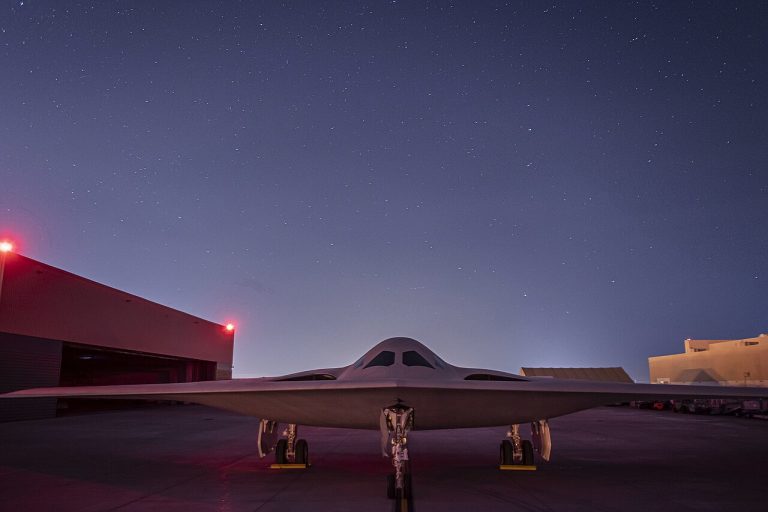
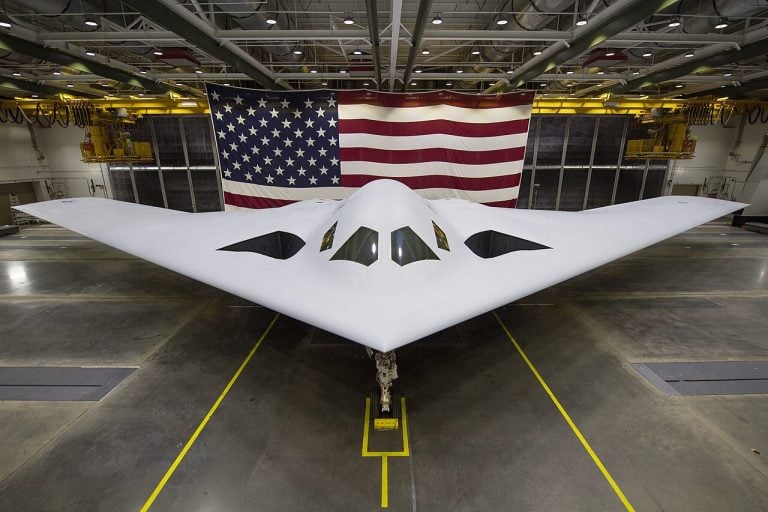
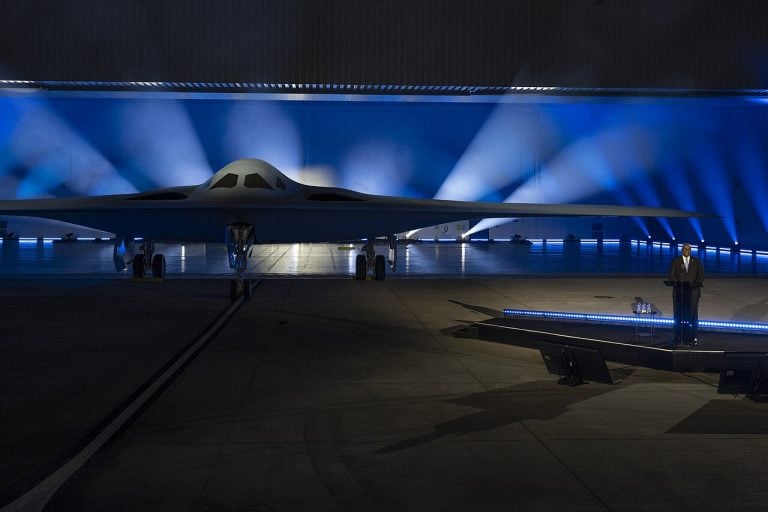
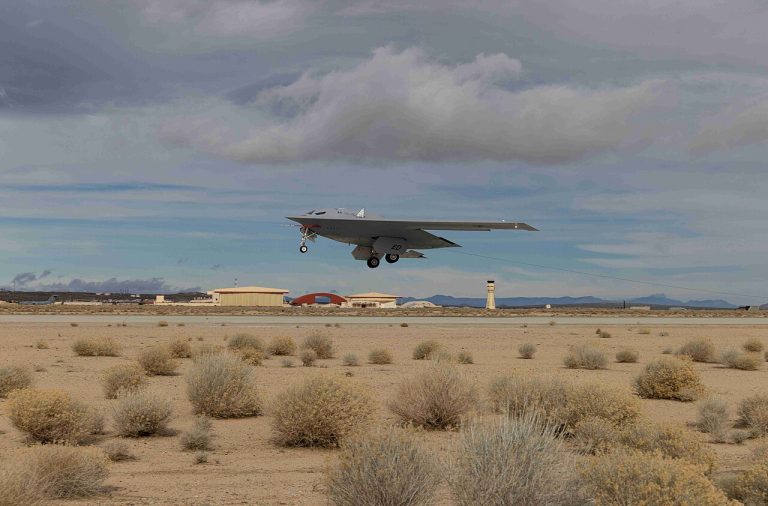
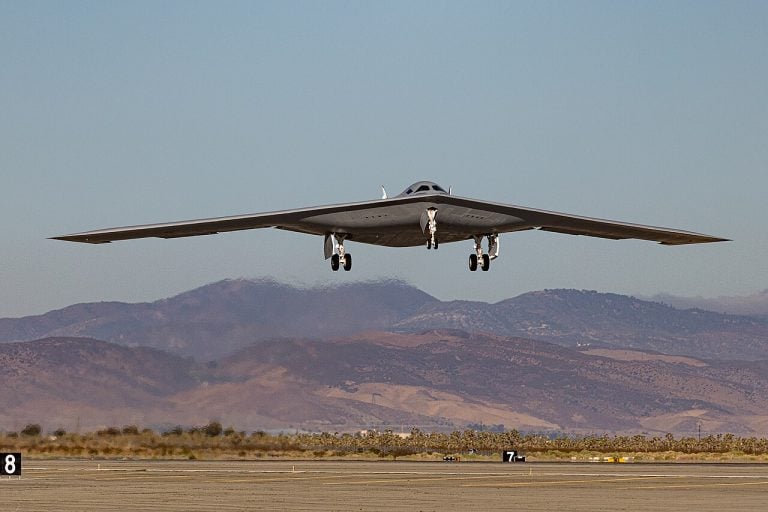
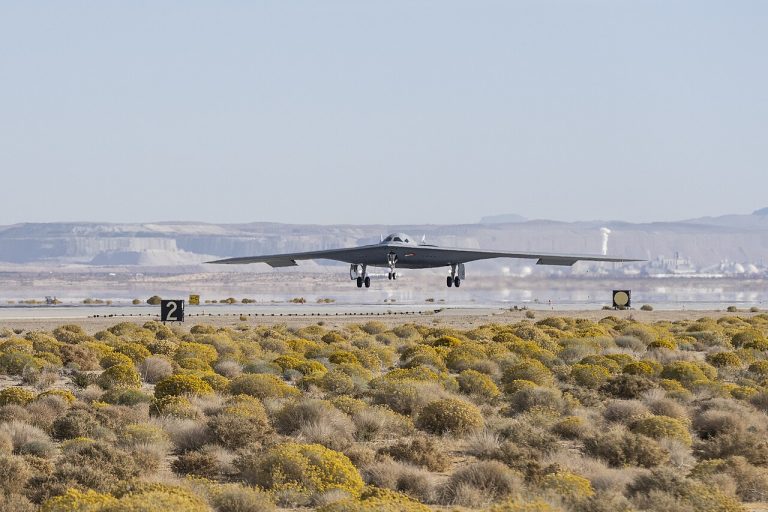
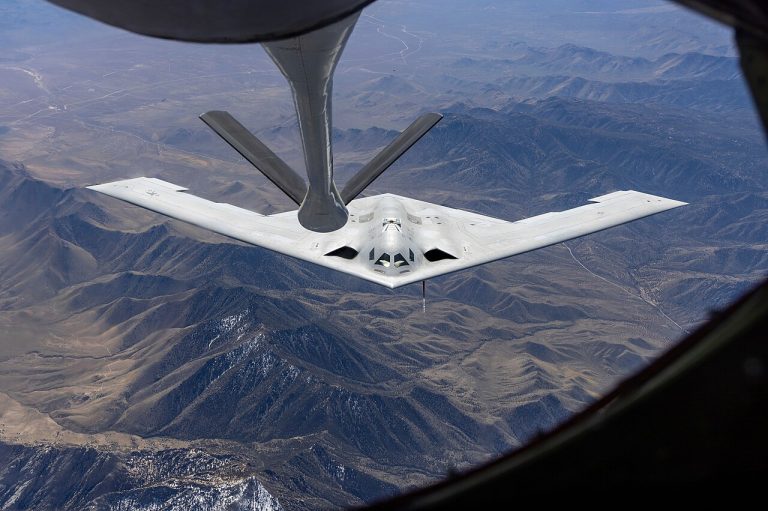
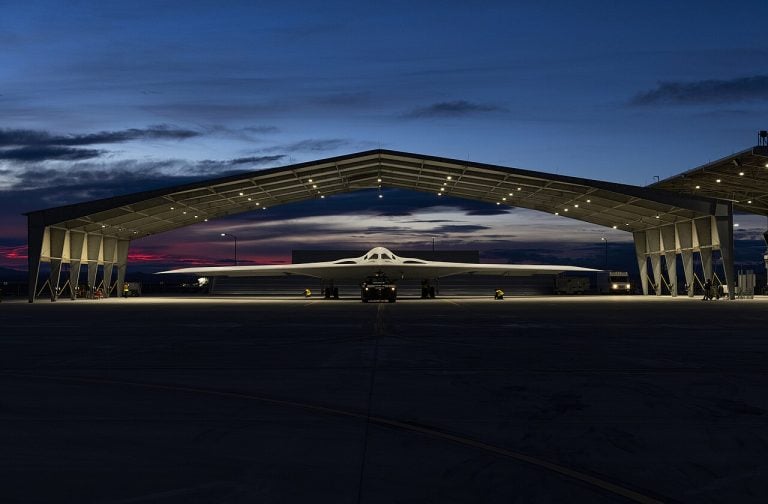
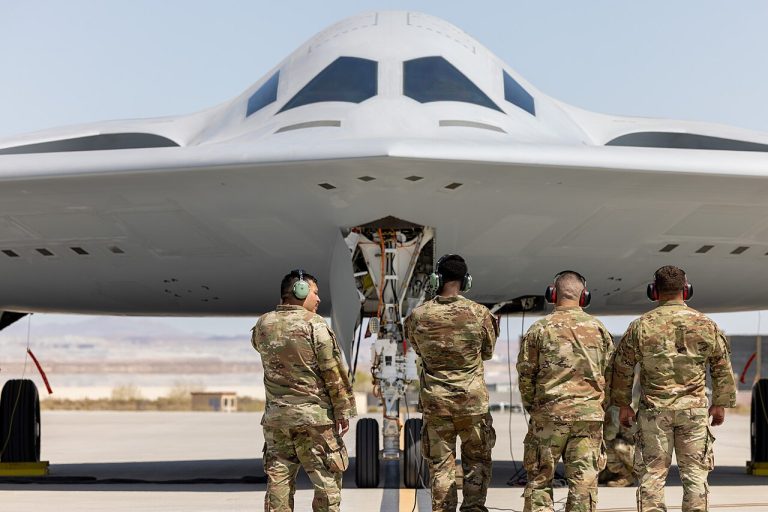
The B-21 Raider, unveiled
The most-watched moment in the B-21’s short public life so far: its rollout, streamed live from a Palmdale hangar on 2 December 2022.
Northrop Grumman’s official unveiling of the B-21 Raider, Palmdale, 2 December 2022 (Northrop Grumman, official channel).
Where the B-21 Raider will be based
Edwards AFB, California
Home of the 412th Test Wing’s B-21 Combined Test Force, where the aircraft is being flown and evaluated.
Ellsworth AFB, South Dakota
The first operational and formal training base — Air Force leaders expect Raiders “on the ramp” here in 2027.
Whiteman AFB, Missouri
The second main operating base — today the home of the B-2 Spirit fleet the Raider will replace.
Dyess AFB, Texas
The third main operating base — today a B-1B Lancer base, also slated to transition to the B-21.
The B-21 Raider, by the numbers
The Raider has not yet flown a combat mission — it is still in flight test. For now its story is measured in firsts, not kills, and its entire purpose is deterrence: making sure the number below never has to change.
The B-21 is not yet operational and has no combat record of its own. Compare the combat records of aircraft that have seen war.
B-21 Raider: your questions, answered
Can I fly in a B-21 Raider?
No. The B-21 is a classified U.S. Air Force nuclear bomber flown by a crew of two — it is not open to the public in any way. However, you can fly in genuine military jets today: MiGFlug offers flights in real fighter jets such as the L-39 Albatros, the MiG-29 and more. See migflug.com/flights-prices.
Has the B-21 Raider flown yet?
Yes. The first aircraft made its maiden flight on 10 November 2023, flying from Palmdale to Edwards Air Force Base, and a second aircraft joined flight testing in September 2025.
How much does a B-21 Raider cost?
The Air Force built the programme around an average procurement cost of roughly $692 million per aircraft in 2010 dollars — more in then-year money. The full programme is estimated at $203 billion or more over its life. Exact figures are partly classified.
How many B-21s will be built?
At least 100 are planned. Some senior officers and analysts have argued for more — studies have suggested 145 to 200 to give the force real depth.
How is the B-21 different from the B-2 Spirit?
It is smaller, lighter and much cheaper, designed to be built in larger numbers. It uses open, upgradeable systems, was engineered digitally, is “optionally crewed,” and was shaped with the Indo-Pacific in mind rather than the Cold-War Soviet threat.
When will the B-21 enter service?
The first operational aircraft are expected at Ellsworth AFB in 2027, with the fleet building through the late 2020s and 2030s.
Is the B-21 Raider nuclear-armed?
Yes. It is dual-capable — carrying conventional weapons such as JASSM-ER and JDAM, and nuclear weapons including the B61-12 gravity bomb and the AGM-181 LRSO missile — making it a future part of the U.S. nuclear triad.
You can’t fly the B-21 Raider.
These, you can.
The Raider will never carry a passenger — but you can still strap into a real military jet. MiGFlug flies civilians in genuine fighters and jet trainers around the world.
 Fly the L-39 AlbatrosThe world’s most-flown jet trainer — aerobatics included
 Fly the F-104 Starfighter“The missile with a man in it”
 Fly the MiG-21The Cold War’s most-produced jet
 Fly the T-33 Shooting StarAmerica’s first jet trainer
 Fly the DH VampireA piece of early jet history
 Fly the S.211Agile Italian jet trainer
 Fly the MB-326The classic Aermacchi jet
 Fly the MiG-15The Soviet legend of the Korean War
Related aircraft
Where this chapter comes from
- U.S. Air ForceOfficial B-21 fact sheets, imagery and rollout coverage (public-domain photos used here).
- Northrop Grumman — B-21 RaiderThe manufacturer’s official programme information.
- Air & Space Forces MagazineContinuing reporting on the programme, cost, testing and basing.
- Breaking DefenseOn-the-ground coverage of the 2 December 2022 rollout.
- Defense NewsReporting on B-21 cost, production and the fixed-price lots.
- The AviationistEarly photographs of the B-21 during flight testing at Edwards.
- Congressional Research ServiceBackground analysis of the long-range strike bomber programme and fleet plans.
- Smithsonian National Air and Space MuseumContext on the Doolittle Raid and the lineage of American strategic bombers.
Many B-21 figures — dimensions, weight, speed, range and engine type — remain officially classified; values marked “estimated” are the best public assessments and should be read as approximate. Cost and schedule figures are current as of 2026 and will change as the programme matures.