
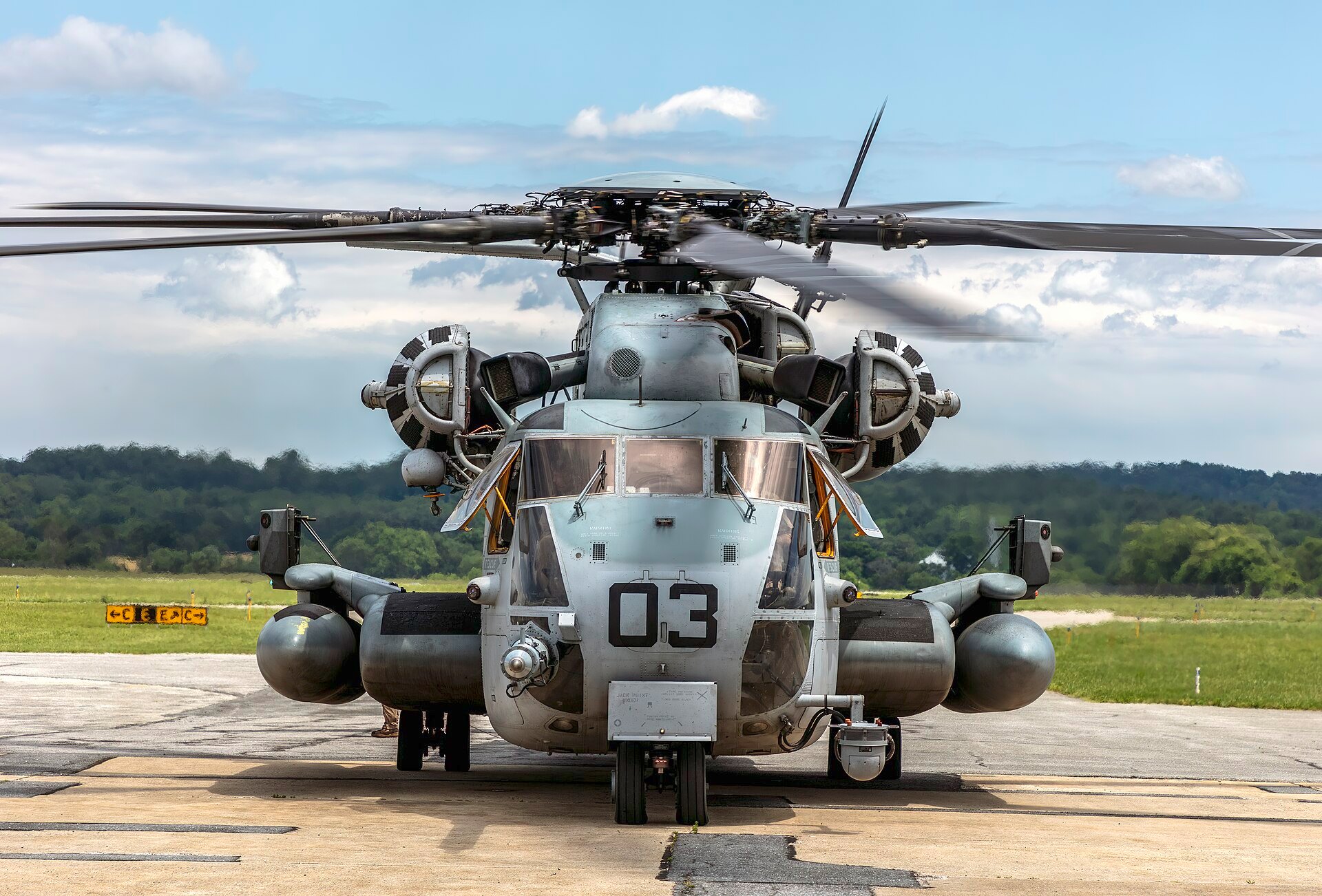
Sikorsky CH-53 Sea Stallion
From Sea Stallion to King Stallion
Six decades of heavy lift: the Sikorsky family that recovered downed aircraft in Vietnam, stole a Soviet radar for Israel, flew the Marines into Afghanistan and now lifts triple the load as the CH-53K King Stallion.
The CH-53: how a Marine Corps heavy lifter became a sixty-year dynasty
In March 1962 the US Navy, buying for the Marine Corps, asked industry for a heavy assault helicopter that could carry 8,000 lb over 100 nautical miles at 150 knots and recover damaged aircraft from the battlefield. Boeing Vertol offered a version of the Chinook; Sikorsky offered its S-65, a scaled-up S-61R with two General Electric T64 turboshafts and the rotor system of the CH-54 Skycrane, and won. The first YCH-53A flew from Stratford, Connecticut, on 14 October 1964, and Marine squadrons received production CH-53A Sea Stallions from 1966. By January 1967 they were in Vietnam, where the big six-blade helicopter quickly proved its worth hauling artillery and slinging wrecked aircraft out of the jungle. The more powerful CH-53D followed in 1969 with room for 55 troops, and the US Air Force adopted the airframe for combat rescue as the HH-53 Super Jolly Green Giant.
Exports followed. Israel chose the CH-53 in 1968 after studying both it and the Chinook, received its first aircraft in October 1969 and named it Yas’ur, the petrel. Within three months two of them had lifted a complete Egyptian radar out of Egypt. West Germany bought 110 CH-53Gs, almost all built by VFW-Fokker at Speyer, Austria flew two in the Alps, and Iran’s navy took six RH-53D minesweepers before the revolution. The Marines, meanwhile, wanted still more lift. Sikorsky added a third engine, a seventh rotor blade, a longer fuselage and a canted tail rotor to produce the CH-53E Super Stallion, which first flew on 1 March 1974 and entered service in 1981, with the Navy’s MH-53E Sea Dragon towing mine countermeasures sleds from 1986.
The Super Stallion became the heaviest-lifting helicopter in the West and the backbone of Marine logistics, from Beirut and Mogadishu to the 2001 assault into Afghanistan and the 2003 invasion of Iraq. It also carried a grim accident record; heavy helicopters full of troops make for deadly crashes. In 2006 the Corps ordered a clean-sheet successor, and on 5 May 2014 Commandant General James F. Amos named it the CH-53K King Stallion. With three 7,500 shp GE T408 engines, composite rotor blades and fly-by-wire controls, it can carry 27,000 lb over 110 nautical miles in hot conditions, about three times what the CH-53E can manage. The Marines declared it operational in April 2022, and Israel is replacing its veteran Yas’urs with it, while Germany chose the Chinook instead.
01The CH-53 in Israel: Operation Rooster 53 and the long life of the Yas’ur
Israel’s first CH-53s arrived on 2 October 1969, in the middle of the War of Attrition along the Suez Canal. Egypt had just received a new Soviet P-12 early-warning radar, and Israeli planners decided to take it. On the night of 26 December 1969 paratroopers landed by Super Frelon helicopters overran the site at Ras Arab on the Egyptian side of the canal and dismantled it. Two CH-53s then lifted the equipment, the radar itself weighing about four tons, back across the water under cover of A-4s and F-4s. One helicopter suffered a hydraulic failure on the way but reached Israeli territory before landing. Israeli intelligence studied the system, which yielded new countermeasures against Egyptian air defences, and it was later passed to the United States.
The Yas’ur went on to move artillery and evacuate wounded in 1973, carry commandos on raids for decades, and fight fires on Mount Carmel in 1989. It also suffered terrible losses, including a collision in 1997 that killed 73 soldiers. During the 2006 Lebanon War a Yas’ur that had just landed troops was hit by an anti-tank missile and crashed, in what Israeli reports called the biggest heliborne landing since 1973. Repeated upgrades kept the fleet flying, but spare parts grew scarce; after an engine fire destroyed one in 2019, Israel blamed a known relay defect that had not been passed on. In 2021 it chose the CH-53K to replace them.
02The CH-53K King Stallion: a new helicopter in an old family name
The King Stallion looks like its predecessors but is almost entirely new. Sikorsky called it one of the first all-digitally designed helicopters, assembled in a virtual reality lab in Stratford before metal was cut. Its three GE T408 engines give 57 percent more power than the CH-53E’s T64s for about 20 percent lower specific fuel consumption, and a new split-torque transmission turns 35-foot composite blades with 12 percent more area. The cabin is wider, able to take a Humvee or two standard 463L pallets, and full-authority fly-by-wire controls make it easier to handle in brownout.
The programme was not easy. A December 2018 restructuring followed problems including engines re-ingesting their own hot exhaust, which caused overheating and stalls in testing; the Navy and Marines said in December 2019 the problem was fixed. In operational test the aircraft flew more than 3,000 mishap-free hours and recovered a disabled Navy MH-60S from a California mountainside that nothing else could reach. Lt. Gen. Mark Wise declared initial operational capability on 22 April 2022, full-rate production followed in December 2022, and in August 2023 the Navy ordered 35 more for US$2.7 billion, eight of them for Israel. The Marine Corps programme of record stands at 200 aircraft.
What makes the CH-53 special
Built to recover aircraft
The original requirement asked for a helicopter that could recover damaged aircraft as well as carry troops, and the CH-53 was designed around a single-point cargo hook, a rear loading ramp and a payload of almost half its own empty weight. In Vietnam it recovered downed aircraft routinely. The CH-53E extended that to anything in the Marine inventory except the KC-130, and the CH-53K’s hook is rated at 36,000 lb. Lifting other people’s wreckage has been part of the family’s job description for sixty years.
A third engine and a seventh blade
To turn the Sea Stallion into the Super Stallion, Sikorsky added a third T64 behind the main rotor on the left side, a seventh blade, a stronger transmission and a fuselage stretched by 6 ft 2 in. The tail rotor was canted 20 degrees so that it contributed some lift in the hover, and a digital flight-control system stopped pilots overstressing the airframe. The MH-53E Sea Dragon added enlarged sponsons for fuel endurance and controls tailored to towing minesweeping sleds through the water.
Ship-friendly giant
For all its size, the CH-53 had to live aboard amphibious ships. Main rotor blades and the tail boom fold automatically, and the King Stallion was deliberately kept to roughly the CH-53E’s deck footprint, with narrower composite sponsons. Air-to-air refuelling probes on most US variants let crews self-deploy and stretch missions; in 2001 Super Stallions flew Marines hundreds of miles from ships in the Arabian Sea into southern Afghanistan, and KC-130 tankers routinely refuel them over water. That reach matters for a Corps that plans to fight from the sea.
03The CH-53’s evolution: from twin-engine Sea Stallion to fly-by-wire King
The CH-53A used two GE T64 turboshafts of 2,850 shp driving a fully articulated six-blade main rotor and a four-blade tail rotor, with mechanical controls backed by three hydraulic systems and extensive titanium in the dynamic components. All fuel lived in the side sponsons. The CH-53D raised engine power to 3,925 shp in its T64-GE-413 form and introduced automatic blade folding; later D-models got a nitrogen-pressurised blade inspection system that warned of cracks.
The CH-53E and MH-53E added the third engine, the seventh blade and a titanium-fibreglass composite rotor; Germany’s CH-53GA upgrade gave 40 of its aircraft a new flight deck, autopilot and sensors from 2010, and Israel’s Yas’ur 2025 programme modernised its fleet again. The CH-53K reset the baseline: glass cockpit, full-authority fly-by-wire, health and usage monitoring, elastomeric rotor hub and composite blades, with Marine figures claiming 63 percent fewer parts than its predecessor and 57 percent more power. Lockheed Martin stresses that “full authority” means the flight-control computers command all of the aircraft’s motion rather than merely helping the pilot with stability.
Sikorsky CH-53E Super Stallion specifications
Specifications
- Crew
- 5 in combat (2 pilots, crew chief and 2 gunners)
- Capacity
- 37 troops standard, 55 with centre-line seats; about 30,000 lb (13,600 kg) internal or 36,000 lb (16,330 kg) external
- Length
- 30.19 m (99 ft 0.5 in) rotors turning
- Height
- 8.46 m (27 ft 9 in)
- Main rotor diameter
- 24.08 m (79 ft), 7 blades
- Empty weight
- 15,071 kg (33,226 lb)
- Max take-off weight
- 33,339 kg (73,500 lb)
- Powerplant
- 3 × General Electric T64-GE-416/419 turboshafts, 4,380 shp (3,270 kW) each
- Maximum speed
- 315 km/h (170 kn)
- Cruise speed
- 278 km/h (150 kn)
- Range
- 1,000 km (540 nmi); ferry 1,830 km (990 nmi)
- Service ceiling
- 5,640 m (18,500 ft)
- Climb rate
- 12.7 m/s (2,500 ft/min)
- Armament
- 2 window-mounted and 1 ramp-mounted .50-calibre GAU-21 machine guns; chaff and flares
Costs & production
- Unit cost
- No single published figure for the legacy models; the August 2023 CH-53K contract was worth US$2.7 billion for 35 aircraft including eight for Israel (Lockheed Martin)
- Cost per flight hour
- Hedged estimate only: no official figure was found in the sources opened. A three-engine heavy helicopter of this class is generally put in the low tens of thousands of US dollars per flight hour, well above the V-22’s reported US$9,000–12,000
- Production
- Roughly 141 CH-53A, 126 CH-53D, 112 CH-53G, about 170 CH-53E and some 50 MH-53E, plus Israeli, Austrian, Iranian, Japanese and USAF variants; CH-53K in production
- Programme
- US Marine Corps CH-53K programme of record: 200 aircraft (Lockheed Martin)
04The CH-53 family’s variants: Sea Stallion, Super Stallion, Sea Dragon, King Stallion
- CH-53A Sea Stallion: first production model for the Marines, two T64s; 141 built including prototypes. Some became RH-53A minesweepers and TH-53A trainers.
- CH-53D: uprated engines and transmission, up to 55 troops; served the Marines until 2012. RH-53D: Navy mine countermeasures version, six exported to Iran. VH-53D: presidential support.
- HH-53B/C and CH-53C: US Air Force rescue and transport versions; most HH-53s were later rebuilt as MH-53 Pave Low special operations helicopters.
- CH-53G and GS/GE/GA: German licence version of the D, later upgraded for rescue and Afghanistan. S-65Ö: two for Austria. S-65C-3 Yas’ur: Israel, upgraded as Yas’ur 2000 and 2025.
- CH-53E Super Stallion: three engines, seven blades; Marine and Navy heavy lift from 1981.
- MH-53E Sea Dragon: Navy airborne mine countermeasures; 11 S-80M exported to Japan.
- CH-53K King Stallion: new-generation model with T408 engines, in service from 2022 and on order for Israel.
05The CH-53’s operating costs: the price of heavy lift
Heavy lift has never been cheap. Austria sold its two CH-53s to Israel in 1981 largely because of their high operating costs, and the ageing CH-53E fleet became notorious for the maintenance hours each flight hour demanded as parts wore out and replacements grew scarce. No official per-hour figure was found in the sources opened for this page, so the estimate in the table is deliberately broad: low tens of thousands of US dollars per flight hour for a three-engine helicopter of this size, depending on variant, age and what is counted.
The CH-53K was designed partly to change that equation. Sikorsky and the Marines point to 20 percent lower fuel consumption per unit of power, fewer parts, and fleet-wide health monitoring intended to catch faults before they ground aircraft. Purchase cost is the other side: Germany chose 60 CH-47F Chinooks over the CH-53K in 2022 largely because the Chinook’s lower unit price let it buy the maximum number of helicopters within its budget.
The CH-53 from Vietnam to the King Stallion
Sikorsky wins
The S-65 is chosen over a Chinook derivative for the Marine Corps heavy helicopter requirement.
First flight
The YCH-53A flies at Stratford, Connecticut, on 14 October.
Vietnam
CH-53As arrive in Vietnam in January and are soon recovering downed aircraft.
Israel and Rooster 53
Israel receives its first CH-53s on 2 October; on 26–27 December two of them carry an Egyptian P-12 radar back across the Suez Canal.
German production
The first German-built CH-53G flies at Speyer in October; 110 are delivered to the Army by 1975.
Super Stallion flies
The three-engine YCH-53E makes its first flight on 1 March.
Desert One
Navy RH-53Ds flown by Marines are lost in the failed Iran hostage rescue; one collides with a C-130.
CH-53E in service
The Super Stallion enters Marine Corps service in February.
Last CH-53D
HMH-362, the Ugly Angels, flies the last Marine CH-53D missions in Afghanistan and is deactivated on 30 November.
King Stallion flies
The CH-53K makes its first flight on 27 October, 18 months after being named.
Operational
The CH-53K reaches initial operational capability on 22 April; Germany picks the Chinook in June.
Largest order
The Navy orders 35 CH-53Ks for US$2.7 billion, eight of them for Israel.
Stories & eyewitnesses: the CH-53 in war, rescue and disaster
Stealing a radar
Operation Rooster 53 carried a Soviet-built radar out of Egypt.
Read the full story
Desert One
The 1980 Iran rescue ended in fire on the ground.
Read the full story
The last Ugly Angels
HMH-362 flew the final Marine CH-53D missions in Afghanistan.
Read the full story
Shot down over Lebanon
In 2006 a Yas’ur was hit moments after landing its troops.
Read the full story
Fire on the way south
A 2019 engine fire exposed the strain of keeping old Yas’urs flying.
Read the full story
Naming the King
In 2014 the Commandant chose a royal title for the new heavy lifter.
Read the full story
The helicopter nobody else could reach
During testing a CH-53K plucked a stranded MH-60S off a mountainside.
Read the full story
Flying the new King
Marine crews at New River describe the fly-by-wire difference.
Read the full story
Germany says no to the King
After decades of CH-53Gs, Berlin chose the Chinook.
Read the full story
Where to see a Sea Stallion
Museums on three continents keep early CH-53s on display.
Read the full story
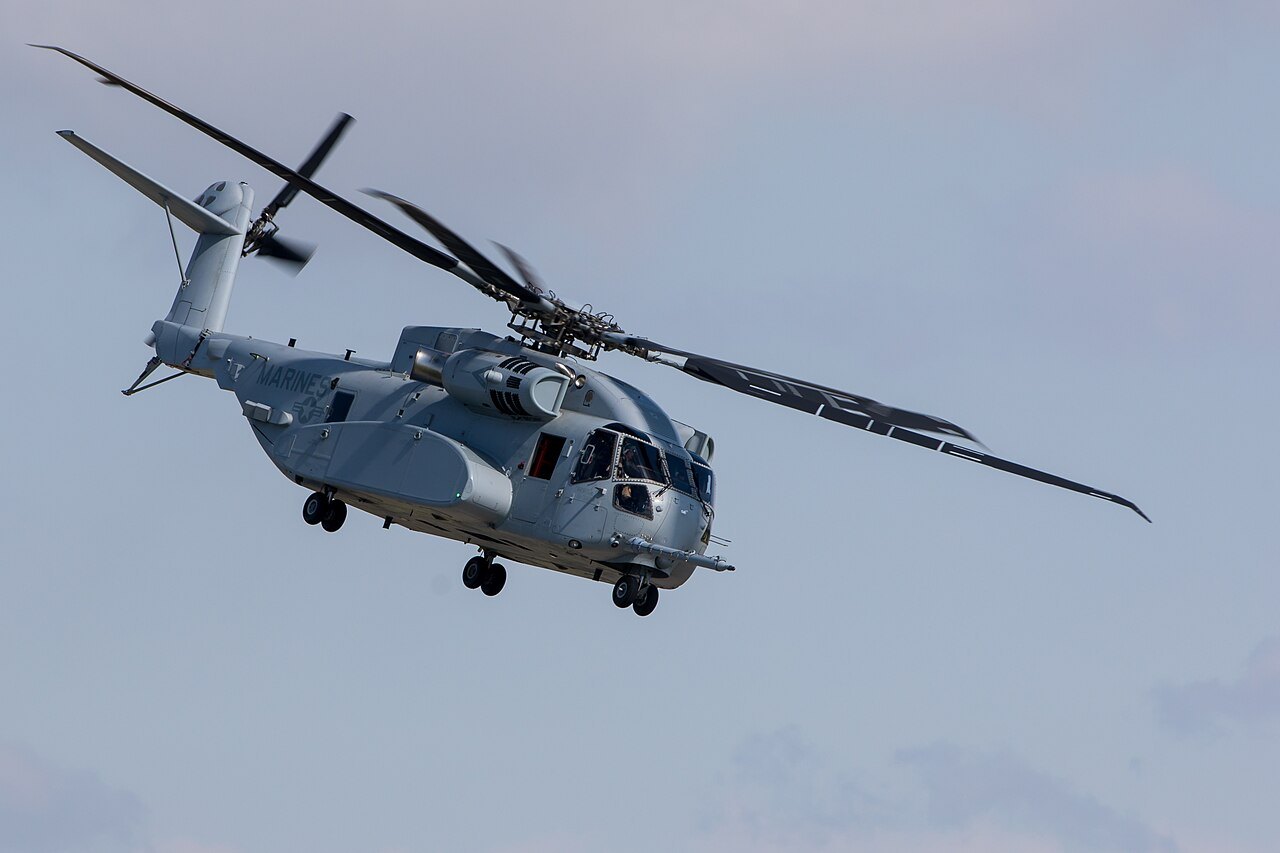
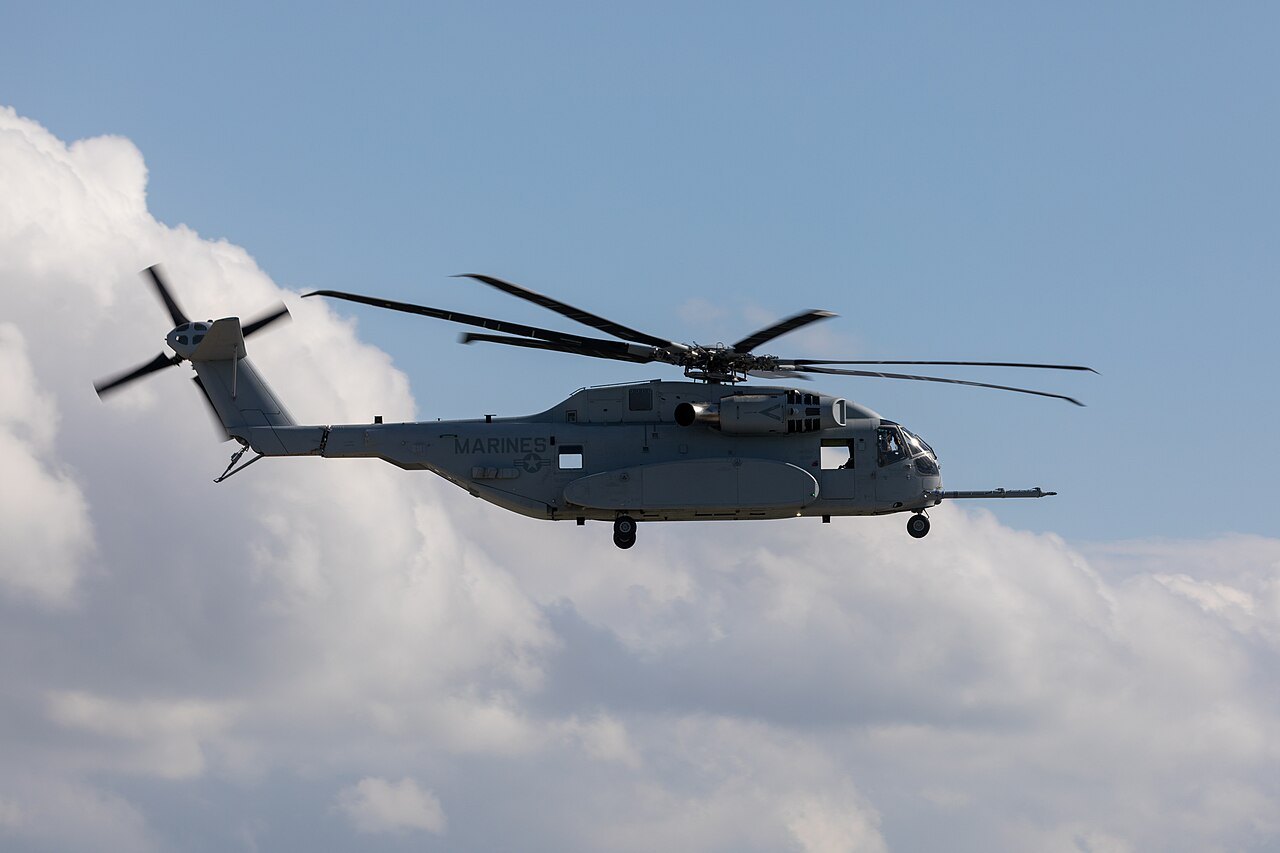
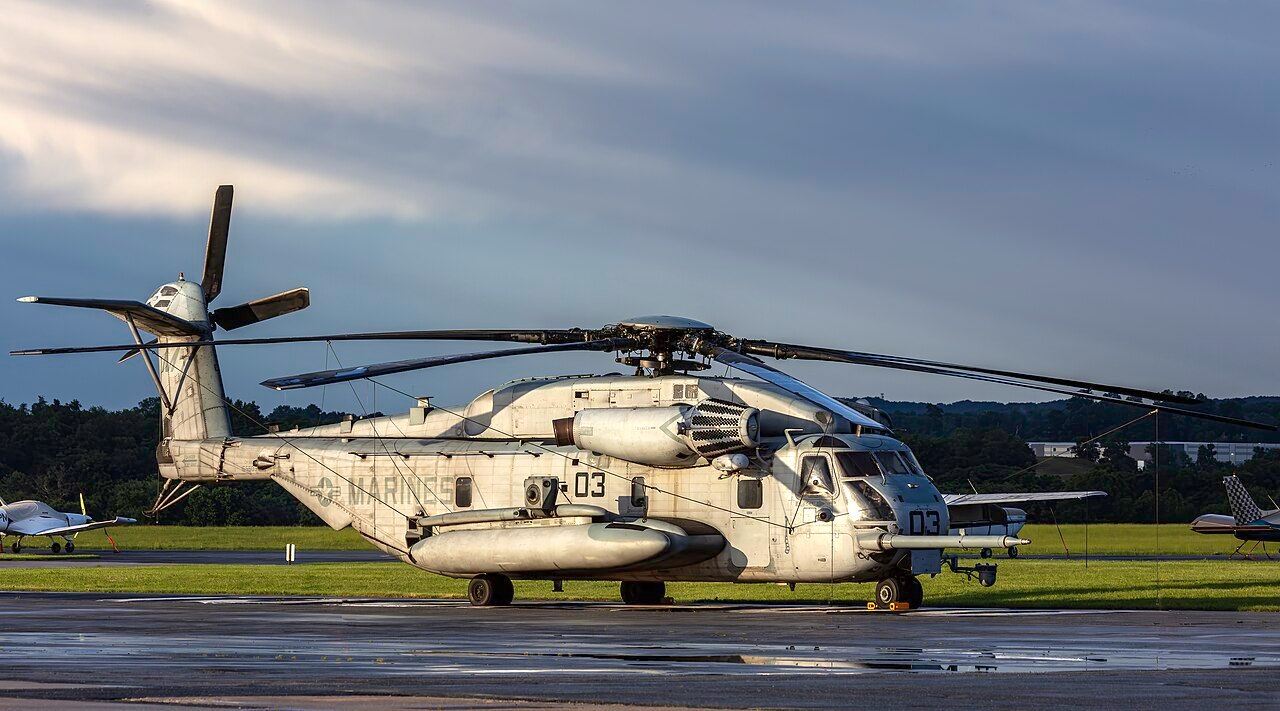
The CH-53 in pictures
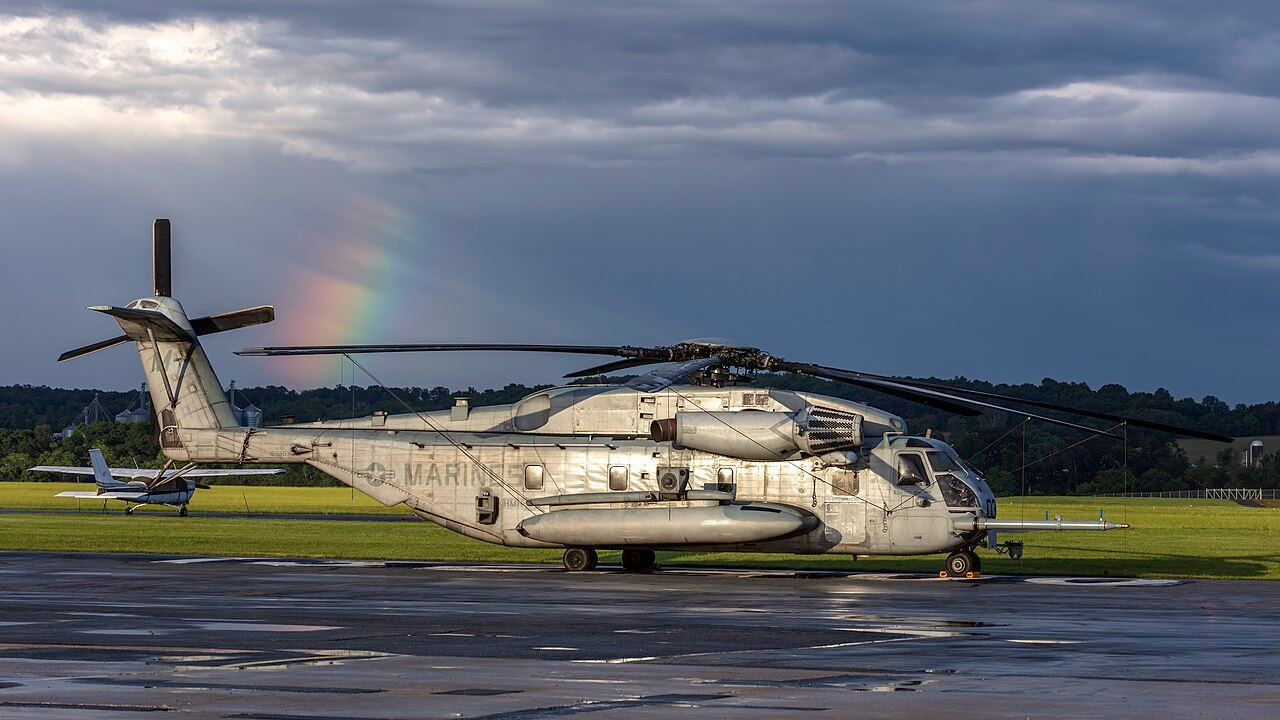
Where the CH-53 flies and flew
The CH-53’s record
CH-53s have flown in Vietnam, every Arab-Israeli conflict since 1969, Grenada, the Gulf, Somalia, the Balkans, Afghanistan and Iraq, mostly carrying troops, guns and supplies and recovering aircraft. The family’s record also includes some of the deadliest helicopter accidents in history, a consequence of its size and troop loads.
See how training and combat types compare in the military aircraft statistics database. Figures are approximate.
Everything people ask about the CH-53
Can I fly in a Sikorsky CH-53 Sea Stallion?
What is the difference between the Sea Stallion, Super Stallion and King Stallion?
When did the CH-53 first fly?
What is the MH-53E Sea Dragon?
How much can the CH-53K lift?
Which countries operate the CH-53?
Why is the Israeli CH-53 called Yas’ur?
You can’t fly the CH-53.
These, you can.
Most of this museum you can only look at. These genuine military jets you can fly yourself with MiGFlug — with aerobatics and time on the controls.
 Fly the L-39 AlbatrosThe world’s most-flown jet trainer — aerobatics included
 Fly the F-104 Starfighter“The missile with a man in it”
 Fly the MiG-21The Cold War’s most-produced jet
 Fly the T-33 Shooting StarAmerica’s first jet trainer
 Fly the DH VampireA piece of early jet history
 Fly the S.211Agile Italian jet trainer
 Fly the MB-326The classic Aermacchi jet
 Fly the MiG-15The Soviet legend of the Korean War
Continue the tour
Every fact, checked
- Sikorsky Unveils CH-53K Helicopter; U.S. Marine Corps Reveals Aircraft NameSikorsky/Lockheed Martin, May 2014: naming, payload, engines, rotor, digital design
- U.S. Navy Awards Sikorsky Contract to Build 35 CH-53K HelicoptersLockheed Martin, August 2023: contract value, Israel, full-rate production
- Sikorsky Delivers Two More CH-53K Helicopters to U.S. Marine CorpsLockheed Martin, February 2023: fleet at New River, crew quotes
- Marine Corps declares its heavy-lift helicopter operationalDefense News, April 2022: IOC, exhaust re-ingestion, MH-60S recovery
- Sikorsky awarded $2.7B contract for 35 CH-53K King StallionsBreaking Defense: Israeli FMS approvals, programme of record
- Boeing wins bid for Germany’s multibillion-dollar helo programDefense News, June 2022: Germany picks 60 CH-47F over CH-53K
- Israel faults relay switch, Lockheed for CH-53 fireVertical magazine: 2019 Yas’ur fire, spare-parts shortage, replacement contest
- Operation Rooster: Israel Captures Egyptian Radar in War of AttritionJewish Virtual Library account of Rooster 53, December 1969
- Hizbullah shoots down helicopter in southern LebanonYnet, August 2006: Yas’ur shoot-down during the Lebanon landing
- “Ugly Angels” deactivate after 60 years of serviceDVIDS: HMH-362 deactivation, last CH-53D missions
- Finally, the OspreyAir & Space Forces Magazine: RH-53 role at Desert One, 1980