
Curtiss P-6 Hawk
The US Army Air Corps’ premier biplane fighter of the early 1930s — and, in its elegant P-6E form with the “Snowy Owl” markings, one of the most beautiful American aircraft ever built.
The Story
The Curtiss P-6 Hawk: the beautiful hawk of the Air Corps
The Curtiss P-6 Hawk is one of the best-loved aircraft in American aviation history, and it earned that affection almost entirely on the ground and in the air-show circuit rather than in combat. The premier pursuit fighter of the United States Army Air Corps in the early 1930s, and especially in its definitive P-6E version, it is widely regarded as one of the most beautiful aircraft the United States ever built — a sleek, elegant biplane whose gorgeous squadron paint schemes have made it a perennial favourite of modellers, artists and restorers. It was a fine fighter for its brief moment, but it is remembered above all for its looks and its charm.
The Hawk was the culmination of a long Curtiss line. Through the 1920s the Curtiss company had built a celebrated family of “Hawk” pursuit biplanes for the Army and Navy, evolving from the PW-8 through the P-1 series and on to the P-6. Each was a refinement of the last, and by the time the P-6 appeared at the end of the decade, Curtiss had accumulated deep experience in building fast, agile pursuit biplanes. The P-6 was the peak of that tradition — the finest expression of the classic American open-cockpit fighter biplane.
Curtiss was, in these years, one of the two giants of American military aviation, and its pursuit biplanes were the products of a company at the height of its powers. The same firm had built the sleek Curtiss racers that won the Schneider Trophy and set speed records in the 1920s, and something of that racing pedigree carried into the Hawks. Speed, clean lines and a powerful in-line engine were Curtiss hallmarks, and the P-6 inherited all three.
“One of the most beautiful aircraft America ever built — the P-6E in its Snowy Owl markings is an icon of the biplane era.”— the P-6 Hawk’s place in history, in a sentence
What set the P-6 apart mechanically was its engine. Where many contemporaries used air-cooled radials, the Hawk was powered by the liquid-cooled Curtiss V-1570 Conqueror, a big, powerful V-12. A liquid-cooled engine allowed a slim, pointed nose, and in the later versions the adoption of Prestone — ethylene glycol — coolant permitted a much smaller, neater radiator, giving the aircraft an exceptionally clean and streamlined shape for a biplane. That sleek nose, combined with the trim lines of the airframe, is a large part of why the P-6E looks so good.
The liquid-cooled layout was a deliberate choice with real trade-offs. An in-line engine and its radiator were more vulnerable to battle damage than a rugged air-cooled radial — a hit to the cooling system could bring the aircraft down — and they demanded more maintenance. But in exchange they offered lower drag and higher speed, and in the pursuit role, where performance was everything, Curtiss judged the bargain worth making. It was the same reasoning that would later shape famous liquid-cooled fighters such as the Spitfire and the Bf 109.
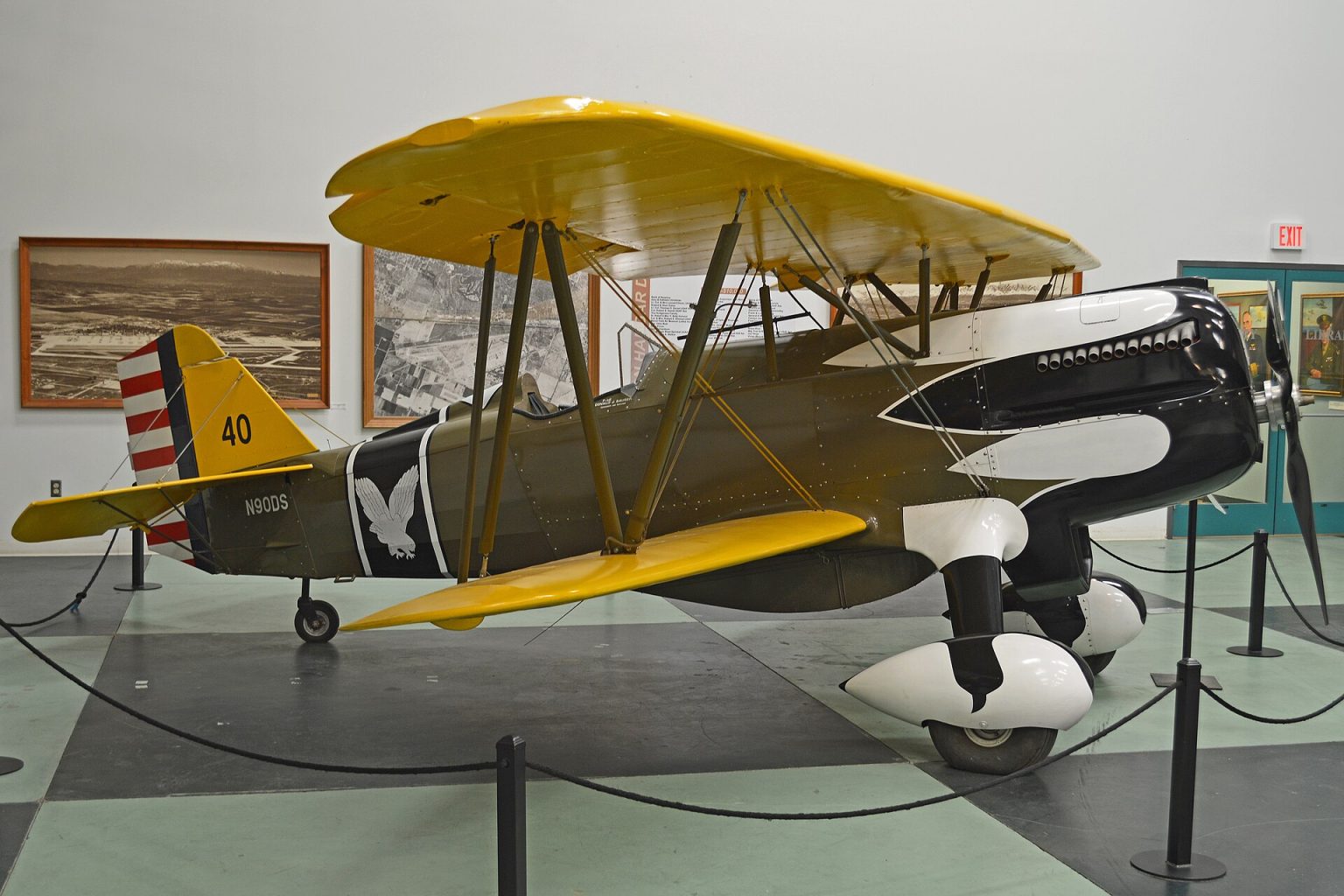
The definitive version, the P-6E of 1932, is the aircraft most people picture when they think of the Hawk. Refined, tidy and fast for its day, it featured neatly spatted wheels and a single-strut main undercarriage that added to its polished appearance. Only around forty-six P-6Es were built — a small number even by the standards of the cash-strapped interwar Air Corps — but those few aircraft made an outsized impression, and they remain the most celebrated American pursuit biplanes of all.
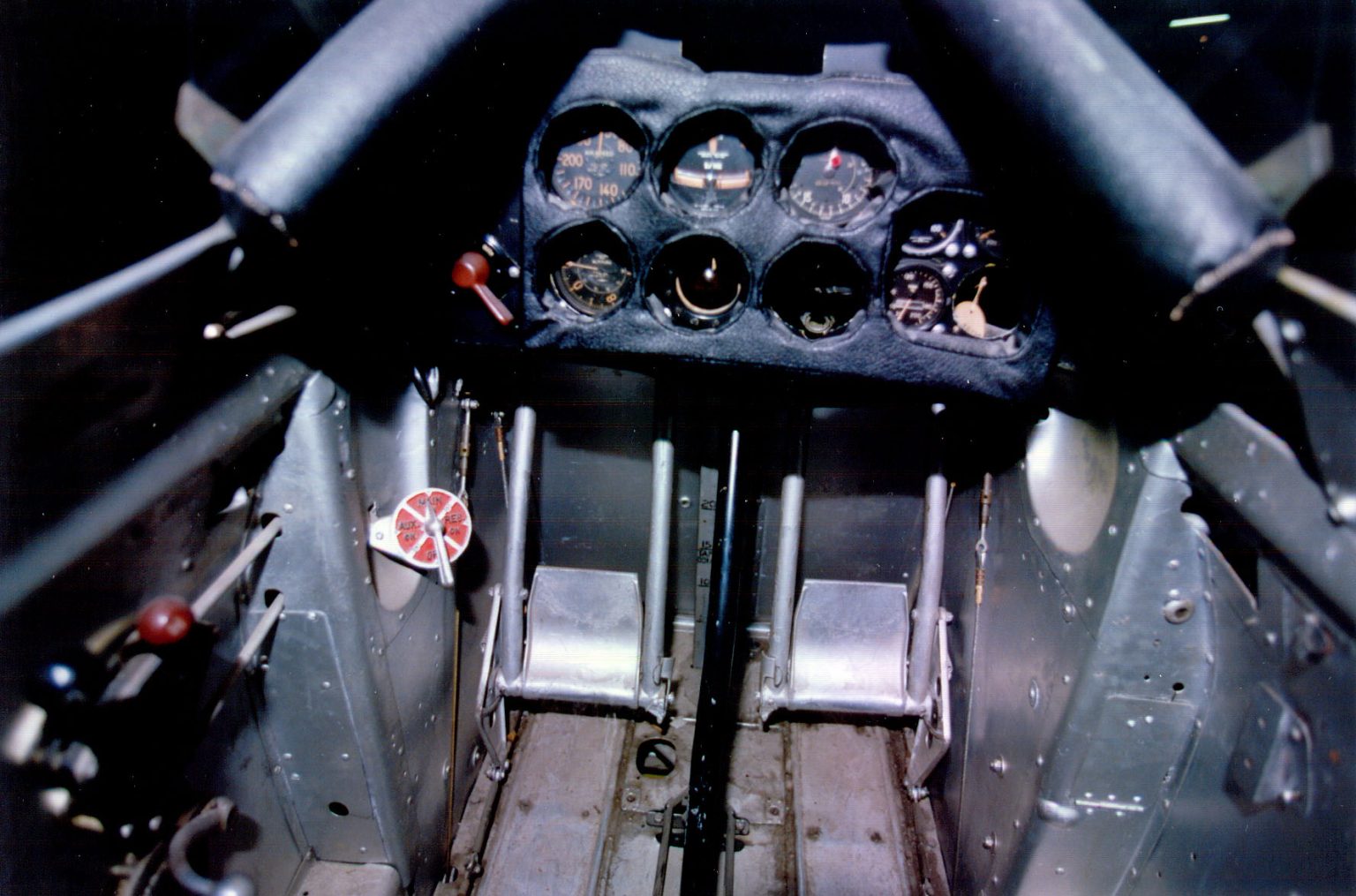
To fly, the P-6E belonged wholly to its era: an open cockpit, a big thundering V-12 ahead of the pilot, wind and noise and the smell of hot oil, and the immediate, responsive handling of a light biplane. Pilots sat high behind the guns with a superb view over the nose, and the aircraft rewarded a skilled hand with crisp aerobatics. It was, by all accounts, a delight to fly — part of why those who flew it, and those who merely watched it pass overhead, remember it so fondly.
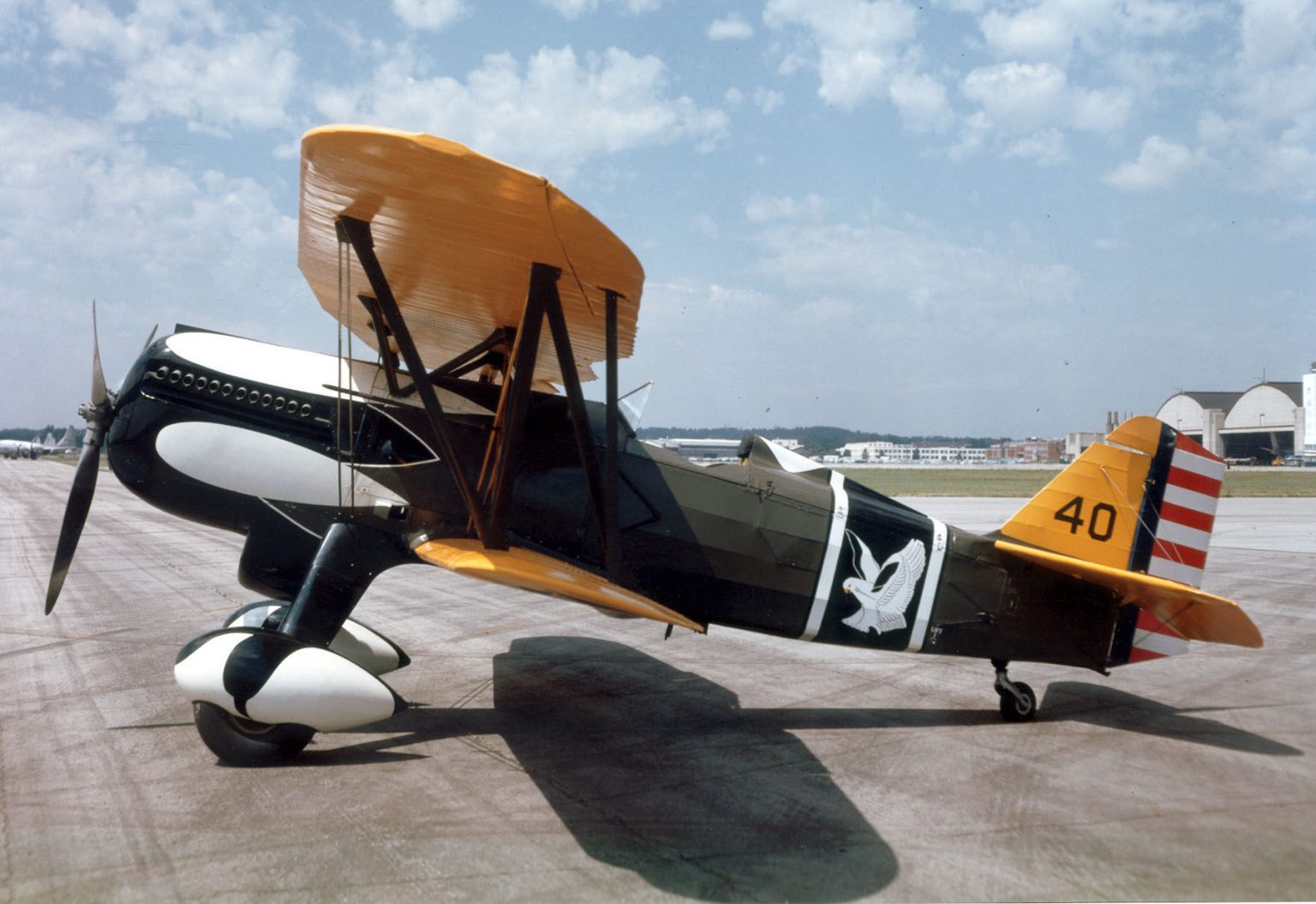
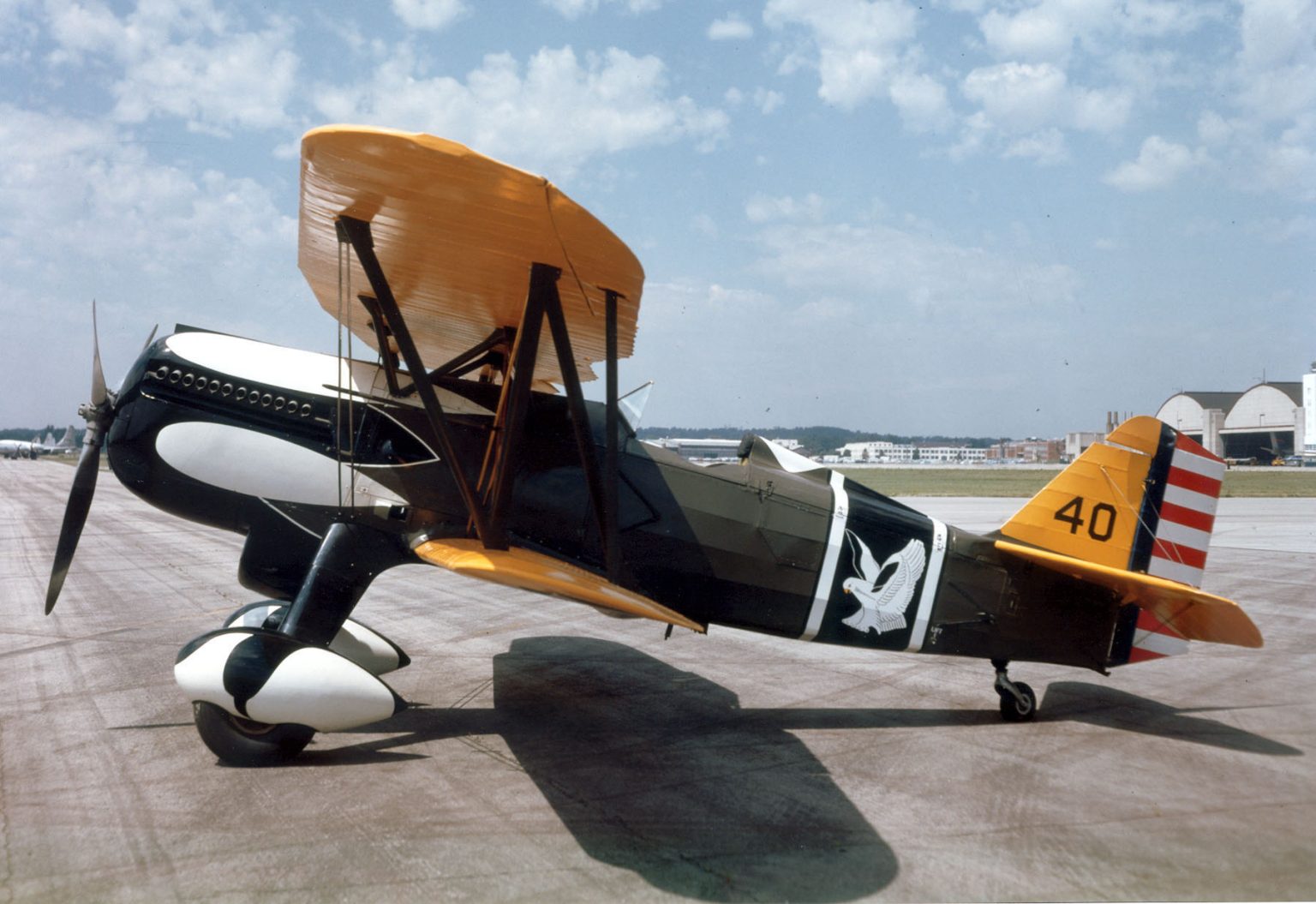
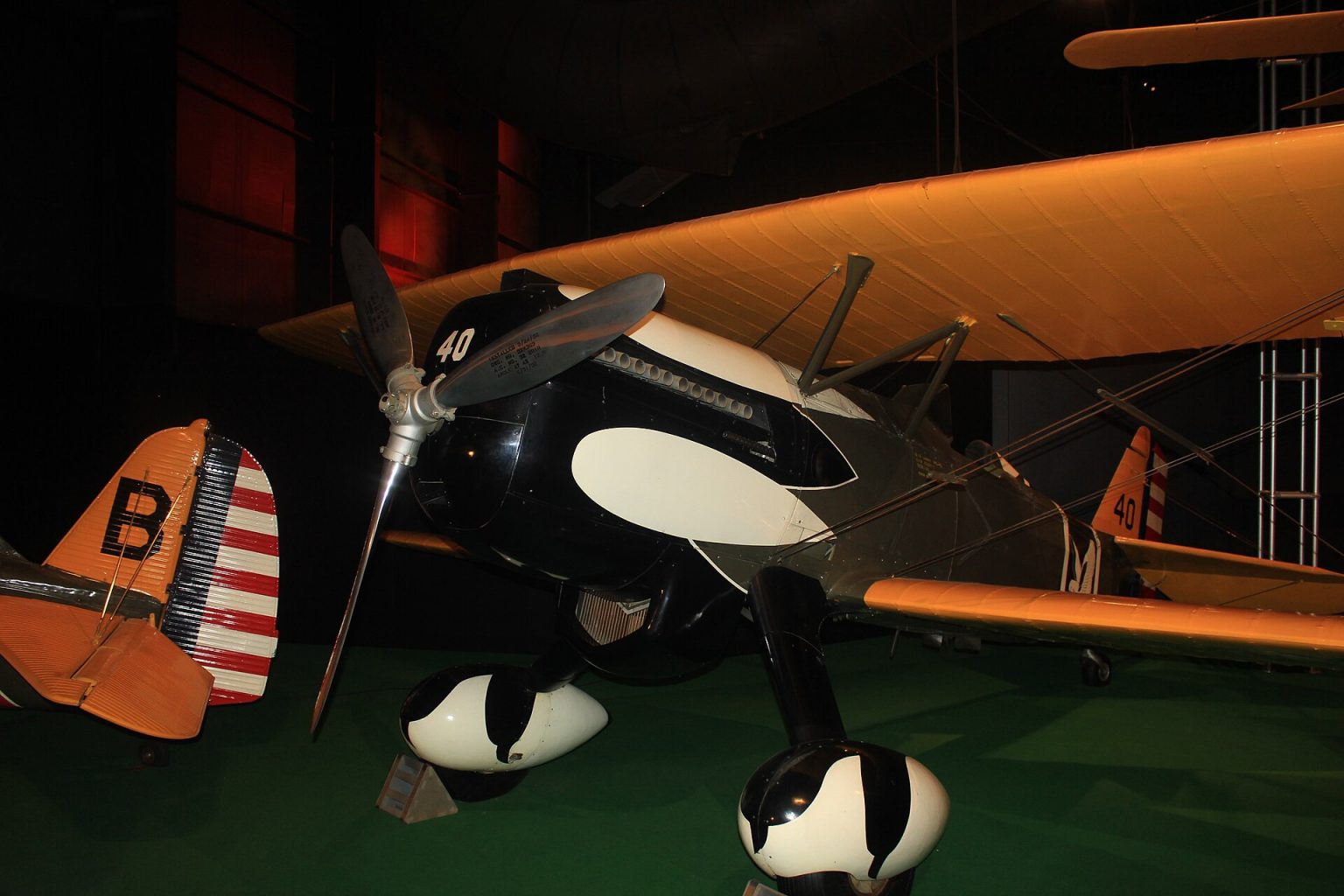
Much of the P-6E’s fame rests on its paint. The 17th Pursuit Squadron, part of the 1st Pursuit Group, adorned its P-6Es with a striking “Snowy Owl” scheme — an arctic-owl motif with bold markings that made the aircraft unforgettable. These beautifully decorated Hawks, photographed in the clear light of early-1930s America, became some of the most iconic images of the peacetime Air Corps, and they are a large part of why the type is so beloved today. Few aircraft have ever worn their markings so memorably.
As a fighter, the P-6E was genuinely competitive for its era. Its Conqueror engine gave it a good turn of speed — approaching two hundred miles per hour, respectable for an early-1930s pursuit — and the agility inherent in the biplane layout made it a fine dogfighter by the standards of the day. Armed with a pair of machine guns firing through the propeller, it was a capable interceptor for the kind of air defence the Army then envisaged. In the peaceful skies of interwar America, it was among the best pursuit aircraft the country had.
But the P-6E arrived at a moment of rapid change, and its front-line career was short. The all-metal monoplane was coming, and coming fast. Within a couple of years the Boeing P-26 Peashooter — a monoplane, if still an open-cockpit one with fixed gear — had entered service, and behind it came the far more modern Seversky P-35 and Curtiss’s own P-36, with their enclosed cockpits and retractable undercarriages. Against these, the fabric-and-wire P-6E was suddenly a generation out of date. The elegant Hawk was, like so many beautiful biplanes, overtaken almost as soon as it reached its peak.
The transition was not quite as abrupt as hindsight suggests. Through the early 1930s there was genuine debate about whether the monoplane’s higher speed was worth the loss of the biplane’s agility and short-field performance, and elegant biplanes like the P-6E had real defenders. But the arithmetic of speed, and the promise of the all-metal monoplane, proved decisive, and within a few years the argument was settled for good. The P-6E had the poignant distinction of being close to the best of a kind that was about to vanish.
Production was modest and exports were limited. The P-6E itself was an Army aircraft, built in small numbers, and while Curtiss sold export versions of its broader Hawk family to a number of countries, the P-6E as such saw little foreign service; a small number of Hawks went abroad, including to the Netherlands. This was not an aircraft produced in the thousands or spread across the world’s air forces — it was a small, jewel-like type that served a single air arm, briefly, at the very end of the pursuit-biplane era.
There is an irony worth noting here. While the P-6E itself stayed almost entirely at home, Curtiss’s wider Hawk family enjoyed considerable export success: dedicated Hawk export models were sold to air forces across the world, from Latin America to Asia, and some of those saw far more combat abroad than the P-6E ever did in American service. The P-6E was the beautiful domestic flagship of a line whose plainer export cousins travelled much further, and fought much harder.
Nor did the P-6E see significant combat. It served in the peaceful interwar years, and by the time the United States entered the Second World War the type had long since been retired from front-line duty. Its career was one of peacetime patrols, exercises, air races and displays rather than battle — which makes its enduring fame all the more remarkable. The P-6E is celebrated not for what it did in war, but for what it was: a superbly elegant machine that marked the high point, and the graceful close, of the American fighter biplane.
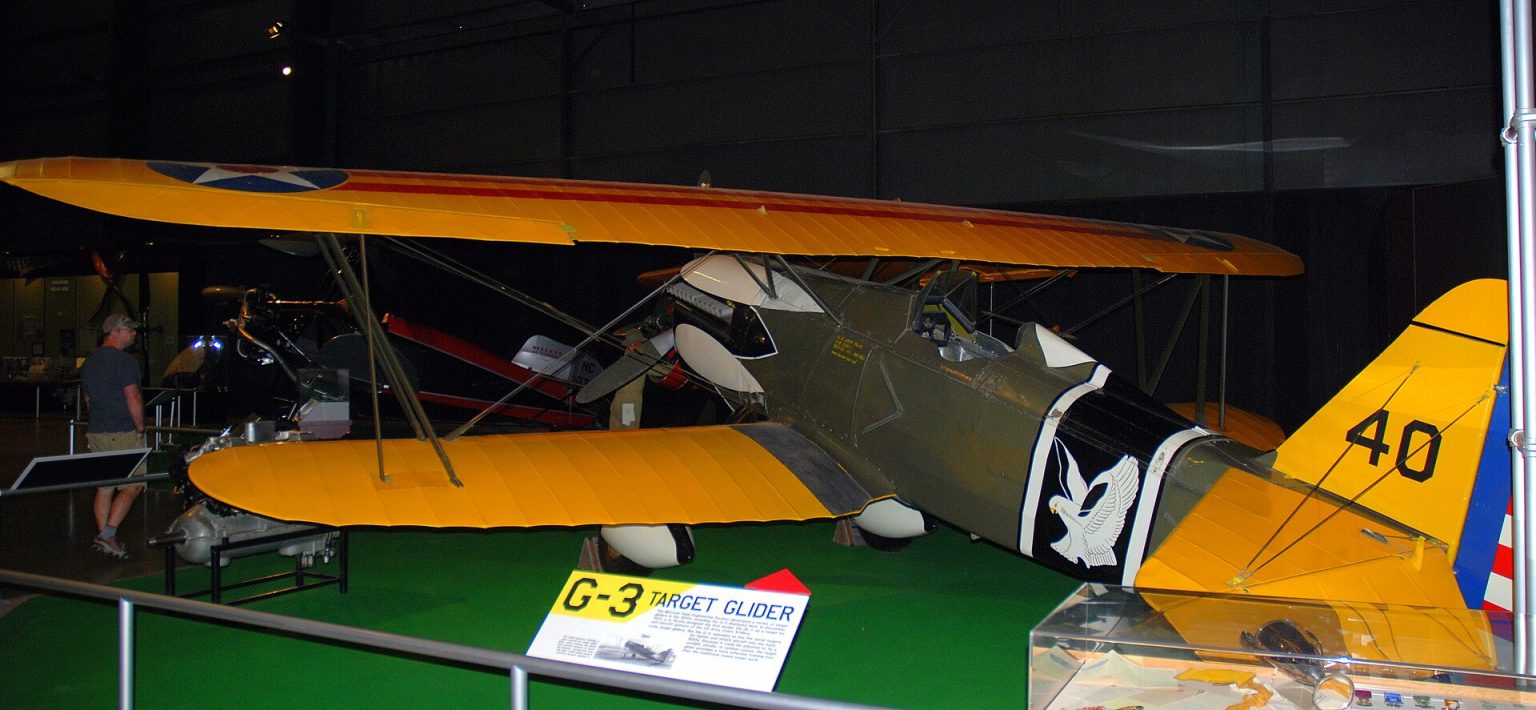
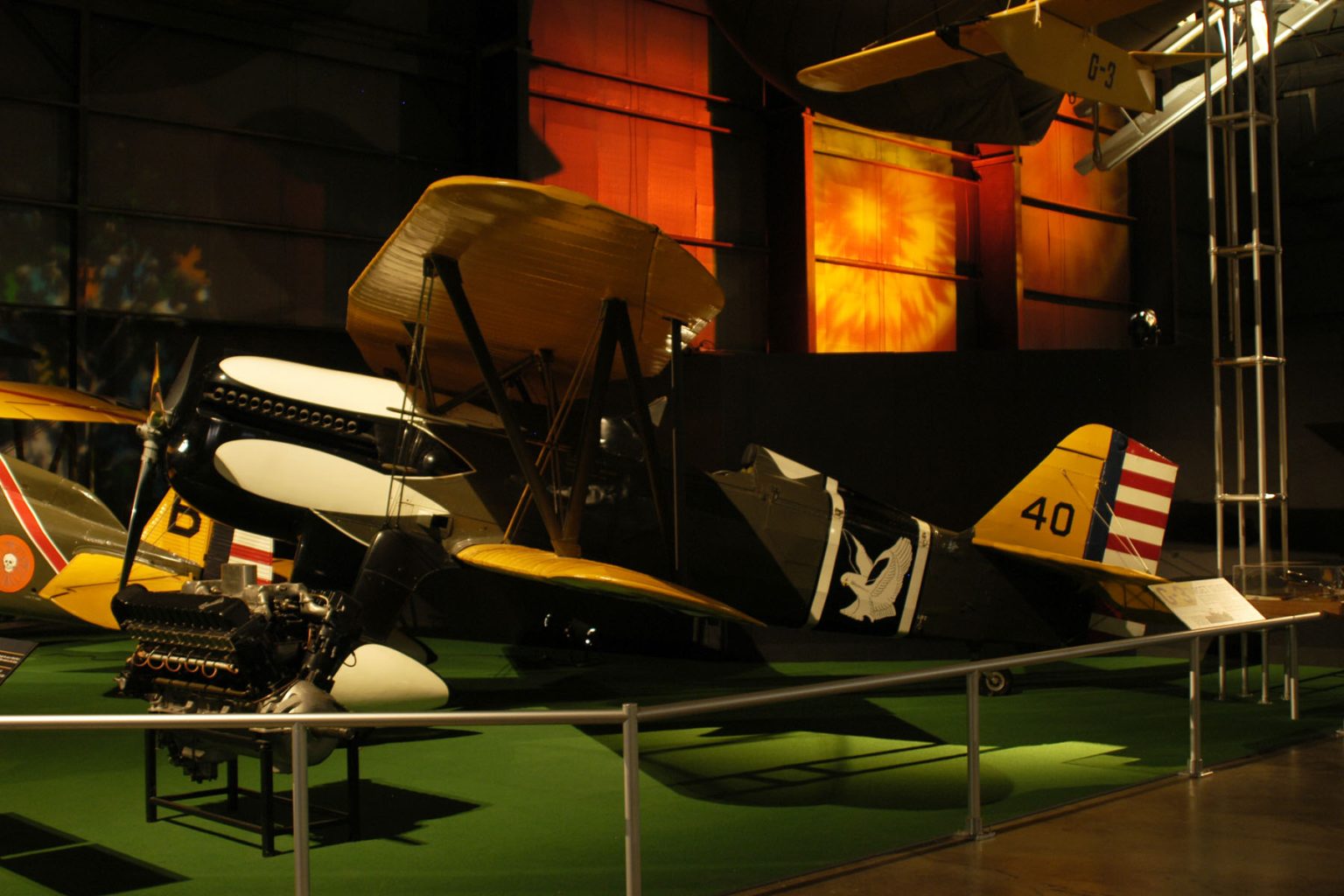
Today the Hawk lives on through preservation. A genuine P-6E, restored in the glorious Snowy Owl markings of the 17th Pursuit Squadron, is a highlight of the National Museum of the United States Air Force, and the type is a favourite subject for scale modellers and replica builders the world over. For an aircraft built in such small numbers and gone from the front line so quickly, the Curtiss P-6 Hawk has achieved a rare and lasting immortality — earned, fittingly, by sheer beauty.
01The Curtiss Hawk lineage: from PW-8 to P-6+
The P-6 was the last and finest of a long line of Curtiss “Hawk” pursuit biplanes. The family began in the early 1920s with the PW-8, evolved through the successful P-1 Hawk series, and was refined step by step across the decade. Each new model improved on the aerodynamics, structure and engine installation of the one before.
By the time the P-6 appeared at the end of the 1920s, Curtiss had become the pre-eminent American builder of pursuit biplanes, with deep experience in the type. The P-6 represented the peak of that accumulated craft — the most polished version of a design philosophy Curtiss had been perfecting for years. It was, in a sense, the classic American fighter biplane brought to its highest point.
02The Curtiss V-1570 Conqueror engine+
The Hawk’s defining feature was its powerplant: the liquid-cooled Curtiss V-1570 Conqueror, a large and powerful V-12. At a time when many fighters used air-cooled radial engines, the choice of a liquid-cooled inline gave the P-6 a distinctive character and, crucially, a very different shape.
The Conqueror was one of the more powerful American engines of its day, and it gave the Hawk the performance to be genuinely competitive as a pursuit fighter. Just as importantly, a liquid-cooled V-12 could be faired into a slim, pointed nose, rather than the broad blunt cowling of a radial — the first ingredient in the P-6E’s famously sleek appearance.
03Prestone cooling and the sleek pointed nose+
A key refinement in the later Hawks was the switch to Prestone — ethylene glycol — as the engine coolant. Because glycol works at a higher temperature than water, it allowed a much smaller radiator to shed the same heat, which in turn let designers give the aircraft a neater, more streamlined nose and cooling installation.
The visual result was striking. The P-6E’s slim, pointed nose, clean cowling and tidy radiator gave it an elegance that few biplanes could match. This was aerodynamic refinement in the service of both speed and beauty: the same features that reduced drag also made the aircraft look fast even standing still. It is one of the reasons the P-6E is so often called the most handsome of the American pursuit biplanes.
04The P-6E: the definitive Hawk+
Of all the Hawk variants, the P-6E of 1932 is the definitive and best-remembered version. It brought together the refinements of the line — the Conqueror engine, the streamlined nose, and a clean airframe with neatly spatted wheels and a tidy single-strut main undercarriage — into an exceptionally polished whole.
Only around forty-six P-6Es were built, a small run that reflected the tight budgets of the interwar Army Air Corps. Yet these few aircraft became the most famous American fighter biplanes of all. The P-6E is the aircraft enthusiasts picture when they think of the Hawk, and its combination of elegant design and gorgeous markings has kept it firmly in the affections of aviation lovers ever since.
05The “Snowy Owls” of the 17th Pursuit Squadron+
The most famous P-6Es of all wore the markings of the 17th Pursuit Squadron, which decorated its Hawks with a spectacular “Snowy Owl” scheme. The motif drew on the squadron’s arctic-owl emblem, and the resulting aircraft — boldly marked, immaculately turned out — were among the most beautiful military aircraft of their era.
These decorated Hawks became icons. Photographed in the clear skies of early-1930s America, the Snowy Owl P-6Es captured the romance of the peacetime Air Corps at its most elegant, and they have been reproduced in paintings, models and restorations ever since. For many enthusiasts, the Snowy Owl scheme is inseparable from the P-6E itself — the markings and the machine remembered as one.
06The 1st Pursuit Group and the Air Corps’ showpiece+
The P-6E equipped units of the 1st Pursuit Group, one of the Army Air Corps’ premier fighter formations, and the elegant Hawks became something of a showpiece for the peacetime air arm. Beautifully maintained and strikingly painted, they represented the Air Corps at its most polished in an era when military aviation was a source of great public fascination.
In the interwar years, before wartime necessity swept such things aside, air forces took real pride in the appearance of their aircraft, and squadrons competed in the flamboyance of their markings. The P-6E, as the front-line pursuit of a prestige group, was a natural canvas for this, and its role as a peacetime showpiece is a big part of why it left so strong an impression.
07Why the P-6E is beloved by modellers and restorers+
Few aircraft are as cherished by the modelling and restoration communities as the P-6E, and the reasons are easy to see. Its elegant lines make it a rewarding subject to build or restore, and its spectacular squadron markings — the Snowy Owl scheme above all — offer a chance to reproduce some of the most beautiful paintwork in aviation history. A well-finished P-6E model or restoration is a genuine showpiece.
The type’s modest production and short career, paradoxically, add to its appeal: it is exotic, a little rare, and strongly associated with a romantic, golden age of open-cockpit flying. For enthusiasts drawn to the beauty of the biplane era rather than the grim business of war, the P-6E is close to the ideal subject — and its popularity in kit form and at air shows keeps its fame very much alive.
08Speed and performance for its era+
The P-6E was more than just a pretty aeroplane; it was a genuinely capable fighter for the early 1930s. Its Conqueror V-12 gave it a top speed approaching two hundred miles per hour, which was competitive with the best pursuit aircraft of its day, and the aircraft climbed and manoeuvred well.
The biplane layout, for all that it was about to be superseded, still offered excellent agility, and in a close-in dogfight of the period the Hawk could hold its own. Its performance was well matched to the air-defence role the Army then envisaged — intercepting intruders and winning the turning fight. It was, briefly, about as good a pursuit biplane as existed anywhere.
09The pursuit role in the interwar Air Corps+
In the terminology of the day, the P-6 was a “pursuit” aircraft — the American term for a fighter — and its job was air defence: intercepting and destroying enemy aircraft. In the interwar Army Air Corps, pursuit aviation was one of the central missions, and the P-6E was the front-line pursuit type of the early 1930s.
This was, however, a peacetime role in practice. The Air Corps of the era was small and underfunded, and its pursuits spent their time on training, exercises, manoeuvres and the occasional air race rather than combat. The P-6E was the sharp end of American fighter aviation in those quiet years — a capable interceptor kept in readiness for a war that, in its service life, never came.
10The transition to monoplanes+
The P-6E’s front-line reign was brief because it coincided with one of the fastest transitions in fighter history: the shift from the biplane to the all-metal monoplane. Even as the Hawk entered service, the future was arriving. The Boeing P-26 Peashooter — a monoplane, though still with an open cockpit and fixed landing gear — reached the Air Corps in the mid-1930s.
Close behind came the truly modern types: the Seversky P-35 and Curtiss’s own P-36, with enclosed cockpits, retractable undercarriages and far higher performance. Against these, the fabric-covered, wire-braced P-6E was obsolete almost overnight. The Hawk had the misfortune, shared by many fine biplanes, of reaching perfection just as the rules of the game changed entirely.
11Modest production and limited exports+
The P-6E was never a numerous aircraft. Only around forty-six were built, a small run reflecting the tight budgets of the Depression-era Army Air Corps, which could rarely afford large orders of any type. It was a select, front-line fighter for a small air arm rather than a mass-produced workhorse.
Exports of the P-6E specifically were limited, though Curtiss did sell versions of its wider Hawk family abroad to several countries, and a small number of Hawks went to foreign operators including the Netherlands. But the P-6E as such remained overwhelmingly a US Army aircraft. Its fame, clearly, rests on quality and beauty rather than on quantity or wide service — a reminder that an aircraft’s place in history is not measured only in numbers.
12Little combat: an honest note+
It is important to be honest about the P-6E’s record: it saw little or no significant combat. It served in the peaceful interwar years and was retired from front-line duty well before the United States entered the Second World War, by which time far more modern fighters had taken over. Its career was one of patrols, exercises, races and displays, not battle.
This does nothing to diminish the aircraft — but it does shape how it should be remembered. The P-6E is celebrated as a beautiful and capable pursuit biplane of its moment, not as a combat legend. Its importance is aesthetic and historical: it marks the elegant high-water mark of the American fighter biplane, just before the monoplane revolution swept the type away. To claim more for it would be to misrepresent a genuinely lovely, but genuinely short-lived, aircraft.
13Survivors and the famous restoration+
Given how few were built and how long ago it served, it is remarkable that the P-6E survives at all — but it does. A genuine P-6E, beautifully restored in the Snowy Owl markings of the 17th Pursuit Squadron, is a treasured exhibit at the National Museum of the United States Air Force, letting visitors see this icon of the biplane era in all its glory.
Beyond the original, the P-6E lives on in replicas and in countless scale models, its elegant shape and gorgeous markings ensuring it is never forgotten. For a small, short-lived interwar fighter, the Hawk has achieved a rare immortality — preserved, modelled and admired as one of the most beautiful aircraft the United States ever produced.
Design & Engineering
How the P-6 Hawk was built: elegance in an open-cockpit biplane
The Hawk took the classic American pursuit biplane to its peak — a liquid-cooled V-12, a streamlined pointed nose and beautifully clean lines, at the very end of the biplane era.
Conqueror V-12 power
The liquid-cooled Curtiss V-1570 Conqueror gave the Hawk both competitive performance and, unlike a radial, a slim pointed nose.
Streamlined by Prestone
Glycol coolant allowed a smaller radiator and a neater nose, giving the P-6E its famously clean, elegant lines — fast-looking even at rest.
The classic pursuit biplane
An open cockpit, spatted wheels, a single-strut undercarriage and two synchronised guns — the American fighter biplane at its polished peak.
Specifications
Curtiss P-6E Hawk specifications: dimensions, performance and cost
Baseline: the P-6E of 1931—32, the mark the Army Air Corps bought in quantity — 46 aircraft, the largest single Conqueror Hawk order — and the one every published table and every photograph describes. Deltas for the water-cooled P-6 of 1929, the Prestone-cooled P-6A, the turbo-supercharged P-6D and the experimental XP-6F and XP-23 are in grey. Figures are for a clean aircraft at normal loaded weight with the wheel spats fitted; squadrons frequently removed the spats for grass and mud work, which cost a few miles an hour.
Dimensions & weights
- Crew
- 1, in an open cockpit
- Wingspan
- 9.60 m (31 ft 6 in), upper plane; single-bay unequal-span biplane with N-struts and wire bracing, the lower plane appreciably shorter
- Length
- 6.88 m (22 ft 7 in)
- Height
- 2.72 m (8 ft 11 in)
- Wing area
- 23.41 m² (252 sq ft), Clark Y aerofoil on both planes
- Empty weight
- 1,232 kg (2,715 lb) P-6 (1929): 1,111 kg (2,450 lb); P-6A: 1,084 kg (2,389 lb); XP-6B: 1,224 kg (2,698 lb)
- Loaded weight
- 1,559 kg (3,436 lb) P-6: 1,501 kg (3,310 lb); P-6A: 1,439 kg (3,172 lb); the four-gun XP-6H rose to 1,750 kg (3,858 lb)
- Weight growth
- the P-6E is 120 kg (265 lb) heavier loaded than the P-6A that preceded it, on 100 hp more. That trade is the whole story of the mark: it bought speed and lost height
- Wing loading
- 66.6 kg/m² (13.6 lb/sq ft) — high for a 1931 biplane, and the reason the P-6E landed faster than the Boeing P-12 it flew alongside
- Power loading
- 2.23 kg/hp (4.9 lb/hp)
- Fuselage
- welded steel-tube truss, metal panelled forward around the engine and coolant plumbing, fabric covered aft the XP-23 of 1932 replaced this with a light-alloy monocoque and was the only Hawk built that way
- Wings and tail
- two wooden spars with wooden ribs, fabric covered, throughout the family. Curtiss never delivered a metal wing on a P-6
- Undercarriage
- the P-6E signature: one cantilever oleo leg per side in place of the earlier cross-braced Vee, faired into teardrop wheel spats, with a tailwheel instead of the tailskid earlier marks used P-6 and P-6A: divided cross-braced gear on oleo-and-spring legs, tailskid
Performance
- Maximum speed
- 311 km/h (193 mph) at sea level P-6 (1929): 286 km/h (178 mph); P-6A: 283 km/h (176 mph) at 1,525 m; XP-6B: 317 km/h (197 mph) at 4,570 m; XP-6F: 362 km/h (225 mph) at 4,570 m
- Cruising speed
- 266 km/h (165 mph)
- Rate of climb
- 756 m/min (2,480 ft/min) initial P-6A: 582 m/min (1,910 ft/min); XP-6B: 527 m/min (1,730 ft/min)
- Climb, period measure
- Air Corps data sheets of this generation quoted time to a stated height rather than a rate. No time-to-height figure for the P-6E is consistently published; the rate above is the number that has come down to us and it is a sea-level rate, which flatters a normally aspirated engine
- Service ceiling
- 7,285 m (23,900 ft) P-6: 8,290 m (27,200 ft); P-6A: 8,320 m (27,300 ft); XP-6B: 9,750 m (32,000 ft)
- The ceiling problem
- the definitive mark had the worst altitude performance in the family. The unsupercharged V-1570-23 ran out of air about 1,000 m lower than the lighter P-6A did, which is why the Army kept experimenting with turbo-superchargers on P-6D, XP-6F and XP-23 airframes
- Range
- 393 km (244 miles) — derisory, and the type's worst single figure P-6 (1929): 418 km (260 miles)
- Endurance
- about 1 h 30 min derived from the published range at cruising speed; no independent endurance figure is quoted. A P-6E could not fly from Selfridge Field to Chicago and back
- Racing pedigree
- the XP-6A won the 1927 National Air Races at 323 km/h (201 mph) with the XP-6 second — a Curtiss one-two that sold the Conqueror installation to the Army before a service Hawk existed
- The 1932 dash
- Captain Ruben C. Moffat flew a supercharged Conqueror Hawk from Dayton to Washington at about 428 km/h (266 mph) at 7,620 m (25,000 ft) that is a ground speed with the winter jet stream behind him, not a true airspeed; no Conqueror Hawk ever flew at 266 mph through the air
- Against what came next
- the Martin B-10 bomber of 1934 reached 343 km/h (213 mph) and the Boeing P-26A monoplane 377 km/h (234 mph). The P-6E could not catch the first and was 66 km/h slower than the second, which is why its front-line life lasted barely two years
- Take-off and landing
- no published take-off run. Contemporary pilots rated the P-6E delightful in the air and unforgiving on the ground: heavier wing loading, a narrow single-leg undercarriage and a tailwheel that steered less predictably than a skid on grass
Propulsion & systems
- Engine
- one Curtiss V-1570-23 Conqueror — 60° V-12, liquid cooled, 25.72 litres (1,570 cu in), the direct descendant of the Curtiss D-12 that had powered the P-1 Hawk and the Schneider racers
- Rated power
- 522 kW (700 hp) Wikipedia's specification table names a "Curtiss V-1750C". No such engine exists; it is the V-1570 Conqueror, and the error has propagated widely
- Engines in the other marks
- P-6 (1929): V-1570-17, water cooled, 447 kW (600 hp). P-6A: V-1570-23, Prestone cooled. P-6D: turbo-supercharged V-1570-C. XP-6F: turbo-supercharged V-1570F, later a 578 kW (775 hp) V-1570-55. XP-23: geared and turbo-supercharged G1V-1570-C driving a left-handed airscrew
- Coolant
- Prestone — ethylene glycol, which boils at 197°C against water's 100°C. Running the coolant far hotter meant far less of it and far less radiator: about a third off the radiator area and roughly 23 kg (50 lb) off the aeroplane, for free
- Why the coolant mattered
- a liquid-cooled V-12 only beats a radial if its radiator drag is small enough to pay back the extra weight and plumbing. Prestone is what made that arithmetic work, and the Army adopted it as standard from the P-6A onwards; every later American liquid-cooled fighter engine, the Allison V-1710 and the Packard Merlin included, used glycol on the strength of it the cost was fire risk — glycol burns, water does not, and a punctured system over hostile ground was a worse proposition than a holed water jacket
- Radiator installation
- a compact tunnel radiator slung low under the nose between the undercarriage legs, moved well forward compared with earlier marks. The arrangement came directly from the XP-22 radiator trials of 1931 and is, with the single-leg gear, what gives the P-6E its shape
- Propeller
- metal, ground-adjustable pitch standard specification tables give a three-blade unit for the P-6E; three blades are firmly documented on the turbo-supercharged P-6D and on the XP-23, whose propeller turned left-handed
- Gun installation
- two guns in the upper forward fuselage decking, breeches inside the cockpit within the pilot's reach for clearing stoppages, firing through the propeller disc
- Synchronising gear
- the Nelson gear, developed by Adolph L. Nelson at McCook Field and the US Army standard from the early 1920s: the firing impulse travelled along a cable held in tension rather than through push rods, and the E-4 model of 1929 enclosed that cable in a metal tube. Attributed here as the Army-standard installation of the period rather than from a P-6-specific citation
- Sight
- ring-and-bead, with a tubular telescopic sight on most aircraft. No reflector sight existed in Air Corps service on this type
- Fuel
- about 189 litres (~50 US gal) internal inferred from the closely related F11C-2, which carried 50 US gal against the 94 US gal of the export Hawk II; the P-6E's 244-mile range is consistent with it, but the figure is not independently attested
- Production
- about 67 new-build Conqueror Hawks for the US Army: 18 on the October 1928 P-6 contract, 3 on the P-11 contract of 1929, and 46 P-6Es ordered on 8 July 1931. Every other P-6 designation — XP-6, XP-6A, XP-6B, P-6D, XP-6E, XP-6F, XP-6G, XP-6H, YP-20, XP-22, XP-23 — is a conversion of an existing airframe, not an additional aeroplane
14The P-6 family and its variants+
The P-6 designation covered a family of related Hawk pursuit biplanes rather than a single model. Early P-6 and P-6A aircraft led to further sub-variants with detail differences in engine, cooling and equipment, and the line culminated in the definitive P-6E of 1932. Numbers of each were small, in keeping with the tight interwar budgets.
The P-6E is the version that matters most for the type’s fame, but it sat within a broader Curtiss Hawk story that also included export models sold abroad under various Hawk designations. For the purposes of this profile, the P-6E — the elegant, Snowy-Owl-marked Army pursuit — is the aircraft the world remembers, and the one this page is chiefly about.
15The Curtiss P-6’s cost: what the records show+
As with almost all interwar military aircraft, there is no reliable, transparent public figure for the P-6E’s unit cost, cost per flight hour or total programme cost. It was procured in small batches through US Army contracts during a period of very tight defence budgets, and consistent lifetime cost data for so small and short-lived a type simply does not exist in a usable form.
Rather than repeat an invented number, we list the cost fields here as “not reliably recorded.” What can be said is that the Depression-era Army Air Corps could afford only small orders of any pursuit type, which is precisely why so few P-6Es — around forty-six — were built, however admired the aircraft was.
16The P-6E among interwar fighters+
The P-6E belongs to the last generation of front-line fighter biplanes, alongside contemporaries such as Britain’s Hawker Fury and, a little later, types like the Fiat CR.32 and Avia B-534. Like the elegant Fury, the P-6E is remembered as much for its beauty and its polish as for its combat record — both were peacetime showpieces of their respective air forces.
What all these aircraft share is timing: they represented the pursuit biplane at its finest just as the monoplane was about to render the whole category obsolete. The P-6E is the American entry in that gallery of lovely, doomed biplanes — arguably the most beautiful of them all, and certainly the most iconic American example.
17Seeing a P-6E today+
The place to see a genuine P-6E is the National Museum of the United States Air Force in Ohio, whose beautifully restored example wears the celebrated Snowy Owl markings of the 17th Pursuit Squadron. It is one of the museum’s most admired exhibits, and for many visitors it is the highlight of the interwar collection.
Beyond the original, the P-6E is kept alive through replicas and through its enduring popularity as a subject for scale modellers. For an aircraft built in such small numbers and retired so long ago, it is unusually accessible to enthusiasts — a testament to the affection in which this most elegant of American biplanes is still held.
Armament & payload
The P-6E was the prettiest fighter in the Air Corps and carried the weakest armament in it
Two rifle-calibre Brownings above the engine, synchronised to fire through the propeller. That is the entire offensive fit of the most advanced Curtiss biplane fighter the US Army ever bought, and by 1932 it was already thin: the Boeing P-12 flying beside it could be fitted with a half-inch Browning in place of one .30, and no P-6E is documented as carrying one. The Hawk had no bomb racks in Army service either — it was a pure pursuit machine at the exact moment American doctrine was discovering that pursuit machines also had to attack things.
The irony is that the same airframe grew a serious weapons fit the moment the Navy got hold of it. Curtiss put the P-6E fuselage together with XP-23 wings and a Wright Cyclone radial to make the XF11C-1; the production F11C-2 became the BFC-2 bomber-fighter, with a 215 kg bomb on a swinging crutch under the belly. The export Hawk II sold on that capability all over the world. The Army version, the beautiful one, kept its two .30s to the end. Gun and ammunition fits varied between squadrons and are poorly documented for this type; export Hawks carried different guns, different sights and, in Chinese and Colombian service, different stores again.
Gun
- Two .30 in (7.62 mm) Browning M1919 aircraft machine guns in the upper forward fuselage, synchronised to fire through the propeller disc
- That fit is quoted identically for the P-6, the P-6A and the P-6E across every source consulted — the type never received a heavier gun in Air Corps squadron service
- The brief for this page called the armament "two synchronised .30 or .50 Browning guns". The .50 substitution is well documented on the P-1 and Boeing P-12 families of the same years; it is not attested on a P-6E, and is not claimed here
- The XP-6H of 1932 was the exception: the first production P-6E, 32-233, rebuilt with four additional .30 in guns in the wings. Gross weight rose to 1,750 kg and speed fell to 306 km/h, and the aircraft was returned to standard
- Sources differ on whether the XP-6H carried four guns in total or four wing guns plus the two fuselage guns for six; the four-in-the-wings reading is the more commonly published
Ammunition, sights and gun access
- Ammunition boxes in the fuselage decking, feeding both guns; 600 rounds per gun was the Air Corps standard allowance for this installation quoted from contemporary practice on the P-12, not from a P-6E-specific source
- Ring-and-bead sight, supplemented on most aircraft by a tubular telescopic sight offset to the pilot's right
- Both breeches sat inside the cockpit, in reach of the pilot's hands, because stoppages in synchronised guns were routine rather than exceptional
- No gun heating. Above about 4,500 m in a Michigan winter the guns froze, which mattered for a squadron based at Selfridge Field
Synchronising gear
- The Nelson gear, developed by Adolph L. Nelson at McCook Field and the US Army standard from the early 1920s through the biplane era
- It carried the firing impulse from the engine to the gun along a cable held in tension, rather than through the push rods and linkages the British and Germans favoured
- The E-4 model of 1929, current when the P-6 entered service, added a simplified impulse generator and enclosed the cable in a metal tube to stop it stretching
- Firing rate through the disc fell well below the gun's free rate — the tax every synchronised fighter paid until wing guns and, later, cannon made the question moot
Bombs and external stores
- None in US Army service. No bomb load is quoted for the P-6 or P-6E in the standard references, and no underwing racks appear in service photographs
- This is a real gap and not an oversight of the sources: the Air Corps bought the Hawk as a pursuit aeroplane and gave the attack mission to the Curtiss A-3 and A-12
- The XP-6B carried long-range fuel tanks instead, for Captain Ross G. Hoyt's attempt on the New York to Nome flight in July 1929 — 7,240 km (4,500 miles) in 38 hours, and a crash in British Columbia on the way home
- The naval and export derivatives carried bombs in quantity: a 215 kg (474 lb) weapon on a belly crutch, or two 53 kg (117 lb) bombs under the lower wings on the F11C-2, BFC-2 and export Hawk II
What it did not carry
- No guided weapons of any kind. Nothing of the sort existed anywhere: the first operational air-to-air missile, the AIM-9B Sidewinder, was a quarter of a century away, and the first guided air-to-surface weapons were German and belong to 1943
- No rockets. American aircraft rockets arrived in 1943—44, six years after the last P-6E left a pursuit squadron
- No armour, no self-sealing tanks, no radio on early aircraft. Formation work depended on hand signals and on the flight leader waggling his wings
- No oxygen system worth the name, which mattered on a fighter whose whole justification was climbing to meet bombers
Naval and export armament
- F11C-2 and BFC-2 Goshawk: two synchronised .30 in Brownings plus the bomb fits above, on an airframe descended directly from the P-6E fuselage
- Export Hawk II: the F11C-2 armament with nearly double the internal fuel — 94 US gal against 50 — which is what made it saleable to air forces with no airfields to speak of
- Colombian Hawk II floatplanes flew armed patrols over the Amazon tributaries in the war with Peru of 1932—33; Bolivian Hawks strafed the Paraguayan gunboat ARP Tacuary at Bahía Negra on 22 December 1932
- Chinese Hawk IIs and Hawk IIIs did the only sustained fighting any Curtiss Hawk biplane ever did, against the Japanese from 1937
- Bolivian Curtiss types are routinely conflated in the literature: the Chaco War aircraft are variously described as P-6S Hawk I machines and as Hawk IIs, and both are probably right at different dates
Three typical loadouts
- Air Corps pursuit patrol, 17th Pursuit Squadron, Selfridge Field, 1933
- Two .30 in Brownings, full ammunition, clean airframe, wheel spats fitted. Ninety minutes of fuel. This is the whole of what a P-6E did operationally, and the photographs that made the type famous are all of aircraft in exactly this configuration.
- Aerial gunnery camp, 33rd Pursuit Squadron, Langley Field, 1934
- Same two guns, painted practice ammunition, telescopic sight, spats often removed for the grass. Gunnery against towed sleeves was the pursuit squadron's core annual exercise and the only time most P-6E pilots fired the guns.
- Export Hawk II strike sortie, Colombia or China, 1933—37
- Two .30 in Brownings, one 215 kg bomb on the belly crutch or two 53 kg bombs underwing, 94 US gal of fuel, Cyclone radial. The same basic aeroplane doing the job the US Army never asked its own Hawks to do.
Armament detail for the P-6 family is thinner in the record than for its Boeing contemporary. Ammunition capacity, sight fits and the exact XP-6H gun arrangement rest on secondary sources that do not fully agree; where they conflict the more commonly published reading has been taken and the conflict stated. Nothing has been carried across from the P-12 or from the naval Goshawks except where that borrowing is declared.
Variants
Curtiss spent five years turning one Hawk airframe into a racer, a record-breaker, a naval bomber-fighter and its best export of the decade
The P-6 is not really a new aeroplane. It is a P-1 Hawk with the Curtiss V-1570 Conqueror in the nose, and the Conqueror is a bored-out D-12, and the D-12 is the engine that won the Schneider Trophy and taught Rolls-Royce how to build the Kestrel. The whole line is one company iterating on one good idea for a decade, and by 1929 the idea had almost run out. What Curtiss did with the last five years of it is genuinely impressive engineering aimed at a target that was already moving away.
Three things distinguish the family. The first is Prestone. Swapping water for ethylene glycol on the P-6A let the coolant run at nearly twice the temperature, which cut the radiator by a third and saved 23 kg, and it is the single change that kept liquid-cooled American fighter engines competitive with radials into the 1940s. The second is the P-6E's undercarriage: a single cantilever oleo leg each side inside a teardrop spat, replacing the cross-braced Vee, on an aeroplane that also got a tailwheel and a repositioned radiator. The third is the constant, futile chase after altitude — the P-6D, the XP-6F and the XP-23 were all attempts to bolt a turbo-supercharger onto the Conqueror and give the Hawk a ceiling worth having.
None of it saved the type. The P-6E entered service in 1932 and the Boeing P-26 monoplane arrived in 1934 at 377 km/h, taking the 17th Pursuit Squadron's Hawks off the flight line within two years of their delivery. The P-6E survived in the 8th Pursuit Group until 1937 and was gone from the records by 1939. It never fired a shot in anger in American hands, and 27 of the 46 built — well over half — were destroyed in accidents. It is remembered because of how it looked: the blue-fuselage, yellow-wing Air Corps finish carrying the 17th Pursuit Squadron's Great Snow Owl badge, adopted on 4 March 1924 and inherited from the squadron's 1918 predecessor, with arctic owl feathering worked across the cowling and wheel spats. It is one of the most photographed and most modelled aeroplanes of the interwar years, and it earned that on appearance rather than achievement.
The export story runs on a separate track and is worth keeping straight, because the literature muddles it constantly. The Hawk I, or P-6S, is a genuine P-6 derivative: three went to Cuba in 1930 with a 336 kW Pratt & Whitney Wasp radial in place of the Conqueror, one to Japan, and Bolivia flew the type in the Chaco War. The Netherlands East Indies aircraft are Conqueror-engined Hawks close to P-6D standard, eight delivered in 1930 and six more licence-built by Aviolanda in the Netherlands in 1931. The Hawk II is a different aeroplane: it is the export version of the naval F11C-2 Goshawk, with a Wright Cyclone radial, and it outsold every Army Hawk several times over.
- XP-6 and XP-6A (1927 / 2 conversions)
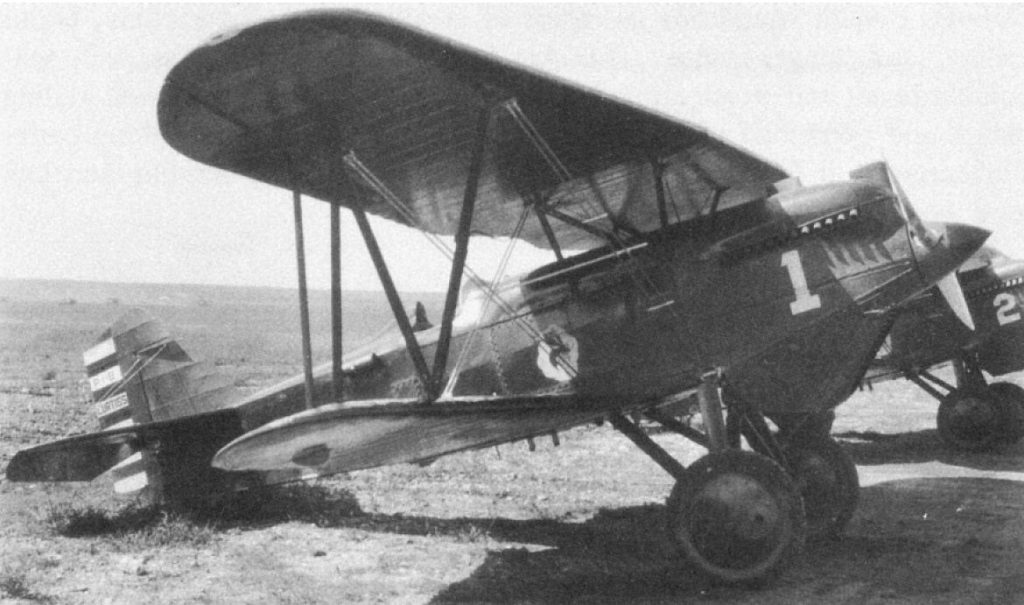
- Racers built for the 1927 National Air Races by putting the V-1570 Conqueror into existing P-2 and P-1A airframes. The XP-6A, with untapered PW-8A wings and wing surface radiators, won at 323 km/h; the XP-6 came second. The Army bought the concept on the strength of that weekend.
- P-6 (Model 34P, ordered Oct 1928, delivered from Oct 1929 / 18)
- First service mark. Water-cooled V-1570-17 of 447 kW, 286 km/h at sea level, rounded fuselage with added stringers and oleo-and-spring undercarriage in place of the P-1's rubber blocks. Serials 29-260/273 and 29-363/366.
- P-6A (1929—30 / 9 of the above)
- The first nine aircraft, redesignated on delivery when fitted with Prestone-cooled V-1570-23 engines. Lighter and cleaner than the P-6 despite the same power, and the mark that proved glycol cooling to the US Army.
- XP-6B (1929 / 1)
- The "Hoyt Special": the last P-1C, 29-259, fitted with a 447 kW V-1570C and long-range tanks for Captain Ross G. Hoyt's New York—Nome flight. 317 km/h at 4,570 m and a 9,750 m ceiling, the best altitude performance of any Hawk. Wrecked near Valemount, British Columbia; struck off 12 August 1931.
- P-11 and YP-20 (1929—31 / 3)
- Three airframes ordered for the air-cooled Curtiss H-1640 Chieftain, which overheated chronically and was abandoned. Two, 29-367 and 29-368, were finished with Conquerors and later became P-6Ds; the third, 29-374, took a Wright Cyclone as the YP-20 and then a 522 kW V-1570-23 as the XP-6E.
- XP-22 and XP-6E / Y1P-22 (1931 / 2 conversions)
- The XP-22 was P-6A 29-262 used to test a repositioned radiator and cooler for the 522 kW V-1570-23, then converted back. Its findings went onto 29-374, which with the single-leg undercarriage, tailwheel and new tailplane became the XP-6E, ordered in July 1931 as the production prototype. The P-6C designation was allocated to the same batch for budgetary reasons and cancelled.
- P-6E (Model 35, ordered 8 July 1931, delivered from Dec 1931 / 46)
- The definitive mark and the baseline of this page. Serials 32-233/278. Equipped the 17th and 94th Pursuit Squadrons of the 1st Pursuit Group at Selfridge Field, Michigan, and the 33rd Pursuit Squadron of the 8th Pursuit Group at Langley Field, Virginia, from 1932 to 1937.
- P-6D, XP-6D, XP-6F and XP-6G (1932—33 / conversions)
- The supercharger experiments. XP-6D was P-6A 29-260 with an external turbo-supercharger, reaching 317 km/h at 4,570 m; six or seven surviving P-6 and P-6A airframes were converted to P-6D standard in March—April 1932 with three-blade propellers and sent to Langley. XP-6F added a turbo-supercharged V-1570F and an experimental cockpit canopy, and reached 362 km/h at 4,570 m — the fastest Hawk of all. XP-6G was P-6E 32-254 with an unsupercharged V-1570F, later returned to standard.
- XP-23 / YP-23 (Model 63, delivered 16 April 1932 / 1)
- The last P-6E, 32-278, completed instead with a light-alloy monocoque fuselage, new tail, pointed nose and a geared, turbo-supercharged G1V-1570-C driving a left-handed three-blade propeller. The most advanced Hawk biplane built; no production followed, and its wings were reused on the XF11C-1. The end of the line, and it knew it.
- P-6S / Hawk I and the Netherlands East Indies Hawks (1930—31 / at least 18 export airframes)
- Radial-engined export P-6: three to Cuba with the 336 kW Pratt & Whitney R-1340 Wasp, one to Japan reportedly with an inverted Conqueror, and Bolivian machines used in the Chaco War. Separately the Royal Netherlands East Indies Army Air Force took eight Conqueror Hawks in 1930 and six more licence-built by Aviolanda in 1931; three were lost before the war, two of them in a mid-air collision on 27 February 1936. The civil Hawk 1A demonstrator became Al Williams' famous Gulfhawk.
- Hawk II and Hawk III (1932—37 / 126+ and 130+)
- Not P-6s but the export F11C Goshawk, built on the P-6E fuselage with a Wright Cyclone radial and roughly double the fuel. Turkey opened the account with 19 from August 1932; China took 50 Hawk IIs and 102 Hawk IIIs, Colombia 26 floatplanes, Siam 12 and 24, Bolivia 9, Chile and Cuba 4 each, Peru 4, Argentina 10 Hawk IIIs and the single Hawk IV, Norway one demonstrator, and Germany two for dive-bombing trials, one of which Ernst Udet flew at the 1936 Olympic Games. The Army's beautiful failure became Curtiss's commercial success in radial-engined form.
Survivors, and the distinction matters more than usual here. Exactly one original P-6E exists: airframe 32-261, donated to the Smithsonian National Air and Space Museum by Edward S. Perkins of Anniston, Alabama, restored by the School of Aeronautics at Purdue University, and displayed on loan at the National Museum of the United States Air Force, Wright-Patterson AFB, Ohio — painted, confusingly, as 32-240 of the 17th Pursuit Squadron, an aircraft it is not. That is the only P-6 of any mark anywhere, and none flies. Alongside it, one genuine Curtiss Hawk 1A survives: Al Williams' Gulfhawk, NR982V, retrieved from a trade school by Frank Tallman in 1958 but so heavily rebuilt over its career — radial engines, a metal-skinned fuselage — that little of the 1929 aeroplane remains; it is held by the National Museum of the Marine Corps at Quantico, Virginia. The radial-engined relatives are not P-6s and should never be counted as such: a Hawk II, one of the two German aircraft, recovered from a field outside Kraków and now in the Polish Aviation Museum; a Hawk III restored by the Royal Thai Air Force Museum in Wing 4 markings; and a BFC-2 at the National Naval Aviation Museum, Pensacola. Reproductions exist and are not originals: the Sauser P6E, also called the P6E-QC, is a homebuilt replica at 82 per cent scale, which makes it neither an original airframe nor even a full-size one. Of roughly 67 Conqueror Hawks the US Army bought, one survives — a survival rate of about one and a half per cent, and the worst of any major American interwar fighter.
Timeline
The Curtiss P-6 Hawk through the years
Curtiss builds its first pursuit biplanes, the PW-8 and P-1 Hawk, establishing the family that would lead to the P-6.
The Curtiss P-6 emerges as the latest and finest of the Hawk pursuit biplanes, powered by the V-1570 Conqueror.
The Hawk is progressively refined, including the switch to Prestone coolant for a smaller radiator and a cleaner nose.
The P-6E enters service — the sleek, polished version that becomes the most celebrated American pursuit biplane.
The 17th Pursuit Squadron adorns its P-6Es with the famous Snowy Owl markings, creating an enduring icon.
The P-6E serves as the front-line pursuit fighter of the 1st Pursuit Group, a showpiece of the peacetime Air Corps.
The Boeing P-26 Peashooter enters service, beginning the shift from biplane to monoplane that will quickly date the Hawk.
Modern monoplanes such as the Seversky P-35 and Curtiss P-36 render the P-6E obsolete, and it is withdrawn from front-line units.
The P-6E passes from service, its brief front-line career over well before the Second World War.
A restored P-6E in Snowy Owl markings is a highlight of the National Museum of the US Air Force, and the type remains a modellers’ favourite.
Stories & Eyewitnesses
The Curtiss P-6 Hawk in stories: the moments that defined it
The peak of the Curtiss Hawk line, a V-12 and a sleek nose, the gorgeous Snowy Owl markings, and a brief front-line reign at the close of the biplane era — the P-6 Hawk’s story through the moments that stuck.
The LinePeak of the Hawks
The last and finest Curtiss pursuit biplane.
The P-6 was the culmination of the Curtiss Hawk line, from the PW-8 through the P-1 to the P-6 — the classic American fighter biplane at its peak.
Years of Curtiss experience distilled into one elegant machine.
ConquerorA liquid-cooled V-12
The engine that shaped the Hawk.
The liquid-cooled Curtiss V-1570 Conqueror gave the P-6 competitive performance and a slim, pointed nose no radial could match.
Power and elegance in one installation.
Sleek NoseStreamlined by Prestone
Glycol coolant, smaller radiator.
Switching to Prestone coolant allowed a smaller radiator and a neater nose, giving the P-6E its famously clean lines.
Aerodynamic refinement that also made it beautiful.
P-6EThe definitive Hawk
The version everyone pictures.
The 1932 P-6E, with spatted wheels and a tidy undercarriage, was the polished peak of the line — and the most famous American pursuit biplane.
Only about 46 were built, but they made an outsized mark.
Snowy OwlsThe famous markings
The 17th Pursuit Squadron scheme.
The 17th Pursuit Squadron adorned its P-6Es with a spectacular arctic Snowy Owl scheme — among the most beautiful markings in aviation.
Machine and markings are remembered as one.
ShowpieceThe 1st Pursuit Group
A polished peacetime showpiece.
Flying with the 1st Pursuit Group, the immaculate P-6Es were a showpiece of the peacetime Air Corps in an age fascinated by aviation.
Squadrons took real pride in their flamboyant markings.
BelovedA modeller’s dream
Cherished by restorers and modellers.
Its elegant lines and gorgeous markings make the P-6E a favourite of scale modellers and restorers the world over.
Rare, exotic and beautiful — the ideal biplane-era subject.
Fast EnoughCompetitive for its day
Nearly 200 mph and agile.
The Conqueror gave the P-6E a top speed approaching 200 mph, competitive with the best pursuits of the early 1930s, with fine agility.
Briefly, about as good a pursuit biplane as existed anywhere.
PursuitThe Air Corps’ fighter
Front-line pursuit, in peacetime.
As a “pursuit” — the American word for a fighter — the P-6E was the front-line interceptor of the early-1930s Air Corps.
Its work was training, exercises and air races, not war.
OvertakenThe monoplane arrives
The P-26 and P-36 dated it fast.
The Boeing P-26 monoplane, then the modern P-35 and P-36, quickly rendered the fabric-and-wire P-6E obsolete.
Perfection reached just as the rules changed.
Few & FarModest numbers
Small production, limited exports.
Only around 46 P-6Es were built, and exports of the type were limited, though Hawk-family variants went to several nations, including the Netherlands.
Fame earned by quality and beauty, not quantity.
HonestLittle combat
A peacetime, not a wartime, legend.
The P-6E saw little or no significant combat, serving in the quiet interwar years and retiring before the Second World War.
It is remembered for beauty and grace, not battle — and rightly so.
PreservedThe Snowy Owl survives
A restored P-6E lives on.
A genuine P-6E, restored in Snowy Owl markings, is a highlight of the National Museum of the US Air Force.
A rare immortality for a small, short-lived, lovely fighter.
Photo Gallery
The Curtiss P-6 Hawk in photographs
Museum, archival and restored-aircraft photographs of the P-6 Hawk, each credited to its source and licence. Click any photo to enlarge.
On Film
The Curtiss P-6 Hawk on video: the elegant pursuit biplane
A look at the Curtiss P-6 Hawk — the Curtiss Hawk line, the sleek P-6E and the famous markings that made it an icon.
“Curtiss P-6E Hawk” by the Academy of Model Aeronautics (approx. 9,800 views at time of writing; running time ~5 minutes) — a short feature on the elegant Curtiss P-6E Hawk pursuit biplane.
Operations Overview
Where the Curtiss P-6 Hawk flew: an operator map
Designed, built and flown chiefly by the United States. The P-6E was overwhelmingly a US Army aircraft; only a small number of Hawks went abroad, including to the Netherlands. This is therefore a small map. Hover or tap a country for detail.
Categories: Design, Manufacture & US Army Air Corps (United States) · Minor Export (the Netherlands, which received a small number of Curtiss Hawks) · Surviving Airframes (United States). The P-6E was overwhelmingly a US Army type; foreign use was minor.
Service Record
The P-6E’s record: beauty over numbers
The P-6E’s significance lies not in production totals or combat victories but in its elegance and its place at the graceful close of the American pursuit-biplane era.
Questions & Answers
Curtiss P-6 Hawk: your questions answered
Can I fly in a Curtiss P-6 Hawk?
No — there is no bookable P-6 Hawk flight experience, and MiGFlug does not offer one. Only around forty-six P-6Es were built, the type retired in the 1930s, and the rare survivor is a museum aircraft. If what you actually want is the real thing — strapping into a genuine military aircraft and flying it — you very much can do that today in other types. MiGFlug arranges flights in real fighter jets and warbirds around the world. Start here: migflug.com/flights-prices.
Why is the Curtiss P-6 Hawk historically important?
The P-6 Hawk was the premier pursuit fighter of the US Army Air Corps in the early 1930s and the finest of the long Curtiss Hawk line of pursuit biplanes. Its definitive P-6E version is widely regarded as one of the most beautiful American aircraft ever built, and it marks the elegant high point — and the close — of the American fighter-biplane era, just before the monoplane took over.
Is the P-6 Hawk the same as the P-40 or the P-36 Hawk?
No — they are quite different aircraft. The Curtiss P-6 Hawk is an early-1930s biplane pursuit fighter. The Curtiss P-36 Hawk and the Curtiss P-40 Warhawk are much later, all-metal monoplane fighters of the late 1930s and the Second World War. They share the Curtiss name and the “Hawk” branding, but the P-6 is a separate, earlier, biplane design and should not be confused with those wartime monoplanes.
What made the P-6E so beautiful?
Several things. Its liquid-cooled Curtiss Conqueror V-12 allowed a slim, pointed nose rather than the blunt cowling of a radial engine, and the switch to Prestone coolant let designers use a smaller radiator for an even cleaner shape. Add neatly spatted wheels, a tidy single-strut undercarriage and elegant overall proportions — and then the spectacular “Snowy Owl” squadron markings — and you have one of the most handsome aircraft of its age.
Did the P-6 Hawk see combat?
Little or none of significance. The P-6E served in the peaceful interwar years and was retired from front-line duty well before the United States entered the Second World War. Its career was spent on patrols, training, exercises, manoeuvres and air races rather than in battle. It is remembered as a beautiful and capable peacetime pursuit fighter, not as a combat aircraft — and it is only honest to say so.
How many P-6 Hawks were built, and do any survive?
Only around forty-six of the definitive P-6E were built, with more across the wider P-6 family — small numbers reflecting the tight budgets of the Depression-era Army Air Corps. Remarkably, a genuine P-6E survives, beautifully restored in the Snowy Owl markings of the 17th Pursuit Squadron, and is displayed at the National Museum of the United States Air Force. The type also lives on in replicas and countless scale models.
Who operated the P-6 Hawk?
The P-6E was overwhelmingly a United States Army Air Corps aircraft. Curtiss did sell export versions of its wider Hawk family to a number of countries, and a small number of Hawks went abroad, including to the Netherlands, but the P-6E as such saw little foreign service. It was essentially a US front-line pursuit fighter of the early 1930s, built and flown in modest numbers at home.
Was the Curtiss P-6 Hawk a good aircraft?
For its brief moment, yes — it was a genuinely competitive pursuit fighter, fast for the early 1930s, agile, and well liked. But its significance is really aesthetic and historical rather than martial: it was built in small numbers, saw little combat, and was quickly overtaken by the monoplane. Judged as the elegant high point of the American fighter biplane, though, the P-6E is a triumph — arguably the most beautiful of them all.
Fly For Real
You can’t fly the P-6 Hawk — but these, you can
No Curtiss P-6 Hawk is a bookable ride today. The urge behind it — to strap into a real aircraft and actually fly — is very much still bookable. MiGFlug puts you in genuine fighters and warbirds around the world.
Fighter Jet Flights
Take the controls of a real ex-military jet with an experienced pilot.
Warbird experiences
Fly in a genuine piston-engined warbird from the golden age of aviation.
All flights are operated by MiGFlug’s vetted partners with professional pilots. Browse every option and current pricing at migflug.com/flights-prices. MiGFlug does not operate Curtiss P-6 Hawk flights — no bookable example exists.
Related Aircraft
If the Curtiss P-6 Hawk interests you, explore these
Sources & Further Reading
Where this Curtiss P-6 Hawk history comes from
Note on figures: dimensions, performance and production numbers for the P-6 Hawk vary between sources and by variant, and are hedged here as approximate; the figures given are for the definitive P-6E. Cost fields are listed as not reliably recorded because trustworthy interwar procurement cost data is not available. The P-6E saw little or no significant combat and served only briefly in the front line; its fame rests on its elegance rather than a war record, and this profile is careful not to overstate its numbers or its service. The Curtiss P-6 Hawk is a distinct, earlier aircraft from the later Curtiss P-36 Hawk and P-40 Warhawk monoplanes. A restored P-6E survives at the National Museum of the US Air Force.