
Fairey Gannet
The Royal Navy’s portly carrier submarine-hunter and radar picket — powered by a unique double turboprop driving contra-rotating propellers, one half shut down to loiter for hours over the sea.
The Story
The Fairey Gannet: the Royal Navy’s submarine-hunter and all-seeing eye of the fleet
The Fairey Gannet is one of those aircraft that looks, at first glance, almost comically awkward — portly, deep-bodied and bristling with bulges — and turns out, on closer inspection, to be one of the cleverest carrier aircraft Britain ever built. For more than two decades it was the Royal Navy’s eyes and ears over the sea: first as a carrier-borne submarine-hunter, then, in a completely different guise, as the airborne-early-warning radar picket that watched the horizon for the fleet. When the last of them left the deck of HMS Ark Royal in 1978, the Royal Navy lost a capability it would badly miss just four years later in the South Atlantic.
The Gannet was born from the lessons of the Second World War at sea, when the submarine had come close to strangling Britain’s supply lines. In 1945 the Admiralty issued a requirement for a new carrier aircraft that could both find a submarine and destroy it — a single machine carrying the search equipment, the crew to operate it, and the weapons to attack, all able to fly from an aircraft carrier’s deck. Fairey Aviation’s answer first flew on 19 September 1949, and after a long development the Gannet entered Fleet Air Arm service in 1955.
Getting there had not been quick. The Gannet was selected over a rival Blackburn design for the anti-submarine requirement, but its novel systems — above all the twin-engine Double Mamba and its complex propeller gearbox — took years to perfect, and the type did not reach the front line until six years after its first flight. When it did, it was among the first purpose-designed turboprop anti-submarine aircraft anywhere in the world, and the long gestation had bought the Royal Navy a genuinely capable machine.
“Two turbines, one propeller shaft, and the ability to shut down half your engine and keep flying — the Gannet could loiter over the sea for hours on a single Mamba.”— the cleverness of the Double Mamba, in a sentence
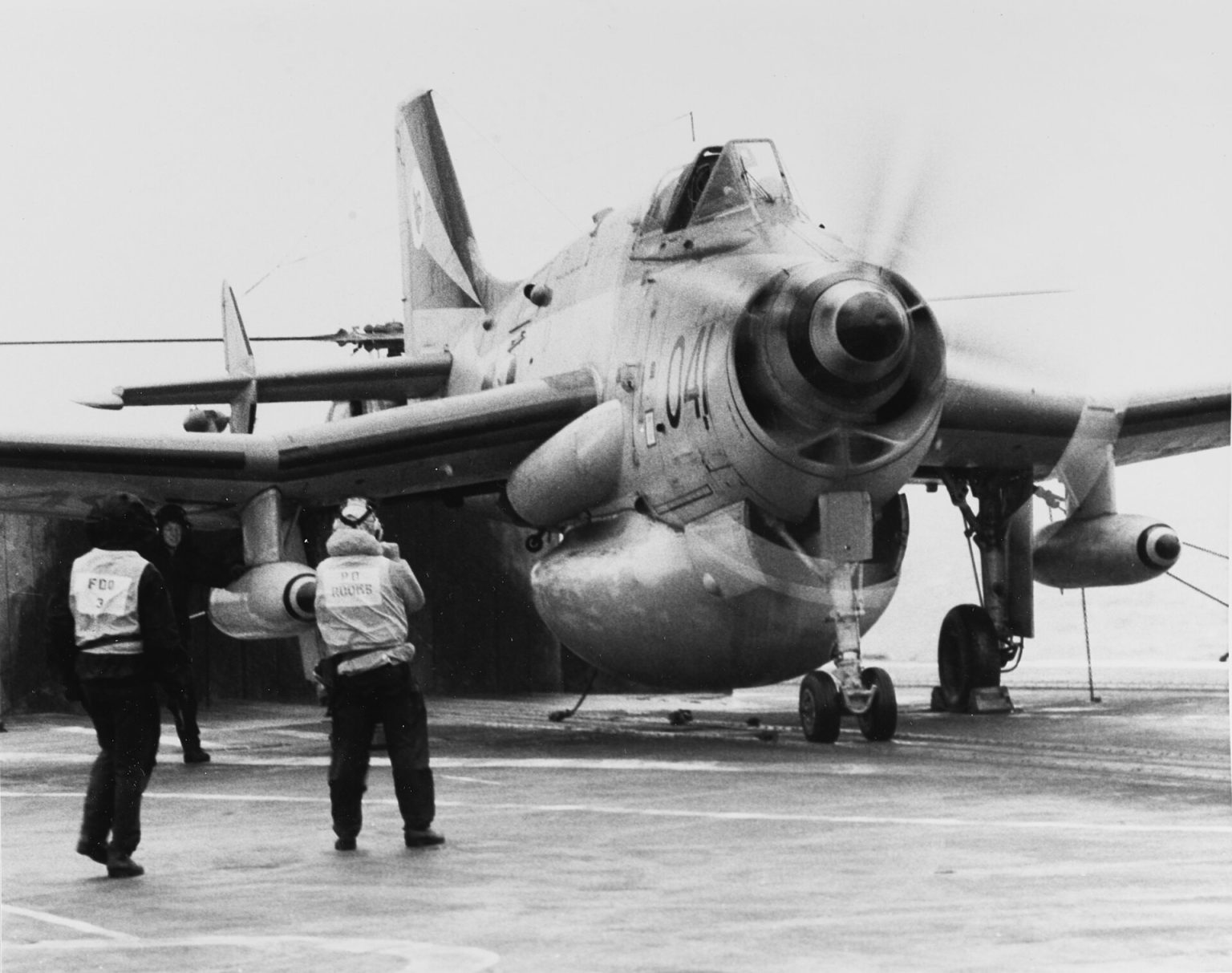
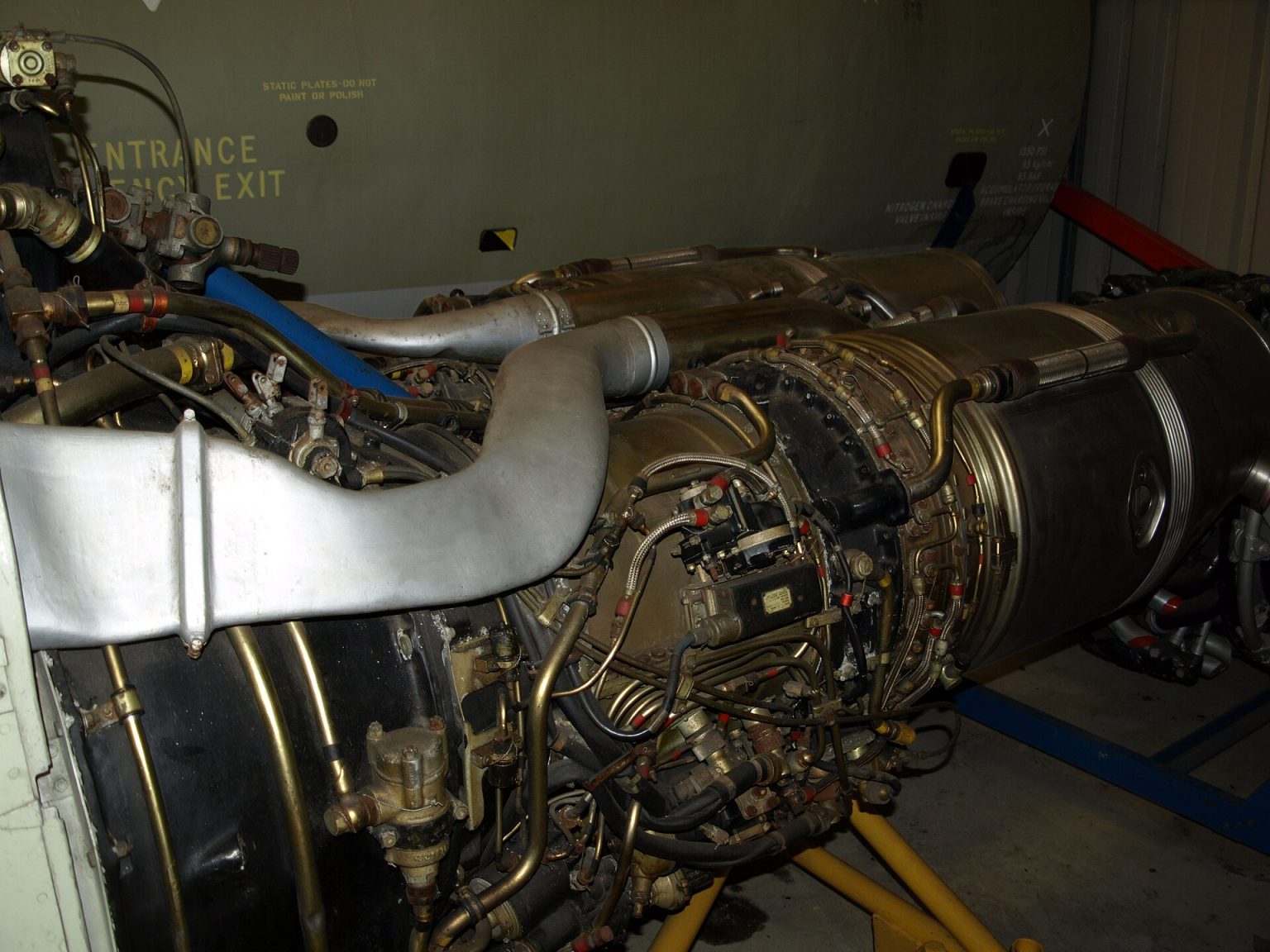
At the heart of that cleverness was the aircraft’s remarkable powerplant: the Armstrong Siddeley Double Mamba. It was, in effect, two Mamba turboprop engines mounted side by side and coupled through a common gearbox to drive two contra-rotating propellers — one turned by each engine. Crucially, the two halves could be run independently. For takeoff, climb and a fast dash, both turbines drove both propellers at full power. But once on patrol, the crew could shut one engine down and feather its propeller, cruising economically on a single Mamba and stretching the aircraft’s endurance far beyond what a conventional design could manage. For an anti-submarine aircraft, whose whole job was to stay airborne over a patrol area for as long as possible, this was a genuinely brilliant solution. The contra-rotating propellers, meanwhile, cancelled out each other’s torque, giving the pilot an aircraft that behaved beautifully on the deck and in the air.
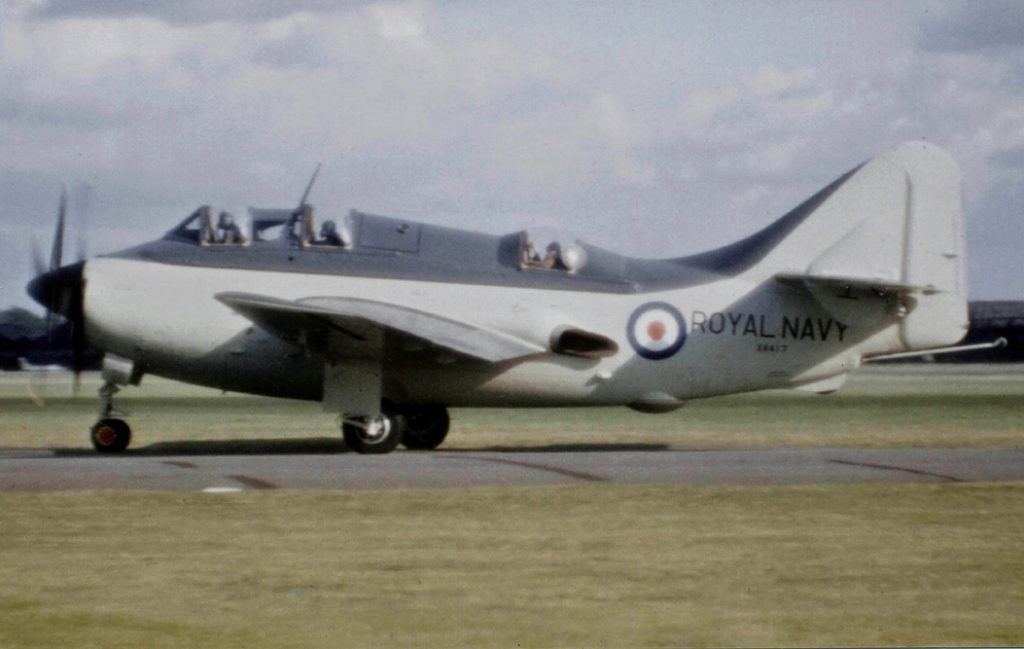
The rest of the Gannet was shaped by the demands of carrier life. It was a three-seat aircraft: a pilot up front and, in the anti-submarine version, two observers behind him to work the radar and the sonobuoys and to coordinate an attack. To fit below deck it had a distinctive double-folding wing, its outer panels folding twice to shrink the aircraft to a fraction of its span. It carried its torpedoes and depth charges in an internal weapons bay, keeping the airframe clean, and a retractable radar dome under the rear fuselage scanned the sea for surfaced submarines. It was rugged, practical and utterly built for the job.
Inside, the Gannet was very much a team aircraft. The pilot flew and delivered the attack, while the two observers in the rear worked the search radar, monitored the sonobuoys and plotted the hunt — the patient, painstaking business of turning a fleeting contact into a firm track and then an attack. Long hours droning over grey water, sifting faint signals for the trace of a submarine, was the daily reality of the anti-submarine mission, and the Gannet’s roomy fuselage and long endurance were built precisely to make that work bearable and effective.
In its original anti-submarine role the Gannet served the Fleet Air Arm through the second half of the 1950s and into the 1960s, flying from Britain’s carriers and hunting the growing Soviet submarine fleet. But technology was moving quickly, and by the early 1960s the anti-submarine mission was passing to helicopters, which could hover, dip a sonar directly into the sea, and operate from smaller ships. The fixed-wing Gannet’s days as a submarine-hunter were numbered — but the aircraft had a spectacular second act waiting.
That second act was airborne early warning. A fleet at sea is desperately vulnerable to low-flying aircraft and missiles that slip in below the radar horizon of its own ships; the answer is to put a powerful radar up in the air, where it can see much farther. Britain took the big American AN/APS-20 radar — the same set used in its land-based Avro Shackletons — and fitted it into a heavily modified Gannet, the AEW.3, which carried it in a large, distinctive radome slung under the belly. From 1960 the Gannet AEW.3 became the Royal Navy’s carrier-borne radar picket, orbiting ahead of the fleet and watching for threats far beyond the horizon. It was an unglamorous but vital job, and the Gannet did it for nearly two decades.
The radar at the heart of the AEW.3 had a long pedigree: the AN/APS-20 dated back to the Second World War and had already served in a string of American and British early-warning aircraft. Housed in the Gannet’s bulbous underbelly radome, it turned the little carrier aircraft into a surprisingly capable radar picket, and the AEW.3 used a more powerful version of the Double Mamba to haul the extra weight aloft. It was a clever piece of adaptation — taking a proven radar and a proven airframe and combining them into exactly the capability the fleet needed.
The Gannet also took on other tasks. A carrier-onboard-delivery version, the COD.4, ferried people and urgent stores out to the carriers at sea, and electronic-countermeasures variants added to the fleet’s toolkit. And the aircraft was exported: the Royal Australian Navy flew Gannets from its carrier HMAS Melbourne, the West German Bundesmarine used them for maritime patrol over the Baltic and North Sea, and the Indonesian Navy operated them too. For a specialised British carrier aircraft, it found a respectable overseas career.
The Gannet’s story has a poignant ending. When HMS Ark Royal — Britain’s last conventional fixed-wing carrier — was decommissioned in 1978, the Gannet AEW.3 was retired with her, and the Royal Navy was left with no carrier-borne fixed-wing early-warning aircraft at all. That gap was felt with painful clarity in the 1982 Falklands War, when British task-force ships, lacking airborne radar cover, were caught out by low-level Argentine air attacks; several were hit and sunk. The lesson was learned the hard way, and the Navy hurriedly fitted early-warning radars to Sea King helicopters as a stopgap. Around 350 Gannets were built in all, and because the type was so distinctive and so loved by enthusiasts, a good number survive today in museums and, for a while, in flying condition — a fitting afterlife for one of the most ingenious carrier aircraft of the Cold War.
01The Gannet’s origins: a purpose-built carrier submarine-hunter+
The Gannet grew directly out of the anti-submarine lessons of the Second World War, when German U-boats had come close to cutting Britain’s Atlantic lifeline. In 1945 the Admiralty issued Specification GR.17/45 for a new carrier aircraft that could carry out the whole anti-submarine mission in one airframe — searching for the submarine, and then attacking it — from the deck of an aircraft carrier.
Fairey Aviation’s design, initially known as the Type 17, first flew on 19 September 1949. Development took several years, as the novel Double Mamba engine and the aircraft’s complex systems were perfected, and the Gannet AS.1 finally entered Fleet Air Arm service in 1955. It was one of the first purpose-designed, turboprop-powered carrier anti-submarine aircraft in the world.
02The Armstrong Siddeley Double Mamba: two engines, one aircraft+
The Gannet’s defining feature was its powerplant, the Armstrong Siddeley Double Mamba (or “Twin Mamba”). It consisted of two Mamba turboprop engines mounted side by side and coupled through a common gearbox, each driving one of two contra-rotating propellers on the nose. In effect it was a single power unit made of two independent halves.
This gave the Gannet the best of both worlds. With both engines running it had ample power for a heavily loaded carrier takeoff and for climb and dash. And because the halves were independent, the aircraft did not depend on both to fly — a vital safety margin over the sea, and the key to its most useful trick.
03One engine shut down: how the Gannet loitered for hours+
The real payoff of the Double Mamba came on patrol. An anti-submarine aircraft earns its keep by staying airborne over a search area for as long as possible, and here the Gannet had a unique advantage: once it reached its patrol station, the crew could shut down one of the two engines and feather its propeller, cruising economically on a single Mamba.
Running on half its powerplant, the Gannet burned far less fuel and could loiter for hours longer than a conventional aircraft of similar size. The contra-rotating propellers made this practical — with one propeller stopped, there was no great asymmetric drag or torque to fight. It was a genuinely elegant piece of engineering, tailored precisely to the endurance the anti-submarine mission demanded.
04Contra-rotating propellers: taming the torque+
The Gannet’s two propellers, mounted one behind the other on concentric shafts, turned in opposite directions. This contra-rotating arrangement absorbed the considerable power of the Double Mamba through a large total blade area while keeping the propeller diameter manageable for a carrier aircraft — important for deck clearance.
Just as valuable, contra-rotating propellers cancel out each other’s torque and slipstream effects. A single large propeller of that power would have tried to twist the aircraft on takeoff and made it a handful to fly; the balanced pair made the Gannet docile and predictable, exactly the qualities wanted for the demanding business of landing on a pitching carrier deck.
05Folding wings and carrier life+
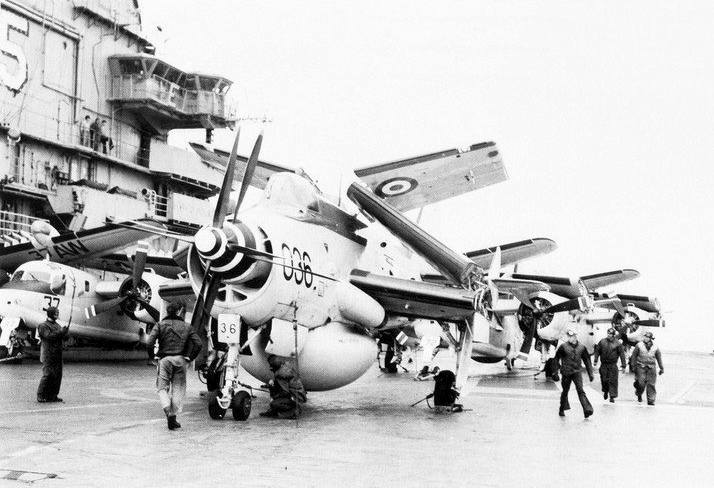
Space on an aircraft carrier is precious, and the Gannet was designed around it. Its wings folded — and not just once: the Gannet used a distinctive double-fold, each wing folding twice, to shrink the aircraft’s span dramatically so that more could be packed into the hangar below deck. Folded, the portly Gannet took on an ungainly, insect-like look that enthusiasts came to love.
Everything else about the aircraft was built for the deck too: a sturdy undercarriage and arrester hook for carrier landings, an internal weapons bay to keep the airframe clean, and three crew seated in tandem within the deep fuselage. It was never elegant, but it was superbly practical — a true carrier aircraft in every detail.
06Hunting submarines: the Gannet AS.1 and AS.4+
In its original role the Gannet was a submarine-hunter, and it carried the tools of the trade. A retractable radar under the rear fuselage searched for submarines caught on the surface; sonobuoys, dropped into the sea, listened for submerged boats; and an internal weapons bay held homing torpedoes and depth charges to attack. The two observers behind the pilot worked the sensors and directed the hunt.
The AS.1 entered service in 1955, followed by the more powerful AS.4. Flying from Britain’s carriers through the late 1950s and early 1960s, the Gannet was the Fleet Air Arm’s fixed-wing answer to the growing Soviet submarine threat — until the anti-submarine role began passing to helicopters, which could dip a sonar directly into the water and fly from far smaller ships.
07The Gannet AEW.3: the fleet’s airborne radar picket+
The Gannet’s second career was as an airborne-early-warning aircraft. A fleet’s own ships can only see as far as their radar horizon, leaving them blind to low-flying aircraft and missiles until it is almost too late. The solution is to lift a radar high into the air, and Britain did exactly that by fitting the big American AN/APS-20 radar into a much-modified Gannet.
The result, the AEW.3, carried the radar in a large radome slung beneath the fuselage and entered service from 1960. Orbiting ahead of the fleet, it could detect threats far beyond the range of the ships’ own radars and vector fighters to intercept them. For nearly two decades the AEW.3 was the Royal Navy’s carrier-borne early-warning capability — an unglamorous but genuinely vital job.
081978, HMS Ark Royal and the AEW gap that mattered in the Falklands+
The Gannet AEW.3 was tied to Britain’s large fleet carriers, and when the last of them, HMS Ark Royal, was decommissioned in 1978, the AEW.3 retired with her. The Royal Navy was left with no carrier-borne fixed-wing early-warning aircraft at all — a capability quietly lost as the fleet moved to smaller carriers operating Sea Harriers and helicopters.
The consequences became tragically clear in the 1982 Falklands War. Without airborne radar cover, the British task force could not reliably detect low-level Argentine air attacks in time, and several ships were hit and sunk. The Navy responded by rushing early-warning radars onto Sea King helicopters as a stopgap. The Gannet AEW.3’s retirement, and the gap it left, is one of the most-cited lessons of the campaign.
09The COD.4 and other Gannet variants+
Beyond the anti-submarine and early-warning versions, the Gannet was adapted to other carrier tasks. The COD.4 — carrier onboard delivery — was a transport conversion used to ferry passengers, mail and urgent spare parts out to carriers at sea, a mundane but essential service. Electronic-countermeasures versions such as the ECM.6 supported the fleet’s electronic-warfare needs.
There were also dual-control trainer versions, the T.2 and T.5, used to convert aircrew onto the type. This spread of variants — from submarine-hunter to radar picket to carrier van to trainer — shows how thoroughly the Gannet’s roomy, practical airframe was worked into the fabric of Fleet Air Arm carrier operations.
Design & Engineering
How the Gannet was built: endurance, folding wings and a double engine
Every feature of the Gannet followed from a single demand — to carry out the whole anti-submarine mission from a carrier deck, staying airborne as long as possible — and its ingenious powerplant was the key to it all.
A double turboprop
The Armstrong Siddeley Double Mamba: two coupled turboprops driving contra-rotating propellers, with either half able to run alone — full power for takeoff, one engine for economical loiter.
Built for the deck
A double-folding wing to save hangar space, a sturdy undercarriage and arrester hook, an internal weapons bay, and three crew in a deep fuselage — a true carrier aircraft.
Sensors and radar
A retractable search radar and sonobuoys for the anti-submarine role; and, on the AEW.3, a big underslung radome housing the AN/APS-20 early-warning radar.
Specifications
Fairey Gannet specifications: dimensions, performance and cost
Baseline note: the figures below describe the Gannet AS.1, the first production anti-submarine mark with the 2,950 ehp Double Mamba ASMD.1, as tabulated by Thetford in British Naval Aircraft since 1912. Deltas for the AS.4, the T.2 and T.5 trainers, the COD.4 and the AEW.3 are in grey. The AEW.3 is not a modification of the aircraft described here but a substantial redesign that shares its wing, its engine concept and very little else, and its figures are flagged as such throughout.
Dimensions & weights
- Crew
- 3 — a pilot and two observers, each under a separate canopy in a line down the spine. The pilot sat directly above the engine and ahead of nothing at all, which gave an exceptional view over the nose for deck landing. On the AEW.3 the two observers moved into an internal cabin with no windows, entered through hatches beside the wing trailing edge
- Length
- 13.11 m (43 ft 0 in). The AEW.3 is 13.41 m (44 ft 0 in)
- Wingspan
- 16.56 m (54 ft 4 in) — unchanged across every mark including the AEW.3
- Wingspan folded
- 6.07 m (19 ft 11 in) — a reduction of nearly two-thirds, achieved by folding each wing twice. The proposed AEW.7 would have gone to 18.3 m (60 ft), which was the practical limit for Ark Royal and one reason the proposal died
- Height
- 4.19 m (13 ft 9 in); Thetford prints 13 ft 8.5 in. The AEW.3 stands 5.13 m (16 ft 10 in) — three feet taller, because the undercarriage had to be lengthened to clear the radome
- Wing area
- 44.87 m2 (483 sq ft); 45.5 m2 (490 sq ft) on the AEW.3, which gained area with its enlarged fin and revised fillets
- Aerofoil
- NACA 23018 at the root, NACA 23010 at the tip — an inverted gull planform, anhedral inboard and dihedral outboard, with the break at the first fold line
- Empty weight
- 6,836 kg (15,069 lb)
- Maximum take-off weight
- 8,890 kg (19,600 lb)
- AEW.3 gross weight
- 11,340 kg (25,000 lb) — more than a quarter heavier than the anti-submarine aircraft, which is the clearest single measure of how much the AN/APS-20 installation cost
- Weapons bay load
- ~907 kg (2,000 lb) of stores — the published figure. The Gannet was the first Fleet Air Arm aircraft able to carry the whole of its armament internally apart from rockets
- Engine weight
- 984 kg (2,170 lb) dry for the ASMD.3, in a package 2,597 mm (102.25 in) long and 1,341 mm (52.8 in) across — two complete turboprops and their combining gearbox in a single nose installation
Performance
- Maximum speed
- 499 km/h (310 mph / 269 kt) for the AS.1 per Thetford. Most other tabulations, including the Royal Australian Navy’s own, give 481 km/h (299 mph); the difference is height and weight assumptions rather than a disagreement about the aeroplane
- Search speed
- Low, and deliberately so — anti-submarine work was flown slowly at low level with the radome extended, and the Gannet’s virtue was that it could sit there for hours rather than that it could sprint
- Initial rate of climb
- 10.2 m/s (2,000 ft/min); some sources give 2,200 ft/min
- Service ceiling
- 7,620 m (25,000 ft) — the same for the AS.1 and the AEW.3, and for an AEW aircraft that ceiling is a real limitation. Radar horizon is a function of height, and 25,000 ft is not much of one
- Endurance
- 5–6 hours — the figure quoted for both the anti-submarine marks and the AEW.3, and it assumes single-power-section cruise for most of the sortie
- Endurance on one power section
- Roughly double the two-section figure — the whole reason the Double Mamba exists. Crews alternated between the two halves every half hour or so to keep both warm and both wearing evenly
- Range
- 1,065 km (662 miles) in Royal Australian Navy service; other tabulations give 826 to 1,065 km depending on cruising speed and mark. The AEW.3 is quoted at 1,127 km (700 miles)
- AEW.3 maximum speed
- 402 km/h (250 mph / 217 kt) — a hundred miles an hour slower than the anti-submarine aircraft, which is what a ventral radome the size of a small boat will do to you
- Deck performance
- First turboprop deck landing in history — the prototype VR546 landed on HMS Illustrious on 19 June 1950, flown by Lieutenant Commander G. Callingham. The nose-high stance imposed by the long nosewheel leg was a carrier characteristic of the era, not an accident
- AN/APS-20 detection performance
- Poor at low level over water — the wartime-designed radar could not readily separate a low-flying aircraft from sea clutter, and had short range. The Gannet carried no computer and no signal processing, so the two observers interpreted the raw radar picture themselves and passed it down the AN/ART-28 Bellhop datalink to the ship
- Fatal accident record
- Two AEW.3s lost together on 9 April 1962 — XL499 and XP197 of 849 Squadron collided at night 15 miles off the Lizard with the loss of all six crew. Night operations from a carrier with a heavy, slow, tightly packed aircraft were unforgiving
Propulsion & systems
- Engine
- One Armstrong Siddeley ASMD.1 Double Mamba, 2,200 kW (2,950 ehp) — and the word to notice is one. It is a single engine unit in a single nose installation, and treating the Gannet as a twin is the commonest error made about it
- Architecture
- Two complete Mamba power sections side by side — each a ten-stage axial compressor with six combustion chambers, each with its own fuel system, its own controls and its own throttle. They are not two halves of one engine; they are two engines that happen to share a gearbox and an oil system
- Combining gearbox
- A common reduction gearbox driving two coaxial shafts — power from each section is carried by a torsion shaft through sun, planet, epicyclic and spur gearing to give the right reduction ratio and, crucially, the right direction of rotation for each propeller shaft. The two shafts turn opposite ways inside one another
- Propellers
- Rotol contra-rotating, eight blades — two four-blade units on coaxial shafts. The port power section drives one propeller and the starboard section drives the other. This is the part usually explained badly: the sections do not both drive both propellers, and they do not blend their power. Each section owns one propeller
- Single-section cruise
- Shut one down and feather its own propeller — because both propellers are on the centreline, killing half the powerplant produces no asymmetry, no yaw, no rudder load and no handling penalty whatever. The dead propeller feathers and windmills to a stop while the live one carries on. That is the entire design argument: a twin’s reliability and a single’s handling, and roughly double the endurance in the cruise
- Starting and relight
- Cartridge start on the ground, forced-air relight in the air — a section shut down for economy could be restarted in flight, which is what made the alternating half-hour routine practical
- Fuel
- Kerosene, wide-cut turbine fuel or diesel — the operational consequence was that the Admiralty could stop carrying high-octane aviation spirit for this aircraft. Removing petrol from a carrier is a safety argument that had cost the Royal Navy dearly to learn
- Later ratings
- ASMD.3 and ASMD.4 — 2,345 kW (3,145 shp) in the AS.4, and 2,890 kW (3,875 shp) in the AEW.3, the last being effectively the same engine developed hard to haul the extra weight of the radar aircraft
- Search radar
- Ekco ASV Mk 19 (ARI 5838) in a retractable ventral radome — lowered aft of the weapons bay for search and retracted for transit and deck operations. The AEW.3 replaced it with a fixed, enormous ventral radome housing the American AN/APS-20 S-band set, with AN/APX-7 IFF and the AN/ART-28 Bellhop datalink
- Common oil system
- The design’s one real weakness — on 23 January 1964 a phosphor-bronze bush in the port section’s accessory drive failed on ECM.6 XG832, and metal particles carried through the shared oil system destroyed both power sections. All three crew took to their parachutes near St Austell and survived. Independence of the two halves was never quite as complete as the concept implied
10The Gannet’s exports: Australia, West Germany and Indonesia+
Though designed for the Royal Navy, the Gannet found overseas customers. The Royal Australian Navy operated Gannets in the anti-submarine role, flying them from its aircraft carrier HMAS Melbourne through the late 1950s and 1960s. The West German Bundesmarine used land-based Gannets for maritime patrol over the Baltic and North Sea, and the Indonesian Navy also operated the type.
These export sales spread the Gannet’s distinctive shape and its clever Double Mamba engine well beyond Britain. Each operator used the aircraft for the same essential purpose — watching the sea and hunting submarines — and the Gannet’s presence in Australian, German and Indonesian service is a measure of how well it filled a role that many maritime nations needed filled.
11The Fairey Gannet’s operating costs: what the records show+
As with most Cold War military aircraft, there is no single reliable, transparent public figure for the Gannet’s unit cost, cost per flight hour or total programme cost. It was procured in modest numbers over several years, in a range of variants, through government contracts rather than at a published list price, and consistent lifetime cost data for the type is not available. Any single figure quoted for it should be treated with caution.
What can be said is that the Gannet’s whole design philosophy — the one-engine loiter of the Double Mamba above all — was aimed at efficiency and endurance, getting the most patrol time from each hour of flying. Rather than invent numbers, we list the cost fields here as “not reliably recorded.”
12Why helicopters took over the anti-submarine role+
The Gannet was an excellent fixed-wing submarine-hunter, but by the early 1960s the anti-submarine mission was shifting to helicopters, and for good reasons. A helicopter can hover motionless over a patch of sea and lower a “dipping” sonar directly into the water to listen for a submarine — something no fixed-wing aircraft can do. It can also operate from small escort ships, not just large carriers, spreading anti-submarine cover across the whole fleet.
As helicopters like the Westland Whirlwind and Wessex matured, they took over the close-in anti-submarine role from the Gannet. This freed the Gannet airframe for its second life as the AEW.3 radar picket — a job the helicopters of the day could not do — and so the aircraft’s career was extended rather than ended by the change.
13Surviving Gannets: a much-loved aircraft preserved+
The Gannet is a great favourite among aviation enthusiasts — distinctive, characterful and full of clever engineering — and thanks to that affection a good number survive. Museum examples are preserved in Britain, in Australia, in Germany and elsewhere, spanning the anti-submarine and airborne-early-warning versions, and for a number of years a few Gannets were even kept in flying condition on the airshow circuit.
These survivors keep alive the memory of one of the Cold War’s most ingenious carrier aircraft: the double engine that could run on half its power, the wings that folded twice, and the big-eyed AEW.3 that watched the horizon for the fleet. For an aircraft that never sought glamour, the Gannet has earned a devoted following.
Armament & payload
The Gannet carried no gun at all, and everything it did carry was chosen for one job: finding a submarine and then killing it without landing first
Specification GR.17/45 asked for something the Fleet Air Arm had never had. Until the Gannet, carrier anti-submarine work needed two aircraft — a searcher with the radar and an attacker with the weapons, working as a pair. The Gannet was the first British fixed-wing aircraft to do both jobs in one airframe, and the internal weapons bay is what made it possible: everything except rockets went inside, so the aeroplane could search for hours in a clean configuration and then attack without a change of role or a change of aircraft.
The six panels below are not the usual fighter categories, because none of them would tell you anything true. A Gannet had no gun, no air-to-air weapon and no guided anything. What it had was a bay, a retractable radar, sonobuoys, torpedoes, depth charges and the endurance to use them. The AEW.3 went further and threw the weapons out entirely: it carried no armament of any kind, only a radar and two men to read it. Fits varied considerably by mark and operator: the AS.4 carried an uprated engine and revised electronics, the AS.6 and ECM.6 conversions traded weapons for electronic countermeasures equipment, the COD.4 carried mail, the trainers carried nothing at all, and German, Indonesian and Australian aircraft were delivered to differing standards.
The weapons bay
- A large internal bay in the fuselage, aft of the wing centre section — the first Fleet Air Arm aircraft able to stow the whole of its armament internally with the sole exception of rockets
- Rated at roughly 907 kg (2,000 lb) of stores, configurable for depth charges, sonobuoys, homing torpedoes, conventional bombs, markers or mines
- The bay was lengthened on the second prototype in 1950 when the operational requirement changed, which is why the radome had to move aft — the two installations were competing for the same piece of fuselage
- The T.2 and T.5 trainers kept the bay and deleted the radar; the AEW.3 deleted the bay entirely and put the radar cabin where it had been
Torpedoes & depth charges
- Two air-dropped homing torpedoes in the bay — the British 18-inch Mk 30 in early service, later the American Mk 43 and Mk 44 lightweight homing torpedoes
- Conventional depth charges, carried internally and dropped on a radar or sonobuoy fix. Against a snorting diesel boat in the 1950s this was still a realistic weapon
- Naval mines and conventional bombs from the same bay, and marker stores for holding contact while the attack was set up
- The Gannet never fired a weapon in anger against a submarine. No Royal Navy fixed-wing anti-submarine aircraft has. The type’s value was deterrent and its training was relentless
Sonobuoys & the retractable radome
- Ekco ASV Mk 19 air-to-surface-vessel radar (ARI 5838) in a radome that lowered from the underside of the rear fuselage for search and retracted flush for transit, deck handling and landing
- Sonobuoys carried in and dropped from the weapons bay, the acoustic half of a search that began with radar looking for a snorkel and ended with a torpedo
- The two observers sat one behind the other under separate canopies, the forward one working the radar and the aft one the acoustics — a division of labour that needed three people and is why the Gannet is a three-seater when the original specification asked for two
- The addition of that third cockpit disturbed the airflow over the tailplane badly enough that small finlets had to be added to the horizontal stabiliser, which is why a production Gannet has them and the first prototype did not
Rockets & underwing stores
- Hardpoints under the outer wing panels — the only external carriage the aeroplane had, and the only stores that could not be stowed inside
- Up to 16 Mk 8 or 24 Mk 5 rocket projectiles, the standard Fleet Air Arm three-inch rockets, for use against a surfaced submarine or a small surface target
- Two 100-gallon external fuel tanks as an alternative, extending an already long sortie
- Nothing guided, nothing stand-off. A Gannet attacked by flying over the thing it was attacking, which was acceptable against a submarine and would have been suicidal against anything that shot back
The AEW.3 radar fit
- AN/APS-20 S-band air search radar in a fixed ventral radome — the set taken straight out of the Royal Navy’s obsolete Douglas Skyraider AEW.1s, on the explicit understanding that this was a stop-gap until a purpose-built aircraft arrived for the CVA-01 carriers
- AN/APX-7 IFF interrogator-responder and the AN/ART-28 Bellhop datalink, which passed the picture down to the ship’s operations room
- No onboard computer and no signal processing whatever, unlike the contemporary American E-2 Hawkeye. The two observers read raw radar video and made the interpretation themselves, then controlled the combat air patrol onto the contact by voice
- No armament of any kind. The AEW.3 gave up the weapons bay, the observers’ canopies and three feet of ground clearance to carry this radar, and gained an enlarged fin to cope with what the radome did to its directional stability
- The proposed AEW.7 would have replaced all of it with a tilting dorsal rotodome and an FMICW radar on a twin-tailed, 60 ft-span airframe. It was not built, and nothing replaced the AEW.3 for four years
What the Gannet did not carry
- No gun. Not a fixed gun, not a flexible gun, not a turret. This is worth stating plainly because a great many published descriptions of 1950s naval aircraft assume one
- No air-to-air weapon and no air-to-surface guided weapon at any point in the type’s life, in any mark, with any operator
- No magnetic anomaly detector boom — the contemporary Grumman S-2 Tracker had one and the Gannet did not, which is a real capability difference between the two aircraft rather than a trivial one
- No armour and no self-defence provision. The design assumed it would operate inside a defended task group, and when that assumption failed the aeroplane had nothing to offer
Three typical loadouts
- Anti-submarine search and strike, AS.1
- Sonobuoys and two homing torpedoes or depth charges in the bay, ASV Mk 19 radome extended, three crew, one power section shut down and feathered for the middle hours of the sortie. Five to six hours on task in the North Atlantic or the Mediterranean, alternating power sections every half hour. This is what 826 Naval Air Squadron flew from HMS Eagle from January 1955.
- Surface strike, AS.4
- Sixteen Mk 8 rocket projectiles under the outer wings, bombs or depth charges internally, both power sections running. A secondary role the aircraft was designed for from the beginning — GR.17/45 asked for search and strike in one airframe — and one the Fleet Air Arm rarely had cause to use.
- AEW barrier patrol, AEW.3
- No weapons at all. AN/APS-20 radiating, IFF interrogating, Bellhop passing the picture to the carrier, a pilot and two observers reading raw video at 25,000 ft for five hours. Four aircraft to a flight, with a Gannet COD.4 attached for ship-to-shore communications. This is what 849B Flight flew from HMS Ark Royal until 1978.
Sourcing caveat: weapon fits follow Taylor’s Fairey Aircraft Since 1915 and Thetford. The 2,000 lb bay figure is the published rating rather than a load routinely carried, and no source gives a reliable breakdown of how many sonobuoys a Gannet took. Torpedo types are inferred from Fleet Air Arm inventory of the period rather than from a Gannet-specific clearance list; the Mk 30, Mk 43 and Mk 44 were the weapons available, and different squadrons in different years carried different ones.
Variants
Fairey built one Gannet for hunting submarines and a second, much larger one for seeing over the horizon, and the second outlived the first by twelve years
The Gannet story divides cleanly in two. The anti-submarine aircraft — AS.1, AS.4 and their trainers — entered service in 1955, equipped the majority of Royal Navy carriers, was exported to Australia, West Germany and Indonesia, and was then swept away within about a decade by the Westland Whirlwind HAS.7 helicopter, which could do the same job from a much smaller ship. That was not a failure of the Gannet. It was the moment at which anti-submarine work stopped being a fixed-wing problem.
The redundant airframes were then recycled ruthlessly: into carrier onboard delivery aircraft, into electronic countermeasures aircraft, and into export contracts. Indonesia’s eighteen "AS.4s and T.5s" of January 1959 were in fact remanufactured AS.1s and T.2s, and several never flew there at all, serving as ground trainers.
And then there is the AEW.3, which is a different aeroplane wearing the same name. It was so extensively rebuilt — new fuselage cabin, exhausts moved to the wing leading edge, enlarged fin, undercarriage lengthened by three feet, weapons bay deleted — that in December 1954 it was seriously proposed that it be renamed the Fairey Albatross. It was meant as a stop-gap for a few years until CVA-01 and a purpose-built AEW aircraft arrived. Neither arrived. The AEW.3 flew on until the last carrier that could operate it was paid off, and the consequences of its going were felt in the South Atlantic four years later.
- Type Q / Fairey 17 prototypes (1949–1951 / 3)
- VR546 flew from Aldermaston on 19 September 1949, ten months ahead of Blackburn’s competing B-54. VR577 followed on 6 July 1950 with a third canopy and a lengthened bomb bay, and WE488 in May 1951. All three had the ASMD.1. VR546 crash-landed on 25 November 1949 and made the first turboprop deck landing, on HMS Illustrious, on 19 June 1950.
- Gannet AS.1 (1953–1957 / 183)
- The baseline for this page. First production aircraft flew from RAF Northolt on 9 June 1953 under Korean War super-priority; four were handed to the Fleet Air Arm at RNAS Ford on 5 April 1954. Grounded for two months during trials to redesign the propeller control system after compressor stalls. Built at Hayes and, from October 1954, at Heaton Chapel with flight testing at Ringway.
- Gannet T.2 (1954–1957 / 38, one converted)
- Dual-control trainer on the AS.1 airframe: controls in both forward cockpits, a retractable periscope for the instructor in the second seat, radar and scanner deleted. First flight 16 August 1954. Finished in overall silver with a yellow trainer band, and the aircraft most often photographed demonstrating flight on one power section with the other propeller feathered.
- Gannet AS.4 (1956–1959 / 75, one converted)
- The improved anti-submarine mark, with the 3,145 shp ASMD.3 and revised equipment. Externally near-identical to the AS.1. Several were later refurbished with new electronics and radar as the AS.6.
- Gannet T.5 (1957–1959 / 11, three converted from T.2)
- Trainer equivalent of the AS.4, with the uprated engine. XT752 in Wisconsin, in the hands of the Wings of Steel Foundation, is a T.5 and is the only Gannet of any mark currently airworthy anywhere.
- Gannet COD.4 (1960s / 6 conversions)
- Carrier onboard delivery conversions of the AS.4, stripped of anti-submarine equipment and used to fly mail and light freight to the fleet. One was attached to each AEW flight aboard ship for ship-to-shore communications, which is why the Gannet’s formal Royal Navy retirement date of 15 December 1978 belongs to a COD.4 and not to a radar aircraft.
- Gannet ECM.6 (1959–1966 / 9 conversions)
- Electronic countermeasures conversions of the AS.4, initially classified AS.6, flown chiefly by 831 Naval Air Squadron. XG832 of this mark suffered the January 1964 double power-section failure that exposed the shared oil system as a single point of failure.
- Gannet AEW.3 (1958–1963 / 44 plus one prototype)
- The airborne early warning rebuild. Prototype XJ440 first flew from Northolt on 20 August 1958, carrier trials aboard HMS Centaur in November, 700G Squadron formed as the trials unit in August 1959, and 849A Flight embarked in HMS Ark Royal in January 1960. Ordered in three batches; the last was delivered on 6 June 1963. Flights served in Ark Royal, Centaur, Victorious, Hermes and Eagle.
- Gannet AEW.7 (proposed 1960s / none built)
- A British Aircraft Corporation proposal to strip and rebuild the AEW.3 with a tilting dorsal rotodome in place of the ventral radome, a new FMICW radar, a twin tail and 60 ft span. The rotodome could tip backwards to keep the beam clear of the propellers, avoiding a change of powerplant. Not proceeded with; a minimum-change re-radar of the existing AEW.3 was also offered and also declined.
- Export deliveries (1955–1959 / Australia 36, West Germany 16, Indonesia 19)
- The Royal Australian Navy took 33 AS.1 and three T.2, flown by 816, 817, 724 and 725 Squadrons from HMAS Melbourne and HMAS Albatross at Nowra, and withdrew its surviving 24 aircraft in 1967. West Germany’s Marineflieger took 15 AS.4 and one T.5 from May 1958, flying them with Marinefliegergeschwader 2 at Jagel and Sylt and then MFG 3 at Nordholz from 1963 until the Breguet Atlantic replaced them in 1966. Indonesia ordered 18 in January 1959 and received 17 AS.4 and two trainers, all remanufactured from AS.1 and T.2 airframes; several served only as ground instructional machines.
Closing note on numbers, retirement and survivors: roughly 350 Gannets were built in all. The usual tabulation gives 303 anti-submarine and training airframes plus 44 AEW.3s, with three prototypes on top, and totals differ between authorities because several marks — COD.4, ECM.6, most of the Indonesian aircraft and three of the T.5s — were conversions rather than new-build. Retirement ran in stages: the Royal Australian Navy in 1967, West Germany in 1966, the Royal Navy’s anti-submarine Gannets by the mid-1960s as the Westland Whirlwind HAS.7 took over, and the AEW.3 on 15 December 1978, when 849 Naval Air Squadron disbanded after HMS Ark Royal paid off; a Gannet of 849B Flight was the last aircraft the ship ever recovered, on 18 November 1978. The equipment outlived the airframes: AN/APS-20 sets pulled from retired Gannets were installed in redundant Avro Shackletons to give the Royal Air Force the AEW capability the Fleet Air Arm had just lost. The Royal Navy itself was left with none, and the judgement of the Falklands War in 1982 — where the task force depended on shipborne air search and lost ships to attacks it did not see coming — is that this was a serious mistake. The Westland Sea King AEW.2 with Searchwater radar was improvised in eleven weeks and reached HMS Illustrious before the deployment ended. No Gannet reproduction has ever been built, so every surviving aircraft is an original airframe, most of them heavily reworked in service. Around two dozen survive. In Britain: AEW.3s XL472 at the Gatwick Aviation Museum, XL497 at Dumfries and Galloway, XL502 at the Yorkshire Air Museum, XL503 at the Fleet Air Arm Museum at Yeovilton and XP226 at Newark; COD.4 XA466 at Yeovilton; T.2 XA508 at the Midland Air Museum; T.5 XG883 at the Museum of Berkshire Aviation; ECM.6s XG797 at Duxford, XG831 at the Cornwall at War Museum and XA459 at the Solway Aviation Museum; XA460 under restoration with the Ulster Aviation Society; and AEW.3 XL500, registered G-KAEW and once flown by the present King, under restoration to airworthiness at the South Wales Aviation Museum. T.5 XG882 lies derelict at the former RAF Errol. In Australia, AS.1s XA331, XA334, XA434 and XG789 and T.5 XG888 survive; in Germany, AS.4s UA-110, UA-112 and UA-113 and AEW.3 XL450 at Hermeskeil; in Indonesia, three AS.1s at Surabaya and Jakarta; and in the United States, AEW.3 XL482 at Pima and the airworthy T.5 XT752 in Wisconsin.
Timeline
The Fairey Gannet through the years
The Admiralty issues Specification GR.17/45 for a carrier aircraft to search for and attack submarines in one airframe — the origin of the Gannet.
The Fairey Type 17 prototype flies on 19 September 1949, powered by the novel Armstrong Siddeley Double Mamba turboprop.
The Gannet AS.1 enters Royal Navy service as a carrier-borne anti-submarine aircraft.
The improved AS.4 appears, and the Gannet is exported to Australia, West Germany and Indonesia for maritime patrol and anti-submarine work.
The airborne-early-warning Gannet AEW.3, carrying the AN/APS-20 radar in an underslung radome, becomes the Royal Navy’s carrier radar picket.
Anti-submarine duties pass to dipping-sonar helicopters; the fixed-wing Gannet’s hunting career winds down, but the AEW.3 flies on.
The COD.4 carrier-delivery version and electronic-countermeasures and trainer variants extend the Gannet’s range of fleet duties.
The Royal Australian Navy withdraws its Gannets as HMAS Melbourne’s air group is modernised.
HMS Ark Royal is retired and the Gannet AEW.3 goes with her, leaving the Royal Navy without carrier fixed-wing early warning.
Lacking airborne early warning, British task-force ships are caught by low-level air attacks; the AEW gap becomes a hard-learned lesson.
Stories & Eyewitnesses
The Fairey Gannet in stories: the moments that defined it
A double engine that ran on half its power, wings that folded twice, a submarine-hunter turned radar picket, and a retirement whose gap was felt in a distant war — the Gannet’s history told through the moments that stuck.
Born of the U-boat WarA hunter by design
The Gannet was built to find and kill submarines from a carrier.
The Gannet came straight out of the Second World War at sea, when U-boats nearly severed Britain’s supply lines. In 1945 the Admiralty called for a single carrier aircraft that could both search for a submarine and attack it.
Fairey’s answer first flew in 1949 and entered service in 1955 as one of the world’s first purpose-built turboprop carrier sub-hunters.
The Double MambaTwo engines in one
The Gannet’s powerplant was really two coupled turboprops.
The Armstrong Siddeley Double Mamba was two Mamba turboprops mounted side by side and geared to drive two contra-rotating propellers — a single power unit made of two independent halves.
Both together gave power for takeoff; either alone could keep the aircraft flying, a vital margin over the open sea.
Half an EngineLoitering on one Mamba
The Gannet could shut down one engine and cruise for hours.
Once on patrol, the Gannet’s crew could shut down one turbine and feather its propeller, cruising economically on a single Mamba and stretching the aircraft’s endurance far beyond a conventional design.
For an anti-submarine aircraft, whose value lay in loiter time, it was a genuinely brilliant trick.
Contra-PropsCancelling the torque
Two propellers turning opposite ways tamed the power.
The Gannet’s two propellers turned in opposite directions on concentric shafts, absorbing the Double Mamba’s power while keeping the diameter small enough for carrier use.
By cancelling each other’s torque, they made the portly aircraft docile to fly — exactly what carrier deck landings demanded.
Wings That Fold TwiceShrinking for the hangar
The Gannet used a distinctive double-folding wing.
To fit below deck, each of the Gannet’s wings folded not once but twice, shrinking its span dramatically and giving the folded aircraft an ungainly, insect-like look.
It was one of the details that made the Gannet instantly recognisable — and much loved by the enthusiasts who follow it.
The Sub-HunterRadar, sonobuoys and torpedoes
The AS Gannet carried the full anti-submarine kit.
The anti-submarine Gannet carried a retractable search radar, sonobuoys to listen for submerged boats, and homing torpedoes and depth charges in an internal bay — with two observers behind the pilot to work it all.
It flew from Britain’s carriers hunting the growing Soviet submarine fleet through the late 1950s.
The Eye of the FleetThe AEW.3 radar picket
A big radome turned the Gannet into an airborne radar.
Fitted with the American AN/APS-20 radar in a large underslung radome, the Gannet AEW.3 became the Royal Navy’s carrier-borne early-warning aircraft from 1960, orbiting ahead of the fleet to see threats over the horizon.
It was an unglamorous but vital job the Gannet held for nearly two decades.
1978Retired with Ark Royal
The AEW.3 left service when the last big carrier did.
The Gannet AEW.3 was tied to Britain’s large carriers, and when HMS Ark Royal was decommissioned in 1978 the aircraft retired with her.
The Royal Navy was left with no carrier-borne fixed-wing early-warning aircraft at all — a capability quietly lost.
The Falklands GapA lesson learned hard
The missing AEW cover mattered in 1982.
In the 1982 Falklands War the task force, lacking airborne early warning, could not reliably detect low-level Argentine air attacks; several ships were hit and sunk.
The Navy rushed radars onto Sea King helicopters as a stopgap — a direct consequence of the Gannet’s retirement.
The Carrier VanThe COD.4 delivery Gannet
One Gannet version ferried stores out to the carriers.
The COD.4 — carrier onboard delivery — was a transport conversion that flew passengers, mail and urgent spares out to carriers at sea, a mundane but essential service.
It was one more job squeezed from the Gannet’s roomy, practical airframe.
Flown AbroadAustralia, Germany, Indonesia
The Gannet served three foreign navies.
The Royal Australian Navy flew Gannets from HMAS Melbourne, the West German Bundesmarine used them over the Baltic and North Sea, and the Indonesian Navy operated them too.
For a specialised British carrier aircraft, it found a respectable overseas career.
The SurvivorsA much-loved preserved aircraft
Many Gannets survive, some once kept flying.
Distinctive and full of character, the Gannet is a favourite with enthusiasts, and a good number survive in museums in Britain, Australia, Germany and beyond — some kept in flying condition for years.
They preserve the memory of one of the Cold War’s cleverest carrier aircraft.
Photo Gallery
The Fairey Gannet in photographs
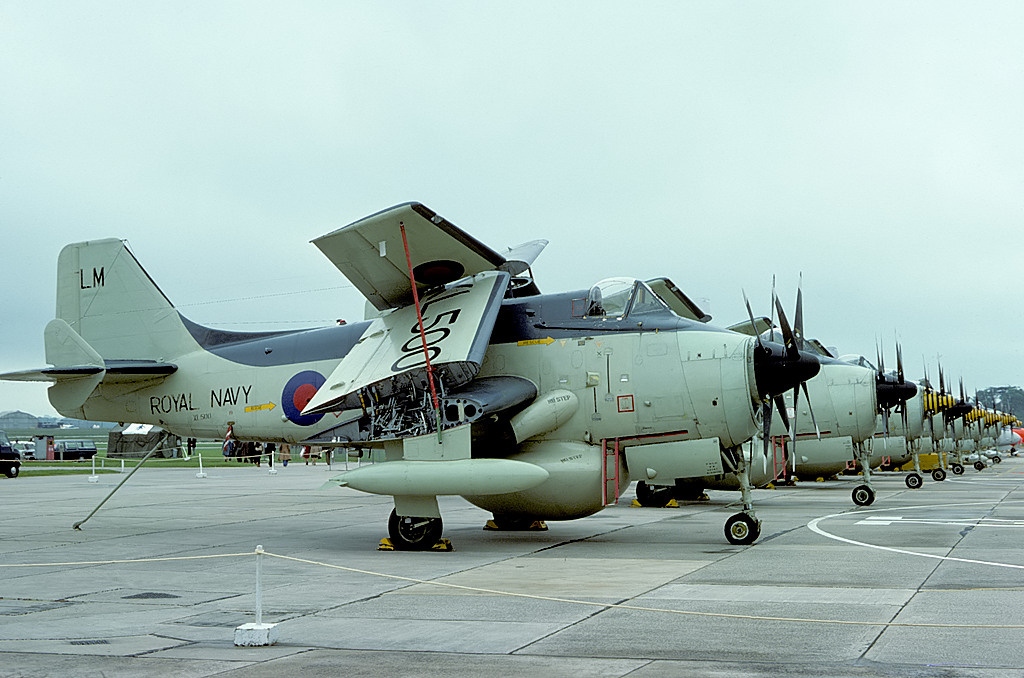
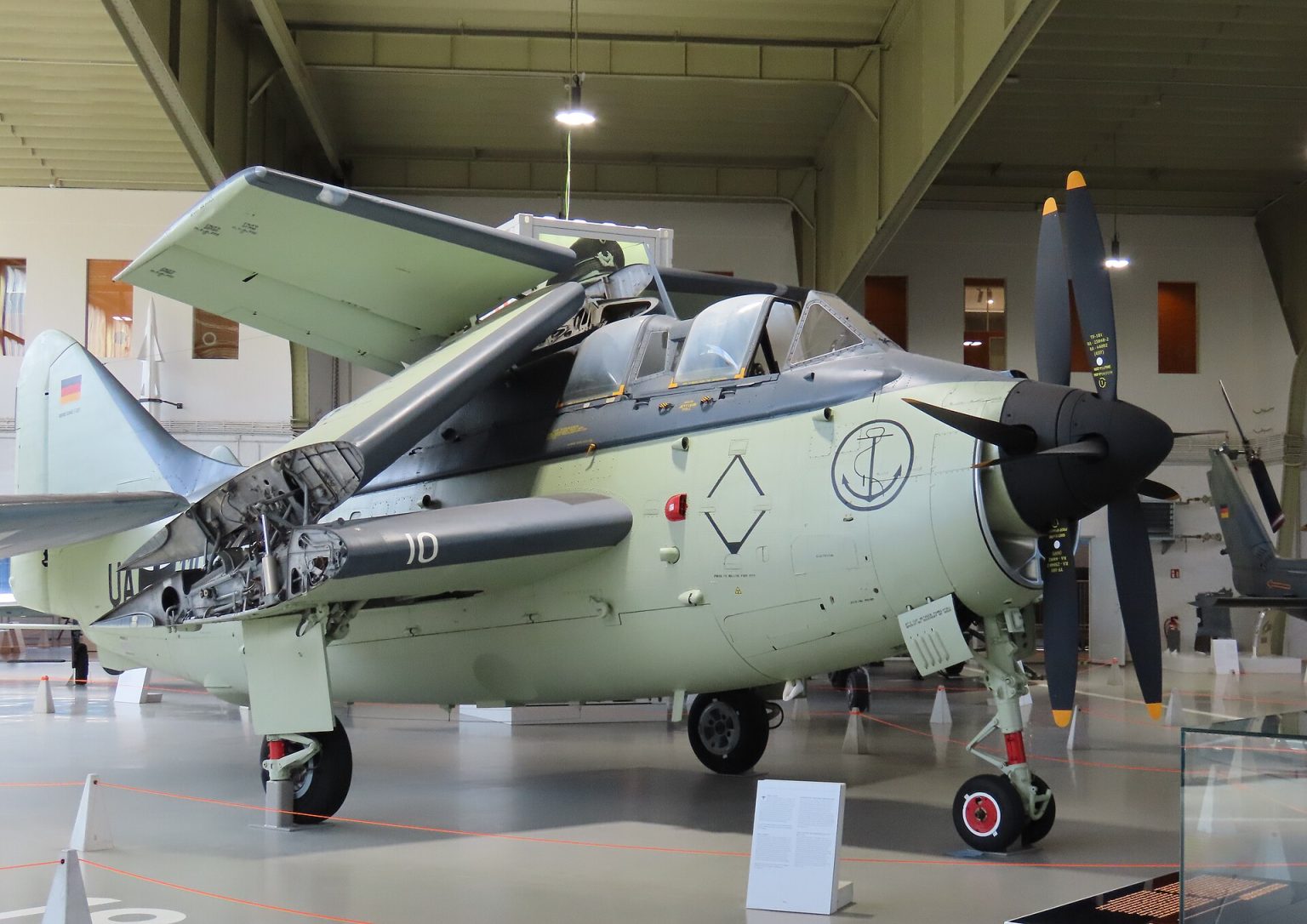
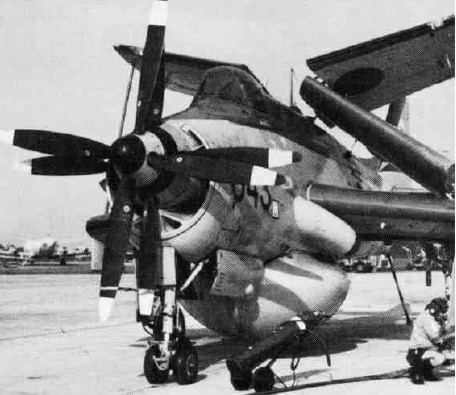
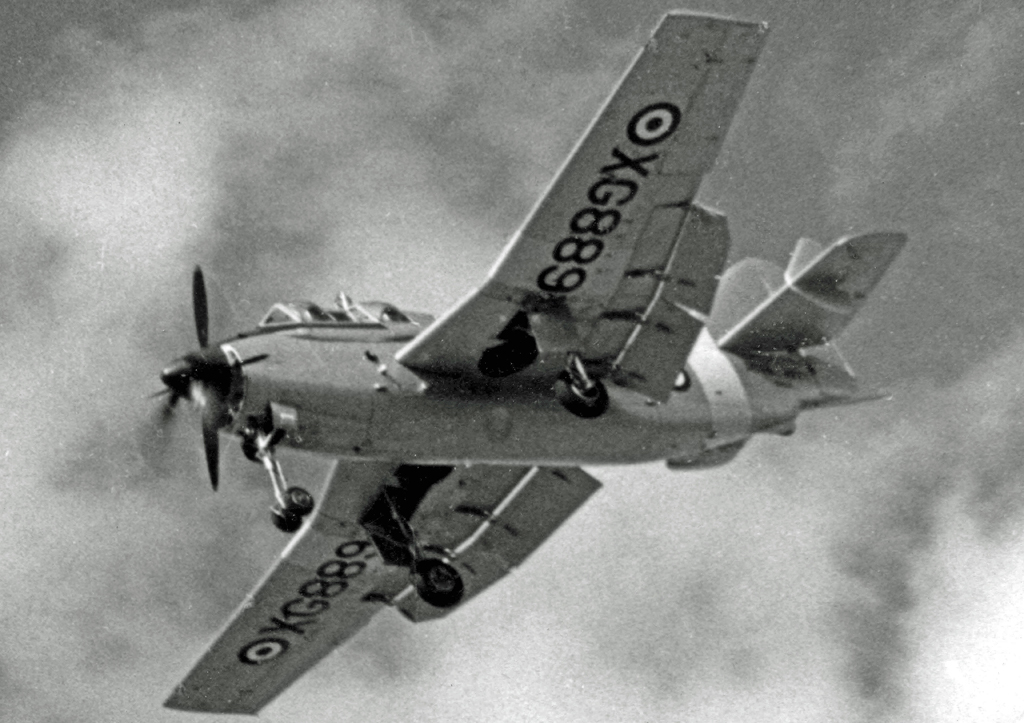
Royal Navy, US Navy and museum photographs of the Gannet and its variants, each credited to its source and licence. Click any photo to enlarge.
On Film
The Fairey Gannet on video: the fleet’s submarine-hunter
A documentary on the Gannet — its ingenious Double Mamba engine, its carrier anti-submarine mission and its later career as the Royal Navy’s airborne-early-warning radar picket.
“Anti-Submarine Aircraft | Fairey Gannet Search And Strike” by DroneScapes (approx. 40,000 views at time of writing; running time ~45 minutes) — a dedicated documentary on the Gannet’s design, engine and service.
Operations Overview
Where the Fairey Gannet flew: an operator map
Designed and built in the United Kingdom for the Royal Navy, and exported to Australia, West Germany and Indonesia. Toggle the categories; hover or tap a country for detail. Figures are approximate and hedged.
Categories: Design & Manufacture (United Kingdom) · Commonwealth Operator (Australia) · Export Operators (Germany, Indonesia) · Surviving Airframes (preserved in the UK, Australia and Germany). Operator list is approximate and hedged.
Service Record
The Gannet’s record: two roles, one clever airframe
The Gannet’s contribution was measured in decades of carrier service, a genuinely ingenious engine, and a capability whose loss became a hard lesson.
Questions & Answers
Fairey Gannet: your questions answered
Can I fly in a Fairey Gannet?
No — there is no bookable Gannet flight experience, and MiGFlug does not offer one. Many Gannets survive in museums, and a few have been kept in flying condition on the airshow circuit over the years, but these are rare, cherished aircraft rather than ride platforms. If what you actually want is the real thing — strapping into a genuine military aircraft and flying it — you very much can do that today in other types. MiGFlug arranges flights in real fighter jets and warbirds around the world. Start here: migflug.com/flights-prices.
What was special about the Fairey Gannet’s engine?
The Gannet was powered by the Armstrong Siddeley Double Mamba — effectively two Mamba turboprop engines mounted side by side and coupled to drive two contra-rotating propellers. The two halves could run independently, so for takeoff and dash both engines drove both propellers, but on patrol the crew could shut one engine down and feather its propeller, cruising economically on a single Mamba to greatly extend the aircraft’s endurance — ideal for long anti-submarine patrols.
What did the Fairey Gannet do?
The Gannet began as a carrier-borne anti-submarine aircraft, carrying search radar, sonobuoys and torpedoes to find and attack submarines from the deck of a Royal Navy carrier. From 1960 a heavily modified version, the AEW.3, took on a completely different role as an airborne-early-warning radar picket, carrying a large radar in an underslung radome to watch for threats far beyond the fleet’s own horizon. There were also carrier-delivery, electronic-warfare and trainer versions.
What was the Gannet AEW.3, and why did its retirement matter?
The AEW.3 was the airborne-early-warning Gannet, carrying the American AN/APS-20 radar in a big underslung radome to give the fleet radar cover over the horizon. It served the Royal Navy from 1960 until 1978, when it was retired along with the last large carrier, HMS Ark Royal. That left the Navy with no carrier-borne fixed-wing early warning — a gap felt sharply in the 1982 Falklands War, when British ships without airborne radar cover were caught by low-level air attacks. The Navy responded by fitting radars to Sea King helicopters as a stopgap.
Why did the Gannet have contra-rotating propellers?
The contra-rotating propellers — two sets turning in opposite directions on concentric shafts — let the Gannet absorb the Double Mamba’s considerable power while keeping the propeller diameter small enough for carrier use. They also cancelled out each other’s torque, making the aircraft docile and predictable to fly, which was essential for landing on a pitching carrier deck. And because each engine drove one propeller, the arrangement made the one-engine loiter possible.
Who operated the Fairey Gannet?
The Gannet was designed and built in the United Kingdom for the Royal Navy’s Fleet Air Arm, its principal operator. It was also exported: the Royal Australian Navy flew Gannets from the carrier HMAS Melbourne, the West German Bundesmarine used them for maritime patrol, and the Indonesian Navy operated the type as well. In all, four nations flew the Gannet.
How many Gannets were built, and do any survive?
Around 350 Gannets were built across all variants between the early 1950s and the early 1960s. Because the aircraft is so distinctive and so well loved by enthusiasts, a good number survive today — museum examples in Britain, Australia, Germany and elsewhere, spanning both the anti-submarine and airborne-early-warning versions, and a few were kept in flying condition for airshows over the years.
Was the Fairey Gannet a good aircraft?
Yes — it was a genuinely clever and effective carrier aircraft. Its Double Mamba engine, with the ability to loiter on one half, was ideally suited to long anti-submarine patrols, and the airframe was rugged and thoroughly practical for carrier life. When the anti-submarine role passed to helicopters, the same roomy airframe was successfully adapted into the AEW.3 radar picket, extending its career for years. Its main limitation was not the aircraft but the decision to retire the AEW.3 without a replacement — a gap that proved costly in 1982.
Fly For Real
You can’t fly the Fairey Gannet — but these, you can
No Gannet is a bookable ride today. The urge behind it — to strap into a real military aircraft and actually fly — is very much still bookable. MiGFlug puts you in genuine fighters and warbirds around the world.
Fighter Jet Flights
Take the controls of a real ex-military jet with an experienced pilot.
Warbird experiences
Fly in a genuine piston-engined warbird from the Gannet’s era.
All flights are operated by MiGFlug’s vetted partners with professional pilots. Browse every option and current pricing at migflug.com/flights-prices. MiGFlug does not operate Fairey Gannet flights — no bookable example exists.
Related Aircraft
If the Fairey Gannet interests you, explore these
Sources & Further Reading
Where this Fairey Gannet history comes from
Note on figures: dimensions, performance and production numbers for the Gannet vary between sources and by variant, and are hedged here as approximate. Cost fields are listed as not reliably recorded because trustworthy Cold War procurement cost data is not consistently available. Many Gannets survive in museums in Britain, Australia, Germany and elsewhere, and a small number have been kept airworthy for airshows.