
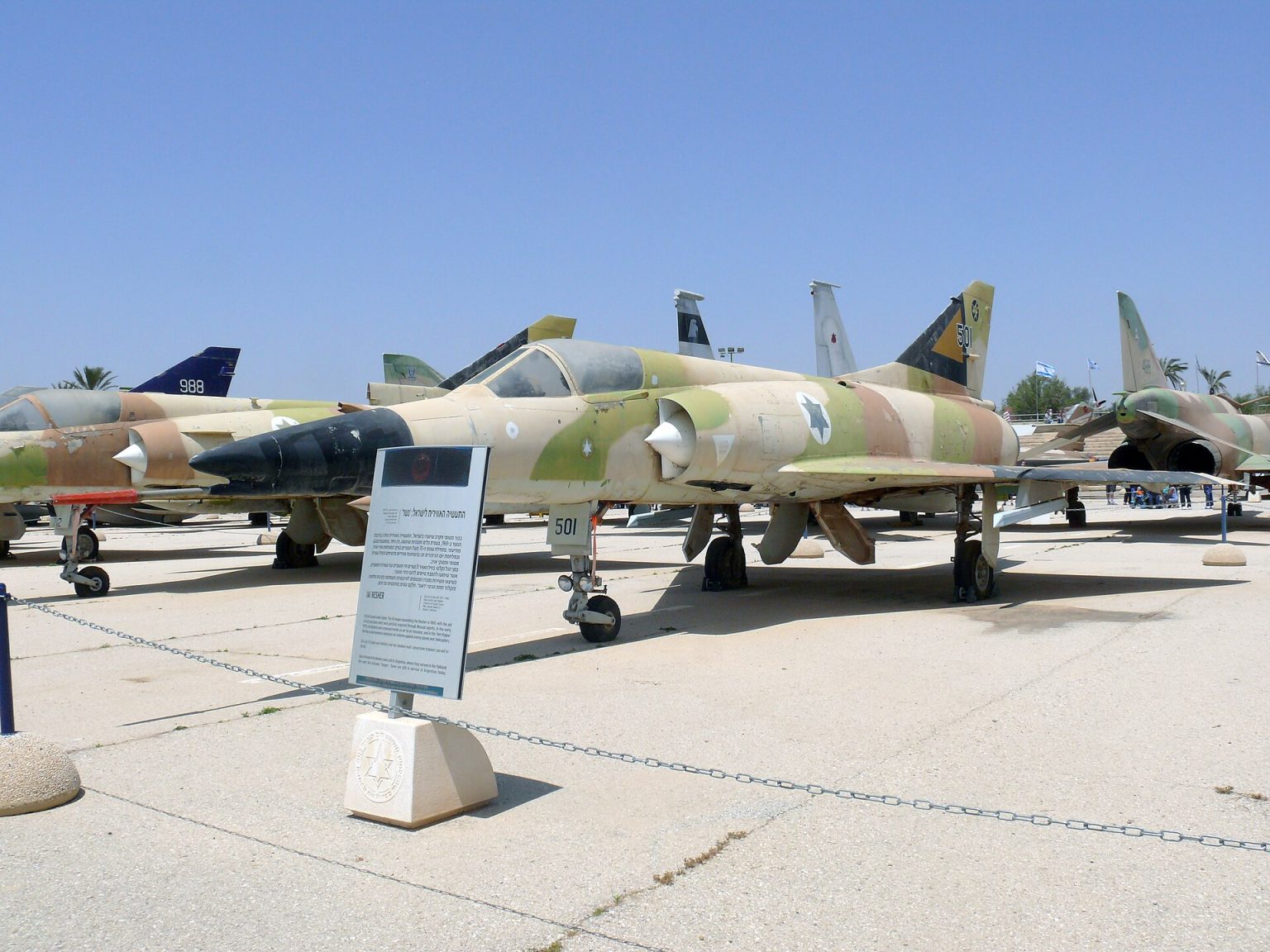
IAI Nesher
“Vulture”
Israel’s reverse-engineered Mirage 5 — built when France’s embargo cut off the jets Israel had already paid for, flown as a dogfighter over Sinai in 1973, and later sold to Argentina as the “Dagger” that fought in the Falklands.
The fighter Israel built when France said no
In June 1967, around the time of the Six-Day War, France — then Israel’s principal arms supplier — imposed an arms embargo. It was hardened in early 1969, and France retained 50 Mirage 5 fighters that Israel had already ordered and paid for. The Mirage 5 was itself a jet Dassault had developed to an Israeli requirement: a simplified, clear-weather ground-attack derivative of the Mirage III with less avionics and more fuel and payload. Denied the aircraft, Israel Aircraft Industries (IAI) set out to build its own.
The result was the Nesher (“Vulture”), essentially a locally built Mirage 5. Israel is widely reported to have obtained Mirage and Atar-engine documentation clandestinely — the most-cited channel being Alfred Frauenknecht, a Swiss engineer at a firm licence-building the Mirage, who was convicted of espionage in Switzerland in 1971. Exactly how much those plans contributed, versus IAI’s own engineering, is debated. The Nesher kept the delta airframe and the SNECMA Atar 9C engine, but added Israeli avionics, a Martin-Baker ejection seat and compatibility with the Israeli Shafrir air-to-air missile. The prototype first flew in 1969 (commonly dated to September) and the type entered service in 1971.
Its combat debut came in the October 1973 Yom Kippur War, where it flew as a frontline dogfighter alongside the French-built Mirage IIICJ and the F-4 Phantom. Israeli sources credit Nesher units with a large share of the war’s aerial victories — tallies of “over 100” kills are commonly repeated — but these are IAF claims, disputed by Arab and independent accounts, and hard to disentangle from the near-identical Mirage III.
By the late 1970s Israel had moved on to the more advanced, J79-powered IAI Kfir and began selling its Neshers to Argentina, which renamed them the Dagger. In 1982 Argentine Daggers flew strike missions against the British task force in the Falklands War, damaging several Royal Navy warships — though many of their bombs failed to explode — while losing roughly a dozen aircraft, most to Sea Harrier missiles. Argentina later upgraded its survivors to Finger standard and retired the last of them in 2015.
01The IAI Nesher’s origin: the French embargo and the Frauenknecht spy affair
France’s embargo left Israel not only without new aircraft but without 50 Mirage 5s it had bought and paid for. To reproduce the design, Israel is widely reported to have acquired large volumes of Mirage and Atar-engine documentation through Alfred Frauenknecht, a Swiss engineer whose employer built the Mirage and its engine under licence. Accounts commonly state he passed some 200,000 documents, smuggled out in crates, and was paid roughly $200,000; he was tried and convicted of espionage in Switzerland in 1971. Sources disagree on whether he supplied engine plans, airframe plans, or both, and on how decisive they were — IAI still had to engineer, tool and build a complete fighter. What is clear is that the Nesher marked Israel’s shift from arms importer to aircraft manufacturer, a path that led directly to the Kfir.
What makes it special
A fighter reverse-engineered under embargo
Cut off from Dassault, IAI built a near-identical Mirage 5 using clandestinely obtained plans plus its own engineering. Producing a Mach-2 fighter from scratch — airframe, tooling and assembly — was a landmark for a country that had until then only bought its combat aircraft, and it set the template for the indigenous Kfir that followed.
The Atar engine and the delta wing
The Nesher retained the Mirage’s SNECMA Atar 9C afterburning turbojet — roughly 60 kN in reheat — and its tailless delta wing. That made it fast (about Mach 2.1) and a hard-hitting energy fighter with twin 30 mm cannon, at the classic delta cost of high landing speeds and heavy energy bleed in a tight, slow turn.
Israeli avionics and Shafrir missiles
Where the French Mirage IIIC carried a radar-heavy interceptor fit, the Nesher was optimised as an austere clear-weather fighter-bomber: Israeli avionics, a Martin-Baker zero-zero seat and compatibility with the home-built Shafrir air-to-air missile, trading some electronics for range and payload. This “Israeli systems on a Mirage airframe” philosophy carried straight into the Kfir.
02The IAI Nesher’s delta wing: why it was fast but demanding to fly slow
The tailless delta gave the Nesher a large wing, high top speed and a simple, robust structure — but deltas trade that for poor low-speed behaviour. With no separate tailplane, pitch control came from the trailing-edge elevons, and pulling hard in a turn bled energy quickly while driving up induced drag. Approach and landing speeds were high. Israeli pilots consequently fought the Nesher as an energy fighter: keep the speed up, use the twin 30 mm DEFA cannon and Shafrir missiles in slashing attacks, and avoid being dragged into a slow, turning duel where the delta’s weaknesses showed.
03The IAI Nesher to Kfir: swapping a French heart for an American one
The Nesher’s successor, the IAI Kfir (“Lion Cub”), kept the Mirage-derived delta but replaced the French Atar with the more powerful American General Electric J79 — the same engine family as the F-4 Phantom. The bigger, hotter engine forced a widened and shortened rear fuselage, enlarged air intakes and a distinctive dorsal intake to feed cooling air; later versions added canards for agility. The Kfir entered Israeli service in 1975. The lineage is direct: the Nesher proved Israel could build the airframe, and the Kfir proved it could re-engineer one.
Full specifications
Baseline note: the figures below describe the Nesher S, the single-seat production aircraft that Israel Aircraft Industries built without a licence between 1969 and 1974. Deltas for the two-seat Nesher T, for the Argentine Dagger A of 1978 and for the rebuilt Finger are in grey. Five warnings belong in front of the tables, because the Nesher is one of the least well documented combat aircraft of its generation and the published data set is contaminated accordingly. First, the production split is routinely mis-stated. Sixty-one is the total, not the single-seat count: 51 single-seat Nesher S and 10 two-seat Nesher T. Anyone quoting 61 single-seaters plus 10 trainers has double-counted the trainers, and the error is common enough to have found its way into reference works. Second, the weights and the performance column are Mirage figures. An empty weight of 6,600 kg and a maximum take-off weight of 13,500 kg are the Dassault Mirage 5 numbers verbatim, and the speed, climb and ceiling entries are the Mirage III family set carried forward. The Nesher programme was covert, IAI published nothing resembling a flight-test report, and no independent measurement of an Israeli-built airframe has ever entered the public record. Treat the whole of the performance table as inherited French paperwork rather than as data taken off the aeroplane. Third, the first-flight date. September 1969 is the date almost universally given for the first Nesher, and the brief for this page uses it; a minority of references date the first flight to 21 March 1971 instead. What is firmer is the delivery record: the first aircraft reached the Israeli Air Force in May 1971 and the name Nesher — eagle, or more precisely vulture — was formalised in November 1971. A programme run to defeat an embargo does not leave a tidy paper trail, and the 1969 date rests on Israeli recollection rather than on a document. Fourth, the drawings. The story that Israel built the Nesher from blueprints stolen in Switzerland is the best-known part of this aeroplane and the least settled. Alfred Frauenknecht, a senior engineer at Sulzer AG in Winterthur, which held the Swiss licence to build the SNECMA Atar 9C for the Mirage IIIS, was recruited by an Israeli attaché in 1968 and shipped out some 200,000 documents and drawings in 24 crates by substituting waste paper for the originals he was supposed to incinerate. He was arrested in September 1969, tried in April 1971 and sentenced to four and a half years. That much is court record. What the court record does not establish is that those drawings built the Nesher: Frauenknecht sat in the engine department, and an engine is not an airframe. Rival accounts hold that Israel already had complete Mirage 5 documentation as the launch customer, or that Dassault quietly supplied jigs, fixtures and components through third parties. Israeli officials, including a former air force commander, have publicly disputed the theft narrative. Nobody has produced the decisive document, and this page treats all three accounts as live. Fifth, the engines. Where the Atar 9Cs came from is a genuine gap. Israel had a stock of engines and spares supporting its Mirage IIICJ fleet, Bet Shemesh Engines in Israel had the industrial capacity to overhaul and to make hot-section parts, and the embargo was leaky. No source establishes how 61 airframes were engined, and any confident answer should be distrusted.
Dimensions & weights
- Crew
- 1 — the Nesher T seated two in tandem under a lengthened canopy, at the cost of forward-fuselage fuel; four Dagger B two-seaters went to Argentina.
- Length
- 15.65 m (51 ft 4 in) — 15.55 m (51 ft 0 in) is also published. The slim ogival nose is the Mirage 5 signature, about half a metre longer than the radar-equipped Mirage IIIC.
- Wingspan
- 8.22 m (27 ft 0 in)
- Height
- 4.25 m (13 ft 11 in)
- Wing area
- 34.80 m² (375 sq ft)
- Wing
- Tailless delta, leading edge swept 60° 34′, thickness ratio about 3.5 per cent at the root — no tailplane, no flaps, elevons doing the work of both.
- Empty weight
- 6,600 kg (14,551 lb) — the Mirage 5 figure. An airframe with Israeli avionics, an Israeli seat and Israeli wiring did not weigh exactly what the French one weighed.
- Normal take-off weight
- 9,600 kg (21,164 lb), clean with full internal fuel and two air-to-air missiles
- Maximum take-off weight
- 13,500 kg (29,762 lb) — 13,700 kg (30,200 lb) is quoted for the Mirage 5 and for the Atlas Cheetah rebuild of the same airframe.
- Internal fuel
- ~3,330 litres (~880 US gal; ~2,660 kg / 5,860 lb) — the Mirage 5 gained roughly 500 litres over the Mirage IIIE by filling the space the intercept radar had occupied.
- Maximum external stores
- ~4,200 kg (~9,260 lb) — a paper maximum. No operational Nesher or Dagger sortie approached it, because fuel always came first.
- Hardpoints
- 7 — one centreline and six underwing. Two of the underwing stations were the Mirage 5 additions; the outboard pair were rated for light stores and missiles only.
- Wing loading
- 388 kg/m² (79 lb/sq ft) at maximum take-off weight; 276 kg/m² (57 lb/sq ft) at normal take-off weight
Performance
- Maximum speed, altitude
- Mach 2.1 (2,230 km/h; 1,386 mph) at 12,000 m (39,370 ft), clean
- Maximum speed, sea level
- Mach 1.13 (1,390 km/h; 863 mph) — and irrelevant to the way the aircraft was actually flown in 1982, when Daggers crossed the water at 900 km/h (560 mph) and 15 m (50 ft).
- Rate of climb
- 83 m/s (16,300 ft/min) at sea level
- Time to 11,000 m
- 3 minutes (to 36,090 ft) — the Mirage III family figure; the delta climbed superbly and turned badly, which is the whole story of the aeroplane.
- Service ceiling
- 17,680 m (58,010 ft)
- Range
- 1,300 km (810 miles; 700 nmi) — this is the figure the standard tables give, and it is plainly a mission range rather than a clean ferry range. A Mirage 5 with three tanks could be flown far further.
- Combat range
- 1,186 km (737 miles; 640 nmi) with 4,700 litres in drop tanks, two air-to-air missiles and 1,180 kg (2,600 lb) of bombs
- Combat radius, Falklands profile
- ~700 km (~435 miles) from Río Grande or San Julián to Falkland Sound. With no refuelling probe and no tanker cleared for the type, this bought perhaps five minutes over the target and no second pass.
- Take-off run
- 700 m (2,300 ft) clean; 1,600 m (5,250 ft) at maximum weight — Mirage III/5 family figures. The delta needed runway, which is why the type was never based on the Falklands themselves.
- Landing run
- 700 m (2,300 ft) with the brake parachute streamed; the approach speed of a tailless delta is high and unforgiving.
- Design load factor
- +7 g — and the delta bleeds energy so fast in a sustained turn that the structural limit was rarely the constraint.
- Thrust-to-weight ratio
- 0.66 at normal take-off weight with afterburner; 0.46 at maximum take-off weight
Propulsion & systems
- Engine
- One SNECMA Atar 9C single-shaft afterburning turbojet — a 1950s design, simple, tolerant of abuse and thirsty. The Kfir replaced it with the General Electric J79, which is the single change that separates the two aircraft.
- Thrust, dry
- 41.97 kN (9,436 lbf)
- Thrust, with afterburner
- 60.8 kN (13,670 lbf) — 60.89 kN (13,690 lbf) is also published; the difference is rounding, not two engines.
- Engine provenance
- Contested — Sulzer AG of Winterthur held the Swiss licence to build the Atar 9C for the Mirage IIIS, and Bet Shemesh Engines in Israel overhauled Atars and made hot-section parts. How 61 embargoed airframes were engined has never been documented.
- Air intakes
- Fixed side intakes with translating half-cone centrebodies (the Dassault souris), scheduled with Mach number to hold the shock on the lip
- Radar
- None as built — the defining Mirage 5 deletion. The Nesher had no intercept radar and no all-weather capability; it was a clear-air day fighter and a visual bomber, and in 1973 over Sinai that was enough.
- Nav/attack
- Israeli-built weapon-aiming computer and head-up display, twin-gyro platform, Tacan — a genuinely better fit than the French original, and the reason the Nesher outfought Mirages flown by its neighbours.
- Argentine avionics
- The Finger rebuild from 1983 added the Elta EL/M-2001B ranging radar, a new central computer and a new head-up display — the radar the Mirage 5 had been designed without.
- Flight controls
- Fully powered elevons and rudder, artificial feel, no tailplane and no flaps — a tailless delta trades landing speed and turning energy for an easy ride at Mach 2.
- Hydraulics
- Two independent 207 bar (3,000 psi) systems, each able to fly the aircraft home
- Ejection seat
- Martin-Baker zero-zero — Israeli accounts credit the Nesher with replacing the Mirage III’s original French seat, and the change is repeated everywhere, but no primary source confirms the exact mark.
- Deceleration
- Brake parachute in a fairing at the base of the rudder, plus an arrester hook for runway barriers
- Countermeasures
- None as built — Argentine Fingers later carried chaff and flare dispensers. In 1982 the Daggers flew into the Royal Navy’s missile envelope with nothing but height, speed and luck.
04The IAI Nesher’s operating costs: why no reliable price exists
The Nesher was an Israeli state programme, built to escape an embargo rather than to be sold on an open market, so a firm flyaway unit price simply does not exist in the public record. It was, in effect, a domestically produced Mirage 5, and period Mirage-family costs place fighters of the class in the low single-digit millions of US dollars in 1970s terms — but any precise figure attached to a Nesher should be read as an order-of-magnitude estimate, not a sourced price. No credible cost-per-flight-hour number for the type exists in open sources either. The later Argentine Dagger and Finger were acquired and upgraded under separate arrangements whose costs are likewise not cleanly documented.
Armament & payload
The Nesher fought with two cannon and one Israeli missile, and the Dagger went to war in 1982 with bombs whose fuzes could not keep up with the way it had to be flown
The Nesher carried almost nothing that Dassault had not already put on a Mirage 5: two DEFA 552 revolver cannon in the belly, iron bombs, rocket pods and drop tanks. The one Israeli addition mattered enormously. The Rafael Shafrir 2 entered service in 1971, and in the Yom Kippur War it was credited with 89 kills from 176 launches — a hit rate above one in two, at a time when the American AIM-9D was doing far worse in Vietnam. A cheap rear-aspect infra-red missile that actually worked, bolted to a light day fighter with a good gunsight, is the entire technical explanation for the Nesher’s 1973 record.
The Argentine Dagger inherited that armament unchanged and then discovered its limits over Falkland Sound. Grupo 6 de Caza flew anti-shipping strikes it had never trained for, at heights chosen to defeat Sea Dart and Rapier rather than to arm a bomb. British-pattern 1,000 lb and Mk 82 500 lb bombs released from fifteen metres did not have the seconds of fall their fuzes needed. Bombs went through frigates and out the far side. HMS Antrim took a 1,000 lb bomb on 21 May that passed through the Sea Slug magazine and came to rest in the after heads without exploding; on 8 June five Daggers put four or five bombs into HMS Plymouth, none of which detonated, though one set off a depth charge on the flight deck and started a fire that took ninety minutes to put out. Thirteen bombs in all struck British ships during the campaign without exploding. A retired Royal Air Force officer’s remark that "six better fuzes and we would have lost" is quoted constantly and overstates the case, but not by much.
What the aircraft never got was a guided air-to-surface weapon of any kind. There was no laser designator, no targeting pod, no television-guided glide bomb, nothing between the gunsight and the target but the pilot’s eye. The Finger rebuild of the 1980s gave the survivors a radar, a computer and a head-up display, and left the weapons exactly where they had been in 1969. Weapon fits differed sharply by operator and by decade: an Israeli Nesher of 1973 was a Shafrir-armed air-superiority fighter, a 1982 Dagger A was a bomb truck with a self-defence missile it had almost no chance to use, and a 1995 Finger IIIB was a radar-equipped ground-attack aircraft carrying the same iron bombs.
Gun — two 30 mm DEFA revolver cannon, and the reason several kills cost nothing
- Two DEFA 552 30 mm revolver cannon in the lower forward fuselage, about 1,300 rounds a minute each, built in Israel by IAI.
- Ammunition is usually given as 140 rounds per gun for the Nesher against the Mirage III’s standard 125; the higher figure is repeated widely and rests on Israeli sources rather than a French loading chart.
- Roughly six seconds of firing across both guns. The 30 mm shell is heavy and slow, which suits one well-aimed pass and punishes a pilot who sprays.
- On 1 May 1982 Daggers strafed HMS Arrow with cannon and wounded a sailor — the first British casualty of the campaign, inflicted by guns rather than bombs.
- The guns stayed through every rebuild. Neither the Nesher T nor the Dagger B lost them, because both were expected to fight.
Air-to-air — the Shafrir 2, the missile that made the aeroplane
- Rafael Shafrir 2: 93 kg (205 lb), rear-aspect infra-red seeker, effective to about 5 km (3 miles), in service from 1971. Credited with 89 kills from 176 firings in the 1973 war.
- AIM-9D and AIM-9G Sidewinder were also carried by Israeli Neshers, and were generally thought inferior to the Shafrir in Israeli hands.
- Argentina received 350 Shafrir 2 rounds in 1981 and took them to war in 1982. Daggers fired them at Sea Harriers and scored nothing; the geometry of a rear-aspect missile fired head-on by an aircraft with no radar and no warning receiver is hopeless.
- The Nesher carried no radar-guided weapon of any kind. The Matra R.530 that armed French and other Mirage IIIs was never part of the fit, because there was no radar to guide it.
- Typical air-to-air load was two missiles on the inboard wing pylons with the centreline and outboard stations left for fuel — a light, clean aeroplane, which is how it was flown in 1973.
Air-to-surface guided — none, in any mark, for the whole 46-year career
- This card is kept because the absence is the point. No Nesher, Dagger or Finger ever carried a guided air-to-surface weapon in service.
- No targeting pod was ever fitted, so laser-guided bombs were not merely unavailable but structurally impossible without a buddy designator the Argentine air force did not have.
- The AS-30 laser and AS-30L missiles that Argentina obtained in 1982 came with the ten Peruvian Mirage 5P transferred during the war, and belonged to that fleet rather than to the Daggers.
- The Finger programme of 1981 onward was a navigation-and-fire-control upgrade, not a weapons upgrade. It made the same bombs land closer; it did not make them smart.
- By comparison the Israeli Kfir, the Nesher’s direct successor, did eventually carry precision weapons — one measure of how far the two branches of the family diverged after 1975.
Bombs — iron, unretarded, and dropped too low to arm
- Standard Argentine strike load in 1982 was two 1,000 lb bombs on the inboard pylons, or three 500 lb Mk 82, with two 1,300-litre tanks outboard.
- Much of the Argentine stock was British-manufactured or British-pattern, bought before the war — one of the campaign’s tidier ironies.
- The fuzing failure was arithmetic, not sabotage. Retarded and free-fall bombs alike need a minimum time of fall to arm; released at 15 m (50 ft) from an aircraft at 900 km/h (560 mph) there was no such time, and thirteen bombs struck British ships without going off.
- Argentine armourers improvised retarding devices and better fuze settings during the campaign, and by 8 June low-level attacks were working better — the Plymouth strike still produced no detonations, but the Skyhawk attacks at Fitzroy the same day were murderous.
- Napalm and cluster munitions appear in Argentine inventories of the period but not in the documented Dagger sorties over the islands; treat any specific claim of a Dagger cluster attack as unproven.
Rockets — French pods, inherited and rarely fired
- Matra 68 mm SNEB rocket pods of 18 or 36 tubes, the standard Mirage-family fit, cleared on the inboard and centre wing stations.
- The Matra JL-100 combined pod — 18 SNEB rockets in the nose and 250 litres of fuel behind them — was a Mirage 5 signature store, buying range and firepower on the same pylon.
- Argentine Daggers and Fingers used rockets extensively in the training and close-air-support role at Tandil and Río Cuarto for three decades after 1982.
- Rockets played almost no part in the Falklands campaign: against warships they were useless, and against troops ashore the Daggers were too short of fuel to loiter.
- No air-to-ground rocket ever gave the type a stand-off capability worth the name; every rocket pass put the aircraft inside small-arms range.
Pods & other stores — fuel, mostly, because there was never enough of it
- Drop tanks of 500, 1,300 and 1,700 litres; the standard Falklands fit was two 1,300-litre tanks, which still left about five minutes over the target.
- No refuelling probe. The Dagger was the only major Argentine strike type that could not tank, and that single omission shaped every mission profile of the campaign.
- No reconnaissance pod entered Argentine service on the type; the Mirage 5’s camera-nosed variants were a separate airframe that Israel never built as a Nesher.
- Chaff and flare dispensers were fitted to Fingers after 1982. The 1982 Daggers had no radar warning receiver and no countermeasures at all.
- The Finger’s Elta EL/M-2001B was an internal ranging radar rather than a pod, and gave the aircraft accurate ranging for guns and bombs for the first time.
Three typical loadouts
- Air superiority, Sinai, October 1973 — Nesher S
- Two Shafrir 2 on the inboard wing pylons, one 1,300-litre centreline tank, 280 rounds of 30 mm. Clean, light, and flown in pairs at medium altitude under ground control. This is the configuration in which the type made its reputation.
- Anti-shipping strike, Falkland Sound, 21 May 1982 — Dagger A
- Two 1,000 lb bombs inboard, two 1,300-litre tanks outboard, one Shafrir 2 for self-defence, guns loaded. Launched from Río Grande or San Julián, run in at 15 m (50 ft), one pass, no second attempt, and roughly 700 km (435 miles) of open water home.
- Close air support training, Tandil, 1990s — Finger IIIB
- Two SNEB rocket pods or four Mk 82 retarded bombs, one centreline tank, ranging radar and head-up display doing the aiming. The aircraft the Falklands veterans should have had in 1982, delivered a decade late and never used in anger.
Sourcing caveat: no operational weapons manual for the Nesher, Dagger or Finger has been published. Israeli figures come from air force and Rafael accounts that are self-reported and not independently audited; Argentine figures come from Fuerza Aérea Argentina unit histories and from the amilarg airframe registry, which are unusually good on serials and dates and thin on ordnance. British accounts of the 1982 bomb failures are far better documented than either, because the Royal Navy examined the unexploded bombs at leisure. Where the three disagree, this page says so rather than averaging them.
Variants
One embargoed French fighter became an Israeli one, an Argentine one and, by way of a bigger engine, the Kfir
The Nesher exists because of a date. Israel ordered 50 Mirage 5J ground-attack fighters in 1966, paid for them, and watched Charles de Gaulle embargo the delivery in June 1967 and harden the embargo into a total ban in January 1969. The aircraft were built and sat on French soil; Israel eventually took a refund, and the airframes went into French service as the Mirage 5F. Israel Aircraft Industries then built the aeroplane anyway. Whether it did so from stolen Swiss drawings, from documentation it already legitimately held as the Mirage 5 launch customer, or with Dassault’s quiet connivance through third parties, is the argument this page declines to settle.
The line runs forward as clearly as it runs backward. The Nesher was always understood at IAI as an interim aeroplane: put the airframe into production first, then put a better engine in it. That engine was the General Electric J79, available to Israel because the F-4E Phantom came with a manufacturing licence. A two-seat J79 testbed flew in September 1970 and a re-engined Nesher in September 1971; the definitive prototype flew in June 1973 and the IAI Kfir entered service in 1975. The Kfir is not a relative of the Nesher, it is the Nesher with a different engine, a wider rear fuselage to hold it, a dorsal air scoop to cool it and, from the C.2, canards to fix what the extra weight did to the handling. The same airframe went on to a third life in South Africa as the Atlas Cheetah.
The Argentine chapter began when the Kfir made the Nesher surplus. Thirty-nine airframes crossed the Atlantic as the Dagger, entered service with Grupo 6 de Caza, fought the Royal Navy in 1982, and were then rebuilt under Argentina’s own SINT programme into the Finger. That the Fuerza Aérea Argentina kept them flying until 2015 — 46 years after the first airframe left the ground, on a design frozen in 1956 — says as much about Argentine maintenance and about the arms embargo Argentina lived under after the war as it does about the aeroplane.
- Dassault Mirage 5J (50 ordered 1966, embargoed 1967–69, none delivered)
- The aircraft that never arrived: a Mirage IIIE with the intercept radar deleted, the freed volume filled with fuel, two extra pylons and a longer nose. Built, paid for, impounded, refunded, and absorbed into the Armée de l’Air as the Mirage 5F.
- Nesher S (prototype flight usually dated September 1969; 51 built to 1974)
- The single-seat production aircraft and the baseline for this page. Mirage 5 airframe and Atar 9C engine, Israeli avionics, Israeli gunsight, Israeli ejection seat. First delivery May 1971; named Nesher in November 1971.
- Nesher T (10 built)
- Two-seat conversion trainer with a stepped tandem cockpit, retaining both cannon and full combat capability. The trainers are inside the total of 61, not additional to it.
- Dagger A (Argentina, 35 aircraft, delivered from November 1978)
- Refurbished ex-Israeli Nesher S, serials in the C-401 to C-437 range, delivered in two lots and taken on charge by Grupo 6 de Caza. Unmodified apart from overhaul and Argentine radios; no refuelling probe, no radar, no countermeasures.
- Dagger B (Argentina, 4 aircraft: C-425, C-426, C-438, C-439)
- Ex-Nesher T two-seaters. Thirty-nine airframes in total went to Argentina — 35 single-seat and 4 two-seat — not 39 single-seaters plus 4 trainers.
- Finger I (prototype, C-408 redesignated 17 October 1982)
- First aircraft of Project SINT, the Sistema Integrado de Navegación y Tiro launched in 1981 and accelerated by the war. Flew in 1983 with a new central computer and head-up display.
- Finger II (from 1984)
- Second standard, taking in more of the Argentine-written software and instrument changes. Only a handful of airframes passed through this state before the definitive standards arrived.
- Finger IIIA (from 1985)
- The first full rebuild: Elta EL/M-2001B ranging radar in the nose, new weapon-aiming computer, revised cockpit. This is where the Dagger finally acquired the radar the Mirage 5 had been designed to do without.
- Finger IIIB (from 1986; the majority of survivors)
- Definitive standard and the mark that served to 2015. British-sourced Ferranti and Marconi components, unobtainable after 1982, were replaced with French Thomson-CSF equivalents and Argentine-built units — a rebuild driven as much by the post-war embargo as by capability.
- Finger IV (claimed; not corroborated)
- A Finger IV appears in secondary sources and in the brief for this page, but the Argentine airframe registry records only Finger I, II, IIIA and IIIB against individual serials. Until a Finger IV airframe can be named, treat the four-step sequence as a tidying-up of a three-step one.
- IAI Kfir (J79-engined successor; prototype June 1973, in service 1975, 220-odd built)
- Not a separate design but the Nesher re-engined and re-skinned around the General Electric J79, with the canards of the C.2 arriving in 1976. Every Kfir, and by extension every South African Atlas Cheetah, descends directly from the airframe described above.
Disposition. Nothing of this family flies. Israel withdrew the Nesher between 1977 and the early 1980s as Kfir C.2s replaced it squadron by squadron — 113 Squadron converted from 1976, 144 Squadron held its Neshers longest and gave them up after moving to Ovda — and the bulk of the fleet was sold on to Argentina between November 1978 and 1981 rather than scrapped. The Fuerza Aérea Argentina flew the last sortie in late November 2015 after 43 years of family service and about 131,000 airframe hours; the withdrawal date recorded against surviving Argentine serials is 28 November 2015, while the farewell ceremony at Tandil is generally dated the 29th. Of the 39 airframes delivered to Argentina, 11 were lost in combat in 1982 and more to three decades of peacetime attrition; the number still airworthy at the stand-down is usually put at around a dozen, and no official figure has been published. Survivors are museum pieces and gate guards in Israel — principally at the Israeli Air Force Museum at Hatzerim — and in Argentina at Tandil, Río Cuarto and the Museo Nacional de Aeronáutica at Morón. Every one of them is an original airframe: no reproduction Nesher, Dagger or Finger has ever been built, and the type is too recent and too closely held for replicas to exist. Two cautions for anyone reading a preserved aircraft’s markings. An Argentine survivor painted in 1982 colours is almost certainly a Finger, a rebuilt aircraft carrying avionics that did not exist during the war; and several wear the serials and unit marks of machines that were shot down over the islands, as memorials rather than as claims of provenance.
From embargo workaround to Falklands veteran
The embargo begins
Around the Six-Day War, France imposes an arms embargo on Israel, its main supplier of combat aircraft.
Embargo hardened
France keeps 50 Mirage 5s Israel had paid for. IAI begins building its own copy; the Nesher prototype flies, commonly dated to September.
Service entry & spy trial
The Nesher enters Israeli service. In Switzerland, engineer Alfred Frauenknecht is tried for passing Mirage documentation to Israel.
Yom Kippur War
The Nesher fights as a frontline dogfighter alongside the Mirage IIICJ; Israel claims a large share of aerial victories (figures disputed).
The Kfir arrives
The J79-powered IAI Kfir, developed from the Nesher, enters Israeli service and begins to supersede it.
Sold to Argentina
Israel sells about 39 retired Neshers to Argentina, which renames them the “Dagger.”
The Falklands War
Argentine Daggers fly strike missions against the British task force, damaging several warships but losing about a dozen aircraft.
The last Fingers retire
Argentina withdraws its upgraded Finger fleet after some 37 years — the end of the Nesher’s operational story.
From the cockpit: twelve Nesher stories
The crates out of Switzerland
A Swiss engineer smuggled a fighter’s documentation past his own government.
Read the full story
The jets Israel paid for but never got
Fifty fighters, bought and grounded on French soil.
Read the full story
Twins in the sky
Two different fighters no one on the ground could tell apart.
Read the full story
“Over a hundred” — but whose count?
A dazzling kill tally that independent historians will not fully sign off on.
Read the full story
The delta’s bargain
Fast and deadly in a straight line — but do not get slow.
Read the full story
An American heart for a French body
To fly further and harder, Israel swapped the engine — and reshaped the jet.
Read the full story
Bomb Alley, 21 May
Argentine deltas ran the gauntlet of San Carlos Water.
Read the full story
The bombs that did not go off
Argentina’s biggest problem was not aim — it was fuzing.
Read the full story
HMS Ardent’s last day
Daggers gutted her superstructure; she sank the next morning.
Read the full story
The Sea Harrier problem
The all-aspect Sidewinder turned the Argentine delta’s day sour.
Read the full story
From Dagger to Finger
Argentina kept upgrading the old delta for three more decades.
Read the full story
A ceremony in 2015
The book closes on the Mirage 5’s Israeli offspring.
Read the full story
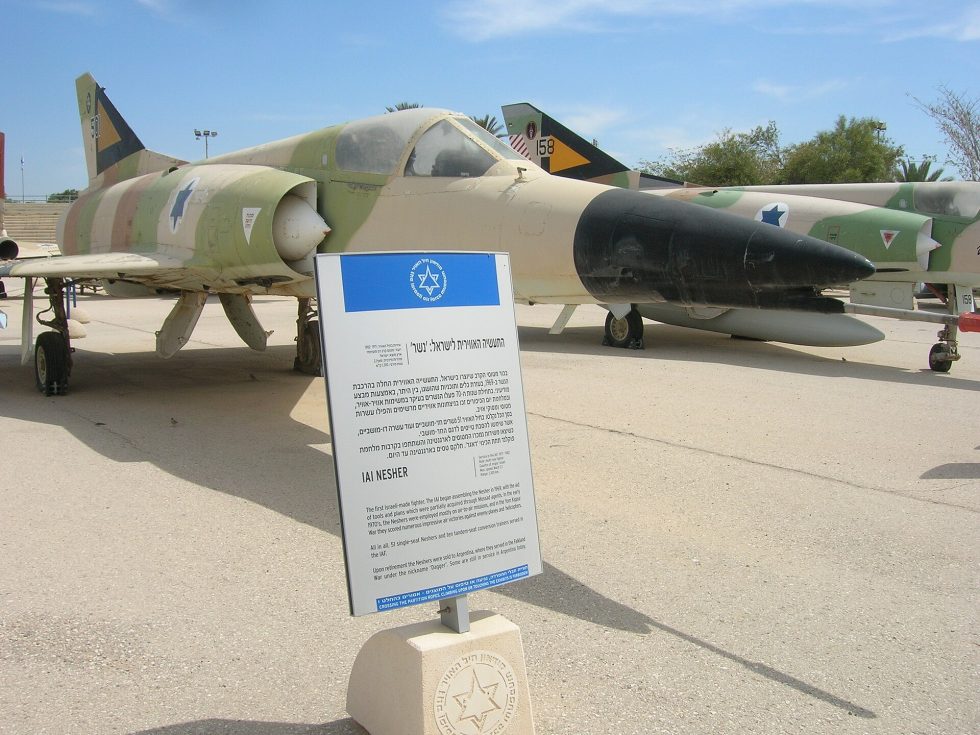
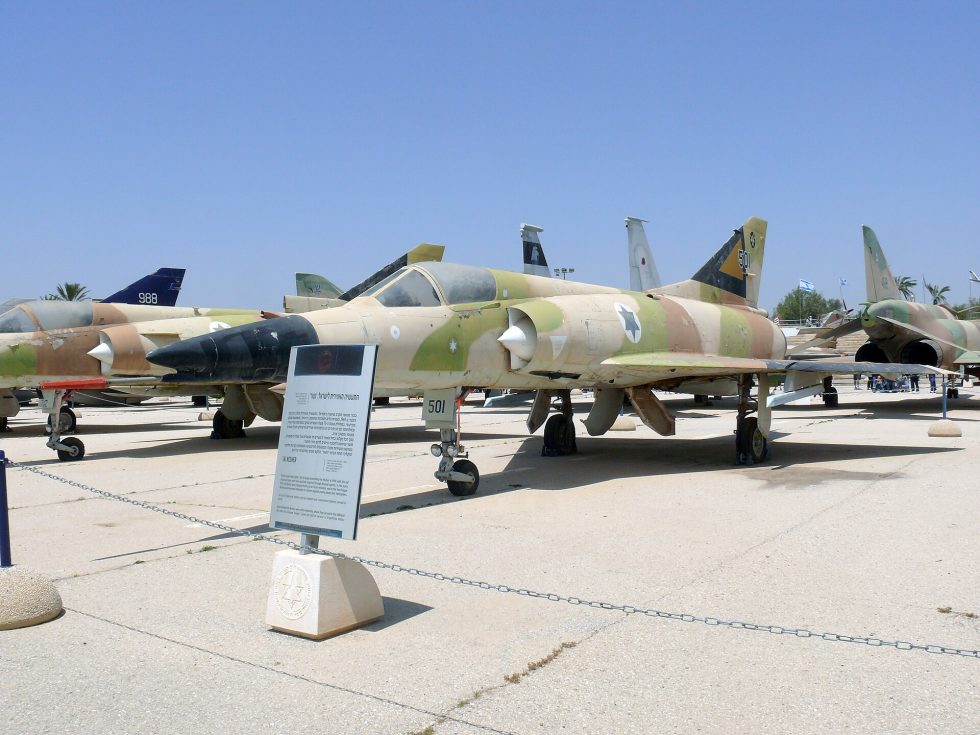
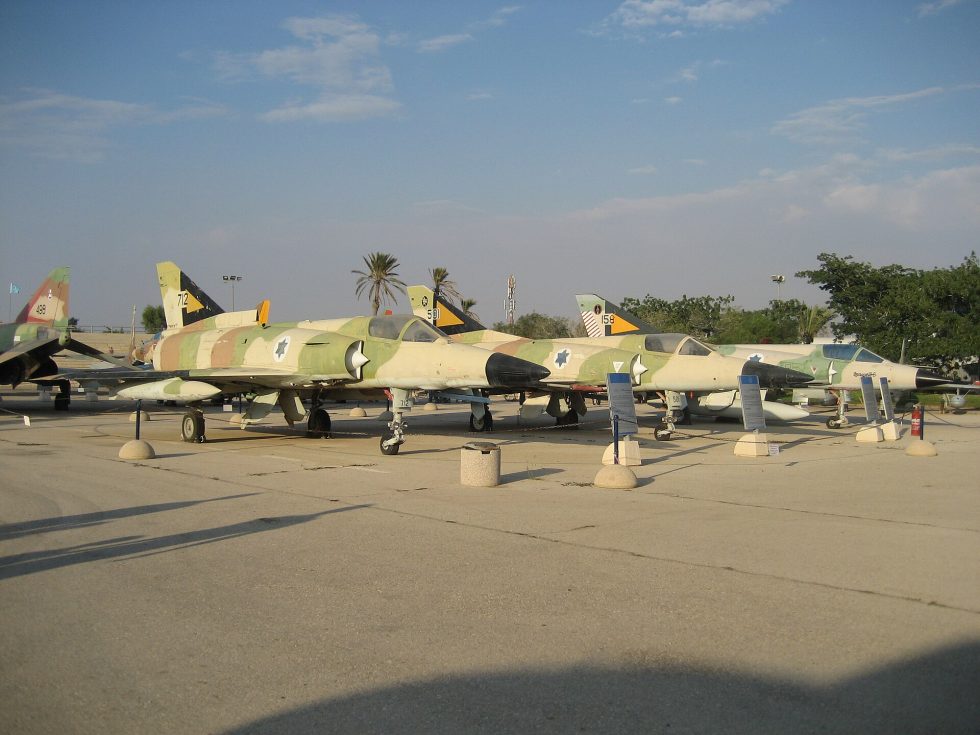
The Nesher and Dagger in pictures
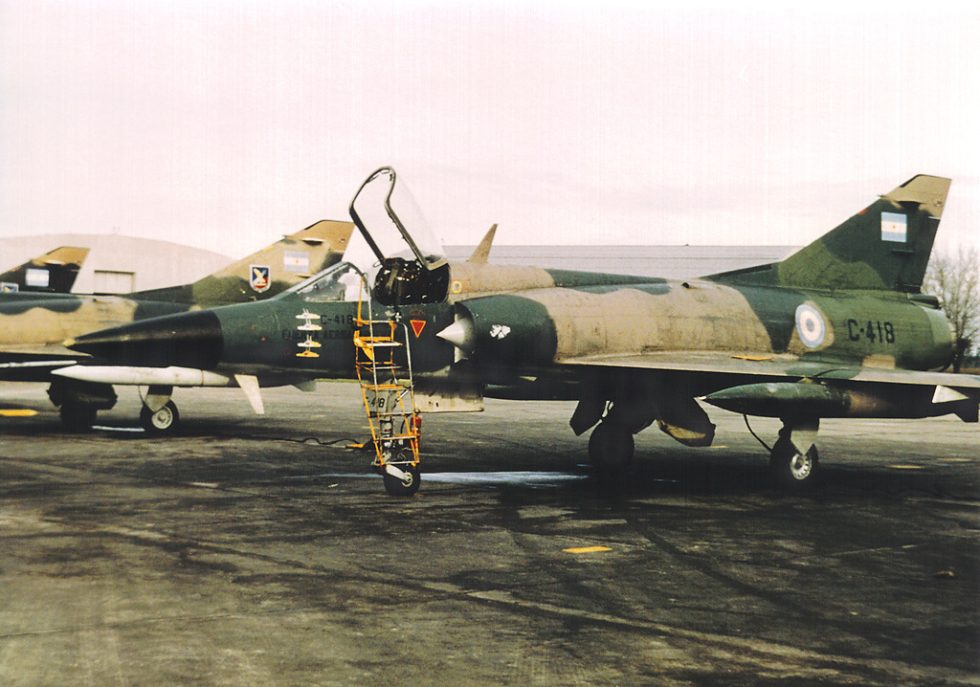
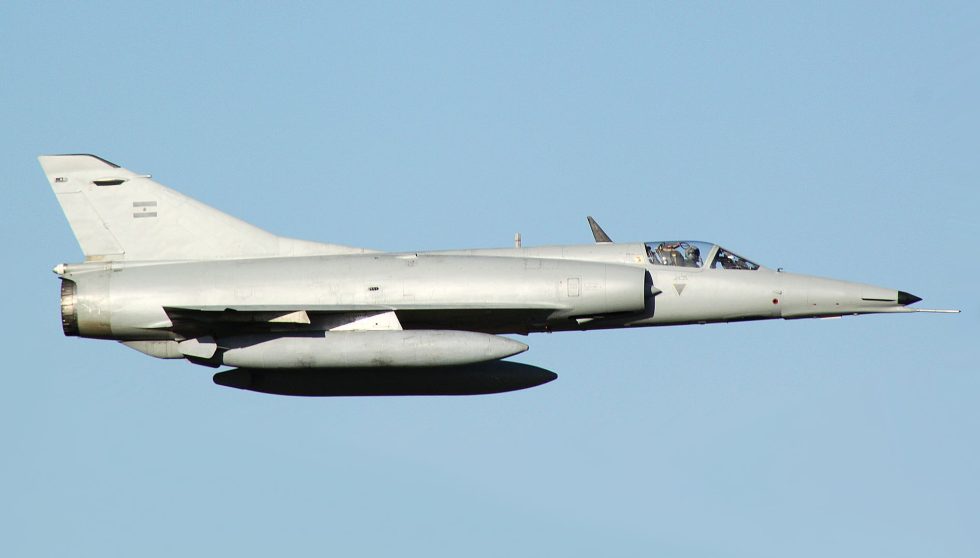
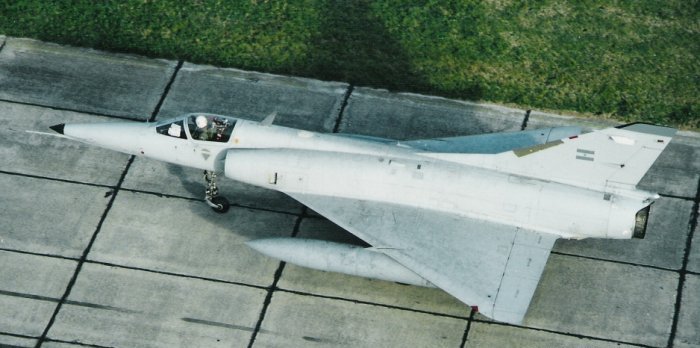
The Nesher in motion
A dedicated, high-quality video feature on the IAI Nesher is coming soon. In the meantime, explore the photo gallery above and the operations map below.
Where the Nesher and Dagger flew
The score that defines it
The Nesher’s record spans two very different wars fought under two flags. As an Israeli dogfighter it saw heavy air combat in 1973; as the Argentine Dagger it flew anti-ship strikes in 1982. Both chapters come with figures that are contested — treat the numbers below as commonly cited claims rather than settled fact.
Compare the combat record of every military aircraft. Figures as of July 2026 and, where noted, contested.
Everything people ask about the IAI Nesher
Can I fly in a Nesher?
How fast was the IAI Nesher?
Was the Nesher really a copied Mirage?
Did the Nesher fight in the Yom Kippur War?
What is the Dagger, and the Falklands connection?
What replaced the Nesher?
Is the Nesher still in service anywhere?
You can’t fly the Nesher.
These, you can.
Some legends only live in museums — others are fuelled and waiting. MiGFlug has put civilians in real military jet cockpits since 2004.
 Fly the L-39 AlbatrosThe world’s most-flown jet trainer — aerobatics included
 Fly the F-104 Starfighter“The missile with a man in it”
 Fly the MiG-21The Cold War’s most-produced jet
 Fly the T-33 Shooting StarAmerica’s first jet trainer
 Fly the DH VampireA piece of early jet history
 Fly the S.211Agile Italian jet trainer
 Fly the MB-326The classic Aermacchi jet
 Fly the MiG-15The Soviet legend of the Korean War
Continue the tour
Every fact, checked
- Jewish Telegraphic Agency archiveContemporary 1971 reporting on the Frauenknecht espionage trial and the Mirage documentation.
- 19FortyFiveThe embargo, the Nesher-to-Kfir engine change and the Frauenknecht affair.
- The Aviation Geek ClubThe Dagger attack on HMS Ardent, the unexploded bombs and the Sea Harrier loss.
- Smithsonian MagazineOverview of the 1982 Falklands air campaign and Sea Harrier versus Argentine strike aircraft.
- MilitaryFactory — IAI NesherConsolidated specifications, dimensions, engine data and service dates.
- Jewish Virtual LibraryIsraeli Air Force perspective on 1973 air combat (used as a claims source, hedged).
- Israel Aerospace IndustriesCorporate history of IAI’s move from importer to fighter manufacturer.
- Royal Air Force MuseumReference for the Falklands air war and the aircraft involved.