
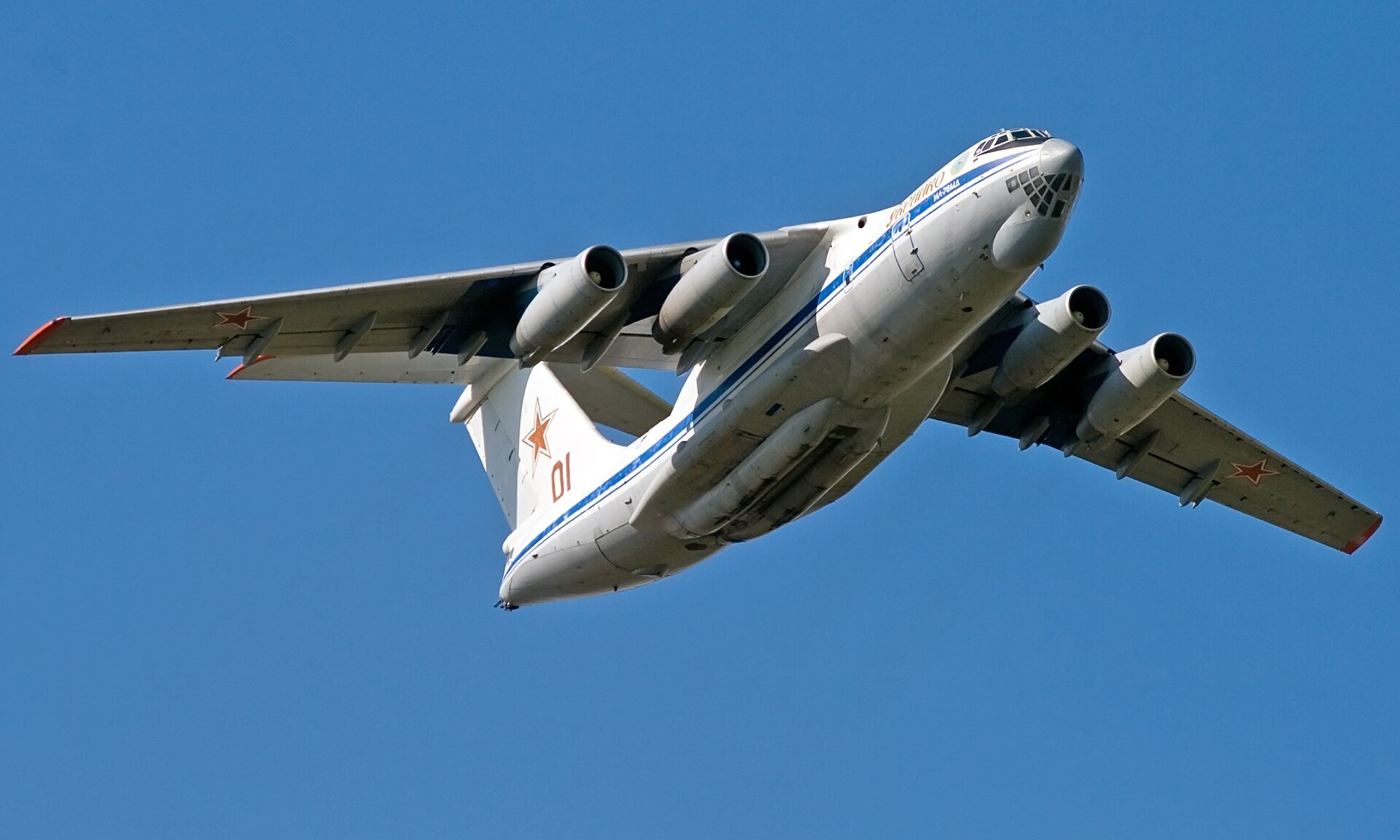
Ilyushin Il-76
Candid
The Soviet answer to the C-141 and C-5: a high-wing jet freighter built to carry 40 tonnes from rough strips, which became the workhorse of the Soviet airlift, the Afghan war and half the world’s cargo charters.
The Il-76: how Moscow built its own heavy airlifter
In the mid-1960s Soviet planners watched the United States move whole divisions by air to Vietnam and drew an uncomfortable conclusion: the turboprop An-12 could not do the same. At the end of June 1966 the Ministry of Aviation Industry instructed the Ilyushin design bureau to create a jet military transport able to carry 40 tonnes over 5,000 km and operate from unprepared strips. The result looked like a family relation of Lockheed’s C-141 Starlifter, with a high, swept wing, a T-tail and four podded engines, but Soviet officials at the time compared it with the much larger C-5A. It first flew from Moscow on 25 March 1971 and was shown at the Paris Air Show the same year.
What set the Il-76 apart was where it was meant to land. Its main gear carries four bogies with low-pressure tyres, twenty wheels in all, so that a fully loaded freighter can use packed earth and short concrete. A glazed navigator’s station in the nose, a tail gun position on military versions and an internal cargo-handling system made it self-sufficient far from a proper airport. The Soviet air force accepted it in 1974, NATO named it “Candid”, and series production at the Tashkent aircraft plant in Uzbekistan rose until more than 950 had been built by the late 1990s. The heavier Il-76MD of the early 1980s became the standard military model.
The Il-76 then did the hard, unglamorous work of a superpower. Between 1979 and 1991 Soviet Il-76s made some 14,700 flights into Afghanistan, carrying hundreds of thousands of troops and over 300,000 tonnes of freight, according to GlobalSecurity’s summary of Russian figures. The airframe also became the basis of the A-50 radar aircraft and the Il-78 tanker. When the Soviet Union broke up, hundreds of Candids passed to airlines, charter firms and air forces from Algeria to China, and the type became a fixture of disaster relief, peacekeeping and the less visible corners of the cargo trade. A modernised Il-76MD-90A now rolls out of Ulyanovsk, more than half a century after the prototype first flew.
01The Il-76 in Afghanistan: the air bridge to Kabul and Bagram
The Soviet war in Afghanistan was, above all, a logistics war, and the Il-76 carried much of it. Over the twelve years from 1979, Soviet Il-76s flew some 14,700 sorties into the country, moving about 786,200 servicemen and 315,800 tonnes of freight, according to figures summarised by GlobalSecurity. The routes from Tashkent and other Central Asian bases into Kabul, Bagram, Shindand and Kandahar crossed some of the most dangerous terrain any airlifter has worked over.
Arrival was the hazardous part. Once the mujahideen received shoulder-launched missiles, transport crews adopted steep spiralling descents over the airfield, staying high until the last moment and dropping flares to decoy heat-seeking weapons. Departures were flown the same way in reverse. The tactic, later copied by Western crews flying into Baghdad and Kabul, kept losses down but did not eliminate them, and the Il-76 proved vulnerable when caught low. It nonetheless remained the backbone of the Soviet supply chain to the end, and in February 1989 it was among the types that flew the last troops and their equipment home.
02The Il-76 after the Soviet Union: freighter for hire
The break-up of the USSR in 1991 scattered the Candid fleet. Aircraft ended up in Russia, Ukraine, Belarus, Uzbekistan, Kazakhstan and other successor states, and many were quickly put to work by new cargo airlines. Through the 1990s and 2000s the Il-76 became the aircraft of choice for outsize charter work across Africa, the Middle East and Central Asia, carrying everything from oil-field equipment to relief supplies for the United Nations and aid agencies.
The same ubiquity gave the type a darker reputation. Investigators and journalists have repeatedly linked chartered Il-76s to arms shipments into conflict zones, and ageing aircraft operated by small firms with little oversight suffered a string of accidents. At the same time the Russian emergencies ministry, EMERCOM, turned the Il-76 into a large firefighting water bomber with internal tanks, and Russian, Indian and Chinese air forces kept large military fleets in service. Few transports have served such a range of masters at once.
What makes the Il-76 special
Built for dirt runways
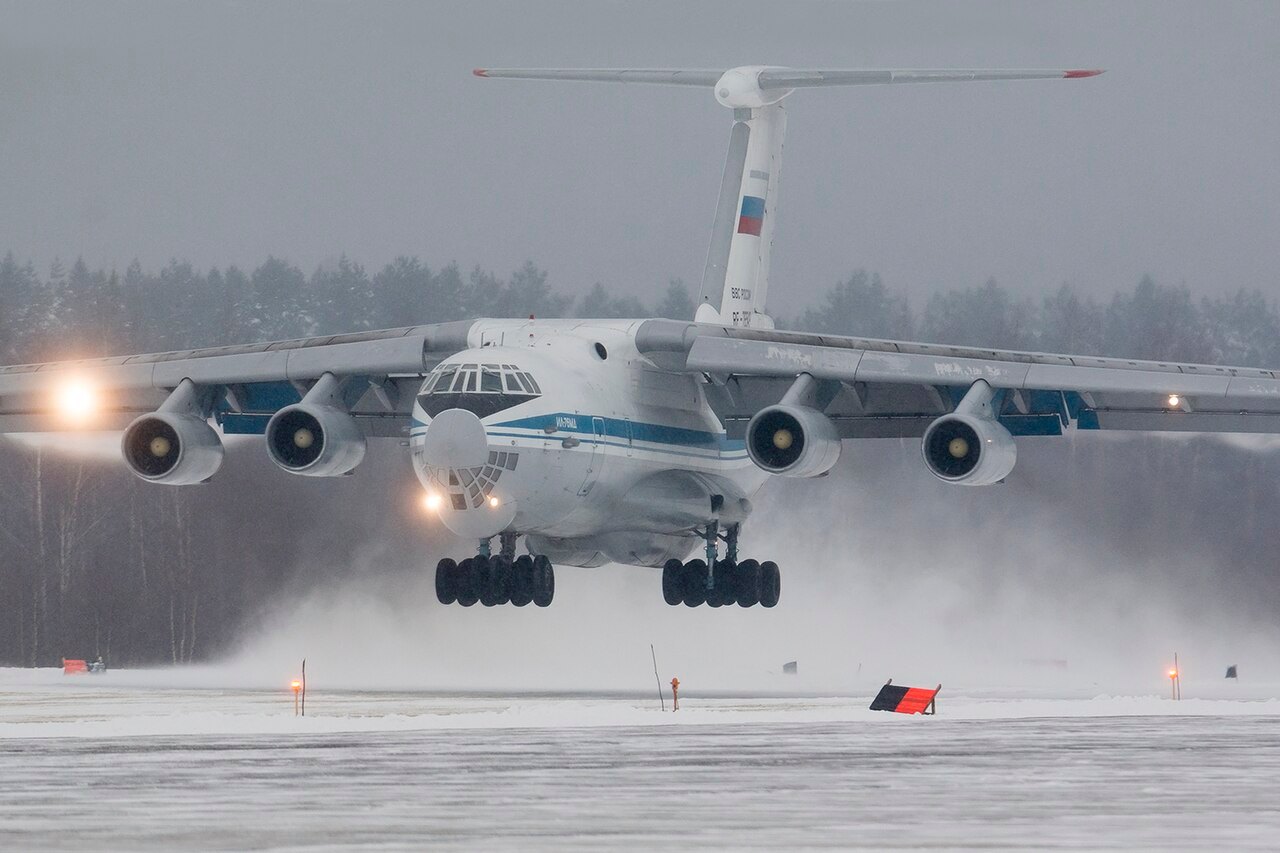
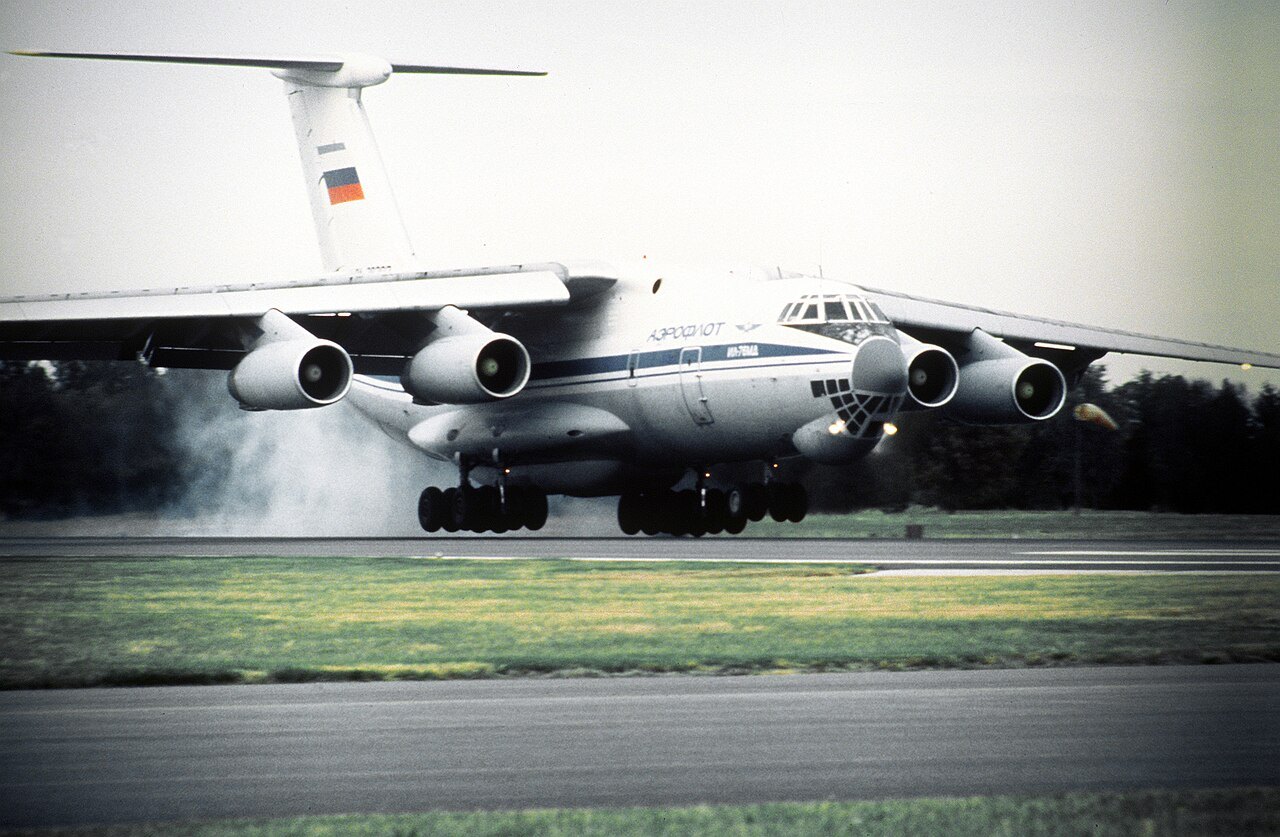
The Il-76’s defining feature is its undercarriage: a nose unit with four wheels and four main-gear legs carrying four wheels each, twenty in total, with low-pressure tyres whose inflation could be adjusted for the surface. Combined with powerful flaps and slats, it lets a heavy jet operate from unpaved or short strips that would wreck a converted airliner. Russian sources give a take-off run of around 1,600 m on concrete for the Il-76M at heavy weights.
A glass nose and a navigator
Below the flight deck sits a glazed nose station for the navigator, a feature inherited from Soviet bomber practice and essential for low-level paradrops and navigation over featureless terrain. Beneath it is a ground-mapping radar. Military versions carried a tail turret with twin 23 mm cannon, manned by a gunner who was also responsible for watching the rear. The standard crew of seven reflects a design built to operate independently, with minimal help from the ground.
A hold with its own cranes
The hold measures about 20 m long, 3.46 m wide and 3.4 m high, according to GlobalSecurity, and is loaded through a rear ramp and clamshell doors. Overhead winches and cranes allow the crew to load heavy vehicles and pallets without ground equipment. Configurations include 150 fully equipped troops or 120 paratroops, armoured vehicles, or roll-on palletised cargo. The pressurised cabin also made the aircraft suitable for medical evacuation flights.
03The Il-76’s family: from A-50 radar plane to Il-78 tanker
- Il-76: initial military transport, 1974.
- Il-76M: improved military version with higher weights.
- Il-76MD: heavier military model of the early 1980s with uprated D-30KP-2 engines and greater fuel; payload around 47 to 48 tonnes. The definitive Cold War version.
- Il-76T / TD: civil freighters without the tail turret.
- Il-76MF / TF: fuselage stretched by 6.6 m with PS-90A-76 engines.
- Il-76MD-90A (Il-476): modernised military version built at Ulyanovsk with PS-90A-76 engines and a glass cockpit; first flight 2012.
- Il-78 “Midas”: three-point probe-and-drogue tanker, in service from 1987; around 50 built at Tashkent.
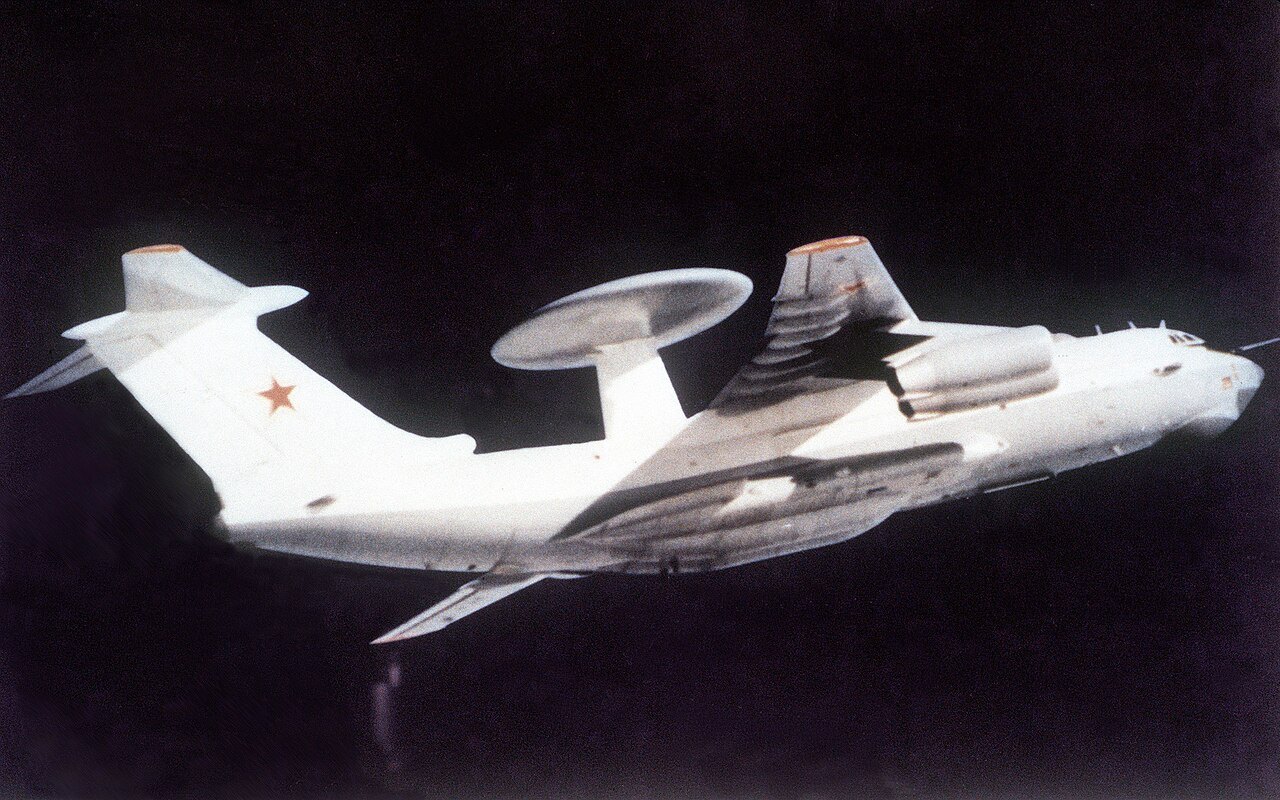
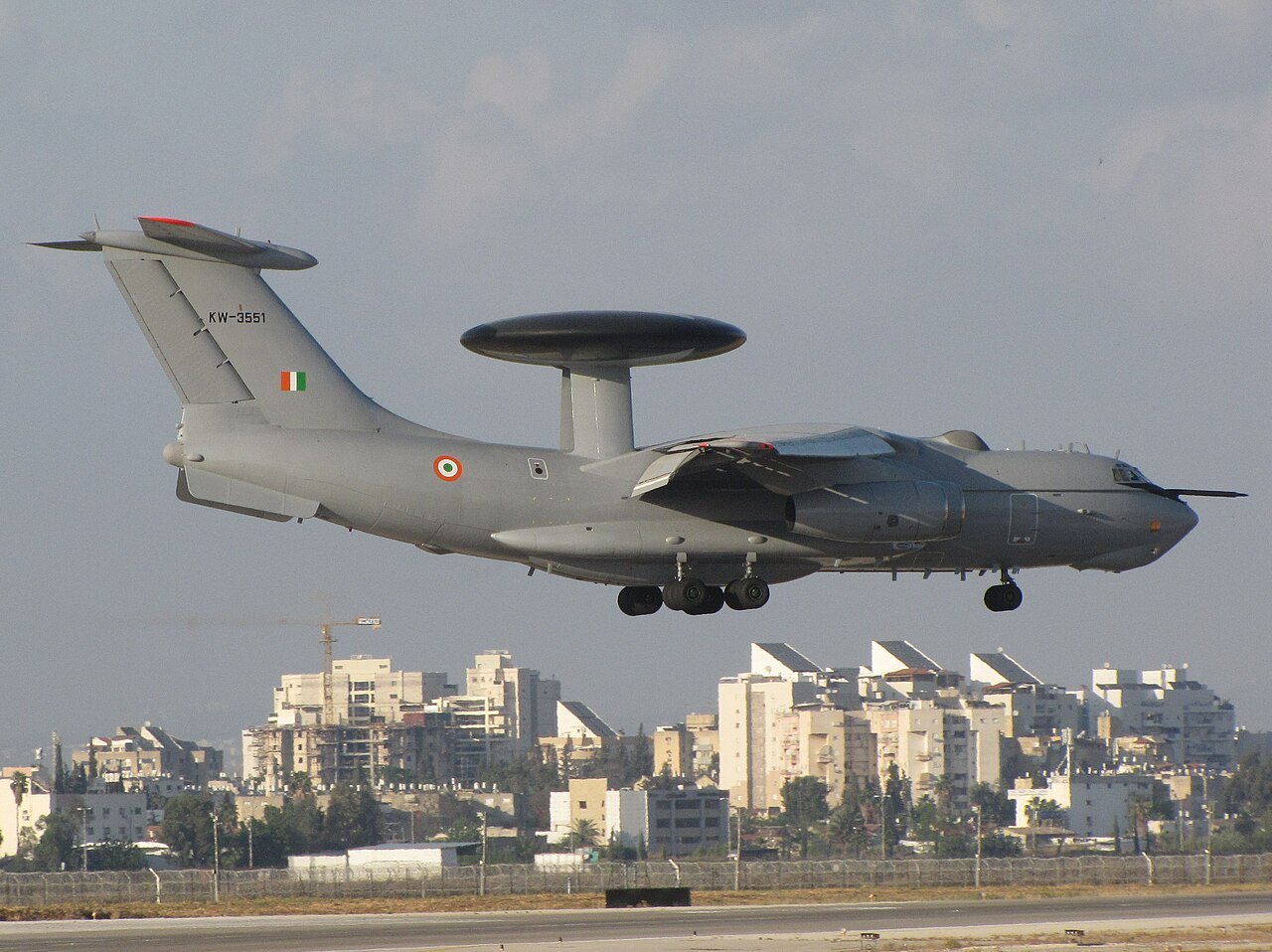
- A-50 “Mainstay”: Beriev airborne early warning aircraft with a rotating radome; first flew around 1980 and adopted in 1984. Modernised as the A-50M and A-50U. India’s A-50EI carries an Israeli radar on the same airframe.
- Il-76MDK: modified for zero-gravity parabolic flights in cosmonaut training.
- Firefighting, research and special-mission conversions.
Ilyushin Il-76MD specifications
Specifications
- Crew
- 5 to 7 (pilots, navigator, flight engineer, radio operator, loadmaster; gunner on early military versions)
- Length
- 46.6 m (152 ft 10 in)
- Wingspan
- 50.5 m (165 ft 8 in)
- Height
- 14.76 m (48 ft 5 in)
- Max take-off weight
- about 190,000 kg (418,900 lb) for the Il-76MD; 170,000 kg (374,800 lb) for the Il-76M
- Payload
- up to about 47,000 kg (103,600 lb)
- Powerplant
- 4 × Soloviev D-30KP turbofans, 12,000 kgf (117.7 kN, 26,500 lbf) each
- Cruise speed
- 760–800 km/h (410–430 kn) at 9,000–12,000 m
- Range
- about 3,000–4,000 km (1,600–2,200 nmi) with maximum payload; about 6,100 km (3,300 nmi) with 20 t
- Take-off run
- about 1,600 m (5,250 ft) on concrete
- Hold
- about 20 m × 3.46 m × 3.4 m (65 ft 7 in × 11 ft 4 in × 11 ft 2 in)
- Capacity
- 150 troops or 120 paratroops
- Armament
- early military versions: 2 × 23 mm GSh-23L cannon in tail turret
Costs & production
- Unit cost
- No reliable current list price is published; export Il-78 tankers have been estimated at roughly US$25–35 million (GlobalSecurity), and new-build Il-76MD-90A costs are not openly disclosed
- Cost per flight hour
- Hedged estimate: roughly US$10,000–15,000, based on a fuel burn commonly given as 7–9 tonnes an hour for four D-30KP engines plus crew and maintenance; charter rates vary widely
- Production
- More than 950 built by the late 1990s, mainly at Tashkent; MD-90A production at Aviastar-SP, Ulyanovsk
- Programme
- Ordered 1966; first flight 1971; service entry 1974; 2012 order for 39 Il-76MD-90A later cut to 14 by 2028
04The Il-76’s operating costs: cheap to buy, thirsty to fly
For much of the post-Soviet era the Il-76 was the cheapest way to move outsize cargo by air. Second-hand airframes were plentiful and inexpensive, crews were available, and the aircraft could use runways that bigger Western freighters could not. That price advantage was offset by its 1960s-technology engines: four low-bypass D-30KP turbofans are thirsty and noisy, and noise rules eventually barred unmodified aircraft from many European airports.
We give a hedged range of around US$10,000 to 15,000 per flight hour, combining fuel burn of several tonnes per hour with crew and maintenance; real figures depend heavily on fuel prices, the operator and the condition of the airframe. The PS-90A-76 engines of the Il-76MD-90A are quieter and more efficient, but Russia’s new-build programme has delivered slowly: GlobalSecurity reports that a 2012 order for 39 aircraft was renegotiated in 2020 to just 14 by 2028.
The Il-76 from Ilyushin drawing board to Ulyanovsk
Order to Ilyushin
The Ministry of Aviation Industry instructs Ilyushin to design a jet military transport for 40 t over 5,000 km.
First flight
The prototype flies from Moscow on 25 March and appears at the Paris Air Show.
Service entry
The Soviet air force formally accepts the Il-76; NATO names it Candid.
Afghanistan
Il-76s begin the air bridge that will run until the Soviet withdrawal in 1989.
A-50 adopted
The Il-76-based A-50 Mainstay radar aircraft enters Soviet service.
Il-78 tanker
The Il-78 Midas tanker version enters service.
Kandahar hostage crew
Taliban fighters force down a Russian-crewed Il-76 freighter; the crew escapes a year later.
Charkhi Dadri collision
A Kazakh Il-76 and a Saudi Boeing 747 collide near Delhi, killing all 349 aboard both aircraft.
Il-76MD-90A flies
The modernised version built at Ulyanovsk makes its first flight.
War losses
Ukraine claims the destruction of A-50 radar aircraft; an Il-76 is shot down near Belgorod in disputed circumstances.
Stories & eyewitnesses: the Il-76 at work
Spiralling into Kabul
The descent that Il-76 crews made famous.
Read the full story
Kandahar, 1995: the crew who flew themselves out
A year as hostages, then an escape in their own aircraft.
Read the full story
Charkhi Dadri: the deadliest mid-air collision
An Il-76 and a Boeing 747 over northern India.
Read the full story
Fourteen thousand flights to Afghanistan
The numbers behind the Soviet air bridge.
Read the full story
The A-50: a radar on a Candid
Ilyushin’s airframe became the Soviet AWACS.
Read the full story
2024: the A-50 losses over the Sea of Azov
Ukraine claimed two of Russia’s scarce radar aircraft.
Read the full story
Luhansk, 2014
The heaviest single loss of the Ukrainian military that year.
Read the full story
The water bomber
EMERCOM turned the freighter into a firefighter.
Read the full story
Weightless over Moscow
Cosmonauts learned zero gravity inside an Il-76.
Read the full story
The Il-76 in pictures
Where the Il-76 flies and flew
The Il-76’s record
The Il-76 is a support aircraft, but it has spent most of its life in or near war zones: Afghanistan in the 1980s, the conflicts that followed the Soviet collapse and the war in Ukraine. It has also flown countless relief and firefighting missions. Its losses include both shoot-downs and accidents involving ageing commercial airframes.
See how training and combat types compare in the military aircraft statistics database. Figures are approximate.
Everything people ask about the Il-76
Can I fly in a Ilyushin Il-76?
What does the Il-76 carry?
Why is it called Candid?
How many Il-76s were built?
What is the A-50?
Who flies the Il-76 today?
Is the Il-76 a copy of the C-141?
You can’t fly the Il-76.
These, you can.
Most of this museum you can only look at. These genuine military jets you can fly yourself with MiGFlug — with aerobatics and time on the controls.
 Fly the L-39 AlbatrosThe world’s most-flown jet trainer — aerobatics included
 Fly the F-104 Starfighter“The missile with a man in it”
 Fly the MiG-21The Cold War’s most-produced jet
 Fly the T-33 Shooting StarAmerica’s first jet trainer
 Fly the DH VampireA piece of early jet history
 Fly the S.211Agile Italian jet trainer
 Fly the MB-326The classic Aermacchi jet
 Fly the MiG-15The Soviet legend of the Korean War
Continue the tour
Every fact, checked
- Il-76 CandidGlobalSecurity: service entry, specifications, current Russian fleet and MD-90A contract
- Il-76 Candid: historyGlobalSecurity: 1966 order, first flight, production totals and Afghanistan figures
- A-50 MainstayGlobalSecurity: A-50 first flight, adoption, numbers and radar performance
- Il-78 MidasGlobalSecurity: tanker variant, service entry, production and export cost
- IL-76 Military Transport AircraftAirforce Technology: variants, engines, payload-range and production
- Il-76MD-90AUnited Aircraft Corporation product page for the modernised version (not opened)