Aero L-29 Delfín — History, Specs & Stories

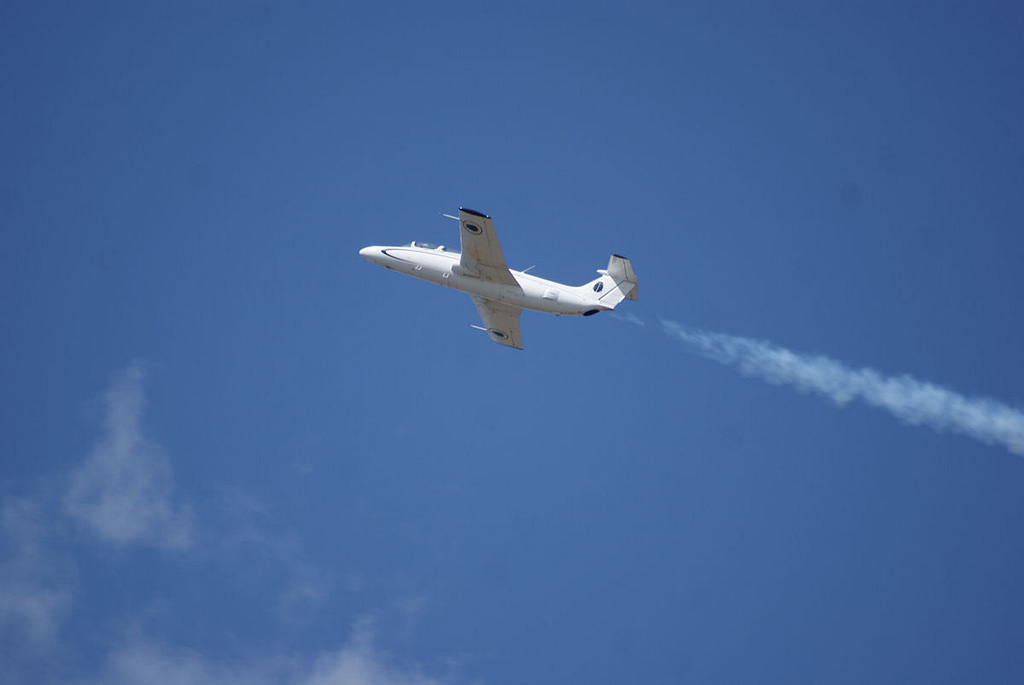
Aero L-29 Delfín jet trainer in flight
Aircraft MuseumJet TrainerL-29 Delfín

Aero L-29 Delfín
“Maya”

The rugged little Czechoslovak jet that taught most of the Warsaw Pact to fly — one of the most-produced jet trainers in history, and the forerunner of the famous L-39 Albatros.

~3,600Built · among the most-produced jet trainers
1959First flight · 5 April
~655 km/hTop speed · single Motorlet M-701
Warsaw PactStandard jet trainer (except Poland)
Photo: Milan.reptile · CC BY-SA 3.0
RoleJet trainer & light attackEraCold WarEngine1 × Motorlet M-701OriginCzechoslovakia · Aero VodochodyStatusRetired / warbirdFly its successor, the L-39 — book a flight
The Story

The jet that taught the Eastern Bloc to fly

By the mid-1950s the air forces of the Soviet bloc were re-equipping with jet fighters, but their pilots were still learning on piston-engined trainers. What they needed was a simple, durable jet on which a raw cadet could safely make the leap to the jet age. In Czechoslovakia, a small Aero Vodochody design team led by Zdeněk Rublíč and Karel Tomáš set out to build exactly that — the country’s first indigenously designed and built jet aircraft.

The prototype XL-29 first flew on 5 April 1959. What emerged was deliberately conservative: a straight, mid-mounted wing, a single centrifugal-flow turbojet, tandem seats, and handling forgiving enough for a student’s first solo. In 1961 the design was pitted against Poland’s PZL TS-11 Iskra and the Soviet Yakovlev Yak-30 in a Warsaw Pact fly-off. The L-29 won and was adopted as the standard jet trainer for the Warsaw Pact — every member except Poland, which stubbornly kept its own Iskra.

Roughly 3,600 were built between 1963 and 1974, more than 2,000 of them delivered to the Soviet Union alone. Generations of Soviet, East German, Hungarian, Egyptian and other pilots earned their wings on the Delfín. It was eventually succeeded by the swept-wing L-39 Albatros, but many L-29s soldiered on for decades — and today the type has a busy second life as an affordable civilian warbird.

Simple, sturdy and forgiving — a jet built so an 18-year-old cadet could survive his first solo.The Delfín brief — the Warsaw Pact’s standard trainer
01The 1961 fly-off: how the L-29 beat the Iskra and the Yak-30 — and why Poland walked away

When the Warsaw Pact went looking for a single standardised jet trainer, three designs competed: the Czechoslovak L-29, Poland’s PZL TS-11 Iskra, and Yakovlev’s Yak-30. Comparative trials held around 1961 favoured the L-29 for its docile handling and rugged, maintainable design, and it was chosen as the bloc’s common trainer.

Poland, however, declined to give up its own aircraft: it continued to develop the Iskra and operated it as its national jet trainer for decades. The result was that the “standard” Warsaw Pact trainer was standard everywhere except the country that had built one of its rivals — a small but telling exception to Soviet-bloc uniformity. The Yak-30, the third contender, never entered series production.


Design & Engineering

What makes it special

01

Rugged simplicity, built to forgive

The Delfín was engineered around one idea: survive the mistakes of a first-time jet pilot. Its straight wing, gentle stall and simple systems made it stable and predictable, while a sturdy airframe and tall landing gear let it operate from the rough grass strips common across the Eastern bloc. It was a jet a nervous cadet could learn on and a conscript ground crew could keep flying.

02

One simple centrifugal turbojet

Power came from a single Motorlet M-701 centrifugal-flow turbojet of roughly 8.7 kN (1,960 lbf) thrust. The centrifugal design was chosen partly because it was less sensitive to swallowing dirt and debris from unpaved runways. It was praised for reliability and easy maintenance — over 9,000 M-701 engines were built, giving the type a deep, cheap spares pool that still helps keep warbirds flying.

03

A trainer that could go to war

Two underwing hardpoints let the Delfín carry gun pods, unguided rockets or light bombs, turning the trainer into a light attack aircraft. Specialised versions followed: the L-29R reconnaissance variant and the single-seat L-29A Akrobat aerobatic ship (only a couple built in 1967). In several countries the humble trainer ended up flying real combat missions.

02The Motorlet M-701: the little engine that outlived the aircraft

The M-701 was a modest single-shaft centrifugal turbojet, and that modesty was the point. Centrifugal compressors are bulky and less efficient than axial ones, but they are robust and tolerant of the grit and foreign objects thrown up by grass and dirt airfields — exactly the conditions a Warsaw Pact trainer had to endure. Somewhere around 9,000–9,200 examples were produced between roughly 1961 and 1989. That enormous production run left a large stock of engines and parts, which is one practical reason so many L-29s remain airworthy in civilian hands today.

03L-29R and L-29A Akrobat: the Delfín’s specialised offspring

Most L-29s were straightforward two-seat trainers, but Aero explored variants. The L-29R was a tactical-reconnaissance version fitted with cameras and a nose sensor package. The rarest was the L-29A Akrobat, a single-seat aerobatic derivative built in tiny numbers in 1967 for display flying. Combined with the wing hardpoints fitted to standard airframes for gunnery and weapons training, these versions show how a basic trainer was stretched toward reconnaissance, aerobatics and light strike.


Technical Data

Full specifications

Baseline note: the figures below describe the production Aero L-29 Delfín as built at Aero Vodochody and at LET Kunovice from 1963 — the tandem two-seat trainer with an unswept mid-set wing, wing-root intakes, a T-tail and one Motorlet M-701 turbojet of 8.7 kN (1,960 lbf). Deltas for the single-seat L-29A Akrobat and for the L-29R reconnaissance and attack version are given in grey. Four disagreements between reputable sources are worth settling before the tables begin. First, maximum speed: English-language reference tables print 655 km/h at 5,000 m, while the Czech Military History Institute and Russian sources give 620–625 km/h. The higher number describes a clean, lightly loaded aeroplane and the lower one a squadron machine with pylons and service equipment; both appear below. Second, weights: 2,280 kg empty and 3,280 kg loaded are the pair that circulates in English, but the Prague museum records 2,364 kg and 3,586 kg for a specific Czechoslovak airframe in its collection, which is what a real L-29 with its full fit actually weighed. Third, service ceiling: 11,000 m and 10,900 m are both widely quoted and the gap is rounding rather than physics. Fourth, production: 3,600 is the round number that gets repeated, while Aero itself publishes 3,665, split 1,943 at Vodochody and 1,722 at Kunovice, with the last deliveries made in 1974. Where the two families of figures diverge, this page prints both and says which is which rather than pretending the question is closed.

Dimensions & weights

Crew
2 in tandem under two separate, individually hinged canopies, the instructor’s seat raised behind the pupil’s. Two canopies rather than one long hood is the quickest way to tell a Delfín from the L-39 Albatros that replaced it. The L-29A Akrobat deleted the rear station entirely and became a single-seater; the L-29R put cameras where the second pilot had been, so it too flew solo
Length
10.81 m (35 ft 6 in), unchanged across the marks. The nose is short and blunt because there is nothing in it: no radar, no gun, no avionics bay worth the name, just the nosewheel and a ballast weight
Wingspan
10.29 m (33 ft 9 in). No tip tanks, no wing fold, no extension on any variant. The Delfín is one of the few jet trainers whose span never changed in eleven years of production
Height
3.13 m (10 ft 3 in) to the top of the T-tail. The tailplane sits high to keep it out of the jet efflux and out of the wing wake at high angles of attack, which is a large part of why the aeroplane behaves so predictably at the stall
Wing area
19.80 m² (213.1 sq ft) — generous for a 3.3-tonne aeroplane, and the single design decision that dictates everything else about the type. A big wing on a small jet gives a low stall, a short field length and a docile handling signature, at the cost of a cruise speed that a Second World War fighter would beat
Aspect ratio
5.36 — conventional, unswept, and chosen for behaviour rather than for speed. Rublič and Tomáš were designing an aeroplane that had to forgive a nineteen-year-old conscript on his first jet sortie, and they got it right
Wing and tail layout
Mid-set unswept wing, T-tail, wing-root intakes — a configuration that keeps the intakes clear of debris thrown up by an unpaved surface and keeps the tailplane clear of the wing wake. Both choices come straight from the design brief for grass-field operation
Empty weight
2,280 kg (5,027 lb) in the usual published tables. The Vojenský historický ústav in Prague records 2,364 kg (5,212 lb) for a documented Czechoslovak airframe, and that is the more honest number for an aeroplane in squadron trim
Normal take-off weight
3,280 kg (7,231 lb) with full internal fuel, two crew and no external stores. This is the weight at which almost every quoted L-29 performance figure was measured
Max take-off weight
3,540 kg (7,804 lb) with underwing stores; the Prague museum figure for its own aircraft is 3,586 kg (7,906 lb). Either way the armed Delfín is carrying about eight per cent of its weight in weapons, which is the arithmetic behind every disappointed operator who tried to use it as a light attack aeroplane
Internal fuel
962 litres (254 US gal, 212 imp gal) in fuselage and wing tanks, with provision for two 150-litre (40 US gal) underwing drop tanks that occupy the same two pylons the weapons use. Fuel or bombs, not both: on a two-pylon aeroplane that is the whole tactical problem in one sentence
Max external load
~200 kg (440 lb) across two underwing hardpoints, typically two 100 kg bombs or two rocket pods. Russian sources describe stores of 50 to 120 kg per station. The L-29R was to have carried four pylons instead of two, which was the whole point of it
Wing loading
166 kg/m² (33.9 lb/sq ft) at normal take-off weight — roughly half that of a contemporary fast jet. This figure is the Delfín’s entire personality: light, unhurried, hard to frighten and hopeless in a fight
Undercarriage
Tricycle, retractable, wide track, low-pressure tyres — specified from the outset for grass, sand and unprepared surfaces. In the 1961 Warsaw Pact fly-off the L-29 recorded the best performance of the three contenders off unpaved strips, and Warsaw Pact training regiments spent the next thirty years operating it from exactly that

Performance

Max speed
655 km/h (354 kn, 407 mph) at 5,000 m (16,400 ft) in the English-language tables. Czech and Russian sources give 620–625 km/h (335–338 kn) for the service aircraft. The Delfín is subsonic by a wide margin and was never intended to be anything else
Never-exceed speed
820 km/h (443 kn, 510 mph) indicated — a placard limit reached in a dive, not in level flight. The gap between 655 and 820 km/h is the margin the designers left for a pupil who lets the nose drop
Stall speed
130 km/h (70 kn, 81 mph) with flaps down. This is the number that won the 1961 competition. The evaluating commission recorded the L-29 as having both the lowest landing speed and the lowest flapless stall speed of the three aircraft tested, which for an air force about to teach tens of thousands of conscripts to fly jets mattered more than top speed did
Rate of climb
14.0 m/s (2,756 ft/min) at sea level. Modest, and honestly so: 8.7 kN pushing 3.3 tonnes leaves nothing in reserve. John C. Fredriksen’s summary that the type was "relatively underpowered, yet exhibited several favourable characteristics" is the fairest one-line verdict anyone has written on it
Service ceiling
11,000 m (36,100 ft); Czech and Russian sources give 10,900 m (35,800 ft). Getting there takes a long time and there is very little the aeroplane can usefully do once it arrives, but the figure matters for high-altitude handling and oxygen-system training
Range, internal fuel
680 km (367 nmi, 423 mi) per the Prague museum’s figure for a service aircraft. A training aeroplane is not measured by its range and the L-29 was never asked to go anywhere
Range, with drop tanks
894 km (483 nmi, 556 mi) with two 150-litre tanks. Note again that fitting them uses both hardpoints, so a long-ranging Delfín is by definition an unarmed one
Endurance
2 hr 30 min — a genuinely useful number for a trainer, because it is what allows several consecutive circuits-and-bumps details without a refuelling stop
Sortie economy
15 five-minute circuits without refuelling — recorded during the 1961 evaluation at Monino, against about 10 for the competing PZL TS-11 Iskra and Yakovlev Yak-30. Fifty per cent more training value per tank of paraffin, multiplied across a continent-sized air force, is not a small thing
Thrust-to-weight ratio
0.27 at normal take-off weight — about half what a Hawk or an Alpha Jet manages. Everything the Delfín does, it does slowly, and its pilots learned energy management the hard way because there was no energy to spare
Field performance
Cleared for grass, sand and unprepared surfaces from the design brief onwards, with the wing-root intakes, the wide-track low-pressure undercarriage and the low approach speed all serving that single requirement. Published take-off and landing runs vary too widely between operators and surface states to quote a single credible pair of numbers, which is itself the point: the aeroplane was built to work off whatever field the regiment had

Propulsion & systems

Engine
1 × Motorlet M-701 turbojet — the M-701c 500 in the late production standard. Czechoslovakia’s first indigenous production jet engine in a Czechoslovak aeroplane, which is a large part of why the L-29 exists at all: the country wanted a complete national aircraft, airframe and powerplant together
Thrust
8.7 kN (1,960 lbf) at take-off, 15,500 rpm; 7.87 kN (1,764 lbf) rated at 14,950 rpm. Some sources give 8.75 kN or 840 kgf for the maximum, which is the same engine measured on a different day
Engine architecture
Single-stage centrifugal compressor, single-stage axial turbine — the simplest arrangement a jet engine can have and a generation behind the axial-flow engines of the day. That is a deliberate choice: a centrifugal compressor is tolerant of distorted intake flow and of the grass, dust and sand a training aerodrome throws at it, and a conscript ground crew can look after it
Engine size and weight
2,067 mm long (81.4 in), 896 mm wide by 928 mm high, 330 kg (728 lb) dry. It sits in the rear fuselage and is fed through ducts from the wing-root intakes, with the jet pipe exiting under the tail boom
Prototype powerplant
Bristol Siddeley Viper on the first XL-29 — the British engine flew the maiden flight on 5 April 1959 because the Czech engine was not ready. The second prototype introduced the M-701 and every production aircraft used it. There is an irony here that the type’s civil owners later completed: several American racing L-29s have been re-engined with the Viper, putting a British turbojet back into an airframe that started with one
Engine programme
More than 9,250 M-701s built between 1961 and 1989 at the Jinonice works in Prague, of which reportedly no fewer than 5,000 supported the Delfín. A surviving spares pool on that scale is precisely why the civil warbird fleet is still flying sixty years on, and why an L-29 remains one of the cheapest jets a private owner can run
Air intakes
Wing-root, one each side — set well above the ground line and behind the nosewheel spray pattern. Anyone who has watched a nose-intake jet ingest a runway light will understand the choice
Fuel system
962 litres internal (254 US gal) in fuselage and wing cells, plus two optional 150-litre underwing tanks on the weapon pylons. Gravity-and-pump feed, no in-flight refuelling, no tank pressurisation for combat survivability. It is a trainer’s fuel system and makes no apology for it
Flight controls
Manual, unpowered, cable and rod — no hydraulic boost, no artificial feel, no stability augmentation. The pupil feels the aerodynamics directly, which is exactly what a basic trainer should give and what makes the type such a satisfying aeroplane for its present civil owners
High-lift and drag devices
Large hydraulically actuated flaps and perforated fuselage airbrakes — the flaps to get the approach speed down to something a beginner can manage, the perforated brakes to allow a steep, controlled descent without the buffet a solid plate would produce. Both are hydraulic; the hydraulic system exists essentially to serve them and the undercarriage
Escape system
Two ejection seats, interlinked to fire together in a fixed order so that the two crew cannot collide on the way out — a sensible piece of engineering on an aeroplane whose whole reason for existing is that the person in front is likely to make a mistake. These are early seats with a real minimum height and speed, not the zero-zero seats of later trainers, and several civil operators have refitted modern seats
Hardpoints
2 underwing — the whole of the type’s offensive capability. The abandoned L-29R was to have had four. No centreline station, no wet outboard pylons, no provision for anything heavier than about 100 kg per side
Unit cost and production
915,200 roubles (1963 prices) per Russian sources, for an aircraft built in a quantity of 3,665: 1,943 at Aero Vodochody and 1,722 at LET Kunovice, delivered between 1963 and 1974. The commonly repeated figure of about 3,600 is the same programme rounded down. It remains the most numerous jet trainer ever built by any Western or Eastern manufacturer
04What did an L-29 cost — and what does it cost to fly one today?

As a state product of the Soviet-bloc economy, the L-29 was never sold on an open dollar market during its service life, so no reliable original flyaway price exists in the public record. Its value today is far easier to gauge: on the civilian warbird market, airworthy L-29s have traded for roughly the price of a nice light aircraft — often cited in the low hundreds of thousands of dollars — which, combined with the huge stock of cheap M-701 engines, is exactly why it became one of the most accessible jet warbirds to own. Any precise operating-cost figure you see should be treated as an estimate, not an official number.


Armament & payload

The Delfín was armed almost as an afterthought, and three air forces still took it to war

There is no gun in an L-29 and there is no room for one. The entire offensive capability of the Warsaw Pact’s standard jet trainer is two underwing hardpoints rated at roughly 100 kg each, and the gun, when carried, is a 7.62 mm machine-gun pod hanging from one of them. That fit exists because a training syllabus has to include weapons delivery, not because anyone at Aero Vodochody expected the aeroplane to fight. The gunsight in the front cockpit is there to teach a pupil what a gunsight is.

And yet the L-29 has been to war at least four times, in every case for the same reason: it was the only jet an air arm could get into the air. Nigerian aircraft, twelve of them delivered in two batches of six from 1967 and flown largely by foreign contract pilots, struck Biafran targets during the civil war. Egyptian L-29s were thrown against Israeli armour from 16 October 1973, during the fighting around the Israeli crossing of the Suez Canal, and four were lost. Azerbaijani L-29s flew close air support throughout the First Nagorno-Karabakh War between 1992 and 1994 and were shot out of the sky by Armenian air defences. In each case a 200 kg bomb load delivered from a 655 km/h aeroplane with no armour, no warning receiver and no self-sealing tanks did what you would expect it to do. Weapon fits varied widely by operator and by decade, and much of the Soviet and Middle Eastern detail rests on secondary sources rather than on published clearance documents. Read every line below as "on some aircraft, for some operators".

Gun

  • No internal gun on any variant. The standard armament fit is a podded 7.62 mm machine gun on one of the two underwing hardpoints, carried singly or in pairs.
  • Some Soviet and export aircraft carried a pod combining a machine gun with a small unguided rocket installation, so that one station could serve both parts of the gunnery syllabus.
  • A fixed reflector sight in the front cockpit only. There is no ranging radar, no computing sight and no laser: aiming is a matter of the pilot’s eye, a depression setting and practice.
  • Gun pods were removed as a matter of course from aircraft used purely for basic flying training, which was most of them for most of their lives.

Air-to-air

  • None. No L-29 has ever carried an air-to-air missile, and no operator is known to have integrated one. There is no radar and no missile interface in the airframe.
  • The only air-to-air claim attached to the type is a grim one: on 16 July 1975 a Czechoslovak Air Force L-29 is reported to have shot down a Polish civil biplane flown by Dionizy Bielański, who was attempting to defect westwards. The weapon would have been a podded machine gun.
  • The reverse case is far commoner. L-29s have been shot down by Armenian air defences over Nagorno-Karabakh, destroyed on the ground by Russian aircraft at Marneuli in Georgia in August 2008, and wiped out en masse in Chechnya in December 1994.
  • Against any armed opponent the Delfín is a target. This card is kept because the template requires it, and because saying plainly that a card is empty is more useful than padding it.

Air-to-surface guided

  • None, ever, on any mark. No precision-guided weapon of any kind was integrated on the L-29 by its manufacturer or by any operator.
  • There is no laser designator, no television or infrared seeker interface, no data link and no weapons computer. The aircraft’s guidance system is the pilot.
  • The nearest thing to a guided weapon in the type’s history is the Iraqi conversion programme of the 1990s, in which surplus L-29s were rebuilt as unmanned aircraft. In those, the airframe itself was the munition.
  • This absence is the honest limit of the light-attack claim. Every L-29 that went to war did so with iron bombs and unguided rockets, aimed by eye from low level.

Bombs

  • 2 × 100 kg (220 lb) general-purpose bombs, one per hardpoint, the standard and effectively the maximum bomb fit.
  • Russian sources describe stores in the 50 to 120 kg class per station, which covers the various Soviet and Czechoslovak bomb bodies used across the type’s service.
  • Small practice bombs on carriers — by a wide margin the most common ordnance any L-29 has ever carried, and the only kind most airframes ever saw.
  • This is the fit Egyptian aircraft used against Israeli armour in October 1973 and Azerbaijani aircraft used over Karabakh: two light bombs, delivered from a shallow dive, against targets that shot back.

Rockets

  • Up to 8 unguided air-to-ground rockets, normally in two four-round pods, one per hardpoint.
  • Soviet-pattern 55 mm rockets are the usual fit in Warsaw Pact and Soviet-supplied service; Western-supplied operators used what their suppliers sold them.
  • Rockets are the type’s most effective weapon in practice. They are light enough that two pods do not ruin the climb, and against soft targets a salvo from a slow, stable aeroplane is more accurate than two bombs.
  • Practice rockets with inert heads remain the standard weapons-training store on the few armed L-29s that survived into the 2000s.

Pods & other stores

  • 2 × 150-litre (40 US gal) drop tanks — and because they occupy the same two pylons as the weapons, an L-29 flying far is an L-29 flying empty.
  • Camera installation on the abandoned L-29R, with downward-looking cameras fitted in the space normally occupied by the rear cockpit and, in the project as drawn, four hardpoints rather than two.
  • Target-towing and gunnery-target equipment on some operators’ aircraft, an unglamorous role the type performed for decades.
  • Unmanned conversions: Iraq rebuilt a number of its 78 aircraft as drones during the 1990s, and the type’s docile handling and cheap airframe made it an obvious candidate.
  • Nothing else. There is no electronic countermeasures pod, no chaff or flare dispenser and no reconnaissance pod in the production standard.

Three typical loadouts

Weapons conversion sortie, Warsaw Pact training regiment
One 7.62 mm gun pod and one four-round practice rocket pod, internal fuel only. The syllabus fit: enough to teach sight picture, dive angle and release discipline, light enough that the aeroplane still climbs. This is what the overwhelming majority of the 3,665 aircraft built actually carried.
Counter-insurgency strike, Nigeria, 1968
Two 100 kg bombs, no drop tanks, short radius from a forward strip. Nigeria took twelve aircraft from 1967 and used them against Biafran targets with contract pilots at the controls; the loss of Colonel Shittu Alao, the Nigerian Air Force’s Chief of Air Staff, on 15 October 1969 in an L-29 that ran out of fuel in bad weather near Uzebba is the type’s best-remembered African episode.
Close air support, Nagorno-Karabakh, 1992–94
Two rocket pods or two light bombs, delivered low and slow over defended ground. Azerbaijani L-29s flew this profile repeatedly against Armenian positions and were destroyed doing it: at least fourteen aircraft were lost or badly damaged to air defences. It is the clearest demonstration on record of what happens when a trainer is used as an attack aeroplane against a competent enemy.

Sourcing caveat: Aero never published a consolidated weapons clearance list for the L-29, and no operator has released one. The fits above are reconstructed from encyclopaedic accounts, museum documentation and operator histories, and the calibres and store weights should be read as typical rather than definitive. The 7.62 mm gun pod in particular is described consistently across sources but without a firm manufacturer designation. Where Russian-language and English-language sources give different bomb weights, both ranges are shown rather than one being silently preferred.


Variants

The L-29 barely changed in eleven years, and the two variants that mattered were both dead ends

Aero Vodochody built 3,665 Delfíns and almost all of them were the same aeroplane. That is unusual, and it is a compliment: the type was got right at the first attempt, and there was nothing pressing to fix. The XL-29 prototype flew on 5 April 1959 on a British Bristol Siddeley Viper because the Czech engine was late; the second prototype had the Motorlet M-701 and settled the configuration for good. Full-scale production began in April 1963 and ran until 1974, split between Aero Vodochody, which built 1,943, and LET Kunovice, which built 1,722.

The decision that made those numbers possible was taken at Monino, outside Moscow, in 1961. A commission under Lieutenant General Matveyev spent two months comparing the third L-29 prototype against Poland’s PZL TS-11 Iskra and the Soviet Yakovlev Yak-30, assessing flight tests, cockpit ergonomics, maintenance access and engine change time. The Iskra was eliminated early and sent home. The L-29 won in August 1961 on reliability, low landing and stall speeds, unpaved-field performance, ease of maintenance and cost. It is worth recording that this verdict is contested: accounts of the Yak-30 argue that the Soviet aircraft was lighter, more manoeuvrable and cheaper to build, and that the choice was ultimately political — a deliberate award of a major industrial programme to a Warsaw Pact partner. Both readings can be true. Poland ignored the result entirely and went on building Iskras until 1987, flying them until 2020.

The Delfín’s successor came from the same factory. Aero began work on a replacement, initially designated C-39, in 1964, and the L-39 Albatros first flew on 4 November 1968 as the world’s first turbofan-powered trainer. It has its own page in this encyclopedia, and it is a genuinely different aeroplane rather than a developed Delfín: different engine, different structure, different mission set. Where the L-29 taught, the L-39 taught and fought.

XL-29 (1959–61, 3 prototypes and static airframes)
The first flew on 5 April 1959 with a Bristol Siddeley Viper; the second introduced the Motorlet M-701 that all production aircraft used. The third was the aircraft sent to Monino for the 1961 fly-off.
L-29 Delfín (1963–74, 3,665 built)
The production standard and effectively the only variant: two seats in tandem, one M-701, two underwing hardpoints. Late aircraft used the M-701c 500. Aero’s split of the total is 1,943 at Vodochody and 1,722 at LET Kunovice.
L-29A Akrobat (1967–68, ~2 built)
A single-seat aerobatic version with the rear cockpit deleted and faired over, intended for competition and display flying. It flew and it was pleasant, but there was no market: an air force with 3,000 trainers has no budget line for an aerobatic special. Russian sources record two aircraft.
L-29R (project, cancelled 1965)
A reconnaissance and light attack development with downward-looking cameras in place of the rear cockpit and, as drawn, four hardpoints instead of two. It would have turned the Delfín into a genuine light combat aircraft. The programme was terminated in 1965, which is why every L-29 that went to war did so with two pylons and no sensors.
Maya (NATO reporting name)
Not a variant but the designation under which the West knew the type. More than 2,000 aircraft went to the Soviet Union alone, where the Delfín replaced piston trainers outright and allowed an all-jet training pipeline for the first time.
Iraqi unmanned conversions (1990s, quantity unknown)
Iraq took 78 aircraft between 1968 and 1974 and rebuilt an unrecorded number of them as unmanned air vehicles after the Gulf War. A cheap, docile, plentiful airframe makes an obvious drone; what they were intended to deliver has never been established.
Re-engined civil racers (United States, 2000s)
Several American L-29s were re-engined with the British Armstrong Siddeley Viper — the engine of the first prototype, returning four decades late. At the Reno Air Races from 10 to 14 September 2008, two of them took first and second place, lapping consistently at or above 500 mph, with the former astronaut Curt Brown winning in "Viper" ahead of Mike Mangold in "Euroburner".
Civil L-29C (registry designation, not a factory mark)
A designation that appears on civil registers in the Czech Republic, Slovakia and Denmark. It denotes a demilitarised airframe on a civil certificate rather than a distinct build standard, and it should not be mistaken for a manufacturer’s variant.

Survivors and fleet note, in place of an operators chart. No air force could be corroborated as a current front-line L-29 operator when this page was checked in September 2026. English-language reference works still credit Angola with about six aircraft and Georgia with about four as of 2022, but the current Georgian inventory lists the L-39 and not the L-29, the Angolan entry survives only in an order of battle that also lists MiG-15UTIs and Yak-11s, and Mali’s six aircraft, in service as late as December 2012, are now listed as retired. Bulgaria took 102 aircraft between 1963 and 1974 and retired them in 2002; Slovakia inherited 16 at the dissolution of Czechoslovakia and withdrew them in 2003; Afghanistan flew as many as 24 from 1978 until about 1999. The largest single loss of L-29s in history was not in combat: of 265 aircraft seized by Chechen separatist forces in 1994, 149 were L-29s, and Russian Su-25 strikes on 1 December 1994 destroyed them on the ground. The type’s real second life is civil, and it is a large one. Every flying L-29 is an original 1960s or 1970s airframe — no reproduction or newly manufactured Delfín has ever been built, and none is likely to be, because surplus airframes and a stock of more than 9,250 M-701 engines made building new ones pointless. Airworthy examples fly in the United States, Canada, the Czech Republic, Slovakia, Denmark, New Zealand and Australia, in private hands, with display teams such as the Czech Jet Team at Žatec, with museums including the World Heritage Air Museum in Detroit and Waterloo Warbirds in Ontario, and as working research aircraft with the International Test Pilots School in Canada, the University of Iowa’s Operator Performance Laboratory and Ohio University’s Avionics Engineering Center. No authoritative worldwide total for the civil fleet exists, because national registers count differently and many airframes are stored rather than flying; the honest statement is that the L-29 is one of the two or three most numerous privately owned jets in the world, alongside its own successor the L-39 Albatros. Sources: Aero Vodochody company history, the Vojenský historický ústav Praha collection records, encyclopaedic accounts of the type in English and Russian, and national air force inventories; entries that could not be corroborated are omitted rather than repeated.


Timeline

From cadet trainer to civilian warbird

1955–56

The requirement

The Soviet bloc needs a modern jet trainer to bridge piston trainers and its new jet fighters. Aero Vodochody begins design work.

1959

First flight

The XL-29 prototype flies for the first time on 5 April — Czechoslovakia’s first home-designed jet aircraft.

1961

The fly-off

The L-29 beats Poland’s TS-11 Iskra and the Yak-30 and is chosen as the standard Warsaw Pact jet trainer — Poland aside.

1963

Into production

Series production begins; over the next decade some 3,600 are built, more than 2,000 going to the Soviet Union.

1967

The Akrobat

Aero builds the rare single-seat L-29A Akrobat for aerobatic display flying.

1973

Egypt at war

Egyptian L-29s are reported flying light-attack sorties during the Yom Kippur War — a trainer pressed into combat.

1974

End of the line

Production ends after ~3,600 aircraft; the swept-wing L-39 Albatros takes over as the bloc’s next-generation trainer.

1990s

Nagorno-Karabakh

Azerbaijan uses L-29s for ground attack in the First Nagorno-Karabakh War, reportedly suffering losses to air defences.

2000s–now

Second life as a warbird

Retired from most air forces, the cheap, reliable Delfín becomes a popular civilian jet warbird across the US and Europe.


Stories & Eyewitnesses

Twelve stories from the Delfin’s long life

Origins

Czechoslovakia’s first jet

The L-29 was the first jet aircraft designed and built in Czechoslovakia.

Read the full story
When Aero Vodochody’s team drew up the L-29 in the late 1950s, they were doing something no Czechoslovak company had done before: designing a jet aircraft from scratch. The Delfín became the nation’s first indigenous jet, launching an aircraft dynasty — through the L-39 Albatros and beyond — that made this small country one of the world’s great trainer builders.
Naming

Why “Delfín”?

The name means “Dolphin” — NATO instead called it “Maya.”

Read the full story
Aero named its trainer Delfín, Czech for “dolphin,” a nod to its smooth, rounded nose and friendly manners. NATO, which assigned its own reporting names to Soviet-bloc aircraft, filed it under the codename “Maya.” Two names for one jet — one affectionate, one bureaucratic.
The fly-off

Beating the competition

In 1961 the L-29 won a three-way Warsaw Pact trainer contest.

Read the full story
The Delfín earned its place the hard way, in a comparative fly-off against Poland’s PZL TS-11 Iskra and the Soviet Yak-30. Judged the best all-round trainer, it was adopted across the Warsaw Pact. It is one of the few cases where a design from a smaller bloc member beat a Soviet OKB’s own aircraft to a major contract.
Poland’s exception

The one that said no

Every Warsaw Pact air force adopted the L-29 — except Poland.

Read the full story
Standardisation was a Soviet ideal, but Poland quietly defied it. Having developed the TS-11 Iskra, the Polish air force kept and flew its own trainer for decades rather than switch to the Czechoslovak jet. So the “standard” Warsaw Pact trainer had one conspicuous hole in its map — the very country that built a rival.
Scale

More than three thousand

Around 3,600 Delfíns were built — one of the most-produced jet trainers ever.

Read the full story
Between 1963 and 1974 Aero turned out roughly 3,600 L-29s, with more than 2,000 delivered to the Soviet Union alone. That places the little Delfín among the most-produced jet trainers in history, and it means a huge slice of Cold War Eastern-bloc pilots — fighter, bomber and transport — first went solo on one.
Engineering

Made for the mud

A centrifugal engine and tough gear let it fly from grass strips.

Read the full story
The Delfín’s M-701 engine used a centrifugal compressor partly because it was more tolerant of dirt and debris than a sleek axial one — important for a jet expected to operate from unpaved fields. Combined with rugged landing gear, it made the L-29 a jet that could work from the kind of rough airstrips scattered across the Warsaw Pact.
Combat · Egypt

A trainer at war

Egyptian L-29s reportedly flew light-attack missions in the 1973 war.

Read the full story
Egypt was one of several export customers that fitted its L-29s with rockets and bombs. During the 1973 Yom Kippur War, Egyptian Delfíns are reported to have flown ground-attack sorties — a reminder that even a gentle trainer can be sent to war when a country needs every airframe it has. Details of their effectiveness remain contested.
Combat · Nigeria

Over Biafra

Nigeria used L-29s during the Biafran civil war of the late 1960s.

Read the full story
In the Nigerian Civil War, the federal air force deployed a mix of aircraft, and L-29s were among the types used for strikes against Biafran positions. It was one of the first combat uses of the Delfín, years before it became better known as a peaceful trainer and airshow jet.
Combat · Azerbaijan

Nagorno-Karabakh

Azerbaijan flew L-29s in ground attack in the 1990s — and lost several.

Read the full story
During the First Nagorno-Karabakh War, Azerbaijan pressed its L-29s into service as improvised ground-attack aircraft. Slow and unarmoured, they proved vulnerable: several were reportedly shot down by Armenian air defences. It was combat the little trainer was never designed for.
Handling

The kind first solo

Instructors valued the L-29 for its forgiving, honest manners.

Read the full story
Ask pilots who trained on it and a theme recurs: the Delfín was honest. It gave clear warning before a stall, recovered predictably, and did not punish a clumsy student. That gentleness was engineered on purpose — the whole point of the aircraft was to carry a novice safely across the gap from propellers to jets.
Succession

Making way for the Albatros

The L-29 handed the trainer role to the swept-wing L-39.

Read the full story
By the early 1970s Aero was already flying the L-39 Albatros, a faster, swept-wing, turbofan-powered successor. The L-39 gradually replaced the L-29 across the bloc and became an even bigger export success — and, unlike the Delfín, remains a jet you can still book a flight in with MiGFlug today.
Legacy

The affordable jet warbird

Cheap, plentiful and reliable, the L-29 became a favourite civilian warbird.

Read the full story
When the Cold War ended, surplus L-29s flooded onto the civilian market. Their low purchase price, simple systems and vast stock of cheap M-701 engines made them one of the most accessible ways for a private owner to fly a real jet. Today Delfíns turn up at airshows and warbird fields across the United States and Europe.

Gallery

The Delfin in pictures

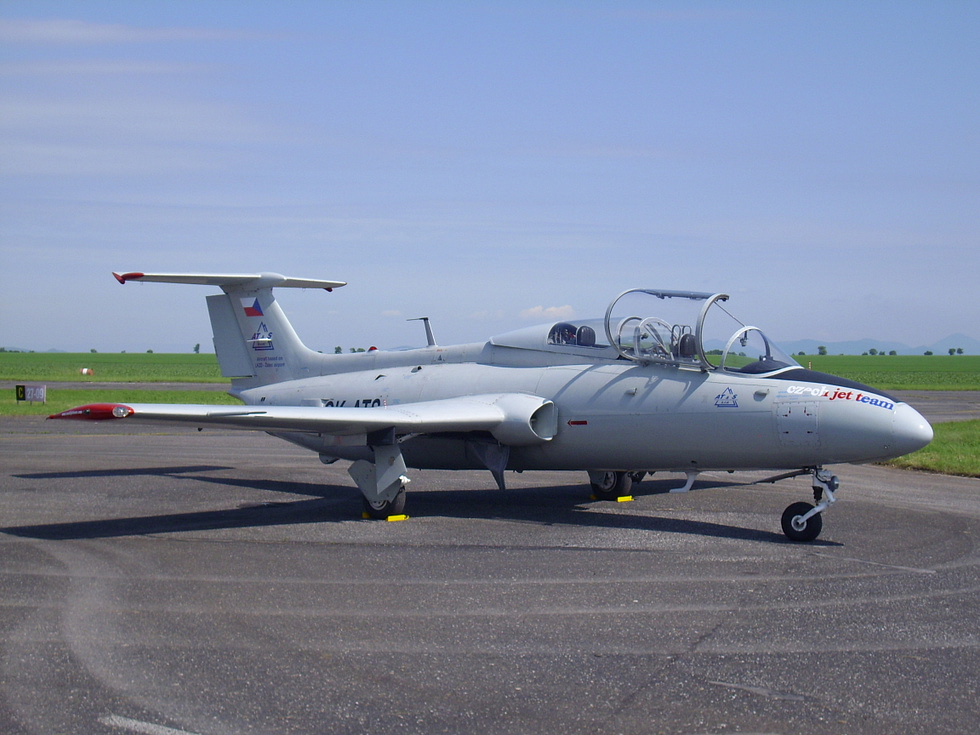
L-29 Delfns of the Czech Jet Team in formation  the trainer in its civilian display life.
L-29 Delfíns of the Czech Jet Team in formation — the trainer in its civilian display life.Photo: Milan.reptile · CC BY-SA 3.0
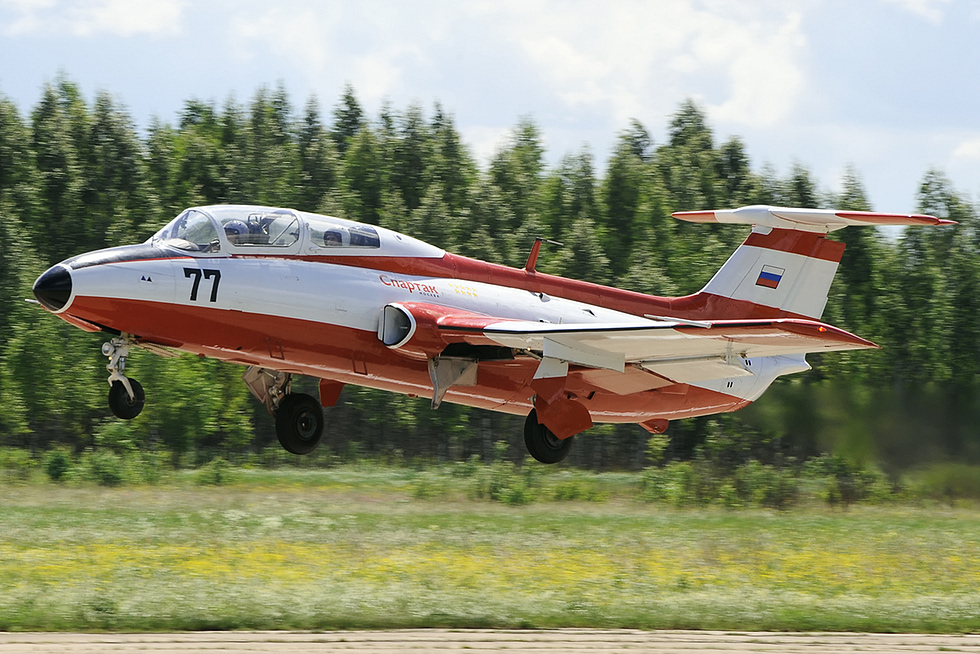
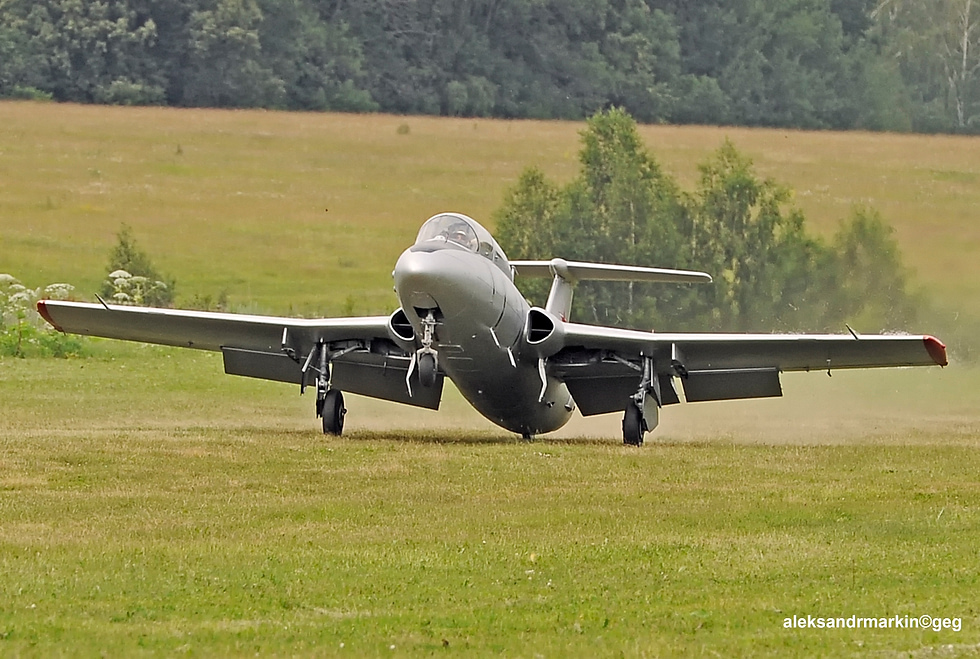
An Aero L-29 Delfn in flight  straight wing, tandem cockpit, single turbojet.
An Aero L-29 Delfín in flight — straight wing, tandem cockpit, single turbojet.Photo: Aleksandr Markin · CC BY-SA 2.0
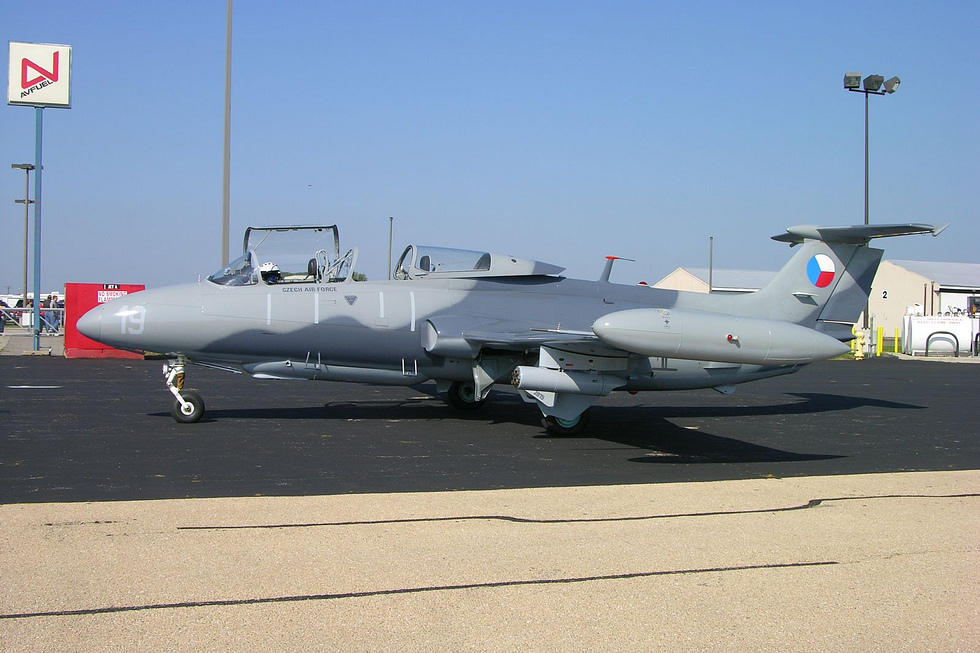
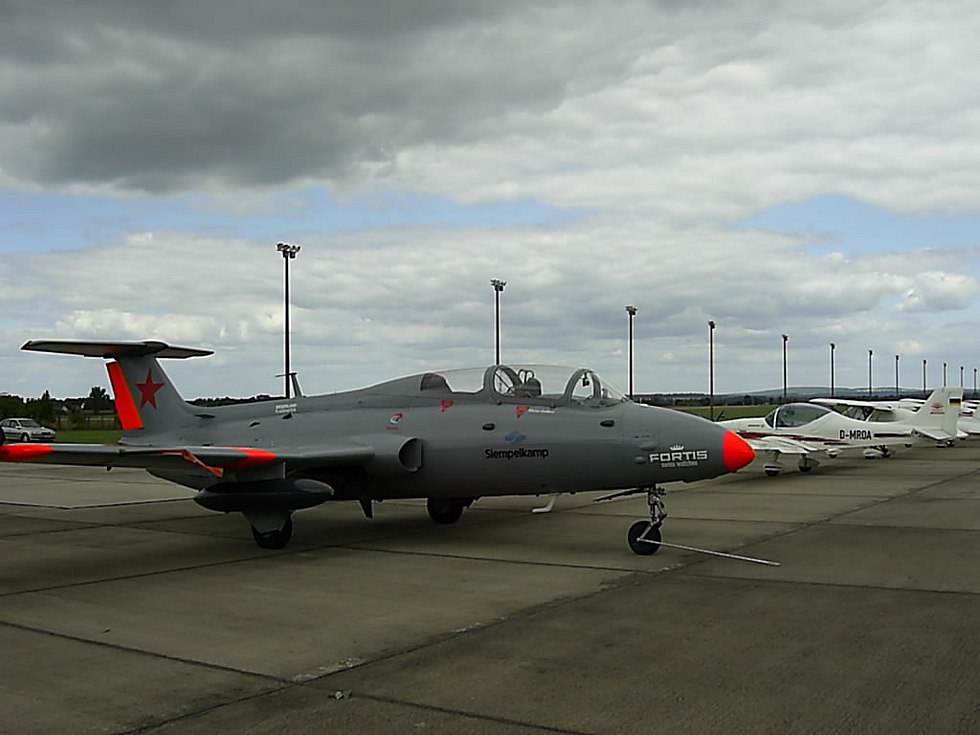
A civil-registered L-29 warbird in the United States  the types busy second life.
A civil-registered L-29 warbird in the United States — the type’s busy second life.Photo: D. Miller · CC BY 2.0
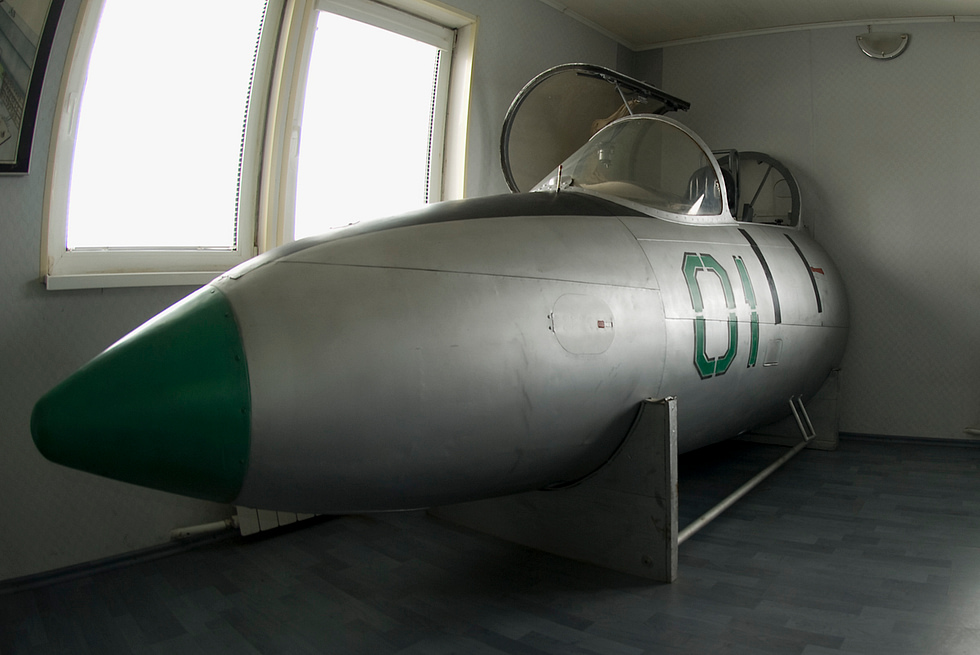
Inside the Delfn  the simple, honest cockpit generations of cadets learned on.
Inside the Delfín — the simple, honest cockpit generations of cadets learned on.Photo: Aleksandr Markin · CC BY-SA 2.0
An L-29 on short final  forgiving low-speed handling was the whole design brief.
An L-29 on short final — forgiving low-speed handling was the whole design brief.Photo: Aleksandr Markin · CC BY-SA 2.0
A preserved L-29 in Germany  a reminder of its East German service.
A preserved L-29 in Germany — a reminder of its East German service.Photo: Coradoline · CC BY-SA 3.0

Watch

The Delfín in motion

A hand-picked L-29 Delfín video is coming soon. In the meantime, explore the photo gallery above — and if you want to fly the type’s direct successor, the L-39 Albatros is bookable with MiGFlug.


Watch

The L-29 Delfín in motion

MojoGrip — one of the most-watched L-29 Delfín films on YouTube.


Operations

Where the Delfin flew


Combat Record

The trainer that went to war

The L-29 was built to teach, not to fight — but with rockets and bombs on its two hardpoints, several air forces sent it into combat anyway. Its war record is scattered and hard to verify, spread across a handful of conflicts where a cheap, available airframe mattered more than performance. These figures should be read as indicative rather than precise.

1973Egyptian L-29s reported in light attack, Yom Kippur War
Late 1960sNigerian use in the Biafran civil war
1990sAzerbaijani ground attack over Nagorno-Karabakh

Compare the combat record of every military aircraft. Figures as of July 2026.


Questions & Answers

Everything people ask about the L-29 Delfín

Can I fly in an L-29 Delfín?
Not through MiGFlug — the L-29 is not part of our fleet. Privately owned, civil-registered L-29s do fly at airshows and with a few operators around the world, but there is no standard MiGFlug booking for the type. The good news: its direct successor, the L-39 Albatros, is fully bookable, and you can see everything we fly at migflug.com/flights-prices/.
What does “Delfín” and “Maya” mean?
“Delfín” is Czech for “dolphin,” the manufacturer’s name for the aircraft. “Maya” is the NATO reporting name assigned to the type in the West. They refer to the same jet.
How many L-29s were built?
Around 3,600 between 1963 and 1974, making it one of the most-produced jet trainers in history. More than 2,000 went to the Soviet Union alone.
Was the L-29 used in combat?
Yes, though it was designed as a trainer. Fitted with rockets, bombs or gun pods, L-29s saw light-attack use in several conflicts — including reported Egyptian sorties in 1973, Nigerian use over Biafra, and Azerbaijani ground attack in the 1990s Nagorno-Karabakh war. Specific claims are often contested.
What is the difference between the L-29 and the L-39?
The L-39 Albatros is the L-29’s successor: a newer, faster design with a swept wing and a turbofan engine, first flown around 1968. The L-39 replaced the straight-winged, turbojet-powered L-29 across most of the Warsaw Pact and became an even bigger export success. You can still fly the L-39 today.
Why did every Warsaw Pact country use it except Poland?
Poland had developed its own trainer, the PZL TS-11 Iskra, which lost the 1961 fly-off to the L-29 but was kept in Polish service anyway. So Poland was the one Warsaw Pact member that did not adopt the “standard” trainer.
Is the L-29 still flying today?
Not in front-line military service, but very much so as a civilian warbird. Its low cost and plentiful cheap engines have made it one of the most accessible private jets to own and fly, and Delfíns appear regularly at airshows in the US and Europe.

Sources & Further Reading

Every fact, checked