
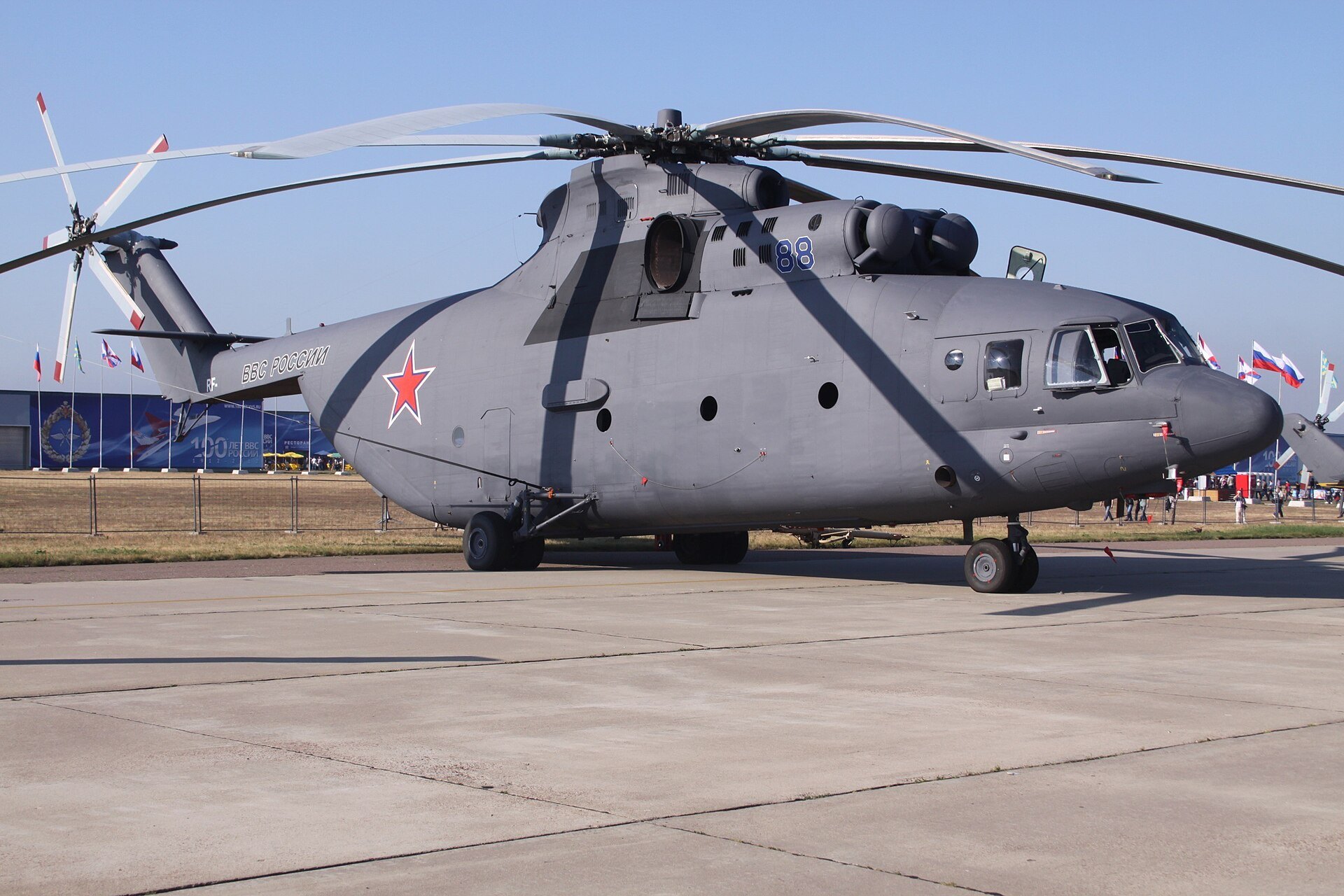
Mil Mi-26 Halo
The Heaviest Lifter in Production
The largest helicopter ever put into series production: the Mi-26 lifts 20 tonnes, flew into Chernobyl, carried a frozen mammoth and two crashed American Chinooks, and is still being built in Rostov.
The Mi-26: how Mil built a helicopter that lifts its own weight
By the early 1970s the Mil bureau had tried the brute-force route to heavier lift. The twin-rotor V-12 of 1967 set a world record by lifting more than 40 tonnes, but it was huge, complex and was cancelled in 1971. Mil had died in 1970, and his successor Marat Tishchenko took a different approach. The army wanted to fly armoured vehicles and mobile missiles from transport aircraft to the field, and Aeroflot wanted to develop Siberia, and the new helicopter had to carry one and a half to two times more than any production helicopter yet. The specification was brutal: its empty weight had to be no more than half its maximum take-off weight. Meeting it meant a new eight-blade rotor and an entirely new gearbox, which Mil designed itself when its usual supplier could not.
On 14 December 1977 test pilot G. R. Karapetyan lifted the prototype for a three-minute hover. The Mi-26 was about the size of the Mi-6 it replaced, with a smaller rotor, but its two D-136 turbines of 11,400 shp each gave it almost twice the power and two-thirds more payload. It became the star of the 1981 Paris Air Show. In February 1982 a crew led by test pilot G. V. Alfyorov lifted 25 tonnes to 4,060 metres, and climbed to 2,000 metres at a total weight of 56,768.8 kg, a world record that still stands. The Mi-26 entered military and Aeroflot service in the mid-1980s, and India became its first export customer in 1986.
Its career has been extraordinary. In 1986 Mi-26s flew into the radioactive air above Chernobyl; in 1999 one carried a frozen woolly mammoth out of the Siberian tundra; in 2002 civilian Mi-26s lifted two crashed US Army Chinooks off Afghan mountains. That same year Chechen fighters shot down an overloaded military Mi-26 at Khankala, killing 127 people in the worst helicopter disaster in history. Rostvertol has built about 300, and modernised Mi-26T2 and T2V versions are still in production for Russia and export customers such as Jordan, nearly fifty years after the first flight. In December 2012 Norway even hired one to lift a damaged Sea King off a mountain in Finnmark.
01The Mi-26 at Chernobyl: test pilots over a burning reactor
New Mi-26s arrived in the disaster zone on 2 May 1986, a week after the explosion. Their cockpits were lined with lead sheet against radiation. They carried supplies and, after modification, sprayed a sticky liquid designed to bind radioactive dust to the ground. The liquid stuck to their undersides, and the rotor wash flying low added more contaminated dust, building a crust that made the helicopters almost impossible to clean. At Rostov, workers scraped the bellies of two Mi-26s with wooden spatulas; one was eventually declared fit for overhaul, the other was so contaminated that it was buried.
The most delicate tasks went to Mil’s own test pilots, G. R. Karapetyan and A. D. Grishchenko, who had experience of loads on unusually long slings. The plan was to cover the wrecked reactor with a steel dome 19 metres across and weighing 15 tonnes. After about 30 rehearsal flights placing it on a mock-up, the real operation was given to an army crew while the test pilots were away. “They may not have known some limitations known only to us,” Grishchenko recalled, “and the cap was broken.” A second dome was never built. Mi-26s later installed filter units so the surviving reactors could restart.
02The Mi-26 in Afghanistan: hiring the Russians to rescue the Chinooks
In March 2002, during Operation Anaconda, two US Army MH-47E Chinooks were left damaged on the slopes of the Shahi-Kot valley in eastern Afghanistan, at about 8,500 and 10,300 feet. Even stripped of fuel, rotors and equipment a Chinook weighed some 26,500 lb, more than any American helicopter could lift at that altitude. The Army’s aviation liaison, Lieutenant Colonel Chuck Jarnot, turned to the Mi-26.
Through Skylink Aviation of Toronto and its Russian partner Sportsflite, the Army chartered a civilian Mi-26T “Heavycopter” that had been working in Tajikistan, for about $300,000. Six weeks after the request, it lifted a Chinook out of the mountains and flew it to Kabul and then Bagram, from where it was shipped home for repair. Six months later another Mi-26 recovered a second Army CH-47 from a hard-landing site about 100 miles north of Bagram, for about $350,000. Jarnot later called the Mi-26 “the 800-pound gorilla in the room any time Joint Heavy Lift programs are discussed.”
What makes the Mi-26 special
Eight blades, one rotor
The Mi-26 was the first production helicopter with an eight-blade main rotor. At 32 metres across it is smaller than the Mi-6’s five-blade rotor, but spreading the lift over more blades allowed far more thrust without a larger disc. The tail rotor alone is about the size of the main rotor on a light helicopter. An engine load-sharing system lets the Mi-26 keep flying on one engine, depending on its weight, if the other fails.
A gearbox no supplier could build
Mil’s normal gearbox supplier could not produce a transmission for two 11,400 shp engines, so the bureau designed the VR-26 itself. It uses a split-torque, non-planetary layout with quill shafts to share the load, and weighs about 3,640 kg while absorbing around 14,700 kW. The same principle was later adopted for the gearbox of the American CH-53K King Stallion, a measure of how far ahead the 1970s design was.
A transport aircraft that hovers
The hold, reached by a hydraulic rear ramp, is about 3.2 metres wide and 3.15 metres high, with two overhead electric winches that can each move 2.5 tonnes along its length, and closed-circuit television to watch slung loads. It takes about 90 troops, 60 stretchers, two infantry fighting vehicles or 20 tonnes of freight, internally or on the hook. Its load and lift capabilities have been compared to those of the C-130 Hercules.
03The Mi-26’s variants: from flying crane to T2V
- V-29 / Mi-26: prototypes and basic military transport (Halo-A).
- Mi-26T: civil cargo version, in production from 1985.
- Mi-26TS / TC: certified civil version marketed in the West from 1996; one went to Samsung Aerospace in South Korea in 1997.
- Mi-26S: disaster response version developed for Chernobyl.
- Mi-26TM / PK: flying crane versions with an under-nose gondola for a crane operator.
- Mi-26TP: firefighter with a 15,000-litre internal tank.
- Mi-26MS: medical version for up to 60 stretchers.
- Mi-27: airborne command post; two prototypes built in 1988.
- Mi-26T2: modernised version with BREO-26 avionics for day and night, all-weather flight; series production from 2015.
- Mi-26T2V: military version for Russia with new avionics, defensive aids and night-vision cockpit; first flown 2018.
Mil Mi-26 specifications
Specifications
- Crew
- 5 (two pilots, navigator, flight engineer, flight technician)
- Capacity
- about 90 troops or 60 stretchers; 20,000 kg (44,000 lb) internal or slung
- Length
- 40.0 m (131 ft 4 in)
- Height
- 8.15 m (26 ft 9 in)
- Main rotor diameter
- 32.0 m (105 ft 0 in), eight blades
- Empty weight
- 28,200 kg (62,170 lb)
- Max take-off weight
- 56,000 kg (123,459 lb)
- Powerplant
- 2 × Lotarev / Progress D-136 turboshafts, 8,500 kW (11,400 shp) each
- Maximum speed
- 295 km/h (183 mph)
- Cruise speed
- 255 km/h (158 mph)
- Range
- about 500 km (310 mi) with 7.7 t of cargo; ferry 1,920 km (1,190 mi) with auxiliary tanks
- Service ceiling
- 4,600 m (15,100 ft)
- Armament
- None
Costs & production
- Cost per flight hour
- No official figure is published. A hedged estimate is well above US$10,000 per hour in commercial operation, based on two 11,400 shp turbines and the maintenance load of the world’s largest production rotor system; in 2002 the US Army paid about $300,000 and $350,000 for two single Chinook-recovery charters
- Production
- About 300 built by Rostvertol at Rostov-on-Don since 1980; production continues with the Mi-26T2 and T2V
- Programme
- Development from the early 1970s; first flight 14 December 1977; first production aircraft October 1980; first export (India) 1986; PD-12V engine development announced 2016
04The Mi-26’s operating costs: expensive to own, cheap per tonne
The Mi-26 is costly to keep. Its rotor and gearbox work close to the limits of their materials, overhauls are frequent and expensive, and in hot, humid climates corrosion attacks the undercarriage. India’s air force, its first foreign customer, came to reserve its four Mi-26s for emergencies because of their running and repair costs, and eventually retired them in favour of the Chinook.
Per tonne moved, though, the Mi-26 is efficient: Mil designed it for a record-low fuel consumption per tonne of cargo, and there is often no alternative for loads of 15 to 20 tonnes in places without roads. That is why it is usually hired by the job. The two 2002 Chinook recoveries in Afghanistan cost the US Army about $300,000 and $350,000, and NATO, the UN and civilian contractors have chartered Mi-26s for the same reason. No operator publishes a cost per flight hour, so the table gives a hedged estimate.
The Mi-26 from Tishchenko’s drawing board to the T2V
First flight
G. R. Karapetyan makes a three-minute hover on 14 December.
Production
The first production Mi-26 is rolled out at Rostov in October.
Paris debut
The Mi-26 is the star of the Paris Air Show.
World record
Alfyorov’s crew climbs to 2,000 m at 56,768.8 kg; Irina Kopets sets nine women’s records.
Chernobyl and India
Mi-26s fly in the disaster zone from 2 May; India receives the first exports.
Distance record
On 7 August a military crew flies a 2,000 km closed circuit at 279 km/h.
The Jarkov mammoth
A Mi-26 lifts a 23,000-year-old mammoth in its block of frozen soil to Khatanga.
Chinooks and Khankala
Civilian Mi-26s recover US Chinooks in Afghanistan; a military Mi-26 is shot down in Chechnya, killing 127.
A Sea King rescued
A Russian Mi-26 lifts a damaged Norwegian Sea King off a mountain in Finnmark.
Mi-26T2
Series production of the modernised Mi-26T2 begins.
Jordan and T2V
Jordan receives its first Mi-26T2; the military Mi-26T2V makes its first flight.
Stories & eyewitnesses: the Mi-26 and its impossible loads
56,768.8 kilograms
In 1982 Alfyorov’s crew set a record that still stands.
Read the full story
The dome that broke
Test pilots rehearsed covering Chernobyl’s reactor.
Read the full story
Too dangerous for Buran
Soviet engineers tried bundling Mi-26s to carry rocket parts.
Read the full story
A mammoth in a block of ice
In 1999 a Mi-26 carried a 23,000-year-old animal.
Read the full story
Hired to save the Chinooks
A Russian helicopter recovered American wrecks in 2002.
Read the full story
Khankala, 19 August 2002
The deadliest helicopter loss ever recorded.
Read the full story
Fifty feet at Jammu
An Indian Mi-26 fell back after take-off in 2010.
Read the full story
A Sea King off the mountain
Norway hired a Mi-26 from Arkhangelsk in 2012.
Read the full story
Still in production
Jordan and Russia keep the Rostov line busy.
Read the full story
The Mi-26 in pictures
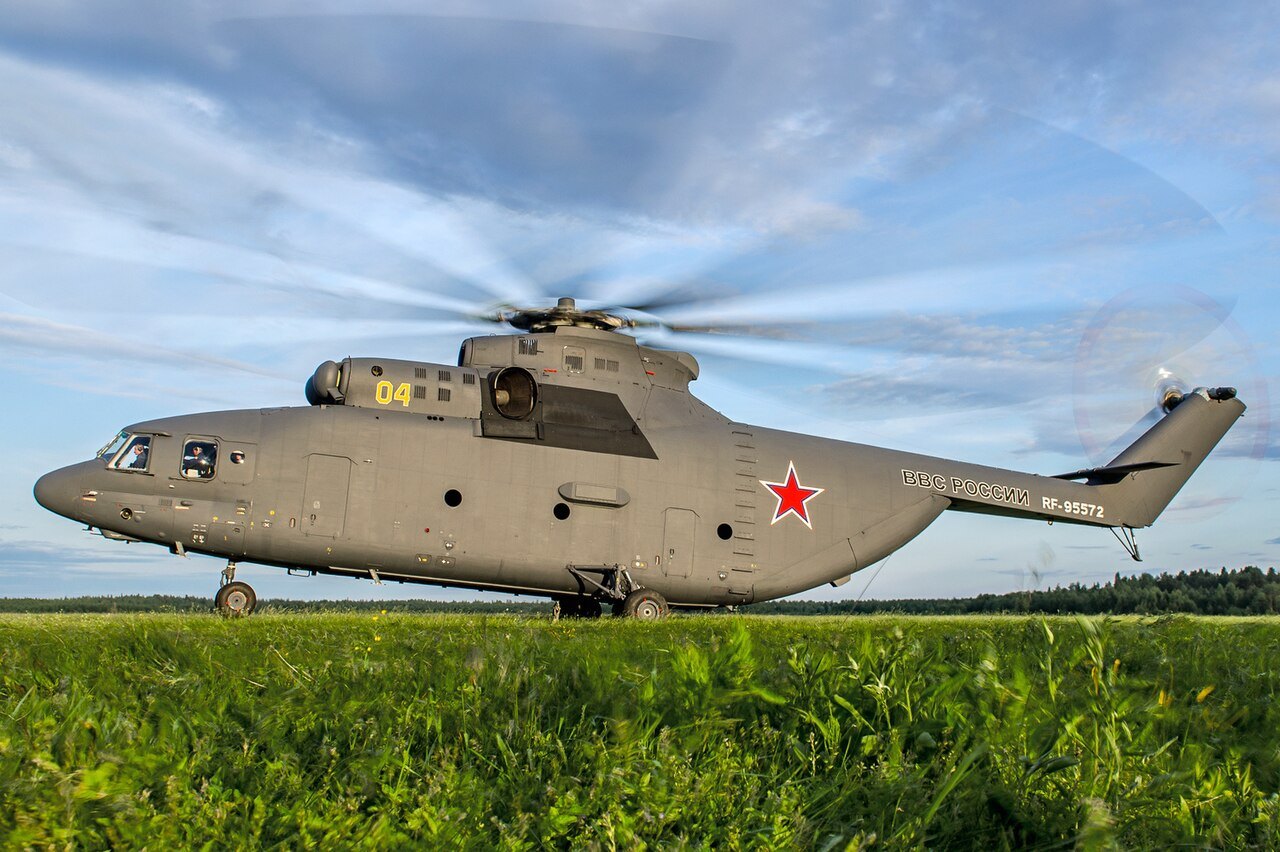
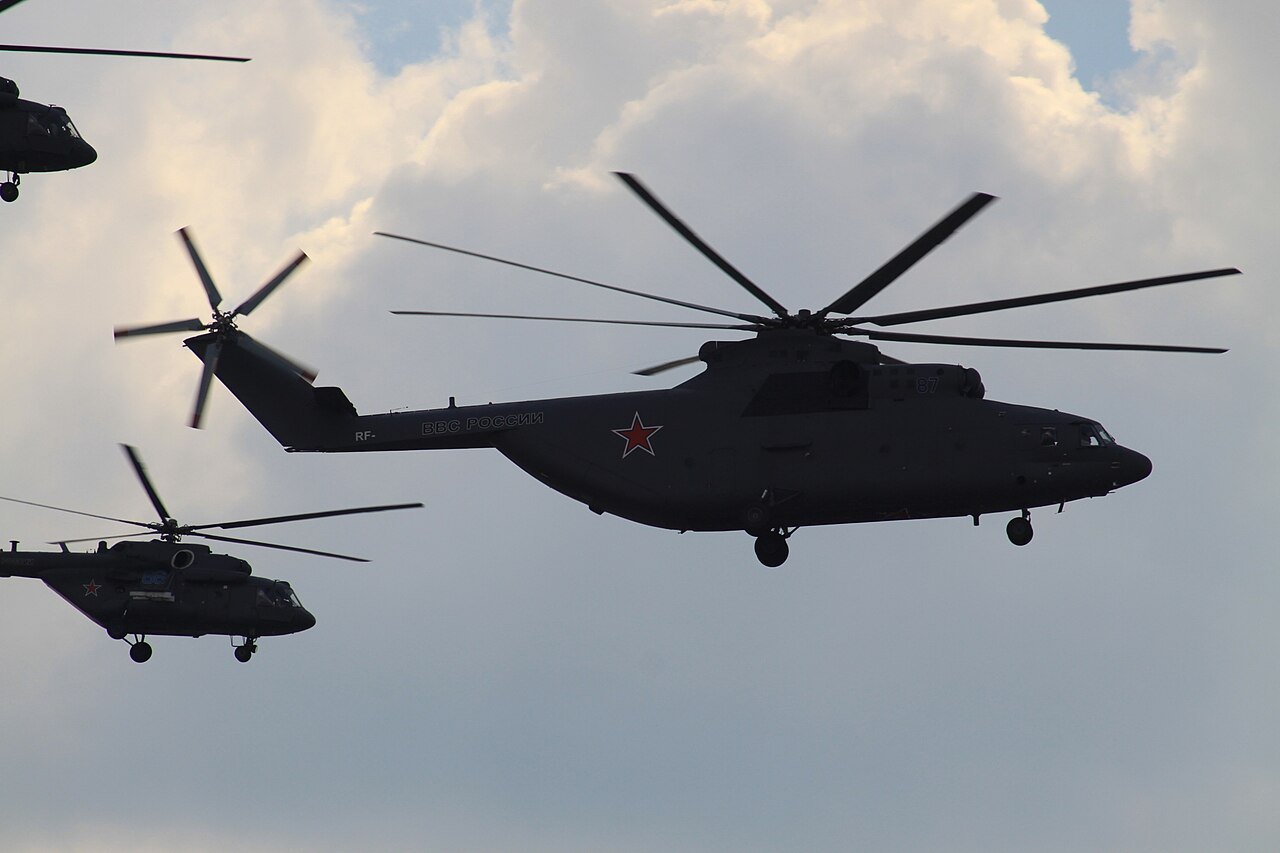
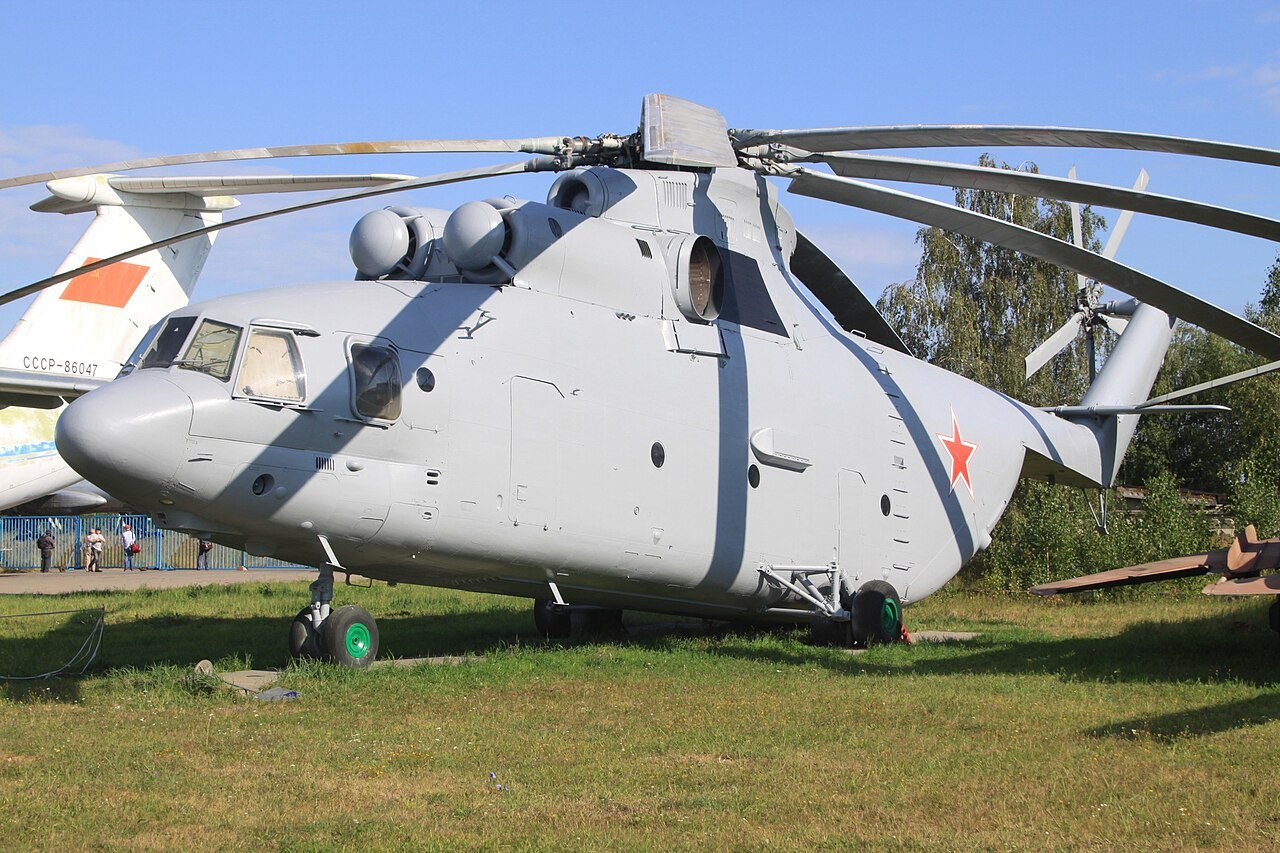
Where the Mi-26 flies and flew
The Mi-26’s record
The Mi-26 is a transport, not a combat helicopter, but it has worked in war zones from Chechnya and Afghanistan to Ukraine, where Russian Mi-26s moved reinforcements during the 2022 Kharkiv counter-offensive. Its peacetime record of disaster relief, recoveries and records is unmatched by any other helicopter.
See how training and combat types compare in the military aircraft statistics database. Figures are approximate.
Everything people ask about the Mi-26
Can I fly in a Mil Mi-26?
Is the Mi-26 the biggest helicopter in the world?
How much can a Mi-26 lift?
How does the Mi-26 compare with the Chinook?
Was the Mi-26 used at Chernobyl?
Who operates the Mi-26?
Is the Mi-26 still in production?
You can’t fly the Mi-26.
These, you can.
Most of this museum you can only look at. These genuine military jets you can fly yourself with MiGFlug — with aerobatics and time on the controls.
 Fly the L-39 AlbatrosThe world’s most-flown jet trainer — aerobatics included
 Fly the F-104 Starfighter“The missile with a man in it”
 Fly the MiG-21The Cold War’s most-produced jet
 Fly the T-33 Shooting StarAmerica’s first jet trainer
 Fly the DH VampireA piece of early jet history
 Fly the S.211Agile Italian jet trainer
 Fly the MB-326The classic Aermacchi jet
 Fly the MiG-15The Soviet legend of the Korean War
Continue the tour
Every fact, checked
- We Haul It AllAir & Space / Smithsonian on Tishchenko, the mammoth lift and the 2002 Chinook recoveries
- Mil Mi-26 (encyclopedia entry)Ugolok Neba Russian aviation encyclopedia: first flight, records, Chernobyl, exports and production
- Komandir sbitogo Mi-26 (Kommersant)Kommersant on the 19 August 2002 Khankala shoot-down and its aftermath
- Chechen gets life for killing 127 Russian soldiersThe Guardian (2004) on the sentencing for the Khankala attack
- Gigahelikopter skal redde Sea KingNRK on the Mi-26 hired to recover a Norwegian Sea King in 2012
- IAF chopper crashes in Jammu, 9 injuredTimes of India on the December 2010 Indian Mi-26 accident
- Largest airlift helicopter MI-26T2 joins RJAFJordan Times (January 2018) on Jordan’s first Mi-26T2
- New Engines For Russia’s Heavy-lift HelicopterAviation International News (2016) on replacing the Ukrainian D-136
- Energia-Buran: air transportationBuran-Energia.com on the abandoned Mi-26 bundle-lift trials
- Mi-26 HALOFederation of American Scientists summary of design, cabin and single-engine capability