
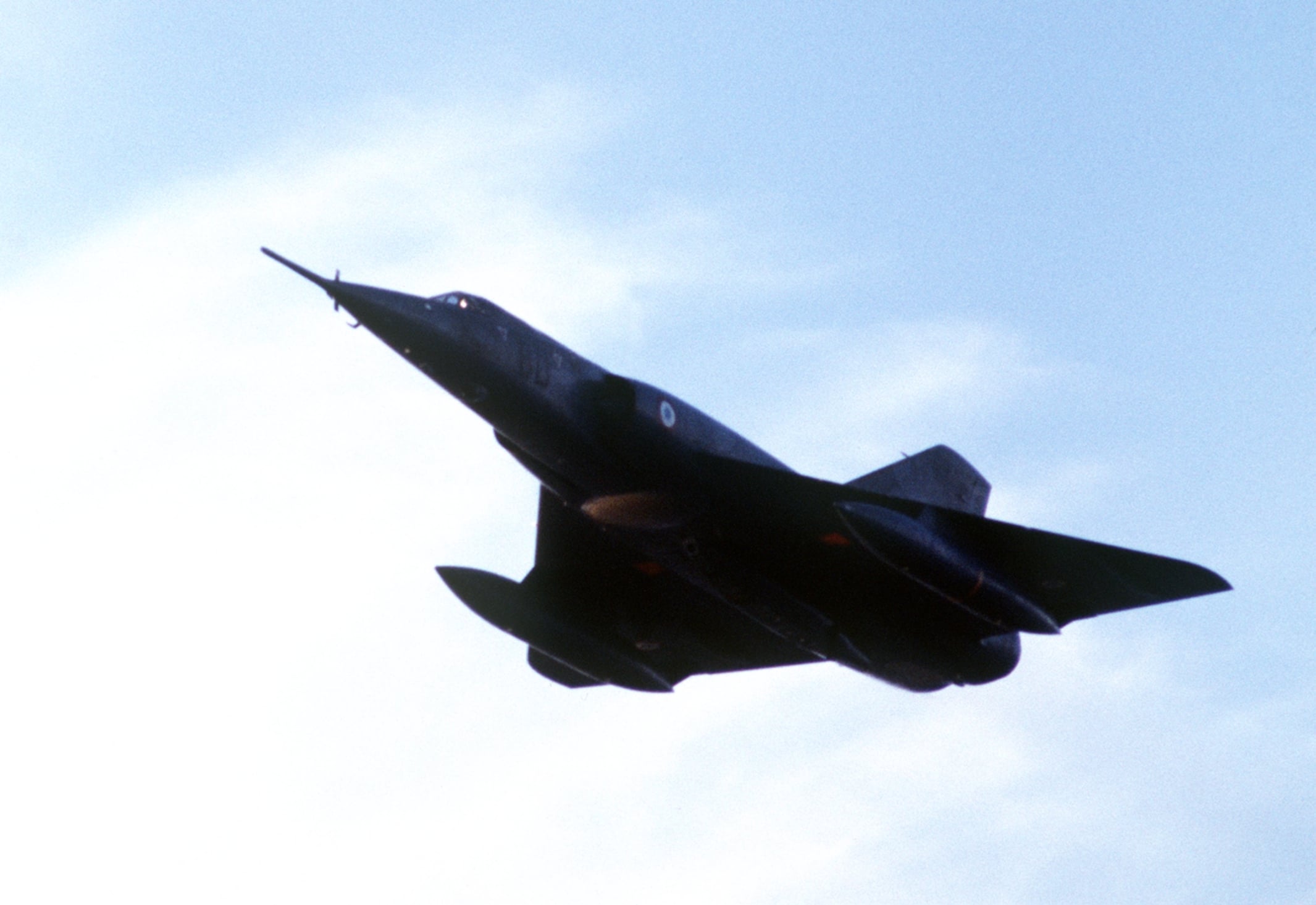
Dassault Mirage IV
France’s Nuclear Delta
The supersonic strategic bomber that carried France’s atomic deterrent for three decades — a scaled-up, twin-engine delta built to punch through Soviet defences at Mach 2 and drop a nuclear weapon that, thankfully, it never had to.
The delta that carried the Force de frappe
France’s humiliation in the 1956 Suez Crisis — leaned on by both superpowers and forced to back down — convinced Paris that only an independent nuclear force could guarantee its sovereignty. When Charles de Gaulle returned to power in 1958, he committed the country to building its own bomb and its own way of delivering it. The airborne leg of that deterrent, the Force de frappe, would be a supersonic bomber built by Dassault: the Mirage IV.
Dassault took the tailless-delta formula it had proven on the small Mirage III fighter and scaled it up into a two-seat, twin-engine machine large enough to carry an atomic bomb at Mach 2. The prototype first flew on 17 June 1959 in the hands of test pilot Roland Glavany, and just days later made a supersonic flypast at the Paris Air Show — extraordinary confidence in a brand-new bomber. Deliveries began in 1964, and the first squadron stood nuclear alert that October.
The Mirage IV was never used in anger — that was the entire point of a deterrent. Its only live nuclear release came over the Pacific in 1966, on a test range. For the rest of its career it stood quick-reaction alert, dispersed across France so no single strike could wipe it out, ready to fly one-way missions that everyone hoped would never be ordered. When the nuclear role passed to newer aircraft in 1996, the surviving jets soldiered on as supersonic spy-planes until 2005 — a remarkable 46 years after the prototype first flew.
01Why France built the Mirage IV: Suez, de Gaulle and an independent bomb
In 1956 Britain and France launched a joint operation to seize the Suez Canal, only to be forced into a humiliating withdrawal under US and Soviet pressure. The lesson French planners drew was blunt: alliances could not be relied upon in an existential crisis, and France needed its own nuclear weapons under its own control. De Gaulle made the Force de frappe a centrepiece of national policy, and the fastest route to a credible deterrent was a manned bomber that could reach Soviet targets at supersonic speed. Dassault’s Mirage IV was the answer — conceived, in effect, as a nuclear delivery system with a cockpit, sized around the bomb it had to carry.
What makes the Mirage IV special
Twin Atar turbojets and a sustained Mach 2
Two SNECMA Atar 9K afterburning turbojets — later the Atar 9K-50 on rebuilt aircraft — gave the Mirage IV genuine supersonic reach, each engine delivering roughly 67 kN in reheat. Dassault claimed it was the only European aircraft able to hold Mach 2 for more than half an hour, letting it dash across defended airspace rather than plod toward its target.
Short legs, solved with the tanker and the buddy
The delta was thirsty and its combat radius on internal fuel was modest, so France bought 12 Boeing C-135F tankers to feed it — the acquisition trials were nicknamed “Boeing Biberon,” Boeing baby-bottle. Because tankers were scarce, Mirage IVs could also refuel one another buddy-to-buddy, one bomber giving up its own range to push a partner deeper toward the target.
One delta, two payloads: nuke or camera
The Mirage IV carried a single nuclear weapon semi-recessed under the fuselage — first the AN‑11 gravity bomb, then the hardened AN‑22, and later the ASMP stand-off missile on rebuilt aircraft. That same belly station accepted the CT52 reconnaissance pod, turning the strategic bomber into a supersonic spy-plane — the role that outlived its nuclear career.
02The Mirage IV’s range problem: tankers, buddy refuelling and the dash to the deck
A supersonic delta burns fuel ferociously, and the Mirage IV’s unrefuelled radius was never enough to reach deep Soviet targets and return — many wartime profiles were frankly one-way. France closed the gap two ways. First, it acquired a dozen Boeing C-135F tankers, derivatives of the KC-135, delivered from 1964. Second, individual bombers carried buddy refuelling stores so one Mirage IV could top up another in flight. As Soviet surface-to-air missiles improved through the 1970s, the fleet also abandoned high-altitude penetration and re-trained to attack from very low level — screaming in at a few hundred feet to slip beneath radar, a punishing profile that drove the switch from the AN‑11 bomb to the toss-delivery-hardened AN‑22.
03From free-fall bomb to stand-off missile: the Mirage IVP rebuild
By the early 1980s a subsonic run-in to drop a gravity bomb over a modern target had become suicidal. Rather than retire the airframe, France rebuilt around 18–19 aircraft (sources differ) into the Mirage IVP — “P” for Pénétration — able to launch the ASMP supersonic stand-off nuclear missile from tens of kilometres out, well outside the innermost defences. The rebuilt jets became operational in 1986, with new navigation and attack systems, and kept the ageing delta strategically relevant until the airborne strike mission passed to the Mirage 2000N in the mid-1990s.
Full Mirage IV specifications
Baseline note: the figures below describe the Mirage IVA, the free-fall nuclear bomber of which 62 were built between 1963 and 1968 and which was France’s entire airborne deterrent for its first decade. Deltas for the Mirage IVP — the eighteen aircraft rebuilt from 1984 to carry the ASMP stand-off missile — and for the Mirage IVR reconnaissance conversion are in grey. French published data for this aircraft is unusually consistent because it only ever had one operator; the two places where sources genuinely differ, the engine sub-mark and the service ceiling, are flagged where they occur.
Dimensions & weights
- Crew
- 2 — pilot and navigator/bombardier in tandem, each under a separate clamshell canopy. The navigator had a ventral periscope sight for aiming free-fall weapons, and almost no view of the outside world otherwise
- Length
- 23.49 m (77 ft 1 in) including the fixed nose refuelling probe, which is a substantial part of the total
- Wingspan
- 11.85 m (38 ft 11 in)
- Height
- 5.40 m (17 ft 9 in)
- Wing area
- 78 m² (840 sq ft) — almost exactly double a Mirage IIIE’s. The aeroplane is a Mirage III scaled up by roughly two in every dimension that matters
- Aerofoil
- Tailless delta, 60° leading-edge sweep, thickness/chord 3.8 per cent at the root and 3.2 per cent at the tip — the thinnest wing built in Europe at the time and among the thinnest anywhere. That is thinner in proportion than most knife blades, and it is what made sustained Mach 2 cruise possible
- Empty weight
- 14,500 kg (31,970 lb)
- Gross weight
- 31,600 kg (69,670 lb) — more than twice the empty weight, because almost all the difference is fuel
- Maximum take-off weight
- 33,475 kg (73,800 lb)
- Internal fuel
- 14,000 litres (3,700 US gal; 3,080 imp gal) — three times a Mirage III’s, held in integral tanks in the wings, in a double-skinned fuselage section around and beneath the intake ducts and engines, and in the base of the fin. Fuel can be pumped fore and aft in flight to shift the centre of gravity rearwards for supersonic cruise and forwards again when subsonic, cutting trim drag
- Drop tanks
- 2 × 2,500 litres (660 US gal) on the inboard wing pylons — the normal fit, and effectively permanent on any operational profile
- Maximum ordnance
- ~6,800 kg (~14,990 lb) of conventional bombs, at the cost of the drop tanks and the countermeasures pods. Some references quote sixteen 454 kg (1,000 lb) bombs; in practice about six large bombs was the realistic figure, and conventional loads were almost never carried
- Hardpoints
- 4 wing pylons plus a semi-recessed fuselage station — the recess under the engines held one nuclear bomb or, from 1972, the CT52 reconnaissance pod. The Mirage IVP added a deep centreline pylon for the ASMP
Performance
- Maximum speed
- 2,340 km/h (1,454 mph), Mach 2.2, at 13,125 m (43,060 ft). The aircraft is redlined at Mach 2.2 by airframe skin temperature rather than by thrust, and is capable of more
- Supersonic cruise
- 1,913 km/h (1,189 mph), Mach 1.8 — the original high-high-high penetration speed. From 1960 the Mirage IV was one of only two aircraft in the world, with the Convair B-58 Hustler, that could hold Mach 2 for more than half an hour at a stretch. The experience fed directly into Concorde
- Maximum speed at low level
- 1,100 km/h (684 mph) — what the aircraft was reduced to once the mission profile changed, and a fair measure of what the switch to low-level penetration cost
- Service ceiling
- 20,000 m (65,600 ft). French sources commonly give 18,000 m (59,050 ft); the difference is a matter of weight and definition rather than a real disagreement
- Time to altitude
- 11,000 m (36,090 ft) in 4 minutes 15 seconds
- Radius of action, subsonic
- 1,240 km (770 mi) at 958 km/h (595 mph) and 13,125 m. This is the central fact about the Mirage IV. Moscow is roughly 2,500 km from eastern France. The aeroplane was deliberately built without the range to get there and back
- Maximum radius, high profile with tanking
- ~3,500 km (~2,175 mi) at Mach 1.85 — achievable only with C-135F support on the way out, and reduced sharply once the fleet went low
- Ferry range
- 4,000 km (2,485 mi) with external tanks
- Low-level penetration altitude
- 60 m (200 ft) on training runs from 1964, flown without terrain-following radar. The workload on the crew was severe and the ride at that height and weight was punishing
- Assisted take-off
- 12 solid-propellant rockets under the wing flaps, adding about 5 tonnes of thrust — fitted so that a fully loaded Mirage IV could get airborne from a short dispersal strip rather than a main base runway that would already have been targeted
- Landing
- Brake parachute housed in the base of the fin — the fin was enlarged in chord during 1959 testing partly to accommodate it, and it also carries a fuel tank of about 500 litres
Propulsion & systems
- Engines
- 2 × SNECMA Atar 9K afterburning turbojets — later production and rebuilt aircraft used the Atar 09K-10 with an improved combustion chamber and cooled turbine blades. Broadly the Mirage III’s engine with greater airflow and an overspeed limit raised from 8,400 to 8,700 rpm for thrust at high altitude
- Thrust, each
- 68.6 kN (15,430 lbf) with reheat — the figure French sources give. Several English-language references instead credit the aircraft with the later Atar 9K-50 at 49.0 kN (11,020 lbf) dry and 70.6 kN (15,870 lbf) in reheat; the 9K-50 was a Mirage F1-generation engine and the 9K is the better-attested fit for the Mirage IVA as delivered
- Intakes
- Side intakes with translating half-cone shock diffusers nicknamed souris, "mice", which move forward as speed rises to keep the shock wave correctly positioned. Reinforced in steel and titanium to survive skin temperatures around 120 °C
- Air refuelling
- Fixed probe in the nose — and the whole force depended on it. France bought twelve Boeing C-135F tankers (plus two spares) specifically for this aircraft, with a drogue adapter on the boom; they were re-engined with CFM56 turbofans as C-135FRs between 1985 and 1988. Mirage IVs also flew in pairs, one carrying the weapon and the other a buddy refuelling pack, which is why the alert squadrons were organised in pairs of pairs
- Radar and navigation
- Thomson-CSF bombing and navigation radar in an oblique ventral radome behind the cockpit, with a Marconi AD.2300 Doppler — the Doppler was one of the very few non-French items aboard. The aircraft entered service without an inertial navigation system because French industry could not yet build one, a direct consequence of the political requirement that the deterrent depend on no foreign supplier
- Sighting
- Ventral blister periscope for the navigator on free-fall deliveries, and an electro-optical sensor under the cockpit — the Mirage IVP received an entirely new radar and electronics suite, a new navigation system and a reworked cockpit as part of the ASMP conversion
- Countermeasures
- Internal jammers and chaff and flare dispensers, supplemented on the outboard wing pylons — on later aircraft a Barax NG jammer pod under the port wing and a BOZ expendables dispenser under the starboard. The outer pylons were never used for weapons
- Escape
- Ejection seats for both crew under separate canopies
- First flight
- 17 June 1959 (Mirage IV 01, flown by Roland Glavany at Melun-Villaroche); 7 December 1963 for the first production Mirage IVA
- Service entry
- 1 October 1964 — the first squadron declared operational eight months after deliveries began in February
- Number built
- 62 production aircraft plus 4 prototypes — a tiny run, and one of the reasons the type consumed up to 44 per cent of the entire French Air Force spare parts budget at its peak
- Withdrawal
- 31 July 1996 from the nuclear strike role; 23 June 2005 from strategic reconnaissance
04The Mirage IV’s numbers: why the specs are hedged
The Mirage IV was a French state strategic asset, never exported and never sold on an open market, so several figures vary between sources. Length is quoted between about 23.3 and 23.5 m; maximum speed as Mach 2.0 sustained rising to about Mach 2.2 in a dash; and range figures swing widely with mission profile — from roughly 1,200 km combat radius to well over 4,000 km ferry range with in-flight refuelling. About 62 production aircraft were built between 1964 and 1968, of which some 18–19 were later rebuilt as Mirage IVP. No credible unit cost or cost-per-flight-hour exists in open sources; treat any precise dollar figure with caution.
Armament & payload
The Mirage IV carried one weapon at a time, and for thirty-two years that weapon was a nuclear one
There is no gun, there is no air-to-air missile, and there is essentially no conventional bomb load worth discussing. A Mirage IVA went to war with a single 60-kiloton bomb tucked into a recess under its belly, two 2,500-litre drop tanks, a pair of jamming and chaff pods on the outer pylons, and twelve take-off rockets under the flaps. That is the entire armament of France’s strategic bomber force. Everything else on the aeroplane exists to get that one object over a Soviet city.
The weapon changed three times and each change tells you what had happened to the air defences it was meant to beat. The AN-11 was a high-altitude free-fall bomb for an aircraft cruising at Mach 1.8 above 12,000 m. The AN-22 was parachute-retarded so that the same aircraft could lay it down from 60 m and get away. The ASMP was a ramjet cruise missile fired from 80 to 300 km out, because by the 1980s the aeroplane could no longer expect to reach the target at all. Only eighteen of the 62 aircraft were ever converted to carry the ASMP, and only twelve were wired for the reconnaissance pod; the standard Mirage IVA could carry neither.
Gun
- None carried, ever. No cannon armament was fitted to any Mirage IV, prototype or production
- This was not an oversight or a weight saving. The aircraft was never intended to be seen, let alone engaged: its defence was to arrive at Mach 1.8 above 12,000 m, and later to arrive at 60 m at night
- It is worth contrasting with the aircraft it most resembles in role. The Avro Vulcan had no gun either; the Convair B-58 Hustler kept a radar-directed 20 mm tail cannon; the Tupolev Tu-22 carried a tail gun as well. Dassault took the view that a gun on a delta-winged bomber with no tail was so much dead weight, and was right
- The crew’s only active defence was electronic: internal jammers, chaff and flares, and from the 1980s a Barax NG jammer pod and a BOZ dispenser on the outboard wing pylons
Air-to-air
- None carried, ever. The Mirage IV never had an air-to-air missile of any kind, nor the radar modes or wiring to use one
- Its bombing and navigation radar looks downward and forward-obliquely from a ventral radome; it cannot search for or track another aircraft
- The type was, in effect, defenceless against interception once found. That is exactly why the profile was changed from high to low in the late 1960s, why the fleet was dispersed to rough strips, and why the nuclear mission eventually moved to a stand-off missile and then off the aircraft altogether
- In its final reconnaissance career over Bosnia, Iraq, Kosovo and Afghanistan the Mirage IVP flew inside coalition air packages and relied on fighter escort and on the suppression of enemy air defences by others
Air-to-surface guided
- ASMP (Air-Sol Moyenne Portée) — one missile on a deep centreline pylon. The only guided weapon the Mirage IV ever carried, and the reason the Mirage IVP exists
- 860 kg, 5.38 m long, 380 mm in diameter, powered by a liquid-fuel ramjet and flying at Mach 2 to Mach 3. Published range runs from about 80 km on a low-level profile to about 300 km launched high; the exact figures remain classified
- Warhead: TN 81 thermonuclear, variable yield between 100 and 300 kt — substantially more than the free-fall bombs it replaced, from a weapon that never has to overfly the target
- Development began in 1979; test launches from Mirage IVs ran between 1981 and 1983; a contract for eighteen conversions was signed in July 1984; the first modified aircraft had flown on 12 October 1982 and the standard re-entered service on 1 May 1986. In French doctrine the ASMP is a "pre-strategic" weapon — the last warning shot before the submarine-launched ballistic missiles
- The Mirage IVP carried it until the nuclear mission passed to the Mirage 2000N on 31 July 1996. The missile itself outlived the aircraft by a wide margin and its descendants are still on the Rafale
Bombs
- AN-11 — France’s first operational nuclear weapon and the Mirage IVA’s original armament. A plutonium implosion pure-fission bomb of about 1,500 kg yielding roughly 60 kt, carried semi-recessed in the fuselage under the engines. In service 1964–67; about 40 built. It could only be delivered from high altitude
- AN-22 — the replacement from 1967 and the weapon that made low-level delivery possible. Similar 60–70 kt fission yield, but the casing was redesigned down to around 700 kg and fitted with a parachute retarder so the aircraft could lay it down from very low level and escape the burst. About 40 built, one per front-line aircraft plus spares; the last was retired on 1 July 1988
- On 19 July 1966, in Operation Tamouré, a Mirage IVA of EB 1/91 Gascogne staged from Hao in French Polynesia with two C-135F tankers and dropped a live weapon of about 50–60 kt over Mururoa. It is the only live nuclear weapon France ever dropped from an aircraft. Sources differ on whether the bomb is properly designated AN-11 or the derived AN-21, and on which airframe carried it
- Conventional bombs: theoretically up to 6,800 kg, commonly quoted as sixteen 454 kg (1,000 lb) weapons, at the cost of the drop tanks and countermeasures pods. Such loads were rarely fitted and the aircraft never dropped a conventional bomb in anger
- The whole delivery chain was built around one weapon and one crew. Alert status held 36 aircraft armed: twelve airborne, twelve at four minutes’ readiness and twelve at forty-five minutes, rotated against 26 reserve airframes
Rockets
- The only rockets a Mirage IV carried pointed backwards. Twelve solid-propellant boosters were mounted diagonally beneath the wing flaps, giving about 5 tonnes of additional thrust for a few seconds
- They were fitted for one reason: dispersal. From the 1960s the French Air Force scattered its Mirage IVs to pre-prepared rough strips, because hardening every base against a first strike had been costed and found unaffordable
- A bomber that can only fly from three or four long, well-known runways is a bomber that will be destroyed on the ground. Rocket-assisted take-off from an austere strip was the cheap answer, and it was tested on the fourth prototype in 1963
- No unguided air-to-ground rockets were ever carried. There was no ground-attack role for this aircraft short of nuclear release
Pods & other stores
- CT52 reconnaissance pod, carried in the same fuselage recess as the bomb. Twelve aircraft were equipped from 1972 as the Mirage IVR; the Mirage IVP could carry it on the centreline pylon in place of the ASMP
- Three configurations: Basse Altitude with three or four long-focal-length cameras for low-level work, Haute Altitude for high-level standoff photography, and an infrared line-scanner fit. All wet film, no digital systems at any point in the pod’s life
- The first operational use was over Chad in September 1974. In its final decade the CT52 flew over Bosnia, Iraq, Kosovo and Afghanistan, and when the last Mirage IVP was retired in 2005 the French Air Force was briefly left with only Mirage F1CRs for the strategic reconnaissance task
- Two 2,500-litre drop tanks on the inboard pylons, effectively a permanent fit. Outboard pylons carried the ECM and expendables: a Barax NG jammer to port, a BOZ chaff and flare dispenser to starboard on later aircraft
- Buddy refuelling pack — one aircraft of each operational pair carried tanks and a hose reel so that its partner could reach the target. In a four-aircraft squadron that meant two bombs, not four
Three typical loadouts
- Nuclear alert, high profile, 1965
- One AN-11 semi-recessed in the fuselage, two 2,500-litre drop tanks, ECM and chaff pods outboard, twelve take-off rockets under the flaps. Climb, take fuel from a C-135F over France or the North Sea, cruise at Mach 1.85 above 12,000 m, release over the target. Fuel for the return leg was not part of the plan for the deepest targets; the assumption was diversion to a neutral country, if the crew got that far.
- Nuclear alert, low profile, 1975
- One parachute-retarded AN-22, two 2,500-litre tanks, jamming and expendables pods, rockets fitted for a dispersal-strip departure. Tanking outbound, then descend and run in at 1,100 km/h (684 mph) at 60 m with no terrain-following radar and the navigator on the radar and periscope. The profile that kept the aircraft alive against 1970s surface-to-air missiles, and that halved its radius while it did so.
- Strategic reconnaissance, Kosovo, 1999
- One CT52 Haute Altitude pod on the centreline of a Mirage IVP, two 2,500-litre tanks, Barax NG and BOZ pods. No weapon of any kind aboard. Flown from Mont-de-Marsan by ERS 1/91 Gascogne, the last unit to operate the type, inside a coalition package that provided the escort and the defence suppression the aeroplane could not provide for itself.
Sourcing caveat: airframe and performance figures follow Dassault and French Air Force sources as reproduced in the standard references, cross-checked against Bill Gunston and Peter Gilchrist. Weapon yields and stockpile numbers for the AN-11 and AN-22 come from open declassified summaries and are approximate by nature; French nuclear weapon data is still incompletely released, and ASMP range remains classified with published estimates spanning 80 to 300 km depending on launch profile. Where the mission profiles are described as one-way, that is what several sources state and what the aircraft’s published radius implies, but no French planning document saying so in those words is public.
Variants
France built a bomber with barely enough range to reach its targets, and that was the point rather than the flaw
In May 1956 the Mollet government wrote a specification for a supersonic bomber able to carry a three-tonne, 5.2-metre nuclear bomb 2,000 km without refuelling. The demand for supersonic speed struck contemporaries as odd for a bomber. What was odder still, and much more revealing, was the range. Two thousand kilometres does not reach Moscow from France and come back. Everybody involved understood that.
Sud Aviation offered a stretched Vautour, Nord offered a proposal of its own, and Dassault offered what was effectively a Mirage III doubled in every dimension — the same tailless delta, the same intake geometry, two engines instead of one, twice the empty weight and three times the fuel. It won in April 1957 on cost and on the argument that development would be quicker because so much of it already existed. The prototype flew on 17 June 1959 and by September 1960 it had taken the world closed-circuit speed records over 1,000 km and 500 km, the latter at an average of 1,972 km/h.
The range problem was addressed twice and solved neither time. The Mirage IVB would have been a genuinely intercontinental aircraft: 57 tonnes, a 120 m² wing, licence-built Pratt & Whitney J75 engines, and enough fuel for a return trip — de Gaulle wanted it precisely so that crews could come home. It was cancelled in July 1959 as too expensive, in favour of relying on aerial refuelling. So France bought twelve Boeing C-135F tankers, which is an uncomfortable fact for a deterrent built on the principle of depending on nobody: the independence of the force de frappe rested on American aircraft. The medium-sized Mirage IVA was ordered instead, fifty aircraft on 4 April 1960, and the fleet went into service knowing that for the deepest targets there would be no fuel for the return leg. Surviving crews would divert to whatever neutral airfield was still standing.
That is the context the aircraft has to be judged in. The force de frappe was not a military instrument in the ordinary sense; it was a political one. De Gaulle wanted a nuclear force that answered to Paris and to nobody else, and he said so plainly — his own phrase for the Mirage IV was that France did not have fighter aircraft but fear-inducing ones. General Pierre Gallois, one of the architects of the doctrine, put the logic in a single sentence: "France is not a prize worthy of ten Russian cities." The deterrent did not have to be able to defeat the Soviet Union. It had to be able to hurt it enough that no rational government would trade Moscow, Leningrad, Kyiv and Murmansk for Paris. Thirty-six aircraft each carrying one 60-kiloton bomb was judged to be exactly that much, and the operational establishment of the Mirage IV force was one of the things that made de Gaulle confident enough to pull France out of NATO’s integrated military command in 1966.
The rest of the story is the aircraft being pushed steadily downwards and outwards by the improving Soviet air defences it was built to beat. In the late 1960s the high-altitude profile became untenable and the fleet went low, flying training penetrations at 60 m without terrain-following radar and losing much of its radius in the process. The aircraft was dispersed to rough strips because hardened shelters were unaffordable. By the mid-1970s free-fall delivery was judged impractical at any height, the deterrent’s weight shifted to land-based S2 missiles and the ballistic missile submarines, and one of the three wings stood down in 1976. The ASMP conversion bought a decade more. Then the aircraft found an unexpected second career: with the nuclear role gone in 1996, five Mirage IVPs became strategic reconnaissance aircraft with ERS 1/91 Gascogne and spent their last nine years photographing Bosnia, Iraq, Kosovo and Afghanistan — the deterrent that never had to be used, ending as a camera platform over the Balkans.
- Mirage IV 01 (1959, 1 built)
- The experimental prototype, built at Saint-Cloud in eighteen months to explore sustained supersonic cruise at a time when no aircraft had been designed to hold more than Mach 1.8 for long. About 32 tonnes, two Atar 9D engines, 67 ft long, a 37 ft span and a 670 sq ft wing. First flown 17 June 1959; the tail was enlarged in chord shortly afterwards. Holder of the 1,000 km and 500 km closed-circuit speed records of September 1960.
- Mirage IVA prototypes 02, 03, 04 (1961–63, 3 built)
- Larger than 01 and sharing almost no drawings with it. 02 first flew 12 October 1961, 03 on 1 June 1962 and 04 on 23 January 1963. 02 flew simulated nuclear runs at Colomb-Béchar in Algeria during 1962; 03 carried the navigation and bombing system and the refuelling probe; 04 was representative of production and tested the twelve rocket-assisted take-off boosters.
- Mirage IVA (1963–68, 62 built)
- The production bomber and the baseline above. Delivered from February 1964, first squadron operational 1 October 1964, nine squadrons of four aircraft in three wings, each squadron at a different base so that no single strike could take out the force. The final batch of twelve, ordered in November 1964, had revised flight controls, avionics and structure for low-level work, and those improvements were retrofitted to the whole fleet.
- Mirage IVR (from 1972, 12 equipped)
- Not a rebuild but a wiring and clearance standard: twelve Mirage IVAs equipped to carry the CT52 reconnaissance pod in the bomb recess. First operational use over Chad in September 1974. The pod came in low-altitude, high-altitude and infrared line-scan configurations and used wet film throughout its life.
- Mirage IVP (1982–86, 18 converted)
- P for Pénétration. A deep conversion, not a modification: a new centreline pylon for the ASMP, an entirely new radar and electronics suite, new navigation and flight control systems and a reworked cockpit. Contract signed July 1984 after the first converted aircraft had already flown on 12 October 1982; back in service 1 May 1986. These eighteen aircraft carried the nuclear mission until 31 July 1996 and five of them then became the reconnaissance fleet.
- Mirage IVB (cancelled July 1959)
- The aircraft the Mirage IV should have been if range had been the priority: 57 tonnes with 31 tonnes of fuel, a 120–130 m² wing, two SNECMA-built Pratt & Whitney J75 turbojets, Mach 2.4 and 5,000 km unrefuelled. De Gaulle wanted it so that two-way missions were possible. It was cancelled on cost, and the decision to rely on tankers instead was made at the same moment.
- Mirage IV-106 (proposed December 1963, not built)
- Two SNECMA TF106 turbofans (a licensed Pratt & Whitney design), an enlarged fuselage at about 105,000 lb gross, terrain-avoidance radar and a proposed French version of the American GAM-87 Skybolt air-launched ballistic missile. Too costly, and never ordered — though the last twelve production Mirage IVAs had originally been intended to receive the TF106.
- Mirage IVS / Mirage IV* (proposed July 1965, not built)
- The Dassault and British Aircraft Corporation joint bid for the RAF requirement left over by the cancellation of TSR-2. Rolls-Royce Spey turbofans totalling about 185 kN, a deeper and longer fuselage, an 80,000 lb gross weight, TSR-2 avionics and a bomb load up to 9,070 kg. Estimated at £2.32 million per airframe for fifty, cheaper than the F-111K. RAF test pilots liked its low-altitude handling; the Air Ministry found a real range shortfall and a field-length problem, and Britain chose the F-111K, which was itself cancelled soon afterwards. Some French commentators date the cooling of Anglo-French aerospace enthusiasm to this rejection.
- Mirage IVA with Avon engines (proposed 1963, not built)
- Offered to Australia as a Canberra replacement with Rolls-Royce Avons. Air Marshal Frederick Scherger took it seriously precisely because it was proven hardware already in service while TSR-2 was not. It was one of five types shortlisted; the RAAF chose the General Dynamics F-111C.
- Export Mirage IV (none)
- Worth stating plainly: the Mirage IV was never sold to anyone. It is one of the very few Dassault combat aircraft with no export operator at all, and the reason is obvious — it was a nuclear delivery system whose only customer needed nuclear weapons to go with it.
Retirement and survivors. The chronology is precise: the last wing of nine squadrons had already been reduced from 1976; free-fall weapons went when the AN-22 stockpile was retired on 1 July 1988; the ASMP-armed Mirage IVP was formally withdrawn from the nuclear strike role on 31 July 1996, when EB 2/91 disbanded and EB 1/91 was redesignated ERS 1/91 Escadron de Reconnaissance Stratégique with five aircraft at Mont-de-Marsan; and the last reconnaissance sortie was flown in 2005, with 23 June commonly given as the withdrawal date. Surviving airframes were conserved at the CIFAS at Bordeaux-Mérignac. Because the type never left France and only 62 were built, the survivors are almost all on French soil and a good number are on air bases rather than in public museums — Rochefort, Saint-Dizier, Orange, Mont-de-Marsan, Châteaudun, Cazaux, Avord, Istres, Creil and Bordeaux each keep one. The publicly accessible ones worth travelling for are at the Musée de l’Air et de l’Espace at Paris-Le Bourget, which has both a Mirage IVA and a Mirage IVP, and which also holds the actual aircraft associated with the Tamouré live drop; the Charles de Gaulle memorial at Colombey-les-Deux-Églises; the Musée Européen de l’Aviation de Chasse at Montelimar; Savigny-lès-Beaune; and Ailes Anciennes Toulouse. One left the country: Mirage IVA number 45, formerly displayed at the Cité des Sciences in Paris, was donated to the Yorkshire Air Museum at Elvington and arrived in March 2017 — the only Mirage IV outside France.
Operators
France built the Mirage IV for one customer only — itself — and 62 supersonic bombers carried the whole of the French airborne nuclear deterrent for thirty-two years without a single export sale.
There is no operator table to speak of here, and that is the point of the aeroplane. The Mirage IV was the delivery system for France’s independent deterrent, ordered in two batches in 1962 — 50 bombers, then 12 aircraft able to carry a reconnaissance pod — and dispersed across nine squadrons and nine bases so that no first strike could catch the force on the ground; approaches to Australia and Britain went nowhere, and no foreign air arm ever took one on charge. The first squadron at Mont-de-Marsan stood up on 1 October 1964 armed with the AN–11 free-fall bomb, later the parachute-retarded AN–22 for low-level delivery, and that free-fall mission ran until 1988, by which time a batch of airframes had been rebuilt as the Mirage IVP to carry the ASMP stand-off missile from 1 May 1986. The IVP left the nuclear mission on 31 July 1996 to the Mirage 2000N, and a handful soldiered on with ERS 1/91 “Gascogne” as France’s strategic reconnaissance asset over Bosnia, Kosovo, Iraq and Afghanistan until the squadron was dissolved on 23 June 2005, 41 years after the type entered service. Eighteen Mirage IVA were rebuilt to Mirage IVP standard to carry the ASMP missile; the 12 aircraft of the November 1962 second contract, ordered for the reconnaissance role, are a different twelve, which is why the two figures are often confused. The alert posture at its peak stood at 36 aircraft on rotation, in three tiers of twelve.
In service with
- No current military operator
- —
Formerly operated by
- French Air ForceFrance · the sole operator — 62 production Mirage IVA delivered between February 1964 and March 1968 against a contract for 50 bombers signed on 29 May 1962 and a follow-on for 12 reconnaissance-capable aircraft in November 1962, plus four prototypes not counted here; flown by nine squadrons in the 91st, 93rd and 94th escadres under the Forces aériennes stratégiques, the command created in 1964 to hold France’s airborne deterrent, with the first squadron declared operational at Mont-de-Marsan on 1 October 1964; armed with the AN–11 and then the AN–22 free-fall bomb until the free-fall role ended in 1988; 18 airframes rebuilt as the Mirage IVP for the ASMP stand-off missile, operational from 1 May 1986 and out of the nuclear mission on 31 July 1996; the last five to eight aircraft flew strategic reconnaissance with the CT52 pod until ERS 1/91 “Gascogne” was dissolved on 23 June 2005
- 62 · 1964–2005
1 operators, 0 current. Dates are first delivery to last retirement, and the basis of the quantity column is stated above. Air forces with a MiGFlug Order of Battle page are linked (1 so far); the rest follow as the database grows.
From Suez to the last supersonic spy-flight
Suez sparks the deterrent
The Suez Crisis convinces France it needs an independent nuclear force under its own control — the seed of the Force de frappe.
First flight
Prototype Mirage IV 01 flies on 17 June with Roland Glavany at the controls, and goes supersonic at the Paris Air Show days later.
Enters service
Deliveries begin; the first bomber squadron at Mont-de-Marsan stands nuclear alert in October, armed with the AN-11 gravity bomb.
The only live drop
Operation Tamouré: on 19 July a Mirage IV releases a live atomic bomb over Mururoa atoll — the sole nuclear release of its career.
Down to the deck
As Soviet SAMs improve, the fleet re-trains for low-level penetration and adopts the hardened AN-22 bomb for toss delivery.
Mirage IVP and ASMP
Rebuilt Mirage IVP aircraft enter service carrying the ASMP supersonic stand-off nuclear missile, replacing the free-fall bomb.
Nuclear role ends
The Mirage IV is withdrawn from the strategic strike mission, which passes to the Mirage 2000N and, later, the Rafale.
The last flight
The reconnaissance Mirage IVPs, flying the CT52 camera pod, are finally retired — 46 years after the prototype first flew.
From the flight line: twelve Mirage IV stories
The bomber Suez built
France’s 1956 humiliation drove the decision to build an independent deterrent.
Read the full story
Supersonic at the air show
Just days after its maiden flight, the prototype went supersonic over Paris.
Read the full story
The 30-minute Mach 2
Dassault claimed no other European aircraft could hold Mach 2 as long.
Read the full story
Closed-circuit speed marks
In 1960 the Mirage IV set world speed records over closed circuits.
Read the full story
“Boeing Biberon”
France bought a dozen C-135F tankers to feed the thirsty delta.
Read the full story
Buddy-to-buddy
Mirage IVs could refuel each other to stretch strike range.
Read the full story
Operation Tamouré
The one and only time a Mirage IV dropped a live nuclear bomb.
Read the full story
Dispersed to survive
The fleet was scattered so no single strike could destroy it.
Read the full story
Under the radar
Improving Soviet missiles forced the fleet to attack from very low level.
Read the full story
From bomb to missile
The Mirage IVP swapped the free-fall bomb for a stand-off missile.
Read the full story
The supersonic spy-plane
Stripped of nuclear duty, the Mirage IV became a fast recon platform.
Read the full story
Forty-six years on
The final Mirage IVs retired in 2005, closing a remarkable career.
Read the full story
The Mirage IV in pictures
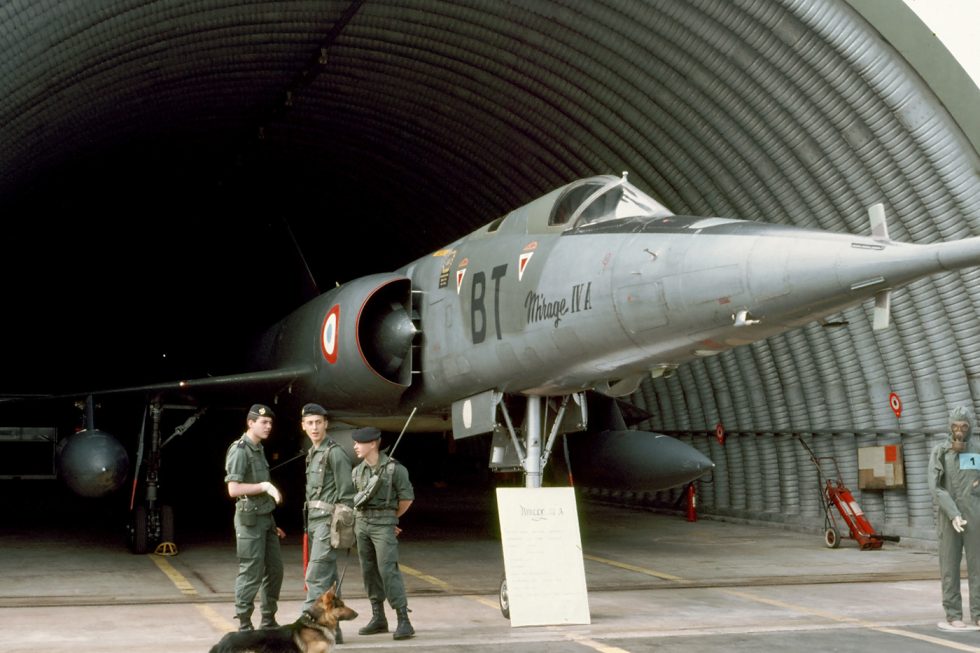
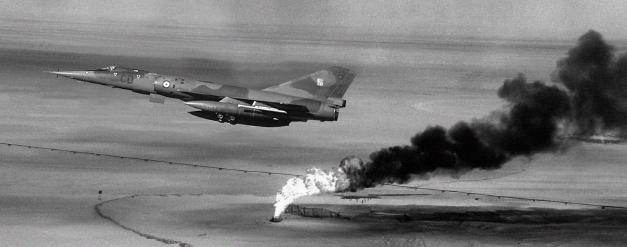
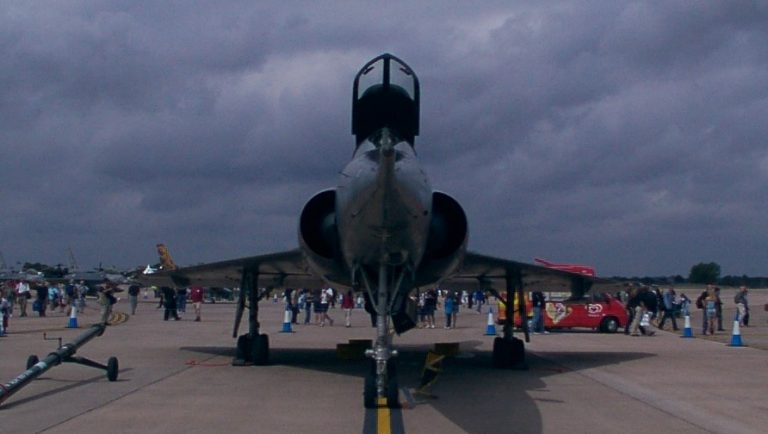
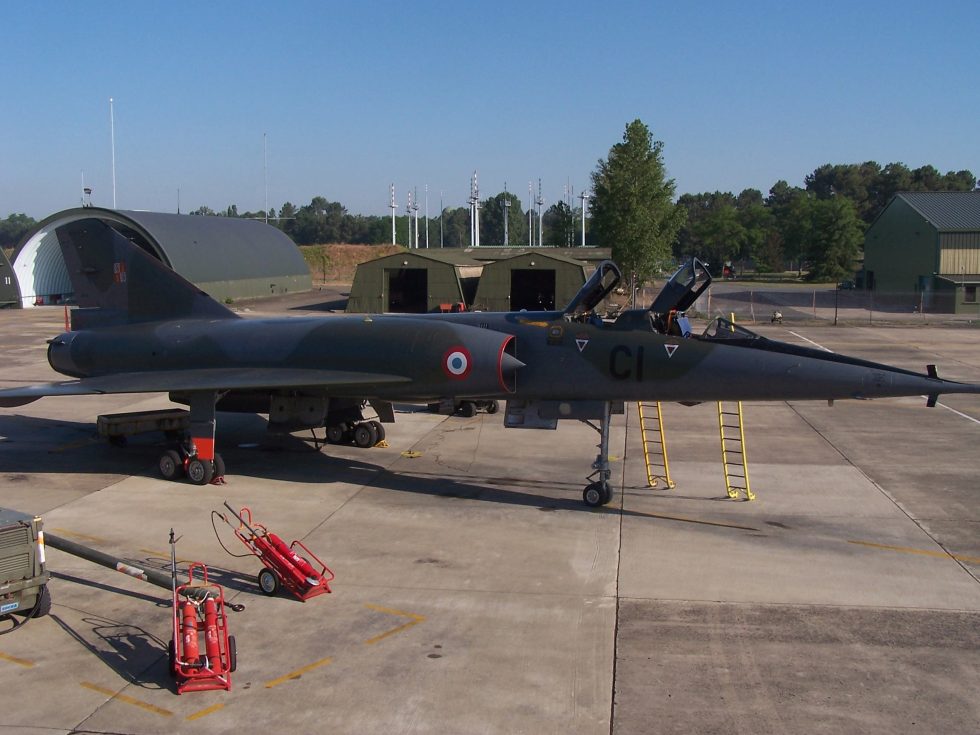
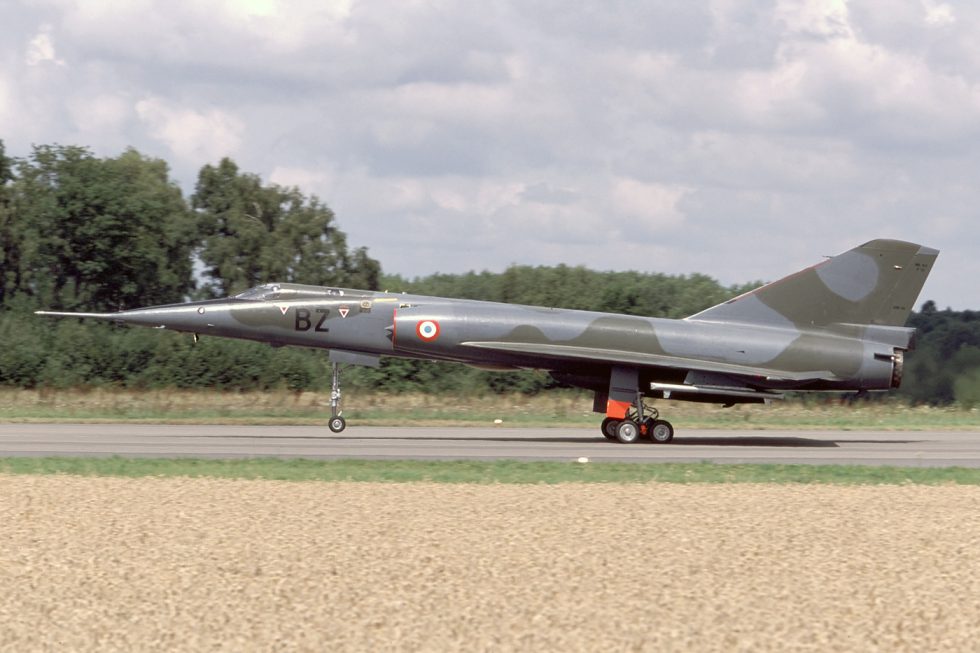
The Mirage IV in motion
A dedicated Mirage IV video feature is coming soon. In the meantime, explore the gallery above and the twelve stories for the full picture of France’s supersonic nuclear delta.
The Mirage IV in motion
ATE CHUET — one of the most-watched Mirage IV films on YouTube.
Where the Mirage IV served
The record of a deterrent that never fired
The Mirage IV was never used in anger — and that was precisely the measure of its success. As the airborne leg of France’s nuclear deterrent, its job was to be so credible that it never had to fly a wartime strike. Its only live nuclear release was a 1966 test over the Pacific; its real operational sorties came decades later, unarmed, as a supersonic reconnaissance platform over the Balkans and the Middle East.
Compare the combat record of every military aircraft. Figures as of July 2026.
Everything people ask about the Mirage IV
Can I fly in a Mirage IV?
How fast was the Mirage IV?
What nuclear weapons did it carry?
Was the Mirage IV ever used in combat?
How many were built?
Why was it retired?
What replaced the Mirage IV?
You can’t fly the Mirage IV.
These, you can.
Some legends only live in museums — others are fuelled and waiting. MiGFlug has put civilians in real military jet cockpits since 2004.
 Fly the L-39 AlbatrosThe world’s most-flown jet trainer — aerobatics included
 Fly the F-104 Starfighter“The missile with a man in it”
 Fly the MiG-21The Cold War’s most-produced jet
 Fly the T-33 Shooting StarAmerica’s first jet trainer
 Fly the DH VampireA piece of early jet history
 Fly the S.211Agile Italian jet trainer
 Fly the MB-326The classic Aermacchi jet
 Fly the MiG-15The Soviet legend of the Korean War
Continue the tour
Every fact, checked
- Dassault Aviation — Mirage IVThe manufacturer’s own history: first flight, service entry and performance claims.
- Royal Aeronautical SocietyDetailed development history, tanker acquisition and the 1960 speed records.
- Federation of American ScientistsNuclear-forces reference: weapons, dimensions and the Mirage IVP conversion.
- GlobalSecurity.orgQuick-reaction-alert doctrine, dispersal and the AN-22 / ASMP weapons.
- Ailes Anciennes ToulouseMuseum profile of the Mirage IVP, conversion numbers and reconnaissance sorties.
- Yorkshire Air MuseumAirframe reference for the preserved Mirage IVA on display.
- The Aviation Geek ClubAccount of Operation Tamouré, the sole live nuclear drop in 1966.
- Military MattersOverview of the type’s career, weapons evolution and final retirement.