
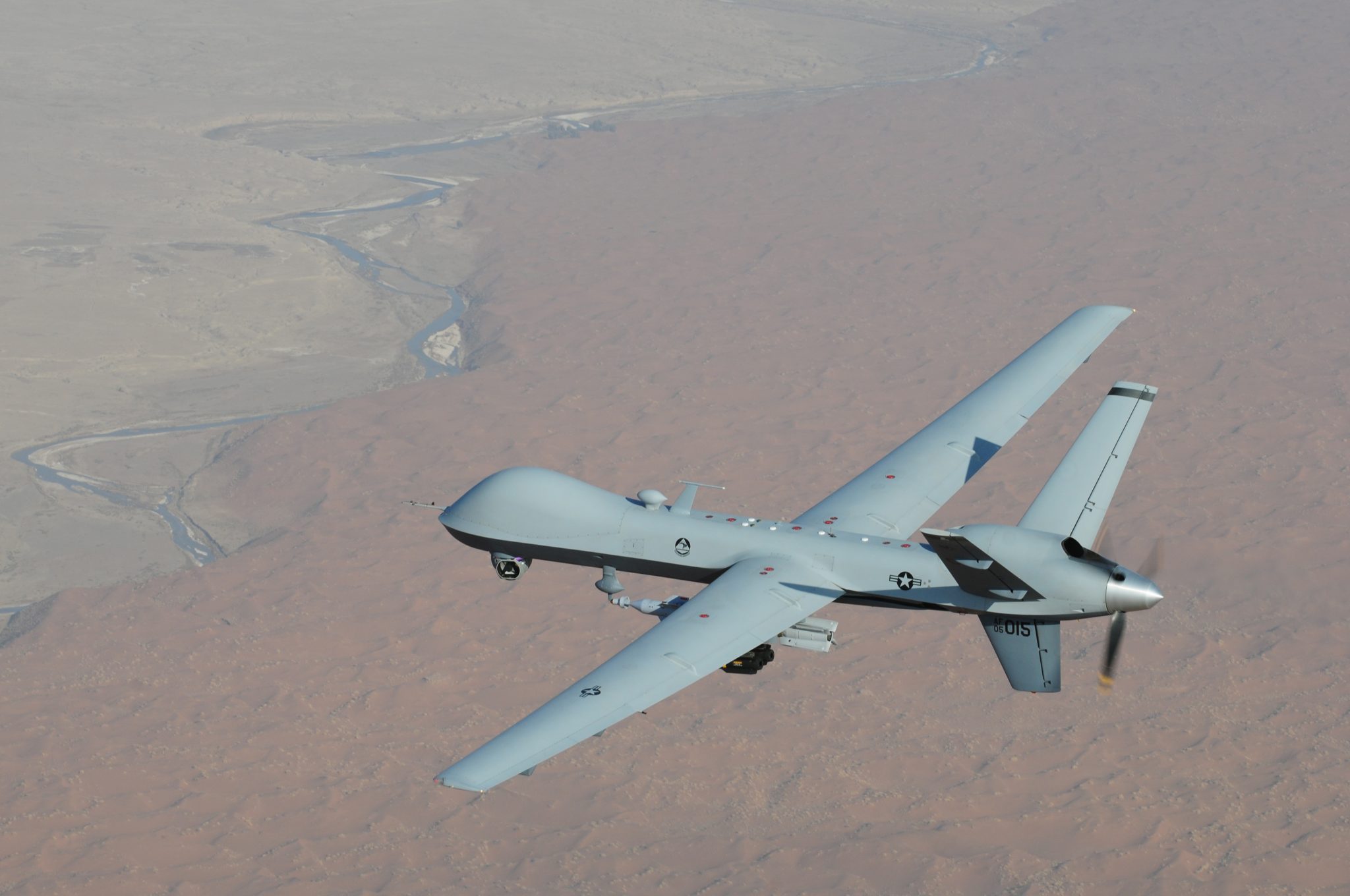
General Atomics MQ-9 Reaper
“Hunter-Killer”
The armed drone that reshaped modern war — a turboprop-powered unmanned aircraft built to watch a target for a full day and then strike it, flown by a two-person crew half a world away.
The drone that made “hunter-killer” a doctrine
The General Atomics MQ-9 Reaper is the aircraft that turned the armed drone from an experiment into a permanent feature of modern war. It grew out of the piston-engined MQ-1 Predator, which had shown in the early 2000s that an unmanned aircraft could not only watch a target but shoot at it. General Atomics Aeronautical Systems answered with a larger, far more powerful turboprop development — originally called Predator B — conceived from the outset as a “hunter-killer”: a single machine for persistent surveillance and strike. It first flew in 2001 and entered U.S. Air Force service in 2007.
What makes the Reaper distinctive is not speed — it cruises at a few hundred kilometres an hour — but persistence and reach. Powered by a roughly 900-shaft-horsepower Honeywell turboprop, it can stay airborne for more than 27 hours, loitering over a target while its Multi-Spectral Targeting System sensor ball streams video to operators. It is flown by a two-person crew, a pilot and a sensor operator, who sit in a ground control station and command the aircraft over a satellite link from thousands of kilometres away. Its hardpoints carry AGM-114 Hellfire missiles and laser- and GPS-guided bombs, so the same aircraft that finds a target can also engage it.
That capability made the Reaper central — and deeply controversial — in two decades of counterterrorism operations across Afghanistan, Iraq, Yemen, Somalia and Pakistan. Supporters argue it lets commanders study a target for hours and strike with precision; critics point to civilian casualties and to the questions raised by killing at a distance. Casualty figures for drone strikes are genuinely contested and are usually given as wide, uncertain ranges rather than firm numbers. The Reaper has also proved vulnerable outside permissive skies: one was brought down over the Black Sea by a Russian fighter in 2023, and several have been lost to Houthi fire over Yemen.
01The MQ-9 Reaper’s hunter-killer concept: how one drone merged surveillance and strike
Before the Reaper, surveillance and strike were usually separate jobs done by separate aircraft. A reconnaissance platform found a target; a strike aircraft was then vectored in, often after the moment had passed. The armed Predator hinted at another way, and the MQ-9 was built to deliver it: a persistent aircraft that could hunt a target for hours with its sensors and, when cleared, kill it with its own weapons — without handing off to anyone else.
This collapsing of the “kill chain” into one long-endurance airframe is the Reaper’s real innovation. It let commanders watch a location develop over an entire day and strike a fleeting opportunity in minutes. It is also exactly what makes the aircraft contentious: the same persistence and precision that its advocates praise are, to its critics, what enabled a style of remote, protracted warfare whose human costs remain fiercely debated.
What makes it special
Persistence and remote piloting
The Reaper’s defining trait is time on station. Its Honeywell turboprop and large fuel load give it more than 27 hours of endurance, so a single aircraft can watch a target across a full day and night. It is flown not from a cockpit but from a ground control station: crews launch and recover it locally, then hand control to operators who fly it over a satellite link from thousands of kilometres away, rotating shifts through a mission.
Sensor-and-weapon fusion
The nose ball is the MTS-B Multi-Spectral Targeting System — infrared and daylight cameras, a laser designator and an illuminator — often paired with a synthetic-aperture radar. Because the aircraft can self-designate its own targets and carry AGM-114 Hellfire missiles and GBU-12 / GBU-38 guided bombs, the platform that finds a target can also strike it, without waiting for another aircraft.
The hunter-killer doctrine
The MQ-9 was the first unmanned aircraft designed from the start to both hunt and kill. By merging long-endurance surveillance with an organic strike capability, it collapsed the traditional kill chain into one airframe and made persistent armed overwatch a routine tool — a shift that reshaped how the U.S. and its allies fought insurgencies, and one that remains ethically contested.
02The MQ-9 Reaper’s crew: who actually “flies” a Reaper
An MQ-9 has no one on board, but it is not autonomous: it is remotely piloted by a crew of two — a rated pilot and an enlisted sensor operator — working side by side in a ground control station. For the U.S. Air Force many of these crews sit at bases such as Creech Air Force Base in Nevada, commuting to a war fought on the other side of the planet. Take-off and landing are usually handled by a local launch-and-recovery team over a line-of-sight link, after which control is handed to the mission crew flying via satellite. The term the Air Force prefers — remotely piloted aircraft — is meant to stress that a human is always in the loop.
03The MQ-9 Reaper in contested airspace: why a slow drone gets shot down
The Reaper was optimised for permissive skies — long loiter over areas without serious air defences. It is large, slow and not stealthy, which makes it an easy target where an enemy has capable fighters or surface-to-air missiles. That vulnerability has been demonstrated repeatedly: in March 2023 a Russian Su-27 forced a U.S. MQ-9 down over the Black Sea, and from 2023 onward Houthi forces shot down a string of Reapers over Yemen. Because each aircraft costs tens of millions of dollars while the weapons downing them can cost far less, these losses have sharpened a debate about how survivable large drones really are in a contested war.
Full specifications
Baseline note: the figures below describe the MQ-9A Reaper in its Block 5 configuration, the standard to which the United States Air Force has bought the type since 2013 and which flew its first combat sortie on 23 June 2017. That is the version worth tabulating because it is what almost every current operator flies, and because it differs from the 2001 Predator B-001 prototype in ways that matter: a heavier trailing-arm undercarriage, three independent electrical sources, dual ARC-210 radios with wingtip antennas, automatic take-off and landing, and the software that doubled the missile count. Deltas for the Reaper ER, for the MQ-9B SkyGuardian and SeaGuardian, and for the Royal Air Force’s Protector RG1 are in grey. Five published disagreements are worth settling before the tables start. Power: General Atomics and the Air Force fact sheet both give 900 shp (671 kW) for the TPE331-10GD in the production aircraft, and the 950 shp figure repeated across the internet belongs to the TPE331-10T in the 2001 proof-of-concept airframe, not to any Reaper in service. Payload: the Air Force says 3,750 lb, General Atomics says 3,850 lb and most tables say 3,800 lb; all three describe the same aeroplane, and the spread is an argument about what counts as payload rather than about the aircraft. Speed: General Atomics publishes 240 KTAS, several tables give 260 kt; the manufacturer’s figure is the one used here. Ceiling: 50,000 ft converts to 15,240 m, not the 15,420 m that has propagated through a good many specification tables. Production: both "about 400" and "about 575" are quoted as the number built, the first being a United States count and the second a running total across all customers; General Atomics has never published a figure, so any total is a tally of contracts rather than a factory number.
Dimensions & weights
- Crew
- 0 aboard, 2 on the ground — a rated pilot with stick, rudder pedals and throttle, and a sensor operator working the turret, with a mission intelligence coordinator alongside them on most operational crews. The Reaper is flown the same way the Predator was: a launch and recovery element at the forward strip handles take-off and landing over line-of-sight radio, then hands the aircraft to a crew in the United States over satellite for the mission itself. Automatic take-off and landing, fielded from 2017, has begun to erode the need for the forward crew altogether
- Length
- 11.0 m (36 ft 0 in). The MQ-9B is 11.7 m (38 ft 5 in), the extra length mostly in a lengthened forward fuselage for the certifiable avionics fit
- Wingspan
- 20.1 m (66 ft 0 in) — against 16.84 m (55 ft 3 in) for a late-model Predator. The MQ-9B and Protector RG1 span 24.0 m (79 ft 0 in) on a winglet-tipped wing, and a proposed 26.8 m (88 ft) wing for the MQ-9A was studied but not bought
- Height
- 3.81 m (12 ft 6 in) to the top of the fin. The Reaper reverses the Predator’s inverted-V tail into an upright V with a ventral fin, because a pusher propeller on a much heavier aircraft needs the ground clearance
- Wing
- High aspect ratio, no published area — General Atomics has never released a wing area for any Reaper, so derived figures should be treated as estimates. The geometry is unambiguous: a long, slender, lightly loaded wing built for hours at altitude rather than for speed or for manoeuvre, and the aircraft has no combat g limit worth publishing because it is never asked to pull one
- Empty weight
- 2,223 kg (4,900 lb) — more than four times the 512 kg (1,130 lb) of a Predator, and about the empty weight of a Beechcraft Baron
- Maximum take-off weight
- 4,760 kg (10,500 lb). The Reaper ER, on the trailing-arm undercarriage, goes to 5,307 kg (11,700 lb); the MQ-9B to 5,670 kg (12,500 lb). A Predator maxed out at 1,020 kg (2,250 lb), so the Reaper is very nearly five aeroplanes to the Predator’s one
- Internal fuel
- 1,800 kg (4,000 lb, 602 US gal); the ER carries 2,721 kg (6,000 lb, 903 US gal), the MQ-9B the same 6,000 lb. The fluid matters as much as the mass: the Reaper burns JP-8 or Jet A, the fuel every deployed unit already stocks, where the Predator burned 100LL aviation petrol that nobody else on the airfield used
- Payload, total
- 1,746 kg (3,850 lb) per General Atomics; the Air Force fact sheet says 3,750 lb and most tables 3,800 lb. Against the Predator’s 204 kg (450 lb) that is roughly an eightfold increase in what the aircraft can carry, and it is the single number that separates the two types
- Payload, internal
- 363 kg (800 lb) — the sensor turret, the radar, the datalink equipment and whatever mission kit the operator has bought. The Predator’s entire payload allowance was smaller than the Reaper’s internal bay alone
- External stores
- 1,361 kg (3,000 lb) across six wing pylons — fifteen times the roughly 91 kg (200 lb) a Predator could hang under its wings, which is where the widely quoted "fifteen times the ordnance" claim comes from. The MQ-9B raises external capacity to 2,155 kg (4,750 lb) on nine hardpoints
- Hardpoints
- 7 stations, 6 usable — two inboard at 680 kg (1,500 lb) each and plumbed for fuel tanks, two mid-wing at 272–340 kg (600–750 lb), two outboard at 68–91 kg (150–200 lb), and a centreline station that the MQ-9A does not use. The MQ-9B has nine, the centreline one carrying the maritime radar pod
- Runway required
- 1,524 m (5,000 ft) for a manually flown, manually loaded aircraft; 914 m (3,000 ft) once automatic take-off and landing is fitted. That halving is why Air Force Special Operations Command could contemplate packing a Reaper into a C-17 and flying it to a strip with no infrastructure
Performance
- Maximum speed
- 444 km/h (240 kt TAS, 276 mph) per General Atomics. Several tables give 482 km/h (260 kt), which appears to be a design limit rather than a published cruise capability. Either way the Reaper is roughly twice the Predator’s speed, and the practical consequence is that it reaches a target hundreds of kilometres away in hours rather than most of a day
- Cruise speed
- 313 km/h (169 kt, 194 mph); crews loiter at 150–170 kt depending on weight and altitude. A Predator loitered at about 70–80 kt, slow enough that a headwind could effectively park it
- Service ceiling
- 15,240 m (50,000 ft) — double the Predator’s 7,620 m (25,000 ft). The MQ-9B is quoted at 12,200 m (40,000 ft) in the certifiable configuration. Altitude is the Reaper’s only real defence: above about 25,000 ft it is out of reach of every gun and most shoulder-launched missiles
- Typical operating altitude
- 7,620 m (25,000 ft) — the height at which the MTS-B turret does its best work and the aircraft is still comfortably above small-arms and man-portable missile threats. Crews go higher for transit and lower when the weather forces it, and lower is where Reapers get shot down
- Endurance, ISR fit
- 27 h — the headline figure, clean, with sensors only. The Reaper ER manages 34 h on external tanks; the MQ-9B is advertised at over 40 h, and a SkyGuardian flew 48.2 h at Laguna Army Airfield in 2021, a record for the class
- Endurance, armed
- 14 h with a full weapons load, and about 23 h with a partial one. The trade is the whole argument of the aeroplane: every missile hung on a pylon is roughly half an hour of watching given away
- Endurance, tanks and light load
- 42 h with two 454 kg (1,000 lb) external tanks and 454 kg (1,000 lb) of munitions — nearly two days over a target on one sortie, which no crewed aircraft in any air force can approach
- Range
- 1,850 km (1,000 nmi, 1,150 miles) for the MQ-9A; 2,590 km (1,400 nmi) for the ER. The MQ-9B is quoted at 11,100 km (6,000 nmi), a figure that only means anything because a SkyGuardian flew the Atlantic to RAF Fairford in July 2018, the first transatlantic crossing by a medium-altitude long-endurance unmanned aircraft
- Combat radius
- ~1,000 km (~540 nmi) with useful time on station, though the number is elastic to the point of meaninglessness: what actually constrains a Reaper is satellite bandwidth, crew shifts and the ground station, not fuel
- Rate of climb
- Not published — General Atomics releases no climb figure and the Air Force fact sheet carries none. A loaded Reaper takes the better part of an hour to reach its working altitude, which is one reason sorties are measured in days rather than hours
- Control latency
- ~1.2 s via satellite — the round trip from a stick input at Creech Air Force Base in Nevada to a control surface over Africa. It is the reason take-off and landing were originally done locally, and the reason a Reaper is flown as a series of considered decisions rather than as an aeroplane
Propulsion & systems
- Engine
- 1 × Honeywell TPE331-10GD turboprop, 671 kW (900 shp), driving a pusher propeller. This is the single change from which everything else about the Reaper follows. The Predator’s 86 kW (115 hp) Rotax 914F was a snowmobile-derived piston engine; the TPE331 is a mature commercial turboprop with more than 13,500 examples built since 1963, flying Metroliners, MU-2s, Dornier 228s and OV-10 Broncos. General Atomics describes the Reaper as having nine times the horsepower of a Predator, and that is the honest headline — the payload gain of roughly eight times and the ordnance gain of fifteen times are both consequences of it
- Engine architecture
- Single-shaft, two-stage centrifugal compressor with a reverse annular combustor, a three-stage axial turbine and an integral reduction gearbox. Single-shaft means the propeller and the compressor turn together on one spool: throttle response is instant, there is no free turbine to spool up, and the engine is mechanically simpler and lighter than the PT6 it competes against. It also means the engine must be started with the propeller turning, which is why Reaper starter-generators work hard
- Engine control
- Digital Electronic Engine Control (DEEC) — full-authority digital management of fuel and propeller pitch. On a remotely piloted aircraft with a 1.2 second control lag this is not a refinement but a necessity: no ground pilot can hand-fly a turboprop’s power management across a satellite link
- Fuel
- JP-8, Jet A, Jet A-1 or JP-5 — heavy fuel, the same as every helicopter, transport and fighter on the ramp. The logistical absurdity of the Predator’s petrol habit is one of the quieter reasons the Reaper displaced it so completely
- Propeller
- Three-blade constant-speed pusher on the MQ-9A; four blades on the Reaper ER and MQ-9B, which need to absorb the same power at higher weights. The pusher layout keeps the nose clear for the sensor turret and keeps propeller noise behind the aircraft, and it is also the reason a Russian Su-27 was able to disable an MQ-9 over the Black Sea in March 2023 simply by striking the propeller
- Electrical system
- High-capacity starter-generator plus backup — three independent sources on Block 5, the backup alone sufficient for all flight-critical functions. This was not gold-plating. A record twenty Air Force drones crashed in 2015 and investigators traced the pattern to three parts of the starter-generator, without ever establishing why they were failing; more than a year of work by the Air Force, General Atomics and the supplier produced "numerous manufacturing quality issues" and no root cause
- Electro-optical sensor
- Raytheon AN/DAS-1 MTS-B multi-spectral targeting system — colour and monochrome daylight television, mid-wave infrared, image-intensified television, laser rangefinder and laser designator in one gimballed turret under the nose. It both finds the target and marks it for the aircraft’s own laser-guided weapons, which is what makes a hunter-killer possible in a single airframe. The Missile Defense Agency has separately used MTS-B to track ballistic missiles in boost phase, and looked at an MTS-C with a long-wave channel for tracking cold bodies after burnout
- Radar
- General Atomics AN/APY-8 Lynx II multi-mode — synthetic aperture radar in spotlight and strip modes, ground moving target indication with a dismount mode that picks out people on foot, and maritime wide-area search. Radar is what lets the Reaper work through cloud and dust, and it is the capability the weight-starved Predator had to give up
- Wide-area sensor
- Gorgon Stare Increment 2 — a podded wide-area motion imagery system incorporating ARGUS-IS, 368 cameras of five megapixels each stitched into a single image of roughly 1.8 gigapixels, covering 100 km² (39 sq mi) at 12 frames per second and generating several terabytes a minute. It reached initial operating capability on the Reaper in early 2014, and it turned the aircraft from a soda straw into a city
- Datalinks
- C-band line of sight, Ku-band satellite — the same remote-split architecture the Predator pioneered, with dual ARC-210 VHF/UHF radios on wingtip antennas from Block 5 for simultaneous talk to multiple air and ground parties. The MQ-9B adds Link 16 as an optional kit
- Airspace certification
- None on the MQ-9A; STANAG 4671 on the MQ-9B — the Reaper as built cannot legally share airspace with airline traffic, having no see-and-avoid capability, and this restriction shaped the type’s whole civil career. The MQ-9B was engineered to fix it: lightning protection, different composite materials, de-icing, a traffic collision avoidance system and a certified detect-and-avoid system, all so the aircraft can be signed off to fly in national airspace like any other
- System cost
- US$56.5 million per system in fiscal 2011 dollars, and that is four aircraft with sensors, a ground control station and the satellite link, not one aeroplane — a distinction that several published sources have lost, quoting the same figure as the price of a single Reaper ER. Average unit cost is nearer US$32 million in 2023 dollars, and United States officials briefing on aircraft lost over Iran in 2026 valued each airframe at about US$16 million
04The MQ-9 Reaper’s operating costs: what an armed drone actually costs
Cost figures for the Reaper vary with how you count. The U.S. Air Force has quoted a system unit cost of about $56.5 million (fiscal 2011) — but that price bundles four aircraft with their sensors, a ground control station and the satellite link, not a single airframe. Per-aircraft figures widely cited in reporting on combat losses sit around $30 million. Cost-per-flight-hour estimates commonly fall in the low thousands of dollars — often quoted around $3,500–5,000 — far below a manned fighter, which is a large part of the Reaper’s appeal. Treat any single number as an estimate: totals depend heavily on the variant, the sensor fit and whether the ground segment is included.
Armament & payload
The Reaper was bought as a hunter-killer, and every choice about its armament follows from that one decision
The Predator was a reconnaissance aircraft that was later given missiles, and the sequence shows in everything about it: two rounds, one aim point each, and an airframe with nothing left over. The Reaper reversed the order. General Atomics flew Predator B-001 on 2 February 2001 as a private venture with a turboprop in the tail, the Air Force ordered two for evaluation in October 2001, and by the time the type reached the 432nd Wing at Creech Air Force Base in May 2007 the service had stopped pretending it was buying a camera. General T. Michael Moseley, then Chief of Staff, put it without hedging in 2006: "We’ve moved from using UAVs primarily in intelligence, surveillance, and reconnaissance roles before Operation Iraqi Freedom, to a true hunter-killer role with the Reaper." The designation says the same thing. M is for multi-role, and it was there from the start.
What the turboprop bought was six pylons and 1,361 kg (3,000 lb) to hang on them, which is fifteen times what a Predator could carry externally and enough to make the aircraft a genuine strike platform rather than a scout with a sting. The standard fit for most of two decades was four Hellfires and two 227 kg (500 lb) laser-guided bombs, a load that lets one crew service both a moving vehicle and a building on the same orbit. A software change in September 2020 doubled the missile count to eight by allowing Hellfires on the stations previously reserved for bombs or fuel, and by late 2025 American Reapers were being photographed with six to ten missiles on multi-rail launchers — the heaviest loads the type has ever been seen carrying, and a fair indication of what a decade of counter-insurgency taught crews to want. The cards below describe the armed MQ-9A as flown by the United States Air Force. Several operators fly the aircraft unarmed by law or by policy — Spain and the Netherlands bought it as a surveillance asset, Belgium explicitly as a reconnaissance one — and Italy waited seven years for American approval to weaponise aircraft it had already bought.
Gun
- None, on any Reaper ever built, and there has never been a serious proposal for one. The card is kept because the absence is a design statement rather than an oversight.
- The physics are unforgiving. A gun needs a recoil path into primary structure, a magazine, a feed and a steady platform. The Reaper’s entire external allowance is 1,361 kg (3,000 lb) spread over six pylons, and a useful cannon with ammunition would consume a large share of it while adding a load case the wing was never designed for.
- A gun is also a short-range weapon, and range is the Reaper’s only protection. It cruises at 169 kt with no armour, no meaningful manoeuvre and no ejection seat to justify the risk. Closing to gun range means being seen, and being seen is how Reapers die.
- The doctrinal reason is the deepest one. Guns exist for pilots who must decide in a second and a half. The Reaper’s advantage is that it can take four hours, and its weapons were chosen to match: one aim point, one deliberate decision, watched by three people and a lawyer.
- The nearest thing to a gun in the Reaper’s future is directed energy. The Pentagon has studied low-power lasers and high-power microwave payloads for the aircraft; nothing has been fielded.
Air-to-air
- AIM-9X Sidewinder Block II is the fielded weapon, carried in multiples depending on mission requirement. It is the first genuinely credible air-to-air fit on any Reaper, and it exists because the aircraft is fast enough and high enough to be worth arming that way.
- The type has a kill. In November 2017 an MQ-9 of the 432nd Wing shot down a small manoeuvring target drone with an air-to-air missile, the first time a Reaper had destroyed an airborne target; the Air Force disclosed it in September 2018. The intended prey is not fighters but cruise missiles, one-way attack drones and other unmanned aircraft — the cheap, slow, numerous things that crewed interceptors are absurdly expensive to shoot down.
- AIM-92 Stinger, the shoulder-launched missile adapted for air launch, has been tested but never became a standard Reaper fit. Its predecessor’s single combat use is instructive: an MQ-1 fired one at an Iraqi MiG-25 on 23 December 2002 and was shot down for its trouble.
- Nobody claims the Reaper can fight. It has no air-to-air radar, no radar warning receiver in its basic fit, no chaff, no flares and no way to look behind itself. The 2015 Air Force Scientific Advisory Board recommended adding a radar warning receiver precisely because the aircraft had no idea when it was being engaged, and an ALR-69A was flown in a payload pod in April 2017.
Air-to-surface guided
- AGM-114 Hellfire II, up to eight rounds since the 2020 software change, and the weapon most associated with the type. Service rounds run through the AGM-114K, the blast-fragmentation M, the thermobaric N, the AGM-114P optimised for high-altitude slow launch, and the multi-purpose R.
- AGM-114R9X, the kinetic variant with folding blades and no explosive warhead, exists to kill one person in a moving car without killing the street. It is the clearest expression of what the pairing of a laser designator and a loitering aircraft made possible, and of the moral argument that goes with it.
- MBDA Brimstone, in the dual-mode millimetric-wave and laser-guided form, was integrated for the Royal Air Force. Nine missiles were fired at China Lake in December 2013 from 20,000 ft at ranges of 7 to 12 km against static, accelerating, weaving and fast-moving targets; all nine hit. Protector RG1 carries up to eighteen Brimstone 3.
- GBU-49 Enhanced Paveway II and GBU-54 Laser JDAM sit between missiles and dumb bombs: dual-mode guided 227 kg (500 lb) weapons that will take a laser spot or a GPS coordinate, and will hit a moving vehicle either way.
- The honest limitation is the launch aircraft, not the weapon. Every one of these needs the Reaper to be within a few tens of kilometres of the target and alive when the missile arrives, and against an integrated air defence system it will be neither.
Bombs
- GBU-12 Paveway II, the 227 kg (500 lb) laser-guided bomb, carried in pairs on the inboard pylons. It has been the Reaper’s heavy weapon since the type’s first combat use, and it exists on the aircraft for the target a 45 kg Hellfire cannot finish.
- GBU-38 Joint Direct Attack Munition, the same 227 kg body with GPS and inertial guidance, for targets under cloud or dust where the laser spot will not hold. Canada’s 2023 MQ-9B contract included Mk 82 bomb bodies alongside 219 Hellfires, which is the same weapon in its unguided form.
- GBU-39 Small Diameter Bomb, 113 kg (250 lb) with folding wings and a glide range of tens of kilometres, is the weapon that most changes the aircraft’s survivability arithmetic: it lets a Reaper release from further out and turn away. India’s 31-aircraft MQ-9B package included 310 of them against only 170 Hellfires, which tells you where the thinking has gone.
- Paveway IV, the British 227 kg dual-mode weapon, is the Protector RG1’s bomb; the aircraft can carry up to eighteen of them or of Brimstone 3.
- Nothing heavier has ever been carried. The inboard pylons stop at 680 kg (1,500 lb), so 907 kg (2,000 lb) class weapons are out, and in practice a Reaper works with 227 kg bombs or smaller.
Rockets
- No rocket pod has ever been part of the Reaper’s fielded armament, in any air force. This is a real gap rather than an accident of listing, and it is worth stating plainly rather than padding.
- The reason is geometry. Unguided rockets are an area weapon fired from close range in a shallow dive by an aircraft that can see the fall of shot and correct. The Reaper works from 25,000 ft in level flight at 169 kt, with a 1.2 second control lag and a camera for eyes; a rocket salvo from that position would be scattering explosives across a map.
- The guided-rocket class that has transformed helicopter and light-attack armament — laser-guided 70 mm rounds of the APKWS and DAGR type — belongs naturally to aircraft that fly low and need many cheap shots. The Reaper’s equivalent answer to the cheap-shot problem has been the small guided bomb, not the guided rocket.
- What the Reaper carries instead of rockets is decoys and other aircraft: the ADM-160 MALD miniature air-launched decoy passed ground verification for Reaper integration in 2012, and Sparrowhawk small unmanned aircraft were captive-carried in 2020 with the Reaper acting as a mothership.
Pods & other stores
- External fuel tanks, 454 kg (1,000 lb) each on the plumbed inboard pylons. Two of them plus 454 kg of munitions gives 42 hours aloft, and on the Reaper ER the tanks come with a fuel management system that keeps thermal and mass balance between tank, wing and fuselage, plus alcohol-water injection to shorten the take-off run.
- Maritime radar pods define the SeaGuardian: a Leonardo Seaspray 7500E V2 active electronically scanned array on the centreline with inverse synthetic aperture modes that identify ships, periscopes and people in the water, or a Raytheon SeaVue on the Customs and Border Protection Guardians.
- Sonobuoy dispenser pods give the SeaGuardian the first self-contained anti-submarine package on an unmanned aircraft — ten A-size or twenty G-size buoys launched pneumatically from each pod, up to four pods, with the processing done aboard and passed down the satellite link.
- Electronic warfare pods have been flown but not widely fielded: a jamming pod with a digital receiver and exciter at Yuma in April 2013, and the Northrop Grumman Pandora system against a simulated integrated air defence network that October.
- Everything else the Reaper does arrives as a mission kit rather than a modification: electronic support measures, signals intelligence, automatic identification system receivers, Link 16, communications relay, and on the MQ-9B an airborne early warning fit that General Atomics has offered to India.
Three typical loadouts
- Armed overwatch, Afghanistan or Iraq standard
- MTS-B turret and Lynx II radar, four AGM-114 Hellfire on the mid and outboard stations, two GBU-12 Paveway II on the inboard pylons. Roughly 14 hours aloft. This is the load that flew most of the type’s combat hours and killed Mohammed Emwazi in November 2015 and Qasem Soleimani at Baghdad airport in January 2020.
- Persistent surveillance, no strike expected
- MTS-B and Lynx II, two 454 kg (1,000 lb) external tanks on the inboard pylons, two Hellfires kept on the outboard stations for a target of opportunity. Thirty to forty-two hours. This is the configuration behind the phrase "unblinking eye" — one aircraft, one orbit, a day and a half, and a crew rotating in shifts on another continent.
- Maritime patrol, MQ-9B SeaGuardian or Protector
- Centreline Seaspray 7500E V2 radar pod, automatic identification system receiver, MTS-B, and up to four sonobuoy dispenser pods on the wing stations. Unarmed, eighteen hours or more, with an eight-hour patrol possible at a radius of 2,200 km (1,200 nmi). The Japan Coast Guard and the Indian Navy fly this fit; the Royal Air Force is studying it for Protector.
Sourcing caveat: hardpoint capacities come from the United States Air Force fact sheet and General Atomics data, and the two disagree by small margins on the mid and outboard stations. Loadouts are representative rather than doctrinal; no air force publishes its standard configurations, and the late-2025 six- to ten-missile fits are known only from photographs of aircraft on the ramp. Weapons cleared for a type are not the same as weapons an operator has bought, and most Reaper operators outside the United States and the United Kingdom have bought very few.
Variants
Predator B became four different aircraft, and only one of them was ever meant to be a weapon
General Atomics took the turboprop Predator in three directions at once in 2001 and 2002, and the branch that won was not obviously the strongest one at the time. B-001 was the turboprop hunter-killer that became the Reaper. B-002 was a jet, a Williams FJ44-2A giving a 60,000 ft ceiling and twelve hours; the Air Force bought two for evaluation, then had the turbofan pulled out and a TPE331 installed so that both delivered aircraft would match. B-003, the Altair, went the other way into a bigger wing and 36 hours for science flying, and NASA used it. Both prototypes now sit in the National Museum of the United States Air Force at Wright-Patterson.
The second great division came fifteen years later and was regulatory rather than aerodynamic. The MQ-9A cannot legally fly among airliners: it has no see-and-avoid capability and never did, and every European operator that bought one found itself with an aircraft it could only fly in segregated airspace under special arrangement. The MQ-9B was built to remove that objection — STANAG 4671 airworthiness, lightning protection, de-icing, collision avoidance, detect-and-avoid, a longer winglet-tipped wing — and it is the reason the type has kept selling into countries that would never have bought a Reaper. Certification, not payload, turned out to be the growth market.
- Predator B-001, B-002, B-003 (2001–2003, 3 prototypes)
- Company-funded proof of concept: Predator fuselage stretched, wing extended from 14.6 m to 20.1 m, TPE331-10T turboprop. B-002 flew on a Williams FJ44 turbofan, B-003 Altair on a 25.6 m wing for NASA and NOAA science work.
- YMQ-9 (ordered October 2001, delivered 2002, 2 aircraft)
- Air Force evaluation airframes, still called Predator B. The name Reaper was applied by the service in September 2006, the year before the type entered squadron use.
- MQ-9A Reaper Block 1 (2007–2013)
- The aircraft that entered service with the 432nd Wing on 1 May 2007 and made its first kill in Oruzgan province, Afghanistan, on 28 October 2007. MTS-B turret, Lynx radar, four Hellfires and two GBU-12s.
- MQ-9 Block 5 (first flight 24 May 2012, first combat June 2017)
- The current standard: three independent electrical sources, secure datalinks, dual wingtip-antenna ARC-210 radios, trailing-arm undercarriage taking gross weight from 4,760 kg to 5,307 kg, automatic landing, high-definition sensor ball, and the ability to ripple-fire missiles 0.32 seconds apart.
- Reaper ER (operational August 2015, 38 aircraft)
- External tanks, heavyweight undercarriage, four-blade propeller, a fuel management system balancing tank against wing against fuselage, and alcohol-water injection to shorten the take-off run. Endurance from 27 to 33–35 hours without giving up any weapon stations.
- Guardian and Mariner (2005–, small numbers)
- Maritime MQ-9As. Guardian, with SeaVue radar, flies for United States Customs and Border Protection and jointly with the Coast Guard. Mariner was the carrier-capable proposal for the Navy’s Broad Area Maritime Surveillance competition, with folding wings, arrester hook and 49 hours; it lost to the RQ-4N.
- MQ-9B SkyGuardian (first flight 2016, in service from 2023)
- Certifiable Predator B: 24 m winglet-tipped wing, 40-plus hours, 5,670 kg gross weight, nine hardpoints, de-icing, traffic collision avoidance, detect-and-avoid and a four-station ground control station. Flew the Atlantic to RAF Fairford in July 2018 and set a 48.2-hour endurance record.
- MQ-9B SeaGuardian (2020–)
- SkyGuardian with a centreline Seaspray 7500E V2 radar pod, automatic identification system, and podded sonobuoy dispensers giving the first self-contained anti-submarine package on an unmanned aircraft. Flown by the Japan Coast Guard and leased by the Indian Navy.
- Protector RG1 (RAF, 16 aircraft, first delivery 30 September 2023)
- The British MQ-9B, replacing ten Reapers retired in September 2025. Up to eighteen Brimstone 3 or Paveway IV, flown by Nos. XIII, 31, 54 and 56 Squadrons from RAF Waddington, with two reported at RAF Akrotiri in October 2025.
- MQ-9B STOL (concept, unveiled May 2022)
- A kit swapping wing, tail and propeller for short-field equivalents derived from the company’s Mojave, aimed at austere strips and the flight decks of amphibious ships. The related Mojave itself is a Gray Eagle derivative rather than a Reaper, and Britain trialled one aboard a Queen Elizabeth class carrier.
Closing caveat: production totals for the family are unusually hard to pin down. General Atomics publishes no running total; the United States Air Force programme of record was set at 433 aircraft including foreign military sales, of which 287 of 366 then on contract had been delivered by 2018; published tallies of all customers reach about 575 by 2026. Attrition has been heavy throughout — 38 Predators and Reapers were lost in combat operations in Iraq and Afghanistan by July 2010 alone, twenty American drones crashed in 2015, and roughly 47 American Reapers were destroyed in the 2026 fighting with Iran. Any figure quoted as "in service" should be read against that.
Operators today
Ten air forces and coastguards fly the Reaper family, and the American fleet has just lost a quarter of its strength in a single campaign
This is a type still in production, still being ordered, and still being shot down. The bars below count airframes taken on national charge rather than airframes serviceable on a given morning, and for the Reaper that distinction has rarely mattered more. The United States Air Force operated more than 300 MQ-9s in May 2021; attrition and quiet divestment had brought that closer to 180 by the start of 2026, and then the war with Iran took roughly 45 more. Visually documented tallies put American MQ-9 losses in that conflict at about 47 aircraft, most shot down over Iran, Iraq and the Gulf by Islamic Revolutionary Guard Corps air defences, several destroyed on the ground by ballistic missile attacks on Ali Al Salem in Kuwait and Muwaffaq Salti in Jordan. The Washington Post reported on 13 August 2026 that some 46 airframes, about a quarter of the fleet, had been lost, and that the Pentagon intends to phase the Reaper out in favour of cheaper armed surveillance drones. Italy lost one of its six the same way, destroyed on the ground in Kuwait on 15 March 2026.
The survivability argument that ran through the 2010s has therefore been settled in the least ambiguous way available. It was never really in doubt: the Reaper is slow, unarmoured, unstealthy, blind behind, and its only defence is altitude. It was superb over Afghanistan, Iraq, Somalia and the Sahel, where nobody could reach 25,000 ft. Against the Houthis it began to struggle from 2017, and by March 2025 the movement claimed its fifteenth kill since the Gaza war began; American reporting confirmed at least seven downed in the six weeks after the March 2025 campaign opened. Against a state with a functioning integrated air defence network it is a target, and the Air Force has known this for a decade — its own Scientific Advisory Board said so in 2015, its budget requests have repeatedly proposed ending procurement, and Congress has repeatedly put the aircraft back. What the 2026 losses change is only the price of being right.
Which is why the growth in the family is all at the other end. The MQ-9B is bought for maritime patrol, Arctic surveillance, fisheries protection and border work by countries that will never fly it into a shooting war, and its selling point is a certificate rather than a pylon: it can be signed off to share airspace with airliners, which no MQ-9A can. Canada has eleven on order for 2028, Denmark four SeaGuardians for the Arctic, India thirty-one to be assembled domestically from 2029, Poland three, Taiwan four, and Colombia three on loan announced in August 2026. Rows for those are not in the chart, because an order is not an air force.
These are estimates. Many airframes counted on paper are stored, in deep overhaul, or not operational. The United States row is the Air Force fleet inferred from the reported loss of about a quarter of it in 2026, and excludes United States Marine Corps aircraft at VMU-1, VMU-3 and VMUT-2 and the nine or so flown by Customs and Border Protection, neither of which publishes a current count. The United Kingdom row is Protector RG1, the MQ-9B that replaced ten Reapers retired in September 2025. France flies MQ-9A and Reaper ER from Cognac; Italy has lost two of its six, one to a Pantsir near Tarhuna in Libya in November 2019 and one on the ground in Kuwait in March 2026; Japan’s are Coast Guard SeaGuardians; India’s two are Navy leases pending a 31-aircraft order. Poland leases an undisclosed number and is therefore not shown. Sources: IISS The Military Balance and FlightGlobal World Air Forces, cross-checked against national defence ministry statements and delivery reporting; entries that could not be corroborated, including Morocco, the United Arab Emirates and the Dominican Republic, are omitted.
From Predator B to a global armed drone
Predator B begins
General Atomics starts a private-venture turboprop development of the Predator — larger, more powerful, and designed to carry a real weapons load.
First flight
The Predator B prototype flies on 2 February 2001, proving the turboprop concept behind what would become the Reaper.
Designated MQ-9A
Following the armed Predator’s success, the U.S. Air Force designates the turboprop aircraft MQ-9A and buys early examples.
Named “Reaper”
The Air Force assigns the name Reaper — the first name chosen to reflect a lethal hunter-killer role rather than pure reconnaissance.
Enters service
The first Reaper wing stands up and the type reaches initial operational capability in October, deploying to Afghanistan and Iraq.
The counterterror decade
The Reaper becomes central to persistent strike and surveillance across Afghanistan, Iraq, Pakistan, Yemen and Somalia — and to the civilian-casualty debate that surrounds it.
Exports expand
Allies field the Reaper and the new MQ-9B SkyGuardian / SeaGuardian across Europe, Asia and beyond, from RAF Protector to maritime patrol.
Losses in contested skies
A Russian Su-27 downs a U.S. Reaper over the Black Sea (March 2023); Houthi forces shoot down a series of Reapers over Yemen.
Twelve stories from the Reaper era
From Predator to Predator B
A piston-engined spy drone that could shoot led to a turboprop built to hunt and kill.
Read the full story
Why it is called “Reaper”
The U.S. Air Force picked a deliberately lethal name for a deliberately lethal aircraft.
Read the full story
The first true hunter-killer
One airframe now did a job that used to take several aircraft and a chain of hand-offs.
Read the full story
Flying a war from Nevada
Reaper crews commute to combat, then drive home for dinner.
Read the full story
A full day overhead
Persistence, not speed, is the Reaper’s weapon.
Read the full story
The unblinking eye
The nose ball turns a slow aircraft into a persistent, all-weather watcher.
Read the full story
Hellfire and Paveway
The aircraft that finds the target can also strike it.
Read the full story
The casualty debate
Precise weapons did not settle the argument over who dies in a drone strike.
Read the full story
Downed by a Russian fighter
A dangerous intercept over international waters forced a Reaper into the sea.
Read the full story
A costly target
Cheap air defences have downed tens of millions of dollars of drone.
Read the full story
Reapers over Europe and beyond
Allies adopted the Reaper for their own long-endurance missions.
Read the full story
SkyGuardian and SeaGuardian
A new generation stretches the Reaper into maritime patrol and civil airspace.
Read the full story
The Reaper in pictures
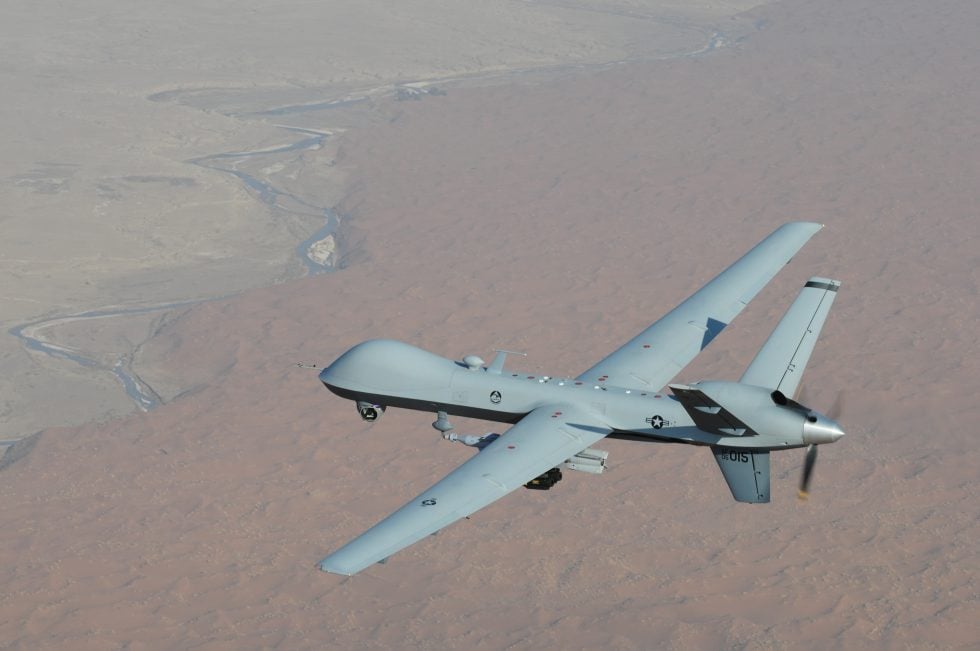
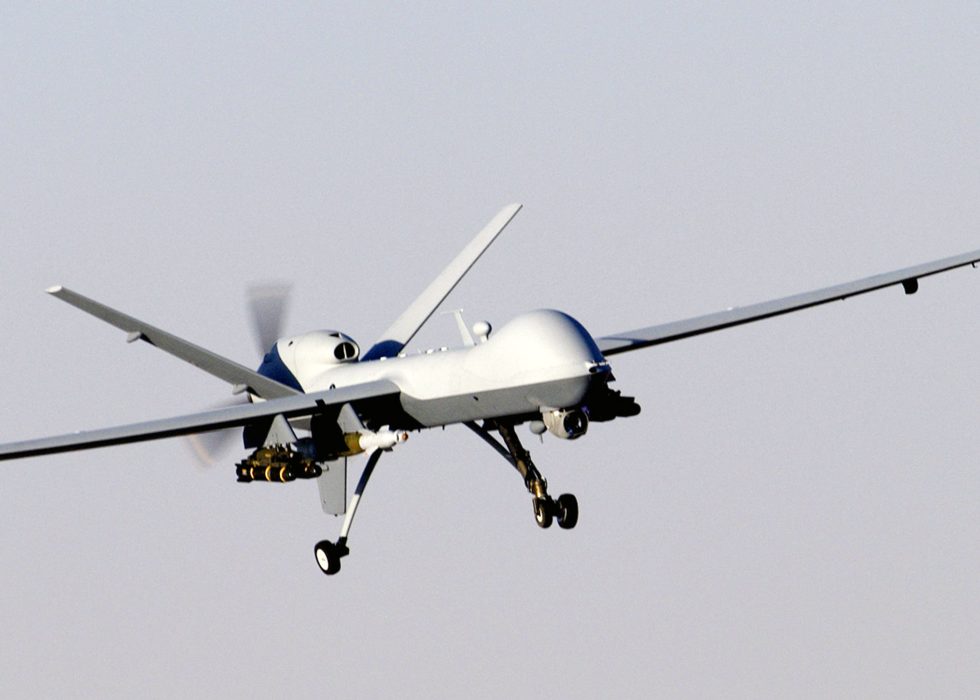
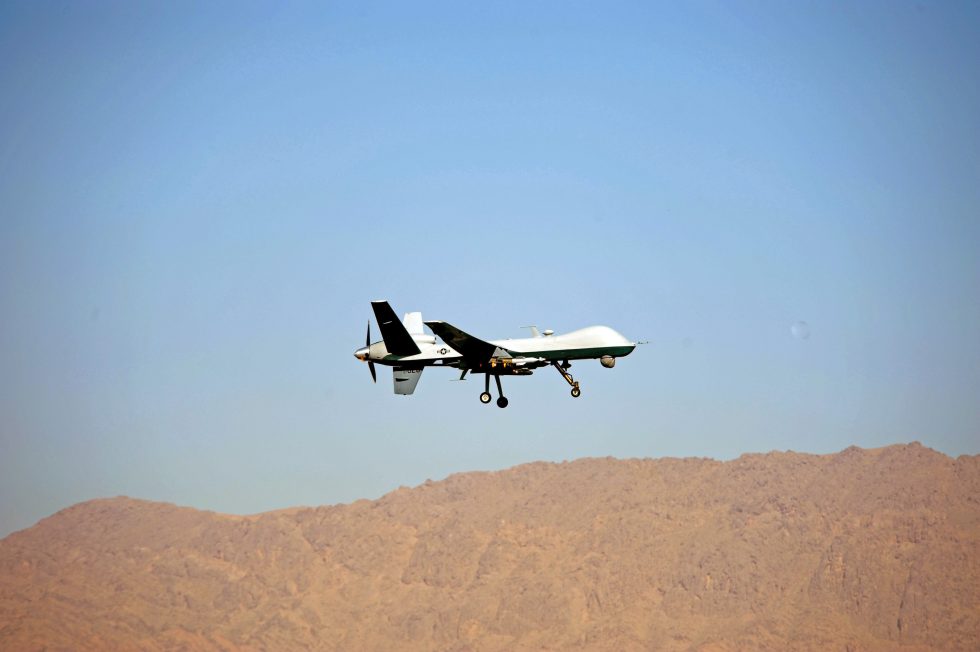
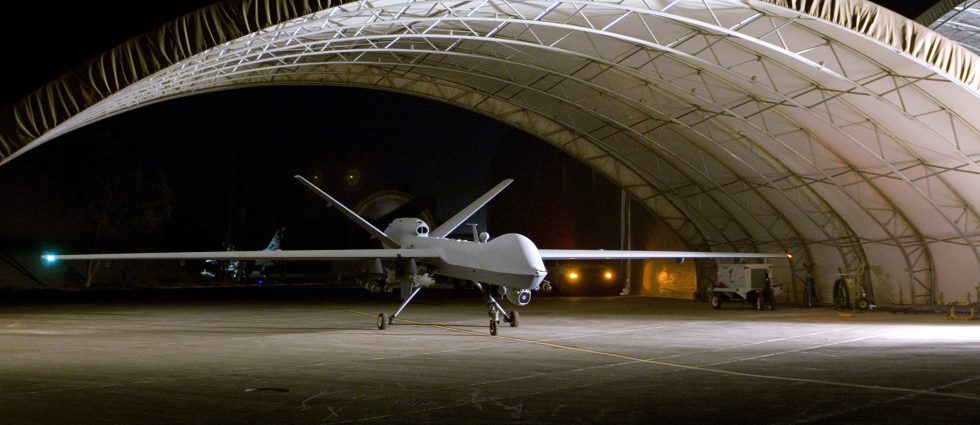
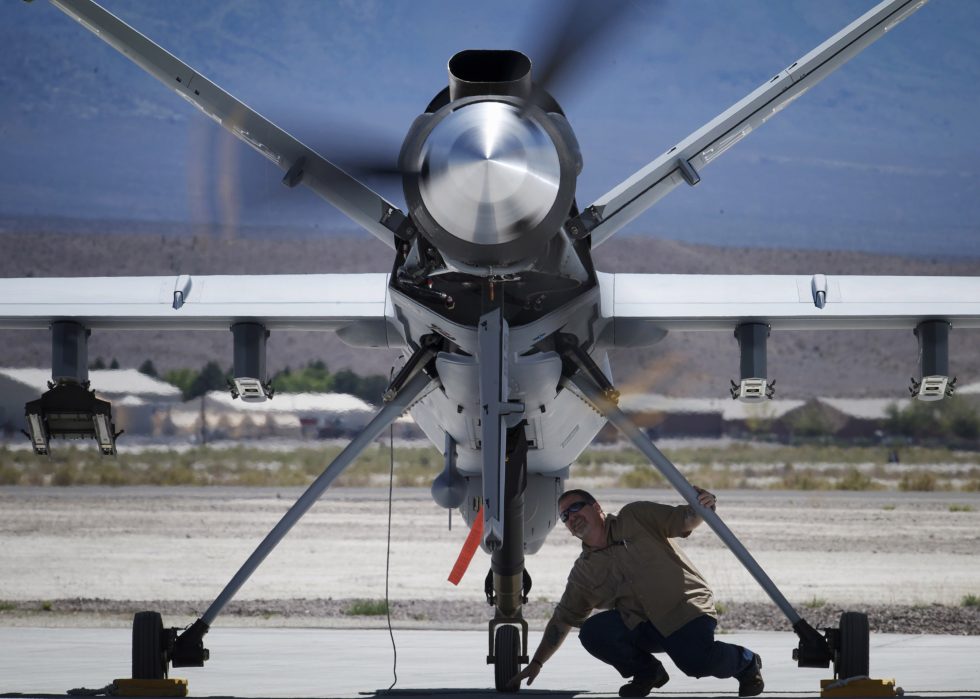
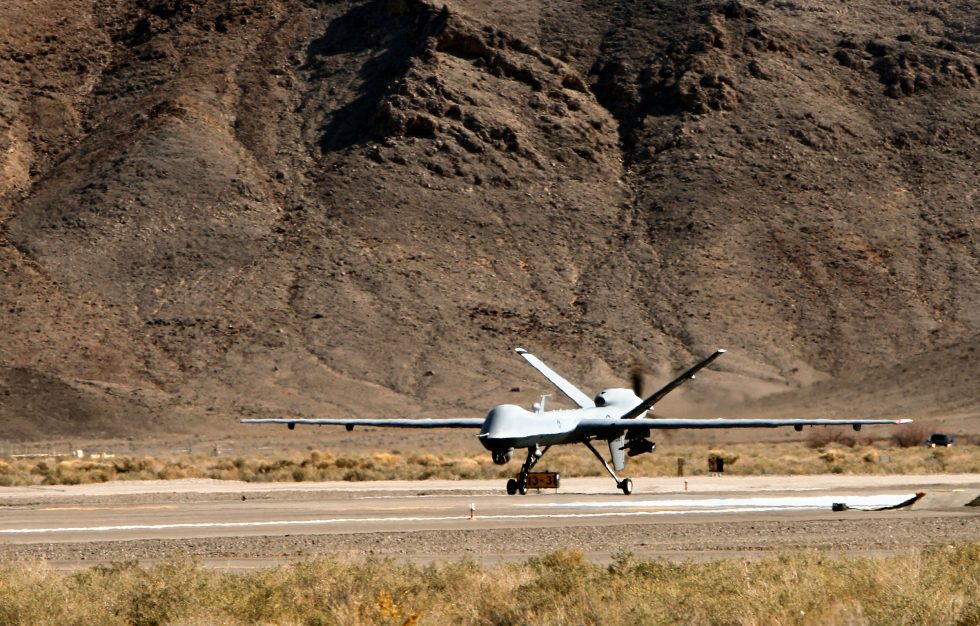
The Reaper in motion
A verified, high-authority video feature is coming soon.
Where the Reaper flies
The record that defines it
The Reaper’s record is not written in air-to-air kills but in persistence and precision strike. It has flown countless armed surveillance sorties over two decades of counterterrorism operations, and it has become the emblem of remote warfare — both for its supporters and for its critics. Its combat story also includes its own vulnerability: in contested skies, this slow, non-stealthy aircraft can be shot down.
Casualty figures for drone strikes are genuinely contested and are best read as wide, uncertain ranges rather than firm totals. Compare the combat record of every military aircraft. Figures as of 2026.
Everything people ask about the MQ-9 Reaper
Can I fly in an MQ-9 Reaper?
Is the MQ-9 Reaper a drone?
What weapons does the MQ-9 Reaper carry?
How long can an MQ-9 Reaper stay in the air?
How fast is the MQ-9 Reaper?
Who operates the MQ-9 Reaper?
Have MQ-9 Reapers been shot down?
How much does an MQ-9 Reaper cost?
You can’t fly the Reaper — nobody can.
These, you can.
Some legends only live in museums — others are fuelled and waiting. MiGFlug has put civilians in real military jet cockpits since 2004.
 Fly the L-39 AlbatrosThe world’s most-flown jet trainer — aerobatics included
 Fly the F-104 Starfighter“The missile with a man in it”
 Fly the MiG-21The Cold War’s most-produced jet
 Fly the T-33 Shooting StarAmerica’s first jet trainer
 Fly the DH VampireA piece of early jet history
 Fly the S.211Agile Italian jet trainer
 Fly the MB-326The classic Aermacchi jet
 Fly the MiG-15The Soviet legend of the Korean War
Continue the tour
Every fact, checked
- U.S. Air Force — MQ-9 Reaper fact sheetOfficial primary source for dimensions, engine, payload, armament and unit cost.
- General Atomics Aeronautical SystemsManufacturer material on the MQ-9A and the MQ-9B SkyGuardian / SeaGuardian family.
- Designation-Systems.net (Andreas Parsch)Development history, first flight and variant lineage from Predator B to MQ-9B.
- The War Zone (TWZ)Reporting on the 2023 Black Sea incident and the Yemen Reaper shootdowns.
- Air & Space Forces MagazineCoverage of Reaper losses, operations and per-aircraft cost figures.
- The Bureau of Investigative JournalismLong-running tracking of drone-strike casualties, and why the figures are contested.
- Atlantic CouncilAnalysis of the Houthi campaign against U.S. Reapers and its wider implications.
- Airforce TechnologyThe RAF transition from the MQ-9A Reaper to the MQ-9B Protector RG.1.