
SIAI-Marchetti S.211
The Modern Mini-Jet
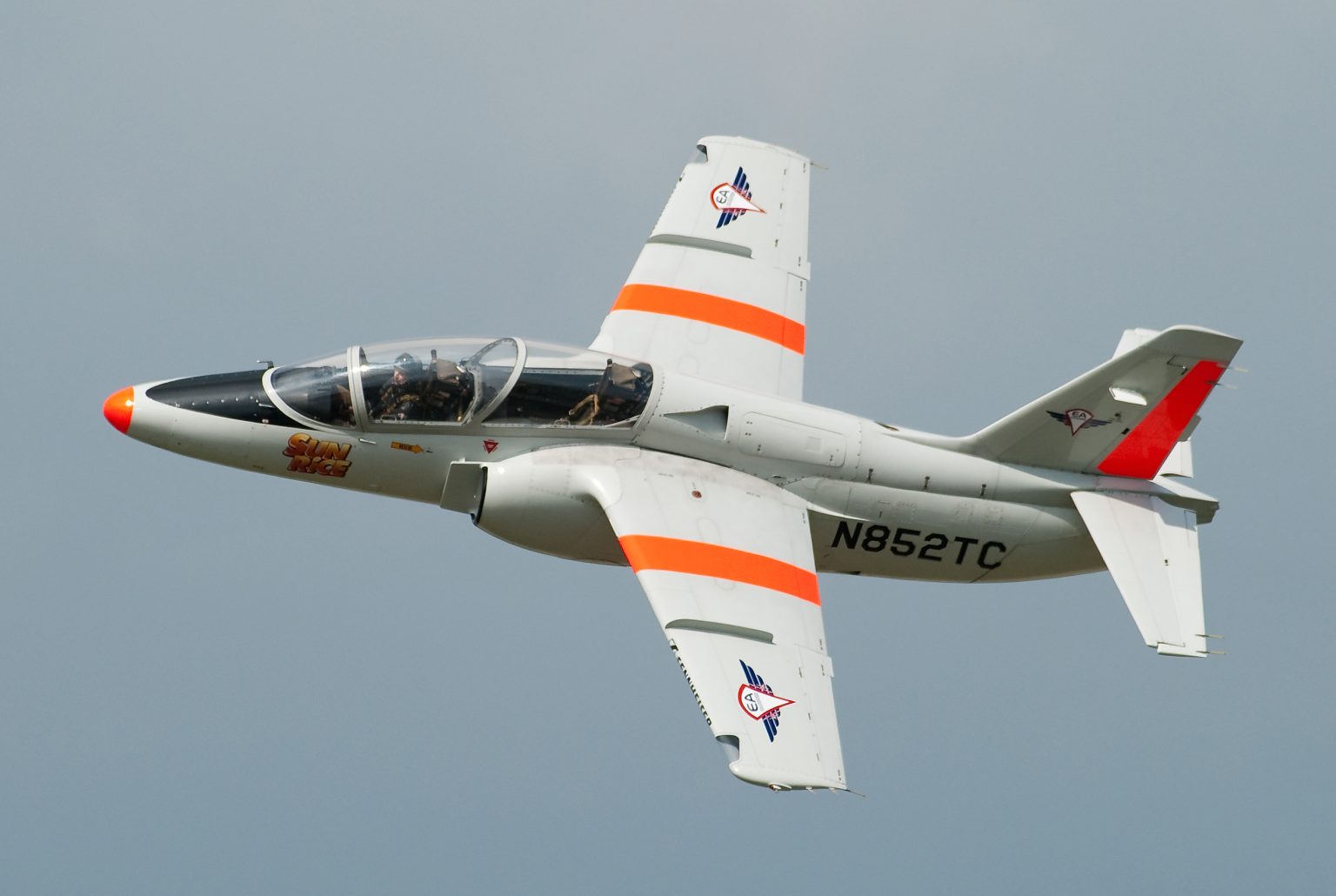
A genuinely modern, purpose-built turbofan jet trainer — small, docile and economical enough to become a realistic private warbird. Barely nine metres long, fully aerobatic to +6 g, and one of the few real jets an ordinary person can actually fly today.
The mini-jet that meant it
Most jet warbirds you can fly are thirsty Cold War hand-me-downs. The S.211 is something rarer: a genuinely modern, purpose-built turbofan jet trainer that turned out to be small, docile and economical enough to become a realistic private aircraft. Where an L-39 burns kerosene by the barrel, the S.211’s Pratt & Whitney Canada JT15D delivers comparable performance at roughly half the fuel flow — an economy that made it the sweet spot for civilian owners.
It was a private-venture bet. Italy’s SIAI-Marchetti — best known for the SF.260 piston trainer — applied its philosophy of “elegant simplicity” to a small, modern jet, unveiling it at the 1977 Paris Air Show with no government backing. The prototype first flew on 10 April 1981, and the type entered service after Singapore placed the launch order in 1983. Technically it punched above its size: a supercritical wing, an all-new composite airframe of Kevlar, Nomex and carbon fibre, and a single fuel-sipping turbofan.
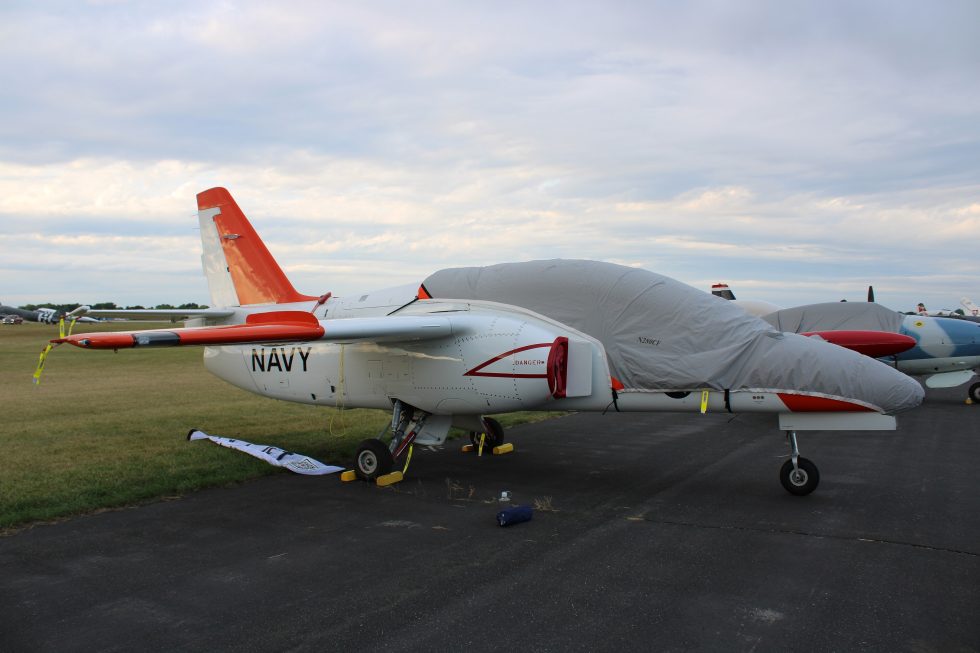
Around twenty now fly in the United States under Experimental-Exhibition rules, refurbished from ex-Singapore airframes — and that accessibility is exactly why MiGFlug can put you in one. From an airfield near Munich you strap into the rear seat of “the most modern military jet in the fleet,” pull 6 g through loops over the Bavarian Alps, and take the stick yourself. A mini-jet, a real jet, a flyable jet.
01The S.211’s origins: a corporate bet on the modern jet trainer
The S.211 began around 1976 as a private venture — a corporate gamble that a small nation would want an affordable, modern jet trainer without waiting for a government programme. SIAI-Marchetti unveiled it at Paris in 1977 with zero state money behind it, and it took Singapore’s 1983 order for ten aircraft to prove the bet. Production stayed modest — roughly 60 airframes — built near Milan between 1981 and the mid-1990s.
The design’s DNA long outlived that small run. After SIAI-Marchetti was folded into the Agusta/Alenia orbit, Aermacchi evolved the S.211 into the M-311 and ultimately the M-345 HET, now serving with the Italian Air Force and slated for the Frecce Tricolori. The little private-venture trainer became the ancestor of a modern front-line jet.
What makes the S.211 special
A supercritical wing
The S.211 wore a modern, efficient supercritical aerofoil on a shoulder-mounted monoplane wing. It gave the small trainer benign handling, full aerobatic capability of +6 / −3 g and clean high-subsonic cruise — genuinely advanced for an early-1980s light jet, and a big part of why civilian pilots still enjoy flying it.
The fuel-sipping JT15D turbofan
A single Pratt & Whitney Canada JT15D-4C turbofan of about 2,500 lbf (11.1 kN) was chosen for economy and simplicity. Owners report performance similar to an L-39 at roughly half the fuel burn (~75 gal/hr), plus self-contained ground operations that need no support cart or ground crew.
Stepped tandem cockpit + composites
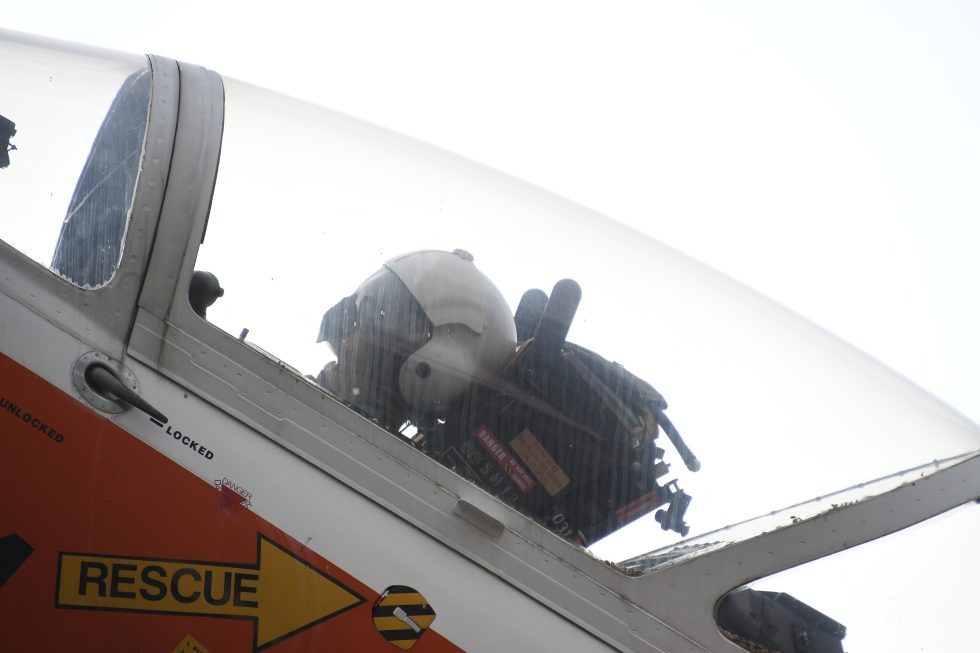
A raised rear seat under a single-piece panoramic canopy gives the instructor — and the MiGFlug passenger — excellent forward visibility. The light Kevlar / Nomex / carbon-fibre airframe and relatively modern avionics kept weight and complexity down for the era.
02The S.211’s economy: why it flew on half the fuel of an L-39
The Pratt & Whitney Canada JT15D is the S.211’s secret weapon. It is a small, efficient business-jet-class turbofan rather than a thirsty military turbojet, and owners quote L-39-like performance at roughly half the fuel flow. Those economics are exactly what turned a military castoff into a genuinely ownable warbird — and what keeps a passenger flight in one commercially viable today. Self-contained ground starting, no support cart and modest running costs make it about as practical as a real jet gets.
03The S.211’s cockpit: the best seat in a small jet
The stepped tandem layout under a one-piece bubble canopy gives the rear occupant a genuinely panoramic view — the raised aft seat looks over the front one rather than into the back of a headrest. It is a big reason instructors, and paying passengers, rate the S.211’s cockpit so highly: from the back seat you get an almost fighter-like sense of sitting on top of the aircraft, with the alps wrapping around the canopy on every side.
Full S.211 specifications
Baseline note: the figures below describe the production S-211 as delivered to Singapore, the Philippines and Haiti between 1984 and 1994 — the 1,850 kg empty, shoulder-wing, single-seat-sized jet trainer built around one Pratt & Whitney Canada JT15D-4C turbofan of 11.12 kN (2,500 lbf), and the performance set published in Jane’s All the World’s Aircraft 1988–89. Deltas for the S-211A of 1992 with the JT15D-5C, and for the M-345 HET (Italian designation T-345A) with the Williams FJ44-4M-34, are given in grey. Five source disagreements are worth settling first. One, the engine mark: the article text and the manufacturer’s own description say JT15D-4C, while the widely copied specification table says JT15D-4D. Both are rated at 2,500 lbf and the -4C is the designation the operators used, so it is the one used here. Two, internal fuel: one description gives "955 litres (210 US gal)", which is arithmetically impossible — 210 US gal is 795 litres. The 800 litre figure is the correct one and 955 is a transcription error. Three, rate of climb: 21 m/s (4,100 ft/min) appears in the Jane’s-sourced table and 5,100 ft/min in the manufacturer’s sales description. The lower figure is the measured one at trainer weight. Four, length: 9.31 m is the Jane’s figure and 9.50 m circulates in Italian sources; the difference is almost certainly whether the pitot boom is counted. Five, production: totals of about 54, about 60 and about 70 are all in print, depending on whether prototypes, the spares airframe, the two S-211A conversions and the two M-311 prototypes are counted. Roughly 60 airframes is the defensible answer, and by any count this aeroplane sold in numbers that would embarrass a light aircraft manufacturer. Figures checked 3 September 2026.
Dimensions & weights
- Crew
- 2 in tandem on Martin-Baker Mk 10 zero-zero ejection seats, the rear cockpit raised above the front one and fully duplicated. This is a very small aeroplane: an S-211 parked beside an Alpha Jet looks like a scale model of it, and beside a Hawk it barely reaches the tailplane
- Length
- 9.31 m (30 ft 7 in). Italian references give 9.50 m (31 ft 2 in), probably including the nose boom. The M-345 stretched the nose to 9.85 m (32 ft 4 in) to swallow avionics the S-211 never had room for
- Wingspan
- 8.43 m (27 ft 8 in). The M-345 spans 8.47 m (27 ft 10 in) — four centimetres more after four decades, which tells you how much of the original aeroplane survived into the modern one
- Height
- 3.80 m (12 ft 6 in); the M-345 sits marginally lower at 3.74 m (12 ft 3 in)
- Wing area
- 12.6 m² (136 sq ft) — and it is exactly 12.6 m² on the M-345 as well. The wing is the part of the S-211 that Leonardo never found a reason to replace
- Aspect ratio
- 5.64 — higher than the stubby wings of the MB-339 and Alpha Jet, which is a clue that this wing was drawn for efficiency rather than for roll rate
- Aerofoil
- NYU/KU 15% at root, NYU/KU 13% at tip — a supercritical section, roughly 19° of sweep on the leading edge and 4° on the trailing edge. In 1976 nobody else was putting a supercritical wing on a cheap basic trainer; SIAI-Marchetti did it to buy cruise efficiency and a benign high-speed stall out of only 2,500 lbf of thrust
- Structure
- Aluminium primary structure with Kevlar, Nomex and carbon-fibre secondary panels and extensive structural bonding in place of riveting — intakes, undercarriage doors, wingtips and fairings. Composites in a 1981 trainer were a genuine novelty and a large part of why the empty weight is so low
- Empty weight
- 1,850 kg (4,079 lb). Leonardo quotes 3,300 kg (7,275 lb) for the M-345, which against a 4,500 kg maximum leaves an implausibly small disposable load and should be treated as a disputed number rather than a settled one
- Max take-off weight, trainer
- 2,750 kg (6,063 lb) clean. Every performance figure in the next column was measured at this weight
- Max take-off weight, armed
- 3,150 kg (6,944 lb). The S-211A raised this to 3,550 kg (7,827 lb) and the M-345 to 4,500 kg (9,921 lb) — a 43 per cent increase over the original armed weight on the same wing
- Max external load
- 660 kg (1,455 lb) across four underwing hardpoints. The M-345 is advertised at more than 1,000 kg (2,205 lb) over five stations. Six hundred and sixty kilogrammes is less than a single Mk 84 bomb; it is the honest ceiling of what a 2,500 lbf trainer can lift and still fly a circuit
- Internal fuel
- 800 L (176 imp gal, 211 US gal) in an integral wing tank and a fuselage bladder cell, plus provision for 540 L (119 imp gal, 143 US gal) in two 270 L underwing drop tanks. Single-point ground refuelling by gravity, with pressure refuelling optional
- Wing loading
- 218 kg/m² (44.7 lb/sq ft) at trainer weight, 250 kg/m² (51.2 lb/sq ft) armed. Low, docile and exactly what a student wants; also the reason the type is a poor weapons platform
Performance
- Max speed
- Mach 0.8, 767 km/h (414 kn, 477 mph) at 7,620 m (25,000 ft) — the manufacturer’s figure. Note that it sits above the published never-exceed speed, so read it as a limiting Mach number at altitude rather than an indicated airspeed
- Max cruise
- 667 km/h (360 kn, 414 mph) at 7,620 m (25,000 ft) — the Jane’s figure and the honest working number. The M-345 is quoted at 740 km/h (400 kn, 460 mph)
- Never-exceed speed
- 740 km/h (400 kn, 460 mph) indicated. The M-345 raises it to 795 km/h (429 kn)
- Stall speed
- 138 km/h (75 kn, 86 mph) flaps down. The M-345, heavier by every measure, stalls at 170 km/h (92 kn) — the price of growth
- Rate of climb
- 21 m/s (4,100 ft/min) at sea level. The S-211A with the JT15D-5C managed 26 m/s (5,100 ft/min), and the M-345 is quoted at 24 m/s (4,700 ft/min). A figure of 5,100 ft/min for the plain S-211 appears in sales material and belongs to the A-model
- Time to altitude
- 6,100 m (20,000 ft) in 6 minutes 12 seconds — adequate for a training sortie and hopeless for an interception, which is worth remembering given what the Philippine Air Force later asked of the type
- Service ceiling
- 12,200 m (40,000 ft); 12,800 m (42,000 ft) for the S-211A. The M-345 is quoted at 12,190 m (40,000 ft)
- Range
- 1,668 km (901 nmi, 1,036 miles) on internal fuel with 30 minutes reserve. The M-345 is quoted at 1,410 km (761 nmi) — less range on more fuel, because it is a heavier aeroplane doing more work
- Ferry range
- 2,483 km (1,341 nmi, 1,543 miles) with maximum internal and external fuel at 3,150 kg, cruising at 500 km/h at 9,150 m
- Endurance
- 3 hours 50 minutes with 30 minutes fuel reserve — unusually long for a light jet, and the specific reason the Philippine Air Force found the type useful for maritime patrol over the Kalayaan Island Group long after it had stopped being a credible combat aeroplane
- Take-off run
- 390 m (1,280 ft) ISA at sea level, 512 m (1,680 ft) to clear 15 m. Short-field figures a turboprop would recognise
- Landing run
- 361 m (1,184 ft) ISA at sea level, 705 m (2,313 ft) from 15 m
- g limits
- +6 / −3 clean, +5 / −2.5 with external stores and a maximum sustained load of 3.4 g at 4,575 m. The M-345 is cleared to +7 / −3.5, which Leonardo advertises as the point of buying a jet rather than a turboprop
Propulsion & systems
- Engine
- 1 × Pratt & Whitney Canada JT15D-4C turbofan, 11.12 kN (2,500 lbf) — a business-jet engine, the same family that powers the Cessna Citation. That was the whole commercial idea: buy an engine already amortised over hundreds of civil airframes, with a worldwide spares network and a known overhaul cost, and the trainer built round it becomes cheap to own. The specification table in several references prints JT15D-4D; the operators’ documents say -4C
- Specific fuel consumption
- 0.57 lb/h/lb — roughly 70 US gal per hour in the cruise, which is turboprop territory and was the type’s central sales argument against the Pilatus PC-9 and the Embraer Tucano
- Thrust-to-weight
- 0.41 at 2,750 kg trainer weight, falling to 0.36 armed. The M-345 is quoted at 0.45. Nobody has ever confused an S-211 for a fighter, and its pilots did not try
- S-211A engine
- 1 × JT15D-5C, 14.19 kN (3,190 lbf) — 28 per cent more thrust for the JPATS bid, together with revised intakes, nosewheel steering, lightened undercarriage and a Collins EFIS cockpit. Around a hundred detail changes in all. It is the engine the M-311 also used
- M-345 engine
- 1 × Williams International FJ44-4M-34, 1,540 kgf (3,400 lbf, about 15.1 kN), selected in October 2014 over Honeywell and Pratt & Whitney bids. Some tables print 15.40 kN, which does not reconcile with 1,540 kgf and looks like a units slip. Williams was chosen on its business-aviation record and its work re-engining the Swedish Saab 105
- Fuel system
- Integral wing tank and fuselage bladder cell, double-ended turbine transfer pump feeding the engine and moving fuel between tanks; two wet inboard pylons for 270 L drop tanks
- Hydraulics
- Single system at 200 bar (3,000 psi) driving the undercarriage, airbrake, compressor and aileron boost. Everything else is manual
- Flight controls
- Manual push-pull rods to all primary surfaces, ailerons hydraulically boosted — deliberately simple. There is no fly-by-wire, no stability augmentation and nothing between the student and the consequences of what they just did
- Electrical
- 28 V DC from an engine-driven generator, AC for instruments and avionics via two inverters and a nickel-cadmium battery for starting and emergencies
- Environmental system
- Automatic control, vapour-cycle cooling and engine bleed air for heating and cabin pressurisation — a pressurised cockpit on a basic trainer, which most turboprop rivals could not offer
- Avionics
- Customer-specified — typically VHF/UHF radios, AHRS, horizontal situation indicator, ADF, VOR/ILS, TACAN and IFF. No radar was ever fitted to any S-211. The M-311 and M-345 replaced the whole fit with a glass cockpit, head-up display and embedded tactical simulation shared with the M-346
- Hardpoints
- Four underwing stations rated at 660 kg total, with a fifth centreline station on some airframes. The Philippine belly gun pod hangs there. The M-345 has five as standard
04The S.211’s cost: what a small modern jet is worth
Historical unit prices for the S.211 are not well documented — it was a low-volume private-venture product sold in small batches to a handful of buyers. On the civilian market the picture is clearer: ex-military examples, mostly ex-Singapore airframes imported to the United States around 2010, have traded for roughly a few hundred thousand US dollars. Combined with the JT15D’s modest fuel burn, that made the S.211 one of the most practical ways for a private pilot to actually own and operate a real jet. Treat any single figure as indicative rather than firm.
Armament & payload
The S-211 was armed because small air forces asked, not because it was ever going to be good at it
Four underwing pylons, 660 kg in total, no internal gun, no radar and no guided weapon of any kind: that is the whole of the S-211’s war-fighting equipment. SIAI-Marchetti fitted the hardpoints from the start because the customers it hoped to sell to — the SF.260 operators of Africa, Latin America and South-East Asia — wanted one aeroplane that could teach in the morning and shoot in the afternoon. Jane’s lists the cleared stores as gun pods, unguided bombs and rocket launchers, and that list has never grown. Six hundred and sixty kilogrammes is roughly two 500 lb bombs, or four rocket pods, or one gun pod and a pair of drop tanks; and taking off with any of it costs climb rate the aeroplane could not spare.
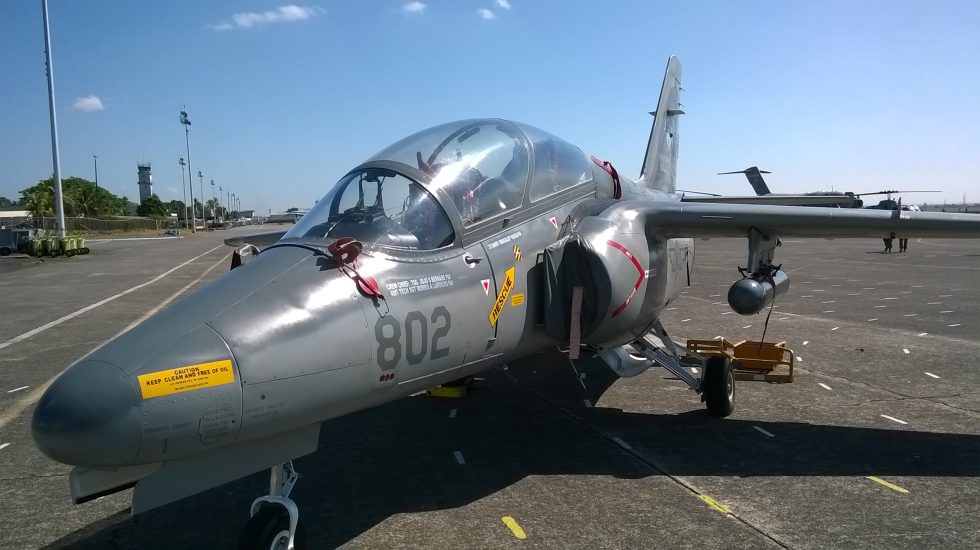
The type nonetheless went to war, in the Philippines. After the Philippine Air Force retired its last Northrop F-5A/B fighters in 2005 the country was left with no jet combat aircraft at all, and the air defence task fell to the AS-211 — a basic trainer with an optical gunsight cannibalised from the retired F-5s. A series of local programmes under the name Project Falcon added that Norsight sight, ex-F-5 AN/ARC-34 radios, a two-tone grey low-visibility scheme, and a belly gun pod designed and built by Aerotech Industries Philippines carrying one M3 .50 calibre machine-gun with an automatic charger and about 240 rounds. Project Falcon Push looked at a 20 mm pod and 5 in Zuni rockets. These are the modifications of an air force making do, and the Philippine Air Force said as much: the AS-211 was a stopgap until a real fighter arrived, which it finally did as the FA-50PH from 2015. Nothing on this page applied to Singapore or Haiti. Singapore flew its S-211s unarmed as trainers throughout, and Haiti’s four were retired before any weapon fit was reported. Every armed configuration described below is a Philippine one unless stated otherwise.
Gun
- No internal gun on any S-211. Everything is podded, and a pod on a 660 kg budget is an expensive way to carry a machine-gun.
- Philippine AS-211: a single centreline belly pod built by Aerotech Industries Philippines with one M3 .50 calibre (12.7 mm) machine-gun, automatic charger and about 240 rounds. Locally designed because nobody was selling pods for this aeroplane any more.
- Aiming was by Norsight optical sight, removed from Philippine F-5A/Bs when they were withdrawn in 2005 and harmonised to the AS-211 by live firing. An optical sight from a 1965 fighter, on a 1989 trainer, in the 2010s.
- Project Falcon Push evaluated a 20 mm gun pod. There is no evidence it entered service.
- Standard European gun pods — 12.7 mm and 30 mm types — were offered by the manufacturer but no operator is confirmed to have fielded them.
Air-to-air
- None. No S-211 has ever carried an air-to-air missile, and none was ever cleared for one.
- There is no radar, no radar warning receiver and no missile approach warning on any airframe of the type.
- Which makes the Philippine decision of 2005 remarkable: for a decade the national air defence alert was stood by aircraft whose entire air-to-air armament was a .50 calibre belly pod and an optical sight. It was a gesture, and the Philippine Air Force never pretended otherwise.
- The M-345 is advertised as able to employ infra-red guided air-to-air missiles. That capability belongs to the derivative, not to the S-211, and no customer has bought it.
Air-to-surface guided
- None, on any mark, for any operator, at any point in the type’s career.
- No laser designator, no targeting pod, no data link and no weapon that steers itself. The aeroplane has an optical sight and iron.
- This is the card that separates the S-211 from the light-attack aircraft it is sometimes filed alongside. An A-29 Super Tucano or an armed MB-339C can deliver a precision weapon; an AS-211 cannot, and that limitation shaped what the Philippine Air Force was willing to use it for.
- The absence matters historically. When Philippine ground troops needed accurate close air support in urban fighting from 2017 onward, the aircraft sent were FA-50PH jets with guided munitions and armed SF-260TP and OV-10 turboprops, not the AS-211.
Bombs
- Unguided general-purpose bombs only. Jane’s lists no bomb type by name for the S-211, which is itself informative about how thin the clearance work was.
- The 660 kg limit caps a realistic load at two Mk 82 500 lb bombs, or four of the 250 lb class, and only with fuel traded away.
- Practice bomb carriers with light heads are the store most S-211 airframes have actually flown with, on weapons-conversion sorties.
- No cluster munition, retarded bomb or penetrator is a confirmed fit on any operator’s aircraft.
Rockets
- SNEB 68 mm rockets in Matra-type pods — the manufacturer’s standard clearance and the type’s principal air-to-ground weapon.
- 2.75 in (70 mm) rockets in LAU-series launchers for customers inside the American supply chain, which is how the Philippine aircraft were equipped.
- 5 in Zuni launchers were evaluated by the Philippine Air Force under Project Falcon Push. Service use is not corroborated.
- Rockets suit this aeroplane better than bombs do: light, cheap, four pods inside the weight limit, and accurate enough for the optical sight it actually has.
Pods & other stores
- Two 270 L drop tanks on the wet inboard pylons, adding 540 L and taking ferry range to 2,483 km.
- Reconnaissance and photographic pods were offered by SIAI-Marchetti from the outset; the four hardpoints were advertised for sensor carriage as well as weapons.
- No electronic countermeasures pod, chaff or flare dispenser is a confirmed fit on any S-211. In a modern threat environment the aeroplane is defenceless, which is the practical reason it flies over insurgents and not over armies.
- The most common external store in the type’s history is nothing at all. Singapore’s 32 aircraft flew clean for twenty-four years.
Three typical loadouts
- Basic and advanced training, Republic of Singapore Air Force
- Clean. Full internal fuel, two pilots, no pylons loaded — the configuration in which the overwhelming majority of S-211 hours were flown, at RAAF Base Pearce in Western Australia.
- Weapons conversion sortie
- Two rocket pods on the outboard pylons with practice heads, or a pair of practice bomb carriers, plus a gun pod. Well inside the 660 kg limit and inside the +5 / −2.5 g stores restriction.
- Philippine counter-insurgency and maritime patrol
- Centreline Aerotech belly pod with the M3 .50 calibre and 240 rounds, 2.75 in rocket pods inboard or two 270 L drop tanks, Norsight optical sight. The tanks and the type’s 3 hour 50 minute endurance are what made the aircraft useful over the Kalayaan Island Group long after it stopped being useful over a battlefield.
Sourcing caveat. The manufacturer never published a weapons manual for open sale and Jane’s gives only generic categories, so the armament picture is assembled from Philippine Air Force material, the GlobalSecurity account of the Project Falcon upgrades and Philippine press reporting. Two claims that circulate should be treated with care. First, that the AS-211 flew strike sorties in the 2017 Marawi siege: the documented strike aircraft over Marawi were the FA-50PH, armed SF-260TP turboprops and OV-10 Broncos, plus MD-520MG and AW109 helicopters, and no contemporaneous report places the S-211 in those operations. The Philippine Air Force describes close air support as among the surviving jets’ current tasks, and the type was on the strength through the Mindanao campaigns, but a specific, dated combat sortie by an AS-211 remains uncorroborated in open sources. Second, that the type carried Sidewinders in Philippine service: it did not, and never had the wiring or the sighting system to do so.
Variants
Three air forces, about sixty airframes, and a descendant that Leonardo sells as a new aeroplane
The S-211 is a commercial failure that refused to die. SIAI-Marchetti drew it in 1976 as a private venture aimed at its own SF.260 customers, announced it at Paris in 1977, flew it in April 1981 and then spent thirteen years selling roughly sixty aircraft to three countries. For comparison, Aermacchi sold well over two hundred MB-339s and BAE built more than nine hundred Hawks. The engineering was ahead of the market — a supercritical wing, bonded composite structure and a pressurised cockpit on a trainer costing a fraction of a Hawk — and the market bought turboprops instead.
What kept the design alive was the wing and the wing alone. Aermacchi bought SIAI-Marchetti in 1997, inherited the drawings and the leftover airframes, and has been re-selling that 12.6 m² planform ever since: as the S-211A for the American JPATS competition, as the M-311, and now as the M-345, which Italy has bought and which Leonardo markets against the Pilatus PC-21. Whether the M-345 is an S-211 is a fair question. It has the same wing area, almost the same span, a new nose, a new engine of 36 per cent more thrust, a glass cockpit shared with the M-346 and a maximum weight 43 per cent higher. Leonardo calls it a new aircraft; the type certificate lineage and the planform say otherwise. Both positions are defensible, and the honest answer is that it is the same wing carrying a different aeroplane.
- S.211 prototypes (1981–1983, 3 aircraft)
- First flight 10 April 1981 from Milan-Malpensa, Alessandro Ghisleni at the controls, about twenty-five minutes airborne; second prototype 3 October 1981; pre-series third aircraft June 1983. Designed by a small SIAI-Marchetti team under Brena, Frontini and Brembati.
- S-211 production (1984–1994, about 60 built)
- The standard aeroplane: JT15D-4C, four hardpoints, Martin-Baker Mk 10 seats. First production aircraft, for Singapore, flew 4 October 1984. Sources put the total at 54, 60 or 70 depending on what is counted.
- S-211, Republic of Singapore Air Force (1983–2008, 32 aircraft)
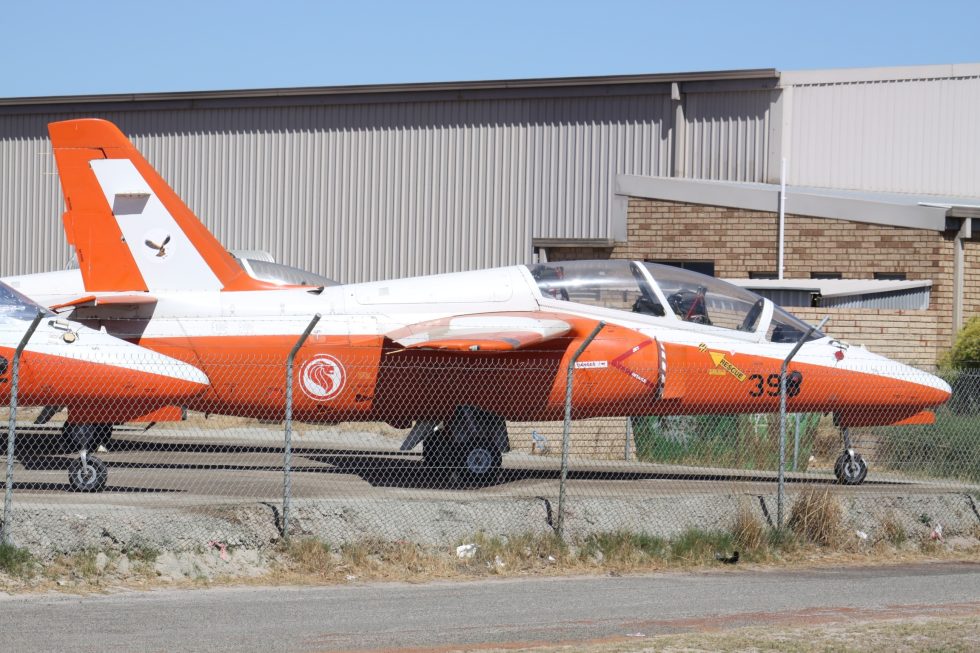
- Singapore placed the launch order for ten in 1983 and grew it to 32, of which 24 were assembled under licence in Singapore by Singapore Aircraft Industries — a deliberate act of industrial policy that helped build what is now ST Aerospace, and arguably the single most consequential thing the S-211 ever did. Flown by 130 Squadron "Eagle" and 131 Squadron, latterly from RAAF Base Pearce in Western Australia because Singapore has no airspace to train in. Seven were written off in accidents. Replaced by the Pilatus PC-21 from the end of 2008.
- S-211 / AS-211 "Warrior", Philippine Air Force (1989–present, 25 delivered)
- Eighteen ordered in 1988 and delivered from 1989, six more in 1992, all handed over by 1994; nine were Italian-built and fifteen assembled locally by the Philippine Aerospace Development Corporation, with one further airframe supplied incomplete for spares. Upgraded from 2005 under Project Falcon, Falcon Uniform, Falcon Hear, Falcon SIM and Falcon Push after the F-5s went, and redesignated AS-211. The 105th Fighter Training Squadron "Blackjacks" still flies them; the 7th Tactical Fighter Squadron re-equipped with the FA-50PH between 2015 and 2017.
- S-211, Haitian Air Corps (1985–1990, 4 aircraft)
- Delivered June 1985 under Jean-Claude Duvalier, the first and only jets Haiti ever operated. Duvalier fled in February 1986 and the aircraft became an embarrassment nobody could afford; they were retired and advertised for sale on 23 April 1990, four years before the Haitian armed forces were disbanded altogether. Their onward fate is genuinely muddled: the same production list is cited both for two going to Singapore as attrition replacements and for two becoming the S-211A conversions, while two others are recorded on the United States civil register. Those claims cannot all be true of only four aircraft.
- S-211A (1992–1995, 2 aircraft)
- The JPATS bid, developed with Grumman and then Northrop Grumman, first flown 17 September 1992. JT15D-5C of 14.19 kN, revised intakes, lightened undercarriage, nosewheel steering, improved hydraulics and a Collins EFIS cockpit — around a hundred changes. It reportedly scored highest of the jet entries and lost anyway to the Pilatus PC-9 derivative that became the T-6 Texan II, because the United States Air Force and Navy had decided they wanted a turboprop. One demonstrator, I-PATS, survives as a Leonardo testbed.
- M-311 (2004–2011, 2 prototypes)
- Announced 2004, first flight 1 June 2005. JT15D-5C, glass cockpit, head-up display, more composite structure, airframe life extended to 15,000 hours. Aermacchi claimed direct operating costs only 5 per cent above a turboprop despite burning about 30 per cent more fuel, and forecast 350 sales by 2030. It sold none.
- M-345 HET / T-345A (2012–present, 18 for Italy)
- The M-311 relaunched in 2012 as the M-345 High Efficiency Trainer, re-engined with the Williams FJ44-4M-34 chosen in October 2014, first flight 29 December 2016, first production aircraft flown December 2018. Italy contracted for five and then for thirteen more in a 300 million euro deal of June 2019, against a stated requirement of about 45. Entered Italian service formally on 12 June 2025 as the T-345A with the 214° Gruppo of 61° Stormo at Lecce-Galatina, replacing the MB-339A. A 2024 decision reversed the plan to re-equip the Frecce Tricolori with it: the display team gets the larger twin-engined M-346 instead, the M-345 having been judged unsuitable for large formation aerobatics.
- Civil S-211 (2009–present, about 21 airframes)
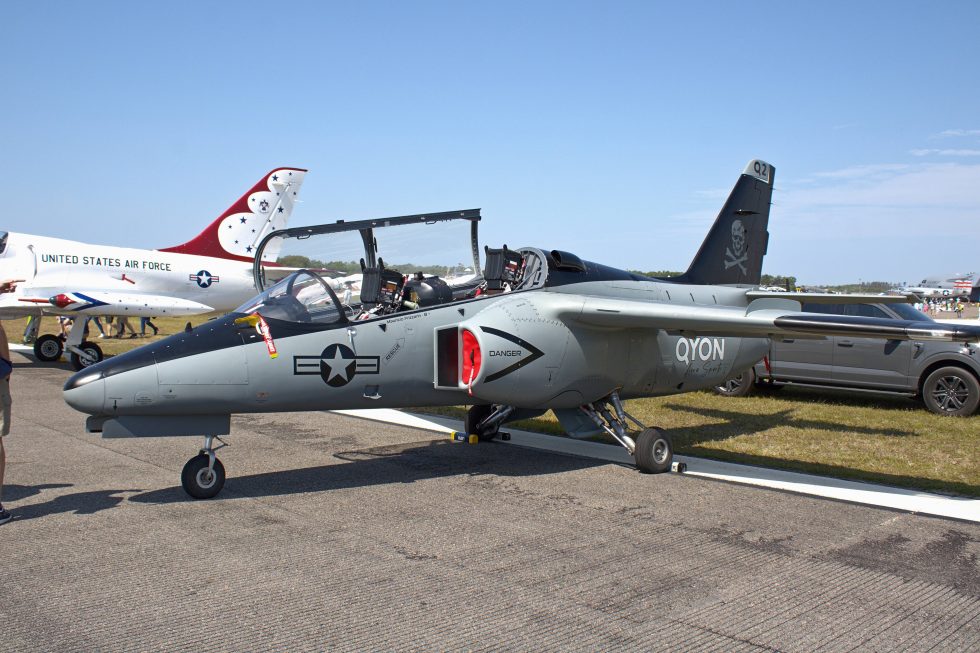
- Twenty-one retired Republic of Singapore Air Force aircraft, one of them a cannibalised hulk, were sold to IAP Group Australia in December 2009 and dispersed onto the Australian, American and Italian civil registers. Marketed to private owners as the cheapest jet warbird on the market, and used by at least one upset-recovery training school in the United States.
Fleet and survivors, checked 3 September 2026. Only one air force still flies the S-211, so no operators chart is shown here. The Philippine Air Force is credited with 3 AS-211s in service in the most recent inventories, unchanged from the FlightGlobal World Air Forces figure for 2024 and consistent with the reference snapshot of 17 December 2025; Philippine reporting in July 2022 and March 2025 put the flyable number at three to five and described the roles as fighter-pilot training, close air support and maritime patrol over the Kalayaan Island Group. Of 25 delivered, attrition and spares shortage had cut the inventory to 13 by September 2013 with five flying. Singapore retired the type at the end of 2008: four airframes went home to Singapore as museum and instructional exhibits, twenty-one were sold to Australia, and seven had already been destroyed in accidents. Haiti’s four went in 1990. The 18 Italian T-345As are counted here as M-345s, a different aeroplane on the same wing, and all 18 had been delivered by July 2026 with the fleet past 2,000 flight hours. Roughly forty original S-211 airframes are thought to survive worldwide in military, museum or civil hands; there are no reproductions of this type and no reason anyone would build one.
Four decades of the S.211
A private venture begins
SIAI-Marchetti starts the S.211 as a private-venture jet trainer, with no government backing.
Unveiled at Paris
The type is shown to the world at the Paris Air Show — a corporate bet on a modern mini-jet.
First flight
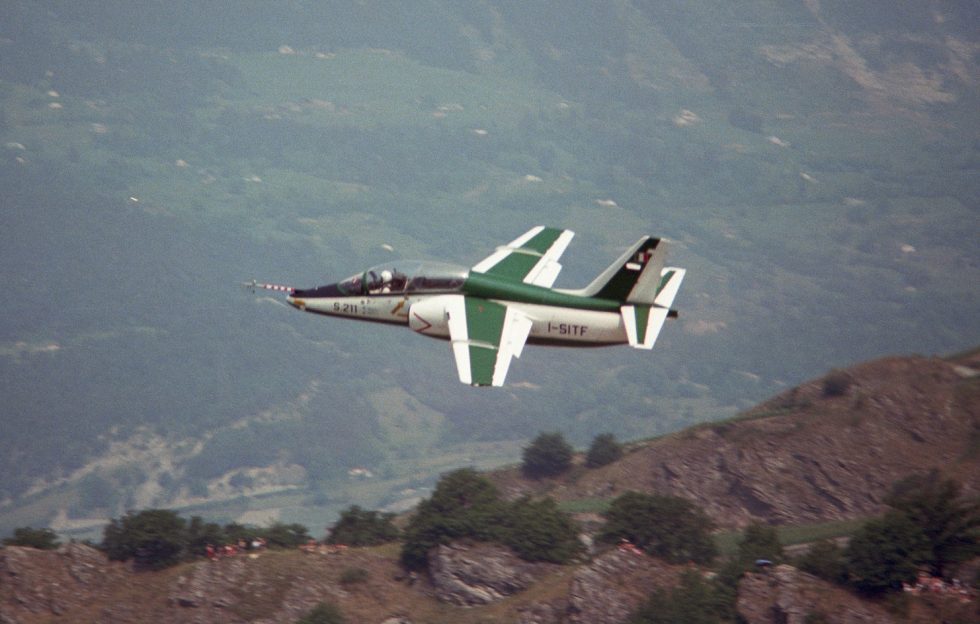
The prototype I-SITF makes its maiden flight near Milan.
Singapore launches it
Singapore becomes launch customer with an order for ten aircraft.
Enters service
Singapore deliveries begin; the Philippines and Haiti follow as operators.
Haiti's four jets
Haiti’s Corps d’Aviation acquires four S.211s — a rare footnote in the type’s history.
Production ends
The line closes after roughly 60 airframes built.
Singapore retires it
The RSAF replaces the S.211 with the Pilatus PC-21.
The warbird market
Ex-Singapore jets enter the US civilian warbird register, refurbished as Experimental-Exhibition aircraft.
Philippine role change
Surviving Philippine S-211s revert to a training-only role after the FA-50 arrives.
From the flight line: twelve S.211 stories
The mini-jet that meant it
SIAI-Marchetti built a full turbofan jet trainer barely 9 metres long.
Read the full story
Singapore’s launch bet
Singapore took the gamble no one else would, ordering ten in 1983.
Read the full story
The Philippine “Warrior”
The Philippine Air Force turned trainers into gunships for jungle counter-insurgency.
Read the full story
America’s bargain jet
After Singapore retired its fleet, ~20 S.211s crossed the Pacific to US owners.
Read the full story
Half the fuel of an L-39
The Pratt & Whitney Canada JT15D is the S.211’s secret weapon.
Read the full story
From S.211 to M-345
Aermacchi never let the concept die — it grew into the M-345 HET.
Read the full story
Fly it yourself over the Alps
MiGFlug puts civilians in the rear seat of an S.211 near Munich.
Read the full story
The best seat in a small jet
The stepped tandem cockpit gives the rear occupant a panoramic view.
Read the full story
A private venture in an air-force world
Unveiled at Paris in 1977 with zero government money behind it.
Read the full story
Four jets and a colourful story
Haiti’s tiny Corps d’Aviation operated four S.211s around 1990.
Read the full story
Aerobatic by design
With +6/−3 g limits and boosted ailerons, the S.211 was fully aerobatic.
Read the full story
The fake Goshawk
Its clean lines make the S.211 an easy stand-in for bigger jets.
Read the full story
The S.211 in pictures
The S.211 in motion
Video coming soon — we’re curating the best footage of the SIAI-Marchetti S.211 in flight. In the meantime, the fastest way to experience it is from the back seat: fly an S.211 with MiGFlug near Munich.
The S.211 in motion
Skyships Eng — one of the most-watched S.211 films on YouTube.
Where the S.211 flew
A trainer that rarely fired a shot
The S.211 was fundamentally a trainer, and most airframes never fired a shot. The notable exception is the Philippine Air Force, which armed its fleet — redesignated AS-211 “Warrior” — for counter-insurgency and close air support in the southern Philippines, adding belly-mounted .50-calibre gun pods (from ~2005), salvaged F-5 optical sights and upgraded radios. No air-to-air records are associated with the type.
Combat use was limited, low-intensity and confined to the Philippines; figures on sorties and effect are not rigorously documented. Compare the combat record of every military aircraft. Figures as of July 2026.
Everything people ask about the S.211
Can I fly in an S.211?
Is the S.211 fast? Is it supersonic?
Is the S.211 still flyable today?
How many S.211s were built?
Who flew the S.211?
What makes it so economical to fly?
What did the S.211 become?
You can actually fly the S.211.
Pick your cockpit.
Some legends only live in museums — others are fuelled and waiting. MiGFlug has put civilians in real military jet cockpits since 2004.
 Fly the L-39 AlbatrosThe world’s most-flown jet trainer — aerobatics included
 Fly the F-104 Starfighter“The missile with a man in it”
 Fly the MiG-21The Cold War’s most-produced jet
 Fly the T-33 Shooting StarAmerica’s first jet trainer
 Fly the DH VampireA piece of early jet history
 Fly the S.211Agile Italian jet trainer
 Fly the MB-326The classic Aermacchi jet
 Fly the MiG-15The Soviet legend of the Korean War
Continue the tour
Every fact, checked
- MiGFlug — S.211 Jet Flight (Munich)The MiGFlug S.211 flight page — prices, experience and booking.
- MiGFlug — SIAI-Marchetti S.211 overviewBackground on the aircraft and the flight experience.
- MilitaryFactory — Alenia Aermacchi S-211Specifications, operators and production overview.
- GlobalMilitary.net — Aermacchi S-211Operators, the Philippine AS-211/FA-50 transition and the M-345 lineage.
- AOPA — “The Italian job” (Pilot, 2018)US civilian warbird fleet, JT15D economy and the owner’s perspective.
- s211jet.com — Development of the S-211Development history, first flight and armament upgrades.
- flugzeuginfo.net — S.211 technical dataIndependent specification cross-check.
- GlobalAir — Marchetti S211 specificationsAirframe and performance data.