
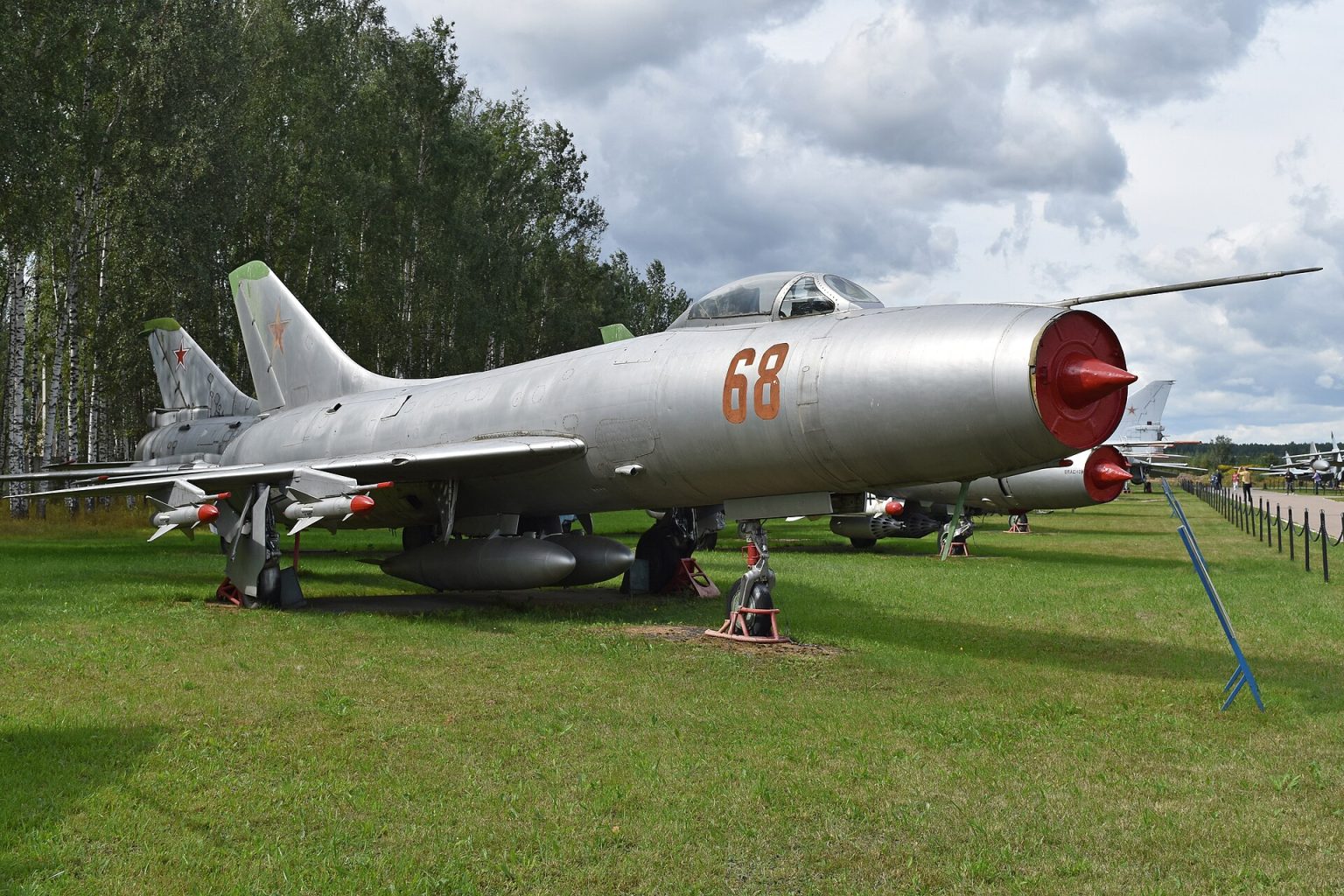
Sukhoi Su-9 / Su-11
“Fishpot”
The Soviet PVO’s delta-wing all-weather interceptors — built to climb fast and high against Western bombers, armed with guided missiles and no gun, and never sold abroad.
The Su-9 and Su-11: the Soviet delta that guarded the stratosphere
In the mid-1950s the Soviet PVO air-defence force needed an interceptor that could climb quickly to high altitude and meet Western bombers and reconnaissance aircraft head-on, in any weather. The recently re-formed Sukhoi design bureau explored two competing wing shapes on parallel prototypes — a swept wing (the S-series, which led to the Su-7 fighter-bomber) and a tailed delta (the T-series). The delta prototype, commonly dated to a first flight in 1956, matured into the aircraft that entered PVO service in 1959 as the Su-9.
The Su-9 paired a large delta wing with a conventional tailplane, a single afterburning Lyulka AL-7F turbojet, and a circular nose intake whose movable centre-body shock cone housed a search radar (the RP-9 / TsD-30, NATO “Spin Scan”). It carried four beam-riding RS-2US (K-5, NATO AA-1 “Alkali”) missiles and — unusually for a fighter of its day — no gun. It climbed hard and flew high, but it was short on range and demanding to handle, with a high landing speed.
The Su-11, which flew in prototype form from the late 1950s and reached service around 1964, was an improved development: a lengthened nose housing the larger Oryol (NATO “Skip Spin”) radar, an uprated engine, and two larger R-8 (K-8, NATO AA-3 “Anab”) missiles, typically one radar-guided and one infrared-homing. Only about 108 Su-11 were built, against well over a thousand Su-9. Both types were flown by the Soviet Union alone, were never exported, and were gradually replaced by the twin-engined Su-15 and the MiG-25 through the 1970s and into the 1980s.
01The Su-9 and Su-11: how Sukhoi’s tailed delta beat its own swept-wing twin
When the Sukhoi bureau was re-established in 1953 it hedged its bets, developing two families of prototype in parallel: a swept-wing series (the “S” aircraft) and a tailed-delta series (the “T” aircraft). The swept wing became the Su-7 ground-attack aircraft; the delta became the interceptor. The delta’s big wing gave the lift needed to reach and hold high altitude, while the all-moving tailplane preserved control at supersonic speed — a combination that suited the PVO’s need for a fast-climbing, high-flying missile carrier more than it suited close-in dogfighting.
The result reached the PVO as the Su-9 in 1959, and the design was refined into the Su-11 a few years later. Both shared the same basic tailed-delta airframe and single-engine layout; the visible differences were in the nose — a longer radome on the Su-11 — and in the missiles they carried.
What makes the Su-9 and Su-11 special
A tailed-delta built to climb, not to turn
The Su-9 and Su-11 used a large delta wing with a separate all-moving tailplane, driven by a single Lyulka AL-7F afterburning turbojet. That layout was optimised for rapid climb and high-altitude performance rather than sustained turning, which matched the PVO’s job of intercepting high-flying bombers under ground-radar control. The trade-off was a demanding aircraft with a high approach speed and limited endurance.
A fighter with no gun
Reflecting late-1950s Soviet doctrine that guided missiles would replace cannon, the Su-9 carried four beam-riding RS-2US (AA-1 “Alkali”) missiles and no gun at all. The beam-riding guidance required the pilot to keep the target centred in the radar beam until impact. The Su-11 switched to two larger R-8 (AA-3 “Anab”) missiles, usually mixing a radar-guided and an infrared round — still with no internal gun.
Radar inside the intake cone
Both types drew air through a circular nose intake with a movable conical centre-body, and it was inside that cone that the radar lived. The Su-9’s RP-9 / TsD-30 (“Spin Scan”) was a modest set; the Su-11’s enlarged Oryol (“Skip Spin”) radar in a longer nose gave better range and became the clearest way to tell the two apart. Neither had a true look-down capability against low-flying targets.
02The Su-9’s beam-riding missiles: why an early Soviet interceptor dropped the gun
The Su-9 entered service armed only with four RS-2US missiles — a beam-riding weapon derived from the K-5 family. Beam-riding meant the missile flew along the interceptor’s radar beam toward the target, so the pilot had to hold the enemy steadily in the radar’s cone throughout the engagement. It worked best against large, non-manoeuvring targets such as bombers at altitude, which was exactly the threat the PVO expected. The Su-11 replaced these with the heavier, longer-ranged R-8, but the philosophy stayed the same: a radar-directed missile interceptor rather than a gun fighter.
03The Su-9 and Su-11’s demanding handling: short legs and a hot landing
The performance that made the Fishpot a good high-altitude interceptor also made it a handful. The delta wing bled energy quickly in hard manoeuvres, endurance was limited, and the landing approach was fast — a challenge on the shorter runways of the era. Range was modest, so the type depended heavily on ground-controlled interception to be vectored efficiently onto its target. These limitations, together with the single engine, were among the reasons the PVO moved on to the twin-engined Su-15 and the MiG-25.
Full specifications of the Su-9 and Su-11
Baseline note: the figures below describe the production Sukhoi Su-9 (OKB designation T-43, izdeliye 34, NATO Fishpot-B), the single-seat tailed-delta interceptor built at Novosibirsk and Moscow from 1958 and armed with four beam-riding RS-2US missiles. It is the right baseline because it is by far the most numerous member of the family — roughly 1,100 airframes against about 108 of its successor — and because every later machine in the line is a modification of it rather than a new design. Deltas for the Su-11 (T-47, izdeliye 36, NATO Fishpot-C) with the AL-7F-2 engine, the Oryol radar and two R-8M missiles, and for the two-seat Su-9U Maiden, are in grey. Four warnings before any number is read. First, and most important, this is not the wartime Sukhoi Su-9 or Su-11. Sukhoi used both designations twice. The first Su-9 (samolyot K) flew on 13 November 1946 and the first Su-11 (samolyot LK) in 1947; both were twin-engined jet fighters of broadly Me 262 layout, the Su-9 on two RD-10 turbojets — Soviet-built Junkers Jumo 004B units — and the Su-11 on two Lyulka TR-1s. Neither was piston-engined, neither saw combat, and neither entered production. They share nothing with the 1950s interceptor but a name, and the confusion between the two generations is the single commonest error in English-language writing on Sukhoi. Second, the radar fit is routinely misreported. The Almaz set belonged to the T-3 prototype of 1956, with its twin cheek intakes, and it failed; the production Su-9 carried the quite different TsD-30, known in service as the RP-9U, mounted in the translating cone of a plain nose intake. Sources that give the production Su-9 an "Almaz" radar have merged the prototype with the aeroplane that replaced it. Third, wing area is printed as either 34.0 m² or 26.2 m² depending on the reference; the larger figure is the gross delta area used in Soviet documents and in the weights and loadings below, the smaller is an exposed or net area and must not be mixed with Russian wing loadings. Fourth, the Su-11 is frequently credited with a maximum speed "at 1,100 m"; that is a transcription error for 11,000 m, and no Su-11 approached Mach 2.2 at low level.
Dimensions & weights
- Crew
- 1 — the pilot alone, working the radar, the missile channel and the aeroplane at once, which is the central design fault of the type. The Su-9U Maiden (U-43, izdeliye 42) added a second cockpit ahead of the first under a lengthened canopy, with full dual controls and a working radar scope, at the cost of about 350 kg of fuel; the Su-11 was single-seat only and never received a trainer of its own, so its pilots converted on the Su-9U
- Length
- 16.772 m (55 ft 0 in) for the fuselage excluding the nose probe; with the pitot boom fitted the overall figure quoted in Soviet handling notes is close to 18 m, which is why published lengths for the same aeroplane differ by more than a metre. The Su-11 measured 18.225 m (59 ft 10 in), the whole increase being nose ahead of the cockpit to house the larger Oryol antenna
- Wingspan
- 8.536 m (28 ft 0 in) — unchanged on the Su-11 and on the Su-9U. The wing is the one part of the aircraft that survived the whole programme untouched
- Height
- 4.82 m (15 ft 10 in) on the Su-9; 4.70 m (15 ft 5 in) on the Su-11, the difference coming from a revised fin fillet and undercarriage stance rather than any change in the airframe
- Wing area
- 34.0 m² (366 sq ft) gross, the same delta on every mark. Several Western references print 26.2 m² (282 sq ft), an exposed-area figure; the two must never be used in the same wing-loading calculation
- Wing sweep
- 53° at the leading edge — a true tailed delta with a conventional all-moving tailplane, not the tailless layout of the contemporary Convair delta. The same fuselage and tail were shared with the swept-wing Su-7 fighter-bomber, which is why the two types look like siblings from the cockpit aft
- Empty weight
- 7,675 kg (16,920 lb); the Su-11 came out at 8,562 kg (18,876 lb), a rise of nearly 900 kg for the heavier engine, larger radar and the structure needed to carry two 275 kg missiles instead of four 83 kg ones
- Normal take-off weight
- 10,755 kg (23,710 lb) with full internal fuel and four RS-2US rounds; 12,674 kg (27,940 lb) for the Su-11 in its equivalent clean intercept fit
- Maximum take-off weight
- 12,512 kg (27,585 lb) with two ventral drop tanks; 13,986 kg (30,834 lb) on the Su-11
- Landing weight
- 8,658 kg (19,088 lb) — a normal, not a maximum, figure. The Su-9 was not cleared to land with a full missile load and full tanks, and PVO practice on an aborted scramble was to burn fuel down rather than accept the tyre and brake loads
- Internal fuel
- 3,100 kg (6,830 lb) in fuselage and wing tanks; 3,440 kg (7,580 lb) on the Su-11. This is a small quantity for an engine of this appetite, and it is the number that explains the type’s whole operational character
- External fuel
- 2,160 kg (4,760 lb) in two ventral tanks on the Su-9, carried on the same fuselage stations that could otherwise take nothing else. The published Su-11 total with tanks is 4,620 kg (10,190 lb), an increment of only about 1,180 kg; the discrepancy between the two marks is real in the sources and probably reflects a different tank size rather than a different fuel system
- Wing loading
- 316 kg/m² (64.8 lb/sq ft) at normal take-off weight, rising to 373 kg/m² (76.4 lb/sq ft) on the Su-11. High even by delta standards, and the direct cause of the landing speeds below
Performance
- Maximum speed
- 2,120 km/h (1,320 mph) at 13,000 m, Mach 2.0; Soviet figures give 2,230 km/h (1,390 mph) above that height with the intake cone fully translated. The Su-11 reached 2,340 km/h (1,450 mph), Mach 2.2, at 11,000 m — the "1,100 m" that appears in several data tables is a transcription error
- Service ceiling
- 20,000 m (65,600 ft) — and here is the paradox of the family: the Su-11, with the more powerful AL-7F-2, is credited with only 18,000 m (59,000 ft). The extra thrust was consumed by nearly two tonnes of extra weight and by the drag of two large Anab rounds, so the later, better-armed interceptor could not reach as high as the earlier one
- Record altitude
- 28,852 m (94,658 ft), set in 1959 by Vladimir Ilyushin in the T-431, a stripped and specially prepared Su-9. Sources disagree on the date, giving 14 July and 4 September 1959; the same airframe later took closed-circuit speed and sustained-altitude records. These are zoom-climb and record-flight numbers and have nothing to do with what a squadron aeroplane could hold
- Rate of climb
- 136.7 m/s (26,910 ft/min). This is the published Su-11 figure and the only climb rate in the family that is consistently attested. The Su-9 was almost two tonnes lighter at gross weight with a thrust-to-weight ratio of 0.89 against the Su-11’s 0.71, so it climbed at least as well; Su-9 values printed between 130 and 200 m/s should all be treated as estimates
- Combat range
- 1,350 km (840 miles) on internal fuel for the Su-9, and 1,800 km (1,120 miles) ferry with tanks. The Su-11 is credited with a combat range of only 500 km (310 miles) and a ferry range of 1,125 km (700 miles) — a collapse that reflects both the thirstier engine and the drag of the Anab installation
- Endurance
- 1 hour 18 minutes on internal fuel; about 2 hours with two ventral tanks. Under a supersonic intercept profile in reheat this fell to a quarter of an hour, which is why the Su-9 was a point-defence weapon tied tightly to its ground-controlled interception net and useless anywhere else
- Landing speed
- 305–310 km/h (190–193 mph) over the threshold — higher than the Su-7, itself notorious at 360 km/h on the approach, once that type’s different reference conditions are allowed for. The delta had no leading-edge devices worth the name and bled speed badly in the flare
- Landing run
- 1,150–1,250 m (3,770–4,100 ft) without the braking parachute; the chute was in practice used on every landing, and the type could only operate from long, hard, well-maintained concrete. This confined the Su-9 and Su-11 to a limited list of PVO main bases and made dispersal in wartime largely theoretical
- Thrust-to-weight
- 0.89 at normal take-off weight on the Su-9, against 0.71 on the heavier Su-11. Both figures are quoted at full reheat and sea level
- Load factor
- +7 g design limit — ample for an interceptor that was never meant to turn with anything, and never demonstrated in anger. PVO tactics called for a single supersonic pass under ground control
- Operational radius under GCI
- Roughly 350 km from base on a subsonic cruise-out, high-supersonic-dash profile, though the figure is a doctrine estimate rather than a published number and varies with the intercept geometry the Vozdukh-1 network handed the pilot
Propulsion & systems
- Engine
- 1 × Lyulka AL-7F-1-100 afterburning turbojet — a single-shaft axial engine of nine compressor stages, and the first Soviet turbojet in the ten-tonne thrust class. The Su-11 used the improved AL-7F-2. Early AL-7 service was troubled: compressor blade failures, surge on rapid throttle movement at altitude and short overhaul lives all contributed to a poor early safety record on both the Su-7 and the Su-9
- Thrust
- 66.67 kN dry, 94.12 kN with afterburner (14,990 lbf and 21,160 lbf). The Su-11’s AL-7F-2 gave 66.7 kN dry and 99.1 kN in reheat (22,270 lbf), an increase of about five per cent that the airframe’s weight growth entirely absorbed
- Air intake
- Circular nose intake with a translating conical centrebody — the cone both shocks the flow down for supersonic entry and houses the radar antenna, an arrangement shared with the MiG-21 and the reason the two types are so often confused in photographs. The Su-9 is the larger aeroplane and has a bubble canopy where the MiG-21 of the period had a faired spine
- Radar
- TsD-30, in service RP-9U — a single-antenna set giving detection of a bomber-sized target at roughly 20 km and lock-on at about 10 km, with no look-down capability whatsoever. The Su-11 carried the much larger Oryol (RP-11), roughly half again the detection range and, crucially, able to support a genuine semi-active homing missile. The Almaz radar often attributed to the Su-9 belonged to the abandoned T-3 prototype and never entered service
- Interception complex
- Su-9-51 — Soviet practice was to certify the aeroplane, its radar, its missiles and its ground network as one weapon system, and the Su-9 was accepted as the T-3-51 or Su-9-51 complex. The Su-11 was accepted as the Su-11-8M complex, the 8M being the R-8M missile. Quoting the aircraft alone misses how completely it depended on the rest of the system
- Ground control
- Lazur command-guidance datalink, working with the Vozdukh-1 network — the controller flew the aeroplane to the merge by voice and datalink steering commands, and the pilot took over only for the final radar acquisition. Without a functioning GCI chain the Su-9 was close to blind: its own radar could not find a target unaided at any useful range
- Flight controls
- Fully hydraulically boosted, irreversible with artificial feel; an AP-28 autopilot was fitted for attitude hold and damping. Pilots described the controls as light and quick but unforgiving — the opposite of the docile Su-7 built on the same fuselage
- Fuel system
- Fuselage and wing tanks, plus two ventral drop tanks of 600 litres each on the only two fuselage stations available. Carrying tanks meant carrying nothing else there, and the endurance problem was never solved on any mark
- Deceleration
- Tail-mounted braking parachute at the fin root plus wheel brakes with a rudimentary anti-skid system. The chute was standard on every landing rather than an emergency device
- Landing gear
- Retractable tricycle gear with a single wheel on each unit and high-pressure tyres. Neither mark could use unpaved or pierced-plank surfaces, and both required long concrete — a serious limitation for an air-defence force that expected its bases to be attacked
- Escape system
- Ejection seat with sequenced canopy jettison — workable at altitude and speed, but with meaningful minimum height and speed limits. Zero-zero capability did not reach Soviet fighters until well after this generation, and low-level ejections in the Su-9 were frequently fatal
- Guns and gunsight
- None fitted — there is no cannon, no ammunition bay and no optical sight for air-to-air gunnery on any production Su-9 or Su-11. This was deliberate doctrine, not an oversight, and it is discussed in full in the armament section below
04The Su-9 and Su-11’s operating costs: why no reliable price exists
The Su-9 and Su-11 were Soviet state products, built for the PVO and never sold on an open market, so no firm flyaway unit price or cost-per-flight-hour figure exists in the public record. Any precise dollar figure attached to these types should be treated as an estimate rather than a sourced number. What can be said with confidence is that the Su-11 was built in far smaller numbers (~108) than the Su-9 (well over a thousand), and that both were superseded by more capable — and more expensive — twin-engined interceptors.
Armament & payload
The Su-9 carried four beam-riding missiles, no gun, and nothing else at all
The Su-9 is one of the purest expressions of the missile-only orthodoxy that swept every major air force in the late 1950s. It has four underwing rails, two ventral tank stations, and that is the complete list. There is no cannon, no bomb rack, no rocket pod, no gun camera worth the name and no air-to-ground capability of any kind, on an airframe that shares its fuselage with the Su-7 fighter-bomber.
The weapon itself was the problem. The RS-2US, a refinement of the Kaliningrad K-5 known to NATO as AA-1 Alkali, was a beam-rider: the launch aircraft had to hold its radar beam steadily on the target while the missile flew up the beam to impact. That is a demanding task for a two-man crew and an unreasonable one for a single pilot at Mach 2 in cloud. Effective range was two to six kilometres, the 13 kg warhead was small, and the guidance degraded sharply against anything that manoeuvred. Against a straight-and-level bomber at high altitude it worked; against almost anything else it did not.
The Su-11 fixed the missile and not the philosophy. Two R-8M rounds — AA-3 Anab, typically one semi-active radar-homing and one infrared — replaced four Alkalis, giving a genuine standoff engagement out to some 20 km and the useful tactic of firing both seekers at one target so that chaff or a cloud deck could not defeat the pair. But the aircraft still had no gun, still had two rounds only, and still could not re-attack if both missed. Weapon fits varied with the interception complex a given regiment was certified for, and later PVO units flew Su-11s with R-98-series rounds in place of the original R-8M; treat any single armament list as a snapshot of one period rather than the type standard.
Gun
- None. Not one round, on any production Su-9 or Su-11. The card is kept here because its emptiness is the most important fact about the type’s armament.
- This was policy, not omission. Soviet air-defence doctrine of the mid-1950s held that a supersonic interceptor under ground control would never see its target visually, so a gun was dead weight and dead volume.
- The cost was immediate. On 1 May 1960, scrambled against Francis Gary Powers’s U-2, Captain Igor Mentyukov was ordered to attempt a ram because his aircraft had no armament aboard that could be used — an unarmed ferry flight in the middle of the most important interception of the Cold War.
- No gun pod was ever fitted operationally. The Su-9 could not strafe, could not perform a warning pass, and could not engage anything its missiles had failed against.
- The lesson was learned across the world at roughly the same time: the MiG-21 regained an internal gun, the F-4 gained a podded then internal one, and the Su-15 that replaced the Su-9 could at last carry a gun pod.
Air-to-air
- Su-9: 4 × RS-2US (K-5MS, AA-1 Alkali) beam-riding missiles on underwing rails; 83 kg launch weight, 13 kg blast-fragmentation warhead, 2–6 km effective range, roughly 800 m/s.
- Beam-riding meant the Su-9 had to keep flying at the target it had just shot at, holding the RP-9U beam steady until impact — no launch-and-leave, no jinking, no second target.
- Su-11: 2 × R-8M (AA-3 Anab), 275–290 kg apiece with a 40 kg warhead and a reach of some 20 km, normally carried as one R-8MR semi-active radar round and one R-8MT infrared round.
- The mixed-seeker pair is the Su-11’s one genuinely modern idea: two different physics against one target, so a single countermeasure could not spoil both shots.
- Later PVO Su-11s were seen with R-98-series rounds, the developed Anab that also armed the Su-15 and Yak-28P.
Air-to-surface guided
- None, on any mark. Neither aircraft was ever wired, cleared or trained for guided air-to-ground weapons.
- The type belonged exclusively to the PVO, the separate air-defence service, not to Frontal Aviation. Ground attack was not its service’s job and never appeared in its syllabus.
- The irony is structural: the Su-7 fighter-bomber shares this aeroplane’s fuselage, tail and engine, and carried a full ground-attack fit. Sukhoi built two aircraft from one set of parts and gave them opposite capabilities.
- No export customer ever received either type, so no foreign air arm improvised a strike role for it either — unusual for a Soviet fighter of this era.
Bombs
- None carried, none cleared, none trialled in service. There are no bomb racks, no bomb bay and no bombing computer.
- The two fuselage stations exist only for drop tanks. They were never stressed or plumbed for ordnance.
- Photographs occasionally captioned as showing a bomb-armed Fishpot are almost always Su-7s, which are externally similar from the cockpit aft and carried bombs as a matter of course.
- The nearest thing to a ground-attack Fishpot was a paper study; none was built.
Rockets
- No unguided rockets in operational service on either mark.
- Early configurations of the T-3 prototype line were drawn with cannon and unguided rocket packs in the manner of the MiG-19; all of it was deleted before the T-43 reached production, as the missile-only doctrine hardened.
- That deletion is worth noting because it was reversed almost everywhere within a decade — the Soviet Union included — once Vietnam demonstrated what a missile-only fighter cannot do.
- The four underwing rails are missile rails, not universal pylons, and could not take rocket pods without rework that was never carried out.
Pods & other stores
- 2 × ventral drop tanks of 600 litres each — the only external stores other than missiles that either aircraft ever carried.
- Lazur datalink equipment for ground-controlled interception, internally mounted; this is the closest thing the type has to a mission system beyond the radar.
- No electronic countermeasures pod, no reconnaissance pod, no targeting pod, no buddy refuelling, no in-flight refuelling probe of any kind.
- Braking parachute at the fin root, used on every landing rather than in emergency — a store in the sense that its absence changed the landing distance by several hundred metres.
- The result is an aircraft with essentially one loadout, one mission and no growth path, which is exactly why the Su-15 replaced it so quickly.
Three typical loadouts
- Su-9 alert intercept
- 4 × RS-2US, no tanks, full internal fuel. The standard PVO duty fit: a short, fast, ground-controlled run at a single high-altitude target, with barely an hour and a quarter of endurance and no realistic diversion options.
- Su-9 extended patrol
- 2 × RS-2US and 2 × 600-litre ventral tanks. Doubling endurance to about two hours at the price of half the missile load — the trade PVO regiments covering the empty north and east of the Soviet Union had to make constantly.
- Su-11 mixed-seeker intercept
- 1 × R-8MR semi-active radar and 1 × R-8MT infrared, launched as a pair against one target under Oryol radar control. Two rounds is the entire magazine; there is no second engagement and no gun to fall back on.
Sourcing caveat: Soviet interceptors were certified as complete weapon systems rather than as airframes, and the published armament of the Su-9 and Su-11 therefore shifts with the complex designation — Su-9-51, Su-11-8M and their later updates — rather than with the aircraft itself. Missile ranges quoted here are manufacturer or handbook figures against a non-manoeuvring high-altitude target; realistic engagement ranges were substantially shorter. Neither type was exported, so there is no Western technical exploitation of an intact example to check Soviet figures against, and much of the English-language literature descends from a small number of 1960s intelligence estimates.
Variants
One delta wing, two designations reused from the 1940s, and a family that ended in the Su-15
The Su-9 and Su-11 are the interceptor half of a two-branch programme. After Sukhoi’s design bureau was reconstituted in 1953 it developed a swept-wing prototype, the S-1, and a delta-winged one, the T-3, on a common fuselage. The swept branch became the Su-7 fighter-bomber; the delta branch became this aircraft. Almost every variant below is a change of nose, radar or missile on an airframe that otherwise stayed put.
Before the list, the designation trap. Sukhoi used the numbers 9 and 11 twice, and the earlier pair were jets, not piston-engined aircraft — a common misstatement. Both are included below explicitly so that they cannot be mistaken for marks of the interceptor.
- Su-9 (1946, samolyot K — NOT this aircraft)
- Twin-jet fighter on two RD-10 turbojets, Soviet-built Junkers Jumo 004Bs, of broadly Me 262 layout; first flight 13 November 1946. Recommended for production but rejected as slower than the MiG-9 and Yak-15. One prototype. It has no design relationship whatever to the 1950s interceptor.
- Su-11 (1947, samolyot LK — NOT this aircraft)
- Direct derivative of the above with the intended Lyulka TR-1 engines buried in the wing roots rather than slung beneath; suffered longitudinal stability trouble and was cancelled. The follow-on Su-13 never left the drawing board. Again a jet, again a prototype, again unrelated to Fishpot.
- T-3 (1956, prototype)
- The delta-winged origin of the family, flown with side or cheek intakes flanking a large radome for the Almaz radar. The radar failed to mature and the configuration was abandoned; NATO applied the name Fishpot to this machine before the production aircraft was known.
- T-43 (1957, prototype for production)
- The decisive reconfiguration: Almaz and the cheek intakes deleted in favour of a plain circular nose intake with a translating cone carrying the smaller TsD-30 antenna. Everything that entered service descends from this aircraft.
- Su-9 (izdeliye 34, 1958–1962, roughly 1,100 built)
- The production interceptor and the subject of the specifications above: AL-7F-1, RP-9U radar, four RS-2US missiles, no gun. Built at Novosibirsk and in Moscow, and issued only to the PVO; initial operational capability came in 1959, formal acceptance in 1960.
- Su-9U Maiden (U-43, izdeliye 42, about 50 built)
- Two-seat conversion trainer with a second cockpit inserted ahead of the pilot’s under a long canopy, full dual controls and a working radar scope, at some cost in fuel. It retained combat capability on paper and became the conversion aircraft for Su-11 pilots as well, since the Su-11 had no trainer of its own.
- T-431 (1959–1962, record aircraft)
- Stripped and specially prepared Su-9 airframes used for record flying. Vladimir Ilyushin took one to 28,852 m in 1959; the same designation later set closed-circuit speed and sustained altitude marks. Sources disagree on individual dates, and none of these figures reflect squadron performance.
- T-47 (1958–1961, Su-11 prototype)
- Su-9 airframe re-nosed to take the far larger Oryol antenna, first flying in this definitive form in 1961, and armed with the K-8 missile. The whole Su-11 programme is this modification made permanent.
- Su-11 (izdeliye 36, 1962–1965, about 108 built)
- AL-7F-2, Oryol (RP-11) radar, two R-8M missiles, longer nose, higher weights, lower ceiling and much shorter range. Squadron service from 1964. Development problems and a poor accident record kept the run short, and the Su-15 — twin-engined, side-intake, properly radar-equipped — was already the better answer.
- T-49, T-5 and other testbeds (late 1950s, experimental)
- The T-49 moved the intakes to the fuselage sides so that the entire nose could be given over to radar, and the T-5 tested an alternative twin-engine installation. Neither entered production, but the reasoning behind both fed directly into the Su-15.
Closing caveat and survivors: neither the Su-9 nor the Su-11 was ever exported, and neither served with any air arm outside the Soviet Union, so every surviving airframe is a former PVO machine. The Su-9 was withdrawn through the 1970s and gone from front-line units by about 1980; the last Su-11s left service around 1981–1983, sources differing by a year or two. Survivors are genuine originals rather than reproductions — nobody has ever built a replica of either — but they are few, static and concentrated in Russian and Ukrainian collections, the Central Air Force Museum at Monino holding examples of both marks. None is airworthy, none is in private hands, and no flying example exists anywhere. Production totals should be read as approximations: the commonly cited figures of roughly 1,100 Su-9s, about 50 Su-9Us and about 108 Su-11s come from Russian post-Soviet accounts and are not supported by a published factory-by-factory breakdown.
From delta prototype to Cold-War relic
Sukhoi reborn
The Sukhoi design bureau is re-established and begins parallel work on swept-wing and tailed-delta prototypes.
The delta flies
The tailed-delta T-3 prototype makes its first flight — the ancestor of the Su-9 and Su-11.
Su-9 enters service
The Su-9 joins the Soviet PVO air-defence force as a missile-armed, all-weather interceptor.
The U-2 scramble
On 1 May a Su-9 is reportedly scrambled against Gary Powers’ U-2 and ordered to ram it — but is unarmed in ferry configuration and overshoots (see the stories below).
Record flights
Su-9-derived research aircraft (T-431 / T-405) set altitude and speed records, reportedly reaching around 28,857 m.
Su-11 built
About 108 Su-11 are produced, distinguished by a longer nose, the Oryol radar and two larger R-8 missiles.
Su-11 in service
The improved Su-11 reaches PVO squadrons as a longer-ranged development of the Su-9.
Withdrawn
Both types are superseded by the twin-engined Su-15 Flagon and the MiG-25, and are gradually retired from PVO service.
Twelve stories of the Su-9 and Su-11
Two wings, one bureau
Sukhoi developed a swept wing and a tailed delta side by side; the delta became the interceptor.
Read the full story
The delta takes off
The tailed-delta prototype first flew in 1956, opening the line that became the Su-9.
Read the full story
A radar in the air intake
The Fishpot carried its radar inside the movable cone of its circular nose intake.
Read the full story
The interceptor with no gun
The Su-9 relied entirely on four beam-riding missiles and carried no cannon.
Read the full story
Ordered to ram a U-2
A Su-9 pilot was reportedly told to ram Gary Powers’ U-2 — but his jet had no weapons fitted.
Read the full story
Records under a research designation
Su-9-derived research aircraft set altitude and speed records around 1959–61.
Read the full story
A bigger nose and bigger missiles
The Su-11 improved the Su-9 with a larger radar and the heavier R-8 missile.
Read the full story
Short legs, hot landings
The Fishpot climbed and flew high, but it was thirsty and fast on approach.
Read the full story
Guarding the Soviet interior
Fishpots stood air-defence alert across the vast Soviet landmass for two decades.
Read the full story
A jet the Kremlin kept at home
Unlike the MiG-21, the Su-9 and Su-11 were never exported.
Read the full story
Overtaken by two engines
The single-engined Fishpot gave way to the Su-15 and the MiG-25.
Read the full story
Where to see a Fishpot today
Preserved Su-9 and Su-11 airframes survive in Russian museums.
Read the full story
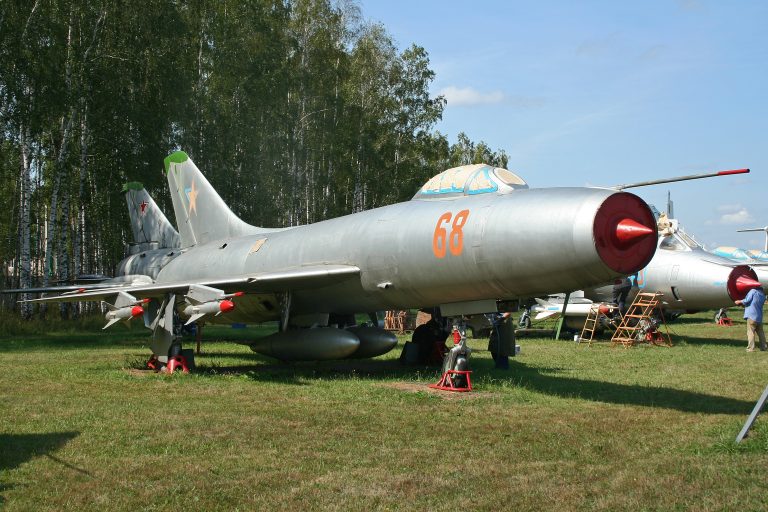
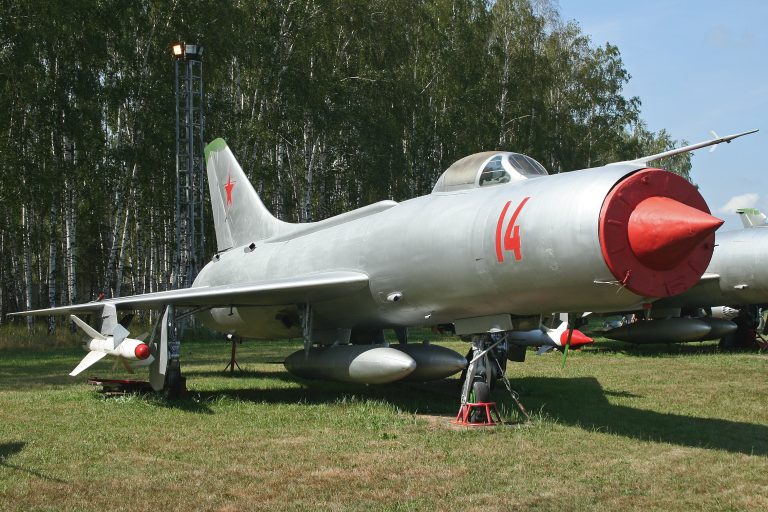
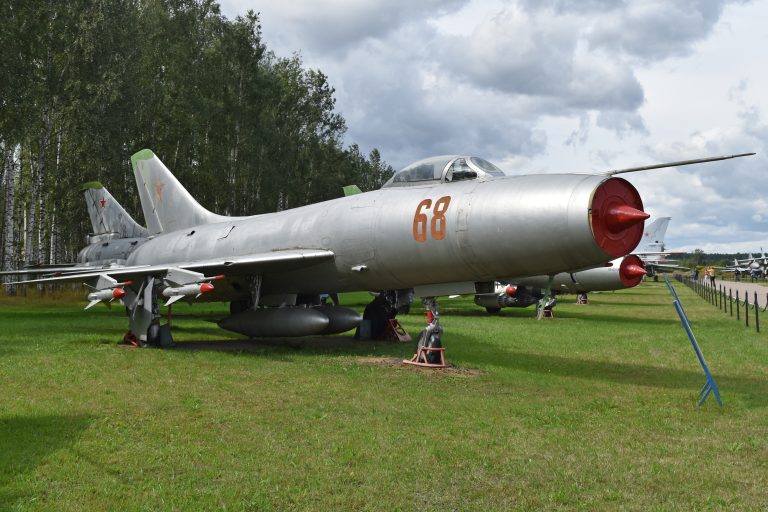
The Fishpot in pictures
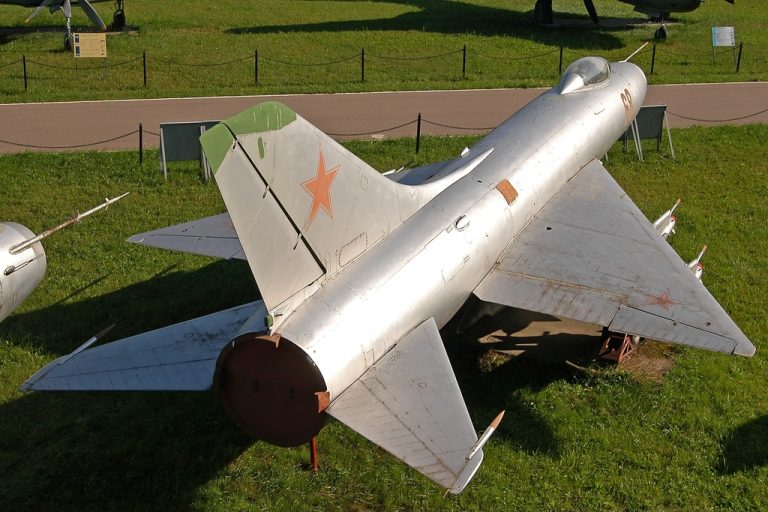
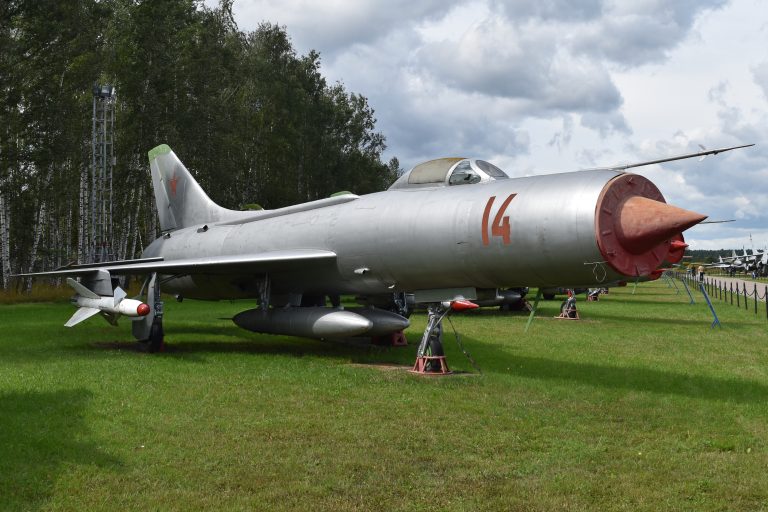
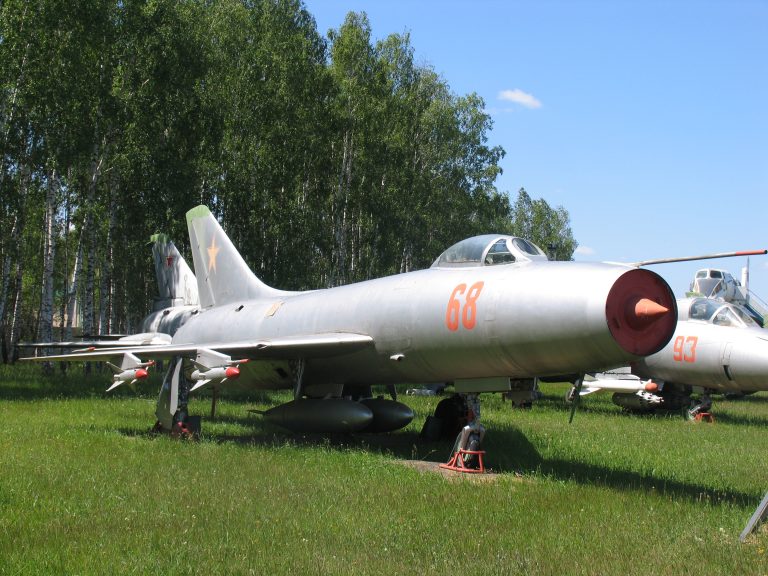
The Fishpot in motion
A dedicated, high-authority video feature on the Sukhoi Su-9 and Su-11 is coming soon. In the meantime, explore the photo gallery above and the operator map below.
Where the Fishpot flew
The score that defines it
The Su-9 and Su-11 were built to deter and, if needed, to shoot down high-flying bombers over Soviet territory — not to dogfight. They served as interior air-defence interceptors, were never exported, and have no widely confirmed air-to-air kills in the public record. Their story is one of readiness, records and a famous near-intercept rather than aerial victories.
Compare the combat record of every military aircraft. Figures as of July 2026.
Everything people ask about the Su-9 and Su-11
Can I fly in a Su-9?
What is the difference between the Su-9 and the Su-11?
Did a Su-9 shoot down the U-2 in 1960?
Why did the Su-9 have no gun?
How fast and how high could the Su-9 and Su-11 fly?
Were the Su-9 and Su-11 exported?
What replaced the Su-9 and Su-11?
You can’t fly the Su-9.
These, you can.
Some legends only live in museums — others are fuelled and waiting. MiGFlug has put civilians in real military jet cockpits since 2004.
 Fly the L-39 AlbatrosThe world’s most-flown jet trainer — aerobatics included
 Fly the F-104 Starfighter“The missile with a man in it”
 Fly the MiG-21The Cold War’s most-produced jet
 Fly the T-33 Shooting StarAmerica’s first jet trainer
 Fly the DH VampireA piece of early jet history
 Fly the S.211Agile Italian jet trainer
 Fly the MB-326The classic Aermacchi jet
 Fly the MiG-15The Soviet legend of the Korean War
Continue the tour
Every fact, checked
- Vintage Aviation News — First Flight of the Sukhoi Su-9Development history and first-flight dating of the Su-9.
- Vintage Aviation News — First Flight of the Sukhoi Su-11 Fishpot-CSu-11 radar, engine, R-8 armament and production numbers.
- The Aviation Geek ClubThe Su-9 pilot ordered to ram Powers’ U-2 in 1960 (hedged account).
- The AviationistThe 1960 U-2 shoot-down and the aircraft scrambled against it.
- The National InterestThe Soviet pilot who tried to ram Francis Gary Powers.
- Military Factory — Sukhoi Su-9Specifications, dimensions and performance reference.
- FAI records databaseSoviet altitude and speed records set by Su-9-derived research aircraft.
- CIA — the U-2 programmeBackground on the 1960 Powers overflight and its interception.