
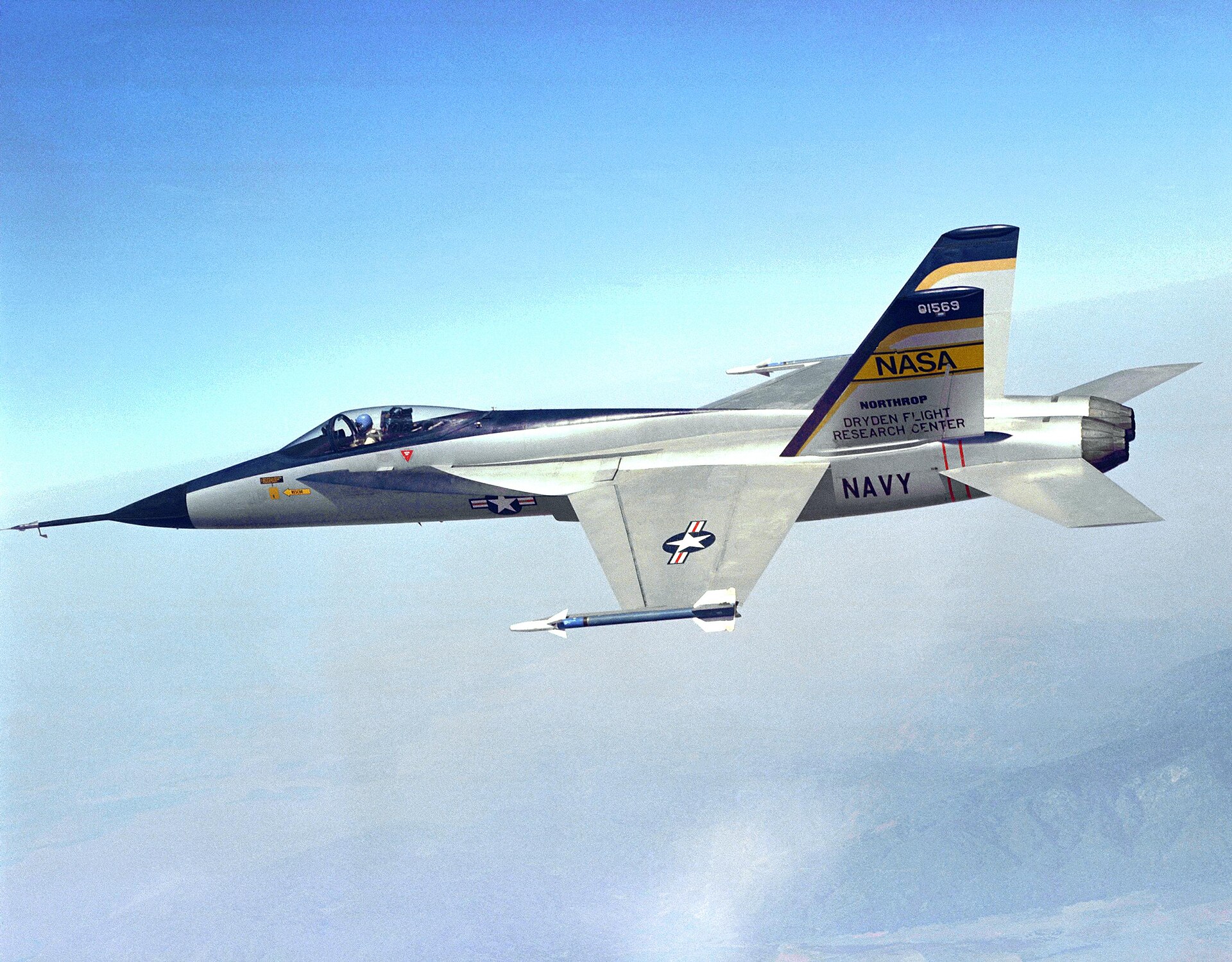
Northrop YF-17
“Cobra”
The twin-engined lightweight-fighter prototype that lost the 1975 fly-off to the F-16 — then came back from the dead as the McDonnell Douglas F/A-18 Hornet, one of the most successful naval fighters ever built.
The Northrop YF-17 Cobra: the lightweight fighter that lost to the F-16 — and became the F/A-18 Hornet
In the early 1970s the US Air Force had just committed to the big, expensive, superb F-15 Eagle — and immediately began to worry that it could never afford enough of them. A group of reformers argued for the opposite: a small, cheap, agile day fighter built around raw dogfighting performance. In 1972 that idea became the Lightweight Fighter (LWF) programme, and the Air Force funded two companies to build flying prototypes to compare head-to-head. General Dynamics would build the single-engined YF-16. Northrop would build the twin-engined YF-17.
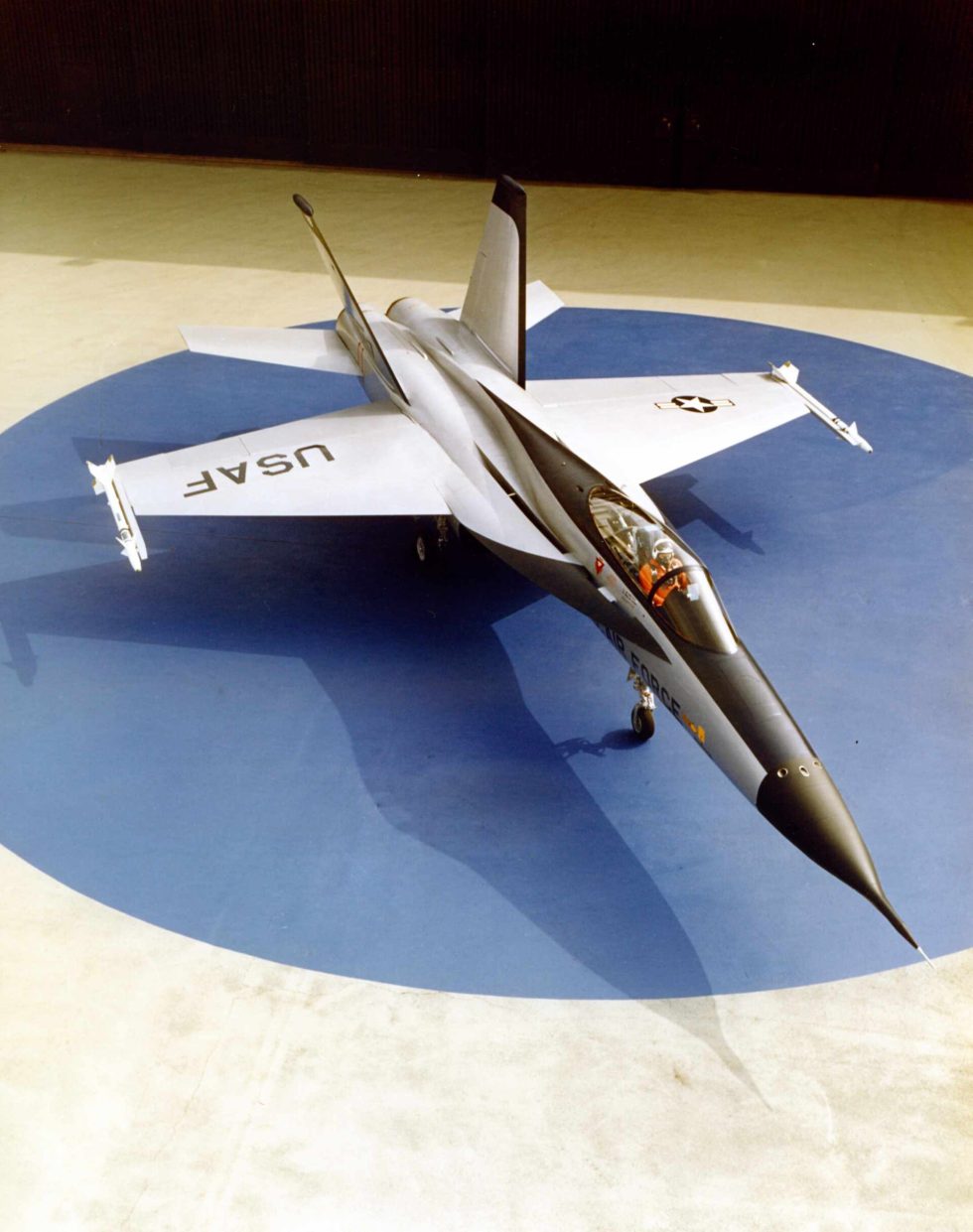
Northrop’s entry did not come from nowhere. It grew out of the company’s private-venture P-530 Cobra studies — a larger, twin-engine evolution of the hugely successful F-5 family Northrop already sold around the world. The YF-17 kept that lineage’s clean, purposeful look but added the ideas that would define fighters for decades: two engines set close together, a blended fuselage, and long leading-edge extensions (LERX) sweeping forward from the wing roots. Those extensions threw energetic vortices over the wing at high angle of attack, letting the jet stay controllable and keep generating lift in exactly the nose-high, slow-speed regime where dogfights are won. The type earned its name honestly — the Cobra could rear its nose up and hang there.
The first YF-17 (serial 72-1569) flew from Edwards Air Force Base on 9 June 1974, with Northrop test pilot Hank Chouteau at the controls. Two days later, on 11 June, it became the first US aircraft to exceed the speed of sound in level flight without afterburner — a striking demonstration of how little drag the airframe carried. Across the fly-off the two YF-17 prototypes flew a combined 288 test sorties, reaching around Mach 1.95 and pulling to 9.4 g.
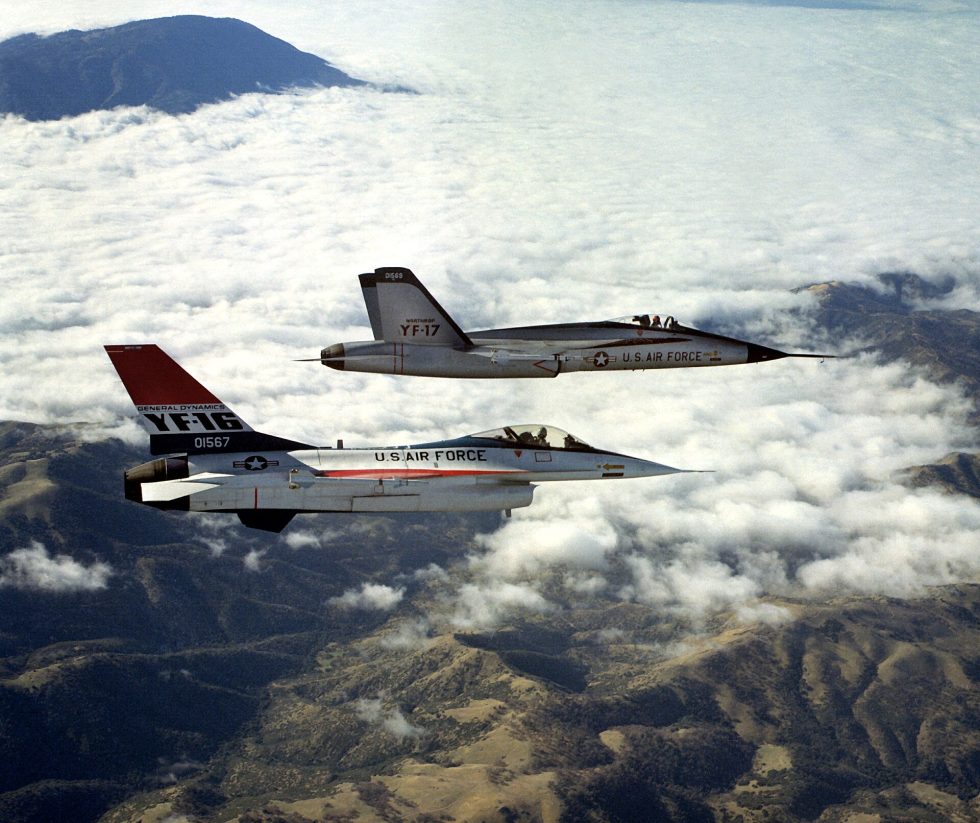
And yet, on 13 January 1975, the Air Force announced that the General Dynamics YF-16 had won. Both aircraft were excellent. But the YF-16 was slightly faster and cheaper, and — decisively — its single Pratt & Whitney F100 engine was the same engine already fitted to the F-15, promising huge savings in logistics and spares. One engine beat two on cost and commonality. The Cobra had lost.
That should have been the end. It was, instead, the beginning of the best second act in fighter history. The US Navy needed a new multirole fighter too, but rejected the single-engined F-16: over open ocean, a second engine is a second chance to get home. The Navy paired McDonnell Douglas with Northrop, and together they enlarged and navalised the YF-17 into the F/A-18 Hornet — adding strengthened structure, folding wings, an arrestor hook, a bigger radar and far more fuel. The YJ101 engines grew into the superb General Electric F404. First flown in 1978 and in service by 1983, the Hornet and its Super Hornet successor went on to serve the US Navy, the Marines, the Blue Angels and a dozen air forces for over four decades.
Both YF-17 prototypes survive. 72-1569 stands in F-18 prototype markings at the Western Museum of Flight in Torrance, California; 72-1570 is preserved at the USS Alabama Battleship Memorial Park in Mobile. Neither ever fired a shot in anger. But no losing prototype in history has a legacy quite like the Cobra’s — it lost a competition and won the next fifty years.
01The YF-17 versus the YF-16: why Northrop’s Cobra lost the Lightweight Fighter fly-off
Both LWF prototypes met the requirement, and both were genuinely superb dogfighters — so the decision came down to margins. The YF-16 was marginally faster and cheaper, and General Dynamics’ single-engine layout carried a powerful hidden advantage: its Pratt & Whitney F100 was the very same engine already powering the F-15 Eagle. Buying one engine type for both fighters promised enormous savings in development, spares and training. The twin-engined YF-17, by contrast, used two of the then-unproven GE YJ101s.
The Air Force also broadened the contest late in the day into the Air Combat Fighter (ACF) programme, adding NATO partners and multirole ambitions — territory that favoured the more developed F-16. When Secretary of the Air Force John McLucas announced the YF-16’s win on 13 January 1975, the reasoning was cost, commonality and perceived lower risk, not any clear performance defeat. It is one of aviation’s neatest ironies that the “loser’s” twin-engine layout — the very thing that cost it the Air Force contract — was exactly what won it the Navy’s.
What makes the YF-17 Cobra special
Twin engines and the leading-edge extensions that tamed high-alpha
The YF-17’s signature was a pair of long leading-edge extensions (LERX) sweeping forward from the wing roots. At high angle of attack these threw powerful vortices over the wing, keeping airflow attached and lift working when a conventional wing would stall. Combined with two closely-spaced engines, the result was a jet that stayed controllable nose-high and slow — the regime where turning fights are decided. The design gave it its name: the Cobra could rear up and hold its nose high.
Built to out-turn, not out-run
Where the F-15 was big and fast, the YF-17 was small, light and ferociously agile — a pure air-combat dogfighter. It could sustain 9.4 g, roll fast, and point its nose thanks to the LERX and a blended, low-drag airframe. On its second flight it went supersonic in level flight without afterburner, proof of just how clean the design was. It was everything the “fighter mafia’s” lightweight-fighter vision demanded.
The engines — and airframe — that became the Hornet
The YF-17 was powered by two General Electric YJ101 afterburning turbojets, then a new design. When the airframe was enlarged and navalised into the F/A-18 Hornet, those engines were grown into the superb General Electric F404 — one of the most successful fighter engines in history, still powering aircraft worldwide. The Cobra’s shape and powerplant, rejected by the Air Force, became the backbone of US naval aviation.
02From F-5 to P-530 to YF-17: the Northrop lineage behind the Cobra
The YF-17 did not appear from a blank sheet. Northrop had built its reputation on the small, cheap, reliable F-5 Freedom Fighter / Tiger II, sold in huge numbers to allied air forces. Looking for a more capable successor, the company developed the private-venture P-530 Cobra in the late 1960s and early 1970s — a larger, twin-engine design with the blended fuselage and leading-edge extensions that would define the YF-17. When the Air Force launched the Lightweight Fighter competition, Northrop refined the P-530 concept into the flying YF-17 prototype. The same DNA later threaded onward into the F/A-18 Hornet, making the humble F-5 a distant ancestor of one of the world’s great carrier fighters.
03How the losing YF-17 became the F/A-18 Hornet: the Navy’s second act
After the LWF loss, the US Navy ran its own Air Combat Fighter competition for a multirole jet to replace the F-4 and A-7. Congress pushed the Navy toward the two LWF designs to save money, but the Navy rejected the single-engined F-16 for carrier work — over water, the redundancy of two engines matters. It selected the YF-17 instead, and because Northrop lacked carrier-aircraft experience, teamed it with McDonnell Douglas as prime contractor.
The two firms enlarged the airframe substantially: stronger structure and landing gear for catapult launches and arrested landings, folding wings, a nose radar, more internal fuel and heavier weapons. The YJ101 engines became the F404. The result, the F/A-18 Hornet, first flew on 18 November 1978 and entered fleet service in 1983. It and the later Super Hornet remain frontline US Navy fighters today — a direct descendant of the jet the Air Force turned down.
Full Northrop YF-17 Cobra specifications
Baseline note: the figures below describe the YF-17A as it flew in the 1974 Lightweight Fighter flyoff — prototype No. 1, serial 72-1569, rolled out at Northrop’s Hawthorne plant on 4 April 1974 and first flown from Edwards on 9 June 1974 by Hank Chouteau. Only two aeroplanes were ever built, no production standard was ever frozen, and several of the numbers in circulation are design estimates rather than measured results. Deltas for the P-530 Cobra study that preceded it and the F/A-18A Hornet that came out of it are in grey. Five published disagreements need settling before the tables begin. First, the dimensions: aviastar.org lists 56 ft 6 in long and 15 ft 6 in high, but the metric figures every source shares — 16.92 m and 4.42 m — convert to 55 ft 6 in and 14 ft 6 in. The imperial column is a transcription error and the metric one is used here. Second, the flyoff totals: 288 flights and 345.5 hours in the type literature against 268 sorties in accounts of the programme as a whole; the higher figure appears to include post-competition and NASA sorties. Third, the top speed: 1,320 mph at 40,000 ft, roughly Mach 2.0, is a projected figure, while the fastest speed actually flown in the programme was Mach 1.95. Both are given below and labelled. Fourth, the YJ101’s bypass ratio, quoted as 0.20 in engine literature and 0.25 in accounts of the P-530’s GE15 — the two describe different build standards of the same idea. Fifth, the claim reproduced across the internet that the leading-edge root extensions "added about 50 per cent additional lift at angles of attack exceeding 50°" is garbled: the vortex lift they generate builds from roughly 15–20° upwards, and 50° is near the departure boundary rather than anywhere a pilot manoeuvres. The correct statement is that they add on the order of half again as much lift across the high-alpha band.
Dimensions & weights
- Crew
- 1 — on an 18° reclined ejection seat under a one-piece bubble canopy with an unusually clean forward view. Northrop’s pilots argued the reclined seat bought g-tolerance; General Dynamics went considerably further with 30° in the YF-16, and the Hornet later settled back at 18°
- Length
- 16.92 m (55 ft 6 in), nose probe excluded. The F/A-18A came out at about 17.07 m (56 ft 0 in) despite a far heavier aeroplane, because the growth went into width and depth rather than length
- Wingspan
- 10.67 m (35 ft 0 in) over the wingtip missile rails. The F/A-18A grew to about 11.43 m (37 ft 6 in), and gained folding outer panels that the YF-17 never had
- Height
- 4.42 m (14 ft 6 in) to the tip of the canted fins
- Wing area
- 32.5 m2 (350 sq ft). This is the number that tells the whole design story: the P-530 Cobra study carried 37.2 m2 (400 sq ft), the Air Force demonstrator was shrunk to 350 sq ft to chase transonic acceleration, and the Navy version went straight back to 400 sq ft because a carrier approach needs the area more than a dogfight needs the drag saving. The F-5E it descended from had just 17.3 m2 (186 sq ft)
- Wing planform
- Trapezoidal, 20° sweep at quarter chord, unswept trailing edge, mid-mounted — deliberately modest sweep for a Mach 2 aeroplane. Northrop bought sustained turn and low-speed handling at the cost of wave drag, which is precisely the trade the Air Force marked it down for. The wing sat on the shoulder in early P-530 drawings and was lowered to mid-fuselage before the demonstrator was built
- Leading-edge root extensions
- Large, highly swept strakes running from the intake lips to under the windscreen — the feature that named the aeroplane, because head-on they read as a cobra’s hood. They shed a stable vortex over the wing root that adds roughly half again as much lift at high angle of attack, and they straighten the flow entering the intakes so the engines keep breathing when the wing is already halfway to stalled. Every American fighter drawn since has some version of them
- Empennage
- Twin fins canted outward, quoted at 45° from vertical, plus all-moving aluminium stabilators — the fins sit in the LERX vortex flow so they stay effective at angles of attack that would blanket a single centreline fin. The Hornet reduced the cant to about 20°, a change made for flutter, structural and carrier-deck reasons rather than aerodynamics
- Empty weight
- 7,888 kg (17,390 lb). The F/A-18A came in near 10,400 kg (23,000 lb) — about a third heavier before a drop of fuel goes aboard
- Gross weight
- 11,231 kg (24,760 lb), the air-combat configuration flown in the flyoff. The Hornet’s equivalent figure is 16,800 kg (37,000 lb)
- Maximum take-off weight
- 15,617 kg (34,430 lb). The F/A-18A is usually quoted around 23,500 kg (51,900 lb), which is the clearest single measure of how far the Navy aeroplane departed from the demonstrator
- Internal fuel
- ~2,903 kg (6,400 lb). This was the YF-17’s weakest number and it cost the aeroplane the competition: the YJ101’s near-turbojet cycle burned fuel at a rate a proper turbofan did not, and there was less of it aboard. McDonnell added about 2,020 kg (4,460 lb) to the Hornet by deepening the dorsal spine and putting 96 US gal tanks in the wings
- Wing loading
- 346 kg/m2 (70.7 lb/sq ft) at gross weight — low for a supersonic fighter of the period and the arithmetic behind the type’s sustained-turn and high-alpha behaviour
- Composite content
- Over 408 kg (900 lb) of graphite/epoxy, with Nomex honeycomb cores and composite facesheets in the wings and a composite airbrake. For 1974 this was a genuinely advanced airframe; the rest was conventional semi-monocoque stressed-skin aluminium
Performance
- Maximum speed (projected)
- 2,124 km/h (1,320 mph; 1,150 kt) at 12,200 m (40,000 ft), about Mach 2.0. This is a design figure and should be read as one
- Maximum speed (demonstrated)
- Mach 1.95 — the fastest the two prototypes were actually taken. The YF-17 was fast enough; it was not fast enough sooner than the YF-16, and transonic acceleration was where the competition was decided
- Service ceiling
- 18,300 m (60,000 ft) quoted; above 15,000 m (50,000 ft) demonstrated in the flight-test programme
- Maximum load factor
- 9.4 g demonstrated. The Hornet was later stressed for 7.5 g as a carrier aeroplane; Northrop’s land-based F-18L proposal advertised 9 g precisely because it did not have to survive arrested landings
- Maximum angle of attack
- 68° at 28 kt indicated airspeed — the headline result of the whole programme, and effectively a controlled hover on the LERX vortices. Nothing else in the 1974 inventory came close, and this behaviour is the direct ancestor of the Hornet’s reputation for being almost impossible to depart
- Thrust-to-weight
- 1.21 at gross weight (30,000 lbf against 24,760 lb); 0.87 at maximum take-off weight. Comfortably above unity, which in 1974 still felt like a novelty
- Ferry range
- ~4,500 km (2,800 miles; 2,400 nm) with external tanks. Internal-fuel combat radius was never published in a form worth quoting, which is itself telling
- Design combat envelope
- Mach 0.6–1.6 at 9,100–12,200 m (30,000–40,000 ft) — the band the Lightweight Fighter request for proposals specified, derived from analysis of Vietnam, the Six-Day War and the 1965 and 1971 Indo-Pakistani air wars
- First flight
- 61 minutes, 5,500 m (18,000 ft) and 982 km/h (610 mph) on 9 June 1974. Hank Chouteau’s verdict afterwards was that the designers "were going to give the airplane back to the pilot" — a sentence aimed squarely at the F-4 generation
- Flight-test totals
- 288 flights, 345.5 hours across both airframes. The YF-16 pair flew 330 sorties and 417 hours, having started four months earlier; at decision time the Air Force simply had more data on the General Dynamics aeroplane. Some sources give 268 sorties for the YF-17, apparently counting only the competitive phase
- Turn performance
- Superior to the YF-16 around Mach 0.7, inferior elsewhere — the honest summary of the flyoff. The Air Force’s own statement conceded the low-transonic band to Northrop and claimed everything above it for General Dynamics
Propulsion & systems
- Engines
- 2 × General Electric YJ101-GE-100 augmented turbojets — developed for this airframe and for nothing else, and at the time of the flyoff nowhere near production maturity. That immaturity was a real argument against the aeroplane and it is usually skipped over
- Thrust, military
- 42.2 kN (9,479 lbf) each
- Thrust, maximum
- 66.7 kN (15,000 lbf) each with afterburner; 133.4 kN (30,000 lbf) total
- Engine cycle
- Bypass ratio 0.20–0.25 — the celebrated "leaky turbojet". GE built what is essentially a turbojet and let a thin sleeve of cool air bypass the core, too little to buy turbofan fuel economy but enough to cool the afterburner and nozzle from the inside and to keep the duct wall cold. That let the engine bay be built from lighter, cheaper materials. Sources give 0.20 for the YJ101 and 0.25 for the earlier GE15-J1A5 in the P-530
- Engine installation
- Side by side in the fuselage, close-coupled — deliberately, to keep the asymmetric moment small enough to fly on one engine. Each drove its own hydraulic pump feeding a separate system, and each could be dropped out downwards without disturbing the empennage control runs. Twin engines were an Air Force cost objection and a Navy requirement; that single divergence decided the aeroplane’s fate twice
- Intakes
- Fixed-geometry side intakes under the LERX — no variable ramps, no bleed complexity, and a top speed capped as a result. The strakes ahead of them do the work of straightening the flow at high alpha that a mechanical inlet would otherwise have to manage
- Flight controls
- Electronic control augmentation system (ECAS), partial fly-by-wire with full mechanical reversion — acting through ailerons, rudders and stabilators over a relaxed-longitudinal-stability airframe. Northrop did not yet trust fly-by-wire and hedged; General Dynamics went all-in on analogue quadruplex FBW in the YF-16 and was right. The Hornet then went further still, to the first quadruple-redundant digital fly-by-wire system in a production fighter
- Airbrake
- Single composite panel on the spine between the fins — carried straight across to the F/A-18A, where it stayed until the Hornet’s later blocks began using differential control-surface deflection instead
- Avionics
- Head-up display, air-data and gunsight computing; no radar — the Lightweight Fighter demonstrators were flown as clear-air manoeuvre testbeds and the YF-17’s nose carried ballast and instrumentation where a set would go. Fitting one, and the Hughes AN/APG-65 that the Navy eventually specified, was among the largest single changes on the road to the Hornet
- Structure
- Semi-monocoque stressed-skin aluminium with composite wing skins over Nomex honeycomb — designed to a demonstrator’s life, not a fleet’s. The F/A-18A was designed to 6,000 flight hours and a carrier fatigue spectrum, which is a different structure wearing the same shape
- Descendant engine
- General Electric F404-GE-400 — the YJ101 with the bypass ratio opened out from 0.20 to 0.34 to buy the fuel economy the Navy’s range requirement demanded, giving about 71.2 kN (16,000 lbf) with afterburner. It became one of the most reliable fighter engines ever built, has been made in the thousands, and powers the F-117, the Gripen, the T-50 and the Tejas. This is the YF-17’s second lasting contribution after the LERX, and it outlived the airframe programme by half a century
04The YF-17’s costs: why there is no unit price or cost-per-hour figure
The YF-17 never reached production, so a flyaway unit cost simply does not exist in any meaningful sense — only two prototypes were built, funded under the Lightweight Fighter demonstration/validation effort rather than sold as a finished product. Contemporary reporting put the LWF prototype programme in the low hundreds of millions of dollars across both competing teams, but that figure covers design, tooling, airframes and an entire flight-test campaign, not a per-aircraft price.
There is likewise no credible cost-per-flight-hour figure for the type: the two aircraft together flew only about 288 sorties over roughly a year before the Air Force programme ended. Any precise dollar cost you see attached to a “YF-17” online is really a figure for its descendant, the production F/A-18 — not a real operating number for the prototype.
Armament & payload
The YF-17 carried a gun, two Sidewinder rails and a great deal of ballast — everything else was a promise
No YF-17 ever fired a shot in anger, never carried a live missile to a firing range under this designation, and never flew with a radar. It was a manoeuvre demonstrator built to win a competition, and the weapons fit was whatever the least amount was that would prove the airframe could host one. So the six armament headings below have been repurposed honestly: what was actually installed, what was demonstrated, what was carried as ballast, and where the armament the design implied was finally delivered.
The one real weapon aboard was the gun. Northrop had drawn the P-530 with its cannon under the fuselage, in the multi-role position; when the design was recast as the P-600 air-combat demonstrator the M61A1 was moved to the top of the forward fuselage, ahead of the windscreen. That was not a styling decision. A Vulcan firing at 6,000 rounds a minute produces a large volume of oxygen-depleted propellant gas, and a fuselage-side intake sitting a few metres behind an underslung muzzle will swallow it and stall. Putting the gun on top, above and forward of everything, solved the ingestion problem outright. The F/A-18 kept the arrangement, and so did every Hornet and Super Hornet since.
Everything else was provisional. Wingtip rails could take acquisition-round Sidewinders for handling and separation work; underwing stations existed on the drawings and were used mainly for test stores and ferry tanks. The published lists of Mk 84 bombs, jamming pods and 600 US gal tanks describe design capability, not a fit that was ever flown in earnest. Station counts differ between sources — four hardpoints in the standard specification block, one centreline plus four underwing elsewhere — because the two airframes were configured differently at different points in a fourteen-month test programme and no operational loadout table was ever issued for a type that had no operators.
Gun — one M61A1 Vulcan, moved to the roof
- One General Electric M61A1 Vulcan, 20 mm, six barrels, hydraulically driven, nominally 6,000 rounds per minute with a lower selectable rate.
- 500 rounds, carried in a linkless feed drum. That is roughly five seconds of continuous fire — adequate for a demonstrator, tight for a fighter, and one of the numbers the Hornet later improved on.
- Mounted in the upper forward fuselage ahead of the windscreen, relocated there from the P-530’s underfuselage position specifically to keep muzzle gas out of the side intakes.
- Firing trials were conducted during the flight-test programme; gas ingestion, dispersion and airframe response were the points at issue rather than lethality.
- The same gun in the same place, above the radar in the nose, is still there on the F/A-18C and the Super Hornet fifty years on.
Air-to-air — two wingtip Sidewinder rails
- Two AIM-9 Sidewinder rails at the wingtips, the only air-to-air provision the demonstrator had.
- Rounds carried were acquisition and captive-carry stores for seeker, separation and flutter work; the YF-17 was never a launch platform for a live shot.
- There was no radar and therefore no radar-guided missile capability of any kind. The AIM-7 Sparrow, which the Navy would insist on, had nowhere to be aimed from.
- Wingtip rails were retained on the F/A-18 and remain a Hornet signature; the Navy aeroplane added Sparrow stations on the fuselage corners and, later, AIM-120 AMRAAM.
- The absence of a radar is the single largest capability gap between the demonstrator and the Hornet, and the largest single cause of the redesign that followed.
Stores stations — plumbed, published, barely used
- Four hardpoints in the usual specification block; other sources describe one centreline station plus four underwing, reflecting different configurations of the two airframes.
- Published capability included two Mk 84 low-drag general-purpose bombs, two electronic countermeasures pods, or two 600 US gal drop tanks.
- In practice, external carriage during the flyoff was almost entirely ferry tanks and test instrumentation. Air-to-ground release was not part of the Lightweight Fighter evaluation.
- The P-530 Cobra had been drawn as a multi-role aeroplane with a substantially larger store load; the P-600 stripped that out because the Air Force asked for an air-superiority demonstrator and nothing else.
- The F/A-18A ended up with nine stations and about 6,200 kg (13,700 lb) of ordnance — which is where the P-530’s original multi-role ambition finally arrived.
Sighting and fire control — a HUD and an empty nose
- Head-up display with a lead-computing gunsight, fed by air-data and inertial inputs. For 1974 the display standard was good and the pilots said so.
- No fire-control radar, no radar warning receiver in operational form, no weapons-management computer — none of it was required to answer the questions the flyoff asked.
- Ballast and flight-test instrumentation occupied the volume in the nose that a radar would later fill.
- The Navy’s requirement for a genuine multi-mode radar with air-to-air and ground-mapping modes forced the Hughes AN/APG-65 into the design and forced a new forward fuselage around it.
- The APG-65 gave way to the AN/APG-73 from 1992; both trace their place in the aeroplane to a hole the YF-17 carried empty.
What actually filled the airframe — the test fit
- Both prototypes were flying laboratories: strain gauges, accelerometers, air-data booms, telemetry transmitters and a recording installation where equipment bays would otherwise sit.
- High angle-of-attack work was the centrepiece. The programme took the aeroplane to 68° alpha at 28 kt indicated and brought it back, which is the result the whole design was built to produce.
- Nine-point-four g was reached, above the 9 g design limit, without airframe failure.
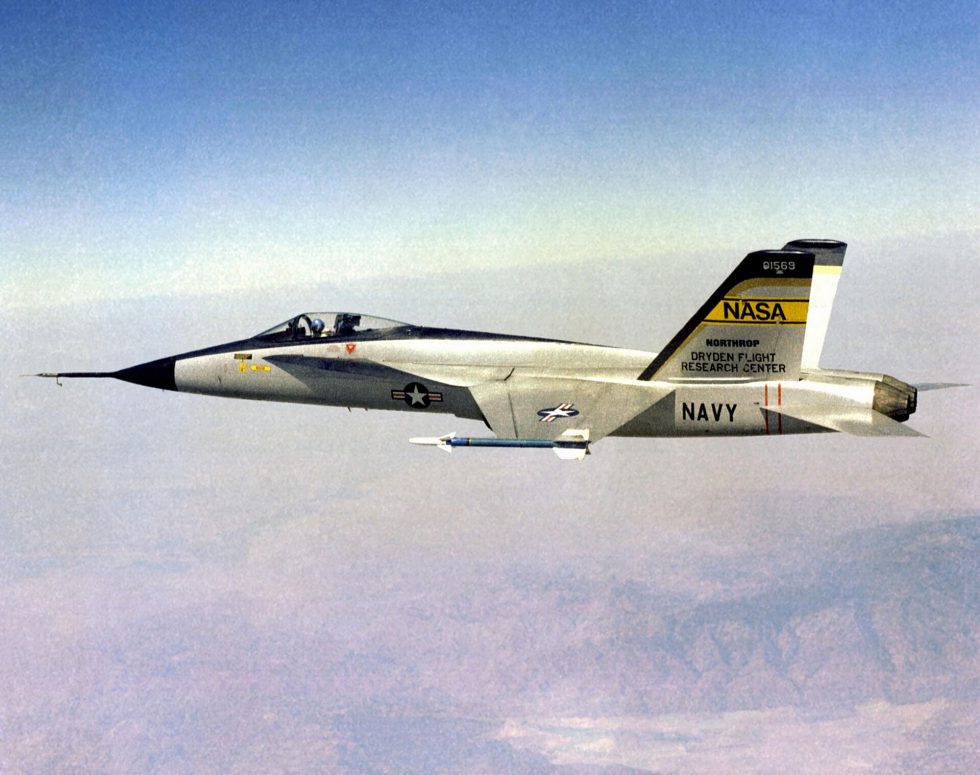
- Prototype 72-1569 spent 27 May to 14 July 1976 at NASA’s Dryden Flight Research Center on base-drag studies, feeding data forward into the F/A-18 programme. NASA pilots described the handling as generations ahead of the operational inventory.
- Neither aeroplane was ever fitted with an operational avionics suite, and neither was ever intended to be.
What was never carried, and where it went instead
- No radar-guided missile, no guided air-to-surface weapon, no targeting pod, no reconnaissance fit, no nuclear provision. None of it was specified and none was flown.
- No defensive electronic warfare suite in operational form; the two ECM pods in the published payload list are a capability statement, not a fit.
- No air-to-ground weapons release was demonstrated. Every published bomb figure for the YF-17 is a projection.
- The Hornet delivered all of it: AIM-7 and later AIM-120 for radar-guided engagement, AGM-65 Maverick, AGM-84 Harpoon and AGM-88 HARM, laser-guided and later GPS-guided bombs, targeting pods, and in the EA-18G a full electronic-attack fit.
- That is the honest verdict on this heading. The YF-17’s armament is not a weapons fit; it is a promissory note that another company cashed.
Three typical loadouts
- Flyoff air-combat sortie
- Clean airframe, full internal fuel, 500 rounds for the M61A1 and two captive AIM-9 acquisition rounds on the wingtip rails. This is the configuration in which the aeroplane was compared with the YF-16 and in which its 9.4 g and Mach 1.95 results were set.
- High angle-of-attack and departure sortie
- Clean, instrumentation fitted, reduced fuel state to keep weight and centre of gravity within the test card, spin-recovery provision rigged. The 68°-at-28-kt point was flown this way, and it is the sortie that justified the whole LERX architecture.
- Cross-country transit
- Two 600 US gal external tanks on the underwing stations, gun loaded or ballasted, no missiles. The 4,500 km (2,800 mile) ferry figure comes from this configuration and from nothing else.
Sourcing caveat: no operational armament document exists for the YF-17 because the type had no operational service. Every figure above is drawn from Northrop and Air Force demonstrator documentation, from the standard specification blocks that descend from it, and from the F/A-18 literature where it describes continuity. Where a store appears in a published payload list but was never flown, that has been said rather than implied.
Variants
Two YF-17s were built, and their descendants have been in production for forty-five years
The YF-17 is the most consequential losing aeroplane in American postwar aviation. Two were built, neither entered service, the type was beaten in the competition it was designed for, and its shape, its aerodynamics and its engine went on to equip the United States Navy and Marine Corps for half a century and eleven foreign air arms besides. Understanding it means following the line backwards to a 1956 paper fighter and forwards to an aeroplane still flying off carrier decks today.
The line begins with Northrop’s house style: small, cheap, exportable fighters. The N-102 Fang of 1956 went nowhere; the F-5 Freedom Fighter that followed sold in the thousands. In 1965 the internal N-300 study stretched an F-5E, gave it small leading-edge root extensions and hung more powerful GE15 turbojets on it. That grew into the P-530 Cobra, which by 1971 had doubled the wing to 37.2 m2 (400 sq ft), mounted twin canted fins, and carried the strakes that gave it its name — head-on, the LERX read as a cobra’s spread hood. Northrop marketed the P-530 hard as a multi-role fighter for allied air forces looking to replace the F-104. Nobody bought it. It existed as brochures, a mock-up and a wind-tunnel programme, and it would have died there had the Air Force not opened the Lightweight Fighter competition in January 1972.
Northrop recast the P-530 as the P-600, stripped of multi-role equipment and rebuilt as a pure air-combat demonstrator with the wing cut to 32.5 m2 (350 sq ft) and the gun moved to the top of the nose. On 13 April 1972 it and General Dynamics’ Model 401-16B were selected for hardware, over Boeing’s Model 908-909, which had actually been the technical favourite. The two YF-17s flew from June and August 1974 and were genuinely impressive: 68° angle of attack, 9.4 g, Mach 1.95, and handling that made test pilots evangelical.
They lost anyway, and it is worth being precise about why, because the affection the YF-17 attracts tends to blur it. Secretary of the Air Force John L. McLucas announced the YF-16 on 13 January 1975 on grounds of lower operating cost, greater range, better acceleration and climb, and manoeuvre performance he called "significantly better" — superior turn rate everywhere except around Mach 0.7, where the YF-17 won. Those grounds were substantially correct. The single Pratt & Whitney F100 was the same engine as the F-15’s, so choosing it collapsed two spares pools into one and cut unit cost across both programmes; two YJ101s were an engine type that existed for one airframe and was nowhere near production maturity. The YF-16 carried a better fuel fraction and a genuine turbofan, so it went further on less. It had flown four months earlier and accumulated 330 sorties and 417 hours against the YF-17’s 288 and 345.5, so at decision time there was simply more evidence about it. And Northrop’s conservatism on flight controls — partial fly-by-wire with mechanical reversion, against General Dynamics’ full quadruplex system — looked, correctly, like the more timid engineering.
Two footnotes complicate that verdict without overturning it. The F100 commonality argument, which weighed heavily in 1975, was undone within five years by that engine’s stagnation-stall problems and the losses they caused, while the F404 that grew out of the YJ101 became one of the most dependable fighter engines ever built. And the Navy, told to pick from the same two aeroplanes, looked at a single engine and a narrow-track undercarriage and refused. Twin engines and a wide stance are not sentimental preferences at sea; they are the difference between a swim and a recovery.
What the Navy then did to the aeroplane deserves stating precisely, because "navalised YF-17" is the most persistent error told about the Hornet. This was not a minor navalisation. Congress had directed in 1974 that the Navy’s VFAX make maximum use of Lightweight Fighter technology, and the Navy Air Combat Fighter competition that followed was won on 2 May 1975 by the Northrop design — but with McDonnell Douglas as prime contractor, because Northrop had never built a carrier aeroplane. What McDonnell delivered as Model 267 was a new aeroplane wearing the YF-17’s silhouette. The wing went back up to 400 sq ft and gained folding outer panels and a leading-edge snag against flutter; the stabilators were enlarged and snagged too; the aft fuselage was widened by 4 in and the engines canted outward; the undercarriage was widened and given a twin nose wheel, catapult attachment and a carrier-strength arrestor hook; the dorsal spine was deepened and wing tanks added for 4,460 lb more fuel; a new forward fuselage was built around the Hughes AN/APG-65 radar; and the analogue ECAS was thrown out for the first quadruple-redundant digital fly-by-wire system in any production fighter. Carrier changes alone added about 4,540 kg (10,000 lb), taking gross weight to 16,800 kg (37,000 lb) against the YF-17’s 11,231 kg (24,760 lb). Essentially no primary structure crossed over unchanged. The Hornet is the YF-17’s child, not its uniform.
- N-102 Fang (1956, none built)
- Northrop’s first attempt at a small, cheap supersonic fighter around a single J79. Rejected, but it established the company’s house doctrine that a light fighter sold on cost and agility could find a market the heavyweights could not.
- N-300 (1965, project only)
- An F-5E stretched, re-engined with 9,000 lbf GE15-J1A1 turbojets and given small leading-edge root extensions. The first appearance in the family of the feature that defines it.
- P-530 Cobra (1966–1971, none built)
- The full design study: 13,000 lbf GE15-J1A5 "leaky turbojets", a 400 sq ft wing of more than double the F-5E’s area, twin canted fins, full-size LERX and a multi-role weapons fit with the gun underneath. Marketed to European and other allied air forces as an F-104 replacement and comprehensively rejected.
- P-600 / YF-17A (1972–1975, two built)
- The Lightweight Fighter demonstrator. Multi-role equipment deleted, wing cut to 350 sq ft, gun relocated to the upper nose, YJ101-GE-100 engines. Serials 72-1569 and 72-1570; first flights 9 June and 21 August 1974; lost the Air Combat Fighter decision on 13 January 1975.
- Northrop F-18L / F/A-18L (1975–1985, none built)
- Northrop’s land-based export Hornet, its own half of the McDonnell Douglas bargain. About 1,130–1,360 kg (2,500–3,000 lb) lighter through simplified undercarriage, no wing fold and a land-based hook, with 9 g design load against the F/A-18A’s 7.5 g and up to 9,070 kg (20,000 lb) of stores against 6,210 kg (13,700 lb). It kept 71 per cent commonality by parts weight and 90 per cent of high-value systems, and it never found a single customer: the F-16 or the standard Hornet took every sale. The partnership collapsed into duelling lawsuits from October 1979, settled on 8 April 1985 with McDonnell Douglas paying Northrop $50 million for worldwide sales rights.
- McDonnell Douglas Model 267 / F-18A (1975–1980, 11 development aircraft)
- The Navy Air Combat Fighter winner and the substantial redesign described above. First flight 18 November 1978. Work split roughly evenly: McDonnell Douglas built wings, stabilators and forward fuselage and did final assembly, Northrop the centre and aft fuselage and the fins.
- F/A-18A/B Hornet (1980–1987)
- Production standard. Originally planned as separate F-18A fighter and A-18A attack variants plus a two-seat TF-18A; improvements in multifunction displays and a redesign of the stores stations let the two single-seaters merge, the combined designation being adopted from 1980 and made official on 1 April 1984. Service entry 7 January 1983 with the Marine Corps, 1 July 1984 with the Navy.
- F/A-18C/D Hornet (1987–2000)
- AMRAAM and Maverick capability, night-attack provision in later aircraft, the AN/APG-73 radar from 1992. Total A/B/C/D production reached 1,480.
- Export and licence-assembled designations
- Canada’s CF-188 (locally CF-18), Australia’s AF-18A and ATF-18A, Spain’s EF-18A/B in Spanish service as C.15 and CE.15, plus Kuwaiti, Finnish, Swiss and Malaysian aircraft. Finland’s F-18C/Ds were assembled domestically by Patria at Halli — the only case in which the design was built outside the United States.
- F/A-18E/F Super Hornet and EA-18G Growler (1995–present)
- A further enlargement, roughly 25 per cent bigger, that ended up in the size and weight class of the F-15 and replaced the F-14 Tomcat it had once been designed merely to complement. The Growler carries the electronic-attack mission. This is the fourth generation of a design that began as a 1965 attempt to stretch an F-5.
Survivors: both YF-17s exist and both are original airframes — there are no reproductions, and there never was a third aeroplane. Prototype 72-1569, the one that flew first on 9 June 1974 and that NASA used for base-drag work at Dryden between 27 May and 14 July 1976, is displayed at the Western Museum of Flight in Torrance, California, a few miles from the Hawthorne plant that built it. Prototype 72-1570, first flown 21 August 1974, stands outdoors at Battleship Memorial Park in Mobile, Alabama. Two aeroplanes, 288 flights, no service, no combat, no export — and a wing-root strake and an engine core that between them shaped almost everything the American fighter industry has drawn since.
From LWF contender to the Hornet’s ancestor
The P-530 Cobra
Northrop develops the private-venture P-530 Cobra, a twin-engine evolution of its F-5 family with blended fuselage and leading-edge extensions.
Lightweight Fighter contract
The US Air Force funds two LWF prototypes for a head-to-head fly-off: General Dynamics’ YF-16 and Northrop’s YF-17.
First flight
YF-17 no. 1 (72-1569) makes its maiden flight from Edwards AFB on 9 June with Northrop test pilot Hank Chouteau at the controls.
Supersonic without afterburner
On 11 June the YF-17 exceeds Mach 1 in level flight without reheat — the first US aircraft to do so, showing how clean the airframe was.
The fly-off
The two YF-17s fly a combined 288 test sorties against the YF-16, reaching around Mach 1.95 and demonstrating 9.4 g agility.
The Cobra loses
On 13 January the Air Force selects the YF-16 — slightly faster, cheaper, and sharing the F-15’s F100 engine. The YF-17 is beaten on cost and commonality.
The Navy’s choice
The US Navy rejects the single-engined F-16 and picks the twin-engined YF-17, pairing Northrop with McDonnell Douglas to navalise it.
Birth of the Hornet
The enlarged design flies as the F/A-18 Hornet on 18 November 1978 and enters US Navy service in 1983 — the Cobra’s triumphant second act.
Twelve YF-17 Cobra stories
The fighter the reformers wanted
A group of insiders argued the F-15 was too big and costly, and pushed for a small, cheap dogfighter.
Read the full story
From the F-5 to the Cobra
The YF-17 grew out of Northrop’s private-venture P-530 Cobra, itself a bigger twin-engine cousin of the famous F-5.
Read the full story
Why it is called the Cobra
The leading-edge extensions let the jet rear its nose up and hold it there — like a cobra about to strike.
Read the full story
9 June 1974
Test pilot Hank Chouteau took the first YF-17 into the air from Edwards Air Force Base.
Read the full story
Supersonic on dry thrust
Just two days after its first flight, the YF-17 broke the sound barrier in level flight without afterburner.
Read the full story
Hanging on the vortices
The LERX let the Cobra fly controllably at angles of attack that would stall a conventional fighter.
Read the full story
Two great jets, one winner
The YF-17 and YF-16 fly-off is one of the closest and most consequential fighter contests ever run.
Read the full story
13 January 1975
The Air Force chose the YF-16 — and the Cobra’s Air Force career was over.
Read the full story
The Navy says no to one engine
Over open ocean, the Navy wanted two engines — and that saved the Cobra.
Read the full story
Northrop meets McDonnell Douglas
Lacking carrier experience, Northrop teamed with McDonnell Douglas to turn the Cobra into a naval fighter.
Read the full story
A legend is born
The F/A-18 Hornet first flew in 1978 and became one of the most successful naval fighters ever.
Read the full story
Both Cobras still exist
Unusually for losing prototypes, both YF-17s were preserved and can be visited today.
Read the full story
The YF-17 Cobra in pictures
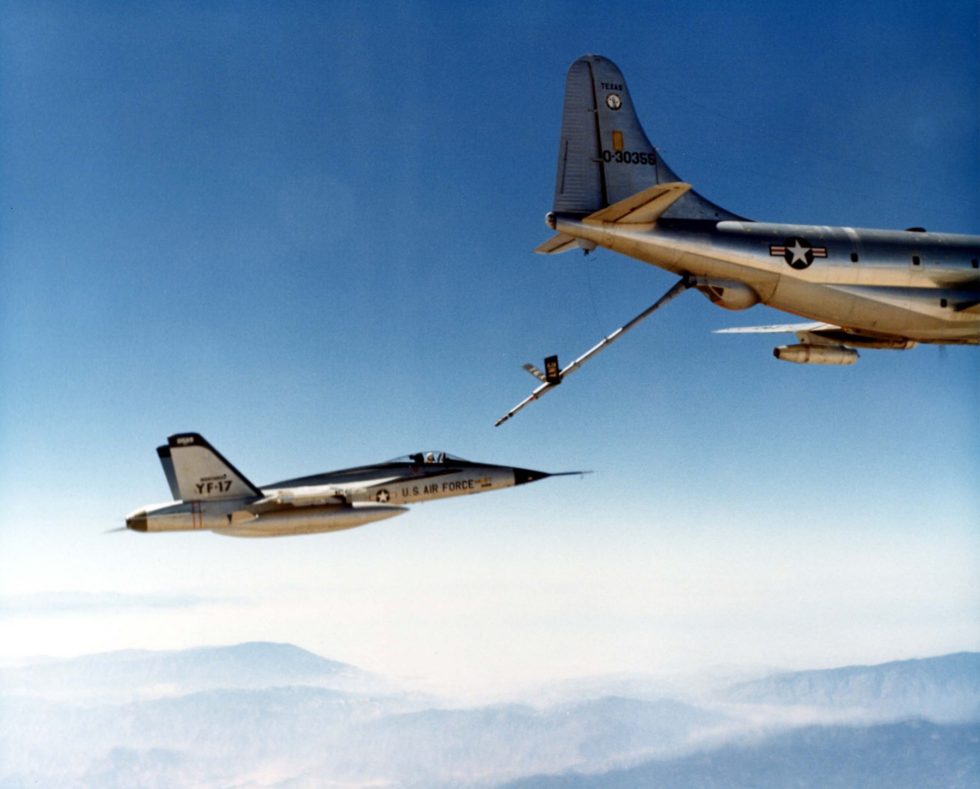
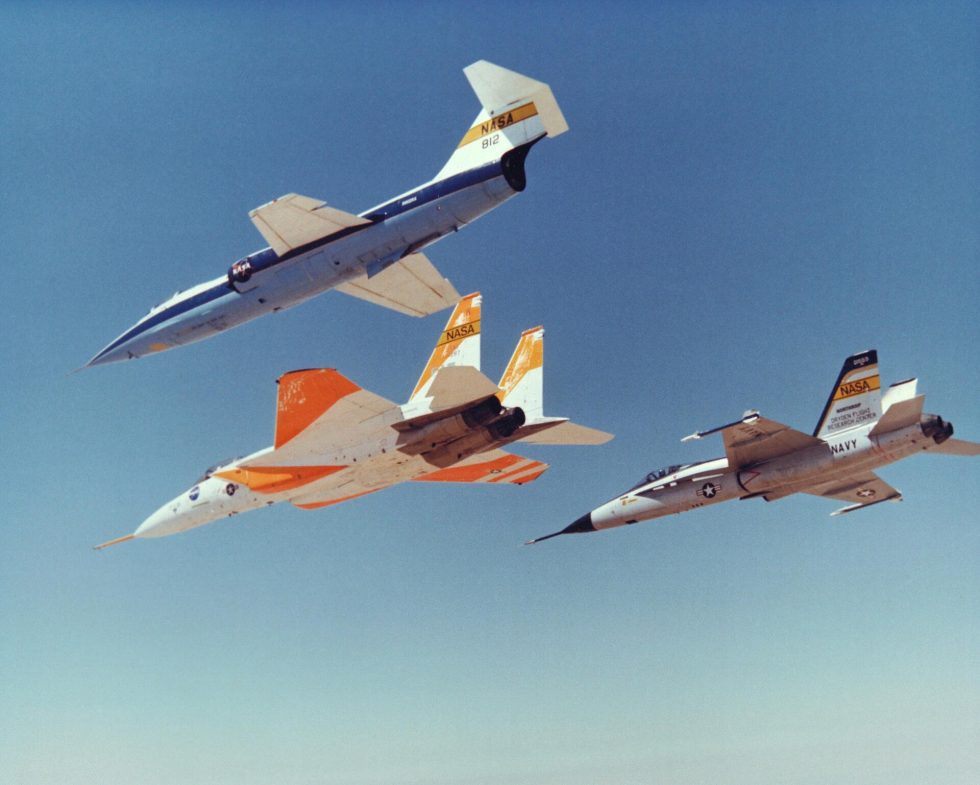
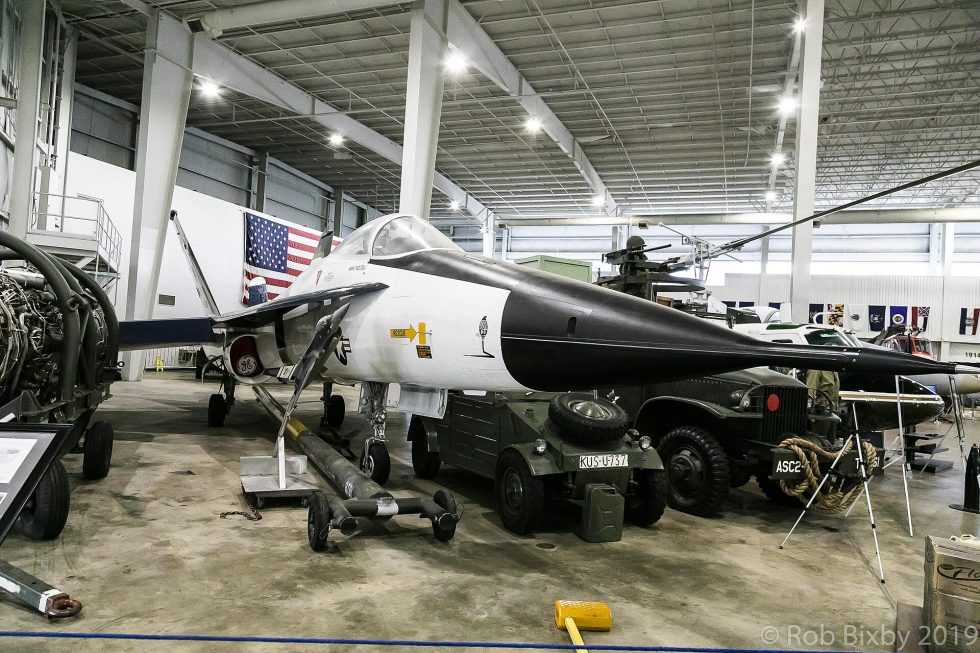
Where the YF-17 flew
A combat record that never happened — and a legacy that did
The YF-17 never entered service, never carried live weapons in anger and never fired a shot — its entire career was a flight-test programme run from Edwards Air Force Base in 1974–75. Its “record” is therefore one of demonstrated capability rather than combat: it proved high-alpha agility, 9.4 g manoeuvring and supersonic flight on dry thrust. But its true legacy is unique among losing prototypes — the design it pioneered went on, as the F/A-18 Hornet, to one of the most successful combat careers in naval aviation history.
See how the Hornet and other service fighters compare in the combat record of every military aircraft. The YF-17 itself has no combat history — its story is what it became.
Everything people ask about the YF-17 Cobra
Can I fly in a YF-17?
Why did the YF-17 lose to the F-16?
How did the YF-17 become the F/A-18 Hornet?
How many YF-17s were built, and where are they now?
How fast was the YF-17, and what were the leading-edge extensions for?
What is the connection between the YF-17 and the F-5?
You can’t fly the YF-17.
These, you can.
Some legends only live in museums — others are fuelled and waiting. MiGFlug has put civilians in real military jet cockpits since 2004.
 Fly the L-39 AlbatrosThe world’s most-flown jet trainer — aerobatics included
 Fly the F-104 Starfighter“The missile with a man in it”
 Fly the MiG-21The Cold War’s most-produced jet
 Fly the T-33 Shooting StarAmerica’s first jet trainer
 Fly the DH VampireA piece of early jet history
 Fly the S.211Agile Italian jet trainer
 Fly the MB-326The classic Aermacchi jet
 Fly the MiG-15The Soviet legend of the Korean War
Continue the tour
Every fact, checked
- Air Force Test Center — June 9, 1974: YF-17 Cobra First FlightThe official USAF account: first-flight date, test pilot Hank Chouteau, YJ101 engines and the loss to the F-16.
- Western Museum of Flight — YF-17 Cobra Prototype #1The museum that holds 72-1569, in F-18 prototype markings; provenance and programme history.
- Vintage Aviation News — First Flight of the Northrop YF-17Two prototypes and serials, YJ101 engines, the LWF loss and the evolution into the F/A-18 Hornet.
- Aces Flying High — The Survivors: Northrop YF-17 CobraMuseum locations of both airframes, 288 test flights and the supersonic-on-dry-thrust milestone.
- Military Factory — Northrop YF-17 CobraDimensions, weights, engine thrust and performance figures for the prototype.
- The Aviationist — YF-17 Cobra repaint and Top Gun markingsCondition and display of the surviving prototype at the Western Museum of Flight.
- National Museum of the US Air ForceReference for the Lightweight Fighter programme and 1970s US fighter development.
- Naval History and Heritage CommandBackground on the Navy Air Combat Fighter decision and the origins of the F/A-18 Hornet.