
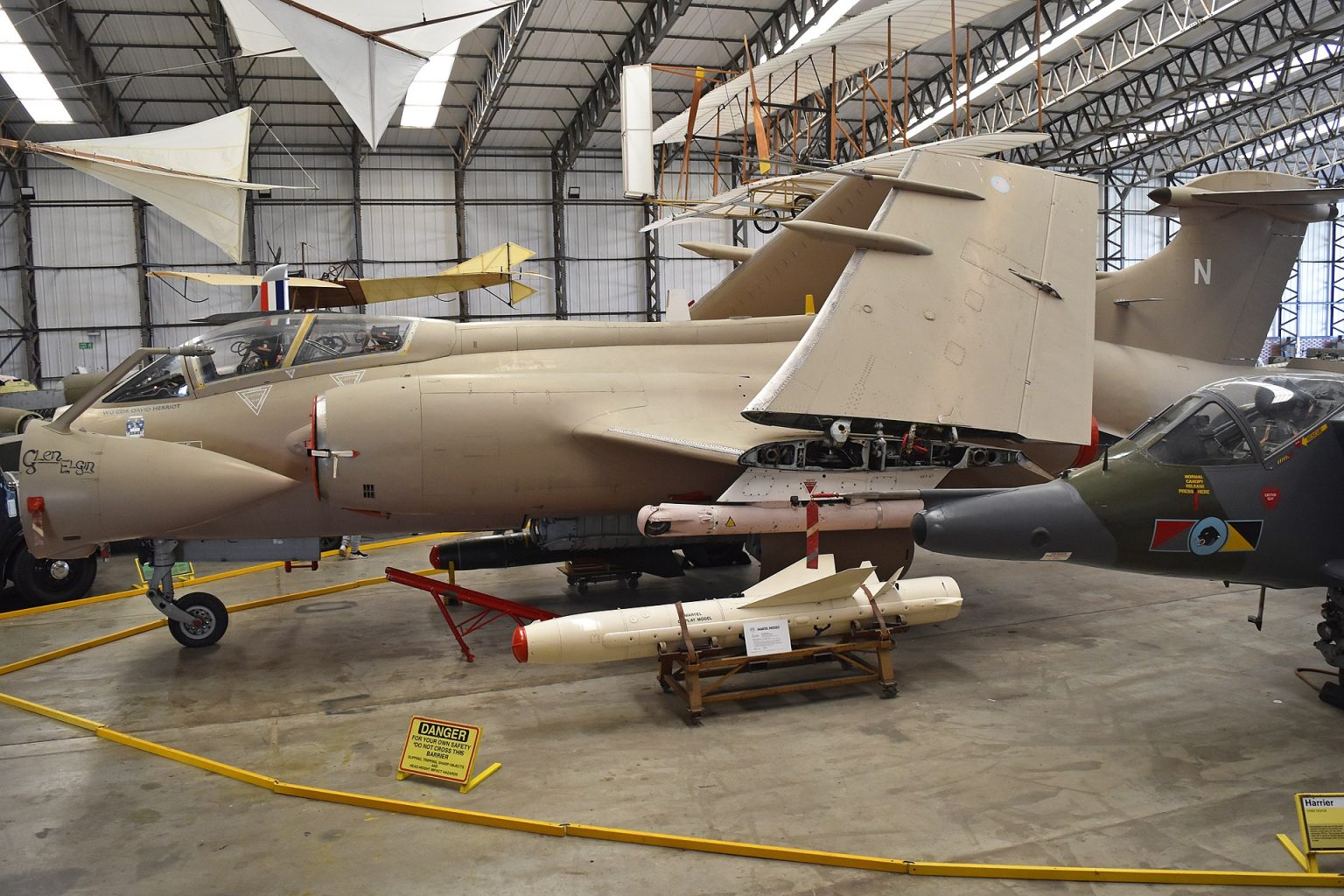
Blackburn Buccaneer
“The Brick”
Britain’s low-level nuclear strike bomber — a carrier jet built to scream in under Soviet radar at wave-top height, and the aircraft that fought its last war lasing bridges for the Tornado over Iraq.
The jet that flew under the radar
In the early 1950s the Royal Navy watched the Soviet Union commission the Sverdlov-class cruisers and knew its carriers needed an answer — an aircraft that could sink a warship before it ever came within gun range. The 1952 requirement, Naval Staff Requirement NA.39, asked for something radical: a two-seat carrier strike aircraft that could dash to its target at just 30 metres above the sea, below the horizon of enemy radar, carrying a nuclear bomb in its belly. Blackburn Aircraft of Brough won the contract, and the prototype B-103 first flew on 30 April 1958.
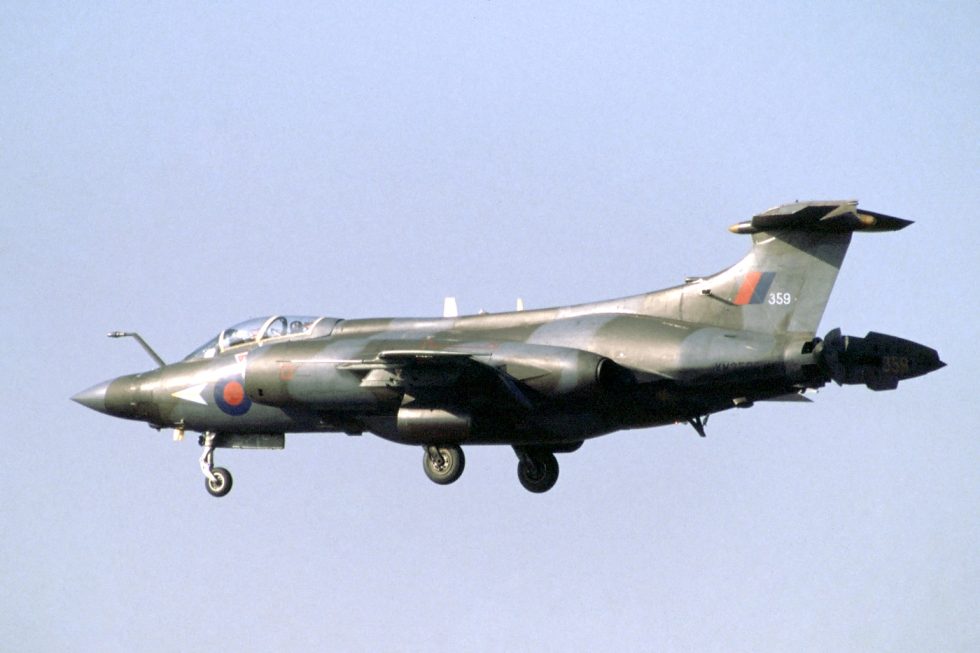
The result was one of the most single-minded designs of the Cold War. Everything about the Buccaneer served low-level, high-speed flight over water: an area-ruled “coke-bottle” fuselage, a rotating bomb-bay door that carried weapons without spoiling the airflow, and engine bleed air blown over the wings and tail so the heavy jet could still slow down enough to land on a carrier deck. It entered Fleet Air Arm service in 1962, and the definitive S.2 with two Rolls-Royce Spey turbofans arrived in 1965.
When the Royal Navy’s big carriers were run down, the RAF — which had fought against buying the Navy’s aircraft — inherited the Buccaneer and discovered it was the best low-level penetrator it had ever flown. It served on into a fourth decade, and in 1991 the “old bomber” flew to war one last time over Iraq, laser-marking targets for the RAF’s Tornados. The last one flew in 1994.
01Why the Buccaneer was built: the Sverdlov cruisers and the wave-top nuclear mission
The Buccaneer exists because of a warship. In 1951–52 the Soviet Navy began building the Sverdlov-class gun cruisers, fast surface raiders that could threaten NATO’s Atlantic convoys and sea lanes. The Royal Navy’s answer was not a bigger gun but a smarter delivery method: an aircraft that could approach at extreme low level, hidden by the curvature of the earth from a ship’s radar, pop up only at the last moment, and toss a nuclear or conventional bomb onto the target.
That single mission — fast, very low, over the sea, with a heavy warload — shaped every unusual feature of the airframe. It also explains why the Buccaneer aged so well: flying under radar cover stayed relevant right through the Cold War, long after high-flying bombers had become easy prey for surface-to-air missiles.
What makes the Buccaneer special
Blown air and area ruling
To land a heavy jet on a carrier you need a slow approach; to survive over a target you need speed. The Buccaneer solved both with boundary-layer control — hot air bled from the engines and blown through slits over the wings, flaps and tailplane, energising the airflow so the wing kept flying at low speed. The fuselage was area-ruled into a “coke-bottle” waist to cut transonic drag, earning it the nickname “the banana jet.”
The rotating bomb bay
A conventional bomb-bay door creates buffeting and drag when it opens at high speed. Blackburn’s answer was a rotary bomb-bay door that spun its load into the airstream in a fraction of a second, leaving the fuselage smooth. It let the Buccaneer carry up to four 1,000 lb bombs (or a fuel tank, or a reconnaissance pack) internally and release them cleanly at wave-top height and full speed.
A rock-solid low-level ride
The Buccaneer was built like a battleship — heavy, strong, with a small, thick, highly-loaded wing. That made it a brutally stable platform down low, punching through the turbulence that tossed lighter jets around, while its two Rolls-Royce Spey turbofans gave the range and the wave-top speed to reach a target far out to sea and get home again.
02The Buccaneer’s boundary-layer control: how blown air let a heavy jet land on a carrier
Carrier aircraft live and die by approach speed — too fast and the arrester gear cannot stop them, too slow and the wing stalls. The Buccaneer was heavy, and a conventional wing would have needed an approach speed no deck could accept. Blackburn’s fix was supercirculation: high-pressure air tapped from the engine compressors was ducted to fine slots along the wing leading edge, the flaps and the tailplane, and blown at high velocity over the surfaces. This re-energised the boundary layer, delayed the stall and dramatically increased lift at low speed. The system let a 25-tonne jet approach a pitching carrier deck under full control — but it was thirsty for engine air, one reason the underpowered S.1 was replaced by the Spey-engined S.2.
03The Buccaneer’s Rolls-Royce Speys: the turbofans that made wave-top penetration possible
The first Buccaneers, the S.1, used de Havilland Gyron Junior turbojets and were chronically short of thrust — dangerous on a hot day off a carrier. The definitive S.2 switched to two Rolls-Royce Spey Mk 101 turbofans of around 49 kN each. The Spey was not just more powerful; as a turbofan it was far more fuel-efficient than a turbojet, which gave the Buccaneer the long low-level range it needed to strike ships far from the fleet and return. The same efficient thrust drove it to around Mach 0.85 down in the weeds — fast enough to be through the target area before defences could react.
Full specifications
Baseline note: the figures below describe the Buccaneer S.2B as the Royal Air Force flew it between 1973 and 1994 — the new-build RAF version with two Rolls-Royce Spey Mk 101 (RB.168-1A) turbofans, Martel wiring, and the bulged bomb-bay door that carried an extra fuel tank instead of a flat weapons door. It is the right baseline because it is the aeroplane that flew Red Flag, stood the maritime strike watch in the North Atlantic and lit up Iraqi bridges for Tornados in 1991, and because in airframe terms the S.2, S.2A, S.2C, S.2D and S.2B are one aeroplane wearing different equipment: a published table for "the Buccaneer S.2" is very nearly a table for the S.2B, and the pages that treat them as separate types are inventing a distinction the drawing office never made. Deltas for the underpowered S.1 with de Havilland Gyron Junior turbojets, and for the South African S.50 with its rocket packs, are in grey. Six cautions before any number here is quoted. First: engine thrust is not agreed and the agreed number is the wrong number anyway. The Spey Mk 101 is printed as 11,000 lbf, 11,030 lbf, 11,100 lbf and 11,200 lbf in sources of equal respectability. Worse, the rating that mattered on a wet deck was none of those: with boundary layer control selected, the bleed taken off the compressors dropped useful thrust to roughly 9,100 lbf per engine, of which about 600 lbf came back as reaction from the rearward-facing trailing-edge slits. The Buccaneer’s landing performance and its engine rating are the same number seen from two ends, which is precisely why the S.1 was lethal on one engine. Second: the S.1 is not this aeroplane. Two Gyron Junior 101s gave 7,100 lbf each against the Spey’s 11,000 — about 40 per cent less thrust, on a pure turbojet that also drank far more fuel. An S.1 could not take off from a carrier with a full load of weapons and a full load of fuel at the same time, and the fleet solved that by launching it nearly dry and tanking it from a Scimitar. Any S.2 range or take-off figure applied to an S.1 describes an aeroplane that did not exist. Third: range figures here are not interchangeable. The flat 2,000 nmi that circulates in most tables carries no profile with it; the better-documented 2,300-mile figure is a hi-lo-hi attack profile with slipper tanks; and the NA.39 requirement of a 400 nmi radius at low level is a third thing again. The best-attested single data point is the demonstrated one: 1,950 miles from Goose Bay to Lossiemouth, unrefuelled, in 4 hours 16 minutes. Fourth: weights. 30,000 lb empty and 62,000 lb maximum are the best-attested pair, with 29,980 lb also printed for empty and a 45,000 lb "loaded" weight quoted for the typical mission. The 62,000 lb figure is a land airfield number: the carrier launch case was around 43,000 lb, and the gap between those two figures is the whole story of why the RAF got more out of the aeroplane than the Navy ever could. Fifth: 580 kt at 200 ft is a clean airframe. No Buccaneer of any mark was supersonic in level flight; Mach 0.95 was the limit and the operational profile was 500 kt at 100 to 200 feet with a war load hanging on the wings. The aeroplane’s reputation was never built on top speed. It was built on being able to hold 500 kt at 100 feet, in turbulence, for an hour, without shaking the crew to pieces — a gust-response problem the small, thick, heavily built wing was designed around from the first drawing. Sixth: after February 1980 the fleet was not flying to its published limits. Fatigue cracking found after a Red Flag break-up cut the RAF fleet to 60 aircraft, several of which flew out their careers with reduced g limitations. The specification below is the aeroplane as designed; the aeroplane as operated in the 1980s was a more carefully flown thing.
Dimensions & weights
- Crew
- 2 — pilot, and an observer (Royal Navy) or navigator (RAF) seated behind him, raised and offset to starboard so that he could see forward past the pilot’s head. That offset is not a detail. The Buccaneer navigated and attacked from the back seat using radar, Doppler and a stopwatch, and the man doing it needed to see the same piece of ground the pilot was flying at
- Length overall
- 19.33 m (63 ft 5 in). With the nose radome swung through 180° for hangar stowage, 15.80 m (51 ft 10 in) — a folding nose as well as folding wings, because the Navy’s hangars were the binding constraint on the whole design
- Wingspan
- 13.41 m (44 ft 0 in); folded, 6.07 m (19 ft 11 in). This is a strikingly short span for a 28-tonne aeroplane, and it is short on purpose: a small wing rides low-level turbulence better and lets the aircraft go faster down low, at the cost of a landing speed that only blowing could bring back under control
- Height
- 4.95 m (16 ft 3 in), to the top of the fin. The tailplane sits high on the fin because the airbrake occupies the tail cone underneath it
- Wing area
- 47.8 m² (514 sq ft)
- Wing loading
- 588 kg/m² (120.5 lb/sq ft) at maximum weight — extremely high for the period, and the direct reason boundary layer control was not an optional refinement but a condition of the aeroplane existing at all
- Empty weight
- 13,610 kg (30,000 lb); 29,980 lb is also printed, and the two are the same measurement rounded differently
- Typical loaded weight
- 20,400 kg (45,000 lb) for a representative strike mission — the weight the aeroplane actually flew at, as opposed to the weight it was cleared to
- Maximum take-off weight
- 28,120 kg (62,000 lb) from a land airfield. Off a catapult the practical figure was far lower, around 19,500 kg (43,000 lb)
- Internal weapon load
- 1,814 kg (4,000 lb) carried on the inner face of the rotating bomb-bay door — four 1,000 lb bombs, or one nuclear weapon nested into a door shaped to receive it
- External weapon load
- 5,443 kg (12,000 lb) across four wing pylons, two under each wing
- Maximum ordnance
- up to ~ 7,260 kg (16,000 lb) quoted for the S.2B with a full internal and external load. This is a paper maximum: a real Buccaneer carrying tanks, an ECM pod and a designator pod was nowhere near it
- Airframe
- machined from solid — the major structure was cut from solid billets and castings rather than built up from sheet, to survive a working life of 500 kt at 100 feet. It very nearly worked: the fatigue that grounded the fleet in 1980 came not from the original design but from a new bolt hole introduced with the S.2’s extended wingtips
Performance
- Maximum speed, sea level
- 1,074 km/h (580 kt, 667 mph) at 60 m (200 ft), clean
- Limiting Mach number
- Mach 0.95 — the Buccaneer was never supersonic in level flight and was never meant to be. Every other aeroplane in the 1955 competition promised Mach 2; this one promised to arrive
- Operational attack profile
- 500 kt (926 km/h) at 30–60 m (100–200 ft) — cruise high for fuel economy, descend outside the enemy’s radar horizon, then run in and out below it. That profile is the entire aeroplane
- Service ceiling
- 12,200 m (40,000 ft)
- Combat radius, low level
- ~ 740 km (400 nmi) — the NA.39 requirement, which the S.2 met comfortably and the S.1 did not
- Combat radius, high level
- ~ 1,480 km (800 nmi) on the same requirement, cruising high and descending only for the attack
- Range
- 3,700 km (2,000 nmi) is the figure most tables print without stating a profile; 2,300 miles is quoted for a hi-lo-hi attack mission with slipper tanks. Treat both as indicative
- Longest demonstrated leg
- 3,138 km (1,950 miles) — Goose Bay to Lossiemouth non-stop and unrefuelled in 4 hours 16 minutes. The S.2 was the first Fleet Air Arm aircraft to cross the Atlantic non-stop without tanking
- Take-off run, land airfield
- 915 m at 144 kt (3,000 ft) with blowing selected; 1,128 m (3,700 ft) at 175 kt without it. Those two lines are the clearest single statement of what boundary layer control was worth
- Minimum carrier launch speed
- 120 kt at 19,500 kg (43,000 lb), tail-down on the catapult with the nosewheel raised to put the wing at about 11°. The launch could be flown hands-off, with the tailplane left neutral
- Thrust-to-weight ratio
- 0.36 at maximum weight — modest, and it never mattered, because the mission was measured in accuracy and survival rather than acceleration
Propulsion & systems
- Engines
- 2 × Rolls-Royce Spey Mk 101 (RB.168-1A) low-bypass turbofans — a militarised derivative of the BAC One-Eleven engine, chosen in 1960 because it would fit inside the existing spar rings with careful positioning, which is why the S.2 is a re-engining rather than a redesign
- Rated thrust
- 49 kN (11,000 lbf) each — 11,030, 11,100 and 11,200 lbf also appear in print. The Spey gave about 40 per cent more thrust than the Gyron Junior and, being a turbofan, burned markedly less fuel: Blackburn predicted an 80 per cent range increase from the change alone
- Thrust with blowing selected
- about 40.5 kN (9,100 lbf) per engine, of which roughly 2.7 kN (600 lbf) is recovered as reaction from the aft-facing trailing-edge slits. About 70 per cent of the blown air went over the drooped flaps and ailerons
- Boundary layer control
- engine bleed blown over wing leading edges, trailing-edge flaps, ailerons and tailplane — a full-span trailing-edge slit gave nearly 50 per cent more lift than any contemporary scheme, and allowed leading-edge slats to be deleted entirely. A self-trimming system was interconnected with it to cancel the violent pitch change that blowing would otherwise produce
- Air brake
- hydraulically operated split tail cone — two leaves opening from the rear fuselage. It decelerated the aircraft in a dive attack, and it balanced out the induced drag of the blowing system so that the engines could be held at the high power that blowing demanded while the aeroplane stayed slow
- Bomb bay
- rotating door, 1,814 kg (4,000 lb). Conventional doors cannot be opened into a 500 kt airstream; Blackburn hung the load on the inside of a single door that rotated about the fuselage axis, exposing the weapons without a drag rise. It also made ground loading easy at waist height, and, entirely by accident, kept the radar cross-section down
- Bomb bay alternatives
- 2,000 L ferry tank, camera crate or cargo pannier — the reconnaissance fit carried six cameras at differing angles and imaging properties and was fitted only for reconnaissance sorties
- Radar
- Ferranti Blue Parrot air-to-surface search and attack radar, in a nose cone that swings through 180° for carrier hangar stowage. Paired with a Doppler navigation set and, in later RAF aircraft, improved navigation equipment; the RAF fleet never received terrain-following radar
- Cockpit and systems
- head-up display, Airstream Direction Detector, autostabiliser and autopilot driven by an integrated flight control computer. The rear fuselage was largely an avionics bay, cooled by ram air drawn from the fin
- Redundancy
- dual electrical busbars, three independent hydraulic systems — a naval aeroplane built to come home with things broken
- S.1 powerplant
- 2 × de Havilland Gyron Junior 101 turbojets, 31.6 kN (7,100 lbf) each. Underpowered, prone to surging, and dependent on inlet guide vanes that gave trouble throughout. Losing one on the overshoot, with the wing blown and the approach flown on power, was very close to unsurvivable, and in December 1970 two accidents in eight days ended the mark permanently
- S.50 rocket assistance
- 2 × Bristol Siddeley BS.605 retractable rocket packs burning high-test peroxide and kerosene, 17.8 kN (4,000 lbf) each for 30 seconds, derived from the smaller chamber of the Armstrong Siddeley Stentor. Fitted for hot-and-high take-offs from Waterkloof at 1,500 m elevation; found unnecessary in service and removed from all aircraft
04The Buccaneer’s cost: why no clean price exists
The Buccaneer was a British government military procurement of the late 1950s and 1960s, never sold on an open commercial market, so a firm modern-equivalent flyaway unit price simply is not part of the public record. Period programme costs were bound up with cancelled projects and the politics of the era — the RAF only took the type after the far more expensive BAC TSR-2 was cancelled in 1965. Any single dollar figure attached to a Buccaneer should be read as an estimate rather than a sourced number, and no credible public cost-per-flight-hour figure exists for the type.
Armament & payload
The Buccaneer had no gun, and hung its most important weapon on the inside of a door that turned
The Buccaneer’s armament follows from one decision taken in 1952: everything important goes inside. A weapons bay whose door rotates about the fuselage axis lets a 4,000 lb load be exposed and released at 500 knots and 100 feet with no drag rise and no doors flapping in a supersonic-adjacent airstream, and it lets a nuclear weapon be nested into a door shaped around it. Four wing pylons took another 12,000 lb, but the wing stores were always the compromise and the bay was always the point.
What that bay was built to carry was a nuclear weapon aimed at a Soviet cruiser. The original pairing — the Green Cheese guided anti-ship missile — was cancelled before the aircraft flew, so the Buccaneer went to sea in 1962 with the Red Beard free-fall bomb, a 10–20 kt weapon developed for the Canberra, nested into its own door. Conventionally, the anti-ship attack meant iron bombs and SNEB rockets delivered from inside the ship’s own defensive envelope, which was survivable in 1962 and unthinkable by 1972. The rest of the type’s armament history is one long retreat from that intimacy: Martel to shoot from a few miles out, Sea Eagle to shoot from sixty, and a laser pod so that somebody else’s bomb could do the work.
Two of those weapons deserve a plain verdict. Martel was a disappointment: the television-guided AJ.168 needed a data-link pod on a fourth pylon, needed the launch aircraft to climb into the threat it had spent its whole design life avoiding, and was remembered by crews as temperamental. Sea Eagle, from 1986, was the weapon the airframe had always deserved — fire-and-forget, sea-skimming, effective at around sixty miles against the AJ.168’s twelve — and it arrived with barely eight years of the type’s service left to run.
And then there is the pod that rewrote the aeroplane’s obituary. Pave Spike, adopted in 1979, made the Buccaneer a laser designator, and in 1991 that turned a 1950s naval bomber into the piece of equipment the RAF’s Tornado force could not go to war without. Twelve Buccaneers deployed to the Gulf at 72 hours’ notice, flew somewhere between 216 and 218 sorties, marked targets for around 169 Tornado-delivered laser-guided bombs, dropped 48 of their own, and came home without a loss. Fits varied enormously by operator, mark and decade: a 1963 Fleet Air Arm S.1 with a Red Beard, a 1988 RAF S.2B with Sea Eagle and a 1985 SAAF S.50 with rocket pods over Angola shared an airframe and almost no weapons in common, and any single armament table for "the Buccaneer" is a composite no individual aircraft ever matched.
Gun
- None. No Buccaneer of any mark carried a gun. A pack of two 30 mm ADEN cannon was intended and was worked on; the effort was abandoned and nothing replaced it.
- This was consistent rather than careless. The aeroplane was designed to arrive below radar cover, release, and leave; a gun is a weapon for an aircraft that expects to be seen and to linger, and the Buccaneer expected neither.
- The cost was paid in South Africa rather than in Europe. SAAF crews flying close air support over Angola would have used a gun most days of the week, and had to make do with rocket pods and retarded bombs instead.
- Nor was there a tail gun, a rear-warning gun position or any active defensive armament. The Buccaneer’s answer to being shot at was to be somewhere else, 100 feet up and doing 500 knots.
Air-to-air
- AIM-9 Sidewinder (AIM-9G, later AIM-9L) on the outer wing pylons, fitted to RAF aircraft as part of the self-defence improvements of the late 1970s and carried operationally in the Gulf in 1991.
- That is the whole list. The Buccaneer had no air-to-air radar mode worth the name, no gun, and no pretence of being able to fight; the Sidewinder was there so that a crew bounced on the way home was not entirely without an answer.
- No Buccaneer of any air force is credited with an air-to-air kill, and none was ever claimed.
- Fleet Air Arm aircraft did not routinely carry air-to-air weapons at all. Escort was the Sea Vixen’s job, and then the Phantom’s.
Air-to-surface guided
- Martel in two quite different forms: the French-developed AS.37 anti-radiation version and the British AJ.168 television-guided anti-ship version, the latter flown three at a time with a data-link pod on the fourth pylon. Crews found it temperamental, and using it forced the aircraft to climb, which is exactly what a Buccaneer existed to avoid.
- Sea Eagle from 1986 on No. 208 and then No. 12 Squadron — a turbojet-powered, fire-and-forget sea-skimmer with an effective range around 60 miles against the AJ.168’s 12. This is the weapon the aeroplane had been waiting thirty years for: launch from below the horizon and turn away without ever exposing the aircraft.
- Paveway II laser-guided bombs, self-designated from 1979 using the American AN/AVQ-23E Pave Spike pod. In the Gulf the Buccaneer did both halves of the job — marking for Tornados and, later in the campaign, dropping its own.
- AS-30 radio command-guided missiles on South African aircraft, used against shipping and, from 1981, against Angolan radar sites. Twelve were fired at the stricken tanker Wafra in March 1971 without sinking her.
- H-2 Raptor stand-off glide bomb on SAAF aircraft in the late 1980s, used to drop the Cuito River bridge on 3 January 1988 after a failed attempt on 12 December 1987. The intended anti-ship missile of 1955, the nuclear-armed Green Cheese, was cancelled before the aeroplane flew.
Bombs
- Four 1,000 lb bombs on the rotating bomb-bay door, free-fall or retarded — the classic internal load, and the reason the aeroplane could release at 500 kt and 100 feet without tearing its own doors off.
- Nuclear: the 2,000 lb Red Beard fission bomb of 10–20 kt, nested into a specially shaped bomb door, cleared in 1965; later the WE.177, which armed both Fleet Air Arm and, from 1970, RAF Buccaneer squadrons. The RAF force stood down from nuclear duties only in 1991.
- Paveway II 1,000 lb laser-guided bombs from 1979, carried on the wing pylons.
- Retard defence: four 1,000 lb retarded bombs carried internally and dropped behind the aircraft to discourage a pursuer — a tactic that says a good deal about how the RAF expected low-level war over Germany to go.
- South African aircraft carried four 450 kg bombs internally and a mixture of bombs, flares and rocket pods underwing for overland work.
Rockets
- Up to four Matra pods of 18 × SNEB 68 mm rockets each, one per wing pylon.
- These were the original anti-ship answer alongside iron bombs: close in below the radar horizon and saturate the target. Soviet naval surface-to-air missiles made that tactic suicidal within a decade, which is why the Martel and then Sea Eagle programmes existed at all.
- They survived longest where the threat was lightest. SAAF Buccaneers used rockets extensively for close air support over Angola and Namibia, where loiter time and load mattered more than stand-off range.
- No air-launched rocket ever gave the Buccaneer a precision capability; that arrived with a laser and a television camera, not with a rocket pod.
Pods & other stores
- AN/AVQ-23E Pave Spike laser designator pod, adopted 1979 — the single most consequential item ever bolted to the aeroplane, and the reason a 1950s naval bomber was still worth deploying in 1991.
- AN/ALQ-101 electronic countermeasures pod, plus chaff and flare dispensers, on RAF aircraft; South African aircraft carried an ELT-555 jamming pod.
- Buddy refuelling pack with a hose-drum unit, letting one Buccaneer tank another — the survival of a habit learned when S.1s had to be topped up by Scimitars immediately after launch.
- Drop tanks on the wing pylons, plus the bomb-bay ferry tank and, on the S.2B, the bulged bomb-door tank. South African aircraft used larger 430-gallon underwing tanks for coastal patrol.
- The bomb bay also took a six-camera reconnaissance crate or a cargo pannier, giving the type a modest photographic and freight capability nobody advertised.
Three typical loadouts
- Sverdlov strike, Fleet Air Arm, 1965
- One Red Beard nuclear bomb on the shaped bomb-bay door, no external stores, full internal fuel. Cruise high, descend outside the cruiser’s radar horizon, run in at 500 kt below 200 feet, toss the weapon and turn away. This is the mission the aeroplane was drawn for, and the one it never had to fly.
- Maritime strike, No. 208 Squadron, 1988
- Two Sea Eagle anti-ship missiles on the inner pylons, two 250-gallon tanks outboard, ALQ-101 pod, bomb bay closed and carrying fuel. Launch from below the horizon at around 60 miles and turn for home before the ship’s radar has anything to shoot at. The Buccaneer only became a genuinely survivable anti-ship aircraft in the last six years of its life.
- Designator, Operation Granby, February 1991
- One Pave Spike pod, one 250-gallon tank, an AIM-9G for self-defence and, from mid-campaign, a single 1,000 lb Paveway II of its own. Flown at around 18,000 feet in daylight — the exact opposite of everything the type was designed to do, because the pod could not see at night and there was nothing left to be frightened of below.
Sourcing caveat: weapon fits are drawn from the published literature on the type rather than from clearance documents, and loadout descriptions above are representative rather than authoritative — in particular the Granby fit varied between airframes and between weeks of the campaign as the Buccaneers moved from designating only to dropping their own weapons. Sortie counts differ between sources: 218 missions is commonly printed, 216 sorties appears in equally careful accounts, and the two are almost certainly the same flying counted on different definitions. South African weapon designations, particularly for the H-2 Raptor family and its guidance, remain partially obscured by the secrecy of the period.
Variants
The Buccaneer changed its engines once, and everything after that was a change of equipment
Two hundred and eleven Buccaneers were built, and the mark that mattered was not a new aeroplane at all but a change of engine. The S.1 was the Buccaneer with the wrong powerplant: two Gyron Junior turbojets that could not lift a full load of fuel and weapons off a deck at the same time, on an airframe whose slow-speed handling depended on bleed air those same engines could barely spare. The S.2, re-engined with the Spey in nacelles enlarged to suit and with minor wing changes, is the aeroplane everyone remembers, and every later designation — S.2A, S.2B, S.2C, S.2D — describes equipment fitted to that same machine rather than a new one.
The Royal Air Force’s relationship with the type is the strangest chapter. Blackburn had offered Buccaneer derivatives against OR.339 in 1957–58 and been rejected as firmly subsonic and short of range; the RAF chose TSR-2, then lost it, then lost the F-111K that was to have replaced it, and in 1968 was ordered to take the naval aeroplane it had spent a decade declining. Denis Healey, Defence Secretary at the time, was blunt that the hostility was institutional — the Buccaneer was a Navy aeroplane, and buying an improved one would have strengthened the case for the carriers the RAF was arguing against. One Ministry of Defence assessment concluded that two of the proposed Buccaneer 2* could do the job of one F-111 for less than half the unit cost. Nobody bought them.
The RAF ended up with 108 Buccaneer S.2s: 46 new-build S.2Bs delivered between 1973 and 1977, plus 62 ex-Fleet Air Arm aircraft handed over as the carriers went. The type served an interim role for twenty-five years, outlived the service that ordered it, and finished as the only thing in the inventory that could point a laser at an Iraqi bridge.
- Blackburn NA.39 / B-103 (1958–61, 9 prototypes and 14 development S.1s)
- Ordered 2 June 1955 against Naval Staff Requirement NA.39 and Ministry of Supply specification M.148T. First flight 30 April 1958 from RAE Bedford; first carrier landing aboard HMS Victorious on 19 January 1960. Known in secret documents as BNA or BANA, from which the crews got "Banana Jet".
- Buccaneer S.1 (1962–70, 40 built)
- First production model, two de Havilland Gyron Junior 101 turbojets of 7,100 lbf. Built at Brough and towed to Holme-on-Spalding Moor to fly; first aircraft flown 23 January 1962, squadron service January 1963. Underpowered to the point of danger, dependent on Scimitar tanking to get airborne with a useful load, and grounded permanently in December 1970 after two engine-related accidents in eight days.
- Buccaneer S.2 (1965–, 84 built: 10 by Blackburn, 74 by Hawker Siddeley)
- Rolls-Royce Spey Mk 101 turbofans in enlarged nacelles, with minor wing aerodynamic changes and a stronger undercarriage. Around 40 per cent more thrust and far lower fuel consumption; all Royal Navy squadrons had converted by the end of 1966. This is the aeroplane the reputation belongs to.
- Buccaneer S.2A (from 1969, 62 transferred)
- Ex-Fleet Air Arm S.2s reworked for the Royal Air Force as the carriers paid off. No. 12 Squadron formed on them at Honington in October 1969; many were later brought up to S.2B standard.
- Buccaneer S.2B (1973–77, 46 built plus 3 for trials)
- The new-build RAF aircraft and the baseline of this page: RAF communications and avionics, Martel capability, and a bulged bomb-bay door housing an additional fuel tank. Later gained ALQ-101 ECM, chaff and flares, Sidewinder capability, Pave Spike from 1979 and Sea Eagle from 1986.
- Buccaneer S.2C and S.2D (from 1975, Royal Navy conversions)
- Fleet Air Arm aircraft brought up to RAF equipment standards: S.2D for the Martel-capable machines, operational from 1975, S.2C for the remainder. Paper designations for a real distinction in wiring, not in airframe.
- Buccaneer S.50 (1965, 16 ordered for South Africa)
- The only export order, placed October 1962 under the Simonstown Agreement in exchange for British use of the naval base. Spey-powered, with manually rather than power-folded wings, strengthened undercarriage and brakes, aerial refuelling, 430-gallon underwing tanks for coastal patrol, AS-30 missile capability, and a pair of retractable Bristol Siddeley BS.605 rocket packs for hot-and-high take-offs from Waterkloof. The rockets proved unnecessary and were removed. A follow-on order for 20 more was blocked by the Wilson government under the arms embargo.
- Buccaneer 2* and 2** (proposed 1960s, none built)
- Hawker Siddeley’s offers of a Buccaneer with TSR-2-derived radar, head-up displays and computers from the cancelled P.1154, and in the 2** a full overland strike suite. Rejected for reasons that had more to do with inter-service politics than with the aeroplane.
- B.103A and B.108 (proposed 1957–58, none built)
- Blackburn’s submissions against OR.339. The B.103A was a Buccaneer S.1 with more fuel; the B.108 a more heavily modified aircraft that kept Gyron Juniors while gaining 10,000 lb, and would have been dismally underpowered. Both were rejected as subsonic and short of range, and TSR-2 was chosen instead.
- RAE trials aircraft and civil survivors (XW986, XW987, XW988)
- Three S.2Bs went to the Royal Aircraft Establishment for trials work rather than to a squadron, and outlived the entire service fleet: sold to South Africa, civil-registered ZU-NIP, ZU-BCR and ZU-AVI, and flown by Thunder City at Cape Town into the late 2000s. They are the only Buccaneers to have flown in civilian hands.
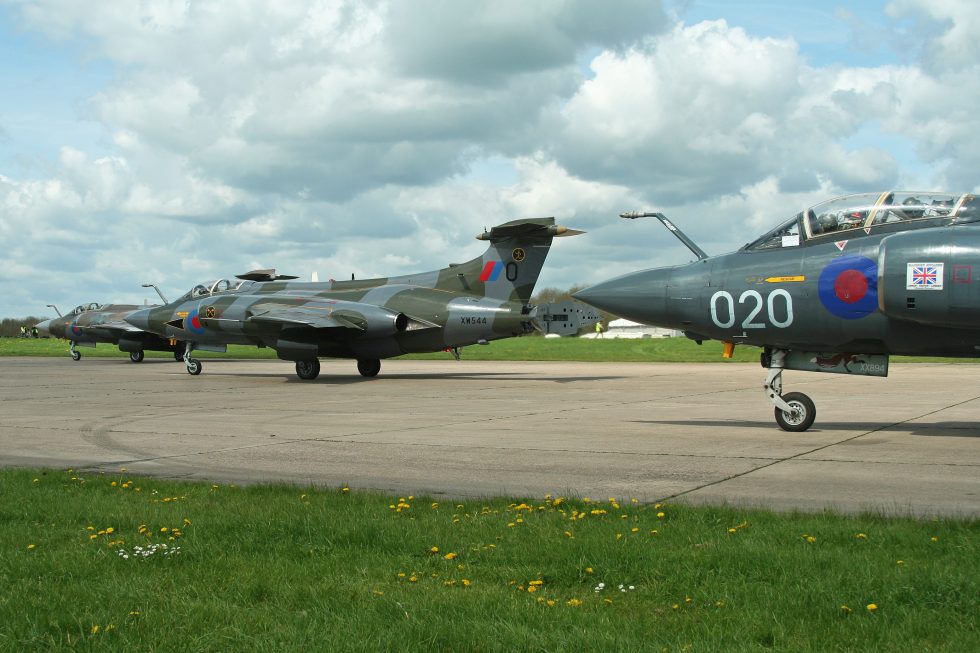
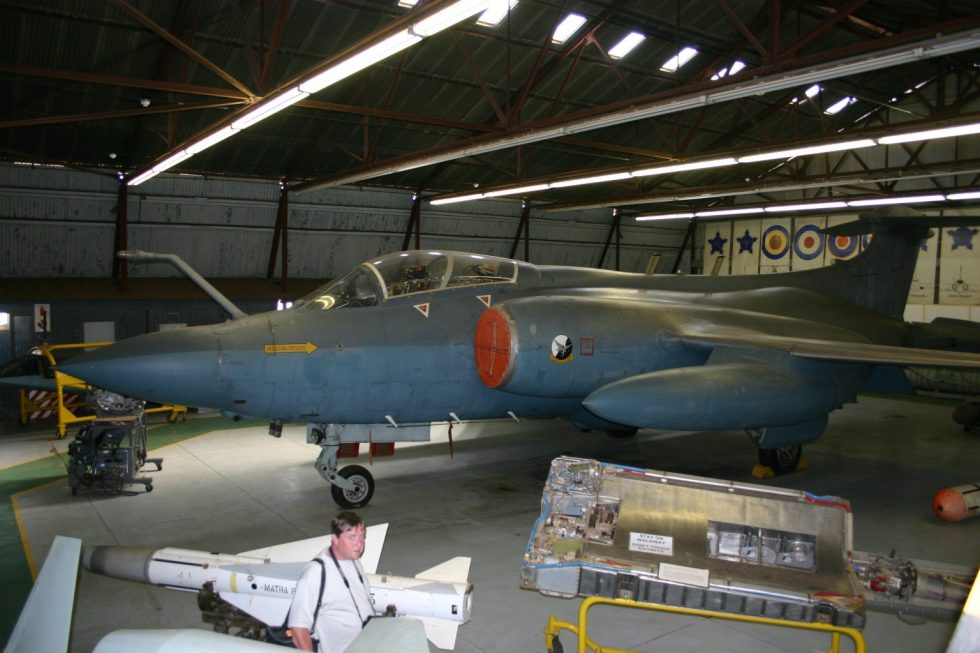
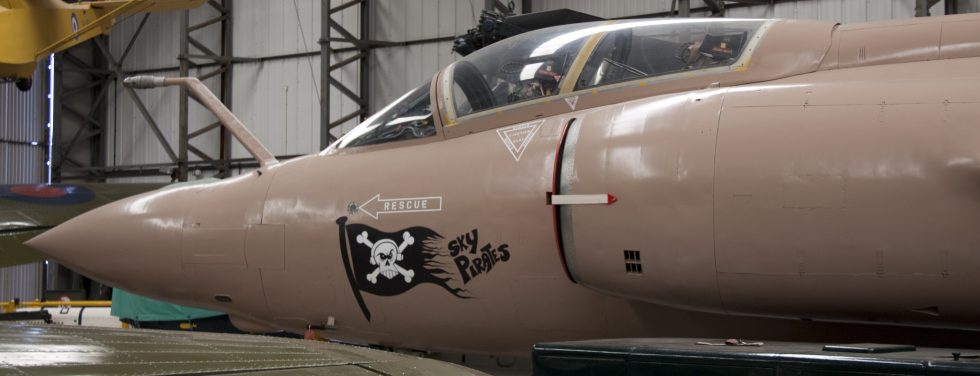
Survivors: no Buccaneer is airworthy anywhere in the world today, and none has flown since the Thunder City aircraft stopped flying in South Africa at the end of the 2000s. Roughly 27 complete airframes survive, together with about 20 nose and cockpit sections; all are original aeroplanes, and no Buccaneer replica has ever been built. Five are kept in ground-running or fast-taxiing condition in the United Kingdom: XW544 and XX894 with The Buccaneer Aviation Group at Cotswold Airport, Kemble, XN974 at the Yorkshire Air Museum at Elvington, XN923 at the Gatwick Aviation Museum, and XX900 with its preservation group at Tatenhill, the last of these described as close to flying. XX885, registered G-HHAA, was rebuilt towards flight by Hawker Hunter Aviation and granted CAA permission to fly in April 2006, but the effort stalled and the airframe has been stored at the former RAF Scampton for more than a decade. Static examples include XN957 at the Fleet Air Arm Museum, XV865 at IWM Duxford, XW547 in Gulf War camouflage at the RAF Museum London, XX889 in desert pink at the South Wales Aviation Museum, XV361 with the Ulster Aviation Society, and XX897 at Shannon wearing a Tornado F2 nose from its Foxhunter radar trials. In South Africa, five S.50s are preserved — 412 as gate guard at AFB Waterkloof, 414 and 421 at the SAAF Museum at Swartkop, 416 at Ysterplaat and 422 at the National Museum of Military History in Johannesburg — and the three ex-RAE civil aircraft, which had been the last flying Buccaneers on earth, were sold to Hangar 51 Aviation in late 2021 and trucked to Gqeberha in December 2022 for restoration; as of 2025 two are advertised for sale and one is privately held at Stellenbosch, and none of the three is flying. Note that these are British-built ex-RAE S.2Bs on the South African civil register, not South African Air Force S.50s: no SAAF Buccaneer has flown since 1991.
From carrier deck to desert war
Requirement NA.39
The Royal Navy issues its requirement for a carrier-borne low-level nuclear strike aircraft to counter the Soviet Sverdlov cruisers.
First flight
The Blackburn B-103 prototype flies on 30 April 1958, revealing the area-ruled fuselage and blown surfaces.
Enters Fleet Air Arm service
801 Naval Air Squadron becomes the first operational Buccaneer S.1 unit aboard the Royal Navy’s carriers.
The Spey-engined S.2
The definitive S.2 enters service with two Rolls-Royce Spey turbofans, curing the underpowered S.1’s deficiencies.
The Beira Patrol
Buccaneers from HMS Eagle fly long-range sorties enforcing the oil blockade of Rhodesia off Beira, Mozambique.
The RAF takes over
With the carrier fleet run down and TSR-2 cancelled, the RAF adopts the Buccaneer; 12 Squadron forms in October.
The Red Flag grounding
A fatal in-flight structural failure at Red Flag reveals wing-spar fatigue; the fleet is grounded and rebuilt.
The Gulf War last hurrah
RAF Buccaneers deploy to Bahrain, laser-designating targets for Tornado bombs — the type’s final war.
The last flight
The RAF retires its Buccaneers in March 1994; South Africa had already withdrawn its fleet in 1991.
Twelve Buccaneer stories
The cruiser that started it all
The Soviet Sverdlov cruisers drove the Royal Navy’s 1952 demand for a wave-top striker.
Read the full story
The banana jet
Area ruling gave the Buccaneer its curved “coke-bottle” belly and a nickname.
Read the full story
Blowing the wing
Hot engine air blasted over the wings let a 25-tonne jet land on a carrier deck.
Read the full story
A door that spun
The Buccaneer carried its bombs on a rotating door that flipped them into the airstream.
Read the full story
The Beira Patrol
From 1966 Buccaneers flew long ocean sorties to help blockade Rhodesian oil.
Read the full story
The jet the RAF didn’t want
The RAF fought against the Navy’s Buccaneer — then found it was the best it had.
Read the full story
Beating the Americans down low
At Red Flag exercises in Nevada, RAF Buccaneers repeatedly out-flew everyone at low level.
Read the full story
The grounding
A fatal structural failure at Red Flag exposed dangerous wing-spar fatigue.
Read the full story
Grandma goes to war
In 1991 the ageing Buccaneer flew to Iraq to laser-mark targets for the Tornado.
Read the full story
Buddy lasing the bridges
A navigator held the laser steady with a roller-ball for the 40 seconds a bomb took to fall.
Read the full story
Buccaneers over the bush
South Africa’s rocket-boosted S.50s fought over Angola in the Border War.
Read the full story
The gap it left
No British aircraft ever quite replaced the Buccaneer’s reach and low-level punch.
Read the full story
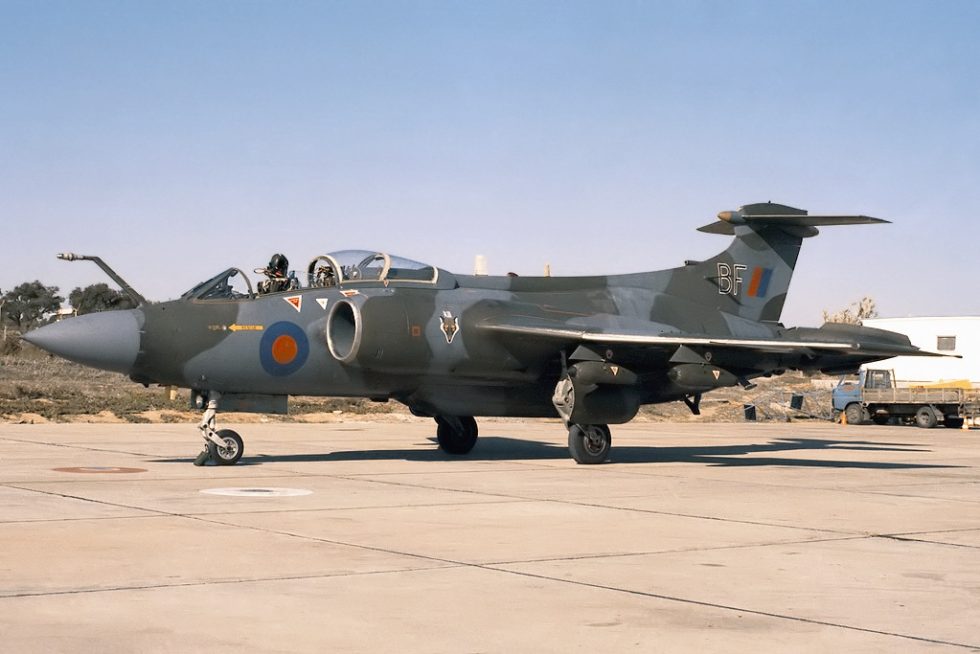
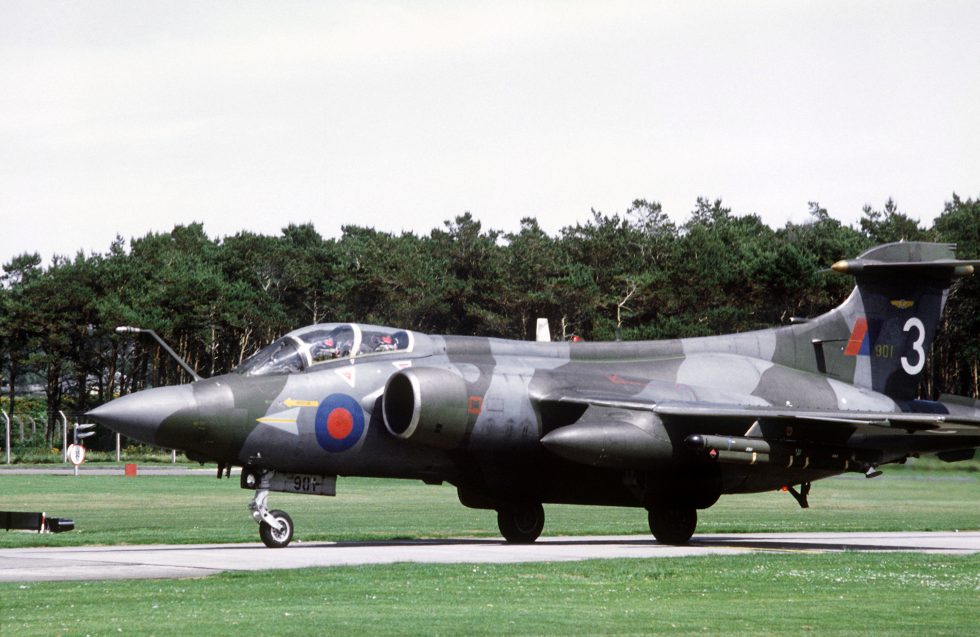
The Buccaneer in pictures
The Buccaneer in motion
Video coming soon. We are still choosing the best documentary footage of the Blackburn Buccaneer — its wave-top low-level runs, carrier operations and Gulf War service — to feature here. In the meantime, explore the gallery above and the twelve stories for the full picture of Britain’s low-level striker.
The Buccaneer in motion
Aviation Republic — one of the most-watched Buccaneer films on YouTube.
Where the Buccaneer flew
The war it fought in the end
The Buccaneer was built for a nuclear war that never came, so most of its combat record was written by others: South Africa’s hard bush war over Angola, and the RAF’s final campaign over Iraq. Its most famous contribution was not dropping bombs but pointing them — holding a laser on Iraqi bridges so Tornados could destroy them with precision.
Figures for the 1991 campaign vary between sources and are approximate. Compare the combat record of every military aircraft. Data as of July 2026.
Everything people ask about the Buccaneer
Can I fly in a Buccaneer?
Why is the Buccaneer nicknamed “the Brick”?
How low and fast did the Buccaneer fly?
Did the Buccaneer carry nuclear weapons?
What did the Buccaneer do in the 1991 Gulf War?
Why did the Royal Navy and RAF both fly it?
Did South Africa really fly the Buccaneer in combat?
Are any Buccaneers still flying?
You can’t fly the Buccaneer.
These, you can.
Some legends only live in museums — others are fuelled and waiting. MiGFlug has put civilians in real military jet cockpits since 2004.
 Fly the L-39 AlbatrosThe world’s most-flown jet trainer — aerobatics included
 Fly the F-104 Starfighter“The missile with a man in it”
 Fly the MiG-21The Cold War’s most-produced jet
 Fly the T-33 Shooting StarAmerica’s first jet trainer
 Fly the DH VampireA piece of early jet history
 Fly the S.211Agile Italian jet trainer
 Fly the MB-326The classic Aermacchi jet
 Fly the MiG-15The Soviet legend of the Korean War
Continue the tour
Every fact, checked
- BAE Systems Heritage — Blackburn BuccaneerManufacturer heritage page on the NA.39 origins, design and service history.
- Thunder & Lightnings — Buccaneer HistoryDetailed British reference on variants, squadrons and the RAF/RN service record.
- The Aviationist — Buccaneers in the Gulf WarAccount of the 1991 Bahrain deployment, Pave Spike lasing and the bridge-busting missions.
- History of War — Blackburn BuccaneerDevelopment background and technical overview of the type.
- Royal Air Force MuseumReference for preserved RAF Buccaneers, including Gulf War veteran XW547.
- The War Zone — South Africa’s BuccaneersThe SAAF S.50, its rocket boost and its role in the Border War.
- Vintage Aviation NewsFirst-flight history and design milestones of the Buccaneer.