
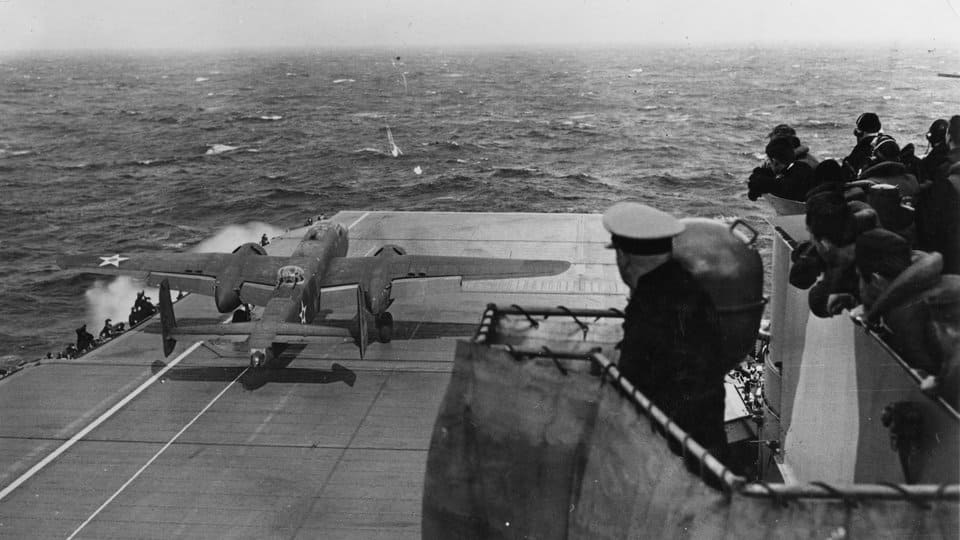
On 18 April 1942, four months after Pearl Harbor, sixteen B-25 Mitchell medium bombers launched from the deck of USS Hornet — something that had never been done before and would never be attempted again — and flew 1,000 miles to bomb Tokyo. The military damage they inflicted was minimal. What they achieved instead was something the US military desperately needed: proof that Japan was not invulnerable, that its homeland could be struck, and that America was not finished. The Doolittle Raid changed the psychology of the Pacific War.

The Problem: America Needed a Win
The attack on Pearl Harbor on 7 December 1941 had devastated the US Pacific Fleet and shocked the nation. In the months that followed, Japanese forces swept across the Pacific — taking the Philippines, Malaya, Singapore, Burma, and the Dutch East Indies with stunning speed. American public morale was low and falling. President Roosevelt demanded an offensive response. The military wanted to bomb Japan. The question was how.
The US had no air bases within range of the Japanese home islands. The nearest friendly territory was too far for any existing bomber. The Navy's carriers could get close enough, but carrier aircraft were too small and too lightly armed for a meaningful land attack. Then a Navy captain named Francis Low had an idea: what if a medium land-based bomber — something larger than a carrier aircraft but small enough to take off from a carrier deck — could be used as a one-way weapon?
The Man Who Made the Impossible Plan Work
Lieutenant Colonel James "Jimmy" Doolittle was handed the mission. He was an unusual military officer: a former barnstormer and air racer who had earned a doctorate in aeronautical engineering from MIT, the first pilot to perform an outside loop, and the first to demonstrate blind (instrument-only) flying. He was also a superb organiser and an entirely fearless leader.
The aircraft chosen was the North American B-25 Mitchell — a twin-engine medium bomber that could, with modifications, take off from a carrier. The modifications were extensive: extra fuel tanks, removal of the lower turret and most radio equipment to save weight, and intensive training for the crews on short-field takeoffs from a runway painted on a land base to simulate carrier dimensions. None of the 80 volunteers selected for the mission were told where they were going until they were already at sea.
“There was no plan for the return flight. The bombers would strike Japan, fly on to China, and land — somewhere. If the carriers were discovered early, the crews would launch into the wind and probably not make it. They knew this, and they volunteered.”
— The Doolittle Raiders, April 1942The Launch: 650 Miles Too Early

On the morning of 18 April, USS Hornet's task force was spotted by a Japanese patrol vessel approximately 650 miles from the planned launch point. The task force sank the vessel, but radio silence had already been broken. Doolittle made the call: launch immediately, 650 miles further out than planned, with fuel margins that were already tight. The aircraft would almost certainly not make their planned Chinese airfield destinations.
All 16 aircraft launched successfully. Doolittle's aircraft, the first off the deck, had the shortest run — just 467 feet — in 30-knot headwinds and a pitching sea. He was airborne with feet to spare. The bombers flew low over the Pacific to avoid detection, climbed to bombing altitude over Japan, struck their targets in Tokyo, Yokohama, Osaka, and Nagoya, then turned west for China. They arrived at night, out of fuel, in rain, with no radio navigation aids operating. Fifteen crews bailed out or crash-landed. One crew diverted to the Soviet Union and was interned.
The Consequences That Mattered
The physical damage was modest. But the psychological and strategic consequences were enormous. The Japanese high command, humiliated by the raid and determined to prevent a recurrence, accelerated their plans for the Battle of Midway — the operation to extend Japan's defensive perimeter by taking Midway Atoll. The result was the decisive naval battle of June 1942, in which the US sank four Japanese fleet carriers, a loss from which the Imperial Japanese Navy never recovered. The Doolittle Raid, by provoking Midway, may have shortened the Pacific War by years.
Of the 80 Raiders, 73 survived the war. Three were killed in action on the day. Eight were captured by the Japanese; three of those were executed. Doolittle, convinced the mission had failed because he had lost all 16 aircraft, expected a court martial. Instead he received the Medal of Honor, was promoted two grades to Brigadier General, and was appointed to progressively senior commands for the rest of the war. He ended the war as a full General commanding the Eighth Air Force.
Sources: James Doolittle, I Could Never Be So Lucky Again (1991); National Archives WWII records; Carroll Glines, The Doolittle Raid (1988); National Museum of the US Air Force.
Verwandte Fragen
Was war der Doolittle-Überfall?
The Doolittle Raid was a US air attack on Japan on 18 April 1942, four months after Pearl Harbor. Sixteen B-25 Mitchell bombers launched from the carrier USS Hornet and flew about 1,000 miles to bomb Tokyo and other cities. The physical damage was small, but its effect on morale was enormous.
Wer war Jimmy Doolittle?
Lieutenant Colonel James "Jimmy" Doolittle led the 1942 raid on Tokyo. A former barnstormer and air racer, he held a doctorate in aeronautical engineering from MIT, performed the first outside loop, and pioneered blind (instrument-only) flying. He planned and led the daring carrier-launched bomber mission.
Why was the Doolittle Raid important?
Though it caused little physical damage, the raid proved that the Japanese home islands were vulnerable and that America could strike back after Pearl Harbor. It lifted sagging US morale and shocked Japan's leadership, contributing to decisions that led to the pivotal Battle of Midway weeks later.
How did bombers take off from an aircraft carrier?
The raid used B-25 Mitchells — land-based medium bombers small enough to take off from a carrier deck but far larger and better armed than normal carrier aircraft. They launched from USS Hornet on a one-way mission, since they could not land back aboard. Carrier flight operations remain among aviation's most demanding.
Whose idea was the Doolittle Raid?
The concept came from US Navy captain Francis Low, who suggested that a medium land-based bomber — bigger than a carrier aircraft but able to take off from a carrier deck — could be used to strike Japan. The idea was handed to Jimmy Doolittle, who turned it into a workable plan.
How many bombers took part in the Doolittle Raid?
Sixteen B-25 Mitchell bombers, carrying 80 airmen, launched from USS Hornet on 18 April 1942. After bombing their targets in Japan, most crews flew on toward China, where the aircraft were lost to crashes or bail-outs once they ran out of fuel, their one-way mission complete.
What aircraft was the B-25 Mitchell?
The North American B-25 Mitchell was an American twin-engined medium bomber widely used in World War II. Rugged and versatile, it served in every theatre, but it is best remembered for the Doolittle Raid, when sixteen of them made the unprecedented launch from a carrier deck to bomb Tokyo.
0 Kommentare