
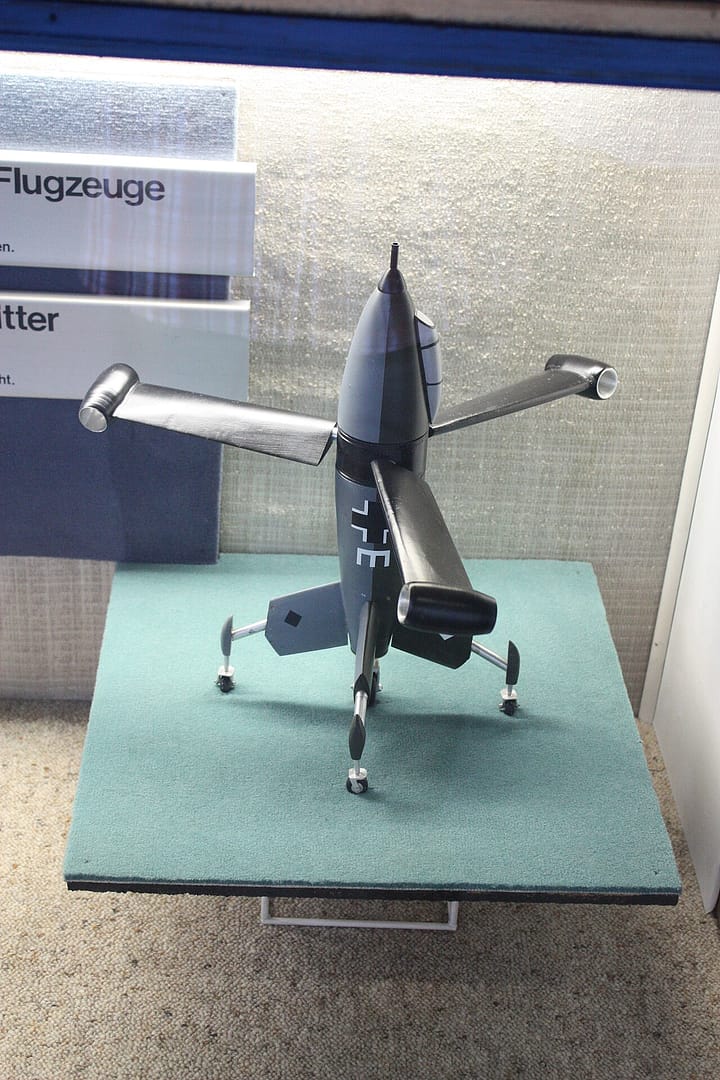
Picture an aircraft that does not sit on a runway but stands upright on its tail, nose pointed at the sky like a rocket. Around its waist spins a three-bladed wing, driven not by an engine in the fuselage but by ramjets screaming at the very tips of the blades. To take off, it simply rises straight up. To land, the pilot must fall backwards out of the sky and settle, blind, onto four little wheels beneath the tail.
This was the Focke-Wulf Triebflügel — one of the most bizarre flying machines ever seriously designed. Drawn up in Germany in 1944, it was meant to defend the Reich from a shrinking patch of ground. It never flew. Looking at it, you understand why.
QUICK FACTS
| Aircraft | Focke-Wulf Triebflügel (Germany, 1944) |
| Type | VTOL point-defence interceptor — tailsitter |
| Propulsion | Three-blade rotor spun by ramjets at the blade tips |
| Armament | Two 30mm and two 20mm cannon in the nose |
| Built | None — only wind-tunnel models |
| Status | Never flew; the war ended first |
A wing that was also a propeller
The Triebflügel’s defining idea was its rotor-wing: three long blades mounted on a ring around the mid-fuselage, free to spin around the aircraft’s body. At the tip of each blade sat a ramjet. Small rockets would spin the assembly up until the ramjets lit; from then on, the spinning blades acted as an enormous propeller, hauling the aircraft vertically off its tail. In forward flight, that same rotating wing generated the lift to keep it airborne.
It was elegant on paper and terrifying in practice. Ramjets are gluttons for fuel and deafeningly loud, and a rotor spun from its tips carries brutal stresses. But the biggest problem waited at the end of every mission.
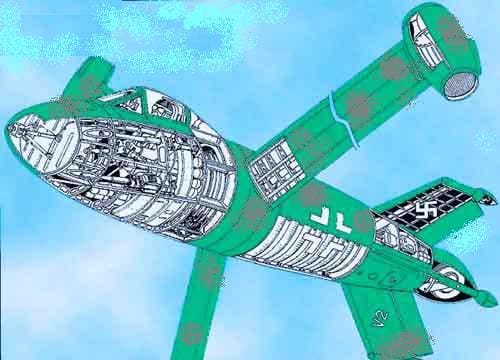
The landing nobody wanted to make
Taking off vertically is one thing. Landing a tailsitter is another entirely. The Triebflügel’s pilot would have to bring the machine to a hover, then lower it tail-first onto a cruciform undercarriage — descending essentially backwards, unable to see the ground properly, balancing a spinning rotor at low speed. Even with modern computers, vertical tailsitter landings are hard. In 1944, by hand, with a novice pilot and a whirling ramjet rotor overhead, it bordered on suicidal.
A wonder-weapon that stayed on paper
The Triebflügel belonged to the last, desperate wave of German “wonder-weapon” designs — aircraft meant to launch from tiny, hidden sites without runways as Allied bombers pounded the Reich. It got as far as wind-tunnel models, tested reportedly to around Mach 0.9. Then the war ended, and the strangest interceptor of the age went straight into the history books without ever turning a rotor in anger.
It is easy to laugh at. But the Triebflügel also asked a question aviation is still wrestling with today: how do you build a fast combat aircraft that needs no runway at all? Eighty years later, with tailsitting drones and VTOL fighters back on the drawing board, the mad German idea does not look quite so mad.
Sources: Deutsches Museum; Luft’46 design histories; German wartime technical archives.
Related Questions
What was the Focke-Wulf Triebflügel?
The Triebflügel was a German vertical-takeoff interceptor designed in 1944. It stood upright on its tail and used a three-bladed rotor mounted around its fuselage — spun by ramjets at the blade tips — to lift off and fly. It was meant to defend targets with no runway, but it was never built or flown.
How was the Triebflügel supposed to work?
A rocket-started ramjet at the tip of each rotor blade would spin the three-bladed wing like a giant propeller, lifting the aircraft straight up off its tail. In forward flight the same spinning wing generated lift. The pilot would then have to descend backwards and settle vertically onto the tail — an extremely difficult landing.
Did the Triebflügel ever fly?
No. Only wind-tunnel models were built and tested, reportedly up to around Mach 0.9. Germany’s collapse in 1945 ended the project before any full-size prototype could be constructed, so no Triebflügel ever left the ground.
Why did Germany design such a strange aircraft?
By 1944 Germany faced relentless Allied bombing and dwindling airfields and fuel. VTOL interceptors like the Triebflügel promised to launch straight up from small, hidden sites without runways — a desperate answer to a desperate situation, alongside other “wonder-weapon” concepts of the period.
Were tip-mounted ramjets ever actually used?
Yes, though not on the Triebflügel. Tip-jet and ramjet-driven rotors were tried on several postwar experimental helicopters. They work, but they are thirsty, extremely loud and complex — which is part of why the concept never became mainstream.
0 Comments