
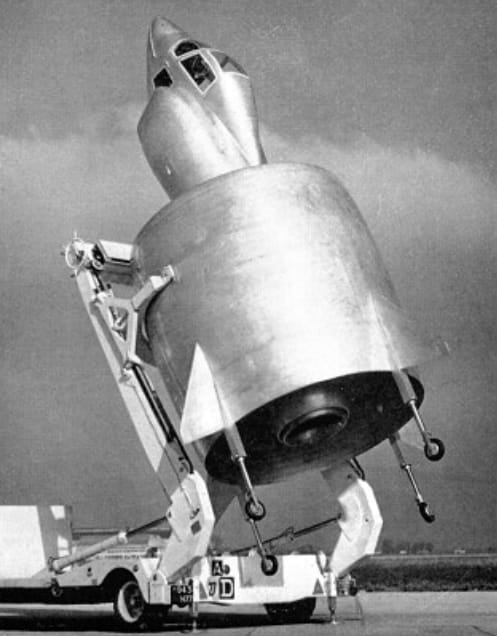
France, the late 1950s. At SNECMA, engineers were building an aircraft with no wings you would recognise — no long span, no tail as anyone knew it, just a jet engine wrapped inside a great metal ring, designed to stand on its tail and rise straight into the sky.
They named it the Coléoptère — French for “beetle.” It was one of the boldest, strangest flying machines the jet age ever produced, and for a few weeks in 1959 it actually worked.
| Aéronef | SNECMA C.450 Coléoptère |
| Taper | Avion à décollage et atterrissage vertical à aile annulaire |
| Moteur | turboréacteur SNECMA Atar |
| Pilote d'essai | Auguste Morel |
| Destin | Seul prototype détruit lors de son 9e vol, le 25 juillet 1959 |
Une aile en forme d'anneau
The heart of the idea was the annular wing — a doughnut-shaped ring encircling the fuselage, conceived by the Austrian engineer Helmut von Zborowski. In theory the ring did three jobs at once: it acted as the lifting surface, it formed the aircraft’s structure, and it wrapped the engine in a smooth, drag-reducing shroud. Power came from a SNECMA Atar turbojet, the same family of engine that drove France’s Mirage fighters. The Coléoptère needed no runway at all — it would leap straight up, tip over into level flight, and land back on its tail.
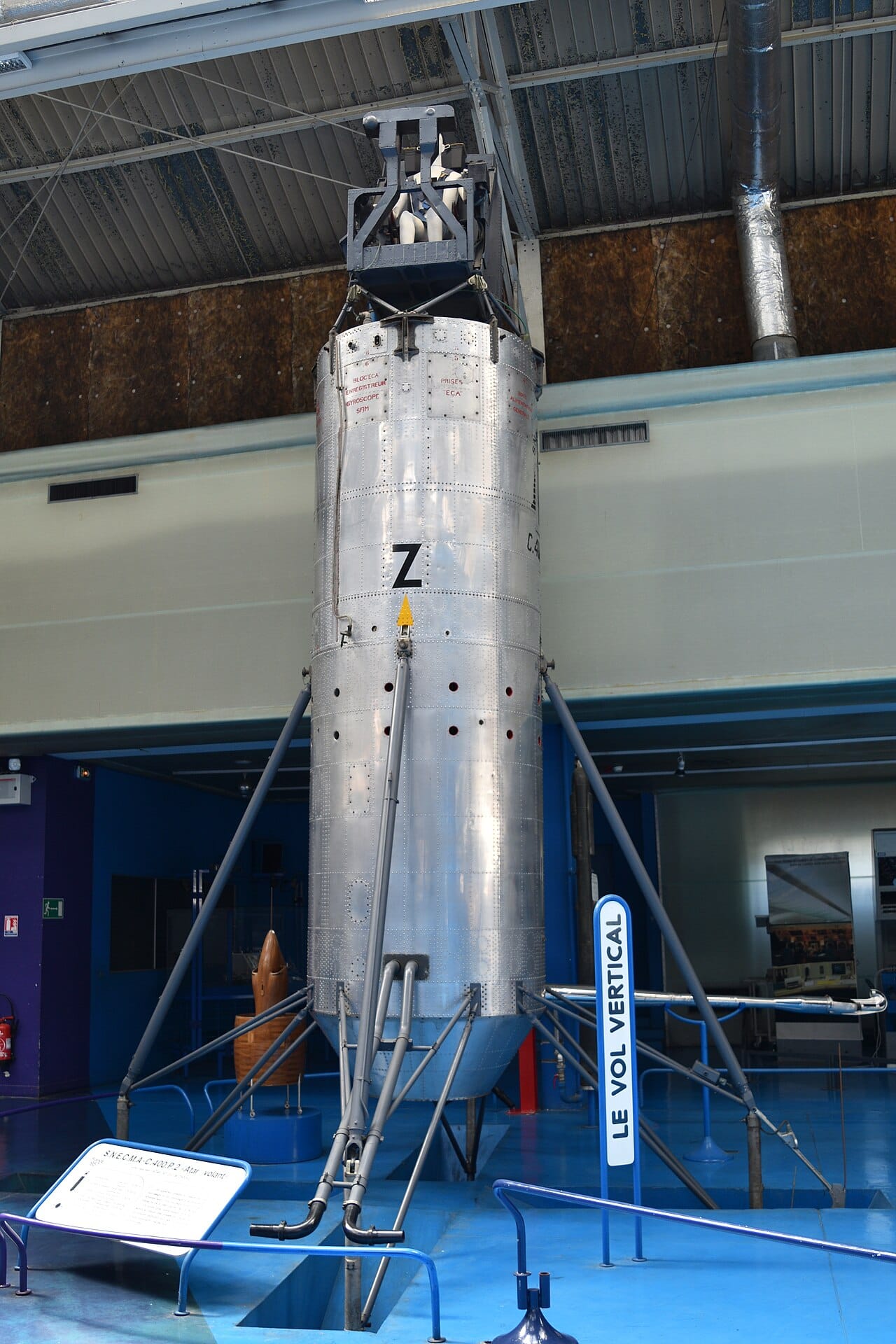
It did not appear from nowhere. SNECMA had first tested the raw concept on the “Atar Volant,” a flying test rig that was little more than an engine on legs learning to balance in the air.
Se tenant sur une colonne de poussée
Test pilot Auguste Morel first hovered the Coléoptère on a tether in April 1959, then cut it loose in early May and held the machine in a free hover for three and a half minutes — balanced on nothing but its own jet blast. Over the following weeks he flew it again and again, climbing to around 800 metres, coaxing more out of the beetle each time.
The killer was the transition. Lying on his back and pointing at the sky, the pilot had almost no natural reference to tell him what the aircraft was doing as it tried to tip from vertical to horizontal flight. It was, in the words used of every tail-sitter, like trying to land a rocket by feel — the same brutal problem that defeated America’s Pogo Convair XFY.
Le neuvième vol
On 25 July 1959, on its ninth flight, it all came apart. As Morel attempted a manoeuvre the Coléoptère began to rotate and oscillate; disoriented and low, he lost control and ejected, escaping with his life but serious injuries. The sole prototype was destroyed. A second was planned, but the money never came, and the beetle’s brief, brilliant career was over.
L'aile annulaire ne vola plus jamais. Les hélicoptères et, plus tard, les avions à décollage vertical comme le Harrier won the argument over how to take off without a runway. But the Coléoptère remains one of aviation’s great and beautiful “what ifs” — a very French piece of audacity that briefly, genuinely, stood on its tail and flew.
Sources: Musée de l’Air et de l’Espace; Vertipedia; Wikipedia.
Questions connexes
Qu'était-ce que le SNECMA Coléoptère ?
Le SNECMA C.450 Coléoptère était un avion ADAV français révolutionnaire de la fin des années 1950. Dépourvu d'ailes et d'empennage conventionnels, il était équipé d'un réacteur intégré à une large aile annulaire et conçu pour décoller en équilibre sur sa queue. Le prototype unique effectua quelques vols durant les semaines de 1959.
Qu'est-ce qu'une aile annulaire ?
L'aile annulaire est un anneau en forme de tore qui entoure le fuselage d'un avion ; une idée conçue par l'ingénieur autrichien Helmut von Zborowski. Sur le Coléoptère, elle remplissait trois fonctions simultanément : elle servait de surface portante, constituait la structure de l'appareil et enveloppait le moteur d'un carénage lisse réduisant la traînée. Ce concept ne fut plus jamais reproduit avec succès après le Coléoptère.
Qu'est-ce qu'un avion à sustentation arrière ?
Un avion à décollage vertical est un appareil qui décolle et atterrit verticalement en s'appuyant sur sa queue, puis s'incline pour voler à l'horizontale. Le Coléoptère en était un exemple. La transition du vol vertical au vol horizontal constituait le principal problème, car le pilote était allongé sur le dos avec peu de repères, un peu comme l'Américain Ryan X-13 Vertijet ont été confrontés au même défi déroutant.
Qu'est-il arrivé au SNECMA Coléoptère ?
Le 25 juillet 1959, lors de son neuvième vol, le Coléoptère commença à tourner sur lui-même et à osciller pendant la transition vers le vol horizontal. Le pilote d'essai Auguste Morel, désorienté et volant à basse altitude, perdit le contrôle et s'éjecta. Grièvement blessé, il survécut. L'unique prototype fut détruit, le financement du second appareil prévu ne fut jamais obtenu et la brève et brillante carrière du Coléoptère prit fin.
Pourquoi les avions à décollage et atterrissage vertical (VTOL) à propulsion arrière des années 1950 étaient-ils si difficiles à piloter ?
Les avions à décollage vertical comme le Coléoptère exigeaient du pilote qu'il passe d'un vol vertical à un vol horizontal sans presque aucune perception naturelle de l'assiette de l'appareil, allongé sur le dos et ' posant une fusée au toucher '. Ce même problème de contrôle brutal a eu raison de projets tels que le Focke-Wulf Triebflügel et le Convair XFY Pogo américain. Les hélicoptères, puis les avions à décollage vertical, ont permis de résoudre le problème du vol vertical de manière plus pratique.
0 commentaire