
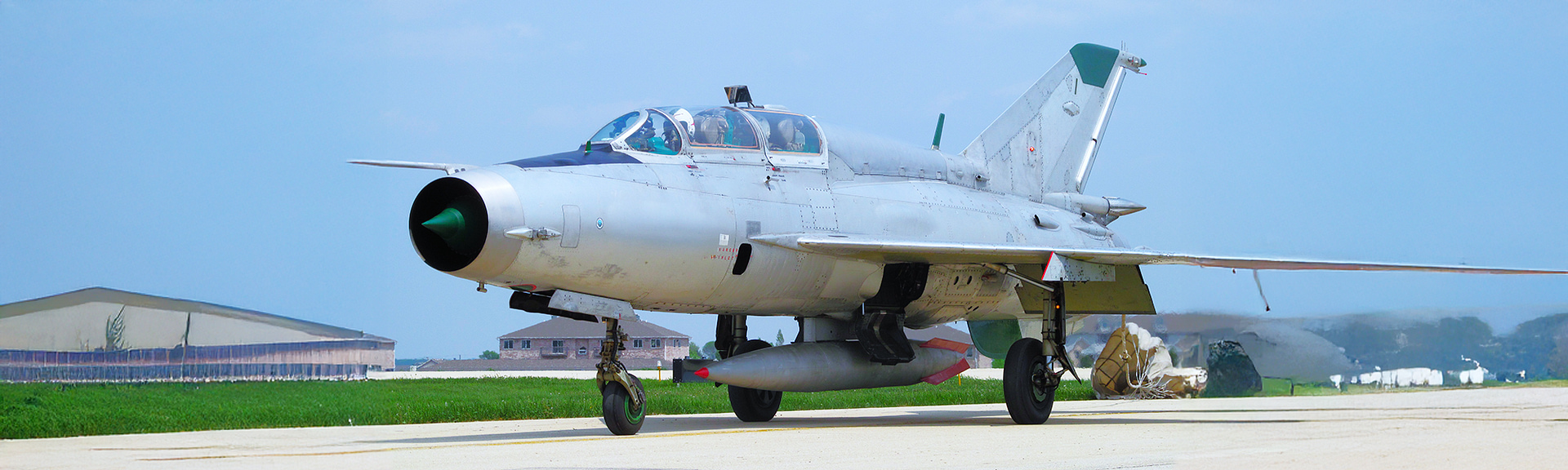
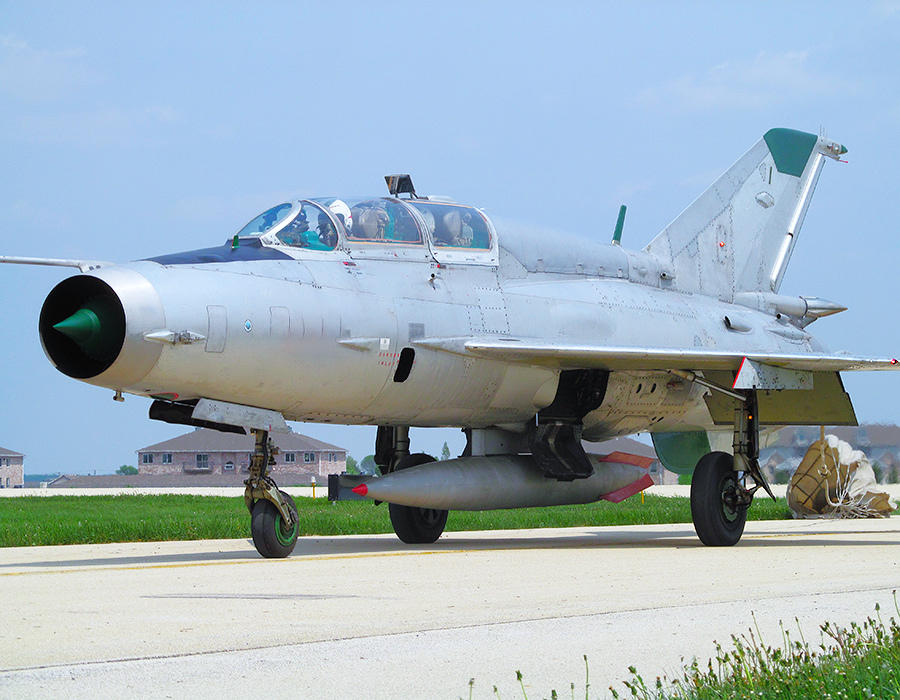
MiG-21. The Fastest You Can Fly.
Over 11,400 built. More than 60 air forces. Mach 2 capability. The MiG-21 Fishbed is the most-produced supersonic fighter in aviation history — a Cold War legend designed to climb fast, fly faster, and outrun anything in its path. Today, experiencing this aircraft in flight is one of the rarest things a civilian can do.
A Soviet Interceptor Built for Speed
When the Mikoyan-Gurevich design bureau received the order to build a lightweight supersonic interceptor in the mid-1950s, the Soviet Union was locked in an arms race where speed meant survival. The result was the MiG-21 — a radical, stripped-down airframe built around the most powerful engine that could fit inside it. First flown in 1956, the MiG-21 entered service in 1959 and quickly proved itself as a Mach 2 fighter that could be produced cheaply, maintained simply, and deployed anywhere. It became the backbone of Soviet air defence and was exported to over 60 nations across four continents. With more than 11,400 units produced across multiple factories — in the USSR, India, Czechoslovakia and China — the MiG-21 remains the most-manufactured supersonic aircraft in history. No other fighter jet has been built in greater numbers.
- Pure Supersonic Speed: Capable of exceeding Mach 2 in level flight, the MiG-21 was designed from the outset as a supersonic interceptor — not adapted from a trainer or repurposed from another role.
- Combat-Proven Pedigree: Deployed in over 40 armed conflicts — from Vietnam and the Middle East to South Asia and Africa — the MiG-21 has more real combat history than almost any other jet ever built.
- Delta Wing Design: The 57° swept tailed delta wing keeps the aircraft inside the Mach cone at supersonic speeds while providing crisp, responsive handling across the entire flight envelope.
- Raw Afterburner Power: The Tumansky R-25 turbojet delivers 97 kN in full afterburner — a visceral, no-compromise thrust that modern turbofans simply cannot replicate.
- Legendary Simplicity: Designed for rapid turnaround by conscript ground crews on austere airstrips, the MiG-21 is famously rugged and maintainable — a major reason it served for decades.
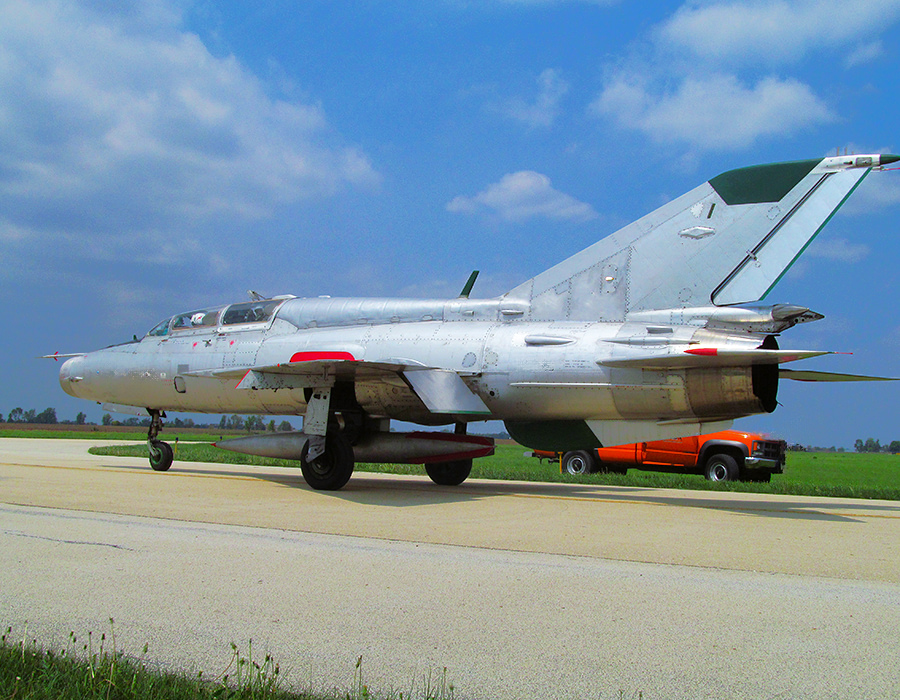
- Unmistakable Silhouette: The needle nose with its shock cone intake, delta wings, and single-engine fuselage make the MiG-21 one of the most instantly recognisable fighter jets in the world.
Design and Airframe
The MiG-21’s design philosophy was radical in its simplicity: the smallest possible airframe wrapped around the largest possible engine. A single Tumansky turbojet fed through the aircraft’s signature nose-mounted shock cone intake — a solution that eliminated the need for side intakes and gave the MiG-21 its unmistakable profile. The tailed delta wing, swept at 57°, was optimised for supersonic flight while keeping the structure light and the fuel volume surprisingly generous for an aircraft this compact. The entire rear fuselage detaches at a single bolted joint for engine removal — a field-maintenance feature that allowed frontline units to swap a powerplant in hours, not days. Over 11,400 airframes were produced across factories in the Soviet Union, India, Czechoslovakia and China, in dozens of variants spanning interceptor, multirole, reconnaissance and two-seat trainer configurations. The MiG-21 remained in active front-line service for over five decades — a testament to an airframe that was built exactly right from the start.
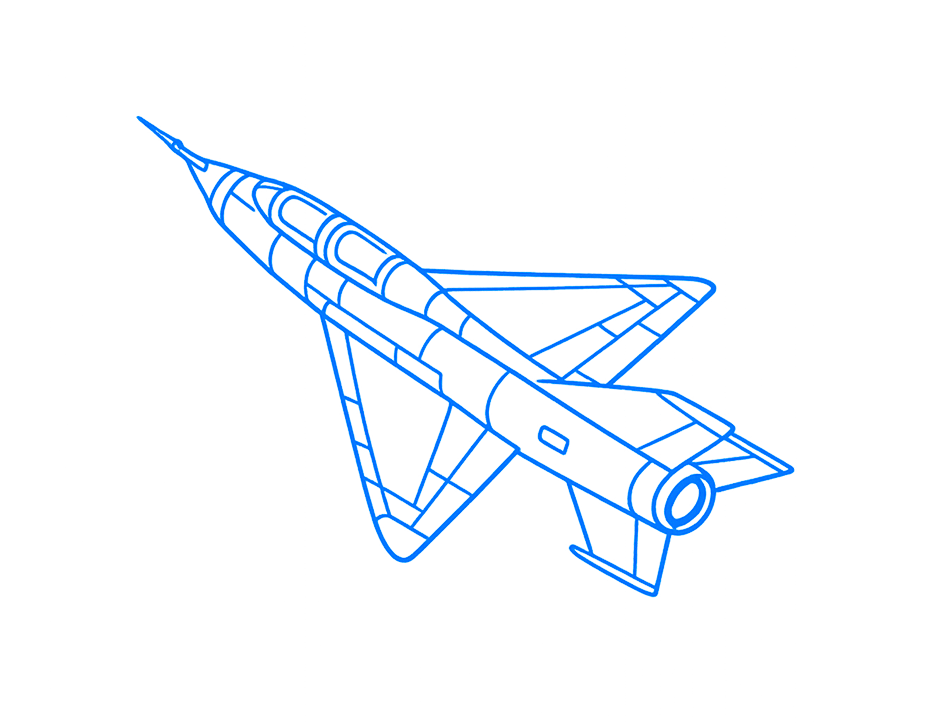
MiG-21 Interactive Blueprint
MiG-21 — Inside a Legend
Explore the engineering behind the world's most-produced supersonic military jet. Hover over a highlighted section on desktop or tap on mobile to discover what makes the MiG-21 an unforgettable ride.
Shock Cone Intake
The signature nose cone isn't just iconic — it's functional. A translating centerbody automatically optimizes airflow to the engine across the speed range, enabling stable thrust from taxi all the way through Mach 2.
Tandem Cockpit
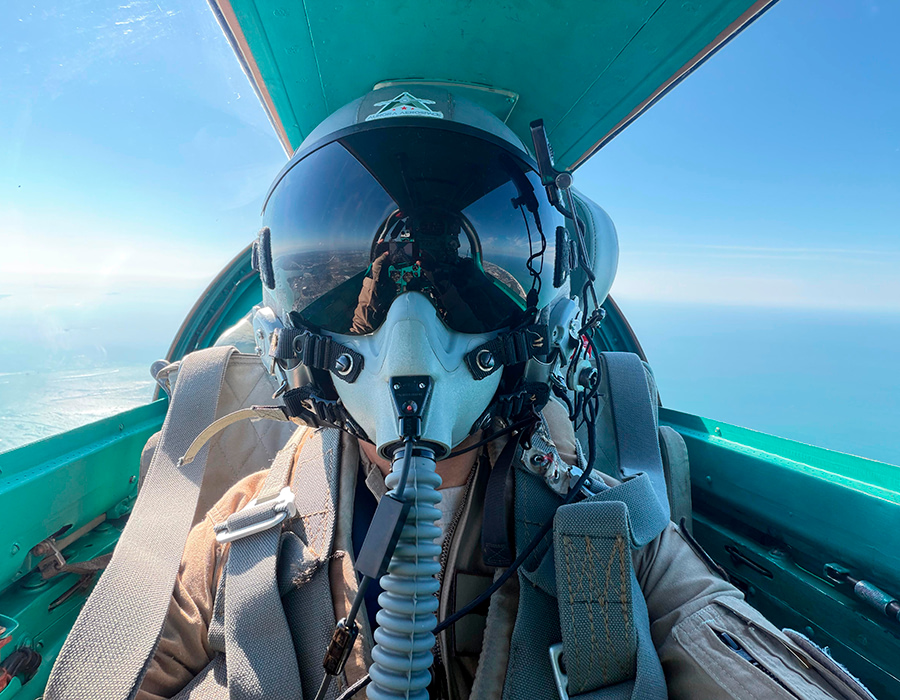
This cutaway shows the single-seat variant. The version you'll fly features a tandem two-seat cockpit: you sit directly behind the pilot with a full set of flight instruments and an unobstructed forward view through the framed canopy.
Zero-Zero Ejection Seat
Both crew positions are equipped with zero-zero ejection seats, capable of safe extraction at any altitude and any airspeed — including standing still on the runway. Your safety is engineered into the airframe.
Tumansky Afterburning Turbojet
With 97 kN of thrust in full afterburner, the Tumansky R-25 catapults the MiG-21 past Mach 2 and delivers a raw, visceral acceleration that modern turbofans simply cannot replicate. Expect to feel every newton.
Tailed Delta Wing
The 57° swept delta keeps the wing inside the Mach cone at supersonic speeds while providing a surprisingly large fuel volume. Combined with the all-moving tailplane, it gives the MiG-21 crisp, fighter-like handling at every speed.
External Hardpoints
Four underwing pylons carried everything from R-3S infrared-guided missiles and UB-16 rocket pods to a 490-litre centerline drop tank — a testament to the MiG-21's versatility as both interceptor and ground-attack platform.
1. Glassfibre radome, fore-and-aft moveable
2. Angle of attack probe
3. Steel intake lip
4. Pitot head
5. Boundary layer bleed duct
6. Boundary layer exit (top and bottom)
7. Divided intake ducting
8. Suction relief door
9. Suction relief door
10. Nosewheel debris deflector
11. 'Spin-scan' fire control radar
12. Avionics compartment
13. Dynamic pressure probe unit
14. Canopy
15. Rear view mirror
16. Radar display and electronic sighting unit
17. Pilot's 'zero-zero' ejector seat
18. Control stick
19. Rudder pedals
20. Throttle quadrant
21. Fore and aft armoured bulkheads, aft with ejector seat rails
22. Electrical equipment bay
23. SPA-10 Sirena radar equipment
24. Communications equipment
25. Fuel system gravity tank
26. Fuselage bag-type fuel tanks
27. Glassfibre top decking
28. Fuel filler and recuperator
29. Control runs to rear fuselage
30. Wing main box section spars
31. Outer auxiliary spars
32. Auxiliary spars
33. 108 gal drop tank
34. Inward retracting mainwheel leg with pneumatic brakes
35. Leg actuator / main strut
36. Mainwheel stowage
37. Forward-retracting steerable nosewheel
38. Bolted aft fuselage joint (for engine removal)
39. Tumansky RD-13-300 turbojet
40. Engine oil tank
41. Hydraulic accumulator
42. Jet exit
43. External nozzle actuator duct
44. Spare / fuselage frame pin joints
45. Engine bay venting intake
46. All-moving tailplane
47. Anti-flutter weight
48. Tailplane actuator
49. Tailplane control hydraulic pack
50. Rudder actuator
51. Aileron jack
52. 'Blown' flaps
53. Flap actuator
54. Flap hinge
55. Ventral fin
56. Airbrakes (each side)
57. Brake parachute stowage
58. Retractable landing / taxiing lamp
59. IFF antenna (on fin and under intake)
60. VHF aerial
61. UHF antenna
62. Fuel vent
63. Twin-barrel 23 mm GSh-23 cannon
64. K-13A Atoll air-to-air missile
65. UV-16-57 rocket pack (16 × 57 mm rockets)
MiG-21 operations worldwide
The MiG-21 was never just an interceptor. Produced in dozens of variants — from the early F-13 day fighter to the multirole MiG-21bis, and from the reconnaissance MiG-21R to the two-seat trainer — the Fishbed proved itself across every conceivable mission type. More than 60 air forces across four continents have flown the MiG-21 in combat, peacekeeping, patrol, and training roles. It has seen real action in over 40 armed conflicts — from Vietnam and the Arab–Israeli wars to South Asia, the Horn of Africa, and the Balkans — earning a combat record unmatched by any other fighter jet in history. The interactive map below shows MiG-21 operations worldwide.
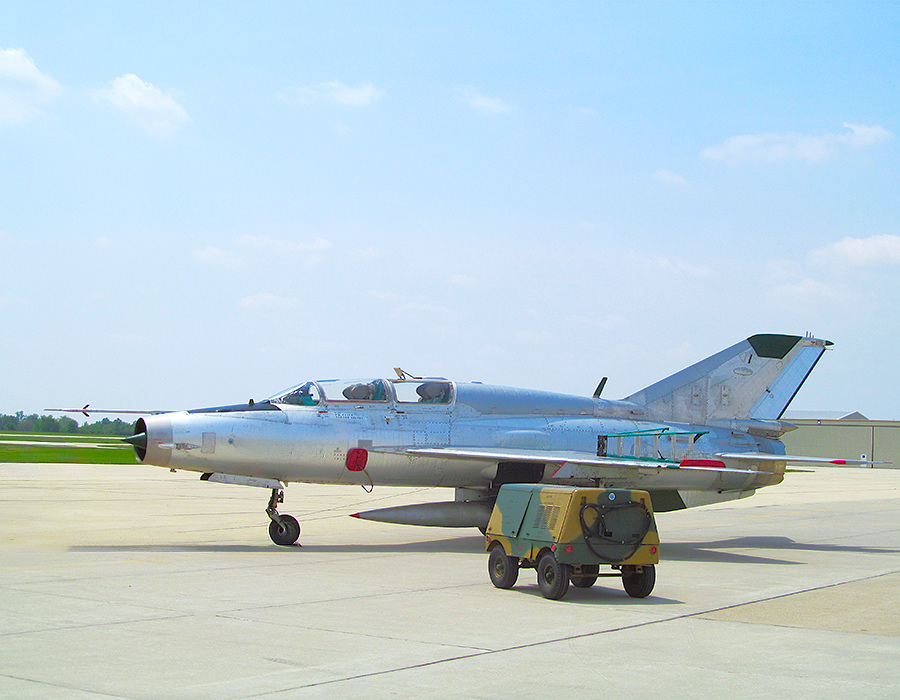
MiG-21 Technical Data
Every detail of the MiG-21 was engineered around one principle: maximum speed from minimum airframe. A single Tumansky turbojet fed through the nose-mounted shock cone intake, a tailed delta wing swept at 57°, and an airframe light enough to exceed Mach 2 in level flight. The entire rear fuselage detaches at a bolted joint for rapid engine swaps in the field. Produced in greater numbers than any other supersonic aircraft in history — over 11,400 across factories in the Soviet Union, India, Czechoslovakia and China — the MiG-21 served on the front lines for more than five decades.
m
WINGSPAN
m
LENGTH
m
HEIGHT
km/h
MAX SPEED
km
RANGE
m/s
CLIMB RATE
m
SERVICE CEILING
kN
ENGINE THRUST
For aviation enthusiasts who want to go deeper, here is a broader technical snapshot of the MiG-21.
| Crew | 1 (2 in trainer variants) |
| Engine | Tumansky R-25-300 afterburning turbojet |
| Maximum thrust | 9,900 kg / 21,825 lb (with afterburner) |
| Maximum speed | 2,175 km/h / 1,351 mph (Mach 2.05) |
| Range | 1,210 km / 752 mi |
| Combat radius | 370 km / 230 mi |
| Climb rate | 235 m/s / 46,250 ft/min |
| Wingspan | 7.154 m / 23.5 ft |
| Length | 14.5 m / 47.5 ft |
| Height | 4.13 m / 13.5 ft |
| Empty weight | 5,350 kg / 11,795 lb |
| Maximum take-off weight | 9,800 kg / 21,605 lb |
Why the MiG-21 stands alone
There is no civilian flight experience like this. The MiG-21 is the fastest, most combat-proven fighter jet available through MiGFlug — a genuine Cold War interceptor that puts everything else in perspective.
The Only Supersonic Option
The MiG-21 is the only Mach 2-capable fighter jet available for civilian flight experiences through MiGFlug. No other aircraft in the portfolio comes close to this speed.
Combat Legend, Real Heritage
More than 60 air forces. Over 40 armed conflicts. The MiG-21 carries a combat pedigree that no trainer or light jet can match — and you feel that history the moment the afterburner lights.
Raw, Unfiltered Experience
No glass cockpit, no fly-by-wire, no digital filters. The MiG-21 delivers pure analogue flying with a stick, rudder pedals, and 97 kN of afterburner thrust pushing you past Mach 2.
Fly a MiG-21
Select a location and make your dream of flying a real fighter jet come true.
What Customers Say
★★★★★
It was an amazing experience flying the MiG-21, great machine!
Thanks for arranging everything.
★★★★★
Highly recommend to ANY aviation enthusiast and PILOT. The overall experience was simply phenomenal and worth every penny.
★★★★★
The Supersonic Flight is probably the most exhilarating experience on Earth. The entire experience was beyond thrilling!!!