
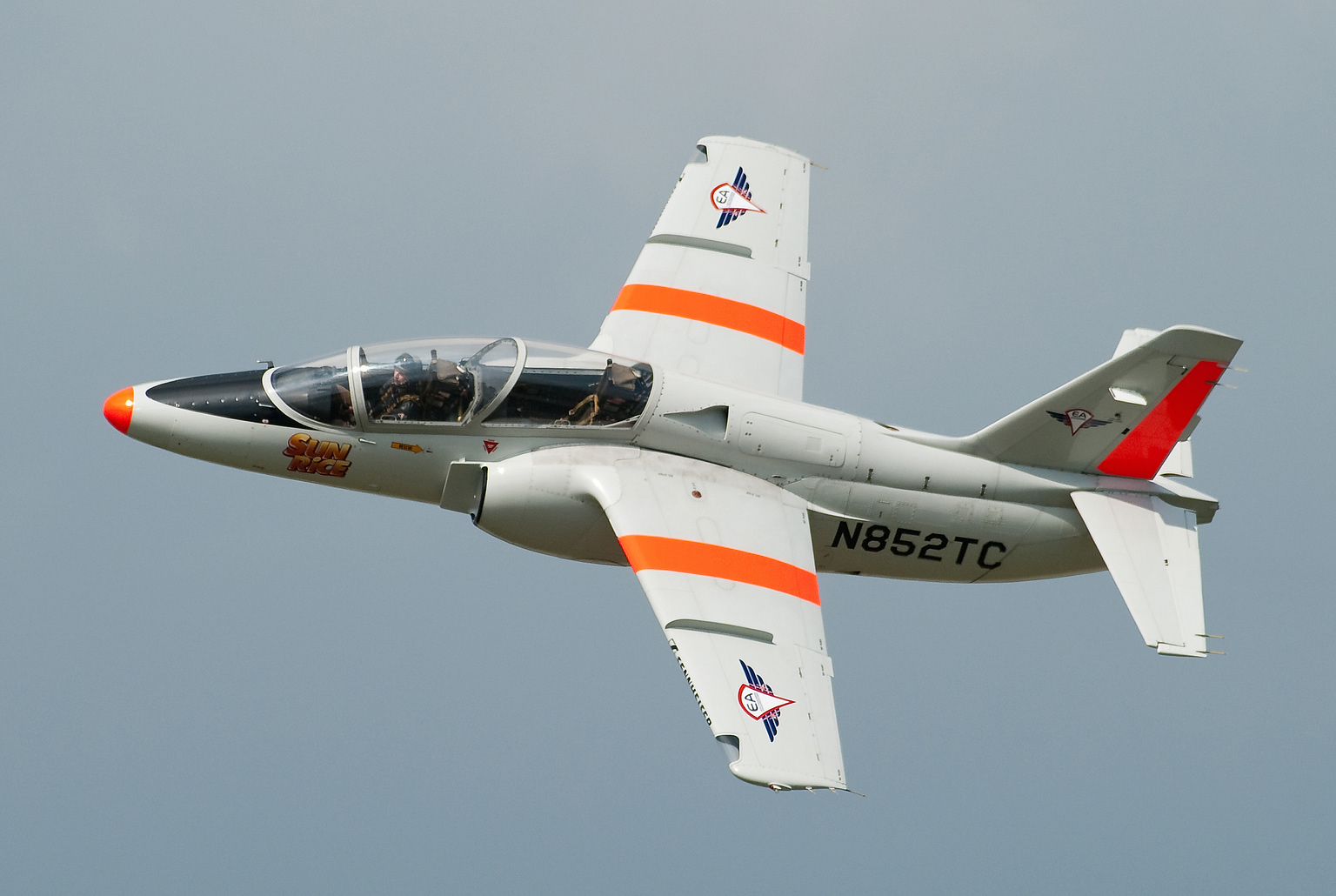
SIAI-Marchetti S.211
The Modern Mini-Jet
A genuinely modern, purpose-built turbofan jet trainer — small, docile and economical enough to become a realistic private warbird. Barely nine metres long, fully aerobatic to +6 g, and one of the few real jets an ordinary person can actually fly today.
The mini-jet that meant it
Most jet warbirds you can fly are thirsty Cold War hand-me-downs. The S.211 is something rarer: a genuinely modern, purpose-built turbofan jet trainer that turned out to be small, docile and economical enough to become a realistic private aircraft. Where an L-39 burns kerosene by the barrel, the S.211’s Pratt & Whitney Canada JT15D delivers comparable performance at roughly half the fuel flow — an economy that made it the sweet spot for civilian owners.
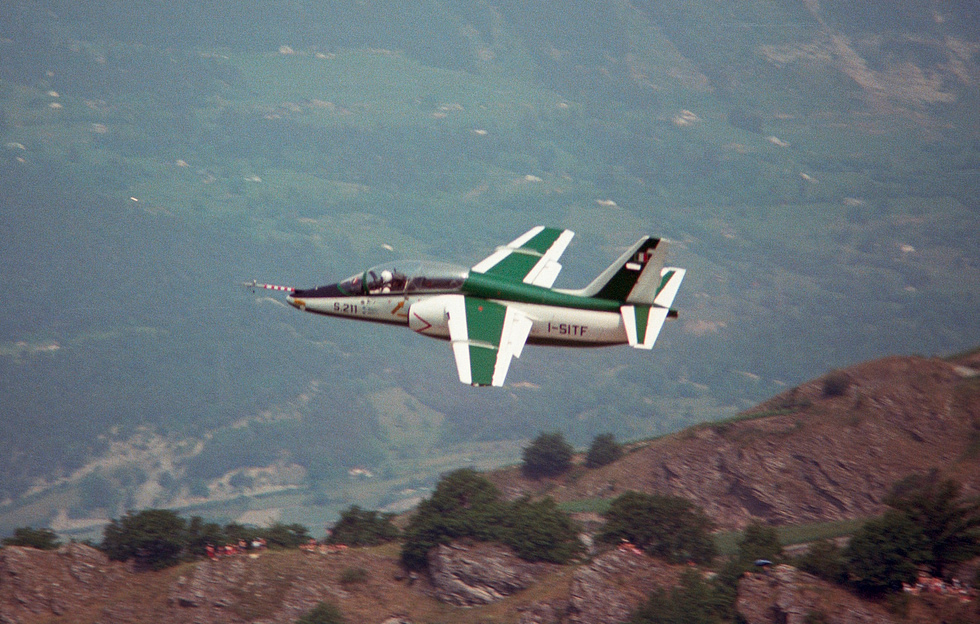
It was a private-venture bet. Italy’s SIAI-Marchetti — best known for the SF.260 piston trainer — applied its philosophy of “elegant simplicity” to a small, modern jet, unveiling it at the 1977 Paris Air Show with no government backing. The prototype first flew on 10 April 1981, and the type entered service after Singapore placed the launch order in 1983. Technically it punched above its size: a supercritical wing, an all-new composite airframe of Kevlar, Nomex and carbon fibre, and a single fuel-sipping turbofan.
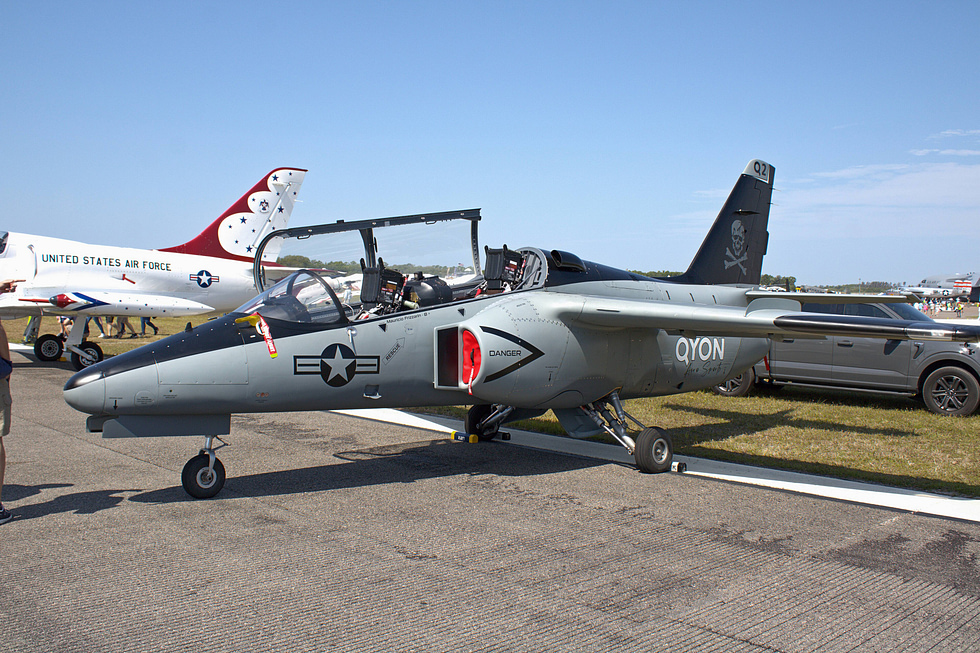
Around twenty now fly in the United States under Experimental-Exhibition rules, refurbished from ex-Singapore airframes — and that accessibility is exactly why MiGFlug can put Jij in one. From an airfield near Munich you strap into the rear seat of “the most modern military jet in the fleet,” pull 6 g through loops over the Bavarian Alps, and take the stick yourself. A mini-jet, a real jet, a flyable jet.
01The S.211’s origins: a corporate bet on the modern jet trainer
The S.211 began around 1976 as a private venture — a corporate gamble that a small nation would want an affordable, modern jet trainer without waiting for a government programme. SIAI-Marchetti unveiled it at Paris in 1977 with zero state money behind it, and it took Singapore’s 1983 order for ten aircraft to prove the bet. Production stayed modest — roughly 60 airframes — built near Milan between 1981 and the mid-1990s.
The design’s DNA long outlived that small run. After SIAI-Marchetti was folded into the Agusta/Alenia orbit, Aermacchi evolved the S.211 into the M-311 and ultimately the M-345 HET, now serving with the Italian Air Force and slated for the Frecce Tricolori. The little private-venture trainer became the ancestor of a modern front-line jet.
Wat maakt de S.211 zo bijzonder?
A supercritical wing
The S.211 wore a modern, efficient supercritical aerofoil on a shoulder-mounted monoplane wing. It gave the small trainer benign handling, full aerobatic capability of +6 / −3 g and clean high-subsonic cruise — genuinely advanced for an early-1980s light jet, and a big part of why civilian pilots still enjoy flying it.
The fuel-sipping JT15D turbofan
A single Pratt & Whitney Canada JT15D-4C turbofan of about 2,500 lbf (11.1 kN) was chosen for economy and simplicity. Owners report performance similar to an L-39 at roughly half the fuel burn (~75 gal/hr), plus self-contained ground operations that need no support cart or ground crew.
Stepped tandem cockpit + composites
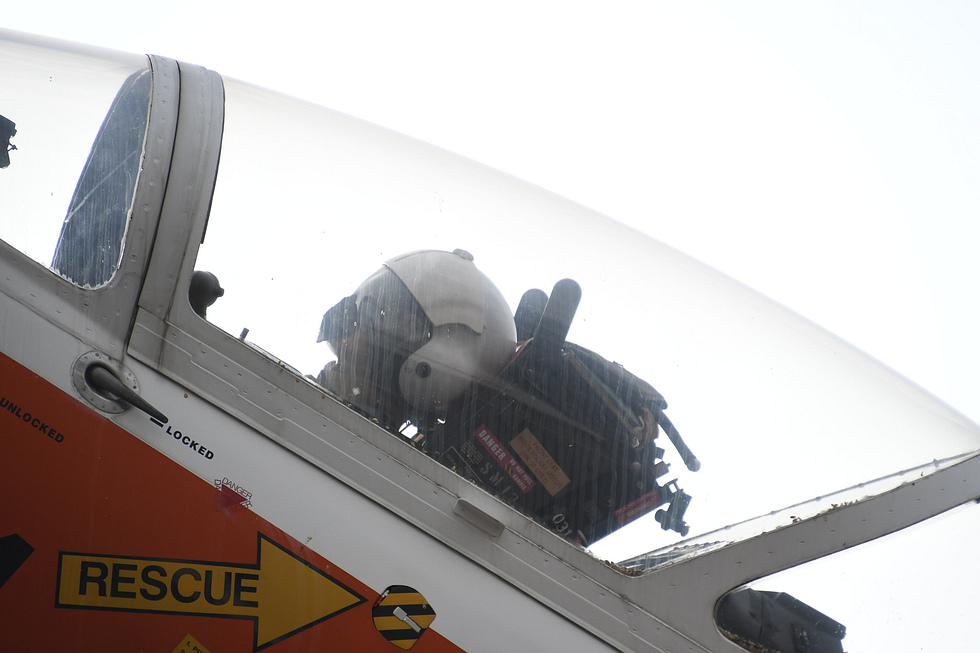
A raised rear seat under a single-piece panoramic canopy gives the instructor — and the MiGFlug passenger — excellent forward visibility. The light Kevlar / Nomex / carbon-fibre airframe and relatively modern avionics kept weight and complexity down for the era.
02The S.211’s economy: why it flew on half the fuel of an L-39
The Pratt & Whitney Canada JT15D is the S.211’s secret weapon. It is a small, efficient business-jet-class turbofan rather than a thirsty military turbojet, and owners quote L-39-like performance at roughly half the fuel flow. Those economics are exactly what turned a military castoff into a genuinely ownable warbird — and what keeps a passenger flight in one commercially viable today. Self-contained ground starting, no support cart and modest running costs make it about as practical as a real jet gets.
03The S.211’s cockpit: the best seat in a small jet
The stepped tandem layout under a one-piece bubble canopy gives the rear occupant a genuinely panoramic view — the raised aft seat looks over the front one rather than into the back of a headrest. It is a big reason instructors, and paying passengers, rate the S.211’s cockpit so highly: from the back seat you get an almost fighter-like sense of sitting on top of the aircraft, with the alps wrapping around the canopy on every side.
Full S.211 specifications
Airframe & Performance
- Bemanning
- 2 (tandem, stepped)
- Lengte
- 9.31 m (30 ft 6 in)
- Spanwijdte
- 8.43 m (27 ft 8 in)
- Hoogte
- 3.80 m (12 ft 6 in)
- Leeggewicht
- ~1,850 kg (4,079 lb)
- Max takeoff weight
- ~2,750 kg (6,063 lb)
- Max speed
- ~667 km/h (414 mph) · subsonic
- Serviceplafond
- ~12,200 m (40,000 ft)
- Bereik
- ~1,670 km (900 nm)
- Belastingslimieten
- +6 g / −3 g
Propulsion & Systems
- Motor
- 1 × P&W Canada JT15D-4C turbofan
- Thrust
- 11.1 kN / 2,500 lbf
- Klimsnelheid
- ~21 m/s (4,200 ft/min)
- Hardpoints
- 4 underwing (+ optional centreline)
- Bewapening
- Up to ~660 kg gun/rocket pods, bombs
- First flight
- 10 April 1981 (I-SITF)
- Built
- ~60 (c. 1981–1990s)
- Unit cost
- Ex-military examples ~a few hundred thousand USD
04The S.211’s cost: what a small modern jet is worth
Historical unit prices for the S.211 are not well documented — it was a low-volume private-venture product sold in small batches to a handful of buyers. On the civilian market the picture is clearer: ex-military examples, mostly ex-Singapore airframes imported to the United States around 2010, have traded for roughly a few hundred thousand US dollars. Combined with the JT15D’s modest fuel burn, that made the S.211 one of the most practical ways for a private pilot to actually own and operate a real jet. Treat any single figure as indicative rather than firm.
Four decades of the S.211
A private venture begins
SIAI-Marchetti starts the S.211 as a private-venture jet trainer, with no government backing.
Unveiled at Paris
The type is shown to the world at the Paris Air Show — a corporate bet on a modern mini-jet.
First flight
The prototype I-SITF makes its maiden flight near Milan.
Singapore launches it
Singapore becomes launch customer with an order for ten aircraft.
Enters service
Singapore deliveries begin; the Philippines and Haiti follow as operators.
Haiti’s four jets
Haiti’s Corps d’Aviation acquires four S.211s — a rare footnote in the type’s history.
Production ends
The line closes after roughly 60 airframes built.
Singapore retires it
The RSAF replaces the S.211 with the Pilatus PC-21.
The warbird market
Ex-Singapore jets enter the US civilian warbird register, refurbished as Experimental-Exhibition aircraft.
Philippine role change
Surviving Philippine S-211s revert to a training-only role after the FA-50 arrives.
From the flight line: twelve S.211 stories
The mini-jet that meant it
SIAI-Marchetti built a full turbofan jet trainer barely 9 metres long.
Read the full story
Singapore’s launch bet
Singapore took the gamble no one else would, ordering ten in 1983.
Read the full story
The Philippine “Warrior”
The Philippine Air Force turned trainers into gunships for jungle counter-insurgency.
Read the full story
America’s bargain jet
After Singapore retired its fleet, ~20 S.211s crossed the Pacific to US owners.
Read the full story
Half the fuel of an L-39
The Pratt & Whitney Canada JT15D is the S.211’s secret weapon.
Read the full story
From S.211 to M-345
Aermacchi never let the concept die — it grew into the M-345 HET.
Read the full story
Fly it yourself over the Alps
MiGFlug puts civilians in the rear seat of an S.211 near Munich.
Read the full story
The best seat in a small jet
The stepped tandem cockpit gives the rear occupant a panoramic view.
Read the full story
A private venture in an air-force world
Unveiled at Paris in 1977 with zero government money behind it.
Read the full story
Four jets and a colourful story
Haiti’s tiny Corps d’Aviation operated four S.211s around 1990.
Read the full story
Aerobatic by design
With +6/−3 g limits and boosted ailerons, the S.211 was fully aerobatic.
Read the full story
The fake Goshawk
Its clean lines make the S.211 an easy stand-in for bigger jets.
Read the full story
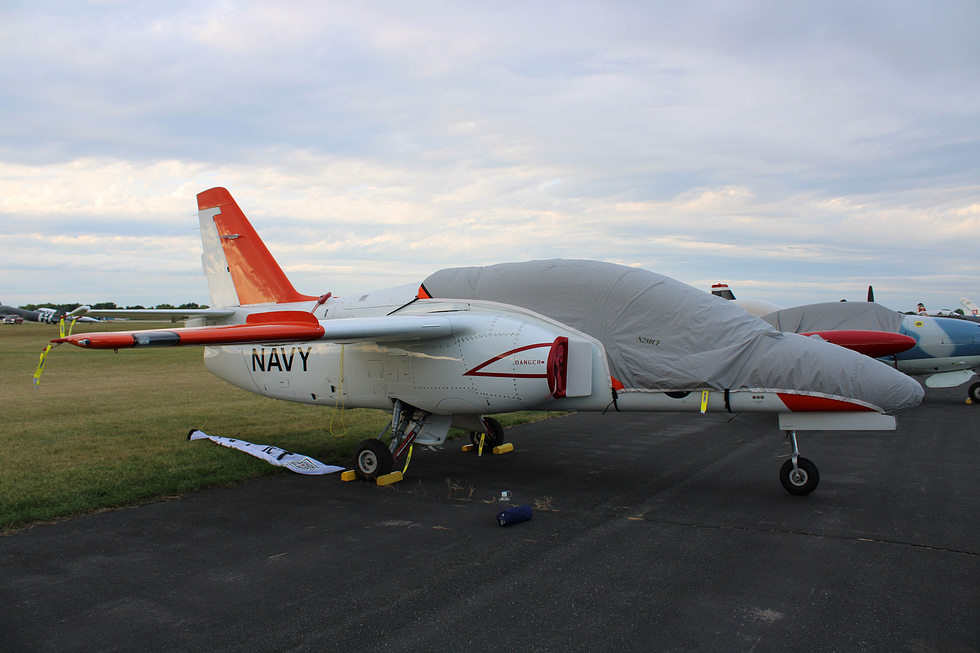
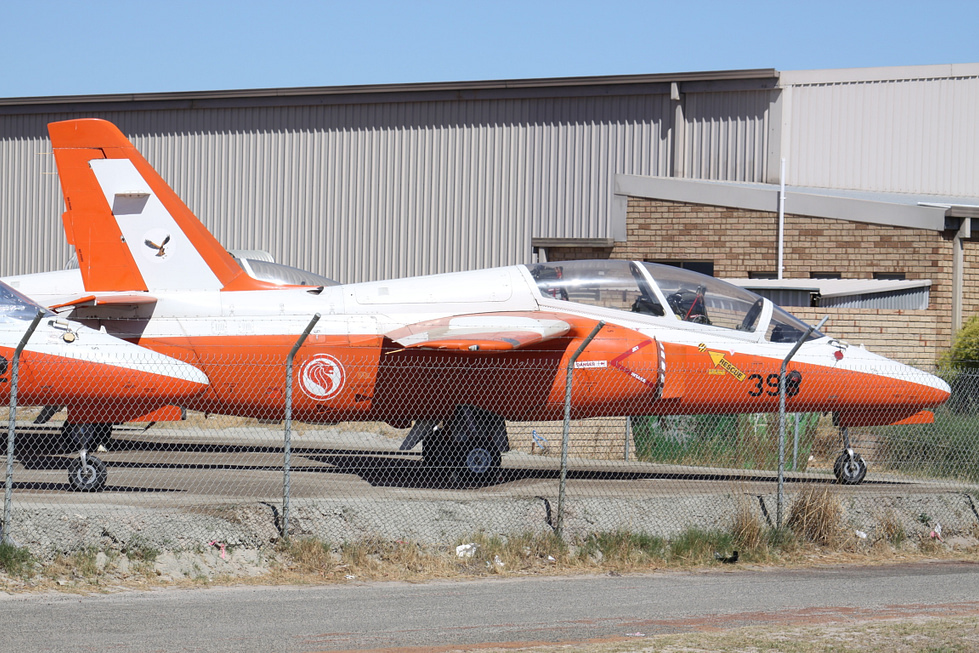
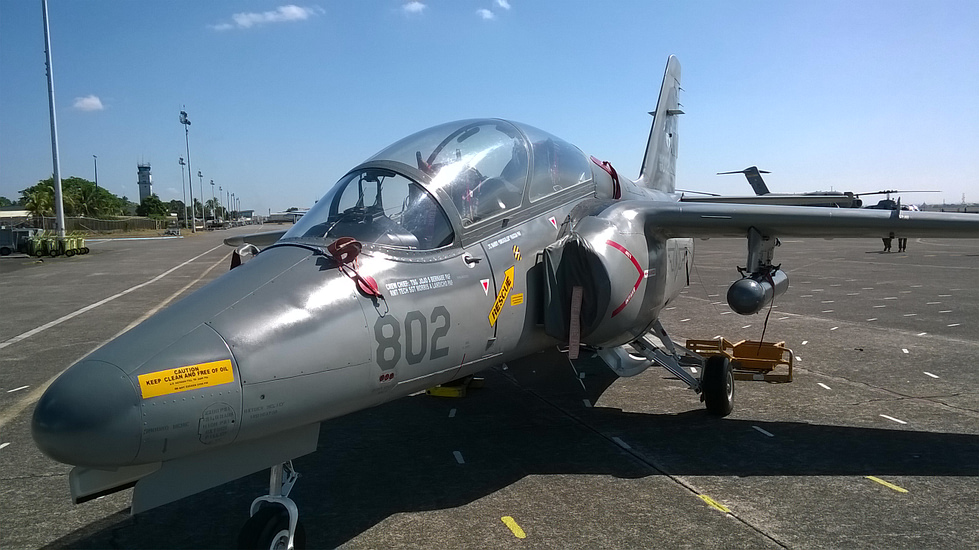
The S.211 in pictures
The S.211 in motion
Video coming soon — we’re curating the best footage of the SIAI-Marchetti S.211 in flight. In the meantime, the fastest way to experience it is from the back seat: fly an S.211 with MiGFlug near Munich.
The S.211 in motion
Skyships Eng — one of the most-watched S.211 films on YouTube.
Where the S.211 flew
A trainer that rarely fired a shot
The S.211 was fundamentally a trainer, and most airframes never fired a shot. The notable exception is the Philippine Air Force, which armed its fleet — redesignated AS-211 “Warrior” — for counter-insurgency and close air support in the southern Philippines, adding belly-mounted .50-calibre gun pods (from ~2005), salvaged F-5 optical sights and upgraded radios. No air-to-air records are associated with the type.
Combat use was limited, low-intensity and confined to the Philippines; figures on sorties and effect are not rigorously documented. Compare the combat record of every military aircraft. Figures as of July 2026.
Everything people ask about the S.211
Can I fly in an S.211?
Is the S.211 fast? Is it supersonic?
Is the S.211 still flyable today?
How many S.211s were built?
Who flew the S.211?
What makes it so economical to fly?
What did the S.211 become?
Jij can actually fly the S.211.
Pick your cockpit.
Some legends only live in museums — others are fuelled and waiting. MiGFlug has put civilians in real military jet cockpits since 2004.
 Fly the L-39 AlbatrosThe world’s most-flown jet trainer — aerobatics included
 Fly the F-104 Starfighter“The missile with a man in it”
 Fly the MiG-21The Cold War’s most-produced jet
 Vlieg met de T-33 Shooting StarAmerica’s first jet trainer
 Fly the DH VampireA piece of early jet history
 Fly the S.211Agile Italian jet trainer
 Fly the MB-326The classic Aermacchi jet
 Fly the MiG-15The Soviet legend of the Korean War
Continue the tour
Every fact, checked
- MiGFlug — S.211 Jet Flight (Munich)The MiGFlug S.211 flight page — prices, experience and booking.
- MiGFlug — SIAI-Marchetti S.211 overviewBackground on the aircraft and the flight experience.
- MilitaryFactory — Alenia Aermacchi S-211Specifications, operators and production overview.
- GlobalMilitary.net — Aermacchi S-211Operators, the Philippine AS-211/FA-50 transition and the M-345 lineage.
- AOPA — “The Italian job” (Pilot, 2018)US civilian warbird fleet, JT15D economy and the owner’s perspective.
- s211jet.com — Development of the S-211Development history, first flight and armament upgrades.
- flugzeuginfo.net — S.211 technical dataIndependent specification cross-check.
- GlobalAir — Marchetti S211 specificationsAirframe and performance data.