
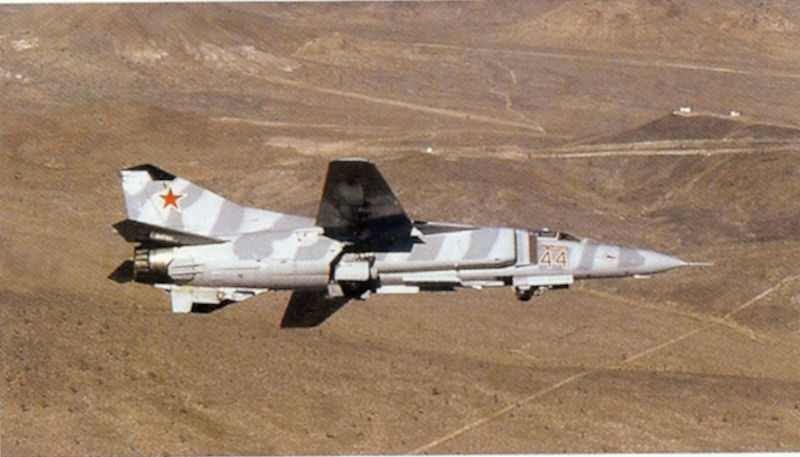
Mikoyan-Gurevich MiG-23
“Flogger”
The Soviet Union’s swing-wing workhorse — a fast, missile-armed interceptor built by the thousand, flown into combat from the Bekaa Valley to the Persian Gulf, and forever remembered for the 1989 “ghost flight” that crossed a continent with no pilot aboard.
The swing-wing that armed the Soviet front line
The MiG-23 was conceived in the early 1960s to fix everything the brilliant but short-legged MiG-21 could not do. Soviet planners wanted three things at once: longer range and endurance, a powerful radar, and a genuine beyond-visual-range (BVR) missile shot — all without giving up the short-field performance Soviet doctrine demanded. The Mikoyan bureau’s answer was a variable-geometry “swing” wing, the same idea then being explored in the West on the F-111 and later the F-14.
The swing-wing prototype, the “23-11,” first flew on 10 April 1967 with test pilot Aleksandr Fedotov. The type entered service around 1970–1971 and, with roughly 5,000+ built (commonly cited as ~5,047) between 1967 and the mid-1980s, became for a decade the single most numerous fighter in Soviet Frontal Aviation — a Mach-2 interceptor deployed in bulk from East Germany to the Far East.
Variants evolved fast: the early MiG-23M with its Sapfir-23 radar, the downgraded MiG-23MS/MF export models, and the definitive lightened MiG-23ML / MLA / MLD family with better handling and avionics. A dedicated ground-attack sibling, the MiG-27, shared the wing and fuselage but adopted a sloped “ducknose,” fixed intakes and a heavier cannon. The Flogger fought almost everywhere — and struggled, repeatedly, against well-flown Western fourth-generation fighters.
01Why the MiG-23 replaced the MiG-21: range, radar and a real BVR missile
The MiG-21 was cheap, fast and beloved, but it was a clear-weather knife-fighter with tiny fuel tanks, a short-range radar and little beyond-visual-range capability. As NATO fielded heavier, radar-and-missile fighters, the Soviet Union needed something that could see and shoot first. The MiG-23 was that aircraft: a bigger fuselage for fuel and a large Sapfir-23 radar, the semi-active R-23/R-24 (AA-7 Apex) BVR missile, and the swing wing to keep short-field performance despite the extra weight.
It was a genuine capability leap for Soviet fighter aviation — the first practical Soviet BVR shot and a rudimentary look-down ability — but it arrived roughly a decade behind the West’s AIM-7 Sparrow, and its radar reliability, look-down/shoot-down and ECM performance lagged its Western contemporaries. The Flogger was a big step forward that was still, in air combat, a step behind.
What makes the MiG-23 special
The three-position swing wing
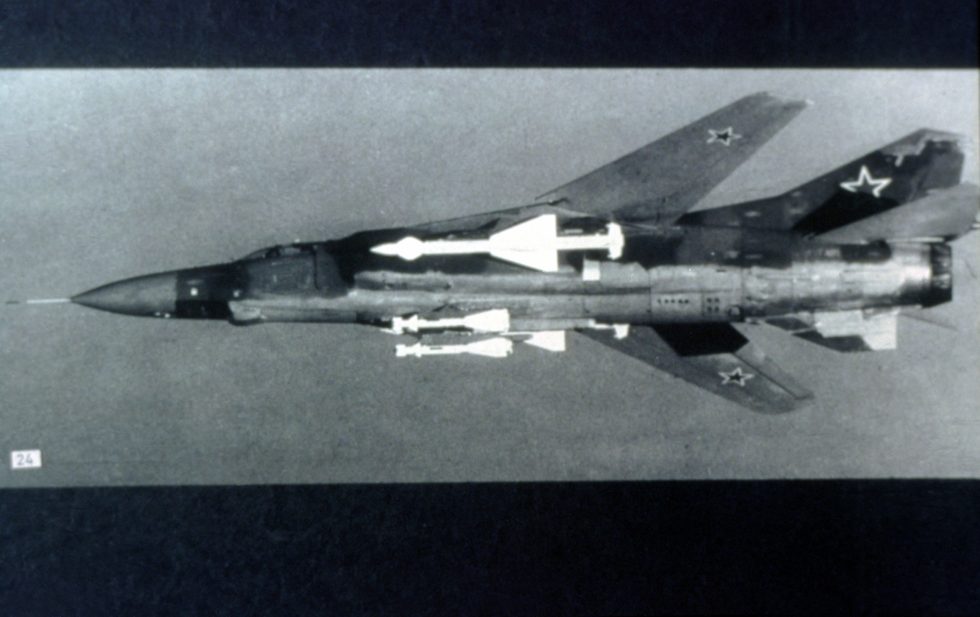
The Flogger’s signature is a manually swept variable-geometry wing with three settings: 16° fully spread for short takeoff, low-speed handling and landing; 45° for cruise and maneuver; and 72° fully swept for a high-speed, low-level dash. It gave one airframe a dual personality the fixed-wing MiG-21 could never match — at the price of weight, complexity and a wing box that demanded careful maintenance.
The big Tumansky R-29 turbojet
A single afterburning R-29-300 (later R-35-300 in the ML/MLD) delivered roughly 83–84 kN dry and ~120–127 kN in afterburner — enough to drive the Flogger past Mach 2 and to haul a heavier radar and BVR missiles than any earlier MiG. That brute straight-line thrust, more than agility, defined how the jet was meant to fight.
The first real Soviet BVR shot
The Sapfir-23 (“High Lark”) radar paired with the semi-active R-23/R-24 (AA-7 Apex) missile gave Soviet pilots their first practical beyond-visual-range capability, backed by a short-range R-60 (AA-8) dogfight missile and a twin-barrel GSh-23L cannon. The capability was real but limited — early reliability, look-down and ECM performance repeatedly showed their age in combat.
02The MiG-23’s swing wing: one jet, three personalities
Variable geometry solves an old aerodynamic conflict: a straight, spread wing is efficient at low speed and short fields, while a sharply swept wing is efficient at supersonic speed. Rather than compromise, the MiG-23 let the pilot pick. At 16° the wing is spread for a short, docile takeoff and landing; at 45° it is a balanced cruise and combat setting; at 72° it is swept hard back for a fast, stable low-level penetration. The cost was mechanical: pivots, actuators and a heavy wing carry-through structure that added weight and maintenance the simple MiG-21 never carried. It made the Flogger genuinely versatile — and genuinely demanding to keep flying.
03Fast, but not forgiving: what pilots said about flying the MiG-23
Test and adversary pilots — including the Americans who secretly flew smuggled Floggers under CONSTANT PEG — consistently praised the MiG-23’s acceleration and top speed while warning about its handling. They described vicious high angle-of-attack behavior, poor cockpit visibility and a heavy control feel. The jet rewarded energy fighting and straight-line speed but punished the low-and-slow turning duel, exactly the fight NATO’s newer, more agile fighters wanted. It was a fighter to be respected and, in the wrong regime, feared by its own pilot.
Full MiG-23 specifications
Baseline note: the figures below describe the Mikoyan-Gurevich MiG-23MLD (factory model 23-18, NATO reporting name Flogger-K) — the last and best single-seat fighter Flogger, powered by the Khachaturov R-35-300 turbojet and carrying the Sapfir-23MLA-II (N008 Ametist) radar. That mark is the right baseline because it is the only one in which the aeroplane finally did what it had been sold as doing since 1969: a strengthened wing pivot, a fourth sweep detent, an angle-of-attack limiter borrowed from the MiG-29 and a radar that could actually look down over broken ground. Deltas for the MiG-23M/MF (Flogger-B), the lightened MiG-23ML (Flogger-G), the ground-attack MiG-23BN (Flogger-H) and the deliberately crippled export MiG-23MS (Flogger-E) are given in grey. One boundary first. The MiG-27 is a separate aircraft with its own page. It shares this aeroplane’s wing and fuselage cross-section and almost nothing else that matters: fixed intakes instead of variable ramps, a short two-position nozzle instead of a fully modulating one, a sloped radarless nose instead of a Sapfir radome, cockpit armour, and a six-barrel GSh-6-30 cannon no MiG-23 ever carried. The MiG-23B and MiG-23BN are attack MiG-23s and belong here; the MiG-27 does not. NATO drew the same line — Flogger-F and -H are MiG-23s, Flogger-D, -J and -J2 are MiG-27s. Four cautions about the numbers. First, sweep. The MiG-23 is universally described as having three wing positions, and the cockpit placards, the manuals and the pilot’s selector detents all say 16°, 45° and 72°. Both halves of that are approximations. The true leading-edge angles on the production Edition 2 and Edition 3 wings are 18°40′, 47°40′ and 74°40′, retained under the old labels for convenience; and the wing is in fact continuously variable anywhere between the stops, with about 30° used for ferry flights. The three positions are detents, not the mechanism’s limits. Second, height. Brassey’s gives 4.82 m for the MLD, but that figure comes from a MiG-23MF drawing; the redesigned ML/MLD main undercarriage changed the aircraft’s sit on the ground and Russian sources give 5.00 m. Third, maximum take-off weight. The English-language specification tables commonly print 17,800 kg for the MLD; that is the MiG-23ML figure. Russian sources and the airwar.ru data give 20,100 kg for the MLD. Fourth, ceiling and climb: Brassey’s gives 18,500 m and 230 m/s, Russian service data 17,700 m and 215 m/s with two R-23s aboard. Where the two traditions disagree, both are shown. Why the wing is swept by hand. The F-111 and the F-14 both schedule sweep automatically, the Tomcat’s central air data computer moving the wings continuously against Mach number so the pilot never thinks about them. The MiG-23 does not. Its wings are driven by an SPK-1 two-channel hydraulic motor turning IP-23 ball-screw jacks, and the pilot moves them with a small lever on the left console beside the throttle, into one of three detents. There is a gauge showing where the wings are and what the Mach limit is for that position; there is nothing telling the pilot which position he ought to be using. Soviet accounts do not spell out the decision, so the reasoning has to be inferred from what the requirement actually was, and it is not hard to see. The MiG-23 was ordered as a replacement for the MiG-21 that could operate from short, rough and bomb-damaged strips and still dash at Mach 2 — variable geometry was bought for field performance and for a supersonic intercept profile that was known before take-off, not for manoeuvring. A GCI-directed point-defence interceptor flies a briefed profile: spread for take-off, mid-sweep for the transit, fully swept for the run-in. An automatic scheduler would have added a computer, sensors and failure modes to an aircraft whose wing box was already a welded steel component that kept cracking, and would have bought nothing the mission profile needed. The same logic produced manual sweep on the Su-17, the Su-24 and the Tu-22M. It was the correct choice for the aeroplane the Soviets thought they were buying, and the wrong one for the dogfight the MiG-23 kept being dragged into, where a pilot at 6 g had one more thing to do with his left hand at exactly the moment he could least afford it. The reputation, stated plainly. The MiG-23 was heavy, unforgiving and disliked. It lost turning fights to the MiG-21 it replaced, which its own pilots found demoralising. American exploitation under HAVE PAD and the Constant Peg programme found that it turned about as well as an unslatted F-4E and that anything newer could out-turn it easily, that it went unstable and departed controlled flight near high angle of attack, that it was unstable in yaw through Mach 1 and again near Mach 2, that its narrow-track undercarriage slid on wet surfaces, and that sitting low it ingested debris. The control column carried a "knuckle rapper" that struck the pilot’s hand as 17° angle of attack approached. Rearward visibility was poor: the KM-1 seat wrapped around the pilot’s head, so checking six meant leaning forward and using a periscope let into the canopy rail. The 4477th Test and Evaluation Squadron nicknamed it the "Looping Hog". Accident rates bear the complaints out — about 12.5 losses per 100,000 flying hours in Soviet service, 24.3 in Hungarian, 20.4 in East German, and roughly half of India’s 70 aircraft written off over 28 years. And yet the same testing concluded that the MiG-23 was a serious threat. It out-accelerated every American fighter below 10,000 ft and through the sound barrier, it was small and hard to see, and with a radar, an infrared search and track, a datalink and the R-23 it could shoot at something it had never laid eyes on. Constant Peg used it to simulate two separate threats: a low-level runner NATO strike aircraft could not escape, and a MiG-25-style high fast flyer coming for the tankers and the E-3s. East German crews, listened to on GCI tapes, knew precisely what they had and planned to overwhelm from many directions at once. It was a bad dogfighter and a good interceptor, and the two judgements are not in conflict. The combat record. It is one of the worst of any major postwar fighter, and the reasons are only partly the aeroplane’s. Syria took the type into action first, on 19 April 1974, when Captain al-Masry claimed two Israeli F-4Es with a MiG-23MS before being shot down by his own side’s surface-to-air missile battery. Over Lebanon in June 1982, against F-15s and F-16s covered by superb electronic warfare and airborne control, Syrian losses were catastrophic: the Russian historian Vladimir Ilyin counts six MiG-23MFs, four MiG-23MSs and fourteen MiG-23BNs lost that month, with 11 to 13 fighter variants lost in air combat between 1982 and 1985; Israel acknowledges losing to Syrian MiG-23s only a BQM-34 Firebee drone, downed by a MiG-23MF on 6 June 1982. Iraq flew Floggers throughout the war with Iran and had a slightly better time of it, claiming about twenty aerial victories of which seven survive cross-checking against Iranian records — including two F-14 Tomcats — while official Iraqi documents admit 38 MiG-23BNs and five interceptors lost, a figure the same documents’ pilot-casualty lists show to be understated. Iraq had 127 MiG-23s on 17 January 1991 and lost 43 of them to all causes in six weeks, eight of those to USAF F-15s. Libya lost two MiG-23s to US Navy F-14As of VF-32 north of Tobruk on 4 January 1989, after three AIM-7 Sparrows missed or failed and a fourth and then an AIM-9 connected; both Libyan pilots ejected into the sea. Soviet MiG-23s in Afghanistan escorted where the MiG-21 lacked the legs, flew about fifteen per cent of their sorties as escort or combat air patrol, and killed two Iranian AH-1J Cobras with R-24Rs in September 1988. Cuban MiG-23MLs over Angola damaged a South African Mirage F1CZ on 27 September 1987 badly enough that its pilot, Captain Arthur Piercy, was paralysed by a ground-level ejection when the aircraft ran off the runway; Cuba claims six victories in total, one confirmed destroyed. UNITA shot MiG-23s down with American Stinger missiles, and South African troops downed one with a 20 mm Ystervark gun over the Calueque dam. Ethiopian MiG-23BNs bombed Eritrean targets, and three were shot down by Eritrean MiG-29s. And the flight nobody was on. On 4 July 1989 a MiG-23M of the 871st Fighter Aviation Regiment took off from Bagicz, near Kołobrzeg in Poland. Forty-one seconds into the climb Colonel Nikolai Skuridin heard a bang from the intake and saw the engine wind down; he reported the failure, was cleared to abandon the aircraft and ejected at around 150 m. Six seconds later the engine recovered. With the wings at minimum sweep and the attitude-hold system doing what it was built to do, the empty MiG-23 climbed to roughly 12,000 m and flew west at about 740 km/h across Poland and East Germany. A pair of USAF F-15s from the 32nd Tactical Fighter Squadron intercepted it over West Germany, found the cockpit empty, and escorted it over the Netherlands and into Belgium without being permitted to shoot it down over populated ground. When the fuel ran out the aircraft glided into a house at 273 Doornikserijksweg in Bellegem, a village belonging to Kortrijk, about 900 km from where its pilot had left it, and killed Wim Delaere, a computer science student of eighteen or nineteen — sources differ — asleep inside. The Soviet Union paid Belgium 685,000 US dollars. The engine fault was never established. It is the most famous thing the MiG-23 ever did, and it did it with nobody aboard.
Dimensions & weights
- Crew
- 1, on a Mikoyan KM-1M ejection seat
- Length
- 16.70 m (54 ft 9 in), including the nose probe
- Wingspan, wings spread
- 13.97 m (45 ft 10 in)
- Wingspan, wings swept
- 7.78 m (25 ft 6 in)
- Height
- 5.00 m (16 ft 5 in); MiG-23M 4.82 m (15 ft 10 in) on the earlier undercarriage
- Wing area, spread
- 37.27 m² (401.2 sq ft)
- Wing area, swept
- 34.16 m² (367.7 sq ft)
- Sweep positions
- 18°40′ / 47°40′ / 74°40′ (placarded 16° / 45° / 72°); MiG-23MLD adds a fourth detent at 33°
- Aspect ratio
- 5.26 spread, 1.48 swept
- Wheelbase / track
- 5.77 m / 2.66 m (18 ft 11 in / 8 ft 9 in)
- Empty weight
- 10,550 kg (23,260 lb); MiG-23M 10,890 kg (24,010 lb)
- Normal take-off weight
- 14,770 kg (32,560 lb); MiG-23M 15,700 kg (34,610 lb)
- Maximum take-off weight
- 20,100 kg (44,310 lb); MiG-23M 18,400 kg (40,570 lb)
- Internal fuel
- about 4,300 L (1,136 US gal), 3,319 kg; the MiG-23M carried roughly 4,090 kg in a fourth fuselage tank the ML deleted
- Maximum external stores
- about 2,000 kg (4,410 lb); MiG-23M and MiG-23BN cleared to 3,000 kg (6,610 lb)
Performance
- Maximum speed, altitude
- 2,500 km/h (1,553 mph, 1,350 kn), Mach 2.35
- Maximum speed, sea level
- 1,400 km/h (870 mph, 756 kn), Mach 1.14; MiG-23M 1,350 km/h (839 mph)
- Cruising speed
- 990 km/h (615 mph, 535 kn)
- Unstick / touchdown speed
- 280 km/h / 250 km/h (174 mph / 155 mph)
- Rate of climb, sea level
- 215 m/s (42,320 ft/min) with two R-23s; Brassey’s gives 230 m/s (45,280 ft/min) clean, the MiG-23M about 222 m/s
- Time to 15,000 m
- 4.3 min from brakes-off, accelerating to Mach 2.1 (MiG-23ML)
- Service ceiling
- 17,700 m (58,070 ft); Brassey’s gives 18,500 m (60,700 ft)
- Combat range
- about 1,450 km (901 mi, 783 nmi) with standard armament and no drop tanks; about 900 km (559 mi) flown at 200 m
- Ferry range
- 2,360 km (1,466 mi, 1,274 nmi) with three 800 L drop tanks
- g limit
- +8.5 below Mach 0.85, +7.5 above the MiG-23M was restricted to 5 g until 1977
- Take-off run / landing roll
- 450 m / 750 m (1,476 ft / 2,461 ft); 880 m (2,887 ft) without the brake parachute
- Wing loading
- 418.6 kg/m² spread, 456.7 kg/m² swept (85.7 / 93.5 lb/sq ft) at normal take-off weight
- Thrust-to-weight
- 0.83 at normal take-off weight; MiG-23M 0.77
- Turn performance
- 16.7°/s instantaneous, 14.1°/s sustained at 1,000 m (MiG-23ML manual); best lift-to-drag ratio 12.1
Propulsion & systems
- Powerplant
- 1 × Khachaturov R-35-300 afterburning turbojet MiG-23M/MF/MS: Tumansky R-29-300; MiG-23BN: R-29B-300 with a shortened low-level nozzle; MiG-23S: R-27F2M-300
- Dry thrust
- 83.9 kN (8,550 kgf, 18,860 lbf); R-29-300 81.4 kN (8,300 kgf)
- Afterburning thrust
- 127.5 kN (13,000 kgf, 28,660 lbf); R-29-300 122.5 kN (12,500 kgf)
- Intakes and nozzle
- Variable two-dimensional side intakes with movable ramps and blow-in doors; fully modulating variable-area nozzle the MiG-27 threw away all three
- Wing-sweep drive
- SPK-1 two-channel hydraulic motor driving IP-23 ball-screw jacks, selected by a lever on the left console beside the throttle; three detents, no automatic scheduling
- Radar
- Sapfir-23MLA-II (N008 Ametist), about 70 km (43 mi) against a bomber-size target MiG-23M: Sapfir-23D; MiG-23ML: Sapfir-23ML; MiG-23MS: an export RP-22SM in a stubby radome, no look-down capability at all
- Infrared search and track
- TP-23M, about 45 km against a bomber and 15 km against a fighter, scanning 60° in azimuth and 15° in elevation deleted entirely on the MiG-23MS
- Sight and weapons control
- ASP-17ML gunsight/head-up display, SUV-2ML weapons system the early ASP-23D showed radar data on a very narrow slice of the combining glass, which is why the type depended so heavily on ground control
- Flight control
- SAU-23-18 three-axis autopilot; SOS-3-4 stick-stop and signals limiter taken from the MiG-29; roll by spoilers and differential tailerons, no ailerons
- Self-protection
- SPO-15L Beryoza radar warning receiver; two 30-round BVP-50-60 upward-firing and two six-round downward-firing chaff and flare dispensers
- Navigation and datalink
- Polyot-21-23 suite with A-321 Klystron radio navigation and automatic landing; Lazur-SML ground-controlled interception datalink
- Escape system
- KM-1M ejection seat, not zero-zero: a minimum of roughly 90 kn was needed for a safe seat
- Engine life
- 450 hours between overhauls on the R-35-300, of which only about 10 could be flown at full military power or in reheat
04How fast is the MiG-23, really? Mach 2.35 versus the “Mach 2.0” label
The MiG-23’s top speed is usually given as around 2,500 km/h at altitude, which works out to roughly Mach 2.35. Some reference pages confusingly label the same aircraft “Mach 2.0,” a figure that is inconsistent with their own quoted 2,500 km/h and appears to reflect a low-altitude or clean-configuration limit. The widely accepted high-altitude figure for the lightened ML is ~Mach 2.35, and that is what we quote here. As with many Soviet-era specifications, published numbers blend the MiG-23M and MiG-23ML across sources, and no credible public unit-cost figure exists for the type at all.
Armament & payload
The MiG-23 gave the Soviet Union a missile its pilots could shoot before they could see
The MiG-21 was a gunfighter with a pair of short-range infrared rounds. The MiG-23 was built around the R-23 (NATO AA-7 Apex), a 222 kg medium-range weapon in semi-active radar and infrared forms, and around the Sapfir radar that could illuminate for it. That combination — a look-down radar, a real beyond-visual-range missile, a datalink taking steering commands from a ground controller and a head-up display — is the whole point of the aeroplane, and in 1974 nothing else in Soviet front-line service had it.
The rounds were not long-legged by later standards. The R-23R reached about 25 km head-on at height and only 14 km down low; the improved R-24 of 1981 stretched that to roughly 35 km with a 35 kg warhead and lock-on-after-launch. What mattered was that a MiG-23 pilot, cued by ground control onto a target he had never seen, could shoot first. Close in he had the R-60, a 44 kg infrared dart carried four or six at a time on twin rails, and a twin-barrel GSh-23L with 200 rounds in a ventral trough. Ground attack was an afterthought on the fighter marks: iron bombs, rocket pods, the radio-command Kh-23, and a single tactical nuclear bomb on a centreline adaptor.
Store carriage is the aeroplane’s one genuinely awkward feature. Two pylons sit under the fixed wing gloves and two under the fuselage; a further pair on the movable outer panels can take drop tanks only, cannot be swung, and must be jettisoned before the wings are swept. That is why sources variously quote five or six hardpoints for the same aircraft, and why a MiG-23 going supersonic arrives with less fuel than its tankage suggests. Clearances differed sharply by mark and customer: the MiG-23MS could fire nothing better than the R-3S and later the R-13M, the MiG-23MF sold outside the Warsaw Pact had degraded radar and no electronic counter-countermeasures, the R-24 was cleared only from 1981 on MLA and MLD airframes, and nuclear carriage was Soviet-only.
Gun
- 1 × Gryazev-Shipunov GSh-23L twin-barrel 23 mm cannon, 200 rounds, in a ventral fairing under the forward fuselage — the same gun on every MiG-23 from the S to the MLD
- Firing the 23 × 115 mm round at roughly 3,000–3,400 rounds per minute, with a muzzle brake and blast deflectors to keep gases out of the intakes
- Aimed through the ASP-23D and later ASP-17ML gunsight/head-up display, with radar ranging
- 2 × UPK-23-250 podded GSh-23L with 250 rounds each, carried on the glove pylons from the MiG-23ML onwards for strafing
- The gun killed: a Soviet PVO MiG-23M downed one of two Iranian CH-47 Chinooks with cannon fire on 21 June 1978 after using missiles on the other
Air-to-air
- 2 × R-23R (semi-active radar) or R-23T (infrared), NATO AA-7 Apex, on the glove pylons — typically one of each, the R-23R to starboard
- 2 × R-24R/T from 1981 on MiG-23MLA and MLD airframes: 243 kg, 35 kg warhead, about 35 km head-on at altitude, lock-on-after-launch
- 4–6 × R-60 / R-60M (AA-8 Aphid) on APU-60-2 twin rails under the fuselage; some late upgrade proposals substituted 4 × R-73 (AA-11 Archer)
- 2–4 × R-13M or R-3S/R-3R (AA-2 Atoll) — the only air-to-air weapons the export MiG-23MS could carry, which is most of why it did so badly over Lebanon
- Cueing came from the Sapfir radar, the TP-23M infrared search and track, or a Lazur datalink command from a ground controller; the MiG-23 was designed to be flown into the shot rather than to hunt on its own
Air-to-surface guided
- 2 × Kh-23 / Kh-23M Grom (AS-7 Kerry), radio-command guided, cleared on MiG-23M airframes from serial 3701 onwards and retained on the ML and MLD
- Kh-23 guidance required the pilot to fly the missile onto the target by eye with a thumb controller while holding a steady run — workable on a range, close to suicidal against defended targets
- The MiG-23BN added the PrNK Sokol-23N sighting system with a laser rangefinder and PBK-3 bombsight, but still no laser designation and no true precision-guided munitions
- No anti-radiation missile was ever integrated on a MiG-23; suppression of enemy air defences was left to the Su-17 and Su-24
- Laser- and television-guided weapons on Floggers belong to the MiG-27K and MiG-27M, which have their own page — not to any MiG-23
Bombs
- Up to 500 kg per hardpoint; about 2,000 kg total on the MiG-23MLD, 3,000 kg on the MiG-23M and the strengthened MiG-23BN
- 4 × FAB-500 or ZAB-500 napalm, 4 × FAB-250, or 16 × FAB-100 on four multiple ejector racks — the standard Afghan load
- 2 × RBK-500 cluster bombs; RBK and napalm loads dominated Ethiopian and Soviet Afghan operations, and drew documented accusations of deliberate attacks on civilians in Eritrea
- 1 × RN-24 (10 kt) or RN-40 (30 kt) tactical nuclear bomb on a centreline adaptor — fitted to all Soviet MiG-23M and later fighter marks, never exported
- After the 1984–85 losses in Afghanistan a minimum release altitude of 3,500 m and then 4,500 m was imposed, which cut losses to zero in 1986 and gutted accuracy at the same time
Rockets
- 4 × UB-16 or UB-32 pods of 57 mm S-5 rockets, the standard Soviet area-suppression weapon of the period
- 2 × B-8M1 twenty-round pods of 80 mm S-8 rockets on the MiG-23MLD, a substantially heavier punch than the S-5
- 2 × S-24B 240 mm heavy rockets fired singly from the glove pylons against point targets
- S-5P variants carried chaff instead of a warhead: a salvo threw up a radar-reflective curtain in front of the aircraft that hung in the air for up to half an hour
- The 4,500 m floor imposed in Afghanistan made unguided rockets unusable altogether, and they were dropped from the mission set there
Pods & other stores
- 3 × 800 L (211 US gal) drop tanks: one on the centreline, two on the movable outer wing panels — the latter only with the wings at 16°, and they must go before the wings sweep
- 2 × UPK-23-250 gun pods on the glove pylons, the MiG-23’s only real strafing enhancement
- BVP-50-60 chaff and flare dispensers, with the MiG-23MLD adding a pair of six-round downward-firing dispensers in the centreline pylon fairing
- SPS-141-series active jamming pods were used by attack Floggers; fighter marks relied on the internal SPO-15L warning receiver and on chaff
- No targeting pod, no reconnaissance pod and no buddy refuelling: the proposed MiG-23R reconnaissance variant was never completed, and the type had no in-flight refuelling capability of any kind
Three typical loadouts
- Air-defence intercept, Soviet PVO, mid-1980s
- 2 × R-24R/T on the glove pylons, 4 × R-60M on twin APU-60-2 rails under the fuselage, one 800 L centreline tank, 200 rounds of 23 mm. Wings at 45° for the transit and cruise, 72° for the run-in, everything driven by Lazur commands from the ground controller.
- Afghanistan close air support, 1986–88
- 2 × FAB-500 or 16 × FAB-100 on four ejector racks, 2 × R-60 for self-defence, wings at 45°, attacking in pairs in a 45-degree dive but releasing no lower than 4,500 m. Accurate enough to hit a village, not accurate enough to hit a compound.
- Ferry or redeployment
- Three 800 L drop tanks, no weapons but the gun, wings held near 30° — a setting that appears on no placard but was the crews’ accepted optimum for range, and the clearest evidence that the "three positions" are detents rather than the mechanism’s limits.
Sourcing caveat: weapon fits are drawn from Yefim Gordon and Alexander Mladenov’s monographs, the English and Russian Wikipedia specification tables and airwar.ru, checked against one another; they disagree at the margins, particularly over hardpoint counts and over whether the outer wing pylons should be counted at all. Missile performance figures are nominal manufacturer envelopes, not what anybody achieved in combat: Syrian, Iraqi and Libyan MiG-23 crews fired R-23s and R-24s in numbers and hit very little with them, for reasons that had at least as much to do with training, maintenance and Israeli and American electronic countermeasures as with the rounds themselves.
Variants
Mikoyan built roughly 5,000 Floggers, and spent fifteen years fixing the first one
The MiG-23 is the rare combat aircraft whose development history is essentially a repair log. The 1969 MiG-23S was dangerous at high angle of attack, prone to spinning, and cracked between the centre fuselage and the wings; the Edition 1971 wing added area and a dogtooth but deleted the leading-edge slats and made the handling worse; the MiG-23M put the slats back and gave the type a usable radar, then had to be restricted to 5 g until 1977 because the welded steel No. 2 fuel tank — which is also the wing carry-through box — kept developing hairline cracks and leaking. Only with the MiG-23ML of 1975, which threw away 1,250 kg by deleting a fuel tank and a dorsal fin extension and strengthened the wing pivot, did the aeroplane become something a squadron could fly hard.
The export policy is worth stating plainly because it shaped the combat record. Moscow sold three grades of Flogger: near-Soviet-standard aircraft to the Warsaw Pact, a degraded version of the same mark to trusted third-world customers, and to everyone else the MiG-23MS — a MiG-23 airframe with MiG-21 avionics, a stubby export radar, no infrared search and track, and no beyond-visual-range missile at all. Syria, Iraq, Egypt and Libya all received MS aircraft first. When Syrian MiG-23s met Israeli F-15s and F-16s over Lebanon in June 1982, a large fraction of them were aircraft that could not shoot at anything they could not see, flown by crews who had been given no technical documentation worth the name.
Production ran from 1968 to 1985 at two plants. Znamya Truda in Moscow built 4,256 single-seaters; Irkutsk built 1,008 MiG-23UB two-seaters, giving a Russian total of about 5,264, against the 5,047 usually printed in English sources. Either way the MiG-23 is one of the most numerous supersonic aircraft ever built, and it was never licence-produced abroad — India assembled the MiG-27M as the Bahadur, but that is a different aeroplane on a different page.
- MiG-23S (Flogger-A, 1969–71, about 60 built)
- First production mark, fitted with the MiG-21’s RP-22SM radar because the Sapfir-23 was late; withdrawn after brief front-line service when testing exposed spin behaviour, cracking and fatal accidents.
- MiG-23 Edition 1971 (Flogger-A, 1971, about 80 built)
- First with the Sapfir-23L radar, TP-23 infrared search and track and the R-23R missile; new Edition 2 wing with 20 per cent more area and a dogtooth but no slats, which made an already awkward aeroplane worse. Relegated to training in 1978.
- MiG-23M (Flogger-B, 1972–78, about 1,300 built)
- The definitive first generation and the most-produced fighter mark: Sapfir-23D with genuine look-down/shoot-down, R-23 and R-60, the R-29-300 engine, slats restored on the Edition 3 wing, and plumbed wing pylons for 800 L tanks.
- MiG-23MF (Flogger-B, export, 1978–83)
- Export MiG-23M in two grades: a near-identical Warsaw Pact version, and a third-world version with the radar redesignated Sapfir-23E, no electronic counter-countermeasures, weaker radios and, until 1981, R-13M instead of R-60.
- MiG-23MS (Flogger-E, 1973–78; 54 to Syria, 54 to Libya, 18 to Iraq, 8 to Egypt)
- The deliberate downgrade: MiG-23M airframe and engine with the MiG-21S weapons system, a short-nosed export RP-22SM radar, no infrared search and track and no radar-guided missile. Its radar was notoriously easy to jam, and Israeli crews did exactly that.
- MiG-23ML / MiG-23MLA (Flogger-G, 1976–83, more than 1,100 built)
- The redesign that made the type work: 1,250 kg lighter, cleaner aerodynamically, stronger wing pivot, R-35-300 engine, 8.5 g cleared, Sapfir-23ML and then the better MLA radar, and from 1981 the R-24. Mikoyan assessed it as about 20 per cent more combat-effective than the MiG-23M.
- MiG-23P (Flogger-G, 1978–81, about 500 built, never exported)
- Specialised air-defence interceptor for the PVO with the Sapfir-23P radar and a digital autopilot that let ground controllers fly the aircraft to the firing point; the pilot handled only throttle and weapons. The last MiG-23 in Russian service, retired on 1 May 1998.
- MiG-23MLD (Flogger-K, 1982–85; 560 Soviet conversions, 66 new-build for export)
- The final fighter: vortex generators on the pitot boom and wing roots, a MiG-29 stick-stop limiter, a fourth 33° sweep detent, the Sapfir-23MLA-II radar and much better countermeasures. No Soviet MLD was new-built — all were reworked ML/MLA airframes — while Bulgaria took 16 and Syria 50 new-build examples that lacked the Soviet aerodynamic refinements.
- MiG-23B / MiG-23BN (Flogger-F and -H, 1971–85, 624 built)
- The attack MiG-23: flat tapered nose with the PrNK Sokol-23 sight system and laser rangefinder instead of radar, armoured windscreen, raised seat, inert-gas fuel system, 3,000 kg of stores. The B used the Lyulka AL-21F and was capped at 24 aircraft because Sukhoi needed the engine; the BN reverted to the R-29B-300 and became the most exported Flogger of all.
- MiG-23UB / MiG-23UM (Flogger-C, 1970–85, 1,008 built at Irkutsk)
- Two-seat trainer with a raised rear cockpit and, on most airframes, ballast under a metal fairing where the radar should be. Used in Afghanistan for strike, reconnaissance and as an improvised airborne controller — the back-seater directing a strike package, a practice the crews called "I am my own AWACS". 251 were reworked as MiG-23UMs from 1984.
Closing caveat: the Soviet Union stopped short of the upgrades that might have kept the type competitive. The MiG-23-98 package offered in the late 1990s — new radar, helmet-mounted sight, R-27, R-73 and R-77 — was priced at about a million US dollars per aircraft and found no buyer beyond a limited Angolan proposal. Retirement was fast where money existed: Hungary 1996, Czech Republic and Russia 1998, Poland 1999, Romania 2000, Bulgaria 2002–04, India 2009. The MiG-27 is a separate aircraft with a separate page and its own retirement history, and should not be counted in any MiG-23 total. Two-seat MiG-23UBs survive on the Western warbird circuit in small numbers; one crashed at an airshow at Willow Run, Michigan, on 13 August 2023 after both crew ejected, damaging cars but injuring nobody.
Operators today
North Korea flies more than half of the world’s surviving MiG-23s
The Flogger has almost finished leaving service. Russia retired the last MiG-23P on 1 May 1998; the European operators were gone by 2004 and India by 2009. What is left is a short list of air forces for which a supersonic aircraft of any kind is a strategic asset, and where the airframes have been kept alive by cannibalisation, Belarusian and Ukrainian spares, and in Sudan’s case by hauling jets out of twenty years of storage and rebuilding them locally.
Three names that appear on most published lists are deliberately absent here. Syria was the largest MiG-23 operator in the world as recently as December 2024, with 87 on strength; the Assad government fell that month, Israel destroyed at least 60 MiG-23s in Operation Bashan Arrow, and FlightGlobal removed the entire Syrian inventory from its 2026 directory. There is no honest number to print. Cuba still shows 24 airframes on paper, but the same directory marks all of them non-operational, and Cuban sources have described only three as flyable as long ago as 2011. Zimbabwe, whose MiG-23s were a gift from Gaddafi, listed three in December 2024 and retired the type in 2025.
These are estimates, current to FlightGlobal’s World Air Forces 2026 directory, published December 2025 and reflecting inventories at the end of 2025; checked 3 September 2026. North Korea’s 56 are MF, MS and ML variants concentrated at Pukchang and are the most modern fighters it has after its small MiG-29 force; Angola’s 22 are MiG-23ML and UB, some supplied second-hand by Belarus; Ethiopia’s 9 are MiG-23BN attack aircraft, one of which was reportedly lost over Tigray in November 2020; Sudan’s 4 are MiG-23MS with one two-seater, refurbished from storage from 2010 onwards with Russian, Belarusian and Ethiopian help. Libya’s figure is the least reliable on the page: the aircraft are split between rival governments, the IISS Military Balance 2024 counted two MiG-23BN with the Government of National Unity and two MiG-23ML with the Libyan National Army, and individual airframes have been rebuilt from the wings of two or three wrecks. Many airframes counted on paper anywhere on this list are stored, cannibalised or unflyable. Sources: IISS The Military Balance and FlightGlobal World Air Forces; entries that could not be corroborated are omitted.
The MiG-23 Flogger through the years
The requirement
Soviet planners issue a requirement for a longer-ranged, radar- and BVR-capable successor to the MiG-21.
First flight
The swing-wing “23-11” prototype flies for the first time, piloted by Aleksandr Fedotov.
Enters service
The MiG-23 is introduced and enters Soviet Frontal Aviation as a swing-wing interceptor.
The definitive MiG-23M
The MiG-23M (Flogger-B) with the Sapfir-23 radar enters mass production.
The MiG-27 is born
A dedicated ground-attack derivative, the MiG-27, is developed from the same swing wing and fuselage.
The ultimate Floggers
The lightened MiG-23ML/MLA/MLD family is produced; production winds down around 1985.
The Iran–Iraq War
Iraqi Floggers fly the type’s busiest combat, downing Iranian F-4s, F-5s and at least one F-14.
Bekaa Valley
Israel devastates Syria’s air arm; roughly ten Syrian MiG-23s are lost in the fighting.
The “ghost flight”
A pilotless MiG-23M crosses ~900 km of Europe on autopilot and crashes fatally into a Belgian farmhouse.
From the flight line: twelve Flogger stories
The three-position wing
One jet, three personalities — hand-selected in the cockpit.
Read the full story
The ghost flight of 1989
A fighter with no pilot crosses a continent and kills a stranger.
Read the full story
Bekaa Valley reckoning
The Flogger meets the F-15 and F-16 — and comes off worst.
Read the full story
Top guns of the Persian Gulf
Iraq’s busiest fighter, through eight years of war.
Read the full story
Warbird survivors
A few Floggers still fly — privately, not for hire.
Read the full story
The MiG-27 sibling
Same wing, different mission — the Flogger turned mud-mover.
Read the full story
The first real Soviet BVR shot
Beyond visual range, at last — a decade behind the West.
Read the full story
Red star over Nevada
America’s clandestine Floggers flew out of Tonopah.
Read the full story
Fast, but not forgiving
A pilot’s-hands-full fighter that punished mistakes.
Read the full story
The Cold War’s everywhere fighter
From Havana to Pyongyang, the Flogger flew for two dozen air forces.
Read the full story
Libya’s Floggers versus the US Navy
Confrontation over the Mediterranean in the 1980s.
Read the full story
Backbone of Frontal Aviation
For a decade, the single most numerous fighter in Soviet service.
Read the full story
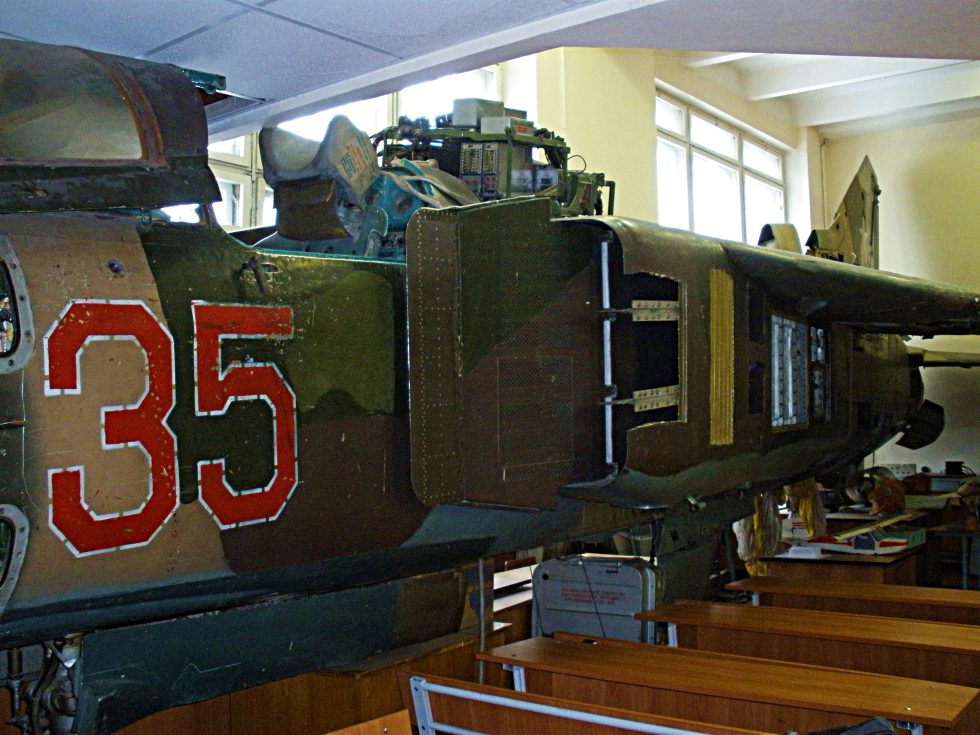
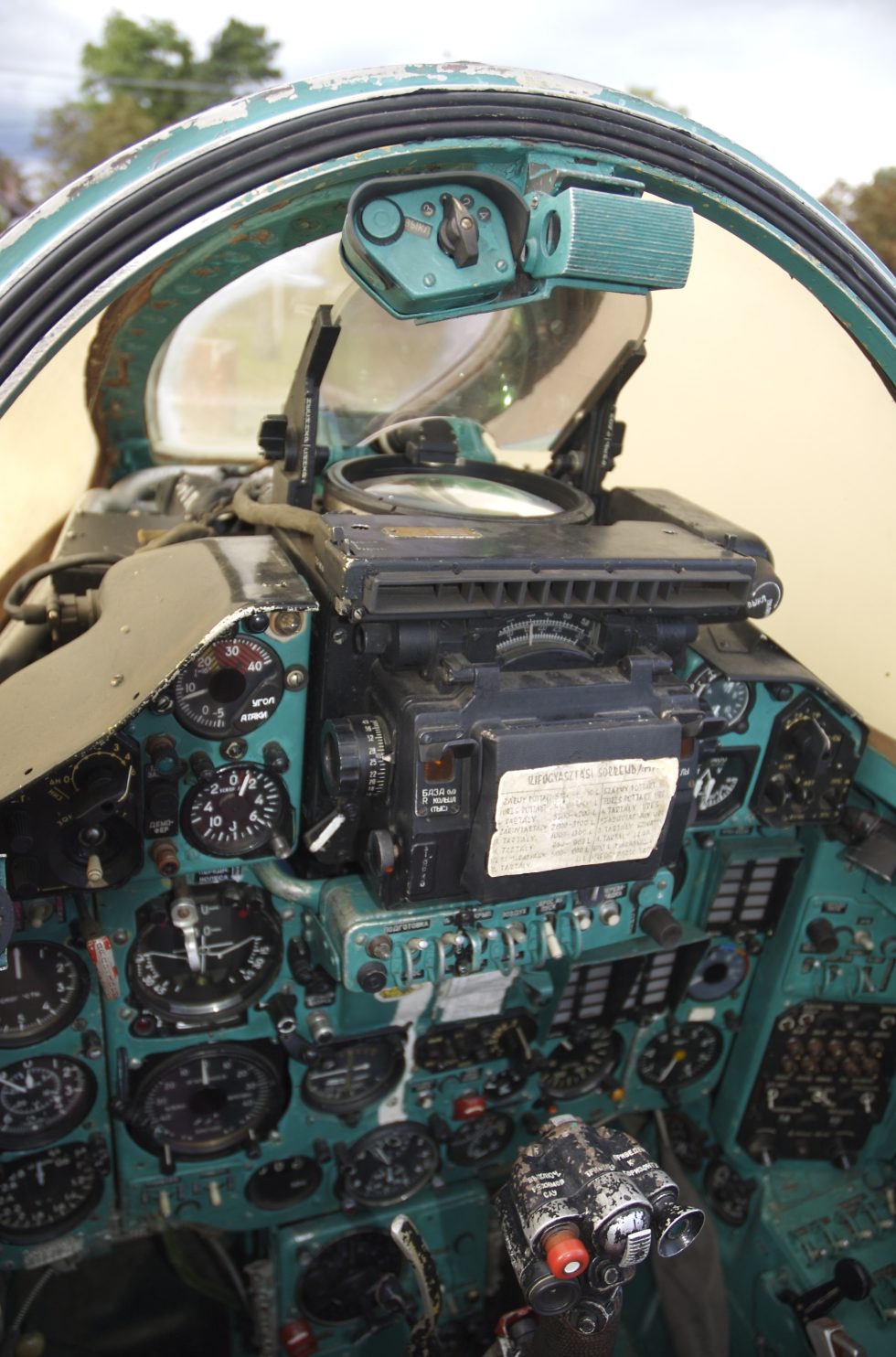
The MiG-23 Flogger in pictures
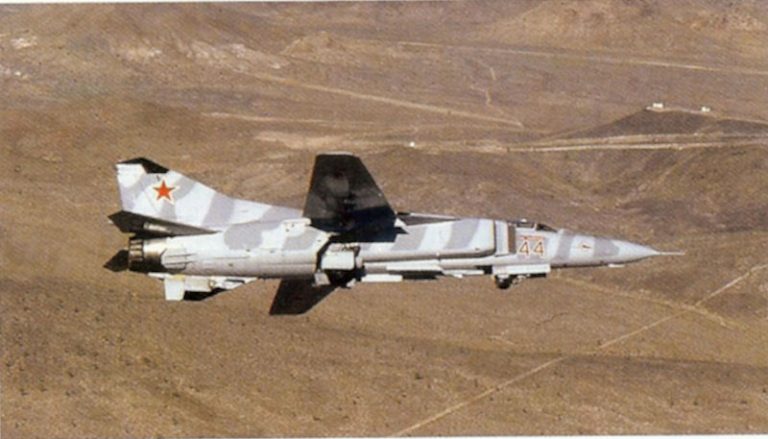
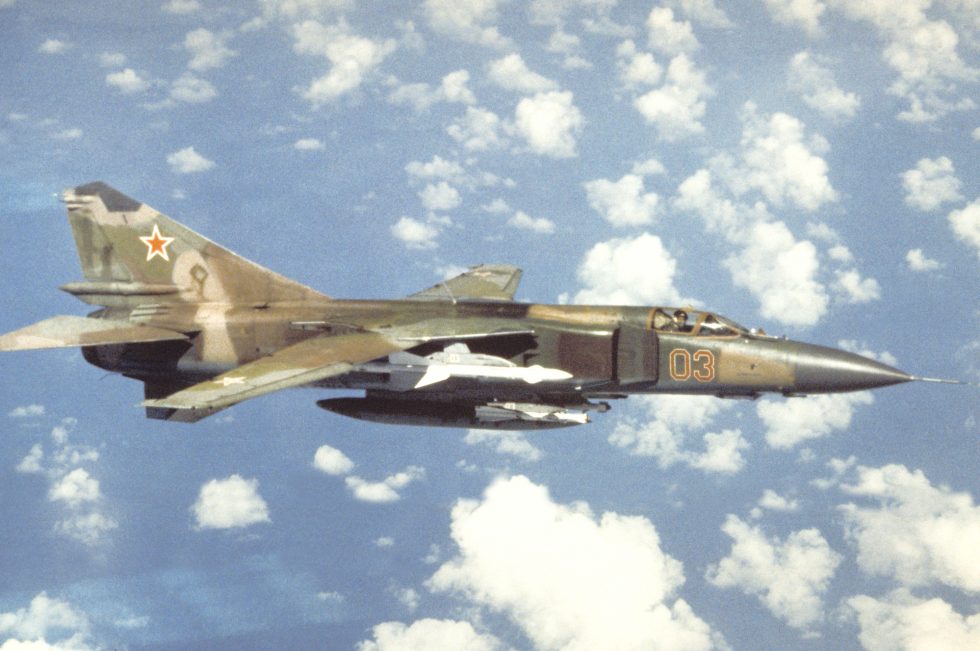
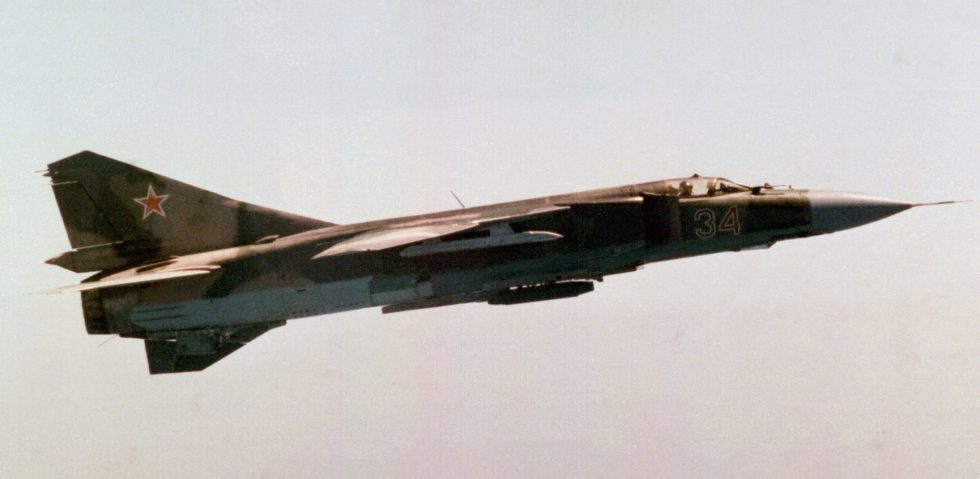
The MiG-23 Flogger in motion
A verified MiG-23 video is coming soon.
The MiG-23 Flogger in motion
Wings Over the Rockies Air & Space Museum — one of the most-watched MiG-23 Flogger films on YouTube.
Where the Flogger flew
One of the most combat-tested Soviet jets
The MiG-23 saw more combat than almost any other Soviet-era fighter — but its air-to-air record is fiercely contested, and every kill and loss total below should be read as a claim, not a settled score. What is beyond dispute is the sheer breadth of its fighting career, from the Bekaa Valley to the Persian Gulf, Angola, Libya and Syria.
Compare the combat record of every military aircraft. Figures as of July 2026 and widely contested.
Everything people ask about the MiG-23
Can I fly in a MiG-23?
How fast is the MiG-23?
What is the swing wing for?
Is the MiG-23 still in service?
How does the MiG-23 compare to the F-16 or F-15?
How many MiG-23s were built?
How is the MiG-23 related to the MiG-27?
You can’t fly the MiG-23.
These, you can.
Some legends only live in museums — others are fuelled and waiting. MiGFlug has put civilians in real military jet cockpits since 2004.
 Fly the L-39 AlbatrosThe world’s most-flown jet trainer — aerobatics included
 Fly the F-104 Starfighter“The missile with a man in it”
 Fly the MiG-21The Cold War’s most-produced jet
 Fly the T-33 Shooting StarAmerica’s first jet trainer
 Fly the DH VampireA piece of early jet history
 Fly the S.211Agile Italian jet trainer
 Fly the MB-326The classic Aermacchi jet
 Fly the MiG-15The Soviet legend of the Korean War
Continue the tour
Every fact, checked
- Military Factory — Mikoyan-Gurevich MiG-23Specifications, variants and production overview for the Flogger family.
- GlobalMilitary.net — MiG-23 FloggerCombat aircraft specs and current-operator estimates (2026).
- flugzeuginfo.net — MiG-23 technical dataIndependent specification and performance cross-check.
- War History Online — The 1989 unmanned MiG-23MThe pilotless Flogger that flew across Europe and crashed in Belgium.
- Russia Beyond — The Belgian ghost-flight crashRussian-side account of the 1989 accident and its aftermath.
- MiG-23 Flogger site — Combat over the Persian GulfDedicated enthusiast history of Iraqi and Syrian Flogger combat.
- The Aviation Geek Club — Bekaa Valley 1982The Israeli air battles that inflicted heavy Syrian MiG-23 losses.
- MiGFlug — Fighter jet flights & pricesThe jets you actually can fly today (no MiG-23 offered).