
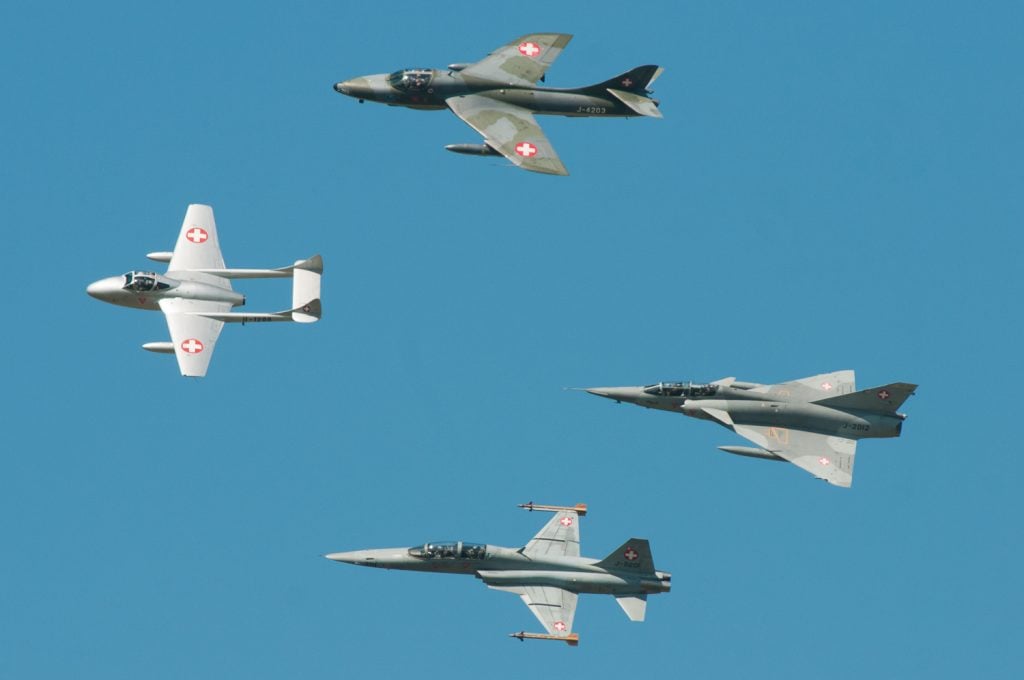
de Havilland DH.100
“Vampire”
Britain’s second jet fighter — the graceful twin-boom pioneer that made the first jet carrier landing, the first jet crossing of the Atlantic and a world altitude record, then taught the world to fly jets. Eighty years on it is one of the very few genuine 1940s jets a civilian can still fly.
The twin-boom pioneer
The de Havilland Vampire is the graceful twin-boom pioneer that bridged the piston and jet ages. Designed under Geoffrey de Havilland’s team from 1941 and first flown on 20 September 1943, it followed the Gloster Meteor into service as Britain’s second jet fighter — entering the RAF in 1946, too late for the Second World War.
Small, simple and forgiving, it rewrote the record books almost as a sideline. On 3 December 1945 a Sea Vampire flown by Lieutenant-Commander Eric “Winkle” Brown landed on HMS Ocean — the first jet ever to land on a carrier. In July 1948 six RAF Vampires became the first jet aircraft to cross the Atlantic, and in March 1948 John Cunningham took one to a world altitude record of 59,446 ft.
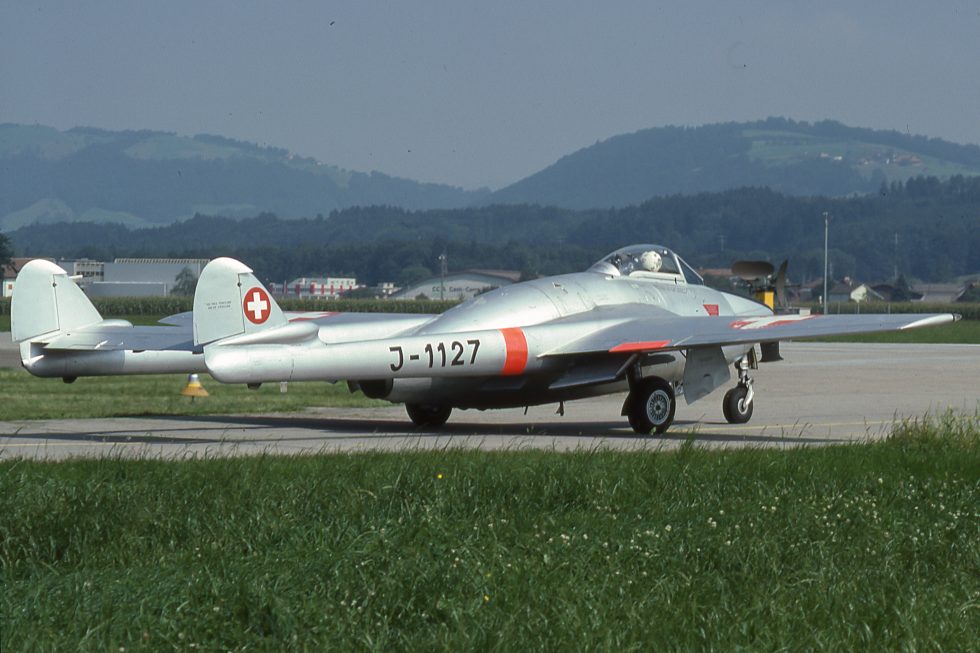
Built in the thousands and licence-produced on four continents — in France, Switzerland, Australia, India and Italy — the Vampire and its two-seat T.11 trainer taught the world to fly jets, from Britain and Sweden to India and Switzerland, which flew the type until 1990. Eighty years on, that same docile little jet is one of the very few genuine 1940s fighters civilians can still fly today — with MiGFlug.
01The Vampire’s twin booms: why de Havilland split the tail
The Vampire’s defining feature was its twin-boom layout. Early turbojets were weak, and a long jet-pipe wasted precious thrust. By mounting the single de Havilland Goblin engine centrally and carrying the tail on two slim booms, de Havilland kept the exhaust pipe short and straight — minimising thrust losses from the low-power engine.
The by-product was one of aviation’s most recognisable silhouettes: instantly “the Vampire” to anyone who sees it. The stubby fuselage nacelle used a mixed wood-and-metal construction — a plywood-and-balsa pod drawing directly on de Havilland’s Mosquito heritage — married to metal booms and wings.
What makes the Vampire special
Twin-boom layout for jet efficiency
With only a weak early turbojet available, de Havilland mounted the Goblin centrally and carried the tail on twin booms, keeping the exhaust pipe short and straight to preserve precious thrust. The solution also gave the Vampire its unmistakable silhouette — the shape that says “Vampire” at a glance.
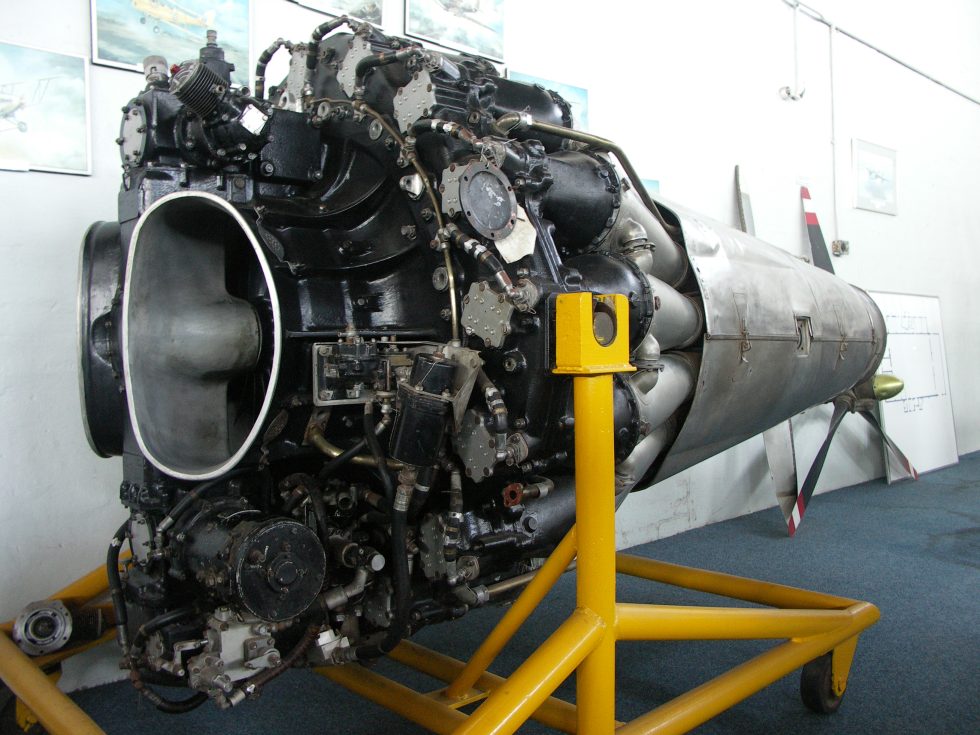
The de Havilland Goblin turbojet
Frank Halford’s robust, single-stage centrifugal-flow Goblin (~3,100–3,350 lbf) was simpler and more reliable than early axial designs — the same basic engine family that also helped launch America’s first jets — and made the Vampire practical to build and maintain in the 1940s.
Wood-and-metal — and docile handling
A plywood-skinned nacelle inherited from the Mosquito saved strategic metal and weight. The result is a light, honest, aerobatic aircraft with gentle manners — exactly why the Vampire remains a favourite warbird and is well suited to civilian passenger flights today.
02The Vampire’s wooden nose: a jet built like a Mosquito
The Vampire’s fuselage pod used a plywood-and-balsa sandwich lifted straight from de Havilland’s wooden wonder, the Mosquito. It saved scarce aluminium and weight, and it meant a cutting-edge jet fighter was, in part, built like a WWII bomber — furniture-makers and cabinet shops among its subcontractors. The mixed construction kept the airframe light, which is one reason the Vampire is such an honest, aerobatic machine to fly.
03The Vampire’s “firsts”: carrier, Atlantic and altitude
For a modest little fighter, the Vampire holds an outsized place in the record books. On 3 December 1945 a Sea Vampire made the first-ever jet landing on an aircraft carrier, HMS Ocean. In March 1948 John Cunningham set a world altitude record of 59,446 ft (18,119 m). And in July 1948 six RAF Vampires island-hopped from Britain to Canada to become the first jets to cross the Atlantic — proving the short-legged early jet could be a strategic aircraft, not just a point defender.
Full specifications
Baseline note: the figures below describe the single-seat Vampire FB.5 with the de Havilland Goblin 2 — the clipped-wing fighter-bomber built in larger numbers than any other mark, and the aeroplane most people mean when they say Vampire. Deltas for the long-span F.1 and F.3 fighters, for the side-by-side T.11 and export T.55 trainers, for the naval Sea Vampire, and for the Swiss and Swedish licence aircraft are in grey. Three warnings before the numbers. First, the engine. The FB.5 was a Goblin 2 aeroplane of 13.8 kN (3,100 lbf), and that is what its operating documents say; several widely copied specification tables, Wikipedia’s among them, credit the FB.5 with the 14.9 kN (3,350 lbf) Goblin 3, which properly belongs to the tropicalised FB.9 and the export FB.6. Second, the performance figures are genuinely unsettled. The famous 548 mph is quoted by different authorities at sea level and at 12,200 m, where it would imply about Mach 0.83 and so cannot be right for an aeroplane with a compressibility limit near Mach 0.78; service ceiling appears as 40,000 ft, 42,800 ft and 44,000 ft in sources of equal standing. Third, production. The number 3,268 is repeated everywhere as the world total, but it is in fact the British-built total; add roughly 1,100 built abroad under licence and the true figure is nearer 4,400, with some compilations going past 4,500. Treat any single Vampire production number as an approximation.
Dimensions & weights
- Crew
- 1 — the DH.115 trainers (T.11, Sea Vampire T.22, export T.55, Australian T.33/T.34/T.35) and the DH.113 NF.10 night fighter seated two side by side, slightly staggered, in a widened nacelle. Side-by-side seating was deliberate: de Havilland argued that an instructor who can see the pupil’s hands teaches faster than one sitting behind him, and the T.11 was the first advanced jet trainer built that way
- Length
- 9.37 m (30 ft 9 in). The two-seat T.11 and T.55 are much longer at 10.50 m (34 ft 7 in) because the nacelle was stretched as well as widened; the NF.10 night fighter added a further radar nose on top of that
- Wingspan
- 11.58 m (38 ft 0 in). The FB.5 lost 30 cm (1 ft) of span against the F.1 and F.3, which measured 12.19 m (40 ft 0 in) — clipping the tips raised the permissible weights and stiffened the wing for ground attack at the cost of climb and ceiling. The record-breaking F.1 flown by John Cunningham in 1948 went the other way and grew extended tips
- Height
- 2.69 m (8 ft 10 in) over the fins. The T.11 sits lower on some published tables at 2.0 m (6 ft 7 in), a figure that appears to be measured to the canopy rather than the tail
- Wing area
- 24.34 m² (262 sq ft) on the FB.5; 24.7 m² (266 sq ft) on the long-span F.1 and F.3. Small by any standard — the whole aeroplane was conceived as the least airframe that would carry a Halford H.1 and four cannon
- Aspect ratio
- 5.5 on the FB.5, 6.0 on the F.1 and F.3. Low aspect ratio and a small wing are why the Vampire turned well and climbed indifferently
- Wing thickness/chord ratio
- 14 per cent — the number that governs everything else about the aeroplane. A wing this thick is a superb structure and a superb lifting surface at 300 kn and a wall at 500. De Havilland’s answer was to thin it to 10 per cent and fit the bigger Ghost engine, which produced the DH.112 Venom; that aircraft has its own page here
- Wing planform
- Straight, tapered, unswept — there is no sweepback anywhere on a Vampire. The type was designed in 1942, before German swept-wing research reached Britain, and it was never redrawn
- Empty weight
- 3,304 kg (7,283 lb); other tables give 3,290 kg (7,250 lb), a difference small enough to be equipment fit. The T.11 is quoted around 3,350 kg (7,380 lb)
- Normal loaded weight
- about 4,680 kg (10,320 lb), the weight implied by the widely quoted wing loading of 39.4 lb/sq ft — a clean fighter with full internal fuel and ammunition and no external stores
- Maximum take-off weight
- 5,620 kg (12,390 lb) with tanks, bombs or rockets. The FB.5’s longer-stroke undercarriage exists purely to absorb this figure; the F.3’s legs would not take it
- Wing loading
- 192 kg/m² (39.4 lb/sq ft) at normal loaded weight, rising to 231 kg/m² (47.3 lb/sq ft) at maximum take-off weight. Even loaded it is a light wing loading, which is why the Vampire was a delight to fly and why it bled speed so fast in a hard turn
- Internal fuel
- 1,500 litres (330 imp gal) in the F.3 and later marks, carried in three tanks in each wing plus fuselage tankage. The F.1 held only 918 litres (202 imp gal), and its short legs were the single loudest complaint from the first RAF squadrons; the F.3 exists mainly to fix it
- External fuel
- 2 × 455 litres (100 imp gal) on the outer wing pylons, or the smaller 50 imp gal size. Carrying tanks meant carrying no bombs: the Vampire had two wet pylons and no more, and every combat sortie was a choice between reach and load
Performance
- Maximum speed
- 882 km/h (548 mph, 476 kn) — the most-quoted figure, and best read as a sea-level number. Sources that place it at 12,200 m are almost certainly in error, since 548 mph true at that height is about Mach 0.83 and beyond anything the airframe would tolerate. Some compilations give 915 km/h (570 mph) instead. What is not in dispute is that the Vampire was the first RAF aircraft to exceed 500 mph in service
- Limiting Mach number
- 0.75 to 0.78 — stability and control are good below that; past about Mach 0.8 compressibility produces nose-down trim change and heavy, unhelpful controls. This is the Vampire’s ceiling as a fighter, and no amount of extra thrust would have moved it
- Rate of climb, sea level
- 24.4 m/s (4,800 ft/min) on the FB.5. The F.1 with a Goblin 1 was appreciably worse, and contemporary RAF opinion called the Vampire’s climb sluggish next to the Meteor’s
- Time to height
- 6,100 m (20,000 ft) in about 6.5 minutes — and, for the T.11, 12,200 m (40,000 ft) in about 20 minutes, which gives a fair idea of how thin the performance became at the top of the envelope
- Service ceiling
- 13,000 m (42,800 ft) in the most-cited table, but the honest answer is a range: authorities give 12,200 m (40,000 ft), 13,000 m and 13,400 m (44,000 ft). The pressurised cockpit and the small thick wing both had a say, and hot-day figures in the Middle East were far lower than any of them
- Range
- 1,960 km (1,220 mi) with drop tanks; sources drawing on pilot’s notes give 1,045 nautical miles. The T.11 is quoted at 1,351 km (840 mi). Range on internal fuel alone is not consistently published and is not guessed at here
- Endurance
- about 2 hours with external tanks. Firm figures for internal fuel alone are scarce; the F.1’s reputation for short legs suggests well under an hour of useful patrol at low level
- Stall speed
- 88 kn clean — down to roughly 72 kn with undercarriage and full flap. Low enough for grass strips and short deck runs, and the reason the Vampire remained a viable trainer for two decades after it was useless as a fighter
- Landing distance
- 900 to 1,200 m (3,000 to 4,000 ft) with full flap. There were no airbrakes worth the name on early marks and no thrust reverser anywhere, though SNECMA did demonstrate a reverser on a French FB.5 in 1951
- Take-off performance
- Poor without help — the great weakness of a 3,100 lbf centrifugal engine. Sea Vampires were pleasant on the approach and sluggish off the deck, needing a catapult or a strong wind over the bow, and hot-and-high fields in Africa and India cost the type dearly
- Deck approach speed
- 87 kn (100 mph) — the speed Eric Brown settled on aboard HMS Ocean on 3 December 1945 after flying the first approach at 95 mph and finding it too marginal in the gusts over the round-down
- Handling
- Light, sensitive, highly balanced — a fast-rolling aeroplane that pilots liked immediately, and one whose cockpit was a mess. The fuel gauges could not be read without easing the stick back. The nickname "aerial kiddie car" was affectionate and also accurate
Propulsion & systems
- Engine
- 1 × de Havilland Goblin 2 centrifugal-flow turbojet, 13.8 kN (3,100 lbf). The F.1 began on the Goblin 1 of about 12.0 kN (2,700 lbf); the FB.9 and export FB.6 used the Goblin 3 of 14.9 kN (3,350 lbf); the T.11 and T.55 the Goblin 35 of 15.6 kN (3,500 lbf). Frank Halford designed the engine as the H.1 before de Havilland absorbed his consultancy, and it was deliberately simpler than Whittle’s competing design
- Engine architecture
- Single-sided centrifugal compressor, sixteen combustion chambers, single-stage axial turbine — 2.72 m (107 in) long, 1.27 m (50 in) in diameter, 703 kg (1,550 lb) dry, swallowing 27 kg (60 lb) of air per second. Robust, reliable and a dead end: every fighter engine that mattered after 1950 was axial
- Alternative engine
- Rolls-Royce Nene — fitted to the F.2 prototypes, the Australian F.30 and FB.31, and the French SE.535 Mistral, giving between 20.0 and 22.2 kN (4,500 and 5,000 lbf) depending on mark. The Nene needed far more air than the Goblin, so Nene Vampires grew supplementary "elephant ear" intakes; on the Australian aircraft these first sat on top of the booms and caused three fatal unrecoverable dives before being moved beneath the fuselage
- Licensed engine production
- Sweden, Australia, France — Svenska Flygmotor built the Goblin 2 as the RM1 and the Goblin 3 as the RM1A; Commonwealth Aircraft Corporation built the Nene in Melbourne for the RAAF Vampires; Hispano-Suiza built the Nene in France for the Mistral. Swiss aircraft used British-built Goblins, unlike the Swiss Venoms, whose Ghosts came from Sulzer
- Intake arrangement
- Wing-root intakes feeding a short duct — the shortest practical run from intake to compressor, and one of the reasons the aeroplane made the most of a modest engine. The FB.9 tropicalisation put a Godfrey air-conditioning unit in the starboard root, which is the quickest way to tell an FB.9 from an FB.5 in a photograph
- Structure
- Composite wood and metal — a moulded plywood and balsa sandwich nacelle in the direct Mosquito tradition, bonded and screwed to a metal aft section, with an all-metal wing and all-metal tail booms. Fast to build, quiet, undemanding of light alloy in a period when Britain had little to spare, and unhappy in tropical humidity
- Twin-boom layout
- Chosen for the jet pipe, not the tail — booms let the pipe be kept short, avoiding the thrust loss a long tailpipe in a conventional fuselage would have cost with 1943 engine technology, and lifted the tailplane clear of the exhaust. The Vampire silhouette is an engineering compromise, not a styling choice
- Ejection seat
- None as designed — the single worst feature of the type, shared with the early Venoms. RAF Vampire and NF.10 crews flew without one throughout front-line service. Martin-Baker Mk 3B seats appeared from the 144th T.11 onward, together with a blown canopy and a dorsal fin extension; Switzerland retrofitted Martin-Baker seats to its single-seaters at F+W Emmen from 1960, reducing the canopy glazing to make room
- Cockpit and pressurisation
- Pressurised, and cramped — pressurisation from early in F.1 production, which mattered at 40,000 ft and was more than the first Meteors offered. Swiss pilots before 1960 flew in leather or summer flying caps rather than bone domes, a detail that dates the aeroplane precisely
- Radar and sensors
- None on the fighters — a reflector, later gyro, gunsight and a gun camera. Only the two-seat DH.113 NF.10 night fighter and its NF.54 export version carried radar, the wartime AI Mk 10; the Indian PR.55 conversions carried cameras instead. No Vampire anywhere received a modern fire-control system, which is the sharpest contrast with the Swiss Venoms and their 1970s ballistic computer
- Undercarriage and naval gear
- Retractable tricycle, long-stroke on the FB.5 — the Sea Vampire added a V-shaped arrester hook retracting above the jet pipe, enlarged flaps and air brakes for the approach, and a strengthened structure. The Sea Vampire F.21 went further and had its belly reinforced for undercarriage-up landings on the Royal Navy’s experimental rubber flexible decks
- Production
- about 3,270 built in Britain, plus roughly 1,100 abroad — Hatfield, Chester (Hawarden), Preston (English Electric) and Fairey at Manchester in the United Kingdom; Pilatus and F+W Emmen in Switzerland; Hindustan Aircraft in India; Fiat and Macchi in Italy; SNCASE at Marignane in France; de Havilland Australia at Bankstown. Fifteen major versions, thirty-one air forces, and the first jet aircraft in service with a great many of them
04The Vampire’s variants: from FB.5 to the T.11 that trained the world
Key variants tell the Vampire’s story. The F.1/F.3 were the early fighters; the FB.5 and FB.6 fighter-bombers became the mainstay. The NF.10 was a two-seat night-fighter, while the naval Sea Vampire pioneered carrier jet operations. Most important for today, the two-seat T.11 (DH.115) trainer schooled a generation of jet pilots worldwide — and it is the side-by-side two-seat version that MiGFlug passengers fly in. Firm unit-cost figures for the Vampire are not reliably published; treat any circulating number as an approximate early-postwar estimate.
Armament & payload
The Vampire fought its wars with four wartime cannon and two pylons, and never carried a guided weapon of any kind
The Vampire’s armament was written into Specification E.6/41 in 1941 and never changed: four 20 mm Hispano Mk V cannon packed into the underside of the nose, with 600 rounds between them. Everything else — bombs, rockets, tanks — hung from two wing pylons added when the F.3 became the FB.5, and there were never more than two. That is the whole story. No Vampire of any mark, in any of the thirty-one air forces that flew it, ever carried a guided weapon of any kind, air-to-air or air-to-surface, and none ever carried a radar ranging gunsight worth the name. Against Malayan guerrilla camps, Kenyan forest hides and Rhodesian bush columns that was sufficient; against Pakistani F-86 Sabres carrying Sidewinders over Chhamb in September 1965 it was a death sentence, and four of twelve Indian Vampires did not come home from the type’s only real air combat. Loads varied more by operator than by mark: the RAF cleared 500 lb bombs while some sources credit the FB.5 with 1,000 lb, Swiss aircraft carried a national list of rockets no British Vampire ever saw, and the trainers flew with two cannon, four, or none at all depending on the air force and the syllabus.
Gun
- Four 20 mm Hispano Mk V cannon grouped in the lower nose beneath the cockpit floor, reloaded through hinged panels — the standard late-war British fighter battery, in the standard late-war position
- 600 rounds in total, 150 per gun. The nose bay is small and the ammunition load is correspondingly short: a few seconds of firing, which was normal for the generation and hopeless by 1960
- Muzzle blast and gun gas ingestion into the wing-root intakes was a known nuisance and a reason cannon were sometimes left out of trainer airframes
- Trainers varied: export T.55s are commonly quoted with the full four cannon, RAF and Commonwealth T.11s frequently flew with two fitted for gunnery instruction, and many flew unarmed
- Indian PR.55 reconnaissance conversions gave up guns for cameras; no Vampire anywhere received a larger-calibre weapon or a podded gun
Air-to-air
- Guns and nothing else, on every Vampire ever built. The type predates the practical air-to-air missile and was out of front-line service before Firestreak and Sidewinder reached most of its operators
- A reflector sight on early aircraft, a gyro gunsight later — unaided ranging, judged by the pilot from the target’s apparent size
- Egyptian Vampires met Israeli Meteors on 1 September 1955 and lost two; more Egyptian Vampires were shot down and many more destroyed on the ground during the Suez fighting of 1956
- Indian FB.52s met PAF Sabres over Chhamb on 1 September 1965: three shot down by Sabres, a fourth by ground fire. The Vampire was withdrawn from Indian front-line service immediately afterwards
- The Vampire is not credited with confirmed air-to-air victories in any operator’s service. It was a fighter that fought only the ground
Air-to-surface guided
- None. Not one guided air-to-surface weapon was ever carried by any Vampire, prototype, production or licence-built
- The card is kept because the absence is the aeroplane. Designed in 1942 and gone from most front lines by 1960, the Vampire lived entirely inside the era of the aimed dive attack
- Accuracy was a matter of dive angle, sight setting, wind and the pilot’s eye. There was no bombing computer, no laser, no radar ranging on any mark
- Where the successor Venom eventually got a Saab BT-9K ballistic computer in Swiss hands during the 1970s, the Vampire never received any equivalent anywhere — by then Swiss Vampires were training and target aircraft, not strike aircraft
Bombs
- Two 500 lb (227 kg) bombs, one on each outer wing pylon — the load quoted in most British sources for the FB.5, FB.6 and FB.9
- Some compilations, including data drawn from RAF Germany squadron practice, credit the same pylons with 1,000 lb (454 kg) bombs. The disagreement is real and is not resolved here; 500 lb is the safer figure
- Napalm in converted 100 imp gal drop tanks was the weapon of choice over Malayan jungle canopy, where a fragmentation bomb through the trees achieved very little
- Rhodesian aircraft used locally produced "frantan" napalm canisters and light fragmentation bombs against insurgent camps into the 1970s
- Carrying bombs meant carrying no drop tanks. With two pylons and 330 imp gal internal, an armed Vampire was a short-ranged aeroplane
Rockets
- Eight RP-3 "60 lb" three-inch rocket projectiles, stacked in pairs on four attachment points inboard of the tail booms — the wartime British anti-armour and anti-transport rocket
- Stacked-pair mounting was a de Havilland economy: it doubled the rocket load without adding pylons, at the cost of dispersion in the salvo
- Rockets, not bombs, were the standard Vampire ground-attack weapon in Malaya, Kenya, Aden, Algeria and Rhodesia, because eight of them saturated an area a 500-pounder would have missed
- Swiss aircraft carried a national arsenal instead: SURA-FL 81 mm and Oerlikon rockets from Swiss stocks, the same family later used by Swiss Venoms and Hunters
- Indian FB.52s at Chhamb attacked Pakistani armour and vehicle columns with rockets and cannon, and did slow the advance before the Sabres arrived
Pods & other stores
- Two 100 imp gal (455 litre) drop tanks, or the smaller 50 imp gal size — the only stores that gave the Vampire useful reach, and the ones it usually flew with in Europe
- Gun camera in the nose; no electronic countermeasures pod, no targeting pod, no reconnaissance pod was ever standardised for the type
- Indian PR.55 conversions carried a camera installation in the nose in place of guns, at least five aircraft, the only purpose-built reconnaissance Vampires
- Swiss single-seaters from the 1970s received a lengthened nose housing radio and electronics, and twelve were painted in red and black stripes for target-towing and target-presentation duties from 1978
- No Vampire was ever fitted for buddy refuelling, rocket-assisted take-off or an external gun pack; the airframe was full and the engine had nothing to spare
Three typical loadouts
- Operation Firedog jungle strike, Malaya, 1951–55
- Four 20 mm Hispano with 600 rounds · eight RP-3 rockets, or two 100 imp gal tanks converted to napalm · no external fuel. No. 60 Squadron RAF flew Vampires from Tengah against Communist guerrilla camps from late 1950, the first RAF single-engined jet to be used in anger, striking targets marked by light aircraft over triple canopy. The squadron re-equipped with de Havilland Venoms in 1955, and the Venom finished the campaign.
- Close support at Chhamb, No. 45 Squadron IAF, 1 September 1965
- Four 20 mm Hispano · rockets and light bombs · no tanks, the target being close to base. Twelve Vampire FB.52s were scrambled against Pakistan’s Operation Grand Slam armoured thrust and did slow it. Then PAF F-86 Sabres arrived with air-to-air missiles: three Vampires were shot down in the ensuing fight and a fourth fell to ground fire. It was the Indian Air Force’s first air combat since 1947 and the Vampire’s last as a front-line type anywhere.
- Rhodesian bush strike, No. 1 Squadron, 1970s
- Four 20 mm Hispano · eight rockets or light frantan canisters · jungle camouflage, no drop tanks. Rhodesian FB.9s and T.55s, some of them acquired from South Africa in 1969 in defiance of sanctions, flew strikes throughout the Bush War and passed to the Air Force of Zimbabwe in 1980. Replaced by BAE Hawk 60s in the early 1980s, they were the last Vampires used on operations anywhere in the world, roughly thirty years after the mark first flew.
Sourcing caveat: for so numerous a type the Vampire’s weapons documentation is surprisingly thin in print. Bomb load in particular is quoted as either 2 × 500 lb or 2 × 1,000 lb by sources of comparable authority, and the number of cannon carried by two-seat trainers varies by air force and by airframe rather than by mark. Ammunition of 600 rounds total is consistent across sources. Figures here follow the most widely cited British compilations, with national ordnance for Switzerland, India and Rhodesia taken from those countries’ own accounts; where authorities conflict, both readings are given rather than one being quietly preferred.
Variants
Six years as a fighter, thirty-five as a schoolroom: the Vampire family is mostly trainers
The Vampire was Britain’s second jet fighter into service after the Gloster Meteor and the first single-engined jet the RAF ever operated, and for about six years it was a front-line fighter. For the thirty-five years after that it was something else: the aeroplane on which a generation of air forces learned what a jet was. That is the shape of the variant list. A short, crowded run of fighter marks between 1945 and 1953, and then a very long tail of trainers, export machines and licence production stretching to a Swiss flying school in 1990.
The British fighter marks age visibly in front of you. The F.1 had short legs and no ejection seat; the F.3 fixed the fuel and the tail; the FB.5 clipped the wing, strengthened the undercarriage, added two pylons and became the definitive aeroplane, built in more than a thousand examples; the FB.9 added an air-conditioning unit for the tropics and was the end of the line. By 1953 de Havilland already knew the answer was a thinner wing and a bigger engine, which is the Venom, and by the mid-1950s the RAF had relegated single-seat Vampires to training.
Abroad the type went everywhere. Sweden bought 380 and flew them as the J 28; Switzerland took 175 single-seaters plus trainers and built 100 of them at Emmen; India built 247 FB.52s and 60 trainers at Hindustan Aircraft and fought two wars with them; Italy built about 195 at Fiat and Macchi; France assembled and then built its own, and produced 250 Nene-powered Mistrals; Australia built 80 Nene fighters and 109 trainers. Almost every major Western power except Germany, the Netherlands, Spain and the United States flew Vampires, and for a great many air forces it was the first jet they ever owned.
- DH.100 prototypes (1943–45 / 3)
- LZ548/G first flew from Hatfield on 20 September 1943 in the hands of Geoffrey de Havilland Jr, six months after the Meteor and to Specification E.6/41. The design began as the DH.99 in June 1941, became the DH.100 in November when wood was worked into the structure, and was codenamed Spider Crab. The third prototype was the aircraft modified for the Royal Navy’s carrier trials.
- Vampire F.1 (1945–48 / about 230)
- The first production fighter, Goblin 1 and then Goblin 2, pressurised, 918 litres of internal fuel and no ejection seat. Entered RAF service with No. 247 Squadron in 1946 and led the Victory Day flypast over London on 8 June 1946. Seventy went to Sweden as the J 28A. On 23 March 1948 John Cunningham took a Ghost-engined, extended-tip F.1 to a world altitude record of 18,119 m (59,446 ft).
- Vampire F.3 (1946–48 / 224)
- The long-range fix: internal fuel raised to 1,500 litres in three tanks per wing, and a new tail with lower, broader fins to cure directional instability. On 14 July 1948 six F.3s of No. 54 Squadron flew Stornoway–Keflavík–Greenland–Goose Bay to become the first jet aircraft to cross the Atlantic under their own power. Twenty went to Norway, 85 of a planned 150 to Canada.
- Vampire FB.5 (1948–51 / 1,123)
- The definitive Vampire and the most-built mark: first flown 23 June 1948, wings clipped by 30 cm, longer-stroke undercarriage, armour around the engine bay and two wing pylons for bombs, rockets or tanks. Some 930 went to the RAF, equipping nineteen squadrons at peak, most of them in Germany replacing Tempests and Mustangs. France took 94 second-hand.
- Vampire FB.9 (1952–53 / 348)
- A tropicalised FB.5 with the Goblin 3 and a Godfrey refrigeration unit in the starboard wing root, built for the Middle East, Africa and the Far East. 332 to the RAF, 16 to Rhodesia. Used over Malaya, Kenya and Aden, and by the RAAF wing in Malta. The last new single-seat Vampire mark built in Britain.
- Vampire NF.10 and NF.54 (1949–54 / about 95)
- The DH.113 night fighter, a private venture originally ordered by Egypt and taken over by the RAF when the sale was embargoed: two seats side by side, AI Mk 10 radar in a lengthened nose, and famously no ejection seats, which the crews resented. 78 NF.10s served from 1951 to 1954, 36 later becoming NF(T).10 navigation trainers with concrete ballast where the radar had been. Italy took 14 and India 30 as the NF.54.
- Sea Vampire F.20, F.21 and T.22 (1945–55 / 18 + 2 + 73)
- The Fleet Air Arm branch. The converted third prototype LZ551/G made the first carrier landing and take-off by a pure jet, aboard HMS Ocean on 3 December 1945. Eighteen F.20s were converted from FB.5s by English Electric with a V-hook above the jet pipe, bigger flaps and airbrakes and a strengthened structure; two F.21s had reinforced bellies for the flexible rubber deck trials on HMS Warrior. The 73 T.22s were two-seat trainers and, despite the name, not deck-capable.
- Vampire T.11 and T.55 (1950–67 / 526 + 322)
- The DH.115, and the reason the Vampire outlived its usefulness as a fighter by three decades: two seats side by side in a widened, lengthened nacelle, first flown at Christchurch on 15 November 1950 as a private venture. Early aircraft had poor visibility and no ejection seats; from the 144th airframe came a blown canopy, a dorsal fin extension and twin Martin-Baker Mk 3B seats. Built at Hatfield, Chester and by Fairey at Manchester. RAF Training Command flew them until the Folland Gnat replaced them from 1962, the last going in 1967.
- FB.6, FB.50 and FB.52 export and licence single-seaters (1949–58 / roughly 1,000)
- The Goblin 3 export fighter-bomber under three designations. Switzerland: four F.1s from 1946, 75 British-built FB.6s from 1949 and 100 assembled at F+W Emmen with fuselages from Pilatus, 175 in all. Sweden: 310 FB.50s as the J 28B. India: 39 British FB.52s and 247 built by Hindustan Aircraft, the first flying on 21 February 1952. Italy: 51 imported plus about 195 built by Fiat and Macchi, of which 58 were passed to Egypt in 1955–56. Egypt, Iraq, Finland, New Zealand, South Africa, Rhodesia, Lebanon, Jordan, Venezuela, Ceylon, Burma, Indonesia and the Dominican Republic all followed.
- Nene Vampires: Australian F.30/FB.31 and French SE.535 Mistral (1948–56 / 80 + 250)
- Two operators rejected the Goblin. De Havilland Australia built 57 F.30s and 23 FB.31s at Bankstown with Rolls-Royce Nenes made under licence by CAC in Melbourne, plus 36 T.33, five naval T.34 and 68 T.35 trainers. France went further: SNCASE at Marignane assembled 67 FB.51s from British kits, built 120 more outright, and then produced 250 Mistrals with Hispano-Suiza Nenes, enlarged wing-root ducts and French ejection seats. Both conversions demanded extra intake area; the Australian solution took three aircraft and three pilots to get right.
Closing note on survivors and service ends. No Vampire is in military service anywhere; the last operational users were Zimbabwe, whose Bush War veterans went in the early 1980s, and Switzerland, whose position deserves precision because it is frequently muddled. Swiss single-seat Vampires left the ground-attack role in the early 1970s, but they did not leave the air force: Zielflugstaffel 12 flew them as target aircraft, some in red and black stripes, until 1990, and the 39 two-seat trainers (U-1201 to U-1239, in service from 1953) flew with the pilot school at Emmen until the last were formally retired there on 12 June 1990 — forty-four years after Switzerland bought its first four. Sources that end Swiss Vampire service in 1973 or 1974 are describing the end of the combat role only. On survivors, every airworthy Vampire in the world is an original ex-military airframe: no reproduction Vampire has ever been built, and the moulded plywood nacelle makes the prospect unattractive. More than 180 aircraft survive in some thirty countries, of which upwards of seventeen in about ten countries are airworthy; detailed registers suggest the flying figure has recently sat nearer twenty, though airworthiness fluctuates constantly with engine life, hours and money. The great majority of flyers are two-seat T.11 and T.55 trainers, and a striking share are ex-Swiss: the Fliegermuseum Altenrhein keeps Swiss-registered T.55s HB-RVF and HB-RVJ on the European display circuit, with other HB-registered examples in private hands, and further airworthy aircraft fly in the United States, South Africa, Norway, Sweden, France, Canada, Australia and New Zealand. A UK-based two-seater is among the very few jet warbirds of its generation still flown with passengers.
Operators
The de Havilland Vampire put more than thirty air forces into the jet age.
Cheap, forgiving and easy to maintain, the Vampire was the first jet fighter for most of the Commonwealth and for much of Europe, Latin America and the Middle East; Sweden, Italy, India, Switzerland, France and Australia built or assembled it under licence. Long after the single-seaters had gone the T.11 and T.55 trainers soldiered on, Switzerland keeping its Vampires until 1990. Many national totals combine imported, licence-built and second-hand aircraft, and several small operators are known only from a handful of trainers.
In service with
- No current military operator
- —
Formerly operated by
- Royal Air ForceUnited Kingdom · F.1, F.3, FB.5, FB.9, NF.10 and T.11; last T.11 training use to 1966
- ~2,000 · 1946–1966
- French Air ForceFrance · F.1, FB.5 and SNCASE-built FB.51, plus 247 SE.535 Mistral derivatives
- ~500 · 1949–1961
- Swedish Air ForceSweden · 70 F.1 (J 28A), 310 FB.50 (J 28B) and 57 T.55 (J 28C)
- 437 · 1946–1968
- Indian Air ForceIndia · FB.52, NF.54 and T.55, many built by Hindustan Aircraft; trainers flew into the 1970s
- ~400 · 1948–
- Italian Air ForceItaly · including Fiat and Macchi licence-built FB.52
- 268 · 1949–1960
- Swiss Air ForceSwitzerland · 4 F.1, 178 FB.6 (100 licence-built), 1 NF.10 and 39 T.55
- 222 · 1946–1990
- Royal Australian Air ForceAustralia · CAC-built F.30 and FB.31 plus T.33 and T.35 trainers
- ~190 · 1949–1970
- Royal Navy Fleet Air ArmUnited Kingdom · Sea Vampire F.20, F.21 and T.22 trainers
- ~100 · 1948–
- Royal Canadian Air ForceCanada · F.3 with regular and auxiliary squadrons
- 86 · 1948–1958
- South African Air ForceSouth Africa · FB.5, FB.52 and T.55; trainers served into the 1970s
- ~75 · 1950–
- Royal New Zealand Air ForceNew Zealand · FB.5, FB.52, FB.9, T.11 and T.55 with 14 and 75 Squadrons
- ~70 · 1951–1972
- Royal Norwegian Air ForceNorway · 20 F.3, 36 FB.52 and 6 T.55
- 62 · 1948–1957
- Egyptian Air ForceEgypt · FB.5, FB.52 and T.55 including ex-Italian aircraft; many lost at Suez in 1956
- ~60 · 1950–
- Dominican Air ForceDominican Republic · 25 ex-Swedish F.1 and 17 FB.50
- 42 · 1952–
- Rhodesian Air ForceRhodesia · FB.9, T.11 and T.55 with No. 2 Squadron
- ~32 · 1953–1980
- Venezuelan Air ForceVenezuela · FB.5 and T.55
- ~30 · 1949–
- Iraqi Air ForceIraq · 12 FB.52 and 10 T.55 with No. 5 Squadron
- 22 · 1953–
- Mexican Air ForceMexico · FB.52 and T.11
- 17 · 1961–1967
- Finnish Air ForceFinland · 6 FB.52 and 9 T.55, Finland’s first jets
- 15 · 1953–1965
- Royal Jordanian Air ForceJordan · FB.9, FB.52 and T.55; exact totals not reliably recorded
- ~15 · 1955–
- Royal Saudi Air ForceSaudi Arabia · ex-Egyptian FB.52 with No. 5 Squadron
- 15 · 1957–1958
- Royal Australian Navy Fleet Air ArmAustralia · T.34 trainers with 723 and 724 Squadrons
- ~10 · 1954–
- Zimbabwe Air ForceZimbabwe · ex-Rhodesian FB.9 and T.55 with No. 2 Squadron, replaced by Hawks in the 1980s
- ~10 · 1980–
- Austrian Air ForceAustria · 5 T.11 from 1957 and 4 T.55 from 1964
- 9 · 1957–1972
- Burmese Air ForceBurma · T.55 trainers
- 8 · 1954–1978
- Indonesian Air ForceIndonesia · T.55 trainers, sold to India in 1963
- 8 · 1956–1963
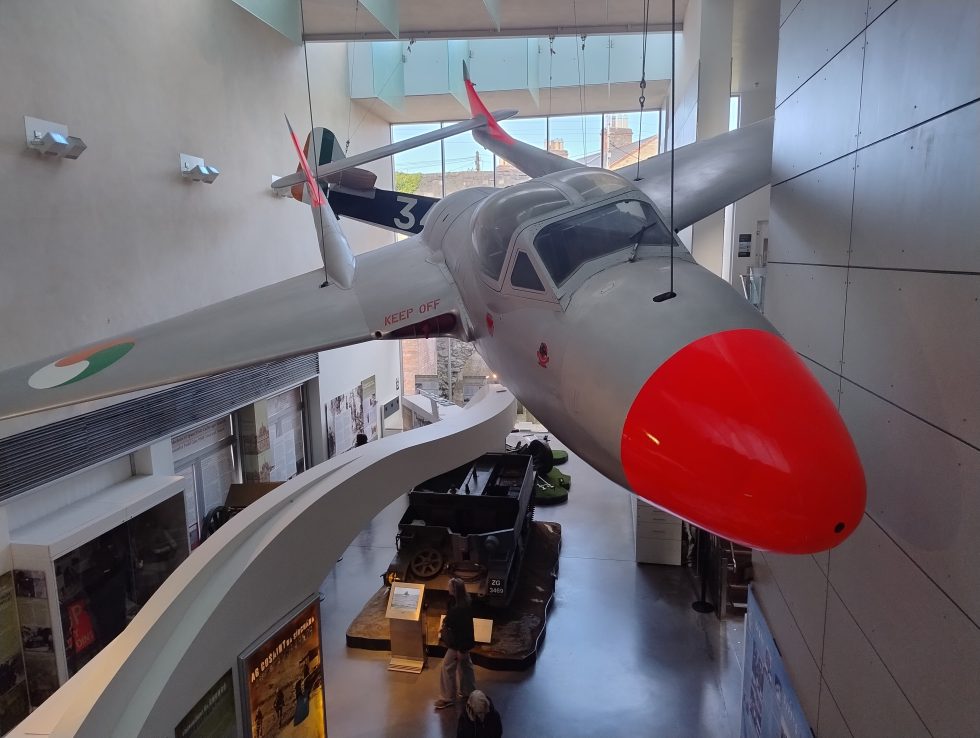
- Irish Air CorpsIreland · T.55 trainers
- 6 · 1956–1976
- Chilean Air ForceChile · T.55 trainers
- 5 · 1953–
- Royal Ceylon Air ForceCeylon · three T.55 delivered but returned to de Havilland unused
- 3 · 1954–1954
- Katangese Air ForceKatanga · ex-Portuguese T.11
- 2 · 1961–1963
- Portuguese Air ForcePortugal · T.55 trainers, later passed to Katanga
- 2 · 1952–
- Japan Air Self-Defense ForceJapan · single T.55 for evaluation
- 1 · 1955–
- Somali Air ForceSomalia · at least one T.55 donated by Iraq
- 1+ · 1964–
- French Navy AéronavaleFrance · small number for jet conversion; count not reliably recorded
- — · —
- Indian Naval Air ArmIndia · small number of trainers; count not reliably recorded
- — · —
- Lebanese Air ForceLebanon · FB.52 and T.55; count not reliably recorded
- — · 1953–
- Syrian Air ForceSyria · FB.52 and T.55; count not reliably recorded
- — · —
37 operators, 0 current. Quantities are airframes taken on charge; dates are first delivery to last retirement. Air forces with a MiGFlug Order of Battle page are linked (1 so far); the rest follow as the database grows.
Eighty years of the Vampire
Design begins
Work starts at de Havilland around the new Goblin turbojet, using a twin-boom layout to keep the jet-pipe short.
First flight
Prototype LZ548/G flies at Hatfield, piloted by Geoffrey de Havilland Jr.
First jet carrier landing
Eric “Winkle” Brown lands a Sea Vampire on HMS Ocean — the first jet ever to operate from a ship.
Enters RAF service
The Vampire joins the RAF as Britain’s second jet fighter.
World altitude record
John Cunningham climbs a Vampire to 59,446 ft (18,119 m).
First jet across the Atlantic
Six RAF Vampires island-hop from Britain to Canada via Iceland and Greenland.
Peak service
FB.5/FB.6 fighter-bombers and the T.11 trainer in worldwide licence production.
Combat in Indian service
Action in the Goa operation (1961) and the 1965 Indo-Pakistani War; other minor conflicts.
Last military Vampires retire
The Swiss Air Force retires the last military Vampires; the type flies on as warbirds.
Twelve Vampire stories
First jet across the Atlantic
In July 1948 six RAF Vampires became the first jets ever to cross the Atlantic.
Read the full story
First jet carrier landing
On 3 December 1945 Eric “Winkle” Brown put a Sea Vampire onto HMS Ocean.
Read the full story
Swiss Vampires in Alpine service to 1990
Switzerland flew 182 Vampires, most built at Emmen, for over four decades.
Read the full story
The twin-boom look
That split tail was engineering, not styling — and it became an icon.
Read the full story
The T.11 that taught the world
The two-seat T.11 gave thousands of pilots their first taste of jet flight.
Read the full story
Warbird flights with MiGFlug
Through MiGFlug you can strap into a genuine Vampire and fly a real 1940s jet.
Read the full story
The wooden nose from the Mosquito
The Vampire’s fuselage pod borrowed plywood-and-balsa construction from the Mosquito.
Read the full story
Reaching for the stratosphere
In March 1948 John Cunningham took a Vampire to a world altitude record.
Read the full story
Halford’s Goblin
Frank Halford’s centrifugal Goblin made the Vampire possible.
Read the full story
The Vampire goes to war
Never a great dogfighter by the jet age, Vampires still saw scattered action.
Read the full story
The Sea Vampire family
Navalised Vampires pioneered carrier jet operations and trials flying.
Read the full story
Built on four continents
From French Mistrals to Indian HAL machines, the Vampire was licence-built worldwide.
Read the full story
The Vampire in pictures
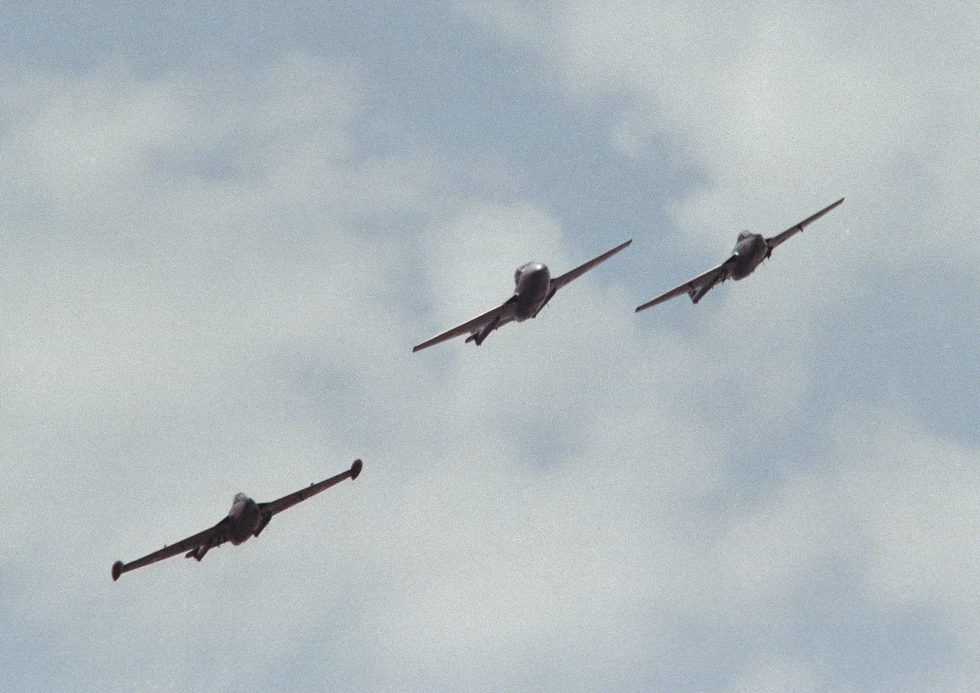
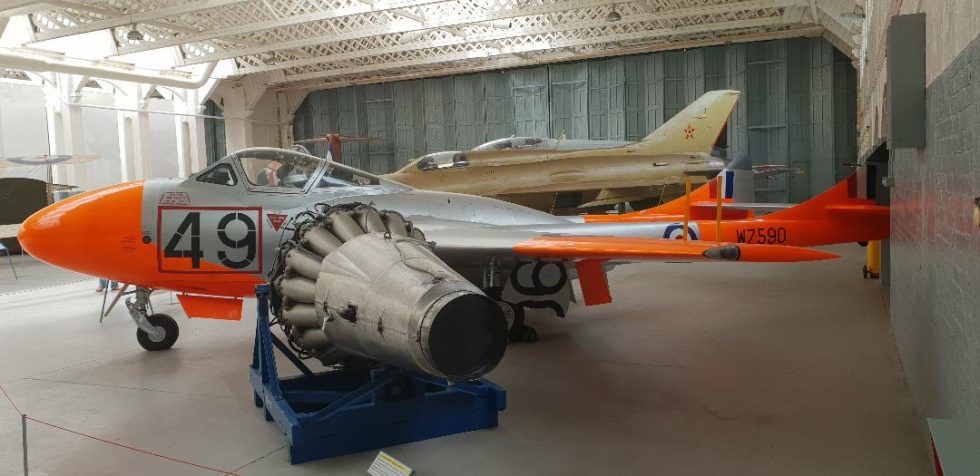
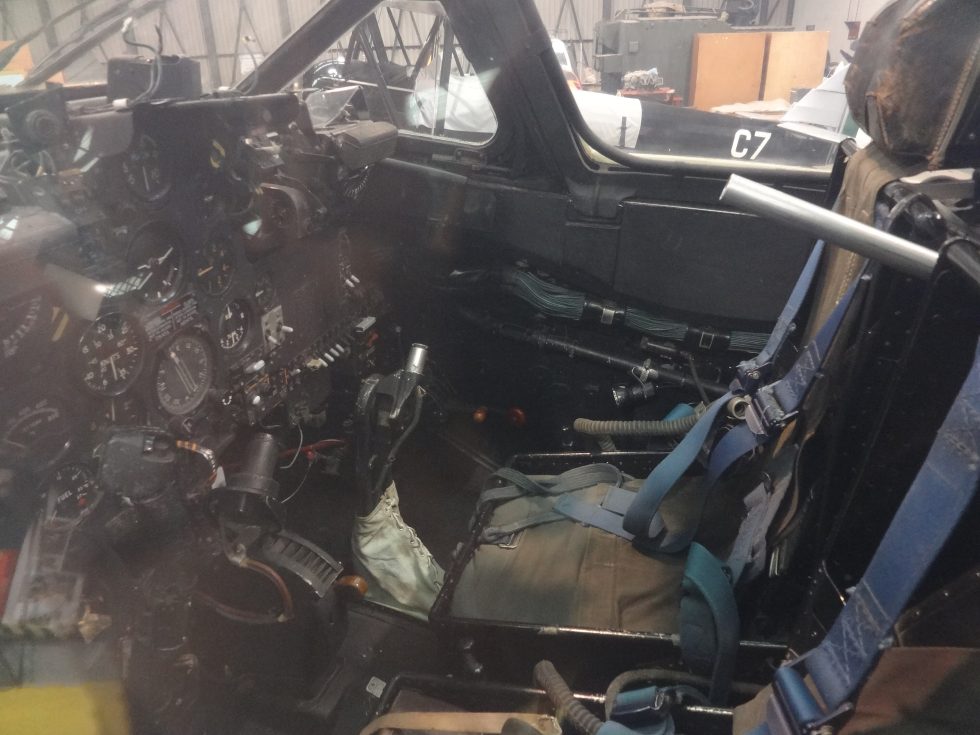
The Vampire in motion
Video coming soon.
The DH Vampire in motion
Dark Skies — one of the most-watched DH Vampire films on YouTube.
Where the Vampire flew
A record-breaker, not a dogfighter
The Vampire’s real claim to fame is a run of “firsts”, not its kill tally. It was the first jet to land on and take off from an aircraft carrier (1945), the first jet to cross the Atlantic (1948) and the holder of a 1948 world altitude record. Its combat career was minor and scattered — and exact loss/kill figures are contested, so treat them as indicative.
Compare the combat record of every military aircraft. Figures as of July 2026.
Everything people ask about the Vampire
Can I fly in a Vampire?
Is the Vampire a two-seater?
How fast is the Vampire?
Is the Vampire still flyable today?
What “firsts” does the Vampire hold?
How many Vampires were built?
You can actually fly the Vampire.
Pick your cockpit.
Some legends only live in museums — others are fuelled and waiting. MiGFlug has put civilians in real military jet cockpits since 2004.
 Fly the L-39 AlbatrosThe world’s most-flown jet trainer — aerobatics included
 Fly the F-104 Starfighter“The missile with a man in it”
 Fly the MiG-21The Cold War’s most-produced jet
 Fly the T-33 Shooting StarAmerica’s first jet trainer
 Fly the DH VampireA piece of early jet history
 Fly the S.211Agile Italian jet trainer
 Fly the MB-326The classic Aermacchi jet
 Fly the MiG-15The Soviet legend of the Korean War
Continue the tour
Every fact, checked
- MiGFlug — Vampire flight (near London)The flight offering, side-by-side seating, specification and location.
- Military Factory — DH.100 VampireSpecifications, variants and build numbers.
- Vintage Aviation News — First flight of the VampireDevelopment, service, the Atlantic first and Swiss service to 1990.
- Vintage Aviation News — 23 March 1948 altitude recordJohn Cunningham and the 59,446 ft record.
- Key.Aero — When the RAF Vampire became a record-breakerDetails of the 1948 transatlantic crossing.
- AirVectors — Vampire in foreign serviceLicence production and combat across many operators.
- Aces Flying High — Swiss DH.100 Vampire182 Swiss aircraft, licence build and retirement in 1990.
- Vulcan to the Sky — Eric Brown on the first jet carrier landingThe Sea Vampire landing on HMS Ocean, 3 December 1945.