
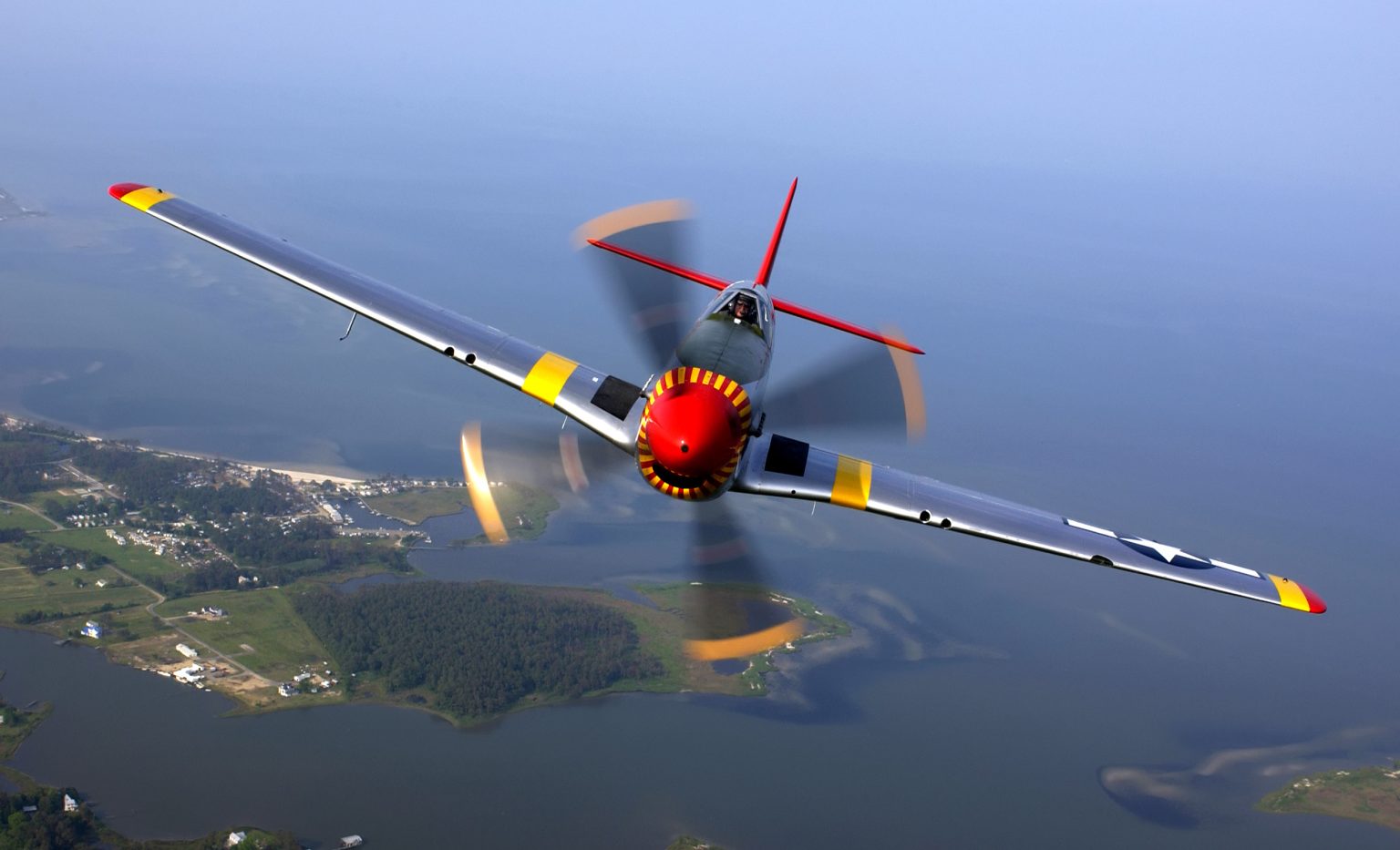
North American P-51
“Mustang”
The long-range escort fighter that finally reached Berlin and back — a mediocre low-altitude design transformed by one engine swap into the aircraft that broke German air power, and today the world’s most beloved warbird.
The engine swap that won the air war
The P-51 exists because North American Aviation said no. In early 1940 the British Purchasing Commission asked NAA to build Curtiss P-40s under licence; company president “Dutch” Kindelberger counter-offered to design a wholly better fighter instead. With British approval in April 1940, NAA rolled out the NA-73X prototype in a legendary 117 days, and it first flew on 26 October 1940.
The airframe was advanced from the start: a NACA-derived laminar-flow wing for low drag, and a belly-mounted ducted radiator exploiting the “Meredith effect.” But the early Allison-engined Mustang was superb only at low altitude, fading above ~15,000 ft. The transformation came when the Allison was replaced by the Rolls-Royce Merlin — built under licence in the USA by Packard as the V-1650 — creating the P-51B/C. Overnight the Mustang had war-winning high-altitude performance and extraordinary range.
The definitive P-51D added a cut-down rear fuselage and a bubble canopy for all-round vision plus six .50-cal guns. Combining the Packard-Merlin’s high-altitude muscle with huge internal fuel and drop tanks, the Mustang could fly to Berlin, fight, and return — hunting the Luftwaffe’s irreplaceable veteran pilots to destruction and handing the Allies daylight air supremacy before D-Day. Total production across all variants reached roughly 15,000+.
01The P-51 Mustang’s origins: how a refusal to build P-40s produced a war-winner in 117 days
When Britain came shopping for fighters in 1940, the obvious answer was more Curtiss P-40s. North American Aviation instead promised something better and delivered the NA-73X prototype in roughly 117 days from go-ahead — an astonishing pace for a clean-sheet design. The airframe married a low-drag laminar-flow wing to a thrust-recovering belly radiator, and it flew for the first time on 26 October 1940.
Yet the early Allison-powered P-51 was a disappointment above medium altitude, relegated by the RAF to low-level reconnaissance. The gamble only paid off when the airframe met the right engine — but that gamble had produced the aircraft that, re-engined, would help decide the air war over Europe.
What makes the P-51 Mustang special
The laminar-flow wing
The Mustang used a then-novel NACA low-drag airfoil whose point of maximum thickness sat far aft, keeping airflow smooth — “laminar” — over more of the wing. The result was markedly lower drag at cruise, a key reason the P-51 went so far on so little fuel, though in practice manufacturing tolerances limited true laminar flow.
Packard-Merlin V12 & the Meredith radiator
The licence-built Rolls-Royce Merlin (Packard V-1650) gave two-stage supercharged high-altitude power. Just as important, the deep belly radiator duct slowed, heated and re-accelerated cooling air through a nozzle, recovering thrust from what is normally pure cooling drag — a rare radiator that nearly paid for itself aerodynamically.
Exceptional range
Generous internal tankage — including a fuselage tank behind the pilot — plus jettisonable drop tanks pushed ferry range beyond ~2,000 miles (~3,300 km). No other single-seat WWII fighter combined this reach with front-line combat performance, the trait that made strategic bomber escort possible.
02The P-51 Mustang’s Merlin: the single most important upgrade of any WWII fighter
Early Mustangs flew on the Allison V-1710: strong down low but gasping above medium altitude, where the bombers needed protection most. Fitting the two-stage supercharged Packard-built Rolls-Royce Merlin transformed the aircraft — high-altitude speed climbed dramatically and, with the Mustang’s huge fuel load, so did its reach. The P-51B could now escort heavy bombers deep into Germany and back. More than the airframe, it was the engine that made the Mustang great.
03The P-51 Mustang’s radiator that made thrust: the Meredith effect explained
Cooling drag was a curse of liquid-cooled fighters. The Mustang’s ventral duct turned it into an asset: incoming air was slowed and compressed, heated by the radiator, then accelerated out of a nozzle at the rear — recovering a portion of the energy as thrust. Combined with the laminar-flow wing, this “Meredith effect” helps explain how the P-51 flew farther and faster than rivals on comparable power, though in practice it offset rather than fully cancelled cooling drag.
Full P-51D Mustang specifications
North American P-51D Mustang — dimensions & weights
- Crew
- 1 (pilot; two-seat TF-51D conversions were post-war rebuilds)
- Length
- 9.83 m (32 ft 3 in) — P-51D
- Wingspan
- 11.28 m (37 ft 0 in) — unchanged across all Merlin marks
- Height
- 4.08 m (13 ft 4.5 in) tail down, propeller vertical
- Wing area
- 21.83 m² (235 sq ft) — NAA/NACA 45-100 laminar-flow section
- Empty weight
- 3,465 kg (7,635 lb) — P-51D
- Loaded weight
- 4,175 kg (9,200 lb) typical combat load, no drop tanks
- Max takeoff weight
- 5,490 kg (12,100 lb) with full external tanks or bombs
- Internal fuel
- ~1,020 l (~269 US gal) — two 92 US gal wing tanks plus an 85 US gal fuselage tank behind the pilot. The fuselage tank moved the centre of gravity aft: with it full the Mustang was longitudinally unstable and pilots were told to fly it down to roughly 25–40 US gal before manoeuvring hard. Early Allison marks and the first P-51B/C aircraft had no fuselage tank at all.
P-51D Mustang — performance
- Max speed
- 703 km/h (437 mph) at 7,600 m (25,000 ft), war emergency power. Allison-engined Mustang Mk I / P-51A peaked near 630 km/h (390 mph) and only low down — above roughly 4,500 m their performance fell away sharply.
- Cruise speed
- 580 km/h (360 mph) fast cruise; escort cruise was flown much slower, near 400 km/h (250 mph) indicated, to stretch endurance
- Rate of climb
- 16.3 m/s (3,200 ft/min) at sea level, clean
- Service ceiling
- 12,770 m (41,900 ft) — P-51D; the Allison marks were limited to roughly 9,500–10,000 m
- Combat radius
- ~1,200 km (~750 miles) with two 108 US gal drop tanks — profile-dependent; enough to reach Berlin and back from East Anglia with combat allowance
- Range with drop tanks
- ~2,660 km (~1,650 miles) with external tanks; ~1,530 km (~950 miles) on internal fuel. This is the whole point of the aircraft: the Mustang was the first fighter that could escort heavy bombers all the way to the target and back.
- Takeoff run
- 370 m (1,200 ft) ground roll at combat weight, hard runway, no wind; longer with full external tanks
- Landing run
- 350 m (1,150 ft) ground roll, hard runway — a narrow-track taildragger that punished careless rudder work
- Load factor
- +8 g (design limit; −4 g negative) — reduced in practice with a full fuselage tank
P-51D Mustang — propulsion, systems & programme
- Engine
- Packard V-1650-7 — the Rolls-Royce Merlin 66 built under licence in Detroit, a 27-litre V-12 with a two-stage, two-speed supercharger. Replacing the single-stage Allison V-1710 with this engine is the central engineering story of the type: the airframe was always aerodynamically excellent, but the Allison lost its breath above roughly 15,000 ft, so early Mustangs were relegated to low-level tactical reconnaissance and ground attack. Rolls-Royce and North American fitted the Merlin in 1942, and the same airframe became a high-altitude escort fighter that could fight above 25,000 ft.
- Power
- 1,111 kW (1,490 hp) at takeoff / military power; roughly 1,720 hp at war emergency power on 150-grade fuel. Allison V-1710-81 in the P-51A: 1,200 hp, and only at low altitude.
- Propeller
- Hamilton Standard Hydromatic four-blade constant-speed, 3.40 m (11 ft 2 in) diameter; the P-51K used an Aeroproducts propeller instead
- Guns
- 6 × 12.7 mm M2 Browning (.50 in), 1,880 rounds total — 400 rpg for the inner pair, 270 rpg for the outer four. The P-51B/C carried only four, canted over in the thin laminar wing, and that installation jammed under g until feed boosters and a revised layout fixed it on the D.
- Radiator / Meredith effect
- Ventral duct aft of the cockpit — the coolant and oil radiators sat in a carefully shaped belly duct where the heated air expanded and left through a variable exit flap. The exhausting air produced a small amount of net thrust that offset much of the cooling drag: the Meredith effect, named for the RAE engineer who described it in 1935. The Mustang is the best-known aircraft to exploit it properly.
- Laminar-flow wing
- NAA/NACA 45-100 series section — maximum thickness well aft to hold laminar flow further back and cut drag. In service, dents, rivets, dirt and paint meant the wing rarely achieved true laminar flow, but the section was still low-drag and gave the Mustang its unusual range and high-speed efficiency.
- Gunsight
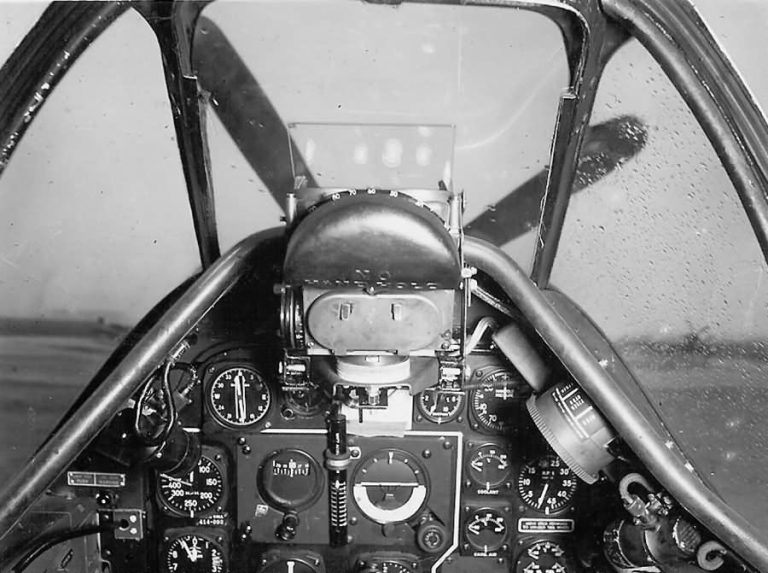
- K-14 gyroscopic sight on late P-51D and K blocks — a US-built development of the British Ferranti Mk II gyro sight; the pilot set target wingspan and range and the sight computed deflection. Earlier aircraft used the fixed N-9 or N-3B reflector sight.
- First flight
- 26 October 1940 — NA-73X prototype, Allison powered. The first Merlin-engined conversion (Mustang X / XP-51B) flew in late 1942.
- Service entry
- January 1942 — RAF Mustang Mk I, in the tactical reconnaissance role. Merlin-engined P-51B escort operations began in December 1943; the P-51D reached squadrons from mid-1944.
- Built
- ~15,000 (all marks; sources give roughly 15,500–15,900 depending on whether cancelled, Australian-assembled and post-war airframes are counted). The P-51D was the largest single block at roughly 8,000 aircraft.
- Unit cost
- ~US$51,000 (~$50,985, P-51D, 1945 dollars — a wartime accounting figure that fell steeply as production scaled, and that excludes engine and government-furnished equipment in some tabulations; treat it as an order of magnitude, not a price tag)
- Cost per flight hour
- ~US$2,000–4,000 per hour — there is no meaningful military figure, because no air force has operated the Mustang for decades. The honest answer today is the warbird operating cost: fuel, insurance, maintenance and an amortised reserve for the Merlin overhaul, which alone runs into six figures every few hundred hours. Owners quote widely different numbers depending on how much of that reserve they count, so this range is approximate.
04The P-51 Mustang’s numbers: how many were built and what one cost
Production of the Mustang ran to roughly 15,000+ airframes across all variants; exact totals vary by source between about 15,000 and 15,875 depending on the count and whether the twin-fuselage F-82 is included. Wartime unit cost is usually cited around US$50,000 — early P-51s ran closer to US$58,000, falling to about US$50,000 by 1945 — but these are approximate figures that varied by year, variant and contract. Maximum-speed figures likewise depend on altitude, boost setting and configuration, so treat single numbers as representative rather than absolute.
What the P-51 Mustang carried
The Mustang was built around guns and fuel, not payload. Its armament was modest by late-war standards — a battery of six .50 calibre Brownings on the P-51D — but it could carry that battery further than any other single-engined fighter of the war, and that reach mattered more than firepower. Bombs and rockets came later, when the escort job was won and the Mustangs went down to the deck.
Guns
- P-51D/K: six 12.7 mm (.50 in) M2 Browning machine guns, three per wing, 1,880 rounds total — 400 rounds for each inner gun, 270 for each of the outer four.
- P-51B/C: only four .50 in guns, 1,260 rounds. The thin laminar wing forced the guns to be mounted canted over, and the ammunition belts fed at an angle that jammed under hard manoeuvring — a well-documented and much-hated fault.
- The fix on the P-51D was to mount the guns upright in a redesigned wing with straight feed; electric feed boosters were also retrofitted to surviving B/C aircraft.
- Early Allison Mustang Mk I: a mixed battery of four .50 in and four 7.62 mm (.30 in) guns, plus two .50 in in the lower nose on the first aircraft.
Bombs
- Two underwing hardpoints, one per wing, typically carrying 500 lb (227 kg) general-purpose bombs.
- Maximum quoted load ~2 × 1,000 lb (~907 kg total) on the P-51D, though this was rarely flown operationally and cut performance badly.
- The A-36 Apache was the dedicated bombing variant: hydraulic dive brakes in the wings and two 500 lb bombs, flown in Sicily and Italy.
- Napalm tanks and fragmentation clusters were used in the Pacific and later in Korea.
Rockets
- Late P-51D blocks carried 5 in (127 mm) HVAR high-velocity aircraft rockets on zero-length launch stubs, usually three under each wing.
- Earlier aircraft used triple 4.5 in M10 tube launchers, which were draggy and unpopular; the zero-length stubs replaced them.
- Rockets became standard practice in Korea, where F-51Ds flew ground attack rather than escort.
Drop tanks
- Two underwing tanks of 75 US gal (284 l) in pressed steel, or 108 US gal (409 l) in British-made laminated paper — the paper tanks were cheap, expendable and made in large numbers.
- Combined with the 85 US gal fuselage tank, the 108 gal tanks are what put Mustangs over Berlin in March 1944 and broke the Luftwaffe day-fighter force.
- Standard practice was to burn the fuselage tank down first, then run on drop tanks and jettison them on contact.
- Larger 165 US gal ferry tanks were used for transit flights, not combat.
Gunsight & fire control
- K-14 gyroscopic lead-computing sight on late P-51D and P-51K aircraft — a licence development of the British Ferranti Mk II. The pilot dialled in target wingspan and twisted a throttle collar to frame the target, and the sight computed the deflection lead.
- Pilots who trusted the K-14 reported much better deflection shooting; those trained on the fixed sight often kept using the fixed reticle beside it.
- Earlier aircraft used the N-9 or N-3B fixed reflector sight with a simple ring and bead backup.
- Gun camera in the left wing root recorded claims — the primary evidence for confirming victories.
Reconnaissance fit
- F-6 series: camera-equipped Mustangs with K-17, K-22 or K-24 cameras mounted obliquely and vertically in the rear fuselage, behind the pilot.
- F-6A and F-6B were Allison-engined conversions; F-6C came from the P-51B/C, and the F-6D/F-6K from the bubble-canopy aircraft.
- Most recon Mustangs kept their guns, so they could fight or strafe on the way home — unusual for a photo-reconnaissance aircraft.
- The Allison Mustang’s low-altitude strength made it a natural tactical-reconnaissance machine, which is how the RAF used the Mk I from 1942.
Representative loadouts
- Long-range bomber escort (Eighth Air Force, 1944): six .50 in guns with full ammunition, full internal fuel including the 85 US gal fuselage tank, and two 108 US gal paper drop tanks. Tanks jettisoned on contact; the fuselage tank flown down before any hard manoeuvring.
- Fighter sweep and strafing: guns and full internal fuel, two 75 US gal tanks retained for the outbound leg, then free-hunting at low level on the way home. Strafing airfields cost Mustang units heavily — light flak, not fighters, killed most of them.
- Fighter-bomber (Ninth Air Force, and later Korea): two 500 lb bombs or six 5 in HVAR rockets, reduced internal fuel, short radius. The liquid-cooled Merlin was badly exposed in this role: a single rifle round through the belly radiator emptied the coolant and ended the flight.
Everything above is mark-dependent. Four guns and a razorback canopy on the P-51B/C; six guns, a bubble canopy and the K-14 sight on the P-51D; rockets only on late blocks. The Allison-engined Mustang Mk I, P-51A and A-36 were different aircraft in all but outline — capable at low level, outclassed above about 15,000 ft, and never used as escorts.
P-51 Mustang variants, from Allison to Enforcer
- Mustang Mk I / Mk IA
- The original RAF aircraft, Allison V-1710 powered, roughly 620 built. Fast and pleasant down low, feeble above 15,000 ft; used for armed tactical reconnaissance over France from 1942.
- P-51 / P-51A
- First USAAF Mustangs, still Allison-engined; 310 P-51A built with four .50 in guns. Good at low level, and the mark that proved the airframe was worth a better engine.
- A-36 Apache
- Dedicated dive-bomber version with hydraulic dive brakes and two 500 lb bombs, 500 built. Flown hard over Sicily and Italy in 1943; sometimes called Invader by its crews.
- P-51B / P-51C
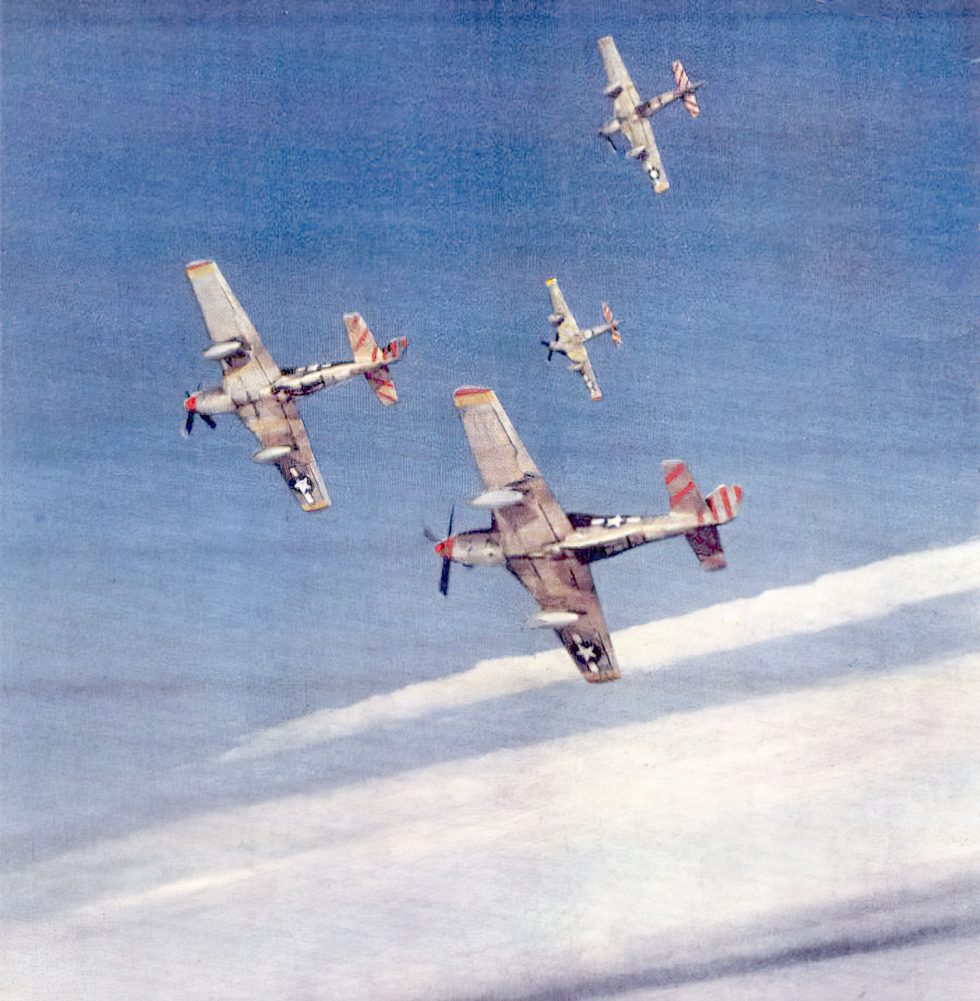
- The Merlin transformation. Packard V-1650 engine, four guns, razorback canopy; about 1,990 B built at Inglewood and 1,750 C at Dallas. These are the aircraft that first escorted bombers to Berlin, gun jams and all.
- P-51D / P-51K
- The definitive Mustang: cut-down rear fuselage with a bubble canopy, six guns with straight feed, a dorsal fin fillet to cure the resulting yaw instability, and the K-14 sight on later blocks. Roughly 8,000 D plus about 1,500 K with a different propeller.
- P-51H
- The lightweight redesign — shorter, lighter, taller-tailed, with a V-1650-9 engine; about 555 built. Quoted at roughly 487 mph (784 km/h), the fastest production Mustang, but it arrived too late for combat.
- F-6 series
- Photo-reconnaissance conversions of every major mark, with fuselage cameras and, unusually, their guns retained. A few hundred aircraft across F-6A, B, C, D and K.
- Cavalier Mustang / Piper PA-48 Enforcer
- Post-war civil and counter-insurgency derivatives, not wartime aircraft. Cavalier Aircraft remanufactured surplus P-51Ds from the 1960s as executive and light-attack machines, some supplied under US military aid programmes; the Piper Enforcer took the idea further with a Lycoming turboprop. Only a handful of Enforcers were built, and it was never adopted.
No air force flies the Mustang today. The last military operators kept theirs into the 1980s — the Dominican Republic Air Force is generally cited as the final one, retiring its P-51Ds around 1984, with Guatemala, El Salvador and Bolivia among the other late users. In civil hands the type is now one of the most numerous airworthy WWII fighters, with roughly 150 or more flying worldwide. That count is approximate and moves constantly as restorations come on line and accidents take aircraft off it, and airworthy status is not the same as regularly flown. The Mustang is also among the most valuable warbirds on the market, which is precisely why so many keep flying.
Operators
The P-51 Mustang fought for the Allies over Europe and then armed more than 25 air forces for another thirty years.
The RAF ordered the Mustang before the USAAF wanted it, the Eighth Air Force made it famous, and after 1945 surplus P-51Ds were sold for a dollar apiece to Latin American signatories of the Rio treaty and passed on to Sweden, Switzerland, Italy, the Philippines, Indonesia, Israel and South Korea. It flew in Korea, Indonesia, the 1969 Football War and against rebels in half a dozen countries; the Dominican Republic retired the last military Mustangs in 1984. Wartime totals are production allocations rather than peak strength, and several small Latin American fleets are known only approximately.
In service with
- No current military operator
- —
Formerly operated by
- United States Army Air Forces / United States Air ForceUnited States · the bulk of 15,586 built; F-51s served with the Air Force Reserve and Air National Guard until January 1957
- ~12,000 · 1942–1957
- Royal Air ForceUnited Kingdom · Mustang I, IA, II, III and IV; the original customer
- ~2,500 · 1942–1947
- Royal Australian Air ForceAustralia · imported P-51D/K and 200 CAC-built Mustangs; 77 Squadron flew them in Korea
- ~500 · 1944–1960
- Italian Air ForceItaly · MDAP deliveries 1947–51 to 2, 3, 4, 5, 6 and 51 Stormo
- 173 · 1947–1958
- Swedish Air ForceSweden · 161 J 26 bought 1945–48 plus four interned aircraft; 12 converted to S 26 reconnaissance
- 165 · 1945–1954
- Royal Canadian Air ForceCanada · RAF-owned Mustangs with five wartime squadrons, then 150 P-51D bought postwar; obsolete 1956, special-duty use into the early 1960s
- ~150 · 1942–1960
- Swiss Air ForceSwitzerland · 130 P-51D bought for 4,000 dollars each in 1948 after interned USAAF aircraft had been flown in 1944–45
- 130 · 1948–1958
- Philippine Air ForcePhilippines · 5th Fighter Wing; replaced by F-86s in the late 1950s, some COIN use into the early 1980s
- 103 · 1946–
- Polish Air Force in Great BritainPoland · RAF-owned Mustang I, III and IV with 303, 306, 309, 315 and 316 Squadrons
- ~100 · 1942–1947
- South African Air ForceSouth Africa · 5 Squadron on RAF Mustang III/IV in Italy 1944–45; 2 Squadron on F-51D in Korea 1950–53
- ~95 · 1944–1953
- Indonesian Air ForceIndonesia · 26 ex-Dutch P-51D/K, 35 P-51D from the US in 1960–61 and Cavalier Mustangs in 1972–73
- ~68 · 1950–1976
- Nicaraguan Air ForceNicaragua · 26 ex-Swedish P-51D plus 30 P-51D and 2 TF-51 from the US
- 58 · 1954–1964
- Dominican Air ForceDominican Republic · 6 bought 1948, 44 ex-Swedish and one more; the last military Mustangs in the world
- 51 · 1948–1984
- Israeli Air ForceIsrael · smuggled aircraft in 1948 then ex-Swedish P-51D; used at Suez 1956, replaced by jets by 1960
- ~40 · 1948–
- Royal Netherlands East Indies Army Air ForceNetherlands · P-51D flown in the Indonesian National Revolution; 26 handed to Indonesia
- 40 · 1946–1950
- People’s Liberation Army Air ForceChina · captured Nationalist aircraft; nine flew over the founding parade on 1 October 1949
- 39 · 1949–1953
- Guatemalan Air ForceGuatemala · P-51D until the early 1970s
- 30 · 1954–
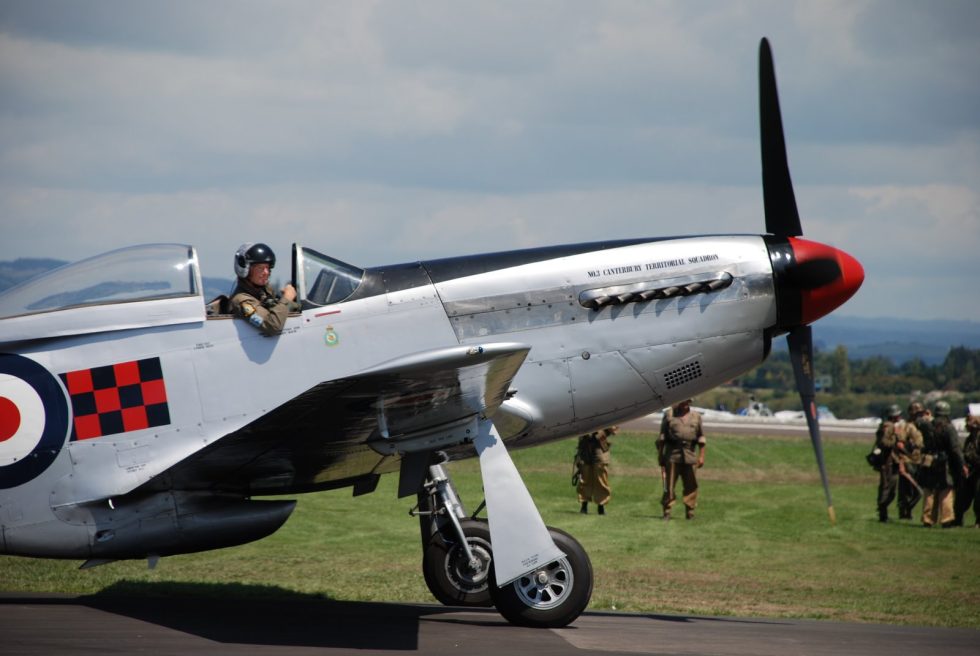
- Royal New Zealand Air ForceNew Zealand · 30 P-51D of 370 ordered; Territorial Air Force squadrons 1951–55, target tugs to 1957
- 30 · 1951–1957
- Uruguayan Air ForceUruguay · P-51D, some later sold to Bolivia
- 25 · 1950–1960
- Bolivian Air ForceBolivia · ex-Uruguayan P-51D and 9 Cavalier F-51D/TF-51D under Peace Condor
- ~15 · 1960–1978
- Salvadoran Air ForceEl Salvador · 5 Cavalier Mustang II, 1 TF-51 and 7 P-51D; fought the 1969 Football War
- 13 · 1968–1974
- Somali Air ForceSomalia · eight P-51D; dates not recorded
- 8 · —
- Costa Rican Air ForceCosta Rica · four P-51D
- 4 · 1955–1964
- Haitian Air ForceHaiti · four P-51D, sold for spares to the Dominican Republic
- 4 · 1950–1974
- Cuban Revolutionary Air ForceCuba · three P-51D smuggled to Castro’s rebels in 1958, never operational
- 3 · 1959–
- United States ArmyUnited States · F-51D chase aircraft for the AH-56 Cheyenne programme, two of them Cavalier-built
- 3 · 1968–
- French Air ForceFrance · F-6C/D reconnaissance Mustangs with GR 2/33 from January 1945 until the early 1950s; count not reliably recorded
- — · 1944–
- Republic of China Air ForceTaiwan · over 100 P-51D/K supplied to the Nationalists 1945–49 and taken to Taiwan; figures vary
- — · 1945–
- Republic of Korea Air ForceSouth Korea · 10 F-51D under Bout One in July 1950, then further US and ex-South African aircraft; count not reliably recorded
- — · 1950–1957
29 operators, 0 current. Quantities are airframes taken on charge; dates are first delivery to last retirement. Air forces with a MiGFlug Order of Battle page are linked (1 so far); the rest follow as the database grows.
From blank sheet to warbird legend
A clean-sheet design
The British Purchasing Commission approves NAA’s offer to design a wholly new fighter instead of building licensed P-40s.
First flight
The NA-73X prototype flies, roughly 117 days after go-ahead — a laminar-flow wing and thrust-recovering belly radiator from the start.
RAF combat debut
The Allison-engined Mustang Mk I enters RAF service for low-level reconnaissance and ground attack.
The Merlin transformation
The Packard-Merlin P-51B/C enters service; escort range and high-altitude performance are transformed.
Escort to Berlin
Mustangs escort bombers all the way to Berlin, hunting the Luftwaffe fighter arm in a war of attrition it cannot win.
The definitive P-51D
The bubble-canopy, six-gun P-51D becomes the mass-production standard.
Over Japan
Long-range Mustangs escort B-29s from Iwo Jima to Japan; the lightweight P-51H arrives late in the war.
Korean War
Redesignated F-51D, the Mustang flies close air support — rugged but tragically vulnerable to ground fire.
The last military Mustangs
Late users such as the Dominican Republic retire the type (~1984); the warbird era continues to this day.
From the flight line: twelve Mustang stories
117 days to a legend
NAA built a world-beating fighter from a blank sheet in under four months.
Read the full story
The Merlin miracle
One engine swap turned a dud into a war-winner.
Read the full story
Red tails over Europe
The Tuskegee Airmen flew red-tailed Mustangs into history.
Read the full story
The escort that reached Berlin
Mustangs went where no Allied fighter had gone before.
Read the full story
George Preddy’s guns
The top Mustang ace fell to his own side.
Read the full story
Comeback as a bomb truck
The escort fighter returned as a mud-mover.
Read the full story
Reno rockets
Stripped, clipped and boosted, Mustangs became air-racing icons.
Read the full story
Fly a two-seat TF-51 today
A handful of Mustangs will let a civilian take the stick.
Read the full story
The Dominican Mustangs
A WWII fighter soldiering on into the 1980s.
Read the full story
The radiator that made thrust
The scoop under the belly was not just for cooling.
Read the full story
Two Mustangs, one fighter
NAA bolted two fuselages together.
Read the full story
The Cadillac of the sky
Pilots called it the finest prop fighter they ever flew.
Read the full story
The Mustang in pictures
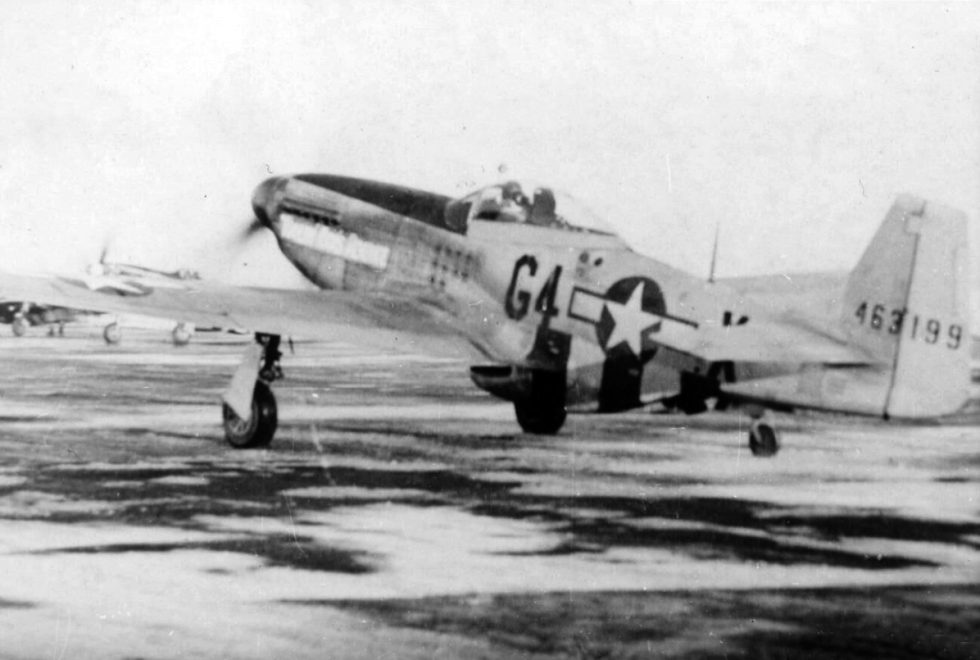
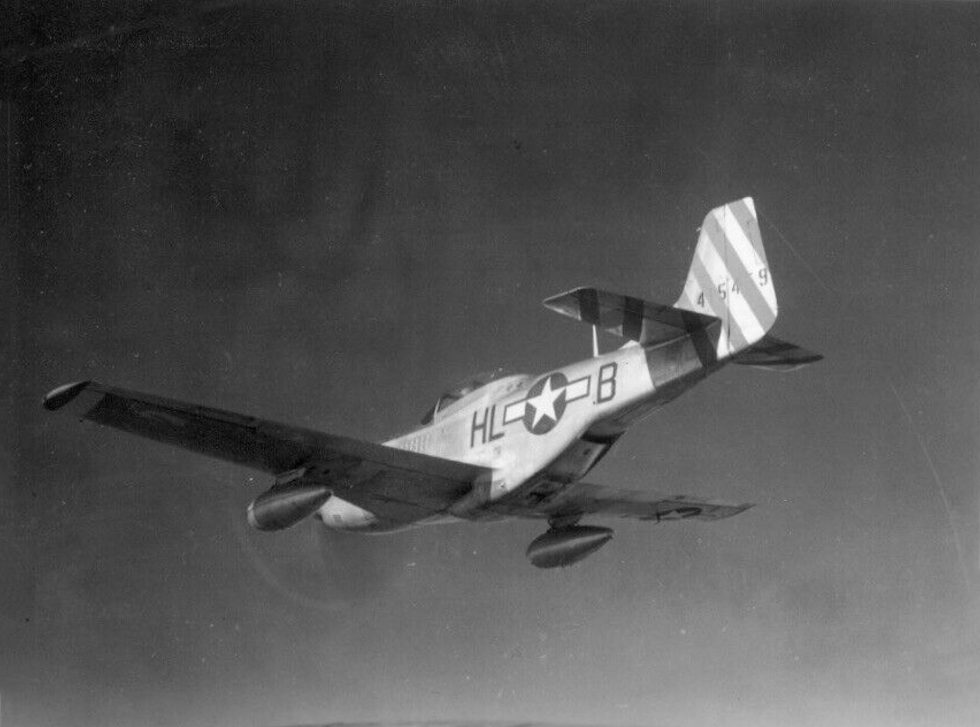
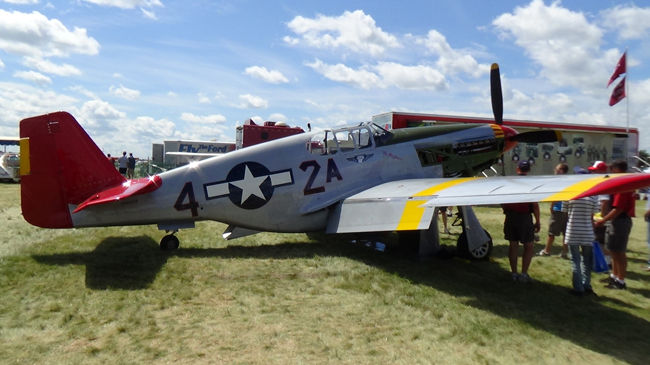
The Mustang in motion
A documentary film on the P-51 Mustang will be added here soon.
The P-51 Mustang in motion
DroneScapes — one of the most-watched P-51 Mustang films on YouTube.
Where the Mustang flew
The fighter that broke German air power
The Mustang’s headline achievement was strategic: by escorting bombers deep into Germany and back, it enabled the daylight bombing campaign and destroyed the Luftwaffe’s veteran pilots in the air. As always with WWII tallies, treat kill figures as claims rather than settled scores.
Compare the combat record of every military aircraft. Figures as of July 2026.
Everything people ask about the P-51 Mustang
Can I fly in a P-51 Mustang?
How fast is the P-51 Mustang?
Is the P-51 still flyable?
How did it compare to the Bf 109 and Fw 190?
How many P-51 Mustangs were built?
Allison vs Merlin — what’s the difference?
You can’t fly the P-51.
These, you can.
Some legends only live in museums — others are fuelled and waiting. MiGFlug has put civilians in real military jet cockpits since 2004.
 Fly the L-39 AlbatrosThe world’s most-flown jet trainer — aerobatics included
 Fly the F-104 Starfighter“The missile with a man in it”
 Fly the MiG-21The Cold War’s most-produced jet
 Fly the T-33 Shooting StarAmerica’s first jet trainer
 Fly the DH VampireA piece of early jet history
 Fly the S.211Agile Italian jet trainer
 Fly the MB-326The classic Aermacchi jet
 Fly the MiG-15The Soviet legend of the Korean War
Continue the tour
Every fact, checked
- Air & Space Forces Magazine — “Mustang!”Development, the Merlin transformation and the escort campaign over Germany.
- MustangsMustangs.com — SpecificationsDetailed variant-by-variant performance and dimensional data.
- MustangsMustangs.com — Foreign ServiceThe full roster of national operators used for the map.
- Encyclopaedia Britannica — P-51Concise overview of design, role and significance.
- Warfare History Network — George PreddyThe top-scoring Mustang ace and his death by friendly fire.
- KITPLANES — “The Meredith Effect”How the belly radiator recovered thrust — fact versus myth.
- The National Interest — Korean War comebackThe F-51D in the close-air-support role, 1950–53.
- Joe Baugher — P-51D/K in Foreign ServiceSerial-level detail on export and post-war operators.