
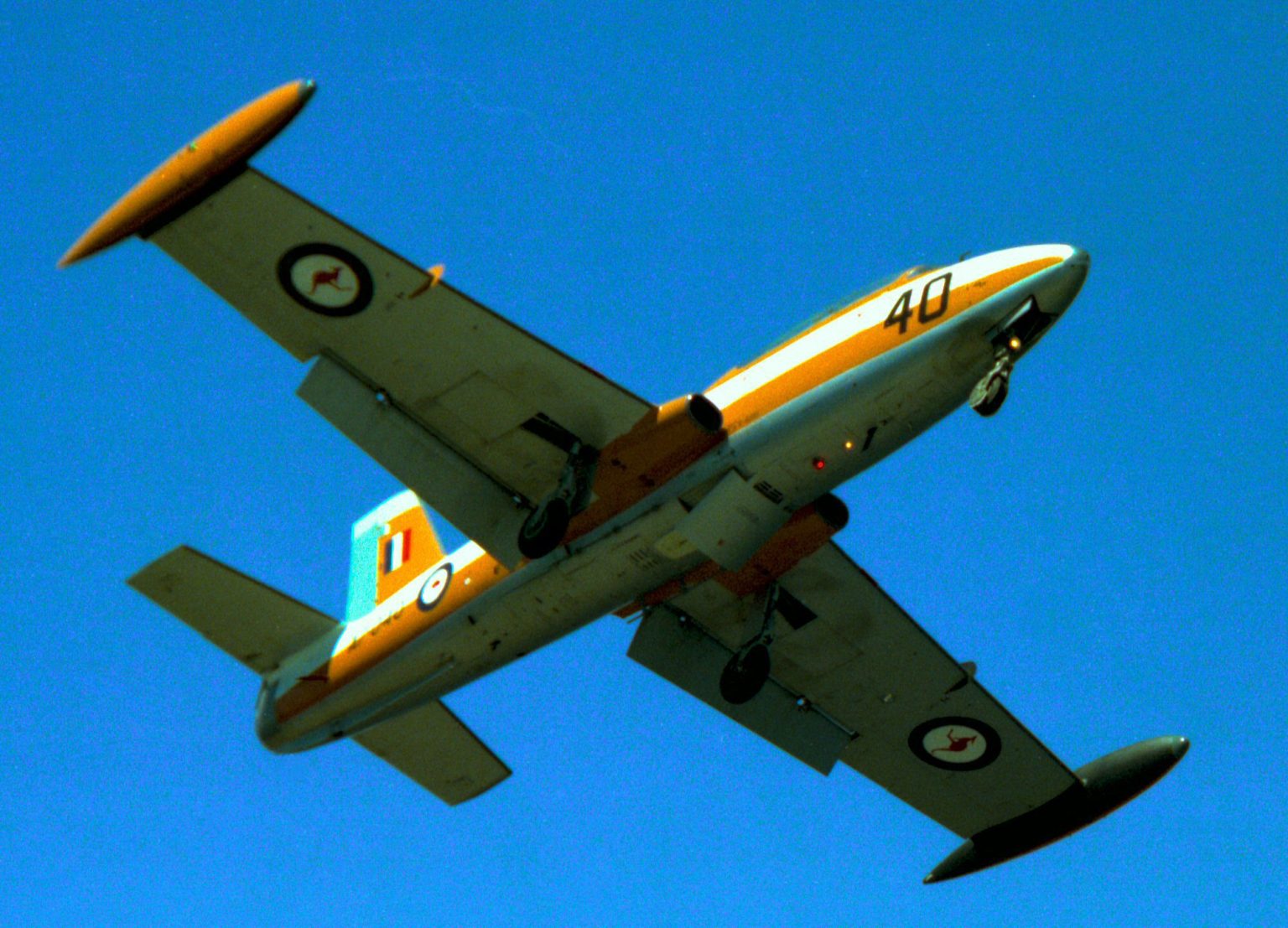
Aermacchi MB-326
Macchi · Impala · Xavante
Ermanno Bazzocchi’s clean little Italian jet became one of the West’s best-selling trainers — docile enough for cadets, tough enough to go to war, and built under licence on three continents. Retired from front-line duty, it now flies as an affordable warbird — and MiGFlug will strap you into the front seat of one in Italy, its homeland.
The trainer that conquered three continents
The Aermacchi MB-326 was an Italian jet trainer and light-attack aircraft designed by Ermanno Bazzocchi, chief engineer at Aeronautica Macchi — the designation reads “Macchi–Bazzocchi 326.” Conceived as a private venture in the mid-1950s to give post-war Italy an indigenous jet trainer, it beat the heavier Fiat G.80/G.82 for the Italian order. The first prototype flew on 10 December 1957 at Milano-Malpensa, powered by a single British Rolls-Royce Viper turbojet, and the type entered Italian service in February 1962.
Few trainers ever earned their keep like the MB-326. Bazzocchi’s clean little Macchi did exactly what a trainer should — it was docile, cheap to run and forgiving — yet it was tough enough to grow teeth. That combination made it a global bestseller: over a dozen air forces bought it, and three nations on three continents built it under licence, from CAC in Australia to EMBRAER in Brazil to Atlas in South Africa.
In its hardest incarnation, the South African Impala, it went to war over Angola and Namibia, flying close air support at treetop height throughout the Border War. Its DNA lived on in the MB-339 that Italy’s Frecce Tricolori still fly today. Retired from front-line duty, the MB-326 now leads a second life as a lively, affordable warbird — and MiGFlug will put you in the front seat of one in Italy, its homeland.
01The MB-326’s numbers: how a cheap Italian trainer became a global bestseller
Roughly 761 MB-326s were built according to flugzeuginfo.net, though MiGFlug and other sources round to about 800 across all sub-variants. The decisive fact is that production was shared across the world: Italy’s Aermacchi, Commonwealth Aircraft Corporation in Australia (the CA-30 / MB-326H “Macchi”), Atlas Aircraft Corporation in South Africa (the Impala Mk I trainer and Mk II single-seat attack) and EMBRAER in Brazil (the EMB-326 / AT-26 Xavante) all turned out the type.
A single, robust Viper engine, benign handling and a strong airframe let small air forces buy one type that could both teach cadets and, when needed, drop bombs. That is exactly why it spread across Europe, Africa, South America, the Middle East and Australasia — and why so many operators kept it for decades.
What makes the MB-326 special
Straight wing with tip tanks
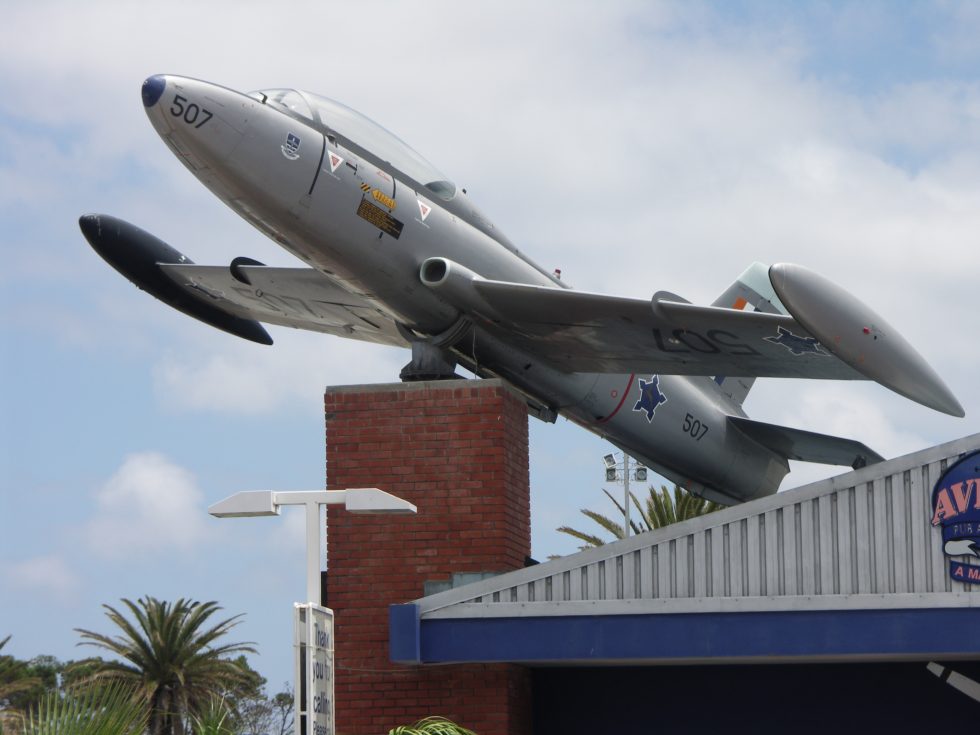
A simple, unswept wing gave the MB-326 benign low-speed handling ideal for ab-initio jet training, while permanent wingtip fuel tanks stretched range without cluttering the hardpoints. They also gave the Macchi its instantly recognisable silhouette — clean, honest and cheap to maintain, exactly what export customers wanted.
The Rolls-Royce Viper heart
A single, robust Rolls-Royce Viper turbojet made the MB-326 easy to maintain and rugged in austere conditions — a key reason so many smaller air forces chose it. Early trainers used the ~15 kN Viper 11; armed and MB-326K models carried the beefier Viper 20/632 at around 17.8 kN.
A strong, adaptable airframe
The structure was stout enough to be developed from a gentle trainer into a genuine attack platform: up to six underwing hardpoints for about 1,800 kg of bombs, rockets, gun pods and AS.12 missiles, culminating in the single-seat MB-326K with two built-in 30 mm DEFA cannon.
02The MB-326’s Viper: one simple engine, endless mileage
The Rolls-Royce (Armstrong Siddeley) Viper made the MB-326 what it was: simple, reliable and easy to feed. The same engine family powered gentle training sorties and low-level attack runs alike, from the ~15 kN Viper 11 in early trainers to the more powerful Viper 20/632 in armed and K models. For budget-minded air forces, a rugged single-engine trainer that could be kept flying from a rough strip was worth more than raw performance — and the Viper delivered exactly that.
03From trainer to predator: the single-seat MB-326K
Aermacchi turned the docile trainer into a dedicated attacker. The MB-326K deleted the second seat, added a strengthened airframe and a more powerful Viper, and built in two 30 mm DEFA cannon plus six hardpoints for roughly 1,800 kg of stores. It gave budget-minded air forces a genuine light-strike jet on a trainer’s running costs — the same philosophy that made the South African Atlas Impala Mk II such an effective bush-war aircraft.
Full MB-326 specifications
Baseline note: the figures below describe the MB-326G and its export twin the MB-326GB as delivered from 1967 — the six-pylon armed two-seater with the 15.2 kN (3,410 lbf) Rolls-Royce Viper 20 Mk 540. That is the mark that matters, because almost every licence-built MB-326 in the world is a G in disguise: the Australian CAC CA-30, the Brazilian EMBRAER AT-26 Xavante and the South African Atlas Impala Mk I are all the same aeroplane with different data plates. Deltas for the original 1962 Viper 11 trainer, for the single-seat MB-326K and its South African equivalent the Impala Mk II, and for the licence-built marks are given in grey. Four disagreements are worth settling before the tables begin. First, empty weight: the single-seat MB-326K and Impala Mk II weigh about 440 kg more empty than the two-seat G, not less — two 30 mm cannon, their ammunition, additional fuel and the local structure to carry all of it cost far more than deleting a crewman saves. Second, the engine of the single-seaters: reference works routinely credit the MB-326K with the 17.8 kN (4,000 lbf) Viper 632-43, but the South African Air Force is explicit that the Impala Mk II — built to the same drawings, in larger numbers than the Italian original — kept the 3,410 lbf Viper Mk 540. An Impala Mk II is therefore a heavier aeroplane on trainer thrust, which explains a great deal about how it was flown. Third, maximum take-off weight: 4,577 kg is the Jane’s figure for a G brimming with fuel and carrying no weapons, while South African sources give 5,897 kg for a combat-loaded Impala Mk II; the two numbers describe different aeroplanes doing different jobs and neither is wrong. Fourth, production: the standard formula is "over 800 built between 1961 and 1975", and the total is sound, but the dates are not — they describe the Italian line only. Embraer was still rolling out Xavantes in 1981 with deliveries running into 1983, and Atlas built Impala Mk IIs into the early 1980s.
Dimensions & weights
- Crew
- 2 in tandem under a single rearward-sliding canopy, on lightweight ejection seats. Aermacchi chose tandem over side-by-side for drag, and accepted that the instructor in the back would spend a great deal of the sortie looking at the back of the pupil’s head. That compromise is precisely what the MB-339 was built in 1976 to fix, by raising the rear seat. The single-seat MB-326K, MB-326KB/KD/KG/KT and Atlas Impala Mk II delete the rear station and fill the space with fuel, ammunition and gun bays
- Length
- 10.65 m (34 ft 11 in). South African figures for the Impala Mk II give 10.67 m, a difference of two centimetres that reflects the cannon installation in the lower forward fuselage rather than any redesign
- Wingspan
- 10.85 m (35 ft 7 in) over the wingtip tanks. Those tanks are permanent structure, not jettisonable stores: they hold a large share of the fuel and they give the type the stubby, blunt-tipped planform that makes an MB-326 recognisable from a mile away. Nothing was ever flown without them in service
- Height
- 3.72 m (12 ft 2 in) — a genuinely small aeroplane. The MB-339 grew to 3.99 m for one reason only, which was to lift the instructor high enough to see the runway the student was aiming at
- Wing area
- 19.35 m² (208.3 sq ft), unswept. This wing was drawn in the mid-1950s and it was still in production, essentially unaltered, on MB-339s built in the 2000s. Aermacchi got two aircraft families and roughly half a century out of one set of drawings, which is as good a return as the European industry has ever managed on a trainer
- Aspect ratio
- 6.08 — modest, which is the right answer for a machine whose working life is circuits, aerobatics and low-level navigation rather than cruise efficiency. It gives crisp roll response and a stall the average student can recognise and recover from
- Aerofoil
- NACA 64A114 at root, NACA 64A212 at tip — a laminar-flow section, and a conservative one. There are no leading-edge devices, no slats and no manoeuvre flaps anywhere in the family
- Empty weight
- 2,685 kg (5,919 lb). The single-seat MB-326K and Impala Mk II come out at about 3,123 kg (6,885 lb). Every kilogramme saved by removing the rear cockpit was spent several times over on guns, rounds, fuel and the structure to hold them
- Max take-off weight
- 4,577 kg (10,091 lb) for the G with full internal, tip and underwing fuel and no weapons — the figure quoted from Jane’s. Armed, the single-seaters go a good deal higher: the South African Air Force gives 5,897 kg (13,001 lb) for the Impala Mk II, and that is the weight at which it went to Angola
- Max external load
- ~1,814 kg (4,000 lb) across six underwing pylons. This is a brochure number. Loading four thousand pounds onto an airframe with 3,410 lbf of thrust produces a take-off run and an initial climb that would worry anyone; operational Impala loads over Angola ran to perhaps a third to a half of it, and the aircraft was flown light and fast rather than heavy and slow
- Internal fuel
- ~1,392 L (368 US gal; 306 imp gal) in one fuselage tank and the two tip tanks, rising to ~2,056 L (543 US gal) with a pair of underwing tanks. A single-point pressure coupling on the starboard side fills the whole system in about five minutes, which for a training unit turning aircraft round eight times a day is not a trivial feature
- Wing loading
- 236 kg/m² (48.4 lb/sq ft) at maximum take-off weight, and nearer 190 kg/m² on a clean training sortie. Low wing loading is why the MB-326 is pleasant, forgiving and slow — the same three words describe every honest jet trainer ever built
- Undercarriage
- Tricycle, hydraulically retractable with low-pressure tyres and generous oleo travel, specified from the start for semi-prepared strips. South African Impalas spent the Border War operating from Rundu, Mpacha and Ondangwa, and Brazilian Xavantes from unpaved fields in Amazonia. That capability was not an afterthought
Performance
- Max speed
- 867 km/h (468 kn, 539 mph) clean. The MB-326 is resolutely subsonic and has a straight wing; it was never going to be anything else. The South African Air Force quotes a more realistic 770 km/h for a service Impala Mk II with pylons fitted, which is the speed that actually matters
- Max diving Mach
- M 0.82 with a never-exceed indicated limit of 871 km/h (470 kn). Beyond that the unswept wing begins to tell the pilot about compressibility in ways a student does not want to hear
- Cruise speed
- 797 km/h (430 kn, 495 mph) — high-speed cruise. Economical cruise for a navigation exercise is far lower and the type is not efficient at it; the Viper is a thirsty engine by modern standards
- Rate of climb
- 30.7 m/s (6,050 ft/min) at sea level on the Viper 540. The original 1962 aircraft, on the 11.1 kN Viper 11, climbed materially worse — the jump from 2,500 to 3,410 lbf between the first production MB-326 and the G is the single largest improvement in the type’s history
- Time to height
- 4 min 10 s to 6,100 m (20,000 ft); 13 min 5 s to 12,200 m (40,000 ft). The second figure shows where the straight wing and the small engine run out of ideas
- Service ceiling
- 14,325 m (46,998 ft) — comfortably above anything a trainee needs, and above most of what the type was later asked to attack
- Absolute ceiling, record
- 17,315 m (56,807 ft), set by Massimo Ralli on 18 March 1966 in a zoom climb; 15,690 m in sustained level flight on the same day. Aermacchi spent 1966 methodically collecting FAI class records with the MB-326, including climbs to 3,000 m in 2 min 2 s and to 12,000 m in 10 min 53 s, and it was excellent marketing
- Range
- 1,850 km (1,000 nmi, 1,150 mi) on fuselage and tip tanks with a 113 L reserve
- Ferry range
- 2,445 km (1,320 nmi, 1,519 mi) with underwing tanks added and reserves. Ferry range is what let Aermacchi deliver aircraft across Africa under their own power, and what let the Impala reach targets deep in Angola
- Take-off run
- 412 m (1,352 ft) at ISA, rising to 506 m (1,660 ft) at ISA +25°C. The second number is the one that governs operations from a hot African strip in the afternoon, and it is why the type’s field performance was quoted so carefully in the sales literature
- Take-off to 15 m
- 555 m (1,821 ft) at ISA; 704 m (2,310 ft) at ISA +25°C
- Landing from 15 m
- 631 m (2,070 ft) at a 3,175 kg landing weight; 671 m (2,201 ft) at ISA +25°C
- Operational attack profile
- 550–650 km/h at 15 m — not a manufacturer figure, but the height and speed band South African Impala Mk II pilots actually used over Angola, chosen to stay below the radar horizon and inside the minimum engagement window of the SA-7. It is the most honest performance number on this page, because it describes what the aeroplane did rather than what it could do
Propulsion & systems
- Powerplant
- 1 × Rolls-Royce (Bristol Siddeley) Viper 20 Mk 540 turbojet — British design, built under licence in three of the four countries that assembled the airframe
- Thrust
- 15.2 kN (3,410 lbf), dry. There is no reheat, no bypass and no water injection anywhere in the family. What you see is what the aeroplane has
- Engine architecture
- Single-spool axial-flow turbojet with a low turbine entry temperature, modest shaft speeds and rapid acceleration. The Viper’s virtues were simplicity, robustness and a forgiving nature towards students who mishandled the throttle at altitude. For an all-through trainer that mattered more than specific fuel consumption, and it is a large part of why the MB-326 outsold the Fiat G.91 abroad
- Engines by mark
- Viper 8 of 7.8 kN (1,750 lbf) in the first prototype; Viper 11 of 11.1 kN (2,500 lbf) in the second prototype and the 1962 Italian production trainer; Viper 20 Mk 540 of 15.2 kN (3,410 lbf) in the G, GB, GC, H, CA-30, AT-26 Xavante, Impala Mk I and Impala Mk II; Viper 632-43 of about 17.8 kN (4,000 lbf) in the late single-seat MB-326K. The 632-43 is the engine that went on to power the MB-339
- Engine licence production
- Piaggio, Italy, from 1959 under an agreement with Bristol Siddeley; the Commonwealth Aircraft Corporation built Vipers in Australia for the CA-30; Atlas built them in South Africa. Very few trainers have ever been manufactured, engine and airframe together, on three continents at once
- Fuel system
- One large mid-fuselage tank plus two permanent tip tanks and provision for two underwing tanks. Single-point pressure refuelling on the starboard side; no in-flight refuelling capability on any mark, which is a real constraint on the attack versions
- Cockpit
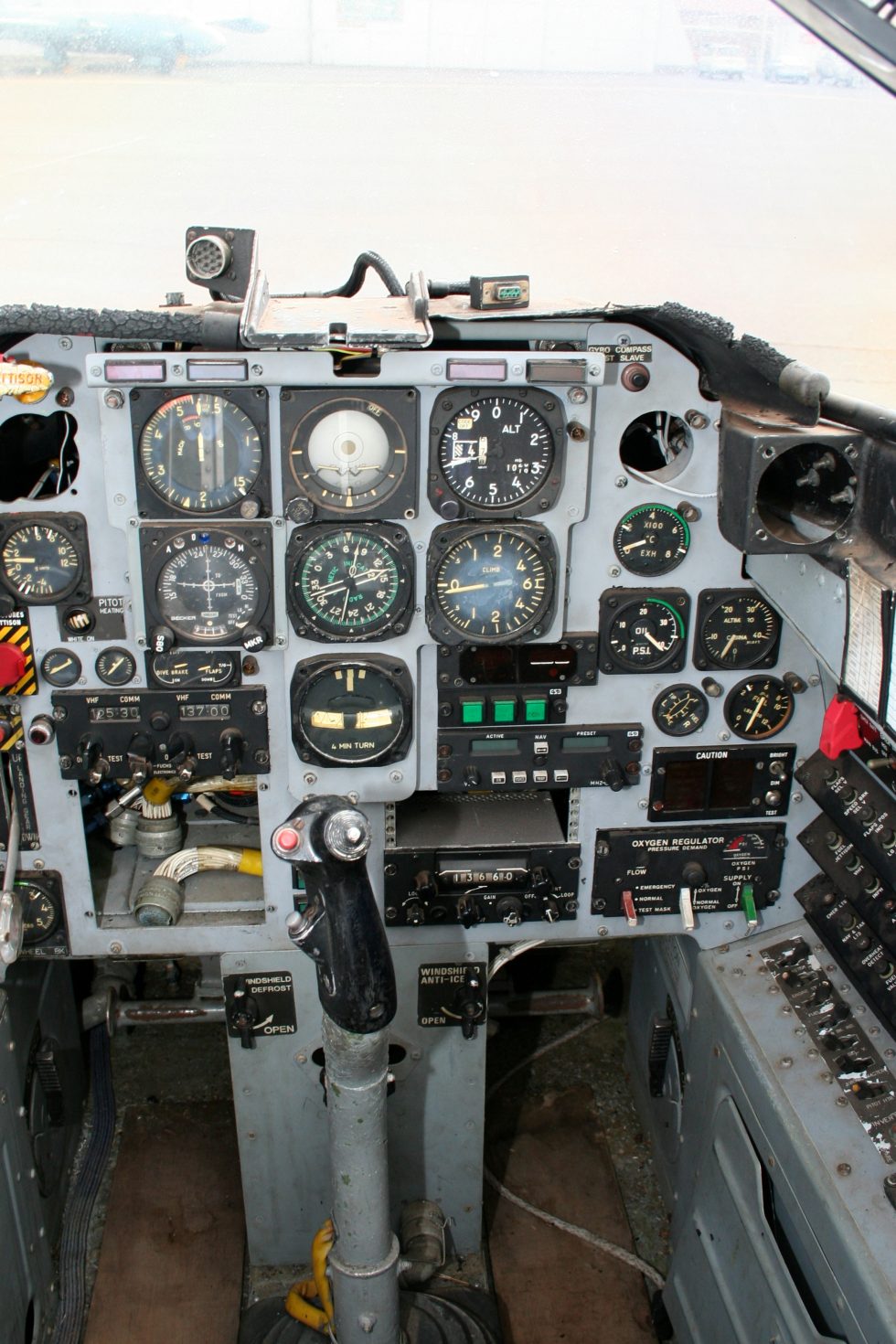
- Pressurised and air-conditioned with bleed-air windscreen anti-icing and a one-piece canopy. Pressurisation was unusual in a 1957 trainer and it is what made the type’s high-altitude work, and its record flights, possible
- Escape system
- Martin-Baker lightweight ejection seats — Mk 4 on early aircraft, later marks subsequently. Not every installation was zero-zero, which is a serious matter for an aeroplane whose combat career was flown at fifteen metres. The pilot of the Silver Falcons Impala that shed a wing at Lanseria on 2 October 1993 ejected and was killed
- Flight controls
- Manual, unboosted, with servo tabs — hydraulics drive only the undercarriage, flaps and airbrakes. No stability augmentation, no autopilot on the early marks and nothing between the student and the consequences of what he has just done. That is a design philosophy, not an omission
- Structure
- All-metal light alloy with fuselage and wing each built in three sections, the wing centre section integral with the fuselage, and roughly 80 inspection panels and doors. It was designed to be maintained by conscripts in a tent, and it was
- Fatigue life
- The type’s real weakness — a light structure flown hard at low level for decades. Australia ran a Life Of Type Extension programme through the 1980s and then re-winged the fleet in the early 1990s after a fatigue-related crash; South Africa lost an Impala to structural failure of the starboard wing during a display in 1993. Every long-term operator ended up paying for the airframe twice
- Avionics
- No radar on any mark, ever — VHF/UHF radio, TACAN or VOR/ILS to customer choice, and an optical sight for weapons work. The Impala Mk II added a South African radar-warning and countermeasures fit as Angolan air defences thickened, and Brazilian RT-26s carried a four-camera Vinten reconnaissance pod
- Hardpoints
- Six underwing on the G and later marks, rated at ~1,814 kg (4,000 lb) in total. The two earliest armed marks had four. Inboard stations are plumbed for tanks
04The MB-326’s cost: low price was the whole point
Low acquisition and operating cost was a core selling point of the MB-326 — it is precisely what let a dozen-plus air forces afford it and three nations build it under licence. But firm public dollar figures do not reliably exist: prices varied by variant, year, licence arrangement and buyer, and Italian, Australian, Brazilian and South African production all had different economics. Treat any specific unit-cost or cost-per-hour claim with caution. What is certain is the comparison — the Macchi was deliberately cheap to buy and cheap to run, which is exactly why it sold and soldiered on for so long.
Armament & payload
The MB-326 has no gun of its own until you delete the back seat, and that single fact divides the family in two
Everything the two-seat MB-326 carries hangs from underwing pylons — four on the earliest armed marks, six from the G onwards, rated at about 1,814 kg (4,000 lb) in total. There is no internal gun. Cannon and machine guns come in pods, which is honest about what the aeroplane is: a 3,410 lbf trainer with hardpoints, sold to air forces that could not afford a trainer and an attack aircraft separately. The single-seat branch of the family is a different proposition. The MB-326K, first flown on 22 August 1970, and the South African Atlas Impala Mk II built to the same drawings, threw out the rear cockpit and put two 30 mm DEFA 553 cannon in the lower forward fuselage with their ammunition. That turned a trainer into a light attack aircraft that could actually fight, and it is the version that went to war.
Go to war it did, and mostly in southern Africa. South African Impalas flew close air support, battlefield interdiction and armed reconnaissance against FAPLA, SWAPO and Cuban forces in Angola from 1975 to 1987, typically at 550–650 km/h at fifteen metres, which is the height at which an SA-7 cannot solve the problem in time. They were withdrawn from external operations before Operation Moduler in 1987, when Angolan air defences finally became too dense for a subsonic aircraft with no radar and a hand-me-down warning receiver. One Impala was brought down by an SA-7; another came home with an unexploded missile lodged in its jet pipe. Weapon fits differ enormously between the two-seat and single-seat branches and between operators: an Australian MB-326H carried practice bombs and a camera gun and nothing else for thirty-four years, a Brazilian AT-26 carried rockets and a reconnaissance pod, and only the South African Impala Mk II ever carried the full South African arsenal. Read every line below as "on some marks, for some air forces".
Gun
- No internal gun on any two-seat MB-326. Two 7.7 mm (0.303 in) machine guns in the forward fuselage were offered as an option on early armed marks and rarely taken.
- Podded guns are the normal fit: 7.62 mm and 12.7 mm Browning pods for gunnery training, and a pair of 30 mm DEFA 553 pods on the inner pylons for the South African Impala Mk I.
- MB-326K and Atlas Impala Mk II: 2 × 30 mm DEFA 553 mounted internally in the lower forward fuselage. Ammunition is given as 125 rounds per gun by Aermacchi and as 300 rounds in total by South African sources — the discrepancy is unresolved and both figures are in print.
- The 30 mm gun is the single most consequential weapon in the type’s history. Every claimed air-to-air kill and most of the effective work over Angola was done with it, not with ordnance.
- Gunsighting is optical throughout. There is no radar ranging, no laser and no computing sight on any production MB-326.
Air-to-air
- Matra R550 Magic infrared missiles were carried by South African Impala Mk IIs for self-defence on deep sorties. Some South African accounts also cite the locally built V3 Kukri; the two are not always distinguished carefully in the literature.
- No MB-326 of any mark has ever had a radar, a radar warning receiver worth the name outside South Africa, or a beyond-visual-range weapon. Air-to-air work means a stern-quarter gun pass on something slower.
- Which is exactly what happened. Reference works credit Impala Mk IIs with six helicopters shot down in two engagements in 1985: two Mi-24 gunships in the first, and two more Mi-24s plus two Mi-17 transports two days later, the escorting MiG-21s being too high to intervene.
- That claim needs handling with tongs. It is South African in origin, no date, squadron or pilot name attaches to it in the open literature, and the aircraft are variously identified as Mi-24, Mi-25 and Mi-8/17. A 2024 academic survey of South African responses to Angolan air defences goes no further than saying Impala Mk IIs "attacked some helicopter flights" during FAPLA’s Second Congress offensive of 1985. Six is a plausible upper bound; it is not an established fact.
- No MB-326 has ever engaged another fixed-wing aircraft in the air, on anybody’s account.
Air-to-surface guided
- Nord AS.11 and AS.12 wire-guided missiles, two rounds — the only guided air-to-ground weapon ever cleared as a standard fit on the family, and a 1960s one at that. It requires the pilot to fly the missile onto the target with a thumb controller while holding the aircraft steady, which over a defended target is close to suicidal.
- Nothing else. There is no Maverick integration, no laser-guided bomb, no designator pod and no data link on any production MB-326 or Impala.
- This is the card where the light-attack description runs out of road. Everything the Impala dropped in anger over Angola was unguided, aimed through an optical sight from fifteen metres and released at 600 km/h.
- The absence is worth stating plainly rather than padding: a 1957 airframe with no radar and no computing sight was never going to grow into a precision platform, and Aermacchi did not pretend otherwise. That job went to the MB-339 and, eventually, to nothing at all — even the MB-339 never became a serious guided-weapons carrier.
Bombs
- South African operational fit: up to 6 × 120 kg or 4 × 250 kg bombs on the Impala Mk I and Mk II. This is the loadout that flew against FAPLA and SWAPO positions in southern Angola.
- Mk 81 and Mk 82 class general-purpose bombs and their French and Italian equivalents on export marks; napalm on some operators.
- Light bombs of 15 kg and 45 kg on multiple carriers, listed in the original armament options — a weapons-training fit rather than a war load.
- Practice bomb carriers with 3 kg and 12 kg heads. Across roughly 800 airframes and forty years these are, by an enormous margin, the most common bomb an MB-326 has ever carried, and the only one the great majority of airframes ever saw.
Rockets
- 68 mm SNEB rockets in Matra pods, in the South African arrangement of four six-round pods or two eighteen-round pods. This was the Impala’s bread-and-butter weapon and the one most often expended over Angola.
- 2.75 in (70 mm) FFAR in LAU-series launchers for customers inside the American supply chain, and 50 mm and 80 mm European pods elsewhere.
- Light 6 kg and 7.5 kg rockets on rails, four rounds, from the original armament menu — a training store from an era when rockets were still fired singly at a range target.
- Rockets suit the type better than bombs do. They can be fired from the low, fast, shallow profile the Impala had to use, and they do not require the pull-up that hands a gunner a shot.
Pods & other stores
- Underwing fuel tanks on the two inboard wet pylons, taking total fuel from about 1,392 to about 2,056 litres. On an aircraft with no refuelling probe these are what made deep sorties possible at all.
- Reconnaissance pods: the Aermacchi installation with four Vinten cameras, carried on the port wing by Brazilian RT-26 Xavantes of 1°/10° GAv, whose aircraft had logged more than 61,000 hours by 1998. South African Impalas flew a similar photo and visual reconnaissance task over Angola.
- Gun pods, covered above, occupy the same pylons and compete with everything else for them. With six stations and no centreline point, every choice is a trade.
- Electronic countermeasures and radar warning on the Impala Mk II only, developed in South Africa as Angolan air defences improved. Five Italian MB-326s were converted to MB-326RM standard as dedicated ECM and calibration aircraft.
- Camera guns, towed target gear and telemetry fits on training aircraft — unglamorous, and the reason most of these airframes existed.
Three typical loadouts
- Advanced training sortie, MB-326H, RAAF Pearce, 1975
- Clean airframe, full internal and tip fuel, no external stores; a camera gun and possibly a practice bomb carrier. Seventy-five hours of this followed 150 hours of medium training on the same type, and the graduate went to a Mirage IIIO. This is what nine airframes in ten did for their entire lives.
- Close air support, Impala Mk II, southern Angola, 1985
- Two internal 30 mm DEFA 553 with full ammunition, four six-round 68 mm SNEB pods or four 250 kg bombs, two underwing tanks, an R550 Magic on an outer station for the flight lead. Run-in at 600 km/h at fifteen metres, one pass, no re-attack.
- Armed photographic reconnaissance, RT-26 Xavante, Brazil, 1980s
- Four-camera Vinten pod on the port wing, underwing tanks, gun pods optional. Brazil used the Xavante as much for mapping and border surveillance over the Amazon basin as for anything resembling combat, and that is the more representative story of what these aircraft actually did.
Sourcing caveat: armament figures for the MB-326 family are unusually messy. Aermacchi’s own literature lists options rather than fits, national air forces cleared different subsets of them, and the South African inventory in particular contains locally developed weapons that were never publicly catalogued during the apartheid-era arms embargo. Where Aermacchi and the South African Air Force disagree — on cannon ammunition, on the Impala Mk II’s engine and on maximum weights — both figures are given above rather than one being silently preferred.
Variants
Four countries built the MB-326, and three of them were not Italy
The MB-326 is the most exported Italian military aircraft of its era and the licence-production story is the reason. Ermanno Bazzocchi’s design first flew on 10 December 1957 in the hands of Macchi’s chief test pilot Guido Carestiato, entered Italian Air Force service on 22 March 1962, and then did something almost no European aircraft of the period managed: it was manufactured under licence in Australia by the Commonwealth Aircraft Corporation, in Brazil by the newly founded EMBRAER, and in South Africa by the Atlas Aircraft Corporation. Between them the three foreign lines built more MB-326s than Macchi did. Of roughly 800 airframes, fewer than half were built in Italy.
Each licence did something different for its host. For Australia it was industrial maintenance: CAC built both the airframe and the Viper engine, keeping a national aircraft industry alive between the Sabre and nothing at all. For Brazil it was foundational: the Xavante was EMBRAER’s first jet, ordered in 1970 when the company was two years old, and the 182 aircraft it built between 1971 and 1983 taught a Brazilian workforce how to make a combat aeroplane. Everything from the AMX to the A-29 Super Tucano and the Gripen assembly line at Gavião Peixoto descends from that decision. For South Africa it was survival: an arms embargo made buying aircraft progressively impossible, and Atlas’s Impala line meant the South African Air Force could keep replacing combat losses without asking anyone’s permission.
The design also solved a problem it created. Selling an "all-through" jet trainer that took a student from first solo to combat readiness on one type looked elegant on paper, and in practice was expensive: jet hours cost more than piston hours, and most operators quickly bolted a cheap propeller trainer onto the front of the syllabus. The MB-326 settled into the role it was actually good at, which was lead-in fighter training. When Aermacchi came to replace it in the mid-1970s the answer was the MB-339: the same wing, the same fuselage aft of the cockpit, a raised rear seat and the 4,000 lbf Viper 632-43. The MB-339 is not a successor so much as a correction, and it is covered on its own page.
- MB-326 (1957–1960s; 2 prototypes and about 125 for Italy)
- The original unarmed all-through trainer on the 11.1 kN Viper 11, plus 15 pre-series aircraft ordered in December 1958. Alitalia bought four demilitarised examples as the MB-326D to prepare airline crews for jets.
- MB-326B / E / F / L series (1960s–1970s; several dozen)
- Armed two-seat export trainers with four hardpoints, sold in small batches to Tunisia, Ghana and others. Six MB-326Es served Italy as armed trainers; five Italian aircraft became MB-326RM electronic-warfare and calibration conversions.
- MB-326G / GB / GC (from 1967)
- The definitive two-seater: Viper 20 Mk 540, six pylons, 1,814 kg of external load. Zambia took 23, Zaire 17, Argentina eight for its Navy’s 1 Escuadrilla de Ataque. This is the mark all three licensees built.
- MB-326H / CAC CA-30 (Australia, 1967–1972; 97)
- Twelve built by Macchi, 18–20 assembled from Italian kits and the remainder built outright by the Commonwealth Aircraft Corporation, which also made the Viper. Ten went to the Royal Australian Navy’s 724 Squadron. Australia flew the "Macchi" from 1967 to 2001, longer than anyone.
- MB-326K (first flight 22 August 1970)
- The single-seat light attack version: rear cockpit deleted, two internal 30 mm DEFA 553, strengthened structure and eventually the 17.8 kN Viper 632-43. Sold in small numbers as the MB-326KB to Ghana and Zaire, the MB-326KD to Dubai and the MB-326KT to Tunisia.
- Atlas Impala Mk I (South Africa, licence from 1964, production from 1966; about 40 Italian-built plus about 125 Atlas-built)
- The MB-326M, a G-standard two-seater assembled and then manufactured in South Africa. Trainer, light strike aircraft and mount of the Silver Falcons display team.
- Atlas Impala Mk II (South Africa, 1974–early 1980s; about 95–100)
- The MB-326K localised: seven bought complete from Italy, 15 assembled from kits and 73–78 built by Atlas. Retained the 3,410 lbf Viper Mk 540 rather than the 632-43, gained a South African countermeasures fit, and did essentially all of the type’s real fighting.
- EMBRAER EMB-326GB / AT-26 Xavante (Brazil, first Brazilian flight 6 September 1971; 182 built to 1981, deliveries to 1983)
- Ordered in 1970 as two pattern aircraft and 166 production machines; 167 for the Brazilian Air Force, ten for Paraguay and six for Togo. Some were converted to RT-26 reconnaissance standard with a four-camera Vinten pod. Eleven were transferred to the Argentine Navy after the 1982 Falklands War to rebuild 1 Escuadrilla de Ataque.
- Aermacchi MB-339 (1976 onwards; roughly 200–230)
- Not an MB-326 variant but its direct descendant, built on the MB-326K wing with a redesigned forward fuselage and a raised rear seat. Treated fully on its own page; noted here so the family tree is not mistaken for a longer MB-326 production run than it was.
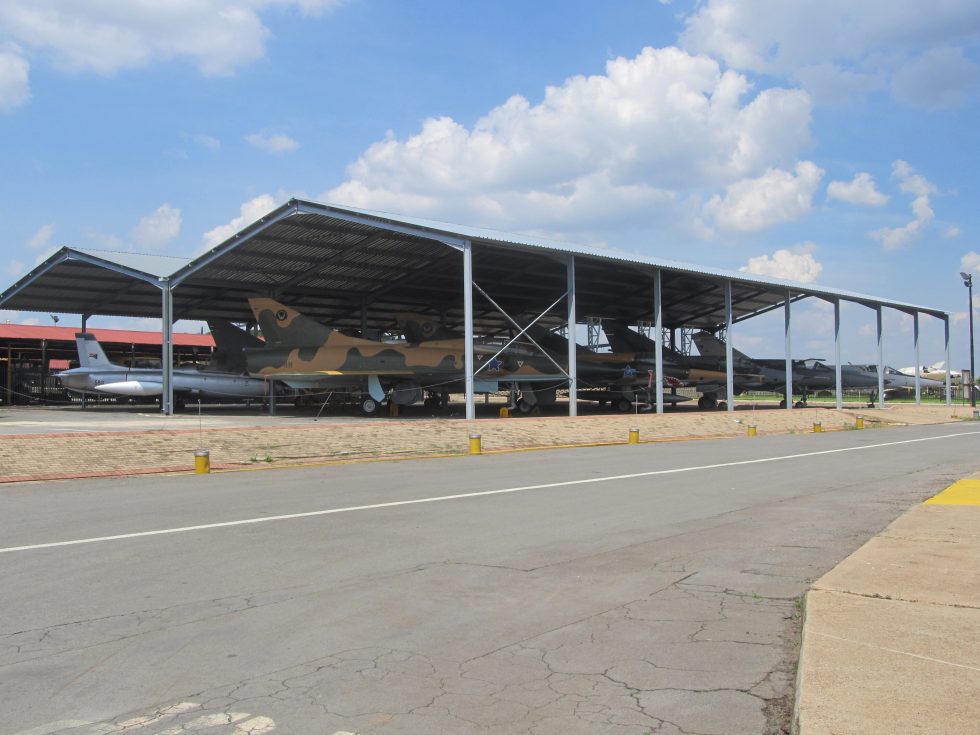
Disposition, September 2026: no air force flies the MB-326 in front-line service. Italy replaced it with the MB-339 between 1981 and 1984 and kept a handful as liaison hacks. Australia retired the last Macchis in 2001 in favour of the Hawk 127; the Royal Australian Navy had given up its ten in 1983 and the Roulettes display team flew the type from December 1970 to 1989. South Africa withdrew the Impala Mk II around 2005, and the dates there are genuinely muddled: 8 Squadron, the first unit to receive the Mk II in November 1974, was disbanded on 31 March 2001 when the Impala was declared retired, yet South African Air Force sources give the type’s service span as 1974 to 2005. Both are true — the squadrons went first and the airframes lingered. Brazil retired the Xavante from the training role in 2013, with a small number retained by the flight-test establishment for occasional trials work afterwards; a widely quoted date of 2 December 2010 refers to withdrawal from operational squadrons, not to the end of flying. Zambia and Tunisia, the last two military holdouts on paper, now list the type as retired — Zambia flies K-8s and L-15s instead. A batch of ex-South African Impalas was reported delivered to Cameroon in the late 2000s but the type does not appear in current inventories. Survivors are numerous and almost all are original airframes rather than reproductions — this is a 1960s jet, not a Great War type, and nobody builds replicas of it. The South African Air Force Museum at Swartkop holds several Impalas, and further examples are preserved at Ysterplaat and at the South African National Museum of Military History in Johannesburg. Ex-South African Impalas make up the bulk of the civil warbird fleet, flying on ZU- registrations in South Africa and in small numbers in the United States, where the Estrella Warbirds Museum at Paso Robles displays a Mk I. That fleet is not risk-free: an Impala Mk I, ZU-IMP, was lost in a display accident at Saldanha Bay on 22 March 2025. The type’s worst day, though, was not in Angola. On 6 December 1990 an Italian Air Force MB-326, abandoned by its pilot after an in-flight fire, crashed into a classroom at the Istituto Salvemini in Casalecchio di Reno near Bologna and killed twelve schoolchildren.
Fifty years of the MB-326
Private venture begins
Ermanno Bazzocchi starts the MB-326 as an Aermacchi private-venture jet trainer for post-war Italy.
First flight
The prototype flies at Milano-Malpensa on Rolls-Royce Viper power, with test pilot Guido Carestiato.
Altitude record
An early MB-326 reportedly sets a notable altitude figure (~15,489 m) as production ramps up.
Enters Italian service
The MB-326 becomes the Italian Air Force’s standard jet trainer.
The CAC Macchi
Commonwealth Aircraft Corporation begins Australian licence production as the CA-30 / MB-326H “Macchi.”
Border War era opens
The conflict begins in which South African Atlas Impalas will later see heavy close-air-support use.
Brazil’s Xavante
EMBRAER secures the Brazilian licence and builds the EMB-326 / AT-26 Xavante, launching the company as a serious aircraft builder.
The single-seat K
The MB-326K light-attack variant, with strengthened airframe and two 30 mm cannon, enters production and service.
Retirement and second life
Withdrawn from front-line service (SAAF Impala retired ~2005); survivors pass into museums and the warbird circuit as the MB-339 carries the lineage on.
From the flight line: twelve MB-326 stories
The trainer that conquered the world
Sold to a dozen-plus air forces across five continents.
Read the full story
The CAC Macchi
Built Down Under, flown for decades.
Read the full story
The Atlas Impala
An Italian jet made African.
Read the full story
Impalas over the bush
Combat at treetop height over Angola and Namibia.
Read the full story
The EMBRAER Xavante
South America’s Macchi.
Read the full story
Xavantes in 1982
A trainer goes to war again.
Read the full story
The MB-326K predator
Single-seat and hard-hitting.
Read the full story
Grandfather of the Frecce jet
A common myth, corrected.
Read the full story
Second life on the airshow circuit
Still flying, still a crowd favourite.
Read the full story
The Viper heart
One engine, endless mileage.
Read the full story
Tip tanks and a straight wing
Simplicity that sells.
Read the full story
Fly the Macchi in Italy
Front seat, homeland skies.
Read the full story
The MB-326 in pictures
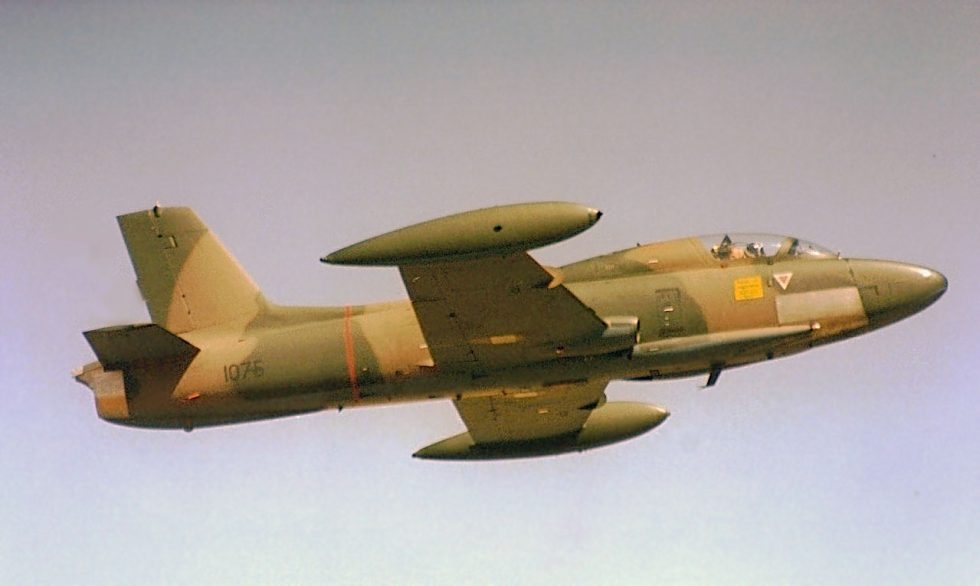
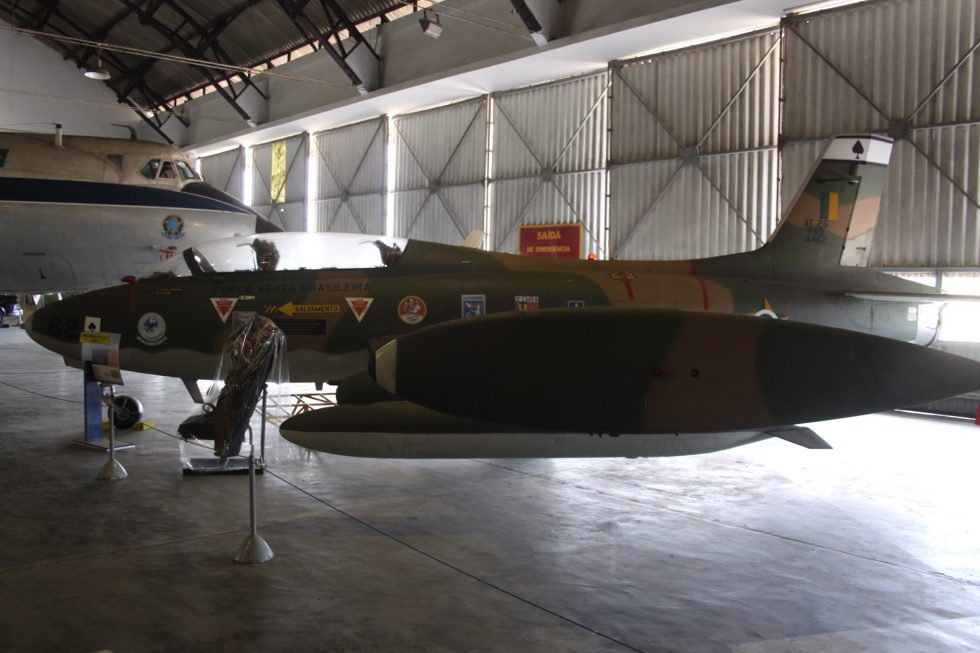
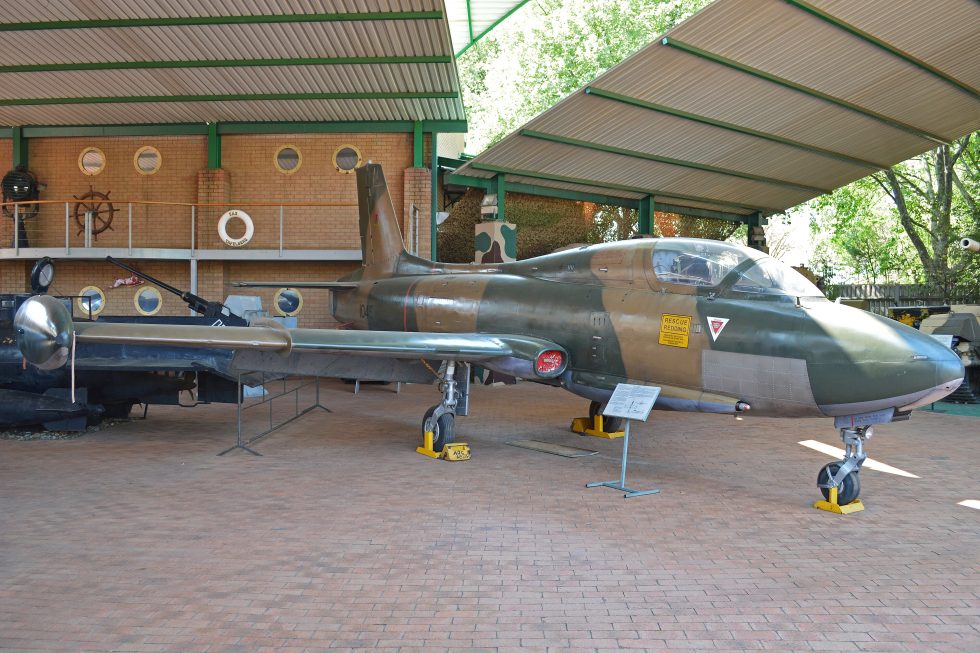
The MB-326 in motion
Flying MB-326 and Impala footage is on the way.
The MB-326 in motion
Weapon Detective — one of the most-watched MB-326 films on YouTube.
Where the MB-326 flew
The little trainer that went to war
The MB-326’s combat record belongs mostly to the South African Atlas Impala, which flew close air support, armed reconnaissance and reportedly helicopter-interception sorties throughout the Border War (c. 1966–1989) over Angola and Namibia. Argentine EMBRAER Xavantes were deployed during the 1982 Falklands/Malvinas period, and other operators used the type in regional conflicts. Treat specific sortie and kill claims cautiously — open sources are inconsistent.
Compare the combat record of every military aircraft. Figures as of July 2026.
Everything people ask about the MB-326
Can I fly in an MB-326?
Is the MB-326 fast?
Is it supersonic?
Is it still flyable?
Was it really licence-built abroad?
How many MB-326s were built?
What is the Impala’s relation to the MB-326?
What engine does it use?
You can actually fly the MB-326.
Pick your cockpit.
Some legends only live in museums — others are fuelled and waiting. MiGFlug has put civilians in real military jet cockpits since 2004.
 Fly the L-39 AlbatrosThe world’s most-flown jet trainer — aerobatics included
 Fly the F-104 Starfighter“The missile with a man in it”
 Fly the MiG-21The Cold War’s most-produced jet
 Fly the T-33 Shooting StarAmerica’s first jet trainer
 Fly the DH VampireA piece of early jet history
 Fly the S.211Agile Italian jet trainer
 Fly the MB-326The classic Aermacchi jet
 Fly the MiG-15The Soviet legend of the Korean War
Continue the tour
Every fact, checked
- MiGFlug — MB-326 flight experienceThe booking page for civilian MB-326 flights from Reggio Emilia, Italy.
- flugzeuginfo.net — MB.326 technical dataSpecifications and the ~761-built production figure.
- MilitaryFactory — Aermacchi MB.326Development history, variants and operator overview.
- Vintage Aviation NewsFirst flight of the MB-326 and the licence-production story.
- globalmilitary.net — MB-326KAttack-variant specifications and 2026 operator status.
- Sea Power Centre (RAN)The CAC Aermacchi MB-326H “Macchi” in Australian service.
- Aviation Heritage Museum WAThe RAAF Macchi MB-326H — history and preservation.