
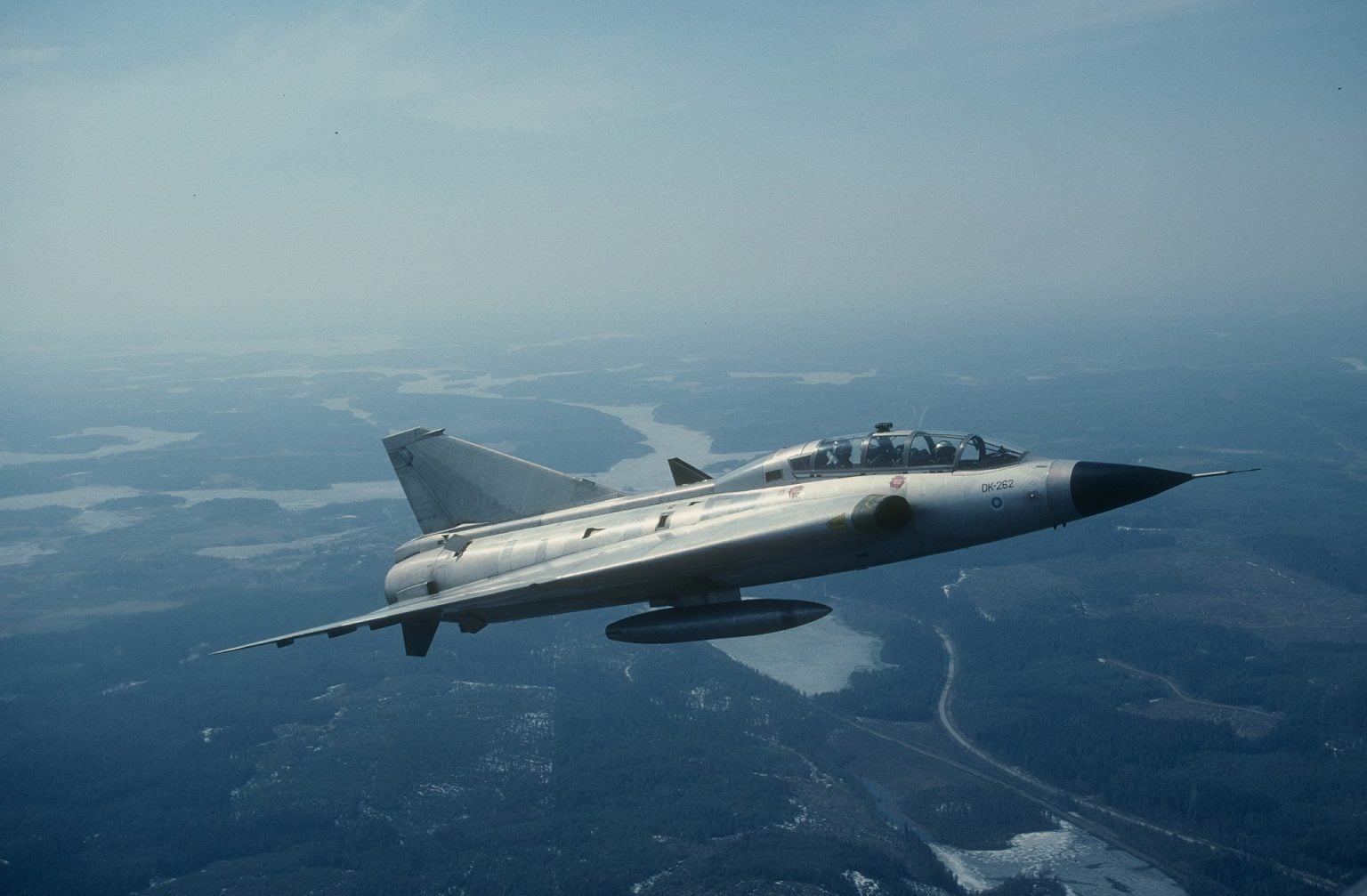
Saab 35 Draken
“The Dragon”
The double-delta gamble that made neutral Sweden the first nation in Western Europe to field a Mach 2 fighter — a road-basing interceptor that could stand on its tail decades before the Su-27 made it famous.
The dragon that guarded a neutral sky
In the late 1940s a small, neutral, non-aligned Sweden faced an outsized problem: how to stop fast, high-flying jet bombers from crossing its airspace without leaning on any alliance to do it. The Swedish Air Force wanted an interceptor that could climb like a rocket, go supersonic, and still recover to short, dispersed strips deep in the forest. Saab’s design team, led by Erik Bratt, answered with one of the most radical shapes of the jet age — the double-delta wing, a compound planform with a steeply swept inner section blended into a gentler outer delta.
Nobody had flown a wing like it, so Saab de-risked the whole programme with a half-scale flying testbed, the Saab 210 “Lilla Draken” (Little Dragon), which took to the air in January 1952 and proved the concept. The full-size prototype first flew on 25 October 1955, went supersonic in level flight within months, and reached Mach 2 in January 1960 — making the Draken the first Western European-designed aircraft to get there. It entered service with wing F13 in March 1960.
The Draken was built around Sweden’s Bas 60 (later Bas 90) dispersal doctrine: instead of concentrating jets on a handful of airfields an enemy could destroy in one strike, the air force would scatter them to camouflaged forest bases and reinforced public roads, rearmed and refuelled by small teams of conscript ground crews. The aircraft had to be tough, simple and quick to turn around — and it was. Its double-delta also gave pilots a startling party trick: pulled hard, the nose would rear up into a controlled superstall the Swedes called kort parad, “the short parry,” bleeding speed so fast a pursuer would overshoot — a cobra-style manoeuvre decades before the Su-27.
Roughly 600–650 Drakens were built over two decades, and the type was exported to Denmark, Finland and Austria. It never fired a shot in anger. Its whole career was interception, reconnaissance, quick-reaction alert and the quiet, constant work of guarding neutral skies — a job it did until Austria, the last operator, retired the type in 2005.
01The Saab 35 Draken’s double-delta wing: why Sweden built a shape nobody had flown
The double-delta fused two wings into one: an inner delta swept at roughly 80°, optimised for high speed and packed with fuel, engine and landing gear, blended into an outer delta of about 60° that preserved lift and control at lower speeds. That let a single airframe combine a very high top speed with acceptable take-off and landing behaviour — a hard trick in the mid-1950s. At high angle of attack the sharp leading edges shed energetic vortices that add lift, an effect later exploited deliberately on the F-16, F/A-18 and Rafale. Saab discovered much of it the careful way, first on the half-scale Saab 210 testbed, before committing the real aircraft.
What makes it special
The double-delta wing
The Draken’s signature is a compound delta — an ~80° inner wing for speed and volume, an ~60° outer wing for low-speed lift. One planform gave it Mach 2 performance and short-field manners at once, and its leading-edge vortex lift anticipated ideas used on fighters built decades later. Hush-Kit’s analysts even note the shape gave it an unusually small head-on radar signature for its generation.
Built to fight from the highway
Engineered for Sweden’s Bas 60/90 dispersal doctrine, the Draken was designed to scatter to forest strips and reinforced public roads and be turned around by small teams of conscript ground crews. Robust, simple systems and short-field performance meant no single enemy strike could catch the air force on the ground — neutrality with a hard edge.
The ‘short parry’ and the zoom-climb
The double-delta let the Draken pitch to very high alpha and enter a controlled superstall — kort parad — that scrubbed speed and forced a chaser to overshoot, a cobra-type move long before it was famous. Paired with a fast snap-up zoom-climb, it suited the jet’s core job: catching high, fast bombers at the edge of the stratosphere.
02The Saab 35 Draken’s engine: a licensed Rolls-Royce Avon with a Swedish afterburner
Power came from a single Volvo Flygmotor RM6C — a licence-built Rolls-Royce Avon 300 fitted with a Swedish-designed afterburner (the EBK 66/67). It delivered roughly 56 kN dry and about 78 kN in reheat, enough to push the Draken past Mach 2. Sweden’s decision to license and then locally develop the Avon — rather than import a finished engine — was part of the same self-reliant, non-aligned logic that shaped the whole aircraft.
03The Saab 35 Draken’s high-alpha handling: brilliant, and briefly dangerous
The same wing that let the Draken perform its kort parad also made low-speed handling demanding on the early marks: mishandled, the jet could enter an uncommanded superstall that required deliberate, trained recovery. Swedish pilots learned to treat the high-alpha regime as both a weapon and a hazard. It is frequently cited as the first aircraft able to perform a cobra-type manoeuvre — but contemporaneously it was flown as a carefully managed combat and recovery technique, not an airshow flourish.
Full specifications
Baseline note: the figures below describe the J 35F, the Falcon-armed all-weather interceptor that was built in larger numbers than every other Draken mark put together — 230 of the 651 airframes — and the version from which the final Swedish J 35J was rebuilt. Its engine is the Svenska Flygmotor RM6C, the licence-built Rolls-Royce Avon 300 series (Avon Mk 60) with a Swedish afterburner, the Ebk 67, bolted on the back. Deltas for the early J 35A and J 35B, the J 35D, the S 35E reconnaissance aircraft, the Danish Saab 35XD (F-35, RF-35, TF-35), the Austrian J 35Ö and the Finnish machines are given in grey. Three warnings before the numbers. First, the specification block on the English-language Wikipedia article quotes 2,450 km/h and Mach 2.3 for the J 35F; the comparative table lower down the same article gives 2,150 km/h and Mach 2.0, the Swedish flight-manual limit, and that is the figure used here. Second, the outer wing sweep is given as 57° by Saab-derived data and as 60° by several general reference works; both are stated below rather than silently picked. Third, Swedish practice tabulated thrust in kiloponds, so kN figures converted from kp and kN figures quoted directly differ in the last digit between reference works.
Dimensions & weights
- Crew
- 1 — two in tandem in the Sk 35C trainer, the Finnish 35CS and the Danish TF-35, which kept only one of the two cannon. Every armed Draken was flown by one man, and doing radar interception, navigation and gunnery single-handed at Mach 2 was the hardest part of the job
- Length
- 15.34 m (50 ft 4 in) for the J 35B, D, E, F and J. The short-tailed J 35A1 (Adam kort) and the Sk 35C rebuilt from it are 15.21 m (49 ft 11 in); the longer tail cone of the J 35A2 (Adam lång) was fitted to house the bigger Ebk 66 afterburner and unexpectedly reduced drag, at the cost of a retractable tail wheel to stop the pilot scraping it on rotation
- Wingspan
- 9.42 m (30 ft 11 in) — unchanged across every mark, Danish aircraft included, even though the Danish outer panels were completely redesigned for load carrying
- Height
- 3.89 m (12 ft 9 in); 3.87 m (12 ft 8 in) on the J 35A, J 35B and Sk 35C
- Wing area
- 49.2 m² (530 sq ft) — enormous for a 12-tonne aeroplane, and the single number that explains the Draken’s low wing loading, its climb and its willingness to keep flying at absurd angles of attack
- Wing
- Tailless double delta, 80° leading-edge sweep inboard, 57° outboard — several reference works round the outer panel to 60°. Section 5 per cent thick. The inner panel is a very large-chord, very thin, highly swept surface running almost to the intakes: it behaves like a supersonic wing, carries the fuel, the guns, the main undercarriage and the engine, and needs no separate tailplane. The outer panel is a conventional 57° delta of ordinary aspect ratio, and it is what gives the aeroplane lift and control at approach speed. Bolting the two together let Saab meet a Mach 2 requirement and a 12-metre-wide road-strip requirement in one airframe without the weight growth a single pure delta would have needed. What it bought: an aeroplane that accelerated like an interceptor and landed like a trainer. What it cost: a deep, stable super-stall at high alpha that killed pilots before the recovery technique was understood
- Empty weight
- 7,425 kg (16,370 lb) for the J 35F. J 35A 6,590 kg (14,530 lb); Sk 35C 6,792 kg (14,970 lb); J 35D 7,265 kg (16,020 lb); S 35E 7,311 kg (16,120 lb); J 35J 7,422 kg (16,360 lb). The Draken gained under a tonne of empty weight across fourteen years and four major marks, which is a very small figure for the capability added
- Maximum take-off weight
- 11,914 kg (26,270 lb) for the J 35F. J 35A1 10,089 kg (22,240 lb); J 35B 10,508 kg (23,170 lb); J 35D 11,864 kg (26,160 lb); S 35E 11,973 kg (26,400 lb); J 35J 12,430 kg (27,400 lb). The Danish F-35, with a strengthened structure, nine pylons and forty per cent more internal fuel, is usually tabulated at 16,000 kg (35,270 lb) and was by a wide margin the heaviest Draken ever flown
- Internal fuel
- 2,820 litres (620 imp gal, 745 US gal) in the J 35D, S 35E, J 35F and J 35J, in integral tanks in the inner wing and bag tanks around the engine. 2,240 litres (493 imp gal, 592 US gal) in the J 35A, J 35B and Sk 35C. Where a cannon was deleted, a fuel tank could be fitted in the gun bay
- External tanks
- 525 litres each (115 imp gal, 139 US gal). One on the J 35A, B and C; two on the J 35D and J 35F; four on the S 35E and the J 35J. Danish aircraft used a much larger 1,275-litre (280 imp gal) tank, which is how a fighter-bomber Draken reached useful strike radius
- Wing loading
- 242 kg/m² (49.6 lb/sq ft) at the J 35F’s maximum take-off weight; about 224 kg/m² (45.8 lb/sq ft) at a normal 11,000 kg. That is Hunter territory on a Mach 2 aeroplane, and it is why the Draken turned better than an interceptor of its generation had any right to
- Undercarriage
- Tricycle, single wheel per unit, plus a retractable tail wheel on the long-tailed marks — with a braking parachute as standard. Danish aircraft and, after the 1990s Mk II upgrade, Austrian ones also carried an arrestor hook for cable engagement on short strips. The fuselage splits into two bolted sections, front and rear, so the whole back half comes off for an engine change at a dispersed base
Performance
- Maximum speed
- 2,150 km/h (1,336 mph, 1,161 kn) at 11,000 m (36,000 ft), Mach 2.0, for the J 35D, S 35E, J 35F and J 35J. This is the Swedish service figure and it is the one to use
- Maximum speed, early marks
- 1,900 km/h (1,181 mph, 1,026 kn) for the J 35A, J 35B and Sk 35C on the less powerful RM6B — about Mach 1.8, which was the requirement as revised in 1956 before it was raised again to Mach 2.0 in 1959
- Mach 2 first reached
- 14 January 1960 — test pilot Erik Dahlström in the J 35B prototype, on engine number 3459. The second full-scale prototype had already gone supersonic by accident, in the climb, on its first flight with an afterburner fitted
- Rate of climb
- 175 m/s (10,500 m/min, 34,450 ft/min) as tabulated in Swedish sources. English-language works commonly quote 199 m/s (39,200 ft/min); the disagreement is real and is probably a difference between a sustained figure and an initial one. In the 1958 Swiss competition the Saab 35H demonstrator out-climbed the Mirage III by 20 to 40 per cent and needed a 35 per cent shorter take-off run, and lost the order anyway
- Service ceiling
- 20,000 m (65,600 ft); Swedish tables give 19,995 m, which is the same number in metric dress
- Take-off run, dry runway
- 1,220 m (4,000 ft) for the J 35F and J 35J. J 35A, J 35B and Sk 35C 810 m (2,660 ft); J 35D 920 m (3,020 ft); S 35E 921 m (3,022 ft). The heavier, better-armed marks needed markedly more concrete, which matters for the road-base story below
- Landing run with braking parachute
- 880 m (2,890 ft) for the J 35F and J 35J; 510 m (1,670 ft) for the J 35A, B and C; 680 m (2,230 ft) for the J 35D. A Bas 60 road strip was 1,500 to 2,000 m long and 12 m wide, so the Draken fitted — but the Bas 90 kortbanor of the 1980s were only 800 m long, and those were sized for the Viggen and the Gripen, not for this aeroplane
- Ferry range
- 2,750 km (1,709 miles, 1,485 nmi) with external tanks
- Combat radius
- ~440 km (~274 miles, 238 nmi) with two Sidewinders and two 500-litre tanks at ten per cent fuel reserve, and ~410 km (~255 miles, 221 nmi) in the fighter-bomber fit with four Mk 82 Snakeye and two 1,275-litre Danish tanks. Both are Saab brochure figures from the 1971 Saab 35FD offer to Denmark, not service planning numbers
- Thrust-to-weight
- 0.7 at maximum take-off weight with the afterburner alight — better than one at combat weight with fuel burnt off, which is what made the J 35D, in Swedish pilots’ description, the version that would simply accelerate until it ran out of fuel
- Turnaround
- Refuelled and rearmed in under ten minutes by conscripts with minimal training — not a marketing claim but a written requirement in the 1949 specification, alongside operation from reinforced public roads. It shaped the servicing panels, the single-point refuelling and the whole ground-handling design
- Super stall and kort parad
- Documented from the early 1960s — the tailless double delta could enter a deep, stable super stall at high angle of attack, which killed several pilots early in service and forced the air staff to add recovery training. Out of that training came the deliberate version: pull to very high alpha, let the nose come up and the aeroplane decelerate violently, then unload to recover. Swedish pilots called it kort parad, "short parry", after the fencing move; F 10 at Ängelholm called it wacka. Test pilots Bengt Olow and Ceylon Utterborn are credited with developing the technique around 1961–63 at F 13 Bråvalla. What is documented is film of it, its use in mock combat — including a filmed engagement in which a pursuing Viggen overshoots a Draken that performs it — and Swedish pilots’ own assessment that it worked but only as a last-ditch move, because you finish it slow. What is not documented is any use in real combat, by anyone, in any aeroplane. Viktor Pugachev flew the same manoeuvre in a Su-27 at Le Bourget in June 1989, roughly a quarter of a century after the Draken squadrons had it in their repertoire
- Attrition
- 15.5 total losses per 100,000 flying hours in Swedish service — 119 write-offs in 766,720 hours over 38 years. Swedish tabulations give 6.2 for Denmark, 1.4 for Finland and no recorded total loss in Austria. The Swedish figure is bad by modern standards and unremarkable for a 1960 supersonic interceptor flown hard at low level by conscript-supported squadrons; the Finnish figure is extraordinary
Propulsion & systems
- Engine, J 35D / E / F / J
- 1 × Svenska Flygmotor RM6C afterburning turbojet — the licence-built Rolls-Royce Avon Mk 60 (300 series), 56.5 kN (5,760 kp, 12,700 lbf) dry and 78.4 kN (7,995 kp, 17,620 lbf) with reheat. Some Swedish sources give 77.3 kN for the same installation; the difference is a kilopond conversion, not a different engine
- Engine, J 35A / B / C
- 1 × Svenska Flygmotor RM6B — the Avon Mk 48A (200 series), 64.1 kN (6,540 kp, 14,410 lbf) with reheat in the figure Swedish sources use; some reference works quote up to 67.6 kN (15,190 lbf). The step from RM6B to RM6C is the largest single performance jump in the family and is what turned a Mach 1.8 aeroplane into a Mach 2 one
- Afterburner
- Swedish design throughout — Ebk 65 on the J 35A1 and Sk 35C, the longer Ebk 66 on the J 35A2 and J 35B, Ebk 67 on the J 35D, S 35E, J 35F and J 35J. Rolls-Royce supplied no reheat for these Avon marks, so Svenska Flygmotor at Trollhättan built its own, exactly as it had for the Lansen. Sweden built world-class airframes, radar and afterburners; the core engines were always licences
- Emergency power
- Ram air turbine under the nose, plus a built-in emergency engine starter — a flame-out at altitude did not leave the pilot without hydraulics or instruments, and he could relight without ground equipment. Useful in an aeroplane whose whole doctrine was operating away from a proper airfield
- Radar
- PS-01/A (later PS-011/A) X-band fire-control radar in the J 35F and J 35J — the Ericsson set that made semi-active radar homing possible, feeding the S-7B sight and slaving the Rb 27. J 35B and J 35D carried the Ericsson PS-03/A with the S-7A-2 sight; the J 35A had the French PS-02, a Cyrano-derived set bought because the Swedish radar was late, and used chiefly as a ranging radar for gunnery. The Sk 35C, S 35E and all Danish aircraft carried no radar at all — the Danes fitted lead ballast in the nose instead. The Hawe I and II modifications improved the P/S-01 sets against jamming in the early 1980s
- Infrared search and track
- Hughes N71 under the nose (IR-spanare 71N), fitted from airframe 35501 onwards, which is the difference between a J 35F1 and a J 35F2, and retained on every J 35J. A passive way of finding and tracking a target with the radar silent, in 1967
- Data link
- Integrated into STRIL 60 from the J 35B onward — the styrdatasystem sent digital vectoring orders from the ground control chain straight into the aircraft, where they were stored and displayed rather than shouted over the radio and memorised. Sweden had a working fighter data link in 1962, and it is the least celebrated genuinely advanced thing about this aeroplane
- Flight controls
- Rudder plus inboard and outboard elevons, no tailplane — each surface on a tandem hydraulic jack fed by two separate circuits, running at 210 kp/cm² (20.6 MPa, 2,990 psi), more than double the pressure of the Saab 29. Artificial feel by a q-feel unit, because there is none naturally, and a three-axis autopilot. Early aircraft had to be flown onto the runway with active pilot stabilisation; landing a Draken was never a relaxing act
- Cameras, S 35E and RF-35
- Nine Vinten cameras in the S 35E, five in the nose and four in the fuselage, some vertical and some oblique, replacing the radar and both guns. For night work it carried an EG&G active infrared reconnaissance pod on a belly station. The Danish RF-35 used a related camera nose, and after the 1980s WDNS programme the same nose shape without side windows was fitted to the F-35 and TF-35 to house a Ferranti laser ranger
- Self-protection
- Radar warning receiver and a Kapsel KB chaff and flare pod on the S 35E — the Swedish fighter fleet was thin on countermeasures. Denmark did far better: ALR-45 warning receivers in the 1970s, ALR-65, then ALR-69 with six antennas on the fin, two per wingtip and two under the nose, plus ALQ-162 jammer pods on the wingtips. Finland fitted Saab BOY 402 dispensers with chaff, flares and expendable active decoys from 1993. Austria bought its warning receiver, chaff dispensers and arrestor hook second-hand from Denmark as the Danish fleet was being scrapped
04The Saab 35 Draken’s operating costs: why no reliable price exists
The Draken was a Swedish state product built for the national air force, never sold on an open dollar market, so a firm flyaway unit price and a credible cost-per-flight-hour simply do not exist in the public record. Surplus airframes later changed hands privately for figures in the low hundreds of thousands of dollars, but that reflects a decommissioned 1960s jet’s scrap-and-collector value, not what it cost Sweden to build or operate. Any precise dollar figure attached to a Draken should be read as an estimate.
Armament & payload
The Draken was built to kill bombers, and the arrival of the licence-built Falcon cost it half its guns
The Draken was drawn around one job: stop Soviet nuclear bombers crossing the Baltic, from a road, at night, with one man in the cockpit. Everything in the weapons fit follows from that. There is no bomb bay, no attack radar and, in Swedish service, essentially no air-to-ground guided weapon; there are two 30 mm ADEN cannon buried in the thick inner wing, a set of hardpoints sized for missiles and rocket pods, and a fire-control system that got progressively better at handing a target to a missile.
The interesting step is the J 35F. To fit the avionics needed for semi-active radar homing, Saab took out the left-hand cannon and gave the survivor 120 rounds instead of 100. In exchange the aeroplane got the Ericsson PS-01 radar and the Hughes Falcon family built under licence in Sweden: the Rb 27, a semi-active radar weapon derived from the AIM-26B, and the Rb 28, the infrared AIM-4 Falcon. A J 35F could go up with four Falcons, mixed radar and heat, and shoot at a bomber from a beam or head-on geometry that a Sidewinder could not attempt. The Falcon was a mediocre missile in Vietnam and it was a mediocre missile over the Baltic too, but against a large, non-manoeuvring target it was the right choice, and it is why the Falcon-capable marks kept only one gun.
The Danish machines are the exception that proves the rule. Denmark bought the Draken as a strike aeroplane, redesigned the outer wings, added nine pylons and forty per cent more fuel, deleted the radar entirely and hung NATO iron off it. No other Draken carried a Bullpup or a Snakeye. Fits varied sharply between marks and between operators — the Sk 35C and S 35E were unarmed, the Austrian J 35Ö flew for six years with nothing but guns because a 1955 treaty forbade guided missiles, and Finland alone fired Soviet weapons from a Swedish fighter.
Gun
- Two 30 mm automatkanon m/55 in the inner wing panels — the licence-built ADEN revolver cannon, firing at roughly 1,200 to 1,300 rounds a minute. 90 rounds per gun on the J 35A, 100 rounds per gun on the J 35B and J 35D. Buried in the thick inboard wing, which is one of the things the double delta bought
- The J 35F and J 35J carry one gun with 120 rounds. The left weapon was deleted to make room for the Falcon fire-control avionics. That is a real loss of firepower and it was deliberate: Sweden judged a radar-guided missile worth more against a bomber than a second revolver cannon
- For gunnery practice one or both cannon could be replaced by 12,7 mm automatkanon m/39 with 100 rounds each — cheap ammunition, similar sight picture, far less wear on an expensive barrel
- From 1977 the guns could fire the 30 mm psrak m/49-56 shaped-charge round, giving the J 35D a genuine anti-armour capability it had never been designed for
- The Sk 35C trainer and the S 35E reconnaissance aircraft carried no gun at all; a fuel tank went into the empty bay. The Danish TF-35 kept one. The Austrian J 35Ö was deliberately built from the two-gun J 35D rather than the more modern one-gun J 35F, because until 1993 guns were the only weapons Austria was allowed
Air-to-air
- Rb 24 — the AIM-9B Sidewinder, on rails under the wings and on the belly station. Up to four on the J 35A, B, D and F. Rb 24J, the AIM-9J, was adopted in 1978 and later fitted with an Ericsson laser proximity fuze, which made it roughly equivalent to an AIM-9P-3
- Rb 27 — Hughes HM-55 Falcon, the export AIM-26B without its nuclear warhead, semi-active radar homing, guided by the J 35F’s PS-01 radar. This is the weapon the whole J 35F avionics fit exists to serve
- Rb 28 — Hughes HM-58 Falcon, the infrared AIM-4. Both Falcons were assembled under licence in Sweden and both were sold on to Finland, where they were designated 7S and 8S
- A J 35F went up with four missiles in six published combinations, from four Rb 27 to two Rb 24 with two Rb 28. The J 35J added two balk G pylons under the intakes for two more Sidewinders, taking it to six
- 75 mm srak m/57 unguided air-to-air rockets in rakkaps m/57 pods, 19 rockets per pod, two pods on the J 35B, D and F and four on the J 35J. A bomber-killing weapon fired on a radar-computed collision course, and standard equipment long after most air forces had abandoned the idea. Uniquely, Finnish aircraft also carried the Soviet R-13M (AA-2 Atoll), a Sidewinder copy bought from the other side of the Iron Curtain
Air-to-surface guided
- In Swedish service, none. The Draken was an interceptor and the Swedish Air Force had the Lansen and later the Viggen for attack work. This card exists to record what was tried and abandoned
- The Saab Rb 05A radio-command air-to-surface missile was to have armed a dedicated attack Draken, the J 35G, a proposed conversion of 70 J 35D. The project was cancelled early. Rb 05 firing trials were flown from the test airframe Fpl 35-10, which was fitted with Viggen outer wings for the purpose, and from the Sk 35C prototype
- The Danish F-35 is the only Draken that carried a guided air-to-surface weapon operationally: the AGM-12B Bullpup, aimed by the pilot flying the missile down a flare with a thumb controller
- The Danes lost the Bullpup capability at some point during the fleet’s service life and it does not appear in the late, WDNS-equipped configuration. The RF-35 reconnaissance aircraft could never carry it
- A late Swedish study, 35 MOD Level 4, proposed new outer wings, canards by the intakes, extra weapon stations, RBS 15 anti-ship capability and a 15,000 kg take-off weight. It was not built; the money went to the Gripen instead
Bombs
- No Swedish Draken carried bombs operationally. The mark that mattered here is the Danish Saab 35XD, and it carried a great many
- Up to about 4,500 kg (10,000 lb) of NATO ordnance on nine hardpoints — eight under the redesigned outer wings and one on the belly. 1,000 lb bombs, and the Mk 82 Snakeye retarded 500 lb bomb as the standard four-bomb strike load
- Aiming was by the Saab BT-9R ballistic computer, which worked for bombs and rockets and supported toss delivery — a way of throwing a bomb at a target without overflying its air defences
- The 1980s WDNS programme replaced that with a Marconi 900 series head-up display, a Ferranti laser rangefinder and marked-target seeker in a new nose, and an inertial navigation set. Danish sources rate the resulting accuracy as comparable to the Royal Danish Air Force’s own F-16s
- Swedish, Finnish and Austrian Drakens carried practice bombs and nothing heavier. Austria in particular flew a pure air-policing aircraft with no air-to-ground role whatever
Rockets
- 13,5 cm sprakraket m/56 — twelve high-explosive air-to-ground rockets on six underwing pylons of the J 35A. Rockets and missiles could not be carried on the wings at the same time, so this was an either-or fit
- 75 mm srak m/57 air-to-air rockets in the rakkaps m/57 pod, 19 per pod, carried in pairs on the belly station from the J 35B onwards and in fours on the J 35J. Fired against bombers on a collision-course attack computed by the radar and the S-7 sight
- 14,5 cm psrak m/49-56 shaped-charge anti-tank rockets became available to the J 35D in 1977, an unexpected late addition to an interceptor’s repertoire
- Danish aircraft carried NATO natures instead: 2.75 in Mighty Mouse folding-fin rockets in launcher pods, on the same pylons that took the bombs
- The rocket fits are the clearest sign of when this aeroplane was designed. In 1960 an unguided rocket salvo was a serious way to kill a bomber; by 1975 it was ballast, and only the Falcons and Sidewinders mattered
Pods & other stores
- 525-litre drop tanks — one on the J 35A, B and C, two on the J 35D and J 35F, four on the S 35E and the J 35J. Denmark used a 1,275-litre tank that no Swedish Draken ever flew
- Camera noses. The S 35E replaced radar and guns with nine Vinten cameras, five in the nose and four in the fuselage, some vertical and some oblique. The Danish RF-35 used a related installation and remained in service two years after the Danish gun-armed F-35 had gone
- EG&G active infrared reconnaissance pod on the S 35E belly station for night work — a genuinely advanced sensor for a mid-1960s tactical reconnaissance aircraft
- Kapsel KB chaff and flare pod on the S 35E; Danish ALQ-162 jammer pods on the wingtips after the WDNS upgrade; Finnish Saab BOY 402 dispensers from 1993, capable of chaff, flares and expendable active decoys
- What the Draken never carried: a targeting pod, a buddy refuelling store, an anti-radiation missile or an anti-ship missile. It had no air-to-air refuelling capability at all, which for an aeroplane meant to fight over its own territory from roads was a deliberate omission rather than an oversight
Three typical loadouts
- Baltic air defence, J 35F2, F 13 Bråvalla, mid-1970s
- Two Rb 27 semi-active radar Falcons on the wing stations and two Rb 28 infrared Falcons on the belly, 120 rounds for the single 30 mm akan m/55, two 525-litre tanks. Radar silent on the run-in, vectored by STRIL 60 over the data link, IR-spanare 71N searching passively.
- Alert intercept, J 35Ö Mk II, Zeltweg, 1995
- Two AIM-9P-3 Sidewinders, two 30 mm cannon with 100 rounds each, clean otherwise. Before the 1993 missile purchase the same aeroplane sat alert with the guns alone, which is what it had to face Yugoslav airspace violations with in 1991.
- Strike, Royal Danish Air Force F-35, Karup, 1985
- Four Mk 82 Snakeye retarded bombs, two 1,275-litre tanks, two AIM-9 Sidewinders on the outer stations, two 30 mm cannon, WDNS head-up display and laser ranger. No radar in the nose — lead ballast instead.
Weapon designations follow Swedish practice (akan, srak, psrak, rb) with the NATO or American equivalent given where one exists. Loadout combinations for the J 35F are those tabulated in Swedish sources; Danish and Finnish fits are drawn from national accounts and changed over twenty years of service. Ammunition counts of 90, 100 and 120 rounds per gun are all correctly attested for different marks and are frequently muddled together in general reference works.
Variants
Seven Swedish marks, three export families and one doctrine that shaped all of them
Six hundred and fifty-one Drakens were built between 1955 and 1974, in six Swedish marks and three export families, and they served in four air forces for 46 years. The Swedish line runs A, B, C, D, E, F, J — Adam, Bertil, Cesar, David, Erik, Filip, Johan — and every step is legible: a better radar, a bigger engine, a camera nose, a missile, a life extension. One production figure is worth noting: 651 is the number in Erichs and colleagues and is the one usually quoted, while the Swedish-language account gives 644. The gap is prototypes and test airframes counted differently.
The doctrine matters more than the marks. From 1958 Sweden built the Bas 60 system: dispersed wartime air bases with squadrons scattered across many fields, and reinforced public roads — 1,500 to 2,000 metres long, 12 metres wide — used as runways. A single road strip is useless if the aeroplane needs a mile of concrete and a hangar full of specialists, so the 1949 requirement demanded that the Draken be refuelled and rearmed in ten minutes by conscripts. That is why the fuselage splits in two for an engine change, why there is a ram air turbine and a built-in starter, and why the wing is shaped the way it is. It is also worth being precise about the follow-on: the famous 800-metre kortbanor of the Bas 90 system, built in the 1980s, were sized for the STOL Viggen and Gripen. A J 35F wanted 1,220 metres dry and 880 metres with the chute out. The Draken was a Bas 60 aeroplane.
Exports were harder work than they should have been. Saab lost Switzerland to the Mirage III in 1958 despite better climb and a shorter take-off run, and then offered the Draken to Belgium, Argentina, Venezuela, Chile, Singapore, Tunisia and Malaysia without a single sale — the Venezuelan deal collapsed under American pressure. The three customers who did buy got very different aeroplanes: a fighter-bomber for Denmark, a mixed fleet held under a postwar treaty cap for Finland, and for Austria a set of twenty-year-old airframes that a treaty forbade to carry a missile.
- J 35A Adam (1959–61, 90 built)
- First operational mark, RM6B engine, French PS-02 ranging radar because the Swedish set was late. 65 short-tailed A1 with the Ebk 65 afterburner, then 25 long-tailed A2 with the Ebk 66 and a retractable tail wheel. Out of service by 1976.
- J 35B Bertil (1962–63, 73 built)
- Ericsson PS-03/A radar, S-7A-2 collision-course sight, 75 mm rocket pods, and the first Swedish aircraft integrated into STRIL 60 with a digital data link. Delivery delays meant 72 were issued first as radarless day fighters, the J 35B′, and converted to full standard from 1964.
- Sk 35C Cesar (1961–62, 25 converted)
- Two-seat trainer rebuilt from short-tailed J 35A1 front sections, unarmed, reconvertible to fighter standard if ever needed. One specially equipped aircraft with a modified braking parachute was used to teach deliberate super-stall entry and recovery.
- J 35D David (1963–64, 120 built)
- The big step: RM6C engine and Ebk 67, more internal fuel, two belly tank stations. The fastest and best-accelerating Draken, and the last Swedish mark with two guns. 24 were later bought back by Saab and rebuilt as the Austrian J 35Ö.
- S 35E Erik (1963–68, 60 built)
- Unarmed tactical reconnaissance: nine Vinten cameras in place of radar and guns, four drop-tank stations, radar warning receiver, a chaff and flare pod and an EG&G infrared pod for night work. 30 built new, 28 converted from J 35D, two more converted but never delivered.
- J 35F Filip (1965–72, 230 built)
- The definitive interceptor and the baseline for this page. PS-01/A radar, integrated sight and missile system, Rb 27 and Rb 28 Falcons, one gun with 120 rounds. From airframe 35501 the Hughes N71 infrared search and track sensor was added under the nose, making the J 35F2.
- J 35J Johan (1987–91, 67 rebuilt)
- A life extension of the J 35F2 forced by delays to the Gripen. Modernised electronics and gun installation, two extra balk G Sidewinder pylons under the intakes, more external fuel. The last operational Swedish Draken flew from F 10 Ängelholm; Swedish sources date that sortie to 8 December 1998, English-language works to December 1999.
- Saab 35XD: F-35, RF-35, TF-35 (Denmark, 1970–73, 51 aircraft)
- Chosen over the Mirage III and the F-5 in 1968. Redesigned outer wings, strengthened structure, nine pylons, forty per cent more internal fuel, no radar and a ballast nose, Saab BT-9R bombing computer. 20 single-seat F-35 strike, 20 RF-35 reconnaissance, 11 TF-35 trainers. Upgraded from the 1980s with the WDNS head-up display, laser ranger and inertial navigation. The heaviest Drakens ever flown; withdrawn in 1991–93 as Eskadrille 725 and 729 gave them up.
- Saab 35XS and ex-Swedish airframes (Finland, 1972–2000, about 50 aircraft)
- Twelve 35S built by Saab as kits and assembled by Valmet, the first flying on 12 March 1974, plus ex-Swedish 35BS, 35CS and 35FS. A 1950 treaty capped Finland at 60 combat aircraft, so the two-seat 35CS and the interim 35BS were classed as trainers and did not count. Uniquely, Finnish Drakens fired Soviet R-13M missiles alongside Swedish-built Falcons, and got extra pylons and BOY 402 dispensers in the 1980s and 1990s. The last display flight was on 16 August 2000.
- J 35Ö (Austria, ordered 1985, in service to 2005, 24 aircraft)
- Twenty-four J 35D bought back from Sweden by Saab, overhauled, given the J 35F’s bird-proof canopy and ferried to Austria between June 1988 and August 1989. The two-gun D was chosen precisely because the 1955 State Treaty banned guided missiles; when Yugoslav aircraft repeatedly violated Austrian airspace during the Ten-Day War of 1991, the Drakens had nothing but guns to meet them with. Austria then declared the clause obsolete, bought AIM-9P-3 Sidewinders from Sweden in 1993 and AIM-9P-5 from 1998, and added a radar warning receiver, chaff dispensers and an arrestor hook bought second-hand from Denmark, producing the Mk II. Five more airframes came from Sweden in 1999 as spares. Flown on air policing from Zeltweg and Graz-Thalerhof until 25 November 2005, then replaced by ex-Swiss F-5E Tiger IIs pending the Eurofighter.
Survivors. No Draken has ever been reproduced — every survivor is an original Saab airframe, so the usual original-versus-replica question does not arise here. Three are currently airworthy so far as can be verified: the Swedish Air Force Historic Flight’s J 35J 35556 (SE-DXR), owned by Saab and flying the European display circuit in 2025 with nothing added but a GPS and a modern radio; its Sk 35C 35810 (SE-DXP); and the civil J 35F N543J at McClellan Air Park in California. A Danish airframe has been kept in airworthy condition but has not flown since 1996, and several ex-Danish machines in the United States are stored, for sale or awaiting restoration — TF-35 AT-155, one of seven shipped to California in 1995, went to the Palm Springs Air Museum in 2024 for static restoration. The National Test Pilot School at Mojave flew six ex-Danish Drakens as supersonic and high-alpha trainers and retired them in 2009; the school’s current published fleet of 22 types contains no Draken, its supersonic work now done on a MiG-21UM and T-38s, so the frequently repeated claim that Drakens still fly in American civil service is out of date. Static survivors are numerous: every Swedish mark is preserved at the Flygvapenmuseum at Malmslätt, Austrian aircraft are at Zeltweg, Graz and the Heeresgeschichtliches Museum in Vienna, Danish examples at Karup, Newark in England and Bodø in Norway, and Finnish ones at the Aviation Museum of Central Finland.
From double-delta gamble to last Cold-War sentinel
Design study begins
Saab starts work on a Mach-capable interceptor to replace the Tunnan and Lansen and defend neutral Swedish airspace.
Lilla Draken flies
The half-scale Saab 210 testbed takes to the air on 21 January, validating the untested double-delta wing.
First flight
The full-size Draken prototype flies on 25 October with test pilot Bengt Olow; it exceeds Mach 1 in level flight in January 1956.
Enters service & hits Mach 2
The J 35 joins wing F13 in March; a Draken had reached Mach 2 that January — a Western European first.
Denmark buys in
The Royal Danish Air Force adopts the Saab 35XD as a strike and reconnaissance aircraft, the first export customer.
Finland joins
Finland begins operating the Draken, with some airframes assembled locally by Valmet and later cleared to carry Soviet missiles.
Austria’s last-of-line
Austria takes 24 rebuilt ex-Swedish airframes as the J 35OE — its first true supersonic interceptors.
Retirement
Sweden retires the type in 1998/1999; Finland in 2000; Austria flies the last military Drakens until 2005.
Twelve stories from the double-delta dragon
The double-delta gamble
Sweden bet its air defence on a wing shape nobody had ever flown.
Read the full story
Lilla Draken, the Little Dragon
A half-size aircraft flew first to de-risk the real one.
Read the full story
A dragon leaves the ground
Test pilot Bengt Olow lifted the prototype off on 25 October 1955.
Read the full story
Mach 2, the European first
Sweden hit twice the speed of sound before its bigger neighbours.
Read the full story
The cobra before the cobra
Draken pilots reared the nose to the vertical decades before the Su-27.
Read the full story
War from the highway
Sweden’s plan was to fight from roads, not runways.
Read the full story
The Finnish Draken’s Soviet sting
A Western fighter that flew with Russian missiles.
Read the full story
Danish dragons over the North Sea
Denmark turned the interceptor into a strike aircraft.
Read the full story
Guarding the Alps while the Balkans burned
Austria’s Drakens policed neutral skies during the Yugoslav wars.
Read the full story
The 1950s jet that photographed stealth
A Cold-War interceptor caught two F-117 Nighthawks over neutral Austria.
Read the full story
The first Western European Mach 2 fighter
A neutral nation beat the big air forces to twice the speed of sound.
Read the full story
Dragons in retirement
A handful still fly — but you cannot buy a ticket.
Read the full story
The Draken in pictures
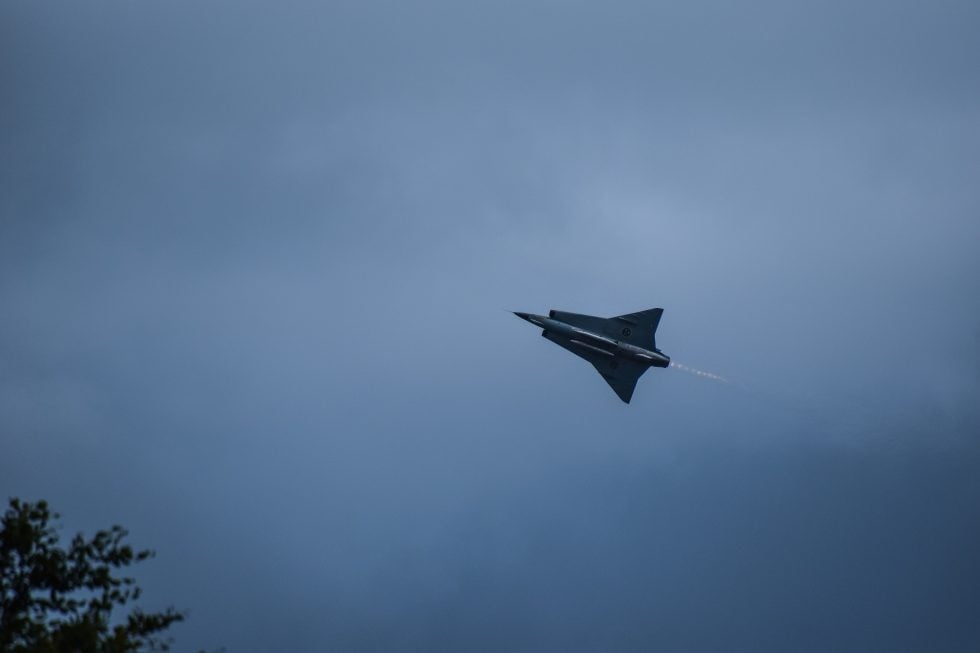
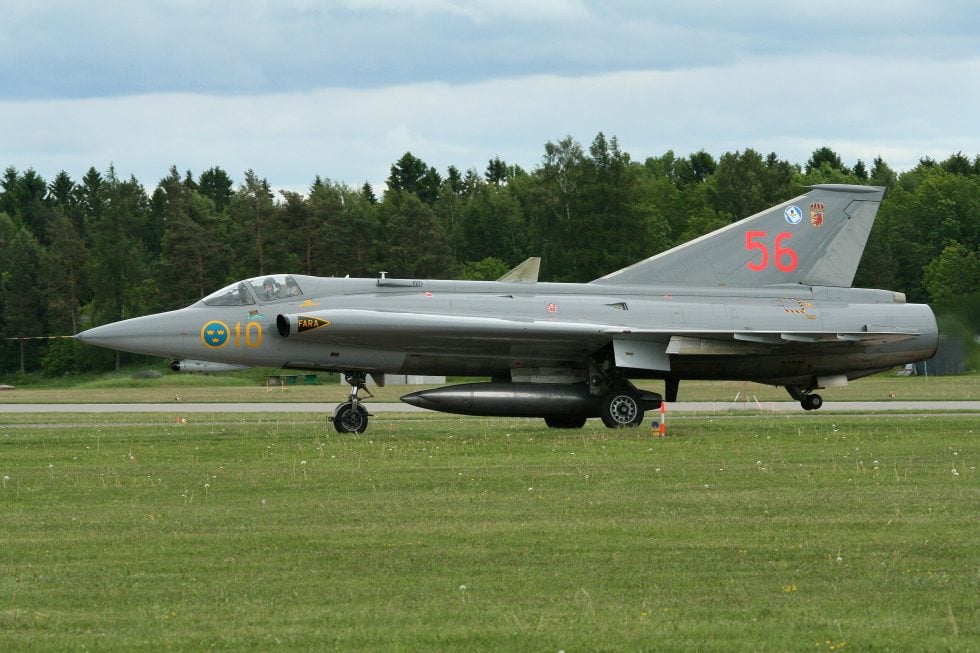
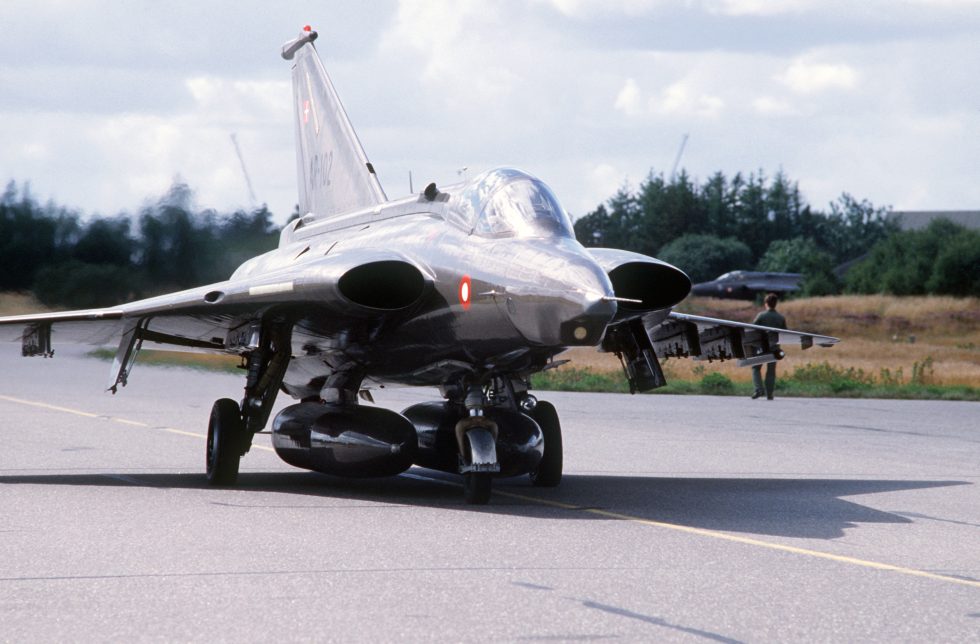
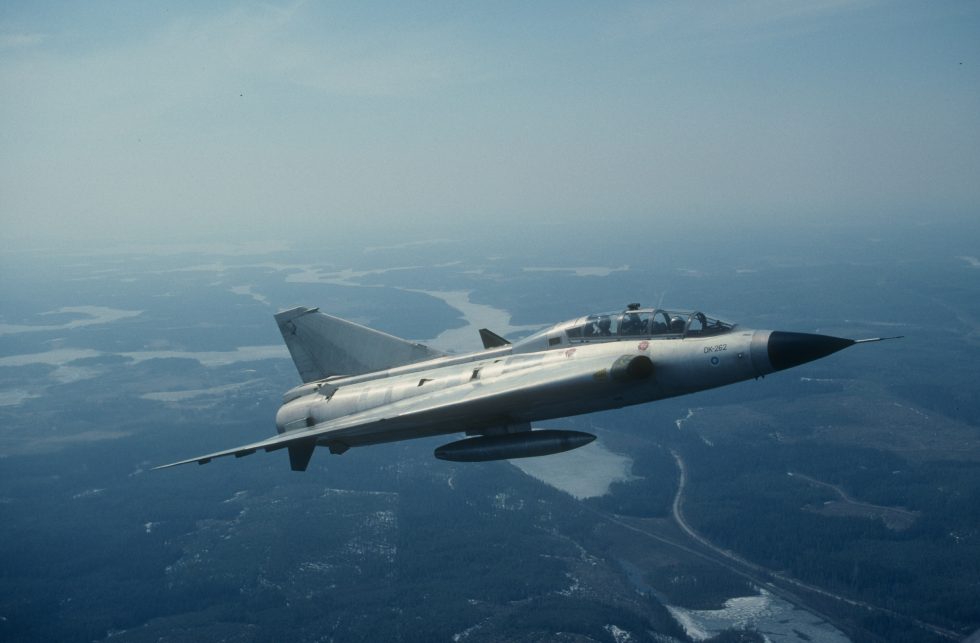
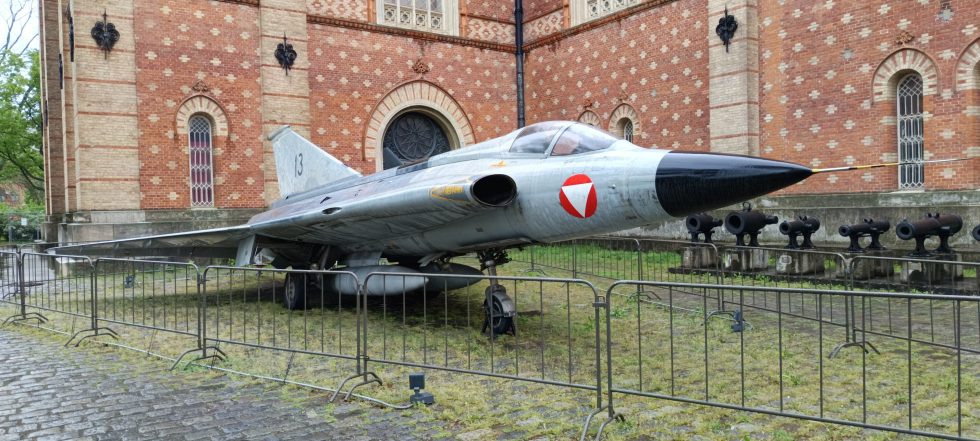
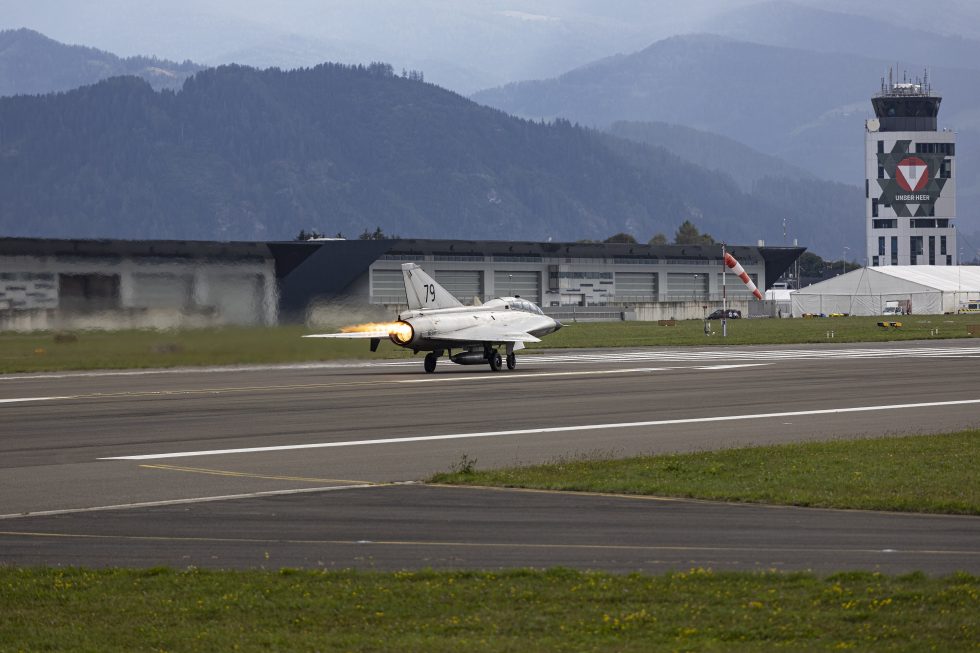
The Draken in motion
A hand-picked video feature on the Saab 35 Draken is coming soon. In the meantime, explore the photo gallery above and the operations map below to see where the dragon flew.
The Draken in motion
Megaprojects — one of the most-watched Draken films on YouTube.
Where the Draken flew
The record it never had to write
The Saab 35 Draken never fired a shot in anger. No operator — Swedish, Danish, Finnish or Austrian — ever used it in combat. Its whole career was written in interception, reconnaissance and quick-reaction alert: shadowing Cold-War intruders over the Baltic, standing neutral watch over the Alps, and once photographing American stealth jets it was never supposed to find. Its victories were the ones where nothing happened.
Compare the combat record of every military aircraft. Figures as of July 2026.
Everything people ask about the Saab 35 Draken
Can I fly in a Saab 35 Draken?
How fast is the Saab 35 Draken?
What makes the double-delta wing special?
Did the Saab 35 Draken ever see combat?
Could a Draken really catch an SR-71?
Who operated the Saab 35 Draken?
Is the Saab 35 Draken still flying?
When and why was the Draken retired?
You can’t fly the Draken.
These, you can.
Some legends only live in museums — others are fuelled and waiting. MiGFlug has put civilians in real military jet cockpits since 2004.
 Fly the L-39 AlbatrosThe world’s most-flown jet trainer — aerobatics included
 Fly the F-104 Starfighter“The missile with a man in it”
 Fly the MiG-21The Cold War’s most-produced jet
 Fly the T-33 Shooting StarAmerica’s first jet trainer
 Fly the DH VampireA piece of early jet history
 Fly the S.211Agile Italian jet trainer
 Fly the MB-326The classic Aermacchi jet
 Fly the MiG-15The Soviet legend of the Korean War
Continue the tour
Every fact, checked
- Saab — “Draken: 50 years in the air”The manufacturer’s own account of the design, Erik Bratt’s team, and Swedish service.
- The Aviationist — “Sweden’s Flying Dragon”Overview of the wing angles, road-base doctrine, high-alpha handling and US test use.
- Hush-Kit — “Saab Draken: Swedish Stealth Fighter?”Jim Smith’s expert analysis of the double-delta and the type’s low head-on radar signature.
- PlaneHistoria — “Saab 35 Draken”Development, aerodynamics, engine detail and the dispersed-basing concept.
- Vintage Aviation NewsFirst-flight milestones, variant history and production figures.
- The Aviation Geek ClubContext on the Viggen’s SR-71 radar locks — correcting the common Draken attribution error.
- 19FortyFiveThe 2002 F-117 intercept and Austria’s neutrality and missile restrictions.
- Plane-Encyclopedia — “Saab 35 Draken”Detailed variant, operator and specification cross-check.