
Dassault MD.450
“Ouragan”
France’s first mass-produced jet fighter — a rugged, straight-winged fighter-bomber that put a war-shattered French aviation industry back in the air and launched the Dassault dynasty that would lead to the Mystère and the Mirage.
The jet that rebuilt French aviation
In 1945 the French aircraft industry lay in ruins. Marcel Bloch — who had survived deportation to Buchenwald and returned to rename himself Marcel Dassault — set out to give France its own jet fighter as fast as possible. Working largely on his company’s own initiative from 1947, his team designed a deliberately conservative machine: a straight low-mounted wing, a nose intake feeding a single centrifugal-flow turbojet, a bubble canopy and tricycle gear. It owed an obvious debt to American jets like the Republic F-84 Thunderjet and the Lockheed F-80.
The prototype MD.450 first flew on 28 February 1949 in the hands of test pilot Constantin “Kostia” Rozanoff. Named Ouragan — French for “Hurricane” — it entered French Air Force service in 1952 as the country’s first indigenous jet fighter to reach mass production. Power came from a Rolls-Royce Nene, built under licence in France by Hispano-Suiza; there was nothing exotic about the aircraft, and that was the point.
The Ouragan was never a world-beater in raw performance — it topped out around Mach 0.76 with a straight wing while rivals were already going swept. But it worked, it was rugged, and it flew in anger far from home: Israeli Ouragans fought over Sinai, Indian “Toofanis” struck in Goa and Kashmir, and El Salvador flew them into the 1980s. Most important of all, it was the first rung of a ladder that ran straight through the swept-wing Mystère to the delta Mirage.
01Why the Ouragan mattered far more than its modest performance suggested
On paper the Ouragan was unremarkable: a straight-winged, subsonic fighter-bomber arriving just as swept-wing jets like the MiG-15 and F-86 Sabre were rewriting the rules. But its significance was industrial and strategic, not aerodynamic. It proved that Dassault could design, build and mass-produce a modern combat jet on French soil, restoring a capability the war had destroyed.
That confidence — and the design team, tooling and supplier network built around the Ouragan — fed directly into the swept-wing Mystère series and, a decade later, the delta-winged Mirage III, one of the most successful fighters of the Cold War. Every Rafale flying today traces its corporate lineage back to this stubby straight-winged jet of 1949.
What makes the Ouragan special
A proven engine and a conservative straight wing
The Ouragan was built around the Rolls-Royce Nene, a reliable British centrifugal-flow turbojet licence-built in France by Hispano-Suiza (the Nene 104B in production aircraft, about 22 kN of thrust). Paired with a thin, unswept low-mounted wing, it was a deliberately low-risk design — France needed a jet that would work, not a technological gamble. The straight wing capped its speed near Mach 0.76 but made it docile and predictable.
A rugged, simple fighter-bomber
Four 20 mm Hispano cannon sat under the nose intake, and four underwing hardpoints carried bombs, napalm or rockets — up to roughly 900 kg of stores. Pilots found it a stable, forgiving gun and rocket platform, ideal for close air support, though its stubby fuselage gave it a habit of snapping into a flat spin in very tight turns. Simplicity made it easy to maintain in the field — a virtue that served Israel, India and El Salvador well.
The foundation of the Dassault line
The Ouragan’s greatest engineering contribution was what it enabled next. Its airframe was the starting point for the swept-wing MD.452 Mystère, which in turn led to the Mystère IV, the Super Mystère and ultimately the Mirage family. The Ouragan was less a masterpiece than a proof of concept — the aircraft that showed Dassault could do it at all.
02The Ouragan’s Nene engine: British power built under licence in France
France in the late 1940s could not yet mass-produce a competitive jet engine of its own, so Dassault turned to the Rolls-Royce Nene, a robust centrifugal-flow turbojet that also powered the Soviet MiG-15 and versions of the American F9F Panther. Hispano-Suiza built it under licence in France. Early prototypes used the Nene 102; production Ouragans standardised on the Hispano-Suiza-built Nene 104B. Relying on a proven, licence-built engine let Dassault concentrate on the airframe and get a working fighter into squadrons quickly — while French firms like SNECMA developed the indigenous Atar engine that would power every later Dassault fighter.
03From Ouragan to Mirage: how one straight-winged jet started a dynasty
The Ouragan’s lineage is unusually direct. Dassault fitted a 30-degree swept wing and revised tail to the basic layout to create the MD.452 Mystère I, then refined it into the transonic Mystère IV and the supersonic Super Mystère. In parallel the company pursued the tailless delta configuration that became the Mirage III — a Mach-2 fighter exported around the world. The through-line from the 1949 Ouragan to the Rafale of today is one continuous corporate and engineering story, and it begins here.
Full Ouragan specifications
Baseline note: the figures below describe the Dassault MD.450B Ouragan as built at Mérignac with the Hispano-Suiza Nene 104B, the licence-built Rolls-Royce Nene that powered the great majority of the 350 aircraft completed and every export machine. Deltas for the first fifty MD.450A aircraft with the imported Rolls-Royce Nene 102, for the Indian Toofani with the Nene 105, for the rough-field Barougan and for the one-off Atar-engined MD.450-30L are in grey. Six warnings before the numbers. First, the family. Four Dassault fighters of the 1950s are constantly collapsed into one another and they are entirely different aeroplanes: the straight-winged Ouragan described here, the swept-wing Mystère II of 1952, the Mystère IV of 1952–54 and the Super Mystère of 1955, the first French aircraft supersonic in level flight. The Mystère IV and the Super Mystère have their own pages in this encyclopedia; do not borrow their figures for this one, and in particular do not import their swept wings. The Ouragan’s wing is straight. Only its fin and tailplane are swept. Second, the production total. We use 350 built, the figure given by Dassault and by the standard reference literature. The English-language Wikipedia infobox says "over 567", which is arrived at by adding 370 French, 104 Indian, 75 Israeli and 18 Salvadoran aircraft as though none of them were the same airframes. They were: the Israeli aircraft were partly ex-French, most of India’s later batches were second-hand, and every Salvadoran Ouragan was a used Israeli one. The 567 figure counts several aeroplanes three times and should not be repeated. Third, the state contract that did not exist. There was no official requirement, no specification and no government money behind the MD.450 when design work began in December 1947. Dassault built it as a private venture and the first prototype flew on 28 February 1949 before the Armée de l’Air had ordered anything. The first order, for fifteen pre-production aircraft cut to twelve, came on 31 August 1949, six months after the aeroplane was already flying. Fourth, the speed. The 940 km/h in every published table is a sea-level maximum and is almost never labelled as one. It corresponds to roughly Mach 0.77 down low. The airframe limit was about Mach 0.83 and the straight wing meant the Ouragan hit compressibility early; a MiG-15 was faster at every altitude that mattered, and the Israeli and Indian air forces both knew it when they bought the aircraft. Fifth, the fuel. Internal capacity is not consistently published in any source accessible here. The 450-litre wingtip tanks that appeared in December 1949 and became a permanent fixture are well attested; the internal figure is not, and the row below says so rather than inventing a number. Sixth, the span. The 13.16 m usually quoted is measured over the fixed wingtip tanks. Salvadoran ground crews routinely removed them in the 1980s to trade range for warload over a country 250 km wide, which changes both the span and the drag figures.
Dimensions & weights
- Crew
- 1 — single-seat throughout; no two-seat trainer version of the Ouragan was ever built, which is why French and Indian conversion onto type was done on Vampires and Meteors.
- Length
- 10.73 m (35 ft 2 in) — short, stubby and, in the designers’ own later judgement, too short: the low fuselage fineness ratio is the direct cause of the type’s flat-spin habit.
- Wingspan
- 13.16 m (43 ft 2 in) over the fixed wingtip tanks. Salvadoran aircraft often flew with the tanks off.
- Height
- 4.14 m (13 ft 7 in)
- Wing area
- 23.8 m² (256 sq ft)
- Wing planform
- Straight, tapered, unswept, aspect ratio 7.3 — NACA 65-112.9 at the root, 65-211.8 at the tip. The tailplane and fin are swept; the wing is not.
- Empty weight
- 4,142 kg (9,132 lb)
- Gross weight
- 7,404 kg (16,323 lb) — the normal loaded figure quoted for the fighter role.
- Maximum take-off weight
- 7,900 kg (17,417 lb)
- Internal fuel
- Not reliably published. The two fixed wingtip tanks hold ~450 litres each (~119 US gal), and underwing drop tanks were routine; the internal figure varies between sources by enough that we decline to state one.
- Hardpoints
- Four underwing stations, ~908 kg (~2,002 lb) of external stores maximum — and the two inboard stations were usually carrying fuel, so the real war load was two bombs or two rocket pods.
- Undercarriage
- Retractable tricycle, single wheels, designed for paved runways. The four Barougan conversions had twin low-pressure main wheels retracting into underwing fairings, plus a brake parachute, for unpaved Saharan strips.
Performance
- Maximum speed, sea level
- 940 km/h (584 mph, 508 kn) — about Mach 0.77 at that altitude, and the number every table quotes without saying it is a sea-level figure.
- Limiting Mach number
- Mach 0.83 (dive limit) — the straight wing put the aircraft into compressibility well below the swept-wing generation that arrived three years later.
- Cruising speed
- 750 km/h (466 mph, 405 kn)
- Rate of climb
- 38 m/s (7,480 ft/min) at sea level. The unarmed first prototype of 1949 recorded 43 m/s and 980 km/h; production weight cost it both.
- Service ceiling
- 13,000 m (42,650 ft)
- Combat range
- ~450 km (~280 miles) — short, which is why the type worked in Sinai and over Diu and would have been useless anywhere larger.
- Ferry range
- ~920 km (~570 miles) with tip and drop tanks.
- Take-off run
- 783 m (2,569 ft)
- Landing run
- 910 m (2,986 ft) — longer than the take-off run, and on the unmodified aircraft there was no brake parachute to shorten it.
- Wing loading
- 311 kg/m² (63.7 lb/sq ft) at gross weight — light by later standards, and the reason the aeroplane turned better than its speed suggested.
- Thrust-to-weight ratio
- 0.31 at gross weight — adequate in 1952, hopeless by 1960, and unchanged for the whole service life because there was no afterburner and no growth engine.
- Handling
- Praised as an exceptionally steady gun and rocket platform; disliked for departing into a flat spin out of hard turns, a trait that killed pilots during the rushed 1952 introduction before the flight-test programme had finished.
Propulsion & systems
- Engine
- One Hispano-Suiza Nene 104B centrifugal-flow turbojet — the Rolls-Royce Nene built under licence in France, lighter than the imported engine and marginally more powerful.
- Rated thrust
- 22.2 kN (5,000 lbf), dry. No afterburner was ever fitted to a production Ouragan.
- Engine, early aircraft
- The three prototypes and the first fifty production MD.450A aircraft used the imported Rolls-Royce Nene 102 at 22.27 kN (5,000 lbf).
- Engine, Indian aircraft
- India’s 71 new-build Toofanis were delivered with the slightly uprated Nene 105.
- Engine, experimental
- The single MD.450-30L of January 1952 traded the Nene for a SNECMA Atar 101B with side intakes and two 30 mm DEFA cannon — the layout that would become the Mystère line.
- Air intake
- Single oval nose intake, the duct splitting to pass either side of the cockpit and rejoining ahead of the engine, which sits directly behind the pilot.
- Escape system
- Martin-Baker Mk.1 ejection seat on early aircraft; most production machines used the French SNCASO E.86 seat instead.
- Cockpit
- Pressurised bubble-canopy cockpit from the second prototype onwards. The first prototype had neither pressurisation nor armament.
- Sighting and avionics
- Optical gyro gunsight, VHF radio, no radar and no radar ranging of any kind — a clear-weather day fighter and nothing else.
- Fuel system
- Fuselage and wing tankage plus two permanently fitted 450-litre wingtip tanks, introduced in December 1949 and the type’s most recognisable feature; underwing drop tanks on the inboard pylons for ferry and long-range work.
- Manufacture
- Beyond Dassault’s own capacity: SNCASE built forward fuselages at Toulouse, SNCASO built rear fuselages at Saint-Nazaire and wings at Bouguenais, Dassault built centre fuselages and tails, and everything came together at Mérignac.
04The Ouragan’s numbers: why production totals and costs vary between sources
The Ouragan was a state-era French product built across several subcontractors — SNCASE and SNCASO produced fuselage sections and wings while Dassault handled centre fuselage, tail and final assembly at Mérignac. France ordered roughly 350 aircraft (an initial 150 plus a follow-on 200), and that is the most commonly cited production figure; some references quote higher totals depending on how prototypes and export airframes are counted. Israel (~75), India (~104) and El Salvador (18) largely operated second-hand or transferred machines rather than wholly new production, so operator counts overlap. No firm flyaway unit price or cost-per-flight-hour exists in the public record — any precise dollar figure attached to the Ouragan is an estimate.
Armament & payload
The Ouragan carried four 20 mm cannon and iron, and every air-to-air kill it ever scored was a gun kill in 1956
The Ouragan’s weapon fit is a 1948 weapon fit, because that is when it was drawn. Four 20 mm Hispano-Suiza cannon in the lower nose, 125 rounds each, four underwing pylons for bombs, rockets or fuel, an optical gyro sight and nothing else. There is no radar, no missile of any kind, no guided air-to-surface weapon and no provision for any of them on any mark, in any air force, at any point in a service life that ran from 1952 to the late 1980s.
What the aeroplane did have was an unusually steady gun platform. Pilots in three air forces said the same thing: the Ouragan sat still while you fired, which for a fighter with no ranging radar and no missiles is the whole of the capability. Four Hispanos firing together are a heavy battery for a 1952 day fighter — heavier than the two 30 mm DEFA of the Mystère IV in throw weight per second at short range, though the DEFA carried further and hit harder per round. The Israeli Air Force bought the type as an admitted stop-gap because the MiG-15 outran it, then discovered in 1956 that a steady gun platform in well-trained hands beat a faster aeroplane in poorly trained ones.
The ground-attack half of the story is where the Ouragan actually earned its keep, and it is a story of small loads carried short distances. Some 908 kg across four pylons, two of them usually holding fuel, means two 227 kg bombs, two napalm tanks or two rocket pods. Israeli Ouragans flew that fit over Sinai in 1956 and against Egyptian, Jordanian and Syrian airfields and armour in 1967; Indian Toofanis flew it against the Diu runway in 1961 and, far more uncomfortably, against Indian towns in Mizoram in 1966; Salvadoran Ouragans flew it against the FMLN into the 1980s, stripping the tip tanks off to squeeze more ordnance onto an aircraft flying missions twenty minutes from base. Fits varied more by operator than by mark: French aircraft flew French ordnance, Israeli aircraft mixed French and American stores, Indian aircraft carried British 1,000 lb bombs, and Salvadoran aircraft carried whatever the arms market would sell to a government under a United States embargo.
Gun — four 20 mm Hispano-Suiza cannon, and the only thing aboard that ever shot down an aeroplane
- Four 20 mm Hispano-Suiza HS.404-family cannon (the Hispano Mk V installation) grouped in the lower forward fuselage beneath the intake duct, with 125 rounds per gun — 500 rounds in total.
- Nose grouping means no wing-root harmonisation compromise: the guns shoot where the pipper is at every range, which matters enormously to a pilot working with an optical gyro sight and no ranging radar.
- Cannon blast against the original four-section nose-gear doors damaged them often enough that the MD.450B was given a revised two-section door — a small change that says a good deal about how much the guns were fired.
- The aircraft was repeatedly described as unusually stable in gunnery and rocketry, and that reputation is the reason it survived as a French advanced gunnery trainer into the mid-1960s after the fighter squadrons had let it go.
- Every Ouragan air-to-air victory on record — all of them Israeli, all of them in 1956 — was scored with these guns.
Air-to-air — no missile, ever; the record is four or five Egyptian Vampires in 1956
- No air-to-air missile was ever carried, fitted or seriously proposed. The Ouragan predates squadron-service guided air-to-air weapons in every Western air force that flew it.
- First victory: 12 April 1956, Lt David Kishon of 113 Squadron shot down an Egyptian de Havilland Vampire over Israeli territory and its pilot was captured.
- Best-known engagement: in the opening hours of 30 October 1956, a pair of Israeli Ouragans caught a formation of Egyptian Vampires over the Mitla Pass and shot down four of them.
- Ouragans also fought Egyptian MiG-15s over Sinai without conclusive result on either side; one Ouragan absorbed 37 mm hits and flew again the following day, and one MiG-15 was badly shot up after making the mistake of turning with them.
- Correction: the frequently repeated claim that an Ouragan shot down an Egyptian Vautour in the Six-Day War does not survive checking. Egypt never operated the Sud Aviation Vautour — only France and Israel did, and the Vautour’s single aerial victory was Israeli, an Iraqi Hunter downed on 6 June 1967. The kills that story is built on are the 1956 Vampires.
Air-to-surface guided — none, and the type was long gone before that mattered
- No guided air-to-surface weapon of any kind. No data link, no television guidance, no laser designator, no wiring for any of it.
- France’s first practical guided air-to-surface weapons, the Nord AS.20 and AS.30, went to the Super Mystère, the Mirage III and the F-100 — two generations after this airframe.
- Everything the Ouragan ever destroyed on the ground was hit with unguided bombs, unguided rockets or the cannon, aimed by a pilot in a dive.
- That included the Egyptian destroyer Ibrahim el Awal on 31 October 1956, strafed and rocketed by a pair of Israeli Ouragans until the ship struck her colours and was taken as a prize.
- Read the absence as a date stamp, not a deficiency: nothing in French front-line service in 1952 had such a weapon either.
Bombs — about 908 kg on four pylons, two of which were usually full of fuel
- Maximum external stores load of roughly 908 kg (2,002 lb) across four underwing hardpoints.
- Standard French and Israeli fits were two 227 kg (500 lb) bombs or two 458-litre napalm tanks on the outboard stations with drop tanks inboard.
- Napalm was part of the repertoire from the beginning and was used freely by Israeli Ouragans against Egyptian columns in Sinai in 1956.
- Indian Toofanis attacked the runway at Diu on 18 December 1961 with 1,000 lb Mk 9 bombs — a heavy single store for an aircraft of this size, and about the practical ceiling of what it could lift.
- Salvadoran aircraft habitually flew with the wingtip tanks removed so that more of the permitted load could be ordnance; over a country 250 km across, the range penalty was irrelevant.
Rockets — the Ouragan’s real ground-attack weapon in three air forces
- Sixteen 105 mm Brandt T-10 air-to-ground rockets on underwing rails — the standard French fit of the early 1950s.
- Alternatively two Matra pods, each holding eighteen 68 mm SNEB rockets, for thirty-six rockets in a single ripple.
- Rockets, not bombs, did most of the damage credited to Israeli Ouragans in Sinai in 1956, where Kenneth Munson records the type destroying a large share of the Egyptian tanks and vehicles attacked over five days for the loss of two aircraft to small-arms fire.
- Rocket-armed Ouragans made the attack on the destroyer Ibrahim el Awal on 31 October 1956.
- The aircraft’s steadiness in the dive is repeatedly cited as the reason its rocket work was accurate; this was one thing the straight wing genuinely bought.
Pods & other stores — fuel, cameras, and a short list of what was never carried
- Two fixed 450-litre wingtip tanks from December 1949 onwards, the type’s visual signature and effectively part of the airframe on French, Israeli and Indian aircraft.
- Underwing drop tanks on the inboard pylons, which is what made the ~920 km ferry figure possible and what ate two of the four hardpoints on almost every combat sortie.
- A single MD.450R reconnaissance conversion carried a camera installation; it remained a one-off and no series reconnaissance Ouragan was built.
- Never carried: gun pods, targeting pods, electronic countermeasures pods, chaff or flare dispensers, air-refuelling probes, or any guided weapon. None of it existed in the form the aircraft would have needed when it was designed.
- The Barougan conversions added a brake parachute, the only aerodynamic store the type ever gained.
Three typical loadouts
- Sinai close support — Israeli Ouragan, 30 October 1956
- 500 rounds of 20 mm; two 227 kg bombs or two napalm tanks outboard; fixed tip tanks full. Fired at Egyptian armour and soft-skinned columns from low level, in daylight, against small-arms and light anti-aircraft fire. Two aircraft were lost this way across the campaign.
- Runway denial — Indian Toofani over Diu, 18 December 1961
- Full cannon load and 1,000 lb Mk 9 bombs against the Diu airstrip, flown under Tactical Air Command direction. On the same operation a Toofani destroyed the Portuguese ammunition dump and the patrol boat NRP Vega, while another pilot broke off his run on the runway after seeing white flags below.
- Counter-insurgency strike — Salvadoran Ouragan from Ilopango, early 1980s
- Wingtip tanks removed to buy warload; cannon, light bombs and rockets against FMLN positions a few minutes’ flying from base. Short-legged, unsophisticated and, in a country that size, sufficient — until an FMLN raid on Ilopango in 1982 destroyed several on the ground.
Sourcing caveat: ammunition loads, external-load limits and store types for the Ouragan are consistent across the reference literature, but operator-specific fits are not. The 908 kg external limit is a French figure; Indian and Salvadoran loads are reconstructed from operational accounts rather than from published loading tables, and where a specific weapon is named above it is because a source names it in that action. Claims of Ouragan aerial victories after 1956 are not corroborated anywhere we can check and are omitted.
Variants
Three prototypes, two engines, one experimental nose and three national names cover the entire Ouragan story
The Ouragan barely evolved, and that is the most revealing thing about it. Marcel Dassault began drawing it in December 1947 with no state contract, no specification and no customer; construction of the first prototype began at Saint-Cloud on 7 April 1948 and Kostia Rozanoff flew it on 28 February 1949. The Armée de l’Air ordered fifteen pre-production aircraft — cut to twelve — on 31 August 1949, six months after the private venture had already proved itself in the air. That sequence is the founding act of Dassault Aviation as a fighter house: build it first, sell it after.
What followed was a production run of 350 aircraft in barely three years and then a full stop. A contract for 150 came in August 1950, followed by further orders of 100 each, the last of which was cancelled in January 1952 in favour of the swept-wing Mystère IIC. The French government had at one point contemplated 850 Ouragans under a five-year rearmament plan; by the time the line was running, the aircraft was already obsolescent and everyone involved knew it. Thirty-nine were completed in 1952, ninety-three in 1953 and the last 118 by mid-1954. There was no Ouragan Mk 2, no afterburning version, no swept-wing rebuild — because the swept-wing rebuild was given a new name and became the Mystère.
In service the type had three national identities. In France it equipped the fighter escadres from 1952, replacing de Havilland Vampires, and flew as the mount of the Patrouille de France from 1954 to 1957, where its steadiness made it an excellent display aircraft; from May 1955 the Mystère IV began to displace it, and by 1961 it was gone from the front line, lingering as an advanced tactical and gunnery trainer into the mid-1960s. In Israel it was the Sufa, bought as a frank stop-gap when the Mystère IIC disappointed and a Canadian embargo killed the Sabre deal; roughly 75 aircraft, five squadrons, and a 1956 campaign good enough that the Israeli Chief of Staff conceded the Ouragan was "a much better aeroplane than had been thought". By 1967 it was obsolete and flew anyway: 113 Squadron alone put up 450 sorties in the Six-Day War against airfields and ground forces and lost seven aircraft doing it, while 107 Squadron struck Egyptian and Jordanian airfields and radar posts and came through without a loss. In India it was the Toofani — the same word, Hindi for hurricane — 104 aircraft in all, and the first jet fighter India bought from anyone other than Britain.
The Indian record deserves its own sentence, and not only the flattering parts. Toofanis bombed the Diu airstrip and sank a Portuguese patrol boat during Operation Vijay in December 1961, flew counter-insurgency strikes in Assam and Nagaland, and carried out reconnaissance during the 1962 war with China. In March 1966, Toofanis of No. 29 Squadron and Hunters of No. 17 Squadron strafed and bombed Aizawl and other Mizo towns — the only occasion on which India has used air power against its own civilian territory, and a fact usually left out of the type’s history. By the September 1965 war the Toofani was no longer a front-line strike aircraft: No. 47 Squadron’s aircraft were detached in small packets for the air defence of Tezpur and Guwahati, five here and four there, which is what a retired fighter gets asked to do.
- MD.450-01, -02, -03 (1949–1950, 3 prototypes)
- Private venture. The first flew 28 February 1949 with a Rolls-Royce Nene 102, unpressurised, unarmed and without tip tanks; the second added a pressurised cockpit in May 1949; the third flew on 2 June 1950 with the Hispano-Suiza-built Nene 104 intended for production. Wingtip tanks first appeared in December 1949.
- MD.450 pre-production (ordered 31 August 1949, 15 cut to 12)
- The first state order, placed after the aircraft had already flown. Used for armament, systems and service trials; the first true production aircraft did not fly until 5 December 1951.
- MD.450A (1951–52, first 50 production aircraft)
- Imported Rolls-Royce Nene 102 of 22.27 kN, four-section nose-gear doors, Martin-Baker Mk.1 seats on the earliest examples.
- MD.450B (1952–54, the great majority)
- The definitive standard and the baseline for this page: Hispano-Suiza Nene 104B, lighter and marginally more powerful than the imported engine, with revised two-section nose-gear doors after cannon blast proved too much for the original four-section arrangement. Most carried SNCASO E.86 ejection seats.
- MD.450R (1 aircraft, MD.450-8)
- Single reconnaissance conversion with a camera installation. Not put into production; France’s tactical reconnaissance work went to other types.
- MD.450-30L (first flight 21 January 1952, 1 aircraft)
- Pre-production airframe rebuilt with a SNECMA Atar 101B, lateral air intakes in place of the nose intake and two 30 mm DEFA cannon. Historically the most important variant and the least used: this is the configuration that led to the Mystère and everything after it.
- Barougan (4 conversions, mid-1950s)
- Rough-field version for North African operations, with twin low-pressure main wheels retracting into underwing fairings and a brake parachute. The fairings cost speed, the concept was overtaken by events in Algeria, and no more were converted.
- Toofani (India, 1953–1957, 104 aircraft)
- Indian designation, Hindi for hurricane. Seventy-one new-build aircraft with the uprated Nene 105 ordered on 25 June 1953, the first four flown in that October and the rest shipped by mid-1954; a further 20 and 13 second-hand machines followed in March 1957. Replaced in the strike role by the Mystère IVA from 1957 and out of front-line service by 1965, then used as an advanced trainer and target tug.
- Sufa (Israel, from 1955, ~75 aircraft)
- Israeli service name, meaning storm; a mixture of new-build and ex-French airframes across five squadrons, bought explicitly as a stop-gap because the Ouragan could not live with a MiG-15. Fought at Suez in 1956 and in the Six-Day War in 1967, then relegated to training; 18 survivors were sold on to El Salvador.
- Ex-Israeli aircraft in El Salvador (delivered 1973–1978, 18 aircraft)
- Refurbished by Israel and sold to a government barred from buying American combat aircraft after the 1969 Football War. Flown hard from Ilopango against the FMLN through the civil war, several destroyed in the 1982 guerrilla raid on the base, replaced by A-37B Dragonflies once the United States embargo lifted, and retired by the middle-to-late 1980s. Sources disagree on the sale date: some place the transfer in 1975, others describe deliveries spread from 1973 to 1978, and retirement is variously given as 1985 and as the end of the decade.
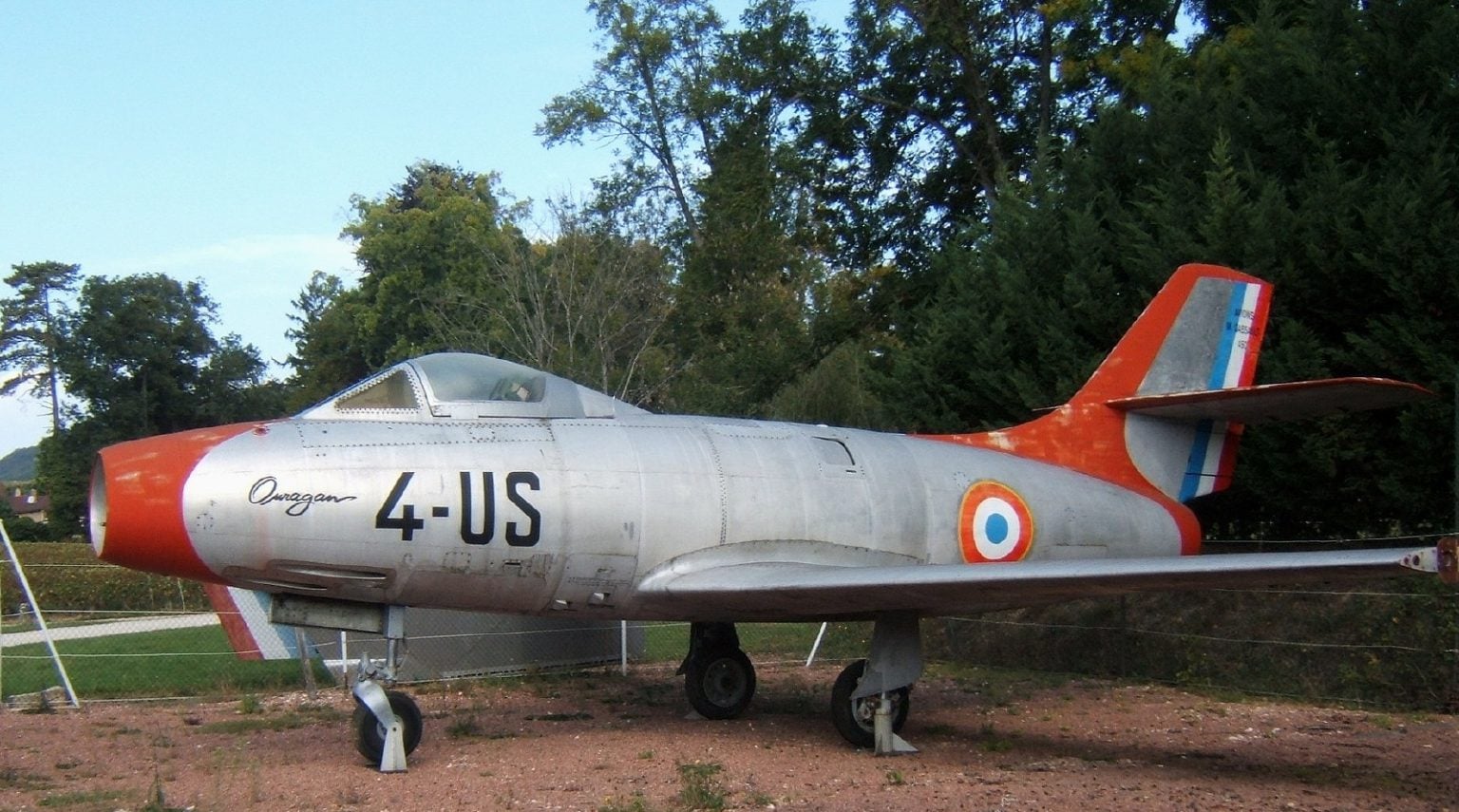
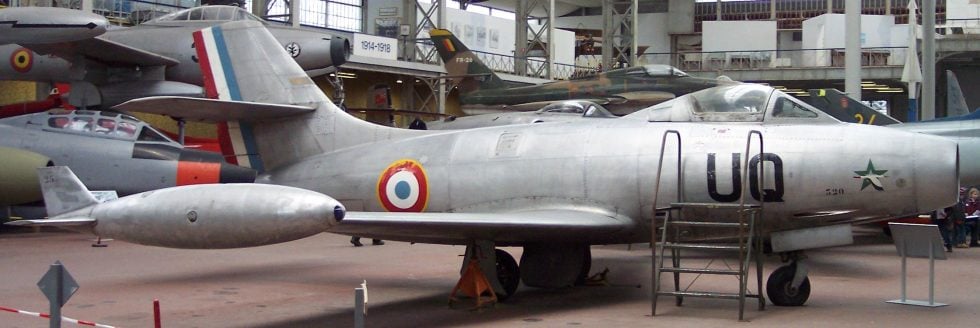
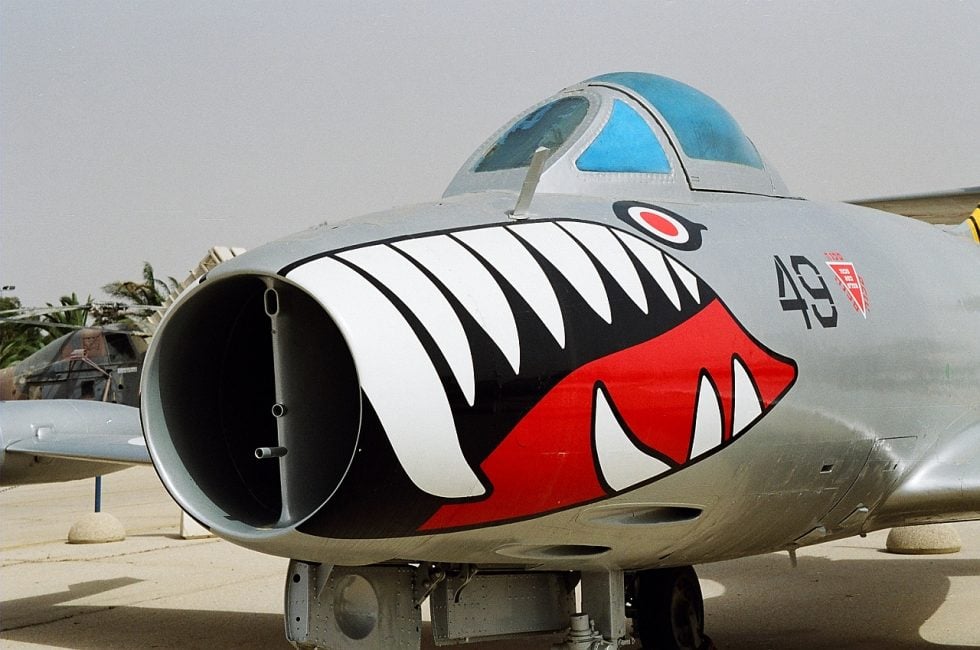
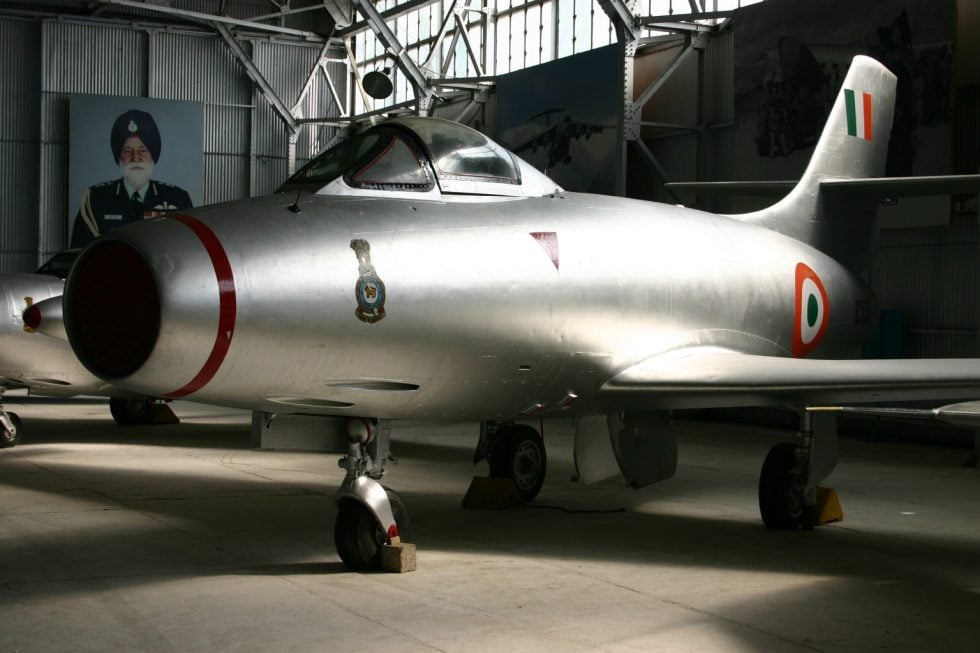
Closing note on survivors. No Ouragan is airworthy anywhere and no reproduction has been built; every aircraft listed below is an original airframe. France holds four: number 154 coded 4-LT at the Musée de l’Air et de l’Espace at Le Bourget in its "Indian head" scheme, number 214 coded UG in Patrouille de France colours at the Musée Européen de l’Aviation de Chasse at Montélimar, and numbers 251 and 450 coded 4-US in the jet collection at Château de Savigny-lès-Beaune. Belgium has one ex-Armée de l’Air machine coded UQ at the Royal Museum of the Armed Forces and Military History in Brussels. Israel displays two combat veterans outdoors at the Israeli Air Force Museum, numbers 80 and 49, both of which flew in 1956 and again in 1967. India keeps Toofani IC 554 at the Indian Air Force Museum at Palam in No. 47 Squadron markings, and a second Toofani — one of those that attacked Aizawl in 1966 — is displayed at Silchar. El Salvador has two at the Museo Nacional de Aviación at Ilopango. The one that got away is the Toofani forced down by Pakistani fighters on 24 April 1965 after straying across the border: the pilot was returned, the aeroplane was kept as a war trophy in a Peshawar museum, and it was later scrapped.
From ruined industry to the Mirage dynasty
Design begins
Marcel Dassault starts private-venture work on the MD.450, a simple straight-winged jet fighter for a recovering France.
First flight
The prototype flies on 28 February with Kostia Rozanoff at the controls, unarmed and unpressurised.
Production begins
The first series-production Ouragan flies on 5 December, powered by the Hispano-Suiza-built Nene.
French service
The Ouragan enters Armée de l’Air service, replacing the de Havilland Vampire as France’s first mass-produced homegrown jet.
Export & replacement
Israel begins receiving Ouragans; in France the swept-wing Mystère IV starts taking over frontline duties.
Suez combat debut
Israeli Ouragans fly ground-attack and score air-to-air kills during the Suez/Sinai campaign of October–November.
India’s Toofani
Indian Air Force Toofanis support the 1961 annexation of Goa and fly in the 1965 war with Pakistan.
Last operator
El Salvador buys ex-Israeli Ouragans and flies them through the Salvadoran Civil War until retirement in the late 1980s–90s.
Twelve Ouragan stories
A survivor rebuilds an industry
Marcel Bloch returned from Buchenwald, became Dassault, and set out to give France a jet fighter.
Read the full story
Rozanoff takes it up
Test pilot Kostia Rozanoff flew the unarmed prototype on 28 February 1949.
Read the full story
Why “Hurricane”
Ouragan is French for hurricane; India would later translate it as “Toofani.”
Read the full story
Borrowed from America
The Ouragan’s stovepipe-and-straight-wing layout echoed the F-84 and F-80.
Read the full story
Replacing the Vampire
From 1952 the Ouragan gave the Armée de l’Air its first mass-produced French jet.
Read the full story
The Ibrahim el Awal
Israeli Ouragans helped force the surrender of an Egyptian destroyer off Haifa.
Read the full story
Better than expected
Ouragans destroyed Egyptian aircraft and armour over Sinai and impressed even sceptical commanders.
Read the full story
Strikes over Goa
Toofanis flew ground-attack sorties supporting India’s 1961 annexation of Goa.
Read the full story
A trophy in Peshawar
A Toofani that strayed across the border became a Pakistani war prize.
Read the full story
From Sinai to Central America
El Salvador flew ex-Israeli Ouragans through a brutal civil war.
Read the full story
The flat-spin quirk
The Ouragan’s stubby fuselage could snap it into a flat spin in a hard turn.
Read the full story
The first Dassault fighter
The Ouragan began the line that runs through Mystère and Mirage to Rafale.
Read the full story
The Ouragan in pictures
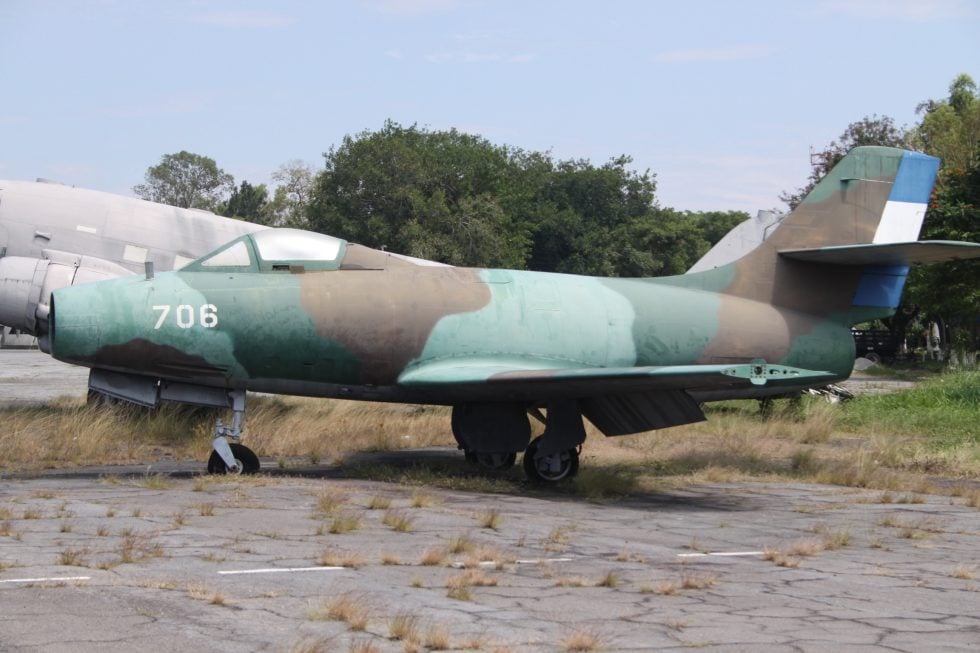
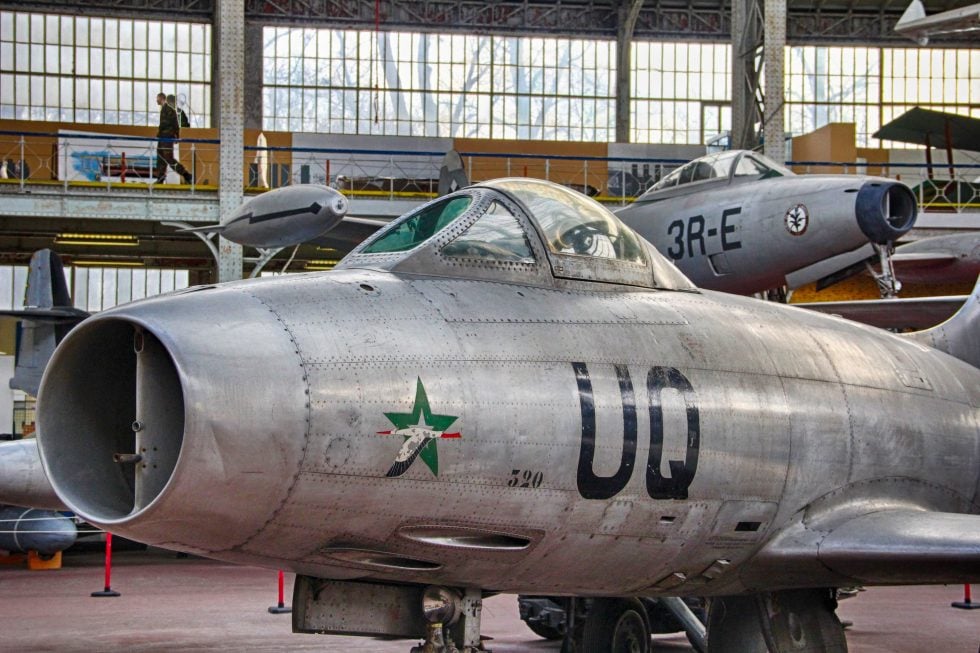
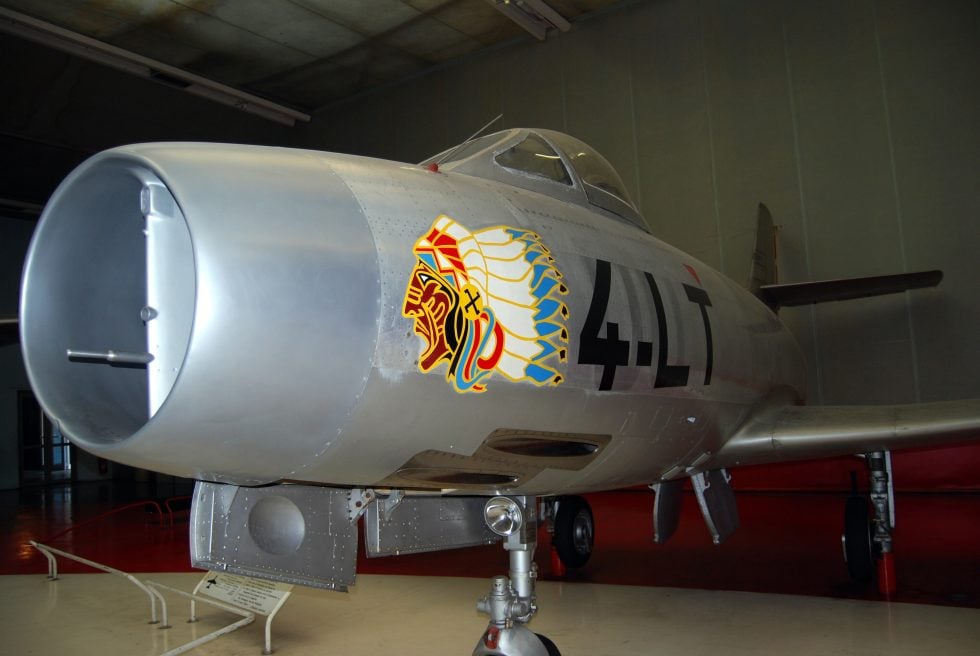
The Ouragan in motion
A dedicated Ouragan video feature is coming soon. In the meantime, explore the photo gallery above and the story of how this first Dassault fighter led to the Mystère and Mirage.
The Ouragan in motion
Not A Pound For Air To Ground — one of the most-watched Ouragan films on YouTube.
Where the Ouragan flew
A first-generation jet that fought worldwide
The Ouragan was a fighter-bomber, not a dogfighter — but it saw a surprising amount of combat far from France. Israeli Ouragans destroyed Egyptian aircraft, armour and even helped capture a warship in 1956; Indian Toofanis struck in Goa and flew in 1965; and El Salvador took the type into a long civil war. Air-to-air kills were modest and are hard to tally precisely, so treat specific totals with caution.
Compare the combat record of every military aircraft. Figures as of July 2026.
Everything people ask about the Ouragan
Can I fly in an Ouragan?
What was the Dassault Ouragan?
Why is the Ouragan historically important?
What engine did the Ouragan use?
Did the Ouragan see combat?
What is a “Toofani”?
How fast was the Ouragan?
Are any Ouragans still flying?
You can’t fly the Ouragan.
These, you can.
Some legends only live in museums — others are fuelled and waiting. MiGFlug has put civilians in real military jet cockpits since 2004.
 Fly the L-39 AlbatrosThe world’s most-flown jet trainer — aerobatics included
 Fly the F-104 Starfighter“The missile with a man in it”
 Fly the MiG-21The Cold War’s most-produced jet
 Fly the T-33 Shooting StarAmerica’s first jet trainer
 Fly the DH VampireA piece of early jet history
 Fly the S.211Agile Italian jet trainer
 Fly the MB-326The classic Aermacchi jet
 Fly the MiG-15The Soviet legend of the Korean War
Continue the tour
Every fact, checked
- Dassault Aviation — MD.450 OuraganManufacturer history, origins and performance data for the type.
- Air Vectors — Ouragan, Mystère & Super MystèreDetailed development, specifications and the line from Ouragan to Mirage.
- Vintage Aviation NewsFirst flight of 28 February 1949 and the Rozanoff prototype story.
- Military FactorySpecifications, armament and operator overview.
- SkytamerVariant details and service-history reference.
- Flugzeuginfo.netTechnical data and dimensions cross-check.
- Air Aces — Israeli victoriesReference for Israeli Ouragan air-to-air claims in 1956.
- National Museum of the US Air ForceGeneral reference for preserved early jet fighters on display.