
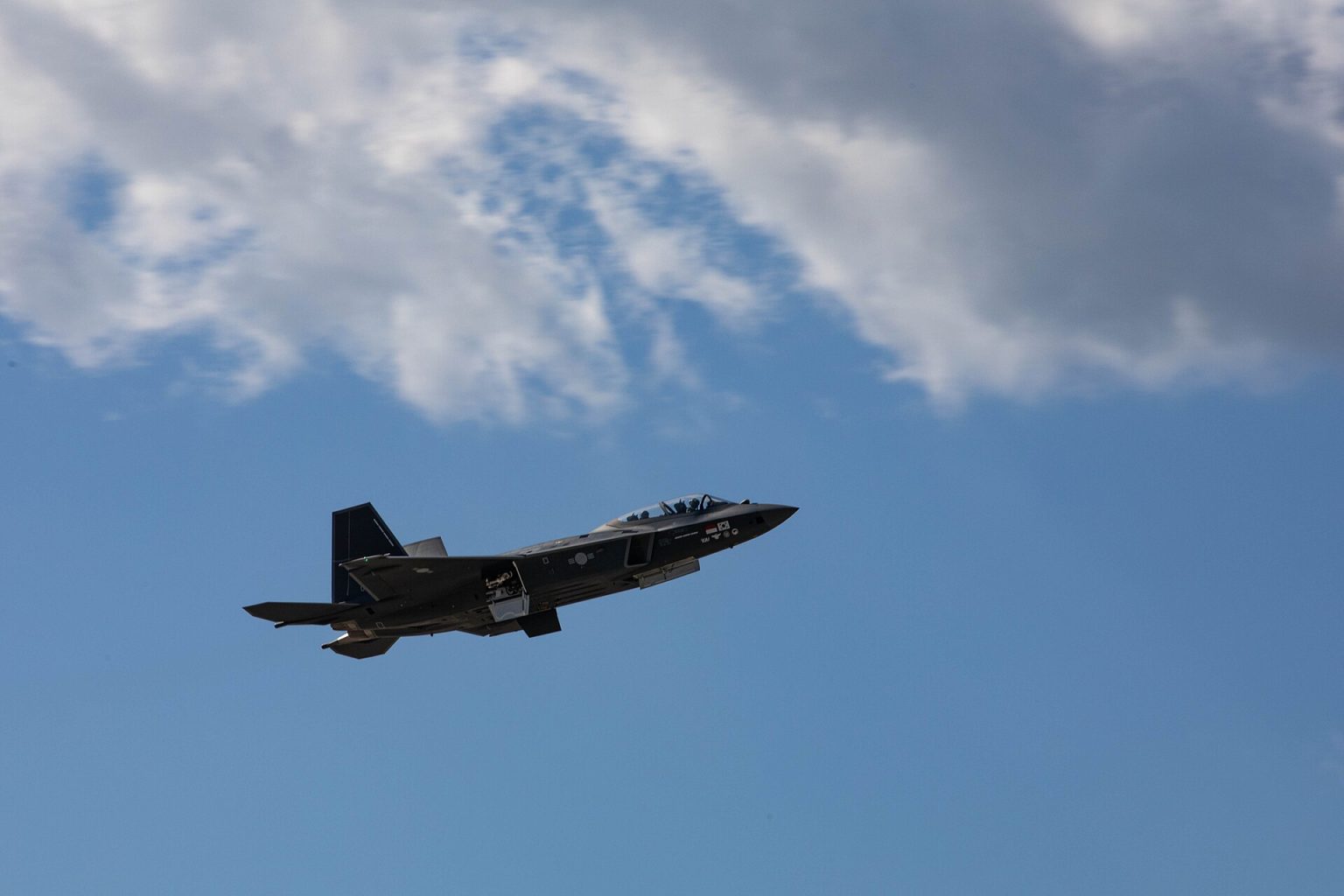
KAI KF-21 Boramae
“Fighting Hawk”
South Korea’s first indigenous fighter — a twin-engine 4.5-generation multirole jet, still maturing through testing and early production, built to retire the ageing F-4 and F-5.
South Korea builds its own fighter
For decades South Korea flew American fighters — F-4 Phantoms, F-5 Tigers, F-16s and later F-15Ks. The ambition to build a home-grown fighter dates to a presidential pledge in 2001, but it took until 2015 for Korea Aerospace Industries (KAI) to win the full-scale development contract for what was then called KF-X. The goal was a twin-engine, 4.5-generati)on multirole fighter to replace the Republic of Korea Air Force’s retiring F-4D/E Phantom II and F-5E/F Tiger II fleets, with a home-built radar and a level of stealth shaping short of a true fifth-generation jet.
The programme is a genuinely new aircraft, and much about it is still being proven. The first prototype was rolled out in April 2021 and made its maiden flight on 19 July 2022. Six prototypes — four single-seat and two twin-seat — flew a development test programme that Korean officials say wrapped up in January 2026 after around 1,600 sorties. The ROKAF has ordered an initial batch of 40 Block I aircraft, with deliveries reported to begin around 2026. These are early days: the KF-21 is best described as in development and entering low-rate production, not as a mature front-line type.
From the start the KF-21 has been an international as well as a national project. Indonesia joined in 2016 as a risk-sharing partner under the parallel IF-X designation, originally committing to roughly a fifth of the development cost in exchange for technology and local assembly. That contribution has been repeatedly contested and, in June 2025, renegotiated sharply downward — a reminder that the aircraft’s programme, like its flight envelope, is still being worked out.
01The KAI KF-21 Boramae’s origins: how South Korea set out to build its own fighter
The idea of a Korean-designed fighter was announced by President Kim Dae-jung in 2001, but the KF-X project spent years in feasibility studies and cost debate before KAI signed the full-scale development contract in 2015. South Korea funds the large majority of the programme; Indonesia signed on in 2016 as a risk-sharing partner, and US firms and Lockheed Martin provided some technology transfer, though several sensitive technologies (including key stealth and AESA elements) were withheld and had to be developed at home.
The result is often described as a stepping stone between the FA-50 light fighter KAI already built and a possible future fifth-generation aircraft. It is important to hedge the claims made for it: many performance and cost figures come from the manufacturer or the Korean government and have not been independently verified in combat or long-term service, because the type is only now entering production.
What makes it special
A largely home-built fighter with an indigenous AESA radar
The KF-21’s headline achievement is that South Korea developed much of it domestically, including an indigenous active electronically scanned array (AESA) radar led by Hanwha Systems with LIG Nex1 — a capability only a handful of countries possess. Several sensitive technologies were denied by the United States during development, so Korea built its own. As with any new radar, its real-world performance is still being validated in flight test.
Two proven GE F414 engines
Rather than gamble on a new powerplant, the KF-21 uses two General Electric F414-GE-400K afterburning turbofans — the same family that powers the F/A-18E/F Super Hornet — each rated at roughly 97.9 kN (about 22,000 lbf) in reheat, assembled in Korea by Hanwha Aerospace. The twin-engine layout gives the reported ~Mach 1.8 top speed and redundancy the single-engine FA-50 lacks.
Semi-stealth now, internal weapons planned later
The KF-21 is a 4.5-generation design: it uses radar-cross-section-reducing shaping and internal-bay provisions, but the early Block I and Block II jets carry weapons externally on ten hardpoints. A future variant (often referred to as KF-21EX) is planned to add an internal weapons bay and greater stealth — so its fifth-generation credentials remain a goal, not a delivered fact.
02The KF-21 Boramae’s radar and sensors: why the home-built AESA matters
When the KF-X programme began, the United States declined to transfer four key technologies — among them the AESA radar, infrared search-and-track and electronic-warfare suites. Rather than abandon the project, South Korea funded domestic development, with Hanwha Systems and the Agency for Defense Development producing a national AESA radar that was fitted to the prototypes and tested in flight from the mid-2020s. Independent verification of its detection range and reliability is limited, and figures cited for it should be read as manufacturer or ministry claims until the type has served operationally.
03The KF-21’s stealth: a 4.5-generation jet, not an F-35 rival
The KF-21 is deliberately positioned as a 4.5-generation fighter. It borrows stealth-influenced shaping — canted tails, a faceted forward fuselage and internal routing — but the initial production aircraft carry missiles and bombs externally, which sharply increases radar cross-section compared with a true fifth-generation type such as the F-35. KAI has spoken of a later variant with an internal weapons bay and reduced signature, sometimes labelled KF-21EX, but that aircraft does not yet exist. Any description of the KF-21 as a “stealth fighter” should be qualified: it is semi-stealthy by design intent, with full low-observability reserved for a future step.
Full specifications
Figures are for the single-seat KF-21 as published by the manufacturer and Korean government. Because the aircraft is still in testing and early production, many values are provisional and should be treated as reported rather than combat-proven.
Baseline note: these figures describe the KF-21 Block I in the production C109 configuration — the standard rolled out at Sacheon on 25 March 2026, flown in production form on 15 April 2026 and certified "combat suitable" by DAPA on 7 May 2026. It is the only version that exists as metal. Everything reflects information published up to 2 September 2026; the aircraft is still in early production and several figures are DAPA estimates rather than measured results. Deltas for the planned Block II, the conceptual Block III / KF-21EX and the Indonesian arrangement are in grey.
Dimensions & weights
- Crew
- 1 (2 in the tandem-seat airframe; prototypes 004 and 006 are two-seaters, and the proposed KF-21EA electronic-attack version is built on that fuselage)
- Length
- 16.9 m (55 ft 5 in; the earlier C107 study was 16.8 m)
- Wingspan
- 11.2 m (36 ft 9 in)
- Height
- 4.8 m (15 ft 9 in; published figures vary between 4.7 and 4.8 m)
- Wing area
- 46.5 m² (501 sq ft)
- Empty weight
- 11,800 kg (26,000 lb)
- Maximum take-off weight
- 25,400 kg (56,000 lb)
- Internal fuel
- ~5,400 kg (~11,900 lb). Some reference works quote 6,000 kg; the ADD configuration table for C109 says 5,400 kg and that is the better-attested number.
- Maximum external stores
- ~7,700 kg (~17,000 lb)
- Hardpoints
- 10 — six underwing, four semi-recessed under the fuselage (the fuselage four are the Meteor stations; Block III would replace them with an internal bay)
- Airframes completed
- Six prototypes plus the first serial aircraft, with about a dozen more on the line (as of mid-2026)
- Korean content
- About 65% by value (engine, ejection seat, canopy, brakes and several accessory systems remain imported)
Performance
- Maximum speed demonstrated
- Mach 1.81 (reached in flight test during May 2024)
- Maximum speed, design
- Mach 1.97, about 2,200 km/h (1,190 kt) at altitude
- Supercruise
- Not claimed for Block I (KAI has never advertised sustained dry supersonic cruise, and the F414 installation makes it unlikely)
- Service ceiling
- 16,764 m (55,000 ft)
- Combat radius
- ~1,000 km (~540 nm) on a high-low-high profile. DAPA has published no official radius; treat this as an estimate.
- Ferry range
- 2,900 km (1,800 miles) on internal fuel with tanks
- Design load factor
- +9 / −3 g (flight-test g restrictions were lifted before the Seoul ADEX display of October 2025)
- Angle-of-attack testing
- About 70 degrees of pitch attitude reached in the high-alpha programme of January 2024
- Thrust-to-weight ratio
- ~0.79 at maximum take-off weight, ~1.3 at a typical combat weight (calculated from quoted thrust and weights, not a manufacturer figure)
- Wing loading
- 546 kg/m² (112 lb/sq ft) at maximum take-off weight; about 320 kg/m² at combat weight
- Flight-test record
- About 1,600 sorties across six prototypes in 42 months without an accident, closed out on 13 January 2026
Propulsion & systems
- Engines
- 2 × General Electric F414-GE-400K afterburning turbofans, assembled under licence in Korea by Hanwha Aerospace
- Thrust with afterburner
- 97.9 kN (22,000 lbf) each; 195.8 kN (44,000 lbf) total
- Dry thrust
- About 57.8 kN (13,000 lbf) each
- Engine contracts
- Hanwha Aerospace engine orders worth 1.18 trillion won to June 2025 (a 623.2 billion won increment signed alongside the second airframe batch)
- Radar
- APY-016K AESA by the Agency for Defense Development and Hanwha Systems — gallium-nitride modules, about 1,000 to 1,150 transmit/receive elements, X-band, with air-to-air, sea-search, SAR and terrain-following modes (module counts of 1,000, 1,088 and 1,152 all appear in print; series production began August 2025)
- Infrared search and track
- Hanwha Systems processing behind a Leonardo SkyWard-K sensor head, faired into the nose ahead of the windscreen
- Targeting pod
- Hanwha Systems electro-optical targeting pod, developed in Korea after the American refusal (carried on a fuselage station; only relevant once Block II clears air-to-ground stores)
- Electronic warfare
- LIG Nex1 integrated suite — radar warning receiver, self-protection jammer and countermeasures dispensing
- Flight control
- Quadruplex digital fly-by-wire developed by KAI and ADD, with an open mission-systems architecture intended to avoid vendor lock at each block upgrade
- Cockpit and escape
- Wide-area cockpit display with head-up display and a helmet-mounted display; Martin-Baker Mk18 ejection seat
- Planned engine replacement
- A domestic 16,000 lbf-class turbofan by Hanwha Aerospace and Doosan Enerbility, seeded with 86 billion won in the 2026 budget and targeted at the 2030s (aspiration, not a programme of record for any ordered aircraft)
04The KF-21 Boramae’s cost: what a new indigenous fighter is estimated to cost
Development of the KF-21 has been budgeted at roughly 8.6 trillion won (on the order of US$6–7 billion) for research and development, with total programme spending including procurement reported near 18 trillion won over its life. Per-aircraft flyaway cost has been estimated at around US$80–110 million, though published figures have drifted upward and vary with exchange rates and block standard — treat any single number as an estimate.
No reliable cost-per-flight-hour figure exists in open sources yet, which is unsurprising for an aircraft that has only just finished its development flight-test programme. Operating-cost claims for the type are, for now, projections rather than measured data.
Armament & payload
The KF-21 carries four Meteors half-buried in its belly because the weapons bay it was designed around has not been built
Block I is an air-to-air fighter and nothing else. The certificate DAPA issued on 7 May 2026 covers gun, Meteor and IRIS-T; every bomb, cruise missile and anti-ship weapon in KAI's brochures belongs to Block II, which is contracted but not yet flown as a cleared configuration. The four semi-recessed fuselage stations are the aircraft's signature and its honest compromise: Meteor sits flush enough to cut drag and frontal radar return, but the space reserved behind them for a true internal bay is still empty air. Weapon fits below describe the ROKAF Block I standard; the Indonesian prototype, the proposed KF-21SA export configuration and any Block II aircraft will differ, and several listed stores are development items with no service release.
Gun
- One 20 mm General Dynamics M61A2 Vulcan six-barrel rotary cannon, mounted internally in the port fuselage above the intake
- 480 rounds, firing at up to 6,000 rounds per minute — roughly five seconds of continuous fire
- Ammunition and gun logistics are common with the ROKAF KF-16 fleet, which was a deliberate sustainment choice rather than a performance one
- Gun firing was cleared during the prototype programme and is part of the May 2026 combat-suitability certification
Air-to-air
- MBDA Meteor ramjet beyond-visual-range missile — four carried semi-recessed under the fuselage; separation testing began 28 March 2023 and guided engagements of target drones followed in 2024, with the AESA cueing at about 87 km
- Diehl IRIS-T, known in ROKAF service as AIM-2000 — short-range infrared missile on the outboard wing stations, first guided kill of a drone in 2024
- AIM-120 AMRAAM and AIM-9 Sidewinder are within the aircraft's design envelope but integration depends on US release; Meteor and IRIS-T were chosen precisely to avoid that dependency
- LIG Nex1 is developing a domestic long-range air-to-air missile for later blocks; nothing has been fired from a KF-21
Air-to-surface guided
- None cleared. Block I as delivered carries no guided air-to-ground weapon at all, and saying otherwise misrepresents the aircraft
- Block II candidates announced by DAPA include GBU-12 Paveway II, GBU-54/56 laser JDAM and GBU-39 Small Diameter Bomb
- KGGB, the LIG Nex1 GPS-guided glide kit already fielded on the FA-50, is expected early in the Block II sequence
- Taurus KEPD 350K and the domestic Cheonryong long-range cruise missile are proposed rather than funded for integration
- A 700 billion won armament-integration programme launched on 23 December 2025 runs to December 2028; that date, not 2027, is the realistic marker for a fully armed strike fighter
Bombs
- Also none in Block I service. The pylons are wired and stressed for them; the software release is not there
- Planned: Mk 82, Mk 83 and Mk 84 general-purpose bodies with JDAM tail kits or Paveway laser seekers
- Planned: GBU-39/B Small Diameter Bomb, which is the store that makes an internal bay worth having on a future Block III
- Maximum external stores figure of about 7,700 kg is a structural limit, not a demonstrated bomb load
Rockets
- No unguided rocket carriage has been announced, tested or requested for any KF-21 block
- The ROKAF keeps LAU-3 and Hydra 70 pods on the FA-50 and older F-16 fleets; the KF-21 was never scoped as a close-air-support platform
- The card is kept here because its emptiness is informative: this is a Meteor-armed interceptor first, and a bomber only by later contract
Pods & other stores
- Hanwha Systems electro-optical targeting pod — one of the four technologies Washington refused to transfer, then built domestically
- External fuel tanks on the underwing and centreline stations; the ferry figure of 2,900 km assumes them
- LIG Nex1 electronic-warfare equipment is internal rather than podded, which is unusual for a fighter of this size and cost
- Manned-unmanned teaming control of loyal-wingman aircraft is advertised for Block II under the Next Air Combat System; no hardware has flown with a KF-21
- Aerial refuelling from the ROKAF KC-330, including night trials on 8 April 2025, extends every loadout above
Three typical loadouts
- Air superiority, Block I as certified
- Four Meteor in the semi-recessed fuselage stations, two IRIS-T on outboard wing rails, one centreline external tank, 480 rounds of 20 mm. This is the configuration the May 2026 certificate actually covers, and the only one an operational ROKAF aircraft can fly today.
- Long-range combat air patrol
- Four Meteor semi-recessed, four IRIS-T on wing pylons, two underwing tanks. The semi-recessed carriage matters here: the same four BVR rounds on conventional pylons would cost meaningful drag and endurance over the Yellow Sea.
- Block II strike, planned and not yet cleared
- Two Meteor retained semi-recessed for self-escort, two IRIS-T, four GBU-12 or laser JDAM inboard, the Hanwha targeting pod on a fuselage station, two tanks. Nothing in this line has a service release; it describes the 2028 objective of the current integration contract.
Sourcing caveat: the KF-21 weapons picture is unusually polluted by programme marketing. DAPA and KAI publish target capability lists, defence media repeat them, and the lists then circulate as though they described a fielded aircraft. Where this page says a weapon is carried it means a firing or separation test has been reported; where it says planned it means a contract, budget line or official statement exists and nothing more. Missile-firing dates in particular disagree between sources — the first guided Meteor and IRIS-T engagements are variously dated between late March and mid-May 2024, and no single authoritative chronology has been published.
Variants
Every KF-21 beyond Block I is a contract, a budget line or a model on a stand
The KF-21 was designed as a spiral. C109, the configuration frozen in 2018, deliberately left volume in the lower fuselage for a weapons bay nobody intended to build in the first decade. That decision is the whole programme in miniature: a 4.5-generation aircraft priced and scheduled like one, carrying the architecture of a fifth-generation aircraft it hopes to become.
The blocks are real in the sense that money is attached to them. Block I is ordered and flying. Block II has a 700 billion won integration contract and a 2028 completion date. Block III and the KF-21EX exist as concept artwork and basic research, with Korean analysts putting full-scale development more than a decade out. The distinction is worth policing, because the programme's own literature does not police it.
The Indonesian strand ended differently from how it was sold. Jakarta signed in 2010 for 20 per cent of development costs and 48 locally assembled IF-X aircraft. It paid 384.4 billion won of a 1.4644 trillion won schedule, renegotiated in August 2024 down to 600 billion won, and in June and July 2026 abandoned local final assembly altogether. What Indonesia gets is one prototype airframe with limited technology transfer; what it is buying instead is more Rafale and Turkish KAAN.
- ADD/KAI C109 (design frozen 2018)
- The definitive configuration: 16.9 m long, 11.2 m span, 46.5 m² wing, two F414s, ten hardpoints and reserved space for an internal bay. Earlier studies ran from the single-engined C501 of 9,300 kg empty up through the twin-engined C103 to C107 family.
- KF-21 prototypes 001 to 006 (2021–2023, 6 built)
- Built concurrently rather than sequentially to compress testing. 001 first flew on 19 July 2022, a 33-minute sortie from Sacheon; 004 and 006 are tandem two-seaters. Between them they flew about 1,600 accident-free sorties before flight test closed in January 2026.
- KF-21 Block I (2024–, 40 ordered)
- The production standard: gun, Meteor, IRIS-T, APY-016K AESA, domestic IRST and EW, no air-to-ground release. Certified combat suitable on 7 May 2026. Roughly 65 per cent Korean content.
- KF-21 Block II (planned, 80 aircraft, 2029–2032)
- Adds air-to-surface and anti-ship weapons, the Hanwha targeting pod in an operational role, and manned-unmanned teaming. Integration work contracted in December 2025 for completion in December 2028; an August 2025 statement promising strike capability by early 2027 should be read as ambition.
- KF-21 Block III / KF-21EX (concept, unfunded)
- Fills the reserved volume with an internal weapons bay for four Meteor or eight air-to-ground rounds, with reshaped surfaces and coatings for a genuine low-observable signature. Unveiled as a concept in 2024 and elaborated in 2025; Korean defence analysts put full-scale development more than ten years away.
- KF-21EA (concept, unfunded)
- Electronic-attack derivative on the two-seat airframe with an electronic warfare officer in the rear cockpit, two ESM and three EA systems, and anti-radiation missiles for suppression of enemy air defences. The stated model is the EA-18G Growler.
- KF-21SA (export configuration, no customer)
- A customer-configurable version of the ROKAF standard offered to export prospects. Air chiefs from Poland and the UAE have flown the aircraft; the Philippines, Malaysia, Saudi Arabia and Peru have inspected it. No export order has been signed.
- IF-X / Indonesian variant (2010–2026, co-production cancelled)
- Originally 48 aircraft assembled by PT Dirgantara Indonesia against a 20 per cent cost share. Reduced to a 600 billion won contribution in August 2024, of which 536 billion won had been paid by 8 April 2026. On 30 June 2026 Jakarta dropped the final assembly line and on 6 July 2026 confirmed it would buy off the shelf if at all; it receives the fifth prototype with limited technology transfer.
Order book and delivery schedule as at 2 September 2026, in place of a fleet chart. DAPA has contracted 40 Block I aircraft in two tranches: 20 in June 2024 for 1.96 trillion won (about US$1.41 billion) and 20 more on 27 June 2025 for 2.39 trillion won (about US$1.76 billion), an average of roughly 109 billion won or about US$79 million per airframe including support. The first serial aircraft rolled out on 25 March 2026 and flew on 15 April 2026; the first hand-over to the Republic of Korea Air Force is scheduled for September 2026, with all 40 due by 2028 and a possible one-year slip to 2029 under budget discussion. A further 80 Block II aircraft are planned for 2029 to 2032, for a stated fleet of 120. Development cost is quoted at about 8.8 trillion won, converted variously to between US$6 billion and US$8 billion depending on the exchange rate used. There is no fleet chart on this page because there is not yet a fleet: one operator, no confirmed deliveries, and a bar of length one would be decoration rather than information. Sources: DAPA and KAI announcements, Korea Herald, Korea Times, FlightGlobal, Aviation Week and The Jakarta Post; figures that could not be corroborated are omitted.
From national ambition to first jets
The ambition is announced
President Kim Dae-jung pledges that South Korea will develop its own fighter — the seed of the KF-X programme.
Development contract
KAI wins the full-scale development contract for the KF-X, beginning detailed design of the aircraft.
Indonesia joins
Indonesia signs on as a risk-sharing partner under the IF-X name, initially committing to about a fifth of the cost.
Roll-out
The first prototype is unveiled in April 2021 and formally named Boramae; ground and taxi testing follow.
First flight
The KF-21 makes its maiden flight on 19 July 2022, opening a multi-year flight-test campaign.
First production contract
South Korea places an initial mass-production order, beginning the shift from prototypes to service aircraft.
Indonesia’s share is cut
Seoul and Jakarta agree to reduce Indonesia’s contribution by roughly two thirds amid unpaid instalments.
Testing done, deliveries begin
Korean officials report the development flight-test programme complete after ~1,600 sorties; early deliveries to the ROKAF begin.
Twelve KF-21 stories
A fighter Korea vowed to build
The KF-21 grew from a 2001 presidential pledge that South Korea would design its own jet.
Read the full story
Indonesia signs on
In 2016 Indonesia joined as a risk-sharing partner under the IF-X designation.
Read the full story
Unveiled before it flew
The first KF-21 was rolled out and named Boramae in April 2021, over a year before its first flight.
Read the full story
19 July 2022
The KF-21 made its maiden flight in July 2022, becoming a genuinely flying prototype.
Read the full story
Six prototypes, 1,600 sorties
A fleet of six prototypes flew the development test programme, reported complete in early 2026.
Read the full story
A homegrown AESA
After the US withheld radar technology, Korea built its own AESA for the jet.
Read the full story
Two American engines
The KF-21 flies on a pair of proven General Electric F414 turbofans.
Read the full story
4.5-gen, not 5th
The KF-21 is semi-stealthy by design, but carries its weapons externally for now.
Read the full story
What Boramae means
The jet’s name comes from a Korean word for a young hunting hawk.
Read the full story
The first orders
South Korea has ordered an initial 40 Block I jets, with more expected.
Read the full story
A contested bill
In 2025 Indonesia’s share of the cost was cut by roughly two thirds.
Read the full story
The road ahead
Korea hopes to grow the KF-21 into a stealthier jet and win export orders.
Read the full story
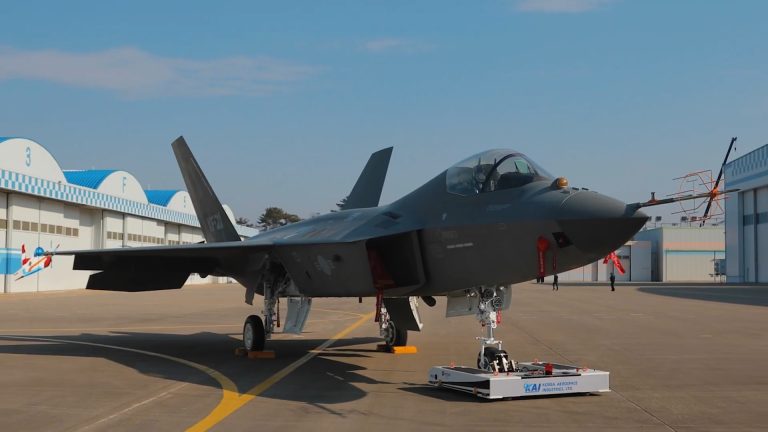
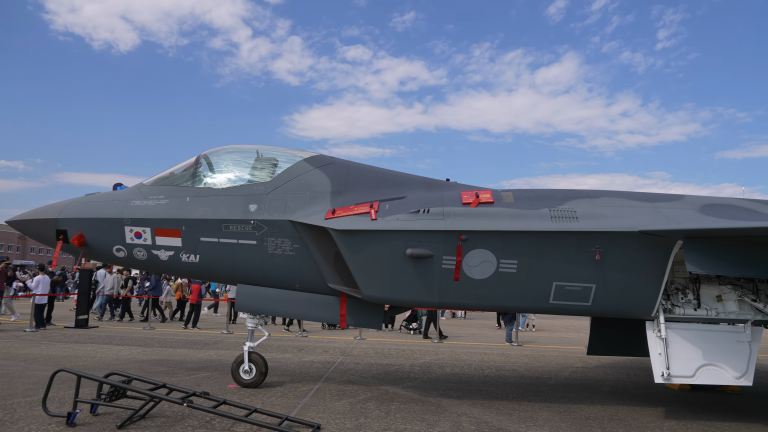
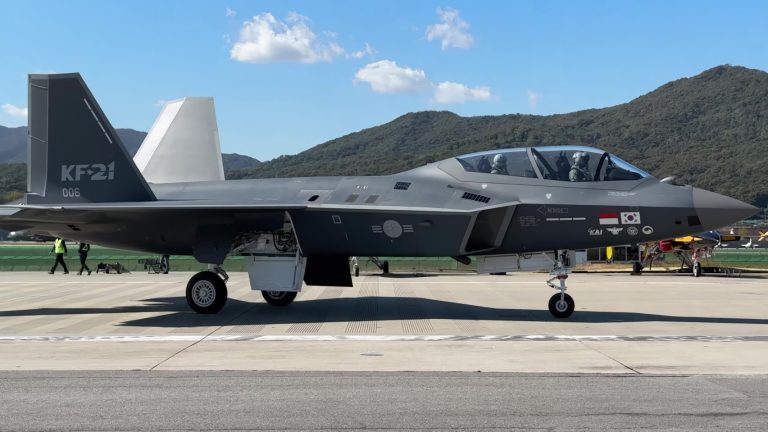
The KF-21 in pictures
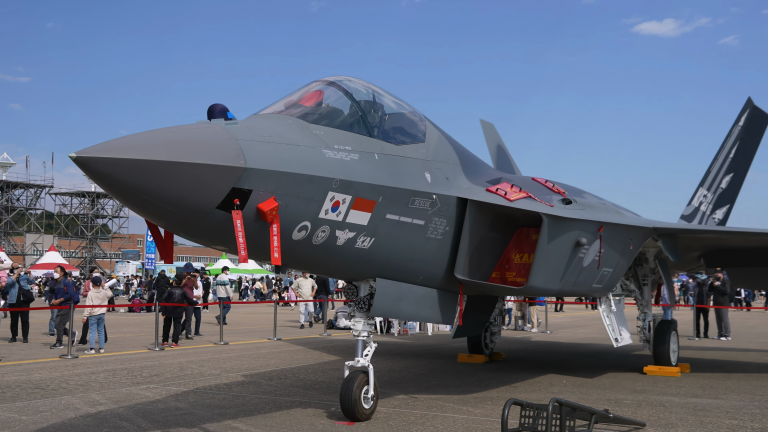
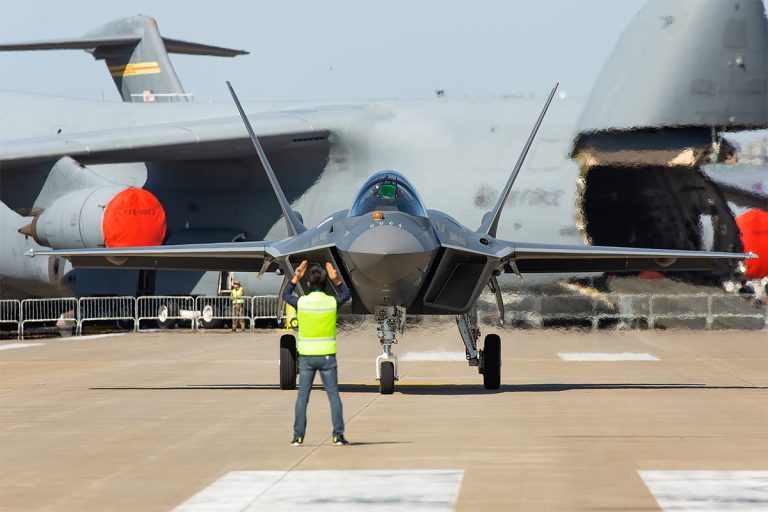
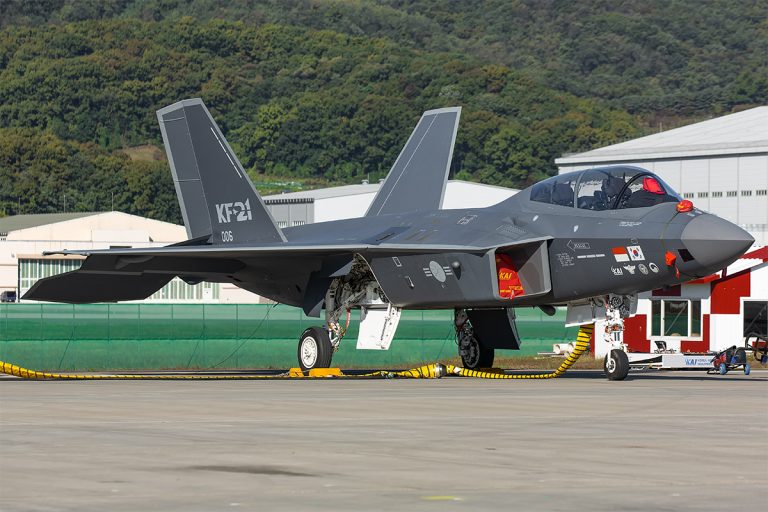
The KF-21 in motion
A curated video feature for the KF-21 Boramae is coming soon. In the meantime, explore the photo gallery above and the operator map below.
Where the KF-21 operates
Where the record stands
The KF-21 has no combat record — it is a new aircraft only now entering service, and everything about its capability is, for the moment, based on testing and manufacturer data rather than operational use. Its story so far is measured in prototypes flown, test points cleared and the first production orders placed, not in missions flown. That is exactly what to expect from a fighter in development and early production.
Compare the combat record of every military aircraft. Figures as of July 2026.
Everything people ask about the KF-21
Can I fly in a KF-21?
Is the KF-21 a stealth fighter?
Who builds the KF-21 Boramae?
What engines does the KF-21 use?
Is the KF-21 in service yet?
What is Indonesia’s role in the KF-21?
What will the KF-21 replace?
You can’t fly the KF-21.
These, you can.
Some legends only live in museums — others are fuelled and waiting. MiGFlug has put civilians in real military jet cockpits since 2004.
 Fly the L-39 AlbatrosThe world’s most-flown jet trainer — aerobatics included
 Fly the F-104 Starfighter“The missile with a man in it”
 Fly the MiG-21The Cold War’s most-produced jet
 Fly the T-33 Shooting StarAmerica’s first jet trainer
 Fly the DH VampireA piece of early jet history
 Fly the S.211Agile Italian jet trainer
 Fly the MB-326The classic Aermacchi jet
 Fly the MiG-15The Soviet legend of the Korean War
Continue the tour
Every fact, checked
- Asian Military Review — KF-21 completes flight-test programmeSix prototypes, ~1,600 sorties and the initial 40-aircraft Block I order.
- The Aviationist — first production KF-21 rolled outThe transition from prototypes to serial production aircraft.
- Breaking Defense — revised Indonesia agreementThe 2025 renegotiation of Jakarta’s cost share.
- KED Global — Indonesia’s cost share cut by two thirdsFigures on the original ~1.7 trillion won share and its reduction to ~600 billion won.
- GlobalSecurity.org — KF-21 programme profileProgramme background, cost estimates and the meaning of “Boramae.”
- Airforce Technology — KF-21 project profileAirframe, engine and systems baseline for the design.
- FlightGlobal — KF-21 development coverageOngoing reporting on flight test and production milestones.
- Defence Security Asia — development flight testing completeDetails of the completed test campaign and sortie count.