
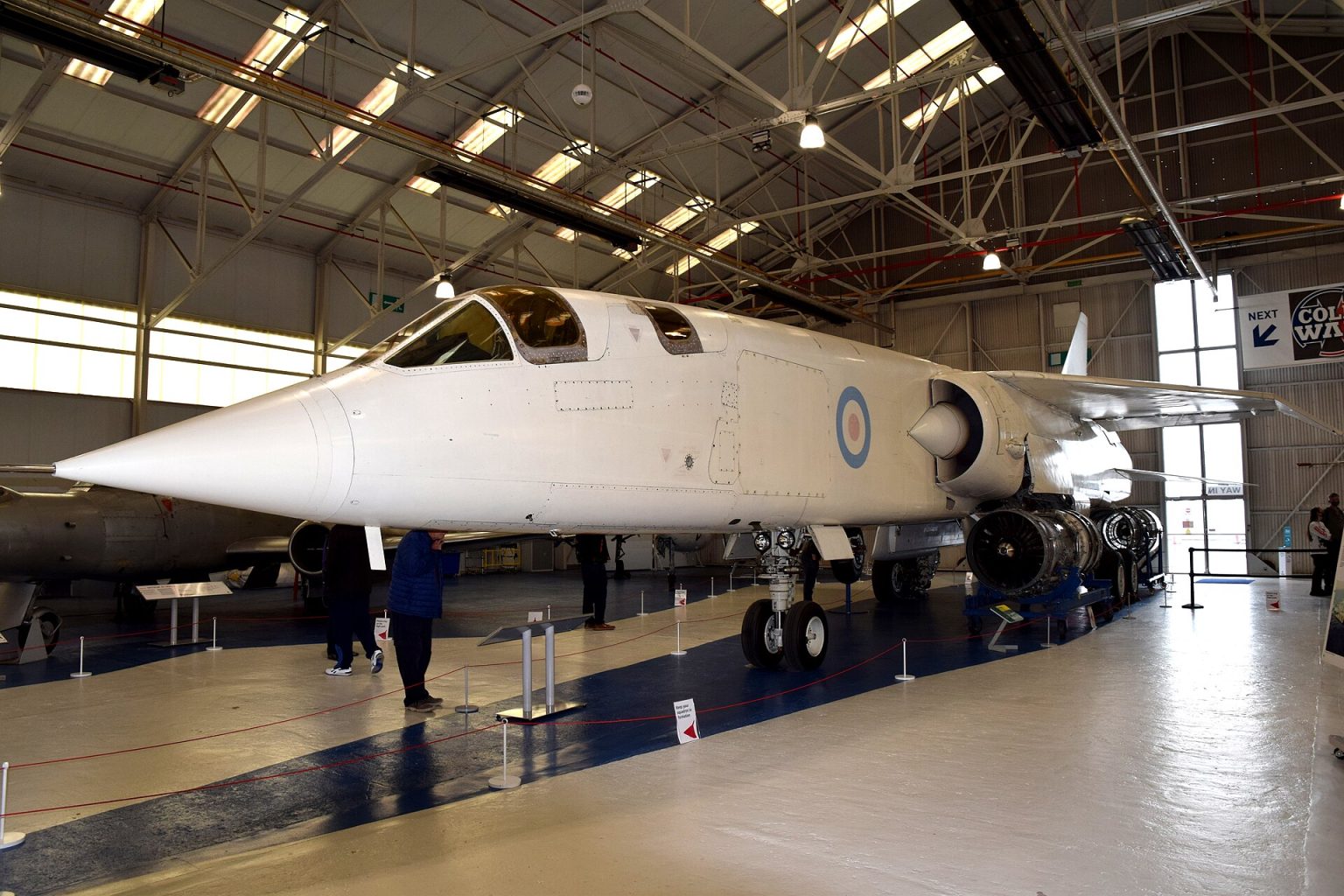
BAC TSR-2
Britain’s most advanced Cold War strike jet — a Mach-2 terrain-hugging bomber a decade ahead of its time, cancelled in 1965 and ordered destroyed, leaving a national grievance that has never quite healed.
The plane its own government destroyed
In the late 1950s the Royal Air Force needed a successor to the English Electric Canberra: a jet that could fly across a hostile frontier at treetop height and near-supersonic speed, drop a nuclear or conventional load with pinpoint accuracy in any weather, and dash away at Mach 2. The 1957 requirement — GOR.339 — asked for more than any aircraft in the world could then do. The answer, drawn up by English Electric and Vickers and built by the newly forced-together British Aircraft Corporation, was the TSR-2: Tactical Strike and Reconnaissance, Mark 2.
It was, by common consent, one of the most advanced aircraft of its generation. It carried terrain-following radar that let it fly automatically at 200 feet through hills and valleys, a digital-age navigation and attack system with a moving-map display and head-up display years before such things were normal, and two reheated Bristol Siddeley Olympus engines — the same family that would later power Concorde. XR219 first flew on 27 September 1964 in the hands of chief test pilot Roland “Bee” Beamont, who called its handling “marvellous.”
But the TSR-2 was born into a storm of trouble that had nothing to do with aerodynamics. Costs spiralled; the two halves of the airframe were built 200 miles apart by companies that had been rivals; the Royal Navy lobbied hard for its own Buccaneer instead; and a new Labour government came to power determined to cut defence spending. On 6 April 1965, in the Budget, the project was cancelled in favour of buying the American General Dynamics F-111K — an aircraft Britain would itself cancel three years later. Then came the act that turned disappointment into legend: the jigs, tooling and nearly every airframe were ordered broken up and burned. Only one aircraft had ever flown; only two survive today.
01The BAC TSR-2’s cancellation: why Britain destroyed its finest aircraft
The TSR-2 was cancelled on 6 April 1965, announced almost as a footnote in the incoming Labour government’s Budget. The stated reason was cost: the programme had run far over its estimates, and the Treasury argued that the American F-111 could do the same job more cheaply. Behind that lay years of inter-service politics — the Royal Navy and Lord Mountbatten pressing the case for the cheaper Blackburn Buccaneer — and a broader decision to scale back Britain’s independent aircraft industry.
What made the cancellation a lasting national grievance was not just the decision but the destruction that followed. The production jigs and tooling were broken up, and all but two airframes were scrapped or shot to pieces on gunnery ranges, apparently to make any revival impossible. The F-111K order that replaced it was itself cancelled in 1968 on cost grounds, and the RAF would not gain a comparable capability until the Panavia Tornado arrived around 1980. To many in Britain, the TSR-2 remains the great “what if” of post-war aviation — and a symbol of an industry talked down by its own politicians.
What makes it special
Automatic terrain-following flight
The TSR-2 carried a forward-looking terrain-following radar coupled to its autopilot that could fly the aircraft automatically at around 200 feet, hugging hills and valleys at high speed and in cloud — keeping it below an enemy’s radar horizon. In tests XR219 was flown within 50 feet of hillsides up the valleys of the Pennines. This was cutting-edge capability for 1964.
A digital nav-attack system, a decade early
Its integrated navigation and attack system — inertial navigation, forward and sideways-looking radar, a moving-map display and one of the first head-up displays — gave the two-man crew a level of situational awareness that would not become normal until the 1970s. It was designed to find and hit a target in one pass, at night, in bad weather.
Mach 2 dash from a rough strip
Two reheated Bristol Siddeley Olympus 22R turbojets — ancestors of Concorde’s engines — were meant to push the TSR-2 to roughly Mach 2 at altitude and beyond Mach 1 at low level, while its tall undercarriage and high-lift wing let it operate from short, semi-prepared airfields close to the front. Few aircraft of its era combined both.
02The BAC TSR-2’s engines: the Olympus that also powered Concorde
The TSR-2 was powered by two Bristol Siddeley Olympus B.Ol.22R turbojets with reheat, each giving roughly 30,000 lbf of thrust in afterburner. It was a development of the same Olympus family that, much enlarged, would power Concorde. The engine also nearly killed the programme: during ground running in 1964 an Olympus low-pressure turbine shaft failed, and a further turbine failure followed. Beamont accepted flying the first sorties with the engines restricted to about 97% power — a risk he later described as “more a political gesture than a logical stage.”
03The BAC TSR-2’s wing and undercarriage: built to fly low and land rough
To survive at low level the TSR-2 used a small, thin delta-like wing with downturned tips, which gave a smooth ride in turbulence at high speed — important when flying at 200 feet and Mach 0.9. To operate from short, rough airfields it rode on a tall, long-stroke undercarriage designed for semi-prepared surfaces. Ironically, that same landing gear caused some of the worst moments in flight test, with violent vibration and bogies that failed to lower symmetrically — problems the test crews flew through rather than abandon the aircraft.
Full specifications
Baseline note: the figures below describe the TSR-2 as specified for production against Operational Requirement OR.343 — the standard the development-batch airframes were being built to when the programme was cancelled — and not an aeroplane that was ever measured in flight, because no such aeroplane existed. Only one TSR-2 flew. XR219 made twenty-four flights between 27 September 1964 and 31 March 1965, roughly fourteen hours in the air in total, and for the first nine of them the undercarriage would not retract. Its fastest run was Mach 1.12, on the fourteenth flight, during the transfer from Boscombe Down to Warton: it went supersonic on dry power with a single reheat lit and drew away from the Lightning chasing it. Every entry in the performance column below is therefore a design prediction or a contractor estimate, an intention rather than an achievement, and should be read that way. Three published disagreements need settling before the tables begin. First, thrust. Bristol Siddeley’s own rating for the Olympus Mk 320 is 19,610 lbf dry and 30,610 lbf with reheat, and those are the figures used here; several modern reference blocks print 22,000 lbf dry instead, which appears to be a later projected rating rather than the engine as built. The engines actually flown in XR219 were de-rated below both. Second, ceiling. Reference tables that give a service ceiling of 40,000 ft sit alongside a quoted sustained cruise of Mach 2.05 between 37,000 and 51,000 ft, and those two statements cannot both be true. The design ceiling was about 54,000 ft, which is what appears below. Third, radius. GOR.339 asked for 1,000 nautical miles; the design as it stood in 1964 offered about 750; and during the 1964 cost-trimming exercise the requirement itself was formally cut to 650 nautical miles, with maximum speed reduced to Mach 1.75 and the take-off run allowed to grow from 1,800 to 3,000 ft. The specification the aeroplane is usually praised against is not the specification it was finally being held to. Deltas for that reduced 1964 standard and for the General Dynamics F-111K bought in its place are in grey.
Dimensions & weights
- Crew
- 2 — pilot and navigator in tandem, on Martin-Baker rocket-assisted ejection seats
- Length
- 27.13 m (89 ft 0 in)
- Wingspan
- 11.33 m (37 ft 2 in) — some sources give 11.28 m (37 ft 0 in)
- Height
- 7.24 m (23 ft 9 in)
- Wing area
- 65.30 m2 (702.9 sq ft)
- Wing form
- Short-span delta, 60° leading-edge sweep, sharply drooped anhedral tips for lateral stability at high indicated airspeed
- Empty weight
- 24,834 kg (54,750 lb)
- Gross weight
- 36,094 kg (79,573 lb) — the standard mission weight with a 907 kg (2,000 lb) internal store
- Maximum take-off weight
- 46,947 kg (103,500 lb)
- Internal fuel
- Not reliably published; the gap between empty weight and maximum take-off weight leaves roughly ~17,200 kg (~38,000 lb) for fuel and stores together
- External fuel
- 2 × 2,046 l wing tanks (450 imp gal each), one 4,546 l ventral tank (1,000 imp gal), plus 2,591 l (570 imp gal) in a weapons-bay tank
- Weapons bay
- 6.10 m long (20 ft), rated 2,722 kg (6,000 lb)
- Wing loading
- 553 kg/m2 (113 lb/sq ft) at gross weight — deliberately high, because a small heavily loaded wing rides low-level turbulence smoothly
- Thrust-to-weight
- 0.59 at maximum take-off weight with full reheat; about 0.77 at gross weight
Performance
- Maximum speed, high
- Mach 2.15 at 12,200 m — 2,283 km/h (1,419 mph, 1,233 kn at 40,000 ft)
- Design dash limit
- Mach 2.35, set by a leading-edge skin temperature limit of 140 °C (284 °F)
- Sustained supersonic cruise
- Mach 2.05 between 11,300 and 15,500 m (37,000 and 51,000 ft)
- Low-level dash
- Mach 1.1 at 61 m — 1,347 km/h (837 mph, 727 kn at 200 ft)
- Low-level attack cruise
- Mach 0.95 at 61 m (200 ft), the speed the mission profile actually assumed over the target run
- Service ceiling
- 16,500 m (54,000 ft) — several reference tables print 40,000 ft, which contradicts the quoted cruise band
- Rate of climb
- 76 m/s (15,000 ft/min)
- Combat radius
- ~1,390 km (~750 nmi) on the 1964 design estimate — against 1,000 nmi asked for by GOR.339 and 650 nmi accepted in the reduced specification
- Low-level radius
- ~1,300 km (~700 nmi) with a full internal weapon load
- Ferry range
- ~4,630 km (~2,500 nmi)
- Take-off run
- 900 m (3,000 ft) in the revised specification, from a semi-prepared strip; 550 m (1,800 ft) was originally demanded
- Fastest actually flown
- Mach 1.12, flight 14, on dry power with one reheat lit — the only supersonic flight any TSR-2 made
Propulsion & systems
- Engines
- 2 × Bristol Siddeley Olympus Mk 320 (BOl.22R) reheated turbojets, a stretched derivative of the Vulcan’s Olympus 301 and a cousin of the Olympus 593 that later powered Concorde
- Dry thrust
- 87.2 kN (19,610 lbf) each
- Thrust with reheat
- 136.2 kN (30,610 lbf) each
- Intakes
- Semi-circular side intakes with translating conical centre-bodies, variable to hold the shock system in place from Mach 0.9 to beyond Mach 2
- Engine development
- The Olympus 22R destroyed its Avro Vulcan flying testbed, XA894, in a fire at Filton on 3 December 1962 during ground running, and suffered two further ground failures in 1964. The failure is generally attributed to fatigue of the low-pressure shaft excited by resonance in the reheat system, though the standard reference accounts record the loss without stating a cause
- Navigation and attack
- A Verdan digital computer of Autonetics origin, extensively modified by Elliott Automation, fed by a Doppler radar and an inertial platform — a genuine integrated nav-attack system at a date when most strike aircraft still navigated by stopwatch and map
- Terrain-following radar
- Ferranti forward-looking radar coupled to the autopilot, intended to fly the aeroplane hands-off at 61 m (200 ft) in cloud and at night. The workload reduction this promised did not become commonplace on Western strike aircraft for another decade
- Sideways-looking radar
- EMI sideways-looking airborne radar, used both for navigational fixing against known ground features and for the reconnaissance role
- Cockpit
- Head-up display and a moving-map display for the pilot; a separate radar and systems station for the navigator
- Undercarriage
- Tandem twin-wheel main units retracting forward into the fuselage sides, on low-pressure tyres sized for semi-prepared strips. It vibrated badly on landing throughout the flight programme and was only partly cured, by additional tie-struts, in the final flights
- Structure
- Largely machined from solid, with X2020 aluminium-copper alloy used in the primary structure — an alloy later judged too brittle for aircraft use and withdrawn from the industry
- Reconnaissance fit
- A pallet in the weapons bay carrying an EMI optical linescan unit, three cameras and the sideways-looking radar. The linescan worked in daylight or by artificial illumination rather than in the infra-red
04The BAC TSR-2’s cost: the number that killed it
Cost was the official reason for cancellation. Estimates for the programme rose steeply through the early 1960s; at cancellation the government spoke of a development bill of the order of £195 million already committed, with far more to come, and argued the American F-111 would be cheaper. Because the TSR-2 never entered service, there is no meaningful unit flyaway price or cost-per-flight-hour — the aircraft never generated an operating record. The bitter footnote is that the F-111K bought instead was itself cancelled in 1968 after its own costs escalated, so Britain ended up paying cancellation charges on both.
Armament & payload
The TSR-2 carried no gun and no air-to-air missile, and never opened its bomb bay on anything
Everything in this section is design intent. XR219 flew twenty-four times with an empty weapons bay and clean wings; no TSR-2 ever carried a store of any kind, let alone released one. What follows is what OR.343 demanded and what BAC and the Ministry had cleared on paper, drawn from requirement documents and manufacturer brochures rather than from any release-to-service.
The shape of the fit tells you what the aeroplane was for. A twenty-foot internal bay rated at 6,000 lb, four underwing pylons rated at 4,000 lb between them, and nothing at all pointing forwards. This was a machine designed to arrive at 200 ft in the dark at close to the speed of sound, put a nuclear weapon or six thousand-pounders on a Warsaw Pact airfield or bridge, and go home very fast and very high. Its defence was the terrain, the terrain-following radar and the acceleration; it had no gun to defend itself with and no missile to defend itself with, and nobody involved thought that was a mistake.
The nuclear weapon and the aeroplane were designed around each other, which is the strongest evidence of how seriously the programme was taken. The WE.177 casing was stressed for a laydown release from 50 ft at speeds from Mach 0.75 to Mach 1.15, and for a dive-toss release from between 10,000 and 15,000 ft at speeds up to Mach 2.05 — the second figure exists only because of the TSR-2. No weapon list for this aircraft is authoritative. Nothing was ever cleared, stores lists differ between Ministry papers and BAC publicity, and several of the weapons named below — Martel above all — were themselves still unbuilt in 1965.
Gun — none fitted, and none intended
- The TSR-2 had no internal cannon and no cleared gun pod. None of the development airframes was stressed, wired or plumbed for one.
- This was a deliberate choice, not an oversight. A gun meant weight, drag, and a large aperture in a pressurised forward fuselage already packed with radar, computer and inertial platform.
- The precedent was the Blackburn Buccaneer, which also carried no gun, and the successor was the F-111, whose gun bay was fitted on a minority of airframes and used on almost none.
- British doctrine by 1960 held that a low-level strike aircraft’s protection was the ground it hid behind. On that reading a gun was dead weight, and the RAF did not argue for one.
Air-to-air — no missile was ever integrated
- No air-to-air missile was fitted, cleared or seriously planned. There is no documented TSR-2 loadout that includes Firestreak, Red Top or Sidewinder.
- The forward-looking radar was a terrain-following and navigation set. It had no air-to-air modes and no missile guidance channel, and adding either would have meant a different radar.
- Self-defence rested entirely on the profile: below the radar horizon at 200 ft and Mach 0.95 going in, and above 40,000 ft at Mach 2 coming out where the mission allowed it.
- The cost of that choice is real and should be stated plainly. A TSR-2 intercepted at medium level had nothing whatever to shoot back with, exactly as the Canberra it replaced had nothing.
- Electronic countermeasures were to carry the burden instead, but the ECM fit was still unsettled when the programme ended.
Air-to-surface guided — a shopping list, not an inventory
- AGM-12 Bullpup, the American radio-command missile the RAF already knew, was the nearest thing to a firm guided-weapon plan.
- Nord AS.30, the French command-guided weapon, appears in the same documents as an alternative.
- AJ.168 Martel, the television-guided Anglo-French missile, is regularly listed. Its development had only begun in 1964 and it did not enter service until the following decade; the pairing is planning-stage.
- An air-launched development of the Blue Water tactical missile, carried underwing or semi-recessed in the bay, was proposed early and died with Blue Water itself in 1962.
- Grand Slam, an air-launched ballistic missile of about 100 nmi range with a warhead derived from the cancelled Skybolt, was studied and dropped. Nothing in this card ever hung on a TSR-2.
Bombs — the mission the aeroplane existed for
- Up to four WE.177 nuclear bombs: two in the weapons bay, side by side or in tandem, and two on the underwing pylons. WE.177A weighed 272 kg (600 lb) at 0.5 or 10 kt; WE.177B weighed 457 kg (1,010 lb) at 450 kt.
- Carriage of the WE.177A at Mach 1.15 at low level was limited to five minutes, an aerodynamic heating constraint that shaped the attack run.
- Red Beard, roughly 907 kg (2,000 lb) and about 15 kt, was the original single-weapon fit before WE.177 matured.
- Conventionally, six 1,000 lb high-explosive bombs internally, with the bay rated at 2,722 kg (6,000 lb) and the four pylons at 1,814 kg (4,000 lb) for a nominal 4,536 kg (10,000 lb) total.
- The weapon and the aircraft were co-designed. The drogue-retarded WE.177 casing was strengthened specifically for the release speeds the TSR-2 requirement demanded.
Rockets — in the requirement, never on the aircraft
- GOR.339 explicitly called for conventional bomb and rocket delivery, so unguided rockets were part of the intended repertoire from the beginning.
- In practice that meant 2 in RP pods or the French SNEB 68 mm installation on the underwing pylons, the standard NATO fit of the period.
- Nothing was ever cleared, and no rocket pod was ever fitted to any TSR-2. The card is kept here because the requirement is real; the capability is not.
- By 1964 the tactical logic had moved on anyway. A Mach 0.95 pass at 200 ft is a poor rocket-firing profile, and the guided weapons above were the intended answer to the same targets.
Pods & other stores — where the reconnaissance half of the name lived
- The reconnaissance pack occupied the weapons bay as a pallet: an EMI optical linescan unit, three cameras and the sideways-looking radar.
- The linescan imaged by daylight or by artificial illumination rather than in the infra-red, which is a real limitation and distinguishes it from the infra-red linescan that became standard a decade later.
- External fuel could be carried as two 2,046 l (450 imp gal) wing tanks and a 4,546 l (1,000 imp gal) ventral tank, with a further 2,591 l (570 imp gal) available in the bay at the cost of the weapon load.
- Active jamming and a full electronic-warfare fit were part of the intended standard but had not been settled at cancellation, and no equipment list for it can be quoted with confidence.
- Not one of these items was carried aloft. XR219 flew every one of its sorties clean.
Three typical loadouts
- Nuclear strike, the design case
- Two WE.177 in the bay and two on the inboard pylons; drop tanks outboard where range demanded them. High-level supersonic cruise outbound, descent to 61 m (200 ft) at the enemy border, roughly 370 km (200 nmi) of terrain-following ingress at Mach 0.95, laydown release, and a supersonic climbing egress. This is the profile every number in the specification was written to serve.
- Conventional interdiction
- Six 1,000 lb bombs internally, 2,722 kg (6,000 lb) in the bay, with Bullpup or AS.30 on the wing pylons against bridges and hardened points. Radius on this fit was well short of the nuclear profile, and the RAF never wrote an operational loadout table for it because the aircraft was cancelled first.
- Low-level reconnaissance
- Reconnaissance pallet in the bay — linescan, three cameras, sideways-looking radar — with the bay fuel tank fitted for reach and the pylons carrying drop tanks. This was the second half of the aircraft’s name and, on the numbers, the mission it would have done best: nothing else in NATO in 1965 could have covered that much ground that low that fast.
Sourcing caveat: no TSR-2 store was ever released to service, and no operational loadout tables were issued. Everything above is reconstructed from GOR.339 and OR.343, from Ministry of Aviation papers and from BAC brochure material, and published lists disagree with one another. Weights for the WE.177 and Red Beard are the best-attested figures for the weapons themselves rather than for any TSR-2 installation.
Variants
Nineteen TSR-2 airframes were laid down, three were finished, one flew, and the jigs were cut up within six months
There are no TSR-2 marks, because there was never a second standard to define one against. What exists instead is a list of individual airframes at different stages of completion on 6 April 1965, and a small set of proposals that never left paper. That list is worth setting out precisely, because the fate of each airframe is the substance of the most argued-about industrial decision in modern British history.
The programme began with General Operational Requirement 339, issued in 1956 for a Canberra replacement: Mach 1.5 at altitude, 1,000 nautical miles of radius, low-level attack, operation from 3,000 ft strips. Operational Requirement 343 of May 1958 hardened it into something close to punishing — Mach 2 at height, 200 ft or lower on the run in, rough semi-prepared airfields, all-weather, day and night. The Ministry of Supply then did something it had never done before: it refused to award the contract to any single firm and required English Electric and Vickers-Armstrongs to bid jointly. English Electric had the supersonic experience and its P.17A delta wing was judged the better; Vickers had the Type 571 fuselage, better for fuel and payload. The winning design was a fifty-fifty marriage, with Vickers building the front half and English Electric the rear, joined just forward of the wing. That shotgun wedding, announced on 1 January 1959, is how the British Aircraft Corporation came into existence. Consolidating the industry was arguably the Ministry’s real objective, and TSR-2 was the instrument.
It also created the programme’s deepest structural flaw. There was no prime contractor with authority over the whole undertaking. Major equipment came from firms contracted directly to the Ministry rather than to BAC, so nobody could give an order that bound everyone. Roland Beamont, who flew the aeroplane, put it bluntly: the practical solution of appointing one prime contractor to manage the whole programme was waived aside. Costs behaved accordingly.
Both sides of the cancellation argument deserve to be stated properly. The case for killing it: the estimates had run away, Denis Healey had put £16 million per aircraft on a run of thirty, Mountbatten was telling anyone who would listen that five Buccaneers could be had for the price of one TSR-2, the Olympus was badly behind after the Vulcan testbed fire, and the F-111 appeared to offer comparable capability at about £2.1 million a copy. In a country running a balance-of-payments crisis with an incoming government committed to cutting defence, that arithmetic was hard to argue with. The case for keeping it: the arithmetic was wrong. The F-111K rose to about £3 million after the 1967 devaluation and was itself cancelled in January 1968 without a single aircraft delivered, leaving the RAF to buy Phantoms and the Buccaneers it had spent a decade refusing. Britain paid the cancellation charges, got no aircraft, and lost the design and systems capability that TSR-2 had built — capability that had to be reassembled, at further cost, to produce the Tornado fifteen years later. The honest verdict is that the government’s financial case against TSR-2 was reasonable and its chosen alternative was worse than the thing it replaced.
- English Electric P.17A and Vickers Type 571 (1957–58, design studies)
- The two GOR.339 submissions the Ministry forced together. The delta wing and much of the aerodynamics came from the P.17A; the fuselage, fuel and payload layout from the Type 571.
- Development batch, X-01 to X-09 (XR219–XR227, 1963–65)
- Nine airframes built on production jigs rather than as prototypes, following the American practice English Electric had used for the Lightning. It saved a tooling cycle and cost the programme dearly in flexibility, since every early change needed a formal concession.
- XR219 (X-01, first flight 27 September 1964)
- The only TSR-2 to fly. Twenty-four flights, roughly fourteen hours, first flown by Roland Beamont from Boscombe Down; supersonic once, at Mach 1.12. Later shot to pieces as a vulnerability target at Shoeburyness.
- XR220 (X-02, complete, never flew)
- Damaged when its transporter overturned during unloading at Boscombe Down, repaired, and made ready to fly. Cancellation came before it did.
- XR221 and XR223 (X-03 and X-05)
- Complete and part-complete respectively; both taken to Shoeburyness with XR219 and used as targets to measure how a modern airframe stood up to gunfire and shrapnel.
- XR222 (X-04, incomplete)
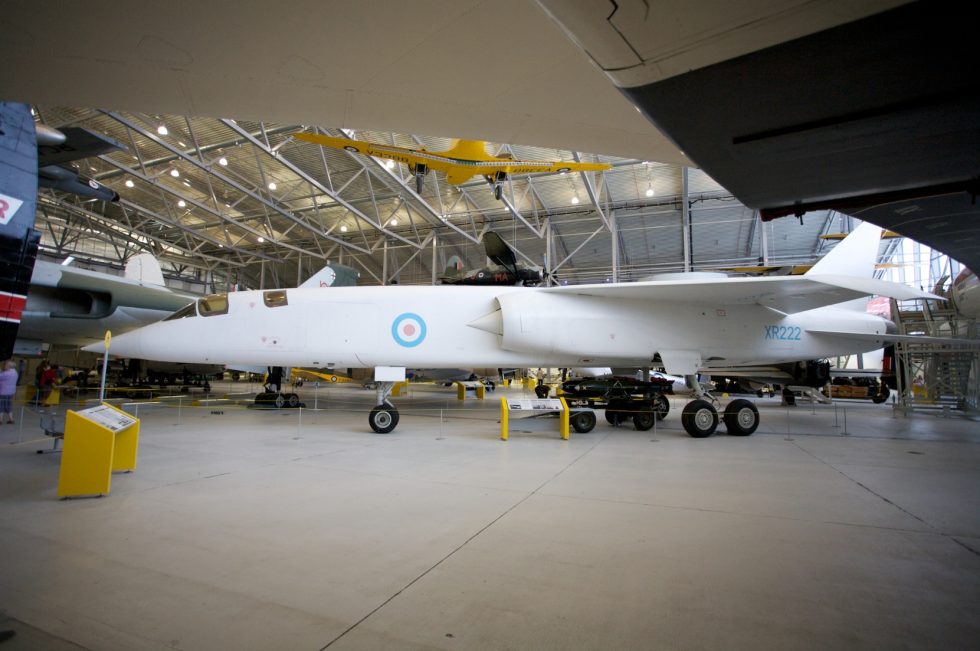
- Unfinished at cancellation, released to the College of Aeronautics at Cranfield as an instructional airframe, and thereby the only reason a second TSR-2 exists at all.
- XR224 to XR227 (X-06 to X-09)
- Broken up by R. J. Coley and Son of Hounslow. The tooling and jigs were scrapped at Brooklands within six months of the announcement.
- Pre-production batch, X-10 to X-19 (XS660–XS669, started, all destroyed)
- Ten further airframes in early construction. All were scrapped, bringing the number of TSR-2 airframes laid down to nineteen and the number that flew to one.
- Projected production batch (XS944–XS995, fifty aircraft, never begun)
- Serials had been allocated for the first true production run. No metal was cut and no production contract was ever signed, which is why the frequently quoted per-aircraft costs are all projections rather than prices anyone paid.
- Variable-geometry TSR-2 (proposal only)
- A later development with a swing wing was studied to improve field performance and loiter. Nothing came of it; the swing-wing strike aircraft Britain eventually flew was the Tornado, in partnership rather than alone.
- Export and licence production (none)
- There was no licence-built TSR-2 and no export variant. The only serious foreign interest came from the Royal Australian Air Force, which evaluated the type for its own Canberra replacement and chose the F-111C instead — a decision that cost Australia a decade of delay but did eventually deliver aircraft.
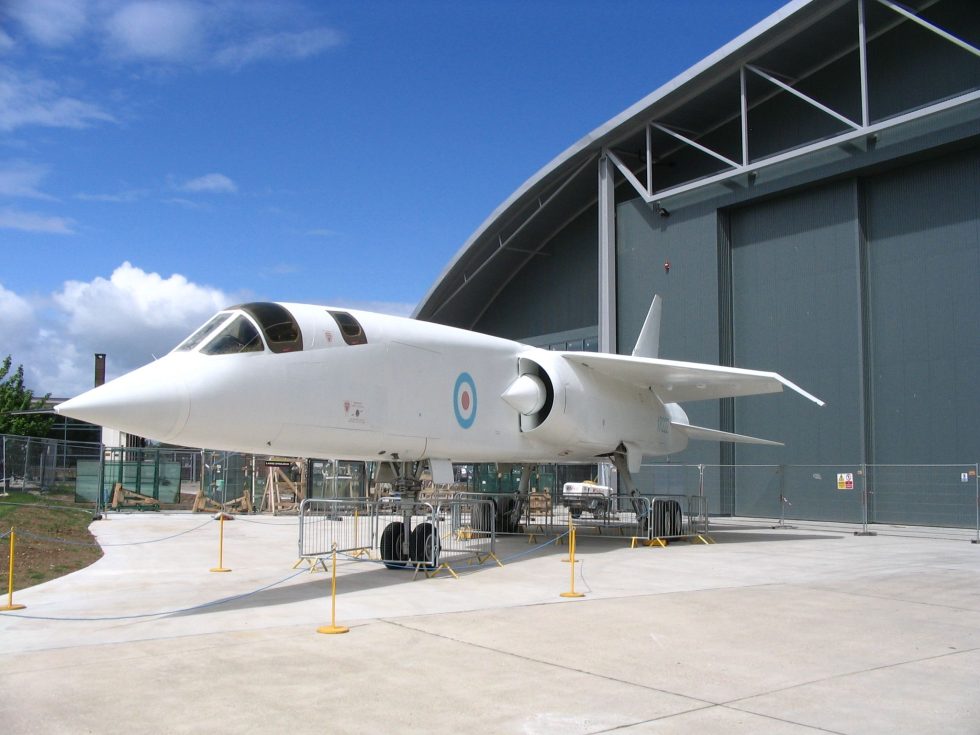
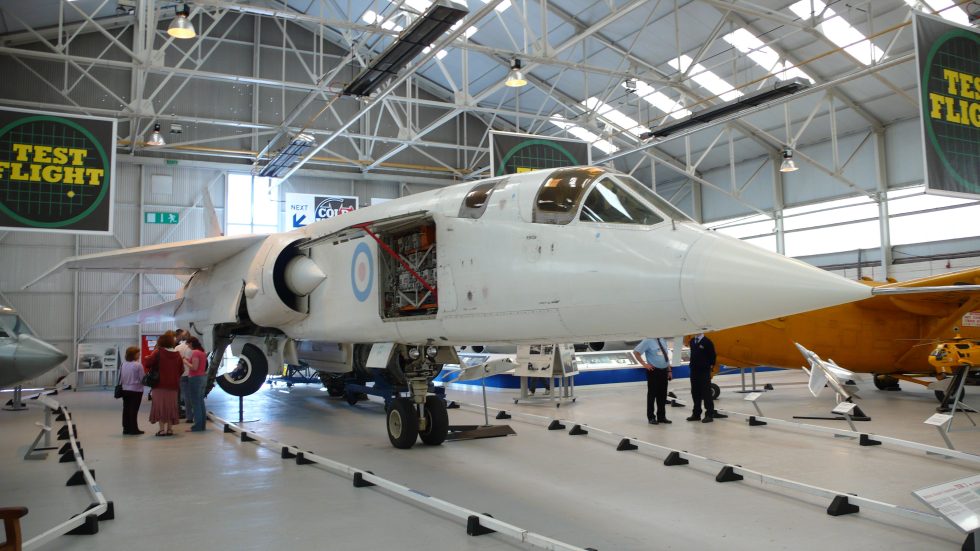
Survivors: two original TSR-2 airframes exist, and no reproduction has ever been built. XR220 is at the Royal Air Force Museum Midlands at Cosford, complete and the more intact of the two; XR222 is at the Imperial War Museum, Duxford, less complete, having been an unfinished airframe passed to Cranfield. A cockpit section is held by Brooklands Museum and a pair of Olympus 22R engines by the Gatwick Aviation Museum. Neither surviving aircraft ever flew, and the one that did, XR219, was destroyed on the ranges at Shoeburyness. Serial allocations and completion states differ slightly between published accounts, and the total of nineteen airframes laid down should be read as the best-attested figure rather than a certainty.
From requirement to rubble in nine years
The requirement
Air Ministry requirement GOR.339 calls for a supersonic, all-weather, low-level strike and reconnaissance aircraft to replace the Canberra.
Vickers & English Electric win
A joint Vickers/English Electric design is selected; the aircraft is named TSR-2.
BAC is formed
Under government pressure the makers merge into the British Aircraft Corporation, with the airframe built at Weybridge and Warton, 200 miles apart.
First flight
On 27 September, XR219 flies for 14 minutes at Boscombe Down, Roland Beamont at the controls with Donald Bowen navigating.
Supersonic — once
On the transit flight to Warton, XR219 goes supersonic for the only time, reaching Mach 1.12 on one engine in reheat.
Cancelled
The Labour government cancels the TSR-2 in the Budget, favouring the American F-111K. The second prototype, ready to fly, never does.
Ordered destroyed
Jigs and tooling are broken up; the wooden mock-up is burned and flown airframes are shot to pieces at Shoeburyness.
The replacement is cancelled too
Britain cancels its F-111K order on cost grounds — leaving the RAF with neither aircraft.
Tornado fills the gap
Only with the Panavia Tornado does the RAF finally get the low-level strike capability the TSR-2 promised fifteen years earlier.
The TSR-2 story in twelve parts
A jet to replace the Canberra
Britain needed an aircraft that could do what nothing else in the world could.
Read the full story
English Electric meets Vickers
The government made two rival firms build the aircraft together, 200 miles apart.
Read the full story
27 September 1964
Roland Beamont took XR219 into the air and found it “marvellous.”
Read the full story
Flying at 97 per cent
The Olympus engines were so fragile that the first flights were flown deliberately throttled back.
Read the full story
The frozen-bogie landing
With the landing gear jammed, Beamont chose to land rather than eject.
Read the full story
Mach 1.12 to Warton
The TSR-2 broke the sound barrier a single time, on its way to a new base.
Read the full story
Fifty feet from the hills
The TSR-2 could fly itself through valleys at 200 feet in cloud.
Read the full story
A cockpit ahead of its time
Inertial navigation, a moving map and a head-up display — years before they were normal.
Read the full story
Mountbatten and the Buccaneer
Powerful voices pushed the cheaper naval Buccaneer instead.
Read the full story
6 April 1965
The cancellation was slipped into the Budget speech.
Read the full story
Jigs burned, airframes shot
The tooling was broken up and most aircraft were deliberately scrapped.
Read the full story
Cosford, Duxford and a grievance
Two airframes escaped the torch — and the anger never faded.
Read the full story
The TSR-2 in pictures
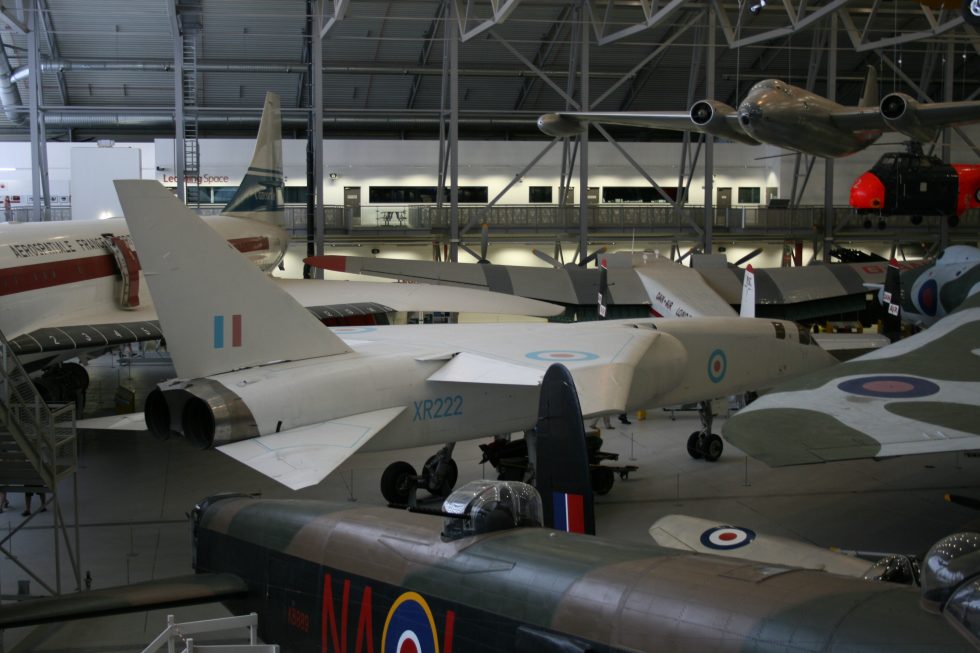
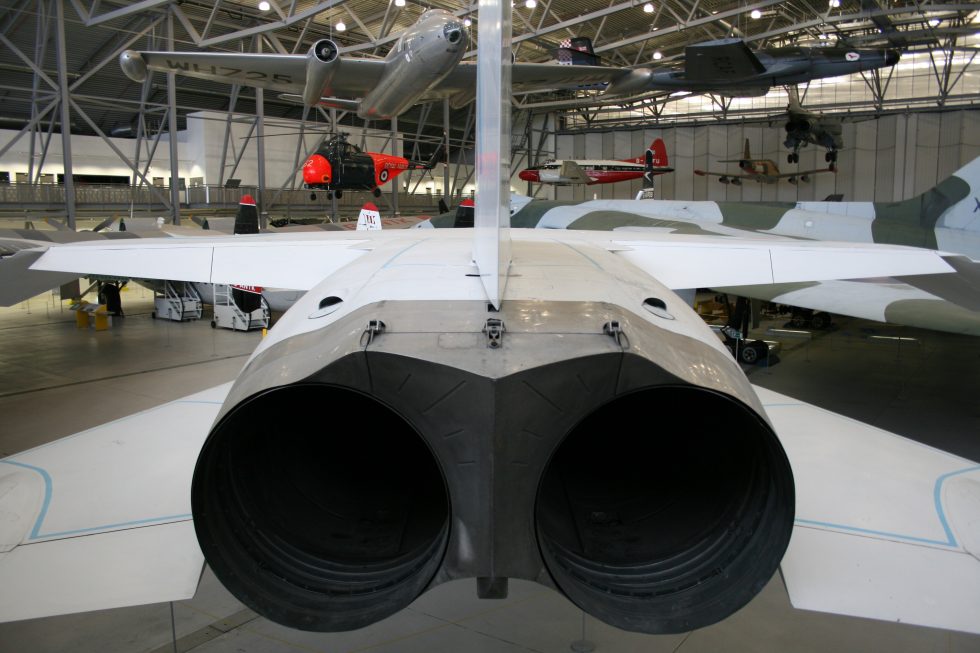
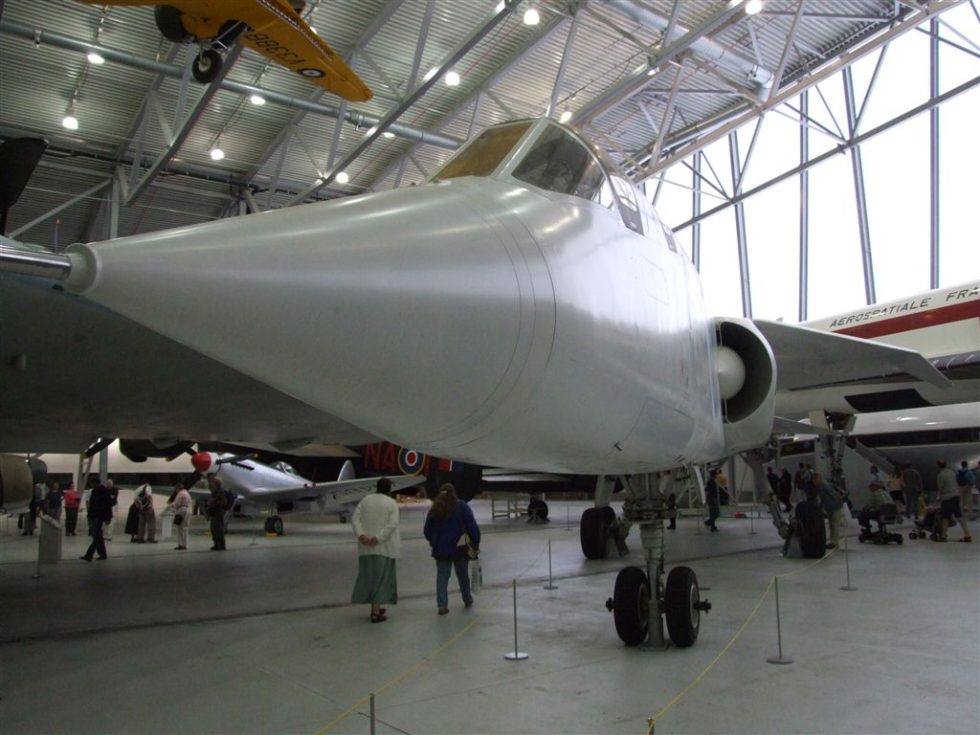
Where the TSR-2 belonged
The war it never fought
The TSR-2 never reached a squadron, never carried a weapon in anger and never fired a shot. Its entire life was spent in flight test: a single aircraft, twenty-four flights, and one brief supersonic dash — before the programme was cancelled and most of the fleet destroyed. Its “record” is a set of numbers about what was lost.
Explore aircraft that did see combat in the military aircraft combat record database. Figures as of July 2026.
Everything people ask about the BAC TSR-2
Can I fly in a TSR-2?
Why was the TSR-2 cancelled?
Did the TSR-2 ever actually fly?
How fast was the TSR-2?
Why were the jigs and airframes destroyed?
Where can I see a TSR-2 today?
What did the RAF get instead of the TSR-2?
You can’t fly the TSR-2.
These, you can.
Some legends only live in museums — others are fuelled and waiting. MiGFlug has put civilians in real military jet cockpits since 2004.
 Fly the L-39 AlbatrosThe world’s most-flown jet trainer — aerobatics included
 Fly the F-104 Starfighter“The missile with a man in it”
 Fly the MiG-21The Cold War’s most-produced jet
 Fly the T-33 Shooting StarAmerica’s first jet trainer
 Fly the DH VampireA piece of early jet history
 Fly the S.211Agile Italian jet trainer
 Fly the MB-326The classic Aermacchi jet
 Fly the MiG-15The Soviet legend of the Korean War
Continue the tour
Every fact, checked
- BAE Systems Heritage — BAC TSR-2Corporate heritage account of the programme, its systems and cancellation.
- Smithsonian Air & Space — Britain’s High-Mach HeartbreakThe development, first flight, test drama and the politics behind the cancellation.
- Thunder & Lightnings — TSR-2 HistoryDetailed flight-test record: the engine limits, the frozen bogies and the Mach 1.12 flight.
- The Aviationist — The Promising Beginning and Sudden End of the TSR-2Overview of the design, the GOR.339 requirement and the destruction that followed cancellation.
- Military Factory — BAC TSR-2Dimensions, weights, engine thrust, payload and production figures.
- RAF Museum — CosfordHome of XR220, the most complete surviving TSR-2 airframe.
- Imperial War Museum DuxfordHome of XR222, the second surviving TSR-2.
- MiGFlug Afterburner — The TSR-2: The Best British Aircraft That Never ServedMiGFlug’s own feature on the aircraft and its cancellation.