
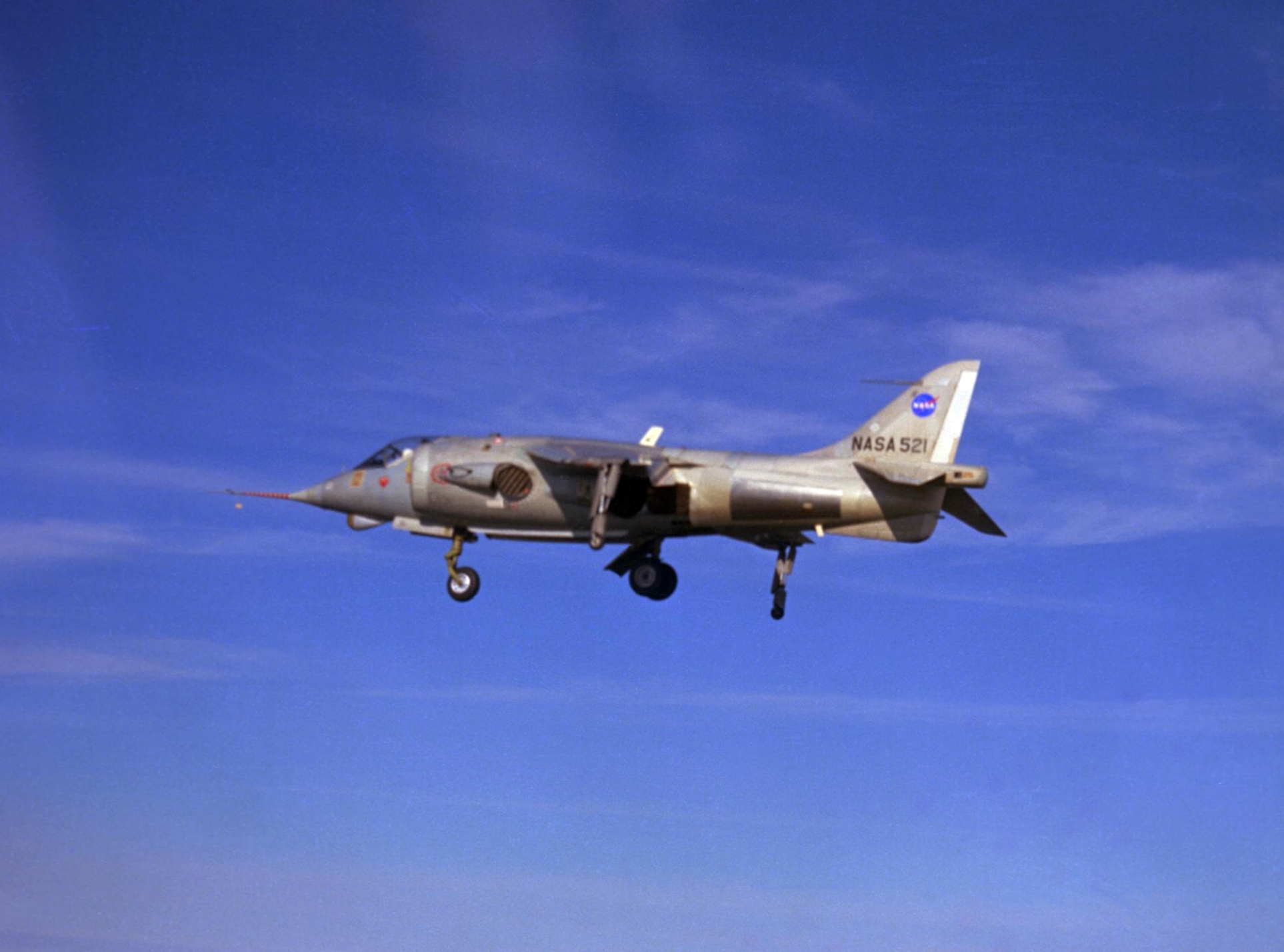
Hawker P.1127
“Kestrel”
The experimental British jet that first hovered in 1960 on a swivelling column of jet exhaust — proved that vertical flight and forward flight could live in one airframe, and grew directly into the Harrier jump jet.
The Hawker P.1127 and Kestrel: the experimental VTOL jet that became the Harrier
For most of aviation history, one hard fact ruled fighter design: a jet needs a runway. Take that runway away — bomb it, or fight from a ship or a forest clearing — and the fastest interceptor in the world is just expensive scrap. Through the 1950s a handful of engineers chased the dream of a jet that could rise straight up, hover, and then fly away like any other aircraft. Most of their answers were monstrous: separate lift engines, tilting whole airframes, machines that could barely stagger off the ground. The Hawker P.1127 was the one that worked — and it worked because of the engine.
The idea began with the French engineer Michel Wibault and was turned into a practical powerplant by Bristol Aero-Engines (soon Bristol Siddeley). Their Pegasus turbofan did something no fighter engine had done before: it split its thrust between four rotating nozzles, two each side of the fuselage, that could swivel from pointing straight down to pointing straight back. Point them down and the aircraft rose vertically; rotate them aft and it accelerated into wingborne flight. All of it came from a single engine — no dead-weight lift jets to carry once airborne.
At Hawker, chief designer Sir Sydney Camm — the man behind the Hurricane — and project engineer Ralph Hooper wrapped the smallest, simplest airframe they could around that engine. The first prototype, XP831, made its first tethered hover on 21 October 1960, straining against a tethering rig inside a wire cage. A free hover followed on 19 November 1960. Conventional runway flight came on 13 March 1961, and the true prize — a full transition from vertical hover to fast forward flight and back again — was achieved in September 1961. For the first time a jet had genuinely bridged the two worlds.
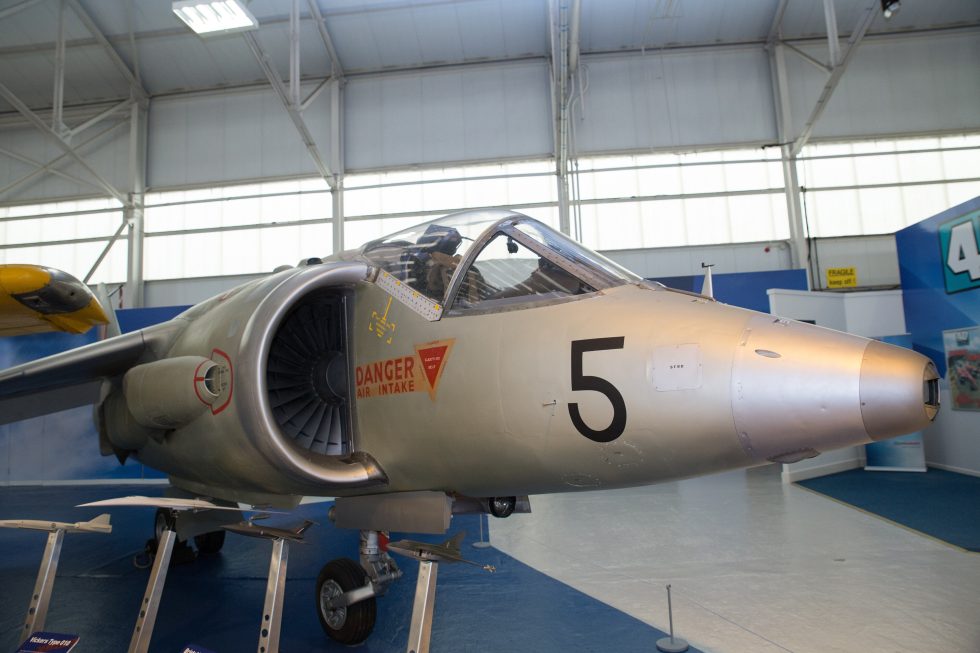
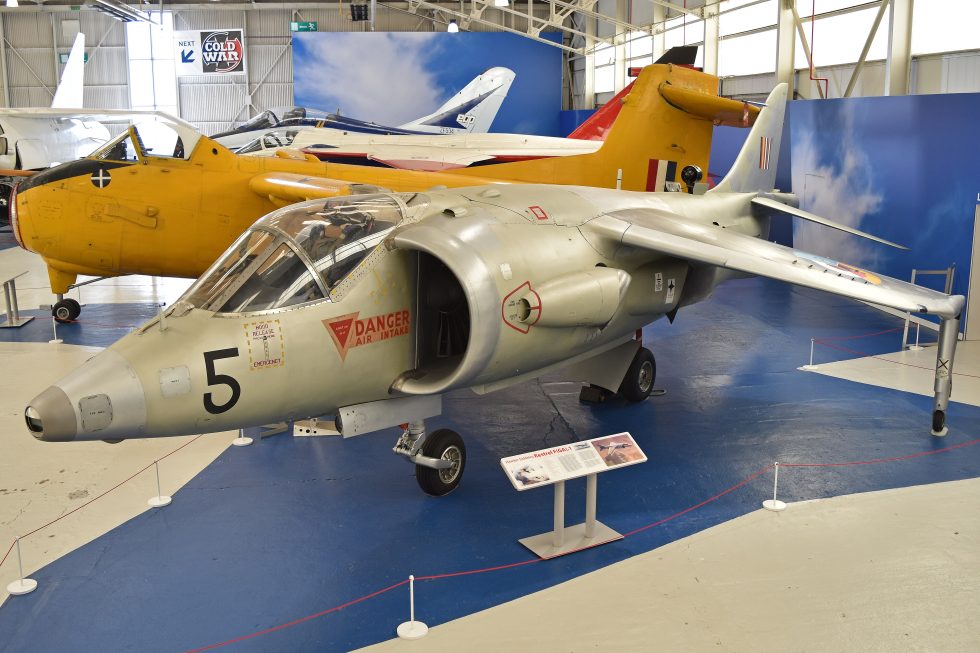
The P.1127 was a research aircraft, not a weapon — six were built, and the programme was as much about learning to control a hovering jet as about speed. But its promise was obvious enough that three governments paid to test it together. From it Hawker developed a more capable version, the Kestrel FGA.1, and nine were built for a remarkable multinational unit: the Tripartite Evaluation Squadron, formed with pilots from Britain, the United States and West Germany and based at RAF West Raynham. Between April and September 1965 they flew the Kestrel from grass, roads and improvised strips to see whether V/STOL could really work in the field.
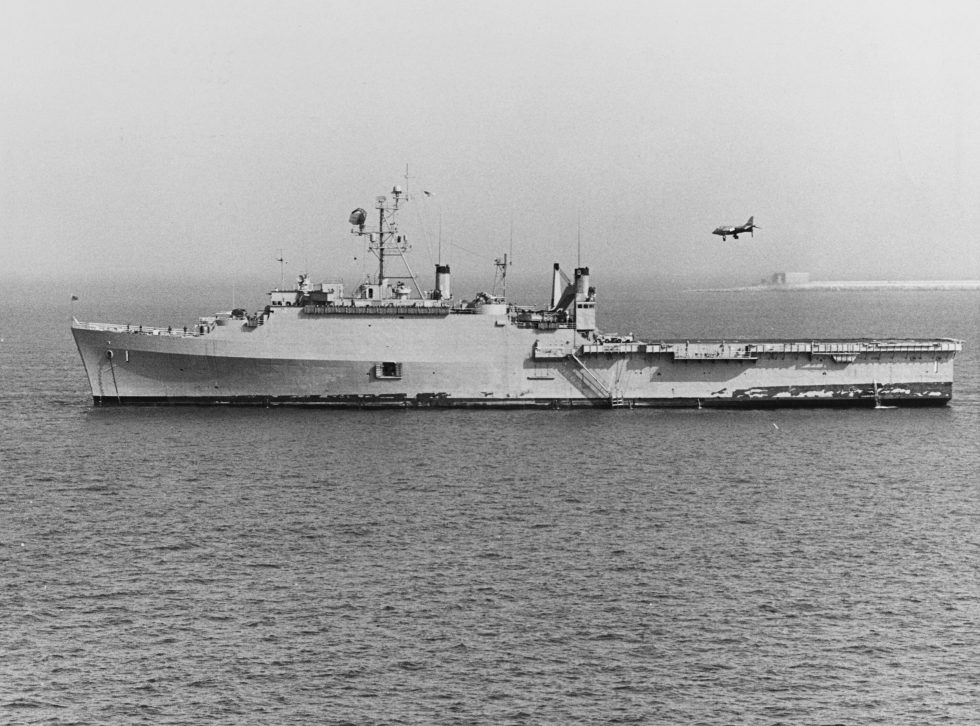
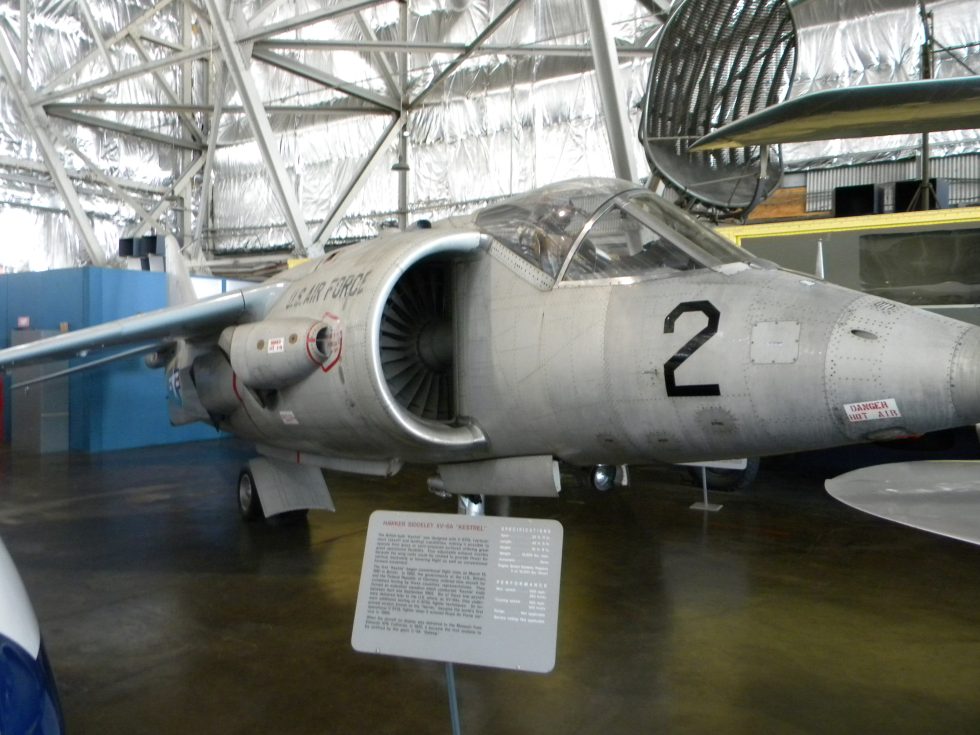
It could. When the trials ended, six of the nine Kestrels were shipped to the United States, redesignated XV-6A, and flown in further tri-service evaluation by the US Army, Navy and Air Force — including trials from the decks of the ships USS Raleigh and USS Independence. The data these small, unglamorous jets gathered fed almost directly into the aircraft everyone remembers: the Hawker Siddeley Harrier, which first flew in 1967 and entered RAF service in 1969. The Harrier — and the AV-8 that served the US Marines and the Sea Harrier that fought over the Falklands — is the P.1127 grown up. Every jump jet that ever hovered traces its bloodline to a little cage-tethered prototype that lifted off in 1960.
01The Hawker P.1127’s vectored-thrust idea: how one engine did the work of two
Rival V/STOL projects of the 1950s mostly used brute force: banks of dedicated lift engines that did nothing but push the aircraft up, then sat as dead weight for the rest of the flight. The P.1127’s genius was to avoid that entirely. The Bristol Siddeley Pegasus fed both the cold fan air and the hot core exhaust into four nozzles that rotated together, so the same engine that lifted the aircraft also drove it forward — the pilot simply rotated the nozzles with a second throttle-like lever.
The concept traced back to a scheme by French engineer Michel Wibault for a “gyropter,” refined by Bristol’s Gordon Lewis and Stanley Hooker into the practical Pegasus. It was elegant, compact and light — and it is why the P.1127 succeeded where heavier, more complex rivals failed. Vectored thrust from a single engine is still the principle behind the Harrier and, in a supersonic afterburning form, the lift system of the F-35B.
What makes the P.1127 Kestrel special
The vectored-thrust Pegasus — one engine, four swivelling nozzles
The heart of the aircraft is the Bristol Siddeley Pegasus turbofan and its four rotating nozzles. Two carry cold fan air, two the hot core exhaust; all four swivel in unison from pointing down (for lift) to pointing aft (for thrust). Because a single engine does both jobs, there are no dead-weight lift engines to haul around once airborne — the design that let the P.1127 hover and fly properly, and the direct ancestor of the Harrier’s powerplant.
Flying with no wings: reaction controls in the hover
In a hover a wing produces no lift and normal control surfaces are useless. The P.1127 stayed pointed the right way using a reaction control system — small puffer jets of engine bleed air at the nose, tail and wingtips that pushed the aircraft in pitch, roll and yaw. The pilot flew the hover on the same stick and rudder, but the commands went to these jets instead of the ailerons and elevators. Learning to juggle nozzle angle, throttle and reaction controls together was the programme’s hardest lesson.
A research jet that became a war-winning family
The P.1127 was never armed and never meant to fight — it existed to prove a principle. But the principle was so sound that it flowed almost unbroken into the Kestrel, then the Harrier, the US Marines’ AV-8, and the Sea Harrier that fought in the Falklands. Few experimental aircraft have a legacy so direct: the humble, subsonic P.1127 defined how the West would do vertical flight for the next half-century.
02The P.1127 in the hover: why controlling it was harder than building it
Getting a jet to rise vertically is only half the battle; keeping it steady is the other. With no airflow over the wings and tail, the P.1127 had nothing to bite against — a hovering jet wants to drift, roll and pitch, and it does so on a knife-edge of engine thrust. Hawker’s answer was the reaction control system: bleed-air nozzles at the extremities that acted like tiny attitude thrusters. Test pilot Bill Bedford flew the earliest hovers, at first with the aircraft tethered inside a cage so it could not wander away or flip. Pilots described the workload as immense — managing engine thrust, nozzle angle and reaction controls simultaneously while the machine tried to slide out from under them. The techniques worked out on the P.1127 became the foundation for training every Harrier pilot who followed.
03From P.1127 to Kestrel to Harrier: how the experiment became a front-line jet
The P.1127 proved the concept; the Kestrel FGA.1 made it useful. Developed from the prototypes with a redesigned, swept wing and a more powerful Pegasus, nine Kestrels were built for the 1965 Tripartite Evaluation Squadron to test V/STOL in realistic field conditions. Their success justified a full combat aircraft. Hawker had proposed a supersonic V/STOL fighter, the P.1154, but when that ambitious project was cancelled in 1965 the government backed a developed, subsonic version of the P.1127 instead — the Hawker Siddeley Harrier. It first flew in 1967 and entered RAF service in 1969. Six of the nine Kestrels, meanwhile, crossed the Atlantic as XV-6A research aircraft, feeding American V/STOL knowledge that later helped shape the Marine Corps’ adoption of the Harrier as the AV-8.
Full Hawker P.1127 / Kestrel FGA.1 specifications
Baseline note: the figures below describe the Hawker Siddeley Kestrel FGA.1, the batch of nine aircraft built at Dunsfold in 1964–65 and flown by the Tripartite Evaluation Squadron at RAF West Raynham, because that was the only standard of this aeroplane ever completed to something resembling a service configuration. It is still a research machine. It carried no radar, no attack computer and no gun, and the numbers in the performance column come from a manufacturer’s data sheet and a Profile monograph rather than from a release-to-service document. Deltas for the six P.1127 prototypes of 1960–64 are in grey. Four published disagreements should be settled before the tables begin. First, engine ratings. The Pegasus grew almost monthly during this programme, and reference works cross-quote each other badly: the first flight engine of October 1960 is variously 11,300 and 11,500 lbf, the Pegasus 3 is given as 13,500 lbf in engine sources and as 15,000 lbf in at least one airframe account, and 15,000 lbf properly belongs to the Pegasus 5 that the Kestrel actually flew. The figures used here follow the engine literature. Second, wing area. Widely reproduced specification tables for the Kestrel often leave it blank; the commonly repeated figure is 17.28 m2 (186 sq ft), which is used below but is not from a primary source. Third, range. There is no dependable published range, radius or internal fuel figure for the Kestrel, and inventing one would be worse than admitting the gap, so this table does not carry one. Fourth, the date of the first conventional flight. The brief for this page gave 13 March 1961; Francis K. Mason, the closest thing to a primary chronicler of the type, gives 13 February 1961 at Dunsfold, while other accounts place a first conventional flight on 13 March 1961 from RAE Bedford. Both dates are in print and the discrepancy is unresolved here.
Dimensions & weights
- Crew
- 1 — pilot only, on a Martin-Baker ejection seat, sitting directly ahead of the engine
- Length
- 12.95 m (42 ft 6 in) — the prototypes were longer over the nose instrumentation boom, which the Kestrel deleted in favour of a fin-mounted boom
- Wingspan
- 6.99 m (22 ft 11 in) — some sources round to 6.96 m (22 ft 10 in); the Harrier GR.1 wing was longer again at 7.70 m (25 ft 3 in)
- Height
- 3.28 m (10 ft 9 in)
- Wing area
- 17.28 m2 (186 sq ft) — widely repeated but weakly sourced; the standard specification block leaves this entry blank
- Wing form
- One-piece shoulder-mounted swept wing with pronounced anhedral and a sawtooth leading-edge extension — the first four P.1127s flew a near-clipped-delta wing with unswept trailing edges and rounded tips; XP984 introduced the swept wing that became the Kestrel’s
- Tail
- All-moving one-piece tailplane with anhedral, hinged on the rear fuselage — the taller fin and the tailplane anhedral appeared on the fifth prototype, XP980, and went straight through to the Harrier
- Undercarriage
- Zero-track bicycle: twin nosewheel and twin mainwheel on the fuselage centreline, with balancing outriggers retracting into the wingtips
- Empty weight
- 4,445 kg (9,800 lb)
- Maximum vertical take-off weight
- 6,350 kg (14,000 lb) — a ceiling set by thrust, and lower still on a warm day or a high airfield
- Maximum short take-off weight
- 7,711 kg (17,000 lb) — the extra 1,361 kg (3,000 lb) is the whole practical argument for STO over VTO
- Wing loading
- Approximately 367 kg/m2 (75 lb/sq ft) at vertical take-off weight — derived here from the quoted weight and the quoted wing area, not published as such
- Hardpoints
- 2 wing pylons, one under each wing inboard of the outrigger; no centreline or fuselage station — internal fuel capacity is not reliably published for either type
Performance
- Maximum speed
- 1,143 km/h (710 mph, 617 kn)
- Limiting Mach number
- Mach 0.92 — deliberately subsonic. The supersonic V/STOL aeroplane NATO asked for was a different design entirely, the P.1154, and it was cancelled before it flew
- Rate of climb
- 152 m/s (30,000 ft/min) — a clean, lightly loaded airframe on 15,000 lbf, and one of the few numbers that flatters this aircraft
- Service ceiling
- 16,760 m (55,000 ft)
- Thrust-to-weight ratio
- 1.04 at vertical take-off weight — the arithmetic of 15,000 lbf against 14,000 lb gives 1.07, so the quoted figure already allows for installation and hot-day losses
- Take-off technique
- Vertical, rolling or short, at the pilot’s choice; landing vertical or conventional. The Tripartite squadron settled on short take-off and vertical landing as the routine sortie, and that judgement shaped every Harrier that followed
- Rough-field capability
- Demonstrated from semi-prepared strips at RAF Bircham Newton and dispersed sites in the Stanford training area, including boggy ground and temporary matting, with aircraft hidden in woodland
- Typical sortie duration
- About 28 minutes — derived from XS695’s own record of 153 flights totalling 70.44 airframe hours; the type was short-legged and everyone involved knew it
- Range and combat radius
- No dependable published figure for either type. The Kestrel was never given an operational radius because it was never given an operational role
- Hover endurance, early prototypes
- Under 2.5 minutes at full power in October 1960 — an engine limitation, not an airframe one; XP831 was stripped of every removable pound to hover at all
- Programme flying
- Six months of Tripartite operations from 1 April to 30 November 1965, on nine aircraft, of which one was destroyed on the squadron’s first day of flying
Propulsion & systems
- Engine
- 1 × Bristol Siddeley Pegasus 5 (BS.53) vectored-thrust turbofan, 66.7 kN (15,000 lbf)
- Engine marks through the programme
- Pegasus 1 bench demonstrators at about 40 kN (9,000 lbf), first run 2 September 1959; Pegasus 2 at roughly 51 kN (11,300–11,500 lbf) for the first hovers; Pegasus 3 at 60 kN (13,500 lbf); Pegasus 5 at 66.7 kN (15,000 lbf) for the Kestrel — the Pegasus 6 (Mk 101) of 84.5 kN (19,000 lbf) belongs to the Harrier GR.1, though the Kestrel XS693 was rebuilt to take it
- Engine layout
- Two-stage fan, three-stage low-pressure and eight-stage high-pressure axial compressors, with the LP and HP spools turning in opposite directions specifically to cancel gyroscopic couples in the hover
- Thrust vectoring
- Four nozzles rotating together through 98.5°, driven by air motors on high-pressure bleed through motorcycle chains — a deliberately crude and deliberately reliable mechanism
- Thrust split
- Roughly 60 per cent through the two cold front nozzles from the fan and 40 per cent through the two hot rear nozzles at about 650 °C — the front nozzles were originally glass fibre; after XP836 shed one in flight they were made in steel
- Reaction controls
- Bleed-air "puffer" jets at nose, tail and wingtips, opened progressively and automatically as the nozzles rotated downwards so that control passed from aerodynamic surfaces to jets without the pilot changing hands
- Stability augmentation
- Auto-stabiliser fitted throughout, but tethered hovers and full transitions were repeatedly flown with it switched off, which says a good deal about how honest the basic aeroplane was
- Intake
- Inflatable rubber lip to smooth the airflow at near-zero forward speed — doubts about its service life led to plain suction-relief doors on the Harrier
- Emergency power
- Ram-air turbine on the upper rear fuselage ahead of the fin, supplying ancillary services after an engine failure — there is only one engine, and no relighting a Pegasus in a hover
- Structure
- Conventional light-alloy stressed skin. Magnesium alloy was used in the Kestrel and was ordered out of all later airframes after corrosion experience during the 1966 trials aboard the commando carrier HMS Bulwark
- Avionics
- UHF radio and assorted operational equipment in a rear-fuselage bay, the principal fit change from the P.1127. No radar, no inertial platform, no attack computer
04The P.1127 and Kestrel’s costs: why there is no unit price or cost-per-hour figure
The P.1127 and Kestrel were experimental and evaluation aircraft, never mass-produced or sold, so a meaningful flyaway unit cost simply does not exist. Only six P.1127 prototypes and nine Kestrel FGA.1s were built, funded as research under British and (for the Tripartite programme) shared British, American and West German budgets. Any figure you see is a research-and-development cost spread across a handful of hand-built airframes, not a per-aircraft production price.
There is likewise no credible published cost-per-flight-hour for the type. Operating-cost data belongs to its production descendant, the Harrier — and even those numbers vary widely by variant and era. For the P.1127 and Kestrel, treat any precise dollar figure as an estimate rather than a documented fact.
Armament & payload
No P.1127 and no Kestrel ever carried a gun, and the only stores photographed on one were rocket pods at an air show
This is the honest position, and it needs stating plainly because almost every popular account of the type quietly imports the Harrier’s weapons onto it. Fifteen aircraft were built — six P.1127 prototypes and nine Kestrel FGA.1s — and not one of them was fitted with a cannon. The Kestrel had two underwing pylons and nothing else: no centreline station, no fuselage hardpoint, no missile wiring, no radar and no attack computer. Its sighting equipment was of the simplest kind.
The Tripartite Evaluation Squadron was not a weapons unit and was never asked to be one. Its written remit was to assess whether a V/STOL aircraft could be operated in the field: to compare methods of taking off and landing, to write normal operating procedures, to fly it on instruments and at night, and to explore jet-borne manoeuvring. Weapon delivery is absent from that list, and no record of a Kestrel firing or releasing anything has been found for this page.
What the aircraft did carry mattered more than what it might have carried. The margin between 4,445 kg empty and a 6,350 kg vertical take-off limit is small, and fuel has first call on it; the useful load on a vertical take-off, after a sensible fuel state, was close to nothing. Short take-off raised the limit to 7,711 kg, and that single arithmetic fact is why the Tripartite pilots converged on short take-off and vertical landing as the standard sortie, and why every Harrier since has been flown the same way. The store lists that appear in reference works for this type are manufacturers’ provisions and brochure options, not cleared fits, and they are frequently contaminated by figures belonging to the Harrier GR.1.
Gun — none, on any airframe, ever
- No internal cannon and no gun bay. None of the six P.1127s or nine Kestrels flew with a gun of any calibre.
- Hawker’s scheme for a production aircraft offered two 30 mm ADEN cannon in removable pods under the fuselage. That was a drawing and a sales point during the Kestrel years, not an installation.
- The idea did become real, but later and on a different aeroplane: the Harrier GR.1 carried two ADEN Mk 4 pods with 130 rounds each, and the pods’ side strakes trapped exhaust gas beneath the fuselage and were worth useful extra lift in the hover.
- Attributing ADEN pods to a Kestrel is the single commonest error made about this type. The gun belongs to the Harrier.
Pylons and payload — two stations, and a very thin margin
- Two wing pylons, one per wing, mounted inboard of the outrigger undercarriage. That is the whole of the Kestrel’s store-carrying capability.
- Each station is quoted at about 450 kg (1,000 lb), giving a nominal 900 kg (2,000 lb) of external load if the aircraft could lift it.
- On a vertical take-off it usually could not. With 15,000 lbf against a 14,000 lb limit and an empty weight of 9,800 lb, fuel absorbs nearly all the disposable load.
- A short take-off run bought 3,000 lb of extra weight, and it is from that margin, not the vertical one, that any real warload would have come.
- The P.1127 prototypes flew clean for most of the programme; pylons were a Kestrel-standard fitting rather than a research-airframe one.
Rockets — the only stores a Kestrel is reliably shown carrying
- Quoted provision: two 19-round 68 mm SNEB launchers, or two 32-round 2 in (51 mm) Microcell launchers — the standard NATO ground-attack rockets of the period.
- XS695 was demonstrated at the SBAC display at Farnborough in September 1966 with rocket pods fitted, which is the best-attested instance of a Kestrel carrying external stores.
- That was a demonstration that the pylons and their release circuits worked, and that the aircraft handled with asymmetric drag. It was not a weapons trial.
- Whether live rockets were ever fired from a P.1127 or a Kestrel is not established by any source consulted for this page, and it is stated here as unknown rather than guessed at.
Bombs, napalm and tanks — the brochure fit
- Accounts of the P.1127 as a proposed strike aircraft list 1,000 lb (450 kg) bombs, napalm tanks and range-extending drop tanks among the intended underwing loads.
- Every one of those is a provision. No P.1127 and no Kestrel is documented as having dropped a bomb, a tank or anything else.
- Nothing was cleared for release. There was no bombing computer, no radar ranging and no release-to-service; the aircraft had a simple fixed sight and a pilot’s judgement.
- Drop tanks are the most persistent phantom on this aircraft’s data sheets. There is no trials record and no photograph of a Kestrel carrying one, and its very short sorties reflect that.
What it carried instead — instrumentation and cameras
- The real payload of these fifteen airframes was measurement: strain gauges, thermocouples, pressure rakes, accelerometers and trace recorders, filling volume that a squadron aircraft would have used for equipment.
- The prototypes carried a long nose instrumentation boom. The Kestrel moved the pitot and yaw vanes to a shorter boom on the fin, which freed the nose for a forward-facing tactical camera.
- UHF radio and operational equipment went into a bay in the rear fuselage — the main equipment difference between a P.1127 and a Kestrel.
- A ram-air turbine sat on the upper rear fuselage forward of the fin. With one engine and no glide to speak of in the hover, electrical and hydraulic services after a flame-out were not optional.
- No radar was ever fitted to either type, and none was planned for the evaluation aircraft.
What all this became — the Harrier GR.1
- The first P.1127 (RAF) flew on 31 August 1966 and, with an order for 60 aircraft in early 1967, became the Harrier GR.1. It is the aeroplane the Kestrel was a rehearsal for.
- The GR.1 had what the Kestrel only had on paper: four wing pylons and a centreline station, plus the two ventral 30 mm ADEN Mk 4 gun pods.
- Its stores included 1,000 lb bombs, BL755 cluster bombs, SNEB rocket pods and a five-camera reconnaissance pod; AIM-9 Sidewinder came later still.
- The enabler was thrust. The Pegasus 6 at 19,000 lbf, roughly a quarter more than the Kestrel’s Pegasus 5, is what turned a demonstrator’s payload margin into a useful one.
- None of the above belongs on a Kestrel specification, and it is set out here only so that the boundary is visible.
Three typical loadouts
- Tethered hover, Dunsfold, October 1960
- Nothing at all. XP831 was stripped of every removable pound, flew over a purpose-built grid that deflected the exhaust away from the airframe, and its Pegasus 2 could not be held at full power for more than two and a half minutes at a time. The aeroplane that began the V/STOL era could barely lift itself.
- Tripartite sortie, RAF West Raynham, 1965
- Clean wings, internal fuel, one pilot, no stores. Short take-off from a runway, a semi-prepared strip or a matted dispersal, roughly half an hour of handling, instrument or night work, and a vertical landing back on the pad. XS695 flew 141 such sorties with the squadron.
- Public demonstration, Farnborough, September 1966
- Two underwing rocket pods on XS695, carried to show that the pylons worked and that a V/STOL aeroplane could lift and handle asymmetric external stores. The nearest thing to an armed configuration this aircraft ever wore.
Sourcing caveat: there is no armament release-to-service for this aircraft, because it never had one. The provisions listed above are drawn from manufacturer material and from the Kestrel specification block in the standard references, cross-checked against the RAF Museum’s individual airframe history for XS695. Where a source lists a weapon without a photograph, a trials record or a serial number attached to it, it is treated here as a provision and labelled as such.
Variants
Fifteen airframes, four designations and one cancelled supersonic detour turned a Bristol engine into the Harrier
The lineage is genuinely confusing, and the confusion is worth untangling because the names overlap. P.1127 is Hawker’s project number for the six prototypes of 1960–64. Kestrel FGA.1 is the nine-aircraft evaluation batch of 1964–65. XV-6A is the American designation applied to six of those same Kestrels after they crossed the Atlantic. P.1127 (RAF) is the pre-production aircraft of 1966 that was renamed Harrier GR.1 in 1967. And P.1154 is a different aeroplane entirely, a supersonic design that never flew.
The detour matters. In 1961 NATO issued Basic Military Requirement 3, which wanted a V/STOL aircraft with the performance of an F-4 Phantom II. The P.1127 could not meet it and could not be developed to meet it, so Hawker offered the P.1150 and then the P.1154, which duly won the NATO competition and was then killed by the politics that followed — France withdrew after the Mirage IIIV lost, and the British cancellation came in 1965 with prototype construction already under way. NBMR-3 nearly destroyed the programme by tempting it into supersonics. What saved the Harrier was that the unglamorous subsonic aeroplane had gone on flying while the paper one was being argued over.
The other thing to keep in view is how little of this was official. Hawker designed the P.1127 with its own money after the 1957 Defence White Paper had killed the P.1121, three quarters of the Pegasus development bill was paid by the American-funded Mutual Weapons Development Program, and NASA Langley did the wind-tunnel work. A British aircraft that the British Air Staff did not much want was kept alive by a French consultant’s patent, an American budget and a company board’s nerve.
- P.1127, first pair (XP831 and XP836, flown 1960–61, 2 built)
- Ministry of Supply contract of April 1959 for the two aircraft Hawker had already decided to build privately. Pegasus 2, clipped-delta wing, no anhedral tailplane, long nose boom. XP831 hovered tethered on 21 October 1960 and free on 19 November 1960.
- P.1127, second batch (XP972, XP976, XP980, ordered 2 November 1960, 3 built)
- Contracted to push the design towards a realistic combat aeroplane: better Pegasus marks, wing refinement, operational equipment. XP980 introduced the taller fin and the anhedral tailplane that went straight through to the Harrier; XP976 was largely used to convert Hawker production test pilots onto the type.
- P.1127, sixth aircraft (XP984, first flown 13 February 1964, 1 built)
- The bridge to the Kestrel. Introduced the fully swept wing and was fitted with the 15,000 lbf Pegasus 5, effectively serving as the Kestrel aerodynamic prototype. It crash-landed on 19 March 1965 and was damaged again in 1975.
- Kestrel FGA.1 (XS688–XS696, 1964–65, 9 built)
- Ordered under a tripartite arrangement with the United States and West Germany after an Instruction to Proceed on 22 May 1962. Fully swept wing, larger tail, fuselage reworked around the Pegasus 5, UHF radio and equipment bay in the rear fuselage, fin-mounted instrumentation boom, two wing pylons. XS688 first flew on 7 March 1964 in Bill Bedford’s hands.
- Tripartite Evaluation Squadron aircraft (West Raynham, 15 October 1964 to November 1965)
- Not a variant but the configuration that matters: nine aircraft, pilots from the RAF, the USAF, the US Navy, the US Army and the Luftwaffe, each given a week of ground school at Bristol, a week at Dunsfold and a three-hour conversion with Bedford. Flying began on 1 April 1965 and the evaluation closed at the end of November.
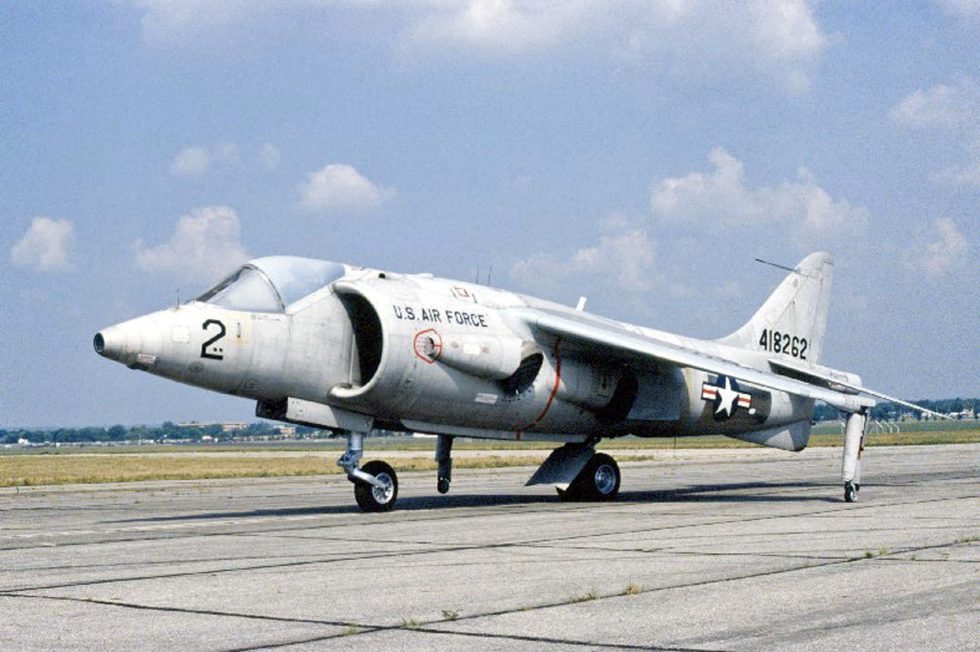
- XV-6A Kestrel (six aircraft, US serials 64-18262 to 64-18266 and 64-18268, from 1966)
- The three American and three West German aircraft were shipped to the United States for tri-service evaluation by the Army, Air Force and Navy, then passed to the USAF at Edwards apart from two operated by NASA. Nothing was procured, but the Marine Corps interest that produced the AV-8A grew directly out of this.
- Kestrel, Pegasus 6 conversion (XS693, from 1966)
- Sent to Blackburn to be modified for the uprated 19,000 lbf Pegasus 6, along with structural strengthening and the replacement of the inflatable intake lip by suction-relief doors. It was destroyed at Boscombe Down on 21 September 1967.
- Hawker Siddeley P.1150 and P.1154 (project only, 1961–65, none completed)
- Supersonic derivatives aimed at NBMR-3, using plenum-chamber burning in the cold nozzles. The P.1154 won the NATO competition, was ordered for the RAF and Royal Navy in incompatible versions, and was cancelled in 1965 with prototype construction begun. Its cancellation is what sent the RAF back to the Kestrel.
- P.1127 (RAF), later Harrier GR.1 (6 development aircraft from 31 August 1966; 60 ordered early 1967)
- The Kestrel with a bigger engine, a proper weapons fit, a nav-attack system and an inertial platform, ordered against Air Staff Requirement 384. This is where the research aeroplane stops and the fighting one begins.
- Descendants (1969 onwards)
- Harrier GR.1 to GR.3, the two-seat T.2 and T.4, the AV-8A for the US Marine Corps, the Sea Harrier FRS.1, the AV-8B and Harrier GR.5 to GR.9, and the Pegasus-derived F135 lift arrangement thinking that fed into the F-35B. All of it traces back to a chain drive turning four nozzles on XP831.
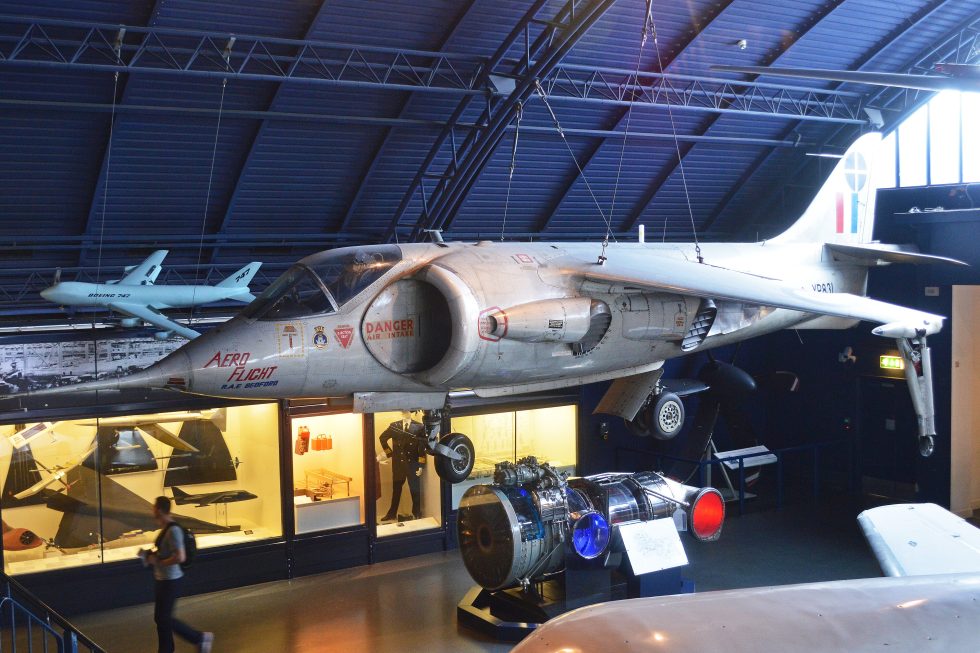
Closing note on survivors. Fifteen airframes were built and nine survive, all original aircraft; there are no reproductions of this type. Of the six P.1127s, three are extant: XP831, the first prototype, at the Science Museum in London, catalogued as part of the Royal Air Force Museum collection; XP980, the fifth, at the Fleet Air Arm Museum, Yeovilton, which served for years as a Royal Navy deck-handling trainer; and XP984, the swept-wing sixth aircraft, at Brooklands Museum in Surrey, its restoration completed in 2016. Both XP980 and XP984 are displayed with wings taken from Harrier GR.1s, and sources differ over how much of each wing is original. The three lost prototypes were XP836, whose glass-fibre front nozzle detached in flight near RNAS Yeovilton on 14 December 1961, forcing Bill Bedford to eject at 100 ft; XP972, which suffered an engine bearing failure and rear-fuselage fire near RAF Tangmere in late 1962, after which Hugh Merewether landed it dead-stick on its belly to preserve the evidence and was decorated for it, though sources give the date as either 30 October or 30 November 1962; and XP976, which survived the programme and was scrapped in 1982. Of the nine Kestrels, six survive. Two are in Britain: XS695 at the Royal Air Force Museum Midlands at Cosford, restored and unveiled in January 2014, and XS694 at the Wings Museum at Balcombe, West Sussex, still under restoration. Four are in the United States, all in their XV-6A identities: 64-18262 (XS688) at the National Museum of the United States Air Force at Wright-Patterson, 64-18263 (XS689) at the Virginia Air and Space Science Center at Hampton, 64-18264 (XS690) at the Pima Air and Space Museum at Tucson, and 64-18266 (XS692) at Air Power Park, also at Hampton. Sources disagree over which of the American aircraft wore the NASA 520 and NASA 521 numbers. The three Kestrels that did not survive were XS696, destroyed at West Raynham on 1 April 1965 — the Tripartite squadron’s first day of flying — when a pilot attempted a rolling take-off with the parking brake on; XS691, lost at Edwards Air Force Base; and XS693, destroyed at Boscombe Down on 21 September 1967.
From a French idea to the Harrier
The vectored-thrust concept
Bristol Aero-Engines, building on Michel Wibault’s idea, develops the vectored-thrust engine that becomes the Pegasus. Hawker’s Ralph Hooper designs an airframe around it.
First tethered hover
Prototype XP831 makes its first tethered hover on 21 October, straining against a rig inside a wire cage with test pilot Bill Bedford at the controls.
First free hover
On 19 November the P.1127 hovers untethered for the first time — a jet balanced on a column of its own vectored exhaust.
Conventional flight
On 13 March the P.1127 flies from a runway like a normal aircraft, proving both halves of its flight envelope work.
Full transition
The aircraft completes a full transition — hover to fast forward flight and back — for the first time, the milestone the whole programme was built to reach.
The Tripartite Evaluation Squadron
Nine Kestrel FGA.1s are flown from RAF West Raynham by British, American and West German pilots between April and September, testing V/STOL in the field.
Six go to America as XV-6A
Six Kestrels are shipped to the United States, redesignated XV-6A, and evaluated by the US Army, Navy and Air Force — including sea trials from the decks of USS Raleigh and USS Independence.
Birth of the Harrier
A developed version of the P.1127 flies as the Hawker Siddeley Harrier in 1967 and enters RAF service in 1969 — the world’s first operational V/STOL combat aircraft.
Twelve P.1127 and Kestrel stories
A jet that did not need a runway
The whole point was to escape the vulnerable runway — to hover, and fly from anywhere.
Read the full story
Four nozzles, one engine
The Pegasus split its thrust between four swivelling nozzles — the trick that made everything else possible.
Read the full story
Camm and Hooper
The Hurricane’s designer and a young project engineer wrapped the smallest possible airframe around a radical engine.
Read the full story
Tethered in a cage
On 21 October 1960 the first prototype rose a few feet, held down by a tethering rig so it could not escape.
Read the full story
Off the leash
A month later, on 19 November 1960, the P.1127 hovered free of its tether for the first time.
Read the full story
Bridging two worlds
In September 1961 the P.1127 flew a full transition — from hover to fast forward flight and back.
Read the full story
Bedford’s broken-leg first flight
Legend has it Bill Bedford made an early P.1127 flight with his leg in plaster after a car crash.
Read the full story
Hovering over the Paris crowds
The P.1127 and its Kestrel sibling stunned air-show audiences by hanging motionless in mid-air.
Read the full story
The Tripartite Evaluation Squadron
In 1965 British, American and West German pilots flew nine Kestrels together from an English airfield.
Read the full story
Six become XV-6A
When the trials ended, six Kestrels sailed to the United States for further evaluation as the XV-6A.
Read the full story
Kestrels on a carrier deck
American trials took the little jet to sea, hovering onto and off the decks of US Navy ships.
Read the full story
The jump jet’s ancestor
Every Harrier, Sea Harrier and AV-8 that ever hovered is a direct descendant of the P.1127.
Read the full story
The P.1127 and Kestrel in pictures
Where the P.1127 and Kestrel flew
A jet that never fought — and changed everything anyway
The P.1127 and Kestrel never carried weapons and never saw combat — they were pure research and evaluation aircraft. Their “record” is one of proof: proof that a single vectored-thrust engine could lift a jet vertically and fly it away, and proof, gathered by three nations flying from grass and ship decks, that V/STOL could work in the real world. That evidence justified the Harrier, whose combat career — from the Falklands to Afghanistan — is the legacy the little prototypes made possible.
See how the Harrier and other service jets compare in the combat record of every military aircraft. The P.1127 and Kestrel have no combat history of their own — their story is what they made possible.
Everything people ask about the P.1127 Kestrel
Can I fly in a P.1127 Kestrel?
What is the difference between the P.1127, the Kestrel and the Harrier?
How did the P.1127 take off and hover vertically?
What was the Tripartite Evaluation Squadron?
What was the XV-6A?
Is the P.1127 supersonic?
You can’t fly the Kestrel.
These, you can.
Some legends only live in museums — others are fuelled and waiting. MiGFlug has put civilians in real military jet cockpits since 2004.
 Fly the L-39 AlbatrosThe world’s most-flown jet trainer — aerobatics included
 Fly the F-104 Starfighter“The missile with a man in it”
 Fly the MiG-21The Cold War’s most-produced jet
 Fly the T-33 Shooting StarAmerica’s first jet trainer
 Fly the DH VampireA piece of early jet history
 Fly the S.211Agile Italian jet trainer
 Fly the MB-326The classic Aermacchi jet
 Fly the MiG-15The Soviet legend of the Korean War
Continue the tour
Every fact, checked
- Smithsonian National Air and Space Museum — Hawker Siddeley XV-6A Kestrel (FGA Mk.1)First hover, transition dates, the nine-aircraft Tripartite programme, the XV-6A evaluation and Pegasus engine detail.
- RAF Museum — Hawker-Siddeley Kestrel FGA.1The Kestrel as a developed P.1127, the 1965 Tripartite Evaluation Squadron at RAF West Raynham, and the link to the Harrier.
- GlobalSecurity.org — Hawker Siddeley P.1127 KestrelVectored-thrust Pegasus, reaction controls, development milestones and the path through the P.1154 to the Harrier.
- Pima Air & Space Museum — Hawker KestrelPreserved-airframe history and the XV-6A American evaluation of the type.
- National Museum of the US Air ForceReference for the surviving XV-6A Kestrel and the US tri-service V/STOL evaluation.
- Royal Air Force MuseumBackground on British V/STOL development and the Harrier family that followed the P.1127.
- Rolls-Royce — Defence Aerospace (Pegasus heritage)Reference for the Bristol Siddeley / Rolls-Royce Pegasus vectored-thrust engine at the heart of the aircraft.
- Fleet Air Arm MuseumContext for the shipborne and Sea Harrier legacy that grew out of the P.1127 sea trials.