
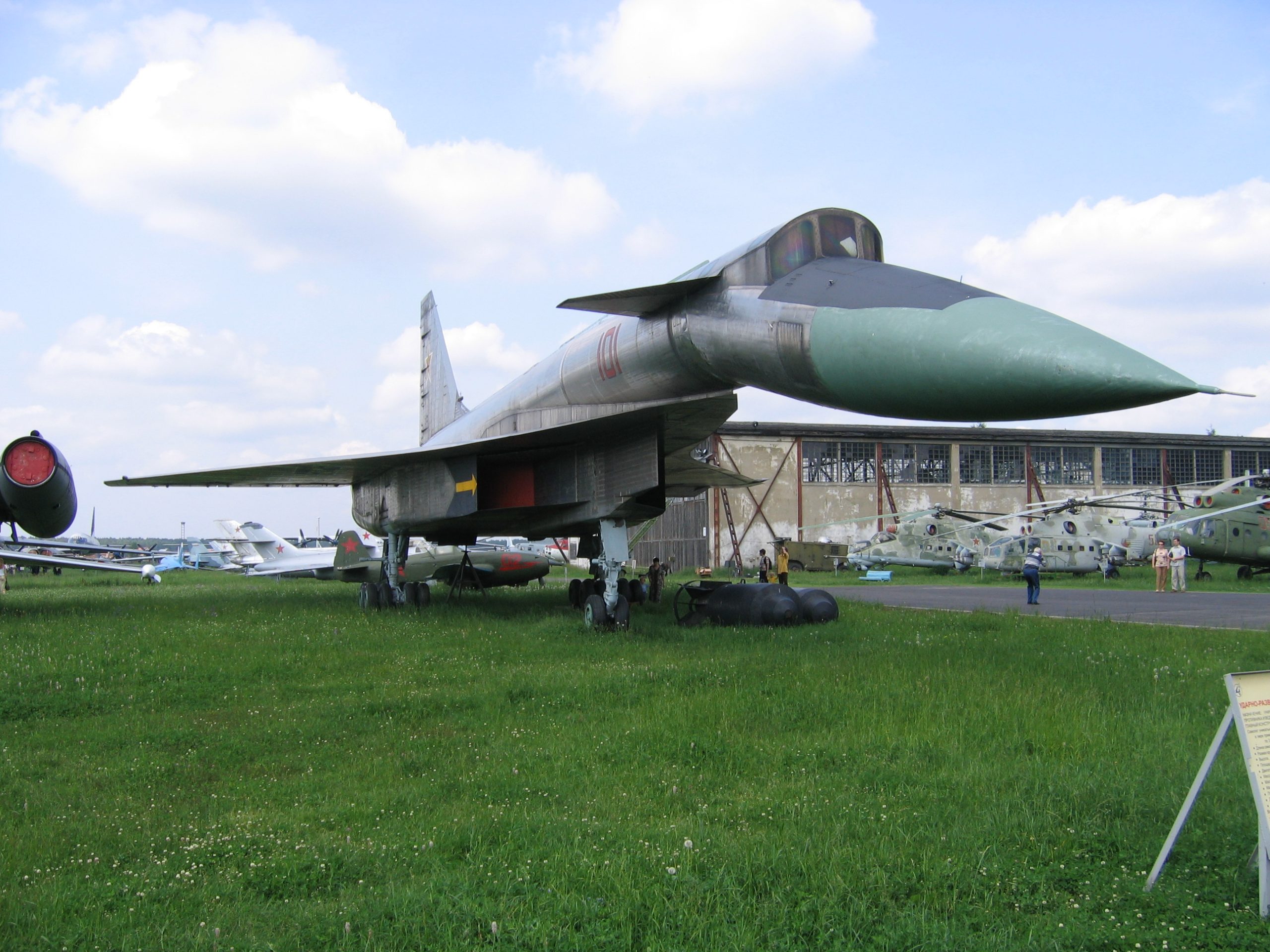
Sukhoi T-4
“Sotka”
A titanium-and-steel Mach-3 bomber built to hunt American carriers and answer the XB-70 — one aircraft flew about ten times, never reached its design speed, and the programme was cancelled after two years.
The Soviet answer to the Valkyrie
In the early 1960s Soviet planners faced two American problems at once: fast, high-flying strike aircraft such as the Mach-3 North American XB-70 Valkyrie then in development, and the mobile threat of US Navy aircraft-carrier battle groups. The answer they wanted was a very fast, very high-flying aircraft that could cross great distances, find a carrier and attack it with a stand-off missile before defences could react. Design work on what became the Sukhoi T-4 began around 1961, and the requirement was set out over the following years.
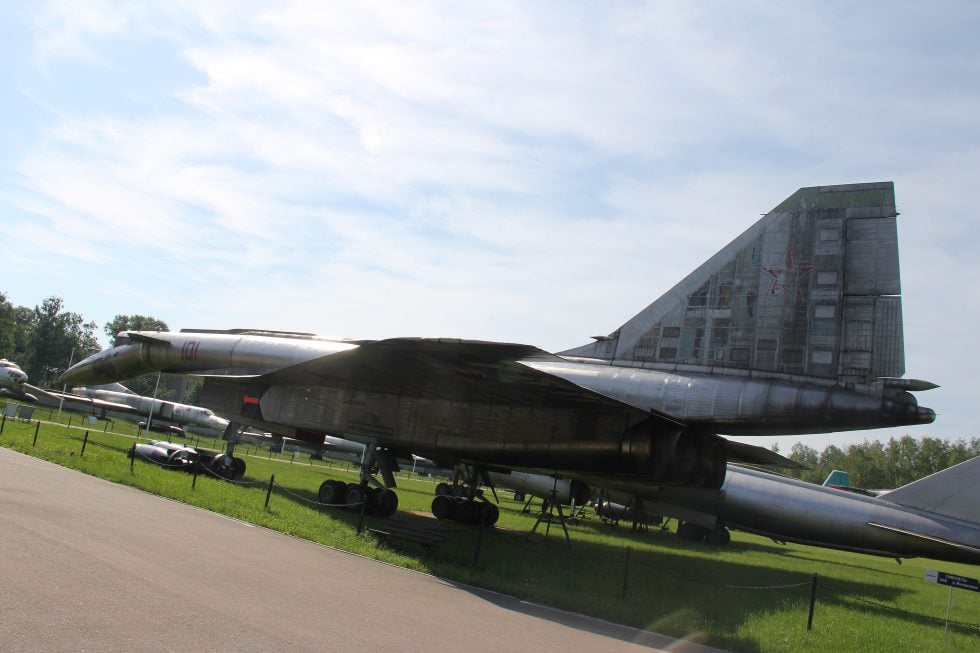
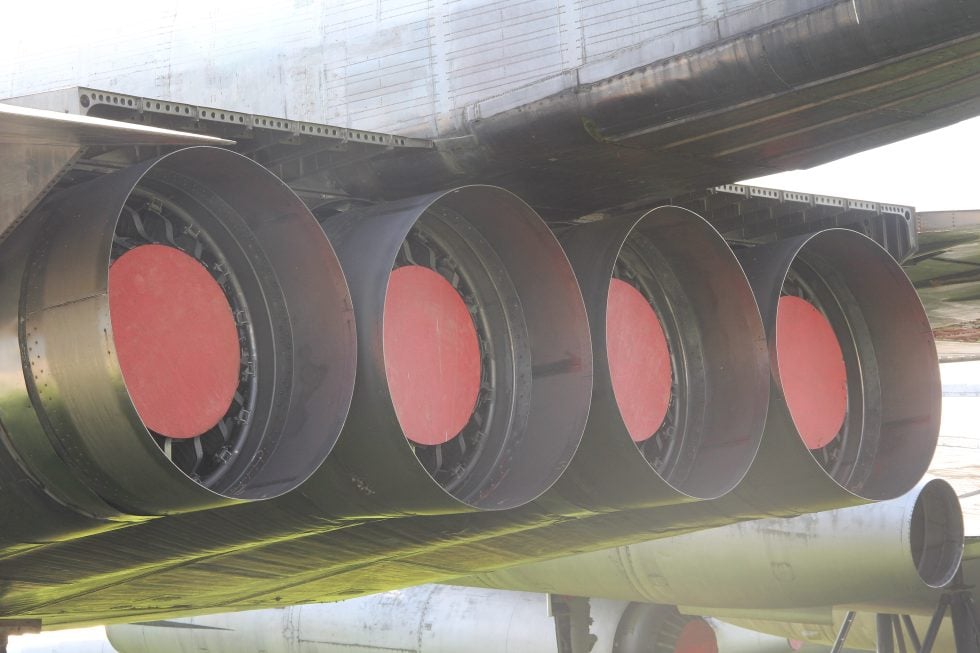
Winning the job was itself a surprise. The Sukhoi bureau, better known for fighters, beat heavyweight bids from Tupolev and Yakovlev — reportedly because its design promised the best projected Mach-3 performance. The aircraft that emerged was a slender canard delta built largely of titanium and heat-resistant steel to survive the kinetic heating of sustained supersonic flight, powered by four engines packed together beneath the rear fuselage. It picked up the nickname “Sotka” — Russian for “a hundred” — from its internal index “100” and its roughly hundred-tonne weight.
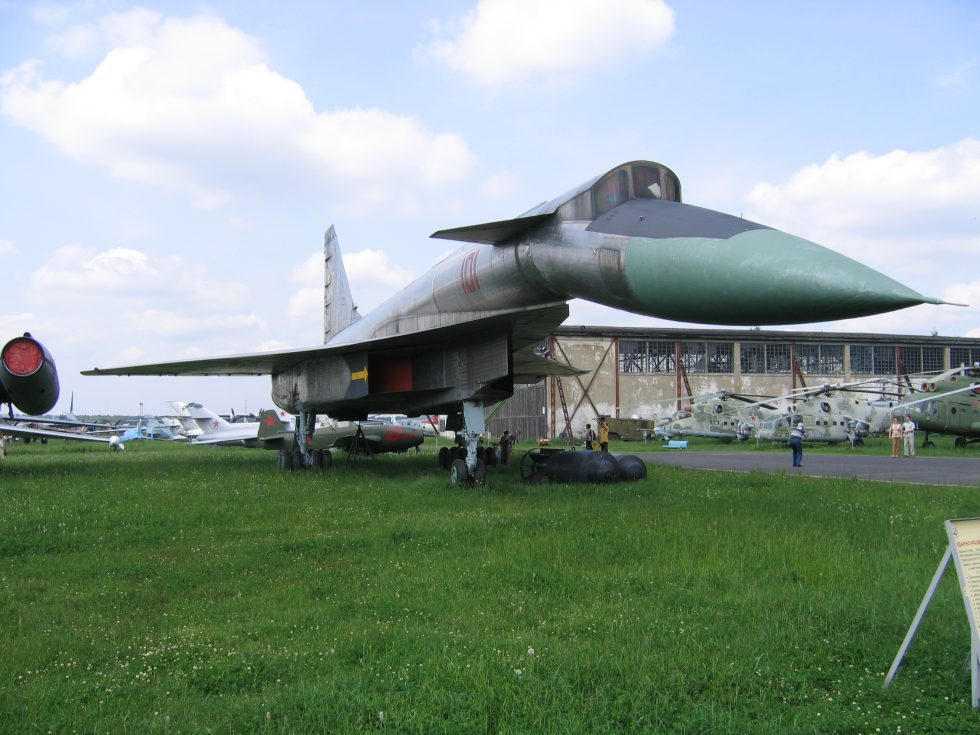
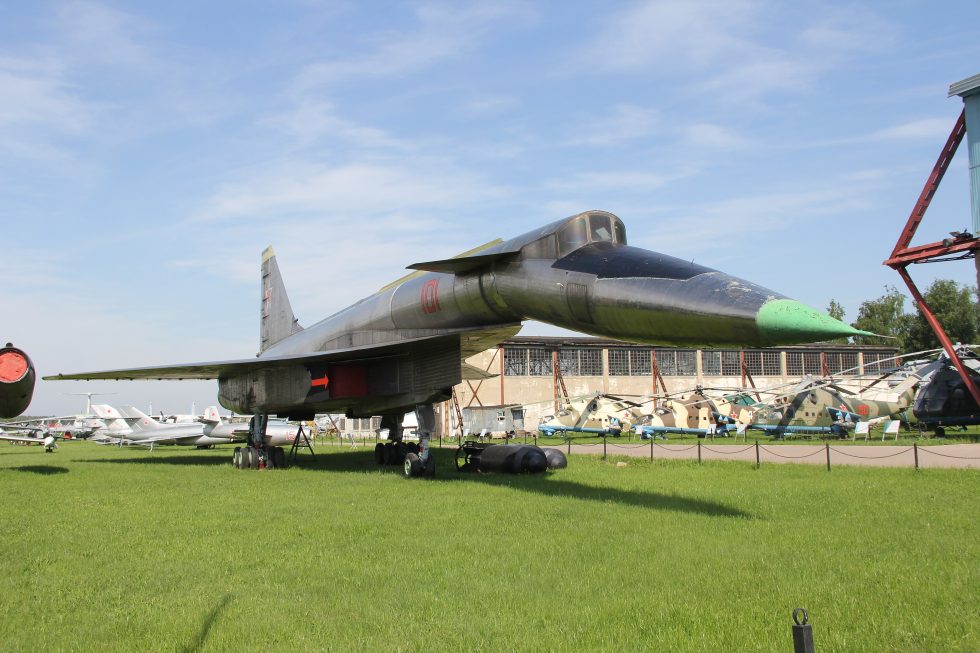
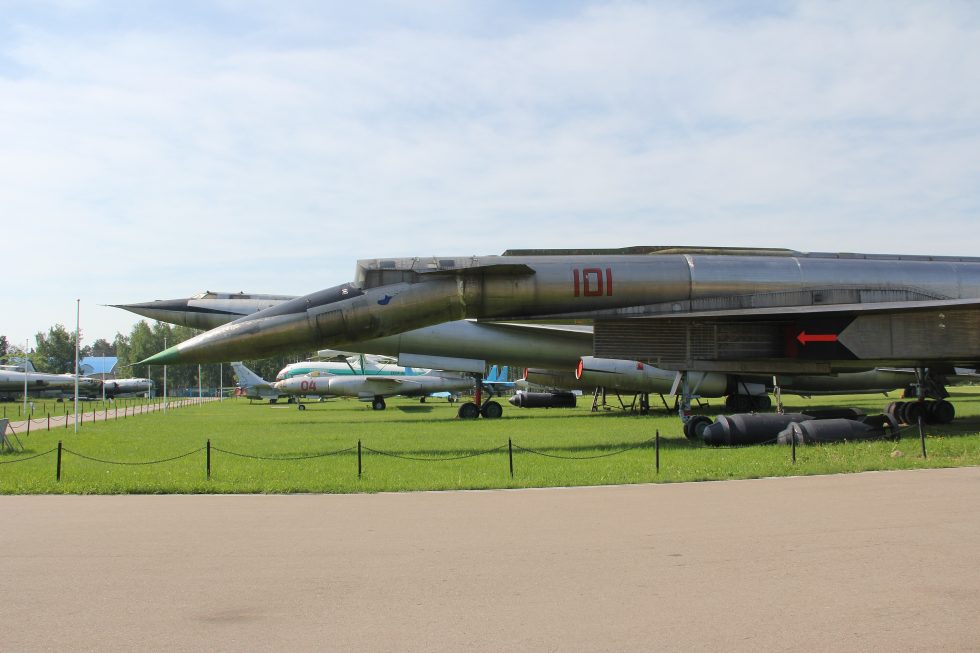
The sole flying prototype, T4-1, first took off on 22 August 1972 in the hands of test pilot Vladimir Ilyushin — son of the aircraft designer Sergei Ilyushin — with navigator Nikolai Alfyorov. Over roughly ten flights it reached only about Mach 1.3 at around 12,000 metres; it never approached its Mach-3 design goal before testing stopped in early 1974. The programme was wound down that year, commonly attributed to a mix of enormous cost, the industrial strain of titanium manufacturing, and a decision to concentrate strategic-bomber work at Tupolev — the path that led to the Tu-22M and, later, the Tu-160. Of four airframes started, only one ever flew; it survives today at the Central Air Force Museum at Monino, near Moscow.
01The Sukhoi T-4 “Sotka”: why the USSR built a Mach-3 bomber it never used
The T-4 was conceived as a specialised high-speed strike and reconnaissance aircraft rather than an intercontinental bomber like the American B-70. Its job was to sprint at high altitude toward US naval groups and launch stand-off missiles — the Kh-45 was developed alongside it — before defending fighters or missiles could close in. Speed and altitude were meant to be its armour.
That premise was already being undermined as it flew. Improving surface-to-air missiles were eroding the old assumption that speed and height alone guaranteed survival, and the aircraft’s cost and manufacturing demands were extraordinary. When strategic-bomber funding and factory capacity were steered toward Tupolev, the T-4 lost the industrial contest as much as the technical one. It remains one of the most ambitious Soviet aircraft never to reach service.
What makes it special
A titanium-and-steel airframe for Mach 3
Sustained Mach-3 flight heats an airframe’s skin to a few hundred degrees — commonly cited around 220–330 °C for the T-4 — far too hot for ordinary aluminium. Sukhoi built the aircraft largely from titanium and heat-resistant steel, which forced the bureau to develop new welding and fabrication methods. Sources credit the effort with a large body of new industrial know-how, often quoted as hundreds (some say far more) of new processes later useful to other Soviet programmes.
A drooping nose and a periscope
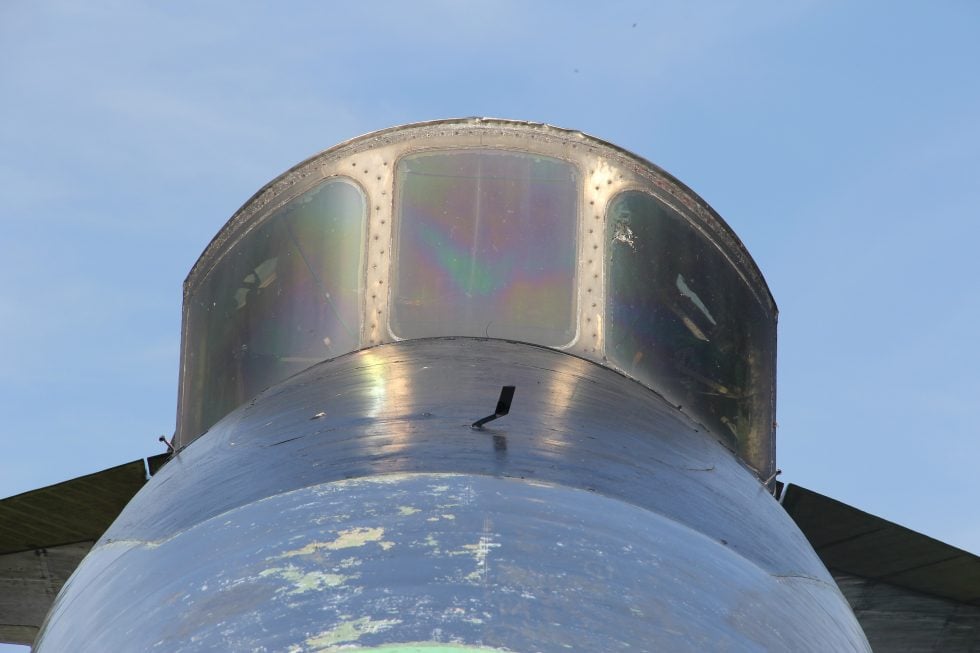
Like Concorde and the XB-70, the T-4 had a long nose that drooped for takeoff and landing to give the crew a forward view. Raised for high-speed flight, it blanked the windscreen entirely: the pilot then flew on instruments, side windows and a retractable periscope reportedly usable only up to about 600 km/h. Above that speed there was effectively no direct forward view at all.
One of the first Soviet fly-by-wire systems
The T-4 was among the earliest Soviet aircraft with a fly-by-wire flight-control system, described as four-channel (quadruplex) and backed up by a mechanical system for safety. Combined with a canard delta layout, variable supersonic intakes and very high-pressure hydraulics, it made the aircraft a genuine technology testbed as much as a bomber.
02The Sukhoi T-4’s drooping nose: how the crew flew nearly blind at speed
The T-4’s slender nose was needed for low supersonic drag, but it left the crew with almost no forward view in the cruise. The solution mirrored the XB-70 and Concorde: a hinged nose section that dropped down for takeoff and landing to expose the windscreen, then raised flush for high-speed flight. With the nose up, the pilot relied on a retractable periscope — usable, by most accounts, only up to roughly 600 km/h — along with small side windows and the instruments. It was an elegant answer to a hard aerodynamic compromise, and one of the aircraft’s most distinctive features.
03The Sukhoi T-4’s engines: four turbojets in a box under the tail
Power came from four Kolesov RD36-41 afterburning turbojets, each commonly cited at around 157 kN (about 16,000 kgf) in reheat. Rather than hang them in separate pods, Sukhoi packaged all four together in a single box beneath the rear fuselage — broadly the arrangement used on the XB-70 — fed by the USSR’s first variable-geometry, mixed-compression intakes designed to work efficiently at Mach 3. The engines were among the reasons the aircraft was so demanding to build and operate; in flight testing the airframe never reached the speed at which that installation would have been fully exercised.
Full specifications
Baseline note: the figures below describe the Sukhoi T-4, factory designation izdeliye 100 and known to everyone who worked on it as the “Sotka” — the hundred — and they are almost entirely design targets rather than measured results. Only one airframe ever left the ground. Aircraft “101” first flew on 22 August 1972 in the hands of Vladimir Ilyushin with navigator Nikolai Alfyorov, and by the time flying stopped in January 1974 it had made ten flights totalling about 10 hours 20 minutes. What it demonstrated was Mach 1.36 at 12,000 m. What it was designed for was Mach 3 and 3,200 km/h in sustained cruise between 20,000 and 24,000 m. Those two sets of numbers are separated by the entire hard part of the problem, and the tables below mark which is which: entries labelled design are contractor and requirement figures, entries labelled demonstrated were flown. Three published disagreements should be settled before the columns begin. First, the flight count. Most references, including Sukhoi’s own museum material, give ten flights; the detailed test-programme account drawn from the factory flight-test report says nine of a planned ten first-stage flights were actually made, and dates the fastest of them, an acceleration from Mach 0.9 to about Mach 1.3 while climbing from 10,000 to 12,000 m, to 6 July 1973. Ten is the commoner figure and is used here, with the discrepancy noted. Second, dimensions. Russian sources print length 44.5 m and span 22.7 m; English-language reference tables print 44.0 m and 22.0 m. Both appear below. Third, wing loading. A widely reproduced table gives 184 kg/m2, which cannot be squared with 114,000 kg over a quoted 295.7 m2; the factory figure of 385 kg/m2 is used here. Deltas for the “101” prototype as flown, and for the variable-geometry T-4M and T-4MS proposals, are in grey.
Dimensions & weights
- Crew
- 2 — pilot and navigator-operator in tandem, each with his own hinged hatch, on ejection seats cleared across the whole envelope, both in full pressure suits
- Length
- 44.5 m (146 ft 0 in) — English-language tables give 44.0 m (144 ft 4 in)
- Wingspan
- 22.7 m (74 ft 6 in) — also published as 22.0 m (72 ft 2 in)
- Height
- 11.2 m (36 ft 9 in)
- Wing area
- 295.7 m2 (3,183 sq ft)
- Configuration
- Canard delta — thin sharp-edged delta wing, all-moving foreplane on the forward fuselage, single fin, no tailplane; the leading-edge root extension blends into centre section and wing as one lifting body
- Instrument bay
- Circular fuselage section 2.00 m (6 ft 7 in) in diameter, 6.75 m (22 ft 2 in) long, sealed and insulated over its whole surface
- Empty weight
- 55,600 kg (122,600 lb)
- Normal take-off weight
- 114,000 kg (251,300 lb)
- Maximum take-off weight
- 135,000 kg (297,600 lb) for the production standard — the “101” prototype was limited to 125,000 kg (275,600 lb)
- Internal fuel
- 57,000 kg (125,700 lb) in fuselage and centre-section integral tanks — T-4M was to carry 82,000 kg, T-4MS 97,000 kg
- Weight on the first flight
- 77,300 kg (170,400 lb) with 20,000 kg (44,100 lb) of fuel, undercarriage down throughout — by the fifth flight take-off weight had reached 101,700 kg (224,200 lb)
- Wing loading
- 385 kg/m2 (78.9 lb/sq ft) at normal take-off weight — the frequently reprinted 184 kg/m2 is not consistent with the quoted weight and area
- Thrust-to-weight
- 0.56 at normal take-off weight with all four engines in full afterburner
Performance
- Maximum speed, design
- 3,200 km/h at altitude — about Mach 3.0 (1,988 mph, 1,728 kn)
- Cruising speed, design
- 3,000 km/h (1,864 mph, 1,620 kn), held for the whole supersonic leg rather than as a dash
- Cruise altitude, design
- 20,000 to 24,000 m (65,600 to 78,700 ft) on internal fuel
- Service ceiling, design
- 25,000 m (82,000 ft) — one widely used table prints 18,000 m (59,100 ft), which sits below the stated cruise band and cannot be right
- Maximum speed, demonstrated
- Mach 1.36 — reached in level acceleration at 12,000 m, the fastest any T-4 ever flew
- Maximum altitude, demonstrated
- 12,000 m (39,400 ft), roughly half the design cruise height
- Range, design
- 6,000 km (3,730 miles, 3,240 nmi) on the supersonic profile without external tanks
- Ferry range, design
- 7,000 km (4,350 miles, 3,780 nmi), extendable by in-flight refuelling
- Take-off run
- 950 to 1,050 m (3,120 to 3,440 ft) from a class-1 concrete runway; no rough-field capability was ever claimed
- Landing run
- 800 to 900 m (2,620 to 2,950 ft) using wheel brakes and a four-canopy braking parachute
- Flight testing achieved
- Ten flights, about 10 hours 20 minutes in total, 22 August 1972 to January 1974; the first five were flown with the undercarriage locked down
- Handling as reported
- Ilyushin’s report called it simple to taxi, stable on take-off, well controlled in cruise, and quiet through Mach 1 — the transition noticeable only on the instruments
Propulsion & systems
- Engines
- 4 × Kolesov RD36-41 afterburning turbojets, developed at OKB-36 in Rybinsk from the earlier VD-19, packaged side by side in a single nacelle beneath the centre section
- Thrust
- 16,150 kgf (158.4 kN, 35,600 lbf) each with afterburner — 16,000 kgf (157 kN, 35,300 lbf) is also published; no reliable dry rating has been released
- Air intakes
- Two rectangular variable mixed-compression intakes with a vertical wedge, each feeding two engines — the first Soviet installation with automatic restart, sized for a design point of Mach 3.0
- Nozzles
- Multi-mode supersonic nozzles with three rings of suspended flaps forming the subsonic and supersonic sections
- Fuel system
- RG-1 “naftil”, a thermally stable kerosene created for this aircraft — some sources call it T-6; hydro-turbine transfer pumps, nitrogen tank inerting, automatic centre-of-gravity trimming and a retractable refuelling probe in the drooping nose
- Flight controls
- Quadruplex electro-hydraulic fly-by-wire, designated SDU — so trusted after high-speed taxi trials that the first flight was flown on it; a mechanical reversion was carried on the prototypes only, and the production fin was deliberately sized small on the assumption that the system would supply the missing directional stability
- Hydraulics
- Four independent systems — green, blue, brown and yellow — at 280 kgf/cm2 (4,000 psi), using high-temperature fluid KhS-2-1 in brazed VNS-2 steel pipework; they drove the controls, undercarriage, intake ramps and the nose droop
- Electrical system
- Three-phase 220/115 V 400 Hz from four oil-cooled 60 kW generators, with rectifiers for 27 V DC, three batteries and a converter for emergency power
- Structure and materials
- Titanium alloys VT-20, VT-22 and VT-21L with stainless steels VNS-2 and VNS-5 and structural steel VKS-210; 69 per cent of the airframe surface was panels spot-welded from sheet, 21.6 per cent panels welded by through-penetration, 9.4 per cent milled plate. After five years the welded titanium and steel assemblies built in 1968 had not failed or leaked at a single joint
- Nose and vision
- The entire forward fuselage drooped for take-off and landing and was raised for cruise. Unlike Concorde or the Tu-144 it carried no glazing at all, so with the nose up the crew flew on instruments, looking out through four side windows and a retractable periscope usable to 600 km/h (373 mph)
- Navigation
- Astro-inertial platform with a plotting-table display and multi-function control panels, feeding the autopilot directly; a terrain-avoidance system for low flying was planned but never fitted
- Mission avionics
- Long-range forward-looking radar for missile targeting, plus a reconnaissance suite of optical, infrared and electronic-intelligence sensors and the first Soviet side-looking airborne radar. Integration was deep enough to let a two-man crew do the work of a bomber crew
- Crew systems
- Two liquid-oxygen gasifiers, a closed-cycle three-stage air-conditioning pack using fuel as the primary heat sink, and pressure suits as standard rather than emergency wear
04The Sukhoi T-4’s cost: why the numbers helped kill it
As a Soviet state prototype, the T-4 was never priced on any open market, so no reliable flyaway unit cost or cost-per-flight-hour figure exists in the public record — any precise dollar number attached to it is guesswork. What is consistently reported is that it was extraordinarily expensive to build: the titanium-and-steel airframe demanded specialised materials, tooling and skilled welding, and the air force reportedly wanted a fleet of around 250 aircraft that was never going to be economical. When cost was weighed against Tupolev’s competing bombers, the economics counted heavily against the T-4.
Armament & payload
The T-4 was designed around two Kh-45 Molniya missiles and never carried one
Everything in this section is intent. Aircraft “101” flew ten times with clean pylons and an empty container station; no T-4 ever carried a weapon, and the airframe earmarked for live missile firings, “103”, was still in pieces when the programme stopped. What follows comes from the requirement documents, from Sukhoi and Raduga design material, and from the published accounts of the Kh-45 programme, not from any release to service.
The aircraft and the missile were conceived as one system, and the missile came first. The 1963 competition that Sukhoi won against the Tupolev Tu-135 and the Yakovlev Yak-33 and Yak-35 was for an aviation-missile complex, and the requirement was blunt: find and destroy carrier battle groups, missile ships and strategic ground targets, and carry out strategic reconnaissance, at a radius of some 6,000 km. The answer was two Kh-45 missiles carried externally between the nacelles, launched from 500 to 600 km out at Mach 3 and 20 km, with the aircraft never entering the defended zone at all. Speed and height were the survival mechanism; there was no gun, no tail turret, no air-to-air missile and no serious argument for any of them.
The judgement to make about that choice is not that it was wrong in 1963 but that it aged badly. By 1969 the air force had rewritten its requirement around multi-role aircraft able to fly low as well as high, because surface-to-air missiles had made 24,000 m less of a sanctuary than it had looked six years earlier. A machine optimised to a single cruise point, with a weapon that could only be carried externally and a nose that could not see forwards, had nowhere to go. No weapon fit for this aircraft is authoritative. Nothing was cleared, published stores lists differ between Sukhoi material and missile histories, and the Kh-45 itself was never completed — its trials were begun at Dubna and abandoned.
Gun — none fitted, none planned
- The T-4 had no cannon, no defensive turret and no provision for either. Nothing in the structure, wiring or systems anticipated one.
- This was a deliberate break with the previous Soviet generation. The Tu-16 and Tu-22 both carried tail guns; at Mach 3 above 20,000 m a turret is dead weight and a source of drag and heat.
- The aircraft’s self-defence was assigned instead to a dedicated electronic subsystem within the radio-electronic complex, covering both individual and formation protection.
- The cost of the decision is honest to state: a T-4 caught subsonic or descending had nothing whatever to shoot with. The design simply assumed that would not happen.
Air-to-air — no missile was ever integrated
- No air-to-air missile was fitted, cleared or seriously proposed. There is no documented T-4 loadout containing one.
- The forward-looking radar was a long-range search and missile-targeting set for surface work. It had no air-to-air modes and no guidance channel for an air-to-air weapon.
- Protection rested on the cruise point. At 3,200 km/h and 24,000 m the interceptors of the mid-1960s could not reach the aircraft, and the whole airframe exists because that was thought to be a durable condition.
- It was not durable. By the end of the decade long-range surface-to-air systems had closed the gap, which is a large part of why the requirement changed under the programme’s feet.
Air-to-surface guided — the Kh-45 Molniya, and nothing else
- 2 × Kh-45 “Molniya”, a hypersonic anti-ship and strategic missile from MKB Raduga under Bereznyak, Samokhvalov and Larionov, carried on two hardpoints under the centre section beside the nacelle.
- Kh-45 as published: launch mass 4,500 to 5,000 kg, length 9.9 to 10.8 m, span about 2 m, multi-mode liquid-propellant rocket motor, cruise above 20,000 m, speed 7,000 to 9,000 km/h — Mach 5 to 7 — and a thermonuclear warhead of about 1,000 kg.
- Launch range 500 to 600 km against a point target, or 1,000 to 1,500 km in the earlier inertial and radio-command form aimed at area targets such as a city or a fleet.
- Guidance evolved from pure inertial or radio command to a combined fit: the “Vikhr” digital guidance computer with a “Garpun” active radar seeker switching on about 90 km from the aim point, which is what made a moving ship or a bridge attackable.
- Documentation went to production in 1969 and a trials batch was built at the Dubna machine works. Testing started and was never finished. Later T-4 studies added the short-range Kh-15 — 8 for T-4M, 24 for T-4MS — and the Kh-2000 for the T-4MS.
Bombs — carried in a jettisonable container, not a bay
- The baseline T-4 had no internal weapons bay. Free-fall bombs were to go in a jettisonable container under the fuselage, which is why no bomb load figure for the basic aircraft is reliably published.
- That arrangement follows from the shape. A fuselage of this fineness ratio, full of fuel and equipment and skinned in welded titanium, had no room for a bay without ruining the area distribution.
- The T-4M redesign fixed it two ways: up to 8,000 kg of bombs inside two containers dimensionally common with the reconnaissance containers, with supersonic flight still permitted, or up to 18,000 kg on external multiple ejector racks.
- The T-4MS went further still, with two insulated and conditioned internal weapons bays taking 9,000 kg as the normal load and up to 36,000 kg of bombs, or 45,000 kg maximum ordnance with external stations added.
- Nuclear delivery in the base aircraft was the Kh-45’s job, not a bomb’s. The T-4 was a stand-off missile carrier first and a bomber a distant second.
Rockets — none, and the omission is the point
- No unguided rocket pods appear in any T-4 stores list. The aircraft had no role in which they made sense.
- Unguided rockets are a low-level, visual, close-range weapon. The T-4 was designed never to be low, never to be close and never to see its target with the naked eye.
- The nose confirms it. With the forward fuselage raised the crew could not look ahead at all, so no aiming mode requiring forward vision was possible in cruise.
- The card is kept here because its emptiness is informative: this was the most single-minded stand-off aircraft the Soviet Union ever built.
Pods & other stores — where the reconnaissance half lived
- Reconnaissance equipment was containerised. Optical, infrared and electronic-intelligence sensors, plus the first Soviet side-looking airborne radar, were packaged for carriage on the same stations as the weapons.
- The T-4M scheme formalised this with four podded reconnaissance containers covering radio-technical, radar, infrared, photographic and radiation reconnaissance.
- Electronic self-defence, individual and for a formation, was a distinct system within the radio-electronic complex rather than a podded afterthought.
- A retractable in-flight refuelling probe sat in the drooping nose section, alongside the radar and the navigation and weapon-control racks.
- Airframe “103” was to have flown the live missile launches and “104” the bombing and range trials. Neither was finished, so every entry on this card remains a drawing.
Three typical loadouts
- Anti-carrier strike, as designed
- 2 × Kh-45 Molniya on the centre-section hardpoints, 57,000 kg of internal fuel, cruise at 3,000 to 3,200 km/h between 20,000 and 24,000 m, missiles released 500 to 600 km short of the battle group with terminal radar homing taking over at about 90 km. The aircraft never enters the escort screen’s engagement envelope.
- Strategic reconnaissance, as designed
- No missiles; optical, infrared, electronic-intelligence and side-looking radar sensors in containers on the same stations, with the astro-inertial platform running the navigation. Radius about 6,000 km, extendable by in-flight refuelling to the 7,000 km ferry figure and beyond.
- As actually flown, 1972 to 1974
- Nothing carried at all. Test instrumentation only, clean stations, undercarriage locked down for the first five flights, a maximum recorded weight of 101,700 kg and a fastest recorded speed of Mach 1.36 at 12,000 m. Ten flights, about ten hours twenty minutes.
Sourcing caveat: Kh-45 figures come from Russian missile histories that themselves disagree, and one widely reproduced table prints a missile diameter of 8.0 m, plainly a typographical error for 0.8 m. Nothing in this section was ever cleared, loaded or fired from a T-4. Treat the whole of it as design documentation.
Variants
One aircraft flew, two more were part-built, and everything else stayed on paper
The T-4 is usually written about as though it were a type. It was not. It was a single flying prototype, a static test airframe, two unfinished machines and a family of increasingly different proposals that borrowed the designation as the requirement moved away from them.
The progression is worth following because it explains the cancellation better than any single decision does. The T-4 of 1963 was a Mach 3 stand-off missile carrier. The T-4M of 1967 to 1969 was the same idea with a swing wing added to buy subsonic range and better field performance. The T-4MS of 1967 to 1972 was a different aeroplane entirely, a 170-tonne blended-body strategic bomber with only the designation and some systems left in common. Each step was a response to a requirement that had already moved on, and by 1972 the customer was asking for something that Tupolev and Myasishchev were better placed to build.
Sukhoi was also, by the early 1970s, simultaneously flight-testing the Su-24, designing the Su-25 and beginning the T-10 that became the Su-27. A ministry looking for somewhere to put a strategic bomber programme had reason to look elsewhere, and the Kazan factory that would have built the T-4 in series went to Tupolev for the Tu-22M instead.
- T-4, izdeliye 100, “Sotka” (1963–1974 / 1 flown)
- The baseline strike and reconnaissance missile carrier: canard delta, four RD36-41 in one under-slung package, welded titanium and steel airframe, fly-by-wire, drooping unglazed nose, two Kh-45 missiles.
- “101”, first prototype (built 1968–1971, flew 1972–1974)
- The only T-4 ever to fly. Assembled with the Tushino machine works, moved to the flight-test base on 30 December 1971, accepted for testing on 20 April 1972 after eight taxi runs, first flight 22 August 1972.
- “102”, second prototype (drawings 1968, assembled 1973 / never flown)
- Intended to develop the navigation complex, with flight testing planned for the fourth quarter of 1973. Structurally complete but never flown; it never received its systems.
- “103”, third prototype (drawings 1970 / never completed)
- Intended for live Kh-45 launches, with flying planned from the third quarter of 1974. Airframe assemblies were built at Tushino and partly put together; the aircraft was never finished.
- “104”, “105” and “106” (planned 1971 onwards / never built)
- Respectively for bombing and range trials, avionics development, and trials of the complete strike-reconnaissance system. Only “104” reached the drawing-release stage.
- “100S”, static test airframe (drawings complete 1968 / 1 built)
- The structural test specimen, built alongside “101” and never intended to fly. It is the fourth airframe in the usual Russian count of “one plus two plus one”.
- T-4M, izdeliye 100I (1967–1969 / project only)
- Canard layout retained, but with outer wing panels sweeping from 15° to 72°, slats and double-slotted flaps, 82,000 kg of fuel and up to 18,000 kg of bombs. Would have been the first swing-wing aircraft designed for cruise from Mach 0.6 to Mach 3. About thirty layouts were studied before work stopped at the end of 1969.
- T-4MS, izdeliye 200, “Dvukhsotka” (1967–1972 / project only)
- A blended lifting body with small pivoting outer panels, twin all-moving fins, three crew side by side and no conventional canopy, 170,000 kg gross and 506.8 m2 of lifting surface. It entered the 1972 strategic bomber competition and lost to the Myasishchev M-18; the eventual winner of that lineage was the Tu-160.
- Passenger T-4 (late 1960s / study only)
- A supersonic transport derivative studied against the Tu-144. It went no further than layout work, and Sukhoi had no airliner organisation to build it with.
- Spiral carrier aircraft (late 1960s / study only)
- A modified T-4 was examined as the hypersonic launch stage for the Spiral aerospace system. The role eventually needed a much larger and faster booster than the T-4 could become.
Closing note on survivors. One original airframe exists. Aircraft “101”, the sole T-4 ever flown, was delivered to the Central Air Force Museum at Monino outside Moscow in 1982 and is displayed there in the open. It is an original, not a replica, and it is the only original T-4 anywhere: “102”, assembled but never flown, had fragments exhibited in a hangar at the Moscow Aviation Institute before being cut up and sent for melting down, and the partly assembled “103” met the same end. No reproduction of a T-4 has been built. Dates for the programme’s formal end differ: flight testing stopped in January 1974, work was suspended that year, and the closure is variously dated to a decision of 19 December 1975 and to the order signed by aviation industry minister Pyotr Dementyev on 28 February 1976 redirecting effort to the Tu-160. Sukhoi’s own accounting afterwards put the cost of the programme at 1.3 billion roubles, and more than six hundred inventions and patents came out of it — titanium welding among them, which is the part that outlived the aeroplane.
From Mach-3 ambition to museum piece
Project 100 begins
Sukhoi starts design work on a Mach-3 strike and reconnaissance aircraft to counter US carriers and the XB-70.
Sukhoi wins the contest
Government backing follows and Sukhoi’s design is selected over rival bids from Tupolev and Yakovlev.
Design and construction
Mock-ups are reviewed and airframes are built, pioneering new titanium welding and fabrication techniques.
First flight
On 22 August, T4-1 flies for the first time with Vladimir Ilyushin and navigator Nikolai Alfyorov.
Pushing the envelope
The prototype reaches about Mach 1.28 at ~12,100 m — well short of its Mach-3 design goal.
Testing halted
After roughly ten flights the flight-test programme stops; funding and priority shift toward Tupolev.
Programme cancelled
The T-4 is formally cancelled; remaining airframes are left unfinished or scrapped.
On display at Monino
The sole flown prototype is preserved at the Central Air Force Museum at Monino, near Moscow.
Twelve stories about the Sotka
Built to answer the Valkyrie
The T-4 was conceived as a Soviet reply to the American Mach-3 XB-70 and to US carrier groups.
Read the full story
Why they called it “Sotka”
The nickname comes from the index “100” and the aircraft’s roughly hundred-tonne weight.
Read the full story
A fighter bureau builds a bomber
Sukhoi, known for fighters, beat Tupolev and Yakovlev to win the Mach-3 bomber job.
Read the full story
Flying almost blind
At speed the nose blanked the windscreen, and the crew relied on a periscope usable only up to ~600 km/h.
Read the full story
A pioneering fly-by-wire
The T-4 was among the first Soviet aircraft to fly with a quadruple-redundant electronic control system.
Read the full story
Mastering titanium
Learning to build in titanium and steel reportedly generated a large body of new industrial techniques.
Read the full story
A designer’s son at the controls
The first flight was flown by Vladimir Ilyushin, son of the famous aircraft designer Sergei Ilyushin.
Read the full story
A box of four engines
The four RD36-41 turbojets were packed together under the rear fuselage behind Mach-3 variable intakes.
Read the full story
Losing to the Tu-160
The T-4’s cancellation helped clear the way for Tupolev’s Tu-22M and, later, the Tu-160.
Read the full story
Killed by cost and politics
Cancellation is usually blamed less on technical failure than on cost and industrial priorities.
Read the full story
Designed for Mach 3, flew Mach 1.3
Across roughly ten flights the prototype never came close to its Mach-3 design speed.
Read the full story
The lone Sotka at Monino
Of four airframes started, only one ever flew — and it is the one preserved at Monino today.
Read the full story
The Sotka in pictures
The Sotka in motion
Video coming soon. We are sourcing a high-quality, properly licensed documentary on the Sukhoi T-4 to embed here. In the meantime, explore the photo gallery above and the twelve stories for the full picture of the “Sotka.”
Where the T-4 was built and flown
The numbers it did — and didn’t — reach
The T-4 never entered service and never saw combat — it was an experimental prototype. Its record is a short, ambitious flight-test programme that ended before the aircraft could show what it was designed to do.
For aircraft that did reach service and combat, compare the combat record of every military aircraft.
Everything people ask about the Sukhoi T-4
Can I fly in a T-4?
Was the T-4 really a Mach-3 aircraft?
Why was the Sukhoi T-4 cancelled?
How many T-4s were built, and how many flew?
Was the T-4 really made of titanium?
Where is the Sukhoi T-4 now?
How did the T-4 compare to the XB-70 Valkyrie?
You can’t fly the T-4.
These, you can.
Some legends only live in museums — others are fuelled and waiting. MiGFlug has put civilians in real military jet cockpits since 2004.
 Fly the L-39 AlbatrosThe world’s most-flown jet trainer — aerobatics included
 Fly the F-104 Starfighter“The missile with a man in it”
 Fly the MiG-21The Cold War’s most-produced jet
 Fly the T-33 Shooting StarAmerica’s first jet trainer
 Fly the DH VampireA piece of early jet history
 Fly the S.211Agile Italian jet trainer
 Fly the MB-326The classic Aermacchi jet
 Fly the MiG-15The Soviet legend of the Korean War
Continue the tour
Every fact, checked
- The Aviation Geek Club — The Sukhoi T-4, the Mach-3 bomber that never wasDesign, specifications, configuration history and the cancellation.
- AirVectors (Greg Goebel) — The Sukhoi T-4 & Tupolev Tu-160Reliable overview tying the T-4 to the XB-70 and the Tupolev programmes.
- Vintage Aviation News — Grounded Dreams: the titanium ghost of the T-4Strong on materials, systems, timeline and why it was cancelled.
- Vintage Aviation News — First flight of the Sukhoi T-4First-flight account, the design contest and the name.
- Testpilot.ru — T-4 (“100”) supersonic strategic bomberRussian technical source: flight-test dates, achieved speeds and the “Sotka” name.
- Air Data News — Sukhoi T-4, the Russian “Valkyrie”Droop nose and periscope, fly-by-wire, and the XB-70 parallel.
- Fly a Jet Fighter — Sukhoi T-4 SotkaLegacy claims on industrial techniques and the reasons for cancellation.
- Military Factory — Sukhoi T-4 (Sotka)Reference specification table used to cross-check figures.