
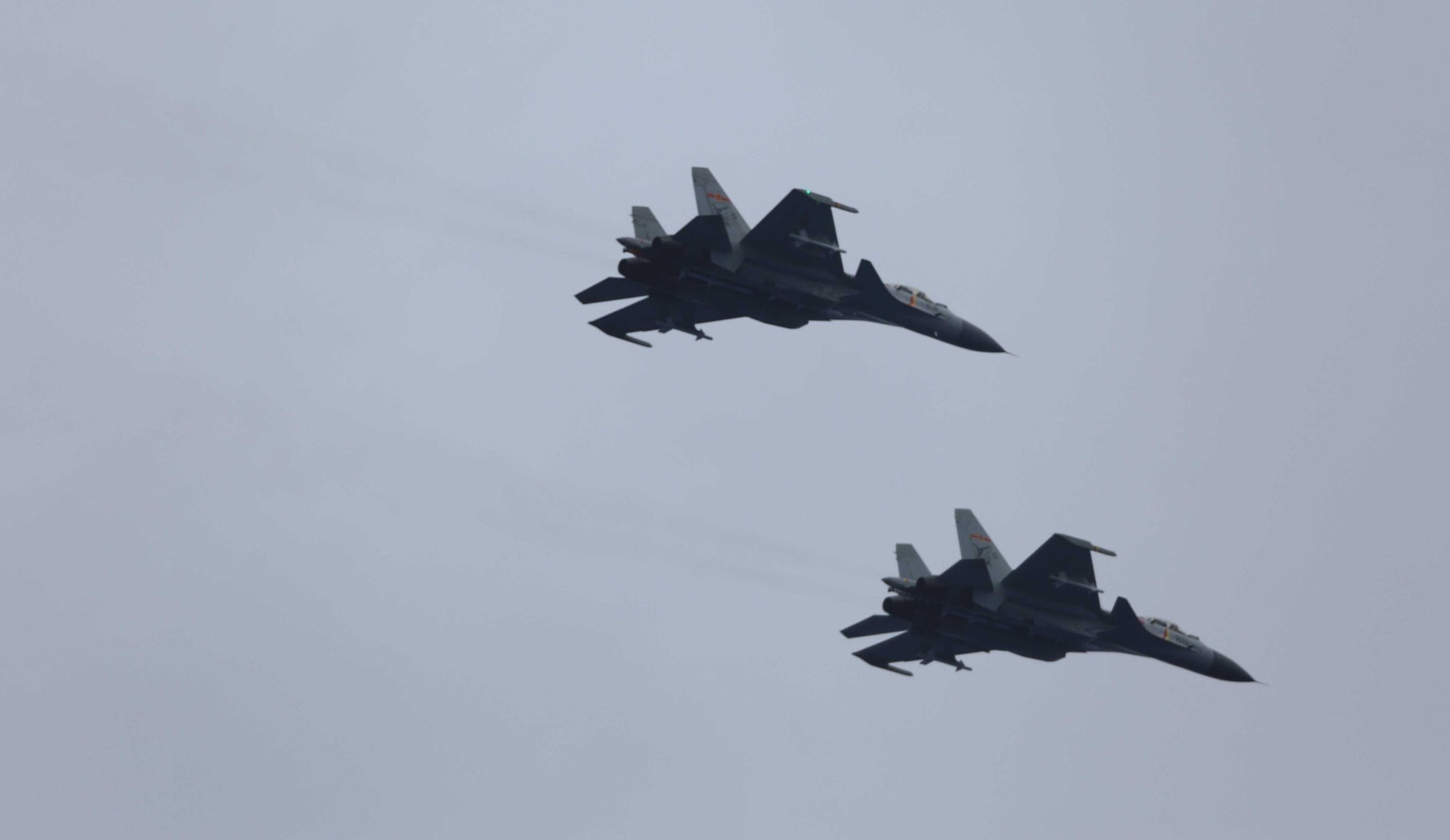
Shenyang J-15
“Flying Shark”
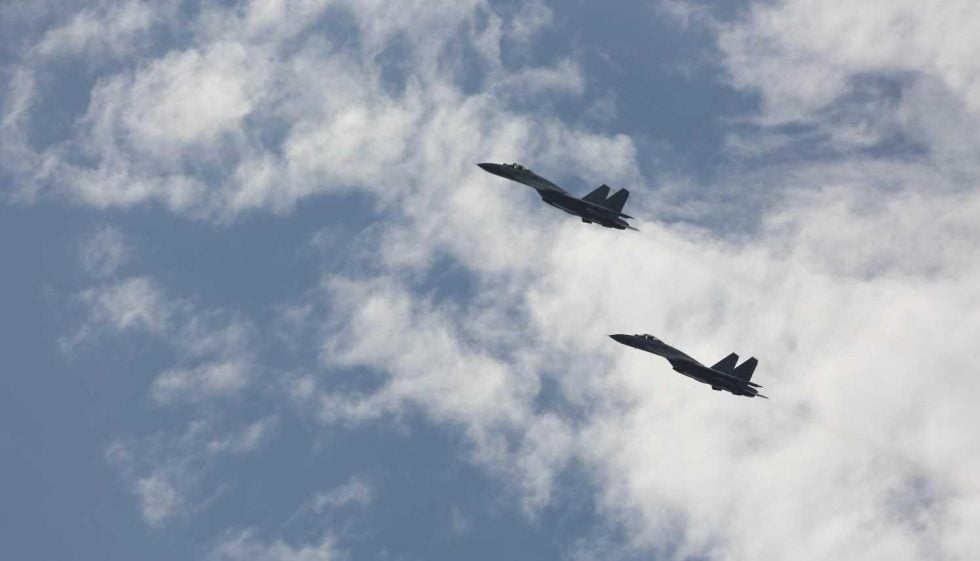
China’s carrier-based multirole fighter — a navalised member of the Su-27/Su-33 “Flanker” family, built for the PLA Navy and, according to numerous reports, informed by an unfinished Su-33 prototype obtained from Ukraine.
China’s first fixed-wing carrier fighter
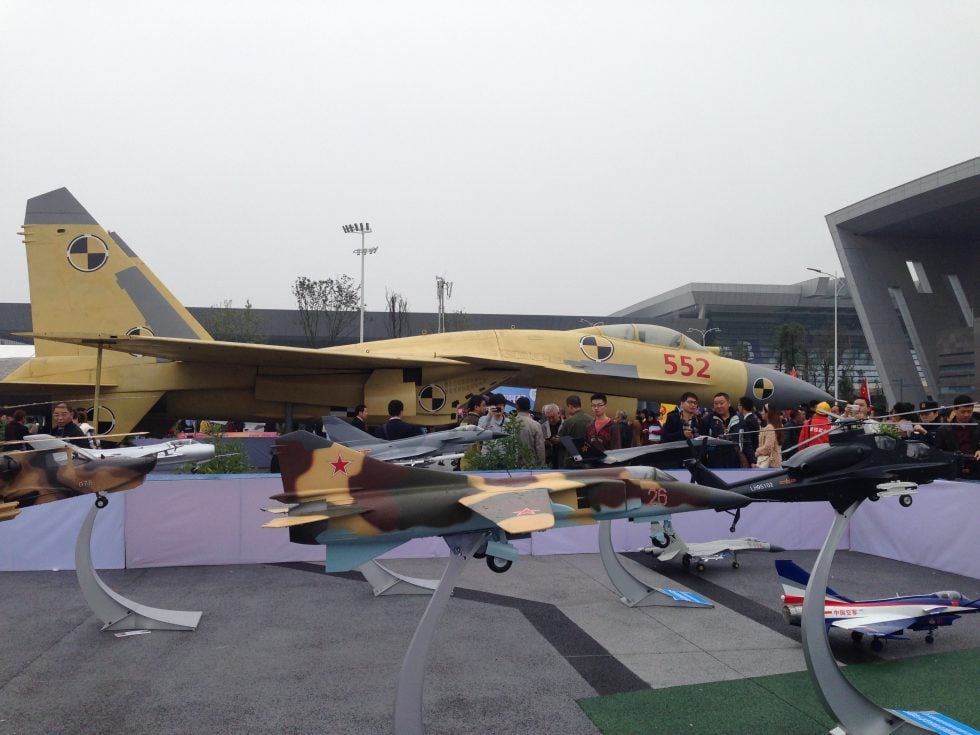
As China set out in the 1990s and 2000s to build a blue-water navy, it faced a gap it could not quickly fill on its own: a fixed-wing fighter able to fly from an aircraft carrier. The natural starting point was the Su-27/Su-33 “Flanker” family it already operated in land-based form. According to numerous reports, around 2001 China obtained an unfinished Su-33 prototype — the T-10K-3 — from Ukraine, and the Shenyang Aircraft Corporation studied it while developing a carrier fighter of its own. The result was the J-15, nicknamed the “Flying Shark.”
The J-15 first flew reportedly in 2009 — the date most often cited is 31 August 2009, though at least one account questions whether a flight took place that year. It is a navalised Flanker: folding wings to fit a crowded hangar deck, strengthened landing gear, and an arrestor hook for recovery. On the deck of China’s first carrier, the Liaoning, test pilot Dai Mingmeng made the first arrested landing in November 2012, with four more pilots qualifying shortly after.
The aircraft’s origins remain contested. Western analysts widely describe it as a Su-33 derivative — some go further and call it an unlicensed copy — while China presents it as an indigenously developed design with Chinese avionics, weapons and, increasingly, Chinese engines. Both framings sit alongside the same hardware. Early aircraft used the Russian AL-31F turbofan; footage released in 2022 showed operational J-15s fitted with the domestic WS-10 (Taihang), though exactly which airframes now fly which engine is not publicly settled.
The J-15 also illustrates the limits of the ski-jump. The Liaoning and the later Shandong launch aircraft by STOBAR — a bow ramp rather than a catapult — which caps the weight a heavy Flanker can carry off the deck, forcing trade-offs between fuel and weapons. China’s third carrier, the Fujian, adds electromagnetic catapults, and catapult-capable variants (reported as the J-15T / J-15B) have been tested to exploit them. Twin-seat (J-15S) and electronic-warfare (J-15D) versions round out a family that is still evolving. Production totals are not officially disclosed and open-source estimates vary widely.
01The Shenyang J-15’s origins: the Ukrainian prototype and the “copy” debate
The most repeated account of the J-15’s beginnings runs through Ukraine. After the collapse of the Soviet Union, an unfinished Su-33 carrier-fighter prototype — the T-10K-3 — is reported to have remained in Ukrainian hands, and China is said to have acquired it around 2001. Analysts believe Shenyang used it to accelerate development of a domestic carrier fighter, which is the basis for the persistent Western characterisation of the J-15 as a Su-33 clone.
China rejects that framing, describing the aircraft as a domestically developed design that pairs a Flanker-derived airframe with Chinese radar, avionics and weapons. Both accounts should be read with caution: the underlying details rest largely on analyst inference, satellite imagery and state-media footage rather than on official disclosure. What is not in dispute is that the J-15 gave the PLA Navy its first operational fixed-wing carrier fighter.
What makes it special
A Flanker rebuilt for the deck
The J-15 takes the large twin-engine Su-27/Su-33 airframe and navalises it for carrier life: folding wings to save hangar space, reinforced landing gear to absorb hard arrested landings, an arrestor hook, and canards inherited from the Su-33 line for low-speed control. It is a heavy fighter — a point critics raise about ski-jump operations — but it gives the PLA Navy a long-range, large-payload airframe.
Ski-jump today, catapult tomorrow
The baseline J-15 launches by STOBAR — rolling off the Liaoning or Shandong ski-jump ramp under its own power. That limits takeoff weight and forces trade-offs between fuel and weapons. For the catapult-equipped Fujian, catapult-capable variants reported as the J-15T / J-15B add a nose-gear launch bar and, reportedly, strengthened gear, allowing heavier launches.
Chinese systems — and Chinese engines
China describes the J-15 as carrying indigenous avionics, reportedly including an AESA radar on newer aircraft, and Chinese weapons such as PL-8, PL-12 and PL-15 air-to-air missiles and YJ-83 anti-ship missiles. The most-watched change is propulsion: from the Russian AL-31F toward the domestic WS-10. These capability and fielding details are widely reported but not officially confirmed.
02The J-15’s STOBAR problem: why the ski-jump caps its payload
A ski-jump launch trades runway for a ramp: the aircraft accelerates along the deck and is flung upward, buying a few seconds for the engines and wings to take over. For a light fighter that works well; for a heavy Flanker it is marginal. To get airborne off the ramp the J-15 must keep its takeoff weight down, which in practice means less fuel, fewer weapons, or both. Reporting on STOBAR sorties has described loads limited to roughly a pair of anti-ship missiles plus air-to-air missiles. A catapult removes much of that penalty, which is a central reason China moved to the electromagnetic catapults on the Fujian. The exact numbers here are estimates drawn from imagery and analysis, not published figures.
03The J-15’s engines: the slow switch from Russian AL-31F to Chinese WS-10
For much of its life the J-15 was the last Chinese Flanker derivative still flying on the Russian AL-31F. China’s goal was to replace it with the indigenous WS-10 “Taihang” family, and in November 2022 state television aired footage of operational J-15s fitted with a navalised WS-10 (reported as the WS-10H). The programme has reportedly had teething issues over the years — questions about thrust, engine life and maritime corrosion protection — and open sources cannot say precisely how many airframes now fly the domestic engine versus the Russian one. Treat any firm split as an estimate.
Full specifications
Baseline note: the figures below describe the single-seat Shenyang J-15 as delivered to the People’s Liberation Army Naval Air Force from 2013, powered by the Saturn AL-31F and flown from the ski jumps of Liaoning and Shandong. That is the mark worth tabulating because it is still the bulk of the fleet and because it is the aircraft every published assessment of the type actually describes. Deltas for the WS-10B-engined production aircraft that appeared from November 2022, for the catapult-capable J-15T (the aircraft widely called the J-15B in Chinese media before the T designation was confirmed) and for the two-seat J-15D electronic-attack machine are in grey. Six published disagreements should be settled before the tables start, because the J-15 is a type on which the open literature is unusually loose. Wingspan: English-language sources give 14.70 m, identical to the Sukhoi Su-33, while Chinese-language tables give 15.0 m; the Su-33 figure is used here because the wing is the Su-33 wing. Internal fuel: 9,400 kg is the Su-33 figure and 9,800 kg is quoted for the J-15, a difference nobody has documented and which may simply be a rounding of usable against total; the lower, better-attested number is used with a tilde. Maximum speed: Mach 2.17 (2,300 km/h) is the usual Western figure, Mach 2.4 appears in Chinese tables, and neither has ever been demonstrated with a carrier fighter’s stores and probe fitted. Service ceiling: 18,000 m against 20,000 m, the same split. Empty weight: the claimed 17,500 kg is 900 kg below the Su-33 on an airframe with a heavier undercarriage, which is only credible if the Chinese composite content is as extensive as Shenyang says it is — a claim that cannot be checked from outside. Production: "about two dozen by early 2018" and "76 or more" are both in print and are not in conflict, the first being a snapshot of two early batches and the second a running total across all marks to 2025. One more point of order: the airframe bought from Ukraine is the T-10K-3 in almost all Western accounts and the T-10K-7 in some Chinese ones. The Western identification is the better attested, but the disagreement is real and is not resolved here.
Dimensions & weights
- Crew
- 1 — two in tandem on the J-15S trainer, which never entered series production, and on the J-15D and J-15DT electronic-attack aircraft, where the back-seater is a systems operator rather than a pilot.
- Length
- 22.28 m (73 ft 1 in) — about a metre longer than the Su-33 and the better part of seven metres longer than an F/A-18E. This is a very large aeroplane to be putting on a 300 m deck.
- Wingspan
- 14.70 m (48 ft 3 in), 7.40 m (24 ft 3 in) with the wings folded. The horizontal stabilators fold as well, an Su-33 feature the J-15 kept.
- Height
- 5.92 m (19 ft 5 in)
- Wing area
- 67.84 m² (730 sq ft), excluding the canard foreplanes. The Su-27 wing, enlarged and re-profiled for the naval role, is the single largest reason the J-15 out-turns and out-climbs a Super Hornet at altitude.
- Empty weight
- 17,500 kg (38,580 lb) as claimed by Shenyang. The Su-33 it is derived from weighs 18,400 kg (40,570 lb); a naval Flanker that has gained a strengthened hook, catapult provision on later marks and Chinese avionics while losing 900 kg is a strong claim, and it rests entirely on composite content that outsiders cannot audit.
- Normal take-off weight
- 27,000 kg (59,525 lb)
- Maximum take-off weight
- 33,000 kg (72,750 lb) — a paper figure. It is achievable only from the long waist spot of a ski-jump deck with a strong wind over it, or from a catapult in the J-15T.
- Internal fuel
- ~9,400 kg (~20,725 lb); 9,800 kg is also quoted. Either way this is close to 40 per cent more fuel than an F/A-18E carries internally, and it is the J-15’s one unarguable advantage over its Western rivals.
- Maximum external stores
- 6,500 kg (14,330 lb) across twelve hardpoints. Note what is missing: the Su-27 family has never carried external fuel tanks, so every kilogram of that 6,500 is weapons or pods, and there is no way to trade payload for range on the pylons.
- Wing loading
- 398 kg/m² (81.5 lb/sq ft) at normal take-off weight — roughly a quarter lower than the F/A-18E/F at comparable loading, which is where the frequently repeated Chinese and American claims about the J-15’s manoeuvre advantage come from.
- Ski-jump launch weights
- ~28 t from the two forward spots (105 m / 345 ft of deck run), ~30–33 t from the waist spot (195 m / 640 ft) with about 28 knots over the deck. This single line is the aircraft’s defining constraint and is discussed at length below.
Performance
- Maximum speed
- 2,300 km/h (1,430 mph), Mach 2.17 at altitude. Chinese tables give Mach 2.4; no carrier fighter with a refuelling probe and a hook has ever been flown to either figure operationally.
- Approach speed
- ~240 km/h (~130 kt). Shenyang claims a lower approach speed than the Su-33 on the strength of its composite structure and lighter empty weight, which for a deck aeroplane matters more than the top end does.
- Rate of climb
- 246 m/s (48,425 ft/min) at sea level, clean
- Service ceiling
- 18,000 m (59,000 ft); 20,000 m appears in Chinese sources
- Combat radius
- ~1,270 km (~790 miles) on a high-altitude profile with a light air-to-air load. From a bow spot with the fuel and weapons a 28-tonne launch actually allows, real radius is a fraction of that, and the People’s Liberation Army Navy had no carrier-borne tanker until the J-15 itself began carrying a buddy pod.
- Ferry range
- 3,500 km (2,175 miles) on internal fuel, no external tanks available
- Endurance
- ~4 hours on a fleet-defence combat air patrol at economical altitude, unrefuelled — an estimate rather than a published figure
- Thrust-to-weight
- 0.93 at normal weight with AL-31F engines; 1.01–1.07 is claimed for the WS-10B aircraft, which if true puts the J-15 roughly ten per cent ahead of an F/A-18E/F on the same measure.
- Load factor
- +8 g — the Su-33 was cleared to the same figure; the naval Flanker’s canards were added for approach handling and low-speed control authority, not for extra g.
- Maximum arrested landing weight
- Not published — and its absence matters. The bring-back weight, meaning what a fighter may recover aboard with unexpended ordnance, is a hard number for the F/A-18E (over 4,100 kg) and an unknown for the J-15. Nobody outside the PLA Navy can say what a J-15 is allowed to trap with.
- Deck run available
- 105 m and 195 m (345 ft and 640 ft) from the bow and waist spots of a 12° or 14° ski jump. Liaoning uses 14°; Shandong was re-cut to 12°, described in Chinese accounts as the optimum for this aircraft.
Propulsion & systems
- Engines
- 2 × Saturn AL-31F afterburning turbofans on aircraft delivered to 2022 — the same Russian engine that powers the J-11 and, until recently, most of the Chinese Flanker fleet. Production aircraft photographed from November 2022 carry the indigenous Shenyang WS-10, probably the WS-10B; the J-15 was the last Chinese combat type to make that switch, which is a fair measure of how much the Navy trusted the engine and how much it needed the reliability once it did.
- Rated thrust
- 74.5 kN dry, 125.5 kN with reheat (16,750 lbf / 28,215 lbf) per engine on the AL-31F. Jane’s gives 135 kN (30,350 lbf) for the WS-10B; Chinese media claim 144 kN.
- Total installed thrust
- 251 kN (56,430 lbf) with reheat on the AL-31F aircraft, ~270 kN (60,700 lbf) on the WS-10B. On a ski-jump deck, thrust is not a luxury — it is the whole launch.
- Engine reliability
- The programme’s worst problem — the WS-10A was reportedly running 30 hours between refurbishments in 2010 against 400 for the AL-31, and only after a decade of quality-control work through the 2010s did life reach 1,500 hours. A carrier fighter that loses an engine on the ski jump has no options at all, which is why the Navy stayed with Russian engines longer than any other Chinese operator.
- Radar
- Type 1493 pulse-Doppler on the baseline aircraft, a mechanically scanned Chinese set derived from the J-11B programme. The J-15T carries an active electronically scanned array and what Chinese sources call fifth-generation avionics; that upgrade, not the catapult gear, is the real difference between the marks.
- Flight control
- Quadruplex digital fly-by-wire, three axes — and the source of two of the type’s worst accidents. On 27 April 2016 a control-system malfunction pitched Zhang Chao’s aircraft to 80° nose-up on a simulated approach; he had about 4.4 seconds and ejected too low to survive. Earlier the same month Cao Xianjian was gravely injured ejecting from another failure.
- Carrier equipment
- Arrestor hook, folding outer wings and folding stabilators, twin-wheel nose unit, strengthened main gear — the Su-33 package, kept largely intact. The J-15T adds a catapult launch bar and the structural reinforcement to take a shot from the electromagnetic catapults of Fujian.
- Refuelling
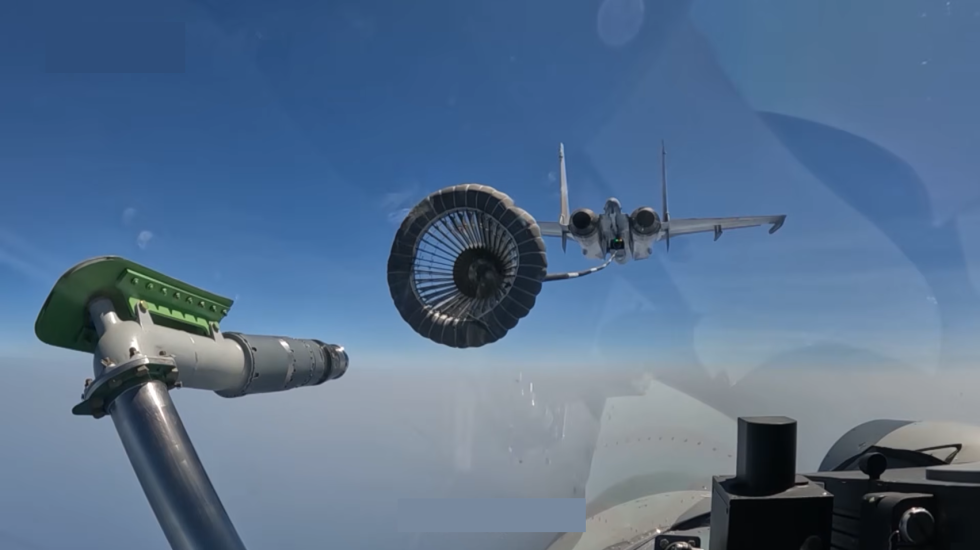
- Retractable probe, port side of the nose — plus the UPAZ-1A buddy store, which lets one J-15 tank another. Until the KJ-600 and a proper deck tanker arrive, buddy refuelling is the only way the ski-jump air wing recovers the radius the ramp costs it, and every aircraft assigned to tanking is an aircraft not carrying weapons.
- Sensors
- Infrared search and track in a ball ahead of the windscreen, helmet-mounted sight, laser rangefinder — the Flanker fit, updated with Chinese hardware. Targeting pods and a data link support the precision air-to-surface weapons.
- Gun
- 1 × 30 mm GSh-30-1, 150 rounds — single-barrel, starboard wing root, Chinese-built. Deleted on the J-15D to make room for electronic-attack equipment.
- Production
- ~76 or more built to 2025 across all marks, in successive small batches rather than a continuous line. This is a type built in the tens, not the hundreds, because until Fujian there were only two decks to fly it from.
- Unit cost
- No published figure — China does not release procurement costs, and the numbers circulating online are invented. Any comparison with the F/A-18E/F’s roughly US$52 million or the Rafale M’s considerably higher price is guesswork.
04The Shenyang J-15’s operating costs: why no reliable price exists
The J-15 is a Chinese state product, built for the PLA Navy and never sold on an open market, so a firm flyaway unit price simply does not exist in the public record. Nor is there a credible public cost-per-flight-hour figure for the type. Even the number of aircraft built is not officially disclosed — open-source estimates have ranged from a couple of dozen in the late 2010s to figures in the region of fifty or more since, but these are analyst estimates that vary widely and should not be read as sourced totals. Any precise dollar figure attached to a J-15 online is, in practice, a guess.
Armament & payload
The J-15 can lift 6.5 tonnes of weapons, and for its first decade the ski jump would not let it
Twelve hardpoints and a 6,500 kg external limit put the J-15 in the same class as any front-line strike fighter, and the weapons themselves are current: PL-10 for the merge, PL-12 and now PL-15 for the beyond-visual-range fight, YJ-83K for ships. The difficulty was never the pylons but the deck. A ski jump does not accelerate an aeroplane; it merely throws it into the air with a positive rate of climb and leaves the engines to sort out the rest, so every kilogram of ordnance has to be paid for in fuel or left behind. From the two forward spots on Liaoning, with 105 m of run, a J-15 goes off at about 28 tonnes, and once nine tonnes of internal fuel are aboard that leaves something in the order of 1.5 tonnes for weapons — four air-to-air missiles and nothing else. The long waist spot buys back most of the payload, but only one aircraft at a time can use it, which is exactly the wrong constraint for generating a strike package. Weapon fits below are compiled from Chinese state media imagery, published Chinese-language sources and Western analysis; the PLA Navy publishes no clearance lists, and several stores widely attributed to the J-15 — the YJ-12 supersonic anti-ship missile among them — have never been photographed on one.
Gun
- 1 × 30 mm GSh-30-1 single-barrel cannon, Chinese-built, in the starboard wing root
- 150 rounds; cyclic rate around 1,500–1,800 rounds per minute
- Slaved to the radar, the infrared search and track set and a helmet-mounted sight
- Deleted entirely on the J-15D, where the volume and the weight go to electronic-attack equipment
Air-to-air
- PL-8B — short-range infrared missile, a licensed descendant of the Israeli Python 3, carried on the wingtip and outer pylons
- PL-10 — imaging infrared, high off-boresight, cued by the helmet sight; the current close-in weapon
- PL-12 — active radar homing, medium range, roughly comparable to an early AIM-120C
- PL-15 — dual-pulse motor, active electronically scanned array seeker, two-way data link, 200–300 km (125–185 miles) claimed; carried by the J-15T, whose own AESA radar is what makes it useful
- Russian R-73 and R-77 were carried on early trials aircraft and are not part of the operational fit
Air-to-surface guided
- YJ-83K — the primary anti-ship weapon; sea-skimming, Mach 0.9, 165 kg (364 lb) semi-armour-piercing warhead, about 180 km (112 miles)
- YJ-83KH — imaging infrared seeker and about 230 km (143 miles), for use where the active radar version would give the launch away
- YJ-91 — anti-radiation missile developed from the Russian Kh-31P, for suppressing ship and shore radars
- KD-88 — turbojet-powered stand-off land-attack missile with television or infrared terminal guidance
- The YJ-12 supersonic anti-ship missile is frequently listed for the J-15; it is a large weapon and the attribution is not supported by photographs
Bombs
- LS-6 series — satellite and inertially guided glide bombs in 250 kg and 500 kg sizes, the standard Chinese precision weapon
- LT-2 — 500 kg laser-guided bomb, requiring a targeting pod or an off-board designator
- Unguided 250 kg and 500 kg general-purpose bombs of the Russian FAB pattern
- Cluster munitions have been shown in Chinese imagery but are not a documented operational fit
Rockets
- 90 mm rocket pods of the Chinese Type 90-1 family, and legacy 57 mm and 130 mm Russian-pattern pods
- Cleared, occasionally photographed, and essentially irrelevant to the type’s job
- A carrier fighter that must trade every kilogram against the ski jump has no business over a battlefield with unguided rockets when an LS-6 costs the same weight and hits from ten miles out
- Kept in the inventory for training and for the ground-attack syllabus rather than for operations
Pods & other stores
- UPAZ-1A buddy refuelling store — the single most important thing a J-15 carries, and the only air-refuelling capability the ski-jump air wing has
- Electro-optical targeting pod, Chinese K/JDC-series, for the laser-guided weapons
- Electronic-attack pods on the wingtips and under the wings of the J-15D and J-15DT, in the manner of the EA-18G Growler
- No external fuel tanks — the Su-27 airframe has never had them, so range is what the internal 9.4 tonnes provide and nothing more
Three typical loadouts
- Fleet air defence, bow spot
- 2 × PL-8B on the wingtips, 2 × PL-12 on the inboard wing pylons, full internal fuel. Launch weight about 28 tonnes off 105 m of deck. This is the fit the forward spots allow, and it is a pure interceptor load — four missiles, a gun and a great deal of petrol.
- Anti-ship strike, waist spot
- 2 × YJ-83K under the wings, 2 × PL-8B on the tips, 2 × PL-12 for self-escort, full internal fuel. Launch weight approaching 33 tonnes off 195 m. Only one aircraft can use the long spot at a time, so a four-ship at this weight takes four separate launch cycles.
- Buddy tanker
- UPAZ-1A store on the centreline, 2 × PL-8B for self-defence, maximum internal fuel. An unglamorous sortie that exists only because the ski jump takes fuel away from everyone else, and the reason a nominal squadron of twenty-four aircraft does not generate twenty-four strike sorties.
Sourcing caveat: China publishes no weapons clearance data for the J-15. The lists above are assembled from state television imagery, PLA Navy photographs released around exercises, Chinese-language technical writing and Western order-of-battle analysis. Ranges quoted for the PL-15 and the YJ-83 family are manufacturers’ or analysts’ figures against unspecified targets and should be read as the outer edge of the envelope, not as a working engagement range.
Variants
An unfinished Sukhoi prototype bought from Ukraine in 2001 became China’s carrier fighter, and both sides of the argument about it are partly right
The J-15’s origin is not in dispute in its essentials. China wanted the Su-33 and tried repeatedly to buy it; Russia would not reopen the production line without a large order and a large payment, insisted on a minimum of around fifty aircraft, and by 2006 was refusing outright, having watched the J-11B appear as an unlicensed reworking of the Su-27SK. A final Chinese approach was made as late as March 2009 and went nowhere. In the meantime, in 2001, Shenyang had bought an unfinished Su-33 development airframe from Ukraine — the T-10K-3 in most accounts, the T-10K-7 in some Chinese ones — and taken it apart. The J-15 programme formally began in 2006 under the name Feisha, Flying Shark. The first aircraft flew on 31 August 2009 and made the first landing on Liaoning on 25 November 2012, flown by Dai Mingmeng.
What each side says about the result is where it gets interesting, and neither position is nonsense. Russian industry figures told Russian media that the J-15 would not match the Su-33 — a claim that in the Western retelling is rarely attached to a named official, and which comes from the party that lost the sale. The Chinese position, put by chief designer Sun Cong, is that the aircraft matches the F/A-18 for bomb load, radius and manoeuvre but needed more work on its electronics; Rear Admiral Yin Zhuo went further and claimed a straight air-combat advantage over the F/A-18E/F while conceding inferiority in strike. Both of those are defensible on the numbers. The J-15 has roughly a quarter less wing loading and about ten per cent more thrust-to-weight than a Super Hornet, and carries close to forty per cent more internal fuel. It also weighs three tonnes more empty, and that weight is precisely what the ski jump punishes.
The most damaging criticism of the J-15 has come from inside China. In 2018 Lieutenant General Zhang Honghe was reported complaining of "unpardonable" mechanical failures and of a payload limited by the aircraft’s weight relative to the F/A-18E/F. Two fatal or near-fatal flight-control failures inside a month in 2016 killed Zhang Chao and gravely injured Cao Xianjian; a bird strike set an engine on fire in 2017; another aircraft was lost on approach on Hainan in March 2025, the pilot ejecting safely. That is a hard first decade even by carrier-aviation standards, and it explains why the Navy held on to Russian engines until 2022. The honest comparison is this: against the F/A-18E/F, the J-15 is the better aeroplane in the air and much the worse aeroplane on the deck, because the Super Hornet launches at full weight every time, brings back over four tonnes, and flies from a ship with organic tanking. Against the Rafale M, which weighs barely 10.6 tonnes empty and lifts nine tonnes off a catapult, the J-15 looks like what it is — a very large land fighter that was taught to go to sea. The J-15T on Fujian is the answer to all of it.
- T-10K-3 (acquired from Ukraine, 2001)
- Not a J-15 at all, but the object the whole programme starts from: an unfinished Sukhoi naval development airframe, complete with folding wings, canards, hook and the strengthened structure, studied and reverse-engineered at Shenyang. Some Chinese sources identify the airframe as T-10K-7.
- J-15 (first flight 31 August 2009; ~60 in service)
- The baseline single-seater. Su-33 aerodynamics and structure, Chinese avionics and weapons taken across from the J-11B programme, more composite material than the Russian original, AL-31F engines. First 24 delivered from 2013 to the carrier fighter group.
- J-15 with WS-10 (in production from late 2022)
- Not a separate designation, but the change that mattered most: the indigenous WS-10B replacing the AL-31F on the line. The J-15 was the last Chinese combat aircraft to make the switch, and did so only when engine life had gone from tens of hours to over a thousand.
- J-15S (first flight 4 November 2012; prototypes only)
- Two-seat conversion trainer, the Chinese equivalent of the Su-33UB that Russia never fielded either. It flew, it worked, and it was never series-produced; the airframe instead became the basis for the electronic-attack aircraft.
- J-15D / J-15DH (testing from December 2018; in service by October 2024; ~6)
- Two-seat electronic-attack aircraft on the EA-18G model — wingtip and underwing jamming pods, gun deleted, a systems operator in the back seat. STOBAR-capable, so it can work from Liaoning and Shandong as well as from a catapult deck. The first carrier-borne dedicated jammer outside the United States Navy.
- J-15T (first seen September 2016; in service October 2024; 10 or more)
- The catapult aircraft, and much more besides: a launch bar and reinforced nose gear, WS-10 engines, an active electronically scanned array radar, PL-10 and PL-15 clearance and what Chinese sources call fifth-generation avionics. Widely called the J-15B in Chinese media before the T designation was confirmed — the two names describe one programme, not two.
- J-15DT (first observed August 2025)
- The electronic-attack aircraft with the catapult modifications, so that the jammer can fly from Fujian alongside the J-15T. A small change on paper and a large one in practice, since an air wing that cannot launch its own jammers is not a modern air wing.
- Land-based training airframes (Huangdicun, Lingshui and elsewhere)
- Not a variant but worth recording: the type was flown from a concrete ski jump at Huangdicun from 7 May 2010, more than two years before a J-15 touched a deck, and shore establishments still carry a substantial share of the fleet’s flying hours.
Closing caveat: no J-15 has been retired to a museum outside China and no example is preserved or displayed abroad, so unlike most types in this encyclopedia there is nothing an outsider can go and measure. Everything above rests on Chinese official releases, state media imagery, Chinese-language technical writing and Western analysis of photographs. Where those disagree — on wingspan, on ceiling, on internal fuel, on the identity of the Ukrainian airframe — the disagreement is recorded rather than resolved. The T-10K-3 itself is reported to survive at Shenyang; that too is uncorroborated.
Operators today
The J-15 has exactly one operator, so the chart below breaks the single fleet down by mark instead
There is no export market for this aircraft and there will not be one: it exists to fly from three Chinese ships and it has never been offered abroad. A one-row chart comparing China with nobody would tell you nothing, so what follows is the People’s Liberation Army Naval Air Force fleet divided by mark, which is the distinction that actually matters. Roughly 76 airframes have been built across all versions since 2013, and the split between them describes the type’s transition better than any prose: a large body of ski-jump single-seaters, a growing number of catapult-capable J-15Ts, and a handful of electronic-attack aircraft.
Two things about these numbers. First, they are small. The United States Navy flies over 500 Super Hornets; France has 41 Rafale Ms. China built the J-15 in the tens because until Fujian commissioned on 5 November 2025 there were only two decks to fly it from, each nominally carrying around two dozen fighters. Second, they are transitional. The J-15T and J-15DT are being built for a catapult ship, the J-35 is arriving alongside them, and the baseline ski-jump J-15 is the part of this fleet with the shortest future.
These are estimates. Many airframes counted on paper are stored, in deep overhaul, or not operational. Sources: IISS The Military Balance and FlightGlobal World Air Forces; entries that could not be corroborated are omitted. For this type the caveat is unusually heavy — China publishes no fleet returns, the figures above derive from serial-number analysis of released photographs and from Western order-of-battle estimates current to 2025, and the J-15T and J-15D counts in particular are minima that are almost certainly out of date by the time you read them. No second operator exists, and no export version has ever been offered.
From a borrowed prototype to a carrier air wing
The Ukrainian prototype
China is reported to have acquired the unfinished Su-33 prototype T-10K-3 from Ukraine, informing Shenyang’s carrier-fighter work.
First flight (reported)
The J-15 is reported to have first flown, with 31 August 2009 the most-cited date — though the exact date is not firmly established.
First carrier landing
Pilot Dai Mingmeng makes the first arrested landing aboard the carrier Liaoning in November 2012; four more pilots qualify shortly after.
EW variant and a fatal crash
The electronic-warfare J-15D is reported to have first flown late in the year; in April, pilot Zhang Chao died in a crash reportedly linked to a flight-control failure.
Second carrier enters service
The Shandong, China’s first domestically built carrier, is commissioned — another ski-jump ship operating the J-15.
Domestic engines revealed
State-television footage shows operational J-15s fitted with the indigenous WS-10 engine, a step away from reliance on the Russian AL-31F.
A catapult carrier launches
The Fujian, China’s first catapult-equipped carrier, is launched — setting the stage for catapult-capable J-15 variants.
Catapult and EW jets at sea
State media show catapult launches of the J-15T and operational J-15D electronic-warfare aircraft as the Fujian conducts sea trials.
Twelve stories from the Flying Shark
The Ukrainian ghost prototype
China’s carrier fighter reportedly began with an unfinished jet bought from a cash-strapped ex-Soviet state.
Read the full story
Dai Mingmeng, first man down
One pilot made the first-ever arrested landing on a Chinese carrier.
Read the full story
“Aircraft Carrier Style”
A launch officer’s crouch became a national meme.
Read the full story
Why “Flying Shark”?
A carrier jet named for a predator that hunts at the surface.
Read the full story
The ski-jump penalty
The ramp that launches the jet also handicaps it.
Read the full story
Four missiles that made a point
A single image hinted at what catapults buy.
Read the full story
Cutting the Russian engine cord
For years it flew on Russian hearts.
Read the full story
China’s answer to the Growler
A jamming jet built to blind an enemy fleet.
Read the full story
A Flanker for the catapult age
A purpose-built jet for China’s newest carrier.
Read the full story
A fatal reminder of the risks
The programme’s progress was shadowed by loss.
Read the full story
Is the Flanker too big for a boat?
A recurring critique of a heavy naval fighter.
Read the full story
Sharing the deck with a stealth jet
The Flying Shark may not have the carrier to itself.
Read the full story
The Flying Shark in pictures
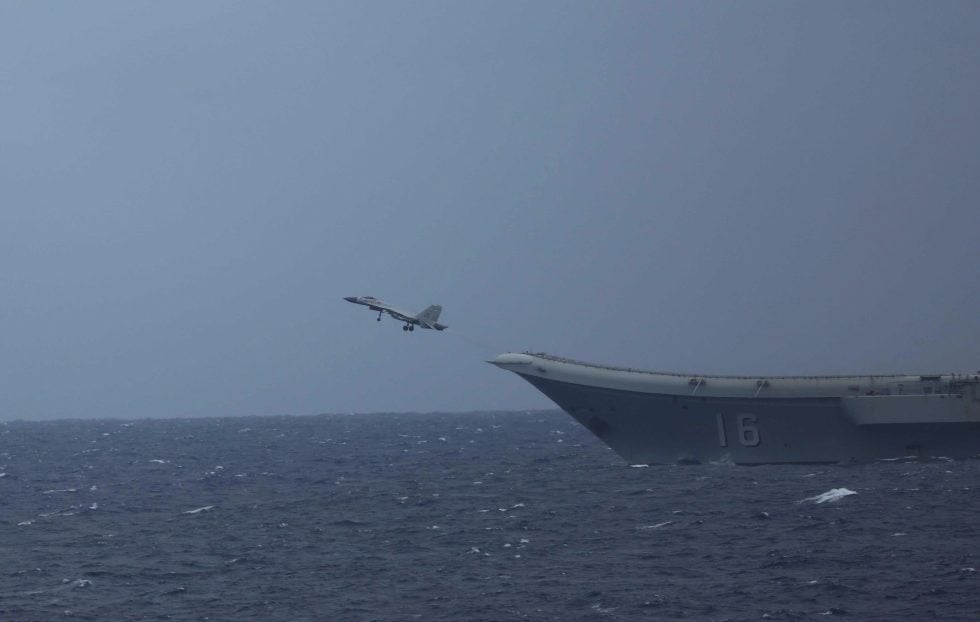
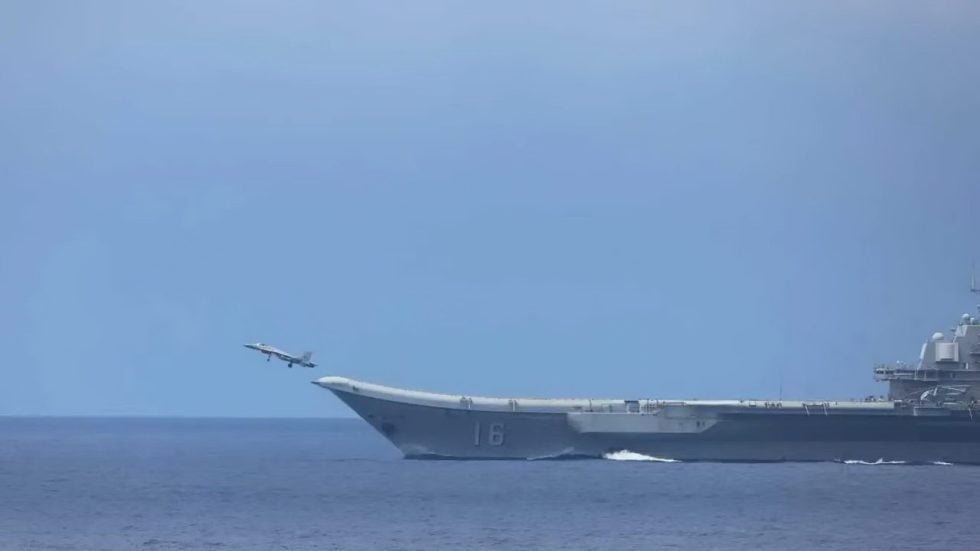
The Flying Shark in motion
A verified, high-authority video feature for the J-15 is coming soon. In the meantime, explore the photo gallery above and the operations map below.
Where the Flying Shark flies
A record measured in milestones, not kills
The J-15 has not been used in air-to-air combat, and it has no confirmed aerial victories or losses to enemy action. Its story so far is one of firsts — qualifying pilots, carriers and catapults — rather than battle. The figures below mark that progress; capability and production claims remain hedged in open sources.
Compare the combat record of every military aircraft. Figures as of July 2026.
Everything people ask about the J-15
Can I fly in a J-15?
Is the J-15 a copy of the Su-33?
What engine does the J-15 use?
What carriers operate the J-15?
What are the J-15 variants?
Why is the ski-jump a limitation?
How many J-15s have been built?
Has the J-15 ever seen combat?
You can’t fly the J-15.
These, you can.
Some legends only live in museums — others are fuelled and waiting. MiGFlug has put civilians in real military jet cockpits since 2004.
 Fly the L-39 AlbatrosThe world’s most-flown jet trainer — aerobatics included
 Fly the F-104 Starfighter“The missile with a man in it”
 Fly the MiG-21The Cold War’s most-produced jet
 Fly the T-33 Shooting StarAmerica’s first jet trainer
 Fly the DH VampireA piece of early jet history
 Fly the S.211Agile Italian jet trainer
 Fly the MB-326The classic Aermacchi jet
 Fly the MiG-15The Soviet legend of the Korean War
Continue the tour
Every fact, checked
- GlobalSecurity.org — J-15Foundational timeline, the T-10K-3 acquisition and the designers.
- The War Zone — domestic enginesThe AL-31F to WS-10/WS-10H engine transition, dated to 2022.
- USNI News — Fujian catapult testsJ-15T catapult launches during the Fujian’s 2025 sea trials.
- Janes — indigenous enginesIndependent assessment of the J-15 with WS-10 engines.
- Council on Foreign RelationsNeutral analysis of the first carrier operations and their limits.
- South China Morning PostThe 2016 Zhang Chao crash and the flight-control debate.
- China Military (PLA English site)Official profile of first carrier pilot Dai Mingmeng — a Chinese state source; read with that in mind.
- Defense NewsThe November 2022 footage showing a domestic engine on the J-15.