
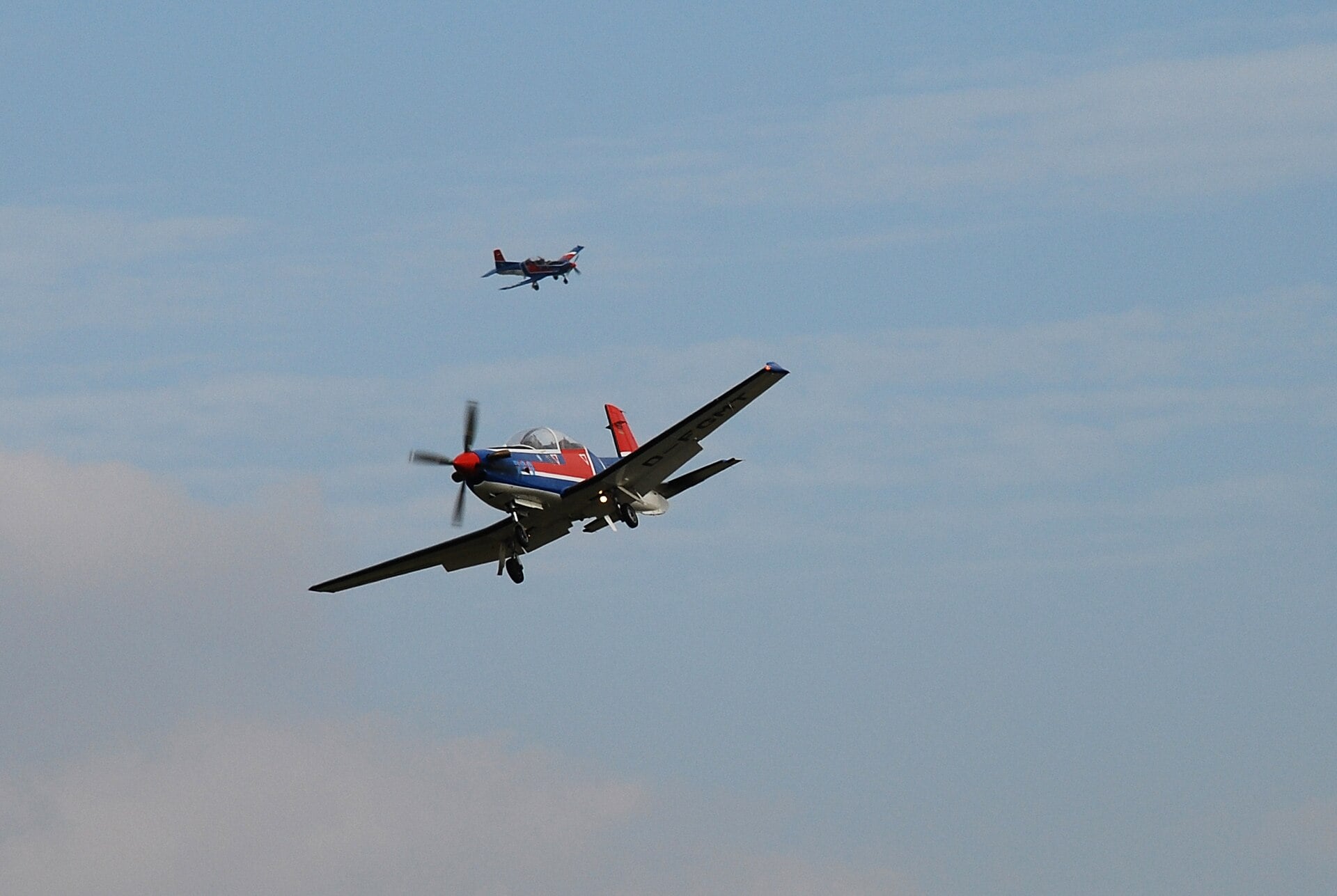
Pilatus PC-9
The Swiss Advanced Trainer
A Swiss turboprop built to bridge the gap to fast jets — a more powerful evolution of the PC-7, and the direct ancestor of the Beechcraft T-6 Texan II now training fighter pilots across the world.
The Pilatus PC-9: a trainer built to fly like a fighter
By the early 1980s, Switzerland’s Pilatus Aircraft had a hit on its hands. Its PC-7 Turbo Trainer had shown that a rugged, economical turboprop could do much of the job that expensive jet trainers had claimed for themselves. But air forces wanted more: an aircraft that could take a student all the way up to the doorstep of a front-line fast jet — higher, faster, and with the systems and cockpit feel of a combat aircraft. Pilatus’s answer, first flown on 7 May 1984, was the PC-9.
Although it shared the PC-7’s general shape, the PC-9 was a substantially new aircraft. A more powerful Pratt & Whitney Canada PT6A-62 turboprop — flat-rated to around 950 shaft horsepower — gave it markedly better climb and speed. A raised, stepped tandem cockpit put the instructor high enough to see over the student’s head; Martin-Baker ejection seats became standard; and a ventral airbrake let instructors set up demanding approaches and aerobatic sequences. The result flew and handled far more like a jet than its price tag suggested.
That combination made the PC-9 a export success. Australia became a flagship operator, with many of its PC-9/A aircraft assembled locally by Hawker de Havilland; the RAAF’s famous Roulettes display team flew the type for three decades. Germany used specialised PC-9 variants as high-speed target tugs; Saudi Arabia, Croatia, Ireland, Slovenia, Oman, Thailand and others adopted it as their advanced trainer. Wherever it went, it did the same job: turn a competent pilot into someone ready for a fast jet, at a fraction of the cost of doing that training on the jet itself.
The PC-9’s most far-reaching legacy, though, was written in the United States. In the 1990s Pilatus teamed with Beechcraft to offer a developed version, the PC-9/Mk II, in the huge US JPATS competition to replace the ageing T-37 and T-34. It won. Heavily reworked and re-engineered for the American requirement, that aircraft entered service as the Beechcraft T-6 Texan II — today one of the most widely used military trainers in the world, and a direct descendant of the Swiss design. The PC-9, in other words, did not just train pilots; it seeded a whole family of trainers still flying now.
01The Pilatus PC-9 vs the PC-7: what actually changed
From a distance the PC-9 looks like a PC-7 with a slightly bigger engine, but the two share less than the family resemblance suggests. The PC-9 introduced a more powerful PT6A-62, a new stepped cockpit and canopy, standard ejection seats, a ventral airbrake, a four-blade propeller and a strengthened, partly redesigned structure. The changes turned a superb basic trainer into a genuine advanced trainer — one that could realistically stand in for a jet in the later stages of a pilot’s course. It is why so many air forces run the two Pilatus types back to back: PC-7 for the early hours, PC-9 (or its successor the PC-21) for the fast, systems-heavy end of training.
What makes the Pilatus PC-9 special
A turboprop with fast-jet manners
The PC-9’s Pratt & Whitney Canada PT6A-62 is thermodynamically capable of more, but is flat-rated to roughly 950 shp so it can hold that power well up into the climb. The payoff is jet-like energy: a top speed near 320 kt (~593 km/h), a service ceiling reportedly around 11,600 m, and a climb rate of about 4,000 ft/min — numbers that let instructors teach fast, high-workload flying without the running cost of a jet.
Stepped cockpit and ejection seats
The PC-9 introduced a raised, stepped tandem cockpit: the rear (instructor) seat sits higher for a clear view over the student and the nose. Martin-Baker ejection seats (Mk 11 class) became standard, giving students and instructors a survivable exit across the flight envelope — a fast-jet feature rare on trainers of its price. A ventral airbrake rounds out the fighter-style handling.
The aircraft that became the T-6 Texan II
In the 1990s Pilatus and Beechcraft offered a developed PC-9/Mk II for the US JPATS trainer competition. It won in 1995 and, extensively reworked, entered service as the Beechcraft T-6 Texan II — now flown by the US Air Force, US Navy and many allied nations. The PC-9 is the direct ancestor of one of the world’s most common military trainers.
02The Pilatus PC-9 engine: why a turboprop is ‘flat-rated’
The PC-9’s PT6A-62 could in theory produce well over a thousand horsepower, but Pilatus flat-rates it to about 950 shp. Flat-rating means the engine is deliberately limited to a set power that it can then maintain as altitude and temperature rise, rather than falling away the way an un-restricted engine would. For a trainer this is ideal: consistent, predictable performance high into the climb, gentler thermal stress, longer engine life and lower running costs. It is a big part of why turboprop trainers like the PC-9 can deliver near-jet training economics.
03The Pilatus PC-9 and the RAAF Roulettes
Australia was one of the PC-9’s most important customers, operating around 67 PC-9/A aircraft, many of them assembled in Australia by Hawker de Havilland (later ASTA). The Royal Australian Air Force’s aerobatic display team, the Roulettes, flew the PC-9/A for roughly three decades and became the type’s public face at airshows across the region. The RAAF retired its PC-9/A fleet in 2019, replacing it — and the Roulettes’ mount — with the newer Pilatus PC-21.
Pilatus PC-9 full specifications
Baseline: the production PC-9 as type-certificated in September 1985 and built through the late 1980s and 1990s — Pratt & Whitney Canada PT6A-62 flat-rated to 950 shp, four-blade Hartzell propeller, Martin-Baker Mk CH11A seats, no pressurisation. Deltas for the Australian PC-9/A, the Swiss PC-9/F and German PC-9B target tugs and the 1997-standard PC-9M are in grey. Weights are for the clean training configuration unless a stores figure is named. Two cautions before reading the numbers. First, the maximum take-off weight of 3,200 kg is an armed-configuration figure; the aerobatic weight the syllabus is actually flown at is roughly 2,250 kg, and quoting the two interchangeably makes the aeroplane look far heavier than it handles. Second, sources disagree on external load: the English-language tables give seven stations with 250 kg inboard and 110 kg outboard, while German-language and Pilatus-derived tables give six stations and a 1,044 kg total. Both are reproduced below rather than averaged.
Dimensions & weights
- Crew
- 2 in stepped tandem — the rear (instructor) seat raised so that he can see the horizon and the runway past the pupil, which the flat-tandem PC-7 could not offer. Solo flight is from the front seat
- Length
- 10.14 m (33 ft 3 in) — the nose is notably longer than the PC-7's, because the PT6A-62 is a longer engine and the aeroplane needed the moment arm
- Wingspan
- 10.12 m (33 ft 3 in) usually printed as 10.125 m; span and length are within a few centimetres of each other, which is why the PC-9 looks square in plan
- Height
- 3.26 m (10 ft 8 in)
- Wing area
- 16.29 m² (175.3 sq ft) — a new wing, not the PC-7's: thinner in section, with larger-area flaps and a revised leading edge
- Aspect ratio
- 6.29:1
- Empty weight
- 1,725 kg (3,803 lb) — almost 400 kg more than a PC-7, which is the plainest single statement of how little the two aircraft share
- Gross weight, training
- 2,350 kg (5,181 lb) with two crew and full internal fuel, no external stores
- Aerobatic weight
- 2,250 kg (4,960 lb) — the weight at which the +7/−3.5 g envelope and the spin clearance apply, and the weight at which the type is actually flown in a training sortie
- Maximum take-off weight
- 3,200 kg (7,055 lb) in the armed or ferry configuration
- Wing loading
- 144 kg/m² (29.5 lb/sq ft) at training weight, rising to 196 kg/m² (40.2 lb/sq ft) fully loaded — roughly half again what a PC-7 carries, and the reason the PC-9 feels like a jet in the circuit
- Power loading
- 2.47 kg/shp (5.45 lb/shp) at training weight — against about 3.9 kg/shp for a PC-7, an improvement of a different order rather than a refinement
- Structure
- all-metal stressed-skin low wing and semi-monocoque fuselage, fatigue-rated for the punishing sortie profile of a military school; Australian licence assembly required the full drawing set to be transferred, which is a fair measure of how conventional the structure is
- Undercarriage
- hydraulically retractable tricycle with a steerable nosewheel, cleared for grass and semi-prepared strips — a requirement that Croatia, Slovenia and Angola all made use of
- Cockpit and canopy
- one-piece rearward-sliding canopy over both seats with a miniature detonating cord for through-canopy escape; the cockpit is deliberately laid out to jet convention, with a centre stick, a left-hand power lever and, optionally, a head-up display the PC-9M brought EFIS multi-function displays as standard, and Croatian criticism of its own fleet centres on the absence of HUD and HOTAS on the aircraft as delivered
Performance
- Maximum speed
- 593 km/h (368 mph, 320 kn) true airspeed at altitude
- Cruise speed
- 556 km/h (345 mph, 300 kn) at 7,620 m (25,000 ft)
- Stalling speed, clean
- 143 km/h (89 mph, 77 kn)
- Stalling speed, gear and flaps down
- 128 km/h (80 mph, 69 kn) the PC-9M added leading-edge stall strips to make the break more honest and more consistent, a change made after the type had been in service for a decade
- Rate of climb
- 20.8 m/s (4,090 ft/min) at sea level — roughly three times a PC-7 and within reach of a first-generation jet trainer
- Service ceiling
- 11,580 m (38,000 ft) — a striking figure for an unpressurised aeroplane, and only usable with oxygen or an on-board generating system; no school flies it there routinely
- Range
- 1,537 km (955 miles, 830 nmi) on internal fuel
- Endurance
- 4 h 30 min on internal fuel at economical settings the German PC-9B target tug carries extra fuel for about 3 h 20 min on task, which is the number that matters to a range operator rather than a ferry figure
- Take-off distance to 15 m
- 391 m (1,280 ft) at training weight
- Landing distance from 15 m
- 700 m (2,295 ft) — the ventral airbrake and reverse pitch on the propeller do most of the work
- Load factors
- +7.0 / −3.5 g at aerobatic weight, cleared for the full aerobatic syllabus including deliberate spinning and inverted flight
- Handling note
- the whole point of the aeroplane: it accelerates, decelerates and rolls closely enough to a jet that a pupil arriving on a Hawk, an F-5 or an F/A-18 has met the numbers already, which is why several air forces deleted an intermediate jet stage entirely
Propulsion & systems
- Engine
- 1 × Pratt & Whitney Canada PT6A-62 free-turbine turboprop
- Rating
- 857 kW (1,149 shp) thermodynamic, flat-rated to 708 kW (950 shp) for the airframe — the flat rating is what preserves full power on a hot day and at altitude, and it is the single largest difference from the PC-7's 550 shp PT6A-25A
- Propeller
- four-blade Hartzell constant-speed reversible unit, 2.44 m (8 ft 0 in) diameter, with feathering and beta range the PC-9M introduced a revised engine and propeller control system to reduce the workload of matching the two
- Internal fuel
- ~535 litres (~118 Imp gal, ~141 US gal) in integral wing tanks; the PC-9B and PC-9/F target tugs carry more
- Airbrake
- hydraulically actuated ventral airbrake under the fuselage — absent from the PC-7 and fitted precisely so that pupils learn energy management on an aeroplane that otherwise refuses to slow down
- Flying controls
- conventional cable and pushrod, unboosted, with electrically actuated trim; large-area single-slotted flaps
- Escape system
- Martin-Baker Mk CH11A lightweight zero-zero ejection seats in both cockpits, sequenced through the canopy — the feature that separated the PC-9 from every piston trainer it replaced, and in the Irish case the first ejection seat in the service since the Vampire
- Pressurisation
- none. The cockpit is unpressurised and the crew work on oxygen above 10,000 ft; an on-board oxygen generating system was an option. This is the clearest technical line between the PC-9 and the T-6A that grew out of it
- Avionics
- conventional instruments with optional HUD on the baseline aircraft; the PC-9M is delivered with electronic flight instrument displays, and individual operators added GPS, radar warning or reconnaissance fits to taste
- External stations
- seven in the English-language tables — three under each wing plus a centreline — rated 250 kg inboard and 110 kg outboard German-language sources instead describe six stations totalling 1,044 kg; the two accounts cannot both be exactly right and no operator has published a definitive station diagram
- Commonality with the PC-7
- about 10 per cent by parts count. The PC-9 looks like a PC-7 and is not one: new wing, new fuselage, new cockpit, new engine, new seats. Calling it a re-engined PC-7 is the single most common error made about the type
04The Pilatus PC-9’s operating costs: why the numbers are hedged
Pilatus does not publish a standard flyaway price or an official cost-per-flight-hour for the PC-9, and figures that circulate come from export contracts of different years, currencies and fit. A commonly cited estimate puts a fully equipped PC-9M at around US$6 million (2000s dollars) — treat that as an order-of-magnitude guide, not a fixed price. No credible public cost-per-flight-hour figure exists either; the whole point of a turboprop trainer, however, is that its hourly cost is a small fraction of a jet’s, which is why air forces use types like the PC-9 for the expensive, high-hours part of pilot training. Any precise dollar figure attached to a PC-9 should be read as an estimate.
Armament & payload
The Pilatus PC-9 carries no built-in gun, and half its customers bought it anyway for the seven holes under the wings
The PC-9 is a trainer with a weapons capability bolted onto it, and the distinction matters. Nothing is built into the airframe: no cannon, no ammunition bay, no gunsight as standard, no targeting pod, no guided weapon of any kind. What Pilatus supplied were hardpoints, a wiring loom and a stores management panel, and what operators did with them varied from nothing at all to genuine armed reconnaissance.
Slovenia, Ireland, Croatia, Myanmar, Angola and Iraq all bought aircraft with the stations fitted; Australia and Switzerland effectively did not use them. The honest summary is that the armed PC-9 is a light strike aeroplane for an air force that cannot afford one, adequate against an opponent with no air defence and lethal to its own crew against anything else. Clearances differ enormously between operators, and a store listed in a Pilatus brochure is not the same thing as a store certified on a particular national fleet; treat every list below as capability rather than inventory.
Gun
- None fitted internally. The PC-9 has no fixed armament of any calibre, in any variant, in any air force
- Podded 12.7 mm heavy machine gun installations, of the FN Herstal HMP class, on the inboard wing stations — the standard armed fit for the Irish and Slovenian aircraft
- Podded 7.62 mm machine guns for lighter work and for cheap air-to-ground training
- 20 mm cannon pods are quoted in the manufacturer's store list; no operator is known to have adopted them, and hanging that much recoil and drag on a 950 shp trainer is a theoretical rather than a practical option
- Because there is no fixed gun there is no harmonisation standard, and gunnery accuracy depends entirely on the pod, the mount and whether the operator fitted a sight at all.
Air-to-air
- Nothing. No air-to-air missile has ever been integrated on the PC-9 or PC-9M — not AIM-9 Sidewinder, not R-60 (AA-8 Aphid), not Mistral or any other man-portable derivative
- The only air-to-air capability the type has ever been credited with is the slow-mover intercept: a gun-podded PC-9 shepherding or, in extremis, engaging a light aircraft that a fast jet cannot slow down enough to handle
- Ireland and Slovenia, both without fighters, are the operators for whom that argument is made most often; neither has published an intercept doctrine that relies on it
- The PC-9 has been on the receiving end of the air-to-air problem once: on 22 March 1991 a USAF F-15C engaged an Iraqi formation over northern Iraq, and the accompanying Iraqi PC-9 pilot ejected without a shot being fired at him
- Where a secondary source credits the PC-9 with air-to-air missiles it is almost always describing a manufacturer's options list for a different Pilatus type or confusing it with the armed PC-21 and AT-6 proposals.
Air-to-surface guided
- None. No laser-guided bomb, no guided missile, no anti-tank weapon has been integrated on a production PC-9
- There is no internal targeting sensor and no standard provision for a designator pod, so even a buddy-lasing arrangement would require a modification programme no operator has funded
- This is the capability gap that killed the armed turboprop trainer as a light attack aircraft: the Embraer A-29 Super Tucano and the Beechcraft AT-6 Wolverine both exist because the PC-9 generation could not drop a precision weapon
- Croatia's own assessment of its fleet — no head-up display, no hands-on-throttle-and-stick, no useful weapon stations in the delivered fit — is the frankest published statement of the limitation
- The PC-21 that replaced the PC-9 in Swiss, Australian, Saudi and Jordanian service is also unarmed in most fits; the precision-strike role went to different aeroplanes entirely.
Bombs
- Mk 82 227 kg (500 lb) general-purpose bombs on the inboard stations, which is the heaviest single store the aeroplane is rated for
- Mk 81 113 kg (250 lb) bombs and the Mk 77 incendiary on the same racks
- Cardoen CB-500 cluster bomb, a Chilean weapon that appears on the Pilatus store list and reflects the export market the type was sold into
- Practice bomb carriers with 3 kg and 12 kg inert stores — in most air forces the only thing ever actually released from a PC-9
- Carrying two Mk 82s consumes the entire useful external load and most of the climb performance; the bombing capability is real but it is a single-pass, short-radius, no-opposition capability.
Rockets
- Hydra 70 (2.75 in) unguided rockets in LAU-series seven- and nineteen-tube pods — the most widely fitted PC-9 weapon after the gun pod
- SNEB 68 mm rockets in Matra-pattern pods, for operators in the French supply chain
- White phosphorus and smoke marker rockets, which is how the Royal Australian Air Force used its aircraft: the PC-9/A(F) forward air control conversion marked targets for strike aircraft and carried nothing lethal
- Rocket work suits the aeroplane better than bombing does: light stores, shallow dives, and a stable enough platform that a competent pupil can be taught to hit something
- Slovenian and Irish aircraft are the ones routinely photographed with rocket pods; Croatian PC-9Ms are far more often seen clean or in Wings of Storm display colours.
Pods & other stores
- Target-towing equipment, which is quantitatively the most important thing the PC-9 ever carried: the German PC-9B and Swiss PC-9/F fly two Southwest RM-24 winches, streaming a target up to about 3.5 km behind the aeroplane
- Electronic countermeasures and electronic warfare pods on the Swiss aircraft, which spent their careers presenting realistic threats to Swiss gunners and fighter crews rather than teaching anybody to fly
- Reconnaissance camera pods, the basis of the armed-reconnaissance role Croatia and Slovenia list for the type
- Auxiliary fuel tanks on the inboard stations for ferry and long-range patrol
- Smoke generation systems for display flying — fitted to the RAAF Roulettes, Croatia's Krila Oluje and Thailand's Blue Phoenix teams
Three typical loadouts
- Light fire support, Slovenian and Irish practice
- Two 12.7 mm machine-gun pods on the inboard stations and two seven-tube 70 mm rocket pods outboard, two crew, internal fuel. A short-radius, daylight, permissive-airspace fit — the maximum useful war load of an aeroplane that was never meant to have one.
- Forward air control, RAAF PC-9/A(F)
- Smoke marker rockets on the inboard stations, no lethal stores, two crew with the rear seat working the radios. The Australian aircraft flew this for No. 4 Squadron marking targets for fast jets, and it is the one armed role the PC-9 performed in a first-rank air force.
- Advanced training and display, clean
- No stores, full internal fuel, two crew or solo from the front seat, smoke system optional. This is how the overwhelming majority of PC-9 hours were flown — aerobatics, instruments, formation, navigation and spin recovery at 2,250 kg and +7 g.
Sourcing caveat: the store list above is assembled from manufacturer material and national air force descriptions, not from clearance documents. Pilatus never published a public certified-stores matrix for the PC-9, national clearances differ, and several stores that appear in export brochures — the 20 mm pod and the Cardoen cluster bomb among them — have no confirmed operator. Where a figure below is a capability rather than a recorded fit, it has been described as such.
Variants
The PC-9 built an Australian production line, two nations' target-tug fleets and, at one remove, the most-produced Western trainer of the last thirty years
The variant list is short because the aeroplane was structurally right the first time. What changed was equipment: target-towing gear for Germany and Switzerland, Australian avionics for a licence line, and in 1997 a modest but genuine aerodynamic clean-up that became the PC-9M and accounted for most later sales.
The interesting entry is the one that is not really a PC-9 at all. Pilatus had already learned the value of a large partner when British Aerospace marketed the type for the RAF competition it lost to the Short Tucano in 1985 — a loss that nonetheless produced the marketing links behind the first production order, from Saudi Arabia. Repeating the trick with Beechcraft for the American JPATS contest worked: the Beech Pilatus PC-9 Mk II beat seven other contenders in June 1995 and became the T-6A Texan II.
How much of the T-6 is PC-9 is a fair question with an uncomfortable answer. The Mk II prototypes were converted PC-9s, but the production aeroplane has a pressurised cockpit, a more powerful PT6A-68, Martin-Baker Mk 16 seats, a strengthened bird-strike-resistant structure, a single power lever, enlarged tail surfaces and an entirely American avionics fit. Beechcraft builds and markets it independently and Pilatus takes royalties. In shape it is a PC-9; in parts it is much further from one than the PC-9 was from the PC-7.
- PC-9 (first flight 7 May 1984, certificated September 1985; first batch of 10)
- The baseline aeroplane: two prototypes flown in May and July 1984, PT6A-62, stepped tandem ejection seats, ventral airbrake, seven external stations. The Royal Saudi Air Force placed the first production order, for 30.
- PC-9/A (Australia, 1987–1992; 67 aircraft)
- Australian-standard avionics and equipment. Two built by Pilatus, 17 assembled from Swiss kits and 48 manufactured under licence by Hawker de Havilland at Bankstown; the first Australian aircraft flew on 19 May 1987. Retired in 2019 in favour of the PC-21.
- PC-9/A(F) (RAAF forward air control conversion, 1990s)
- A small number of PC-9/As modified for the forward air control role with target-marking rockets and smoke, flown by No. 4 Squadron at Williamtown. The only sustained operational, as opposed to instructional, use of the type by a major air force.
- PC-9/F (Switzerland, 1987–December 2022; 16 airframes)
- Swiss target-towing and special-mission aircraft, initially leased, carrying winches and electronic warfare pods and serialled in the C-4xx block. The fleet was cut to eight in 2012 and flew its last sortie in December 2022 after 28,698 hours.
- PC-9B (Germany, ~10 aircraft)
- Civil-registered target tugs flown for the Bundeswehr by contractors — Condor Flugdienst originally, latterly QinetiQ's German arm. Extra fuel for about 3 h 20 min on task and two Southwest RM-24 winches streaming a target some 3.5 km astern.
- PC-9M (from 1997; the majority of later production)
- The definitive standard: enlarged dorsal fin for better directional behaviour and spin recovery, revised engine cowling fairings, leading-edge stall strips and a new engine and propeller control system, with electronic flight instruments in the cockpit. Bought by Croatia, Slovenia, Oman, Ireland, Bulgaria and Mexico.
- Beech Pilatus PC-9 Mk II (1992; 2 prototypes)
- The JPATS demonstrator, converted from PC-9 airframes by Beech with a pressurised cockpit and a redesigned structure. Won the competition in June 1995 against seven rivals including the Rockwell Ranger 2000.
- Beechcraft T-6A Texan II (from 1995; ~740 planned for the USAF and US Navy)
- The production JPATS aeroplane: PT6A-68 of 1,100 shp, pressurised cockpit, Mk 16 zero-zero seats, glass cockpit with HUD and HOTAS. Built and sold by Beechcraft with royalties to Pilatus, and now far more numerous worldwide than the PC-9 itself.
- PC-7 Mk II (from 1992)
- The reverse hybrid: the PC-9 airframe and avionics with the smaller PT6A-25C of 700 shp, sold to operators who wanted PC-9 handling and cockpit layout at PC-7 running costs. It is a PC-9 lite far more than the PC-9 was ever a PC-7 heavy.
- B.F.19 (Thailand; 36 aircraft, retired February 2024)
- Royal Thai Air Force service designation. The Thai fleet, one of the largest, flew the Blue Phoenix display team from 2012 and was withdrawn in February 2024 in favour of the T-6 — the PC-9 replaced, in the end, by its own descendant.
Production and totals: roughly 250 to 276 PC-9s were delivered across all variants before the line wound down around 2010, and no single authoritative figure exists — Pilatus and the standard reference works give "in excess of 250" and "approximately 276" respectively, with the discrepancy probably turning on whether kits assembled in Australia and later attrition replacements are counted. About 15 airframes passed to civil and contractor operators for target towing. Note also two claims commonly made about the type that do not survive checking. The PC-9 was never a Swiss training aeroplane: Switzerland trained on the PC-7 and bought the PC-9 purely as a target tug, so the statement that the PC-21 replaced the PC-9 in Swiss service is wrong in that form — the PC-21 replaced the BAE Hawk in Swiss advanced training from 2008, while the PC-9/F target tugs soldiered on to December 2022 and were not directly replaced by anything. And the PC-9 is not a re-engined PC-7; parts commonality is around 10 per cent.
Operators
The Pilatus PC-9 was the stepping stone between the PC-7 and the PC-21, and it spawned the American T-6 Texan II.
Fewer than 300 PC-9s were built, yet they trained pilots in Australia, Saudi Arabia, Thailand, Switzerland and a dozen smaller air arms, with the Roulettes, Wings of Storm and the Irish Air Corps flying it as an aerobatic mount. Its greatest legacy is indirect: the Beechcraft-modified PC-9 Mk II became the T-6 Texan II, the standard trainer of the US forces. Small fleets change status quickly; Cyprus and Saudi Arabia are listed as former operators although some sources still count them.
In service with
- Croatian Air ForceCroatia · 17 new PC-9M from 1997 plus 3 second-hand; 14 operational in 2023; Wings of Storm display team
- 14 · 1997–
- Royal Air Force of OmanOman · delivered 1999–2000
- 12 · 1999–
- Myanmar Air ForceMyanmar · delivered from April 1986
- 10 · 1986–
- Irish Air CorpsIreland · PC-9M, armed with gun and rocket pods from 2005
- 8 · 2004–
- Slovenian Air ForceSlovenia · 11 PC-9M Hudournik delivered 1995–99 including ex-US Army aircraft, one lost
- 8 · 1995–
- Bulgarian Air ForceBulgaria · PC-9M
- 6 · 2004–
- National Air Force of AngolaAngola · four delivered from 1987
- 4 · 1987–
- Chadian Air ForceChad · single armed aircraft
- 1 · 2006–
- Mexican Air ForceMexico · two PC-9M delivered 2006, one active in 2023
- 1 · 2006–
Formerly operated by
- Royal Australian Air ForceAustralia · PC-9/A, 65 assembled or built by Hawker de Havilland; replaced by the PC-21
- 67 · 1987–2019
- Royal Saudi Air ForceSaudi Arabia · delivered from December 1986 via British Aerospace; replaced by the PC-21 by 2015
- 50 · 1986–2015
- Royal Thai Air ForceThailand · acquired 1991–96, 23 upgraded to PC-9M; retired February 2024 for the T-6TH
- 36 · 1991–2024
- Iraqi Air ForceIraq · delivered from 1987; one lost during the 1991 Gulf War
- 20 · 1987–
- Swiss Air ForceSwitzerland · 16 airframes leased or bought from 1987, four returned; target-towing and EW fleet retired December 2022
- 16 · 1987–2022
- United States ArmyUnited States · target and test aircraft, sold to Slovenia
- 3 · 1991–1996
- Cyprus Air CommandCyprus · one lost 2005, the other stored
- 2 · 1989–2005
16 operators, 9 current. Quantities are airframes taken on charge; dates are first delivery to last retirement. Air forces with a MiGFlug Order of Battle page are linked (1 so far); the rest follow as the database grows.
The Pilatus PC-9 through the years
First flight
The PC-9 prototype flies for the first time on 7 May 1984, a more powerful development of the PC-7 with a stepped cockpit and ejection seats.
Certified and sold
Type certification follows in 1985 and the first customer deliveries begin; Saudi Arabia is among the earliest major buyers.
Australia adopts the PC-9/A
The RAAF selects the PC-9/A; many are assembled in Australia by Hawker de Havilland. It becomes the mount of the Roulettes display team.
The PC-9M and armed variants
The improved PC-9M appears, adopted by Croatia, Slovenia, Oman and others; some export aircraft carry light stores.
JPATS win — the T-6 is born
The Pilatus/Beechcraft PC-9/Mk II wins the US JPATS competition; heavily reworked, it becomes the Beechcraft T-6 Texan II.
Ireland joins the operators
The Irish Air Corps takes delivery of eight PC-9M trainers, flown from Baldonnel for advanced training and display flying.
Australia retires the PC-9/A
After more than three decades the RAAF withdraws its PC-9/A fleet, replacing it and the Roulettes’ aircraft with the Pilatus PC-21.
Thailand moves to the T-6
The Royal Thai Air Force retires its PC-9s around 2024 in favour of the Beechcraft T-6 — the type the PC-9 itself fathered.
From the flight line: twelve Pilatus PC-9 stories
From PC-7 to PC-9
A hit basic trainer created the appetite for a faster, jet-like Swiss turboprop.
Read the full story
Flat-rated for the climb
The PC-9’s engine is deliberately held back — and that is the point.
Read the full story
The Roulettes’ mount
For three decades the RAAF’s display team flew the PC-9/A across the region.
Read the full story
The seed of the T-6 Texan II
A developed PC-9 won America’s biggest trainer contest.
Read the full story
The high-speed target tug
Some PC-9s spend their lives being shot at — deliberately.
Read the full story
Eight aircraft from Baldonnel
A small air corps runs a compact, capable PC-9M fleet.
Read the full story
Wings of Storm
Croatia’s PC-9M team turned a trainer into a crowd favourite.
Read the full story
The Hudournik
Slovenia’s PC-9M carries a Slovene name and, sometimes, light arms.
Read the full story
The export controversy
PC-9 sales became part of a long Swiss political debate.
Read the full story
Like a jet, on a budget
Instructors often say the PC-9 flies bigger than it is.
Read the full story
From PC-9 to PC-21
Pilatus eventually replaced its own advanced trainer.
Read the full story
Still training, forty years on
Four decades after its first flight, the PC-9 family is everywhere.
Read the full story
The Pilatus PC-9 in pictures
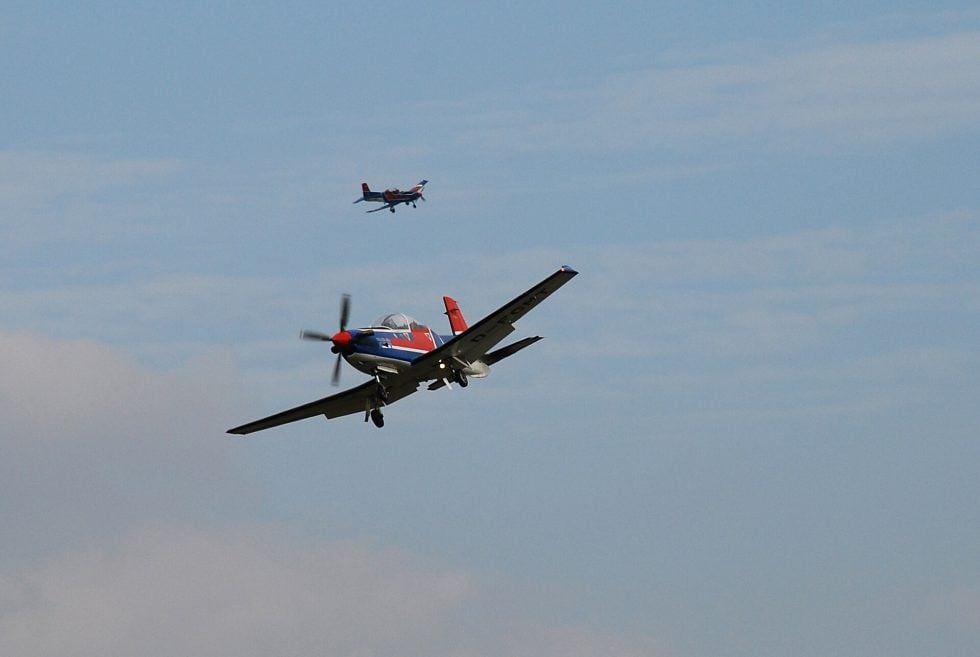
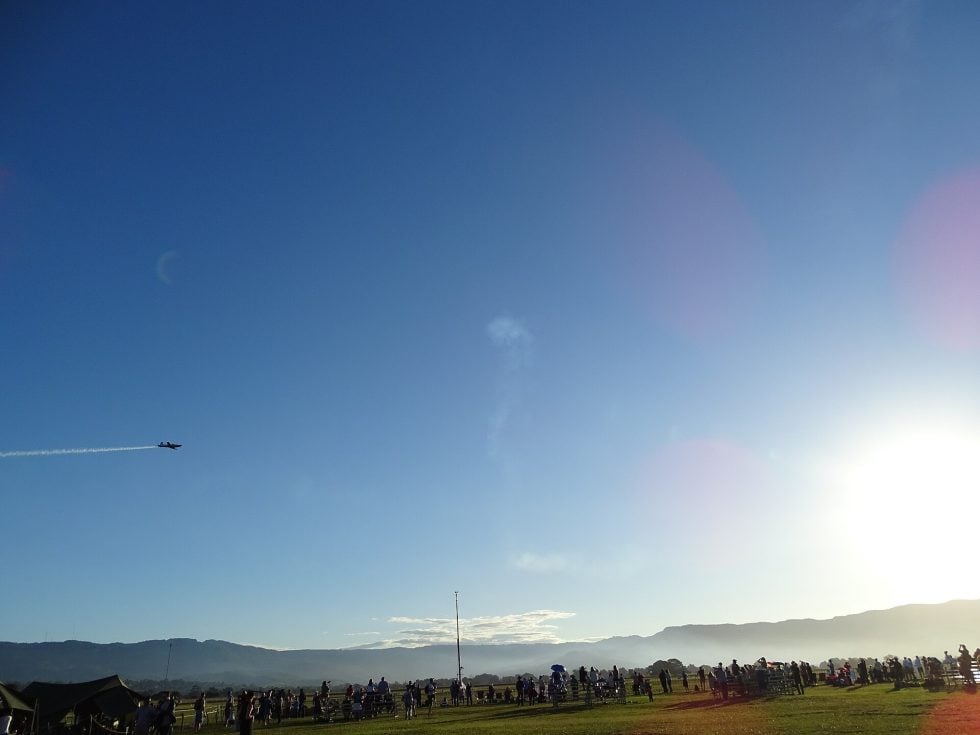
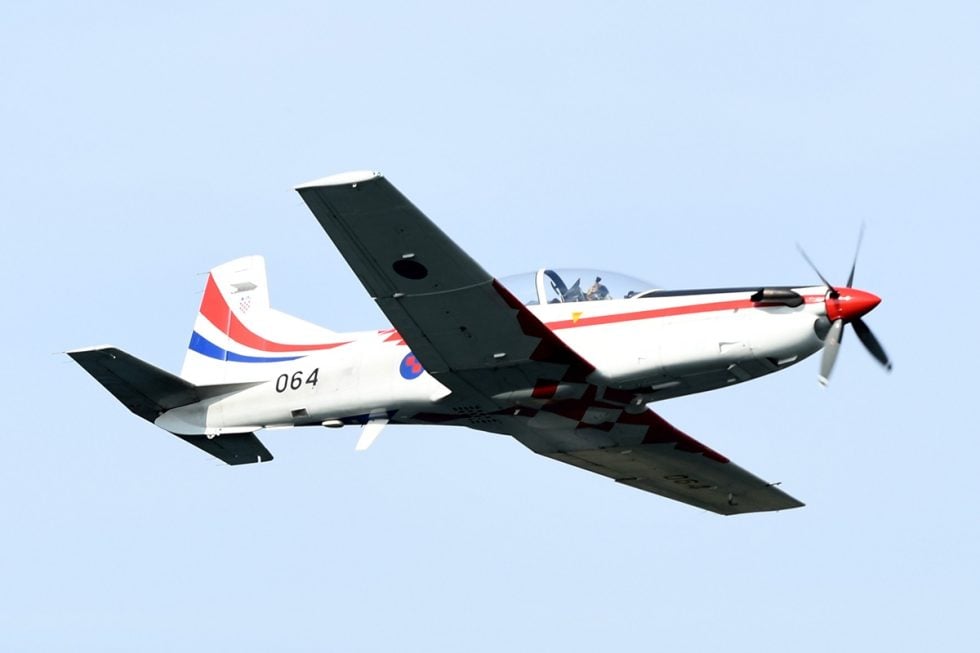
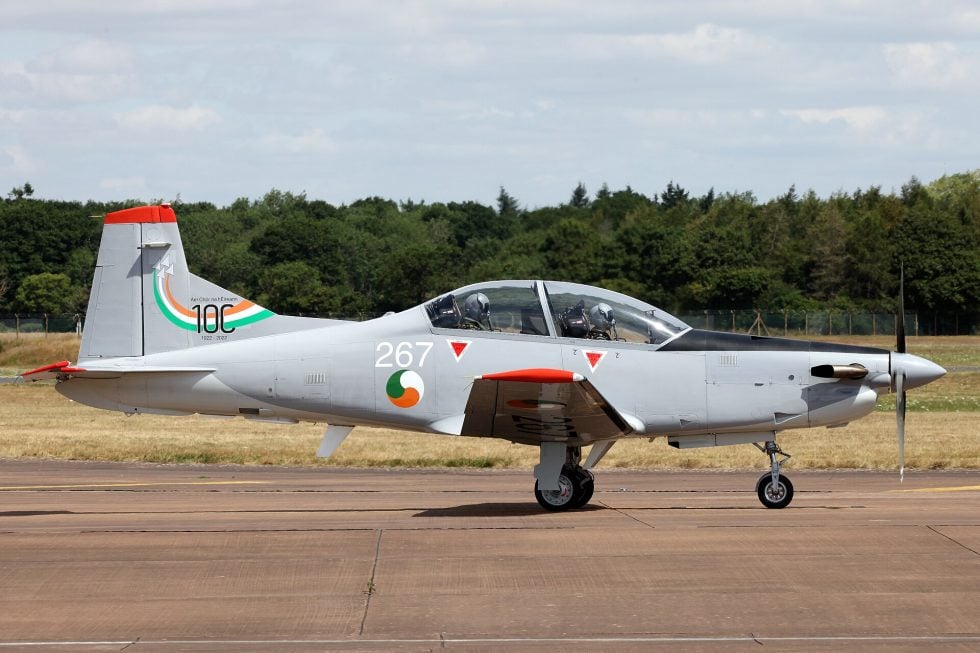
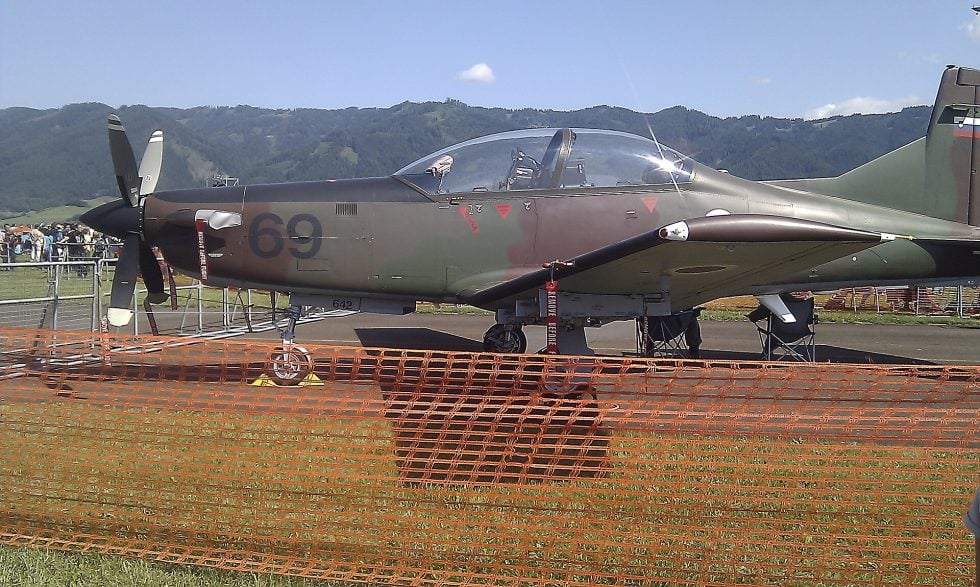
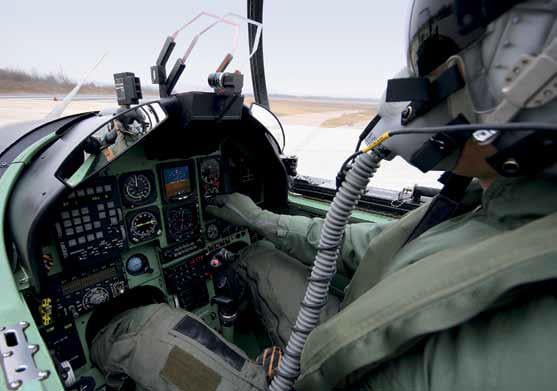
The Pilatus PC-9 in motion
The Croatian Air Force ‘Wings of Storm’ (Krila Oluje) display team flying the armed-capable PC-9M — a good look at how jet-like the type is in the air. Airshow display footage.
Where the Pilatus PC-9 flies
A trainer, not a fighter — and proud of it
The Pilatus PC-9 was never built to fight. Its record is written in pilots trained, display seasons flown and a whole family of trainers it inspired. A handful of export PC-9M aircraft can carry light stores for weapons familiarisation or low-intensity roles, but the type’s real achievement is how many front-line fast-jet pilots first learned high-performance flying at its controls.
See how front-line types compare in the combat record of every military aircraft.
Everything people ask about the Pilatus PC-9
Can I fly in a Pilatus PC-9?
What is the difference between the PC-9 and the PC-7?
Is the Pilatus PC-9 the same as the T-6 Texan II?
How fast is the Pilatus PC-9?
Does the Pilatus PC-9 have ejection seats?
Who flies the Pilatus PC-9 today?
How much does a Pilatus PC-9 cost?
You can’t fly the Pilatus PC-9.
These, you can.
Some legends only live in museums — others are fuelled and waiting. MiGFlug has put civilians in real military jet cockpits since 2004.
 Fly the L-39 AlbatrosThe world’s most-flown jet trainer — aerobatics included
 Fly the F-104 Starfighter“The missile with a man in it”
 Fly the MiG-21The Cold War’s most-produced jet
 Fly the T-33 Shooting StarAmerica’s first jet trainer
 Fly the DH VampireA piece of early jet history
 Fly the S.211Agile Italian jet trainer
 Fly the MB-326The classic Aermacchi jet
 Fly the MiG-15The Soviet legend of the Korean War
Continue the tour
Every fact, checked
- Pilatus Aircraft LtdManufacturer reference for the PC-9 family, its design and its place between the PC-7 and PC-21.
- Airforce Technology — PC-9MSpecifications, powerplant, operators and armament options for the PC-9M advanced trainer.
- Australian Government — Dept of DefenceOfficial record of the RAAF PC-9/A retirement in 2019 and the transition to the PC-21.
- Royal Australian Air ForceReference for the PC-9/A, local assembly and the Roulettes display team.
- Irish Air CorpsOperator reference for the eight PC-9M based at Baldonnel.
- Forecast InternationalIndustry cost and production estimates used for the hedged unit-cost figure.
- Pilatus — PC-21 advanced trainerContext on the PC-9’s successor and the wider Pilatus trainer lineage.
- GoAviator (a MiGFlug brand) — fly the PC-7Public passenger flights in the PC-9’s sibling, the Pilatus PC-7, in Switzerland.