
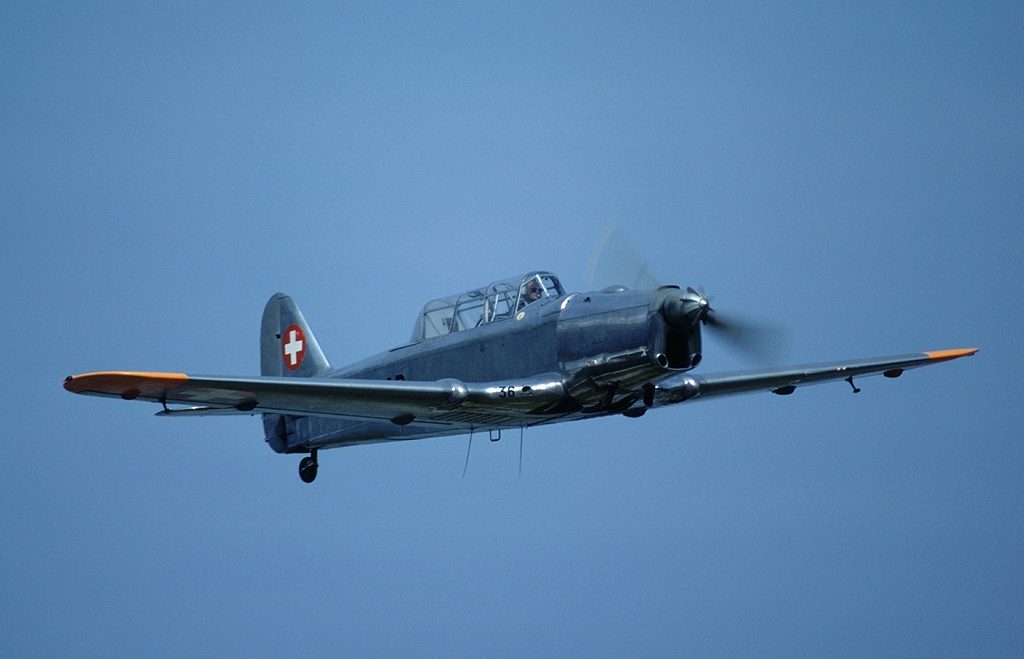
Pilatus P-2
Switzerland’s piston-era trainer
The propeller trainer Pilatus built to turn Swiss recruits into fighter pilots — an Argus-V12 warbird still flying from Grenchen today, and the aircraft that founded the Pilatus trainer dynasty.
The trainer that founded a Pilatus dynasty
In the closing months of the Second World War, neutral Switzerland needed a modern trainer to bridge the gap between primary flying and its front-line fighters — a fleet that then included licence-built and purchased Messerschmitt Bf 109s. The young Pilatus Aircraft company at Stans answered with the P-2, a low-wing, all-metal, tandem two-seater with retractable gear that first flew on 27 April 1945.
The P-2 was deliberately designed to fly and feel like the fighters its graduates would go on to. Cockpit ergonomics, retractable undercarriage, flaps and a powerful inline engine gave Swiss students a realistic step up toward the Bf 109 and, later, the P-51 Mustang and de Havilland Vampire. It could also be fitted for gunnery and light bombing practice, doubling as an armament trainer.
Power came from the Argus As 410, an air-cooled inverted-V12 of German design rated at around 465 PS (about 340 kW). Only about 55 airframes were built — every one for the Swiss Air Force — split between the P-2-05 and the armed P-2-06. It was never exported and never fired a shot in anger, yet it soldiered on in Swiss service for an extraordinary length of time, finally retiring around 1981 after roughly three and a half decades.
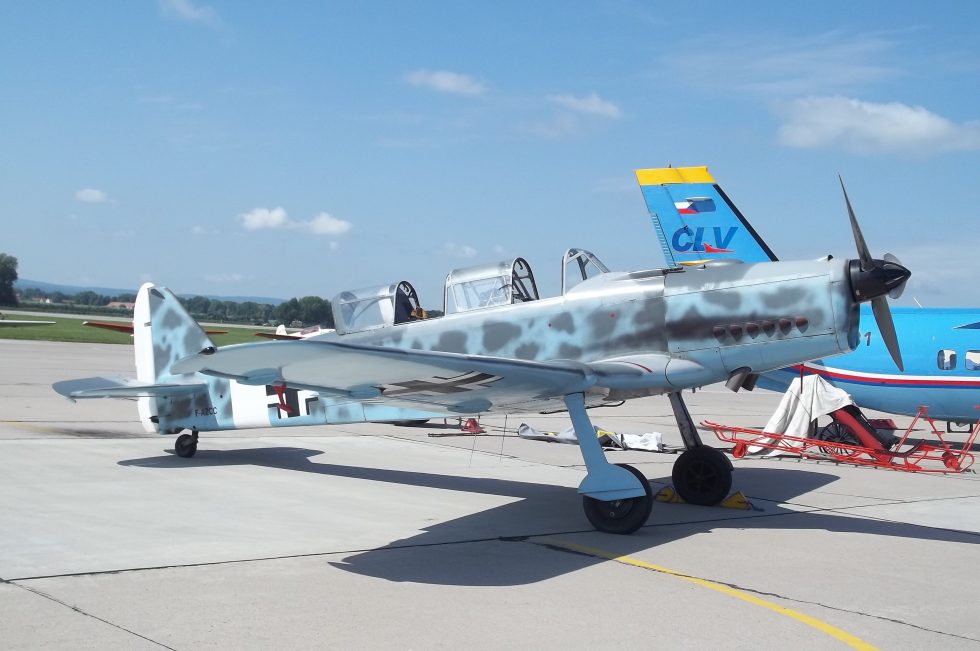
When the Swiss Air Force let them go, collectors seized on them. The P-2’s vintage lines, throaty V12 and rarity made it a prized warbird; several remain airworthy across Europe, and some have worn wartime German or P-51-style paint schemes for films and airshows. Its design DNA also lived on: the P-2 led directly to the piston Pilatus P-3 and, through it, to the turboprop PC-7 that made Pilatus a world leader in military trainers.
Best of all, the P-2 is one of the few aircraft in this encyclopedia you can still fly in yourself. MiGFlug’s partner GoAviator operates a genuine P-2 warbird from Grenchen, Switzerland, offering roughly 45-minute sightseeing or aerobatic flights (see the Q&A below).
01The Pilatus P-2’s origins: a wartime Swiss trainer for a fighter force
Switzerland spent the war defending its airspace with a mix of Bf 109s and Morane fighters, and needed a home-grown advanced trainer to prepare pilots for them. Pilatus, founded in 1939, designed the P-2 to combine forgiving handling with fighter-like systems — retractable gear, flaps, a constant-speed propeller and a strong inline engine. The prototype flew in April 1945; deliveries to the Flugwaffe ran through the late 1940s. Because it was built purely for Swiss needs, production was small — commonly given as about 55 aircraft — and the type never left Swiss military service until the early 1980s.
What makes the Pilatus P-2 special
An Argus As 410 inverted-V12 heart
The P-2 is powered by the Argus As 410, an air-cooled, inverted-V12 of German wartime design producing roughly 465 PS (~340 kW). Inverting the V put the cylinder banks below the crankshaft, lowering the thrust line and improving the pilot’s forward view over the nose — a real advantage for a trainer. Its distinctive throaty growl is a large part of why the P-2 is so prized on the modern warbird circuit.
Built to fly like a Bf 109
Switzerland’s front-line fighters were Messerschmitt Bf 109s, and the P-2 was shaped to prepare pilots for them. A narrow-track retractable undercarriage, similar cockpit layout and comparable approach behaviour gave students a realistic taste of a high-performance taildragger fighter before they ever strapped into one — which is exactly why enthusiasts nickname it the “Bf 109 trainer.”
A true advanced trainer — and gunnery platform
Beyond basic handling, the P-2 taught the business of combat flying. The armed P-2-06 could carry a machine gun plus practice bombs and rockets, letting students learn air-to-ground gunnery and weapons delivery. Two tandem seats under a long glasshouse canopy let an instructor supervise every phase from behind.
02The Pilatus P-2’s Argus As 410 engine: a German V12 in a Swiss airframe
The Argus As 410 was a compact air-cooled inverted-V12 developed in Germany in the late 1930s, widely used on wartime types. Switzerland obtained and operated the engine for the P-2, and its air-cooling made it well suited to Alpine operations without the vulnerability of a liquid-cooled radiator. Rated at roughly 465 PS, it gave the P-2 lively performance for a trainer — a top speed commonly cited around 340 km/h — while remaining docile enough for ab-initio advanced students.
03The Pilatus P-2 and the P-3/PC-7 lineage it started
The P-2 was Pilatus’ first real military-trainer success and set the template for what followed. Its successor, the Pilatus P-3 of the early 1950s, refined the concept with a more modern airframe; the P-3 in turn led to the hugely successful turboprop PC-7 and the wider PC-7/PC-9/PC-21 family that made Pilatus one of the world’s leading trainer manufacturers. In that sense the humble P-2 is the ancestor of aircraft still rolling out of Stans today.
Pilatus P-2 full specifications
Baseline: the Pilatus P-2-06 as delivered to the Swiss Fliegertruppe between December 1949 and September 1950 — the armed advanced and gunnery trainer, Argus As 410A-2 inverted V-12, retractable tailwheel undercarriage, one synchronised machine gun above the engine and two underwing racks — because that is the mark that gave the type its working purpose and the mark that most of today's surviving warbirds actually are. Deltas for the P-2-01 prototype of 1945, the unarmed P-2-05 of 1946–48 and the water-cooled P-2-03/P-2-04 proposals are in grey. Four corrections before the figures. First, the production total and the split. The number repeated almost everywhere is 55 or 56 built, 26 P-2-05 and 26 P-2-06. The Swiss serial blocks will not support it. The unarmed batch ran U-102 to U-128, which is twenty-seven airframes, and the armed batch U-132 to U-157, which is twenty-six — fifty-three production aircraft. Add the P-2-01 prototype, U-101, and the air force took fifty-four flyable machines; the P-2-02 was a static test frame that never flew. The English-language reference works contradict themselves on this: the same article that lists 26 and 26 in its variant table says in its body text that the second batch was twenty-five. The defensible statement is 53 production aircraft in two batches, one flying prototype, one static airframe, one customer, and anyone quoting a tidy 26 plus 26 is quoting a table rather than a delivery record. Second, the construction. The P-2 is routinely called all-metal and it is not. It is a mixed-construction aeroplane — light alloy, steel, wood and fabric — and the economies went further than that: to keep the price down and the supply chain inside Switzerland, Pilatus reused parts already in the Fliegertruppe's stores, most famously the main undercarriage legs and wheels of the Messerschmitt Bf 109E. A Swiss trainer of 1945 therefore stood on German fighter landing gear and was pulled along by a German bomber-trainer engine. Third, the never-exceed speed. The figure of 720 km/h (447 mph) appears in the standard specification tables. It is not credible for a 340 km/h trainer with a framed sliding canopy and a wooden-structure wing, and it is almost certainly a transposition of 420 km/h. It is reproduced below because it is what the sources say, flagged because it should not be believed. Fourth, the engines. There was never a Swiss production line for the Argus. Every As 410 the P-2 fleet ever used came from a batch bought from Germany during the war, and after May 1945 no more were made anywhere. The type flew for thirty-five years on a closed stock of engines, which is the single most important fact about its service life and the reason the warbird fleet flies as sparingly as it does today.
Dimensions & weights
- Crew
- 2 — pupil and instructor in tandem, full dual controls, under a long multi-framed sliding canopy
- Length
- 9.07 m (29 ft 9 in) Swiss data sheets give 9.02 m (29 ft 7 in); the difference is a tailwheel-up versus tail-down measurement, not two aeroplanes
- Wingspan
- 11.00 m (36 ft 1 in)
- Height
- 2.70 m (8 ft 10 in)
- Wing area
- 17.00 m² (183 sq ft)
- Aspect ratio
- 7.1
- Empty weight
- 1,380 kg (3,042 lb)
- Empty equipped
- 1,520 kg (3,351 lb) with radio, oxygen, night-flying equipment and, on the P-2-06, gun and racks
- Maximum take-off weight
- 1,970 kg (4,343 lb)
- Useful load
- ~590 kg (~1,300 lb) over bare empty weight — two crew, fuel, oil and stores
- Internal fuel
- ~225 l (~59 US gal / 49 imp gal) in three tanks
- Wing loading
- 116 kg/m² (23.7 lb/sq ft) at maximum weight
- Power loading
- 4.2 kg/hp (9.3 lb/hp) on take-off power
- Airframe
- Mixed construction — light alloy, steel tube, wood and fabric; low cantilever wing, retractable tailwheel undercarriage (main legs and wheels of Bf 109E origin)
Performance
- Maximum speed
- 340 km/h (211 mph, 184 kn) at 2,500 m (8,200 ft) Swiss sources quote 335 km/h (208 mph)
- Maximum cruise
- 332 km/h (206 mph, 179 kn) at 3,300 m (10,800 ft)
- Economical cruise
- 306 km/h (190 mph, 165 kn) at 4,500 m (14,800 ft) German-language data give a school cruise of 265 km/h (165 mph), which is the speed a syllabus sortie was actually flown at
- Never-exceed speed
- 720 km/h (447 mph, 389 kn) as published — see the correction above; treat 420 km/h (261 mph) as the plausible reading
- Landing speed
- 105 km/h (65 mph, 57 kn) Swiss figures give 120 km/h (75 mph), most likely an over-the-fence rather than a threshold speed
- Rate of climb
- 6.5 m/s (1,280 ft/min) at sea level 7.5 m/s (1,476 ft/min) in Swiss data
- Service ceiling
- 6,600 m (21,650 ft)
- Range
- 865 km (537 miles, 467 nmi) in still air at economical cruise on full fuel Swiss practice quoted a working radius equivalent to about 560 km (348 miles), which is the same aeroplane flown with reserves and a syllabus profile
- Endurance
- ~2 h 45 min at economical cruise; a typical training detail was 45 to 60 minutes
- Take-off run
- 231 m (758 ft) from grass
- Landing run
- 157 m (515 ft) on grass
- Aerobatics
- Cleared for the complete Swiss aerobatic and spinning syllabus; the P-2 was flown inverted, spun deliberately and used for formation and tail-chase training throughout its career
Propulsion & systems
- Engine
- 1 × Argus As 410A-2, air-cooled inverted V-12, German-built
- Displacement
- 11.95 l (729 cu in), bore and stroke 105 mm × 115 mm (4.13 in × 4.53 in)
- Take-off power
- 347 kW (465 PS / 459 hp) at 3,100 rpm
- Rated power
- 272 kW (370 PS / 365 hp) at 2,000 m (6,560 ft)
- Maximum continuous
- 232 kW (315 PS / 311 hp) at 2,820 rpm
- Supercharger
- Single-stage, single-speed geared centrifugal blower
- Engine dry weight
- 315 kg (694 lb) — roughly a fifth of the aeroplane's empty weight
- Propeller
- Two-blade Argus constant-speed unit, pitch changed by the Argus automatic control driven by a finned spinner acting as a windmill ahead of the blades — an elegant German idea that gave a trainer a governed propeller without a hydraulic system for the pupil to mismanage
- Fuel system
- Three tanks totalling ~225 l (~59 US gal); 87 octane aviation petrol in Swiss service
- Undercarriage
- Hydraulically retractable main legs and fixed tailwheel; main legs, oleos and wheels drawn from Swiss Bf 109E stock — a deliberate economy that also gave the pupil a genuine retractable-gear checklist to get wrong
- Equipment
- Radio, oxygen, full blind-flying panel and a hood for instrument training, plus night-flying equipment; the P-2 was specified from the start for operation from Switzerland's high-altitude airfields
- Engine supply
- No Swiss production and no licence. The whole thirty-five-year career ran on a finite wartime purchase of German As 410s, and warbird operators today are still living off that same closed pool plus reverse-engineered parts The As 410 is not a robust engine. Connecting-rod and piston failures are its known signature, and that reputation follows it into private ownership.
04The Pilatus P-2’s operating costs: why no reliable figure exists
The P-2 was a Swiss military procurement of the late 1940s, never sold on an open market, so no dependable flyaway unit price survives in the public record. As a privately owned warbird today its running costs — fuel, maintenance of a rare 1940s V12, insurance and hangarage — are substantial but not publicly documented; any per-flight-hour figure you see is an estimate rather than a sourced number. A useful real-world anchor is the price of the public P-2 experience flight offered from Grenchen, currently around 1,080 CHF for roughly 45 minutes (see the Q&A). Treat all cost figures here as indicative.
Armament & payload
Half the Pilatus P-2 fleet carried one machine gun and a few practice bombs, and that was the entire point of it
The P-2 was never a combat aeroplane and Switzerland never pretended otherwise, so the six headings below are repurposed to describe what a gunnery trainer actually carried rather than padded with six empty cards. Twenty-six aircraft of the second batch, the P-2-06, were built as Schiessflugzeuge: one fixed machine gun above the engine firing through the propeller disc, and two underwing racks each taking three practice or fragmentation bombs, with provision for light rockets. The other twenty-seven, the P-2-05, carried nothing but a radio, an oxygen system and a blind-flying hood. That division of labour is the interesting part of the design. Switzerland did not want an armed trainer because it expected the trainer to fight; it wanted a machine on which a pupil could learn to point an aeroplane at a ground target, fire live rounds on the Axalp and Forel ranges, and be assessed doing it, before he was let near a Morane D-3801 or, later, a Vampire. Mark and fit varied. Sources rarely name the gun; Swiss aircraft of the period carried the 7.5 mm Flieger-Maschinengewehr 29, and that is the strong presumption for the P-2-06, but the calibre is better attested than the exact designation. Rocket provision is documented but was used far less than the bomb racks, and some accounts of P-2 armament describe post-1981 civil or film modifications rather than anything the Fliegertruppe ever fitted.
Gun and synchronisation
- P-2-06 only: one fixed rifle-calibre machine gun mounted in the upper fuselage decking above the engine, firing forward through the propeller arc — the classic inverted-V-12 installation the Argus layout invites
- Calibre 7.5 mm, almost certainly the Swiss Flieger-Mg 29, the Furrer-designed aircraft gun already standard on the EKW C-3603 and the Morane D-3800 series and therefore already in the armourers' hands
- Synchronisation gear timed the gun to the two-blade Argus propeller; the P-2-06 is one of the last new-build aeroplanes anywhere to be delivered with an interrupter gear as standard equipment
- P-2-05: no gun, no mounting, no provision. The unarmed and armed batches were not interchangeable in service
- A single rifle-calibre gun was militarily worthless by 1950 and everyone involved knew it. It was there to teach harmonisation, deflection, range estimation and the discipline of a firing pass on a machine that cost a fraction of an hour on a front-line fighter — and, not trivially, to let an instructor sit behind the pupil and watch him do it.
Ammunition, sights and scoring
- Belt-fed 7.5 × 55 mm Swiss service ammunition, the same cartridge as the infantry rifle and the ground machine guns — a logistics decision that mattered more to Switzerland than ballistic performance did
- Simple reflector or ring-and-bead sighting; the P-2 taught the geometry of a gunnery pass, not the electronics of one
- Camera-gun work and towed-target and ground-target firing on the Swiss ranges, with scoring by hits on the banner or the target frame
- Live firing was flown against ground targets in the Alpine ranges, notably the Axalp firing area above Brienz that the Swiss Air Force still uses
- Ammunition natures and sight fits are the least well documented part of the P-2 story. Swiss training records were not published in the way RAF or USAAF ones were, and much of what circulates in English comes from warbird owners rather than from Fliegertruppe manuals.
Bombs and underwing racks
- Two underwing racks on the P-2-06, each carrying three light stores — six bombs per aircraft
- Practice bombs of a few kilogrammes apiece, smoke- or flash-marked, for dive- and glide-attack instruction
- Fragmentation bombs of similar size could be carried, giving the syllabus a live-ordnance phase without hanging anything heavy on a 1,970 kg (4,343 lb) trainer
- Total ordnance load was trivial in absolute terms — well under 100 kg (220 lb) — and deliberately so
- The racks are the reason a number of P-2s survive in original external configuration: they are visible, they photograph well, and civil owners have generally kept them rather than cleaning the wing up.
Rockets
- Provision existed on the P-2-06 wing racks for light unguided rockets, and the type is consistently described as cleared for them
- Rocket work introduced the pupil to the very different sight picture and much flatter attack profile of a rocket pass before he met it on an operational type
- In practice the bomb racks did most of the teaching; rocket sorties appear far less often in Swiss accounts of the syllabus
- No P-2 ever carried an anti-armour or anti-shipping rocket load in any operational sense — the aeroplane had neither the performance nor the mandate
- This is the weakest-sourced card on the page. That rocket provision existed is well attested; what rockets, in what numbers, on what rail, is not, and no source consulted names a Swiss rocket type for the P-2.
What the unarmed P-2-05 carried instead
- A complete blind-flying panel and a folding instrument hood over the rear cockpit — the P-2 was a serious instrument trainer, not merely an aerobatic one
- Radio and an oxygen system, both specified from the outset because Swiss training fields sit high and the Alps sit higher
- Night-flying equipment, which for a 1945 Swiss trainer meant lighting, the instrument fit and clearance to operate after dark
- Full dual controls in tandem, with the instructor behind — and a retractable undercarriage, which is itself a teaching device: the P-2 was where a Swiss pupil first learned that an aeroplane has a gear lever you can forget
- In a syllabus sense the P-2-05 is the more important of the two batches. It is the machine on which the whole Swiss fighter pilot cadre of the 1950s and 1960s learned to fly on instruments, and it did that job without a single weapon fitted.
What the P-2 never carried
- No cannon of any calibre. Switzerland made some of the best aircraft cannon in the world at Oerlikon — the company that owned Pilatus — and never put one on this aeroplane
- No self-sealing tanks, no armour, no armoured windscreen. The P-2 was not built to be shot at and was never intended for an operational role
- No radar, no gyro gunsight, no gun camera as delivered standard, no external fuel tanks
- No air-to-air weapon of any kind, and no realistic capability to use one; the type was never counted in the Swiss order of battle as a combat aircraft even in an emergency-dispersal role
- Two things belong in this card that are not weapons. The P-2 was never fitted with an ejection seat, and it was never fitted with a nosewheel — both of which mattered when the Fliegertruppe went to jets and the pipeline had to teach a tailwheel-trained pilot to land a Vampire.
Three typical loadouts
- Advanced flying and instrument detail, P-2-05
- Two crew, full fuel, no external stores. Hood up in the rear cockpit, forty-five to sixty minutes of unusual attitudes, timed turns, radio-range and let-down practice, then a circuit and a wheeler onto grass. The commonest P-2 sortie flown, and the one the type existed for.
- Gunnery detail, P-2-06
- Two crew, one 7.5 mm machine gun loaded, no bombs. Transit to the Alpine range, a sequence of firing passes on a ground target with the instructor calling the pattern, scoring on return. Fuel loaded for the range transit plus a generous mountain-weather reserve.
- Ground-attack introduction, P-2-06
- Two crew, gun loaded, six light practice bombs on the two underwing racks. Dive and glide deliveries against a marked target, smoke plot read from the ground, followed by strafing passes with whatever ammunition remained. About as much offensive load as the type ever carried at one time.
Sourcing caveat: the P-2's armament is thinly documented in English and only slightly better in German. The gun's calibre, the two three-bomb racks and the existence of rocket provision are consistent across sources; the gun's exact designation, ammunition natures, sight type and rocket type are not, and no manual-level source was available for this entry. Where this section names the Flieger-Mg 29 it is drawing an inference from standard Swiss practice, and says so.
Variants
Six designations, two of which flew in numbers, and a line of descent that runs straight to the PC-7
The P-2 exists because Switzerland decided, as a matter of doctrine rather than industrial vanity, that a neutral country cannot depend on foreign factories for the aeroplanes it trains its pilots on. Between the wars the Confederation built the Morane-Saulnier MS.406 under licence as the D-3800 and D-3801 at the federal works at Thun and at Altenrhein, built the EKW C-3603 outright, and bought Bf 109s from Germany while it could. Pilatus Flugzeugwerke was founded at Stans on 16 December 1939 into exactly that policy — backed by Emil Bührle of Werkzeugmaschinenfabrik Oerlikon with the Elektrobank, sited deliberately in the interior of the country beside Buochs airfield and far from any frontier, and set to work first on maintenance and on assembling C-35s from spares.
Pilatus wanted to build a trainer and tried twice to buy a licence — for the German Arado Ar 96 and, on the procurement authority's side, for an Italian design. Both attempts failed, and the failure is the best thing that ever happened to the company: told it could not build somebody else's aeroplane, it designed its own. The preliminary study, openly indebted to the Arado, went to the air force in 1942; construction of the prototype began late in 1943; the first flight was on 27 April 1945, three weeks before the war in Europe ended. Fifty-three production aircraft followed, and Pilatus — a firm with no aeroplane of its own to its name in 1942 — had a product.
What followed matters more than the P-2 itself. The P-3 of 1953 is a P-2 rethought for the jet age: tricycle undercarriage, side-by-side ideas rejected in favour of the same tandem seating, a flat-six Lycoming in place of the German V-12. The PC-7 of 1966 and 1975 is a P-3 with a Pratt & Whitney Canada PT6A turboprop where the Lycoming was. From that came the PC-9 and the PC-21, and from the money they earned came the PC-6, the PC-12 and everything Pilatus is today. The line from a wartime trainer built around scavenged Messerschmitt landing gear to the aeroplane that trains a large fraction of the world's military pilots is unbroken and traceable aircraft by aircraft.
- P-2-01 (1943–45, 1 built)
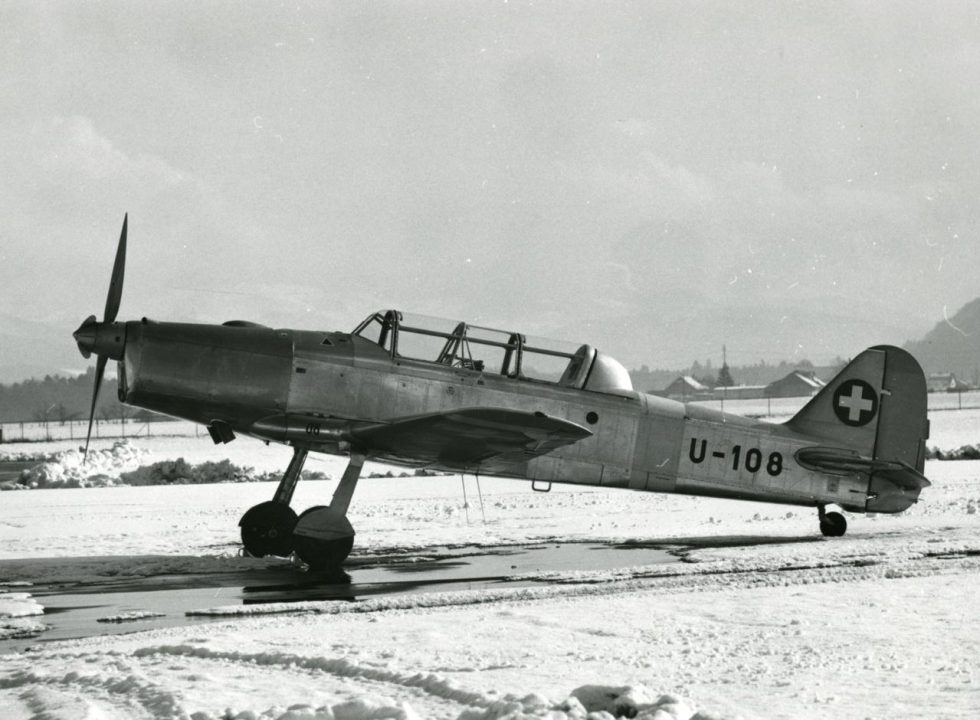
- The prototype. Argus As 410A-2, unarmed, flown 27 April 1945; carried the civil marks HB-GAB and the military serials A-101 and U-101 at different points in its life. Preserved by Pilatus at Stans.
- P-2-02 (1944, 1 built, never flew)
- Static test airframe for structural proof loading. It is a real airframe and is why some totals say 55 or 56 where delivery records say 54.
- P-2-03 (project / prototype, water-cooled)
- Alternative powerplant study around the Hispano-Suiza 12Mb, an upright water-cooled V-12, with a large ventral radiator that transformed the aeroplane's appearance. Pursued as insurance against the German engine supply, abandoned once the Argus stock proved sufficient.
- P-2-04 (project, water-cooled and armed)
- Armed derivative of the P-2-03: the gunnery-trainer requirement married to the Hispano-Suiza installation. Not proceeded with; the armament requirement went instead to the Argus-engined P-2-06.
- P-2-05 (1946–48, 27 built, U-102 to U-128)
- The unarmed advanced trainer and the first Pilatus aeroplane in series production. Radio, oxygen, blind-flying hood, night-flying equipment, no weapons. Ordered after the 1946 trials and the aircraft on which Swiss pilots learned instrument flying for a generation.
- P-2-06 (December 1949 to September 1950, 26 built, U-132 to U-157)
- The armament trainer: one synchronised 7.5 mm machine gun above the engine and two underwing racks for three light bombs each, with rocket provision. Externally near-identical to the P-2-05 apart from the gun trough and the racks.
- Civil conversions (from 1981, ~48 airframes)
- Not a factory variant but the largest single population. On withdrawal the fleet was sold complete into private hands and re-registered in Switzerland, Germany, France, the United Kingdom and the United States. Most changes are paperwork and paint; a few aircraft have had the armament removed or replaced with dummies.
- Film aircraft (1980s onward, a handful)
- Several civil P-2s have been dressed as German fighters — spinner, cross, splinter camouflage, sometimes a dummy cannon — and used as generic Luftwaffe types on screen and at airshows. The best known appearance is in Indiana Jones and the Last Crusade (1989). No P-2 is a Messerschmitt of any kind and none has ever been converted into a flying replica of one; the resemblance is entirely a matter of the inverted-V nose and the paint.
Survivors, honestly. Roughly forty-eight airframes were still on charge when the Fliegertruppe retired the type in 1981 and were sold as a fleet into private ownership — an unusually clean disposal that is the reason so many exist today. By 2008 at least twenty-three were carried on the civil registers of Switzerland, Germany, France, the United Kingdom and the United States, and the prototype U-101 is preserved at Pilatus in Stans. Every one of these is an original Pilatus-built airframe: no P-2 replica or reproduction has ever been constructed, and the type has no kit, homebuilt or scaled derivative. What cannot be stated honestly is how many fly in any given year. There is no audited airworthiness census, register entries lag reality by years in both directions, and the binding constraint is not the airframe but the Argus As 410 — an engine out of production since 1945, with a reputation for connecting-rod and piston failure, and no source of new parts. The realistic picture is a few dozen surviving airframes, a smaller number currently airworthy, and a still smaller number flown regularly. Any figure quoted more precisely than that is a guess wearing a number.
Operators
The Pilatus P-2 was built for one customer, the Swiss Air Force, and flew for it for 35 years.
Pilatus’s first production aircraft borrowed its undercarriage from the Bf 109 and its engine from Germany, and every one of the 53-odd examples went to the Swiss Fliegertruppe as an advanced and weapons trainer between 1946 and 1981. No foreign air force ever bought it; its second life came on the civil warbird circuit, where it doubles for Luftwaffe fighters in films. Production is quoted as 52, 53 or 54 depending on whether prototypes are counted; a claimed Haitian Air Force example is unsourced and omitted.
In service with
- No current military operator
- —
Formerly operated by
- Swiss Air ForceSwitzerland · 26 P-2.05 delivered 1946–48 and 27 armed P-2.06 in 1949–50, plus prototypes; about 48 survivors sold to civil owners
- 53 · 1946–1981
1 operators, 0 current. Quantities are airframes taken on charge; dates are first delivery to last retirement. Air forces with a MiGFlug Order of Battle page are linked (1 so far); the rest follow as the database grows.
From wartime trainer to flying warbird
Pilatus is founded
Pilatus Aircraft is established at Stans, Switzerland — the company that will build the P-2 and, later, the PC-7 family.
First flight
The P-2 prototype takes to the air on 27 April 1945, in the final weeks of the Second World War.
Swiss Air Force service
About 55 aircraft — the P-2-05 and the armed P-2-06 — enter service as advanced and armament trainers.
The P-3 follows
Lessons from the P-2 feed directly into the Pilatus P-3, beginning the trainer lineage that leads to the PC-7.
Retirement
After roughly 35 years the Swiss Air Force withdraws the P-2, and airframes begin passing to civilian owners.
Warbird second life
Surviving P-2s become sought-after warbirds across Europe; several are repainted in wartime or P-51-style colours for films and airshows.
Fly one yourself
A genuine P-2 flies passenger experience flights from Grenchen through MiGFlug’s partner GoAviator — sightseeing or aerobatics.
Twelve stories from the Pilatus P-2
A trainer born at war’s end
The P-2 first flew on 27 April 1945, as Pilatus set out to equip the Swiss Air Force.
Read the full story
The “Bf 109 trainer”
Its narrow-track retractable gear and fighter-like cockpit prepared students for the Messerschmitt.
Read the full story
A German V12 in Swiss service
The air-cooled inverted-V12 Argus As 410 gives the P-2 its unmistakable growl.
Read the full story
Just 55, all Swiss
Every P-2 built served one air force — Switzerland’s.
Read the full story
Learning to fight
The armed P-2-06 could carry a gun, practice bombs and rockets for weapons training.
Read the full story
Thirty-five years on strength
The P-2 served the Swiss Air Force from 1946 until around 1981.
Read the full story
Grandfather of the PC-7
The P-2 led to the P-3, and the P-3 to the world-beating PC-7.
Read the full story
A movie Messerschmitt
Several P-2s have been painted in wartime German colours for films and airshows.
Read the full story
A prized collector’s aircraft
After retirement the P-2 became a sought-after European warbird.
Read the full story
You can fly one today
A genuine P-2 flies passenger experience flights from Grenchen, Switzerland.
Read the full story
Preserved for the nation
Swiss museums keep P-2s on permanent display.
Read the full story
A quiet Swiss classic
Never exported, never in combat — yet a landmark aircraft.
Read the full story
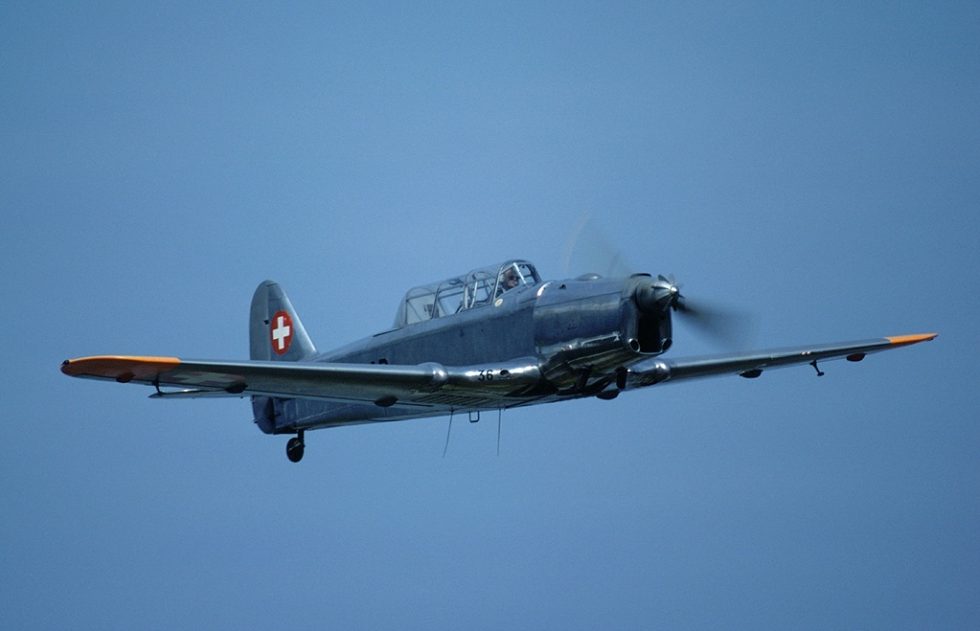
The Pilatus P-2 in pictures
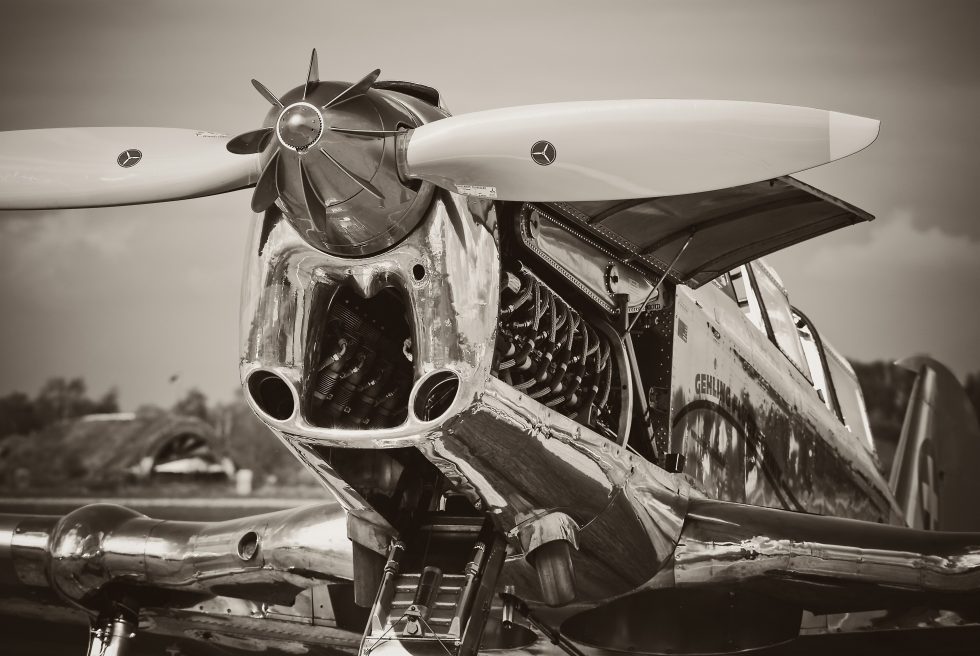
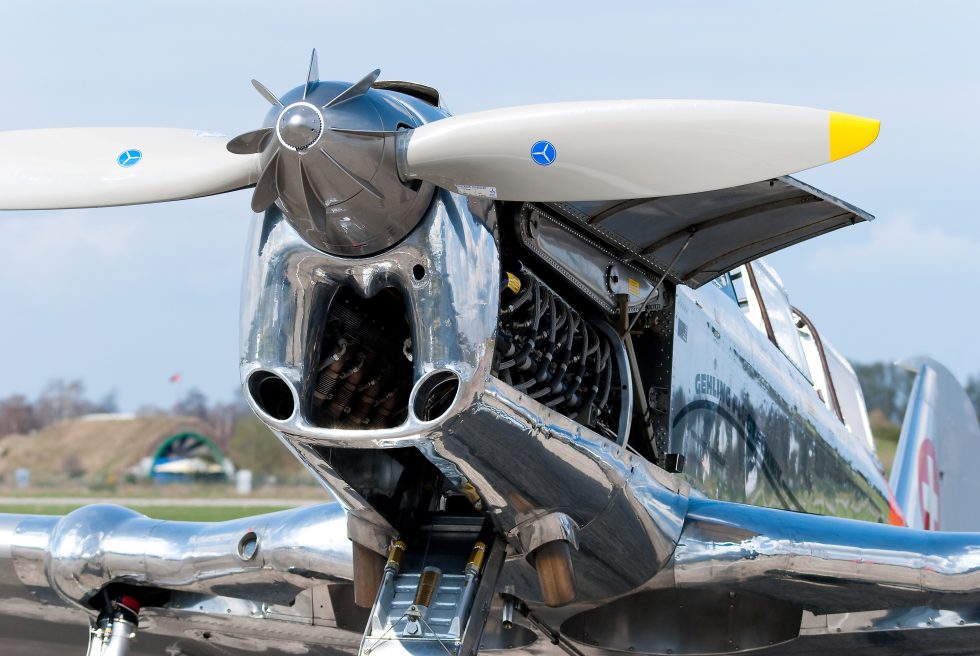
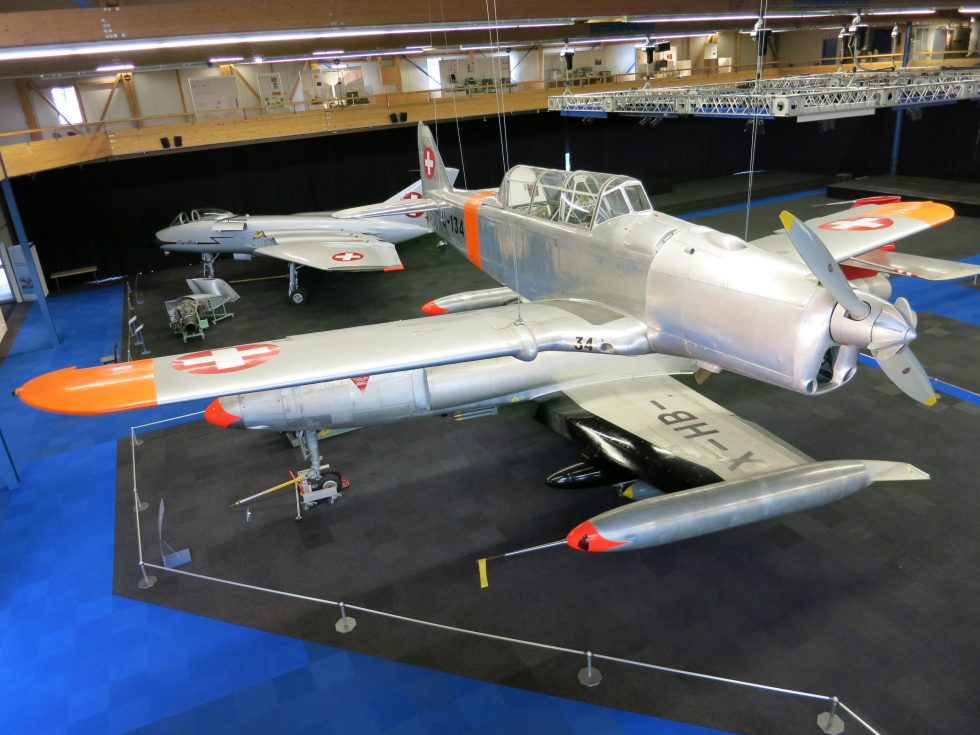
The Pilatus P-2 in motion
Pilatus P-2 — the Messerschmitt Bf-109 Trainer. Airshow footage of an airworthy P-2 flying and showing off the deep note of its air-cooled Argus V12 — the aircraft that once prepared Swiss pilots for the Bf 109.
Where the Pilatus P-2 flew
A trainer, not a fighter
The Pilatus P-2 never flew in combat — that was never its purpose. Its record is written in the thousands of Swiss pilots it prepared for front-line fighters over three and a half decades, and in the rare distinction of still being flyable today. These are the numbers that define it.
Explore the rest of the Book of Beasts aircraft encyclopedia for the fighters the P-2’s graduates went on to fly.
Everything people ask about the Pilatus P-2
Can I fly in a Pilatus P-2?
What is the Pilatus P-2?
What engine does the Pilatus P-2 have?
How many Pilatus P-2s were built?
Why is it called the “Bf 109 trainer”?
Is the Pilatus P-2 related to the PC-7?
How fast is the Pilatus P-2?
Are any Pilatus P-2s still flying?
You can fly the Pilatus P-2.
Book the real warbird.
MiGFlug’s partner GoAviator flies a genuine Pilatus P-2 warbird from Grenchen, Switzerland — a roughly 45-minute sightseeing or aerobatic flight in a piece of Swiss Air Force history. And if you catch the bug, MiGFlug has put civilians in real military cockpits since 2004.
 Fly the L-39 AlbatrosThe world’s most-flown jet trainer — aerobatics included
 Fly the F-104 Starfighter“The missile with a man in it”
 Fly the MiG-21The Cold War’s most-produced jet
 Fly the T-33 Shooting StarAmerica’s first jet trainer
 Fly the DH VampireA piece of early jet history
 Fly the S.211Agile Italian jet trainer
 Fly the MB-326The classic Aermacchi jet
 Fly the MiG-15The Soviet legend of the Korean War
Continue the tour
Every fact, checked
- Pilatus AircraftCompany history and the trainer lineage from the P-2 through the P-3 to the PC-7 family.
- Swiss Armed Forces / Swiss Air ForceReference for Swiss Air Force trainer operation and the 1946–1981 service period.
- Swiss aviation heritage collectionsBackground on preserved and airworthy Swiss warbirds including the P-2.
- GoAviator — Pilatus P-2 flight experience, GrenchenDetails of the public P-2 warbird flight: duration, price and sightseeing or aerobatic options.
- flugzeuginfo.netCross-checked dimensions, weights and performance figures for the P-2.
- Wikimedia Commons — Pilatus P-2Image source and licensing for the photographs used on this page.
- MiGFlug Book of BeastsThe wider aircraft encyclopedia, including the fighters P-2 graduates went on to fly.