
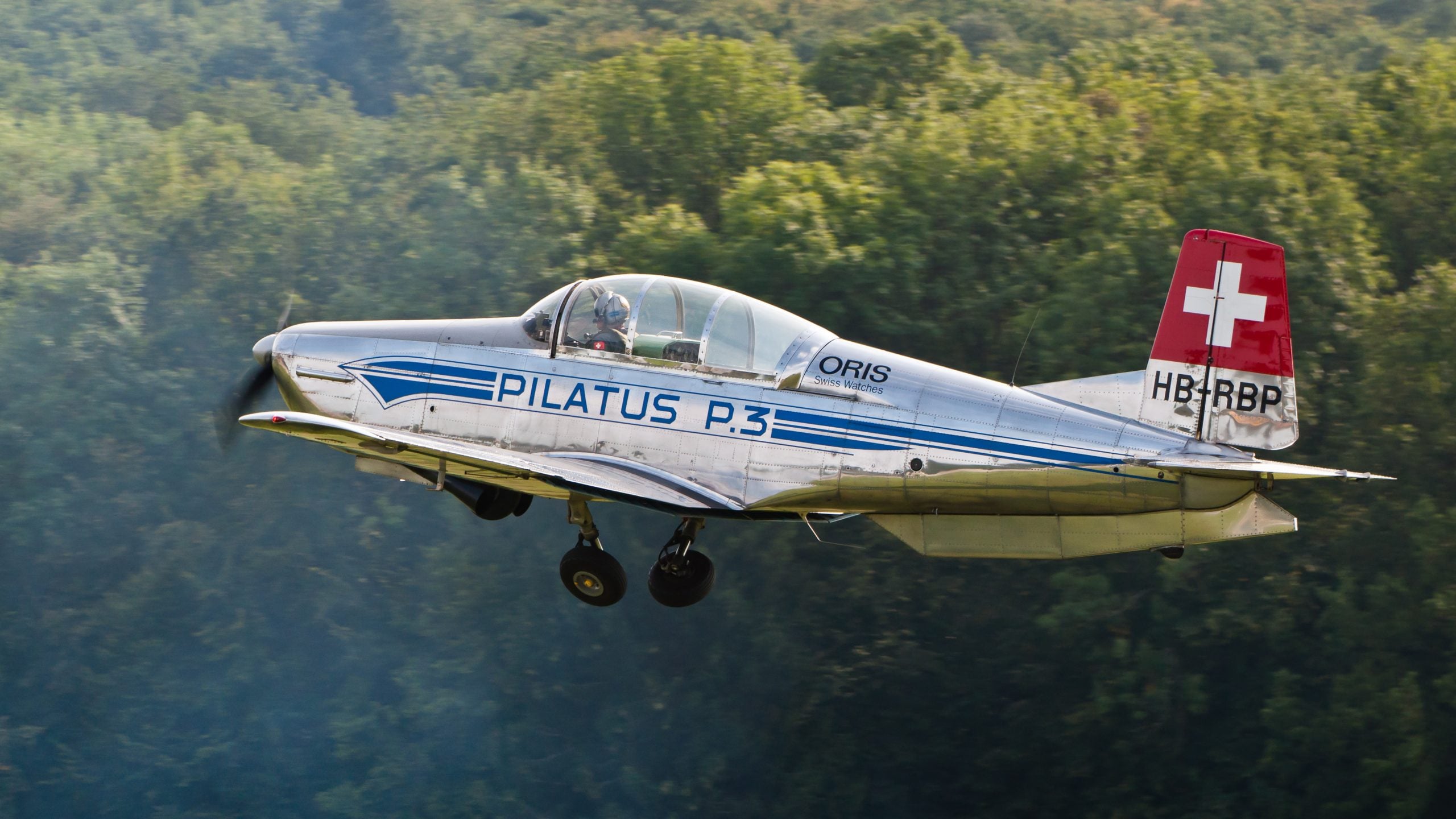
Pilatus P-3
Switzerland’s aerobatic trainer
The all-metal piston trainer that taught the Swiss Air Force to fly for nearly four decades — and the airframe whose turboprop descendant became the world-conquering PC-7.
The Pilatus P-3: Switzerland’s home-built trainer
After the Second World War the Swiss Air Force faced a quiet but pressing problem. Its cadets learned to fly on the piston Pilatus P-2, a competent tail-wheel trainer of 1945, but the jet age was arriving fast — de Havilland Vampires and, soon, Hawker Hunters were entering Swiss service. The gap between a docile tail-dragger and a swept-wing jet was widening, and Switzerland wanted a modern stepping stone that could take a raw recruit and hand a jet squadron a competent, confident pilot. Being Switzerland, it preferred to build that machine itself.
The job fell to Pilatus Aircraft, the mountain-valley firm at Stans that had already built the P-2. The design that emerged, first flown in 1953, was deliberately unremarkable in the best sense: an all-metal, low-wing monoplane with tandem seating, a framed sliding canopy, a geared Lycoming flat-six and — crucially — a retractable tricycle undercarriage. The nose-wheel layout was a teaching decision as much as an engineering one. It gave cadets the modern ground handling and gear discipline they would need in jets, while the airframe itself was rugged enough to shrug off the heavy landings that come with teaching people to fly.
The Swiss Air Force ordered the P-3 into service from 1956, and around 72 aircraft — the initial P-3-03 and the definitive P-3-05 — became the backbone of Swiss ab-initio training. For a generation of Swiss pilots the P-3 was the first aircraft they ever soloed, spun, looped and rolled. It was fully cleared for aerobatics, and Swiss instructors used that clearance hard: the syllabus put students through spins, stall recovery and basic combat manoeuvring, and even fitted an underwing pod so cadets could learn the rudiments of gunnery and ground attack before graduating to fast jets.
Only one foreign air arm ever bought the type. Brazil took a small batch — commonly cited as six aircraft — in the second half of the 1950s, making it the P-3’s sole export customer. In all, roughly 75 were built. By the standards of the great trainer programmes that is a tiny number, and yet the P-3’s influence reaches far beyond its production run.
That influence is the P-3’s real story. In the mid-1960s Pilatus engineers took a P-3 airframe, removed its piston engine and installed a Pratt & Whitney Canada PT6 turboprop. The converted aircraft flew, proved the concept, and became — in all but name — the prototype of the PC-7 Turbo Trainer. Through the PC-7 came the PC-9 and the widely exported PC-21, a turboprop dynasty now flown by dozens of air forces. The unassuming Swiss piston trainer had, quietly, seeded one of the most successful trainer families in history.
The P-3 itself soldiered on until the early 1990s, when the PC-7 finally replaced it in Swiss service after roughly 35 years. Retirement was not the end. Dozens of airframes were sold to private owners across Europe and North America, where the type’s toughness, aerobatic clearance and good looks made it a natural warbird. The P3 Flyers formation team keeps a flight of them display-flying today, and — from Grenchen in Switzerland — you can book a real flight in a genuine ex-Swiss P-3 through MiGFlug’s partner GoAviator. Few Cold War trainers are this easy to meet in the air.
01The Pilatus P-3’s lineage: from the P-2 to the world-beating PC-7
The P-3 sits at the exact hinge of a remarkable family tree. Its predecessor, the Pilatus P-2 of 1945, was a tail-wheel piston trainer that served the Swiss Air Force from the late 1940s and did sterling work, but belonged to an earlier era of flying-school design. The P-3 modernised the whole concept: a nose-wheel tricycle undercarriage for jet-age ground handling, a more powerful geared engine, an all-metal stressed-skin airframe and a cockpit laid out to prepare cadets for fast jets rather than propeller-driven fighters.
Then came the leap that made history. In the mid-1960s Pilatus fitted a P-3 airframe with a Pratt & Whitney Canada PT6 turboprop — a light, powerful, reliable engine that transformed the aircraft’s performance. That experiment became the basis of the PC-7 Turbo Trainer, which entered production in the late 1970s and sold around the world. The PC-7 in turn led to the more powerful PC-9 and, later, the PC-21, aircraft that today train military pilots on every inhabited continent. So while only about 75 P-3s were ever built, the design lineage it launched has been produced in the many hundreds. The humble Swiss piston trainer is, quite literally, the ancestor of a global turboprop dynasty.
What makes the Pilatus P-3 special
An all-metal trainer built to last
The P-3 is a stressed-skin, all-metal low-wing monoplane — sturdy enough to absorb the heavy landings and constant abuse of ab-initio training. Its retractable tricycle undercarriage was a deliberate teaching choice: unlike the tail-dragging P-2 before it, the nose-wheel layout taught cadets modern gear discipline and gave them a stable, forgiving platform on the ground. That toughness is a big part of why so many airframes survive and still fly today.
A geared flat-six for aerobatics
Power comes from a single Lycoming GO-435, a geared, air-cooled horizontally-opposed six-cylinder piston engine of roughly 240 horsepower, turning a two-blade constant-speed propeller. Fully cleared for spins and aerobatics, the P-3 let Swiss instructors drill loops, rolls and stall recovery all day — the core airmanship a fighter pilot would later need. The reduction gearbox let the engine run efficiently while spinning the prop at a quieter, more effective speed.
A weapons trainer, not just a flying school
The P-3 was more than a gentle hack. It could be fitted with an underwing pod carrying a 7.5 mm machine gun plus light practice bombs, so students learned the rudiments of gunnery and ground attack before graduating to combat types. That dual role — primary trainer and weapons trainer — kept the type genuinely useful across decades of Swiss service.
02The Pilatus P-3’s cockpit and training syllabus: how Switzerland made pilots
Instructor and student sit in tandem under a long framed canopy, each with a full set of dual controls, mirroring the single-file seating of the fast jets cadets were headed for. The training progression was methodical. Students began with straight-and-level handling, circuits and their first solo; moved on to stalls, incipient and fully developed spins, and recovery; then to the full aerobatic repertoire — loops, rolls, stall turns and combinations; and finally to formation flying, instrument work and the elements of tactical flying, including gunnery with the underwing pod. Because the P-3 was benign near the stall yet fully aerobatic, an instructor could demonstrate a manoeuvre and hand it straight over, building confidence quickly. Only once a cadet had mastered the P-3 did they graduate to jets such as the Vampire, Venom or Hunter.
03The Pilatus P-3’s engine: why Pilatus chose a geared Lycoming flat-six
Pilatus picked the American Lycoming GO-435 — the “G” denoting a reduction gearbox. Gearing let the engine spin fast and efficiently while turning the propeller at a slower, quieter, more efficient speed, delivering the usable torque an aerobatic trainer needs for climb and vertical manoeuvres. The horizontally-opposed, air-cooled six was mechanically simple, cheap to maintain and forgiving of the abuse student pilots inevitably hand out — cold starts, mishandled throttles, hard landings. An inverted fuel and oil system allowed sustained inverted flight, essential for the aerobatic syllabus. Power figures around 240 hp are commonly cited; exact ratings vary a little by sub-type and source.
04The Pilatus P-3’s structure: all-metal toughness for a flying school
Where many trainers of the 1940s still used fabric-covered wood or steel-tube fuselages, the P-3 was built as a modern all-metal, stressed-skin aircraft — aluminium alloy throughout, with a low cantilever wing and a semi-monocoque fuselage. This mattered for a machine that would spend its life being hammered by learners. Stressed-skin construction is stiff, damage-tolerant and easy to inspect and repair, so the P-3 could absorb thousands of firm arrivals and years of hard aerobatic use without fatigue trouble. It also made the aircraft straightforward to keep airworthy long after retirement, which is exactly why so many P-3s remain flyable as warbirds today when more fragile contemporaries have long since been grounded.
05The Pilatus P-3’s gunnery pod: turning a trainer into a weapons platform
The P-3 was designed with a genuine weapons-training role in mind. Under the wing it could carry a pod housing a 7.5 mm machine gun, together with racks for light practice bombs and, in some configurations, small rockets. With these fitted, instructors could take cadets through the basics of air-to-ground gunnery, dive-bombing and weapons delivery — skills that would otherwise have to wait until the far more expensive jet phase. It meant a Swiss cadet arrived at their first combat type already understanding sight picture, dive angles and firing discipline. For a small air force watching every franc, teaching those fundamentals on a cheap piston trainer was simply good economics.
Full Pilatus P-3 specifications
Baseline: the P-3.05, the 60-aircraft main production batch delivered to the Swiss Fliegertruppe from 1957 as A-814 to A-873, with the Lycoming GO-435-C2A2 and the three-blade Hartzell propeller. Deltas for the two prototypes, for the twelve pre-series P-3.03 (A-802–A-813) and for the six civil-registered P-3.04 sold to Brazil are in grey. Figures are for a clean aeroplane in the training configuration, with no stores on the wing stations. Note that authorities disagree on the P-3 more than the aircraft's modest career would suggest: German-language sources give an empty weight of 1,190 kg and a maximum weight of 1,530 kg against the 1,090 kg and 1,500 kg of the Jane's 1958–59 entry, and German tables routinely print the 500 km/h never-exceed figure in the maximum-speed row, which has propagated a badly wrong picture of a 260 hp trainer.
Dimensions & weights
- Crew
- 2, in tandem under one long canopy, with full dual controls; the rear seat was the instructor's and could be curtained off with a blind-flying hood
- Length
- 8.75 m (28 ft 8 in) several online tables convert this to 29 ft 8 in, which is simply an arithmetic slip: 8.75 m is 28 ft 8.5 in
- Wingspan
- 10.40 m (34 ft 1 in)
- Height
- 3.05 m (10 ft 0 in) on the tricycle undercarriage, tail down being irrelevant for the first time in Swiss training
- Wing area
- 16.55 m² (178.1 sq ft) German sources round to 16.50 m²
- Aspect ratio
- 6.55:1
- Empty weight
- 1,090 kg (2,403 lb) against 1,190 kg (2,624 lb) in German-language tables; the higher figure probably describes a late aircraft with the ventral fin, radio fit and service equipment rather than a factory-fresh airframe
- Normal loaded weight
- 1,415 kg (3,120 lb) — two crew, full fuel, no stores
- Maximum take-off weight
- 1,500 kg (3,307 lb) 1,530 kg (3,373 lb) in Swiss and German accounts
- Wing loading
- 85.5 kg/m² (17.5 lb/sq ft) at normal loaded weight, 90.6 kg/m² (18.6 lb/sq ft) at maximum — light enough that the aeroplane taught aerodynamics honestly, which was the entire brief
- Power loading
- 5.77 kg/hp (12.7 lb/hp) at maximum weight — the single number that explains every complaint ever made about the P-3
- Structure
- all-metal stressed-skin cantilever low wing and semi-monocoque fuselage, with fabric on no primary surface — a deliberate step away from the mixed construction of the P-2
- Undercarriage
- electrically retractable tricycle with a steerable nosewheel, low-pressure tyres and disc brakes — the first nosewheel aeroplane in Swiss military flying training, adopted specifically so that pupils met a nosewheel before they met a de Havilland Vampire
- Canopy
- one long transparency over both seats giving the instructor a genuine view forward past the pupil's head; on later aircraft a small ventral fin was added under the rear fuselage after two flat-spin accidents
Performance
- Maximum speed
- 310 km/h (193 mph, 167 kn) at sea level to 2,000 m
- Maximum cruise
- 275 km/h (171 mph, 148 kn)
- Economical cruise
- 252 km/h (157 mph, 136 kn) Swiss sources quote 220 km/h (137 mph, 119 kn) as the practical school cruise, which is what an instructor would recognise
- Never-exceed speed
- 500 km/h (311 mph, 270 kn) — a genuinely high VNE for the power, and the reason the P-3 dives cleanly; this figure is frequently and wrongly reprinted as the type's maximum level speed
- Stalling speed
- 100 km/h (62 mph, 54 kn)
- Rate of climb
- 7 m/s (1,378 ft/min, 420 m/min) at sea level — worse than the Bucker Bu 131 biplane and the P-2 the type replaced, and the defect that dogged the P-3 for forty years
- Service ceiling
- 5,500 m (18,050 ft) the English Wikipedia entry lists an absolute ceiling of 5,100 m below its own service ceiling, which is aerodynamically impossible; one of the two numbers is mislabelled
- Range
- ~750 km (~466 miles, ~405 nmi) maximum in still air German sources give ~450 km (~280 miles), which is closer to a realistic school-sortie figure with reserves
- Endurance
- ~2 h 30 min to 3 h on internal fuel at training power settings — derived from tankage and typical consumption rather than quoted in the manual, so treat it as an order of magnitude
- Take-off distance to 15 m
- 342 m (1,122 ft)
- Landing distance from 15 m
- 390 m (1,280 ft) — short enough for the grass and mountain-valley strips the Swiss school system used
- Manoeuvre limits
- cleared for the full aerobatic syllabus including deliberate spinning, inverted flight and night flying limit load factors are usually quoted as +6/−3 g, but the number varies between the Swiss military manual and the individual civil certificates under which surviving aircraft fly today, and no single authoritative figure should be repeated without checking the specific airframe's paperwork
Propulsion & systems
- Engine
- 1 × Lycoming GO-435-C2A2, air-cooled horizontally opposed six-cylinder four-stroke, geared, with dry-sump lubrication
- Rated power
- 194 kW (260 hp) at 3,400 rpm for take-off German-language sources persistently give 240 PS (180 kW). That figure belongs to the plain GO-435-C2 of the first prototype; the Lycoming type data for both the C2 and the C2A2 gives 260 hp, and Brazilian sources quote 263 hp, which is the same rating expressed in metric horsepower
- Displacement
- 7.1 L (434 cu in), bore 123.8 mm (4.875 in), stroke 98.4 mm (3.875 in), compression ratio 7.3:1
- Reduction gearing
- the G in GO-435 — the propeller is geared down from the crankshaft, letting the engine turn 3,400 rpm for power while the propeller stays below the tip-speed limit. It is also why the P-3 sounds unlike any other piston trainer and why its maintenance was fussier than a direct-drive engine's
- Dry weight
- 196 kg (432 lb) for the C2A2 — a heavy engine for its output, and a large part of the P-3's power-to-weight problem
- Propeller
- Hartzell three-blade constant-speed metal the P-3.01 prototype flew with a two-blade propeller and was the only P-3 ever to do so; the change to three blades came with the C2A2 on the P-3.02
- Fuel capacity
- ~160 L (~42 US gal, ~35 imp gal) internal
- Oil system
- dry sump — adopted on the P-3.02 precisely so the engine would keep feeding oil through sustained inverted flight, which a wet-sump installation will not
- Systems
- electric undercarriage and flap actuation, full blind-flying panel in both cockpits, radio and night-flying lighting as standard fit rather than options; dual controls throughout
- Weapons provision
- two underwing stations, plus provision for a machine-gun pod under the port wing — described below
- Turboprop derivatives
- 1 × Pratt & Whitney Canada PT6A-20 in the 1966 PC-7 prototype rebuilt from P-3.01 HB-HON, and a PT6A in the 1975 PC-7 prototype HB-HOZ rebuilt from the Swiss P-3 A-871. Both PC-7 prototypes were converted P-3 airframes, which makes this aeroplane the direct structural ancestor of every PC-7, PC-9 and, at one remove, PC-21
06The Pilatus P-3’s variants: P-3-03, P-3-05 and the Brazilian batch
The P-3 family is small and easy to follow. After the prototype and pre-series aircraft came the first production standard, the P-3-03, followed by the definitive P-3-05, which made up the bulk of Swiss deliveries and incorporated refinements from early service experience. The two Swiss marks account for around 72 airframes between them. The only export version was the small batch built for Brazil in the second half of the 1950s — commonly cited as six aircraft — the type’s sole foreign sale. Because the production run was so short and so heavily Swiss, individual airframes are unusually well documented, and many can be traced by their original Swiss military serials right through to their current civilian registrations.
07The Pilatus P-3’s operating costs: why no clean figure exists
The P-3 was a 1950s Swiss military procurement, never sold on an open commercial market, so no reliable flyaway unit price or official cost-per-flight-hour figure exists in the public record. As a simple piston trainer it was cheap to run by the standards of the jets it fed — modest fuel burn from a single air-cooled engine, straightforward maintenance and no complex avionics. Today, operating a P-3 as a civilian warbird still costs real money in fuel, insurance, hangarage and upkeep, but private owners rarely publish exact numbers. As a booked experience, a P-3 flight from Grenchen is priced roughly in the several-hundred-Swiss-franc range depending on duration. Any precise cost figure attached to a P-3 should be treated as an estimate.
08The Pilatus P-3’s survivors: where the type lives on today
For a type built in such small numbers, the P-3 has an unusually healthy survival rate. When the Swiss Air Force retired its fleet in the early 1990s, dozens of airframes were sold rather than scrapped, and their all-metal toughness made them attractive to private owners and warbird operators. Many are registered and flying today in Switzerland, elsewhere in Europe and in the United States, where a number of ex-Swiss P-3s carry US civil registrations. The P3 Flyers formation team display several in Switzerland, others appear regularly on the airshow and fly-in circuit, and preserved examples sit in Swiss military aviation collections. Uniquely among classic military trainers, one is even offered for booked passenger flights — from Grenchen, through MiGFlug’s partner GoAviator.
Armament & payload
The Pilatus P-3 was wired, plumbed and stressed for weapons training that the Swiss Air Force bought the kit for and then, by most accounts, never actually flew
The P-3 is a trainer, so the six headings below are repurposed rather than padded out with six cards saying "none carried". What matters about this aeroplane's armament is not what it could shoot but the gap between the provision and the practice. Two underwing stations were designed in from the start, capable of light practice bombs or rockets, and a pod housing a machine gun could be hung under the port wing so that a pupil could be taught to aim an aeroplane rather than merely fly one. The kits were bought. The English-language literature and the Swiss accounts agree that they were essentially never used in service, and the surviving photographic record of armed P-3s is thin to the point of absence.
That is worth stating plainly because it says something about how Switzerland trained. Weapons instruction moved to the Vampire and Venom, where a pupil met the real gunsight, the real recoil and the real dive angles of the aeroplane he would fight in. The P-3 was left to do what it did best: teach circuits, instruments, night flying, aerobatics and spin recovery to a standard that made the jet conversion survivable. Fits and provisions varied between the P-3.03 pre-series and the P-3.05, and the civil P-3.04 airframes sold to Brazil were delivered unarmed; Brazilian sources nonetheless describe hardpoint provision for bombs, rocket pods and machine guns on the type, so the capability existed on paper in more than one country.
Gun: the underwing pod
- One machine gun carried in a detachable pod under the port wing, asymmetrically — a single-gun installation for teaching sighting and firing discipline, not a combat fit
- Rifle calibre, matching Swiss service ammunition of the period; sources describing the pod do not consistently name the weapon, and any specific model number quoted for it should be treated as inference rather than record
- Asymmetric mounting means the pupil learned about yaw with power and asymmetric drag as a by-product, which on a 260 hp trainer at 250 km/h is a real and instructive effect
- The pod was removable and the aeroplane spent virtually its whole career without it
- English and French accounts both state that the gun and stores kits were purchased and then never used. That is a strong claim to make about forty years of service and it rests on secondary sources rather than on Swiss procurement records, so it is best read as "no evidence of operational use has surfaced" rather than as a documented negative.
Ammunition, sights and camera guns
- No fixed reflector gunsight is described as standard equipment on the Swiss fleet; the aeroplane's panel was a blind-flying panel, not a fighter panel
- Ammunition would have been Swiss standard rifle-calibre belt, held within the pod itself rather than in the wing — the point of a pod installation being that the airframe needs no magazine bay or feed chutes
- Camera-gun work, drogue shooting and live firing were done on the Vampire and Venom, where the sight, the harmonisation and the dive profile matched the operational aeroplane
- What the P-3 did teach towards gunnery was the underlying skill: precise speed and attitude control, coordinated flight and the ability to hold a dive angle without instrument reference
- Nothing in the accessible literature describes a Swiss P-3 gunnery syllabus, harmonisation procedure or scoring method. Where a source asserts one, it is almost certainly extrapolating from the existence of the pod.
The two wing stations
- Two hardpoints, one under each wing, fitted to the pre-series P-3.03 from 1955 and retained on the P-3.05 production batch
- Rated for light stores only — practice bombs and rockets. With 260 hp, a 1,500 kg maximum weight and a 7 m/s climb, there was no useful margin for anything heavier
- Hanging stores on a P-3 costs climb the aeroplane could not spare; the operational consequence of loading it was that it stopped being a good trainer
- The stations survive on warbird airframes today, usually empty or carrying smoke canisters for display flying
- German sources put it bluntly: two stations for practice weapons were provided on the wings, and they were never used. Nobody has published a photograph that contradicts them.
Rockets and practice bombs
- Underwing racks for light practice bombs — small inert or smoke-marking stores of the kind used to teach dive angle and release point without expending ordnance
- Provision for rockets on the same stations; the Swiss inventory of the period revolved around 8 cm air-to-ground rockets carried by the Vampire and Venom, and a P-3 fit would have been a light training subset of that
- No published Swiss unit is recorded as having flown an armed P-3 range detail
- Brazilian sources credit the type generically with rocket-pod and bomb provision, but the six Brazilian aircraft were bought as trainers and flown as trainers, then as liaison hacks
- Rocket types quoted for the P-3 in secondary sources should be treated with suspicion. The provision is documented; a specific Swiss rocket cleared on a P-3 station is not.
What it actually carried
- Two men and a set of dual controls — the real payload, and the one the aeroplane was optimised around
- A blind-flying hood for the front cockpit, a full instrument panel in both, and a radio and night lighting fitted as standard rather than as options
- Enough fuel for a school sortie of well over two hours, which in the Swiss system meant a whole exercise flown from a valley strip without a fuel stop
- Baggage and light freight in the liaison role after 1983, when the fleet stopped teaching and became the air force's hack and communications aeroplane
- The P-3 spent roughly the last eleven years of its Swiss career, 1983 to 1994, doing work its designers never specified: liaison, currency flying and staff transport. That is where a good deal of its total airframe time was accumulated.
What was never fitted
- No fixed forward-firing armament of any kind, no synchronisation gear, no ejection seats and no oxygen system of consequence — the 5,500 m ceiling made one unnecessary
- No target-towing gear on the Swiss fleet, although the civil prototype HB-HON was used as a target tug by Pilatus's sister company Contraves after its military evaluation career ended
- No armour, no self-sealing tanks, no radar and no weapons computing of any sort
- No pressurisation and no anti-icing; the P-3 was a fair-weather school aeroplane operated within sight of its home valley in winter
- The absences are the design. Every kilogram not spent on combat equipment went into an airframe that could be spun, recovered, flown inverted and landed on a nosewheel by a nineteen-year-old with forty hours, which is what Switzerland actually needed in 1955.
Three typical loadouts
- Basic training sortie, Swiss school 1957
- Two crew, full 160 L internal fuel, clean wings. Circuits, stalls, and the nosewheel landing technique that neither the Bucker Bu 131 nor the P-2 could teach. Endurance around two and a half hours; typical detail an hour.
- Aerobatic and spin detail
- Two crew, reduced fuel, clean wings, ventral fin fitted after the mid-career modification. Loops, rolls, inverted flight on the dry-sump engine, and deliberate spin entry and recovery — the exercise that killed two aeroplanes before the fin was added and that the fin was designed to make survivable.
- Armament familiarisation, as provided for and seldom if ever flown
- Two crew, machine-gun pod under the port wing, light practice bombs or rockets on the two wing stations. This is the loadout the aeroplane was built to carry and the one for which no operational evidence has surfaced; it belongs in the specification, not in the squadron history.
Sourcing caveat: the armament of the P-3 is documented almost entirely through short passages in English, German, French and Portuguese encyclopedia entries that share ancestry, and no primary Swiss armament manual is publicly quoted in any of them. Everything above about the pod, the stores and their non-use should be read at that level of confidence. Where this page names a calibre, a rocket or a bomb type, it says so as inference and marks it as such.
Variants
The Pilatus P-3 exists in only five factory marks, but two of its airframes were rebuilt into the aeroplane that made Pilatus famous
Pilatus began the P-3 in 1952 to solve a specific Swiss problem. Two ageing trainers had to be replaced at once: the Doflug-built Bucker Bu 131 Jungmann, in Swiss service as the A-16 from 1936, and the Pilatus P-2 of 1945, of which 54 were built. Neither had a nosewheel, and Switzerland was buying de Havilland Vampires and Venoms that did. A pupil who had learned exclusively on tailwheel aircraft arrived at the jet conversion with a set of ground-handling habits that were now actively wrong. The P-3 was designed to fix that, and to fold basic and advanced training, instrument flying, night flying and aerobatics into a single airframe.
The development story is one long argument with the engine. The P-3.01 flew on 3 September 1953 in the hands of Georg Gyssler with a Lycoming GO-435-C2 and a two-blade propeller, and it was underpowered. The fix was not, as is sometimes written, a change of engine family: the aeroplane stayed on the GO-435 for its whole life. It went to the GO-435-C2A2, a dry-sump version rated at the same 260 hp but able to sustain inverted flight, and to a three-blade propeller. That combination flew as the P-3.02 in August 1954 and became the production standard. The climb rate never got better. German accounts are candid that it remained the aeroplane's permanent weakness, and that the Bu 131 and P-2 it replaced both out-climbed it.
During the Swiss evaluation the P-3.02 was flown against a Beechcraft T-34 Mentor, and the Pilatus test pilot demonstrated a standing eight that he knew the Mentor could not follow. Switzerland bought the P-3. The type served as the primary and advanced trainer from 1955 until 1983, when the PC-7 replaced it, then spent a further decade as a liaison aeroplane before the last aircraft were withdrawn in 1994.
- P-3.01 (1953, 1 built, HB-HON)
- First prototype, flown 3 September 1953. Lycoming GO-435-C2 and the only two-blade propeller ever fitted to a P-3. Underpowered; later a target tug for Contraves, then bought back by Pilatus and rebuilt as the first PC-7 prototype.
- P-3.02 (1954, 1 built, HB-HOO, later A-801)
- Second prototype, flown August 1954 with the dry-sump GO-435-C2A2 and a three-blade Hartzell. This is the aeroplane that won the Swiss competition; it was taken onto military charge as A-801 in January 1956.
- P-3.03 (1955–56, 12 built, A-802–A-813)
- Pre-series batch for the Fliegertruppe, with the two underwing stations for practice weapons from the outset. Effectively the service-test fleet.
- P-3.05 (from 1957, 60 built, A-814–A-873)
- Main production batch, described as largely identical to the P-3.03. With A-801 this brought the Swiss total to 73 airframes on military charge, of which 72 were new-build purchases. French sources state that part of this batch was subcontracted to the federal aircraft works at Emmen and to FFA at Altenrhein; German and English accounts credit Pilatus alone, and the claim should be treated as unconfirmed.
- Ventral-fin modification (retrofit, fleet-wide)
- Not a mark but the most important change the type ever received. After two accidents caused by flat spins, A-858 was fitted with an additional fin under the rear fuselage; the trial succeeded and every Swiss P-3 was modified. It is the quickest way to date a photograph of the type.
- P-3.04 (6 built, civil registrations, to Brazil 1963)
- Six airframes built to civil standard for flying schools and sold in 1963 to the Brazilian Navy — reportedly without prior government authorisation, arriving disassembled by ship and assembled at the HU-1 helicopter squadron in Rio de Janeiro before flying out from an improvised strip.
- Brazilian L-3, O-3 and U-3 (1963–72, 6 aircraft)
- The Brazilian six flew with the newly formed AI-1 training squadron at Sao Pedro da Aldeia from 1963 to 1965. A 1965 presidential decree abolished fixed-wing naval aviation, and five passed to the Forca Aerea Brasileira for liaison and observation until retirement in 1972.
- PC-7 prototype, first attempt (1966, ex-P-3.01 HB-HON)
- The original prototype rebuilt with a Pratt & Whitney Canada PT6A-20 turboprop and a fuselage stretched by 30 cm; first flight 12 April 1966 with Rolf Boehm. Shown at Paris in 1967 as the PC-7. There was no market, the programme stopped, and the aeroplane was written off in a belly landing on 9 September 1970.
- PC-7 prototype, second attempt (1975, ex-A-871, HB-HOZ)
- Pilatus bought a low-time Swiss P-3, A-871, and rebuilt it as HB-HOZ; first flight 12 or 13 May 1975 depending on the source, and shown at Paris that summer. Released for series production in 1976, first production PC-7 flown 18 August 1978, civil certification 5 December 1978. HB-HOZ went back to the Fliegertruppe as A-901. Every PC-7 in the world therefore descends from a converted P-3 airframe, and through the PC-7 the line runs on to the PC-9 and the PC-21.
- Civil and re-engined conversions (1991 onwards)
- Ex-Swiss aircraft on civil registers, mostly stock. At least one owner has fitted a Lycoming GO-480 of about 305 hp — the power the aeroplane always wanted and never had.
Survivors, stated honestly. Every surviving P-3 is an original airframe: no reproduction has ever been built, and there is no reason anyone would. Production totals disagree between sources, from 79 to 84; the defensible arithmetic is 1 P-3.01, 1 P-3.02, 12 P-3.03, 60 P-3.05 and 6 P-3.04, which is 80, and the frequently quoted 79 probably excludes the written-off first prototype. The disposal figures disagree too: German accounts say 35 aircraft went to civil buyers in 1991–92 with the last 22 withdrawn in 1994, French sources tally roughly 53 sold across 1991–95 (about 30 to the United States, 12 within Switzerland, 6 to France, 2 each to Germany and Canada, 1 to the United Kingdom), and the English account gives 65 sold in 1993–95. What is not in dispute is that the entire fleet reached private hands more or less intact, which is why the P-3 has one of the healthiest warbird populations of any post-war military trainer: several dozen remain airworthy in Europe and North America, about a dozen are Swiss-registered, and the P3 Flyers display team at Ambri flies five of them. Museum aircraft include examples in Switzerland, Germany and the United States, and two of the Brazilian six at the Museu Aeroespacial in Rio de Janeiro. Precise current airworthy counts change year to year and any figure quoted to the aircraft is stale by the time it is printed.
Operators
The Pilatus P-3 trained a generation of Swiss military pilots and found a single export customer in the Brazilian Navy.
Seventy-three P-3s served the Swiss Air Force from 1956, first as the basic trainer that fed pilots into the Vampire and Venom, then as a liaison aircraft into the 1990s; six more went to Brazil’s naval aviation. The type’s real importance is what it became: a re-engined P-3 airframe was the prototype of the PC-7. Swiss figures include the military prototype A-801 and the twelve pre-series P-3.03.
In service with
- No current military operator
- —
Formerly operated by
- Swiss Air ForceSwitzerland · 1 P-3.02 prototype, 12 P-3.03 and 60 P-3.05; training ended 1983, liaison use to about 1993, 65 sold to civil owners 1993–95
- 73 · 1956–1983
- Brazilian NavyBrazil · six P-3.04 acquired in the early 1960s, designated L-3, O-3 and later U-3
- 6 · —
2 operators, 0 current. Quantities are airframes taken on charge; dates are first delivery to last retirement. Air forces with a MiGFlug Order of Battle page are linked (1 so far); the rest follow as the database grows.
The Pilatus P-3 from drawing board to warbird
The P-2 sets the scene
Pilatus delivers the piston P-2 tail-wheel trainer to the Swiss Air Force — capable, but soon outpaced by the arrival of jets.
First flight
The Pilatus P-3 prototype takes to the air, offering a modern nose-wheel, all-metal replacement for the P-2.
Enters Swiss service
Series deliveries begin. The P-3 becomes the standard basic and aerobatic trainer of the Swiss Air Force.
Production run
Around 72 aircraft are built for Switzerland; a small batch — commonly cited as six — is exported to Brazil, the only foreign customer.
The workhorse years
A generation of Swiss cadets learns to fly, spin, loop and shoot on the P-3 before graduating to Vampires, Venoms and Hunters.
Birth of the PC-7
Pilatus re-engines a P-3 airframe with a PT6 turboprop, creating the prototype that leads directly to the PC-7 Turbo Trainer.
The PC-7 arrives
The turboprop PC-7 enters Swiss Air Force service and begins to take over the training role the P-3 had held for a generation.
Retirement
The Swiss Air Force withdraws the P-3 from service after roughly 35 years of ab-initio training.
Civilian life
Retired airframes are sold to private owners across Europe and North America; the P3 Flyers display team keeps a formation of them flying.
A flyable warbird
The P-3 flies on as a warbird — and from Grenchen you can book a real flight in one through MiGFlug’s partner GoAviator.
From the flight line: twelve Pilatus P-3 stories
Replacing the P-2
Switzerland wanted a modern trainer of its own — and turned to Pilatus.
Read the full story
The prototype flies
The first P-3 took to the air in 1953, launching a design that would serve for decades.
Read the full story
All-metal and all-business
Stressed-skin aluminium built to survive thousands of student landings.
Read the full story
Two seats, one file
Instructor behind, student in front — just like the fighters they would fly.
Read the full story
Loops all day
Fully cleared for spins and aerobatics, the P-3 built pilots’ confidence upside-down.
Read the full story
More than a flying school
An underwing pod turned the trainer into a gunnery platform.
Read the full story
Brazil’s half-dozen
The only foreign customer took a small batch of P-3s.
Read the full story
The P-3 becomes the PC-7
A turboprop bolted to a P-3 airframe launched a dynasty.
Read the full story
Handing over to the turboprop
After 35 years the PC-7 finally took the P-3’s place.
Read the full story
The P3 Flyers
Retired P-3s found a second life in formation aerobatics.
Read the full story
A warbird from Grenchen
You can actually book a flight in a genuine P-3.
Read the full story
A Pilatus bloodline
From P-2 to PC-21, the P-3 is the pivot point.
Read the full story
The Pilatus P-3 in pictures
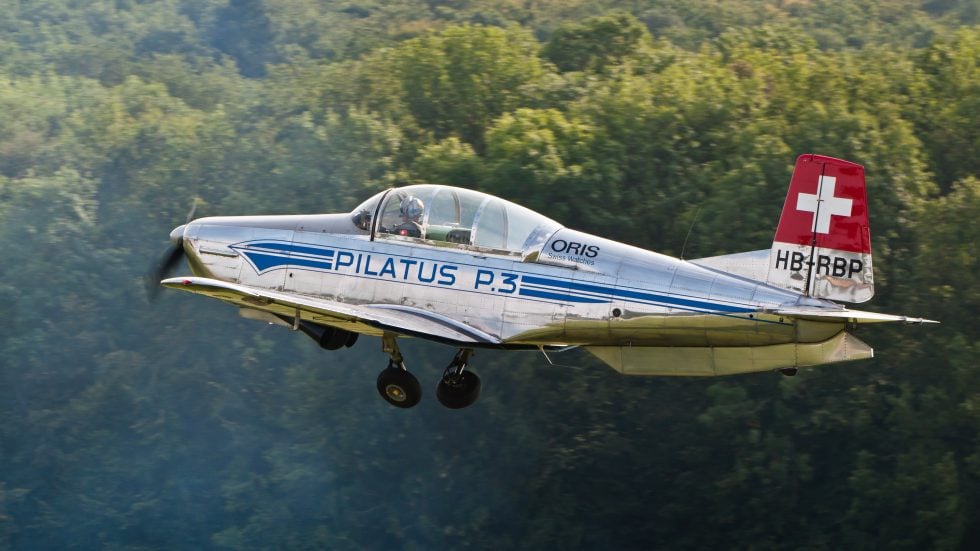
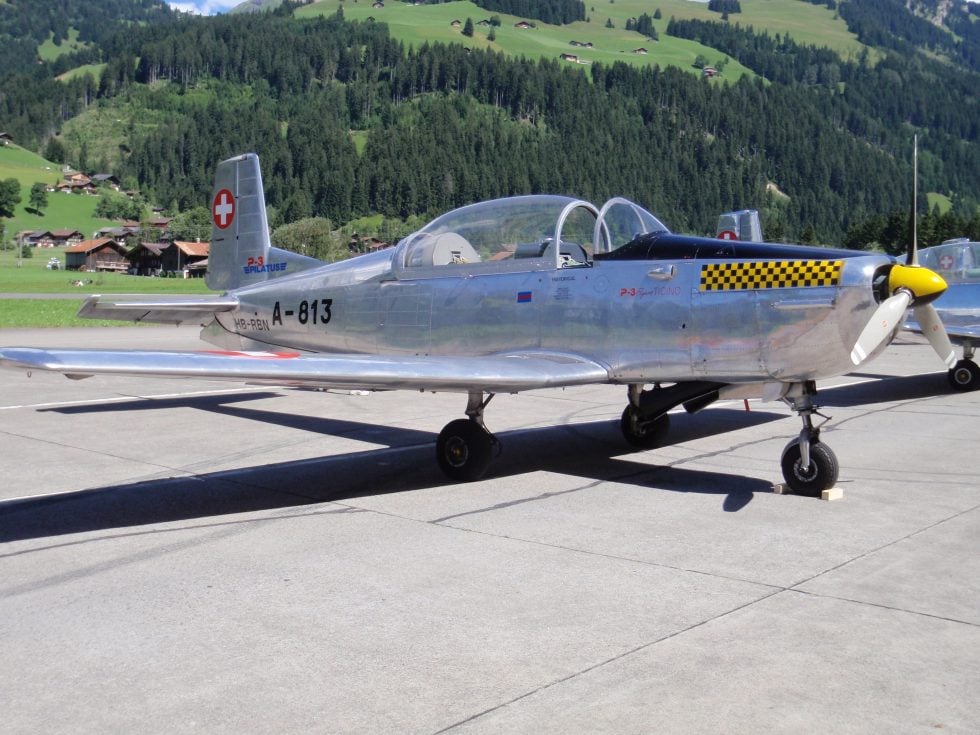
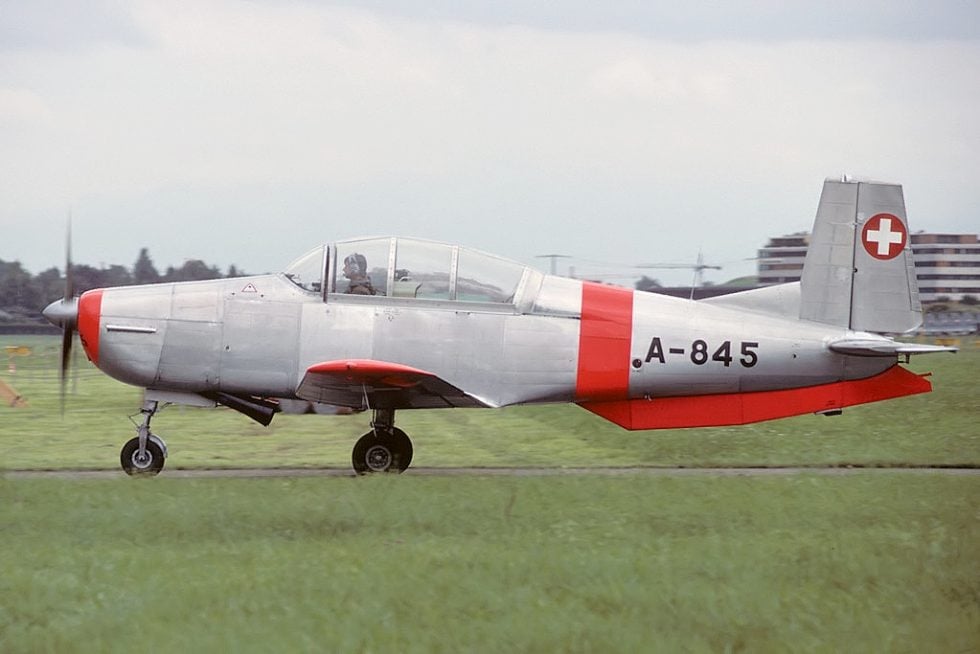
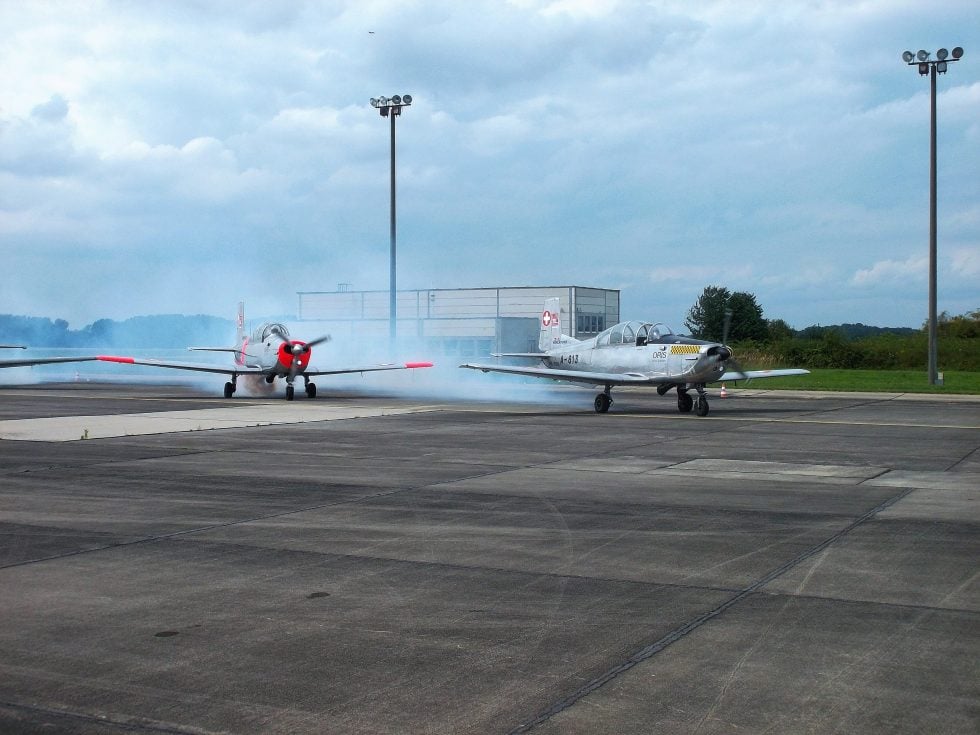
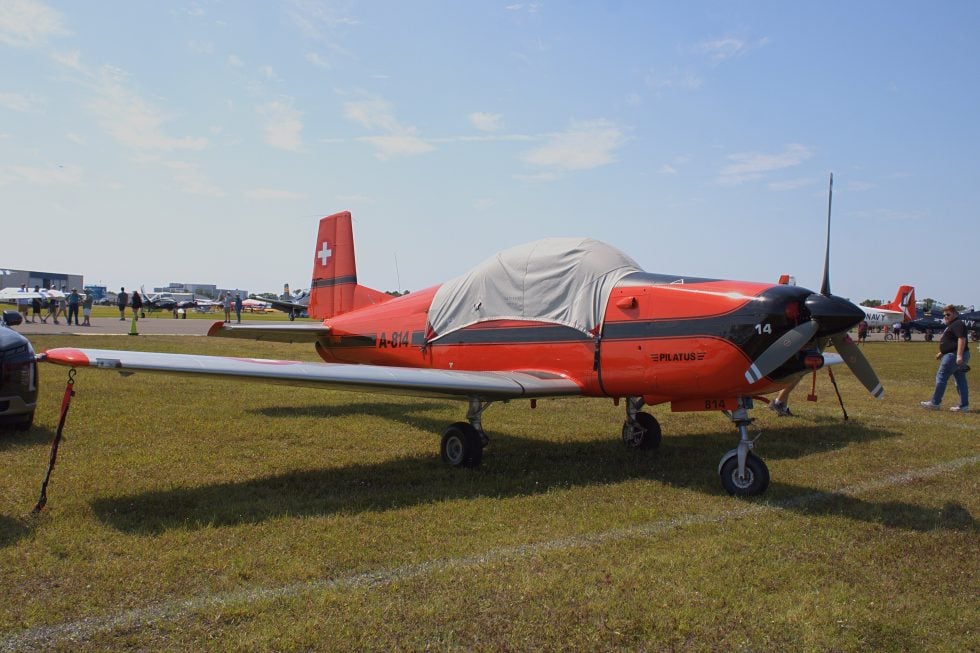
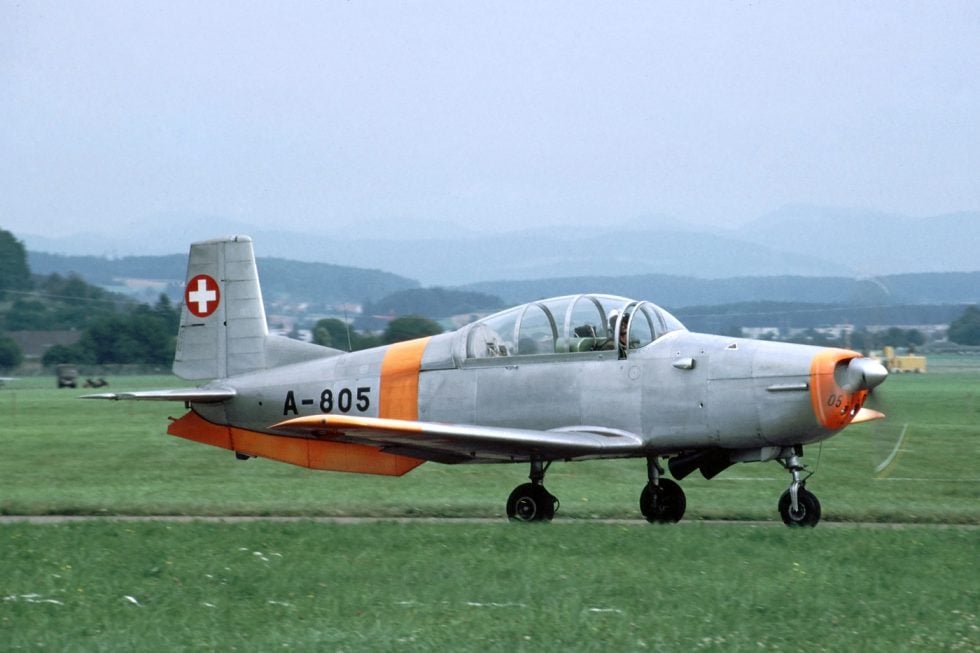
The Pilatus P-3 in motion
Pilatus P3 — Swiss Warbird Display. A retired Swiss Air Force P-3 put through its aerobatic paces — a good look at the type that still flies the airshow and warbird circuit today.
Where the Pilatus P-3 flew
The Pilatus P-3’s real record: pilots, not kills
The P-3 never fought a war — that was never its job. Its record is written in the thousands of Swiss cadets it carried from first solo to their first fighter, and in the turboprop dynasty it spawned. It is one of those rare aircraft whose influence vastly outweighs the number ever built, measured not in kills or records but in the pilots and the aircraft families it made possible.
Meet its turboprop successor: the Pilatus PC-7 Turbo Trainer.
Everything people ask about the Pilatus P-3
Can I fly in a Pilatus P-3?
What is the Pilatus P-3?
When did the Pilatus P-3 first fly?
What engine does the Pilatus P-3 have?
Is the Pilatus P-3 aerobatic?
How many Pilatus P-3s were built?
Did the Pilatus P-3 carry weapons?
Is the Pilatus P-3 related to the PC-7?
What is the difference between the P-3 and the PC-7?
Is the Pilatus P-3 still flying?
Where can I see a Pilatus P-3?
What replaced the Pilatus P-3?
You can fly the Pilatus P-3
This is one classic trainer you don’t just read about. From Grenchen in Switzerland, MiGFlug’s partner GoAviator flies a genuine ex-Swiss Air Force Pilatus P-3 — 30 or 60 minutes over the Jura or the Bernese Alps, with optional aerobatics from the front seat.
Continue the tour
Every fact, checked
- Pilatus Aircraft LtdThe manufacturer’s own history of its trainer lineage, from the P-2 and P-3 to the PC-7 family.
- Swiss Air Force (Schweizer Luftwaffe)Operator background on Swiss basic and aerobatic training and the P-3’s service career.
- Swiss military aviation museumsReference for preserved Swiss trainers and the P-2 / P-3 lineage on display.
- P3 Flyers display teamThe team keeping a formation of ex-Swiss Air Force P-3s flying at airshows today.
- GoAviator — Pilatus P-3 flightsThe operator offering genuine P-3 passenger flights from Grenchen, Switzerland.
- Key AeroEstablished aviation reference for Pilatus trainer development and specifications.
- FlugRevueGerman-language aviation coverage of Swiss Pilatus types and their history.
- FAA Aircraft RegistryConfirms ex-Swiss P-3s registered and flying as civilian warbirds in the United States.