
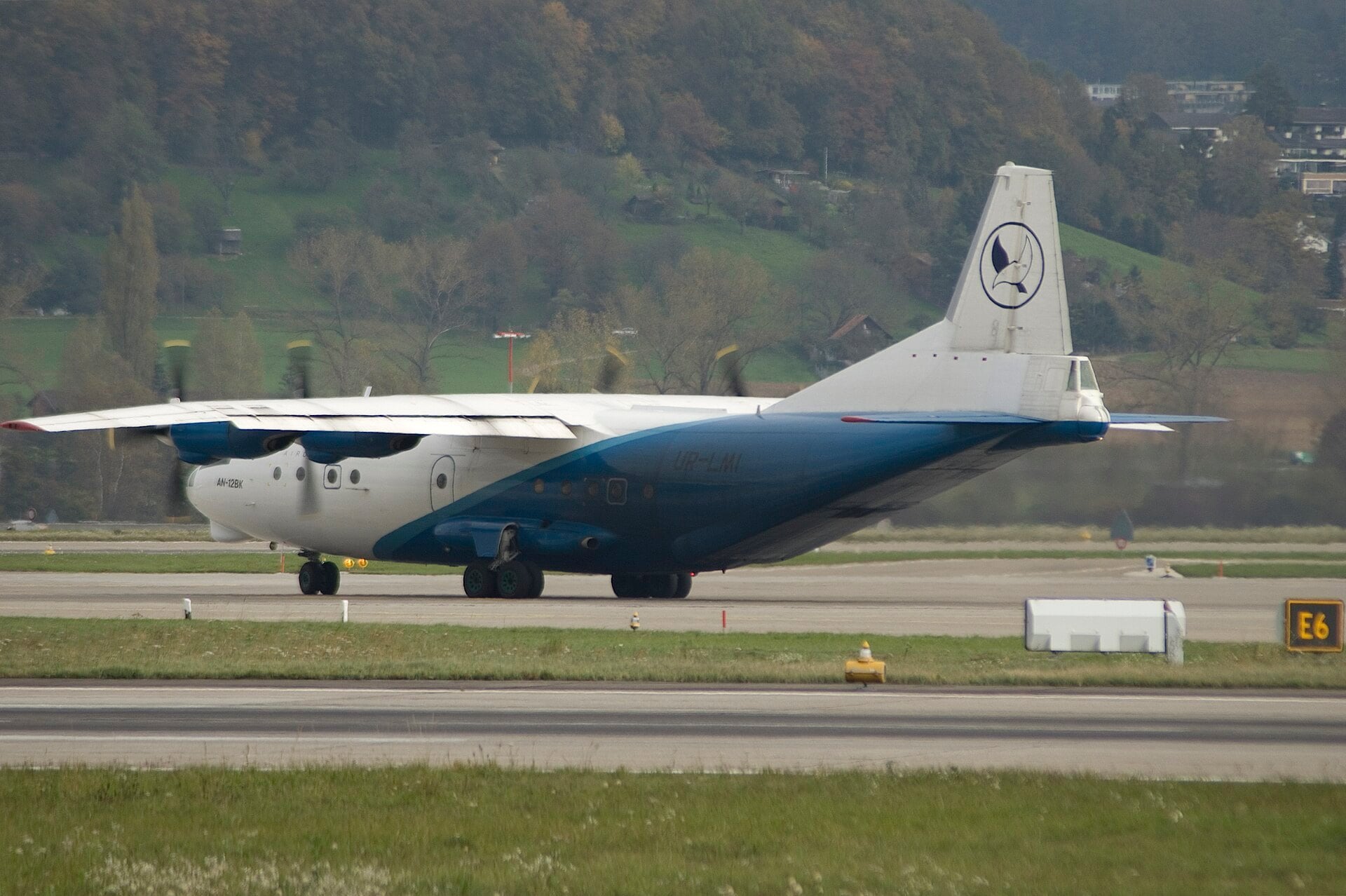
Antonov An-12
The Soviet Hercules
The four-turboprop freighter that gave Soviet airborne forces their reach, carried India’s tanks into Ladakh and the coffins home from Afghanistan, and lives on in China as the Shaanxi Y-8 family.
The An-12: how Antonov built the Soviet answer to the Hercules
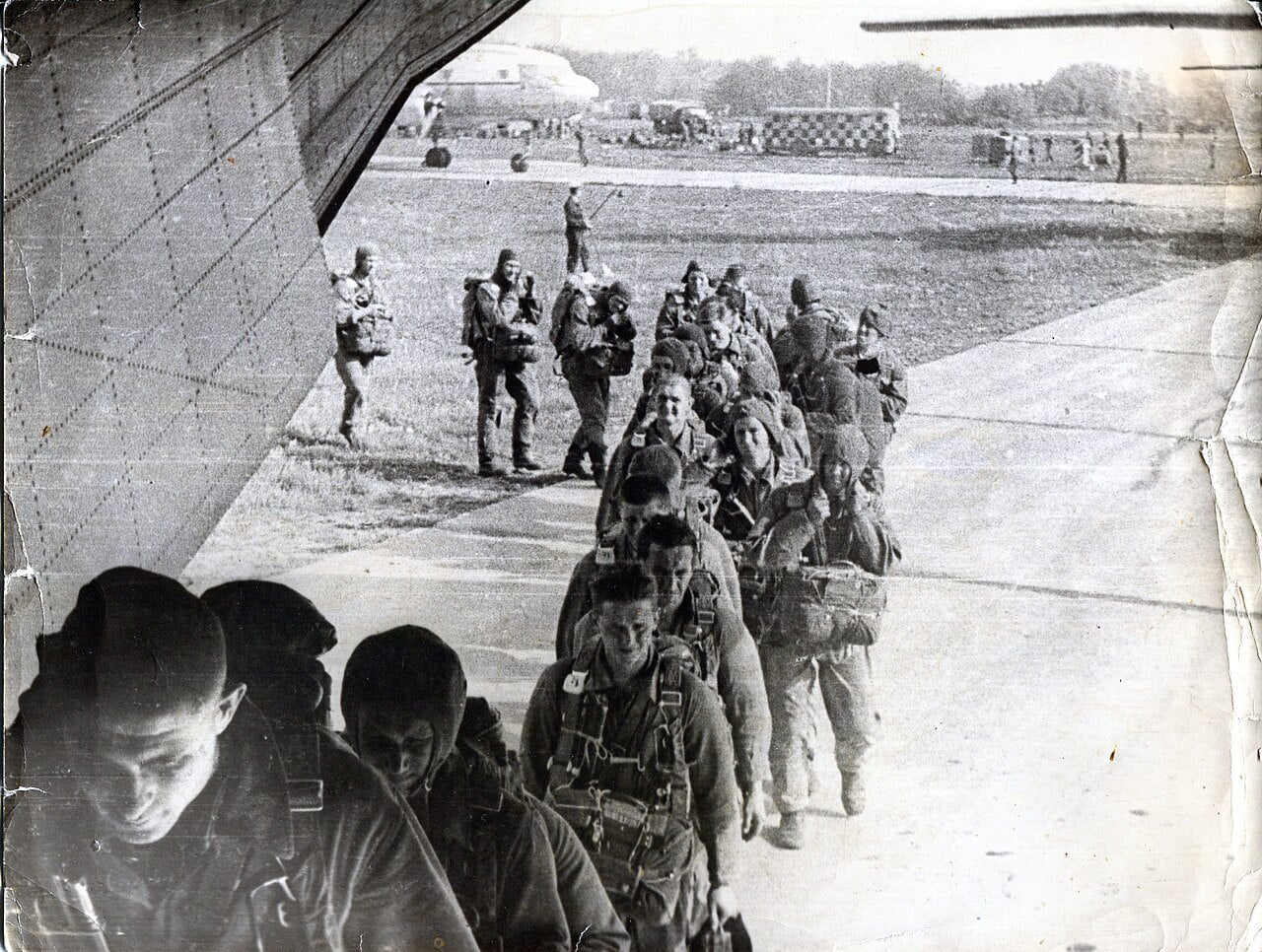
In the early hours of 21 August 1968, Soviet transports began landing at Prague’s Ruzyně airport one after another, disgorging airborne troops and vehicles who drove into the city to secure the government quarter. The aircraft were Antonov An-12s, and the operation showed what the type had given Moscow: the ability to put a division of paratroops and their armour wherever it was needed, fast. Designed in Kyiv on the basis of the An-10 airliner, the An-12 combined a high wing, four Ivchenko AI-20 turboprops, an upswept tail with loading doors beneath it and, on military aircraft, a tail gunner’s turret with twin 23 mm cannon. It first flew on 16 December 1957.
Between 1957 and 1973 factories at Irkutsk, Voronezh and Tashkent built 1,248, with Tashkent alone producing about 830. The type became the backbone of the Soviet military transport aviation command, the VTA, able to carry around 20 tonnes or some 60 paratroopers, light armoured vehicles or artillery, and to drop them by parachute. Antonov and his team received the Lenin Prize in 1962 for its creation. It was the natural Soviet counterpart to the Lockheed C-130 Hercules, faster and with a similar payload, though its hold was unpressurised and its loading doors less convenient than the Hercules’s ramp. For two decades it was the aircraft on which the whole Soviet airborne doctrine rested.
The An-12 went everywhere Soviet influence went. India used it to supply Ladakh during the 1962 war with China and as a bomber in 1971; the Soviet Union used it in Czechoslovakia and Afghanistan, and in famine relief in Ethiopia; Egypt, Iraq, Indonesia and a dozen other air forces flew it. In China, where a licence had been bought before the Sino-Soviet split, the design was reverse-engineered as the Shaanxi Y-8, which flew in 1974 and spawned a huge family of transports, airborne early warning and maritime patrol aircraft. Nearly seventy years after its first flight, the An-12 still hauls freight across Africa and Asia, and its Chinese descendants remain in production.
01The An-12 in India: tanks to Chushul and bombs in 1971
India inducted the An-12 in 1961, and within a year the aircraft faced its biggest test. During the 1962 Sino-Indian War, Indian Air Force An-12s flew reinforcements, supplies and equipment into Ladakh, including light tanks landed at the high-altitude strip at Chushul, a feat that helped hold that sector. The An-12 became the backbone of Indian air maintenance to mountain posts for the next three decades.
In the 1971 Indo-Pakistani War, Indian An-12s were used as heavy bombers, with crews pushing bombs out of the rear of the aircraft on night raids against Pakistani targets. The Indian fleet suffered its worst loss on 7 February 1968, when An-12 BL534 disappeared over the Rohtang Pass while flying from Chandigarh to Leh with 102 people aboard. Climbers found the first human remains on a glacier in 2003, and recovery expeditions continued to find wreckage and remains in 2007, 2018, 2019 and 2024, more than half a century after the loss. The An-12 was retired from Indian service in the early 1990s, replaced by the Il-76 and An-32.
02The An-12 in Afghanistan: the Black Tulip
During the Soviet war in Afghanistan from 1979 to 1989, An-12s flew a large share of the supply runs from Soviet Central Asia to Kabul, Bagram, Kandahar and Shindand. As shoulder-launched missiles appeared in mujahideen hands, crews adopted steep spiralling approaches and departures, firing flares to decoy heat-seeking weapons, and several An-12s were still lost.
The type also acquired a grim nickname. Soldiers called the An-12 that flew the bodies of the dead home in zinc coffins the Black Tulip, and the code for those shipments, Cargo 200, entered the Russian language. The phrase became the title of songs and books about the war and was used again in Chechnya and Ukraine. It is one of the clearest examples of how a transport aircraft, rather than any fighter or bomber, came to symbolise a conflict for the people who fought it and the families who waited for its return.
What makes the An-12 special
The An-12’s tail turret
Military An-12s carried a gunner in a glazed position in the extreme tail, armed with two 23 mm Nudelman-Rikhter NR-23 cannon, a feature inherited from bomber practice and unusual on a transport. It reflected Soviet thinking in the 1950s, when transports were expected to fly into contested airspace during airborne operations. In practice the turret rarely fired in anger, and many aircraft later had it faired over or used the position for observation or electronic equipment, but it gave the An-12 a profile no Western transport shared.
The An-12’s AI-20 turboprops
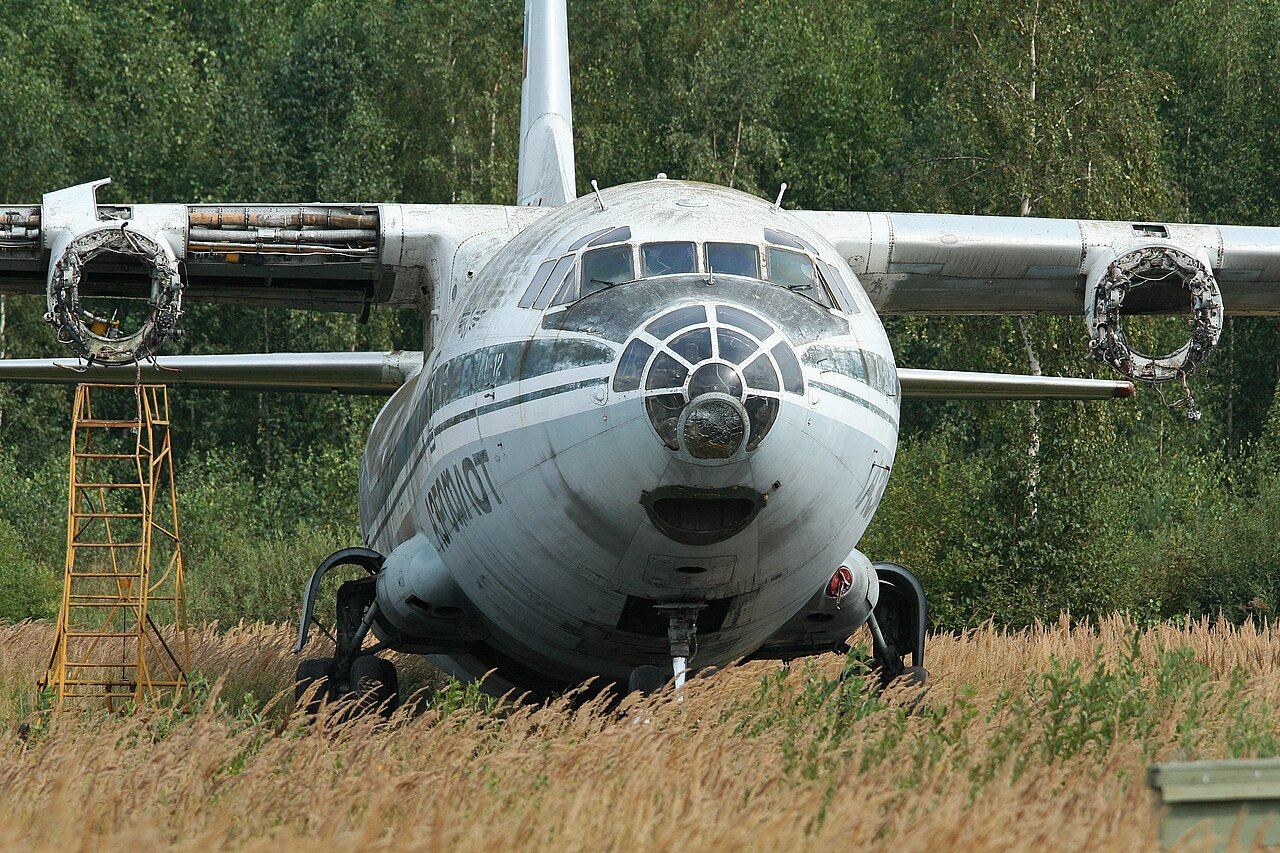
The four Ivchenko AI-20 turboprops, of about 4,000 shp each, were the same family that powered the An-10 and Ilyushin Il-18 airliners. They gave the An-12 a top speed of about 660 km/h, faster than the early C-130, and the power to operate from unpaved strips. The engine became one of the most durable in Soviet aviation, later powering the An-32 and the Be-12 amphibian, and its Chinese derivative, the WJ-6, still powers the Y-8 family. Its reliability, rather than its fuel economy, is the reason it has survived so long.
The An-12’s hold and doors
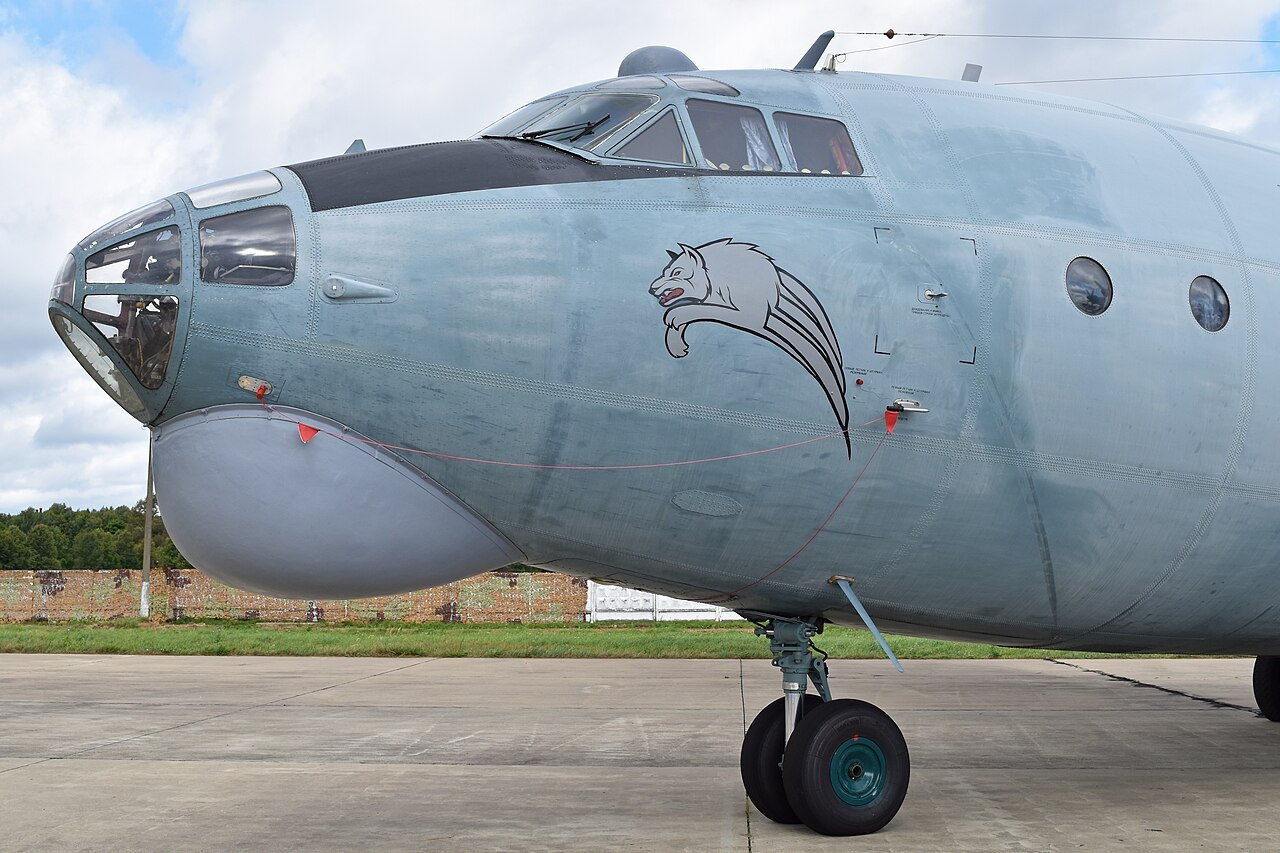
The An-12’s weakness compared with the Hercules was its cargo bay. The hold was unpressurised, so troops carried at altitude needed oxygen, and instead of a full rear ramp there were ventral doors under the upswept tail that opened inwards. Vehicles had to be loaded using portable ramps. The arrangement was adequate for air-drops of paratroops and equipment, and the An-12 could carry up to about 20 tonnes, but it was one reason the Soviet Union later developed the much larger Il-76 with a proper ramp.
03The An-12’s variants: transports, jammers and spy planes
- An-12A: early production with AI-20A engines and extra fuel.
- An-12B: improved version with greater fuel capacity, exported as the An-12BK and civil versions.
- An-12BP: the standard tactical transport of the VTA.
- An-12BK: final production model with improved avionics and wider loading capabilities.
- An-12PP and An-12BK-PPS: electronic countermeasures aircraft with jammers and chaff dispensers.
- An-12BK-IS and similar: ELINT and electronic warfare versions.
- An-12BSh: navigator trainer.
- Civil freighters used by Aeroflot and later by numerous cargo airlines.
Around 30 versions are recorded. In 2019 Russia announced an armed gunship study based on the An-12, loosely comparable to the American AC-130, but it was dropped in 2021 as unsuitable. Several electronic warfare An-12s remained in Russian service into the 2020s, alongside a dwindling number of transport versions as the Il-76 took over the main airlift role. Civil An-12s were often converted from military airframes, with the tail turret removed and replaced by a fairing.
Antonov An-12BK specifications
Specifications
- Crew
- 5 (two pilots, flight engineer, navigator, radio operator), plus tail gunner on military aircraft
- Capacity
- about 20,000 kg (44,092 lb) of cargo or around 60 paratroopers
- Length
- 33.10 m (108 ft 7 in)
- Wingspan
- 38.00 m (124 ft 8 in)
- Height
- 10.53 m (34 ft 7 in)
- Empty weight
- 28,000 kg (61,729 lb)
- Max take-off weight
- 61,000 kg (134,482 lb)
- Powerplant
- 4 × Ivchenko AI-20L or AI-20M turboprops, 3,000 kW (4,000 shp) each
- Maximum speed
- 660 km/h (410 mph)
- Cruise speed
- 570 km/h (354 mph)
- Range
- 5,700 km (3,542 mi) with maximum fuel; 3,600 km (2,237 mi) with maximum payload
- Service ceiling
- 10,200 m (33,500 ft)
- Climb rate
- 10.2 m/s (2,010 ft/min)
- Armament
- 2 × 23 mm NR-23 cannon in tail turret (military aircraft)
Costs & production
- Unit cost
- No reliable Soviet-era price published; second-hand civil An-12s have long been among the cheapest 20-tonne freighters available
- Cost per flight hour
- No official figure. A hedged estimate of roughly USD 5,000 to 8,000 per hour reflects four AI-20 turboprops, a crew of five and the maintenance of airframes built before 1974, by comparison with older C-130 operations
- Production
- 1,248 built at Irkutsk, Voronezh and Tashkent, 1957–1973; Y-8 and derivatives built in China from 1974
- Programme
- Derived from the An-10 airliner; Lenin Prize awarded to Antonov and his team in 1962
04The An-12’s Chinese family: the Shaanxi Y-8 and its descendants
China bought An-12s and a production licence from the Soviet Union in the 1960s, but the Sino-Soviet split stopped technical help. The Xi’an aircraft factory began design work in 1969 to reverse-engineer the type, the first Chinese-built aircraft flew on 25 December 1974, and production moved to the Shaanxi Aircraft Factory at Hanzhong, with serial production approved in 1980. The Y-8 can carry about 20 tonnes or 96 troops.
- Y-8 / Y-8B: basic military and civil transports.
- Y-8C: version with a pressurised cargo hold and a true rear ramp.
- Y-8F: civil freighter family, including a version for carrying livestock.
- Y-8X: maritime patrol aircraft.
- KJ-200 (Y-8W): airborne early warning aircraft with a balance-beam radar.
- Y-8 high new series: electronic intelligence, electronic warfare and anti-submarine versions.
- Y-8F600: modernised version developed with Antonov and Pratt & Whitney Canada, with PW150B engines and a two-crew glass cockpit.
- Y-9: stretched successor with modern avionics, the basis for a new family of special mission aircraft.
Y-8s have been exported to air forces including Myanmar, Sri Lanka, Sudan, Tanzania and Venezuela.
05The An-12’s operating costs: cheap to buy, costly to keep
Since the 1990s, many An-12s have flown with small cargo airlines in Africa, the Middle East, Central Asia and the former Soviet Union, attractive because they could be bought for very little and carry a large, bulky load to strips with little infrastructure. The cost has come in maintenance, fuel and safety. The aircraft are old, the AI-20 engines are thirsty, and a crew of five is expensive by modern standards.
Spares are another variable: AI-20 engines and propellers remain widely available because of the Y-8 family and the An-32, but airframe overhauls depend on a shrinking number of repair plants.
The type’s accident rate in civil service has also led regulators to act: the United Arab Emirates imposed a temporary ban on An-12 operations in January 2009 and made it permanent in March 2010 after an airworthiness review. No operator publishes an hourly cost, and the figure in the table above is an estimate based on comparable four-engine turboprops rather than a published rate.
The An-12 from 1957 to Operation Spider’s Web
First flight
The prototype flew on 16 December 1957.
Into service
The An-12 entered Soviet Air Forces service and soon became the VTA’s standard transport.
Indian induction
The Indian Air Force received its first An-12s.
Ladakh airlift and Lenin Prize
Indian An-12s supplied Ladakh during the war with China; Antonov’s team received the Lenin Prize.
Rohtang and Prague
IAF An-12 BL534 vanished over the Rohtang Pass in February; in August Soviet An-12s landed paratroops at Prague.
Bomber over Pakistan
Indian An-12s were used as night bombers during the Indo-Pakistani War.
Soviet production ends
The last of 1,248 Soviet-built An-12s left the factories.
Y-8 flies
The first Chinese-built Y-8 flew on 25 December 1974.
Afghanistan
An-12s began a decade of supply and evacuation flights into Afghanistan.
Glacier finds
Climbers found the first remains from BL534 on a glacier near the Rohtang Pass.
UAE ban
The United Arab Emirates made its ban on An-12 operations permanent.
Spider’s Web
A Russian An-12 was reported destroyed in Ukraine’s drone attack on Russian airbases on 1 June 2025.
Stories & eyewitnesses: the An-12 at war and in the mountains
The An-12 at Prague, August 1968
An airborne invasion landed at a civil airport.
Read the full story
The An-12 in Ladakh, 1962
Tanks flown to a strip at 14,000 ft.
Read the full story
The An-12 BL534: a crash that took 50 years to recover
A transport lost in 1968, still giving up its dead.
Read the full story
The An-12 as a bomber in 1971
Rolling bombs out of the back at night.
Read the full story
The An-12 and the Black Tulip
The aircraft that brought the dead home from Afghanistan.
Read the full story
The An-12 in the Ethiopian famine
Soviet transports in a Cold War relief effort.
Read the full story
The An-12 in the African cargo trade
A Cold War freighter in the margins of world trade.
Read the full story
The Y-8 on one engine
A Chinese milestone in 1985.
Read the full story
The An-12 you can see today
Museum pieces and working freighters.
Read the full story
The An-12 in pictures
Where the An-12 flies and flew
The An-12’s record
The An-12 is a transport that has seen more war than most combat aircraft: the 1962 Ladakh airlift, the 1968 Prague landing, the 1971 Indo-Pakistani War as a bomber, and a decade of supply runs in Afghanistan. It also flew famine relief and decades of commercial freight.
See how training and combat types compare in the military aircraft statistics database. Figures are approximate.
Everything people ask about the An-12
Can I fly in an Antonov An-12?
What is the NATO reporting name of the An-12?
Is the An-12 a copy of the C-130 Hercules?
Why does the An-12 have a tail gun?
How many An-12s were built?
What is the Shaanxi Y-8?
Is the An-12 still flying?
You can’t fly the An-12.
These, you can.
Most of this museum you can only look at. These genuine military jets you can fly yourself with MiGFlug — with aerobatics and time on the controls.
 Fly the L-39 AlbatrosThe world’s most-flown jet trainer — aerobatics included
 Fly the F-104 Starfighter“The missile with a man in it”
 Fly the MiG-21The Cold War’s most-produced jet
 Fly the T-33 Shooting StarAmerica’s first jet trainer
 Fly the DH VampireA piece of early jet history
 Fly the S.211Agile Italian jet trainer
 Fly the MB-326The classic Aermacchi jet
 Fly the MiG-15The Soviet legend of the Korean War
Continue the tour
Every fact, checked
- An-12 CUBGlobalSecurity: role, Lenin Prize, capacity, VTA service
- Y-8 (Yunshu-8)GlobalSecurity: Y-8 design start, first flight, production, single-engine milestone
- Aviation Safety Network: IAF An-12 BL534, 7 February 1968The Rohtang Pass loss
- 56 years after IAF plane crash over Rohtang La, four bodies recoveredHindustan Times, 2024: recovery of further victims of BL534
- Antonov CompanyManufacturer; An-12 history and Y-8F600 cooperation
- Yefim Gordon and Dmitriy Komissarov, Antonov An-12: The Soviet Hercules (Midland, 2007)Book: development, variants, operators