
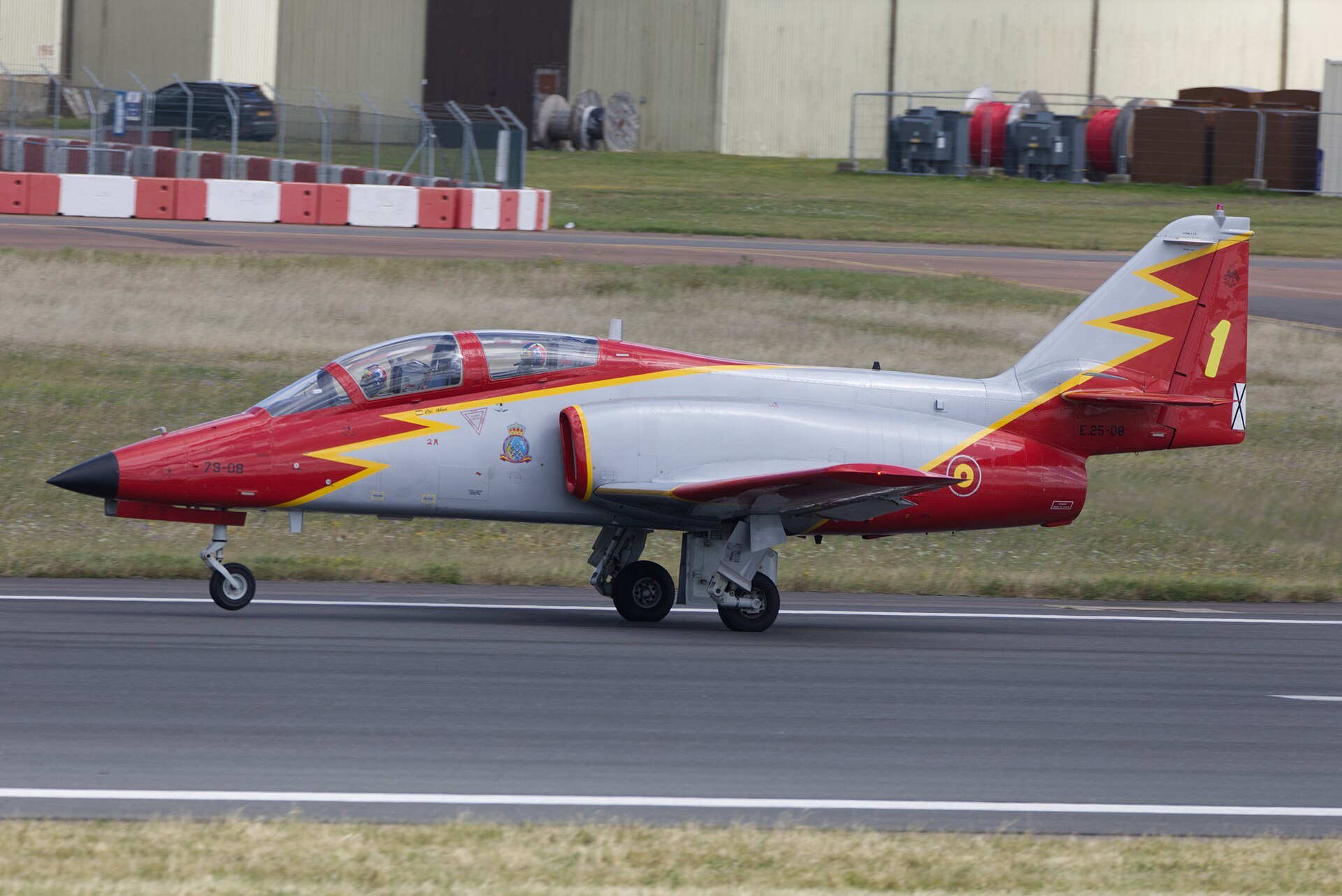
CASA C-101 Aviojet
Spain’s Mirlo
Spain’s own jet trainer taught a generation of Spanish military pilots, flew 40 years with the Patrulla Águila and became an armed light-attack jet in Chile, Honduras and Jordan.
The C-101 Aviojet: how Spain built its own jet trainer
In 1975 the Spanish Air Force asked CASA to design a jet trainer to replace its ageing piston and early-jet trainers, and ordered four prototypes. The answer was conservative by design: a straight-winged, low-wing tandem two-seater with a stepped cockpit and a single Garrett TFE731 turbofan, the engine of business jets rather than fighters. CASA bought expertise where it lacked it, with MBB in Germany helping on the rear fuselage and tail and Northrop on the wing and intakes. The first prototype, XE.25-01, flew on 27 June 1977 in the hands of Colonel De la Cruz Jiménez. The Spanish called it the E.25 Mirlo, the blackbird. For CASA, better known for transports such as the C-212 Aviocar, it was a major step into military jets.
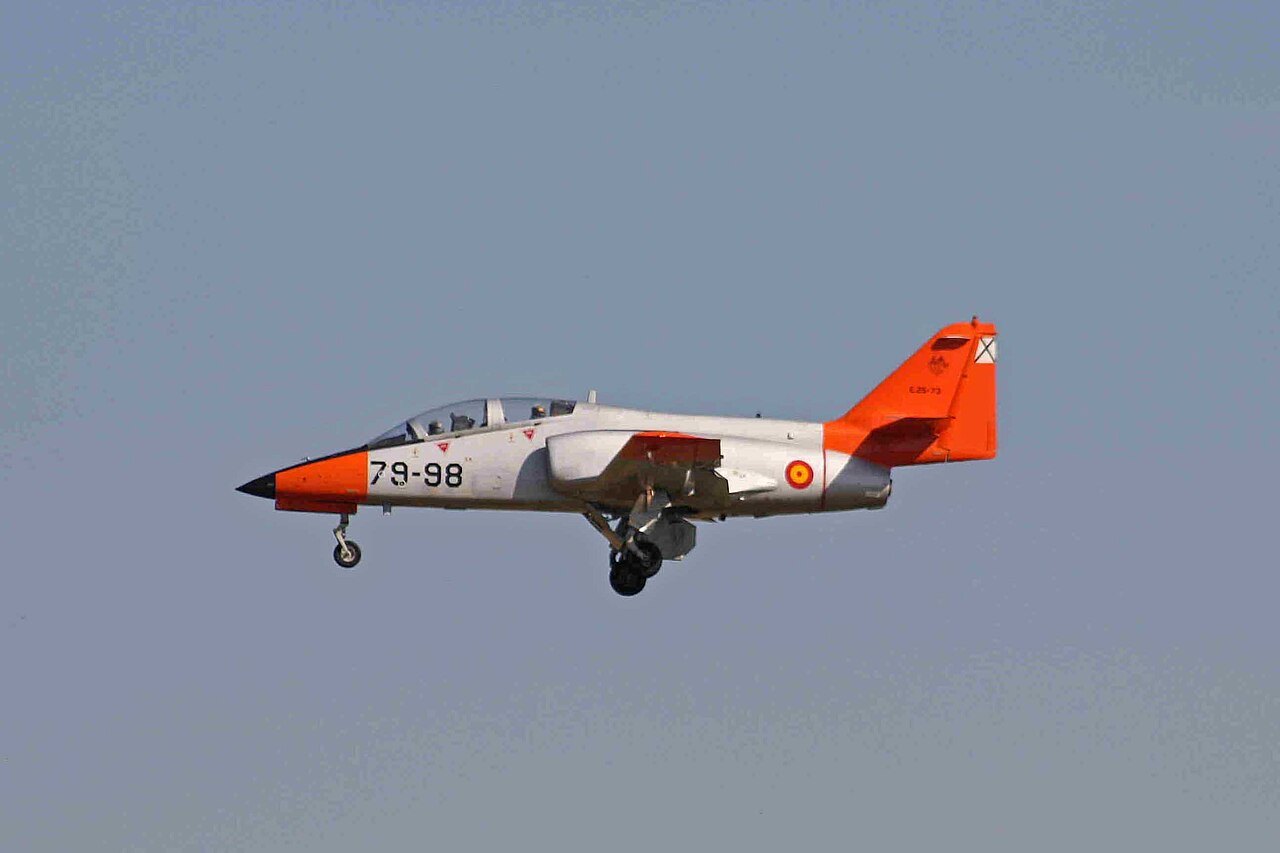
The C-101 reached the Academia General del Aire at San Javier in early 1980, and for the next 42 years almost every Spanish Air Force pilot passed through its cockpit. Students flew around 110 hours on it before moving on. The turbofan gave long endurance and economy that turbojet trainers could not match, and the airframe proved tough, honest and easy to maintain. When the academy flew its last C-101 training sortie on 29 July 2022, the fleet had logged some 285,000 hours and trained more than a thousand cadets. From 1985 it also gave Spain its national jet display team, the Patrulla Águila. It was, in short, the aircraft on which modern Spanish military aviation learned to fly.
CASA also built the C-101 to fight. A weapons bay under the rear cockpit could take a 30 mm DEFA cannon or a reconnaissance pack, and six underwing pylons carried bombs, rockets and even air-to-air missiles. Chile became the most important export customer, building the armed A-36 Halcón with ENAER, and Honduras and Jordan bought it too. Production ended at 166. In Spain it has given way to the Pilatus PC-21, and the Patrulla Águila flew its last C-101 display in June 2025, but Chile’s armed versions have kept the type in uniform. Few trainers of its generation have had such a long or varied working life, from the classroom to the air-show circuit and the strike squadron.
01The C-101 and the Patrulla Águila: forty years of red and yellow
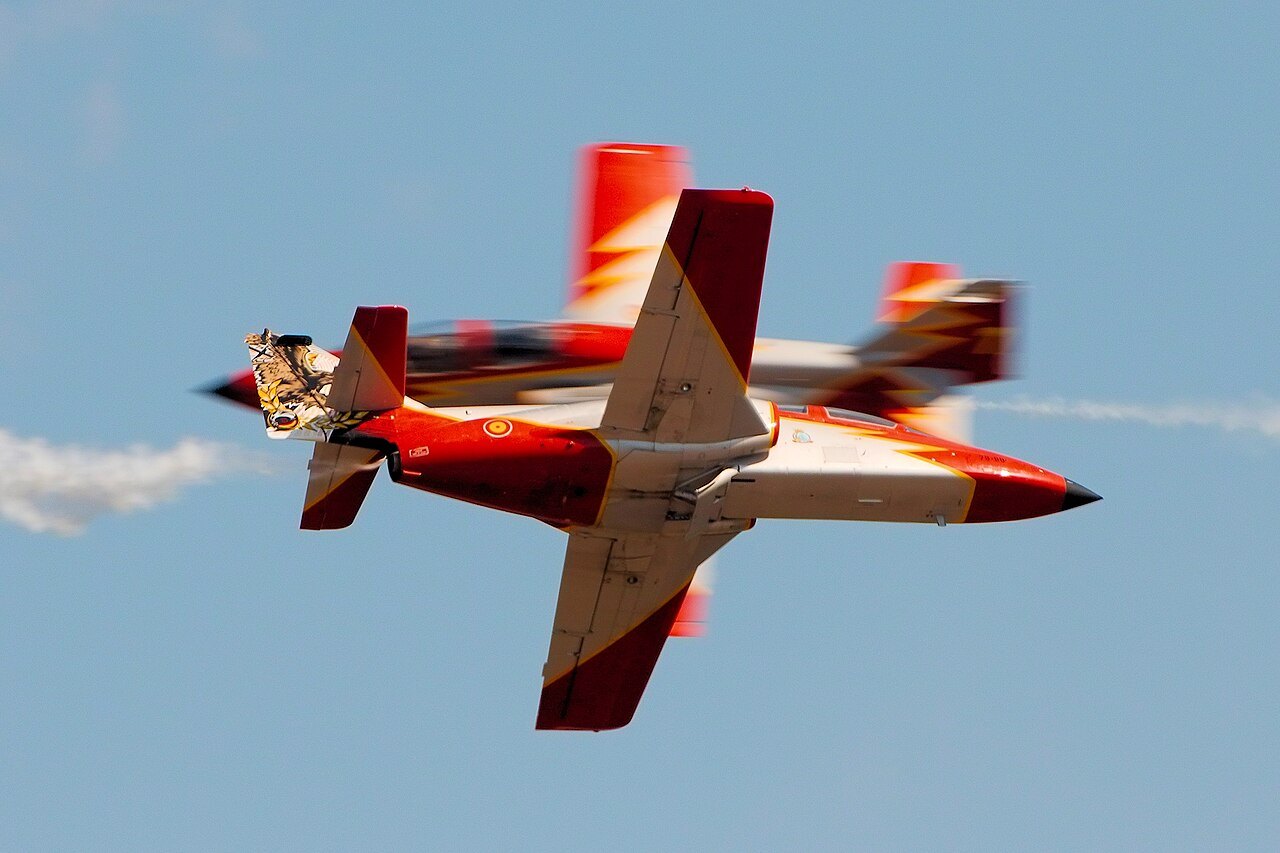
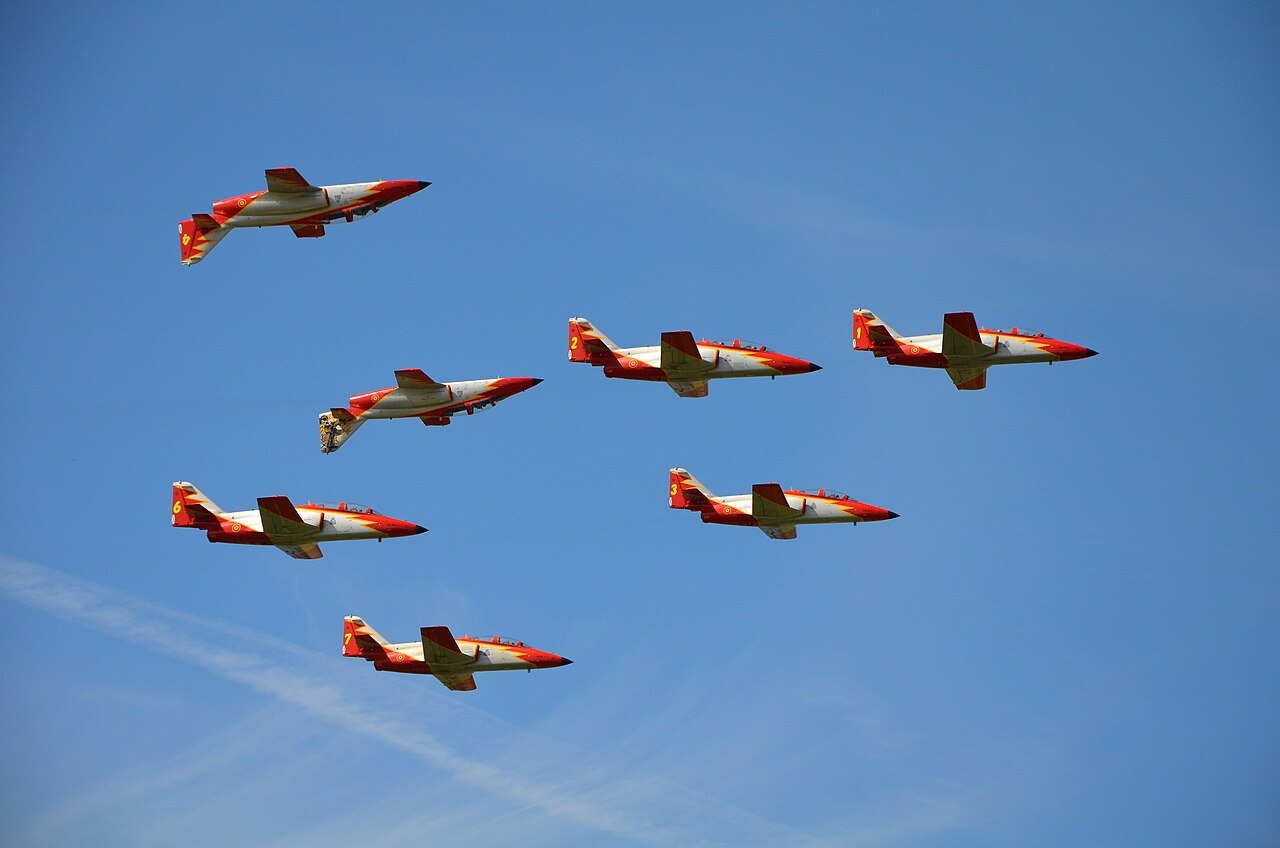
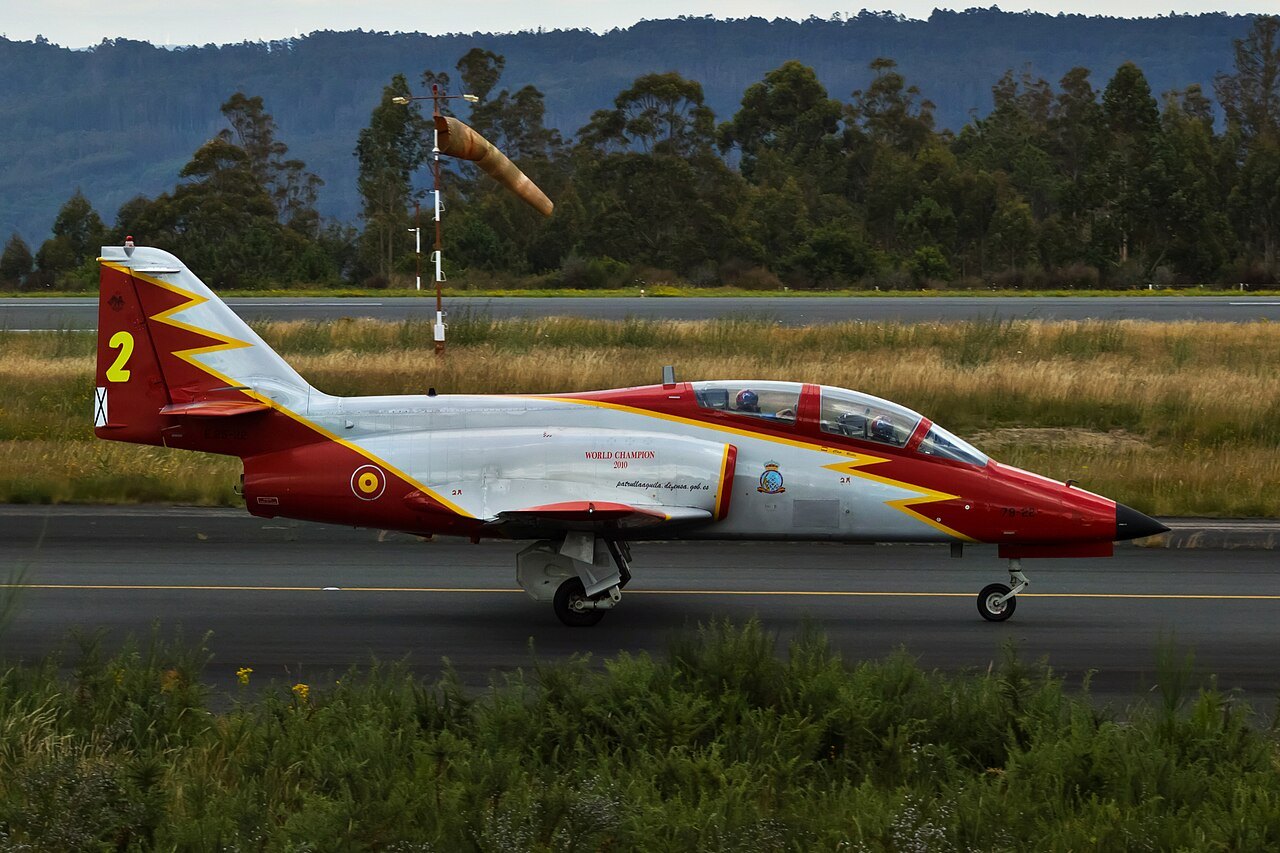
The Patrulla Águila was formed at the Academia General del Aire in 1985, originally to demonstrate the formation-aerobatic qualities of the then-new C-101. Its pilots were instructors from the academy’s 793 Escuadrón, flying the same aircraft their students flew. The team made its first public display in June 1985 with five aircraft and grew to seven in 1988.
The Patrulla’s signature became the smoke: from 12 October 1992, at Seville, the team trailed the red and yellow of the Spanish flag, a sight that became a fixture of national celebrations and European air shows. Over four decades it flew more than 500 displays, around 170 of them abroad, and logged some 30,000 flight hours on the C-101.
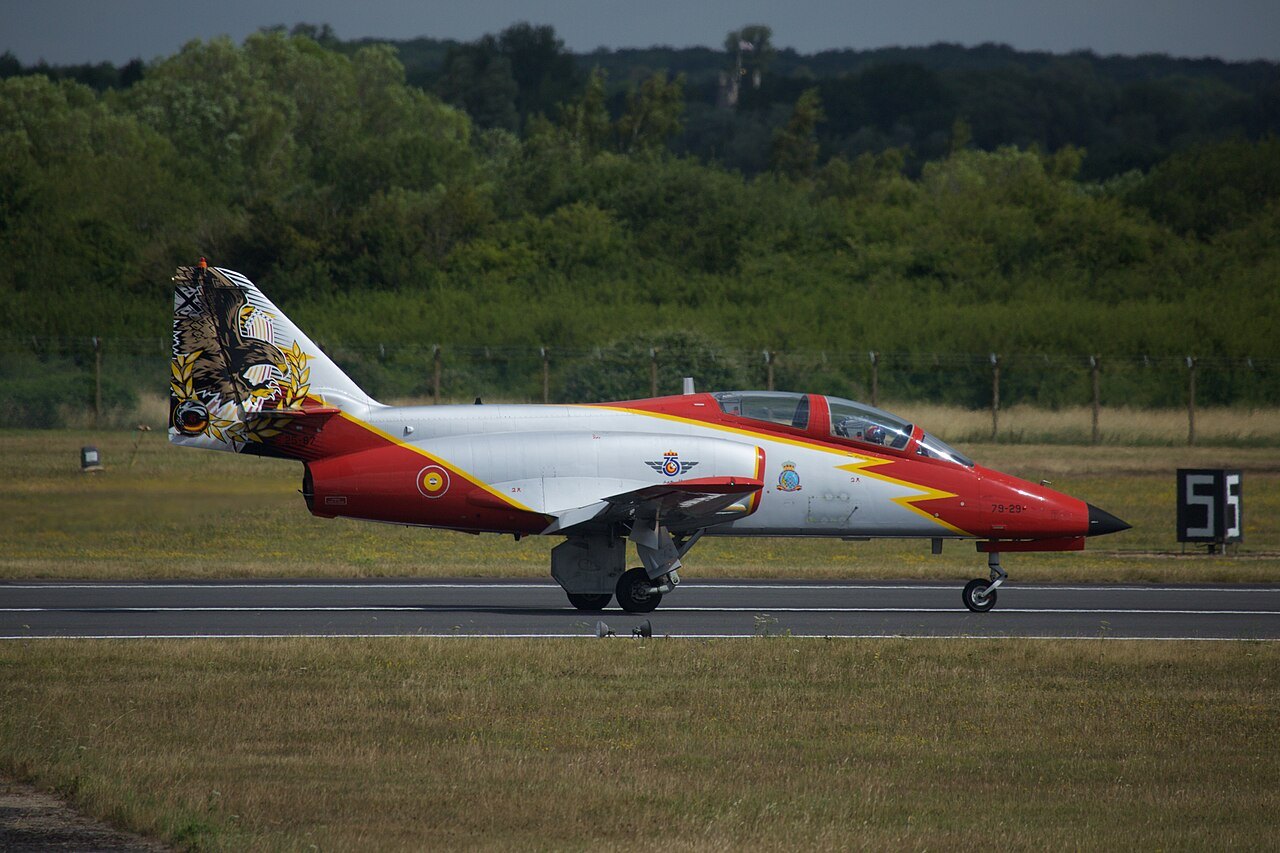
The team flew its final C-101 displays at San Javier on 14 and 15 June 2025, during its 40th-anniversary celebrations. Its commander, Lieutenant Colonel José Javier Sánchez Martín, confirmed that the Patrulla would continue on the Pilatus PC-21. Former team aircraft are now preserved, including E.25-23, which arrived at the Museo del Aire in March 2019.
02The C-101 in Chile: the A-36 Halcón
Chile was the C-101’s most ambitious customer. The Fuerza Aérea de Chile first bought four complete trainers and kits for eight more, assembled locally by ENAER, as the T-36 Halcón. It then ordered the dedicated attack C-101CC as the A-36 Halcón: only the prototype was built in Spain, with 22 production aircraft built by ENAER in Chile.
The A-36 gave Chile a cheap, long-range light strike aircraft. A radar-equipped maritime strike variant carrying the BAe Sea Eagle anti-ship missile was flown in prototype form in 1992, and in the mid-1990s ENAER and SAGEM upgraded the fleet with a new navigation and attack system, HUD and HOTAS controls; the upgraded aircraft became known as the A-36 Toquí. ENAER was still carrying out deep maintenance on the Iquique-based A-36 fleet in 2021, decades after the first deliveries, making Chile one of the last active C-101 operators.
What makes the C-101 Aviojet special
A business-jet turbofan
Most jet trainers of the 1970s used turbojets. The C-101 used the Garrett TFE731 turbofan, an engine designed for business jets, giving around 16 to 21 kN depending on version. It was quieter and far more economical, so a training sortie could last over an hour and a ferry flight could cover 2,000 km. The trade-off was modest thrust: the C-101 was never a sparkling performer in the climb, but it could stay up longer and cost less than its rivals.
A weapons bay in a trainer
Unusually for a trainer, the C-101 has an internal bay below the rear cockpit. It could hold a 30 mm DEFA cannon pack, twin 12.7 mm machine guns, a reconnaissance camera pack or electronic equipment, leaving the six underwing pylons free for stores. That modular bay is what let CASA turn the same airframe into the armed C-101BB and C-101CC for export customers.
Simple, modular and built to last
CASA designed the C-101 around simplicity and economy: an unswept wing, conventional controls and a modular structure that eased production and maintenance. The stepped tandem cockpit, with the instructor raised behind the student, gave good visibility from both seats. Spain’s fleet received a navigation and weapons upgrade between 1990 and 1992, and the basic airframe kept flying with the academy for 42 years.
03The C-101’s variants: from Mirlo to Toquí
- C-101EB-01 (E.25 Mirlo): basic and advanced trainer for Spain; 88 ordered.
- C-101BB-02: armed trainer with uprated engine; Honduras (4) and Chile (T-36 Halcón).
- C-101CC-02: dedicated light-attack version with more thrust and a military power reserve; Chile’s A-36 Halcón, 22 built by ENAER.
- C-101CC-04: attack version for Jordan; 16 delivered.
- C-101DD: 1985 development with HUD, HOTAS, radar warning receiver and Maverick capability; demonstrated but not produced.
04The C-101’s cockpit and systems: training for the jet age
The C-101’s stepped tandem cockpit put the instructor high behind the student, an arrangement that let one teacher watch both the student and the world outside. Both crew sit on ejection seats. The original analogue panel was deliberately simple for basic training; the 1990–1992 Spanish upgrade improved navigation and weapons systems, while the Chilean Toquí upgrade added a HUD and HOTAS controls of the kind students would meet on frontline fighters.
CASA C-101 Aviojet specifications
Specifications
- Crew
- 2 (stepped tandem)
- Length
- 12.5 m (41 ft 0 in)
- Wingspan
- 10.6 m (34 ft 9 in)
- Height
- 4.25 m (13 ft 11 in)
- Wing area
- 20 m² (215 sq ft)
- Powerplant
- 1 × Honeywell TFE731-5-1J turbofan, 19.13 kN (4,300 lbf); 20.91 kN (4,700 lbf) with military power reserve (C-101CC)
- Maximum speed
- 834 km/h (518 mph) at 4,575 m (C-101CC)
- Cruise speed
- 656 km/h (408 mph) at Mach 0.6
- Range
- 2,000 km (1,240 mi) ferry, with reserves
- Endurance
- About 1 h 10 min training sortie; up to 7 h maximum
- Service ceiling
- 12,800 m (42,000 ft)
- Climb rate
- 24.9 m/s (4,900 ft/min)
- g limits
- +7.5 / −3.9 g at 4,500 kg; +5.5 / −1 g at 6,300 kg
- Armament
- Internal bay for 30 mm DEFA cannon or 2 × 12.7 mm guns; up to about 2,200 kg on 6 underwing pylons
Costs & production
- Unit cost
- Not reliably published; the programme was promoted as low-cost against foreign rivals
- Cost per flight hour
- No official figure. A hedged estimate is in the low thousands of US dollars per hour, based on its single business-jet turbofan, low fuel burn for a jet and a simple airframe; well below a frontline fighter
- Production
- 166 built, including 22 A-36 assembled by ENAER in Chile
- Programme
- Development cost about 1,297 million pesetas (about $22 million at the time)
05The C-101’s operators: four air forces
- Spain: 88 E.25 Mirlo; Academia General del Aire 1980–2022, Patrulla Águila 1985–2025.
- Chile: T-36 and A-36 Halcón, many built by ENAER; still in service.
- Honduras: 4 C-101BB.
- Jordan: 16 C-101CC-04, retired in 2018.
06The C-101’s operating costs: why a turbofan mattered
CASA’s choice of the TFE731 was an economic decision. A turbofan burns markedly less fuel than the turbojets in contemporary trainers, which let the C-101 fly long sorties and self-deploy to the Canary Islands, as the original Spanish requirement demanded. Spain’s 2020 decision to replace it with 24 PC-21s cost more than €200 million, around €8.5 million per aircraft, which shows how cheaply the old Mirlo had been doing the job. Treat any per-hour figure as an estimate.
The C-101 Aviojet from San Javier to farewell
Requirement and prototypes
The Spanish Air Force contracts CASA for four prototypes of a new jet trainer.
First flight
Prototype XE.25-01 flies on 27 June.
Farnborough debut
The C-101 is shown at the Farnborough air show in July.
Into service
The first E.25 Mirlos are delivered to the Academia General del Aire at San Javier.
Patrulla Águila formed
Academy instructors form the Patrulla Águila and fly their first public display in June.
Spanish upgrade
Between 1990 and 1992 Spain’s fleet receives navigation and weapons upgrades.
Chilean Halcón II
Chile unveils its upgraded A-36 on 31 July.
Jordan retires it
The Royal Jordanian Air Force phases out its last C-101s.
PC-21 chosen
Spain orders 24 Pilatus PC-21s to replace the C-101 at the academy.
Last academy sortie
The final C-101 training flight at San Javier is flown on 29 July.
Patrulla farewell
The Patrulla Águila flies its last C-101 displays at San Javier on 14–15 June.
Stories & eyewitnesses: the C-101 Aviojet
XE.25-01 takes off
On 27 June 1977 Spain’s first home-grown jet trainer flew.
Read the full story
Help from Munich and California
CASA borrowed expertise to build a trainer quickly.
Read the full story
Farnborough, 1978
A year after first flight the C-101 went on show.
Read the full story
The Mirlo comes to San Javier
In 1980 the C-101 began 42 years at the air academy.
Read the full story
The Patrulla Águila is born
A team formed to show off a new trainer lasted 40 years.
Read the full story
Chile’s anti-ship Halcón
A trainer that could carry a Sea Eagle.
Read the full story
Commander Francisco Marín
In August 2019 a Patrulla Águila pilot was killed off La Manga.
Read the full story
A second loss off La Manga
Six months later another C-101 went into the sea.
Read the full story
The last red and yellow pass
In June 2025 the Patrulla flew its final C-101 shows.
Read the full story
The Mirlos at Cuatro Vientos
Spain’s air museum holds the first and a team veteran.
Read the full story
The C-101 in pictures
Where the C-101 flies and flew
The C-101 Aviojet’s record
The C-101 was above all a trainer, and its main achievement was 42 years of pilot training at San Javier. Armed versions served as light-attack aircraft in Chile, Honduras and Jordan, but no combat use by any operator is well documented.
See how training and combat types compare in the military aircraft statistics database. Figures are approximate.
Everything people ask about the C-101
Can I fly in a CASA C-101 Aviojet?
What is the C-101 called in Spanish service?
How many C-101s were built?
Which countries flew the C-101?
What replaced the C-101 in Spain?
Did the Patrulla Águila fly the C-101?
Is the C-101 armed?
You can’t fly the C-101.
These, you can.
Most of this museum you can only look at. These genuine military jets you can fly yourself with MiGFlug — with aerobatics and time on the controls.
 Fly the L-39 AlbatrosThe world’s most-flown jet trainer — aerobatics included
 Fly the F-104 Starfighter“The missile with a man in it”
 Fly the MiG-21The Cold War’s most-produced jet
 Fly the T-33 Shooting StarAmerica’s first jet trainer
 Fly the DH VampireA piece of early jet history
 Fly the S.211Agile Italian jet trainer
 Fly the MB-326The classic Aermacchi jet
 Fly the MiG-15The Soviet legend of the Korean War
Continue the tour
Every fact, checked
- CASA C-101 Aviojet E.25 Mirlo, pieza del trimestreMuseo del Aire (Spanish Air and Space Force), 2022: development, service, hours, museum examples
- 40th anniversary of Patrulla Águila and the final performance of the Spanish jet aerobatic teamFinal C-101 displays, display totals, transition to PC-21
- Patrulla ÁguilaMilavia: team formation, size and smoke history
- The air academy plane which crashed on Thursday was one of the oldest in serviceMurcia Today, 2020: 2019–2020 accidents and PC-21 replacement
- ENAER historyENAER: A-36 production and avionics upgrade
- T-36 / A-36 HalcónGlobalSecurity: Chilean variants, units and upgrades
- CASA C-101 AviojetModelersite: overview and Patrulla Águila liveries