
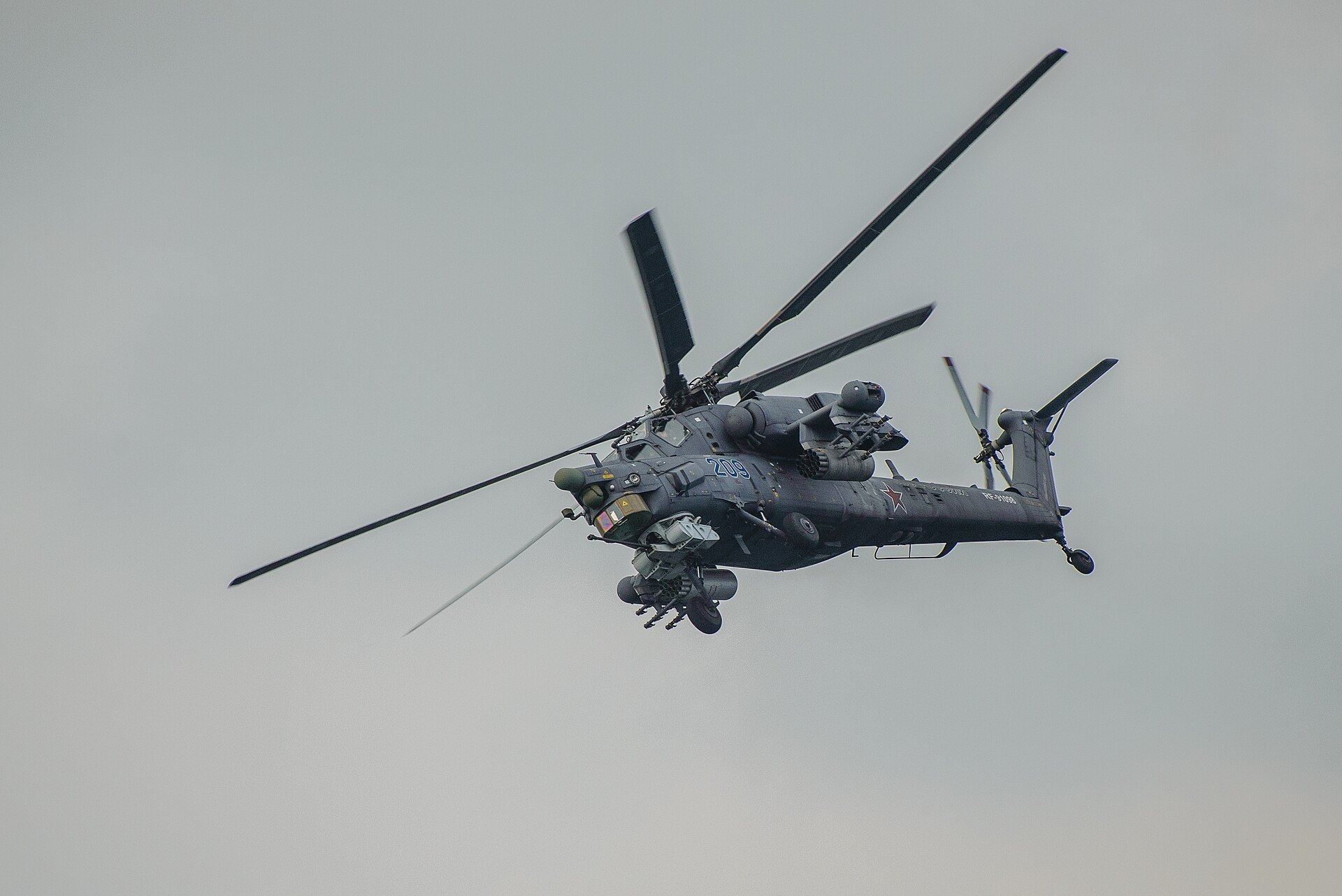
Mil Mi-28 Havoc
The Night Hunter
Mil’s armoured tandem-seat tank hunter lost its first competition in 1984, waited more than two decades for production, then fought over Syria and Ukraine as the Mi-28N Night Hunter.
The Mi-28: how Mil built Russia’s answer to the Apache
By the early 1970s the Mil bureau had given the Soviet army the Mi-24, a gunship that could also carry eight soldiers. Mil’s next idea was purer: a dedicated, heavily armoured anti-tank helicopter with no troop cabin, a crew of two in stepped tandem cockpits and a 30 mm cannon in a chin turret. Design work began in earnest in 1980 under Marat Tishchenko, and the first prototype, numbered 012, flew on 10 November 1982. It looked, at first glance, like the American AH-64 Apache, which had flown in 1975. In October 1984, however, the Soviet Air Force chose Kamov’s radical single-seat V-80, the future Ka-50, as its anti-tank helicopter. Mil kept going. The improved Mi-28A, with downward-pointing exhaust suppressors and an X-shaped tail rotor, flew in January 1988 and was shown at the Paris Air Show in 1989, the first time the West had seen it up close.
The Mi-28A was cancelled in 1993, largely because it could not fight at night or in bad weather. Mil’s response was the Mi-28N, for Nochnoy, night. Army funding was announced in January 1994, the demonstrator was rolled out in August 1996, and it carried a millimetre-wave radar in a dome above the rotor hub, a thermal and television sighting system and an integrated flight and weapons computer. Russia’s budgets in the 1990s were so thin that progress was painfully slow. The first production Mi-28N flew in April 2004, and the first was delivered to the army from the Rostvertol plant in Rostov-on-Don in 2006, almost a quarter of a century after the original prototype. Once in production, though, the ‘Night Hunter’ came off the line steadily, and more than 190 are commonly said to have been built.
Exports followed. Iraq signed for up to 36 Mi-28NEs as part of a large 2012 arms package and used them against Islamic State, and Algeria ordered 42. Russia sent Mi-28Ns to Syria from 2016. In February 2022 the type went into Ukraine alongside the Ka-52, and its losses were quick and public: by October 2026 the analysts of Oryx had visually confirmed 21 Mi-28s destroyed or damaged. Meanwhile the upgraded Mi-28NM, with a redesigned nose, a new radar and more powerful engines, entered production, and the first examples were photographed in Iran in 2026, while Uganda had lost one of its three new Mi-28s in a fatal crash in January 2024.
01The Mi-28 at war: Iraq, Syria and Ukraine
The Mi-28 waited three decades for its first war, then found several at once. Iraq signed a US$4.2 billion agreement with Russia in October 2012 covering up to 36 Mi-28NEs, other helicopters and air-defence systems, approved it in 2013 and received its first aircraft the following year, just as Islamic State overran much of the north and west. Iraqi Mi-28NEs were in combat by the autumn of 2014.
In Syria, Russia began using both the Ka-52 and the Mi-28N in early 2016 to support the Syrian Arab Army, notably during the fighting for Palmyra, firing S-8 rockets and Ataka missiles at Islamic State positions. A prototype of the upgraded Mi-28NM was also sent to Syria to test its systems in heat and dust.
Ukraine was a different kind of war. Mi-28Ns flew from the first weeks of the full-scale invasion in 2022, and wreckage of one was found near Hostomel outside Kyiv in April that year. Shoulder-launched missiles, ground fire, strikes on airfields and, increasingly, drones took their toll. On 15 July 2026 Ukraine’s Unmanned Systems Forces released footage of a drone destroying a Mi-28 in flight over Russia’s Belgorod region. By October 2026 Oryx had visually confirmed 21 Mi-28s destroyed or damaged, a large share of a fleet that numbered in the low hundreds.
What makes the Mi-28 special
Armour everywhere
The Mi-28 was designed to be shot at. Its fully armoured cabin, windscreen included, was built to withstand 7.62 mm and 12.7 mm bullets and 20 mm shell fragments, with an armoured bulkhead between the two cockpits so that one hit could not kill both crew. On the Mi-28N, new composite rotor blades were designed to survive hits from 30 mm shells. Energy-absorbing seats and fixed landing gear are meant to protect the crew in a heavy crash landing, and the engines have infrared-suppressed exhausts.
A radar on the mast
The Mi-28N’s defining feature is the dome above its rotor hub, housing a millimetre-wave radar that can see over terrain and in poor weather while the helicopter hides behind trees or ridges. Below the nose sits a gyro-stabilised sight with television, thermal and laser channels. The Ataka missiles it guides ride a narrow radio beam out to about 8 km and have a tandem shaped-charge warhead designed to defeat explosive reactive armour. The Mi-28NM added a new radar in a redesigned nose.
A seat for a stranded pilot
Like the Mi-24 before it, though on a much smaller scale, the Mi-28 has a compartment in its fuselage behind the cockpits. It is cramped, with room for two or three people or an equivalent amount of cargo, and is entered through a small door. Its main purpose is to pick up the crew of another downed helicopter, a rare feature in a dedicated attack helicopter. The two crew sit in tandem, the weapon systems operator in front and the pilot raised behind.
02The Mi-28’s weapons and rotor: built around the Ataka
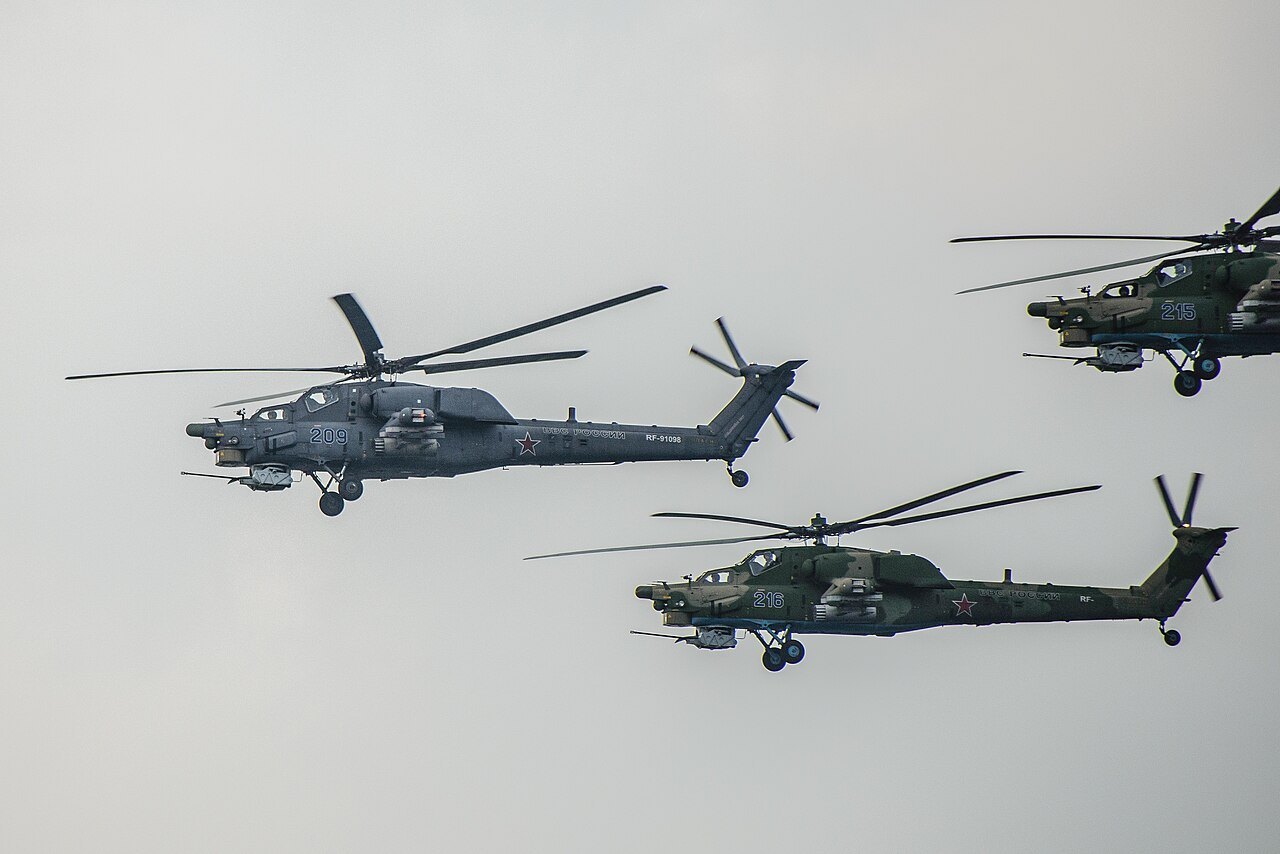
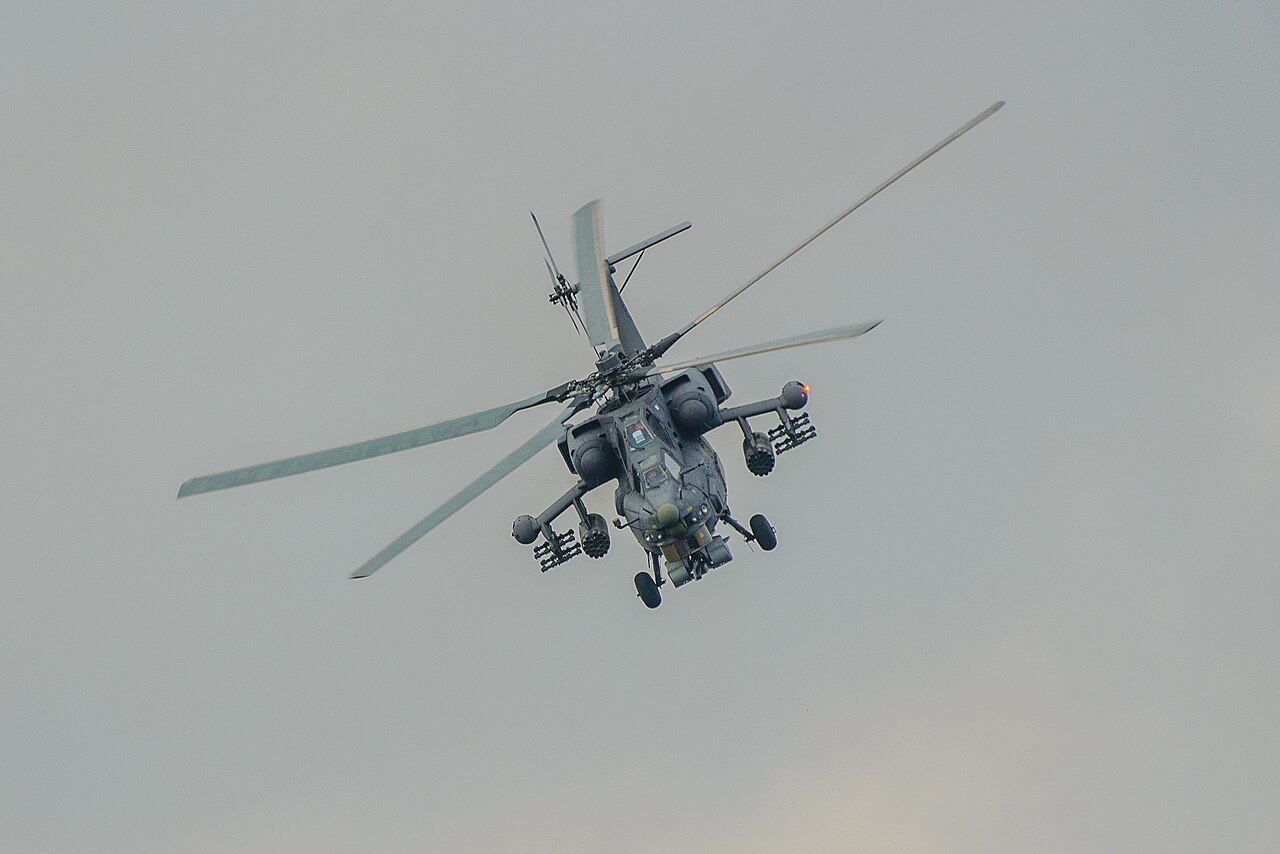
The Mi-28 carries a 30 mm 2A42 cannon in a chin turret with about 250 rounds, the same gun used on the BMP-2 infantry fighting vehicle. Its main anti-tank weapon is the 9M120 Ataka, carried in two racks of eight for a typical load of 16, alongside 80 mm S-8 or 122 mm S-13 rocket pods on four pylons. Igla-V air-to-air missiles, gun pods and bombs can also be carried, and later versions added the Khrizantema and the long-range LMUR missile.
The main rotor has five composite blades on a head with elastomeric bearings, while the tail rotor uses a distinctive biplane layout with independently controlled X-shaped blades, which reduces noise and improves control. Two Klimov turboshafts sit in pods above the wing roots; production Mi-28Ns moved from the Ukrainian-built TV3-117VMA to the Russian VK-2500, and the Mi-28NM uses the more powerful VK-2500P with digital engine control.
Mil Mi-28N Havoc specifications
Specifications
- Crew
- 2 (tandem), plus emergency space for 2–3 people
- Length
- 17.01 m (55 ft 10 in) excluding rotors
- Main rotor diameter
- 17.2 m (56 ft 5 in)
- Height
- 3.82 m (12 ft 6 in) to rotor head
- Empty weight
- 8,590 kg (18,938 lb) equipped
- Normal take-off weight
- 10,900 kg (24,030 lb)
- Max take-off weight
- 11,500 kg (25,353 lb)
- Powerplant
- 2 × Klimov TV3-117VMA or VK-2500 turboshafts, about 1,640 kW (2,200 shp) each
- Maximum speed
- about 300–320 km/h (186–199 mph)
- Cruise speed
- 270 km/h (168 mph)
- Range
- 435 km (270 mi)
- Service ceiling
- 5,600 m (18,400 ft)
- Climb rate
- 13.6 m/s (2,680 ft/min) at sea level
- g limits
- +3 / −0.5 g
- Armament
- 30 mm 2A42 cannon in chin turret; up to 16 Ataka anti-tank missiles; S-8 or S-13 rocket pods; Igla-V air-to-air missiles; gun pods and bombs
Costs & production
- Unit cost
- About US$15–16 million (2002 estimate for the Mi-28N); about US$18 million quoted in Ugandan reporting in 2024
- Cost per flight hour
- No official figure published. Hedged estimate: several thousand US dollars per hour, based on two Klimov turboshafts of the Mi-24 class and the maintenance of a large, heavily armoured airframe; actual costs are not disclosed
- Production
- More than 190 commonly given, built by Rostvertol in Rostov-on-Don
- Programme
- First flight 10 November 1982; Mi-28N development cost about US$150 million (2000 figure); first production Mi-28N delivered 2006
03The Mi-28’s variants: Havoc to Night Hunter
- Mi-28: two prototypes from 1982 with TV3-117 engines; the first had a three-blade tail rotor, the second the definitive X-shaped tail rotor.
- Mi-28A: improved prototypes from January 1988 with downward exhaust suppressors; cancelled in 1993.
- Mi-28N Night Hunter: all-weather, day and night version with mast-mounted radar and thermal sights; rolled out 1996, production from 2004.
- Mi-28NE: export version, bought by Iraq and Algeria, and later delivered to Iran.
- Mi-28UB: combat trainer with dual controls in both cockpits.
- Mi-28NM: modernised version with redesigned nose, new radar, VK-2500P engines and new missiles; first flew in 2016.
04The Mi-28’s operating costs: what we know
Russian operating costs are not public. Jane’s-derived figures give a development cost for the Mi-28N of about US$150 million in 2000 and a unit price of US$15–16 million in 2002; Ugandan press reporting in 2024 put the price at about US$18 million. Running costs follow from two turboshafts of the same family that powers the Mi-24 and Mi-8, a five-blade rotor and an airframe weighing up to 11.5 tonnes. An hour of flying therefore almost certainly costs several thousand US dollars, before weapons.
The Mi-28 from 1982 to the drone war
First flight
Prototype 012 flies on 10 November.
Competition lost
The Soviet Air Force picks the Kamov V-80, the future Ka-50, as its anti-tank helicopter.
Mi-28A
The improved Mi-28A flies in January; it appears at the Paris Air Show in 1989.
Mi-28A cancelled
The day-only version is dropped; Mil turns to a night-capable design.
Night Hunter rolled out
The Mi-28N demonstrator, with a mast-mounted radar, is rolled out in August.
Into service
The first production Mi-28N is delivered to the Russian army from Rostvertol.
Iraq signs
Iraq agrees a US$4.2 billion package including up to 36 Mi-28NEs.
Berkut crash
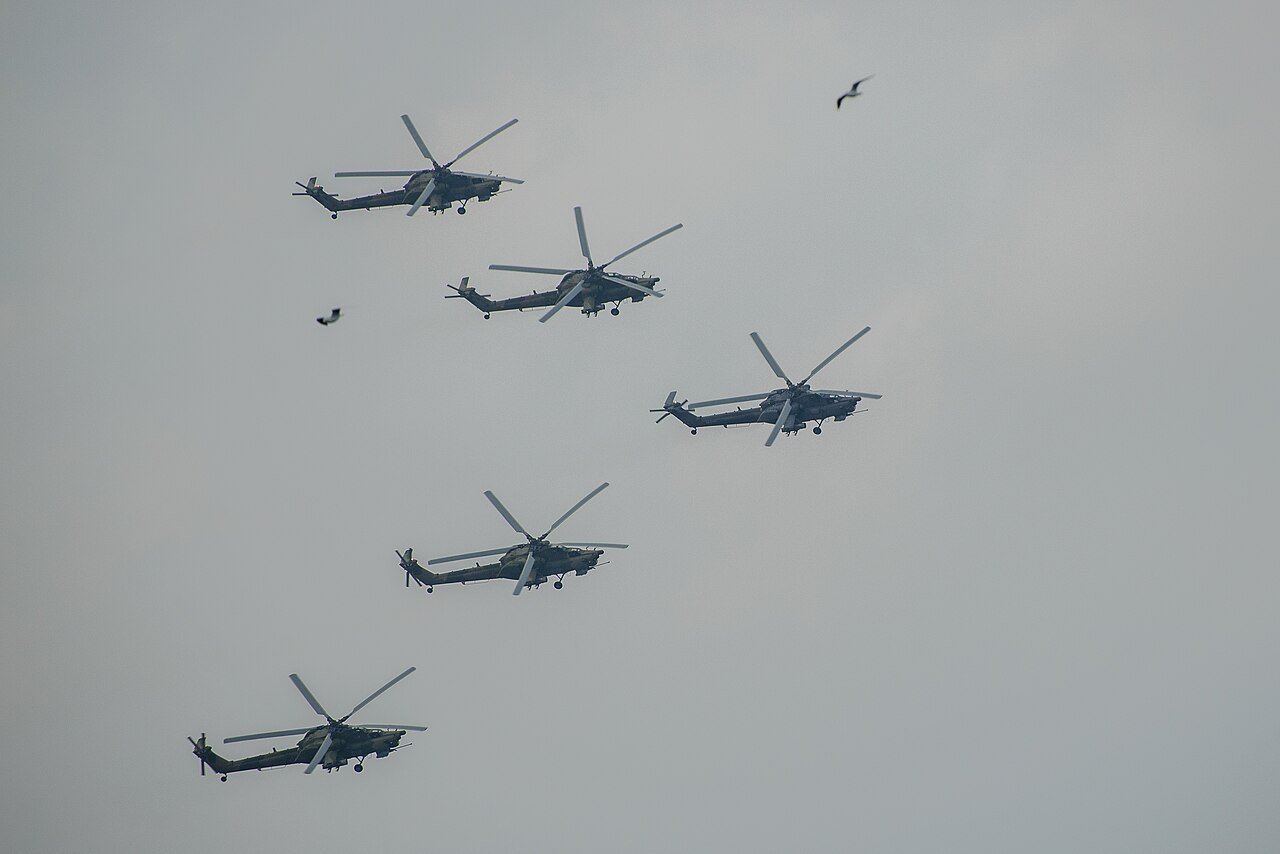
A Mi-28N of the Berkut display team crashes in the Ryazan region on 2 August; the pilot is killed.
Syria and the NM
Russian Mi-28Ns go into combat in Syria; the Mi-28NM makes its first flight.
Ukraine
Mi-28Ns fly in the full-scale invasion; losses are documented from the first weeks.
Uganda crash
A Ugandan Mi-28 crashes in Ntoroko district on 3 January, killing both crew.
Iran and the drones
First Mi-28NEs are photographed in Iran; a drone destroys a Mi-28 over Belgorod on 15 July.
Stories & eyewitnesses: the Mi-28 in peace and war
Beaten by a single seater
In 1984 the Mi-28 lost to Kamov’s radical rival.
Read the full story
Paris, 1989
The Havoc steps into the open.
Read the full story
The long road of the Night Hunter
Twenty-four years from first flight to service.
Read the full story
Room for two more
A gunship with a rescue compartment.
Read the full story
Iraq against Islamic State
The Mi-28’s first export war.
Read the full story
Syria, 2016
Russian Mi-28s support the Syrian army.
Read the full story
The Berkut crash at Ryazan
A display team pilot dies in front of spectators.
Read the full story
Uganda, January 2024
One of three new Mi-28s lost.
Read the full story
Hunted by a drone
July 2026, Belgorod region.
Read the full story
Night Hunters for Iran
Photographs confirm a delivery.
Read the full story
The Mi-28 in pictures
Where the Mi-28 flies and flew
The Mi-28’s record
The Mi-28 first saw combat with Iraq against Islamic State in 2014, then with Russian forces in Syria from 2016 and in Ukraine from 2022. In Ukraine, open-source analysts have documented heavy losses to missiles, artillery, airfield strikes and drones.
See how training and combat types compare in the military aircraft statistics database. Figures are approximate.
Everything people ask about the Mi-28
Can I fly in a Mil Mi-28 Havoc?
Is the Mi-28 a copy of the Apache?
What does the N in Mi-28N stand for?
Who operates the Mi-28?
How many Mi-28s has Russia lost in Ukraine?
Can the Mi-28 carry passengers?
What weapons does the Mi-28 carry?
You can’t fly the Mi-28.
These, you can.
Most of this museum you can only look at. These genuine military jets you can fly yourself with MiGFlug — with aerobatics and time on the controls.
 Fly the L-39 AlbatrosThe world’s most-flown jet trainer — aerobatics included
 Fly the F-104 Starfighter“The missile with a man in it”
 Fly the MiG-21The Cold War’s most-produced jet
 Fly the T-33 Shooting StarAmerica’s first jet trainer
 Fly the DH VampireA piece of early jet history
 Fly the S.211Agile Italian jet trainer
 Fly the MB-326The classic Aermacchi jet
 Fly the MiG-15The Soviet legend of the Korean War
Continue the tour
Every fact, checked
- Mi28: Military System Project OverviewArmy Technology: Mi-28N development, armour, rotor design, Ataka missile
- Mi-28NE Night Hunter Attack HelicopterAirforce Technology: export version, Iraqi deal, specifications
- Mil Mi-28Programme history compiled from Jane’s: prototypes, Mi-28A, Mi-28N dates, development and unit costs
- Russian Kamov Ka-52 ‘Alligator’ Sees Combat Debut in SyriaAviation International News, April 2016: Ka-52 and Mi-28 in Syria
- Fatal helicopter crash grounds Russian helicoptersBBC News on the Berkut team crash, August 2015
- Russia’s Mi-28 Havoc Attack Helicopter Has Tiny Crew Compartment To Pick Up Downed PilotsThe War Zone on the rescue compartment
- Uganda loses new Mi-28N attack helicopter in fatal crashMilitary Africa, 3 January 2024
- First Verified Images Confirm Delivery of Russian Mi-28NE Attack Helicopters to IranAviacionline on the Iranian deliveries
- Ukraine’s FPV Drone Hunted Down a Russian Mi-28 Attack Helicopter Over BelgorodUNITED24 Media, July 2026
- Attack On Europe: Documenting Russian Equipment Losses During The Russian Invasion Of UkraineOryx visually confirmed loss list; 21 Mi-28s as read in October 2026
- Mil Mi-28NUgolok Neba (Russian-language encyclopedia): Mi-28N systems and Mi-28NM first flight