
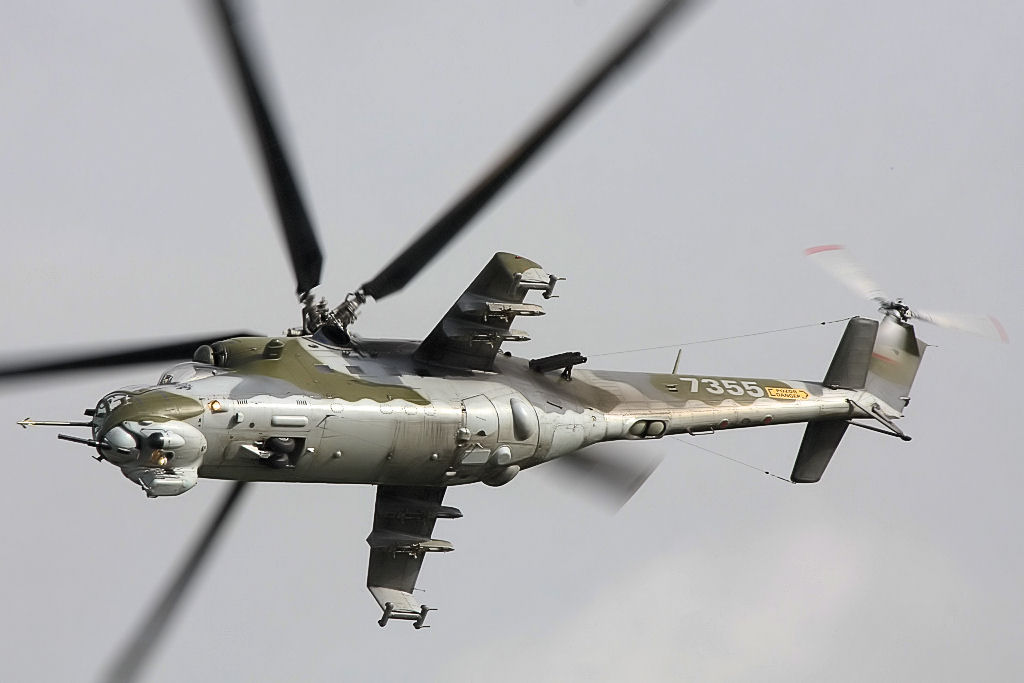
Mil Mi-24 “Hind”
The flying tank
The Soviet armoured gunship that broke every rule — a heavily armed attack helicopter that could also carry eight soldiers into battle. Mujahideen fighters called it “Satan’s chariot.”
The Mil Mi-24 Hind: the gunship that also carried an army
In the late 1960s the Soviet Union watched the United States pioneer the armed helicopter in Vietnam and reached a bold conclusion: it wanted something more. Not just a gunship, and not just a troop carrier, but a single armoured machine that could do both — smash a defended position with rockets and cannon fire, then land and disgorge a squad of infantry to hold it. The result, designed by the Mil Moscow Helicopter Plant founded by Mikhail Mil, was unlike anything in the West.
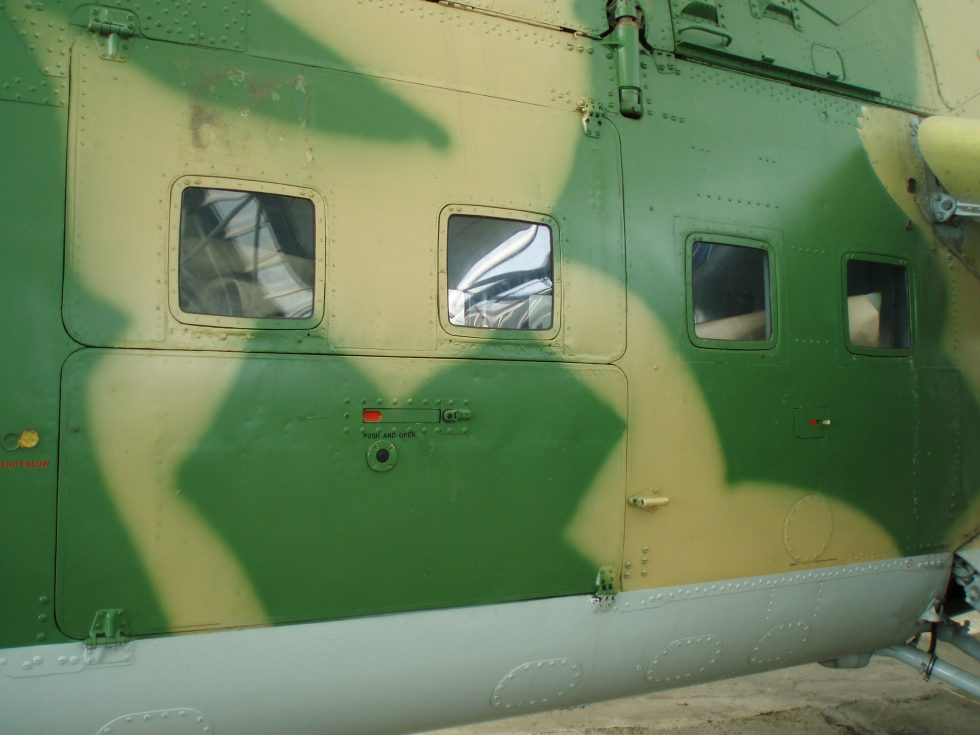
The prototype first flew on 19 September 1969, and the type entered Soviet service in the early 1970s. Where American doctrine kept the attack helicopter (the AH-1 Cobra) and the transport (the UH-1 Huey) as separate aircraft, the Mi-24 fused the two roles into one heavily armoured airframe. A gunner and pilot sat up front behind armoured glass; behind them, a cabin could carry up to eight fully equipped troops. No Western attack helicopter has ever matched that combination.
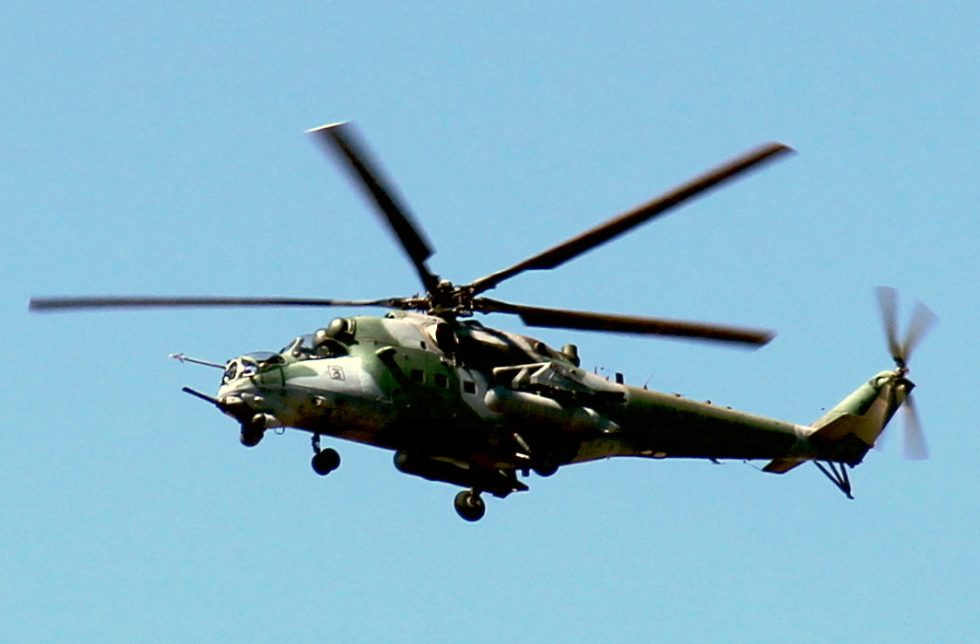
Power came from two Isotov (later Klimov) TV3-117 turboshafts of roughly 2,200 shaft horsepower each, turning a five-blade main rotor. The Mi-24 was fast — a modified example set an absolute helicopter speed record — and it was tough, wrapped in titanium and armoured glass designed to shrug off small-arms fire and cannon shells. Soviet crews nicknamed it the “Krokodil” (crocodile) for its mottled camouflage and menacing snout, and simply the “flying tank.”
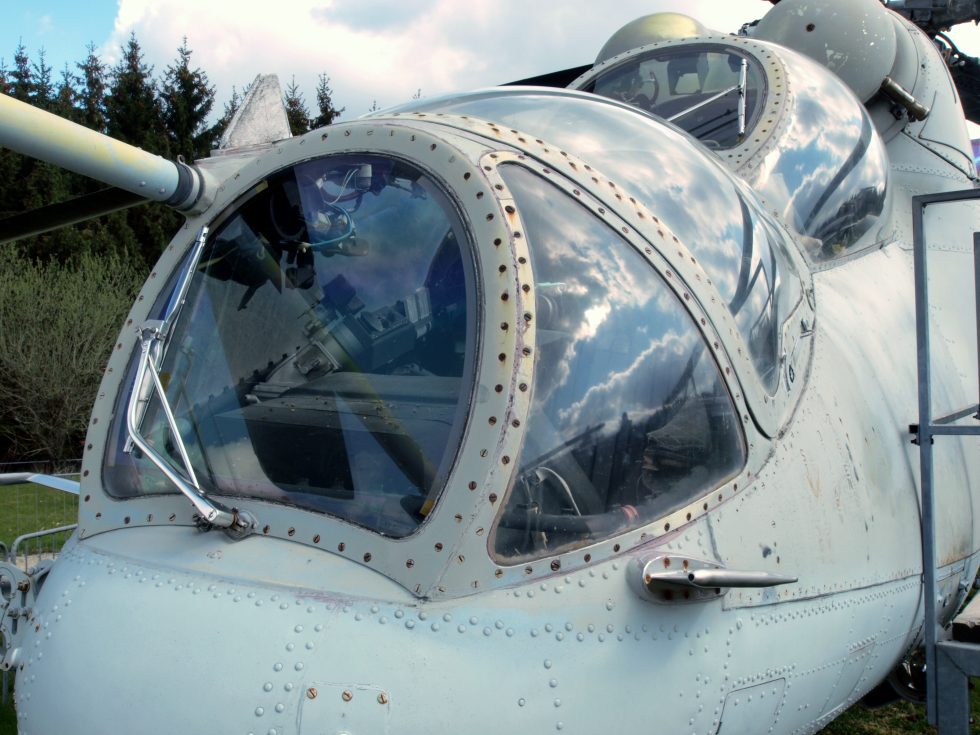
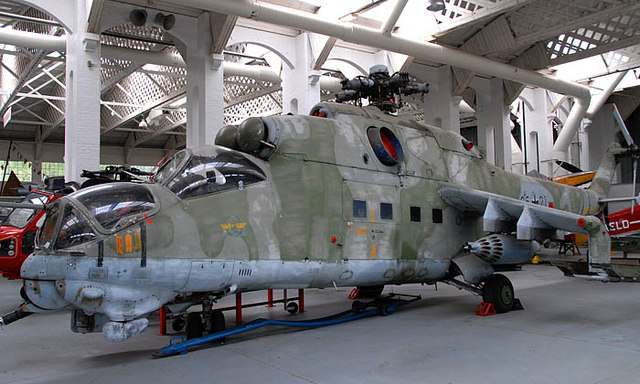
Early Mi-24A models had a wide “greenhouse” cockpit seating the crew side by side. From the definitive Mi-24D onwards the nose was completely redesigned into the now-iconic tandem “double-bubble” canopy, with the weapons operator sitting low in the nose and the pilot stepped up behind — a silhouette recognised around the world. Armament grew accordingly: a 12.7 mm four-barrel Gatling gun in the nose, later variants with fixed 23 mm or 30 mm cannon, plus rockets, bombs and anti-tank guided missiles slung under stubby weapon-carrying wings.
It was the Soviet–Afghan War (1979–1989) that made the Hind infamous. Ranging over the mountains, Mi-24s escorted convoys, hunted mujahideen columns and delivered troops into the high valleys. To the fighters on the ground it was a terror weapon — they called it “Shaitan-Arba,” Satan’s chariot — until American-supplied Stinger missiles began to redress the balance. The war wrote the Hind into history and shaped a generation of Soviet rotary tactics.
The Mi-24 never stopped fighting. Exported as the Mi-25 and Mi-35, it saw action in the Iran–Iraq War, across a dozen African conflicts, in Sri Lanka, the Balkans, Chechnya, Syria and beyond, flown by more than fifty nations. More than half a century after that first flight, upgraded Mi-35M gunships remain in production and front-line service — the flying tank still very much on the battlefield.
01The Mil Mi-24 Hind’s nicknames: “Krokodil,” the flying tank and Satan’s chariot
Few aircraft have collected as many names. Soviet crews called the Mi-24 the “Krokodil” (crocodile), partly for the reptilian camouflage schemes and partly for the long, armoured, snout-like nose of the tandem-cockpit variants. The broader nickname was the “letayushchiy tank,” the flying tank — a nod to its heavy armour and its role as an airborne assault vehicle. Some crews also called the fat-fuselage early models the “Stakan” (drinking glass) for the flat glazing of the greenhouse canopy.
But the most chilling name came from its enemies. Mujahideen fighters in Afghanistan reportedly called the Hind “Shaitan-Arba” — Satan’s chariot — a measure of the fear the armoured gunship inspired before shoulder-launched missiles gave the fighters a way to strike back. That reputation, forged over the mountains of Afghanistan, has followed the Mi-24 ever since.
What makes the Mil Mi-24 Hind special
Gunship and troop carrier in one airframe
The Hind’s defining feature is its dual nature. Behind the two-seat armoured cockpit sits a cabin that can carry up to eight troops — so a single Mi-24 can suppress a landing zone with rockets and cannon, then land and deliver the assault force itself. No Western attack helicopter, from the Cobra to the Apache, was ever built to do both. It is the feature that makes the Hind genuinely unique.
Armour built to take hits
The Mi-24 was designed to fly into fire and survive. The crew sit behind armoured glass and titanium, the cockpit tub is protected, and key systems are hardened against small-arms and cannon fire. Combined with two powerful turboshafts and a rugged five-blade rotor, that protection let Hind crews press home attacks at low level in the face of ground fire — and earned the type its “flying tank” reputation.
A heavy, versatile weapons fit
Under its stubby weapon-carrying wings and nose the Hind carries a formidable arsenal: a nose-mounted 12.7 mm four-barrel Gatling gun (or fixed 23 mm/30 mm cannon on later variants), pods of unguided rockets, bombs, and anti-tank guided missiles. The stub wings also generate lift in fast forward flight, offloading the rotor. Few helicopters have ever brought so many weapons to the fight.
02The Mil Mi-24 Hind’s “double-bubble” cockpit: how the definitive Hind got its face
The earliest Mi-24A carried its crew side by side under a wide, flat “greenhouse” canopy. It worked, but it offered the crew poor protection and a cluttered view. With the definitive Mi-24D of the mid-1970s the Mil bureau completely reshaped the nose, adopting a tandem “double-bubble” canopy: the weapons operator sits low in a separate bubble in the extreme nose with an excellent field of fire, while the pilot sits raised behind, looking over the gunner’s head. Both are wrapped in armoured glass. That stepped, twin-blister silhouette became the Hind’s signature and has defined every major variant since.
03The Mil Mi-24 Hind’s engines: the Isotov TV3-117 turboshaft
The Hind is powered by two Isotov TV3-117 turboshafts (the design bureau later became Klimov), each producing roughly 2,200 shaft horsepower. The same reliable engine family powers the Mi-8/Mi-17 transport and the Ka-50/52, and it has been progressively uprated over decades of production. Twin engines give the heavy Hind the power to lift its armour, weapons and troops, and provide a margin of safety if one fails. Mounted above the cabin with prominent intakes either side of the rotor mast, the TV3-117 is a large part of why the Mi-24 can be both fast and hard-hitting. The very early Mi-24A used the earlier TV2-117 before the switch to the more powerful TV3-117.
04The Mil Mi-24 Hind’s variants: from Hind-A to the Mi-35M
The Hind family is large. The original Mi-24A (Hind-A/B) had the greenhouse cockpit. The redesigned Mi-24D (Hind-D) introduced the tandem double-bubble cockpit and the 12.7 mm Gatling nose gun, and was exported as the Mi-25. The Mi-24V (Hind-E) added the more capable 9M114 Shturm anti-tank missile and was exported as the Mi-35. The Mi-24P (Hind-F) swapped the turret for a fixed side-mounted 30 mm twin-barrel cannon, while the Mi-24VP used a 23 mm turret. The modernised Mi-35M, still in production, adds a shortened wing, fixed landing gear, night-attack sensors and modern missiles — keeping the flying tank current more than fifty years after the first flight.
Full Mil Mi-24 Hind specifications
Baseline note: the figures below describe the Mi-24V (NATO: Hind-E), the most numerous mark by a wide margin — well over 1,500 built — and the one that fought the Soviet war in Afghanistan. The early Mi-24/Mi-24A (Hind-A/B) had a glazed "greenhouse" cockpit shared by both crew and a single-barrel nose gun; the Mi-24D (Hind-D) introduced the tandem double-bubble canopy and the four-barrel turret; the Mi-24P (Hind-F) deleted the turret for a fixed 30 mm cannon on the starboard side; and the Mi-35M is a comprehensively rebuilt night-capable export standard with a shorter fixed wing, non-retractable gear and Mi-28 rotor technology. Deltas for those marks are in grey. Published Mi-24 figures diverge more than they should: where Russian and Western sources disagree the better-attested value is given with the alternative noted.
Dimensions & weights
- Crew
- 2 — weapons operator forward and low, pilot behind and raised (a flight technician was very often carried in the cabin, and in Afghanistan became the de facto door gunner)
- Cabin
- 8 troops seated back to back, or 4 stretchers — the feature that makes the Mi-24 unlike any other gunship ever fielded
- Main rotor diameter
- 17.30 m (56 ft 9 in), five blades — a smaller, faster-turning rotor than the Mi-8 it was derived from
- Disc area
- 235.0 m² (2,530 sq ft)
- Fuselage length
- 17.51 m (57 ft 5 in)
- Length, rotors turning
- 21.35 m (70 ft 1 in) — some references print 19.79 m (64 ft 11 in), which appears to omit the tail rotor arc
- Height
- 6.50 m (21 ft 4 in) overall; 3.97 m (13 ft 0 in) to the top of the rotor head
- Stub wing span
- 6.54 m (21 ft 5 in), set with 12° anhedral to cure a Dutch-roll tendency found above 200 km/h in testing; three stations a side
- Tail rotor
- 3.91 m (12 ft 10 in), three blades, moved from starboard to port during development and its rotation reversed so the advancing blade climbs into the main rotor downwash
- Empty weight
- 8,500 kg (18,740 lb)
- Normal take-off weight
- 11,200 kg (24,690 lb)
- Maximum take-off weight
- 12,000 kg (26,455 lb)
- External sling load
- 2,400 kg (5,290 lb)
- Disc loading
- 51.1 kg/m² (10.5 lb/sq ft) at maximum weight — roughly half again the Black Hawk's, and the reason the Mi-24 hovers badly at altitude
- Armour
- Titanium cockpit tub, 5 mm steel plate around the crew, armoured windscreens rated against 12.7 mm; titanium main rotor blades (total armour mass is not reliably published; the troop-compartment armour was routinely stripped out in Afghanistan to save weight)
Performance
- Never-exceed speed
- 335 km/h (208 mph, 181 kt)
- Maximum level speed
- 320 km/h (199 mph, 173 kt) at sea level
- Cruising speed
- 270 km/h (168 mph, 146 kt) — several Western reference works print 295 km/h (183 mph); the lower figure is the one Soviet crews planned to
- Rate of climb
- 12.5 m/s (2,460 ft/min)
- Hover ceiling, in ground effect
- 2,200 m (7,220 ft)
- Hover ceiling, out of ground effect
- Not consistently published, and low. In Afghanistan the type habitually used rolling take-offs from high-altitude strips because it could not lift its load vertically, which tells you more than any single number would.
- Service ceiling
- 4,500 m (14,760 ft) — Russian sources quote 5,750 m (18,865 ft) for the lightened Mi-35M
- Range, internal fuel
- 450 km (280 mi, 243 nmi)
- Ferry range
- 950 km (590 mi, 513 nmi) with auxiliary tanks
- Endurance
- ~2 h on internal fuel; typical armed sorties were far shorter
- Absolute helicopter speed record
- 368.4 km/h (228.9 mph) over a 15/25 km course, 21 September 1978, by a stripped and wingless Mi-24 flown under the cover designation A-10; it stood until a Westland Lynx took it in 1986
- Closed-circuit record
- 332.65 km/h (206.7 mph) over 1,000 km, 13 August 1975; many of the women's-class records in the series were set by the all-female crew of Galina Rastorguyeva and Lyudmila Polyanskaya
Propulsion & systems
- Engines
- 2 × Klimov (Isotov) TV3-117V turboshaft, side by side above the cabin and feeding a common gearbox — the layout that gives the Hind its twin-intake face (early Mi-24/24A: TV2-117 of 1,120 kW / 1,500 shp; Mi-35M: TV3-117VMA of 1,640 kW / 2,200 shp with an uprated VR-24 gearbox)
- Power
- 1,660 kW (2,225 shp) each
- Intake protection
- PZU vortex dust separators, developed specifically because Afghan dust was eating compressors; EVU exhaust diffusers mix cool air into the efflux to reduce the infrared signature
- Rotor system
- Five-blade fully articulated main rotor with titanium spars, tilted 2.5° to starboard to offset translating tendency in the hover; the landing gear is set 2.5° the other way so the disc sits level on the ground, which is why a parked Hind visibly leans
- Fuel
- ~1,840 litres (~486 US gal) internal in five self-sealing tanks; up to four 500-litre (132 US gal) external tanks on the wing stations, and an internal ferry tank in the troop cabin
- Sighting system
- KPS-53AV gunner's sight and Raduga-Sh radio-command guidance for the Shturm missile; ASP-17V pilot's sight for rockets and the fixed gun (Mi-24A/D: Raduga-F for the Falanga; Mi-35M and Mi-24PN: GOES-342 or OPS-24N gyrostabilised electro-optical turret with thermal imager and laser rangefinder, giving the type genuine night capability for the first time)
- Self-protection
- SPO-10 (later SPO-15) radar warning, ASO-2V flare dispensers on the tail boom and rear fuselage, L-166V-11E "Ispanka" infrared jammer above the boom (late Russian standards fit the L370 Vitebsk / President-S directional infrared countermeasures suite)
- Landing gear
- Fully retractable tricycle — almost unheard of on a helicopter, and fitted purely to chase speed (the Mi-35M deletes it for fixed gear, accepting the drag to save weight and complexity)
- First flight
- 19 September 1969 (first free flight; a tethered hover four days earlier)
- Service entry
- 1972 (Mi-24 and Mi-24A); the Mi-24V entered production in 1976, the Mi-24P in 1981
- Number built
- 2,648 of all marks, and the Mi-35M remains in low-rate production at Rostvertol
- Unit cost
- ~US$15–20 million for a new-build Mi-35M on recent export contracts; figures for refurbished Mi-24V/P airframes are far lower and rarely disclosed
05The Mil Mi-24 Hind’s operating costs: what a flying tank costs to run
There is no reliable published cost-per-flight-hour figure for the Mi-24. As a heavy twin-turbine combat helicopter operated mostly by state air arms — many of which do not publish detailed cost data — its true operating cost is hard to pin down and varies enormously with country, variant, age and how the accounting is done. Rough public estimates for operating a Hind fall in the low thousands of US dollars per flight hour, but that figure should be treated as an approximation rather than an official number. What can be said with confidence is that the Mi-24 was designed to be relatively simple, rugged and cheap to keep flying by the standards of a heavily armed combat helicopter — one reason so many nations could afford to operate it, and why upgraded Mi-35 versions remain attractive on the export market today. Treat any single Hind cost figure as an estimate.
06The Mil Mi-24 Hind’s numbers: how many were built and who flew them
Production totals for the Mi-24 vary by source. Figures commonly cited range from around 2,600 to roughly 3,500 airframes across all variants, built over decades at Soviet (later Russian) plants, with export versions designated Mi-25 and Mi-35. The type has been operated by more than fifty nations across Europe, Asia, Africa and Latin America — from India, Algeria and Vietnam to Poland, the Czech Republic, Cuba and beyond — and it has seen combat on almost every continent. Because different sources count sub-variants, export machines and licence work differently, exact totals should be treated as best estimates rather than definitive counts.
Armament & payload
The Hind carries a heavier and more varied load than any Western attack helicopter of its generation, and changes its gun with every mark
Six stub-wing stations — four under the wings, two on the tips — take up to 2,400 kg (5,290 lb) of stores, with 500 kg on each inboard pylon and 250 kg outboard; the tip rails are reserved for anti-tank missiles. That is a bomber's load on a helicopter, and Afghan crews used it as one, flying with ten 100 kg bombs or four 250 kg bombs as often as with rockets. The gun, unusually, is not a constant: the Mi-24D and Mi-24V carry a four-barrel 12.7 mm YakB-12.7 in a chin turret, the Mi-24P deletes the turret entirely for a fixed twin-barrel 30 mm GSh-30K bolted to the starboard side of the nose, and the Mi-24VP and Mi-35M restore a turret with a twin 23 mm GSh-23L in it. Each choice trades traverse against hitting power, and crews argued about it for decades. Fits differ by mark and by operator more than on almost any other combat aircraft; upgraded Mi-35M and Mi-35P Phoenix standards carry weapons the original Mi-24V could not guide.
Gun
- 12.7 mm Yakushev-Borzov YakB-12.7, four barrels, about 4,000–5,000 rounds per minute, 1,470 rounds, in the USPU-24 chin turret — the Mi-24D and Mi-24V weapon. Devastating and famously unreliable when hot.
- 30 mm Gryazev-Shipunov GSh-30K, twin barrels, fixed and non-traversing on the starboard nose — the Mi-24P (Hind-F). Vastly more destructive per round; the whole aircraft has to be aimed.
- 23 mm GSh-23L in the NPPU-23 turret on the Mi-24VP, Mi-24VM and Mi-35M, with 450 rounds — the compromise, and the standard on modern rebuilds.
- 7.62 mm PKT machine guns fired from the cabin windows by the flight technician, sometimes one on each side so he could move without carrying the gun.
Air-to-air
- R-60 and R-60M (AA-8 Aphid) infrared missiles, one or two per pylon — carried, cleared, and very rarely used.
- 9K38 Igla-V infrared missiles on the Mi-35M and later Russian standards, for self-defence against helicopters and slow movers.
- The gun has done the real air-to-air work: Iranian AH-1J SeaCobras and Iraqi Mi-25s fought each other repeatedly in the 1980–88 war, in what remain among the only sustained helicopter-versus-helicopter engagements on record.
- No radar, no beyond-visual-range capability, and no pretence of one.
Air-to-surface guided
- 9M17P Falanga-P (AT-2 Swatter) — four radio-command missiles on the Mi-24A and Mi-24D, manually flown onto the target; slow, and hard to use under fire.
- 9M114 Shturm-V (AT-6 Spiral) — the Mi-24V's weapon and the reason for the mark. Supersonic, radio-command with automatic tracking, up to eight carried in tubes on the outer and tip stations.
- 9M120 Ataka-V (AT-9 Spiral-2) and 9M127 Ataka-VM — the Mi-24VM, Mi-35M and Mi-35P weapon; up to 16 on a fully loaded Mi-35M, with tandem, thermobaric and fragmentation warheads.
- Ukrainian Mi-24s have been fitted with locally integrated stores; Russian upgrades add laser guidance the original radio-command sets never had.
Bombs
- FAB-100, FAB-250 and FAB-500 general-purpose bombs — typically ten 100 kg, four 250 kg or two 500 kg. Very few attack helicopters have ever been bombers as well.
- RBK series cluster bombs and ZAB incendiaries.
- ODAB thermobaric bombs, used against cave and compound targets in Afghanistan and Chechnya.
- KMGU-2 and KGMU2V submunition and mine dispenser pods, for scattering anti-personnel mines along infiltration routes.
Rockets
- 57 mm S-5 in UB-16 or UB-32 pods — the original fit, and judged too light to be effective in Afghanistan.
- 80 mm S-8 in B-8V20 twenty-tube pods — the replacement, and the Mi-24's favoured munition for the rest of the Soviet war.
- 122 mm S-13 in B-13L five-tube pods, for hardened targets.
- 240 mm S-24 on single rails — a very heavy unguided rocket that blasted the aircraft with its own efflux and was disliked accordingly.
- Flechette warheads were used to break convoy ambushes.
Pods & other stores
- UPK-23-250 gun pod containing a 23 mm GSh-23L with 250 rounds — popular in Afghanistan, and the way a turretless Mi-24P got flexible fire.
- GUV-8700 universal gun pod, either as a YakB-12.7 with two 7.62 mm GShG-7.62 miniguns, or with a single 30 mm AGS-17 automatic grenade launcher.
- Four 500-litre (132 US gal) external fuel tanks, at the cost of two thirds of the weapon stations.
- Spare rocket rounds carried loose in the troop cabin, so a crew could land in the field and reload its own pods — an improvised use of the cabin that crews rated far above carrying infantry in it.
Three typical loadouts
- Afghan hunter-killer, Mi-24V
- Two B-8V20 pods of 80 mm S-8 rockets, a UPK-23-250 gun pod, full YakB-12.7 magazine, troop-compartment armour removed, spare rockets stacked in the cabin, and a technician on a PKT in the window. Flown in pairs or fours, low and fast, with rear-view mirrors fitted because the aircraft is blind astern.
- European anti-armour, Mi-24V
- Eight 9M114 Shturm on the outer and tip stations, two B-8V20 rocket pods inboard, full nose gun. The mission the type was designed for and, mercifully, never had to fly: killing NATO armour on the North German Plain in company with the Mi-8s carrying the actual infantry.
- Convoy escort and close support, Mi-24P
- Four rocket pods, the fixed twin 30 mm GSh-30K with 250 rounds, and no missiles. The Hind used as a flying autocannon — the load that most Russian and Ukrainian crews have actually flown since 2022, usually lobbing rockets in a ballistic pop-up from behind cover rather than making a diving attack.
Sourcing caveat: Soviet and Russian armament documentation is patchy in the open literature and export standards differ from domestic ones, so clearance lists in Western reference works are often aspirational. Weapons listed here are those with credible evidence of operational carriage; demonstrated-but-not-fielded stores have been left out.
Variants
Mikhail Mil set out to build a flying infantry fighting vehicle, and the troop cabin he insisted on is the part that never worked
The V-24 mock-up of 1966 was explicitly a helicopter version of the BMP: a compartment for eight soldiers, small wings carrying rockets and missiles, and a cannon on the landing gear. Mil had to fight for it — senior officers thought conventional weapons a better use of money — and the concept only survived because Marshal Andrei Grechko's expert panel came down narrowly in its favour. The idea was that the same aircraft would clear a landing zone, put its own squad on the ground, and then stay to support them. Nobody else built anything like it, and the reason is instructive: the cabin costs about a metre and a half of fuselage, several hundred kilogrammes of structure and armour, and a great deal of agility, in exchange for a capability that combat almost never called for.
Afghanistan settled the argument within months. Gunship crews found that carrying passengers while being shot at was a distraction, that they wanted to fly as light as possible from high, hot strips, and that the Mi-8 next to them could do the trooping better anyway. Cabin armour came out to save weight. What the cabin actually earned its keep doing was carrying spare rocket rounds so a pair could self-reload in the field, lifting downed crews and small teams out under fire, hauling gear, and giving a technician a window to fire a PKT from — a rear-facing capability the design otherwise lacked entirely. That is a real and useful set of jobs, and it is not the one the aircraft was designed around.
What did work was the speed. The stub wings carry up to a quarter of the total lift in fast cruise, unloading the rotor and letting the Mi-24 run away from things that a conventionally laid-out gunship could not. It is a fast aircraft that hovers badly, which is the exact opposite of the Western attack-helicopter tradition, and it is why the Hind is flown like a strike aircraft rather than a sniper.
- Mi-24 / Mi-24A (Hind-A/B, 1971–1974)
- Glazed greenhouse cockpit with both crew side by side, Falanga missiles on the wingtips, a flexible 12.7 mm A-12.7 in the nose. Recognisably a different-looking aircraft from the Hind everyone pictures. The unarmed Mi-24U (Hind-C) trainer came from the same batch.
- Mi-24D (Hind-D, 1973–1977, ~350)
- The redesign that created the shape: separate tandem cockpits under a stepped double-bubble canopy, the four-barrel YakB-12.7 in a chin turret, SACLOS-guided Falanga. Exported as the Mi-25.
- Mi-24V (Hind-E, from 1976, 1,500+)
- The definitive mark: 9M114 Shturm missiles, uprated engines, improved sights. Exported as the Mi-35; Polish aircraft are designated Mi-24W.
- Mi-24P (Hind-F, from 1981)
- Turret deleted, fixed twin-barrel 30 mm GSh-30K on the starboard nose. Heavier punch, no traverse. Exported as the Mi-35P.
- Mi-24VP (1989, 25 built)
- Mi-24V with a twin 23 mm GSh-23L in a movable turret; production ended almost immediately with the Soviet Union.
- Mi-24R and Mi-24K (Hind-G1/G2)
- Nuclear, biological and chemical sampling, and artillery observation. Mi-24Rs flew over Chernobyl in 1986.
- Mi-24PN and Mi-35M (2004 onwards)
- The night-capable rebuilds: gyrostabilised electro-optical turret with thermal imager, GLONASS/GPS, glass cockpit, Ataka missiles. The Mi-35M also takes shorter fixed wings, fixed landing gear and Mi-28 rotor technology, and is the version still in production.
- Mi-35P Phoenix (2020 onwards)
- Russia's common modernisation standard for existing Mi-24P airframes: OPS-24N-1L sight with a third-generation thermal imager, digital flight system, Vitebsk or President-S countermeasures.
- SuperHind Mk.III / Mk.IV (South Africa, Algeria)
- Advanced Technologies and Engineering's Western-avionics rebuild, with a 20 mm cannon, a modern sighting turret and Ingwe missiles. Algeria is the main operator, and the result is arguably the most capable Hind flying.
- AH-2 Sabre (Brazil, 12, 2010–2024)
- Mi-35M with Israeli avionics. Brazil retired the fleet after little more than a decade, defeated by cost, spares and the practical difficulty of running Russian equipment through Western sanctions.
Closing caveat: the Mi-24 has been shot down in very large numbers. Russian accounts give 74 Mi-24s lost in Afghanistan across nine years, 27 of them to Stinger and two to Redeye, and the Mujahideen's most effective early counter was not a missile at all but the RPG-7 fired at an angle it was never designed for. Since February 2022 both Russia and Ukraine have lost Hinds heavily — open-source analysts have visually confirmed dozens on each side, and the true totals are higher. The aircraft's armour and redundancy genuinely do bring crews home from hits that would down lighter machines, but its size, its infrared signature and its poor hover performance make it an easy target for a man with a shoulder-launched missile, and that has been true since 1986.
The Mil Mi-24 Hind from prototype to modern battlefield
A radical requirement
Watching armed helicopters emerge in Vietnam, the Soviet military asks the Mil bureau for something more: an armoured flying weapon that can also carry an assault squad.
First flight
The prototype flies for the first time on 19 September 1969, powered by twin turboshafts and combining gunship firepower with a troop cabin.
Enters Soviet service
The Mi-24 enters service with Soviet forces in the early 1970s as the first of a new class of armoured assault helicopters.
The definitive Mi-24D
The redesigned Mi-24D introduces the tandem “double-bubble” cockpit and the 12.7 mm Gatling nose gun — the classic Hind silhouette.
The Soviet–Afghan War
The Hind becomes infamous over Afghanistan, escorting convoys and hunting fighters who nickname it “Satan’s chariot” — until Stinger missiles change the odds.
Exported and combat-proven
Exported as the Mi-25 and Mi-35, the Hind fights in the Iran–Iraq War and across a string of African and Asian conflicts.
Post-Soviet wars
Hinds see heavy use in the Balkans, the Chechen wars and numerous regional conflicts as former Soviet stocks spread worldwide.
The modernised Mi-35M
Russian Helicopters develops the upgraded Mi-35M with night-attack sensors, modern missiles and a shortened wing, keeping the design current.
Syria and beyond
Mi-24s and Mi-35s fly combat missions in Syria and other theatres, more than forty years after entering service.
Still on the front line
Operated by more than fifty nations and still in production as the Mi-35M, the flying tank remains one of the most widely used combat helicopters ever built.
From the flight line: twelve Mil Mi-24 Hind stories
A weapon with no equal
The Soviets wanted more than a gunship — they wanted a flying armoured personnel carrier.
Read the full story
Gunship and taxi in one
The Hind could suppress a landing zone and then unload the men to take it.
Read the full story
The double-bubble cockpit
A nose redesign gave the Hind the silhouette the world remembers.
Read the full story
Why crews called it the crocodile
Camouflage and a menacing snout earned the Hind a reptilian nickname.
Read the full story
Satan’s chariot
Over the mountains of Afghanistan the Hind became a legend of fear.
Read the full story
Built to fly into fire
Titanium and armoured glass let Hind crews press home their attacks.
Read the full story
A record-setting helicopter
The heavy Hind was also genuinely fast.
Read the full story
Guns, rockets and missiles
Few helicopters have ever carried so much.
Read the full story
Mi-25 and Mi-35 worldwide
The Hind became one of the Soviet bloc’s great exports.
Read the full story
Fighting on every continent
From the Gulf to Africa to the Balkans, the Hind kept turning up.
Read the full story
The Mi-35M keeps it current
Decades on, the flying tank is still being built.
Read the full story
The gunship that stayed unique
No one has copied the Hind — and it is still flying.
Read the full story
The Mil Mi-24 Hind in pictures
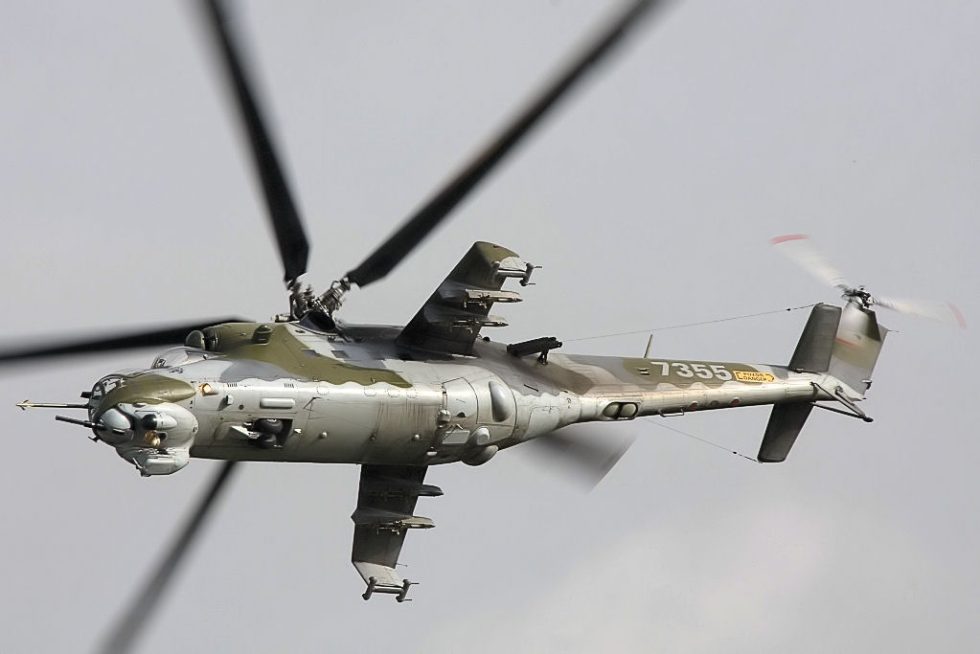
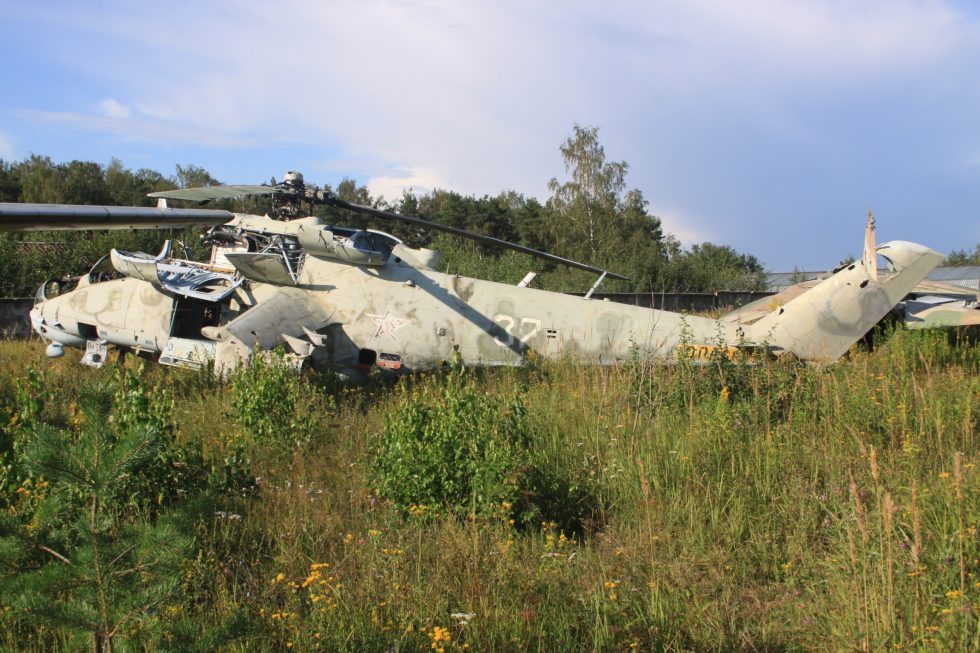
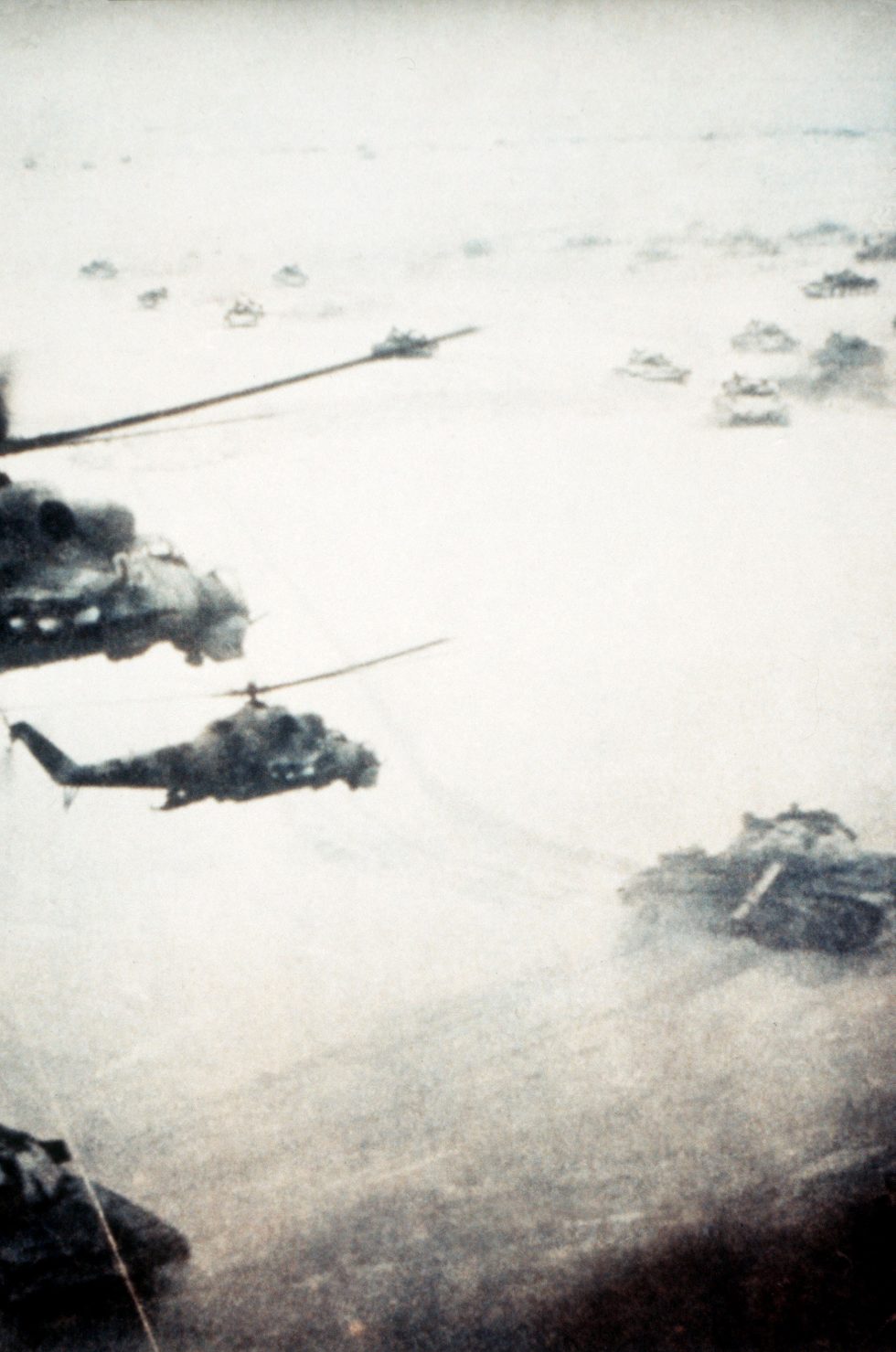
The Mil Mi-24 Hind in motion
“A Flying Tank”: Why the Mi-24 Is Called the World’s Only Assault Helicopter — from the WSJ Equipped series by The Wall Street Journal, a clear explainer of why the Hind’s gunship-plus-transport concept remains unique.
Where the Mil Mi-24 Hind flew
Operators today
More than fifty air arms still fly the Hind, and almost all of them are flying aircraft built before 1991
Russia and Ukraine between them account for the largest active fleets and by far the heaviest recent use; everything else is a scattering of small forces, mostly across Africa, Central Asia and Latin America, mostly flying Mi-35 export airframes delivered in the 1980s and kept alive on overhaul. Serviceability is the story these numbers do not tell. Several operators listed at a dozen or more aircraft can put a fraction of them in the air on a given day, and in states under sanction or at war the flyable figure is anyone's guess. India's Mi-25/Mi-35 force, once two full squadrons, is down to a handful as the indigenous LCH Prachand replaces it. Brazil retired its twelve AH-2 Sabres and Czechia gave its Mi-24/Mi-35s to Ukraine in August 2023, as North Macedonia did with its Mi-24Vs; both are former operators now, not current ones.
These are estimates. Many airframes counted on paper are stored, in deep overhaul, or not operational. Sources: IISS The Military Balance and FlightGlobal World Air Forces; entries that could not be corroborated are omitted. Four cautions. The Russian total combines Aerospace Forces Mi-24D/V/P and Mi-35P with a small naval detachment and is a pre-attrition paper figure — confirmed combat losses since 2022 are substantial and are not deducted here. Ukraine's figure is likewise a paper one; the flyable fleet is materially smaller, though it has been topped up with ex-Czech and ex-North Macedonian airframes. Sudan's aircraft are caught in a civil war and their status is unknowable. Azerbaijan is credited with a large Mi-24V and Mi-35 force in several listings, but the figures conflict badly enough that no number is printed here. Angola, Kazakhstan, Egypt, Venezuela, Sri Lanka, Serbia, Yemen, Indonesia, Pakistan and a dozen smaller African operators each fly single-figure to low-teens fleets.
The Mil Mi-24 Hind’s record: half a century of combat
Few helicopters have fought in as many wars as the Mi-24. Its combat debut came in the Soviet–Afghan War of 1979–1989, where Hinds flew convoy escort, ground attack and air assault until shoulder-launched Stinger missiles raised the cost. Exported widely, it went on to fight in the Iran–Iraq War, across the civil wars of Angola and Africa, in Sri Lanka, the Balkans, Chechnya, Syria and Ukraine, flown by more than fifty nations. These conflicts are well documented, though loss and sortie figures vary by source and should be read as estimates.
See the aircraft that flew alongside it: the Sukhoi Su-25 Frogfoot, its fixed-wing “flying tank” partner over Afghanistan, and the Bell UH-1 Huey, the Western helicopter it was conceived to answer.
Everything people ask about the Mil Mi-24 Hind
Can I fly in a Mi-24 Hind?
What is the Mil Mi-24 Hind?
Why is the Mi-24 called the “flying tank”?
When did the Mi-24 first fly and enter service?
What engines does the Mi-24 Hind have?
How many troops can a Mi-24 carry?
What weapons does the Mi-24 carry?
What is the difference between the Mi-24, Mi-25 and Mi-35?
What was the Mi-24’s role in the Soviet–Afghan War?
Why does the Mi-24 have stub wings?
Is the Mi-24 Hind still in service?
How fast is the Mi-24?
You can’t fly the Mi-24 Hind.
These, you can.
Some legends only live in museums — others are fuelled and waiting. MiGFlug has put civilians in real military jet cockpits since 2004.
 Fly the L-39 AlbatrosThe world’s most-flown jet trainer — aerobatics included
 Fly the F-104 Starfighter“The missile with a man in it”
 Fly the MiG-21The Cold War’s most-produced jet
 Fly the T-33 Shooting StarAmerica’s first jet trainer
 Fly the DH VampireA piece of early jet history
 Fly the S.211Agile Italian jet trainer
 Fly the MB-326The classic Aermacchi jet
 Fly the MiG-15The Soviet legend of the Korean War
Continue the tour
Every fact, checked
- Russian HelicoptersThe manufacturer group behind the Mi-24 and the modernised Mi-35M.
- Mil Moscow Helicopter PlantThe design bureau, founded by Mikhail Mil, that created the Hind.
- National Museum of the U.S. Air ForceFact sheet on the Mi-24D Hind and its history.
- Royal Air Force MuseumReference material on the Mi-24 and Cold War Soviet aircraft.
- Helis.com Helicopter DatabaseDevelopment history, variants and production data for the Mi-24.
- Military FactorySpecifications, variants and operator data for the Mi-24 Hind.
- Key AeroEstablished aviation reference for Hind development, variants and combat use.
- Imperial War MuseumContext on the Soviet-Afghan War and the Hind’s combat record.