
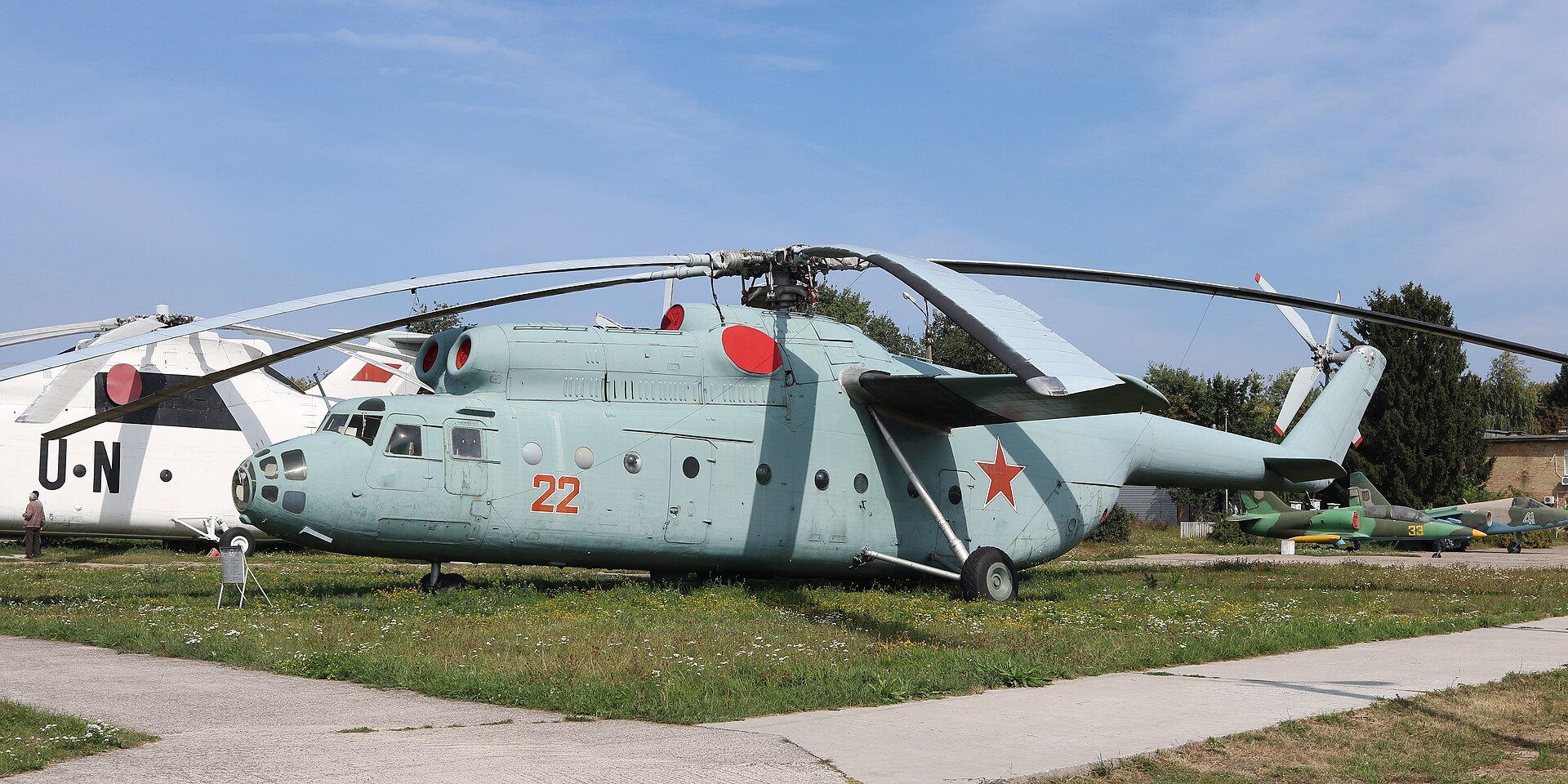
Mil Mi-6 Hook
The First Giant
In 1957 the Mi-6 was by far the biggest helicopter in the world and the first Soviet turbine helicopter; it set 16 world records, opened up Siberia’s oil fields and hauled the Soviet army through Afghanistan.
The Mi-6: how Mil built a helicopter twice the size of anything else
In the early 1950s the biggest helicopters in the world could lift about two tonnes. The Soviet army wanted one that could carry a division’s guns, tractors and trucks, and the ministries running Siberia wanted a machine that could move oil rigs where there were no roads. On 11 June 1954 the Council of Ministers ordered Mikhail Mil to build it: six tonnes normally, up to eleven and a half over short distances, and for the first time in the USSR, heavy loads slung underneath. There was no suitable engine, so Pavel Soloviev’s bureau created one, the D-25V, and Mil’s engineers designed a five-blade rotor 35 metres across, with a gearbox and rotor head that together outweighed both engines.
On 5 June 1957 test pilot Rafail Kaprelyan lifted the first prototype off the ground at Moscow. Weighing more than 40 tonnes at take-off, when the largest foreign helicopters weighed about 14, the Mi-6 was a leap in scale without precedent. It began breaking records within months: on 30 October 1957 it lifted 12 tonnes to 2,432 metres. On 21 September 1961 it became the first helicopter to fly faster than 300 km/h, reaching 320 km/h, and the American Helicopter Society awarded Mil its Igor I. Sikorsky Prize. Sikorsky himself, Mil’s successor Marat Tishchenko later recalled, called the Mi-6 “not one step forward, but two steps forward” in rotary-wing technology.
Production began in 1959 at Rostov-on-Don, which built 874 Mi-6s up to 1980, while a Moscow factory added 50 before switching to rockets. The army used them to carry missiles, artillery and armoured vehicles; Aeroflot used them to build Siberia, lifting drilling rigs, pipelines and power-line pylons into the taiga and tundra. Mi-6s were exported to Egypt, Vietnam, Iraq, Ethiopia, Algeria, Peru and others, and served through the 1967 Arab-Israeli war and the Soviet war in Afghanistan, where the 40th Army lost 28. The type’s descendant, the Mi-26, replaced it from 1980, and Russia grounded the last Mi-6s in 2002. In 1965 it was shown with great success at the Paris Air Show.
01The Mi-6’s records: the fastest and strongest helicopter on earth
Mil used records as a showcase, and the Mi-6 collected sixteen of them. On 30 October 1957, only months after its first flight, Kaprelyan’s crew lifted 12,000 kg to 2,432 metres. In April 1958 crews took 5,000 kg to 5,584 metres and 10,000 kg to 4,885 metres. On 21 September 1961 N. V. Leshin and V. P. Koloshenko flew at 320 km/h, ten km/h faster than a record set by an American Sikorsky S-61 earlier that year, and the first time any helicopter had passed 300 km/h, a speed then thought to be the practical limit.
September 1962 brought a burst of new marks. Koloshenko’s crew set four speed-with-payload records over 500 and 1,000 km courses; B. K. Galitsky’s crew flew 1,000 km with up to two tonnes at more than 300 km/h; and on 13 September Kaprelyan lifted 20,117 kg to 2,000 metres, more than the entire weight of the biggest Western helicopter of the 1960s, the Sikorsky S-64. A few years later Galitsky’s crew pushed the 100 km closed-circuit record to 340.15 km/h. Several of these records stood for decades.
02The Mi-6 at war: from the Six-Day War to Afghanistan
The Mi-6 was conceived as a military machine able to move tactical missiles such as the Luna, artillery, BTR-152 armoured carriers and airborne self-propelled guns. In service it gave the Soviet army a heavy airlift that no other force could match. Egypt received 19 Mi-6s between 1965 and 1971 and reportedly lost ten of them on the ground in the Six-Day War of 1967. Vietnam, Iraq and Ethiopia also received them, and an Egyptian Mi-6 is now displayed at the Air Force museum at Almaza.
Afghanistan was the Mi-6’s hardest war. From 1979 Soviet Mi-6s supplied isolated garrisons, carried fuel and ammunition and moved troops over mountains where roads were deadly. Units such as the 280th Regiment flew them there through the 1980s. The cost was high: by Russian figures the 40th Army lost 28 Mi-6s in Afghanistan, including 15 between 1985 and 1989, to missiles, ground fire and accidents.
What makes the Mi-6 special
Wings on a helicopter
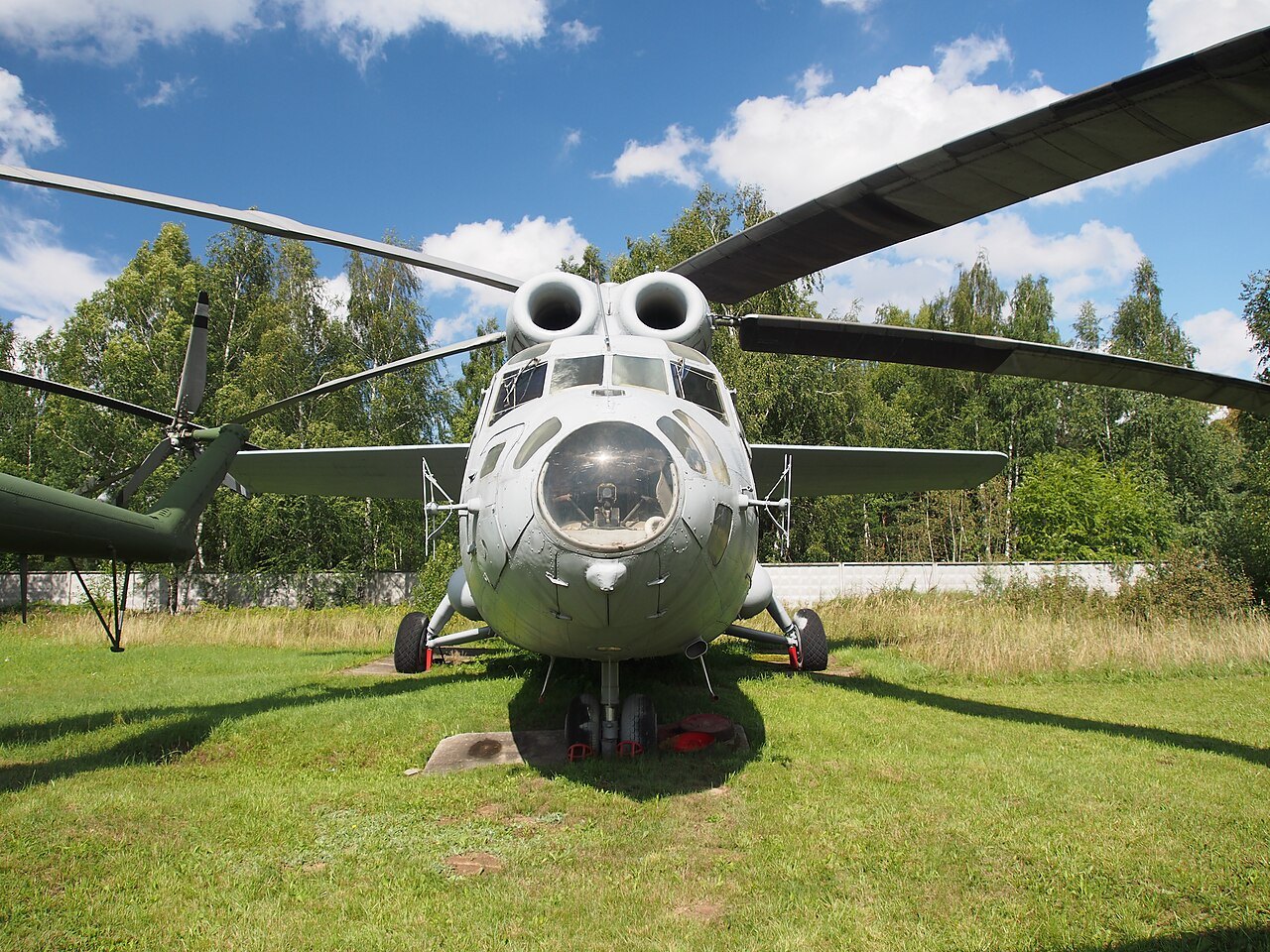
To fly fast, the Mi-6 carried a pair of stub wings that took about a fifth of the lift in cruise, offloading the rotor so it could go faster before the blades stalled. They were set at slightly different angles left and right to help balance the rotor’s torque. For crane work the wings could be removed to save weight, and the flying-crane derivative, the Mi-10, did without them altogether.
A gearbox heavier than its engines
The hardest problem was transmitting the power of two 5,500 shp turbines to a rotor turning only slowly. Mil’s four-stage planetary gearbox, designed under A. K. Kotikov, delivered torque that no Western helicopter gearbox matched for years. It was so massive that gearbox and rotor head outweighed both engines, and each main rotor blade alone weighed about 700 kg, with a steel spar fitted with a pressure warning system that showed red if a crack appeared.
A cabin like a transport aircraft
The Mi-6’s hold measured about 12 by 2.65 by 2.5 metres, close to that of an An-12 transport. It took 61 folding seats, 41 stretchers with two medics, or 12 tonnes of vehicles and freight loaded through rear clamshell doors. In emergencies crews crammed in up to 150 people. A hook could carry about eight tonnes underneath, and Aeroflot versions moved drilling rigs and bridge sections across Siberia.
03The Mi-6’s variants: tankers, command posts and space recovery
- V-6: five development aircraft, the first flown 5 June 1957.
- Mi-6 / Mi-6T: transport for troops, vehicles and cargo (Hook-A).
- Mi-6A: improved standard version in production from 1971, with better reliability and avionics.
- Mi-6TZ / ATZ: fuel-carrying versions that refuelled vehicles and aircraft on the ground.
- Mi-6VKP and Mi-22: airborne command post versions with large antennas (Hook-B, C and D).
- Mi-6PS: search and rescue version built to recover cosmonauts and their descent capsules.
- Mi-6PZh: firefighting conversion with a 12-tonne water tank, shown at the 1967 Paris Air Show.
- Mi-6S: medical evacuation version for 41 stretchers.
- Mi-6M: experimental anti-submarine version with torpedoes.
- Derivatives: the Mi-10 flying crane and the giant twin-rotor V-12, which used two sets of Mi-6 dynamic components.
Mil Mi-6 specifications
Specifications
- Crew
- 5 to 6 (pilots, navigator, flight engineer, radio operator)
- Capacity
- 65 to 70 troops, 41 stretchers, or 12,000 kg (26,455 lb) internal cargo; 8,000 kg (17,637 lb) underslung
- Length
- 33.2 m (108 ft 10 in) fuselage and tail boom
- Height
- 9.16 m (30 ft 0 in)
- Main rotor diameter
- 35.0 m (114 ft 10 in)
- Max take-off weight
- 42,500 kg (93,696 lb) normal; 44,000 kg (97,003 lb) maximum
- Powerplant
- 2 × Soloviev D-25V turboshafts, 4,100 kW (5,500 shp) each
- Maximum speed
- 300 km/h (186 mph)
- Cruise speed
- 250 km/h (155 mph)
- Range
- 970 km (603 mi); ferry range 1,450 km (900 mi)
- Service ceiling
- 4,500 m (14,800 ft)
- Armament
- Optional 12.7 mm A-12.7 machine gun in the navigator’s station
Costs & production
- Cost per flight hour
- No official figure was published. A hedged estimate is in the high thousands of US dollars per hour or more in today’s money, based on the fuel burn of two 5,500 shp turbines, a five-to-six-person crew and the heavy maintenance load of its gearbox and rotor
- Production
- 874 built at Rostov-on-Don (1959–1980) and 50 in Moscow (1960–1962), plus prototypes
- Programme
- Government order 11 June 1954; first flight 5 June 1957; Aeroflot service 1963; Mi-6A from 1971; withdrawn in Russia in 2002
04The Mi-6’s operating costs: heavy lift at a heavy price
A Mi-6 needed a crew of five or six, two big turbines and constant attention to its huge gearbox and its rotor, whose blades were fitted and replaced only as a matched set. Yet for the Soviet economy it paid its way. Moving a drilling rig or a power-line tower by Mi-6 across Siberian swamp could save months of road and track building, and Aeroflot directorates such as Tyumen flew Mi-6s for exactly that work.
Age eventually caught up with it. After a fatal crash in 2002, attributed to an engine fire caused by a bearing failure, Russia withdrew its remaining Mi-6s from service, and reports also pointed to the wooden tail-rotor blades reaching the end of their lives. No operator published a cost per flight hour, so the table gives only a hedged estimate.
The Mi-6 from first hover to final retirement
The order
On 11 June the Soviet government orders a heavy transport helicopter from Mil.
First flight and first record
Kaprelyan flies the V-6 on 5 June; on 30 October it lifts 12 tonnes to 2,432 m.
Production
Rostov-on-Don builds its first nine Mi-6s.
Army trials
First Mi-6s go to the 696th Helicopter Regiment at Torzhok for trial service.
Past 300 km/h
On 21 September a Mi-6 reaches 320 km/h, winning the Sikorsky Prize; it also carries a Vostok capsule mock-up over Tushino.
20 tonnes aloft
Kaprelyan lifts 20,117 kg to 2,000 m on 13 September.
Aeroflot
Civil Mi-6 operations officially begin.
Paris debut
The Mi-6 is a star of the Paris Air Show; exports to Egypt begin.
Loss in France
On 6 August the Mi-6PZh firefighter, commanded by Yuri Garnaev, crashes fighting a fire in southern France.
Afghanistan
Soviet Mi-6s begin a decade of supply flights; 28 are lost.
End of production
Rostov completes its 874th Mi-6 and switches to the Mi-26.
Grounded
After a fatal crash, Russia withdraws its last Mi-6s.
Stories & eyewitnesses: the Mi-6 in records, wars and wilderness
Faster than 300 km/h
In 1961 a 40-tonne helicopter broke a speed barrier.
Read the full story
Twenty tonnes to 2,000 metres
Kaprelyan’s 1962 lift outweighed any Western helicopter.
Read the full story
Two steps forward
Igor Sikorsky’s verdict on Mil’s giant.
Read the full story
A spacecraft over Tushino
In Gagarin’s year, a Mi-6 flew a Vostok mock-up.
Read the full story
The firefighter that never came home
A Mi-6 water bomber crashed in France in 1967.
Read the full story
Oil rigs on a hook
Mi-6s carried Siberia’s oil boom on their backs.
Read the full story
Twenty-eight lost in Afghanistan
The heavy lifters paid a price in the Soviet war.
Read the full story
Destroyed on the ground
Egypt’s new giants never got airborne in 1967.
Read the full story
Where to see a Hook
Museums from Monino to Ho Chi Minh City keep the giant.
Read the full story
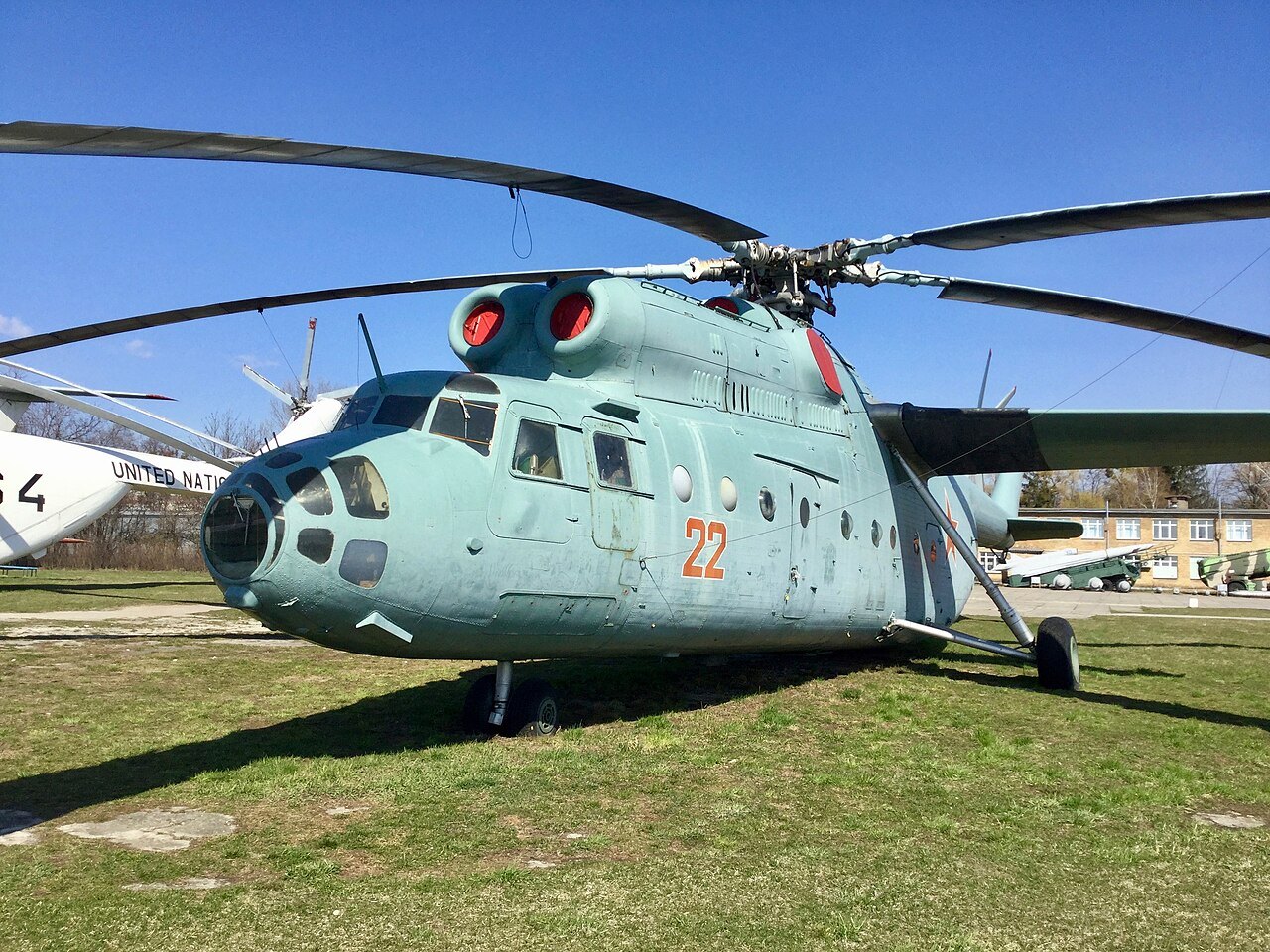
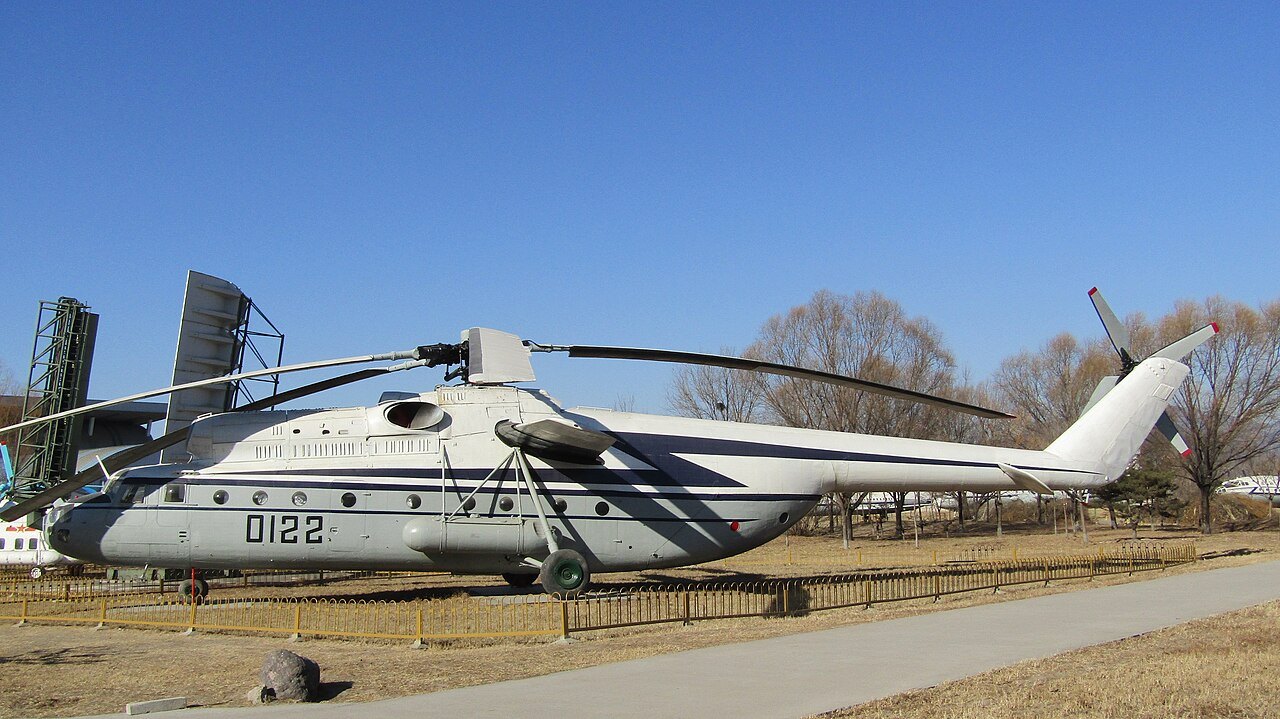
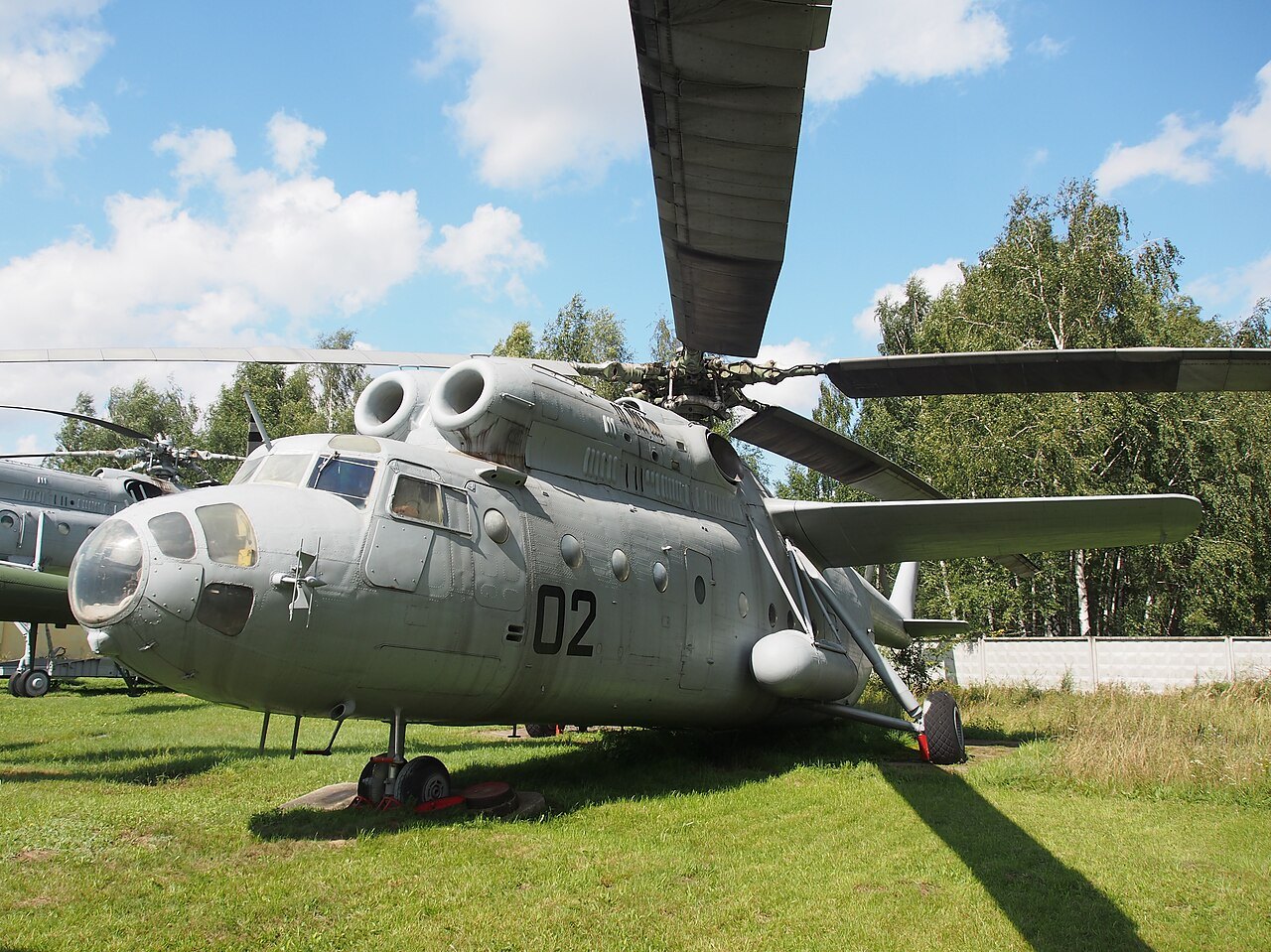
The Mi-6 in pictures
Where the Mi-6 flies and flew
The Mi-6’s record
The Mi-6 was a heavy transport, not a combat aircraft, but it went to war with Egypt in 1967 and with the Soviet army in Afghanistan, where it was a vital supply line and suffered heavy losses. In peacetime its record was one of records broken and wilderness opened.
See how training and combat types compare in the military aircraft statistics database. Figures are approximate.
Everything people ask about the Mi-6
Can I fly in a Mil Mi-6?
How big was the Mi-6?
Why did the Mi-6 have wings?
How many Mi-6s were built?
What replaced the Mi-6?
When was the Mi-6 retired?
You can’t fly the Mi-6.
These, you can.
Most of this museum you can only look at. These genuine military jets you can fly yourself with MiGFlug — with aerobatics and time on the controls.
 Fly the L-39 AlbatrosThe world’s most-flown jet trainer — aerobatics included
 Fly the F-104 Starfighter“The missile with a man in it”
 Fly the MiG-21The Cold War’s most-produced jet
 Fly the T-33 Shooting StarAmerica’s first jet trainer
 Fly the DH VampireA piece of early jet history
 Fly the S.211Agile Italian jet trainer
 Fly the MB-326The classic Aermacchi jet
 Fly the MiG-15The Soviet legend of the Korean War
Continue the tour
Every fact, checked
- Mil Mi-6 (encyclopedia entry)Ugolok Neba Russian aviation encyclopedia: design, gearbox, cabin, records and production at Rostov and Moscow
- Vozdushnyy silach: kak vertolet Mi-6 stal legendoyRossiyskaya Gazeta (2020): first flight, cabin, Vostok mock-up flight and speed records
- Vertolet Mi-6Monino.ru Russian aviation database: programme, 300 km/h record and Sikorsky Prize
- Poteri aviatsii 40-y Armii v AfganistaneSkywar.ru loss tables for Soviet aviation in Afghanistan, including Mi-6
- We Haul It AllAir & Space / Smithsonian on Mil heavy lifters and Tishchenko’s account of Sikorsky’s verdict
- Mil Mi-6Aviastar compilation quoting Munson (1968) and Jane’s on records, wings and exports