
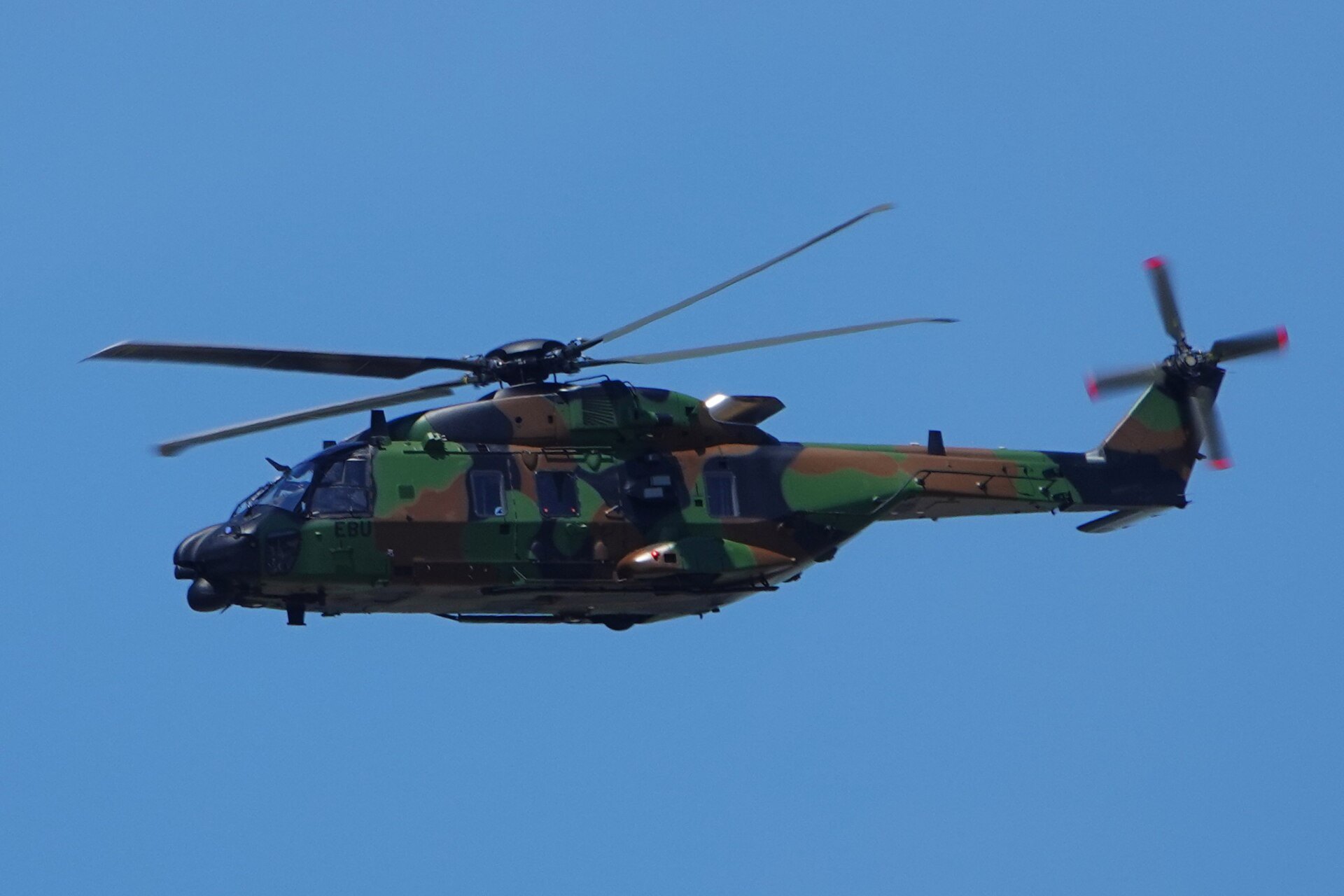
NHIndustries NH90
Europe’s Fly-by-Wire Workhorse
NATO’s medium helicopter and the first production helicopter with fully fly-by-wire controls: more than 525 delivered, flown from Afghanistan to the Gulf of Aden, yet dropped early by Australia and Norway.
The NH90: how NATO built a helicopter by committee, and what it cost
In 1985 France, West Germany, Italy, the Netherlands and Britain set out to build one helicopter that could carry troops across a battlefield and hunt submarines from a frigate. Britain left in 1987, but the other four pressed on, and on 1 September 1992 the new consortium NHIndustries signed a design-and-development contract with the NATO Helicopter Management Agency, NAHEMA. Airbus Helicopters in France and Germany each took 31.25 per cent, Agusta (later Leonardo) 32 per cent and Fokker 5.5 per cent. The first prototype, PT1, flew on 18 December 1995, and on 12 December 2002 the third prototype became the first helicopter to fly with its mechanical back-up controls removed entirely, relying on fly-by-wire alone.
The design split into two families with about 75 per cent in common. The TTH (Tactical Transport Helicopter) carries up to 20 equipped soldiers or 12 stretchers through side doors and a rear ramp. The NFH (NATO Frigate Helicopter) folds its rotor and tail, locks down onto a heaving deck and carries dipping sonar, sonobuoys, torpedoes and anti-ship missiles. In June 2000 the partner nations ordered 366 helicopters worth US$8.6 billion, and export customers followed from Finland and Sweden to Oman, New Zealand, Australia and Qatar. The German Army took the first production aircraft in late 2006, and the type entered operational service in 2007. Final assembly was shared out between Marignane, Donauwörth and Italy, with further lines in Finland, Spain and Brisbane for national orders, and production peaked at 53 helicopters in 2014.
Then came the reckoning. Almost every customer wanted its own configuration, and the result was delays, spares shortages and low availability. Australia withdrew its MRH-90 Taipan fleet in September 2023 after a fatal crash; Norway terminated its contract in 2022; Sweden and Belgium chose to retire theirs early. Yet the NH90 has also flown medevac in Afghanistan, chased pirates off Somalia and rescued sailors in storms, and New Zealand, Italy, France and Germany fly it hard. NHIndustries reports more than 525 delivered and over 460,000 flight hours, and an upgraded Standard 3 version is in production, with the Netherlands ordering three more naval NFHs as recently as December 2025. Few modern military aircraft have been praised and condemned so loudly at the same time.
01The NH90’s troubles: Australia, Norway and the cost of a custom fleet
Australia ordered the NH90 in 2004 as the MRH-90 Taipan, eventually acquiring 46, most assembled in Brisbane. In 2010 the fleet was briefly grounded when RTM322 compressor blades were found rubbing their casings, and in November 2011 the programme went on Defence’s “Projects of Concern” list, with transmission oil-cooler fan failures, cracking windscreens and cabin floors damaged by soldiers’ boots added to the charge sheet. In March 2023 a Taipan ditched in Jervis Bay after an engine failure, all ten aboard surviving. Four months later, on the night of 28 July 2023, a Taipan crashed into the sea near Lindeman Island during Exercise Talisman Sabre, killing its four crew. The fleet never flew again in Australian service and was replaced by UH-60M Black Hawks.
Norway’s story was one of waiting. It ordered 14 in 2001 for delivery from 2005, received its first only in December 2011, and in June 2022 the defence minister announced the contract would be terminated and the type withdrawn immediately. A settlement in November 2025 required Norway to return its helicopters while NHIndustries paid back €305 million. Sweden, whose high-cabin Hkp 14 had been reported in its own media as costing about 242,000 kronor per flight hour, announced in November 2022 that it too would phase the type out. NHIndustries’ answer has been a programme called New Horizon, with longer maintenance intervals and spares recovered from Australia’s retired fleet.
02The NH90 at work: Herat, the Gulf of Aden and the South Pacific
Italy took the NH90 to war first. On 20 August 2012 an Italian Army UH-90A made the type’s first flight in Afghan skies at Herat, two days after arriving inside a C-17. Five aircraft of Task Unit Nemo replaced six ageing AB 205s, flying forward medevac within the “golden hour”, special forces insertions and resupply, armed with two M134 Miniguns in the doors. Crews nicknamed it the “Black Bumblebee”, and in its first year it logged more than 1,000 flying hours. Germany deployed up to four TTHs to Afghanistan for forward air medical evacuation in 2013, and France sent two to Mali in 2014.
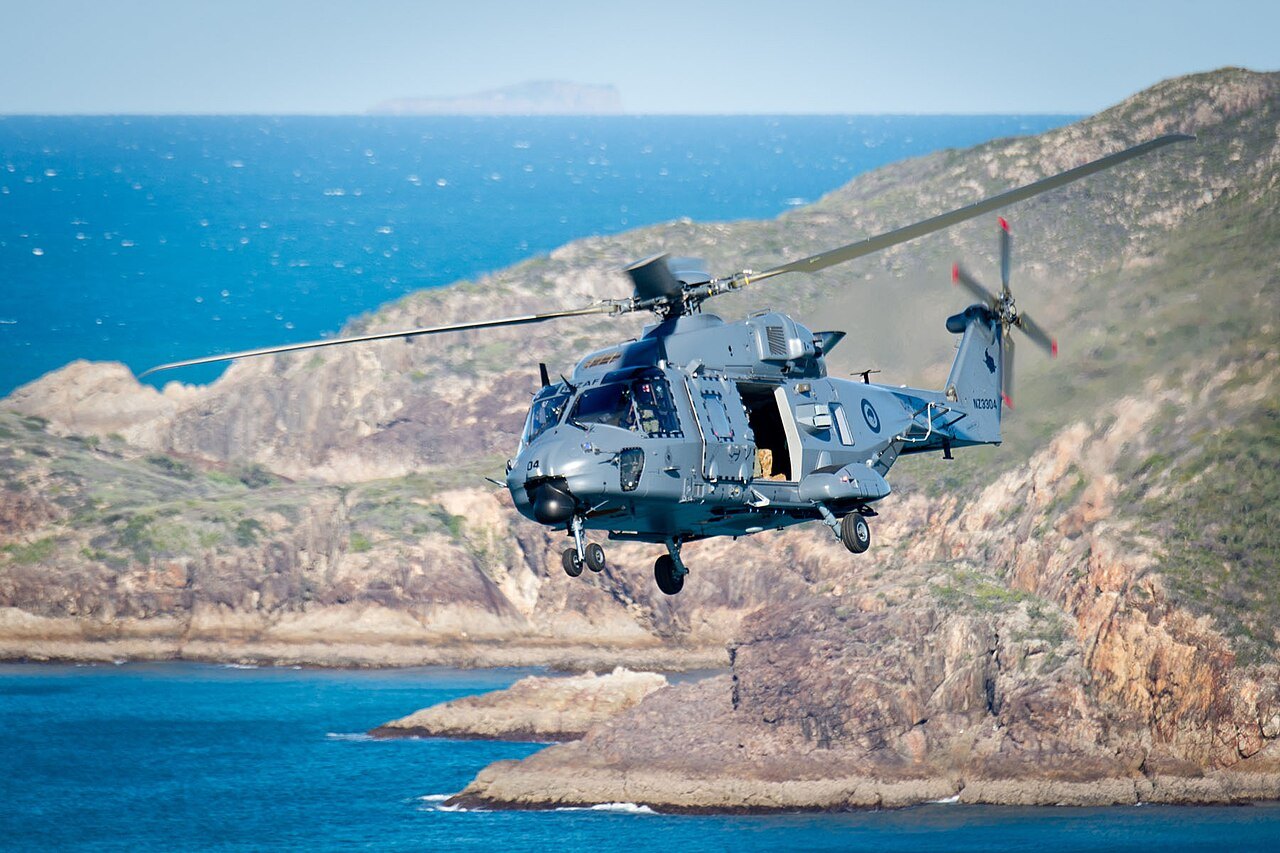
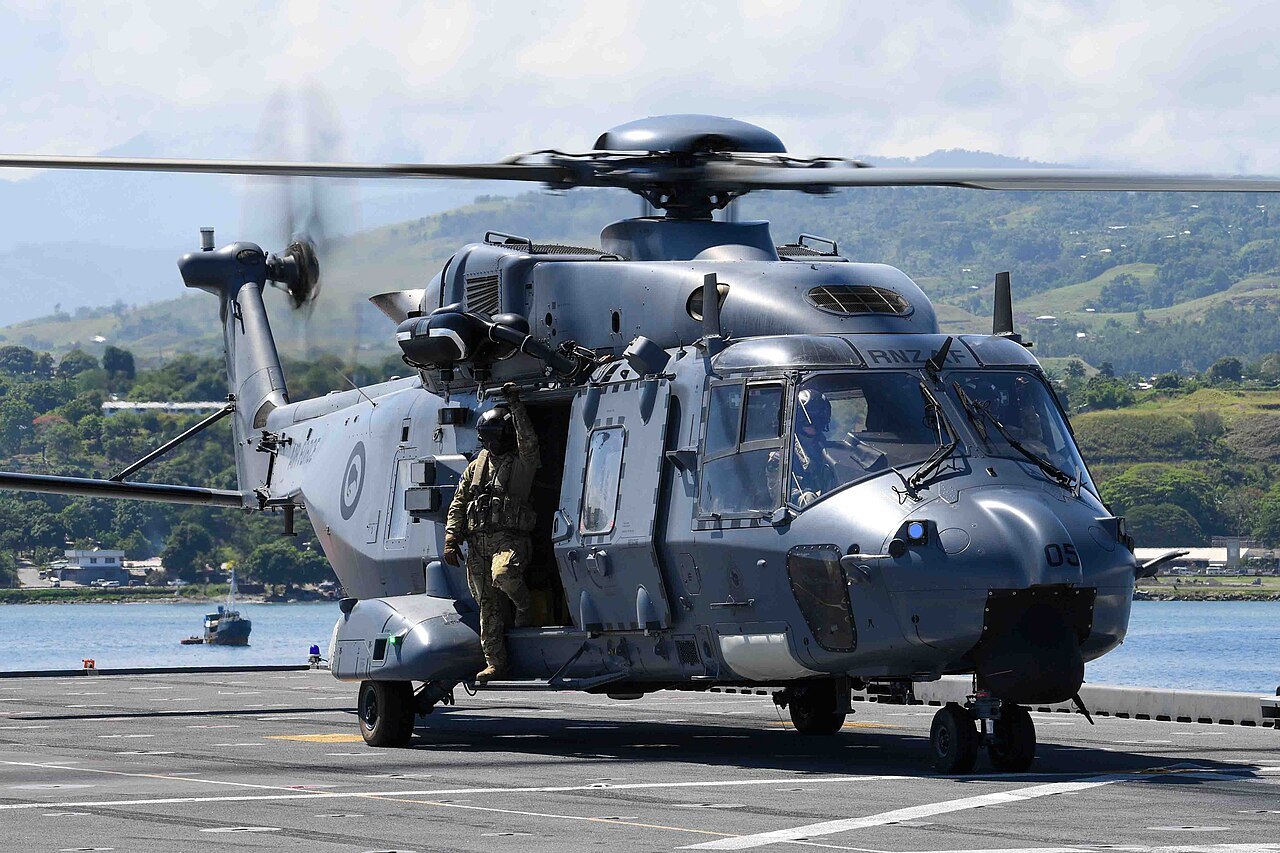
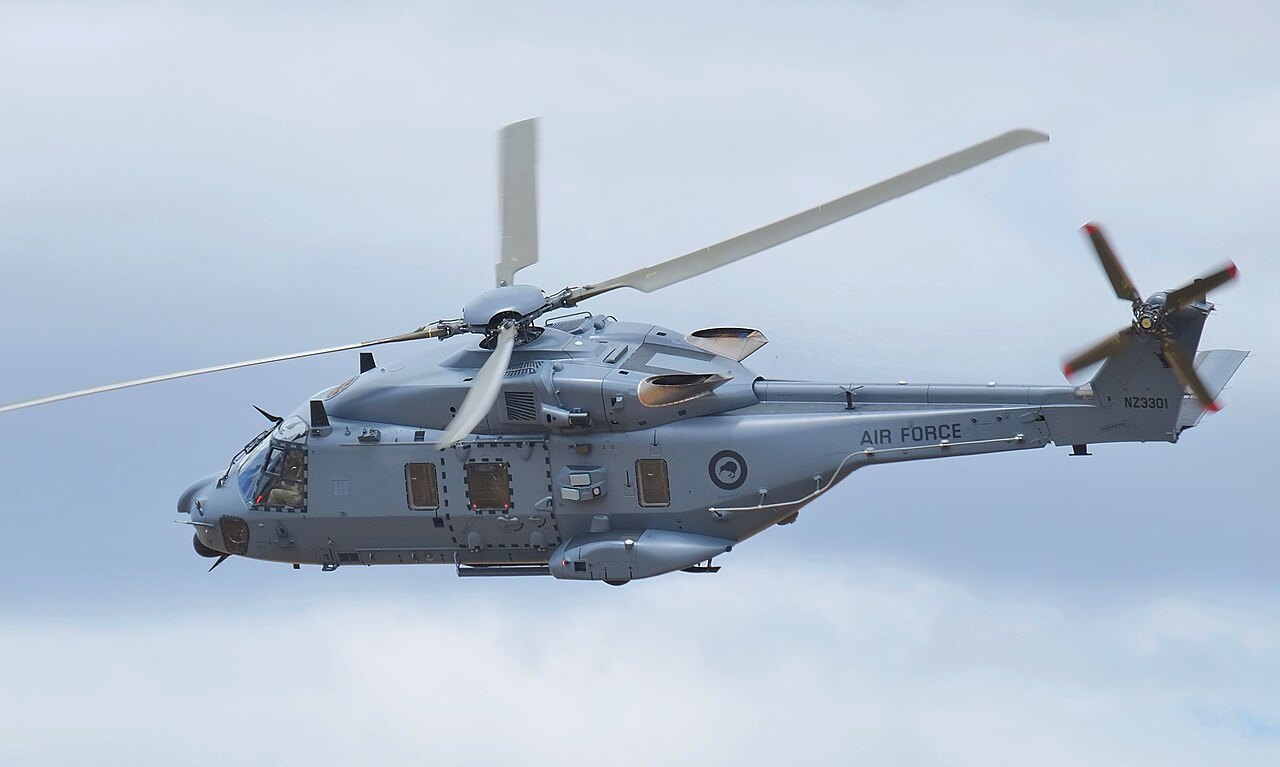
The naval NFH found its role at sea. The Royal Netherlands Navy, the first NFH customer, made the type’s first operational deployment in 2013 against pirates off Somalia. On the other side of the world, New Zealand’s eight NH90s became the programme’s quiet success: they flew 160 hours of relief missions in Fiji after Cyclone Winston in 2016, delivered aid after the Kaikōura earthquakes, and in November 2021 aircraft NZ3302 became the first NH90 anywhere to reach 2,000 flying hours.
What makes the NH90 special
Flown by wire
The NH90 was the first production helicopter with full fly-by-wire flight controls: a four-channel system that turns the pilot’s inputs into electrical signals, with no mechanical back-up after the prototype phase. A four-axis autopilot is integrated with it, along with the mission and navigation systems, which cuts workload when hovering over a pitching deck at night or flying in dust. The flight envelope covers all weather, day and night, high sea states and temperatures from −40 to +50 °C, up to 20,000 feet.
A composite airframe
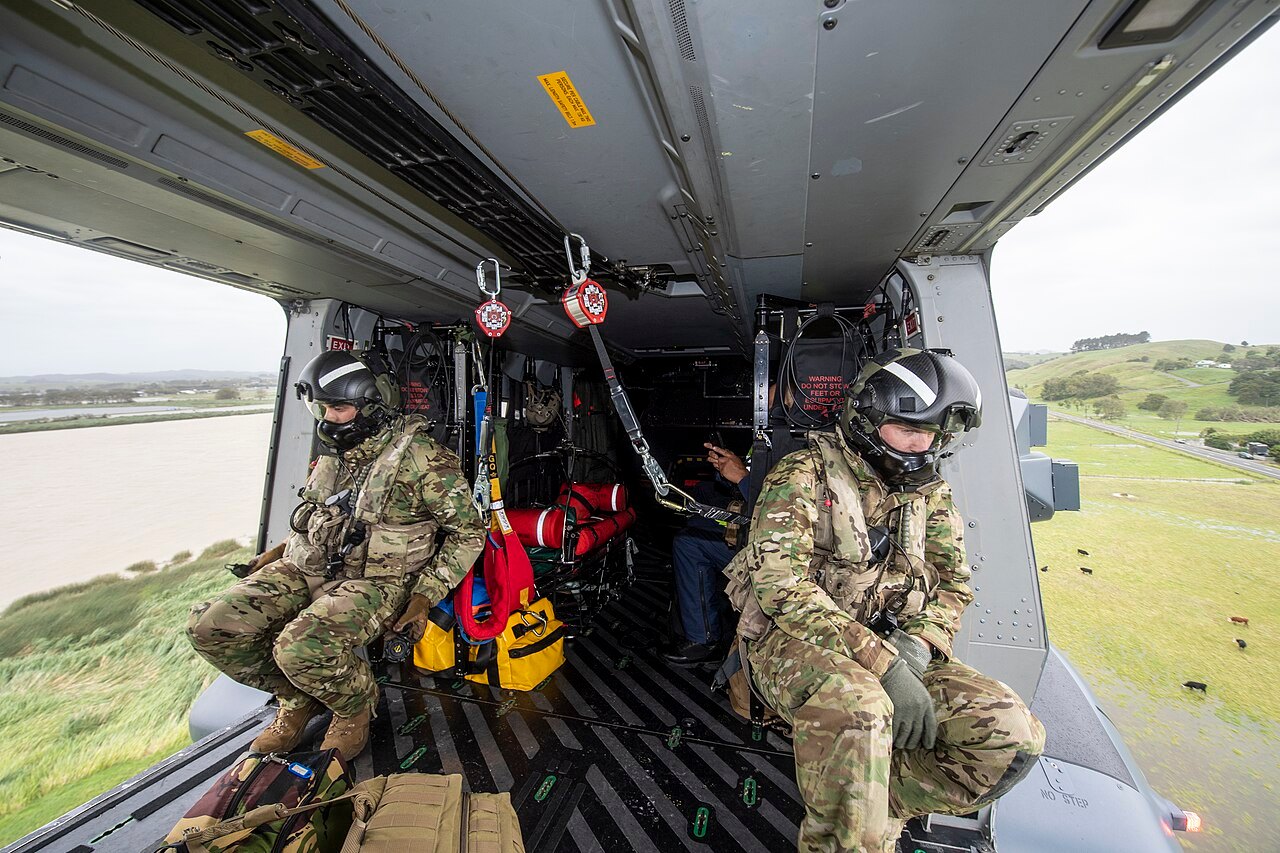
The fuselage is a diamond-shaped composite structure, designed for crashworthiness and ballistic tolerance, lighter than a metal equivalent and, according to Airbus Helicopters, giving the lowest radar signature in its class. The four composite main rotor blades resist fatigue and damage. Inside, the unobstructed cabin opens through big sliding doors and a rear ramp and takes modular role kits: troop seats, stretchers, armour panels, extra fuel, a rescue hoist or a light vehicle. The Swedish Hkp 14 raised the cabin by 24 cm to 1.82 m for medical work.
One name, two machines
The TTH and NFH share about three-quarters of their parts but do very different jobs. The NFH adds automatic rotor and tail folding, a harpoon deck-lock, a stronger undercarriage, radar, FLIR, dipping sonar and sonobuoy processing, and carries torpedoes such as the MU90 in French service. The TTH is built for assault transport, medevac and special operations, with door guns and, in Oman’s case, 20 mm gun pods. Customers then specified their own avionics, engines and kit, which produced flexibility but also more than 20 different variants.
03The NH90’s cockpit and sensors: glass, helmets and a laser collision warning
Thales supplies much of the NH90’s avionics on many versions: a glass cockpit with full-colour multifunction displays, tactical mission and encrypted communication systems, IFF and the TopOwl helmet-mounted sight and display. Other fits include forward-looking infrared, weather radar, a digital map generator, enhanced ground proximity warning and VHF/UHF/HF radios, all tied together on a MIL-STD-1553 databus with sensor fusion. In 2015 the NH90 became the first helicopter to receive a laser-based airborne obstacle and collision avoidance system. Exhaust gases pass through an infrared suppressor to reduce the heat signature.
Engines are a customer choice: the Rolls-Royce Turbomeca RTM322 or the General Electric CT7-8, which Italy and Spain chose. The 2024 Block 1 upgrade, also called Software Release 3, adds new software, data links, sensors and weapons, while the Standard 3 airframe, first delivered to Spain in December 2024, has stronger landing gear, an automatic folding main rotor and an 11-tonne maximum take-off weight.
NHIndustries NH90 specifications
Specifications
- Crew
- 2 pilots plus loadmaster or sensor operator
- Capacity
- 20 seated troops, or 12 stretchers, or 2 NATO pallets; 4,200 kg (9,260 lb) underslung
- Length
- 16.13 m (52 ft 11 in)
- Main rotor diameter
- 16.30 m (53 ft 6 in)
- Empty weight
- 6,400 kg (14,110 lb)
- Max take-off weight
- 10,600 kg (23,370 lb); 11,000 kg (24,250 lb) for Standard 3
- Powerplant
- 2 × RTM322 turboshafts, 1,802 kW (2,417 shp) each, or 2 × GE CT7-8E/F, 1,845 kW (2,474 shp) each
- Maximum speed
- 300 km/h (186 mph)
- Range
- 800 km (497 mi) TTH; 1,000 km (621 mi) NFH
- Endurance
- About 5 hours
- Service ceiling
- 6,000 m (19,690 ft)
- Climb rate
- 8 m/s (1,575 ft/min)
- Armament
- Door guns; 20 mm cannon and rocket pods (TTH); torpedoes and anti-ship missiles (NFH)
Costs & production
- Unit cost
- About €28.6 million per French Army TTH after discount (French Senate report, 2012); Germany’s 31 Sea Tigers cost €2.7 billion including spares and training (2020)
- Cost per flight hour
- Reported figures range from about €10,000–15,900 (Finland’s budget, 2017–2018) and €12,000 (Belgium, 2020) to A$30,000–50,000 (Australian estimates); Sweden’s 242,000 kronor figure included purchase and support costs spread over few hours
- Production
- More than 525 delivered by 2026, from assembly lines in France, Germany, Italy, Spain, Finland and Australia
- Programme
- Launched 1985; NAHEMA development contract 1992; first flight 18 December 1995; first deliveries 2006; Standard 3 from 2024
04The NH90’s variants: Caïman, Sea Lion, Sea Tiger and Taipan
- NH90 TTH: Tactical Transport Helicopter, the land version.
- NH90 NFH: NATO Frigate Helicopter with folding rotor and tail, sonar and weapons.
- Caïman: French Army TTH and French Navy NFH; the TTH Standard 2 (TFRA) is for special forces.
- Sea Lion: German Navy search-and-rescue and transport NFH, first flight 8 December 2016; 18 delivered.
- Sea Tiger: German Navy anti-submarine NFH, 31 ordered in 2020 to replace the Sea Lynx.
- UH-90A / MH-90A / SH-90A: Italian Army TTH, Italian Navy transport and Italian Navy NFH.
- HT-29 Caimán: Spanish Army TTH.
- Hkp 14E / 14F: Swedish high-cabin transport and naval versions, nine of each.
- MRH-90 Taipan: Australian Army and Navy version, withdrawn in 2023.
- MTT: Maritime Tactical Transport, a TTH with NFH folding and undercarriage.
05The NH90’s operating costs: why the numbers disagree
Few helicopters have had their running costs argued over as publicly as the NH90. Belgium said in 2020 that an NH90 hour cost about €12,000, more than double the €5,000 of the Sea Kings it replaced, and cut annual flying by 40 per cent. Finland budgeted €15,900 per hour in 2017 and €10,000 a year later. Australian parliamentary research put the Taipan at A$30,000 to 40,000 an hour, later about A$50,000, while New Zealand’s fleet, flown intensively on a simple maintenance contract, became the programme’s example of good availability.
Part of the spread is accounting: Sweden’s widely quoted figure folded purchase and support contracts into the hourly rate, so it rose as flying hours fell. The rest is real, the price of spares shortages, low availability and a fleet split into many national standards. The figure in the table is therefore given as a range of reported numbers, not a single official cost.
The NH90 from NATO requirement to Standard 3
Five-nation project
France, West Germany, Italy, the Netherlands and Britain agree to develop a NATO helicopter; Britain leaves in 1987.
Development contract
NHIndustries signs the design-and-development contract with NAHEMA on 1 September.
First flight
Prototype PT1 flies on 18 December.
Big order
The partner nations order 366 helicopters worth US$8.6 billion.
Wires only
PT3 becomes the first helicopter to fly with mechanical back-up controls removed.
First deliveries
The German Army receives its first production NH90 TTHs in December.
Afghanistan
Italian Army NH90s begin operations from Herat on 20 August.
Counter-piracy
Dutch NFHs fly the type’s first operational deployment, off Somalia.
Cyclone Winston
New Zealand NH90s fly 160 hours of relief missions in Fiji.
Norway walks away
Norway terminates its contract and withdraws the NH90 with immediate effect.
Taipan withdrawn
After two accidents, Australia retires its MRH-90 fleet in September.
Standard 3
Spain receives the first Standard 3 NH90 with an 11-tonne take-off weight.
Stories & eyewitnesses: the NH90 at war, at sea and in the headlines
Nineteen off the TK Bremen
One week into service, a French Caïman made a night rescue.
Read the full story
The Black Bumblebee of Herat
Italy’s UH-90As flew 1,000 hours in their first Afghan year.
Read the full story
Hunting pirates off Somalia
The Dutch Navy took the NFH on its first operational deployment.
Read the full story
Cyclone Winston and the busiest NH90s
New Zealand’s small fleet became the type’s best advertisement.
Read the full story
Four lost off the Whitsundays
A Taipan crashed at night during Exercise Talisman Sabre.
Read the full story
Ditching in Jervis Bay
Ten people walked away when a Taipan lost an engine.
Read the full story
Norway’s long wait
Ordered in 2001, returned to the maker in 2025.
Read the full story
The snapped winch line
French NH90s saved yachtsmen at the edge of the envelope.
Read the full story
Across the Coral Sea
Long-distance flights from Oman to Papua New Guinea.
Read the full story
Qatar’s €3 billion order
A late export win for a troubled programme.
Read the full story
The NH90 in pictures
Where the NH90 flies and flew
The NH90’s record
The NH90 has flown combat support in Afghanistan and Mali, counter-piracy patrols off Somalia and many rescues and relief missions, but its service record is as much about availability as action. Two fleets, Australia’s and Norway’s, were withdrawn early, and Australia lost four aircrew in 2023.
See how training and combat types compare in the military aircraft statistics database. Figures are approximate.
Everything people ask about the NH90
Can I fly in an NHIndustries NH90?
What is the difference between the NH90 TTH and NFH?
Why is the NH90 called fly-by-wire?
Why did Australia retire the MRH-90 Taipan?
How many NH90s have been built?
How many soldiers can an NH90 carry?
Who flies the NH90 today?
You can’t fly the NH90.
These, you can.
Most of this museum you can only look at. These genuine military jets you can fly yourself with MiGFlug — with aerobatics and time on the controls.
 Fly the L-39 AlbatrosThe world’s most-flown jet trainer — aerobatics included
 Fly the F-104 Starfighter“The missile with a man in it”
 Fly the MiG-21The Cold War’s most-produced jet
 Fly the T-33 Shooting StarAmerica’s first jet trainer
 Fly the DH VampireA piece of early jet history
 Fly the S.211Agile Italian jet trainer
 Fly the MB-326The classic Aermacchi jet
 Fly the MiG-15The Soviet legend of the Korean War
Continue the tour
Every fact, checked
- NHIndustries: NH90 Multimission HelicoptersManufacturer site: more than 525 deliveries, more than 460,000 flight hours, 18 operators
- Italian Army NH90 in Afghanistan: one year and 1000 flight hoursMILAVIA report on Task Unit Nemo at Herat, 2012–2013
- Germany cleared €2.7 Bn deal for 31 NH90 Sea Tiger ASW helicoptersNaval News on the Sea Tiger order and Sea Lion SAR role
- Qatar signs $3.7 billion deal for NH90 helicoptersDefense News on the 2018 Qatari order and consortium shares
- Sweden to axe NH90 fleet under revised defence equipment planFlightGlobal on Sweden’s 2022 decision and NHI’s response
- Taipan army helicopter crash: human remains and cockpit debris found after Queensland searchThe Guardian on the July 2023 Talisman Sabre crash and its crew
- Helicopter wreckage found after Taipan crash, search continues to locate four-person crewABC News on the crash near Lindeman Island
- NZ sticks with troubled NH90 helicopters as Australia and Norway opt for alternativesRNZ on New Zealand’s fleet availability and costs
- The Netherlands expands NH90 NFH fleet with 3 more helicoptersNaval News on the 2025 Dutch order and the 2013 Somalia deployment