
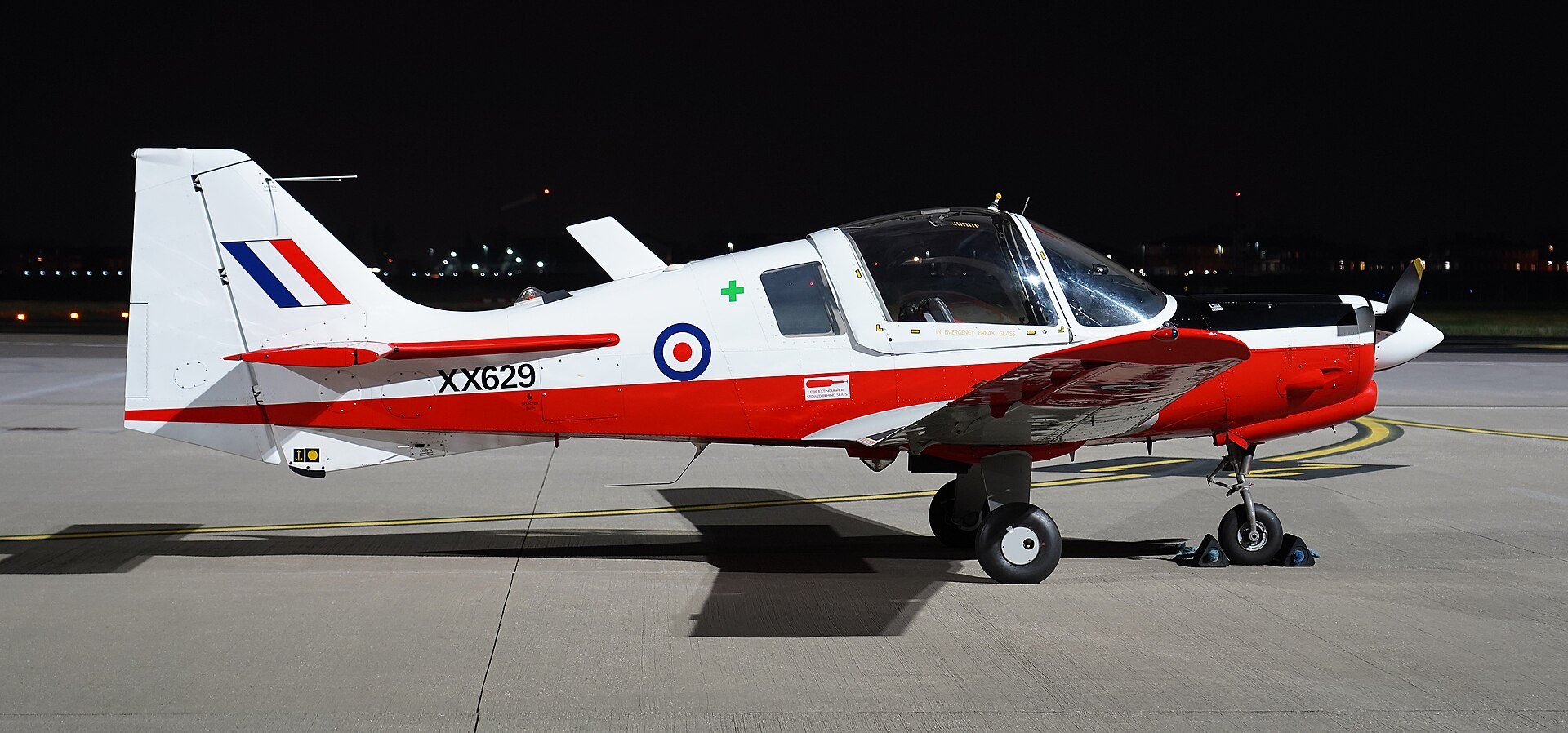
Scottish Aviation Bulldog
The Side-by-Side Trainer
Born at Shoreham and saved at Prestwick, the Bulldog taught a generation of RAF university cadets and Swedish, African and Asian air force students to fly, and hundreds still fly in private hands.
The Bulldog: how a bankrupt firm’s trainer became an RAF institution
On 19 May 1969 a stubby, low-winged two-seater lifted off from Shoreham on the Sussex coast. It was the Beagle B.125 Bulldog, a militarised, strengthened and more powerful development of the company’s civil B.121 Pup, with a 200 hp Lycoming in the nose, a sliding bubble canopy and seats for instructor and student side by side. Beagle had good reason for optimism: the Swedish air board had already ordered 78 for its air force and army. But the company, kept alive by government money, was running out of it. On 27 February 1970 Beagle ceased trading, and the Bulldog, with its orders, seemed likely to go down with it.
It was rescued in Scotland. Scottish Aviation, at Prestwick in Ayrshire, took over the design rights and the production line, and its first Bulldog flew on 14 February 1971. The Swedish aircraft were delivered by early 1973, and the Royal Air Force followed with an order for 130 Bulldog T.1s, the first of which, XX513, flew on 29 January 1972. From October 1973, when London University Air Squadron received its first aircraft, the Bulldog replaced the Chipmunk as the standard mount of the University Air Squadrons, and it served the Royal Navy’s Elementary Flying Training School and the Central Flying School as well. Export orders came from Kenya, Malaysia, Ghana, Nigeria, Jordan, Lebanon, Botswana and Hong Kong.
The Bulldog was never glamorous, and was never meant to be. It was strong, forgiving and fully aerobatic, cleared to +6 and −3 g, and its side-by-side seating let an instructor watch a student’s hands and eyes rather than the back of a helmet. For almost three decades it was the aircraft on which thousands of British undergraduates discovered whether they wanted to be military pilots. As the RAF ran down its fleet, retiring the type in 2001 in favour of the Grob Tutor, four went to the Armed Forces of Malta, which flew them on training and coastal patrols until 2013, many more were sold to private owners, and the Bulldog’s second life, at fly-ins, air races and air shows from Britain to New Zealand, began.
01The Bulldog’s rescue: from Beagle’s collapse to Prestwick
The Bulldog was conceived as an answer to a commercial problem. Beagle Aircraft, formed to give Britain a light-aircraft industry, had produced the B.121 Pup, a neat all-metal civil trainer. A military version, with a stronger structure, a 200 hp Lycoming IO-360, a better view and full aerobatic clearance, promised the export orders that civil sales had not delivered. That version was the B.125 Bulldog, and the prototype, G-AXEH, flew from Shoreham on 19 May 1969.
The Swedish order for 78 aircraft, placed in 1969, should have secured Beagle’s future. Instead the company collapsed on 27 February 1970, leaving a promising aircraft, a foreign customer and no factory. Scottish Aviation, best known for the Twin Pioneer and for its maintenance work at Prestwick, took over the project; BAE Systems’ heritage records give a total of 256 orders on the books when it did so. The first Prestwick-built Bulldog flew on 14 February 1971, and Scottish Aviation, later part of British Aerospace, went on to build the type until 1982.
By the common count about 320 production Bulldogs were completed, plus prototypes and the single four-seat Bulldog 200, marketed in civil form as the Bullfinch, giving totals of around 323 to 329 depending on what is included. The RAF’s 130 T.1s were the largest single batch; the rest went to nine export customers, with Sweden by far the biggest.
What makes the Bulldog special
Side-by-side seating
Most military trainers seat instructor and student in tandem, as they will sit in a fast jet. The Bulldog put them shoulder to shoulder. For an elementary trainer that was a deliberate advantage: the instructor could see exactly what the student was looking at, where the hands were going and how tense they were, and could point at an instrument rather than describe it over the intercom. Many University Air Squadron instructors valued the arrangement for teaching circuits, navigation and the first aerobatic sequences, and it made the Bulldog an easy aircraft in which to talk a nervous beginner through a first spin.
Built to be thrown around
The Bulldog was stressed to +6 g and −3 g and cleared for full aerobatics, with inverted flight limited to about 15 seconds by its fuel and oil systems. Its 200 hp fuel-injected Lycoming and constant-speed Hartzell propeller gave enough performance for loops, rolls, stall turns and spins without demanding much of a student’s engine handling. Its tricycle undercarriage also made it easier to handle on the ground and on landing than the tailwheel Chipmunk it replaced, letting more of a student’s early hours go into flying skills.
A trainer that could carry weapons
Although the RAF never armed its Bulldogs, the airframe was designed with four underwing hardpoints. Company demonstrators trialled machine-gun pods and stores, and a bomb load of up to about 290 kg (640 lb) was offered. Sweden fitted six of its aircraft, designated Sk 61B, to carry wire-guided Bantam anti-tank missiles (Rb 53) for training, and the six Model 1210 aircraft for Botswana were delivered with hardpoints for light-attack work. For small air forces with limited budgets, a trainer that could double as an armed patrol aircraft was a real selling point.
02The Bulldog’s cockpit and systems: simple by design
The Bulldog was a conventional all-metal low-wing monoplane with a fixed tricycle undercarriage, a sliding canopy that gave a good all-round view, and a Lycoming IO-360-A1B6 four-cylinder flat engine of 200 hp driving a two-bladed Hartzell constant-speed propeller. The wing used a NACA 63-series laminar-flow section and carried electrically operated flaps.
In the cockpit, instructor and student sat side by side with dual controls, the student normally on the left. The Swedish Model 101 could be fitted with an optional third seat behind the two pilots, useful for liaison and the army’s artillery-spotting role. The instrument fit was conventional for the period. In Sweden, some surplus aircraft received new avionics as the Sk 61D and Sk 61E for civil commercial-pilot training before the type left service.
The engineering choices were cautious rather than clever, and that was the point. A fuel-injected Lycoming was familiar to every general-aviation engineer, the structure was robust enough to survive student landings and occasional overstressing, and spares remain available today, which is one reason so many Bulldogs are still flying.
Scottish Aviation Bulldog specifications
Specifications
- Crew
- 2 (side by side), optional third seat in some versions
- Length
- 7.09 m (23 ft 3 in)
- Wingspan
- 10.06–10.11 m (33 ft 0–2 in), sources differ
- Wing area
- 12.02 m² (129.4 sq ft)
- Empty weight
- about 645–669 kg (1,430–1,475 lb)
- Max take-off weight
- 1,066 kg (2,350 lb)
- Powerplant
- 1 × Lycoming IO-360-A1B6 flat-four, 150 kW (200 hp), two-bladed Hartzell constant-speed propeller
- Maximum speed
- 241 km/h (150 mph, 130 kt)
- Cruise speed
- about 190–225 km/h (120–140 mph)
- Never-exceed speed
- 343 km/h (213 mph, 185 kt)
- Range
- about 1,000 km (620 mi), no reserves
- Service ceiling
- about 4,880 m (16,000 ft)
- Climb rate
- 5.25 m/s (1,034 ft/min)
- g limits
- +6 / −3 g; inverted flight limited to about 15 seconds
- Armament
- None in RAF service; four optional underwing hardpoints for up to about 290 kg (640 lb) of stores on export aircraft
Costs & production
- Unit cost
- No reliable new-build price published; in 2000 the Armed Forces of Malta paid £25,000 each for ex-RAF Bulldog T.1s
- Cost per flight hour
- Hedged estimate: roughly £200–350 (about US$250–450) for a privately operated example today, based on a 200 hp Lycoming burning on the order of 35–40 litres of avgas an hour plus maintenance and an engine overhaul reserve; figures vary widely
- Production
- About 320 production aircraft plus prototypes, 1969–1982 (totals of 323 to 329 are quoted)
- Programme
- Beagle B.125 first flight 1969; Scottish Aviation production from 1971; RAF service 1973–2001
03The Bulldog’s variants: from Model 101 to Bullfinch
- B.125 Bulldog Series 1: Beagle prototypes, first flight 19 May 1969.
- Model 101: Swedish aircraft, 78 built, designated Sk 61A and Sk 61B (air force) and Fpl 61C (army).
- Model 102: Royal Malaysian Air Force, 15 built.
- Models 103 and 127: Kenya Air Force.
- Models 122 and 122A: Ghana Air Force.
- Model 123: Nigerian Air Force, the largest export customer after Sweden.
- Models 125 and 125A: Royal Jordanian Air Force, 22 built.
- Model 126: Lebanese Air Force, 6 built.
- Model 128: Royal Hong Kong Auxiliary Air Force, 2 built.
- Model 129: a single civil aircraft for Venezuela.
- Model 1210: Botswana Defence Force, 6 built with underwing hardpoints.
- Bulldog T.1 (Series 120): Royal Air Force, 130 built.
- Bulldog 200 / Bullfinch: four-seat version with retractable undercarriage; one prototype only.
04The Bulldog’s operating costs: a cheap way into aerobatics
For an air force the Bulldog was an economical trainer: a single 200 hp piston engine, a fixed undercarriage and simple systems kept fuel and maintenance costs low compared with turboprop or jet trainers. Sweden flew students for about 40 hours on the Sk 61 before they moved to the Sk 60 jet, and the RAF used it for the grading and elementary phases where hours are many and mistakes are frequent.
In private hands today the Bulldog is one of the cheaper ex-military aerobatic aircraft to run. MiGFlug’s estimate of roughly £200–350 an hour is not an official figure: it is based on fuel burn on the order of 35–40 litres of avgas an hour plus routine maintenance, insurance and an engine overhaul reserve, and actual costs vary with hangarage, utilisation and the condition of the airframe. Purchase prices of ex-military examples have been low by warbird standards; Malta paid £25,000 per aircraft for its ex-RAF T.1s in 2000.
The Bulldog from Shoreham to retirement
First flight and Swedish order
The Beagle B.125 prototype flies at Shoreham on 19 May; Sweden orders 78 for its air force and army.
Beagle collapses
Beagle ceases trading on 27 February; Scottish Aviation at Prestwick takes over the design and the orders.
First Prestwick Bulldog
Scottish Aviation’s first Bulldog flies on 14 February, and Swedish service begins.
The RAF’s first T.1
Bulldog T.1 XX513 flies on 29 January, the first of 130 for the RAF.
University Air Squadrons
London University Air Squadron receives its first Bulldog in October, beginning the replacement of the Chipmunk.
Bulldog 200 announced
The four-seat, retractable-gear Bulldog 200 is shown at Farnborough; only one prototype is built.
First fatal RAF accident
XX530 crashes on Bilsdale Moor on 21 September, the first RAF Bulldog loss after more than 150,000 flying hours.
Production ends
The last Bulldogs leave the line, now part of British Aerospace.
Sweden goes all-jet
Swedish student pilots begin training directly on the Sk 60 jet, ending the Sk 61’s basic-training role.
Malta and New Zealand
Malta buys four ex-RAF T.1s for coastal patrol and training as RAF aircraft begin moving to civil owners.
RAF retirement
The RAF retires the Bulldog in favour of the Grob Tutor; Swedish service also ends.
Last military flights in Malta
The Armed Forces of Malta ground their Bulldogs on 23 October.
Stories & eyewitnesses: the Bulldog in service
The aircraft that outlived its maker
Beagle went bust months after the Bulldog’s first flight, with a Swedish order on its books.
Read the full story
Forty hours at Ljungbyhed
Swedish student pilots flew the Sk 61 before stepping into their first jet.
Read the full story
A trainer with anti-tank missiles
Six Swedish Bulldogs were wired for Bantam missiles.
Read the full story
Spotting for the Swedish artillery
The Swedish Army bought 20 Bulldogs for liaison and fire direction.
Read the full story
Bilsdale Moor, September 1978
The first fatal RAF Bulldog accident came after more than 150,000 flying hours.
Read the full story
Engine failure at Newtownards
A Queen’s University Air Squadron instructor was killed in 1992.
Read the full story
A University Air Squadron racer
Bristol UAS’s XX654 flew in the King’s Cup.
Read the full story
Malta’s coastal patrollers
Four ex-RAF Bulldogs became the Armed Forces of Malta’s trainers and patrol aircraft.
Read the full story
XX637, the travelling exhibit
An overstressed Bulldog found a second career on the ground.
Read the full story
A second life in civil hands
Retired Bulldogs now fly from Hungary to New Zealand.
Read the full story
The Bulldog in pictures
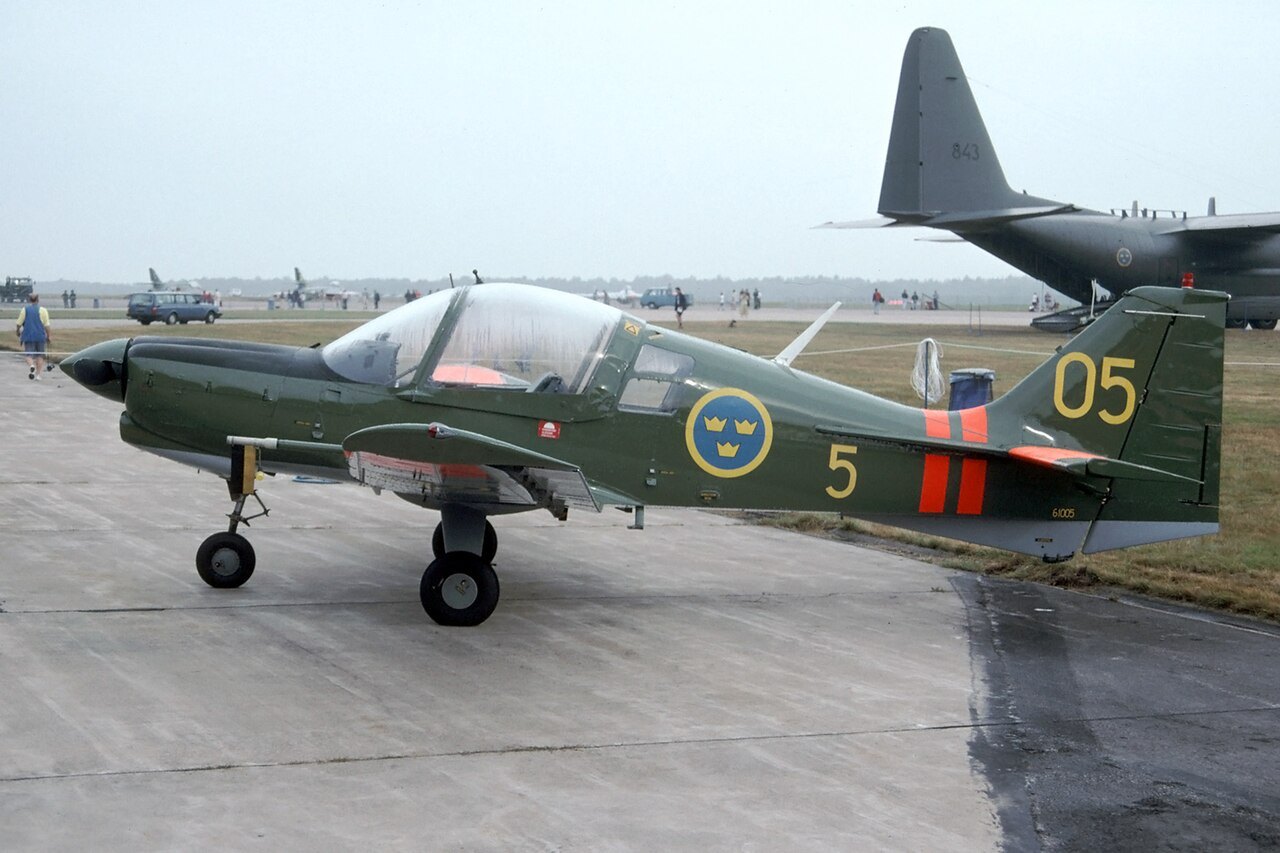
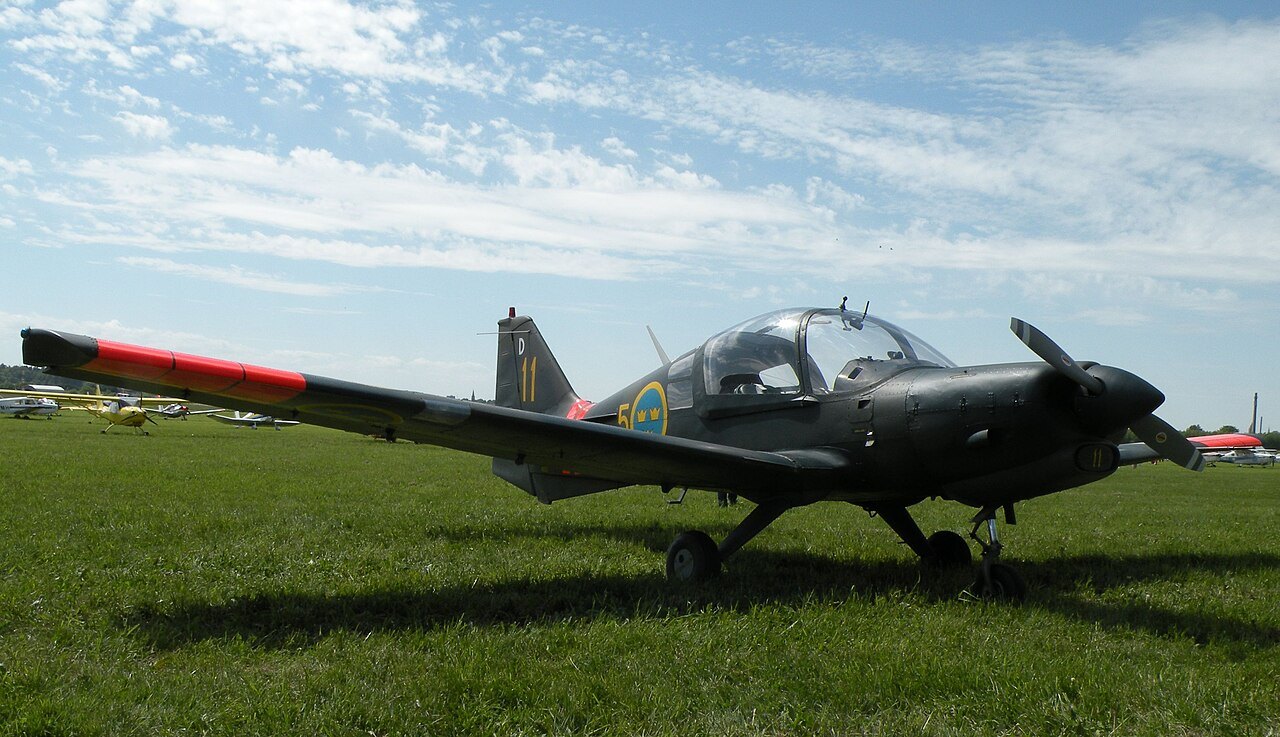
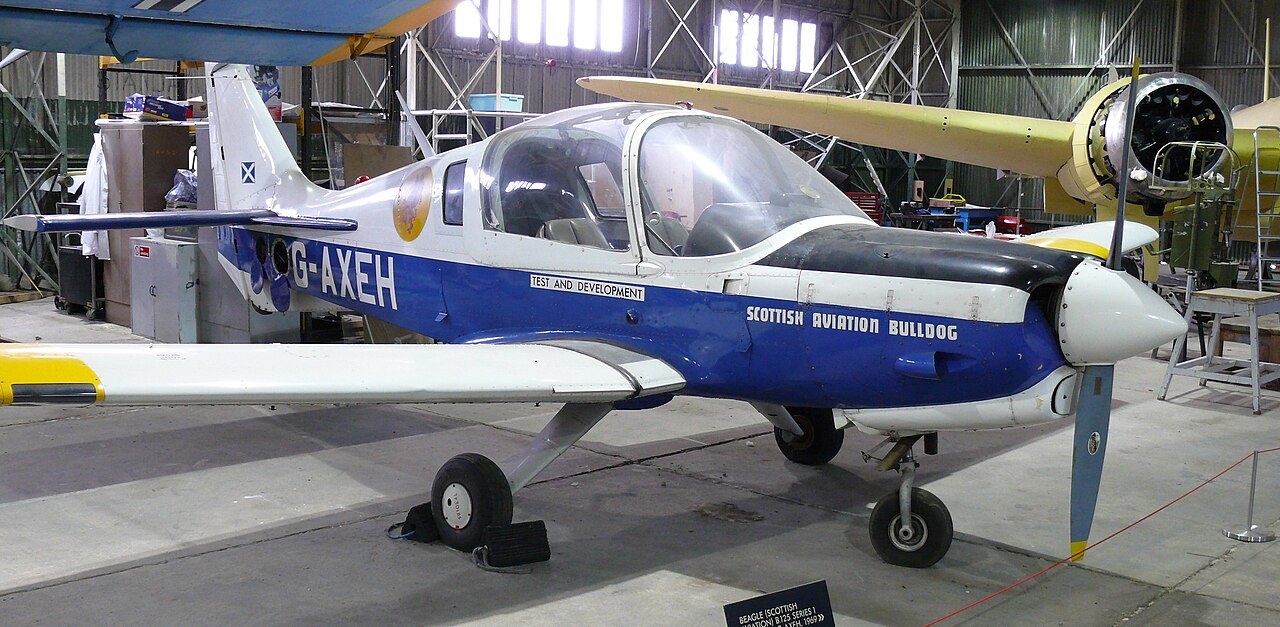
Where the Bulldog flies and flew
The Bulldog’s record
The Bulldog never saw combat. Its record is a training one: almost three decades as the RAF’s University Air Squadron and elementary trainer, basic training in Sweden, Africa, the Middle East and Asia, and a handful of armed variants that were offered for light attack but, as far as published sources show, never used in anger.
See how training and combat types compare in the military aircraft statistics database. Figures are approximate.
Everything people ask about the Bulldog
Can I fly in a Scottish Aviation Bulldog?
Who designed the Bulldog?
How many Bulldogs were built?
Why do Bulldog pilots sit side by side?
When did the RAF retire the Bulldog?
Was the Bulldog ever armed?
Is the Bulldog related to the Bristol Bulldog?
You can’t fly the Bulldog.
These, you can.
Most of this museum you can only look at. These genuine military jets you can fly yourself with MiGFlug — with aerobatics and time on the controls.
 Fly the L-39 AlbatrosThe world’s most-flown jet trainer — aerobatics included
 Fly the F-104 Starfighter“The missile with a man in it”
 Fly the MiG-21The Cold War’s most-produced jet
 Fly the T-33 Shooting StarAmerica’s first jet trainer
 Fly the DH VampireA piece of early jet history
 Fly the S.211Agile Italian jet trainer
 Fly the MB-326The classic Aermacchi jet
 Fly the MiG-15The Soviet legend of the Korean War
Continue the tour
Every fact, checked
- Scottish Aviation BulldogBAE Systems Heritage: Beagle origins, collapse date, Prestwick first flight, production totals
- Scottish Aviation BulldogTimeline, first RAF T.1, London UAS deliveries, export orders and civil survivors
- SK 61 Scottish Aviation Bulldog (1970-2001)Swedish air force and army service, Sk 61B Bantam missiles, training syllabus
- Bulldog T.Mk.1 XX654 individual historyRAF Museum: Bristol UAS service, air racing, hours and preservation
- History of the UAS Bulldog T.1 XX637Ulster Aviation Society: airframe history and memorial markings
- From Sky to Museum: The Legacy of Malta Air Wing BulldogsMalta Aviation Museum: purchase, roles, incidents and grounding
- Bulldog XX530, Bilsdale MoorYorkshire-aircraft.co.uk: the first fatal RAF Bulldog accident, 1978
- Accident Scottish Aviation Bulldog T1 XX613, 16 October 1992Aviation Safety Network record of the Queen’s UAS accident
- Scottish Aviation Bulldog T.1Royal International Air Tattoo 2025: privately operated survivors